The 2018 Bulfinch winners

Screen Shot 2018-03-26 at 12.20.04 PM.png

Yale’s new residential colleges, by Robert Stern Architects. (Peter Aaron/OTTO)

Winners of the eighth annual Charles Bulfinch awards include the new residential colleges at Yale designed by Robert Stern Architects. That is the most significant project of classical architecture in America in recent years, and possibly for years to come. Those of us who love to immerse ourselves in classical architecture are lucky it is in New England, or it would not have been eligible, let alone so easy to visit.

People who view the Benjamin Franklin and Pauli Murray colleges, which placed first in the “institutional” category, will better understand the allure of new classical architecture – that is, assuming visitors to the new college do not confuse them with, shall we say, “pre-existing” classical architecture. So one of the vital purposes of the Bulfinches is to let people know that certain winning structures are recently built.

“It is not good because it is old, it is old because it is good.” Someday that will be true of these two new Yale Colleges.

My apologies for lingering on just a single Bulfinch laureate. To see the rest – and they are very, very good – click on the announcement of the winners in the Boston Design Guide. Sandy Giardi’s summary comments (with pix, of course) are interesting. So you don’t have to lift your finger to click on the BDG link in order to see the winning projects, here is a list, with pix:

***

LeBlanc Jones Landscape Architects, Inc. – “John L. Gardner Estate” – Landscape Architecture

Screen Shot 2018-03-26 at 12.25.42 PM.png

***

Dell Mitchell Architects – “Brick House” – Residential Restoration, Renovation or Addition

Screen Shot 2018-03-26 at 12.26.16 PM.png

***

Carpenter & MacNeille – “Oakledge” – Residential New Construction over 5,000 square feet

Screen Shot 2018-03-26 at 12.26.45 PM.png

***

Campbell/Smith Architects – “Norton St. Home” – Residential New Construction under 5,000 square feet

Screen Shot 2018-03-26 at 12.27.26 PM.png

***

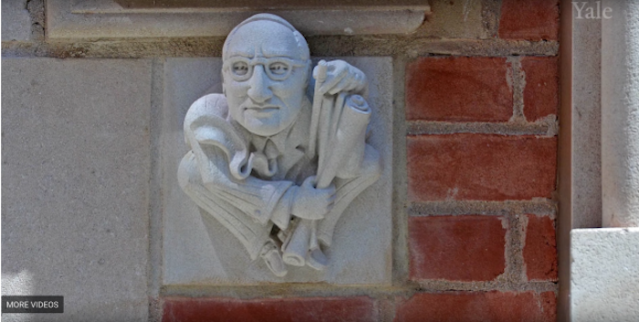
Robert A.M. Stern Architects LLP – “Benjamin Franklin College and Pauli Murray College, Yale University” – Institutional
Screen Shot 2018-03-26 at 12.58.23 PM.png

***

Carpenter & MacNeille Woodworking – “Nantucket Bunk Room” – Craftsmanship/Artisanship

Screen Shot 2018-03-26 at 12.27.53 PM.png

***

G. P. Schafer Architect – “Alterations for House by the Sea” – Interior Design

Screen Shot 2018-03-26 at 12.28.27 PM.png

***

Ronald Lee Fleming – Patron

newportri.com.png

The award for Patronage is chosen annually by the board of the ICAA New England Chapter from recommendations, also by the board, of individuals who have devoted themselves to the mission of appreciating and reviving classical architecture and its allied arts in New England. Ronald Lee Fleming, of Newport, is a noted urban planner and philanthropist whose “cottage” on Bellevue Avenue features a “backyard” filled with delightful follies – nominally useless features of mostly classical architecture, useful, however, for enlivening the spirit – among which the board and other guests have been pleased to stroll in the past.

***

This year’s jury for the other awards was composed of Marc Appleton, Thomas Pheasant and Greg Tankersley. The laureates will be celebrated on Saturday, April 28, at a gala in the Harvard Club of Boston, at 374 Commonwealth Ave., Boston. Reception begins at 6 p.m. For information on reservations for the gala and two lectures to be delivered in association with the awards program, please visit the Bulfinch Page of the chapter website.


Screen Shot 2018-03-26 at 1.21.02 PM.png

Posted in Architecture | Tagged , , , , , , , , , , , | 1 Comment

Fane tower versus beauty

Screen Shot 2018-03-25 at 3.46.19 PM.png

Providence River looking north from Point Street Bridge. (gregdubois.com)

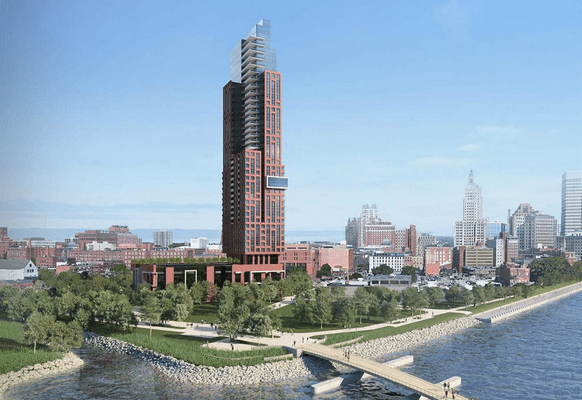
Charles Denby is a Barrington doctor who has allied himself with the push for more art and sculpture in Providence. He doesn’t see why Providence should not have some major iconic work of art such as The Little Mermaid in Copenhagen.

But Denby considers the skyscraper proposed by Jason Fane as more eyesore than icon. He has penned a statement against Fane’s 46-story tower from an aesthetic point of view. He does not think the City Council should let it rise three times higher than zoning allows. Here is his statement, which was published as a letter to the editor in today’s Providence Sunday Journal:

The cities of Amsterdam and Paris – to highlight only two of many examples – are admirably self-aware. They are aware that people love to stroll along the canals and  the Seine. They are careful not to disrupt the sense of openness, the lightness of being that derives from proximity to these watercourses. They abide by an aesthetic which is both implicit and established by tradition, and limit the height of buildings near these waterfronts.
.
Hence, I pose the question: Does anybody seriously believe that a 46-story tower would pass review if a developer proposed to build it along the canals or the Seine? I suggest that the authorities in Amsterdam or Paris would simply have a good laugh over that one, dismissing it as obviously absurd, as patently ruinous to the appearance and the appeal of their city.
.
And ruinous it will be if Jason Fane succeeds in erecting his out-of-scale, out-of-place, aesthetically incompatible 46-story monstrosity on the western bank of the Providence River. To boot, in Amsterdam and Paris and in the many other cities around the world more skilled in the art of crafting pleasing urban settings, they will be laughing at us.
.
Denby kindly and logically imagines that because the canals of Amsterdam and the embankments of the River Seine are beautiful today, civic leaders there can be trusted to continue to protect the beauty of their waterfronts. That may be so in Amsterdam. In Paris, whether height limits protect the Seine directly or not, Mayor Hidalgo has embarked on a program to uglify the City of Light, not just by introducing skyscrapers within the city’s boundaries but also by dumbing down the ornamental features of benches, kiosks and other street furniture that heretofore has been designed to augment the city’s beauty.
.
That’s too bad, of course, and hopefully she will be voted out before too much damage is done. Still, her desire to rape Paris does not undercut but only strengthen’s the validity of the sentiments expressed by Charles Denby about the obnoxious Fane tower proposal, which is way too tall and, regardless of its height, is architecturally incompatible with the city’s historical character.
.
Of course, the Fane Tower is just one of many affronts arising along the Providence waterfront. These include a proposed hotel on the east side of the river, and on the west side of it the Wexford complex, whose steel frame is nearing completion, as are the frames of the two Brown dormitories that will block views of the beautiful 1912 power plant at South Street Landing, as the hideous garage recently completed blocks views of it from the north.
.
Providence civic leaders are clearly uninterested in protecting the beauty of Providence, either along the river or anywhere else.
.
We have yet to see a rendering of Fane’s latest version, the “white tower with sculptured curves.” The Fane project might be blocked, however, because City Council will soon vote on whether to exempt its 470-foot height from a zoning limit of 130 feet. It has already received permission from the state to shrink the abutting park. The City Council, however, is filled with honorable men and women who may be expected to vote for the public interest, not that of a developer who has ridiculed the city for its many historic districts.
.
Well, we are allowed to hope, are we not? “Hope” is Rhode Island’s motto.
.
Screen Shot 2018-03-25 at 3.58.29 PM.png

Hope Point Tower, proposed by the Fane Organization. (Fane)

Posted in Architecture, Development | Tagged , , , , , , , , , | 7 Comments

Roman Forum, live, at night

Screen Shot 2018-03-23 at 5.53.13 PM.png

Rendering of Roman Forum at night after reconstruction someday. (Gilbert Gorski)

Above is how the Roman Forum might look at night today if it had never degenerated into ruins since the empire, or if it had been reconstructed as it was at the apogee of its ancient fame. The work, by Gilbert Gorski, was given to Léon Krier as consolation for the rejection, by Gorski’s publisher, of Krier’s introduction to The Roman Forum: A Reconstruction and Architectural Guide, by Gorski and James Packer. (Krier’s essay was posted in its entirety in “Krier: Ruins and discontents.”)

Screen Shot 2018-03-23 at 5.54.09 PM.png

The inspiration for Gorski’s rendering comes from the last line of Krier’s introduction: “To ensure maximum effect, I recommend the reader to imagine the figurants sporting contemporary clothing and steering modern vehicles.”

Clayton Fulkerson, a builder of classical models who lives in Warwick, Rhode Island, and who tends to object to the reconstruction of ruins unless they are substantially intact already, sent me the following description and photos of Cinecittá, a series of movie sets for films set in ancient Rome:

Cinecittá is a huge studio complex on the outskirts of Rome. It was conceived as part of Mussolini’s plan to revive the Italian economy. Films such as Ben Hur (the good one), Cleopatra and, more recently, Gangs of New York and the Rome series by HBO were shot there. Virtually all of Fellini’s and Zeffirelli’s films were also.
.
The tour took us to only part of the vast Rome set. HBO spared no expense and had to abort the series because of its huge cost. No stone was used in the set’s construction. It’s all a fantastic fiberglass façade mounted on steel framing. You would swear it’s all the real deal, as the Italians are devilishly good at this kind of thing. The “stones” paving the streets are cast from concrete using only five molds. The pieces are arranged in such a way that you’d never know the economies involved. When production ceases, the sets become the property of the studio, which has the right to rent them to other production companies.
.
Screen Shot 2018-03-23 at 6.01.14 PM.png
.
Screen Shot 2018-03-23 at 6.01.31 PM.png
Posted in Architecture | Tagged , , , , , , , | 3 Comments

Krier: Ruins and discontents

Screen Shot 2018-03-22 at 7.58.31 PM.png

The New Rostrum, Milliarium aureum, the Basilica Julia, the temple of Saturn, the temple of Vespasian and Titus, Via Sacra, the arch of Septimius Severus, the Mundus, the temple of Concord, the Tabularium, the temple of Jupiter.
(Giuseppe Becchetti. 1893. Gallery of Ancient Art)

Since we are still on our reconstruction roll, here is an excellent essay by Leon Krier, architectural theorist and master planner of Prince Charles’s new town of Poundbury. It was originally intended as an introduction to The Roman Forum: A Reconstruction and Architectural Guide, by Gilbert Gorski and James Packer, a massive and copiously illustrated book on the Forum. In his essay, Krier expands perceptively upon the experience of ruins causing disappointment – as noted in my recent post “Rebuild the Roman Forum.” Here is Krier’s essay in its entirety:

***

The Future of Archaeological Reconstruction

by Leon Krier

The Roman Republican Forum was one of the finest architectural and urban ensembles ever realized under the sun. Its reputation had so well survived its near total destruction that it remains to this day one of the most sought after places on earth; clearly not for what it has become, but for what it once was, not for what eyes can perceive there, but for what has disappeared from sight.

Ever since its devastation, cognoscenti and dilettanti have tried to recreate “the glory that was Rome” in measured drawings, models, paintings, all culminating in the 1930s in the creation of the Museum of Roman Civilization and Gismondi’s glorious plaster model of Imperial Rome.

Despite the formidable quantity of intelligence existing on the subject, what is missing on site is generally very unsatisfactorily evoked by guides and guidebooks, by flat words and even flatter images. The information perceived by visitors forlornly wandering amongst the ruins of the Campo Vacchino is on the whole probably even poorer than what they may remember from schoolbooks and pulp-fiction.

With the exception of having discovered once, by myself and by pure chance, a large Roman ruin in a remote pastoral landscape, I never felt established archaeological sites provoking anything but disappointed expectations. I always wondered if I, an unconditional aficionado, could get so little out of celebrated ruin-sites, what must be the state of mind of those who pay for visiting scattered remains they can’t shape back into any intelligible form. It is this feeling of frustration what, through the ages, has spurred archaeological reconstructions, i.e., retrieving in some palpable form something of great relevance not just for our forebears but for us, today.

What is it that is being so assiduously sought on archaeological sites? The question is why is that which is so keenly looked for, namely the buildings, the public spaces, the sculptures, urban furnishings and adornments, so poorly provided by archaeological sites, however well managed or manicured. Why are ruins and fragments supposed to be better vehicles for transmitting “history” than the walls and roofs themselves, the rooms, spaces, platforms and pavings, which once made the physical environment where it all happened.

Notions of conservation, reconstruction and restoration are as old as those of architecture itself. In traditional architectures there is indeed no conflict between principles of building and conservation, of maintenance and reconstruction. These conflicts only arise with the advent of “new” building materials. As a consequence, and quite unjustifiably, synthetic materials are held to be more modern than natural materials. In the ensuing ideological confusion, the technology of building with natural materials has been erroneously declared to be “historical,” dated and hence no longer of technological relevance. This historicist error is at long last being identified and corrected.

The physical and graphical reconstructions of a Valadier, Viollet-le-Duc, Evans, Thompson, Becchetti, Krischen are no longer being decried as unscientific by current archaeological science. They are being instead considered as policy models for the planning of archaeological sites. The recently completed restoration of the Maison Carrée in Nîmes and the reconstruction of the Liebfrauen Kirche in Dresden bear shining testimony to a new attitude, putting to shame the bad surgeries practiced for decades on historic buildings in the name of “modernity” and the Charter of Venice.

  • The refusal to reconstruct ruined historical buildings in their technical and material integrity
  • The sacralisation of ruins,
  • The restoration of ruins as ruins,
  • The building of costly and often purposely jarring protective devices over them,
  • The proliferation of bizarre visitors and interpretation centers,
  • The compulsive collecting, cataloguing and preserving of millions of “historical” bits and pieces, for half a century, without a policy of completing, repairing or recreating them.

All these “ideological fakes” are fast losing legitimacy. For the archaeologist, métier is undergoing a radical renewal as an artistic rather than a bureaucratic endeavor.

The formidable works of reconstruction undertaken by James E. Packer and Gilbert Gorski are the magnificent peaks of a new approach to archeology. Digital techniques are not only changing representation, achieving undreamed levels of definition in whole and detail, but are re-professionalizing archaeological investigation after decades of waste and decay. As a result, great architectural ruins need no longer just be seen as historical relics to be pampered as casualties of bygone ages, but as parts of puzzles to be recomposed in their corporal integrity, be it on paper, on screen and ultimately in situ.

It is a legitimate hope that these wonderful prospects will not merely be seen as evocations of a long gone architectural and urban past but received as inspiring visions, instrumental in leading one day soon to the actual resurrection of the Roman Forum in its former splendor. To ensure maximum effect, I recommend the reader to imagine the figurants sporting contemporary clothing and steering modern vehicles.

Posted in Architecture, Preservation | Tagged , , , , , , | 3 Comments

Zoo’s next stop: Houston

Screen Shot 2018-03-21 at 9.28.46 AM.png

Faces of the Amazon Building, under construction at Roger Williams Park Zoo. (RWP)

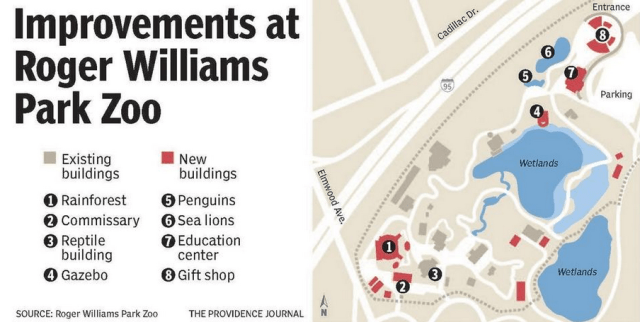
Next stop: the Amazon” reads the headline on today’s front-page story in the Providence Journal about the new South American Rainforest exhibit and its clichéd design, so out of step with the historical character of the zoo and its host, Roger Williams Park. “Next stop: Houston” seems more like it.

I am disappointed because every time Providence tries to move into the future, it repeats its regrettable past. That is, it replicates architecture of recent decades that rejects a gentle glide path from its past to its future. It embraces architecture that sees the future as a contrast with the past rather than a continuation of the past. It embraces buildings that most people find alien. With aggressive stupidity, the city embraces placemaking that weakens rather than strengthens its brand.

The two prime examples are most of Capital Center and most of the I-195 land. Brown and RISD are culprits, and so are the city’s medical institutions. They are all run by smart men and women who have been taken in by the folly of a cult, which is what the profession of architecture has become.

The architectural establishment suppresses design diversity, and belittles traditional architecture as illegitimate in our time. Unlike every other field of human endeavor, its operating principles reject precedent – in theory more than in practice, however, as the clichéd zoo building demonstrates. Modern architecture prefers creativity that favors freakish novelty over the subtle refinement of artistic technique. Modernist architects treat the dismay of the public with the result as a feather in their cap.

In a democracy, architecture – the most visible of the arts – should make some attempt to reflect the taste of the public rather than the taste of the editors of the leading architecture journals and members of the Pritzker prize juries. No doubt Washington, Jefferson and Roger Williams are spinning in their graves.

Providence is not alone in committing such errors. The whole world is doing the same. Providence has an opportunity to separate itself from the pack, nationally and internationally. It can do so with a credibility that most cities in America no longer enjoy. With consummate bullheadedness, Providence refuses to do so, hence spurning the economic and spiritual well-being of its citizens.

The rainforest building, whose interior seems excellent (see video), is among what from the map below seem to be upward of 13 new buildings in the zoo’s 20-year master plan. The rainforest building is especially disappointing because its architect, Yoder & Tidwell, has designed numerous facilities at the zoo in styles that mostly fit in. These include its African Pavilion, Anteater Exhibit, North American Trail and Eagle Exhibit, Children’s Zoo, Treehouse, Veterinary Hospital and others.

What happened this time? Well, it is still possible to hope that the rest of the proposed new buildings will lean toward Providence, not Houston.

Screen Shot 2018-03-21 at 11.02.08 AM.png

Posted in Architecture, Video | Tagged , , , , , , | Leave a comment

Rebuild Aristotle’s Lyceum

Screen Shot 2018-03-20 at 7.59.26 PM.png

In 1996, as construction workers cleared a site in downtown Athens for the foundations of a new Museum of Modern Art, they found traces of a large structure sitting on the bedrock. A building had occupied this same spot some two-and-a-half thousand years earlier, when it was part of a wooded sanctuary outside the origi- nal city walls, on the banks of the River Ilissos. The excavation uncovered the remains of a gymnasium, a wrestling arena, changing rooms and baths. This had been a place for athletics and exercise, where the young men of Athens had trained to become soldiers and citizens. …

An ancient gymnasium in Athens? Achh! Let ‘er rip. Cart away the sweat-stained artifacts. Build your Εθνικό Μουσείο Σύγχρονης Τέχνης, with my blessing.

But wait. Not so fast.

… [I]t was much more than just a centre for physical improve- ment. The archaeologists soon realised that they had found one of the most significant sites in all of western European intellectual culture, a site referred to continually by history’s greatest philo- sophers: the Lyceum of Aristotle. The world’s first university.

Screen Shot 2018-03-20 at 9.11.18 PM.png

Aristotle

The passages, from James Crawford’s Fallen Glories, which I mentioned in my post “Rebuild the Roman Forum,” left me filled with anxiety for the fate of the remains of the Lyceum of Aristotle. The vision of its rubble bulldozed aside to make way for a Museum of Modern Art (Εθνικό Μουσείο Σύγχρονης Τέχνης), no doubt designed to poke out the eyes of the spinning shades of the Father of Western Philosophy (a title he shares with his own tutor, Plato, whose eyes would also be at risk) and the teacher of Alexander the Great (ditto).

Thankfully, my expectation, though validated by the history of brutality as the operating system of modern architecture, was too dire. The new building was cancelled, the museum’s art stored at a temporary site nearby, and, even though not everyone agrees that the exact site of Aristotle’s Lyceum was truly identified, the excavation continued.

Alas, nothing was found of notable architectural value farther back than Roman times, and what was found was no more than the lower walls and foundations. Since Greece is no longer an empire and Athens no longer a wealthy city-state, a dig is not a done deal. The history of the site after its discovery in 1996 is described by David John in his Cheshire Cat Blog, with copious text, notes, maps and photos. Fascinating. He expresses an infinitude of frustration (or shall we say patience) at the slow pace of progress. At last, the excavation was complete. Of the results, he wrote in 2013:

[D]isappointingly, the archaeological finds at the gymnasium site proved meagre: only the foundations and lower courses of walls of the wrestling area (palaestra) and library and part of a baths from the Roman period were uncovered; there appeared to be no sign of statues, inscriptions or any significant evidence of the site as the ancient sanctuary of Apollo Lykeios, after whom the Lyceum (Λύκειον, Lykeion) was named, or as a gathering place for philosophers; and unfortunately, no treasures, revelations or “astonishing discoveries.” So far, very little has been published about the excavation finds in English, which can only be taken as a discouraging sign.

David John leaves room, however, for hope that a restoration is in the works:

Several times after this author had heard that the site would be opened he dutifully traipsed along to only to find the same fence screening a closed building site on which nothing whatsoever was happening. In September 2010 a press release by the official Athens News Agency stated that the restoration work was finally – really, really, really – about to begin. However, when I visited the site again in May 2011 there had been no discernible progress.

Restoration? Does David John mean the restoration of the ruins, if such a project makes any sense, or the rebuilding of the Lyceum? The latter, I hope. There was not enough left in the way of ruins for the average visitor, or evidently even a scholar, to feel the frisson of ancient history upon this sacred ground. (Much the same might be said of Penn Station.) Although a pleasant garden has been created next to the Lyceum site, the remains seem to be a perfect example of a ruin that could and should be rebuilt without thwarting what intellectual pleasure a ruin might have aroused. Thankfully, at any rate, the bulldozers of the modernists have been sent packing. That is a victory, in itself, of beauty and history over ugliness and nihilism.

(I am not sure how much is known through contemporary texts or drawings of how the Lyceum of Aristotle actually looked. The closest apparent attempt at a visual reconstruction that I could find is from, I think, a video game, “Call to Power 2: Aristotle’s Lyceum.” That image is on top of this post. Below is an unidentified painting from the schoolworkhelper.net website, said to show the inside of the Lyceum, though it looks bigger than the Lyceum as portrayed by the gamers. Go figure.)

[Numerous gentle readers have informed me that the painting below is Raphael’s “School of Athens,” with the structure comprising parts of St. Peter’s. Was the blogger unaware of this fact, or aware of it and, in the absence of an actual illustration of the Lyceum, making a joke?] [Update: I have fixed the caption below.]

Screen Shot 2018-03-20 at 9.07.34 PM.png

Interior of the School of Athens, by Raphael. (schoolworkhelper.net)

Posted in Architecture | Tagged , , , , , , , , | 3 Comments

Still allowed to like Meier?

Screen Shot 2018-03-14 at 6.25.44 PM.png

Dancing House, in Prague, by Frank Gehry. Flirtatious or harassment? (Naked Tour Guide)

I had absolutely no idea, two weeks ago when I wrote my post “Ha ha ha ha! Seriously?,” that its two subjects, Pritzker Prize architect Richard Meier and the late female architect Natalie de Blois, are connected. No, de Blois is not among the five women who have just accused Meier of sexual assault. But unbeknownst to me, I introduced the oppressor and the oppressed into the same post. How was I to know? You can never be too careful.

Aaron Betsky wrote in November wondering when architects would get caught up in the #MeToo movement. Now that the moment has come, his interesting column has been reposted online by Architect, for which he is a columnist. “Waiting to be Weinsteined” makes some interesting points. The article opens with this passage:

“What do you think of Louis Kahn?” one of my students asked last week. “Oh, well, I think he was God,” I answered only half-jokingly and turning away to my next task. “Oh,” she said. “Well, but he was sort of a creep, wasn’t he?” I turned around, faced her, and didn’t know what to say.

Well, Louis Kahn, now Richard Meier, who else? Oh, Lord, please: Frank O. Gehry! He is about as arrogant as they come, and also a creep. Didn’t he say that “98 percent of what gets built today is shit”? Okay, that’s a different kind of creep. I have a special animus against Gehry because he is about to uglify my hometown, Washington, D.C. Anyway, wasn’t his Dancing House, in Prague, caught in the act of dirty dancing, or maybe even frottage?

Harking back to his own 1995 book Building Sex, Betsky adds that

the values of the architecture world are thoroughly bound with notions of masculinity. The glorification of the big, the muscular, and the tall, the suppression of comfort and sensuality as important values, and the complete domination of the architecture world (still!) by men are all wrapped up together. Too many male architects see the world as a supine figure waiting for their brilliant erection to bring it to life.

Oh ho! Betsky lets the cat out of the bag. He refers to modern architecture. No other architecture calls for “the suppression of comfort and sensuality as important values.” No doubt the classical firms of a century ago and beyond were as dominated by men as are today’s. Classical architects were probably just as arrogant* as modernists are today (and with much better reason for it). The rare female architects and office staff were probably just as subject to male “interest” then as now. But back then it was probably far more subtle because it was far more forbidden than today, as of November at least.

As flirtation grows bold enough to cross the line into harassment, or worse, it becomes more desirable to chastise, sanction and prevent. But preventing dastardly behavior originating in the office must not be allowed to throttle innocent behavior. Romance often germinates in the work environment, and to block that off, or to generate a fear of indulging in it, would constitute an assault on the quality of life. In the office, gentle yearnings are among the benefits of employment. Boundaries must be clear, but innocent flirtation mustn’t be punished for the deeds of the sexually irresponsible.

Betsky cannot decide whether knowing of Kahn’s infidelities means he can no longer like Kahn’s buildings. Isn’t it just like the modernists to think that wrongdoing can be blamed on buildings? One of the founding blunders of modern architecture is that the horrors of World War I demanded not just new forms of government but new forms of architecture as well.

Betsky writes:

In an ideal world, we should be able to separate the work from the man or woman who made it, but in the real world, the cult of the “genius maker” so thoroughly defines the way in which any art is made and received that we cannot ignore questions of character when we look. Moreover, the inexcusable behavior of men has too long let them build unabashedly while inhibiting the work and the careers of women.

That’s pretty dodgy. What can Betsky mean? The “cult of the ‘genius maker” prevents us from distinguishing the artist from his (or her!) work? Sexual assault and sexual discrimination are different issues, not entirely unrelated perhaps, but still distant. Neither causes the other, and both are problems that require different programs of redress on the part of the profession.

In short, Richard Meier and Natalie de Blois may have cohabited my blog two weeks ago, but the problems each represents are worlds apart.

Betsky should feel free to erect a wall between his opinion of Kahn and of his buildings. I would not condemn him for allowing Kahn’s behavior to affect his opinion of Kahn’s work, but I would insist that they may indeed be judged independently. Some might be unable to do so, but that doesn’t mean it is impossible, or even especially difficult. To argue otherwise is to fling oneself (and one’s profession) down a dangerously slippery slope. After all, we never do have a full knowledge of anyone’s character, which is more than just what makes it into the news. So in the end we must judge an architect’s work by his buildings, or we must acknowledge that we judge it in blindness.

I may deplore Aaron Betsky’s admiration for Kahn but I will defend to the death his right to that admiration, whatever he said about bricks.

(I would have put the photo of Meier’s building on top instead of below if I could have found any Meier building guilty of the least sexual misconduct.)

(* Read the demurral in the comments below by Milton Grenfell. I would add that those who saw the sexual revolution with clear eyes, at the time or looking back, could see #MeToo’s embarrassingly conflicted discontents coming down the track.)

Screen Shot 2018-03-14 at 8.38.53 PM.png

Rickmers headquarters, in Hamburg, by Richard Meier. (richardmeier.com)

Posted in Architecture | Tagged , , , , , , , | 8 Comments

Sledding near Dutch Emb.

Screen Shot 2018-03-12 at 9.10.04 PM.png

My friend Steve Mields, age 12 perhaps, flies over bump at Cal Hill. (See video)

With snow bearing down this evening, ready to whack New England starting early tomorrow morning, thoughts naturally turn to sledding down hills while young. Or, rather, memories of same. My friends and I used to sled at Cal Hill, behind the Dutch embassy in the District of Columbia. Cal Hill, which apparently nobody knew about but us, was a very long and very steep hill with a stone building on top where, I don’t recall but am informed, hot chocolate could be had, and woods at the bottom, requiring sledders to brake hard or abandon ship.

The land was apparently owned by the Dumbarton College for Women then, whose staff never chased us away. Today it is apparently owned by the Divinity School of Howard University.

Sledding at Cal Hill was, in a word, divine. It was memorialized on 8mm film by me one late afternoon, or so it seems in my clip, which runs a bit over one minute. [Trigger warning: violent falls off sleds, stray voice in background discussing baseball, film quality execrable.] Well, some people consider grainy footage to be tantamount to historic, or at least old. However grainy, or rather perhaps blurry, this footage might be considered fun.

See Steve Mields flying down the hill and hitting our hastily built snow ramp. Will he crash? Will he abandon ship? Will he make it over? Chills and thrills aplenty in this clip. If you cannot go out and sled down a snowy hill tomorrow, this may be the best opportunity you will have to recall what it was like. Enjoy!

And by the way, in case lightning strikes and I do go out sledding tomorrow – I have a 9-year-old boy, after all – anybody know the best sledding in in Providence?

Posted in Humor, Old Video | Tagged , , , , , , | 3 Comments

Sources of modern silliness

Screen Shot 2018-03-11 at 8.51.00 PM

Even London’s Crystal Palace, an early modernist icon, had decoration. (Sources)

Nikolaus Pevsner (1902-83) wrote some of the pathbreaking works of architectural history that form the belief system of modern architecture today. The Sources of Modern Architecture and Design is one, which I am reading again for the first time in many years. Not too long ago, in “Form, function and Sullivan,” I wrote of an earlier seminal work of modernist design philosophy. Louis Sullivan’s Autobiography of an Idea, published in 1949, discussed “Form follows function,” which arose in his mind more than half a century earlier, after the invention steel framing and elevators led to the skyscraper, in which he played an important role.

Screen Shot 2018-03-11 at 9.23.39 PM

Nikolaus Pevsner

Sullivan himself attributed the concept to the Roman architect Vitruvius, who first (that we know of) enunciated the triad of firmitas, utilitas, venustas – buildings must be solid, useful, beautiful. Wikipedia says Sullivan’s maxim is “often incorrectly attributed to the sculptor Horatio Greenough (1805-52),[1] whose thinking mostly predates the later functionalist approach to architecture.” But Greenough’s linkage of form to function prior to the “later functionalists” is no more and no less what Vitruvius did. And probably lots of other architects and theorists made the obvious connection on many occasions between Vitruvius and Sullivan. It was the modernists who had the idea of using such a vapid platitude as a keystone of their architectural philosophy.

I mention that in order to suggest a parallel with the thinking of many modernist pioneers, which is glaringly evident in the very first chapter of Pevsner’s Sources. “The plea for functionalism is the first of our sources,” he writes, and then piles up quotes from Pugin, Hogarth, Voillet-le-Duc, Scott and Morris that purport to place them in a vanguard pushing for a more functional architecture.

But, though Pevsner and other modernists won’t admit it, Vitruvius stole their thunder a millennium and a half earlier. Utilitas is functionalism, and almost every architect since Vitruvius has placed function on a par with strength and beauty as required of all architecture.

What Pevsner and most other modernists truly mean by functionalism, and how it is different from architecture’s longstanding concern with function, is function without ornament. And even the quotes piled up by Pevsner in the first chapter of Sources fail to support the notion that functionalism requires that ornament be purged.

For example, Pevsner cites Pugin, writing in 1841:

There should be no features about a building which are not necessary for convenience, construction or propriety. … The smallest detail should serve a purpose, and construction itself should vary with the material employed.

Propriety? Eh? Not entirely unconnected with venustas! But even if Pugin did not use the word propriety, the passage would contain nothing that excludes ornament as a feature of a building that serves a purpose.

Indeed, Sullivan’s reputation as a “precursor of the modernist movement” may have arisen after Pevsner wrote Sources. That might explain why Sullivan makes only the slightest appearance in the book. Pevsner probably realized that Sullivan loved ornament, and he may not have had the chutzpah to label him a “pioneer” of modernism – even if he did coin the dictum “Form follows function.”

Only after modernism captured the establishment of architecture did its thinkers and leaders have the balls to treat Sullivan as a precursor to modernism. By then the field had become less a profession than a cult, and the tendency to merely suppress and ignore uncomfortable facts became part and parcel of the modernist discourse.

Anyway, modernists have a most extraordinarily narrow definition of function. If a building’s beauty makes it more likely to be maintained and repaired by the human beings who own it, use it and love it, then its beauty is functional. Put that in your pipe and smoke it, Nick Pevsner!

Posted in Architecture, Architecture History | Tagged , , , , , , | 5 Comments

Ross Award winners of 2018

Screen Shot 2018-03-09 at 4.47.36 PM

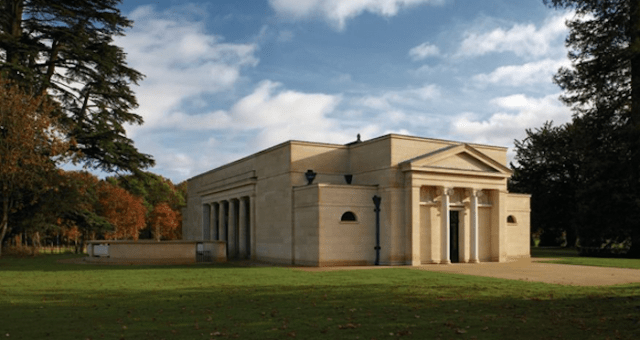
The Williamstrip Bath House, by Craig Hamilton. (Photos by Paul Highnam)

The Institute of Classical Architecture & Art has just announced this year’s Arthur Ross Award laureates. Unlike the Bulfinch Awards of the New England chapter (also just announced) and other regional ICAA awards programs, which honor specific works, the ICAA’s Ross awards honor the career “achievements and contributions of architects, painters, sculptors, artisans, interior designers, landscape designers, educators, publishers, patrons, and others dedicated to preserving and advancing the classical tradition.” This year’s honorees are excellent. Go to the announcement to see multiple examples of the life work of each laureate.

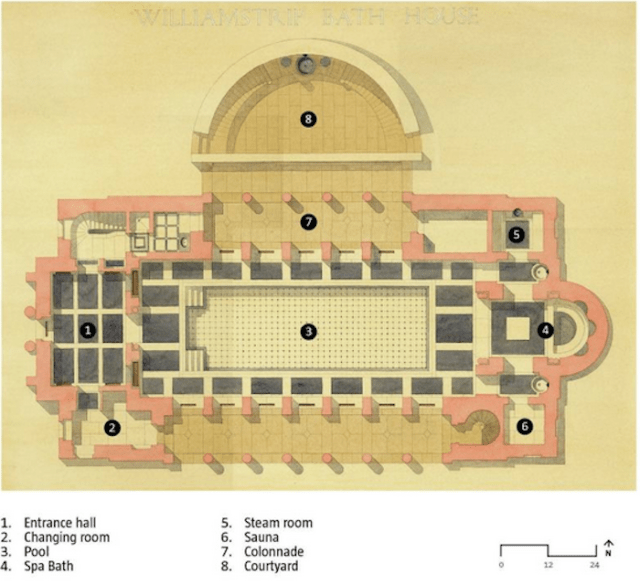
By way of introducing this year’s Ross winners, allow me to focus on one building by Craig Hamilton, this year’s choice in the category of architecture. The building is a new bath house on a wealthy estate in Gloucestershire whose manor house, restored in the 1790s by Sir John Soane, had just been renovated by Hamilton. The bath house combines a number of strains that, it seems to me, characterize much of his work since he emigrated to Britain from South Africa.

The Williamstrip Bath House combines a temple front with colonnades (one of four columns and another of six columns) that reach back on either side to a hemispherical bow at the rear of the building. Its classical styling is very restrained, except for the twin columns flanking the temple front. Their capitals are described by Katie Gerfen for Architect: “[O]n the entrance façade [Hamilton] reinterprets Ionic columns at the Temple of Apollo Epicurius in Bassae, Greece, exaggerating the volutes to the point of creating his own chambered-nautilus-like nonce order.”

The capitals surely will strike some as disproportionally rendered. Is this a sin against ye olde classical canon? Is it experimental? Is it creativity? Is it “bad trad”? Sometimes it can be hard to say, but bad trad it is not. Like the rest of the building, the temple front is certainly spare, but it would probably strike Nikolaus Pevsner, say, as criminally profuse in its embellishment.

Never mind. Advancing the classical tradition, the chief purpose of the ICAA, means preserving the canon and promoting its glory through diversification. Craig Hamilton has performed both roles, and his Ross makes perfect sense.

Screen Shot 2018-03-09 at 4.49.00 PM

Screen Shot 2018-03-09 at 8.21.35 PM

Screen Shot 2018-03-09 at 8.20.09 PM

Screen Shot 2018-03-09 at 8.20.30 PM

Screen Shot 2018-03-09 at 8.22.00 PM

Screen Shot 2018-03-09 at 8.22.25 PM

Screen Shot 2018-03-09 at 8.55.29 PM

Posted in Architecture | Tagged , , , , , , , | 4 Comments