

View of Providence Place, with Nordstrom at right. (photo by author)
Providence and its renaissance will survive the departure, announced yesterday, of Nordstrom from the Providence Place mall. Many local commentators are pulling their hair out in shock and dismay. Relax. Losing Nordstrom is a gut check, but hardly fatal.
It’s early, but the winning entry in the sweepstakes for the gloomiest reaction to the startling news may be GoLocalProv’s “The Death of the Providence Renaissance.” “The Providence Renaissance began in the late 1990s. … Two decades later, Providence is stagnant.” The evidence? “A new report of the fastest growing cities in America ranks Providence number 458 out of 515 ranked. The population of Providence has decreased over the past fifty plus years. Providence’s population in 1960 was 207,498 and today it is just 179,219. And now, the Renaissance seems to be morphing into the Dark Ages.”
To take these in order, the renaissance started not in the late 1990s but in the late 1970s, after Johnson & Wales started renovating old buildings and the city embraced an unofficial moratorium on the demolition of old buildings downtown (which lasted until 2005). To save old buildings became the order of the day, including the Biltmore hotel, which had closed in 1975, reopened in 1979, and the Ocean State Theater, whose application for a demo permit in the late 1970s was refused, leading to its eventual rehabilitation as PPAC. Work began on the Capital Center development project in the early 1980s, and in the mid-’80s the river-relocation project was added. In the early ’90s the convention center and Westin hotel joined the fun. Waterplace opened in 1994, the same year as the first WaterFire. Narragansett Electric Co.’s Manchester Street Station was renovated in 1996. The renaissance was well under way by the late ’90s, and went into overdrive when the mall opened and Buff Chace started rehabbing old buildings as lofts the same year.
Stagnation hit almost a decade ago, before the Great Recession, when most of Chace’s rehabs were done. Old buildings were being demolished again after a quarter of a century. (Thank you, Mayor Cicilline!) Five new buildings were proposed in 2005, including one that would have topped the Industrial Trust. None was ever built. But the mall had become a financial boon to the state, and a great “third place.” However, in 2011, Borders closed.
Under a string of owners, the mall has been poorly run, a fact that was evident years ago when management refused, in spite of repeated requests from this corner, to fix the glorious exterior lighting that had long washed up between the pilasters at Macy’s. The mall’s lunkheaded leadership reached its nadir when Borders was replaced by the umpteenth shoe store. The last upscale restaurant, the Napa Valley Grille, also closed in 2011.
If Nordstrom is so vital to the Providence economy and to the mall’s already tarnished upscale rep – and it is – the mall should have tried harder to keep it there, offering a lower and lower lease until Nordstrom could no longer refuse. Its replacement will be Boscov’s, a retail chain that offers much of what Nordstrom offers at – ahem! – a lower price point. Let’s not forget that Nordstrom, too, is a retail chain. Perhaps, however, Boscov’s will do a better job tapping the market of metro Providence at its true price point.
Naturally, we hesitate to embrace that idea. But look at the survey linked above by GoLocalProv as “fastest growing cities in America.” Look at it and one thing is clear: The places rated tops in “growth” may not rank very high in a list of “nicest places to live.”
Providence’s population has declined from 207,498 in 1960 to 179,219 today. In 1959 and 1960, the city proposed the College Hill plan and the Downtown Providence 1970 plan. Both plans recommended massive demolition and urban renewal, replacing old buildings with new modernist buildings. Both plans were largely abandoned in just a few years, and what little was built made Providence worse. Neighborhoods were already being bulldozed for new highways. A highway had been seriously proposed to shoot right up the Providence River. The status of downtown and College Hill today is a rebuke to the know-it-alls of yesterday. It is altogether possible that a large portion of the population that left after 1960 were people who felt queasy at the city fathers’ ridiculous, indeed horrifying idea of what Providence needed to stem the flow of residents and businesses to the suburbs.
Be that as it may, the failure of these two plans left Providence with extensive historic architectural fabric intact, more so than in most cities, whether bigger or smaller, many of which bought whole hog into urban renewal and modern architecture. Providence did not, and that is the basic reason there was a Providence renaissance at all. In the 1980s, civic leaders finally “woke” to the idea that beauty was this city’s major advantage (along with being between Boston and New York City) in vying with other cities.
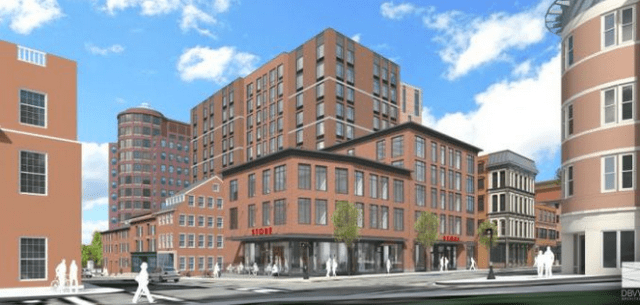
Today, our city fathers seem to have forgotten that. They are transforming a beautiful city into a standard city, one that could be located anywhere. Look at what is being built in the Route 195 corridor. New buildings, yes, but, my god! Must they be so damn ugly? Has Providence learned nothing over its past very extraordinary 40 years? Were today’s leaders asleep during the city’s renaissance? It certainly looks that way.
The primary concern of a city’s leadership should be its citizens of today, not its possible citizens of tomorrow. Make Providence nice and beautiful for today’s citizens and people in other cities are much more likely to become tomorrow’s citizens of Providence. Yes, other factors that have nothing to do with beauty are vital to making a place livable. However, those factors are very hard to do right, whereas we already know how to bring beauty to the city because it has been done very well before. Beauty creates places where civility reigns, and under the influence of a civilized environment it may be easier to come together and solve the city’s toughest problems. We already have more of such an environment than almost every other city. Let’s build it up not tear it down. Let’s strengthen our brand, not shoot it in the foot.
Providence’s mantra should not be more and bigger but better and better. That should be the lesson we take from the departure of Nordstrom.
* Absquatulate means to leave abruptly, and usually has a connotation of tail between leg.






 Architecture Here and There