Obama Center crisis solved

Screen Shot 2019-06-23 at 1.40.04 PM.png

Proposal by two grad students to transfer Obama Center to Midway Plaisance. (Notre Dame)

Chicago can solve the crisis of its proposed Obama Presidential Center by transferring it from Jackson Park to the nearby Midway Plaisance, the strip of land best known as the sideshows of the World’s Columbian Exposition of 1893. So say a pair of enterprising urban design graduate students at the University of Notre Dame, working under Prof. Philip Bess. They propose to relocate the planned presidential museum to the underutilized Midway and transform it into a grand boulevard anchored by a recast Obama Center.

Of course, this is unlikely to happen. It is supposedly a mere academic exercise (notwithstanding that, accolades to Marie Acalin and Roger Foreman); but great ideas often extend important conversations. For example, their proposal joins that to rebuild New York’s Penn Station as designed in the early 1900s by Charles Follen McKim of McKim, Mead & White, a proposal that reinforces the idea that modernist disasters can be fixed by using older, more humane methods of city building.

The status of the Midway today is not a modernist disaster but a lesser problem – a relatively unadorned and under-used green space left behind by the march of time. Here’s how Bess describes the potential transformation of the Midway in “Imagine the Obama Presidential Center on Chicago’s Midway Plaisance,” written for the Chicago Tribune. The proposal

reimagine[s] the Midway as a baroque-scale urban boulevard, defined spatially to the north and south by new academic and residential buildings, and terminated at each end by monumental architecture. A grand urbane vision informed by Rome, Paris, Washington, D.C., and Chicago’s own Daniel Burnham, their work engages pressing issues of land use, race and class mistrust, neighborhood gentrification and equal justice under the law by proposing traditional Chicago building types, form-based-zoning, incremental development and land-value-taxation … .

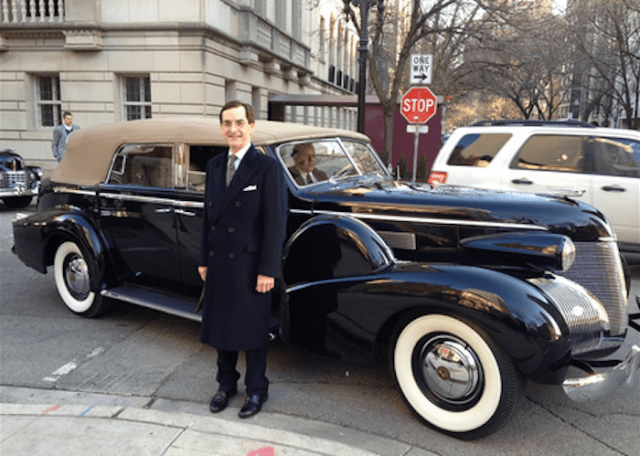
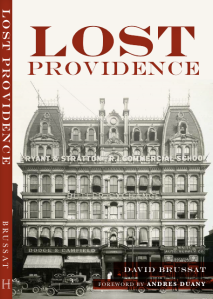
Bess, who led another group of grad students in a 2016 project to reimagine Providence’s I-195 District and its proposed 6/10 Connector, adds that the Chicago proposal could “ennoble the Midway, the University of Chicago, the Obama Presidential Center, the adjacent Woodlawn neighborhood and ultimately Chicago itself.” It would “confirm [the Obama presidency] as a watershed achievement of aspirational American ideals of freedom, justice and equality.”

Progress on the Obama center has been slowed by a suit based on public-trust doctrine in Chicago law – mandating protection of historic city land – protests against possible gentrification in the South Side vicinity, and a poorly conceived design uncongenial to historic Jackson Park, designed by Frederick Law Olmsted. At the very least, the grad students’ proposal could improve the Obama center’s prospects by rebranding it on the Midway as a place Chicagoans could love – mooting some of those issues and vaulting the Obama Center above both its off-putting modernist style and the tawdry persona of the typical midway. It would transform them into civic grandeur – albeit with a Ferris wheel at one end. (The first Ferris wheel was built on the Midway for the 1893 fair, and the term “midway” itself came to denote the lunch-‘n’-game-booth sections of state fairs and other playgrounds.)

As the Obama Center proposal’s challenges have deepened, starchitects are sending in their even wackier alternative proposals to dislodge current architects Billie Tsien and Tod Williams.

Bess argues that the grad students’ placement of a 250-foot obelisk inspired by the Washington Monument amid two traditionally inspired Obama Center buildings would do a far better job than any modernist design at fitting the Obama phenomenon into the American historical trajectory:

The entire Obama Presidential Center ensemble would thereby link the Obama presidency simultaneously to both the ideals and the flaws of the American founding, to the history of African American emancipation and to the biblical foundation of the mid-1960s civil-rights movement’s opposition to the Jim Crow regime of legal segregation.

Bess raises the obligatory doubt that traditional architecture would be an appropriate environment for such a commemorative task. Bess addresses that doubt with a parallel doubt that crony capitalism’s modernist veneer is any more appropriate. Naturally, the proposal has been criticized by the design elite in Chicago (including Tribune critic Blair Kamin), which is itself a good reason to embrace it.

Chicago and Barack Obama should give this “academic exercise” (which Kamin wishes it would remain) a closer look.

Screen Shot 2019-06-23 at 1.42.50 PM.png

Proposal by Bille Tsien/Tod Williams for Obama Presidential Center in Chicago. (Obama Foundation)

Posted in Architecture | Tagged , , , , , , , | 3 Comments

Salingaros: How cities heal

johnmartincoachholidays.co.uk.png

Town in Germany climbs hills above the Rhine River. (johnmartincoachholidays.co.uk)

Globetrotting mathematician and theorist Nikos Salingaros hits the nail on the head in his recent analysis of urban ills in “A Schizophrenic Approach to Building Cities,” published on the Meeting of the Minds website. Actually he hits many nails on the head, and while I will quote a few passages here, the essay deserves to be read in its entirety. Usefully, he links readers to his sources throughout. Here is his opening paragraph.

Two currents — so far, irreconcilable and mutually exclusive — are shaping our cities. On the one hand, we have vast construction projects churning profits for multinationals, local firms, and indirectly for stockholders. The media is inundated with their exciting images, and the developing world appears as a testing-ground for the more ambitious (and pharaonic) among those schemes. But are they good for humankind?

He answers his own question in the next paragraph by citing the alternative:

The other design alternative is small-scale, and focuses on human responses to the built environment. It uses proven methods to elicit mental wellbeing and bodily healing responses. Its products look very old-fashioned, not because its practitioners blatantly copy traditional forms, but because the healing responses rely upon a specific complex geometry that is common to all historical buildings and cities.

Salingaros is based at the University of Texas but lectures worldwide and has long worked with architectural theorist Christopher Alexander (author of A Pattern Language). Salingaros has made a name for himself by identifying the many similarities between traditional architecture and the biological traits of nature. Buildings and cities reproduce by using the best practices of builders developed by trial and error as handed down by generations of builders over the centuries. The process mimics the descent of species in nature, and for this reason he calls the resulting architecture and urbanism “living” design.

To expand on this point, I cannot resist quoting a passage from an article co-authored by Salingaros with his frequent writing partner, the urban theorist Michael Mehaffy, taken from “What Historic Structures Can Teach Us About Making a Better Future,” a piece written for the National Trust for Historic Preservation:

This view of change over time is familiar to any biologist. For a biological system, sweeping away the past and starting anew, without the benefit of the past’s genetic evolution, would constitute a catastrophic and destructive event—the genetic equivalent of starting life over with single-celled bacteria. Evolution is not about doing away with the old … and starting with a radical newness. Instead, building blocks of the past are recombined to achieve ever more adaptive complexity and resilience. The process is not static, but neither is it only about change: it is rather about preserving and building on the tested and proven accomplishments of the past.

I noticed this phenomenon in 2003 during a trip to Germany. My brother and I took a train running along the hills above the Rhine and found that many towns and villages seemed to creep up toward the crest of the valley as if they had grown out of the soil. (We were dismayed to see one enchanting village marred by a BP gas station with its obligatory huge flat lime-green roof, the only hint of modernity amid the village’s sea of clay tiles.)

Salingaros’s scientific clarity in describing the two mutually exclusive philosophies of city design extends to their economic, physiological and psychological ramifications. He suggests that the powerful architecture and planning establishments are acutely aware of the problems they perpetuate, and seek in response to “co-opt the ideas presented by the humanist side”:

Bringing nature into cities is a major step in the right direction, but it’s only a palliative if the built geometry remains alien. Unfortunately, our world is largely shaped by typologies that are opposite to what human physiology and psychology require. This continues because the subservient, sycophantic media praise — instead of condemn — designs that assault our senses.

Salingaros is, if not optimistic, hopeful that cities can embrace living design by promoting mixed-use development and a wide variety of scales typical of older cities that have not yet been neutered by modernist sterility. Cities, he says, need to subordinate automobiles to people. He identifies resilience as the vital characteristic of cities that work, changing over time in ways that learn from and reflect the natural patterns of historical development:

Resilience comes from linked processes and structures working on many different scales. Solutions are found in self-built spontaneous settlements and in traditional cities. Historic evolution took place towards healthier environments through biophilia and design patterns, but city form as decided by design ideology linked to power cannot re-configure into a new system. By worshipping “images of the future,” society doesn’t re-use older successful solutions, and this limitation prevents resilient systems from forming.

Salingaros does not expect the proposals being made for living urbanism to surmount the current reign of modernist sclerosis. And yet:

Yet some optimism is indeed called for. We propose an economic solution that can still benefit developers while achieving human-scale urbanism. Legislators can re-write the scale-erasing codes enforced after World War II, because those make the living urban fabric we wish for illegal. Those of us who know the science now consult with architecture and building firms. We apply Alexandrian Patterns and supporting geometrical tools for adaptation. Neuroscience experiments are finally validating what we knew empirically all along. We are convincing stakeholders of the health and long-term advantages of biophilic design.

He concludes with the hope that this good work can bring results:

That is highly unlikely, yet in this age of information, major world changes could occur on very short time scales. There is hope!

Posted in Architecture, Urbanism and planning | Tagged , , , , , , , , , | 2 Comments

Betsky barks at the Bauhaus

Screen Shot 2019-06-17 at 5.25.44 PM.png

The Bauhaus school, in Dessau, founded 1919 in Weimar, Germany. (Architect)

Some might not realize that Aaron Betsky has added to his role as critic for Architect magazine that of director of Taliesin West, the architecture school founded in 1932 by Frank Lloyd Wright and his third wife, Olgivanna. Amid the centennial of the Bauhaus compound, where most concede that modern architecture was founded, Betsky has written a piece for Architect that seems just a bit rough on the old school.

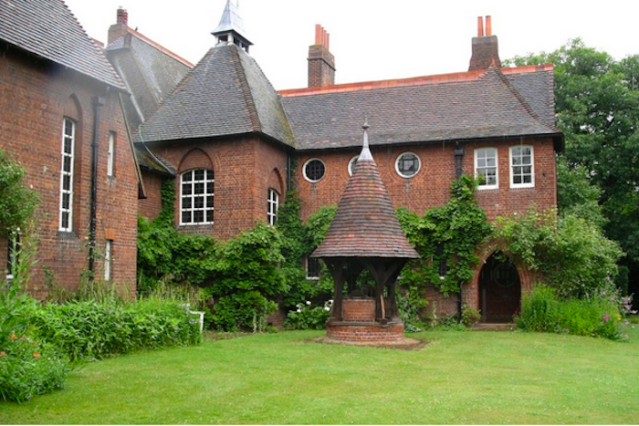
Is that a twinge of jealousy I detect? In “What We Did Not Learn From the Bauhaus,” Betsky cannot resist comparing the Bauhaus to his Taliesin West. First, though, he erroneously locates their supposed roots in the arts and crafts movement – which emphasized hand-made artistic techniques and had nothing to do with modern architecture. (Check out, at bottom, the Red House, 1860, deemed by modernist historians to be a precursor to modern architecture.) Craft and its sensibility did not last long at the Bauhaus, and was jettisoned by Wright when he abandoned his Prairie Style for more modernistic design schemes. Then Betsky writes:

These schools often split into ones that were either more idealistic or more focused on production. If Taliesin developed into a program that mixed not only practice and academia, but also agriculture, cuisine, and performance art, the Bauhaus, under the direction of its second head, Walter Gropius, moved toward building stronger ties with industry.

Industry? Booo! Double-plus-bad! Idealism and craft, not industry and production, better reflect the slow-food Zeitgeist of our era, do they not? Betsky here tiptoes around the division that alienates many from modern architecture, which was then and remains today all about the metaphor of the machine. (It was never about genuine efficiency, let alone honesty.)

After accusing the Bauhaus school of focusing on “more and more (pseudo) scientific” methods (ouch!) of production design and standardized forms that were “somewhat affordable” (double ouch!), Betsky writes:

The Bauhaus technique of using analytic reduction to create standardized and mass-producible forms worked best in graphic design. Where it resolutely did not work was in what remained the core of the curriculum, namely architecture. Yet it was in this field that the Bauhaus had arguably its greatest influence. The “Bauhausler,” as the graduates and former faculty members came to be known, spread out across the world creating neither basic shapes nor standardized ones, but boxes clad in white stucco relieved by metal-sash windows that carried forward the designs Gropius had made for the Dessau school and its masters’ houses. The “Bauhaus style” became thus not a realization of its principles, but an imitation and elaboration of the building in which the school was housed.

You could have knocked me over with a feather when I read that. But just wait until you read Betsky’s next line:

Because this style was both expensive to execute [ouch squared!] and appeared highly refined, it developed into an emblem of the enlightened middle class. You can find the “purest” Bauhaus architecture in the villas dotting the hills above Zagreb and Prague, on the shores of Tel Aviv, or in the fancy and educated suburbs beyond.

Worker housing!

And, after explaining how the real influence of the Bauhaus was in the “the manner in which the work was published in articles and books, and exhibited in photographs and models,” Betsky concludes:

What disappeared in that process was the notion that the Bauhaus was a place to learn about and change the world, a place to understand nature and science and create types and forms that would make all of our lives better. It is that work that I believe should still be at the core of those research and development laboratories for the future of the designed environment that we call architecture schools. We should all be Bauhausler, in the best sense of the world, while rejecting the nostalgic recall of the limited palette of forms, materials, and compositions that housed that particular school.

Enter the New Modern Architecture, soon to arise at your neighborhood architecture school, or, more likely, from two talented students at Betsky’s own Taliesin West, whose work is highlighted in photos amidst his article. Go and see what you think. It certainly can’t be accused of boxy. Enjoy!

Screen Shot 2019-06-17 at 5.26.08 PM.png

The Red House (1860), in London, supposedly a precursor to modernism, designed by leading Arts & Crafts founders Philip Webb and William Morris. (Architect, whose caption says “1960”)

Posted in Architecture | Tagged , , , , , , , | 2 Comments

Graduate bilks the Biltmore

Screen Shot 2019-06-13 at 11.13.34 PM.png

The Biltmore after rebranding as the Graduate Hotel Providence. (Providence Business News)

The Biltmore Hotel, built in 1922 and still the oldest hotel in Providence, now fashions itself the Graduate – the Graduate Hotel Providence. It is the latest in a chain of hotels in college towns that hope to cash in on the wealth of the academic community, especially in places like Providence where Ivy League colleges abide.

The Graduate? Cue Dustin Hoffman!

On second thought, don’t. Isn’t he a privileged white male? Fie on him!

I will continue to call it the Biltmore, because that is what people around here know it as. Its management thinks it has done Providence a favor by keeping the sacred red neon Biltmore sign up on top. And so it has, but that won’t protect the hotel from the danger of leading with its chin. Mark my words: its days as the Graduate are numbered, and it will be the Biltmore again soon enough.

Screen Shot 2019-06-13 at 10.47.24 PM.png

Lobby of the Graduate. (Graduate)

How do I know? Well, I watched the Graduate fold immediately after complaints that each guest room boasted a portrait of Buddy “Vincent A.” Cianci Jr. He was the late but not quite great mayor of Providence who did prison time for corruption but still emerged with his manufactured reputation for reviving Providence intact. Buddy was good at talking up Providence while others did the heavy lifting of its actual revival – part of which was to work behind the scenes to keep Cianci’s grasping hand out of the pockets of the private firms hired to do the work. Many stories went around of companies that refused to relocate to the state capital because of its mayor’s gangsta rep. Providence’s revival succeeded less because of Cianci than in spite of him.

So I agree with removing his portraits from the guest rooms. Hanging them so prominently only showed how little thought went into the historical tidbits that are the claim to fame of the hotel’s new decor. As are most universities today, Brown is all about finding things to complain about. Without knowing exactly what features of history are highlighted in the hotel, I nevertheless foresee a constant drumbeat of feigned outrage from guests – or the sons and daughters (if I’m not being too binary) of guests. Or from new hires at Brown – especially its burgeoning bureaucracies tasked with holding the hands of its woke communities. Imagine the quad cred of a new deputy assistant provost of dietary diversity, still house-hunting on College Hill, whose first day on the job is accompanied by news of a scandal he triggered over the insufficiently  prioritized attention paid by the hotel decor to the marginalization of this or that. You fill in the blank. Do not underestimate the hunger of the eyes that seek this prize. There will be snooping around the Graduate. The Cianci portrait scandal only scratches the surface of this iceberg of micro-aggressive possibilities.

Anyway, the portraits are “campy,” said Scott MacKay of Rhode Island NPR.

Screen Shot 2019-06-13 at 11.04.00 PM.png

A guest room. Cianci at left. (Graduate)

I have my popcorn ready. But my big complaint, only marginally ameliorated by the removal of the Cianci portraits, is that the hotel’s interior rehab is poorly designed. The guest rooms are garish in the extreme. The lobby has lurid touches that diminish what of elegance remains. The exterior has dodged the bullet so far, though I’m worried that some version of “at least for now” attaches to every mention of the hotel’s retention of the neon Biltmore sign. The ballroom has dodged the bullet, but how long will it hold out? What happened to plans announced by the Graduate’s developer a year ago for the return of the Biltmore’s old top-floor restaurant, which I discussed in “L’Apogee, here we come!“? Not happening, it seems. Will some woke wonk at the corporate level decide that the existing entrance canopy needs to be replaced with something that better reflects our era? The Biltmore dodged that bullet in 2003 when a local firm was hired to design a goofy replacement. See “A nose job for the Biltmore?” Thankfully, nothing happened. Then.

My wish for the new hotel brand’s success is tentative. I want its managers to realize that it will profit not by robbing Providence of its beloved old hotel on behalf of a feckless fad but by shifting slowly from this theft back toward that old hotel over time. Removing Buddy Cianci’s face is a good beginning.

Posted in Architecture, Development | Tagged , , , , , | 9 Comments

Dalrymple: Curl’s ‘Dystopia’

Screen Shot 2019-06-11 at 7.45.50 PM.png

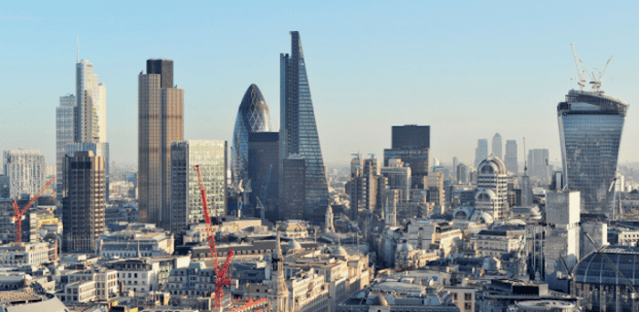
The modern skyline of London. (elba-1.org.uk)

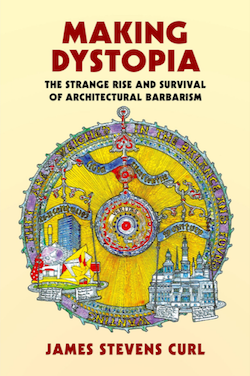
Theodore Dalrymple, the British prison doctor, psychiatrist and social critic, has written several reviews of James Stevens Curl’s book Making Dystopia, the most detailed and penetrating history of modern architecture written thus far. Each of Dalrymple’s several reviews seems intended to outdo its predecessors in their damnation of modern architecture. With “Crimes in Concrete,” published in the journal First Things, Dalrymple succeeds so well that he must now, it seems, cease and desist. Modern architecture cannot, it would seem, be pummeled more severely, even by the good doctor; yet, at the risk of stoking pity for the modernist dystopians, readers familiar with modernism’s terrible legacy see only justice in Dalrymple’s running up the score, and can only long for his next onslaught.

Screen Shot 2018-12-28 at 1.02.35 PM.png

(Oxford University Press)

I will do nothing more here but to quote some passages to encourage reading the entire essay. First, in describing the drive from France’s Charles de Gaulle Airport into Paris, Dalrymple debunks one of the central myths of modern architecture – that it’s less expensive.

Nor is this visual hell the consequence of the need to build cheaply. Where money is no object, contemporary architects, like the sleep of reason in Goya’s etching, bring forth monsters. The Tour Montparnasse (said to be the most hated building in Paris), the Centre Pompidou, the Opéra Bastille, the Musée du quai Branly, the new Philharmonie, do not owe their preternatural ugliness to lack of funds, but rather to the incapacity, one might say the ferocious unwillingness, of architects to build anything beautiful, and to their determination to leave their mark on the city as a dog leaves its mark on a tree

Just so. Next, Dalrymple praises the book in terms of condemning its subject:

Professor Curl’s magnum opus is both scholarly and polemical. He has been observing the onward march of modernism and its effects for sixty years and is justifiably outraged by it. British architects have managed to reverse the terms of the anarchist Bakunin’s dictum that the urge to destroy is also a creative urge: Their urge to create is also a destructive urge. I could give many concrete examples (no pun intended).

How did modern architecture overcome its obvious weaknesses? Well, Dystopia‘s subtitle is “The Strange Rise and Survival of Architectural Barbarism”:

Making Dystopia is not just a cri de coeur, however. It is a detailed account of the origins, rise, effect, and hegemony of architectural modernism and its successors, and of how architecture became (to a large extent) a hermetic cult that seals itself off from the criticism of hoi polloiamong whom is included Prince Charles—and established its dominance by a mixture of ­bureaucratic intrigue, intellectual terrorism, and appeal to raw ­political and financial interest.

Dalrymple returns to the cultishness of modern architecture later in his review, quoting a list of criteria for cults that Stevens Curl attributes in his book to Nikos Salingaros, an architectural theorist and professor of mathematics at the University of Texas at San Antonio, who has worked closely with the theorist Christopher Alexander.

But Dalrymple’s just getting started. Central to Dystopia is Stevens Curl’s exposure of modern architecture’s totalitarian roots that have been hidden for decades by its most dedicated acolytes. Even supporters of new traditional architecture often cringe when this subject is broached – stirring up ancient history only creates rancor in the architectural discourse, right? And yet it must be done, I believe, because modernism is contributing to the human desensitization required to bring forth the authoritarian future for America and the world sought by some. Fighting against modern architecture is key to civilization’s fight against forces that would curtail our freedom and, with it, our quality of life going forward.

So what follows is a string of such edgy quotations from Dalrymple. The faint of heart should stop reading now.

After describing Stevens Curl on the goofy “new age” social practices within the Bauhaus (which is a century old this year), Dalrymple continues:

Far more important, however, was their early and inherent attraction to totalitarianism. As the author points out, Gropius and Miës van der Rohe had no objection to Nazism other than that the ­Nazis failed to commission work from them. Gropius was an opportunistic anti-Semitic snob who espoused communism until it was no longer convenient for his career. Miës sucked up to the Nazis as much as he was able. The fact that both of them emigrated from Germany has done much to obscure their accommodation with the Nazis and even allowed the modernists to pose as anti-Nazi—though the most important proponent of modernism in America, Philip Johnson, had for some years been a rank Nazi in more than merely nominal terms. Moreover, as Professor Curl points out, the Nazi aesthetic, like the communist, had much in common with modernism.

Dalrymple then describes Le Corbusier’s 1941 proposal to deport many thousands of Parisians to the countryside, made 16 years after his proposal, mentioned in the following passage, to destroy central Paris and replace it with skyscrapers in a park laced with highways:

To what kind of man could such a thought [the 1941 proposal] even have occurred, much less at such a time? Le Corbusier had the sensibility of a totalitarian dictator, as is evidenced by his Plan Voisin, by which he planned to turn much of Paris into a kind of Novosibirsk-­sur-Seine. He loathed streets and street life, because for him they represented disorder and spontaneity instead of discipline, strict hierarchy, and what he considered, in his highly limited and autistic way, rationality. Personally, I do not see how anybody could fail to detect his essential ­authoritarianism just by looking at his designs, even without knowing that he aspired to lay down the law for the architecture of the whole world—which, to a horrible extent, he managed to do.

It is at this point in his review that, to answer his own question, Dalrymple cites Curl’s/Salingaros’s thinking on the nature of the modernist cult. One of the characteristics of a cult is its refusal to brook criticism – a key aspect of the broader future dystopia that may be seen as an outgrowth of the culture of modern architecture. Here, noting the fury of the British architectural establishment at the publication of Dystopia, Dalrymple describes the effort by Britain’s version of the American Institute of Architects to browbeat its author into silence:

 The editor of the Royal Institute of British Architects Journal, Hugh Pearman, wrote a scathing but inaccurate review, whose very subtitle was a flagrant misrepresentation: If it’s not trad, he ain’t glad. In fact, in criticizing modernism and its successor movements, Curl is promoting no particular type of architecture, any more than if I criticize McDonald’s hamburgers I am saying that all cuisine should be French or Italian or anything else. Of course, Mr. Pearman has a right to his private opinion of the book, but as editor of the Institute’s Journal he must have known that he was, in effect, speaking ex cathedra for the British profession as a whole. This impression was reinforced when he printed no criticism of his own review but tweeted instead,

I’m getting loads of letters (mostly written on paper from elderly men with no email address) supporting the deranged recent writings of James Stevens Curl . . .

The fury against Curl, I suspect, was an implicit admission that he was right.

No room for doubt exists.

For those who read the whole essay, when you are done, if you are so moved, please read Dalrymple’s pathbreaking essay in a 2001 issue of City Journal entitled “The Uses of Corruption.” I link to it from my own post from January of 2018, “The uses of preservation.” Dalrymple compares British society to Italian society, explaining brilliantly, along the way, why architectural beauty and its preservation have been so important to the quality of life.

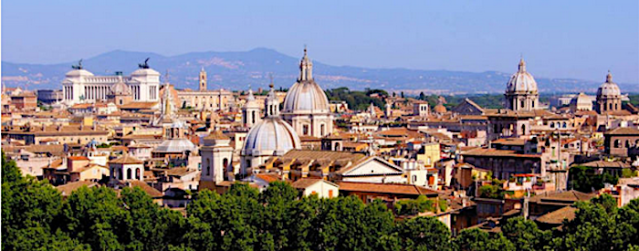
That essay will explain why I have bookended this extended quotation of passages from Dalrymple’s review of Making Dystopia with photographs of the current skylines of Rome and London. Here, in deference to the theme of Professor Curl’s excellent book, I have placed London first and Rome last.

Screen Shot 2019-06-11 at 7.45.30 PM.png

The modern skyline of Rome. (nh-hotels.net)

Posted in Architecture | Tagged , , , , , , , | 5 Comments

Lovely Simon Hall at Indiana

Screen Shot 2019-06-09 at 2.26.01 PM.png

A corner segment of Simon Hall at Indiana University. (flad.com)

The other day I wrote of a quirky house whose architect, David Andreozzi, called it the Shingle style on acid. Well, maybe that’s an overstatement. Still, the house is a “dazzling example of how creative tradition can be.” For work that exemplifies the same thing in a more substantial building, just take a look at the University of Indiana’s Simon Hall, in Bloomington, Indiana, a facility for scientific education completed in 2007.

Screen Shot 2019-06-09 at 3.46.25 PM.png

Drawing by Hugh Ferriss, circa 1924. (The Skyscraper Museum)

What style is this? The photo above reveals the abundant variety with which tradition has been flouted, oddness definitely winning out over regularity, yet without undermining the broad sense of tradition in the limestone building’s design. Simon Hall’s multi-paned fenestration represents its closest approach to tradition. It is absolutely within the traditional if not the classical vernacular, though leaning slightly less toward the edgy than the work of, say, Léon Krier or the Westerly house on acid of David Andreozzi. It reminded one observer of the etchings of architect Hugh Ferriss and his idea of “buildings like mountains.” Not the Himalayas in this particular case, perhaps, but maybe the more majestic of the Appalachians.

How did this building happen? That it was the work of Flad Architects, with offices in nine cities, is astonishing. Flad? I’d say Vlad – Vlad the Impaler Architects. I was unaware of the firm’s existence, but a visit to the projects page of its website reveals a collection of modernist buildings, 83 in all, so banal and clichéd that the casual appearance among them of Simon Hall launches a severe attack of cognitive dissonance on the unsuspecting visitor. An observer commenting through the online classical discussion group TradArch wondered whether the firm was embarrassed by this unusual example of its work product. The website’s commentary on the building is minimal. Its chief architect goes unnamed by the firm.

The website Concrete Construction offers this relatively detailed description of the construction of Simon Hall. Below are a number of photographs. Nos. two through five below are from Polycor, which provided the limestone, and the rest are from Indiana University. The last photograph is of Leon Krier’s auditorium at University of Miami’s architecture school.

Screen Shot 2019-06-09 at 2.49.37 PM.png

Screen Shot 2019-06-09 at 3.35.59 PM.png

polycor.png

Screen Shot 2019-06-09 at 3.35.27 PM.png

Screen Shot 2019-06-09 at 3.35.11 PM.png

Screen Shot 2019-06-09 at 2.28.43 PM.png

Screen Shot 2019-06-09 at 2.28.25 PM.png

Screen Shot 2019-06-09 at 4.09.18 PM.png

Screen Shot 2019-06-09 at 3.43.49 PM.png

Posted in Architecture | Tagged , , , , , | 2 Comments

A deep dive into sculpture

Screen Shot 2019-06-07 at 3.56.57 PM.png

The Dying Gaul, circa 220 B.C., artist unknown. (vulture.com)

Sculpture is among the allied arts most closely associated with classical architecture. A set of stone figures along the cornice or flanking the entrance of a building is neither required of classicism nor exclusive to classicism, but it sure does reward the eye. So it was altogether appropriate that sculpture was discussed at one of this year’s two keynote lectures at the celebration of the Bulfinch Awards in April, sponsored by the New England chapter of the Institute of Classical Architecture & Art.

Catesby Leigh, an art and architecture critic based in Washington, D.C., gave a lecture suffused with his characteristic depth of observation and insight. It was so far above my head that I have given up on the idea of conveying its main ideas. Having heard it in person and reread the text he sent me, I still doubt that I could distinguish a “pictorial” sculpture from a “dimensional” sculpture if I walked by an example of either type.

Screen Shot 2019-06-07 at 11.59.38 AM.png

St. George by Donatello, bronze copy of marble original dating to 1416.

The one type is limited by the sculptor’s reliance upon the limits of his eye, outlined by the play of light on a figure and its clothing; the other reveals a deeper understanding by the sculptor of the body’s interior makeup, which enables him to express its subject’s character with greater fidelity because he has a deeper knowledge of human insides. As Leigh tells it,

Over time, Greek sculptors realized that the pictorial nature of human vision was impeding their quest for a fully lifelike representation of the figure. They somehow internalized, as no artists had ever done before, the distinction between what we see and what is.

The Dying Gaul, a slightly larger than lifesize marble circa 220 B.C. by an artist unknown but possibly Epigonus, epitomizes the reach of sculpture’s progress. One of three copies in America is at the Redwood Library, in Newport, Rhode Island. The lengthy passage in which Leigh describes why it is considered so good must be one of the most exhilerating texts on art that I have ever read. Here is part of it:

Viewed from any angle, the sublime orchestration of anatomical forms contributes to the warrior’s powerful physical presence, heightening the emotional impact of his courageous bearing. Agony is indicated only by the Gaul’s bent head and the vigorous modeling of his furrowed brow. Energy suffuses his lithe body in defiance of death. The thrust from his left foot raises part of his rump slightly off the ground. The supporting right arm generates an opposing force, while the left arm perched on his thigh accentuates the upper body’s slight rotation. Deeply incised folds of flesh at the juncture of abdomen and pelvis also emphasize the abdomen’s lateral slide, like a tectonic plate, along the pelvis. The exquisitely articulated torso becomes the medium through which the contending forces are resolved into a state of equilibrium in tension. The warrior is thus suspended in time and space. Death is a moment away, yet we have no sense of imminent collapse.
Screen Shot 2019-06-07 at 4.15.23 PM.png

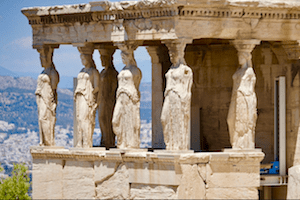
Caryatids near the Parthenon.

Perhaps this lack of any “sense of imminent collapse” suggests that even this advanced sculptural type can reveal only so much truth. Or it may just as well be the unknown artist’s expression of “Hellenistic humanism in its deeply moving ennoblement of a barbarian adversary” – who, perhaps, refuses to die. (Leaving aside the words “barbarian adversary,” this may perhaps bring to mind imagery from yesterday’s moving speeches at Normandy commemorating the 75th anniversary of the D-Day landings.)

There is much more about The Dying Gaul to come in Leigh’s lecture. For those intrepid enough to dive in with Leigh, I have added a PDF of his text at the end of this post, pending the inclusion, soon, of his taped lecture on the video page of the ICAA chapter website, where there are already other videos of past Bulfinch keynotes.

Leigh carries the fascinating story of the evolution of sculpture much further, from ancient times to the decline of figurative sculpture leading into the 20th century. The progress made by the ancients, he writes,

involved a sort of feedback loop between the development of the Greek sculptural canon and the Greek architectural canon. The classical architectural orders were originally conceived as articulating the support of massive weight in pictorial terms. … The clear hierarchy of parts the classical Orders manifest, starting with their division into base, shaft and capital and continuing on to the subordinate elements within each division, contributes to their legibility. … The Caryatids [the feminine columns of the Erechtheion near the Parthenon on the Acropolis] and their marvelous crowns are endowed with a structural clarity akin to that of the Orders and likewise read well from a distance, thus bearing witness to the historic interaction between sculpture and architecture.

Screen Shot 2019-06-07 at 4.05.04 PM.png

The Parthenon, in Athens. (holdinthedonut.com)

Please, reader, excuse my slant toward architecture in quoting from Leigh’s lecture. I cannot resist, especially when he describes some interesting features of the Parthenon. Here is a passage of thrilling description:

I’ve mentioned the feedback loop between classical sculpture and architecture, so I’d like to comment briefly on how this culminates in the architecture of the Parthenon. Like archaic statues, Greek temples, of which the Parthenon is universally recognized as the greatest, were quadrifrontal entities. The Parthenon, however, was situated on the Acropolis in a way that emphasized oblique rather than frontal views, allowing it to read more spatially. Architectural adjustments for optical effect, employed on earlier Doric temples, were applied with greater subtlety at the Parthenon. There were many such adjustments, but to cite just a couple, the slight doming of the Parthenon’s floor was accompanied by the rise of its entablature toward the middle on all four sides and the very slight inward tilt of its colonnades and walls—actually a diagonal tilt of a little over two inches in the case of the corner columns. The almost imperceptible swell or entasis in the shafts of the Parthenon’s columns—amounting to three-eighths of an inch on shafts 34 feet tall—conveys a subconscious sense of organic life while the resulting column profiles discourage the eye from a simplistic upward movement. While the Parthenon, like the Dying Gaul but at a much larger scale, acts with magnetic force on its environment, its columns’ inward tilt generates a tension—a countervailing outward thrust.

I have always preferred, as the explanation for entasis, the one Leigh adduces here that such swelling expresses the bulging muscles caused by the work of lifting performed by columns, as opposed to the one that suggests (as he also notes) it was meant to correct the slight errors in the optics of the eye as it perceives a building like the Parthenon. Yawn! He adds:

And even if it registers at the subconscious level, [such optical manipulation] further removes the Parthenon from the realm of commonplace experience and instills in the sensitive viewer a state of heightened awareness that the sculptural decoration, itself unsurpassed in Western art, could only reinforce. Such states of intensified consciousness are of course conducive to reverence and even awe.
Screen Shot 2019-06-07 at 5.37.55 PM.png

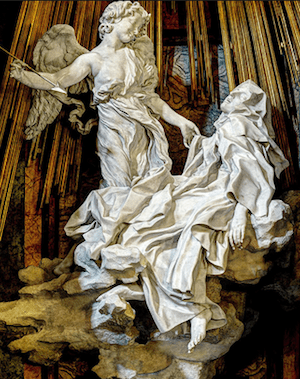
St. Teresa in Ecstasy. (Fine Art America)

Leigh describes the simplification of figurative sculpture in the medieval era, and then in the Renaissance a return to the highest of ancient practices, and then (if I am following him correctly) – … excuse me for a sec, but I cannot resist Leigh’s passage on Bernini’s St. Teresa in Ecstasy, which brings to mind his earlier comments on how the essence of the human body is revealed, or not, by the clothing into which it has been carved:

A classical figure should wear his or her vesture rather than vice-versa, but St. Teresa’s body is submerged in a theatrical pile of drapery that takes on a life of its own apart from the form underneath, with the deep folds creating spectacular chiaroscuro effects. Only the saint’s head, hands, and feet are exposed.

– … and then dips again with the advent of photography. Leigh has some pithy remarks on that:

Photography, which appeared on the scene around the time Rodin was born, played a decisive role in marginalizing the classical idea of the human figure as a thing-in-itself of great complexity—as an entity logically prior to the incidence of natural light though by no means worked out, as the design of drapery shows us, without regard to the effects of light. Thanks to photography’s influence, the figure was ever more relentlessly condemned, like everything else within the artist’s purview, to the status of an optical byproduct of reflected light, and academic training swiftly accommodated the new dispensation.
Screen Shot 2019-06-07 at 4.02.22 PM.png

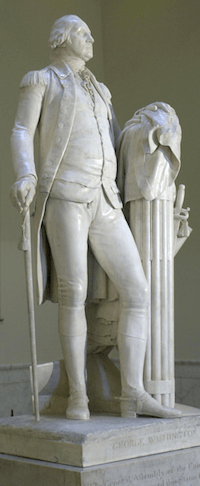
Washington, by Houdon.

Leigh goes on to describe the work of Augustus Saint-Gaudens as reflecting this trend away from the Renaissance revival of a deeper figurative sculpture; yet he draws attention to finer work: He praises Jean-Antoine Houdon’s “thoroughly classical” George Washington that stands in Virginia’s capitol at Richmond, which he calls, “pound for pound, the finest statuary monument in the United States.”

Of the long decline in the most expressive forms of sculpture, Leigh writes:

Needless to say, Bernini, Canova, and Saint-Gaudens were exceptionally gifted artists. There is a noteworthy common denominator in their work, however: the artistic methods they adopted were less demanding—requiring less time and labor in the design and modeling of the figure—than those espoused by the likes of Michelangelo and Houdon. But the more pictorial outlook they adopted was also the more natural outlook, given the mechanism of human vision.

Leigh concludes with the sad suggestion that we may never again see new sculpture that matches the level of artistic competence and beauty of the ancients or the Renaissance. He praises the work of certain traditionally classical sculptors of our time, but offers a parting shot that could hardly be surprising to those listening to him that Saturday in April at the Harvard Club before the Bulfinch gala. He concludes, however, with something more hopeful. I will conclude this post with the entire passage:

Modernists have long since concluded that, because photography has nature covered—which, of course, it doesn’t—classical standards of competence in the representation of nature are obsolete. To be sure, such standards could hardly be permitted to undermine modernity’s, or the modernist artist’s, self-esteem by the time Picasso burst onto the scene after the turn of the last century. But now more than ever, we have dire need of a pedagogy, both art-historical and strictly artistic, that gauges classicism’s unique significance.

We need a pedagogy that challenges pupils to understand an elementary truth that has sailed right by the privileged guardians of our cultural anomie: that in the final analysis classicism does not conjugate as a style, but rather as a distinct way of seeing nature—and the human figure above all—that is unique to Western civilization and has manifested itself in a variety of arts and artistic genres over a very long period of time, immeasurably enriching humanity’s cultural patrimony. We need a pedagogy that recognizes that to speak of classicism’s exceptional status is to speak with regard not only to the art of other cultures but also to the art of the West itself.

Because it involves a grasp of form that is unnatural in terms of the way we are hardwired to see the world, classical discipline is especially conducive to representing nature in a way that transcends our ordinary experience of the world. This doesn’t mean pictorial modes of perception are irrelevant to classical representation. Nothing could be further from the truth. The point is that the classical standard, having its origins in the Greeks’ abiding awareness that what we see and what is are two different things, is not only grounded, first and foremost, in reality—but is also the key to the creation of what we might call an intensified reality, a higher reality.

Classical Except’sm Lecture 042719

Posted in Architecture | Tagged , , , , , , , , | 2 Comments

Streamline? No. Steamroll

Screen Shot 2019-06-04 at 11.07.15 AM.png

Rhode Island State House. (rilin.state.ri.us)

Senate President Dominick Ruggerio will hold a meeting later today – 4 p.m. in Room 313 – on his legislation to “streamline” the development process for projects on state land in every city and town in Rhode Island. This is not really an effort to make the process more efficient. It is an effort to violate the right of the public, though local governments, to influence what is built in their communities.

Make no mistake. This legislation was birthed in anger by Ruggerio, who feels personally affronted by the success, so far, of opponents of the Fane tower project on Route 195 land in Providence. Assuming that his care for workers is his main interest in this matter, he has allowed the priorities of his day job as a labor leader to undermine his duty as an elected officer of the state to protect the rights of his own constituents and, as president of the state Senate, those of all Rhode Islanders.

According to an April 11 Senate press release, the legislation would:

[Establish] a process for creating Special Economic Development Districts on state-owned tracts of 20 or more contiguous acres. These special districts would be vested with the authority to adopt development plans that include land use, location of buildings, street systems, dimension and height requirements, parking, landscaping, design review and population density.

In brief, it would take over those responsibilities from any of 39 Rhode Island cities and towns where the state wants to develop land itself or promote private development on state land of 20 acres or more.

Most projects go through easily, as did the Wexford Innovation Center right across the street from the proposed Fane tower. But when a project tries to violate local rules – such as the 100-foot height limit mandated by zoning on land proposed for that tower – the process becomes more complicated and time-consuming. The Fane developer was able to get a weak Providence city council to override a mayoral veto and raise the height limit to 600 feet, but that took time, cost money, and generated a lawsuit.

Efforts to game the system usually take more time, especially if intelligent local civic leaders and groups, such as the Jewelry District Association and its allies in the Fane case, are alert and try to force developers to obey the law. This does not mean that the development process is inefficient and in need of “streamlining.” It means the process is working. Ruggerio’s legislation is not about streamlining the process, it is about steamrolling the process.

Let’s hope many people show up at the State House today for a show of strength against this proposed effort to silence the voice of the people in their own communities.

Posted in Architecture, Development | Tagged , , , , , | 5 Comments

Nightmare on Smith Hill

Screen Shot 2019-06-01 at 6.12.10 PM.png

Initial design concept for proposed new Rhode Island State Archives. (DBVW Architects)

Last night I had a dream so disturbing that I woke up, got out of bed, and sat at my computer to memorialize it. This was about 5:30 a.m. With minor clarifications and omissions, my memo reads:

Dreamed I was walking along the Providence waterfront and entered a new segment of the Capital Center district that had a ramp leading into a low concrete space in its bowels that turned out to be my apartment, with large plate-glass windows. You could see in from the ramp, and I saw my dear mother in the apartment kneeling on my living-room rug, arranging something. We went in but by then Mom, who died in 2004, was gone.

I was with a reporter or a public official who was examining my place for some reason unknown to me. She was dismayed at the ugly view of a wet concrete trough outside one of my windows. I said I liked it. Then she pointed from a bigger window down to a highway with many cars passing below. I said I liked that, too. We looked up approvingly at the Providence skyline through a slanted window along an upper edge of my apartment.

Somehow it occurred to me that I had not paid any rent for a long time, but then I remembered that I had agreed to allow a music entrepreneur to store his audio tapes there in return for paying my rent, but I hadn’t seen or heard from him in forever, nor had I been bothered for my rent money. Then I recalled that someone else had made the same sort of deal with me. Then I stumbled upon the audio tapes stored in an archival chest with a label – “Charles Morial” – their owner [nobody I’m aware that I know in real life]. Then I pulled from a storage unit a file of old, black-and-white photographs of Providence.

Then Bob Whitcomb [a former editor at the Providence Journal and the only person whom I recognized in the dream, aside from my mother] entered with a small group of people and sat down at a table, as if part of my apartment were a restaurant. They did not seem to notice my presence. For some reason, I suddenly began to wonder whether I was going to be evicted. Then I woke up.

What could this dream have meant? Nothing, probably, although my positive assessment of my “apartment” and its nastier views is very strange. The brief appearance of my mother through a window was a blessing. But if I could don my Freudo-Jungian cap for a moment, allow me to speculate that the dream might be about one or both of two things:

  • First, it could be about the ridiculous, copy-the-past design of granddaddy modernism for a new state archives building proposed by Rhode Island Secretary of State Nellie Gorbea – right across Smith Street from the State House. Fortunately, nobody in the administration or legislature seems the least bit eager to fork out the $52 million in state funds she says it would cost.
  • Or, second, it could be about the legislation proposed by Dominick Ruggerio to strip every Rhode Island municipality of its authority over the zoning and design of any major state project of over 20 acres in their jurisdiction. The bill is designed to grease the skids for the Fane tower but might also be used to turn the State House lawn into a parking lot, if the capitol and grounds exceed 20 acres. A hearing about the bill is scheduled for Tuesday at 4 p.m. in Room 313.

Either possibility qualifies as a nightmare.

Screen Shot 2019-06-01 at 6.12.53 PM.png

Visitor’s center space for proposed archives. (DBVW)

Posted in Architecture | Tagged , , , , , , , , , | 8 Comments

‘Spirit of the age’ bugaboo

Screen Shot 2019-05-29 at 8.19.25 PM.png

David Watkin in Chicago for Henry Hope Reed Award ceremony. (Architects Journal)

Among the most inane of modern architecture’s founding conceits is that buildings reflect the spirit of the age. If a building truly reflects the spirit of the age rather than, as most people would expect, its architect’s desire to express his own particular talent, how can one architectural period possibly supply buildings of different styles, as is always the case? This would suggest that a period may have competing spirits, which of course torpedoes the very idea of an identifiable spirit of the age.

For months I have immersed myself in the thinking of Prof. James Stevens Curl, author of Making Dystopia, published by Oxford University Press. As part of that immersion I am rereading a book by one of his favorite authors, the late David Watkin, his friend and fellow British architectural historian. Morality and Architecture Revisited*, published in 2001, is a reprint that added his reaction to the largely but not completely negative establishment critique of the original book’s publication in 1977. In a letter to Watkin, the eminent architectural historian Sir John Summerson wrote:

I admire the book greatly. It is the most important piece of writing on the philosophy of architecture that has appeared for a very long time. But do I agree with everything you say? Well, yes, I think I do. I have the feeling that you have written an obituary of ideas which have wilted and died without many of us realizing that this is what has happened.

The ideas were stillborn, but the modernists and their acolytes have kept them on life support, so to speak, hiding their intellectual weakness in the same closets where the founders’ relations with the Nazis are kept.

Sir Karl Popper, the eminent philosopher, wrote: “I find this important. The irrelevance and emptiness of the Zeitgeist philosophy” – essentially the same idea that each period in history has a distinct spirit of its own – “is shown very powerfully in your book.”

Watkin, who died last year, and whom I met in 2013 in Chicago, where he was celebrated for winning the Henry Hope Reed award (given in association with the Driehaus Prize), was disappointed that so many of eminence who expressed admiration for his book privately did not do so publicly. This is no surprise. The modernist establishment, or cult, is ruthless, even if its power may be on the wane. Even today, though, many of the most dire opponents of speaking truth to modernist power are classicists themselves, who fear anything that might discomfort the reigning apparat. Such bad manners!

Still, I imagine Watkin’s book would get similarly tentative applause from many classicists today, as I suspect has been so with Professor Curl’s book, which has been roundly condemned by the usual suspects. Stevens Curl gores oxen with his terrible swift pen, as Watkin did 41 years ago.

Whereas Stevens Curl in his book describes in detail the “strange rise and survival of architectural barbarism” (its subtitle) and indicts each rascally turn in modernism’s sordid history,  Watkin’s book dissects the “spirit of the age” bugaboo line by line from architectural historians – Lewis Mumford, Sigfried Giedion and, especially, Nikolaus Pevsner – who struggled to fortify the mush of Le Corbusier’s thinking. I would say that Watkin inflicts the death of a thousand cuts, except that each sentence is a stab in the heart.

To give you an idea, here is an example in which he critiques Giedion’s writing about the spirit of the age:

[O]ne can surely be suspicious of the implication that the historian owes less to documentary evidence than to inspiration by the spirit of his age. According to this view, … the historian is not capable of discovering truths by the scholarly exercise of a disciplined mind, but is merely a vehicle of the spirit of the age or of class interests or of the collective subconscious. Basic to this interpretation of history is a belief not merely in the spirit of the age but that the spirit expresses itself through men, rather than that men themselves create and constitute the spirit of the age and are able to help choose what it will be. It is a view which sees art and architecture as an inevitable reflection or expression of something else outside its creators.

Without a single particularly memorable sentence or phrase, the passage is priceless and suddenly “the spirit of the age” is history. After reading it, no thinking person could possibly credit it as anything but nonsense.

Two decades ago, as the guest of Roger Scruton, I heard Watkin lecture in London. I have no recollection of what he said because the Prince of Wales had just that very day announced that a modernist had been hired to run his architecture school. The many fans of Charles and of Watkin in the audience were cast into deep funk by the news. It just occurred to me to wonder whether Professor Curl was among them.

[*I have linked to the original version because a copy of Revisited runs into the hundreds of dollars.]

Posted in Architecture, Architecture History | Tagged , , , , , , , , | 2 Comments