Read-Ott House, RIP

Remains of Read-Ott House after partial demolition on Monday. (Photo from Valley Breeze)

After years of effort by those who wished to save it, the Read-Ott House succumbed to demolition on Monday by its owner, the Assumption of the Virgin Mary Greek Orthodox Church next door to it on Walcott Street, in Pawtucket’s Quality Hill historic district. It may seem a bit much to point the finger of blame at the church and its fathers, but there it is.

Nobody seems to know what will become of the patch of earth on which Read-Ott stood so proudly since its construction in 1842. In all likelihood: parking.

Designed in the Italianate style, Read-Ott was built for hardware shop owner John B. Read and then remodeled for Joseph Ott, founder of the Royal Weaving Co. A third story, an expanded portico, and classicizing details were added early in the 20th century by architect W.G. Sheldon after the house was sold to Ott by Read’s widow, Jane Thatcher Ingraham.

The church’s efforts to be rid of the house apparently began in 2012. It was occupied for a period by a church official. The city of Pawtucket offered the church $500,000 to restore the house, but was turned down. A six-month period was officially dedicated by the city to consider options for saving the house, or whatever, and it elapsed in 2023.

The church claims it would have cost $10,000 every five years just to keep the house painted. To renovate it would have cost millions on top of that, which the church arguably does not have. But the city was remiss in failing to do more to save the Read-Ott House. Pawtucket does not recognize that in saving Read-Ott, it would have been saving itself. Instead, Pawtucket throws its scant resources away on a soccer stadium, and on a pointless new and gargantuan high school, supposedly to replace Tolman and Shea.

Unlike Pawtucket’s neighbor to the south, Providence, it is difficult to recall how rich and powerful it used to be before it was sliced by Route 95 (Providence suffered that indignity as well) and shredded (much more so than Providence) by modern architecture. Without the insult of modern architecture, Pawtucket might still rival Providence in prosperity – or at least might have measured its decline step by step with that of its southern neighbor.

The quality of historic houses in Quality Hill and elsewhere in the Bucket testify to the city’s long lost prosperity. Its downtown once closely rivaled that of Providence. Both northern cities have failed to keep up with Newport in its laudable dedication to its own preservation. Newport is an 18th century city; Providence and Pawtucket are 19th century cities. Modern architecture tells the tale. In ten years, Providence, which has rededicated itself to modernism in recent years, may catch up to Pawtucket in its decline, which is already well under way.

Pawtucket and its leading institutions have shown their lack of seriousness as a city by letting the Read-Ott House go. So, no, let’s not blame the church alone. There is enough blame to go around. For shame!
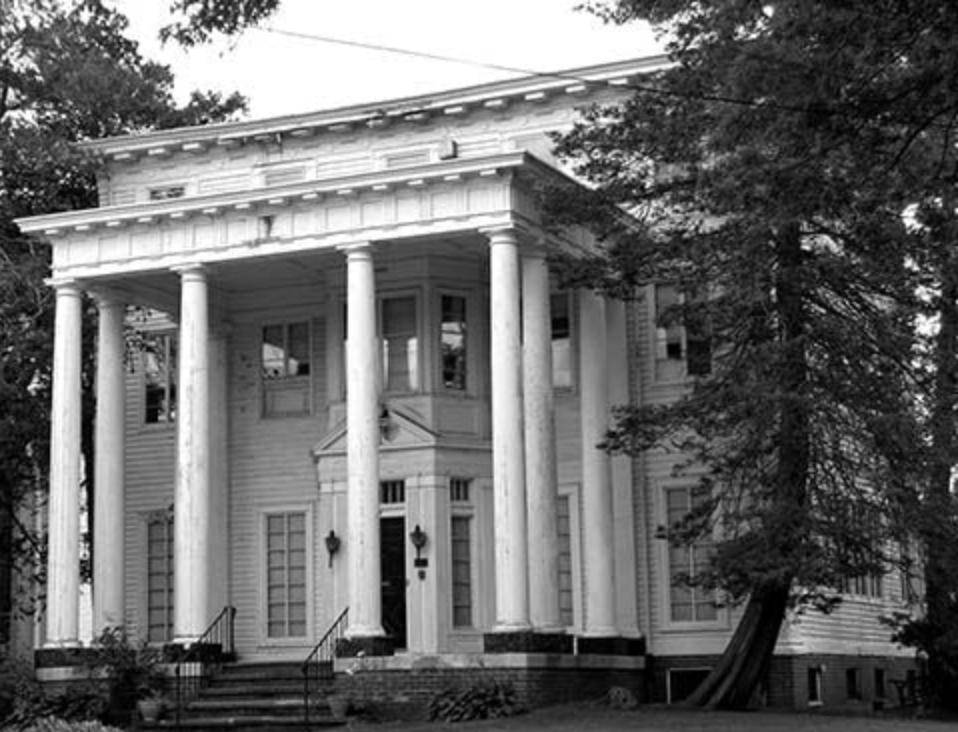
Read-Ott House’s after rnovation in 1915 or thereabouts, with two-story portico.
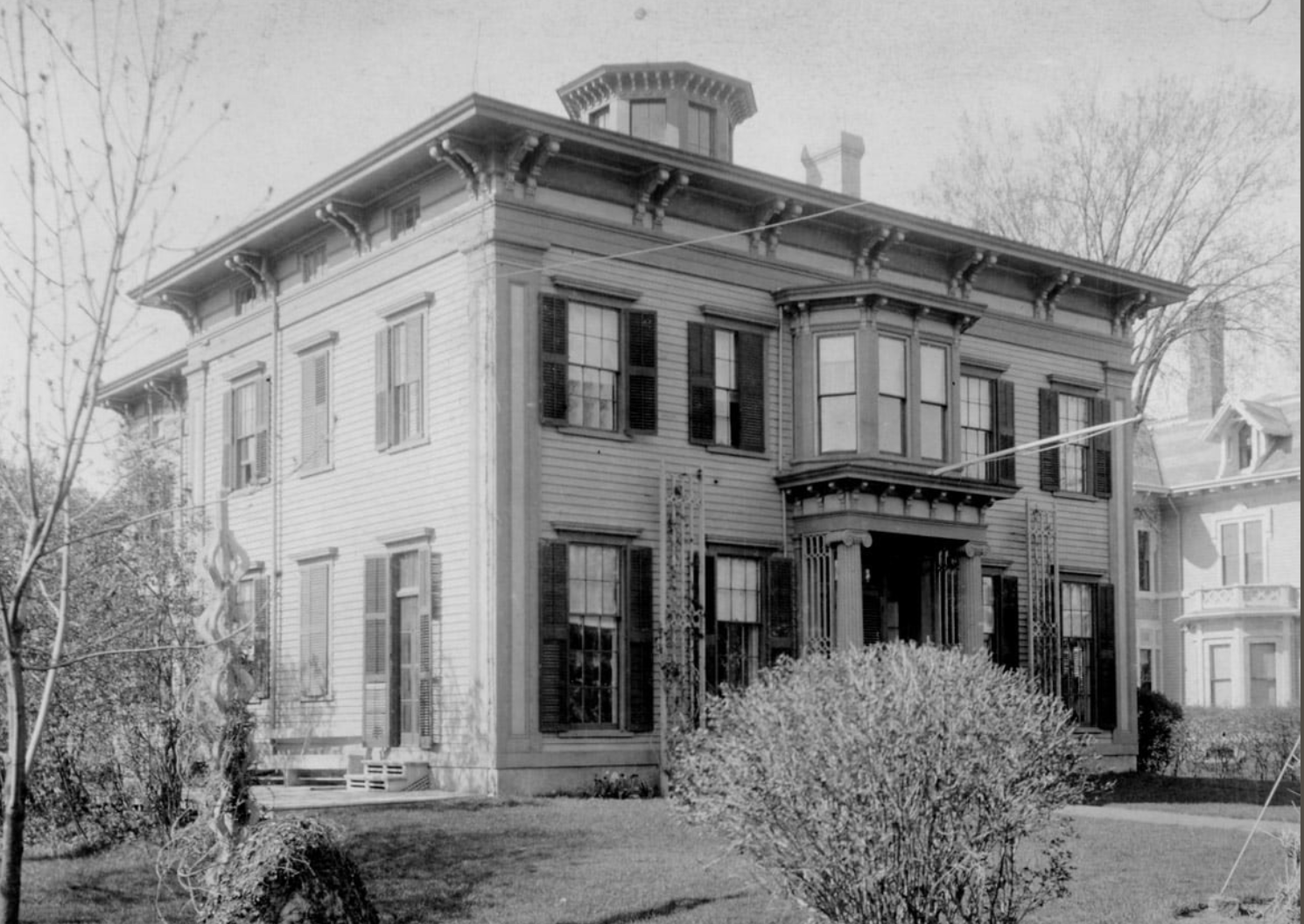
Read-Ott House after renovation in early 20th century by its new owner, Joseph Ott.
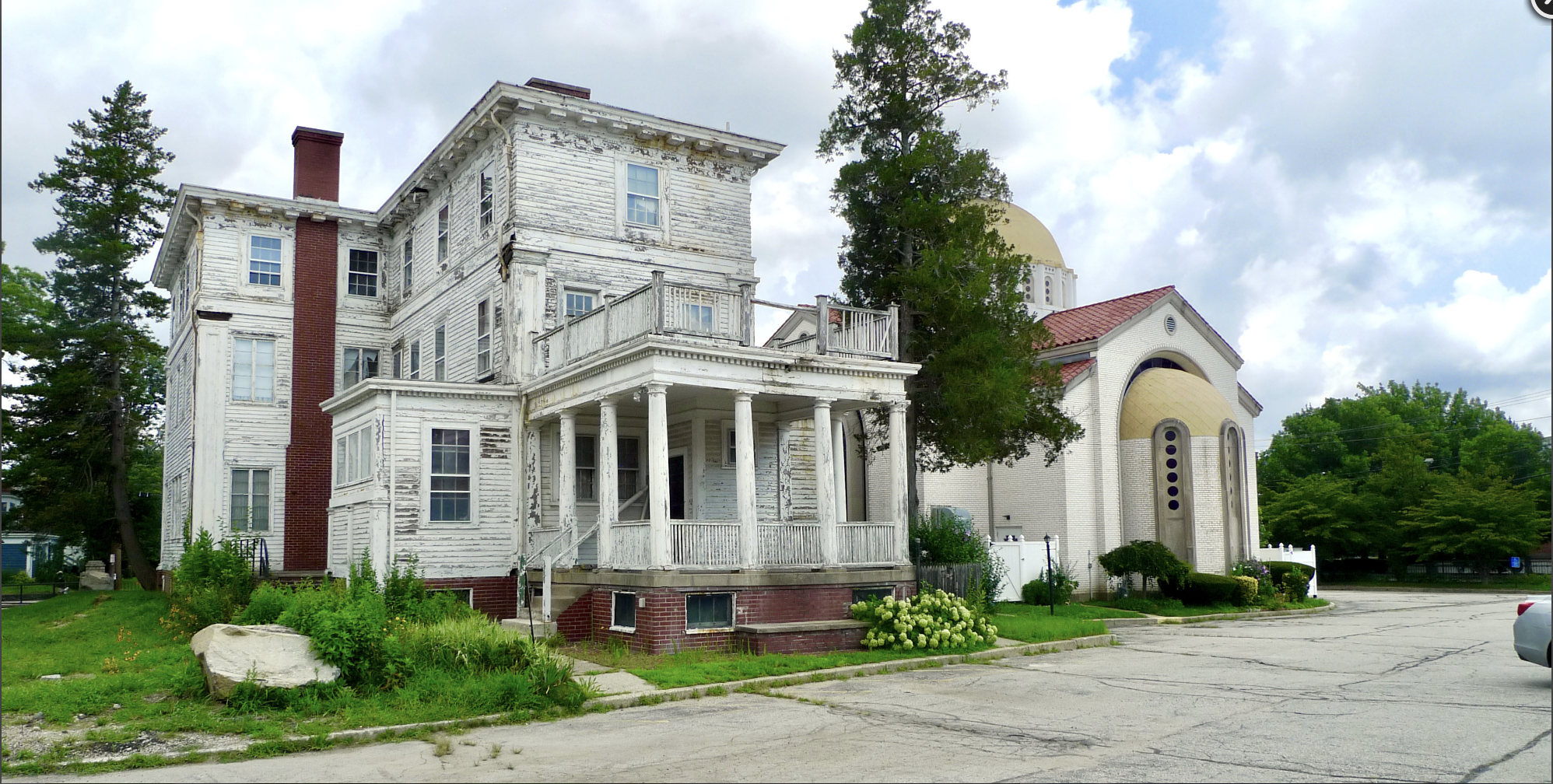
Rear of the Read-Ott House prior to demolition in August 2024. Greek Orthodox church at right.

Posted in Architecture, Architecture History | Tagged , , , , , | 3 Comments

My guess on Penn Station

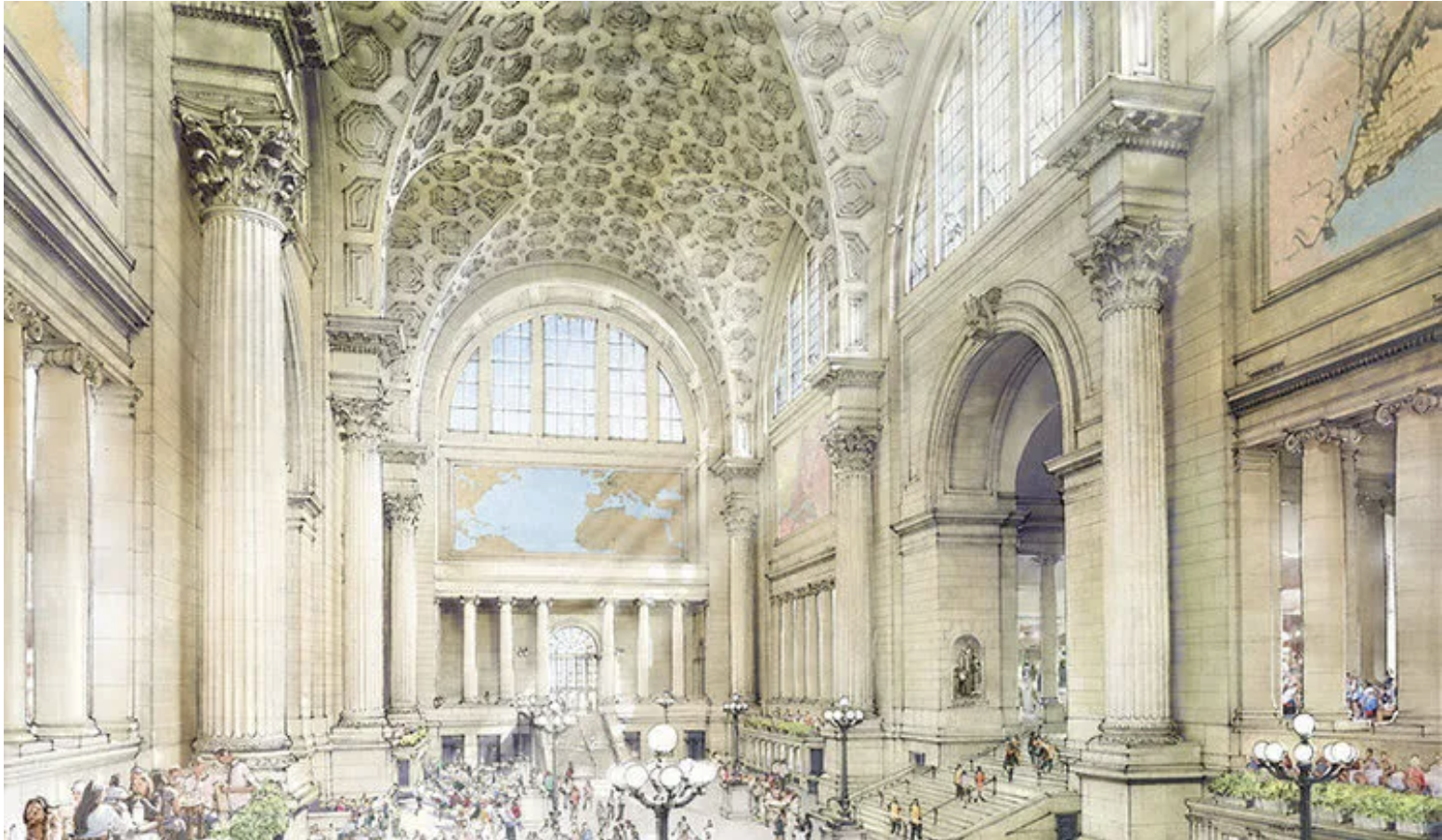
Rebuilt waiting room at the proposed new Penn Station. (By Jeff Stikeman for Rebuild Penn Station)

Not much news lately on the idea of rebuilding Pennsylvania Station as it was originally designed by architects McKim Mead & White in 1910. The station was torn down in 1963 and replaced by the existing mess of a rail hub, underneath a hulking sports arena.

An excellent and eminently feasible proposal to rebuild the old Penn Station is being pecked to death by ducks.

Surveys suggest that rebuilding Penn Station would be popular – more so than several rival proposals, some better than others, but none with the advantages of rebuilding the old station, updated to adapt to today’s market realities. Restoring its vaulting beauty would bring economic benefits unlike those of any other major development project imaginable today.

Instead, New York’s city and state leaders want to surround a half-assed renovation of the station with ten supertall office buildings – doomed to remain empty as long as the work-from-home phenomenon prevails, undermining the real-estate market possibly for decades.

At a forum yesterday sponsored by the Regional Plan Association and the Municipal Art Society, the convoluted and probably corrupt railroad interests (Amtrak, New Jersey Transit and the Metropolitan Transportation Authority) argued weakly against “through-running,” the concept of treating Penn Station as one stop in a series of stops, as opposed to treating it as it is now: a terminus. Through-running, which many cities in Europe and Asia have embraced, would connect Penn Station and its regional railroads together with far greater efficiency than the current tangled “system.”

The train interests have been coy and secretive about the details or lack of details in their plan, if they even have one. The public deserves to know much more about their plan.

My own interest, and I suspect that of most readers here, is to rebuild Penn Station as it was originally designed. That would boost the regional economy even more than through-running, which – don’t get me wrong! – is a damned good idea. But it seems to me that the idea of rebuilding Penn suffers when the concept of through-running is emphasized by those who back rebuilding the station. Through-running is a worthy, transformative idea, but it lacks pizzazz. Once rebuilding Penn has been settled upon as the main goal, once the idiotic idea of demolishing a whole block of Manhattan south of the station and surrounding it with ten more towers has been jettisoned, and once Madison Square Garden has been relocated, the project of rebuilding Penn would pave the way for New York to adopt through-running quite easily and naturally. But first there’s a lot of work to be done: focus on the big picture, please.

A simple and great idea would run interference for a great but complex idea better than the other way around.

It grieves me to say this, as I am a great fan of ReThinkNYC, whose chairman, Sam Turvey, has been pushing both ideas. He wrote about the forum here. Lately, he seems to emphasize (and overemphasize) through-running at the expense of rebuilding Penn. The railroad interests are finding it easier to kill through-running than to kill the grander idea, in my opinion, because it lacks the glitz that rebuilding Penn would provide. Rebuilding Penn Station would ensure that through-running goes through – and ensure that ramming more towers down the city’s throat will not happen.

Drawing illustrates through-running proposal at Penn Station and its region. (ReThinkNYC)

Posted in Architecture, Development | Tagged , , , , , , , , | 10 Comments

Olympic start was a bit off

The River Seine in Paris all decked out for the Summer Olympiad. (Paris 2024)

Many around the globe had hoped to be thrilled by this year’s opening ceremonies at the XXXIII Olympiad. The beauty of Paris offered splendid opportunity, if organizers had only let Paris be Paris. But sadly, it was not to be.

The ceremony, with the famous bateaux mouches cruising down the River Seine with the Olympic teams of 205 nations aboard. It was the first Olympic ceremony not held at an Olympic stadium. And it was, I believe, the first to feature the host city as the centerpiece of the ceremony. It was an opportunity not to be lost … but lost it was.

Opening day began with a coordinated arson attack on the French TGV, or trains à grandes vitesse, stranding thousands of Olympic opening ceremony goers at stations throughout France. Its origin, presumably Islamic terror in support of Hamas, is being investigated.

The ceremony mixed the Parade of Athletes along the river in boats big and small with various artistic presentations on the Seine embankments. Some were more successful than others, but the choreography was abysmal and the costuming was worse. It might be an overstatement to say that the overall character was represented by a portrayal of the biblical Last Supper enacted by drag queens.

It is easy but perfectly accurate to blame much of the worst of the opening ceremony on the NBC team broadcasting the event for the American viewing public. The “Good Morning America” duo gushed and drooled throughout the festivities, and it was painful to hear their ridiculous gabbling with the endless string of tedious celebrities throughout the evening or their comments on the countries as their national teams floated by, getting soaked in the steady rain, often amounting to a downpour. They gamely danced and waved their nations’ flags, but you could tell they were not happy troupers.

The NBC duo seemed to be addicted to one of the “artistic” flourishes of the ceremony – a costumed sprite running along the roofscapes and through buildings en route, the symbolic meaning of whose costume we did not catch and was not clear. Again and again all evening the duo returned to his jaunt, and one almost wished he would trip on one of the raised ridges of the Parisian roofscape.

Cricket presenter Alan Wilkins wondered, “Is this the worst-ever opening ceremony of an Olympic Games? Absolute garbage to deliver to a global audience.”

“Garish, ghastly, and vulgar in the extreme. European culture down the plughole with the chain pulled. You don’t have to look far to see the Game is Over, with every bloody fool pandering to the lowest common denominator.” Such was the view of Professor James Stevens Curl, author of Making Dystopia: The Strange Rise and Survival of Architectural Barbarism (2018).

Oh how we missed the usual parade of athletes from past Olympics as the nations’ teams flowed (or trickled) in semi-orderly fashion into the Olympic arenas, around the running tracks and up to their places in the stands. This ritual every four summers and every four winters always fascinates, with viewers at home anticipating their favorite nations’ teams going by. In these displays the characters of the various nations and the antics of the teams were on full display, while the inanities of the broadcast booth were given minimal outlet. May this parade be resumed at the next Summer Olympics in Los Angeles!

The embankments of and bridges over the Seine featured applied decoration, some of it quite artful and other bits hopefully quite temporary. Some of it, new and overpolished, may eventually attain the grace of weather and time.

Views of Paris and its roofscapes and streetscapes delightfully charmed the television audience. Occasionally, modernist buildings loomed in the background over the Haussmannesque architecture of the latter half of the 19th cntury, but they did not succeed at killing the overall sense of beauty.

All in all, the evening was a disappointment, but it is likely that had it not been Paris but some other city, it would have been as garish and commercialized as you would expect, since national cultures around the world are in a race to the bottom, and no city likely to host an Olympics is likely to escape its fate, hastened by each nation’s version of “Good Morning America!” But at least we can hope that the Angelenoes will not botch their turn at the Parade of Athletes, even if it is broadcast from the Entertainment Capital of the World.

Posted in Architecture, Art and design | Tagged , , , , , , | 6 Comments

Another one bites the dust

The IGA at the bottom of Pitman Street, in Providence.

Stop & Shop, owner of Eastside Marketplace (or, to many of its longtime shoppers, the IGA, Independent Grocers Alliance), will shut down the market on or before Nov. 2. That is a shame and a tragedy for my family, which has tried to avoid the Whole Foods Market, owned by Amazon.com, the most logical alternative, which has two stores on the East Side alone, including one just half a block from the IGA.

That probably reduces the likelihood of another grocery replacing the IGA. But at least it is unlikely to be another shoe store.

I refer to the closure about a decade ago at Providence Place, where its Borders bookshop employed my wife Victoria until she gave birth to our son Billy. We were hoping that the old Borders space would be a good place for a Barnes & Noble closer than Route 2 in Warwick. Alas, no dice. Instead, we got a Designer Shoe Warehouse. I used to visit Providence Place four or five times a week, often to see a movie or visit Macy’s. I always stopped in at Borders, but now I rarely visit the mall, and I assume there are many more like me. I wonder whether the mall’s manager was sacked for such a stupid choice to replace Borders – though I must admit that the mall seems to be thriving now. Victoria, Billy (now 15) and I saw the new Minions movie there last night, and the shopping parts of the mall were hopping.

Maybe a new book store will open up in the IGA space when it closes its doors this fall. Not likely, I suppose,  and frankly not a good idea, with Books on the Square just a stone’s throw away, but there’s always room to hope for a Dave’s (which is IGA-owned), or an ALDI. Is not “Hope” the Rhode Island motto, after all?

Probably, though, we’ll get another shoe emporium anyway.

We’ll have to wait and see. So it goes.

ALDI bills itself as a source for “quality food [at] everyday low prices.” True, it costs a quarter to rent their shopping carts, but I think you get it back when you return the cart – it’s not really clear in the “about” segment of its website. There are nine ALDIs in Rhode Island – in Rumford, Johnston, Middletown, North Smithfield, Warwick, Westerly, two in Cranston and at 539 Smith Street in Providence.

Our family will probably do most of our shopping at first at Whole Foods, in the University Heights shopping center, where long ago I was assaulted by a guy who believed (falsely) that I had cut him off as I entered the plaza’s parking lot. I had gone to grab some nosh for that year’s Super Bowl at a friend’s house nearby. This was back in the ’80s, after I was hired by the Providence Journal. There was a silly court proceeding at which the perp was fined $75 in restitution for my broken glasses. I suppose my black eye and bloodied cheek were considered priceless by the judge. Remember Philippe & Jorge? They wrote that they had raised $300,000 for my assailant’s “defense fund.” Fake news! P&J disliked me for my weekly column in the Journal, which during the ’80s was not on architecture but on politics and culture. The Star Market’s rent-a-cop in those days was Rodney Patterson, head of the Providence police union. He nabbed my assailant, who after decking me had gone in to do his shopping. A kindly local photographer had seen the incident and had come over to help me and then, I rhink, poinred him out to security.

But I don’t trust Whole Foods, which is owned by Amazon. I don’t want to accidentally pop some health food in my basket – though last night I attended a birthday party where the food, though healthy, was free. But it was delicious, and that was an eye-opener for me.

Who knows. Maybe the owners of the IGA will change their minds about closing it down. Stop & Shop: My first wife used to call it Slop & Plop. Well deserved, considering how far down its selection had fallen since Stop & Shop acquired the IGA maybe a decade ago. I hope the employees get a fair shake from the owners. They (the former, not the latter) are a good bunch.

Posted in Uncategorized | Tagged , , , , , , | 2 Comments

Fourth of July in Providence

“Declaration of Independence” (1819), by John Trumbull.

As a blogger, I am remiss in not having posted for a month and a half, nor have I explained that what I cannot attribute to laziness I may attribute to writing a book, my first since Lost Providence (2017). This second book is now 98 percent written.

Okay, having got that over with, I think it appropriate on Independence Day to refer to the meaning of the name of the city of Providence. Although we Rhode Islanders are more familiar with the name’s derivation from founder Roger Williams words “having a sense of God’s merciful providence unto me in my distress” (he had been banished from Massachusetts), I like to think of it in the sense of providential, either opportune or divinely inspired. The two are not contradictory.

Rhode Islanders take more pride from being the first colony to declare independence from England than from being the last of the 13 former colonies to ratify the constitution of 1789.

My sense of the meaning of Providence relates to the fact that Rhode Island is one of only two American states, so far as I know, that were independent countries before they became states. The other was Texas. I’m not sure how one would classify pre-statehood Hawaii, and I do not include the insurrectionists of 1861. I wonder how Rhode Island thought of itself during that period, after twelve of the rebel colonies had ratified the United States Constitution by 1789, but not Rhode Island.

In 2018, Rhode Island History Journal ran an essay by historian Robert W. Smith called “Algiers or St. Eustatius: Foreign Affairs and the Ratification of the Constitution in Rhode Island.” He writes:

Two paths seemed to lie before Rhode Island if it did not ratify the Constitution of the United States. A Federalist writer in the Newport Herald claimed that “the paper money leaders flatter themselves that their unfederal conduct in not sending Delegates to [the Constitutional] Convention and not permitting the people to meet to consider the new Constitution, may cause them to be thrown out of the Union, and then they will become the Algiers of America.” The Federalists made the idea of independent Rhode Island as a pirates’ den a recurring theme in their literature. [Of course, Rhode Island was already widely known as Rogue’s Island for accepting those banished from Massachusetts, from other colonies, and both religious and nonconformists generally.]

The writer went on to claim that, if necessary, Rhode Island’s leaders would seek British protection against the United States. Rhode Island’s fate would be sealed, as the United States would not permit that outcome. “Sooner than such an event should take place, we should see our country wasted with destruction, our fields drenched with blood, and our little territory parceled out among the adjacent states.”

In the limited amount of Anti-federalist literature, Rhode Island independence was more of an opportunity than a danger. An Anti-federalist under the name “Charlestoniensis,” who may have been Jonathan J. Hazard of the Country Party, responded to Federalist criticism. “I will observe that, in that case [that Rhode Island does not ratify], this state will not become an Algiers, as some malevolent scribblers in Massachusetts have impudently asserted, but a St. Eustatius.” St. Eustatius was a Dutch-owned island in the Caribbean that functioned as a free port – an “entrepôt for the trade between Europe and the United States.”

That is the argument for the sense of “Providence” as opportune. The other sense of divinely inspired we are all familiar with, so I will end here, not having finished this very long essay by Smith, and not certain where it leads.

Whether in the context of an “opportune” port such as Providence or in its sense of “divinely inspired,” the Declaration of Independence and the Constitution are worth celebrating today, and struggling, as ever, to protect.

We hold these truths to be self-evident, that all men are created equal, that they are endowed by their Creator with certain unalienable Rights, that among these are Life, Liberty and the pursuit of Happiness. That to secure these rights, Governments are instituted among mean, deriving their just powers from the consent of the governed.

Happy Independence Day.

Posted in Providence, Rhode Island | Tagged , , , , , , | 4 Comments

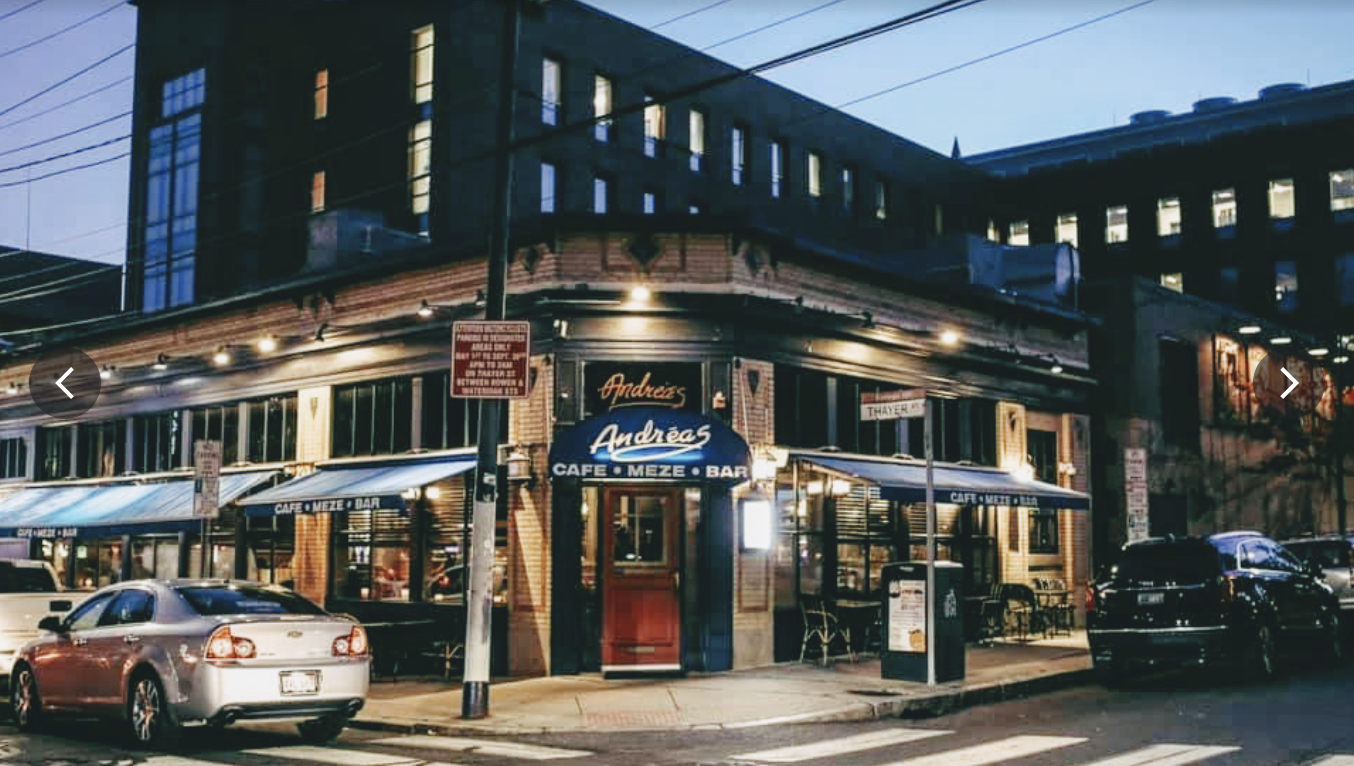
Andreas restaurant: RIP?

Andreas, which closed temporarily in 2022, now closed permanently?

Andreas Restaurant has reigned for decades as the favorite dining establishment on the East Side of Providence, R.I. Maybe not the best restaurant east of the Providence River, but surely the best on Thayer Street, often considered the Main Street of Brown University, and the first place most people turn to for a fine meal they needn’t cook for themselves.

We all have our favorite Andreas stories. I met my first wife, Tracey, there in 1990 (she was reading The Sheltering Sky [1949] by Paul Bowles.) I dined there often with my second (and last) wife, Victoria, whom I met at the IGA in 2003. I got behind her in the checkout line and asked her if I could help her eat the pile of Ben & Jerry’s ice cream she was buying. With an ex-boyfriend nearby, she politely declined, but I met her again and over the next year or so woo’d her and won her. That’s the very short version of a fine origin story, which I’ve probably told more than three dozen times over meals at Andreas with or without Victoria, whose family ate there whenever they wanted to eat out.

Andreas was famous for its comely waitresses. Now we’re not allowed to say that, but it was okay for many years until the owner, or one of the managers, or so I heard, got in trouble for favoring attractive waitresses. For shame! Lookism is, I believe, the name that the woke have given to my crime. But I got away with fondling Andreas’s waitresses with my eyes for at least three decades before I began to feel any guilt for my thoughtcrime. Never managed to ask any of them for a date. No touchee!

In the 1980s, I once dined outdoors at Andreas with the famous Soviet dissident Vladimir Bukovsky along with several student conservatives from the Brown Conservative Union, or some such title. For that matter, I think it was Bukovsky. Time fogs all rear view mirrors. Mine has been foggy for, I believe, seven decades.

Long ago, also in the 1980s, I began an evening of drinking with Sheldon Whitehouse, then Rhode Island’s junior U.S. senator, at Andreas. He had been introduced to me by my colleague at the Journal, Irving (“Shel”) Sheldon (no relation). We bumped into each other on the sidewalk outside of Andreas. Whitehouse and I started there and went on to The Hot Club, or some such place, where we met a tipsy young lady, name forgotten. Every other word she uttered started with the letter f. She and I left Whitehouse to his own devices and went to a downtown nightclub called One Step Down, where we planned to play a game of pool (this was, thank God, long before I had my own pool table overlooking the Plunder Dome at Loft 501 in the Smith Building, or who knows where we would have ended up and what the f I might have contracted). On our way into One Step Down, she met a gang of motorcyclists of her acquaintance parked outside. She began a-smooching them one after another to beat the band. I never saw her again, or at least not knowingly. I never saw Whitehouse again, either, I don’t think. No big loss. Shel and I are still friends.

Andreas closed down for seven months to remodel back in 2021, and reopened that November. Andreas first opened up in 1966 and has served authentic Greek fare ever since, along with tasty cuisine from elsewhere. It has long featured outdoor seating along Thayer and Meeting streets. In the warmer months the parade of pulchritude is no less than astonishing. All night long. Thayer is narrow so the parade redoubles on the other side, beyond an always annoying twin string of parked SUVs – always SUVs, it seemed – which always blocked the view. Were I king of Providence, I would enact legislation to ban SUVs from parking parallel to an outdoor scene on Thayer, or any other street with a sidewalk dining scene. That goes against my political instincts. In a foul mood, I would extend this ban to parking spots outside of window seating indoors. Go ahead, try me!

Well, Andreas’s phone is disconnected, and you can find a smattering of stories online that attest to its closure. I hope it’s not shut for good – though why remodel twice in four years? If it reopens, I’ll be back!

Posted in Architecture, Architecture History | Tagged , , , , , , , , , | 7 Comments

True: Andreas Restaurant, RIP?

Andreas Restaurant, offering Greek fare since 1966, though  closed (again) for remodeling. (facebook)

Andreas Restaurant has reigned for decades as the favorite dining establishment on the East Side of Providence, R.I. Maybe not the best restaurant east of the Providence River, but surely the best on Thayer Street, often considered the Main Street of Brown University, and the first place most people turn to for a fine meal they needn’t cook for themselves.

We all have our favorite Andreas stories. I met my first wife, Tracey, there in 1980 (she was reading The Sheltering Sky [1949] by Paul Bowles.) I dined there often with my second (and last) wife, Victoria, whom I met at the IGA in 2003. I asked her if I could help her eat the pile of Ben & Jerry’s ice cream. With an ex-boyfriend nearby, she politely declined, but I met her again and over the next year or so woo’d her and wed her. That’s the very short version of a fine origin story, which I’ve probably told more than a dozen times over dinner with or without Victoria, whose family ate there whenever they wanted to eat out.

Andreas was famous for its comely waitresses. Now we’re not allowed to say that, but it was okay for many years until the owner, or one of the managers, or so I heard, got in trouble for favoring attractive waitresses. For shame! Lookism is, I believe, the name that the woke have given to my crime. But I got away with fondling Andreas’s waitresses with my eyes for at least three decades before I began to feel any guilt for my thoughtcrime. Never managed to ask any of them for a date. No touchee!

In the 1980s, I once dined outdoors at Andreas with the famous Soviet dissident Vladimir Bukovsky along with several student conservatives from the Brown Conservative Union, or some such title. For that matter, I think it was Bukovsky. Time fogs all rear view mirrors. Mine has been foggy for, I believe, seven decades.

Long ago, also in the 1980s, I began an evening of drinking with Sheldon Whitehouse, then Rhode Island’s junior U.S. senator, at Andreas. He had been introduced to me by my colleague at the Journal, Irving (“Shel”) Sheldon (no relation). We bumped into each other on the sidewalk outside of Andreas. Whitehouse and I started there and went on to The Hot Club, where we met a tipsy young lady, name forgotten. Every other word she uttered started with the letter f. She and I left Whitehouse to his own devices and went to a downtown nightclub called One Step Down, where we planned to play a game of pool (this was, thank God, long before I had my own pool table overlooking the Plunder Dome at Loft 501 in the Smith Building, or who knows where we would have ended up and what the f. I might have contracted). On our way into One Step Down, she met a gang of motorcyclists of her acquaintance parked outside. She began a-smooching them one after another to beat the band. I never saw her again, or at least not knowingly. I never saw Whitehouse again, either, I don’t think. Shel and I are still friends.

Andreas closed down for seven months to remodel back in 2021, and reopened that November. Andreas first opened up in 1966 and has served authentic Greek fare since, along with tasty cuisine from elsewhere. It has long featured outdoor seating along Thayer and Meeting streets. In the warmer months the parade of pulchritude is no less than astonishing. All night long. Thayer is narrow so the parade redoubles on the other side, beyond an always annoying twin string of parked SUVs – always SUVs, it seemed, which always blocked the view. Were I king of Providence, I would enact legislation to ban SUVs from parking on Thayer, or any other street with a sidewalk dining scene. That goes against my political instincts. In a foul mood, I would extend this ban to parking spots outside of window seating indoors. Go ahead, try me!

Well, Andreas’s phone is disconnected, and you can find a smattering of stories online that attest to its remodeling. I hope so – though why remodel twice in four years? If so, I’ll be back!

Posted in Architecture, Architecture History | Tagged , , , , , , , , , | Leave a comment

Christopher Gray’s legacy

This building is reprinted on the promotional material for next Thursday’s lecture. (OMH)

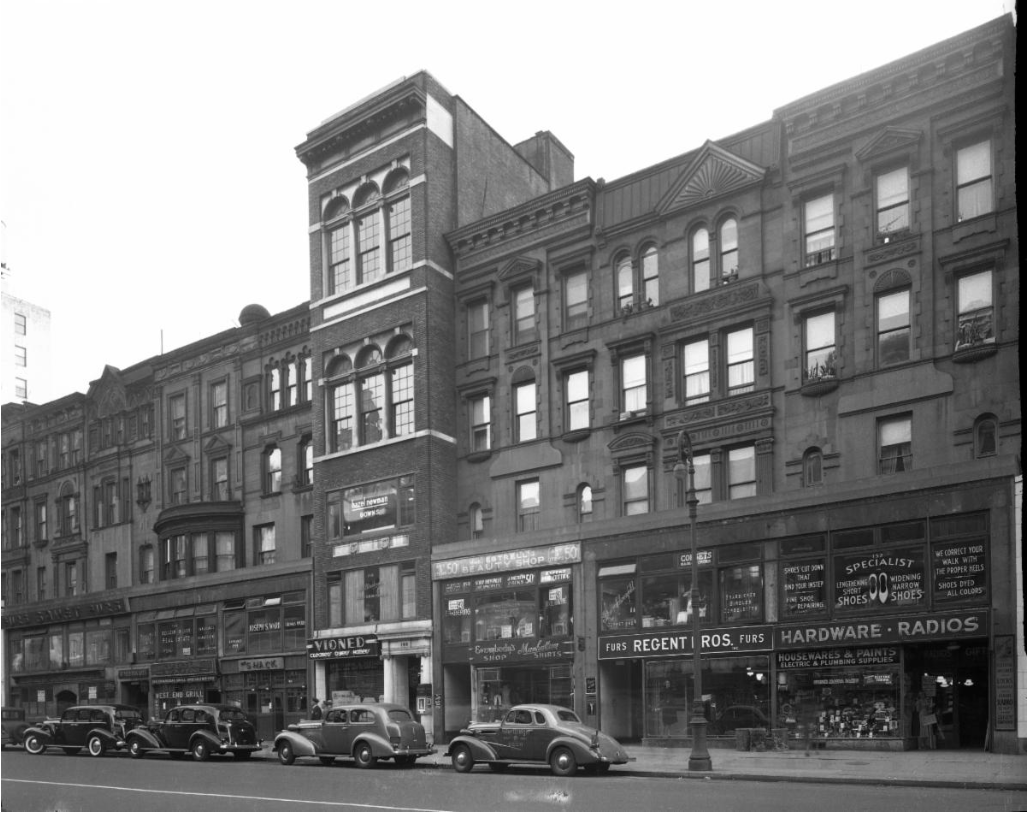
Christopher Gray was my favorite Timesman, which is news speak for reporter at the New York Times. (I’ll admit, that’s a low bar, these days at least.) I didn’t read him often because I don’t get the Times, but when I did come across his work, he always covered a building like white on rice – a simile I don’t quite understand, but let it go. Gray would dig into the history of a building such as the one illustrated above and tell us its history of ownership, when and for what purposes it was built, who had purchased it over the years, and what its current status was – newly renovated or newly demolished. These sound like relatively boring tidbits for all but the most die-hard buildingologist, but Gray would always manage to infuse them with meaning and delight.

Alas, Gray passed away on March 10, 2017, and has been sorely missed ever since.

The organization concerned with preserving Manhattan’s Upper West Side, LandmarkWest!, will host, next Thursday at 6 p.m., a Zoom lecture by Sam Hightower, current director of Gray’s library of building history, the Office for Metropolitan History. (Click on link to reserve your $6 ticket.) OMH sounds a little bit too much, for my taste, like OMA – the Office for Metropolitan Architecture, founded by the übermodernist architect Rem Koolhaas – but let that pass as well.

Andra Moss, who wrote the press material for the upcoming lecture, reveals that Gray has been replaced in writing Gray’s column at the Times by John Freeman Gill. I will have to check that out. Online. (Any relation to The New Yorker’s famous writer Brendan Gill?)

Hightower plans to take attendees through the OMH collection compiled by Gray during his 28 years writing the “Streetscapes” column in the real-estate section of the Times. He will “shed light on the research methods undergirding [Gray’s] work, highlight gems in the OMH’s private archive, and discuss the never-ending evolution of New York City’s built environment.” It seems that Gray was let go by the Gray Lady (no relation, and it would not apply anymore, anyway) in December 2014, about three months after I was let go by the Providence Journal. But let that go, so to speak, as well.

I wonder whether Hightower plans to refer to the “never-ending evolution” of the city as a devolution, indeed as a degeneration. A tedious gray box by OMA would fit in well on the streetscapes of today’s Manhattan. It is important to keep in mind that today’s city retains more, many more, than a handful of beautiful buildings of great historical significance. Too bad so many have been lost, and that those that remain are so regrettably swamped by stuff of much poorer quality.

So: 6 p.m. next Thursday evening (Office for Metropolitan History). Be there or be a glass box.

Posted in Architecture, Architecture History | Tagged , , , , , , , , | 3 Comments

Architecture of community

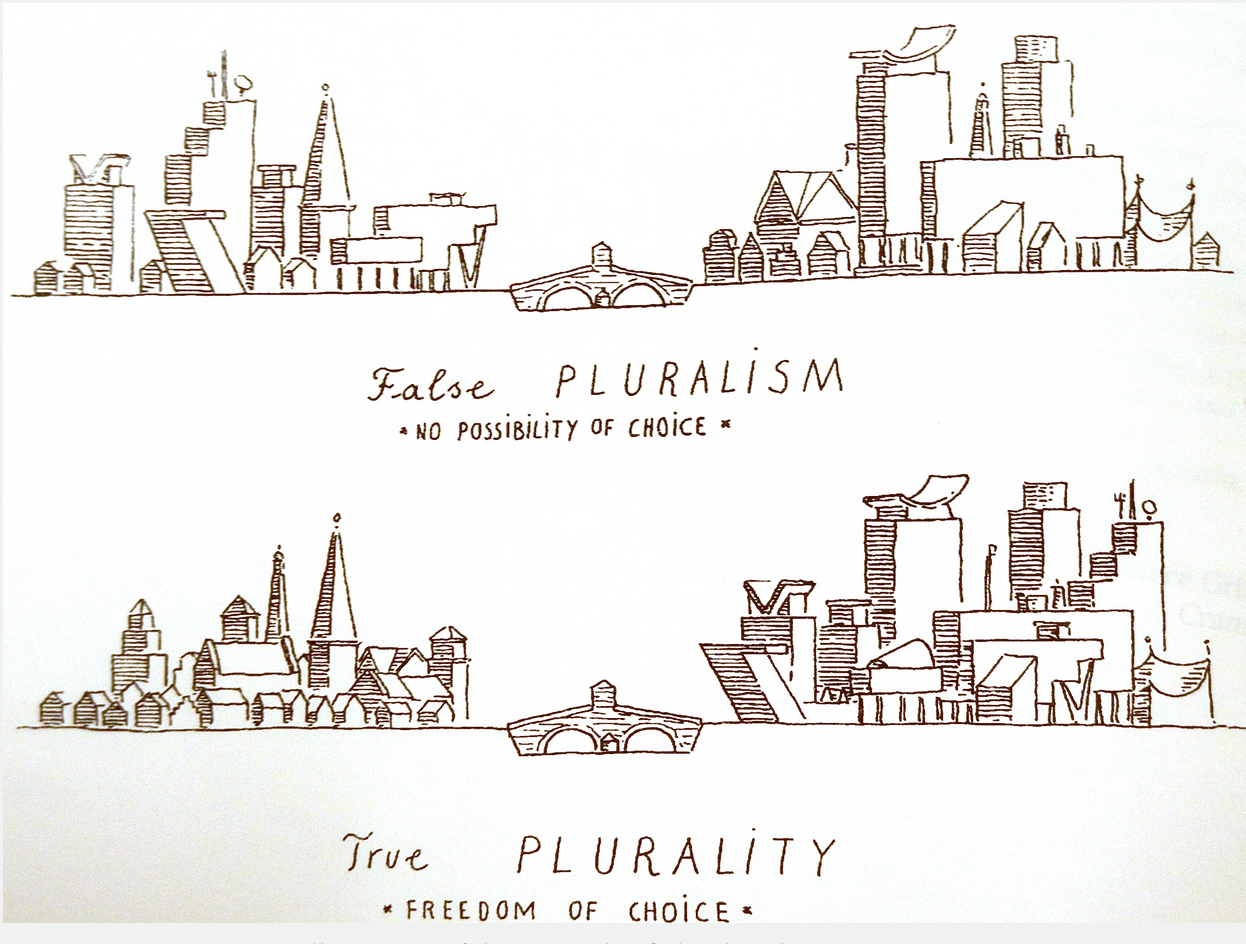
Drawing by Leon Krier.

Below is the foreward to Léon Krier’s book The Architecture of Community (2009), which I posted on my blog in 2020. Born in Luxembourg, Krier, is, of course, among the foremost thinkers about architecture and city planning. Above his foreward I posted my favorite from his collection of drawings that illustrate principles via the conundrums faced by architects and city planners. Here is the foreward to Krier’s masterful volume:

***

Recently, a delegation of developers and planners from Shanghai and Singapore visited Poundbury, the new town I have been master-planning for HRH Prince Charles since 1988 in Dorset, England.

After my presentation, a representative from the Chinese delegation came to me, saying. “You must come to China. We want Poundbury in Shanghai.” I responded that for his country I would of course design a Chinese not an English town. “No, no,” he cut in, “we want English Poundbury. It will have much success.” When I replied that it would be as unsuitable as planting a palm tree in the Siberian tundra, the gentleman shook his head and walked away. After him the delegate of Singapore addressed me: “Mr. Krier,” he said, you must come to Singapore. We want Poundbury with skyscrapers.” When he understood that my skyscrapers would have no more than three to five floors, he too frowned in disbelief and turned on his heel.

This is to say that the present book is not about exoticism, not about the brief thrill of consuming imported alien products, not about promoting trendy European goods for globalized markets, cultures and climates.

The Architecture of Community is about something more fundamental. It is about re-establishing our own traditional forms and techniques of building and settling. The devastation of the traditional Chinese building heritage is causing headlines worldwide. Yet I am less alarmed by the loss of material than by the loss of the ideas which generated and perpetuated it for thousands of years. I am not merely talking about saving historic buildings and towns but saving the technology which created and sustained those forms, made them to be desirable and to be emulated for hundreds of generations. I am suggesting that architects and planners become primordially concerned, not with the historicity of traditional architecture and urbanism but with their technology, with the techniques of building settlements in a specific geographic location with its natural materials.

It is tragic that more and more intelligent minds should at once be spellbound by that undecipherable Spirit of the Age (Zeitgeist) and so indifferent to the Spirit of Place (Genius Loci), the conditions of nature, of local climate, topography, soil, customs, all of them phenomena objectively apprehensible in their physical and chemical qualities.

This book advocates not to respect, study and use traditional ideas because they are historical, but where and when they are relevant for us the living, essential for our well-being. They are repositories not merely of humanity, but of humaneness and ecology.

Human scale, as we now discover when too many of our built environs have lost it, is an unrenounceable attribute of civilization, not an obsolete luxury. We demonstrate here, by vision and example, how human scale can become again the yardstick of modern artifacts, adequate for our bodies and souls, for both our limited physiological capacities and our infinite desires, be they tools, buildings, cities or landscapes.

Posted in Architecture, Urbanism and planning | Tagged , , | 2 Comments

Radiant Garden City Beautiful

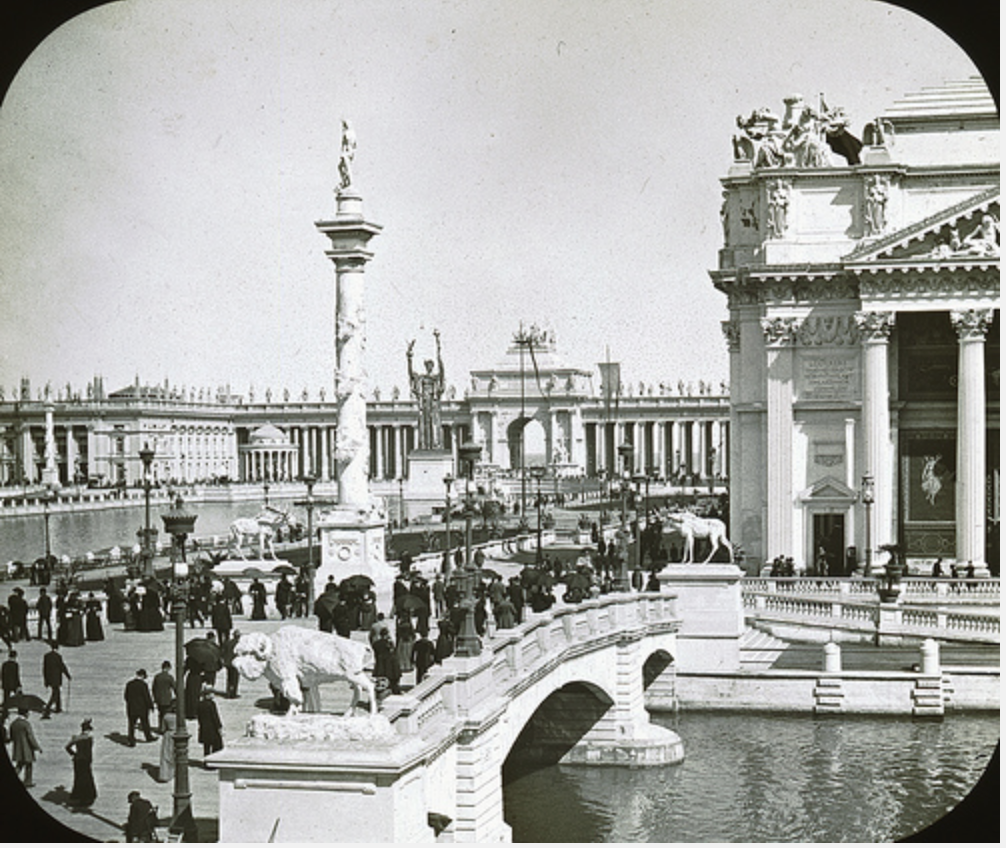
Court of Honor at center of World’s Columbian Exposition, in Chicago, 1893.

Henry Hope Reed, who wrote The Golden City in 1959 and led the opposition to modern architecture in the mid-20th century and helped to found the Institute of Classical Architecture & Art in 1968 (originally called Classical America), was not totally infallable. In his exaltation of Greco-Roman classical styles, he fell into an ill-fated opposition to Gothic and other styles that were opposed by architects in the previous two or three centuries. This was a mistake, and it somewhat undermined his strength in arguing for tradition as the basis for architectural style. So imagine how I must have felt when I stumbled on this post of mine from 2014:

***

Radiant Garden City Beautiful

If wizards like Henry Hope Reed can be wrong on occasion, so can Jane Jacobs, who in our era is even more famous for her own pathbreaking 1961 book, The Death and Life of Great American Cities. Its chief claim to fame is to have thrown the active life of the best city streets into the face of the city-deadly megaprojects of Robert Moses, king of development in New York for almost half a century.

Jacobs spends some time toward the beginning of her book describing the horror brought to cities by the ideas of Le Corbusier and his book, The Radiant City. (We do not marvel at the mistakes of Corbu – he got everything wrong.) This was the idea that city streets were bad and should be replaced by towers in a park. In 1925 he proposed razing central Paris to carry out his totalitarian idea. She then describes the Garden City movement, originating in Britain, which was basically the idea that cities were bad and should be replaced by, in essence, suburbs. She combines these concepts into what she calls the Radiant Garden City, a catchall for bad ideas. How convenient.

But then she ropes in another concept, one that was basically flawless, of which Henry Reed was a strong proponent – the City Beautiful movement. Jacobs exaggerates and misconstrues it, referring to the World’s Columbian Exposition of 1893 as “a sort of squat, decorated forecast of Le Corbusier’s later repetitive ranks of towers in a park.” She notes that it fizzled stylistically but that its core concept of the “Monumental Center” remained, leading to America’s great civic plazas, which Jacobs did not really appreciate because she saw them as countervailing her preferred animated small streets of many shops and eyes looking out from windows. This is indeed a powerful concept – one that Moses sought to eradicate and replace with the Radiant City model – but Jacobs was mistaken, I think, in believing that a great city could not have both her animated street life and a monumental city plaza or two with a sort of Benjamin Franklin Parkway-like monumental boulevard linking them together.

Anyway, I wonder whether Jacobs was compelled to rope the City Beautiful into her catalogue of woes by the elegance and charm and wit of the phrase she invented to combine them into a single monolithic pox of modern planning on all houses. Here is that passage:

The architecture of the City Beautiful centers went out of style. But the idea behind the centers was not questioned, and it has never had more force than it does today [1961]. The idea of sorting out certain cultural or public functions and decontaminating their relationship with the workaday city dovetailed nicely with the Garden City teachings. The conceptions have harmoniously merged, much as the Garden City and the Radiant City merged, into a sort of Radiant Garden City Beautiful[.]”

I suspect that as a lively writer Jacobs was so captivated by the phrase Radiant Garden City Beautiful that she twisted the last part into something more awful than she knew to be the case. Or maybe not. Still, the excitement of words can sometimes get in the way of the excitement of ideas. Maybe this is one example of that.

By the way, the World’s Columbian Exposition had over 27 million visitors over a period of six months, which was almost half the 63 million population of the United States at the time, and they could not get to Chicago anywhere near as easily as we can today. On one day over 700,000 visitors attended. In terms of “animated streets,” it would be hard for Jane Jacobs to argue with those numbers.

Posted in Architecture | Tagged , , , , , | 8 Comments