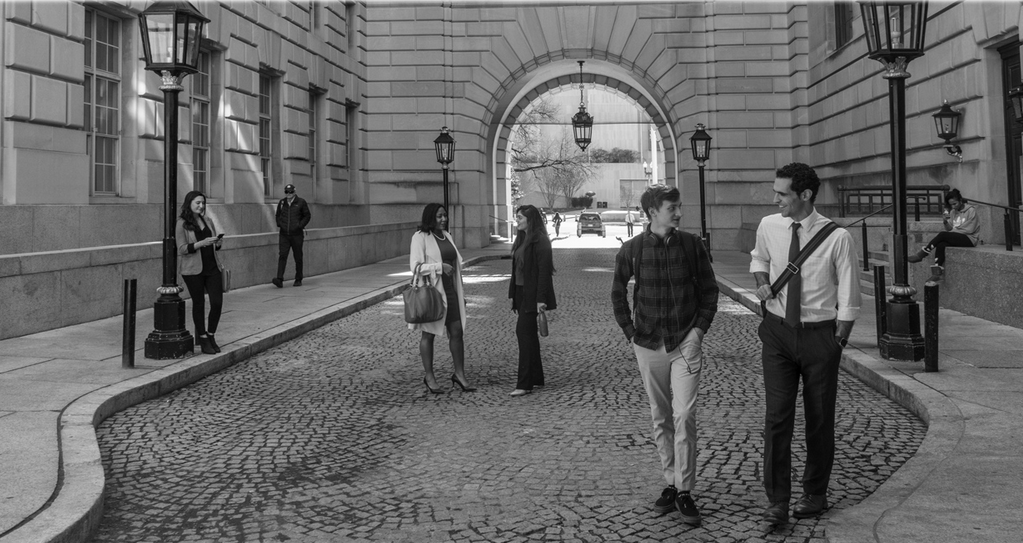
Betsky on classical popularity

One of many courtyards within Washington’s Federal Triangle, built in the 1930s. (American University)

Before I applaud modernist critic Aaron Betsky’s kind words for classical architecture in the wake of the Harris Poll confirming its popularity, let me note, also with approval, the even more recent article by critic Kriston Capps, entitled “Why Trump’s ‘Beautiful’ Federal Building Order May Be Here to Stay.”

Capps reiterates his concern that a shift away from modernism and toward classical and traditional architecture may be under way at the General Services Administration, which oversees the design and construction of federal buildings. The GSA awaits appointment of a new chief architect, but already proposals for courthouses are emerging with language influenced by the executive order on federal architecture. President Trump has just appointed four more classicists to the U.S. Commission of Fine Arts: architect Rodney Mims Cook, sculptor Chas Fagan, landscape architect Perry Guillot and architect Steven W. Spandle. Capps refers snidely to these classicists as “deeply steeped in yesteryear’s European art forms.” Each will serve a four-year term. All seven commission members are now classicists, including Justin Shubow, who as president of the National Civic Art Society was involved in the E.O. Capps also reports the appointment of classicist Gibson Worsham to the National Capital Planning Commission. Capps adds that the recently opened memorial to Dwight Eisenhower designed by Frank Gehry “could not have survived review with this bunch.”

That’s high if unintended praise for “this bunch.” They will help steer toward a new federal design policy to replace the current policy, which has favored modern architecture for half a century, since the mandate for modernist federal buildings was put into effect in 1962. For the first time since then, federal policy would take its cue from the tastes of the American public.

Hold the presses! What a novel idea!

Even Aaron Betsky, the chief polemicist for the modernist American Institute of Architects (which should be neutral on style), has conceded that this might be a reasonable notion in a democracy. His “Back to the Classics,” in AIA’s Architect magazine, reports on a Harris Poll commissioned by Shubow’s NCAS. It found that up to three-quarters of the public, across a broad range of demographic categories, prefers classical or traditional architecture over modernist alternatives for federal courthouses and other buildings. He writes:

There is nothing magical about the preference for Classicism, which has been giving shape to buildings for millennia. That default collection of columns, pediments, architraves, moldings, and compositional principles add a touch of class to any building, be it a bank or a courthouse, a suburban McMansion or a utility plant. Include those elements or compose your plan according to its system, and you have made any structure convey a message of importance and elegance, much in the way that we might opt for a suit and tie or an evening dress. No other style has been able to achieve the same level of success at communicating that sense of class.

Of course, there is an edge to this admission by Betsky. With his characteristic subtlety, he dismisses the preference of Americans for classicism as a matter of “class,” which can be read in several ways, but which is likely to be read by his readers as “classism.” That’s not classicism, which is a stylistic language, but classism, which is how some groups oppress other groups in society.

Phrases such as “a touch of class” and “that sense of class” probably do reflect something of what most Americans have in mind when they think of how federal buildings should be designed – so as to “convey a message of importance and elegance.” Betsky lets his classist cat out of the bag further down in his essay:

Classicism may be easy to use as a designer and a builder, but it is also the style of the upper classes. The fact that the majority of respondents in the poll across all demographic groups preferred the Classical buildings says more about our dominant cultural values than it does about the universality of the style. If you can afford Classicism, or you can enter into its domain, you have arrived. The various modes of Modernism have never been able to achieve a similar reality.

Then he adds:

But that also means that Classicism serves those in power and, more than just about any style we know, has racist associations, because of its long history with slaveholders and institutions of Black oppression. Our national and state capitols are supposed to represent democratic values, although their very Classicism can convey a message of white, male power. Like any language, however, Classicism has been used in many ways that were indifferent to any moral, ethical, or political message.

That last sentence undermines the narrative that Betsky has attempted to erect, because what happens inside buildings should be blamed not on the buildings themselves or on their styles but on the people in those buildings. This is true of courthouses, state capitol buildings, and every other sort of building, including plantation houses, prisons or Albert Speer’s New Reich Chancellery (1939). In most cases, they are used by people for purposes that change over time and are completely unrelated to what Betsky calls the “collection of columns, pediments, architraves, moldings, and compositional principles” that make up their design.

There is no element or combination of elements on that list or any longer list of classical elements or principles that can be made to say “Invade France” or “Kill the Jews!” or “Oppress blacks!” or “Succor the rich!” The classical language is articulate, but not so articulate as to express the agendas of passing ideologies or the purposes of the inhabitants of any given building, either over time or at any given time. The style of the U.S. Capitol doesn’t even say “America’s legislative branch lives here,” though it supports that interpretation with classical elements that are designed to cause a feeling of, say, dignity in the public eye. Classical language cannot be so particular as to distinguish this or that legislative act or agenda, apart from what baggage legislators, commentators, or others in the public arena might, with no assistance from the design of the building, wish to apply to it. A building in the classical manner gives voice to sentiments far more basic and far more profound than the passing whims of its occupants.

This truth is understood intuitively, at least, by probably 100 percent of the American public, and it is denied by those who believe that their agendas are more important than that truth. Capps believes, for example, that the racial and sexual makeup of a body such as the Commission of Fine Arts is more important than its role in overseeing the maintenance of federal standards of design. Betsky seems to believe, without much evidence, that a particular standard of design in federal buildings will be more likely to produce federal policies that he supports.

Since these arguments are so flimsy, Betsky resorts to a sort of aesthetic classism:

If you can afford Classicism, or you can enter into its domain, you have arrived. The various modes of Modernism have never been able to achieve a similar reality.

The fact is that anybody can enter into the domain of a classical building or a modernist building. The ornamental language of a classical building – in which, for example, the entry may be more easily perceived than a modernist entry – welcomes us more readily than the sterility of a modernist building, which prohibits most of the design cues that signify “entrance,” let alone those which gently engage the attention of visitors. It is not necessarily more difficult for the taxpayer to afford to build a classical building – although modernist industrial shenanigans have created a narrative that causes many to believe that is so.

But maybe I am quibbling. The fact is that Aaron Betsky has acknowledged that it makes sense for the public to prefer classical to modern architecture, and Kriston Capps has reported that agencies of the American government are gearing up to give the public a greater voice in the design of government buildings. That’s good news, and for me it’s enough for now.

Posted in Architecture | Tagged , , , , , , , , , , , , | 10 Comments

E.O. just signed by Trump

EPA headquarters was preferred to HUD headquarters by 81-19 percent in recent Harris Poll. (NCAS)

I have just now learned that the draft executive order on federal architecture that was leaked last April has today been signed by President Trump. “Making Federal Buildings Beautiful Again” is now entitled “Promoting Beautiful Federal Civic Architecture.” I see no major changes that would affect its purpose of making classical and traditional styles the default design for new and redesigned federal buildings in Washington and around the nation.

This is excellent news. If Joe Biden ends up replacing Trump as president, the executive order will make it easier for him to use classical architecture as a means of unifying the country after a difficult election campaign. If he chooses to reject the executive order or its purpose, he will not be able to do so without publicly rejecting the sentiments of a large majority of the public.

Events at the General Services Administration hint that the old mandate in favor of modern architecture for federal buildings, which was instituted in 1962, has come into disfavor. At least two new federal courthouses have been proposed for construction in classical styles, and at least two such courthouses in classical styles have recently been completed, both in Alabama.

Whoever was elected president – which has not, I think, been factually or legally established – more new federal buildings designed in one of the wide variety of classical or traditional styles will beautify their locations and, as beauty naturally aims to do, raise the spirits of the general public. As stated in the E.O.:

Societies have long recognized the importance of beautiful public architecture. Ancient Greek and Roman public buildings were designed to be sturdy and useful, and also to beautify public spaces and inspire civic pride.

Eight years after Daniel Patrick Moynihan wrote the original modernist guidelines adopted by the GSA in 1962, he wrote:

Twentieth-century America has seen a steady, persistent decline in the visual and emotional power of its public buildings, and this has been accompanied by a not less persistent decline in the authority of the public order.

That was the result of Moynihan’s guidelines, which asserted that “an official style must be avoided.” But whether it was his intent or not, his guidelines have served as an official style. He wrote them while he was a counselor to LBJ, which means that the guidelines originated, for all practical purposes, as an executive order. It was no more and no less a “mandate” than is Trump’s executive order, and indeed the idea that a mandate somehow reflects an abuse of power is false: it depends on what is being mandated. Laws passed by Congress are mandates, and so are the regulations designed either to carry out laws or, as any old Washington hand will admit, to bury them in the coils of the vast bureaucracy. Mandates characterize every government, not least our own federal government.

Trump’s signing of the executive order follows his signing last summer of an order mandating figurative rather than abstract design for sculpture on federal premises, including U.S. parks and the grounds of U.S. buildings. Where this statuary E.O. originated I don’t know. The architecture E.O. appears to have originated, as do many ideas taken up by the federal government, with an organization devoted to public policy, in this case the promotion of classical design. If some people are reluctant to credit this E.O. to a recent evolution in Donald Trump’s widely deplored aesthetic taste, they may feel free to credit the National Civic Art Society, whose president, Justin Shubow, sits as a Trump appointee on the U.S. Commission of Fine Arts. No doubt others inside and outside the White House were involved. Shubow and his organization nearly defeated the Frank Gehry design for a memorial to President Eisenhower, and they have also proposed a restoration of New York’s Penn Station using the demolished original design by Charles Follen McKim of the famous Gilded Age classical firm McKim Mead & White.

Whoever is president, if this E.O. is carried out and becomes policy at the federal level, it will eventually have a profound influence on architecture at every level of society. More schools of architecture will institute additional curricula to teach classical in addition to modernist principles and techniques. More classicists will graduate, and they will get jobs at firms that had previously refused to hire any but modernist architects. Cities and towns will be more likely to consider classically designed proposals for local government buildings. Development agencies will allow a more level playing field for projects in classical styles. As more classical buildings are built, the public will learn, at last, that classical architecture is a source of beauty that has not been relegated to the past, as modernists have long insisted, but is available today as a practical alternative to the reigning ugliness.

This is how leadership operates and how society can change to reflect progress in social attitudes. A Harris Poll found in October that nearly three-quarters of the public, as a whole and in a wide range of demographic categories, prefers classical architecture to modern architecture for federal courthouses and other buildings. One startling result of that survey was a column by Aaron Betsky, a polemicist at the American Institute of Architects, that said the general public’s preference for classicism was only natural. He pretty much took it back in the second half of his essay – to which I expect to devote a post soon – but he would certainly not have made such a concession without the publication of a persuasive survey by such a reputable polling organization.

The fate of this executive order is no more or less certain than the fate of Donald Trump’s presidency. The Oval Office could – and looks as if it will – be occupied by Joe Biden, but who really knows? Either way, the restoration of beauty to our built environment is more likely to be achieved if the discourse on American architecture is allowed to proceed without the baggage of American politics.

Posted in Architecture | Tagged , , , , , , , , | 39 Comments

Museum of National Identity

A few days ago I wrote “Life preserver for Inga Saffron,” in which I deplored the “loose thinking” of Saffron and other architecture critics. I described that thinking in the following post, “Museum of National Identity,” from November 2017.

***

Christopher Hawthorne, the architecture critic for the Los Angeles Times, wrote a piece on Philadelpia’s new Museum of the American Revolution, by Robert A.M. Stern Architects, back in June that I somehow missed. “An Identity Crisis for American Architecture” cries out for rebuttal.

He asserts that in Stern’s eyes, the museum “had to embody a certain Americanness: It had to look as though it belonged in a group of buildings hugely important to the country’s early history,” such as Independence Hall, as if there were something wrong with that. After noting that Philadelphia Inquirer critic Inga Saffron had called it “stodgy,” but without mentioning that her chief objection was that its design was not “revolutionary,” he writes:

It would be a mistake to say that a museum dedicated to exploring the roots of the American Revolution has some obligation to be explicitly revolutionary in its architecture — that it should suggest upheaval, radicalism or rupture in its very shape.

But he reverses himself in the next breath:

But there’s a significant gap between that architectural attitude and the one embodied by Stern’s design, which assumes that the most important questions about national identity have long been settled. What’s really missing from the museum’s architecture, perfectly well-turned but also perfectly complacent, is any noticeable sense of curiosity.

I will assume that by “curiosity” he means “revolutionary” – that is, rejecting the supposed complacency about our national identity somehow revealed by the museum. He, like Saffron, wanted the building to be modernist. He doesn’t want to admit that, but he fairly shouts it between the lines.

Of course, that betrays a misunderstanding of the particular revolution at issue. Both seem not to understand what the American Revolution was all about. Yes, the colonies revolted against King George, but they were reacting to the king’s refusal to grant the colonists the same rights as English citizens. The colonists did not object to English rule or English law or England per se, they objected to being allowed only partial participation in it. That’s what “No taxation without representation” meant.

Understanding this might put a different spin on the idea that a museum about the Revolution necessarily requires a specifically rejectionist attitude in its design.

Twisting the meaning of the American Revolution to fit the modernist narrative fits into a long tradition among modernists. Here is a short list of words that have been stripped of their real meaning by a culture, including architecture, that embraces the modernist project of rejecting American traditions and cultural mores:

Nostalgia means yearning for the good things of the past. It has been twisted to mean wallowing in that yearning to the point of refusing to accept change.

Authenticity means the quality of being authentic, not false. It has been twisted to mean the quality of skepticism toward traditional or conventional attitudes, including buildings designed to reflect those attitudes.

Modern means current, of today, up to date. It has been twisted to emphasize discontinuity above continuity in attitudes, practices and traditions, including those relating to design.

Of course most people who embrace traditional architecture have their own favorites, and reject the idea that buildings that reflect the continuity of tradition also represent a rejection of all change. It is the modernists who, harboring a warped view of tradition, believe that modern architecture represents a stage in progress that need not further evolve and that certainly must not, as they see it, regress.

Which brings us back to national identity. New traditional architecture does not assume that national identity has been long settled. Rather, it seeks to suggest that continuity in our attitudes toward and expressions of national identity is as valid as discontinuity. Tradition is as important as change in national life. They are two sides of the coin that represents our national identity. Tension between them is natural.

Modern architecture is part of a deconstructivist program to deny that reality and to do so in part by introducing new meanings to words, undermining traditions and institutions, and enforcing new mandates in the language of architecture. A natural and inevitable opponent of that program is new traditional architecture.

I don’t think most modern architects today buy into the deconstructivist program or are even aware of it, but it is implicit, and often explicit, in the writings of founding modernists such as Corbusier, Mies and Gropius. All modern architects help carry out that program whether they realize it or not.

It is no surprise that in a free society some will emphasize its ideals, and want to move toward them, and others will emphasize its flaws and want to start from zero. They are in disagreement. So be it. But I really wish people like Hawthorne and Saffron would acknowledge the degree to which people like Stern bend over backward to embrace the challenge posed by modern architecture. (That’s the understatement of the week. Much design by RAMSA, the firm founded by Stern, is in fact modernist.)

Just look at one of the earlier drawings of the Museum of the American Revolution. It originally had a cupola. Those who wished that the design were modernist badgered Stern into removing it. Other aspects of the building also compromise between tradition and change in architecture – in my opinion too much so. Why Hawthorne and Saffron are loath to acknowledge this is understandable, but it nevertheless amounts to rhetorical dishonesty in the discourse of architecture.

[Christopher Hawthorne no longer works for the Los Angeles Times. He has joined the city’s department of development.]

Posted in Architecture | Tagged , , , , , , , , | 3 Comments

Why historic preservation?

Cottage at 59 Williams St. with latest version of modernist addition to its west (at right). (PHDC)

I just got through watching the Providence Historic Preservation Commission grant conceptual approval to the renovation and expansion of a charming little Italianate cottage on Williams Street, just off the city’s historic Benefit Street. It was a most depressing event.

Objecting neighbors cheered that the latest design no longer moves the cottage toward the street by several feet. Members of the commission seemed barely to notice that the addition would not fit in at all. And yet they seemed to agree that the plan, by architect Friedrich St. Florian, was an improvement on previous plans, which had caused commissioners to put off conceptual approval.

This plan was not an improvement. Instead, the project moved even further from aesthetic consistency with its 18th and 19th century neighborhood.

With each iteration, St. Florian’s design has become even more blatantly modernist. At first, the addition was on the left (east) side of the cottage but behind a tall stone wall. Now the addition has moved directly onto Williams, flipping to the west side of the cottage closest to Benefit. It has gotten bigger and bigger, raising doubts about its supposed subservience to the old cottage. The cottage would no longer would have roof tiles but a metallic standing-seam roof, like the addition, which would have a goofy tilted roof, a sort of flat modernist roof on LSD. Its two bedrooms and a two-car garage would be clad not in the cottage’s horizontal clapboard but with vertical board-and-batten slats, like the siding for a rent-a-space emporium. The addition’s large glazed windows make no reference to the cottage’s historical fenestration. The addition contradicts the cottage at every turn. It purposely rejects the neighborhood’s historic patrimony.

If this is built as planned, anyone walking onto Williams from Benefit would see the blank garage siding first and maybe catch a glimpse of the old cottage as they walked between the garage and the tall stone wall, which would block its view as they walked by. Anyone walking west on Williams toward Benefit would not see the cottage at all, only the modernist addition. Is this proper? Can it be the role of the commission to allow this travesty to occur?

The Providence Historic District Commission was created in 1960 to protect the unique physical character, historic fabric and visual identity of the city.

So declares the introductory statement on the PHDC’s website. Most of the commissioners seemed to hint at recognizing the plan’s violation of this goal. Nobody wanted to step forward and make a motion to approve. The long pause just went on and on. This must have been really embarrassing. The pause for a member to second the motion was even worse. Still, eventually, a vote was held and the commission gave the plan its conceptual approval. Only a single solitary brave “nay” vote issued forth to call her colleagues to their purpose: that of our city’s venerable historic preservationist Tina Regan.

Before signing off, commission staffer Jason Martin noted that in coming weeks and months the commission would be tinkering with its “rules, regulations, standards and guidelines.” The public must watch this process closely, lest the protection of the historic character of Providence be frog-marched out of the commission’s official purpose.

If that hasn’t already happened.

Elevation sketch for the Williams Street side of the cottage and its addition, to the right. (PHDC)

Posted in Architecture, Development | Tagged , , , , , , | 5 Comments

Life preserver for Inga Saffron

Fire set by rioters in downtown Philadelphia last June. (Philadelphia Inquirer)

Six months ago, Inga Saffron, the architecture critic for the Philadelphia Inquirer, wrote a column, “Buildings Matter, Too,” deploring riot damage to buildings near the city’s fashionable Rittenhouse Square. Saffron herself did not write the headline, and anyway she buys into Black Lives Matter’s false narrative of America’s institutional racism. She remains on the job.

In my 30 years as an architecture critic I’ve written every headline to appear above my byline, both when I was on the editorial board of the Providence Journal and on my current blog. So when I first heard of the tempest involving Inga Saffron last June, I assumed she must have written the headline. I thought that she had resigned. Since then, I have regretted that I did not throw a lifeline to my fellow member of the very small tribe of architecture critics.

I am glad she didn’t need it. The editor who actually did resign, Stan Wischnowski, should not have. He was the Inquirer’s chief editor. Maybe he deserved to resign for the stupidity, cowardice and fecklessness he displayed by resigning, but not for the headline itself, which he did not even write. (The New York Times story on this does not say whether either of the two editors involved with the headline lost their jobs. The Inquirer’s publisher, Lisa Hughes, did not resign but should have – for accepting Wischnowski’s resignation.)

The headline itself falls squarely in the tradition of headlines that pun or play on phrases or slogans in the news or with a long cultural patrimony. “Black Lives Matter,” thus: “Buildings Matter, Too.”

A craven letter of apology by the editors reads: “The headline … suggested an equivalence between the loss of buildings and the lives of black Americans.” No, it did not. This accusation was fabricated from whole cloth by those who cynically find it convenient to discover an insult in even the most benign of associations. We’ve all run into people like that.

If there were any offense in such a play on words, then how can it be inoffensive for Saffron to place the destruction of buildings on anything like a par with the murder of black people? How could she even think of discussing the two topics in the same article? Maybe she should have been fired after all.

No. That would be ridiculous. But she probably thinks I should be fired for defending the headline.

Perhaps this is all inside baseball. But modern architecture has bought into the rejection of tradition globally for a century, more so than any major field of human endeavor. The loose thinking of most architecture critics – including Inga Saffron – consigns the world to ugliness and sterility.

These features invite a rejection of humanism and an opening to authoritarianism that threaten to reverse more than a century of historical progress toward equality – progress that is belittled by the false narrative that fueled the Saffron imbroglio.

Posted in Architecture | Tagged , , , , , | 15 Comments

Tulip survives London nip

Skyline of London with Tulip, Gherkin, and (I think) other proposed towers. (Dezeen)

Rowan Moore, architecture critic of The Guardian in the U.K., writes that the proposed 1,000-foot Tulip, designed by Sir Norman Foster as a fancy tourist observation deck, should be denied planning permission by the London authorities (“The Tulip’s towering vanity must be nipped in the bud“).

Huh? I thought that Mayor Khan already did that last year. (“Mayor nips Foster’s Tulip.”) As Providence’s proposed Fane tower recently demonstrated, these ego-driven projects are like cats with their nine lives. Apparently, Foster applied for a redo, and might well overturn the mayor’s thumbs’ down. Here is Moore’s description of the proposed Tulip:

Unlike other [London] towers, the Tulip’s object is not to maximise lettable square metres but to create restaurants, bars, viewing galleries and “classrooms in the sky,” all placed in a glass bud at the top of a long concrete stalk. It might also be guessed that the project serves to feed the egos of the Safras [its financial backers] and of Lord Foster, as it would restore the pre-eminence on the skyline that the Gherkin has lost to a clutch of bulky skyscrapers around it.

Moore rejects the idea that the Tulip will revive Covid-dissipated London. The Shard, London’s tallest tower, is at 1,016 feet not much taller than the Tulip would be. But it seems to me the Tulip would be much scarier, with its bulbous top atop a slender concrete “stalk.” A confidence-builder indeed! Think of the tulip craze in 1637 Holland, the first recorded speculative bubble in history. As a building, the Tulip is a speculative bubble on top of a speculative bubble on top of – you could say – a speculative bubble.

Holland survived its crisis but London is buying into a speculative bubble far more sinister than bulbomania. Hundreds of towers have been proposed or approved in London. They are economically and ecologically unsustainable. Eventually, their risky business will catch up with them. Who knows: with Covid, maybe it already has.

My guess is that when Covid exits stage left, the popularity of a view from atop the Shard, or the Tulip if and when it is completed, will have been degraded by the hundreds of towers that have already arisen in London. There’s no telling when the unsustainability of the buildings or their views will manifest itself, but it may be sooner than later.

This Dezeen article on the Tulip has more illustrations. Frankly, if London wants to go the full folly of Dubai, it might as well.

Posted in Architecture, Development | Tagged , , , , , , , | 2 Comments

Capt. Aubrey’s dad’s house

Station Road, in Woolhampton, Britain, circa 1965. (visionofbritain.org.uk)

Here is a May 2016 post, quoting from the late Patrick O’Brian’s The Surgeon’s Mate, written in 1979. His novels are – and I truly hate to say this, as it verges on sacrilege – as good as those of Jane Austen, with whom he has been compared by literary critics. I am now beginning volume five of the series, Desolation Island, on my fifth “circumnavigation” of the saga. O’Brian died in 2000. As a writer, I am often asked what I think people should read. My answer is Patrick O’Brian.

I republish this post mindful of the onset of the gift-giving season.

***

I am on the seventh volume of my fourth circumnavigation of Patrick O’Brian’s Aubrey-Maturin series of 21 novels, set during the Napoleonic Era. Much of it occurs between bouts of naval warfare and stints at home as an half-pay officer with wife Sophie and their children. In The Surgeon’s Mate, Capt. Jack Aubrey visits his father, a former general and now a radical member of Parliament, and in this passage, already dismayed by his stepmother, a former milkmaid younger than Jack, he rues what the old man is doing to Woolcombe, the house where he grew up in Woolhampton, which lies on the road from Bath to London:

[Aubrey senior] had recently set about altering Woolcombe on an ambitious scale. It was perhaps that which had saddened Jack most. The house in which he was born had no doubt been a raw and staring edifice when it was first built two hundred years ago [circa 1614] – highly ornamented red brick with a great number of gables and bays and high corkscrew chimneys – but no Aubrey since James’s time had sprung up with Palladian tastes or indeed with any tastes at all in the architectural line, and the place had mellowed wonderfully. Now it was beginning to stare again, with false turrets and incongruous sash-windows, as if the vulgarity of his new associates had infected the General’s mind. Inside it was even worse; the panelling, old, dark, and inconvenient to be sure, but known for ever, had been torn out and wallpaper and gilt mirrors had taken its place. Jack’s own room had already vanished; and only the unused library, with its solemn rows of unopened books and its noble carved plaster ceiling, had escaped; he had spent some hours there, looking, among other things, at a first folio Shakespeare, borrowed by an earlier Jack Aubrey in 1623, never read and never returned: but even the library was doomed. The intention seemed to be to make the house false – ancient outside and gimcrack modern within: at the top of the hill, where he had always taken a last look back (for Woolcombe lay in a dank hollow, facing north), he directed his gaze steadily down on the other side, to Woolhampton.

Was that a fling at modernism? Yes and no. Modernism as we know it today did not exist in the early 19th century, of course. But the tendency toward the garish new was already well established by then. It is that tendency that has the modern era by the throat, most sadly in architecture. Today we look back with envy at the architectural disputes of prior eras. How could anybody so vociferously favor, say, either Gothic or Classical over the other? With modernism having wreaked havoc on the built environment of the West for closing in on a century, and on the rest of the world for half a century, they both seem, along with every other strain of traditional and vernacular architecture, heaven sent.

Mindful of O’Brian’s description, it has been said that preservationists often work too hard to restore old houses to their original look and sheen, peeling away the sensibility of time that enhances lovability. The last annual meeting of the Providence Preservation Society, in January, featured a keynote by Adele Chatfield-Taylor, the early preservationist leader and former longtime head of the American Academy in Rome, who had this to say:

A continuing worry for some of us was that once a building was rescued, those in charge seldom considered anything but a full-blown, multi-million-dollar restoration or reconstruction as a way to preserve it. And to this day it is, more or less, our favorite model of what to do.

But at least preservationists of that era wanted to save beautiful architecture. Now they mainly want to save Brutalist architecture and other errors. The 20th-century battle (or surrender) that saw modernism routing tradition in architecture is a tragic saga that awaits its Patrick O’Brian.

***

In light of the passage from Fortune of War*, I join Chatfield-Taylor in wishing preservationists, whenever they manage to save an old building, repair it where necessary, but leave its aesthetic – including that supplied by Nature – alone!

[*Actually not Fortune of War , as stated in the original post and in this reposting, but the following or seventh volume of the Aubrey-Maturin series, called The Surgeon’s Mate. I apologize for any confusion resulting.]

Posted in Architecture, Books and Culture | Tagged , , , , , , , , | 1 Comment

“The Art of Classic Planning”

Proposed U.S. Navy Museum on banks of Anacostia River, in Washington, D.C. (Nir Buras)

This comprehensive, fascinating and brilliant volume by Nir Haim Buras, who founded the Washington, D.C., chapter of the Institute of Classical Architecture & Art, is subtitled “Building Beautiful and Enduring Communities.” So one might well assume that it rejects the planning practices of the past century. In fact, it urges planners to embrace anew the planning practices that worked for thousands of years before the onset of those we suffer under today.

“It’s not good because it’s old, it’s old because it’s good.” I don’t know who said that or whether the motto may be found somewhere in this book. Anyhow, that is the spirit of the planning enshrined herein.

The Art of Classic Planning (2020) was published by Belknap Press of Harvard University Press, containing almost 500 large-format pages and hundreds of color images. Backed primarily by the Richard H. Driehaus Foundation, Buras traveled around the world to research and photograph the urbanism that preceded and ought to succeed the modernist scheme that oppresses the globe today. You can open the book and pop your finger on any paragraph to find inspiration for why such a switcheroo is overdue. “This is truly the mother of all planning books,” writes Leon Krier. At $79 it is costly, but cheap at twice the price. For planners and architects alike, it would be the mother of all Christmas gifts.

In his introduction, Buras notes that

as a matter of habit, we disallow what has worked well before. Most consider classic planning outdated, if they recognize it at all. As specialists, planners also seem to discount that consumers of cities are their peers, equally capable of understanding and judging what makes their cities good places in which to live.

The reader knows from quotidian urban life the pain, inconvenience, and cost of this. Nearly everyone intuitively recognizes something, some quality of older places, is much more beautiful and enduring than what we are building today. Annually, one in seven of the world’s population engages in tourism, and many of them seek places where they can experience that quality. While modern-day planners assure us that we will never build that way again, we swarm through Venice, Agra, Rome, Paris, Athens, and Florence as if in desperation that this is our last chance to experience it.

Buras adds that “there is no need to repeat the litany of negatives that describe contemporary development.” Then, reprising much of British architectural historian James Stevens Curl’s fine history of modern architecture, Making Dystopia (2018, Oxford), Buras proceeds in Part I (“How Did We Get Here?”) with a description of the history of the modernist mistake.

It is difficult to overemphasize the extent to which the past, tradition, and history was taboo to these heroes [Ludwig Mies van der Rohe, Walter Gropius, Le Corbusier, et al.]. Wanting to be expressive of the Zeitgeist, they strove to achieve atemporality through “pure” cubist form. While eliminating ornament as “criminal,” they sought the technological expression of form-follows-function.

One of the feats of Classic Planning arises from Buras’s skill at mixing quotation and narrative so as to clarify – one trusts! – the vagaries of modernist rhetorical mishmash. Modernist writing has only grown more convoluted and ambiguous in recent decades as more creative techniques of pettifoggery are required to mask the increasingly evident failure of the modernist project. Here, continuing the above quotation, is Buras’s description of a passage in which the expressionist architect Erich Mendelsohn explains Louis Sullivan’s “form-follows-function”:

Mendelsohn explained that an image of function was created by “functional dynamics,” the “expression in movement” of the forces inherent in building materials “in a free play between form and its postulates of purpose, material and construction.” To Mendel- sohn, a newspaper building, for example, would not reflect its cause – the creative, political, cultural, intellectual, and commercial spirit of the paper. Instead, it would distill the tempo of modern life by expressing a material effect – the mechanical press inside.

It’s easy for a reviewer to become spellbound by Buras’s narrative of modernism’s history. How delicious it would be to quote at length, say, his description of Le Corbusier urban follies, such as the ideas that led to his Plan Voisin to replace central Paris with towers sixty stories in height. But that would take too long in an already overlong review. Let me substitute, instead, his description of how Brasilia, the modernist capital of Brazil that was erected in the 1950s, influenced the design of the government center of New York State:

At its inauguration, Brasilia was branded an Orwellian, Kafkaesque nightmare. Copying its design, the complex of state office buildings at Empire State Plaza in Albany, New York (1959-1976), loom menacingly from their elevated stone podium, obliterating all vestiges of the existing site. … Architect Oscar Niemeyer’s and other Modernists’ reason for their designs to this day is that you had “never seen anything like it before” – that they were unrecognizably foreign, perceptually alien.

Clearly, the search for this ideal vision of modernism would eventually run up against a problem faced by artists down through the centuries – that art based primarily on creativity would run up against artists’ inability to conceive the next level of innovation without slapping function in the face. Corbusier created an organization called CIAM to propagate his ideas. Buras states with a profound simplicity that “the application of its principles destroyed more good traditional fabric in Europe than World War II itself.” Corbusier left CIAM, distraught that the organization’s meetings were increasingly carried on in the English language. (Corbu was a Frenchman born in Switzerland.)

My joy at Buras’s thumping of modernism knows no end, but soon he takes up his own cry that “there is no need to repeat the litany of negatives” and proceeds to Parts II and III of the book, “Classic Planning Fundamentals” and “Classic Planning Applied.”

I just now applied the blind-taste-test theory of book reviewing. Here is the passage my finger landed on. I will conclude with it (I think) because it takes us into the deepest weeds of planning fundamentals in the most charming manner.

Ahem. I find that I must nudge my finger down to the next paragraph, for without it the paragraph I originally fingered might be hard to understand, charming though it may be. First let me add that modern architecture preens at the supposed role of science in its production, but as Buras demonstrates, the practice of classicism in classical architecture and classic planning shows how the mods know diddly about science. (The originally fingered paragraph is on page 156, starting “The physical measures of stress ….”) Here is the explanatory graf that follows it:

This is important not only because people are hard-wired to respond to specific forms of fractals found in nature, but also because stress reduction is physiologically triggered when the eye-scanning fractal pattern matches the fractal image being viewed. … Upon finding [it], the brain releases endorphins, automatically relaxing the person and greatly reducing stress levels.

Okay, we are still in the weeds, deeply. But the idea is that in the Serengeti plain of prehistory, human (and animal) brains were wired to read details in their field of vision to locate information about the existence of food and of danger. Today, in our mostly more pacific environments, these brain functions have evolved from solving problems of survival to those involving the desire for beauty. Of course, notwithstanding modernist theory, beauty and function are not at all mutually exclusive but are, rather, mutually reinforcing. This relates to both architecture and planning. Indeed, a well-planned city or town might be usefully compared, I think, with a well-designed building.

I am sure that Nir Buras, whom I know through my dealings with the ICAA (the Institute of Classical Architecture & Art), would agree. In fact I have little doubt that such a notion is lurking somewhere in the engaging coils of this magnificent book. (Like beauty, the book is also useful. It does not require a degree in nuclear physics to combine the two elements.)

Be that as it may, I intend to turn to it in future posts, perhaps on the matter of how the idea of the picturesque led to modernism. Or to the question of why the author hesitates to fully endorse the ideas of architectural theorist Christopher Alexander, which are linked to architectural theorist Nikos Salingaros’s research on fractals, neurobiology and beauty, with which Buras mostly agrees. Or about the effort led by Buras to bring classic planning techniques to the renovation of the Anacostia River waterfront in Washington, D.C. (See the drawing of the proposed U.S. Navy Museum atop this post. It was done by Nir Buras for the National Maritime Heritage Foundation while in the office of Daniel Lee.)

There is a lot of gold to mine in The Art of Classic Planning. I have not done it full justice here. The book should be the new bible for the planning profession. It should be on the bookshelf and indeed on the desktop or nightstand of anyone interested in cities. And I wish to emphasize again that it would make a classic Christmas present for a friend or loved one, or for oneself.

Posted in Architecture, Book/Film Reviews, Urbanism and planning | Tagged , , , , , , , , | 4 Comments

Confusion to Trump’s E.O.?

U.S. Supreme Court, a classical design by Cass Gilbert. (billmoyers.com)

“Confusion to Boney” was a toast raised by the British Navy in the Napoleonic era. No doubt “Confusion to Trump’s E.O.” is a toast raised today by modernists fearful of the president’s draft executive order favoring classical styles for federal architecture. The order remains unsigned, however, and the next administration remains undetermined, so confusion does indeed reign over the fate of the E.O.

It is possible but unlikely that a Biden administration would carry out a classical mandate, but it seems the General Services Administration may already have got the memo to proceed anyway, signature or no. As reported in my September post “Animal spirits of the E.O.,” two proposed federal courthouses, in Huntsville, Ala., and in Ft. Lauderdale, Fla., are already on track to be built in “the classical style.” Wording in their RFQs could have been lifted directly from the E.O.

This was heartening indeed, yet I was doubtful that it was significant. Classically styled courthouses have recently been built in Tuscaloosa and Mobile in spite of the official decree favoring modernism since 1962. A bill in Congress to block the proposed E.O., should it be signed, has been introduced by Rep. Dina Titus (D-Nev.), but not passed. Still, a recent CityLab article called “Trump’s defeat did not stop his ‘ban’ on modern architecture,” by Kriston Capps, has raised my spirits about prospects for a mandate favoring classicism.

The subhead for this article reads: “The president never signed a controversial ‘Making Federal Buildings Beautiful Again‘ executive order. But a neoclassical-only building mandate is still happening.”

Of course, it is not a “neoclassical-only” mandate. It would favor traditional design, and yet would allow local circumstances to guide the selection of an architect. But let’s allow the critic to have his little prevarication.

For, while Capps is a standard-issue mod-symp architecture critic, his article presents a relatively straightforward look at the political forces arrayed for and against the E.O. in particular and a revival of classical architecture in general. And yet I was startled by the degree to which Capps himself seems truly concerned that the spirit of the E.O. may have already become entrenched at the GSA.

[T]he forces that [Trump’s] White House set in motion could outlive his administration: The GSA appears to have adopted a modernism ban, without any authorization in place. What seemed to be a pipe dream for admirers of classical architecture back in February now looks like procurement policy at the federal agency that manages office space and needs for the U.S. government.

Let’s hope he’s correct.

(In that passage, Capps links to a brilliant essay on classicism and the E.O. by critic Catesby Leigh that is well worth reading.)

And it may be that the E.O., whether or not signed by Trump, could serve a prospective Biden administration as a symbol of unity after a terribly divisive election. A survey conducted by the Harris Poll in October found that classical architecture is preferred to modern architecture by ratios of two- and three-to-one among Americans of almost every demographic stripe. For that matter, if Trump manages to overturn Biden’s apparent victory, the E.O. could serve the same purpose of seeking comity during his second administration.

Posted in Architecture | Tagged , , , , , , , , | 27 Comments

Africa’s “woke” architecture

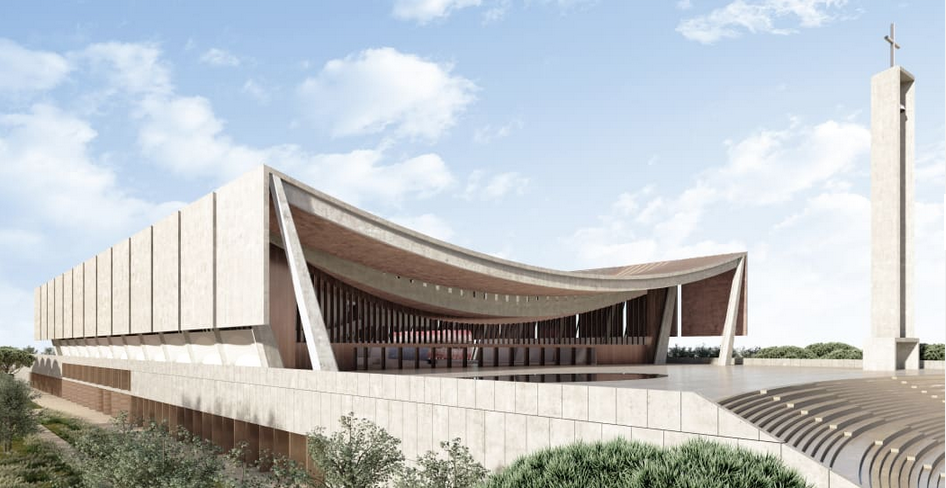
Proposed National Cathedral of Ghana, by David Adjaye. (Adjaye Associates)

On Oct. 20, CNN ran a piece describing the 10 most anticipated architectural developments in Africa, titled “Buildings for the future.” Most of the projects are typical of their ilk around the world. They say nothing of Africa or the cultures from which the projects supposedly take their inspiration, if indeed they intend any such reverence at all. Look at the slide show of proposals. The opening passages of the article confirm what the slideshow suggests of the deep gulf between these proposals and any idea of Africa:

Great architecture captures the world’s attention – if it’s good enough, a single building can put a city on the map. Those buildings are symbols of ambition as much as they are of beauty, and when leveraged correctly, they’re a worthy investment, attracting people and opportunities.

All across Africa, daring architectural statements are taking shape in the private and public sectors. From bustling cities to the depths of the rainforest, they promise to bring new life to their surroundings.

(The reference to “the depths of the rainforests” seems accidentally to refer to South America, else the descriptor would have referred to the depths of the jungle – unless that word has now been canceled.)

The platitudes of CNN author Tom Page could be written of architecturally modernist projects anywhere in the world. The only promise they bring to their surroundings is that new life will continue to reflect the neocolonialism that has for more than half a century assaulted the indigenous cultures of Africa – in short, since they won independence from ye olde colonial powers of Europe. What might easily be deemed cultural genocide will continue to animate the pan-national ruling classes of Africa.

Elites in virtually all nations, developed and developing, have bought into the idea that their traditions are worth nothing and their success as nations relies on copying architecture that supposedly embraces successful Western economic practices but in truth reflects, instead, both the egoism of its architects and the financial interests of the global one-percenters who hire them. None of this has anything to do in particular with Africa, or any respect for anything African.

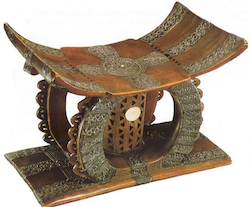
Golden Stool, Asante throne. (ringmar.new)

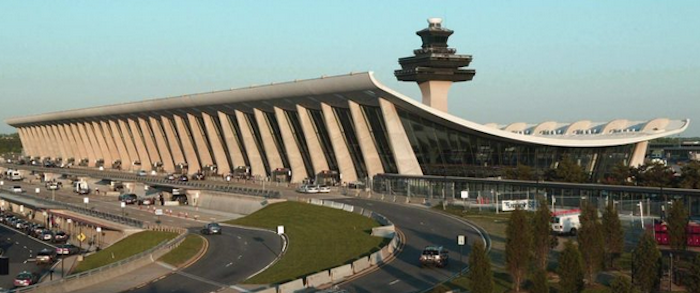
The first slide shows the proposed National Cathedral of Ghana, in Accra, designed by international celebrity architect Sir David Adjaye, a Ghanaian Brit born in Tanzania. Its shape, writes CNN’s Tom Page, “evokes tented canopies and the Golden Stool, the royal throne of the Asante people.” Maybe it does, but it very much more recalls the swooping form of Dulles International Airport, located outside of Washington, D.C. As the designer of the U.S. National Museum of African American History and Culture, the architect has no doubt flown through Dulles more frequently than he has visited the Golden Stool. (Unless, as you might expect, he normally takes the more convenient but more expensive flights in and out of Reagan National Airport.)

My favorites include Cairo’s Grand Egyptian Museum, which, writes Page, “overlooks the Giza Necropolis some two kilometers away and makes use of copious amounts of glass to draw museum and pyramids together and, fittingly, leans heavy on triangular forms.” How precious! And there’s also the Ellen DeGeneres Campus of the Dian Fossey Gorilla Fund, in Musanze, Rwanda. “The center was made possible when Portia de Rossi, wife of DeGeneres, donated to the Fossey Fund in the TV star’s name as a 60th birthday present (Fossey was a childhood hero of DeGeneres).” … Anyway.

Most indigenous architectures of the developing world feature forms traceable to ancient classicism, either directly or in the sense that they developed over time by dint of trial and error through generations of builders who adapted the latest advancements to longstanding practical, cultural and climatic needs.

Modern architecture rejects that process and the successful cities, towns and villages it created, while seeking an anti-traditional template putting innovation above all and hence recognizable as culturally divergent wherever it appears. It is unlikely that most cultures will resume the design imperatives that benefit their native populations until their ruling classes begin, someday, to respect their own cultures. This article by CNN merely demonstrates how far such cultures, in this case those of Africa, remain from regaining their self-possession.

Dulles International Airport, by Eero Saarinen. (wingsjournal.com)

Posted in Architecture | Tagged , , , , , , | Leave a comment