Kennedy Plaza is still at risk

Downtown Providence, with its its bus hub at the city center, left of Burnside Park. (Arup)

Efforts by the city and state governments to make Kennedy Plaza ugly have not yet succeeded in making it fail. But the attempt to ruin the central public square of Providence is ongoing. The plaza’s beauty has diminished greatly since its Art Nouveau waiting kiosks were replaced by sterile modernist ones, but the plaza remains an effective main hub for public transit.

Not for long, though, if city and state transportation officials have their way.

They have already added new waiting kiosks in the Jewelry District that look like equipment from a torture chamber (or, less harshly, an ironing board). Now, in addition to ramming through a new multi-hub plan opposed by the bus-riding public, they are planning to “re-envision” aspects of Waterplace Park, the river walks, the pedestrian tunnels under Memorial Boulevard and Exchange Terrace, and other downtown amenities.

According to a news report by SmartCitiesWorld, the engineering firm Arup, hired to design this “single cohesive vision,” said its “placemaking modifications” include:

a cohesive artistic lighting plan; shade structures and two temporary liner buildings at the Providence Rink; a utility plan for Waterplace Park, the tunnels, and Riverwalk between Francis and Steeple streets; a programming plan for the central plaza area at Kennedy Plaza; and a series of modifications to make Waterplace Park and the Riverwalk more accessible and pedestrian friendly. Overall climate resilience in Waterplace Park and along the Riverwalk will also be addressed.

Much of that sounds benign. No doubt these areas can be improved. The river-relocation project of 1990-1996, which daylighted the downtown rivers and created Waterplace, the river walks and a dozen elegant bridges, is almost a quarter of a century old, and is showing its age. For example, there is much spawling on too many of the bridges. Fine. Yet maybe that’s not what this is all about. Curious motives seem to emerge in boilerplate language from Arup:

There has never been a more important time for us to set a new benchmark for inclusivity, equity, respect and ownership of these shared spaces, ensuring that accessibility means access for all, not just for some.

They probably say that to all the cities!

And yet, at a time of exceptionally constrained city and state budgets, what does it really mean?

What is this “new benchmark”? Where in the public spaces now targeted for “improvement” have such values as inclusivity, equity, respect, ownership and accessibility been slighted? Are these parks, bridges and river walks not open to all? Is there some sort of stroll tax levied to enter the grounds?

It is obvious that there are no such constraints on the use or enjoyment of these relatively new urban features, paid for almost exclusively by taxpayers outside of Providence and Rhode Island. If there are constraints in the offing, they are the burdensome bus transfers and walking distances to be required of users by the proposed multi-hub system, especially the most needy users. (My post “Still attacking Kennedy Plaza,” from August, focuses on the multiple hubs.)

More than anything else, the “single cohesive vision” sounds like a perfect opportunity to waste taxpayer money on things that aren’t needed.

Because of the masterful work decades ago by the late Bill Warner, who led the effort to redesign the waterfront, the city of Providence and the state of Rhode Island transformed rivers covered up little by little over a century into an urban paradise. This work successfully revived the city’s fortunes. Warner recognized that historic beauty was the capital city’s saving grace, and designed the new waterfront to reflect the legacy of its past. Warner’s accomplishments belong to all citizens, and they must be protected from those whose vision of the future cannot abide its glorious past.

Posted in Architecture, Development | Tagged , , , , , , , , | 6 Comments

Scott: The mechanical fallacy

Facade of Seagram Building, with its structural dishonesty. (www.eca.ed.ac.uk)

Perhaps the most eloquent, erudite, evocative denunciation of modern architecture came near the beginning of its ascendancy with Geoffrey Scott’s chapter “The Mechanical Fallacy” from his 1924 book, The Architecture of Humanism. Scott has the modernists dead to rights. The following passages, which address the notion that beauty is the result of structural honesty, are excerpted from A Battle of Styles, a compendium edited in 1961 by Henry Hope Reed Jr. and William A. Coles.

Such [writes Scott, referring to his previous chapter “The Romantic Fallacy”], in broad outline, were the tendencies, and such, for architecture, the results, of the criticism which drew its inspiration from the Romantic Movement. Very different in its origins, more plausible in its reasoning, but in its issue no less misleading is the school of theory by which this criticism was succeeded. Not poetry but science, not sentiment but calculation, is now the misguiding influence. …

In every activity of life … [w]here mechanical elements indisputedly formed the basis, it was natural to pretend that mechanical results were the goal; especially at a time when, in every field of thought, the nature of value was being more or less confused with the means by which it is produced.

… [If] the relation of construction to design is the fundamental problem of architectural aesthetics, … [w]e must ask, then, what is the true relation of construction to architectural beauty. …

“Architecture,” such critics are apt to say, “architecture is construction. Its essential characteristic as an art is that it deals, not with mere patterns of light and shade, but with structural laws. In judging architecture, therefore, this peculiarity, which constitutes its uniqueness as an art, must not be overlooked: on the contrary, since every art is primarily to be judged by its own special qualities, it is precisely by reference to these structural laws that architectural standards must be fixed. That architecture, in short, will be beautiful in which the construction is best, and in which it is most truthfully displayed.” …

In the modern criticism of architecture, we are habitually asked to take this view for granted, and the untenable assertions as well; and this is accepted without discussion, purely owing to the mechanical preconceptions of the time, which make all criticisms on the score of “structure” seem peculiarly convincing. …

[The Renaissance] produced architecture which looked vigorous and stable, and it took adequate measures to see that it actually was so. … Had it remained tied to the ideal of so-called constructive sincerity, which means no more than an arbitrary insistence that the structural and artistic necessities of architecture should be satisfied by one and the same expedient, its search for structural beauty would have been hampered at every turn. And since this dilemma was obvious to every one, no one was offended by the means taken to overcome it.

I was never offended by the fact that the ancients covered columns of rude structural material with marble in order to enhance beauty. But I have long been offended by Ludwig Mies van der Rohe’s use, in the Seagram Building (1958), of “bronze-toned” vertical beams to cover fire retardant (concrete) demanded by the New York City building code to protect steel girders. This was a lie, but an offensive lie only insofar as it was described as “honesty” – the reflection of true structure. “God is in the details,” quoth the despicable Mies! What baloney!

Posted in Architecture | Tagged , , , , , | 1 Comment

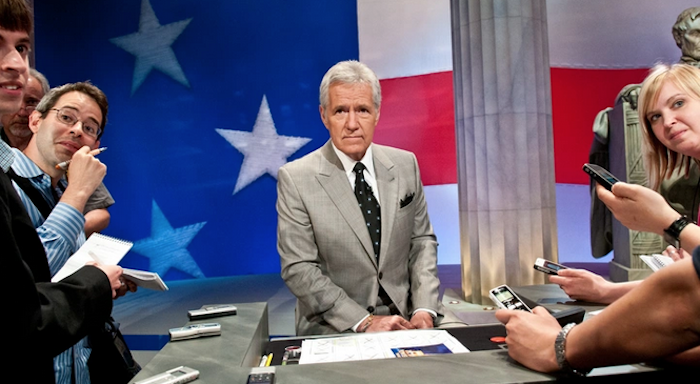
Classical Alex Trebek, R.I.P.

Alex Trebek standing next to a classical column. (Internet)

Alex Trebek died the other day. I heard the news in the half-time report of a televised pro football game. Jeopardy! and I had drifted apart of late, but I and my wife, Victoria, watched the show with some fervor for years. My ability to keep up withered over time; even at its height, I was never swift enough to actually pose answers in the form of questions. Still, we kept up with Trebek’s sad bout with cancer and felt the uplift of his occasional progress reports.

I introduced Victoria to Scrabble, and eventually my ability to keep up withered in that game too, and so we have, ahem!, drifted apart. It’s not the losing, it’s the luck, or lack of it, in what tiles you draw. That’s my story and I’m sticking to it. Perhaps it’s time for us to pick up Hangman again. No luck factor there!

There must be some sort of parallel between successful game shows, game-show hosts, and classical architecture. I will try to reach for one.

Maybe it is the luck factor. There is no luck factor in classical architecture. It has rules such as modern architecture does not. Play by the rules and it is almost impossible to produce a building that lacks beauty. You can break the rules, but only if you know the rules, which requires having rules. For modernists, it’s all about breaking the rules – the rules of proportion, the rules of gravity, etc. For the modernists, except for not having rules, there are no rules. Unless you are a genius (and even if you are one), it’s almost inevitable that you’ll produce a building that lacks beauty.

So maybe it can be said that classical architecture is to Jeopardy! what modern architecture is to Pickup Sticks.

This difference was obvious to Alex Trebek, and he did not fiddle with the rules of his game. He did not try to innovate. He knew his audience was expecting predictability, and that’s what he gave them. Occasionally the stage set would get a little more snazzy – some cynics will say this was Alex’s inner modernist trying to escape – but the rules remained always the same, whether it was normal Jeopardy! with regular contestants or tournament Jeopardy! with contestants from high school and college, or special Jeopardy! pitting former winning contestants against each other. Either way, the rules remained the same.

In 2004, Ken Jennings won 74 straight games of Jeopardy! Jennings was the beneficiary of a rules change (in the show, not in the game itself) that released contestants from a limit of five games on the length of a winning streak. For 20 seasons it was five wins and poof! you were off the island. It would be the height of futility to wonder whether any of those seasons might have produced some mute, inglorious Ken Jennings.

Alex Trebek was no Ken Jennings, but Ken Jennings was no Alex Trebek. Unlike Ken Jennings, who was a classic dweeb, nobody on the planet disliked Alex Trebek. Or so it seemed. After hearing endless encomia declaring the famous likability of Alex Trebek after his death, Victoria was startled to read a thread on Reddit that began:

Alex Trebek really irks me. He comes off as really snobby and condescending on the show when he has the answers in front of him! Anyone else share my disdain for him?

(The next reply went “At least you insulted him in the form of a question.”)

No, Alex Trebek did not jump up and down to induce histrionics in contestants as other game show hosts do. This leads to another parallel between Alex Trebek and classical architects. They are the adults in the room. They know the answers. They know the rules of the game. There is room for humor in the answers to which contestants pose questions, and for wit in Alex Trebek’s commiseration with contestants whose questions are wrong. The game and its rules were a bond with its audience. Never, so far as I know, did Alex Trebek look down his nose at his audience, as modern architects look down their nose at those upon whom their work is inflicted. Like Alex Trebek, classical architecture loves and respects its public, and the feeling is mutual.

So long live classical architecture. As for Alex Trebek, “What is the Latin phrase ‘Requiescat in pace’?

Posted in Architecture, Books and Culture | Tagged , , , , , , , | 3 Comments

Fate of E.O. if Biden wins

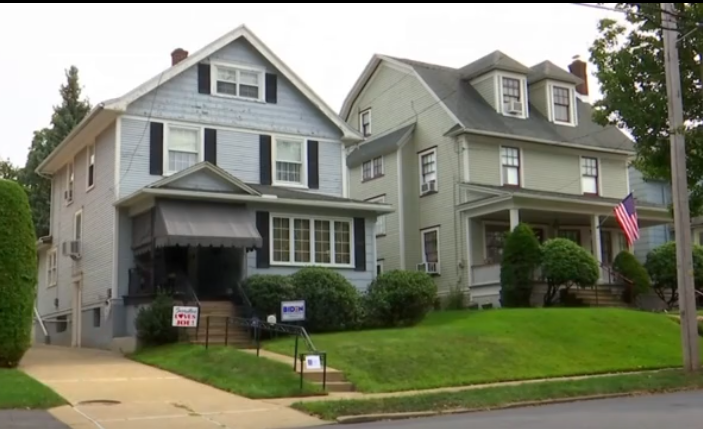
At left is the Scranton house where Joe Biden spent his youth. (yahoo.com)

I was properly upbraided in a comment on my last post, “Architecture and the ballot box,” for assuming that Joe Biden, if elected president, would not sign a draft proposal to mandate classical architecture for federal buildings. I don’t know how often a new administration has ever taken up an executive order proposed by its defeated adversary, but it is possible.

In his comment, architect Gaither Pratt, wrote:

I disagree with your premise that a vote for Trump secures the mandate for classical architecture and Biden doesn’t. Have some faith in the hard work and advocacy of the people and organizations that got it on Trump’s desk to do the same with a Biden administration.

I had written that Biden seemed a “blank slate” on architecture, and I regret, since he seems on the verge of winning, that the validity of this assessment remains firm. (Someone please correct me if I am wrong.) Still, as Pratt points out, the classicists who engineered the draft E.O. in the Trump White House are unlikely to throw up their hands in despair if Biden wins. No, they will continue to push for a classical mandate, and perhaps even harder since it appears that many classicists are uncomfortable with President Trump.

Perhaps, as president-elect and then as president, Biden will be looking for a way to unite Americans going forward. If so, he could do no better than to embrace classical architecture. A two- or three-to-one majority prefers traditional over modern architecture, according to a survey performed by the Harris Poll in October. The majority is maintained over a widespread set of demographics – age, sex, race, income, education, region and political identification. Granted, polls are in bad odor in the wake of pollsters’ blundering at all levels throughout the campaign – but this poll on architecture only confirms what anecdotes and prior research have found to be the case for many decades.

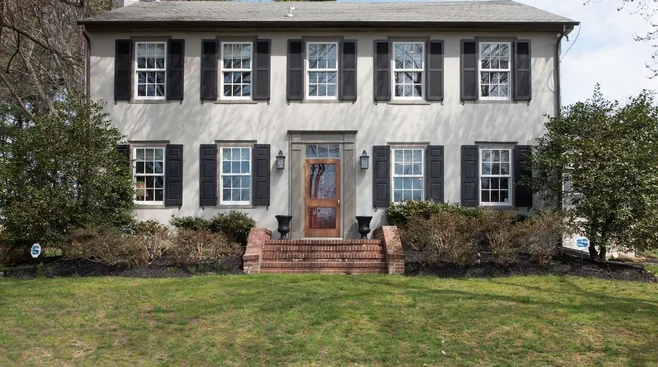
I have little doubt that Biden, who spent most of his lengthy career in politics as a moderate, prefers traditional to modern architecture. He grew up in a pleasantly trad Scranton, Pa., cape, lived in a 1723 colonial when first elected senator in 1972, and has added more houses to his portfolio ever since, each one quite as traditional as the one before, only larger. (Trump also grew up in a classical mansion in Queens, against which perhaps he revolted to assume his revolting style as a developer, which he may have outgrown as president.)

The big question is whether Biden remains a moderate – not that liberals or even the left wing are necessarily averse to classicism. However, if Biden turns out to be the empty vessel perceived by Republicans, moderates and liberals might play second fiddle to woke party activists and leftists who may staff the new Biden administration, and they are unlikely to put up with a mandate for classical architecture. After all, critical race theory could soon be in the ascendancy: columns and cornices, in that view, are totems of racism and white superiority. However alien that set of beliefs may be to most Democrats and most Americans, something like it has long had a foothold, at least, in the architectural profession, even if most architects know little or nothing of it.

To unite America and to assert his political independence, signing the E.O. (or otherwise mandating federal classicism) could serve Joe Biden as something like the “Sister Soulja moment” that served Bill Clinton. It goes without saying that architecture, no less than America, could stand a return to roots.

House where Biden lived in his early years as U.S. senator. (delaware online)

Posted in Architecture | Tagged , , , , , , , | 16 Comments

Architecture and the ballot box

Classical architecture defines the National Mall in Washington, D.C. (Wikipedia)

Few votes are likely to be influenced by a post on the eve of Election Day, but architecture will be heavily influenced by the vote. If Donald Trump wins, classical architecture will receive a boost. On the other hand, if Joe Biden wins, so will modern architecture.

Trump, after all, has sponsored an executive order that would shift the design of federal buildings from the current modernist mandate toward a classical mandate. Trump has not signed the order, and the order may not reflect the president’s personal taste in architecture. But the E.O. is called “Make Federal Buildings Beautiful Again,” a title that speaks volumes. If Trump does sign the E.O., and it is faithfully implemented, its influence will spread beyond federal buildings. The unbalanced market for architectural commissions will open up and shift toward tradition. Schools of architecture will respond to that shift by adding classical curricula. The public’s preference for traditional buildings, which has been stifled for a half a century, will guide architecture back to its roots. That will take time, but over time, beauty will return to the built environment.

Biden is a blank slate on architecture, so far as I know, but the modernists’ dominance of the field will continue if he is elected, since modern architecture is the brand of America’s corporate establishment. Furthermore, there will be no check on the rising influence of critical theory in architecture, which holds that its classical and traditional strains reflect the structurally racist agenda of white power, and threatens to escape the confines of academia. Institutional leadership will find it ever more difficult to resist the idea that columns and cornices are too risky in an increasingly woke cultural climate.

That does not mean that all Democrats are modernists and all Republicans are classicists. Far from it. Architecture ought to be the most bipartisan of fields. Classicism caters to the bottom-up, small-is-beautiful beliefs of traditional liberals, and fits better than modernism into the green agenda. And I’m sure that warm and cozy beats cold and sterile at the ballot box and everywhere else.

In fact, I’d wager that if exit polls taken after voters cast ballots were to ask about architectural preferences, the preferences of Biden voters and Trump voters would be nearly identical: three-to-one in favor of traditional styles. That conclusion was reached by a Harris Poll taken in October, and reached across every demographic category, including party identification. Of course, polling is in ill repute these days. Perhaps there are as many shy classicists as shy Trumpsters.

Who knows? That is one question that will not be answered on Election Day.

***

By the way, on the subject of voting, readers may vote whether my recent change to a smaller text font, forced upon me by WordPress, should be resisted. I may be able to increase the font size myself. If enough readers vote to approve such an attempt, I will make it, if it is possible.

Posted in Architecture | Tagged , , , , , , , , , , | 13 Comments

Goofy new RW Park “gateway”

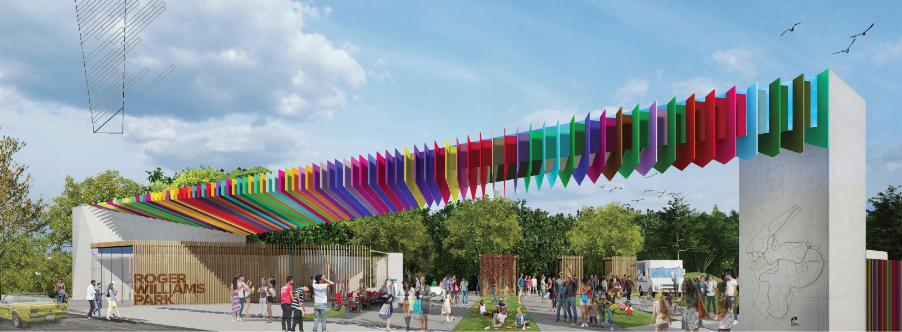
Proposed new gateway for Roger Williams Park, in Providence. (INFORM Studio)

Leafing through the November issue of Providence Monthly, I was dismayed to stumble across a short piece, “Gateway to Change,” by Elyse Major, illustrating a gaudy new portal and visitors center planned for the Broad Street entrance to the city’s lovely Roger Williams Park.

Thankfully, the idea is not to displace the current Broad Street entrance or its elegant Gilded Age set of wrought-iron gates matching those at Elmwood Avenue’s primary park entrance. So it’s really not a new entrance at all (at least not for cars) but a new welcome center with a plaza near the existing entrance. You go in on foot beneath a ridiculous “gateway” of 40 thin, parallel trapezoids of bright coloration – a huge xylophone that plucks its palette, or so it is alleged, from the ethnic Latino shopfronts of Broad Street.

The connection is amplified by Cory Lavigne, of INFORM Studio (a woman-owned firm based in Detroit and Chicago):

Borrowing from the diverse cultural vibrancy of the city, color represents the people of Provi- dence. It symbolizes the heritage portrayed through a collection of restaurants, businesses, and homes in the surrounding neighborhoods. It represents families, students, and children; future leaders of Providence. Color stimulates and captivates, drawing residents and visitors alike to the grounds while increasing patronage to local businesses along Broad Street.

Well, no it doesn’t. Maybe it “represents” children, but it infantilizes the city and its citizens. “Symbolizes the heritage”? Rather, it rejects the heritage, and was probably designed to do so. That’s where our culture is headed. Five firms competed for this job, and all but one decided against submitting an entry that sought to fit into either the park or the neighborhood, or any facet thereof.

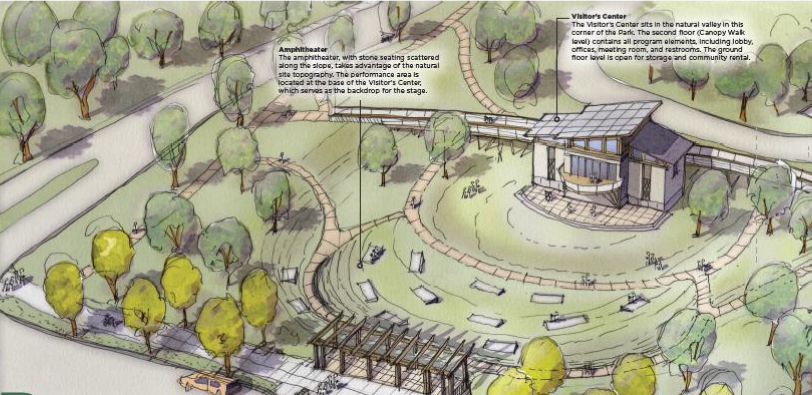
All but the Union Studio entry, whose visitors center design actually featured the vague suggestion that it was a sort of a building. Who would want anything to do with that? Clearly not goofy enough! So its entry wasn’t chosen. But at least Union Studio is a local firm. For a city that prides itself on being “the creative capital,” Providence seems to have a hard time finding local talent for its building projects.

One of the few silver linings of the pandemic is that cities can no longer afford to throw their citizens’ money at bad ideas that are not needed, like the Roger Williams Park Gateway and Visitors Center. The city’s planning department may already have selected this peacock waste of money, but we can hope that the natural selection of civic survival will render it extinct before it struts off the drawing board and into construction on Broad Street.

Union Studio proposal for RWP gatewey and visitors center. (Union Studio)

Posted in Architecture, Development | Tagged , , , , , | 4 Comments

Architecture of the picturesque

Baroque church in Prague that serves as my computer desktop. (Photo by author)

Having just twitted a panel of architects for having “touched on weighty academic matters that would never enter the mind of most citizens,” I beg readers’ pardon for touching on such a matter here.

Many classicists blame “the picturesque” for paving the way for modern architecture. Since I, like most people, think of the picturesque as quaint or charming, I never understood its connection with modernism, although the word “terror” often appears in the discussion. In this connection, paintings of nature as drama – a storm in a tranquil valley – are key. “The sublime and the beautiful,” awe-inspiring vs. serenity, the rational and the nonrational, the Enlightenment vs. Romanticism, Gothic vs. classical styles. Somehow, the picturesque got mixed up in all of this, and, in the words of Nir Haim Buras (Classic Planning, 2020), its “sensibility formulated Modernist thinking regarding design, buildings, and cities.”

I am still confused, but I know a good passage on architecture when I see one, and I recently happened upon a lengthy passage on the picturesque by Geoffrey Scott from his The Architecture of Humanism (1924) in a collection of essays called A Battle of Styles (1961), edited by Henry Hope Reed Jr. and William Coles. The passage struck me as enchanting; however that might relate to the picturesque, I’m not sure. It reads as follows:

Of these two types of aesthetic appeal [the classical and the picturesque], each commands its own dominion; neither is essentially superior to the other, although, since men tend to set a higher value on that which satisfies them longest, it is art of the former kind which has most often been called great. But they do both possess an essential fitness to different occasions. … Fantastic architecture, architecture that startles and delights the curiosity and is not dominated by a broad repose, may sometimes be appropriate. On a subdued scale, and hidden in a garden, it may be pleasant enough; but then, to be visited and not lived in. At a theatrical moment it will be right. It may be gay; it may be curious. But it is unfitted, aesthetically, for the normal uses of the art, for it fatigues the attention; and architecture once again is insistent, dominating and not to be escaped.

I believe Scott had Baroque architecture in mind, not the modernism we put up with incessantly today. Some modern architecture might be said to grant a feeling of repose, but most, especially today, is, at best exciting, even discombobulating – “insistent, dominating and not to be escaped.”

I have referred to Nir Buras’s The Art of Classic Planning. It sits open on my dinner table to be read at leisure. I will occasionally extract a trenchant quote (in fact, the entire book is one long trenchant quote), and eventually, in the not too distant future, will review this volume and its 498 large-format pages. I can’t wait to imbibe his long passage on the picturesque, which I clearly still need to read.

Posted in Architecture | Tagged , , , , , , , , | 8 Comments

Trads trash mods in new poll

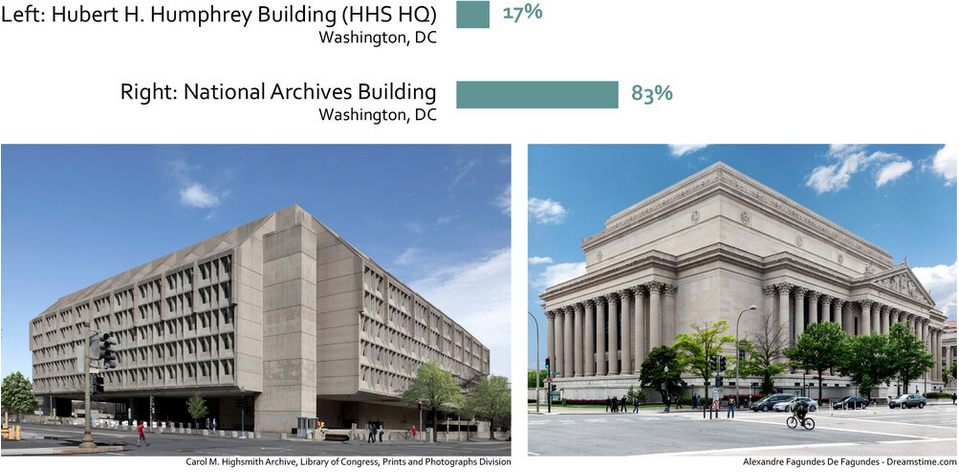
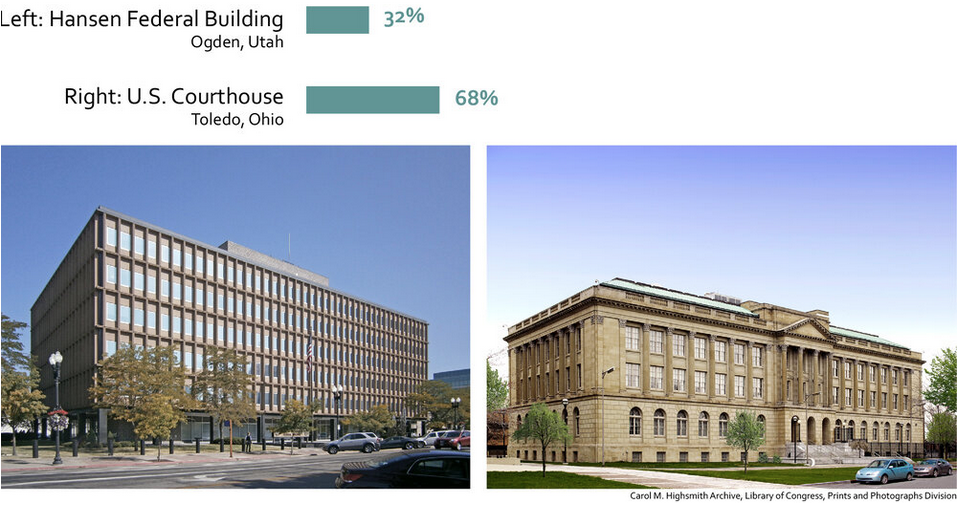
One of seven pairs of matched federal buildings in survey by Harris Poll. Another example is at end.

Now would not seem to be the moment for convergence on a major cultural issue in America. Division is everywhere. And yet a new survey by the Harris Poll, done for the National Civic Art Society, shows an overwhelming public preference for classical over modernist styles in the design of federal buildings and courthouses.

In August, the Harris people showed 2,039 respondents seven pairs of unidentified federal buildings, each matching one classical against one modernist in style, and asked “Which of these two buildings would you prefer for a U.S. courthouse or federal office building?” They took care to make sure each choice was fair:

From a long list of many dozens of photos, the seven pairs of images were very carefully selected and edited to ensure fair comparisons. Factors such as sky color, angle of photo, light conditions, distance from building, weather conditions, nature of foreground, nature and quality of street furniture, presence of street trees, parked cars, and passing people were all controlled for either perfectly (e.g., sky color) or as far as possible via careful photo selection and editing.

Click the link above for the survey itself to judge how diligently they worked to match the buildings evenly.

The poll found that Americans prefer classical architecture across a range of demographics. A ratio of between two-to-one and three-to-one prevailed in favor of tradition among Americans in general and among categories of the public broken down according to age, sex, race, income, education, region and party. The numbers of those who prefer traditional over modernist styles for courthouses and other federal buildings are as follows:

  • Overall: Traditional vs. modern, 72-28 percent
  • Age: 65+, 77-23 percent; 18-34, 68-32 percent;
  • Sex: Women, 77-23 percent; men, 67-33 percent;
  • Race: White, 75-25; black, 62-38; Hispanic, 65-35;
  • Income: Under $50,000, 73-27; over $100,000, 70-30;
  • Education: High school or less, 72-28; college grad/post, 72-28;
  • Region: Northeast, 73-27; South, 73-27; Midwest, 74-26; West, 69-31;
  • Party: Republican, 73-27, Democrat, 70-30; Independent, 73-27.

It is naturally gratifying for classicists to yet again have their reverence for tradition ratified by solid public support. It may surprise some that the degree of that preference is maintained over such a range of demographic categories. But few classicists can be surprised by the findings. Indeed, few modernists can be surprised. That the preference for tradition prevails well beyond federal buildings is a sensible presumption that might be taken from the survey’s modest conclusions:

Why does a wide majority of Americans prefer a U.S. courthouse or federal office building with a traditional appearance? Perhaps the neoclassical style of some of these buildings, as well as that of Colonial Revival, is positively associated with the historic architecture of the American founding, iconic government buildings such as the U.S. Supreme Court, and/or the country’s democracy. Furthermore, some of the buildings in the study are characterized by classical columns and pediments—features that could signify a courthouse as a recognizable building type—i.e., a temple of justice.

It is also possible that Americans perceive traditional buildings as being more beautiful or pleasing to the eye than modern ones.

By contrast, the survey describes the minority taste in language that arouses little sympathy. Or maybe that merely reflects the bias of this writer. Either way, the survey’s description is as follows:

In comparison to the traditional buildings in the study, the modern-style buildings follow a more minimalistic, austere style with emphasis on glass, concrete, and sharp geometric shapes. The three modern-style buildings that were at the bottom of the list of those Americans preferred all feature a grey unornamented concrete façade with uniform repetitive windows, which may project a more cold and sterile feel compared to the warmer stone and variation in structure of the traditional buildings.

Cold and sterile. Some people prefer that. Still, it would be interesting to see whether further polling might reveal how much of the minority taste for modern architecture reflects genuine admiration for such styles or, instead, admiration feigned for motives of sociological or professional self-interest.

I won’t be holding my breath waiting for that study to be performed.

The survey was sponsored by the National Civic Art Society in order, I suspect, to bolster the case for the proposed executive order called “Making Federal Buildings Beautiful Again,” which remains unsigned by President Trump. It was leaked last February and caused a sensation, but the healthy debate it sparked back then was snuffed by Covid.

In recent years, the NCAS has tried to stop the Gehry Ike memorial, striven to rebuild Penn Station in its original classical style, and, most recently, triggered the effort to rethink the existing mandate for federal architecture. Who are these guys? You’d think I’d be a member (and indeed I am).

A panel held on Wednesday via zoom, sponsored by the American Enterprise Institute to discuss the merits of the E.O., reached no conclusions, although the four panelists voiced varying degrees of support for the proposal. While the new survey on federal buildings was mentioned by NCAS president Justin Shubow, the panelists did not get around to assessing the merits of the E.O. in light of the new information. Most of the back-and-forth touched on weighty academic matters that would never enter the mind of most citizens.

In one of the more striking assertions, former Notre Dame architecture school dean Michael Lykoudis argued that if the E.O. is signed, “those who believe classicism is authoritarian will have seen their point made.” This is one of the leading modernist talking points against the proposal, in spite of the fact that a mandate favoring modern architecture has existed since 1962. But why should the told-you-so’s of a few cranks prevent the public from playing a role, at last, in how federal buildings are designed?

Modernists who oppose the E.O. routinely declare that a stylistic mandate from Washington will erase public participation in the design of federal buildings across the nation when, in fact, no such participation has been solicited for decades. We already have a stylistic mandate from Washington, but it favors styles that three-quarters of the public dislike.

How democratic is that?

Trump is unlikely to sign the executive order until after the election. Why try to curry favor with such a solid majority of the electorate? He should sign it before the election, and watch the heads explode.

Posted in Architecture | Tagged , , , , , , , , | 5 Comments

Today: Panel on classical EO

Winning design for the U.S. Capitol by William Thornton in 1792 competition.

Today at 2 p.m., a distinguished panel on the proposed White House executive order “Making Federal Buildings Beautiful Again” will be held in Washington. The panel, with Justin Shubow of the National Society of Civic Art, Philip Bess of Notre Dame’s School of Architecture, and other worthies, will discuss the proposed E.O. via video livestream and take questions. The panel is sponsored by the American Enterprise Institute. Those interested in attending can click on the AEI website here.

No doubt the panelists will discuss the very recent new survey by the Harris Poll of architectural preferences, sponsored by the NCAS. I was planning to discuss the survey in this post, but instead, I am trying to get word out about the AEI panel. Enjoy! I will discuss the survey and the panel in my next post.

Posted in Architecture | Tagged , , , , , , | 2 Comments

Nix the San Marco bugaboo

Piazza San Marco in Venice in all its stylistic variety. (Flickr)

In my last post, “Neighbors win third straight,” I described the latest zoom meeting of the Providence Historic District Commission, which deferred action for a third (actually, a fourth) straight time on proposals to relocate a historic cottage and to build a new pair of townhouses between Williams and John on College Hill. Friedrich St. Florian, their designer, used a common argument to defend his blatantly modernist design.

Modernist house proposed for John Street. (PHDC)

St. Florian, who is celebrated for his design of the Providence Place mall here and the National World War II Memorial in Washington, D.C., referred to Venice’s Piazza San Marco to defend his proposal to place a modernist building in one of Providence’s oldest historic districts.

Using an argument widely deployed by modernists for decades, St. Florian noted that “every single building is different in style but are harmonious.” Therefore, he concluded, placing a modernist house on a historic street like John Street should not upset the neighbors on College Hill.

St. Florian is correct in his description of the famous plaza but incorrect in the conclusion he (and many other modernists) has drawn from it. Yes, all the buildings are of different styles and they all fit together nicely, and yet because all of the styles are traditional, the argument is flawed. Architects who make it are actually making the case for the tremendous variety of traditional architecture. But to plop a modernist building in St. Mark’s would be as disconcerting there as to plop a modernist house on John Street.

Let’s say you have four men in a saloon: a white, a black, a brown and a yellow man seated at the bar. They are joined by a red man. How lovely! If, instead of a red man a robot comes into the saloon and sits down at the bar, what then? The robot, which is hard and metallic rather than soft and flesh, does not fit in at all. That is what St. Florian proposes on John Street.

Modernism is by definition anti-traditional. Traditional architecture features elements that grew organically, evolving generation after generation over millennia from the Greco-Roman roots of classical architecture. All members of tradition’s family tree, however different, have enough design elements in common to stand together nicely on St. Mark’s Plaza or on John Street, or, in fact, anywhere else. The beauty of John Street may not necessarily be ruined by a modernist house, but its historical character certainly would be. Modern architecture rejects the whole idea of fitting in.

Coincidentally, it seems, a new survey just came out on Wednesday showing that almost 75 percent of Americans prefer traditional styles of architecture to modernist styles of architecture. The results were broken down by income, age, gender, race, region, education and political preference. In each category some three-quarters of over 2,000 respondents to the survey who chose from seven pairs of buildings, one mod and the other trad, favored the traditional federal building over the modernist building.

Very few Americans or citizens of any country can possibly be surprised by this finding. Despite a relative dearth of scholarly and scientific studies, the wide preference for traditional architecture over modern architecture has been evident to virtually all observers, including modernists, since the outset of their challenge to tradition in the early 20th century.

The survey was performed by the Harris Poll in August and sponsored by the National Civic Art Society. My next post will describe it in more detail.

Left: William Jefferson Clinton Building (EPA). Right: Robert C. Weaver Building (HUD). (Gallup)

Posted in Architecture, Development | Tagged , , , , , | 4 Comments