Guatemala’s peaceful Cayala

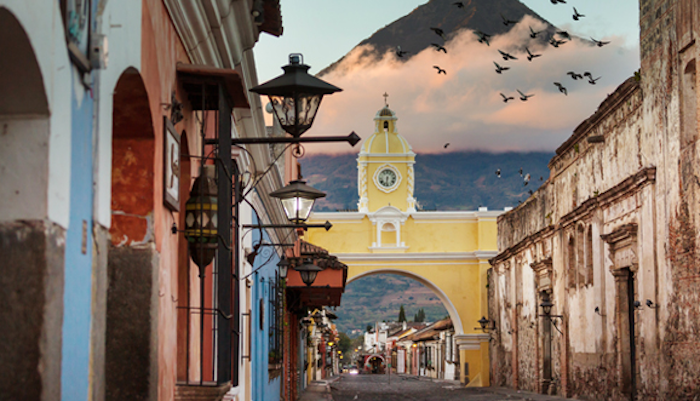
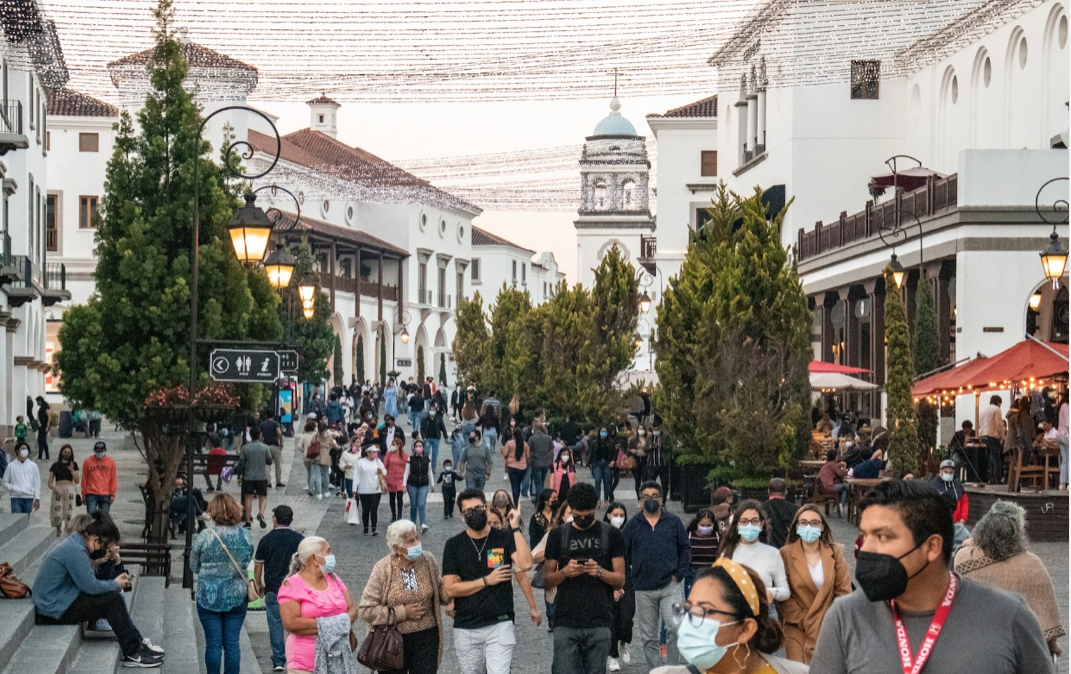
The Paseo Cayala, in Zone XVI of Guatemala City. (Estudio Urbano)

Cayalá is a new town on the edge of crime-ridden Guatemala City that has grown stronger since it was planted in 2011. I’ve written about its lovely mixture of Spanish and Mayan design influences, starting as early as 2012 in one of my weekly columns for the Providence Journal. In a 2015 post on my blog I made what is now a common error in descriptions of Ciudad Cayalá – the city of Cayalá – I called it “allegedly ‘gated’.” In a comment, architect Steve Mouzon corrected me: Cayalá is not gated, neither the town as a whole nor its central business district, known as the Paseo Cayalá. Since then, however, journalists on the left have made a cottage industry of false narratives regarding Cayalá.
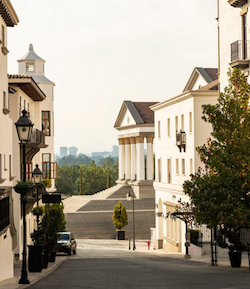
Fortunately, those narratives are generally ignored by the residents of Cayalá, its many visitors and admirers from around Guatemala and the world, plus its famously droll master planner, Léon Krier, and his two  lieutenants, architects Pedro Godoy and Maria Sánchez, founders of Estudio Urbano. Still, the false narratives do sting, and do hurt Guatemala more broadly in its efforts to stabilize and improve its damaged society.

The goal of reforming architecture globally and returning beauty to its rightful centrality, in Guatemala and in the United States, requires, also, that such narratives be exposed and seen for what they are.

Before continuing on this theme, allow me to quote my own first description of Cayalá from that 2012 column, called “A new classical flower in Guatemala” and posted on my blog in 2015 following news of a visit to Guatemala by Providence Mayor Jorge Elorza:

Ciudad Cayalá is a new town being built on open land beyond the city center but within the city’s broad boundary. Developed by the landowner, Grupo Cayalá, and masterplanned by Léon Krier, who spearheaded Prince Charles’s new town of Poundbury (outside Dorchester, England), Cayalá’s Phase I was finished in November. It incorporates Mayan ornamental detail amid a robust Spanish classicism. Streets and squares are lined with colonnades. A monumental set of steps ascends to the Athenaeum, designed by Notre Dame Prof. Richard Economakis, forming a pyramid of Mayan descent, topped by a Spanish temple. Photos hint at the glory of ancient Rome, whose classical buildings mounted to an urban epiphany with a seemingly natural, unplanned grandeur.

The gates theme seems to have begun with an article by Scranton University associate professor Michael E. Allison for what is now his blog called Central American Politics, focusing on the transition of (supposedly) former Central American rebel groups to political parties. In 2013, the UK Guardian posted an Associated Press story (“Guatemalan capital’s wealthy offered haven in gated city“). In 2017, Adventures Guatemala ran an article based on Allison’s reporting (“Private city built to escape crime“). Last year, in the journal Kairos, Rutgers University published “My visit to an invented city of privilege,” by a professor Madhu Murali. It is filled with one of the silliest collections of “outraged” leftist platitudes I’ve ever read. Most articles on Cayalá that are not advertisements for residential units there seem to be obsessed with its nonexistent gates, its security, and the idea that its beauty somehow makes the town inauthentic.

Memes that pop up in writing by Allison and picked up by other writers include not only the alleged gates but the impact of Cayalá on efforts to restore the old center of Guatemala City – the Centro Histórico, as distinguished from the far older former capital, Antigua Guatemala (now a UNESCO world heritage site), which is located some 25 miles from the capital.

Detractors [of Cayalá] say it is a blow to hopes of saving the real traditional heart of Guatemala City by drawing the wealthy from the urban center to participate in the economic and social life of a city struggling with poverty and high levels of crime and violence.

But there is another meme associated with that concern, one which has today become ubiquitous in the United States as well, with equally dire consequences for Guatemala:

One consideration why some people want to live in Cayalá boils down to the fact that many of the wealthy are simply racist. They do not like their fellow citizens. In fact, they don’t even think of them as citizens.

People who want to protect their families and themselves from crime are not racists for preferring safety to danger. To turn such an allegation into a dominant narrative, at least among the elite, risks destroying a society’s mechanisms to improve the lives of citizens. In all societies, self-preservation has been the concern  of all humans. In free societies, citizens have the right to plan for the betterment of their families, in part by selecting residences that are safe, schools that provide quality education, and jobs that offer prospects for higher income. Societies such as Guatemala, young democracies that are rising from periods of civil strife, have these same natural rights as free peoples, and it should be the purpose of government to honor and to protect those rights.

In Guatemala, it is not the alleged racism of the wealthy who move to Cayalá that poses a threat to social reconciliation or the restoration of the Centro Histórico. It is the violence itself, and the racist narrative that can promote distrust and even justify violence – Guatemala’s long civil war ended recently, in 1996. Violence is what sends those who can afford it to safer places, in or out of Guatemala, at all levels of its society (as we have seen, for example, at the U.S. border).

Arising from its history and, more recently, the Cold War, violence and injustice by Guatemalans against Guatemalans have brutalized life. Whether most of the guilt lies with the former rebels, the military, Guatemala’s elites, or U.S. support for the government, Guatemalans and their civil institutions, local and national, must work for a better future. A narrative that equates citizens’ desire for safety with racism, if it takes hold in social discourse, can only undermine the nation’s hopes for such a future.

Cayalá and the safety it offers do not work against restoring the Centro Histórico, let alone efforts to reach a modus vivendi in Guatemala; rather it is a safety valve that slows flight from the country and permits civil reconciliation to continue within its borders. It is a model for peace. When Guatemalans of all levels see an alternative to civil strife, progress will surely follow – if the people want it to, if it is allowed to happen. Cayalá thus serves a positive good in society as a lubricant for the gears of social advancement in Guatemala.

Wealthy Guatemalans who have moved from the old town to the new town are not prevented from contributing to that social advancement, whether by helping to finance the Centro Histórico’s restoration or by participating in the broader social, financial or political efforts to bring comity. Anyone at any level of income can visit Cayalá to shop, dine, visit friends or partake of its beauty. Its charms can only raise incentives to better pacify and beautify the rest of Guatemala, and serve as a model for one way of doing so. False narratives only retard prospects for a better future for all – a truth that spans not just that nation but the world.

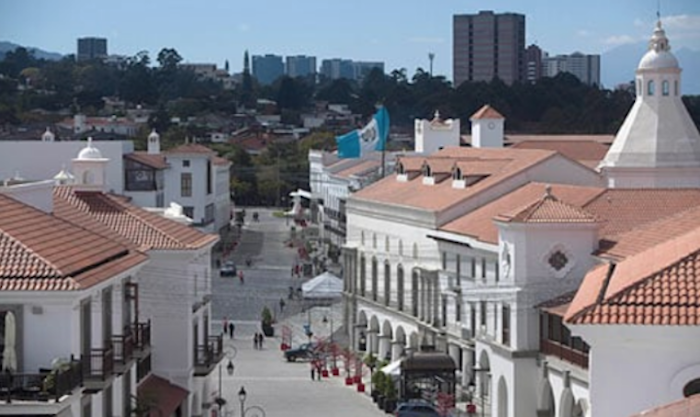
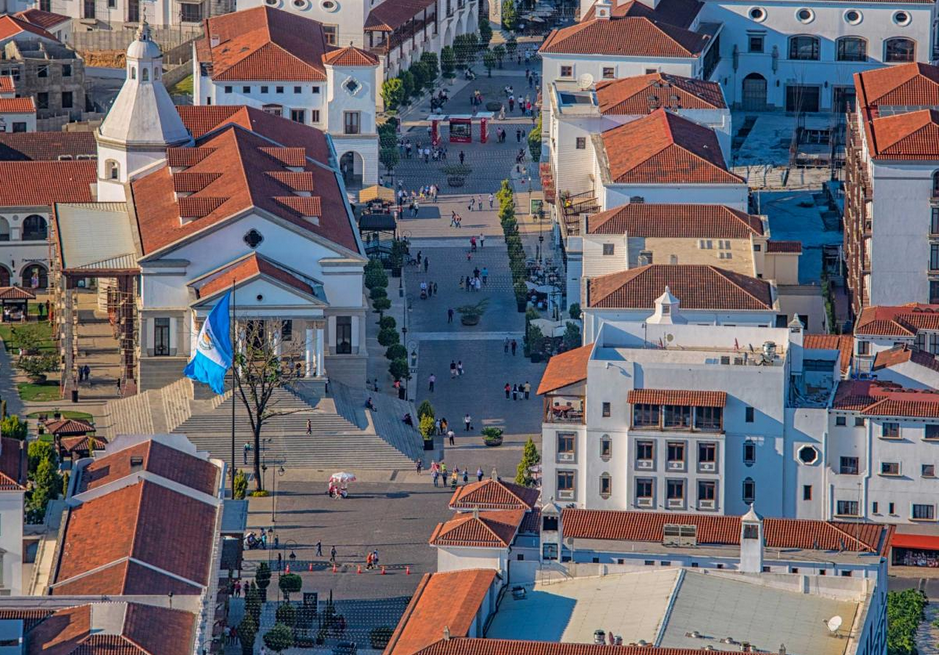
[At the end of this post are several photographs of Paseo Cayalá and Ciudad Cayalá. The first, from the UK Guardian, gives a sense of the distance from the central business district of Guatemala City. The rest, from Studio Urbano, taken from ground level and from above. Finally, there is a photo of Antigua Guatemala from the Expat Exchange.]

[Correction: The original version of this post mistook the old historical center of Guatemala City for the Antigua Guatemala, a former capital some 25 miles from today’s capital. That error was fixed by 11:54 p.m. Friday.]

***

This month, Cayalá won a Charter Award from the Congress of the New Urbanism. Celebrating the award is an article, “The Cayalá effect in Guatemala City,” from the CNU Public Square journal by its editor, Robert Steuteville. Its opening line seems to contain the “gated community” meme: “The Paseo Cayalá Neighborhood in Guatemala City is a model of open and economically resilient development in a city of gated development.” It turns out that by “city” this means Guatemala City, not Cayalá.
Posted in Architecture, Urbanism and planning | Tagged , , , , , , , , , , | 11 Comments

An architectural reawakening

Children’s library in Burundi, designed by BC Architects and Studies, in Belgium. (BCAS)

Architect David Rau gave a lecture called “Reawakening” last week, sponsored by the New Vitruvians, the youth wing of the New England chapter of the Institute of Classical Architecture & Art. He tracks four “awakenings” in the world today, involving food, happiness, genetics and our increasing knowledge of ourselves as human. Rau concludes that in the future, architecture need not be “futuristic” but can build upon the increasing awareness that architecture has been on the wrong track for a century. We must treat technology with greater skepticism and embrace local craft as the way to build if we want bring a true sustainability to design and construction, and the sort of beauty than can make us happy.

Rau describes the slow-food movement, recent studies in human happiness, the discovery by neuroscientists that our brain hasn’t evolved as much as we thought it had since prehistoric times, and the re-emergence of craft as vital to human self-worth and the survival of the planet.

It was a great lecture. Rau spoke for an hour and a half, and answered questions for another half an hour, but the ICAA has not yet posted its recording of the lecture. So I am posting the TEDx version of the lecture from six years ago, which sums up Rau’s main points in just eleven minutes.

Rau starts us out with a photograph of himself and his wife (an architectural historian) on the Grand Canal in Venice, and notes that in the print they bought of an 1742 engraving of the canal that Venice looked today as it had for almost 400 years. It was built with local materials by local artisans, highly ornamented, beautiful and beloved around the world. It was here in this ancient beloved city that Rau had his awakening, which he describes by summarizing the trends in thinking that have arisen from those who have noticed that the world is on the verge of epic fail in many realms. Many of these failures are embodied in today’s architecture, from whose errors we all can and should learn.

In the TED version, Rau seems to end with the suggestion that architecture in the future will look more like it did in the past. He said much the same to the ICAA, but hesitated to say what I think he might (and ought to) mean: that society would go back to the classical and traditional architecture that worked so well until it was interrupted by modernism in middle of the last century.

After his lecture (on Zoom), I asked him to cite a building of recent vintage that might give us some idea of what he was talking about. He named a children’s library in Africa, which seemed to me to resemble what the architectural theorist Christopher Alexander might design. Rau had mentioned Alexander and his pathbreaking book A Pattern Language in his lecture but not in his TED talk.

In spite of the fact that it is featured in Dezeen, the library is lovely, and its photo atop this post is delightful, for reasons beyond the building itself. It is highly ornamental and highly local in its materials. Still, traditional architecture features all of the avenues of reawakening that David Rau cites in his own reawakening. I will post his lecture as soon as it is available, and the reader may judge more fully whether he is calling for a new architecture or calling us back to an old one.

***

The ICAA’s New England chapter has just posted David Rau’s lecture.

Posted in Architecture | Tagged , , , , , , , | 14 Comments

OopSox chill at Polar Park

Retro stadium proposed for PawSox in Providence shortly after team was sold. (bostonglobe.com)

By the time this has posted, the WooSox, as the former PawSox Triple-A Boston Red Sox franchise is called, will have played their home opener at the new Polar Park, in Worcester, Mass. Rhode Island baseball fans are of two minds about the team’s absquatulation from Pawtucket: 1) they hate it, or 2) they really hate it. Most non-fans don’t much care. I had some pleasant outings at McCoy after I learned how to find it. Still, in this whole sad train of events, it was the lost opportunity for Providence that irks me the most.

(Absquatulation is a comical Latinate synonym for departure, with a hint of leaving with its tail between its legs.)

To recapitulate events that might have fled the memory of some readers, longtime team owner Ben Mondor died in 2010. His widow sold the team in 2015. Its new owners soon announced the team would move into a retro stadium to be built on the new Providence waterfront. Alas, the deal fell through. The new owners, disinclined to remain in Pawtucket, then played “let’s make a deal” with several Massachusetts cities. To counter this auction tactic, Pawtucket proposed, along with the state of Rhode Island, a new riverfront stadium next to its downtown. In 2017, the General Assembly approved a deal that shifted more of the financial burden from the state to the team. The team rejected that deal. At last, in 2018, Worcester pitched the best woo, with an assist from Massachusetts. Polar Park was built and the WooSox held their home opener today against the Syracuse Mets. (The WooSox won 8-5 in a game with six home runs.)

Rhode Island will survive the loss of professional baseball. Pawtucket is the big loser, but Providence could have won big-time if the stadium had been built on the vacated Route 195 land where the west end of its new pedestrian bridge terminates in one of the many public parks along the city’s new riverfront.

It seems to me that the long knives were unsheathed for this proposal from the start. The owners’ initial proposal was treated not as an opening gambit to be negotiated toward parity but as a non-negotiable deal killer by owners intending, for some obscure reason, to fail. When the proposal was twisted by the media as wealthy team owners eager to turn a public park into private profit, the city and Brown University withdrew their support, never mind that the waterfront was festooned with parks. This led to the swift demise of what could have been a bonanza for the city, the state, their citizens and, of course, the team.

My own personal stake in this deal was the hope that the classic beauty of an old-fashioned ballfield might cause the recently created innovation district to shift its architectural strategy from one of stark, raving modernism to a more people-friendly set of traditional styles – similar to the classical trend in Capital Center that was aborted by the GTECH building in the mid-1990s. That was my excuse for supporting the sin of a publicly funded sports venue. Whether it would have worked I have no idea; as things stand now, it didn’t take long for modernism to stifle all hope of a humanistic innovation district on the edge of downtown.

Polar Park, named for a soft-drink manufacturer in Worcester, is a great title for the new stadium, but not because the naming rights belong to Polar Beverages Inc. Yes, Worcester is cold in winter, but baseball is a summer game. No, Polar Park is apropos because it evokes the ballpark’s ice-cold architecture. Look at it. Warm it ain’t. A chill for WooSox fans is, however, cold comfort for baseball fans in Rhode Island, 49 miles’ drive from McCoy in the Bucket.

New Polar Park stadium for WooSox in Worcester, Mass. (William Morgan)

Brrr! … But wait! Below is an early rendering of the ballpark in Worcester back in 2019, cozy and traditional. That’s not what they built. What happened? Maybe it was the old bait-and-switch. Maybe the cozy traditional stadium proposed at first for downtown Providence would have been the same bait-and-switch. If so, this will be the last word on the subject from a rube who swallowed it hook, line and sinker.

Early rendering of proposed ballpark for Worcester Red Sox. (masslive.com)

Read William Morgan’s assessment of Worcester’s new WooSox stadium at GoLocalProv.com. It’s excellent, except for when he seems to be sorry the team did not build an even more exacrable stadium.

Posted in Architecture, Development | Tagged , , , , , , , | 6 Comments

Providence now and then

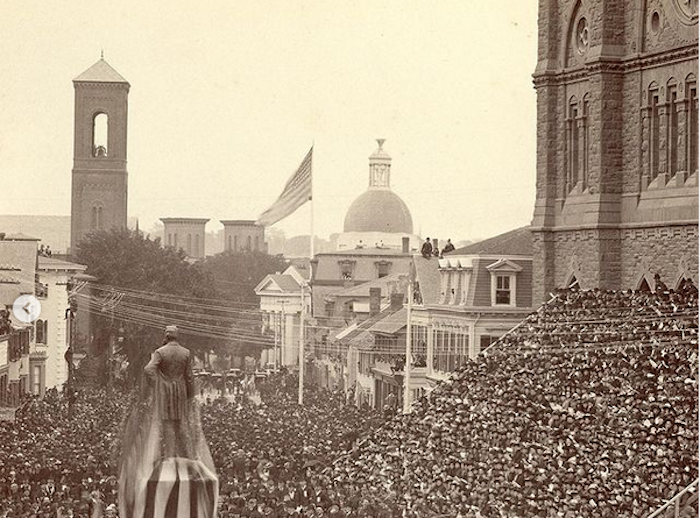
Dedication of statue of Providence Mayor Doyle at original Cathedral Square, 1889. (PPL)

Among the most fascinating places I’ve recently discovered on the web is the Instagram site of Mike Ferguson, which takes new photographs of Providence and places them next to one or more old photographs of what used to be there. For a state whose denizens constantly refer to where this or that place used to be, pvdnowandthen.com must be manna from heaven. It certainly has my attention. Moreover, since before-and-after shots can be terribly confusing, the photos are frequently augmented by Ferguson’s description and often by comments from visitors to his site reacting to the juxtapositions.

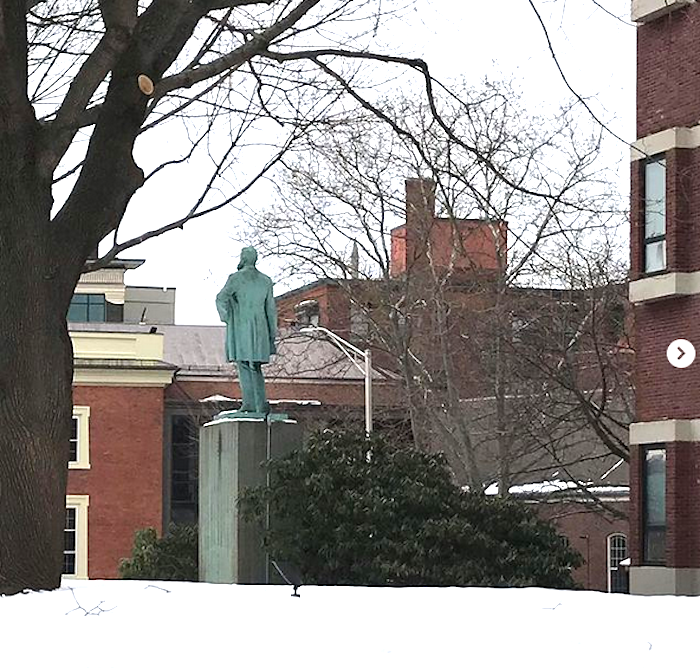
Recently, I clicked on a shot of the statue of former mayor Thomas Doyle, now sitting between the Beneficent Church (“Round Top”) and Beneficent House (designed by modernist architect Paul Rudolph) at Weybosset and Chestnut. I then clicked to a photo of the dedication of the statue in 1889, at its original location near the front of the Cathedral of St. Peter & Paul, where Westminster and Weybosset streets used to intersect before most of the area was demolished in the era of urban renewal, executed under the Downtown Providence 1970 Plan, which created a new and diminished Cathedral Square, the Westminster Mall, and then thankfully was killed by the belated neglect of civic leaders.

It was a fascinating juxtaposition, especially the old photo of the dedication, in which a huge crowd had gathered to honor the most longstanding of Providence mayors until the reign of Buddy (“Vincent A.”) Cianci Jr. – as Philippe & Jorge used to call him in the old Phoenix. Celebrants watched from rooftops and hung from lampposts and telegraph wires. The shot is 60 ranks down on Instagram, counting as the photos march down the page three by three.

What caught my attention most of all, however, were the three towers that I could not identify. See, in the picture atop this post, a tall bell tower and, to its right, two flat-topped towers on one building, much like the cathedral’s pair of towers. (You can see where they moved Doyle’s statue, just to the right of the portico of Round Top near the center of the photograph.)

I wrote to Mike, who works for a coffee distributor located in the Tilden-Thurber Building (1895) and lives in the West End, and asked if he knew what the towers were. He wrote back:

The curve of the street makes it tricky. The single tower was Central Baptist, which sat on Broad Street just a block west of Beneficent, approximately the corner of Weybosset and Empire today. The twin towers belong to the Richmond Street Church which sat at the corner of Richmond and Pine.

Tricky indeed. Weybosset Street winds differently today compared with its curvature in 1889, when it curved to the south away from Westminster near the cathedral then, after several relatively straight blocks, curved to the north back to Westminster just before reaching the Providence River. I cannot quite figure out the location of the twin towers, but they seem to be near where the Providence Performing Art Center arose in 1928. But that’s just a guess. I don’t doubt that Mike, who walks around Providence a great deal gathering info and images for his Instagram site, and filling out the map in his brain, will fill me in.

I have another architectural mystery to place before one of the city’s most diligent architectural detectives. When my Journal editor Edward Achorn was writing his book about the Providence Grays and their victory in the first World Series (1884) – Fifty-nine in ’84, about Old Hoss Radburn, the Grays pitcher who had 59 victories in that season – we consulted together about pictures of Washington Street, where one of his protagonists had an apartment. One pair of pictures, when juxtaposed, appeared to show that either City Hall or the Slade Building (on the corner of Eddy Street and Washington Street) had moved several feet to the right or left. So it seemed to me, and I have wondered about it ever since. I do not have or remember the particular photos we were inspecting.

Without those photos it might be impossible for Mike Ferguson to shed light on this mystery, or wish to be put on the spot in the quest for a resolution. But that is what they said about Sherlock Holmes, eh wot? Or at least that’s what you’d think Scotland Yard might imagine. In any event, I invite those intrigued by the winding history of the streets of Providence to visit his (Mike Ferguson’s) Instagram account. For a good time, as they say.

***

(As a mere afterthought, I remind dear readers of my book Lost Providence (2017), which may appeal to those who find Providence’s architectural history mysterious.)

Posted in Architecture, Architecture History | Tagged , , , , , , | 1 Comment

What would St. Florian do?

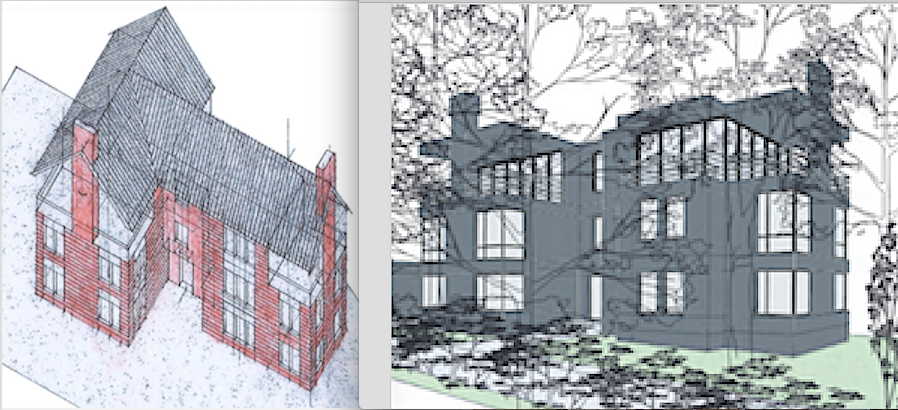
Design evolution of 6 John St. townhouses from June (left) to October (right) 2020. (HDC)

Last Thursday, Friedrich St. Florian, the Providence architect, appeared before a subcommittee of the Historic District Commission on the matter of 59 Williams St., just off Benefit Street in the city’s College Hill Historic District. Its members had visited the site to see if more could be done to assure that the cottage and its proposed addition would reflect the neighborhood’s historical character.

At this April 29 subcommittee meeting, on Zoom, which I attended, St. Florian pledged that he and his team (including his client, the developer) had agreed to put all of the HDC’s latest requirements into his plans. The subcommittee members pronounced themselves satisfied.

(I would want, in addition, to encourage the developer to add brick sidewalks along the project’s Williams Street frontage. And I would further suggest that they allow the garage to go up a story, maybe for a granny loft, in order to avoid the flat roof line that hints too much of suburbia.)

The subcommittee meeting had followed a meeting on March 8 at which St. Florian had abandoned a year of successive iterations of his proposal. In each of them, the addition to the cottage embraced more modernism, each design less and less sympathetic to the circa 1870s Italianate cottage itself, not to mention the historic character of the neighborhood. At the March 8 meeting, neighbors were gratified to learn that, after a 180 degree turnabout, St. Florian’s new design would fit well into the neighborhood. He just threw out all his work, and good for him. On Thursday, St. Florian agreed to the HDC’s suggestions that would make the cottage and addition even more traditional and historical.

Aside from some neighborly admonitions that the addition looked too suburban, and should have been blocked from the beginning by the HDC, it seemed as if the commission had done its job. It had forced the developer and his architect to back down from their modernism and make their proposal fit into the district’s historical character. It was a victory for preservation, history, beauty and the future of Providence.

And I trust that’s how it will remain as the proposal takes on the status of a project unfolding on a construction site.

But you never know.

Just as a thought experiment, let us suppose St. Florian and his developer simply ignore the commission – as they have done throughout the design process up till just recently – and refuse to carry out the agreement they have with the HDC. Suppose they build an addition as modern as Friedrich obviously wants it. I’m sure that once their intentions were made clear by ongoing construction, the city could get an injunction to stop the work. Still, it might be instructive to think a little about such a betrayal of the city and the neighborhood – which, again, has already been attempted by the architect and the developer.

After all, it beggars the imagination why a developer who wants to build in a historic district would hire St. Florian. Yes, he famously designed a traditional façade for the Providence Place mall in the mid-1990s and, shortly after, designed the winning proposal for a National World War II Memorial on the national mall in Washington, D.C., which was completed in 2004. But ever since, his relatively small commissions in Providence have been starkly modernist – less in line with the designs that made his reputation than with the abstractions he drew while a professor at Rhode Island School of Design, and which obviously nobody in his right mind would want to pay to build.

Modernist architects hate contemporary traditional design. They might like, or pretend to like, genuinely historic old buildings, but most of them despise and ridicule the idea of designing houses today that are inspired by historical styles. They believe that only modernist designs are appropriate for the modern era. But time passes. The modern era (as they see it) eventually becomes as yesterday as all previous eras. You even see the occasional building erected in the International Style, one of the early modernist styles, which lost favor in the 1950s or ’60s to the glass box or the Brutalist style. (“Must not copy the past!”) All styles are in fact appropriate to build at any time. That’s true of modernist styles, too, even though most neighbors dislike it and three-quarters of the U.S. population, according to recent research, prefers traditional styles.

So one can understand if not excuse St. Florian for wanting to make his true mark by kicking a historic district in the shins, even in the face of the stern opposition of neighbors. It’s épate la bourgeoisie, man! Or can’t we all just get along? Or something. Whatever. Of course he wants more respect from his modernist colleagues, who are the vast majority of the tribe. But in a broader sense, St. Florian and his retreat to modernism is sucking up to the ruling class – the corporate architecture bigwigs who understand that modern architecture is the architecture of the 1 percent. He gets no points from me for that.

But how can he have found a developer foolish enough to up the neighborhood? He’s the one who loses money every time the HDC orders St. Florian to go back to the drawing board, and who will lose money if the project fails. St. Florian may suck his thumb all he wants while his client sweats bullets.

And what about the Providence Historic District Commission? Why did the commission not lay down the law to begin with? St. Florian may propose anything he wants, but the commission does not have to encourage him. Why didn’t the commission tell the developer and the architect that, in a historic district, modern architecture would not be permitted? Providence law is festooned with language that mandates respect for historical character. And if nothing else is clear, it is clear that modern architecture does not respect historical character. Well? Most local design apparatchiks were taught to be skeptical of conventional concepts of beauty. That is the first purpose of architecture school, if that’s where they went. Even if they later got jobs as, say, preservationists, their education was already imprinted on their minds.

The artist known as Mondrian pointed out in a 1937 survey of “constructive art” that artists (and architects) should be intolerant of competition from the past. “Certainly the art of the past is superfluous to the new spirit and harmful to its progress, just because its beauty holds people back from the new conception!” I could dredge up a thousand quotes saying the same thing. That’s why modernists and their camp followers try to get rid of any old building, or put up stinky new buildings that elbow old buildings in the rib cage. In the end, it’s to make things easier for socialist thinking that most people (being much more intelligent than socialists) view with a healthy skepticism.

Most architects either are unaware of such thinking or, having learned it in architecture school, have put it out of their minds and would not admit, if challenged, that they believe it today. But modern architecture’s pioneering authoritarian principles are carried out by today’s practitioners regardless of their intentions, simply by designing buildings as they learned in school. And in any event, an old building preserved is a job lost for a modernist architect. Probably most in the profession understand that.

I’m just trying to puzzle through why residents of the College Hill neighborhood find they must worry about modern architecture, which is sure to undermine the value of their houses, or degrade the pleasant but dear historical environment they love. Isn’t that why the city has a Historic Preservation Commission?

So you’d think, but think again. And quickly.

Next up for these citizens and homeowners is the threat of one or two new townhouses behind 59 Williams on land fronting John Street that is today a historic woods. St. Florian is the architect for those townhouses, too. That process is already under way, and his designs have gone from quasi-traditional in style to starkly modernist. (See images atop this post.) If St. Florian does not backtrack, as he did at 59 Williams, that will be proof that he has not learned from his recent experience, or has decided to ignore the lesson.

Then there are the two proposed Brown dormitories across from each other on Brook Street, both in a cockeyed modernist style with syncopated windows and roofs that slant lurchwise. The neighborhood, including many of these same homeowners, has responded more directly against the design of this proposal, and at a recent meeting with the Fox Point Neighborhood Association, Brown and its architects (Deborah Berke Partners) agreed to take another look at the proposal based on objections to the design’s unsympathetic modernist style.

Even in this small but significant corner of Providence’s historical environment, one battle has been won but two remain to be fully joined.

Posted in Architecture, Development | Tagged , , , , , , , , | 6 Comments

Save a Jamaica Plain house

305 Chestnut Ave. as it once was (left); the house as it is today. (zillow.com/patch.com)

Sadly, a beautiful Greek Revival house in Boston’s Jamaica Plain neighborhood, erected as long ago as 1841, is on what seems a sure path to demolition. The fate of 305 Chestnut Ave. is not sealed, however, and in a world where so much of beauty and history is at greater risk than ever, my concern for this house equates largely with my concern for its owner. He is my longtime friend David Mittell, who served with me for years on the editorial board of the Providence Journal, worked for years at the Duxbury Clipper, worked for peace in his poor beloved Ukraine, which he has visited 28 times, and who is now abed in a Newton care facility after a stroke that has drained his ability to act on the causes for which he cares most – including his house on Chestnut Avenue.

Saving the house could help save my friend. In the last week David has wrestled with his house pride, finally letting a group of those who love him take steps to save his house as they work to secure his health.

But saving David’s old house could also help save Jamaica Plain. After years of dilapidation, the house has been condemned by the Boston Fire Department; it could be demolished as a fire hazard or sold to a developer who would probably rip it down and put up something at odds with the street’s character. For now, that block of Chestnut is a modest mecca of 19th and early 20th century houses. Elsewhere in Jamaica Plain the forces of modernity are gnawing away at JP’s historic charm. Saving 305 Chestnut could slow if not halt that trend.

The J. Alba Davis House, as 305 is known to historians and preservationists, is named for the leather dealer who purchased it in the 1860s, after ship carver John Foule (or Fowle) built it along with his brother, William, in about 1841. Davis moved it round the corner from Green Street to Chestnut Avenue, setting it back from the street so that today it sits amid a wee charming woods of its own.

The Davis House was built in the Greek Revival style that was sweeping the nation as its citizens sought to figure out what Thomas Jefferson and George Washington had in mind when they selected Greco-Roman classical architecture to reify the principles of the first nation ever conceived to carry out an idea rather than to protect the interests of a ruling class. Most Greek Revivals are relatively modest affairs, well within the capacity of shipwrights and other tradesmen or artisans to build on their own.

Preservationist Gretchen Grozier, in tour notes for the Jamaica Plain Historical Society, describes the architecture of the house at 305 Chestnut:

This house is grander than the house we saw earlier. It displays the main characteristic of Greek Revival buildings, which is to be completely symmetrical. The structure is square, with an octagonal cupola in the center of the roof. Note the semi-circular window on the third [attic] floor and the prominent porch with the four columns. Due to the symmetry, it [once had] the same configuration on the back.

The porch’s four Ionic columns are mirrored behind and above on the second story by Ionic pilasters. Maybe it is my desire to imagine the house in the utmost of its nobility, but it seems to me that, even in the right-hand photo of 305 in its currently forlorn condition, the volutes, or scrolls, of its column capitals almost shimmer, seeming to revolve with a hallucinogenic, come-hither allure.

Well, be that as it may, 305 Chestnut cries out for restoration by loving historians and preservationists. Its interior elegance could be even more difficult to restore than its dilapidated exterior. Ah, but what beauty, what local affirmation would attend such a community effort! If successful, with the help of the JPHS, the Boston Preservation Alliance, Historic Boston Inc. or other organizations with the will and maybe the capacity to raise the money to do the job, work on the house will contribute to the integration of the streets of Jamaica Plain with the Emerald Necklace of the great landscape architect Frederick Law Olmsted, the designer (with Calvin Vaux) of New York’s Central Park. Many elements of his Boston necklace of parks run through Jamaica Plain.

The revival of 305 Chestnut Ave. will work, also, to revive the spirits of one of Boston’s finest citizens, David A. Mittell Jr. Let’s all help get him back on his feet, so he can help Jamaica Plain revitalize its own delicate civic glory. For the achievement of both high ends there is not a moment to lose.

Posted in Architecture, Preservation | Tagged , , , , , , , , , | 1 Comment

Pop the “historicist” bugaboo

The architectural theorist Nikos Salingaros recently urged me to bar the use of the words historicist and pastiche, which modernists use to criticize architecture by traditionalists. “The modernists are forewarned that their favorite terms of insult are now off-limits,” quoth the great mathematician (from the University of Texas). He recalled a post of mine from 2017, “Pop the ‘historicist’ bugaboo,” in which I popped both words on the chin. Yet these words, which are obnoxious and insulting to me and Nikos, mustn’t be “canceled” because, however insulting, they are part of the intellectual discourse of architecture. We might as well snap our fingers and cancel modernist architecture altogether, past, present and future, because it is stupid and insulting to all human beings, not to mention unhealthy. As for the words historicist and pastiche, they must not be expunged but rather exposed whenever they appear. They are properly defenestrated in my old post from 2017:

***

Jan Michl, the design theorist at the Norwegian University of Science and Technology, saw my post “Huxtable versus Huxtable” and sent me a recent paper called “Towards Understanding Visual Styles as Inventions Without Expiration Dates.” In it, he argues that the late British philosopher Karl Popper had come up with an alternative to [the late critic Ada Louise] Huxtable’s “historicism.”

According to Huxtable and most architectural historians, architectural history advances no further than modern architecture, where it reaches nirvana. That sounds arrogant, but yes, they do actually believe that all prior architectural styles are inappropriate to build in modernity because they reflect the past, not today. That is the “expiration date” to which Michl refers in his title. This attitude architects call “historicism.” (They use the same word to criticize building designs inspired by historic architecture.)

As is often the case, however, the average man on the street sees things much more clearly, intuitively and naturally. Most folks do not discriminate against building styles based on when they were invented. They accept architecture of every type openly and judge it based not on when it was invented but on whether they like it. Michl writes:

[T]he common-sense feeling here ascribed to the public, that art of the past is a natural part of the modern present, has been seldom clearly articulated. … It has been incomparably more prestigious to side with the modernist cause and applaud the “avant-garde” positions than to espouse the perspective of the “philistine” public.

Modern architecture, according to historicism, is based on the idea that the course of history is set, and that with modernism, architectural history has arrived at its logical, rational, scientific conclusion. Traditional architecture, old or new, stands in the way of the new order by evoking sentiments that connect individuals to the past, causing them to resist new buildings that may or may not reflect our time but which definitely lack familiarity.

That is historicism in a nutshell. If it sounds vaguely Marxist, that is no accident. It is, say Popper and Michl, directly influenced by Marx, who put a stopping point – socialism, the goal of communist government – on Hegel’s dialectical analysis of time and progress. The idea that human will and individual action can affect the course of history is traditional architecture’s original sin.

It is no accident (as Marx would say) that futuristic films featuring authoritarian governments that try to stifle free will almost always also feature settings of modern architecture. Look at Fahrenheit 451 or Blade Runner. In the Star Wars series, the bad guys live in places like the Death Star, while the good guys (that is, the oppressed) on various planets live in different sorts traditional villages, towns or cities. Are the directors of these films (such as George Lucas) aware of the philosophical debate that plays out in the sets they create for their films? I suspect not.

Popper sets up an ontological triad consisting of the physical world, the mental world, and the world of ideas for things created over time in the mental world. It is the latter entity, which Popper called “World 3,” that supplants historicism. World 3, or objective knowledge, is a “cultural commons” that enables each human to freely borrow from all of man’s past creativity. This, Michl writes,

represents a truly bold attempt to conceptualize a fact known or at least suspected by every productive person. Namely, that our human creativity is anchored in, and incessantly draws upon, a realm outside the individual creator’s head. … I submit that it implies a powerful alternative to the governing modernists’ “time-keeping” [historicism], and simultaneously a more realistic view of the nature of creativity in the field of architecture and design.

He adds later:

[I]t is neither something eternal nor divine, but entirely man-made, just as birds’ nests and spiders’ webs are created by birds and spiders. … Had Popper been still alive and active today, he would have probably resorted to up-to-date analogies in order to make the concept of World 3 more widely understandable, such as, for example, “World Wide Web,” “Public Domain,” “Open Source,” or “Creative Commons.” Creative Commons in particular might serve as an accessible synonym for Popper’s World 3.

Of the use of locutions such as “historicist,” “pastiche,” “faux,” and “not of our time” by architects trying to solve design problems, he writes:

[T]here can be many reasons for finding a formal solution objectionable, but not the one that points out that it hails from a past epoch – which is what the modernist critical arguments against contemporary non-modernist stylistic idioms invariably boil down to. As already suggested, such branding makes sense only when one subscribes to the [historicist] belief that there is an intrinsically correct aesthetic expression pertaining to the modern period and that this correctness can be discovered only by designers and architects who have turned their back on the past.

The awkwardness of architectural periods that architectural historians have managed to talk around so adeptly is that most historical buildings of whatever “period” have more characteristics in common than not. That is because they all evolve to a greater or lesser degree from Greco-Roman classicism, which is a reflection of both nature and human nature. The traditional idiom, or language, evolved for centuries, honing refinements to building practice. Then modern architecture tried to throw it onto the ash heap of history and replace it with an experiment that rejects precedent. Imagine that! The degree of their success, given the poverty of their basic idea, is astonishing. But given modernism’s inability to develop its own coherent architectural language despite the passage of a century, there is ever more reason to hope today that modernism will be forced to relinquish its hold on architectural authority.

Modern architecture suffered epic fail more than half a century ago, a truth evident to all outside the cocoon of modernism. That is why historic preservation went from being a niche hobby to a mass movement in the snap of a finger after 1960. Jan Michl’s revival of Karl Popper’s thoughts on the invalidity of a central mantra of the modernist cult will be an invaluable tool for readmitting beauty and other shunned qualities to architecture.

My effort to sum up these important ideas should be reinforced by reading Michl’s elegant, evocative and persuasive paper, which is here. A page sent by Audun Engh linking to 30 other papers on architecture, design and education in those fields is here.

Posted in Architecture | Tagged , , , , , | 5 Comments

A Duck & Bunny mystery

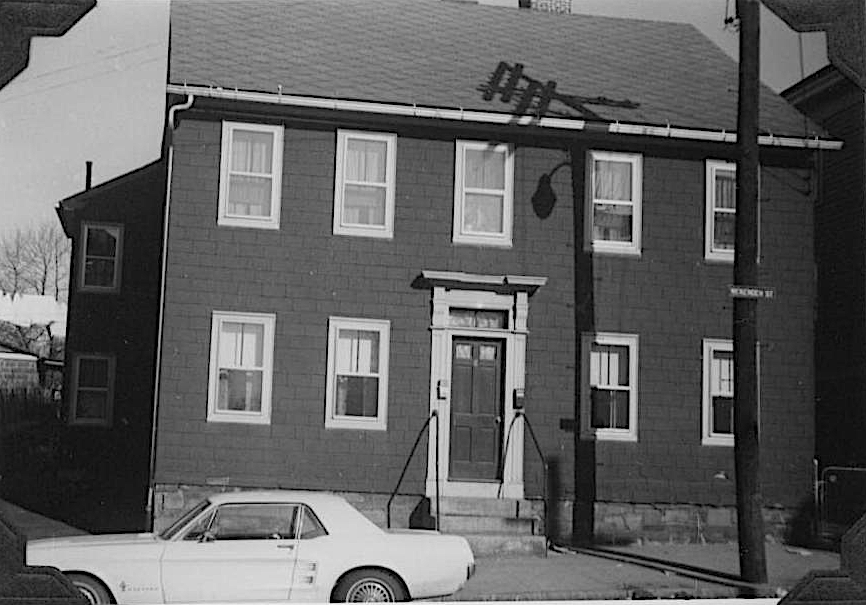
312 Wickenden St., c. 1790. (Gowdey Database, PPS)

On Easter weekend a colonial-style building at 312 Wickenden St., in Providence, was razed by its new owners, who also owned the Duck & Bunny Snuggery, which was shut for the pandemic. I heard about this calamity on Sunday and instantly wrote an obituary for the lovely building, which was said to have been built in 1900, but might have been built as early as 1790.

After my post ran I was informed by email that reporter Lynzi DeLuccia of WJAR Channel 10 had done a story in which the new owners said that code issues and structural instability had forced their hand, but they hoped to rebuild 312 Wickenden and reopen the Duck & Bunny. Good news, if true!

But other emails came to me saying that there had been no code or structural issues arising at 312 Wickenden as of 2018, when the new owners bought the building for $405,000. I confirmed this with city planning officials.

And yet the new owners insist that those issues were there, and they are backed up by the Providence Preservation Society. There is direct contradiction here not just between the new and old owners, but between PPS and the city planning department. And the evidence has been demolished.

The local historic district’s boundary excludes Wickenden Street, so it was not protected by the city and the owners were able to demolish it “by right,” without any notification to abutters or the community, which they did not provide.

Now I have learned from the prior owner that 312 Wickenden might have been built in the 1790s, early in the Federal period. The city gave it a pro-forma date of 1900 because the actual date was unknown, even though it was thought to be “earlier than 1857.” Local preservationist Mack Woodward dated it to between 1810 and 1830. The previous owner cites 18-inch floorboards and other features that suggest the older reaches of its age. If the building, officially the Almira P. Allen House, really dates from the post-colonial era, then its loss is doubly tragic.

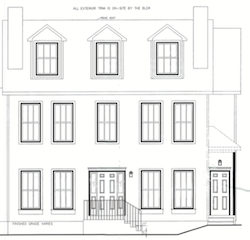
Elevation for new 312 Wickenden. (Coastal Modular)

The new owners intend to rebuild 312 Wickenden as closely as they can manage to its old look, but they are using a quad construction system. It will be built in sections off-site and erected on-site. How well they can replicate the building using such a method seems unclear to me. For example, did they rescue the elegant front door surround? If not, can they reproduce it? Will the clapboards be as narrow as the original ones? They claim to have saved some of the beautiful interior features, but that will be of little account if the exterior looks as bad as 298 Wickenden, two doors downhill from 312. It was torn down a year or so ago and replaced with a clunky faux colonial. If anything like that happens at 312, the Duck & Bunny may end up in bad odor with the neighborhood, no longer so beloved. Naturally, I am rooting for a high-quality exterior restoration that the Duck & Bunny can occupy with their heads held high.

The city contends that the Duck & Bunny could have operated in 312 Wickenden for the foreseeable future. But it seems there may have been a fly in the ointment. According to one source, the owners’ purchase of the building involved a new insurer in its fate, which may have said it would not insure the building unless it was brought up to a higher level of fire and safety codes and ADA disabled access that would take effect because of the owners’ desire to renovate substantially.

Duck & Bunny before its demolition, April 5, 2021. (Jess Ann Kirby)

Providence has 35 districts on the National Register of Historic Places. A listing is purely honorary. The city has only seven local historic districts with limited actual protection for historic properties. The local College Hill Historic District extends into Fox Point but only to within one block of Wickenden Street. If its merchants and residents fear for its historic character, they will need to petition to have the College Hill Historic District extended by at least one block. Eventually, the merchants who blocked the street’s inclusion in the local district decades ago will regret what is brought by the winds of change. Yet, by then it is likely that Providence as a whole will no longer boast the allure from which Wickenden Street borrows its charm.

Posted in Architecture, Development, Preservation | Tagged , , , , , | 5 Comments

Another travesty at Brown?

Sketch of proposed Brown dormitories on Brook Street. (Deborah Berke Partners)

Brown sent a gang of its minions to present its latest proposed abomination to the Fox Point Neighborhood Association last night. The two huge rectangular boxes with skewed roofs on either side of poor Brook Street (disembowled recently by the nearly completed student wellness center several blocks to the north) would create a forbidding allee along the street that parallels Thayer a block farther east.

The Brown officials, reinforced by a team from Deborah Berke Partners, the architect, were received politely by the FPNA. Yet it was clear that the group’s leaders and members were very distressed by the proposal, which would remove four buildings, three of them attractive old houses, from the historic residential district that once dominated the area.

It is doubly fortunate that the neighbors as well as the FPNA folks, interacting by Zoom, were largely in agreement that, among other issues, the two buildings’ poor fit with College Hill/Fox Point’s historical fabric was the key issue. A host of opponents stated or read effective remarks refuting (not just rebutting) the Brown officials’ presentation. Brown responded to all the minor objections in an obvious effort to ignore the elephant in the room. Nevertheless, said architect Noah Biklen, Brown ’97, “We are working within a modern idiom.” Yes, and that’s the big problem. The statement by Arria Bilodeau was remarkably blunt on this point, focusing on the design issue. Below is the text of her remarks:

***

Statement on Brown’s Proposed Dorms

By Arria Bilodeau

Brown’s proposed plans for two new dorms have been modified in response to the Historic District Commission negative reception, and, purportedly, to concerns voiced by neighbors.

From the neighbors’ point of view, our objections have as yet been unaddressed.

West dorm

The intrusion of the west dorm into the local historic district has been removed, and an open space, planned to be landscaped and green, has replaced the retail component on the south-west [portion of the] dorm.

However, the dorm building designed by Deborah Berk Partners continues to incorporate design elements that have been almost universally rejected by the surrounding community:

  • the irrelevant and jarring roofline (not characteristic of the abutting built environment);
  • extended, elongated windows (not reflective of the surrounding styles);
  • a seemingly non-conforming brick siding (not “Brown brick found everywhere else on campus, and immediately next door in the Vartan Gregorian quadrangle facing the west dorm from the east);
  • and an industrial, urban office-building shape (not respectful of scale, density or character of the adjacent buildings).

The design of the dorm has not fundamentally changed. It is a replication of the architect’s similar buildings on two other campuses, and does not offer a signature design statement of any distinction for Brown.

Erecting two of them, facing each other in one block next to our homes, is a dismal prospect.

East dorm

In the 1980s, Brown cleared the northeast corner for a future dorm by demolishing two houses. Across Charlesfield Street, however, Brown handsomely restored a Victorian house – of 3½ stories, which is one of a whole block of houses on Brook, running north from Charlesfield. In other words, the context on this side of Brook is residential housing stock, as was the building at the western corner of Brook and Charlesfield.

Again, a five-story, vertically oriented, erratic-roofed massive dormitory with elongated windows singularly fails to make any gesture at fitting into the neighborhood, where the Institutional Zone abuts the surrounding housing stock. The architects have not acknowledged that this is a residential setting. Their dorms will be bordering a residential neighborhood of family-occupied homes and yards.

Corner of Brook and Power

There has been no neighborhood clamor for “open space” or “green space” at the Power and Brook intersection. The northeast corner lot is, in fact, missing a tooth. And Brown owns the missing tooth: the multi-family house on Brook it says it must demolish. Whatever effort must be made to convince the City to allow the lot to be used for a house – and put on the tax rolls – is definitely not beyond Brown’s power, and is within the City planning goal of increasing density.

Additionally, the pink house at 126 Power should be added to the Brown-to-Brown program, sold to an owner-occupant, and kept on the tax rolls as well. This would be in keeping with the character of the neighborhood.

In sum

Brown has latitude within the Institutional Zone to expand and increase density in its development. However, the Comprehensive Plan speaks to institutional growth in three Objectives that should be taken into account in this dorm proposal. These are the words of Brown’s Comprehensive Plan:

  • Objective LU7: Allow for institutional growth while preserving neighborhoods. Require institutions to use their land … and expand … while ensuring compatibility with the surrounding neighborhood.
  • Objective BE5: Preservation Planning. Preserve the historic buildings, districts and areas that contribute positively to Providence’s urban fabric.
  • Objective BE7: Neighborhood Character and Design. Encourage developments to be compatible with surrounding uses in scale, density and character, while not stifling innovative design and architecture.

Brown has yet to provide a building of sufficient architectural merit and sensitivity to its immediate surroundings to serve as its interface with the City’s and our historic neighborhood.

***

These remarks by Ms. Bilodeau are about as tart a response as I can recall to Brown’s half a century of insensitive expansion of its campus on College Hill. Since 1960 or thereabouts, Brown has gone stark, raving modernist, blasting huge holes in the historic fabric of its host city. The only exceptions have been, in 1990, the addition on George Street to the John Carter Brown Library (which is not even a part of the university), and the 2012 Jonathan Nelson Fitness Center on Hope Street, from which Brown learned nothing. Brown has been very good at restoring old buildings, occasionally relocating them to make way always for inexplicable carbuncles, but that has probably caused decades of Brown facilities officials to grind their teeth to a fare-thee-well.

About a year ago I wrote a post, “At Brown, here we go again,” in which I beat Brown, Deborah Berke Partners and its ex-Brown architect Noah Biklen severely about the head and shoulders for voicing flagrant untruths about their declared goal of integrating new buildings, including these dorms, into neighborhoods. Drawings were not even available at the time, but now that we have the designs, they are quite as bad as I predicted, even after the recent, irrelevant changes cited by Arria Bilodeau.

She, the neighborhood and its leaders at the Fox Point Neighborhood Association have been much more direct and forceful in their objections to the design of the proposed dormitories. At last night’s meeting, Brown and its architects expressed a willingness to revise its proposals with advice from the neighbors in mind. The neighbors should be inspired by the success, just a month ago, of neighbor opposition to a developer’s proposal for an addition to a dear old cottage on Williams Street. After offering designs that got more and more modernist over time, the architect, Friedrich St. Florian, did a 180 and offered a proposed addition that was quite in keeping with the historic character of the neighborhood. I wish I’d been a fly on the wall when the Historic District Commission issued its ultimatum (I presume) to the developer!

It is clear that Brown could build dormitories quite as large as it needs with proper massing and historic detailing inspired by the campus buildings most beloved by Brown itself and the community. The neighbors would love it. The longstanding town vs. gown headaches caused by decades of insensitive Brown development on College Hill would largely evaporate, Brown’s genuine reputation as a city benefactor would shine more luxuriantly as its role as “local villain” disappeared, and the university would reap greater alumni donations in the future if new parts of the campus were more lovable. Let’s hope Brown and its architects were really listening last night.

Posted in Uncategorized | Tagged , , , , , | 7 Comments

Mary Gallagher: Saving Paris

Montmartre district in Paris, with Sacre Coeur in distance. (Photo by Lance Vaughn)

On Thursday, Mary Campbell Gallagher, a leader in the crusade to save Paris from skyscrapers, had an oped in Le Figaro, one of the capital’s leading newspapers in addition to Le Monde. With her permission I republish it as a guest post. It is called “Lovers of Paris the World Over Are Alarmed as it Descends into Ugliness.”

Gallagher has asked me to mention that a new collection of 49 essays, Paris Without Skyscrapers (Paris sans gratte-ciel) will be published by the International Coalition for the Preservation of Paris toward the end of May. Its subtitle is “The Battle to Save the Beauty of the City of Light.”

Recently Gallagher told me that Paris’s famous (and elegant) benches and newspaper kiosks are being removed from city streets. I responded that at least, unlike the skyline of Paris, they could be returned from storage when the current insane mayor is gone. Gallagher replied that they are not being stored but trashed. Totally shocked, I replied that this must be inspired by the growing desire to destroy Western culture among leftists who arrogantly suppose they are defending non-Western cultures – whose citizens, living in or visiting Paris, probably love the old benches and kiosks quite as much as Mary and I do. I admit I phrased this idea a bit more bluntly than was advisable. Her reply was that my theory was “looney tunes.” Rather, the mayor’s intent, supposedly, is to make sure that Paris grows economically in the future and does not become just a museum, beloved for its beauty but fading compared to other world financial centers.

Whatever. Here is Mary’s essay in Le Figaro:

***

Lovers of Paris the World Over Are Alarmed as it Descends into Ugliness

By Mary Campbell Gallagher

The world loves Paris for its beauty. Paris is the world’s city, and most of us think it will always be beautiful. But Paris is in danger. Its leaders are about to destroy its beauty.

Proposed skyscraper in Paris.

The sacking of Paris did not begin yesterday, and is not just the piling up of garbage on the streets, the cutting down of trees, or the installation of banal street furniture. The sacking includes skyscrapers built on the periphery of the city in the style of the universally-despised Montparnasse Tower, destroying the city’s centuries-old skyline against the wishes of the residents, and the government’s remodeling of the île de la Cité.

It was not until October 2020 that Mayor Hidalgo called for a debate on the “aesthetic of Paris.” One might have expected an economic argument for her towers, arguing that they would be a good investment for her heavily indebted city. But instead, she has chosen to argue for towers based on their modernism. One might wonder whether Hidalgo, who won last year’s election with only 17% of the city’s registered voters, with an abstention of more than 63%, has a moral right to alter the character of her ancient city.

We argue, to the contrary, that people love beauty and history. Remember the faces of the people watching when the Cathedral of Notre Dame was on fire, on April 15, 2019. Parisians prayed for their cathedral to be saved. This was not the first time the cathedral was in danger. It had also been in danger after the Revolution of 1789, but in 1832, Victor Hugo published Notre Dame de Paris. The great success of that stirring novel awakened public opinion to the value of heritage, or “patrimoine,” and it saved the cathedral. The anguished crowd witnessing the fire in 2019 testifies to the continuing importance of place and of our traditional cities.

Victor Hugo referred to Paris as a collective masterpiece. For centuries, builders always sought to add to the beauty of the city. Whether Henri IV with the Place des Vosges, Cardinal Richelieu with the Palais Royal, or Napoleon I with the rue de Rivoli, the objective was always to make the city more beautiful.

Today’s unbridled “modernization”  or “reinvention” of Paris adds nothing to its beauty. To the contrary, it degrades Paris. Without any public discussion, City Hall has authorized the implementation of novel urban initiatives. On the streets of Paris we see a loss of the charm that has made the city legendary, the newspaper kiosks and the street benches designed in the 19th century by architect Gabriel Davioud. And let us not forget that City Hall approved the remodeled La Samaritaine on rue de Rivoli, where ancient buildings were torn down to construct a six-story-high undulating glass façade for giant retailer LVMH, close to the Louvre.

Ecology is a key theme of City Hall. Its efforts to reduce the use of autos have received world-wide attention. But its claims of the sustainability of towers fail to take into account the great mass of energy needed for the building material of these towers: the cement, glass, and steel. Nor are towers sustainable economically. Note that two of the skyscrapers built at La Défense since the ‘fifties have already been torn down.

The stakes are high. Paris is a treasure of the world. The banks of the Seine were recognized for their beauty when Unesco designated Paris a World Heritage site.

As Olivier de Monicault, head of SOS Paris, has said, the beauty of Paris is not a “renewable resource.” But City Hall is on the verge of destroying the beauty of Paris for the sake of global financial interests. The centuries-old Paris skyline will no longer proclaim the glory of God or of France, but instead will signal craven surrender to major real estate developers and architects of transient renown. Paris will not become more financially competitive with other world capitals. It will simply be left to stand in its diminished state, which will be irreparable.

If we want to leave to our children and grandchildren the beauty of the Paris we have inherited, we must act now. Of the traditional cities in the world, Paris is the most beautiful and largest to have kept its low silhouette.

The people of Saint Petersburg fought hard when the giant international corporation Gazprom wanted to build a 100-story tower in the historic center. That battle lasted five years. And the people of the city, with support from around the world, won!

Parisians, too, must count on international support. If the world allows Paris to descend into ugliness, how can we defend beauty anywhere?

Posted in Architecture, Preservation | Tagged , , , , , , , | 10 Comments