Romancing the Post Office

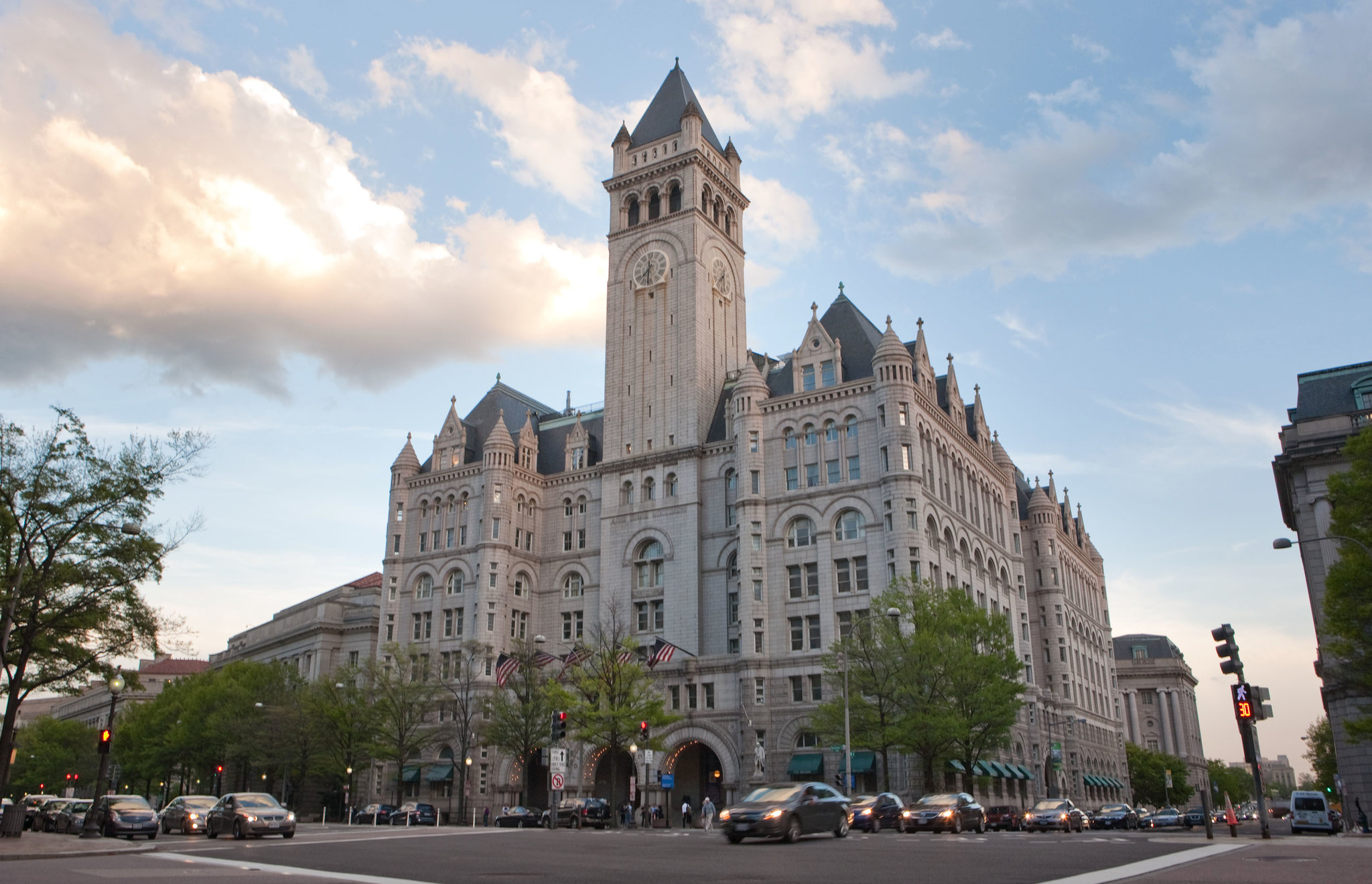
Post Office Building, in Washington, D.C. (Daniel Rosenbaum/NYT)

Post Office Building, in Washington, D.C. (Daniel Rosenbaum/NYT)

The New York Times reports the finalization of Donald Trump’s agreement to renovate the old U.S. Post Office Building, on Pennsylvania Avenue in Washington, D.C., as a hotel. This is one of my favorite buildings and I’m glad to hear it is going back into use. I used to frequent it when it was basically a failed office building surrounding a highly successful food court beneath an atrium of nine stories. What a glorious place to hang out! I hope the Trumps’ renovation – with the Fine Arts Commission looking over their shoulder – will not bring an end to its grand pubic usage.

The article is full of cliches and falsehoods, though no harm done. The writer, Eugene Meyer, says the Richardson Romanesque pile, completed in 1899, seems “out of place” among its Beaux Arts neighbors that went up in the 1930s. Not so! The picture above from the Times proves that. The buildings fit well together, as they all have classicism at their root, especially when one keeps in mind what might have gone in that space today, or in the 1970s when the feds wanted to tear it down. (The federal government was actually the last major American institution to abondon classicism for modernism.) And either the Donald or daughter Ivanka says you could not build this building today – but, oh, yes you could. It would be revolutionary, and given what modernism has done to the craftsman trades, it would be expensive, but yes, it could be done.

Posted in Architecture, Development, Preservation | Tagged , , | Leave a comment

Mackintosh fire update

Wreckage inside the Mackintosh Library. (Glasgow Fire and Rescue via BBC)

Wreckage inside the Mackintosh Library. (Glasgow Fire and Rescue via BBC)

The conversation in Glasgow about how to restore the school and its library has moved into a phase that pits faithful restorers against reinterpretive restorers, who presumably would want to apply their own aesthetic tics in fiddling with the work of Charles Rennie Mackintosh. The former are, thankfully, far more numerous, apparently. Here is a summary of that debate from ArchDaily.com. It also includes a description of some of the funds and funding sources that give rise to hope that the building will be restored in full, along with as much of its content as possible. It is amazing how spirits have risen since the gloom on the day of the fire. There has been a lot of luck involved and also a lot of courage and intelligence in how Glasgow public services and the school’s own professional staff responded to the blaze. Many thought the entire building was lost. Thankfully that is not so, far from it.

Below is one of the latest descriptions, sent in by Niall Murphy to the TradArch listserv (an online discussion among classicists), of what has been saved, specifically in regard to the library’s famous archive (as opposed to the Mackintosh Library, whose collection has been lost but whose physical elements can probably be reconstructed), and of the extraordinary courage and firefighting savvy of the Glasgow Fire & Rescue Service.

Good news on the archive front. Glasgow’s Herald newspaper is reporting this morning that: “School of Art library staff, working with volunteers and Historic Scotland, worked in what was described as a ‘late-night human chain miracle’ to salvage the archives, which have become a famed source for research.

“The School of Art’s archives and collections comprise a wide range of material from school records to artworks and architectural drawings, textile pieces, plasters casts, photographs and furniture. A School of Art spokeswoman said: ‘All the Mackintosh works on paper that were in the archive have been retrieved.’

“The School of Art received advice from the conservation team of the National Registers of Scotland as part of the project to salvage the archive.'”

[Niall adds:]

Also, from some of the photographs I’ve seen it looks as though the fire spread right along the west wing corridor of the building. The paint on the woodwork and metalwork is badly blistered. It appears that only the fire doors stopped it spreading into the heart of the Art School. A human chain of fire fighters fought it back. This could have been a whole lot worse…

Posted in Architecture, Architecture Education, Preservation | Tagged , , , , | Leave a comment

Blast from past: Fogarty

Fogarty Building, in downtown Providence. (exploringvenustas.wordpress.com)

Fogarty Building, in downtown Providence. (exploringvenustas.wordpress.com)

Today’s column involves a plan to place an extraordinarily bland extended-stay hotel (luxury, of course, and well “branded,” on the site of the Brutalist Fogarty Building, which would be torn down. Haven’t we been here before? Yes, we have!

Not so hard to say yes to beauty
February 15, 2007

TWO DEVELOPMENT PROJECTS in downtown Providence await the demolition of two derelict buildings. One is the Fogarty Building, an eyesore pure and simple. The other is the old police/fire headquarters; while far prettier, it reminds us of crime, danger and parking tickets.

Both buildings radiate bad vibes. So let ‘er rip, right? Well, not so fast.

To take the easy case first, the Fogarty Building (1967) has been described as historic. It exemplifies the style of modern architecture called Brutalism, from the French béton brut, or exposed concrete. The Penguin Dictionary of Architecture describes Brutalism as concrete “handled with an overemphasis on big chunky members which collide ruthlessly.” Just so. The Fogarty’s sheer brutality argues a lot more strongly for its demolition than its brief history [built in 1967; Castellucci, Galli & Planka Associates, arch.] argues for its preservation.

The police/fire headquarters, on the other hand, was built in 1940 [Office of the Commissioner of Public Buildings, arch.], at a time when modernist architectural ideas were mounting a challenge to traditional architectural ideas. The response of traditionalists was to sacrifice the ornament of their buildings. The Fountain Street façade of the headquarters exemplifies the result – a more austere, subdued classicism. If its other sides were as good, its preservation would be of unquestioned importance.

Frankly, the demolition of both buildings would be acceptable – if their replacements were going to make Providence lovelier. But as matters stand today, both buildings would be replaced by buildings that further erode the city’s historic beauty.

Duncan Pendlebury, of Jung/Brannen Associates, the architect for both projects, and Tom Niles, of the Procaccianti Group, which is developing both projects, addressed a recent meeting hosted by the Downtown Neighborhood Alliance at the apartment of Michael Egan in the Cosmopolitan, overlooking the Fogarty. Niles and Pendlebury argued for moving the projects forward, described their designs, and explained the challenge of fitting into an area where neither old nor new buildings dominate.

I would argue that the easiest way to move both projects fast forward is to promise to build something better than before at both sites. Both projects are more likely to get off the dime if the developer opts to build in a traditional rather than modernist style. It’s not more costly or even more difficult.

The challenge of designing for a site where neither style dominates the immediate vicinity is less complicated than meets the eye. If the nearby architecture does not offer a clear solution to the challenge of diversity, then it must be sought in the broader civic context. Move the whole context away from its current hodge-podge and toward coherence. The proper direction is as obviously traditional in Providence as it is modernist in Houston.

In fact, the Downcity Design Review Commission, which oversees both of these projects, is by law responsible for promoting development that protects downtown’s historical character.

The aesthetic case for Providence to encourage new buildings in traditional styles is familiar to readers here. But the practical rationale for the developer to adopt such a design strategy if it wants to get the two projects going is even more compelling.

At every juncture of the design-review process, a small set of intelligent, dedicated and well-connected opponents can use legal and political tactics to delay and derail a project. A design seen as ugly by the public girds up opponents whose critique might otherwise lack merit. But a pleasing project can neutralize opposition, and provide cover for city officials under pressure to find reasons to stall.

In short, giving the public what it prefers is easier than forcing it to accept what it doesn’t. The design elites who dominate the review panels will grind their teeth but won’t dare kill such projects.

Of all people, this should be clearest to Duncan Pendlebury. For a decade, he was the architect for a series of projects at these same two sites developed by Vincent Mesolella Jr. when he was in the Rhode Island House of Representatives. In spite of his powerful position, those projects, generally modernist in design, fell through again and again.

And yet the same Pendlebury was also the architect who designed the Westin’s addition in a traditional style. It was approved swiftly, despite the Procacciantis’ controversial acquisition of the hotel from the state, and is heading to completion.

If the versatile Pendlebury had produced loveable designs for Mesolella’s projects, would they have survived his palpable eagerness for state subsidies that so irked the public? It’s hard to say. Providence Place survived a grueling and hostile process largely on the strength of its looks. The record suggests that public affection for a proposed building, although difficult to measure and subtle in its operation, can be a vital ally in the development process.

If the Procacciantis really want to build their buildings, they have got an easy decision to make.

David Brussat is a member of The Journal’s editorial board. His e-mail is dbrussat@projo.com.

* * *

The old Providence police/fire headquarters, left; the Fogarty Building, right

Photos by David Brussat

Posted in Architecture, Blast from past, Development, Urbanism and planning | Tagged , , , , | 3 Comments

Don’t just shrug off horrid hotel plan

Proposed hotel on Fountain Street, in downtown Providence. (Journal archives)

Proposed hotel on Fountain Street, in downtown Providence. (Journal archives)

What’s that word these days that articulates a shrug of the shoulders?

Meh.

The day after Memorial Day, The Journal reported a proposed 170-room “premium-branded upscale extended-stay” hotel for Fountain Street, in downtown Providence. To be razed was the Fogarty Building, a former welfare office long vacant and so ugly that its architectural style is called Brutalist, but barely worse than the proposed hotel.

Meh.

The design of the hotel shows off its suburban airport access-road schlock with such evident pride that readers could not possibly hold out hope that its tedium might be blamed on the ineptitude of CAD (computer-assisted design) at illustrating architectural detail.

Meh.

The plan calls not just for a hotel restaurant but for street-level retail, which usually makes urbanists like me mist up — especially if it is to be next to The Journal. Lunch, anyone?

Meh.

Any construction project in Rhode “Been Down So Long It Feels Like Up” Island should have us all leaping out of our lethargy and dancing for joy. All the more as it promises to deliver us from a building only the architect’s mother could love. So why do I feel so . . . meh?

To read the rest of this column, please visit The Providence Journal.

Posted in Architecture, Development, Preservation, Providence, Urbanism and planning | Tagged , , , , | 2 Comments

Providence Opera House

DSCN1774I had the pleasure of foisting my viewpoint upon a captive audience at a recent meeting of the Providence Netopian Club. For the uninitiated, which is surely almost everyone, Rhode Island founder Roger Williams, the father of religious (or “soul”) liberty, was greeted upon his arrival here by members of the Narragansett Tribe, who declared, “What cheer, Netop?”

“Netop” means friend in the native tongue and “What cheer” was an old English phrase of greeting. So it appears that Roger Williams met bilingual Indians upon his arrival. But that is no surprise. He knew them already and had learned their language and no doubt taught them his own. (Williams actually paid for the land on which he founded Providence.)

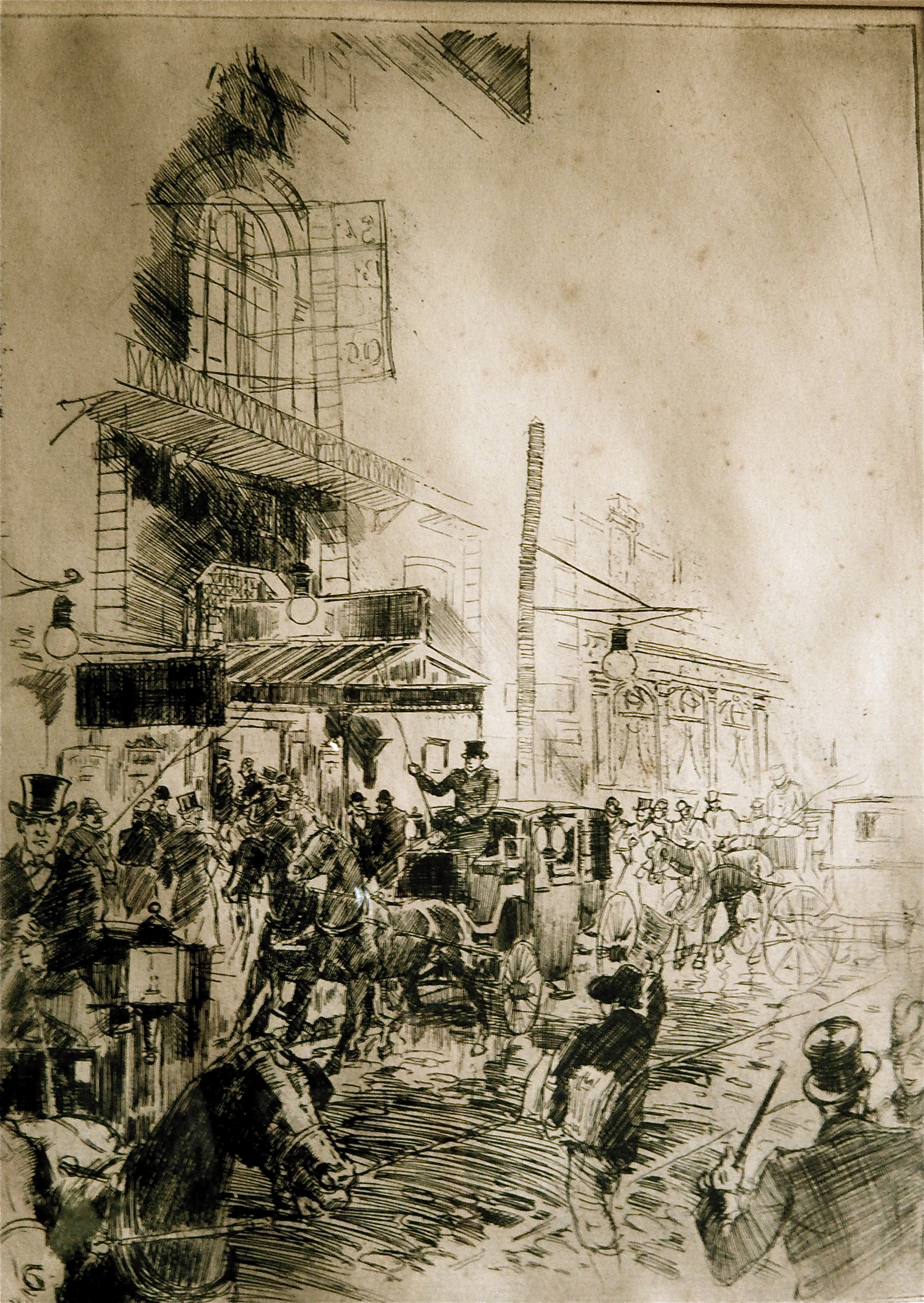
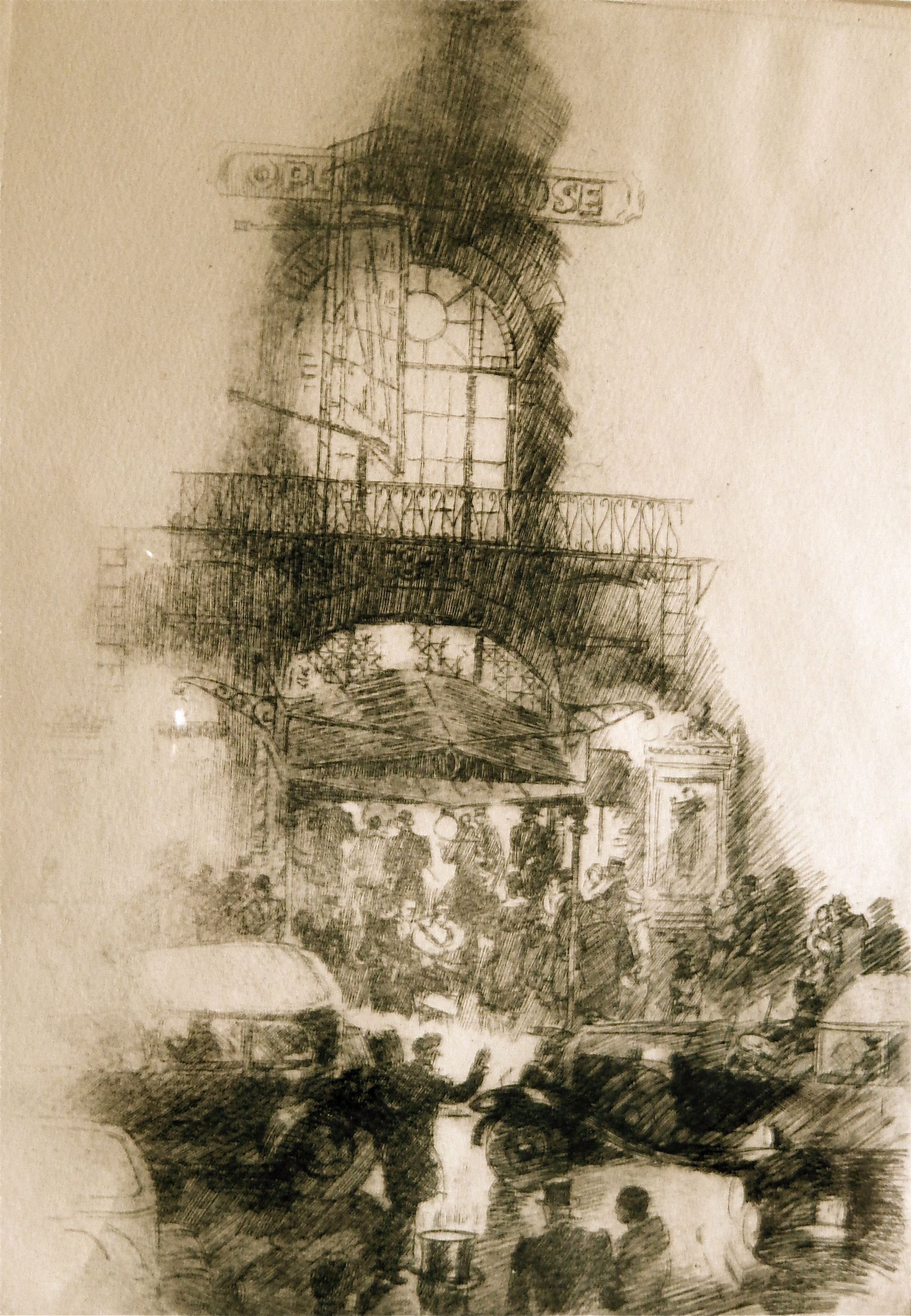
Hence, the Netopians, who were meeting at the Wannamoisett Country Club in East Providence. Warren Lutzel, who had the idea of inviting me, greeted me warmly and showed me two etchings of the Providence Opera House, once located on Dorrance Street where today the East German Embassy (that is, the Johnson & Wales library) sits coldly on the site of the Narragansett Hotel, which was demolished in 1960 to make way, it turns out, for a couple of decades’ worth of parking. Broadcast House (now the library) was erected in 1979, which, along with its nickname, tells you all you need to know about its appearance. I call it the East German Embassy, though my former editor Robert Whitcomb, recently retired from the Journal, retains title to its coinership.

Anyhow, the etchings were just sitting there on a couch, looking pretty, so I snapped their picture. They are by Harold Guenther Breul (d. 1965), of North Providence, and they are entitled “The Opera House in Days of its Glory” and “Last Night of the Opera House.” The first shows men in top hats arriving at the Opera House in carriages drawn by horses; in the second motor cars of a certain age are trundling down Dorrance past the building. It’s rare to find etchings of this high quality anymore, so feel free to feast your eyes. Warren Lutzel says he has more of these, and if he is able to get them to me, I will get them to you.

DSCN1773

Posted in Architecture, Art and design, Providence | Tagged , , , , , , | Leave a comment

Mackintosh’s ‘modernism’

Renfrew Street (front) elevation drawing of Glasgow School of Art.

Renfrew Street (front) elevation, by Charles Rennie Mackintosh, of Glasgow School of Art.

The idea of Charles Rennie Mackintosh as an early modernist may seem absurd to those familiar with his work, but a few passages in one of his lectures are surely what has given rise to such an idea. Thought to have been delivered in 1893, to a club of painters and other artists, who had invited local architects to hear Mackintosh speak, at least in part, of the relationship between architecture and painting, Mackintosh, said:

IMG_3213

The Willow Tearoom (1903).

It is absurd to think it is the duty of the modern architect to make believe he is living 4 – 5 – 6 hundred or even 1000 years ago – and that his mission is to exercise on the forms found associated with a certain decade. no all the past is one art and all for us. And I am glad to think that now there are men such as Norman Shaw [the Edinburgh architect specializing in vernacular styles] – John Bentley, John Belcher Mr Bodley Leonard Stokes and the late John D Sedding … who more and more are freeing themselves from correct antiquarian detail and who go streight to nature. We must clothe modern ideas, with modern dress – adorn our ideas with living fancy. We shall have designs by living men for living men – something that expresses fresh realization of sacred fact – of personal broodings of skill – of joy in nature in grace of form & gladness of colour[.] [spelling and punctuation as written]

It is, of course, easy to pluck out certain phrases from the above and, voila! – Mackintosh the modernist!

But a closer and more contextual examination of this passage is sufficient to undermine its use as proof of Mackintosh’s modernist tendencies. Various phrases fly in the face of the use to which the passage has been put. (“Living fancy,” to name just one.) Not only has “freeing themselves from correct antiquarian detail” been vital to any architect’s ability to mate form and function in finding the solution to a particular architectural problem – and all jobs in architecture are different, and they all require manipulating and transcending the constraints represented by the orders. How and how much the orders constrain creativity in architecture have evolved over the years. The purpose of the orders, after all, is to facilitate their creative application. That architecture had seen so much tumultuous and symphonic change over the centuries within the bounds of its transformative strictures is proof that the orders had served well to promote art and creativity.

When Mackintosh gave the lecture whose passage, quoted above, has so bent his legacy from its true meaning, architecture was in the midst of stylistic shifts that involved what today we might call gears within gears – revivals of Gothic, Classical and various national vernaculars in and out of supposedly appropriate settings. But an architect who applauds his fellows for “freeing themselves from correct antiquarian detail” in order to “go streight to nature” is not an architect who is forecasting, let alone proposing, the architecture of the machine that was to emerge as “modernism” within the next 20 or 30 years. It takes plenty of chutzpah to claim otherwise.

I have little doubt that Mackintosh, who died in 1928, was appalled at the International Style as it emerged in the ’20s. They made a fetish of rejecting the past, whereas Mackintosh, concluding his lecture with a rousing finale, cries, “We mean to stand to architecture in its widest sense – we plant our feet in traditional tracts, we will not relinquish one item of the time honoured programme of our art as practiced in days of old.”

All you have to do to throw bad “historicist” theory into a cocked hat in this case is to look at the man’s actual work. Throw in the face of Mack the Traditionalist the Willow Tearoom, arguably his building with the most “modern” appearance, and those who understand his true legacy can throw back everything else he built.

In an earlier lecture on the principles of architecture, Mackintosh stated: “Variety and Novelty if not carried to[o] far are qualities both allowable and desirable, but by ignorance often clamoured for most unreasonably.”

Exactly. He had no idea how right he was.

Let us only hope that as the project of rebuilding the burnt Mack proceeds, it will not be captured by those who have bent the great architect’s legacy and now may think they have the right to “reinterpret” his greatest building.


Posted in Architecture, Architecture History | Tagged , , , , | Leave a comment

Mackintosh . . . modernist? Nah.

Mackintosh Building, Glasgow School of Art. (flickr.com, from page of Lex McKee)

Mackintosh Building, Glasgow School of Art. (flickr.com, from page of Lex McKee)

No sadist, I open with an image of the glorious facade of the Mackintosh Building, not with the image that has eaten away at the backside of my last several posts on the fire at the Glasgow School of Art on Friday (and actually in the picture atop my last post). Despite the tragedy of the loss of the Mackintosh Library, most of the building and much of the art work (including the inspired interiors and furniture designed by Charles Rennie Mackintosh) has been saved. Much of the damaged portions, including the Hen Walk, is certain to be restored. Money is already flowing in.

As we look forward to the restoration of the building and its interiors, we can conceivably also undertake a restoration of the reputation of Mackintosh himself. Perhaps a more accurate word would be not a restoration but an intervention: Mackintosh is considered a “precursor” to modernism. His kidnapping by the modernists is said to have been the work of the architectural historian Nikolaus Pevsner, who ignored most of what the architecture of his victims had in common and used their generally minor differences as an excuse to deny their paternity and place them in the modernist foster home, where they are further abused.

Reid Building, by Steven Holl. (

Reid Building, by Steven Holl. (theguardian.com)

Mackintosh is in there with Louis Sullivan and other obvious classicists whose reps have been snatched after their deaths by the hungry maw of modernism. And yet can there possibly be any relation between the Mackintosh Building and the school’s new Reid Building, designed by Steven Holl, which literally devours its nearest neighbor? If there is any relation at all, historically or aesthetically, between the Mack and the Holl, then there is no building on Earth, past, present or future, that is not the ancestor or the descendant of any other building on Earth. Mackintosh was not a precursor to modernism, he was an artist unbound by the canon of classicism. But neither in his writing nor in his work did he reject the past or the traditions from which his work arose. As the Mack is rebuilt, its creator’s legacy must also be rebuilt.

Posted in Architecture, Architecture Education, Architecture History, Art and design | Tagged , , , , | 1 Comment

Archives saved in Glasgow

Glasgow School of Art during yesterday's blaze.

Glasgow School of Art during yesterday’s blaze.

It was a tremendous relief to learn that among the treasures saved from fire at the Glasgow School of Art, designed by Charles Rennie Mackintosh and completed in 1907, was the school’s famous archives, which contained the third largest collection of Mackintosh material (mostly sketches, plans and working drawings). I link here to a marvelous 360-degree moving panorama of the library. It has been lost but firefighters apparently saved enough of it, hacking some of it out by main force, that conservators will be able to rebuild it much as it was, though lacking (for a while) a century’s patina of time. Experts are working to see what else can be saved, hopefully including volumes stacked loosely on the library’s wooden shelving. Much of the building’s famous collection of windows had actually been restored in a project just completed months ago. The British government has pledged millions of pounds to help restore the entire building, most of which has miraculously been saved. In fact, the governments of the UK and Scotland are literally competing for the honor of financing the job – partly because a vote is impending whether Scotland will separate from the UK.

The jolt of losing this building may be ameliorated by how much was not consumed in flame, and by how much that was consumed but may be reconstructed.

Posted in Architecture, Architecture History | Tagged , , , , , , | 1 Comment

Iron, glass, Mackintosh

Glasgow School of Art (xxx)

Glasgow School of Art (greatbuildings.com)

From an untitled 1892 lecture by Charles Rennie Mackintosh:

007-charles-rennie-mackintosh-theredlistThese two comparatively modern materials iron & glass though eminently suitable for many purposes will never worthily take the place of stone, because of this defect the want of mass. With the advent of the Crystal Palace and the many rosetinted hallucinations of that period arose the belief in the intervention of a new style. At last common sence it was shouted prevails – no more connection with the works of the past – no more deference to the ideas of artists poets, or even the principals of beauty in Nature: for now we can pile up the hugest buildings with the least possible means of support, and that on most economical principals as design can be turned out of the foundry by repetition without limit, to the minimising of intellectual labor and so also to the payment of it. But time has passed and practical experience has shown that apart altogether from any defect in stability or actual comfort the want of appearance of stability is fatal to the introduction of such a style for either domestic, civil or ecclisiastical buildings. [spellings and punctuation as written]

Posted in Architecture, Architecture History | Tagged , , , | Leave a comment

Sad. Sad. Sad.

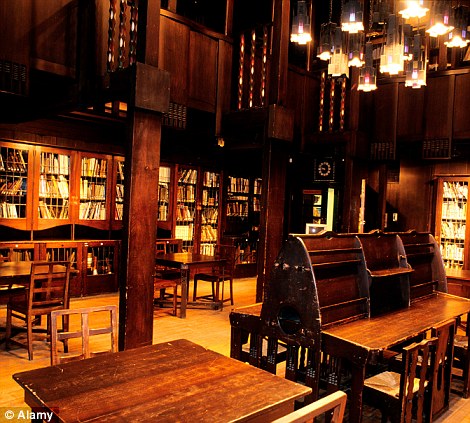
article-2637430-1E260BC300000578-477_470x423Indications are that after the horrible fire today in Scotland, the Glasgow School of Art’s famous Rennie Mackintosh Building has survived, with, as fire officials put it, 90 percent of the building structure considered “viable” and 70 percent of the interior (whether this refers to the interior structure and design or the furniture and art works, I don’t know) has been saved. This is something close to a miracle, but it only serves to deepen the tragedy of the destruction, the apparent destruction (I say with forlorn hope), of the library and of the Mackintosh archives themselves – possibly including the documentation of what is – was, I am afraid – a most comprehensively documented piece of architecture. I am hopeful that much of what is beloved in the building can be meticulously reproduced but the books, manuscripts, drawings, detailed plans of other Rennie works – kaput. What a sad day not just for Scotland and lovers of architecture, but the world.

[I hear that though the library is lost the archives are saved, some furniture from the library was saved, various doors and other artisanal wonders were hacked off by brave firemen to serve as models for rebuilding. Some valuable art works were on loan.]

Posted in Architecture, Architecture History, Art and design | Tagged , , , , | Leave a comment