Choo-choo afternoon

The Pawtucket Armoy's drill hall, with train sets. (Photos by David Brussat)

The Pawtucket Armory’s drill hall, with train sets. (Photos by David Brussat)

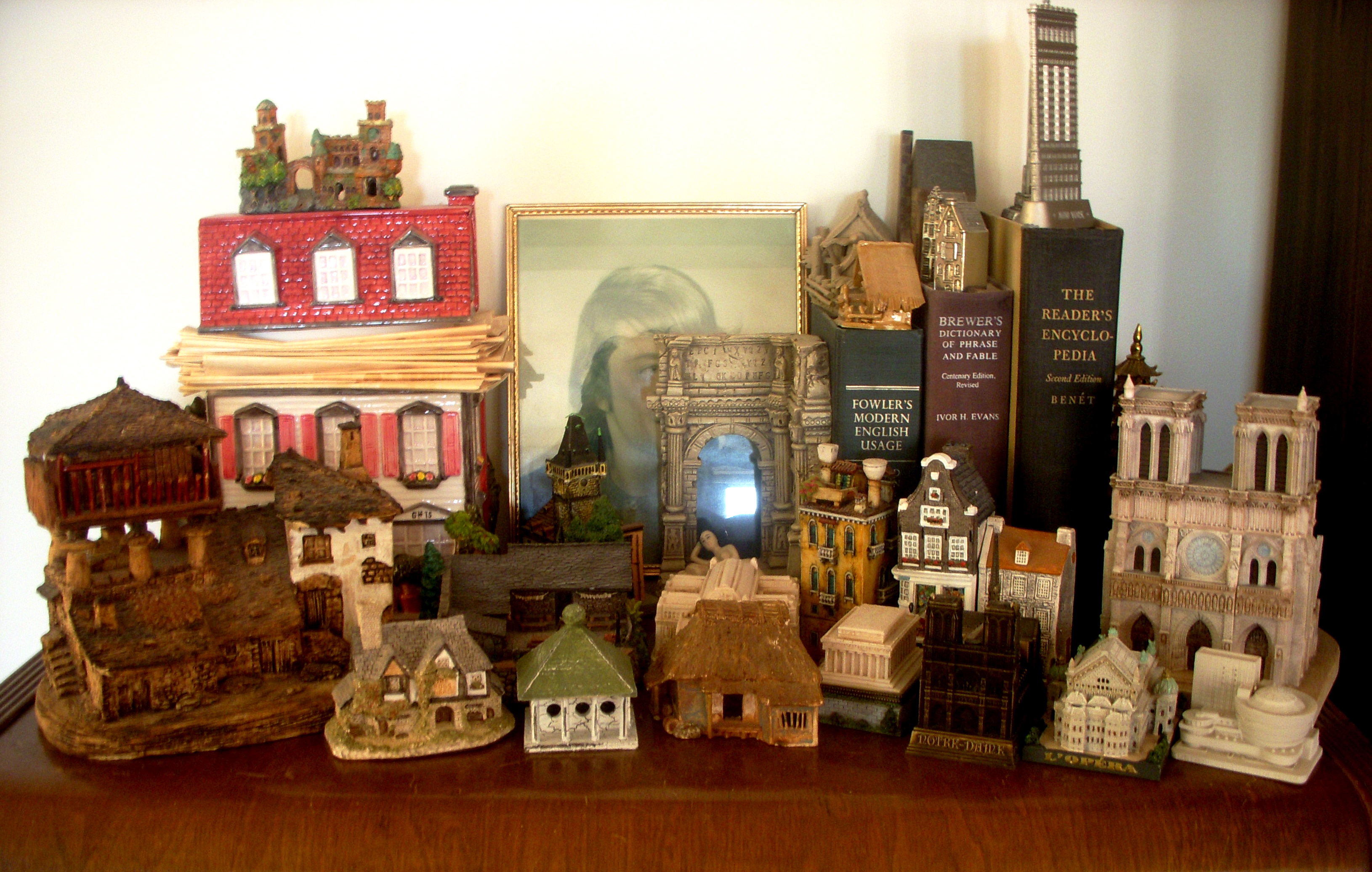
My collection of miniature buildings. (Click to expand.)

My little building collection. (Click to expand.)

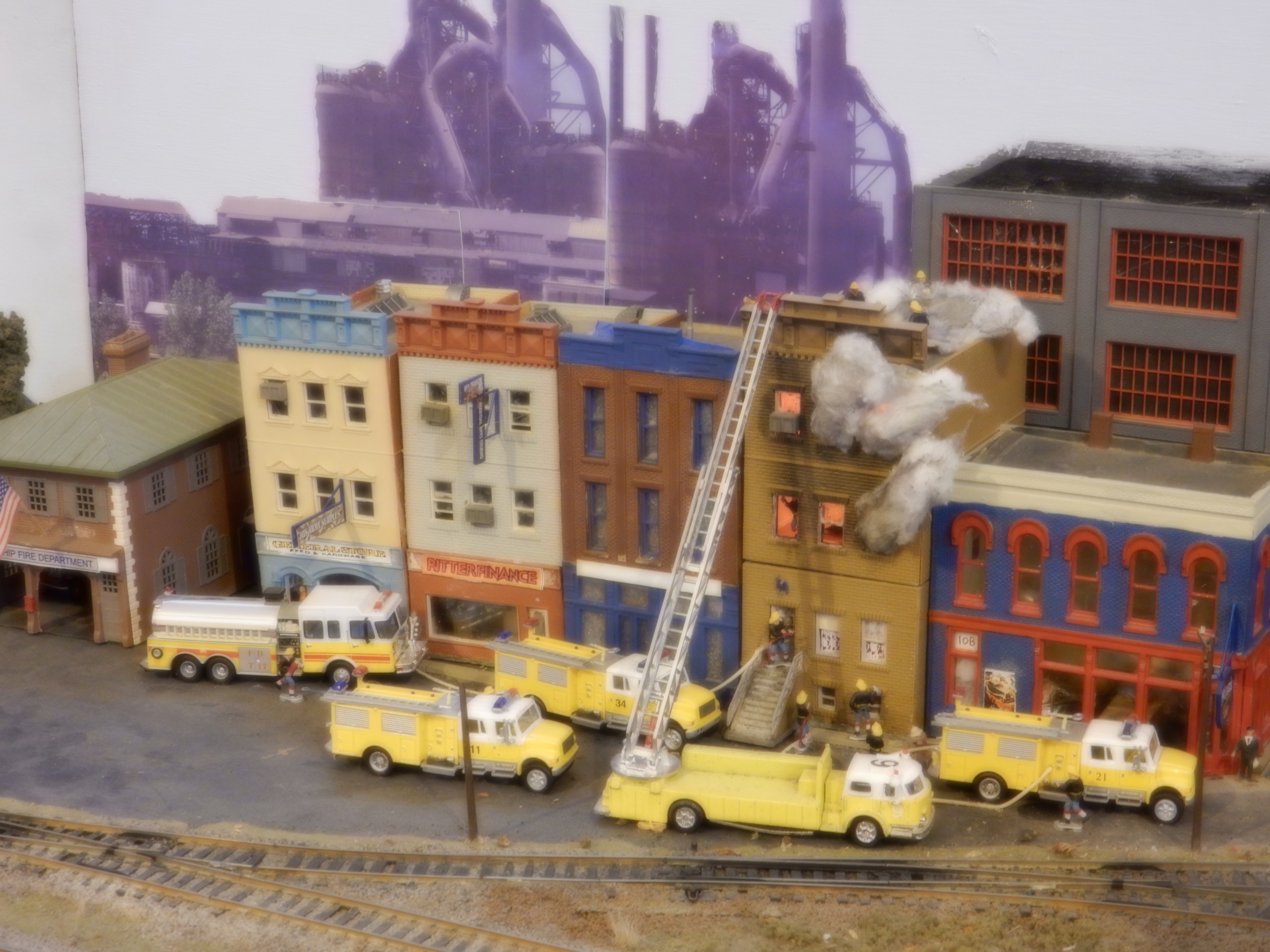
Fire afflicts rowhouse along HO-scale trackage.

Fire afflicts rowhouse along HO-scale trackage.

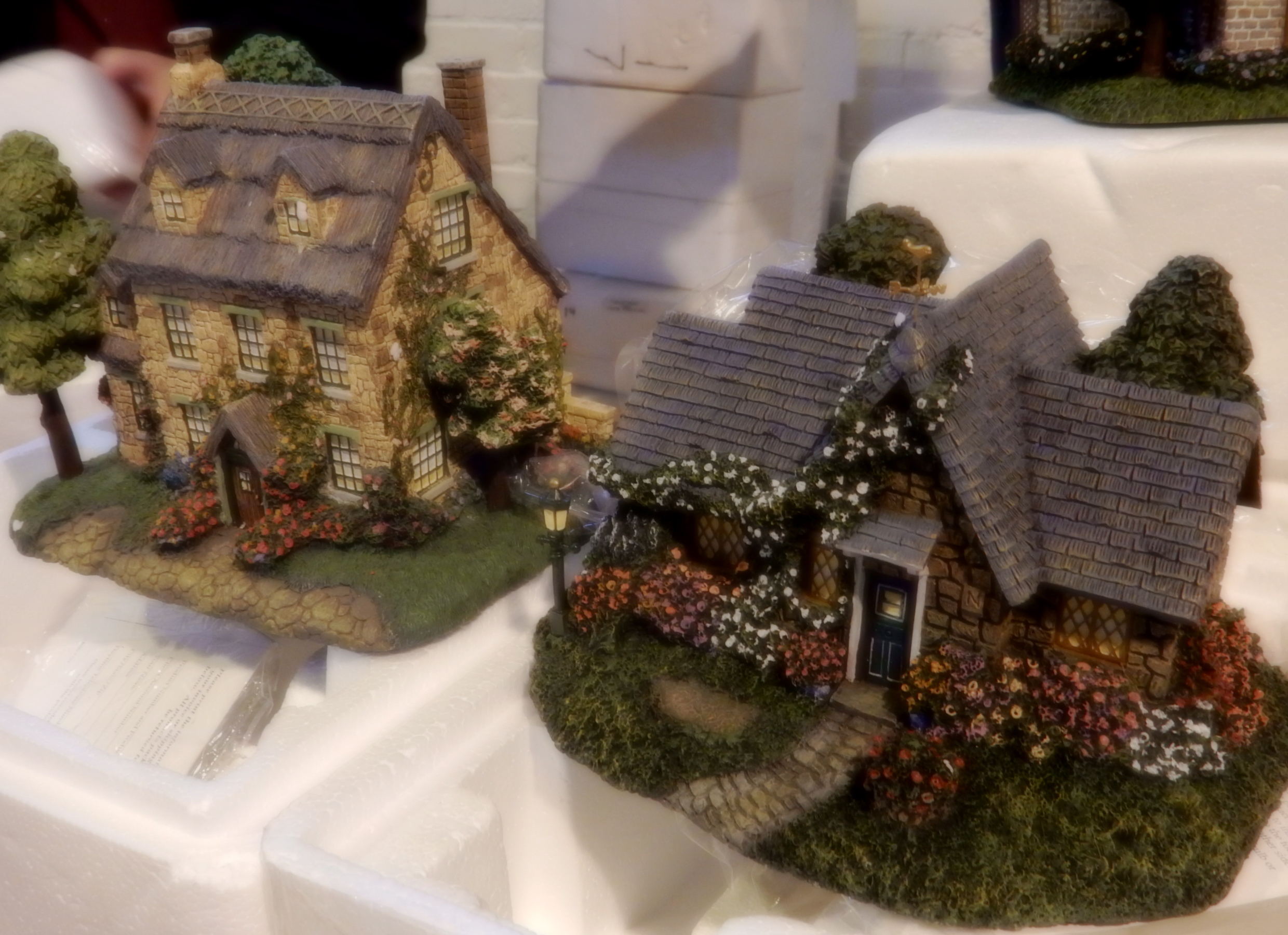
Train-set scenery for sale.

Train-set scenery for sale.

Spent an hour at the model train show in the Pawtucket Armory on Sunday afternoon. Superlative setups, though not as many as we had hoped, and most were linear, with mostly HO-scale trains choo-choo’ing up and down long, narrow platforms past fires in old buildings or through mining villages in the mountains, that sort of thing, rather than winding through deeper, more extensive sets of scenery. For me, much of the allure was in the miniature houses and other buildings that filled the scenery along the tracks.

But excellent as this tiny architecture may be, it does not qualify for inclusion in my miniature building collection. While these examples do feature the sort of detailing I seek, they are purpose-built scenery for trains, mostly of plastic, rather than the evocations of culture (okay, tourist tchotchkes) that I look for when I go to other cities and countries. Some nations seem prouder than others of their built heritage. You cannot turn around in the Netherlands without stumbling upon examples of Dutch architecture for sale. But I searched up and down in shops and outdoor markets in Taiwan for a temple, a palace, a pagoda, even a Taipei 101 (then the world’s tallest skyscraper, which resembles stacked Chinese takeout; the Burj Khalifa, in Dubai, is tallest now). I finally found the pagoda, and it sits proudly amid my collection. But it was a close-run thing.

By the way Jane Jacobs, in her Death and Life of Great American Cities, notes that while much real scenery along our actual railroad tracks features miles and miles of decay, some of the plants and other buildings, however tumbledown they are today, were once newly erected architecture of some considerable ambition. It was not always assumed that the train took us between one wrong side of the tracks seen from both sets of passenger-car windows. By the way, the inlets along the Connecticut shore between New London and New Haven are among the loveliest scenery along the eastern seaboard. (Heading south? Sit on the left side of the train, with a view to the east. Heading north? Vice-versa.)

Here is my miniature building collection. Actually, the pagoda is hard to see, its crown poking out from behind Notre Dame. (Link coming soon, but check out recent post on starting a traditional-building development archive a week or so ago.)

Posted in Architecture, Art and design, Rhode Island, Urbanism and planning | Tagged , , , , | 1 Comment

Patrick Conley’s waterfront

An early plan for building out Conley's Wharf, circa 2005. (Patrick Conley)

An early rendering of plan for building out Conley’s Wharf, circa 2005. (gcpvd.org)

Here is the column I refer to in my last post, “The lady on the waterfront“:

Pat Conley’s educational wharf
Sept. 29, 2005

STATE PIER No. 1 might be called the Ellis Island of the Ocean State. It was the entry point to Rhode Island and the rest of America for thousands of immigrants. Today, it juts into the Providence harbor from land just south of a building that once housed the old City Tire Co. The red-brick warehouse with the barrel roof, visible from Route 95, is now called Conley’s Wharf.

Conley is, of course, Patrick T. Conley, lawyer, historian, writer, tax-lien vulture and local bad boy made good, now returning to his home turf. [And now also the state’s historian laureate.]

Conley grew up half a mile downriver from Conley’s Wharf – on Byfield Street, by the railroad tracks, in the crook of what soon was to become the Thurbers Avenue curve. A boyhood in South Providence, when it was mostly Jewish and Irish: St. Michael’s Parish. He says he used to play atop the nearby oil-storage tanks. After leaving the ‘hood, he continued to live a life on the edge.

In buying up the tax liens of absentee landlords, Conley says he put abandoned properties back into use. Controversy attended this practice, but forgive me if I cannot think ill of the author (with fellow historian Paul Campbell) of Providence: A Pictorial History or the scribbler of such lines as “There’s gold in them thar mills” and “Make a million: save a mill” (both are from “A sentimental and mercenary look at mills,” in the Dec. 15, 2003, Journal).

Well, he has saved this mill — erected in 1899 by the Berlin Iron Bridge Works, of East Berlin, Conn. — though I’ll bet he’s yet to make his first mill from it. He paid $106,000 for it at (what else but) a tax sale. He also bought nine acres of adjacent land for $2.3 million. The project that he envisions reaches far beyond the artist studios and conference center now almost complete inside the old tire shop. He sees a hotel, a condo tower, a marina, garages, retail, a museum of immigration, and, neither last nor least, a floating seafood restaurant called Gail’s Landing, to be run by his wife and partner, Gail.

The drawing above is an earlier version of this vision, which has been tweaked here and there but remains unchanged in essentials. I like it because it has a traditional look, and thus flies in the face of my own suggestion that this area should be a “sandbox for the modernists.”

My hope was that modern architects could be sent out here to futz around with their goofy designs, so that downtown would be spared. Indeed, a sandbox for the modernists had already arisen in South Providence: the medical complex centered on Rhode Island Hospital.

Alas, the modernists didn’t stay in their sandbox; just look at the glass curtain-wall system being attached to the boxy thing in Capital Center [GTECH].

So God bless Pat Conley for being a controversialist, and refusing to knuckle under to the reigning design orthodoxy. Beauty has got to push back against ugliness, or Providence will become just another themeless pudding. The main difference is that, unlike most American cities, which decades ago bought into a postwar Zeitgeist of sterile utilitarianism, Providence will have only itself to blame. Not an earlier generation, but the civic leaders of today.

(Mayor Cicilline, call your office!)

Whether Conley recognizes it or not, his decision to embrace rather than to spurn Providence’s architectural heritage can only bolster his own broader economic interests — and those of the city.

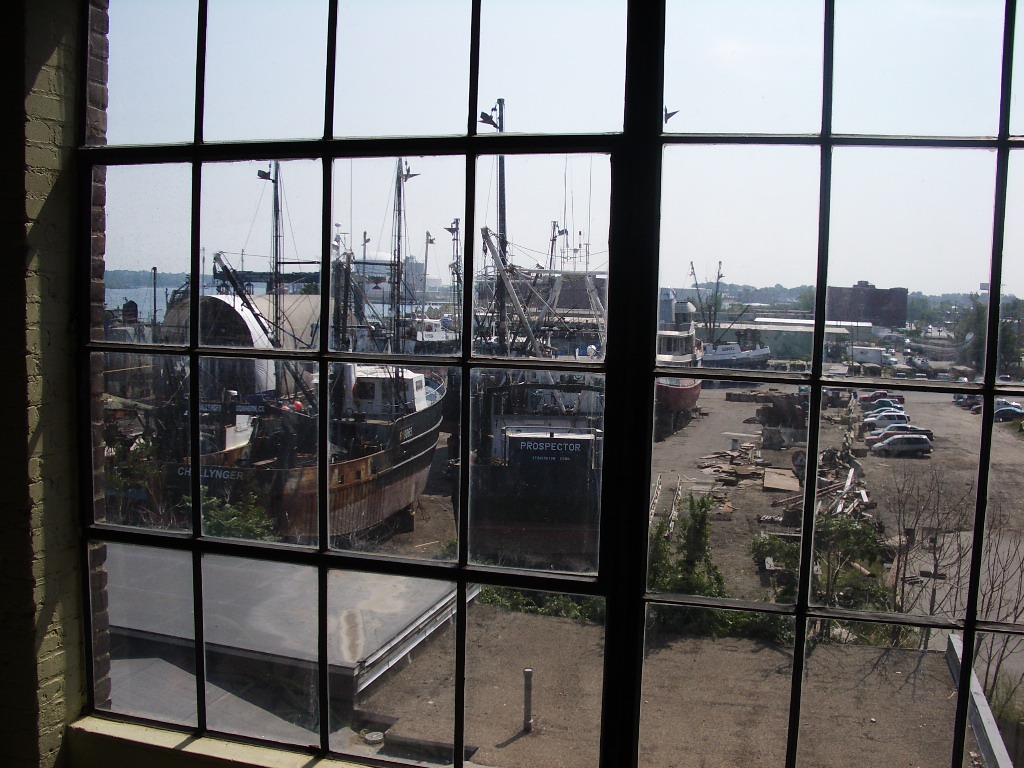
Conley hopes that his project will encourage the city’s plan to extend development up Allen’s Avenue. The city imagines more hotels, condos, museums, marinas and light rail to downtown along the stretch targeted for development and called Narragansett Landing. The distant views from the top floor of Conley’s Wharf are spectacular, but the nearby landscape of oil tanks, slag heaps, utility sheds, junk yards and parking lots cries out for redevelopment. Beyond Route 95, you can see the sandbox for the modernists mentioned above [the medical complex]. To replace Narragansett Landing’s industrial wasteland with modern architecture would only replace one uninviting landscape with another.

If the renaissance does not migrate from downtown, Conley’s big project might wither on the vine, along with the city’s own ambitious civic plans. The extraordinary number of development projects under way or about to break ground downtown and around the city must not be built in vain. That is why every strategy for luring people from outside Providence and outside Rhode Island is important. Embracing beautiful local architectural traditions may well be the easiest of those strategies to apply.

Whatever his demerits, former Mayor Vincent A. “Buddy” Cianci Jr. understood this well: He blocked a radically modernist design where GTECH (which will be even worse) now looms. Cianci’s old business partner, the visionary of Conley’s Wharf, also seems to understand. But most of the local design and political elite do not. I hope that Conley’s Wharf will succeed — not only by making Pat Conley his mill, but in educating a civic leadership that just doesn’t get it.

David Brussat is [was] a member of The Journal’s editorial board. His e- mail is [now]: dbrussat@gmail.com.

Posted in Architecture, Blast from past, Development, Providence, Urbanism and planning | Tagged , , | 1 Comment

The lady on the waterfront

View south from inside Conley's Wharf, circa 2005. (Photo by David Brussat)

View south from inside Conley’s Wharf, circa 2005. (Photo by David Brussat)

In her chapter “The curse of border vacuums” in The Death and Life of Great American Cities, Jane Jacobs considered waterfronts a potential assassin of liveliness in city districts, not intrinsically so but because they were often poorly used. But near where she lived in Greenwich Village she found one stretch of waterfront seductive. She wrote:

Near where I live is an old open dock, the only one for miles, next to a huge Department of Sanitation incinerator and scow anchorage. The dock is used for eel fishing, sunbathing, kite flying, car tinkering, picnicking, bicycle riding, ice-cream and hot-dog vending, waving at passing boats and general kibbitzing. (Since it does not belong to the Parks Department nobody is forbidden anything.) You could not find a happier place on a hot summer evening or a lazy summer Sunday. From time to time, a great slushing and clanking fills the air as a sanitation truck dumps its load into a waiting garbage scow. This is not pretty-pretty, but it is an event greatly enjoyed on the dock. It fascinates everybody. Penetrations into working waterfronts need to be right where the work (loading, unloading, docking) goes on to either side, rather than segregated where there is nothing much to see. Boating, boat visiting, fishing, and swimming where it is practicable, all help make a seam, instead of a barrier, of that troublesome border between land and water.

In Providence, the mayoral race features the issue of whether the waterfront south of downtown and south of the Route 195 redevelopment project should be of the working type or the leisure type. An intelligent case can be made for both types of urban riverfront; the question is whether it is feasible to develop the working waterfront effectively enough so that the jobs and tax dollars are greater than those that would come if the city redeveloped the waterfront as a leisure type.

Of course, the removal of taxable economic activity in the process of accomplishing the latter strategy is a cost that would be difficult for Providence to recoup, and whether the city could interest enough developers of marinas and hotels to really make it work – it certainly lacks the money to subsidize them – is very highly dubious.

I wrote a column long ago supporting local developer Patrick Conley’s effort (since failed, largely because of official city opposition under the dreadful Cicilline administration) to turn his wharf property into a waterfront paradise. His Fabre Line Club was a nice place for years while it lasted (it closed several months ago). And he was able to turn the old plant that housed it into space for artist live/work space for a considerable while. But the machinations of the Taveras administration (which is on its way out) put paid to Conley’s efforts. If he had been allowed to succeed, he might have sparked a development trend that could have animated the waterfront between the port and downtown.

Or maybe not. Again, the working waterfront strategy also holds promise when intelligently managed. Taveras did not seem to make much hay on the working waterfront he inherited as mayor from Cicilline, nor even farther south along the city’s largely moribund port. But that is another issue – upon which, I believe, all the candidates for mayor agree.

You can read my Sept. 29, 2005, column “Pat Conley’s educational wharf” on my next post.

In any event, Jane Jacobs’s words offer ideas that the city can use if it wants to continue the working-waterfront strategy. As she suggests, there are ways to have it both ways, at least to a degree. Who is not enthralled by the working waterfront? That is, if you can get close enough to luxuriate in the grime and noise of its action and drama.


Posted in Architecture, Development, Providence, Urbanism and planning | Tagged , , , , | 1 Comment

Barbarians at the gate

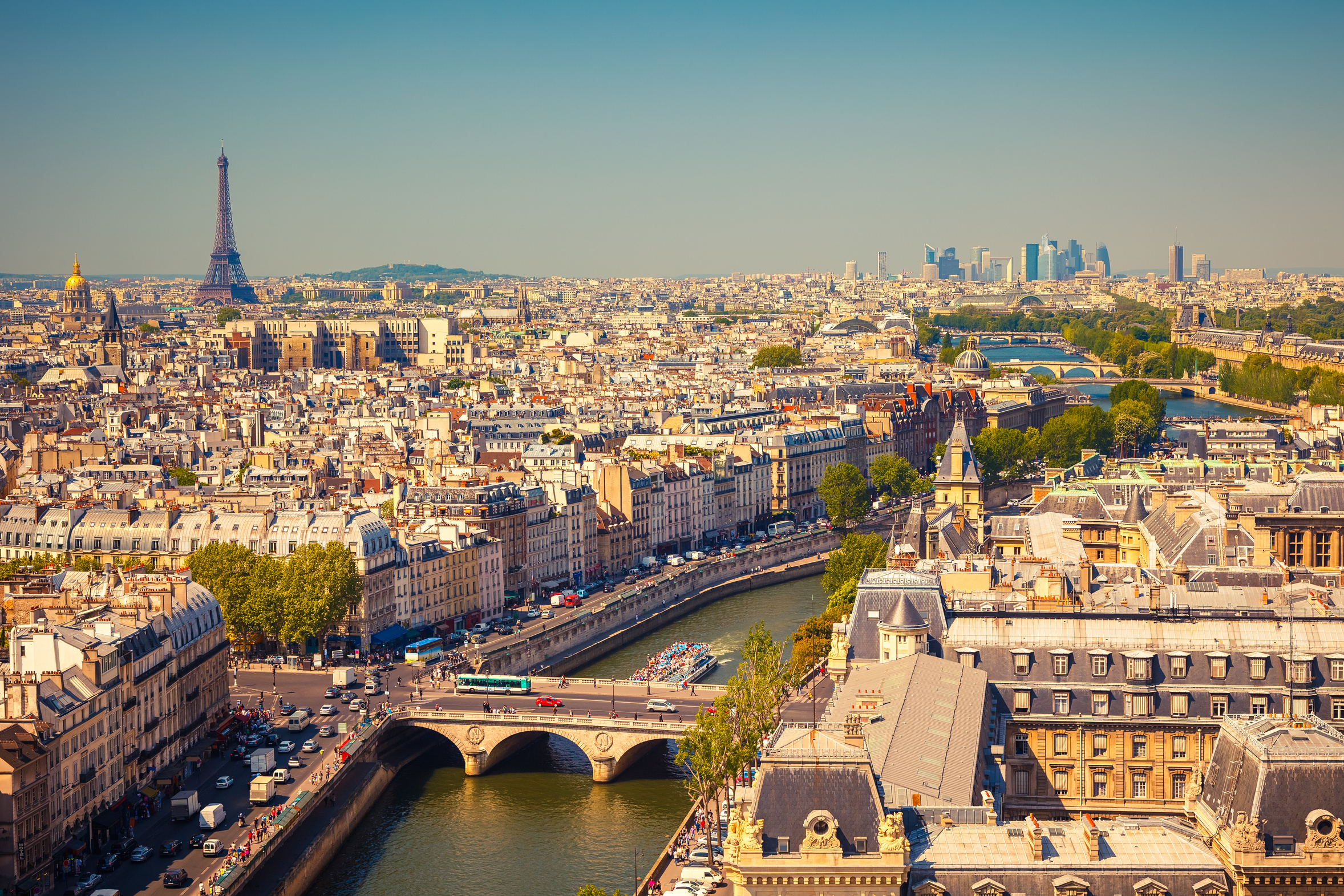
Paris. (xxx)

Paris. (grand-paris.jll.fr)

Above you can see them in the distance, but watch the video by Mary Campbell Gallagher and you will find that they are marshalling their vandalism for an invasion of central Paris. And here, again, is a petition to get Mayor Hidalgo of the City of Light to stop it. She wants the towers. The only way she can be turned is to heap the indignation of the world upon her desk. Sign the petition now!

Posted in Architecture, Development, Preservation | Tagged , , , , | Leave a comment

The new brand of France!

Frank Gehry - smiling all the way to the bank? (Vanity Fair)

Frank Gehry. Laughing from Fondation Louis Vuitton all the way to the bank? (Photo for Vanity Fair by Jonas Fredmall Karlsson)

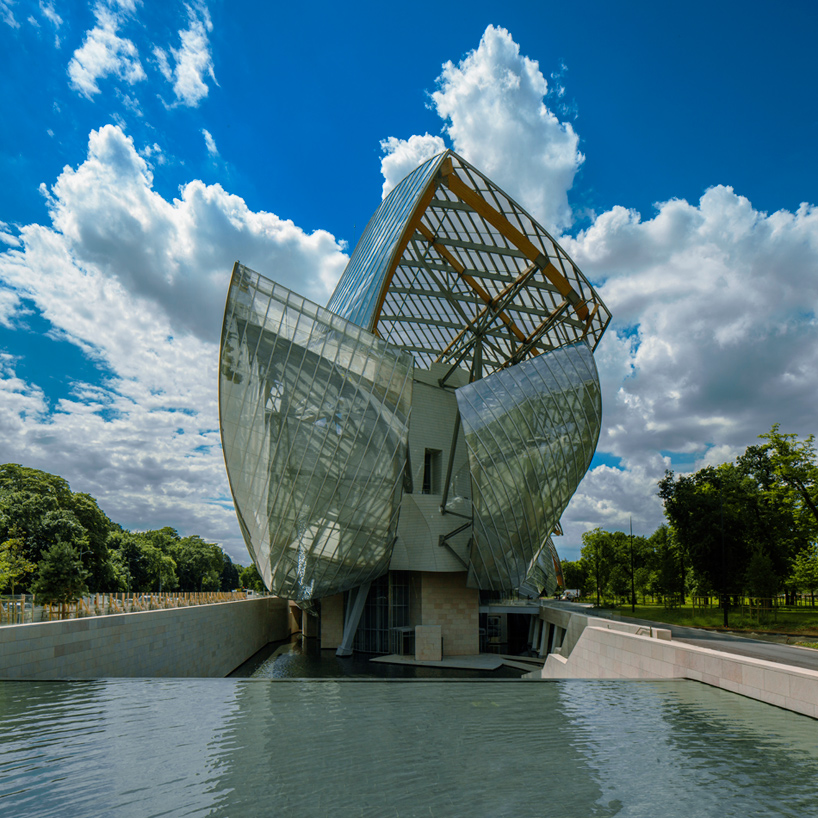
Fondation Louis Vuitton. (designbloom.com)

Fondation Louis Vuitton. (designbloom.com)

Above is Frank Gehry laughing all the way to the bank. His latest paean to his genius sits in the background, which happens to be the Bois de Boulogne, the vast park at the western edge of central Paris. Soon to open there is his exploding Crystal Palace – an already conventional likeness that like any likeness one can see if one wants. Paul Goldberger, in his risible paean to Gehry called “Gehry’s Paris Coup” in Vanity Fair, sees more, much more deeply into the myth – oh, excuse me, the legend – of Gehry.

It is too easy to defenestrate a building and its architect when the one, contrary to resounding acclamation, is the latest parody of the other. Except for his merely tedious proposed memorial to Dwight Eisenhower in Washington, the Fondation Louis Vuitton looks like every other building he has designed since his Guggenheim Bilbao. It is in glass rather than titanium, and it blights a park rather than a city street, but in every other regard it is Gehry copying his own past. Not a crime, but neither is it genius.

Gehry’s patron is the luxury conglomerate LVMH Moët Hennessey Louis Vuitton. The Fondation Louis Vuitton will mainly house the art collection of LVMH’s CEO, Bernard Arnault. Goldberger has won the critical droolathon, filling up the biggest imaginable bottle of lux bubbly with his assertion that the building “has the potential to develop a brand even more potent than that of LVMH: that of France itself.”

But readers attuned to the logrolling of establishment architecture critics had better take care, in perusing Goldberger’s enthusiasms, that their rolling eyeballs do not twirl their optic nerve to smithereens. With this article Goldberger has outdone Gehry in twisting his materials into a structure of pure fantasy. “This building is muscular, and it is delicate: it is a linebacker with the moves of a ballerina or, if you prefer, it is Moby-Dick with the athleticism of a sailfish.”

If so, then so is almost every other Gehry building since Bilbao. Is it a bird? Is it a plane? Is it a fish? Is it a sail? No! It is a super exploding Crystal Palace! A new Eiffel Tower! A new logo for France! (Get thee to a nunnery, fleur-de-lis! “Gehry, who is now 85, continues to push himself forward,” hyperventilates Goldberger, “as Picasso and Wright did late in their careers, relentlessly determined that, however important his past work may be, it must serve for him as the foundation for something more than a mere dénouement.”

Once one gets to the other side of Gehry’s “Wow!” factor, his genius is highly suspect. By pretending to violate the laws of physics, his budget-busting buildings attract almost as many drip pails and lawyers as masochists. His defensiveness in confrontations with the public and critics is cringe-inducing. An interview with Gehry is a mixture of platitudes, banalities of urbanism, dubious attempts at insight, and poorly disguised expressions of self-regard. (Of the Fondation’s advantageous but far from novel strategy of stacking pizzazz atop plain rectangular boxes for art, he effused: “I could do neutral galleries, and I could do me at the same time.”)

Someday an architect will gain fame for buildings even more ridiculous than those of Frank Gehry, and she will be acclaimed the new avatrix of architecture-as-sculpture. I fear she is already upon us, but Gehry refuses to fade away.

Posted in Architecture, Art and design, Other countries | Tagged , , , | 2 Comments

ICAA Northshore splash

Reposting with link to Bulfinch reservations site.

David Brussat's avatarArchitecture Here and There

NorthShore_HomeDesignNorthshore, the stylish monthly of the shore north of Boston, has a spread in its October issue on the New England chapter of the Institute of Classical Architecture & Art. It’s an interesting think piece by Jeff Harder, with illustrations seemingly focused on the desk and office of the chapter’s former president and current treasurer, Eric Daum. There are also stories in the issue about John Margolis, who was president for five years until taking a job with a top architecture firm in Los Angeles late this summer, and Sally Wilson, who is also on the chapter board (along with your trusty and unbiased correspondent), and who, with her husband John Kelsey, runs Wilson Kelsey Design out of Salem.

For the ICAA spread, this link will take you to a digital version of the October issue, and the article is on page 87, or you can search the issue for…

View original post 1,190 more words

Posted in Uncategorized | Leave a comment

ICAA Northshore splash

NorthShore_HomeDesignNorthshore, the stylish monthly of the shore north of Boston, has a spread in its October issue on the New England chapter of the Institute of Classical Architecture & Art. It’s an interesting think piece by Jeff Harder, with illustrations seemingly focused on the desk and office of the chapter’s former president and current treasurer, Eric Daum. There are also stories in the issue about John Margolis, who was president for five years until taking a job with a top architecture firm in Los Angeles late this summer, and Sally Wilson, who is also on the chapter board (along with your trusty and unbiased correspondent), and who, with her husband John Kelsey, runs Wilson Kelsey Design out of Salem.

For the ICAA spread, this link will take you to a digital version of the October issue, and the article is on page 87, or you can search the issue for “ICAA.” The other stories may be tracked down in the issue using similar detective strategies.

Of particular interest are quotes in the story on the ICAA chapter from Daum’s excellent speech at last year’s Bulfinch awards. I posted it last year, but it is worth scrutinizing for those who did not read it last year, or for that matter, hear it. If you did, it is worth scrutinizing again, so I’ve printed it below. This year’s Bulfinch ceremony, by the way, is Wednesday, Nov. 12, again beneath the dome of the architect’s Massachusetts Statehouse. You can make reservations here. Again, Eric’s speech from last year:

Why Classical?
November 14, 2013
Eric Inman Daum AIA

The Classical is the foundation of Western Civilization.

We study the Classics, the surviving literature of Greco-Roman antiquity, because they address the fundamental issues of our humanity. We return to Homer, Plato, Aristotle, Virgil and Ovid because we continue to learn from them, because their universal themes of life and death, love and hate, peace and war, honor and truth remain relevant today. Our forbearers grappled with their humanity, as we grapple with our own.

The sole surviving text devoted to architecture from Classical antiquity, is Vitruvius’s De Architectura, or The Ten Books of Architecture.  Vitruvius describes the means of building in classical Rome, including a system of architectural composition and proportion derived from the Greeks.

So, what do we mean when we describe the Classical in architecture?  Sir John Summerson describes the fundamental elements that make a building “Classical”:

First:  Symmetry, either as the large scale bilateral symmetry evidenced by the human form, or as the more subtle Vitruvian theory of the harmony of the parts and their relationship to the whole.

Second:  Hierarchy, by expressing the importance of the primary spaces in a building so that their use corresponds to its architectural form.

Third:  that the building explicitly or implicitly exhibits the proportioning system of the classical orders  

These orders, the architectural language of Greco-Roman antiquity, described by Vitruvius, reborn during the Renaissance, embellished by the Baroque, rationalized by Neoclassicism and codified during the Beaux Arts, live on, and their continued use connects us back not just to the our Classical foundations in Greece and Rome, but through the ages of Western history.

Vitruvius’s most well known claim is this: “Good Building fulfills three conditions, firmitas, utilitas, and venustas.   According to the 1624 translation by Sir Henry Wooten, these are commodity, firmness and delight.  It goes without saying that all buildings should embrace the first two criteria.  In fact, mere competence of the builder’s craft should satisfy them: a building must stand up and be useful.  

The third criterion, beauty, is what we honor here tonight.

But are not all design awards about beauty?  Is beauty subjective, or is it objective?  

We live in an age of relativism.  Our current culture espouses the belief that beauty, like reality and truth, is subjective. This relativism is the legacy of Modernism.  Le Corbusier, Gropius and Meies removed beauty from the conversation about architecture just as Schoenberg, Webern and Berg, removed beauty from the conversation in music.

The Modern movement explicitly is not about beauty. The seminal texts of Modernism, Le Corbusiers’s Toward a New Architecture, and Marinetti’s Futurist Manifesto, claim to describe the end of history, the end of beauty, and the death of human-scaled classicism for the technology driven rule of the machine.

Vitruvius claims that beauty is objective, that there are strict criteria describing beauty that a building should fulfill, rooted in rhythm and proportion, and rules of composition and ornament. Modernism was relatively successful in its attempt to obliterate the Classical.  Beaux Arts training was banished from the academies, collections of classical art and casts were discarded, or worse, destroyed. Knowledge and tradition centuries in the making was nearly lost. And yet the threads of history and tradition survived, hidden from the mainstream and ignored by the architectural press and schools.  

One curator of this tradition was Classical America, one of the parent organizations of the ICAA, which under the stewardship of Henry Hope Reed celebrated the great buildings of the American Renaissance, and championed the few surviving classical American architects, John Barrington Bailey, Alvin Holm, John Blatteau and Allan Greenberg.

Many of us here are now in the middle years of our practice, for architecture, as we were told as students, is an “old person’s profession.”  But when we were students during the 70’s and 80’s, we had front-row seats to heated conversations about the “Presence of the Past” in architecture.  Re-examination of traditional forms opened our eyes to history as a legitimate precedent for our own work.  But many of the results of the Postmodern era seemed to us glib and uninformed. We wanted deeper truths and collectively, we traveled the path toward a new authenticity.   

But our paths diverged.  The majority returned to the forms of the Modern movement, giving rise to Neo-modernism, a historicist collage of the forms of early 20th Century Socialist worker’s housing in celebration of finance and the Information Age. The minority followed an academic disinterment of the Western tradition. We taught one another what we had learned of the long-forgotten classical cannon: the books, the forms, the theory and the techniques discarded by previous generations.  

This younger generation of emerging classicists, coalescing during the early 90’s in the offices of their Classical America forebearers, embraced an activist streak.  They conceived of our other parent organization, Institute for the Study of Classical Architecture, with the purpose of resurrecting not just classical forms, but the academic tradition at its heart.

So, we ask the question again, “Why Classical?”

We are faced with a myriad of possibilities in the contemporary age. Technology has given us the capability of creating unbelievable virtual worlds that defy the laws of nature. Technology has also given us the capability of creating real places that seemingly defy these very same laws. We must remember that we build not just for ourselves, but in this fragile time of diminishing resources, for many future generations as well.  

There are those who claim that traditional architecture replicates the past and that we must build in a contemporary style. In an age of unlimited possibilities, all styles are contemporary.  Any language I choose now is contemporary. Architecture and building need to be more than mere fashion if they are to be permanent.   As Steven Semes has so eloquently put it, it is more important to build like the place we are in than like the time we are in. There is no one style unique to our time, but we can collectively understand the deep rooted truths of a place as evidenced by form, scale and materials that underscore the continued relevance of the Classical.

Given the choice between Modernism on one hand – the machine-aged architecture of constantly changing fashion enabled by technology – and Classicism on the other, the architecture of Humanism, Reason and Democracy, enabled by craft and expressing the human spirit …

We choose the Classical.

We choose the human.

Posted in Architects, Architecture, Uncategorized | Tagged , , , , | 1 Comment

Copy the past

A house from the Sears & Roebuck catalogue.

A house from the Sears & Roebuck catalogue.

An article shedding light on the idea of copying the past has been published in The Washington Post. “Recognizing a revival in pattern books,” by Kirstin Downey, treats the construction of houses from pattern books with examples of really nice houses designed many years ago as a really good thing.

And it is!

“Copying the past” is modern architecture’s most predictable stock rejoinder to the idea that good houses can be built by using the accumulated intelligence of previous architects and house builders. The alternative is to either guess at what the future will look like and try to copy that, which is what most modernist house designers do. For that reason, there are not very many successful practitioners in that field. Most people do not want to go out on that limb, which could put them in bad odor in their neighborhood. And there is no reason they should.

The Post article describes house developments using pattern books not by Andrew Jackson Downing of a century and a half ago but put together by local architects and municipal planning departments to foster regional aspects of house design that got lost over the past half century of homebuilding. People are seeking to redesign their mid-century houses in more authentic period styles. (There’s a phrase that will cause shuddering spines among the modernist set!) But Downey, the Post writer, also finds the practice flourishing on the Eastern Shore of Maryland, where I used to spend vacations as a kid. She also speaks of building along the Gulf Coast in the wake of Hurricane Katrina.

Toward the end of her piece, Downey seems to have felt obliged to quote from an “expert” from the American Institute of Architects, who looked down his nose at a practice that lets average people without the funds to hire an architect have nice houses. His response is predictable. He even pulls out the old “Disneyfication” chestnut. Talk about copying the past!


Posted in Architecture, Architecture History, Development | Tagged , , , , | Leave a comment

Sign petition to save Paris!

The vandals are gathering outside central Paris. (

The vandals are gathering outside central Paris. (dw.de)

Here is a petition sent out worldwide to save Paris from skyscrapers. Need I say more, except that it comes to me (and the TradArch list) from the inimitable Mary Campbell Gallagher – our correspondent for all things Paris. I will be posting on Frank Gehry’s new abomination there, fortunately sequestered, somewhat, in the Bois de Boulogne.

Keep the vandals outside the gate, beyond the Périphérique!

Here is the petition.

Posted in Architecture, Other countries, Preservation | Tagged , , | Leave a comment

Column: Kennedy Plaza’s future spins its wheels

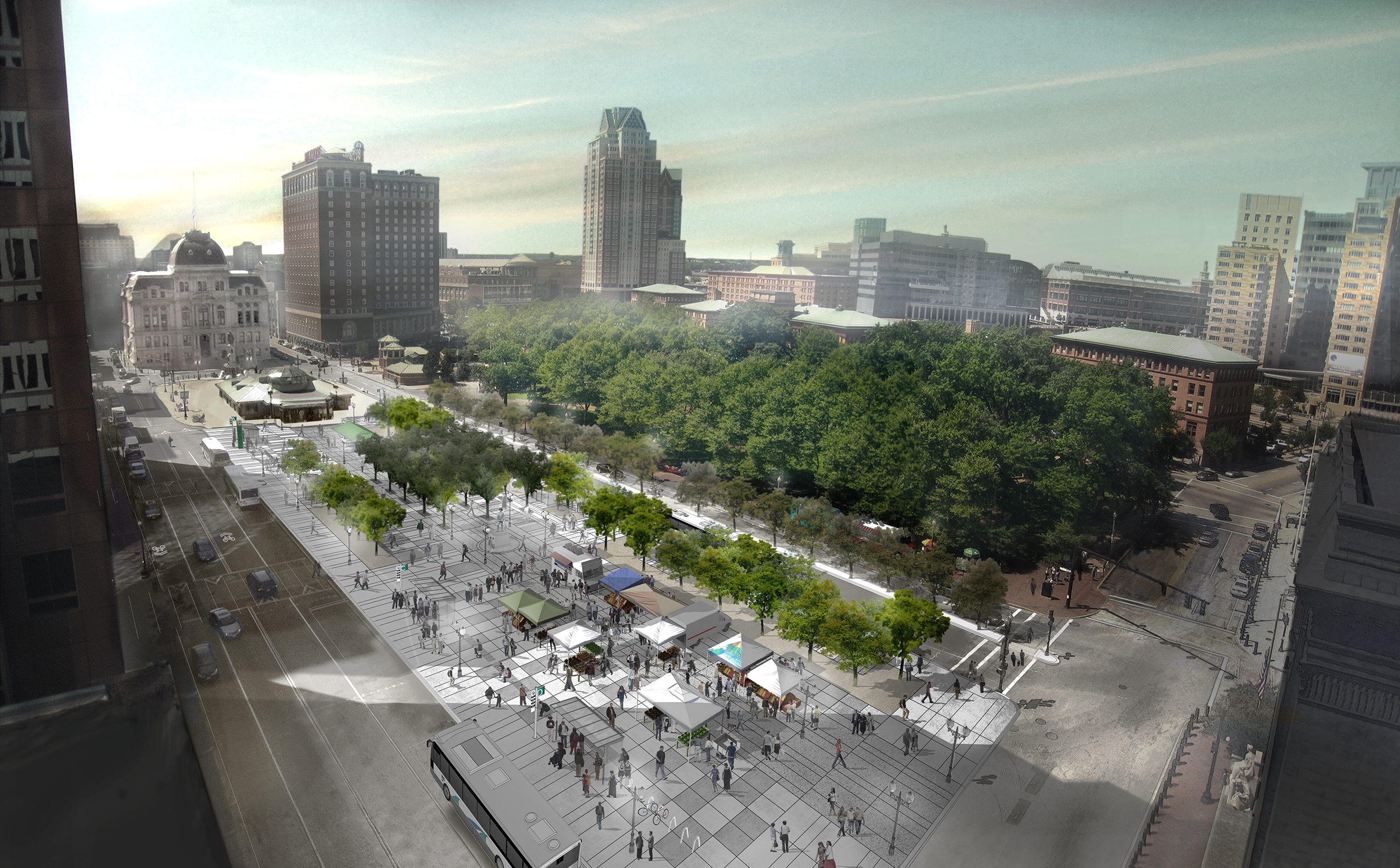
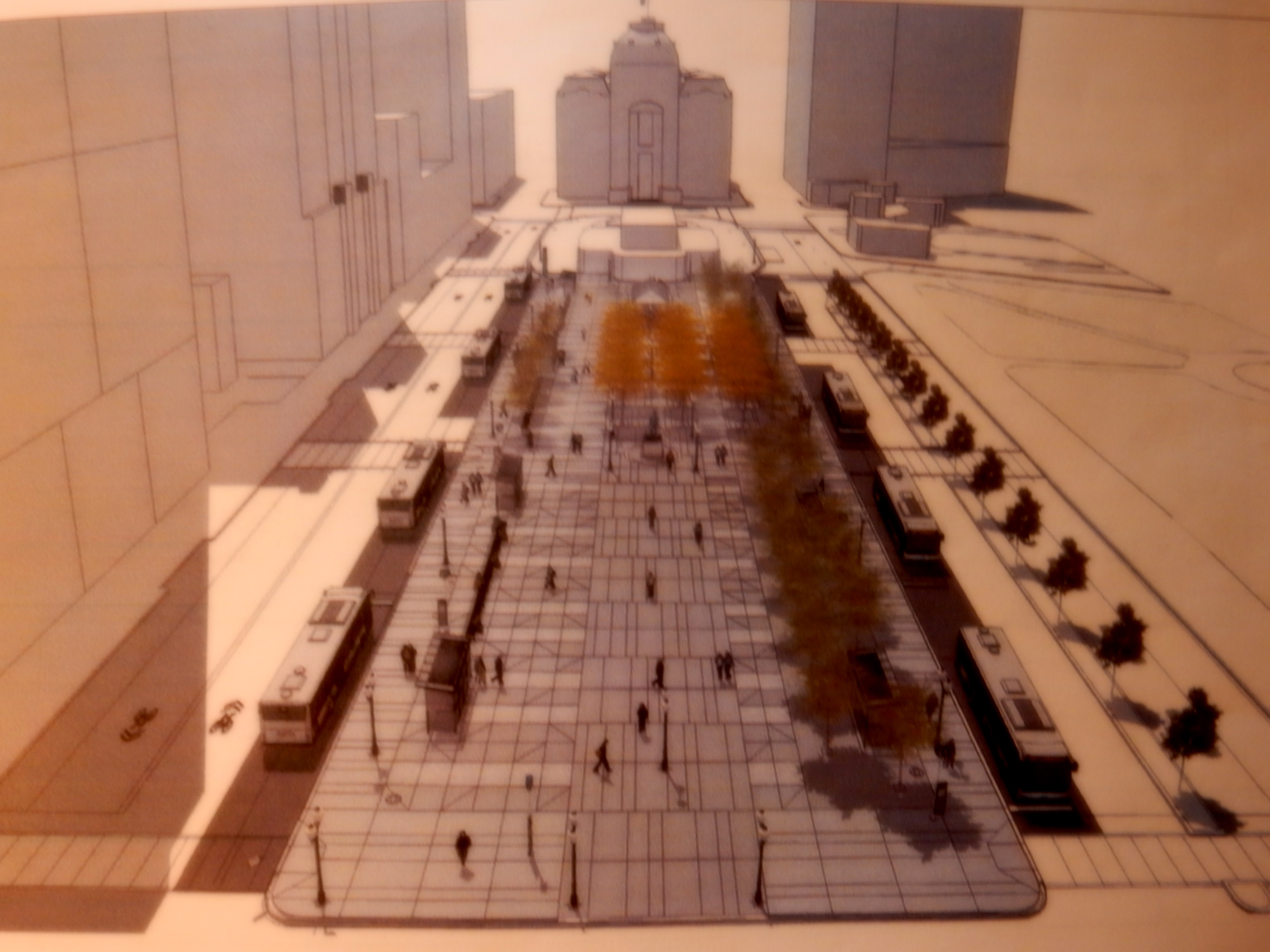
Latest rendering of the design of Kennedy Plaza, with market event in vacant space. (RIPTA)

Latest rendering of the design of Kennedy Plaza, with market event in vacant space. (RIPTA)

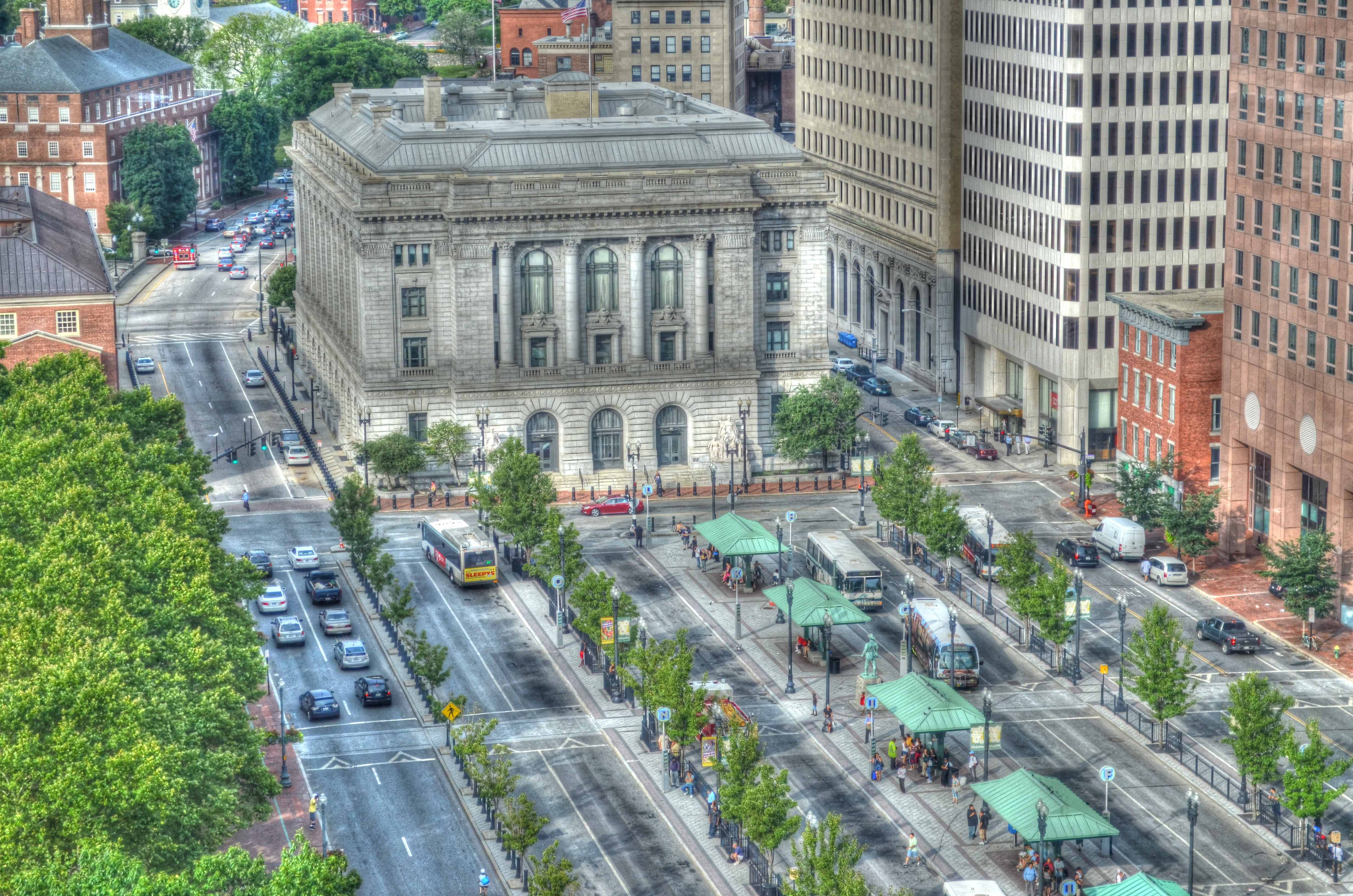
Kennedy Plaza before demolition. (providenceri.com)

Kennedy Plaza before demolition. (providenceri.com)

This half of Kennedy Plaza was demolished over the summer. (brendaleetroiaphotography.com)

This half of Kennedy Plaza was demolished over the summer. (brendaleetroiaphotography.com)

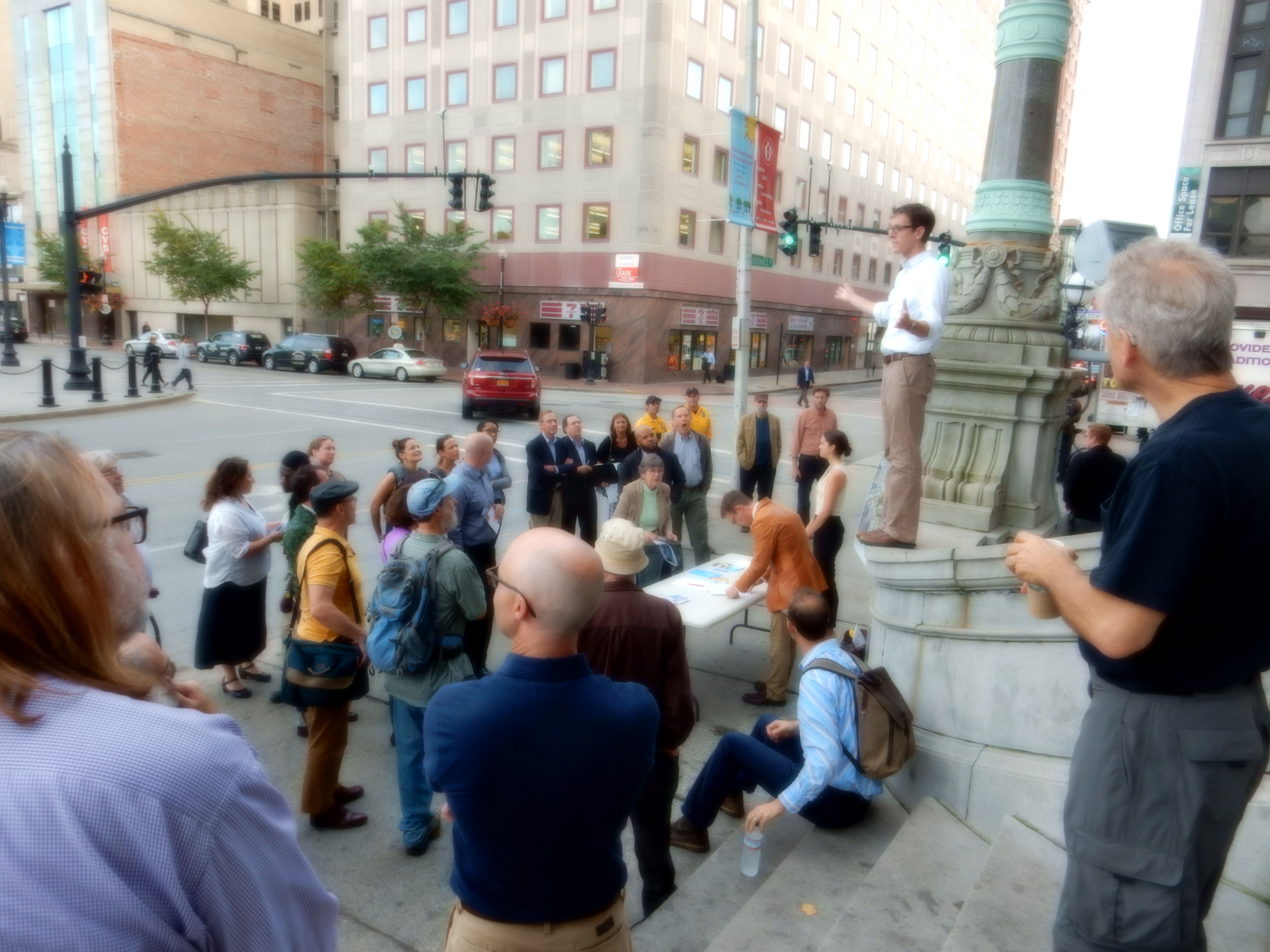
Participants gather at steps of City Hall. (Photo by David Brussat)

Participants gather at steps of City Hall. (Photo by David Brussat)

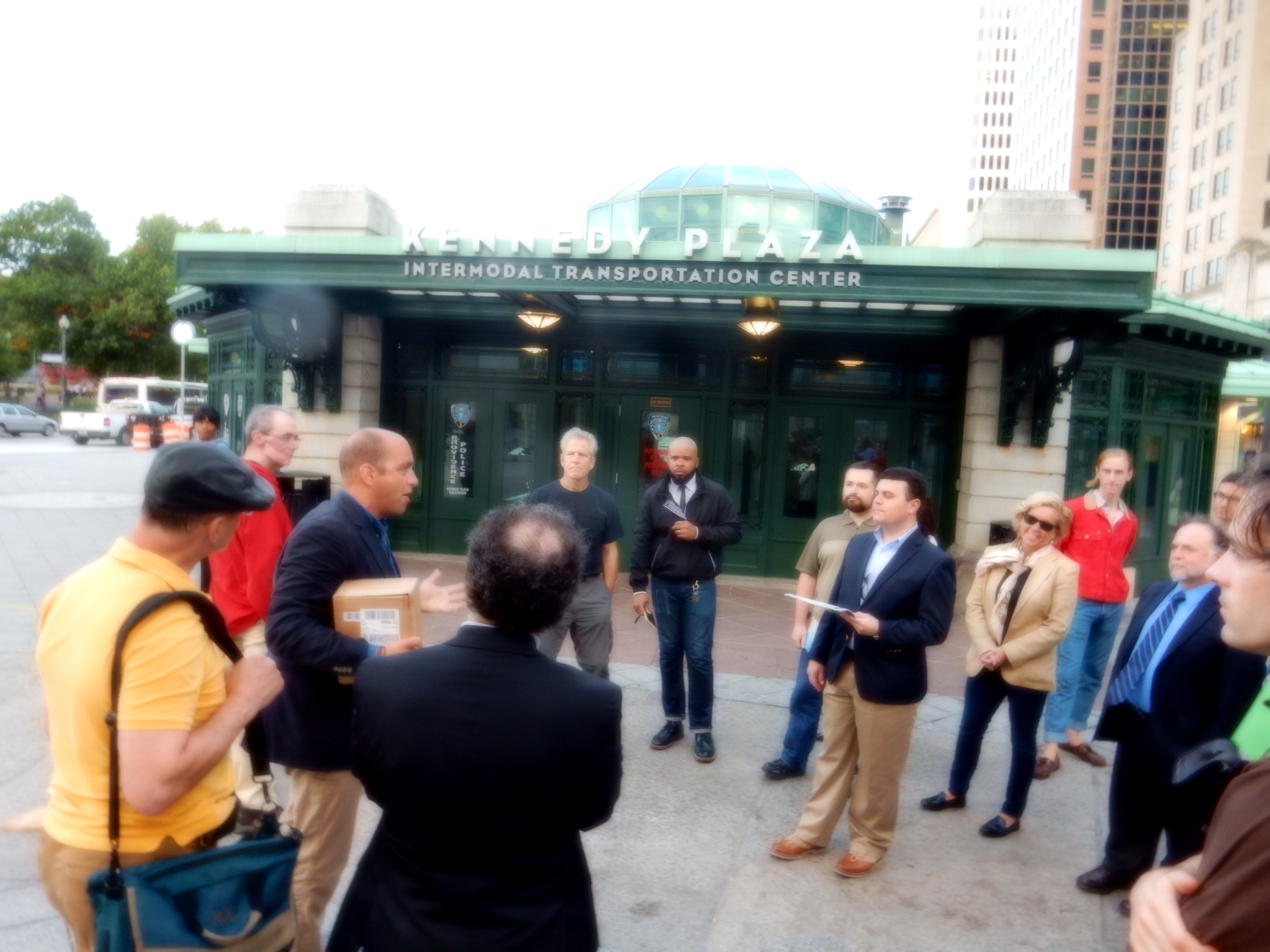
Cliff Wood, with box, leads tour. (Photo by David Brussat)

Cliff Wood, with box, leads tour. (Photo by David Brussat)

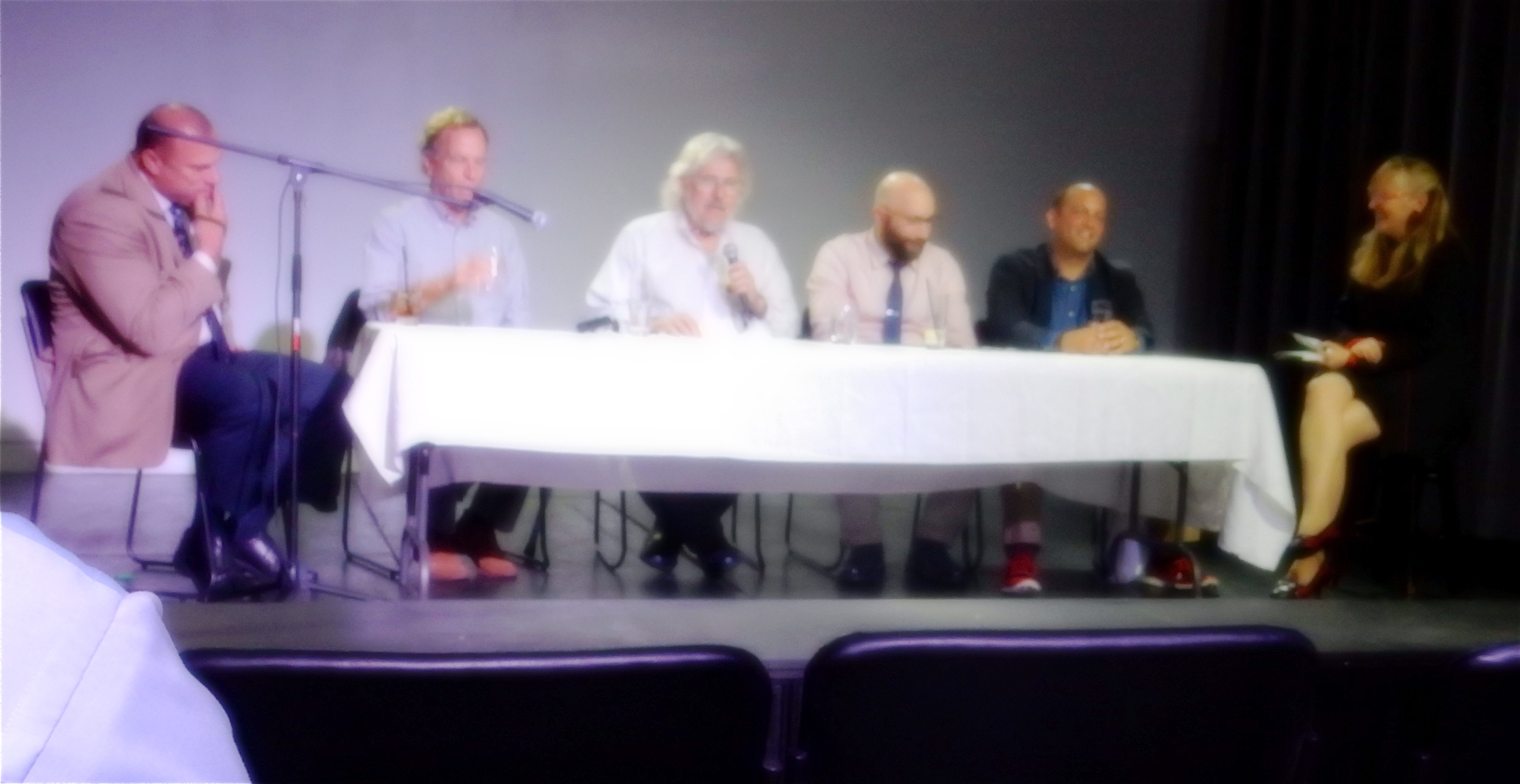
Panel, including Raymond Studley (RIPTA), Buff Chase (Cornish Assoc.), Don Rhodes (RIPTA riders), Chris Ise (City Planning), Cliff Wood (Parks Conservancy) and Anne Tate (RISD). (Photo by David Brussat)

Panel, including Raymond Studley (RIPTA), Buff Chase (Cornish Assoc.), Don Rhodes (RIPTA riders), Chris Ise (City Planning), Cliff Wood (Parks Conservancy) and Anne Tate (RISD). (Photo by David Brussat)

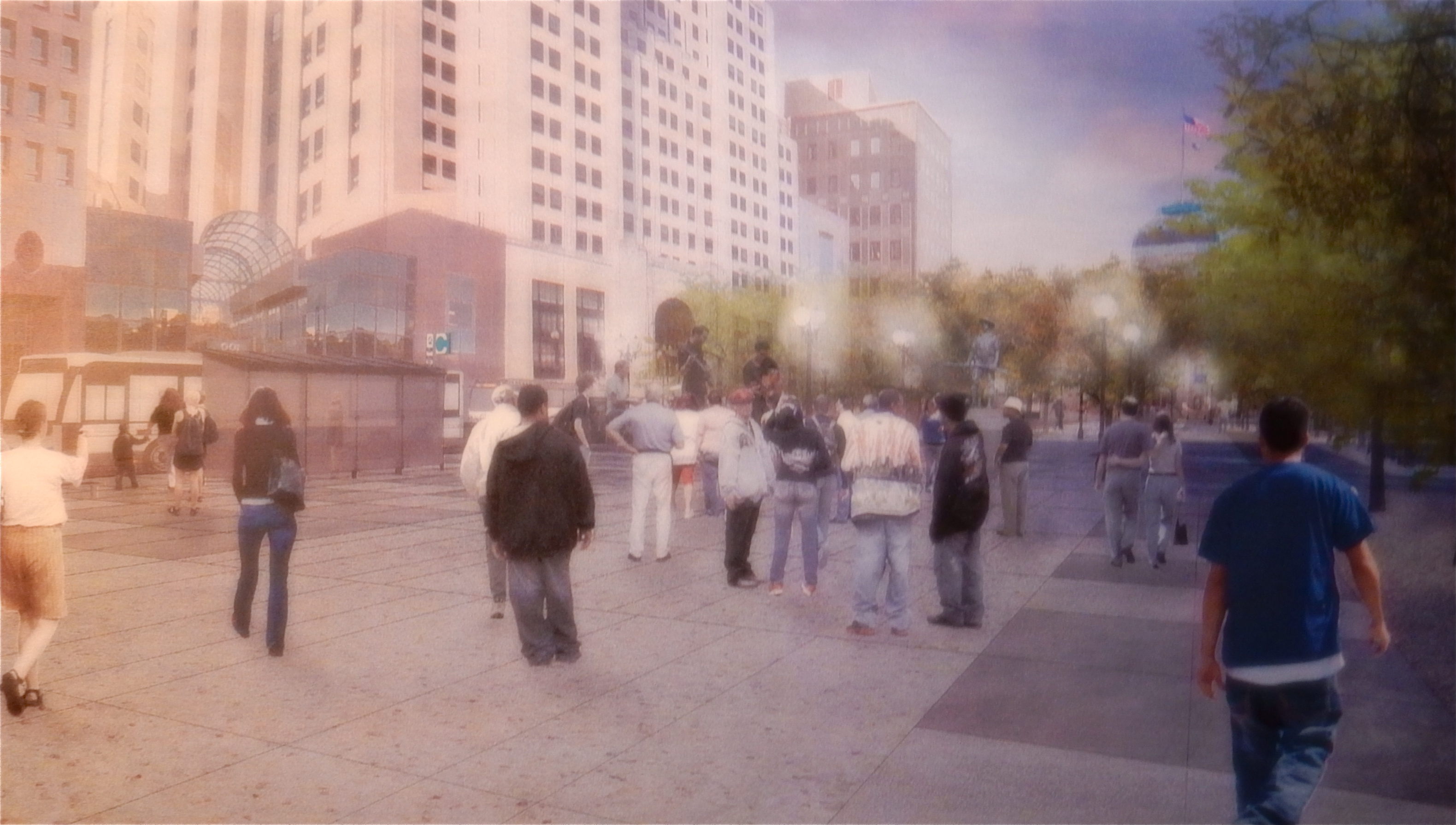
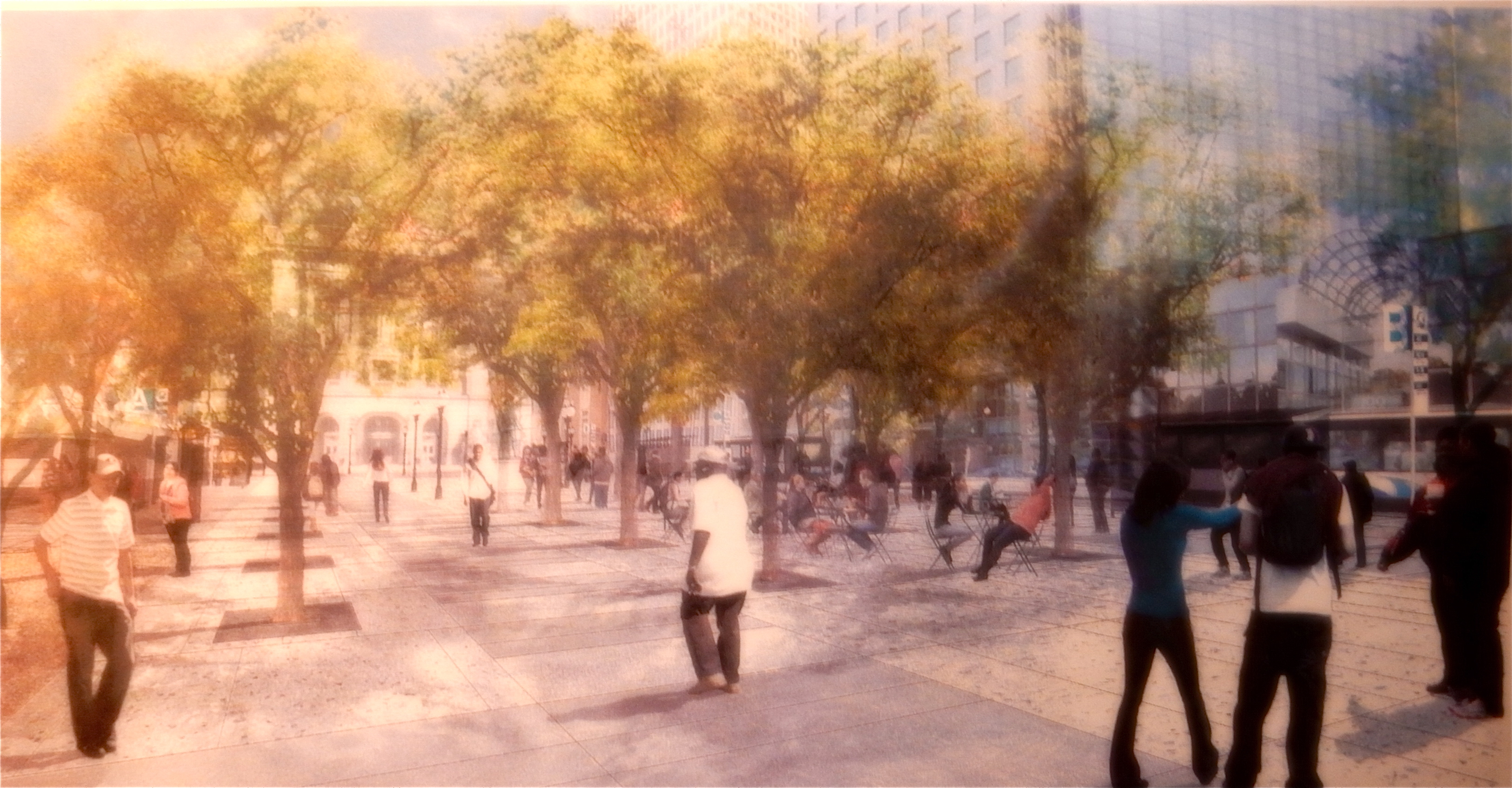
Rendering of Kennedy Plaza. (RIPTA)

Rendering of Kennedy Plaza. (RIPTA)

Rendering of Kennedy Plaza. (RIPTA)

Rendering of Kennedy Plaza. (RIPTA)

Rendering of Kennedy Plaza. (RIPTA)

Rendering of Kennedy Plaza. (RIPTA)

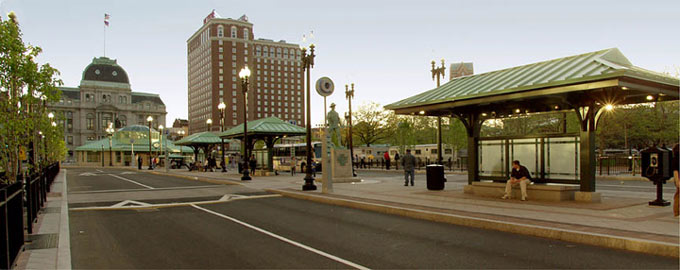
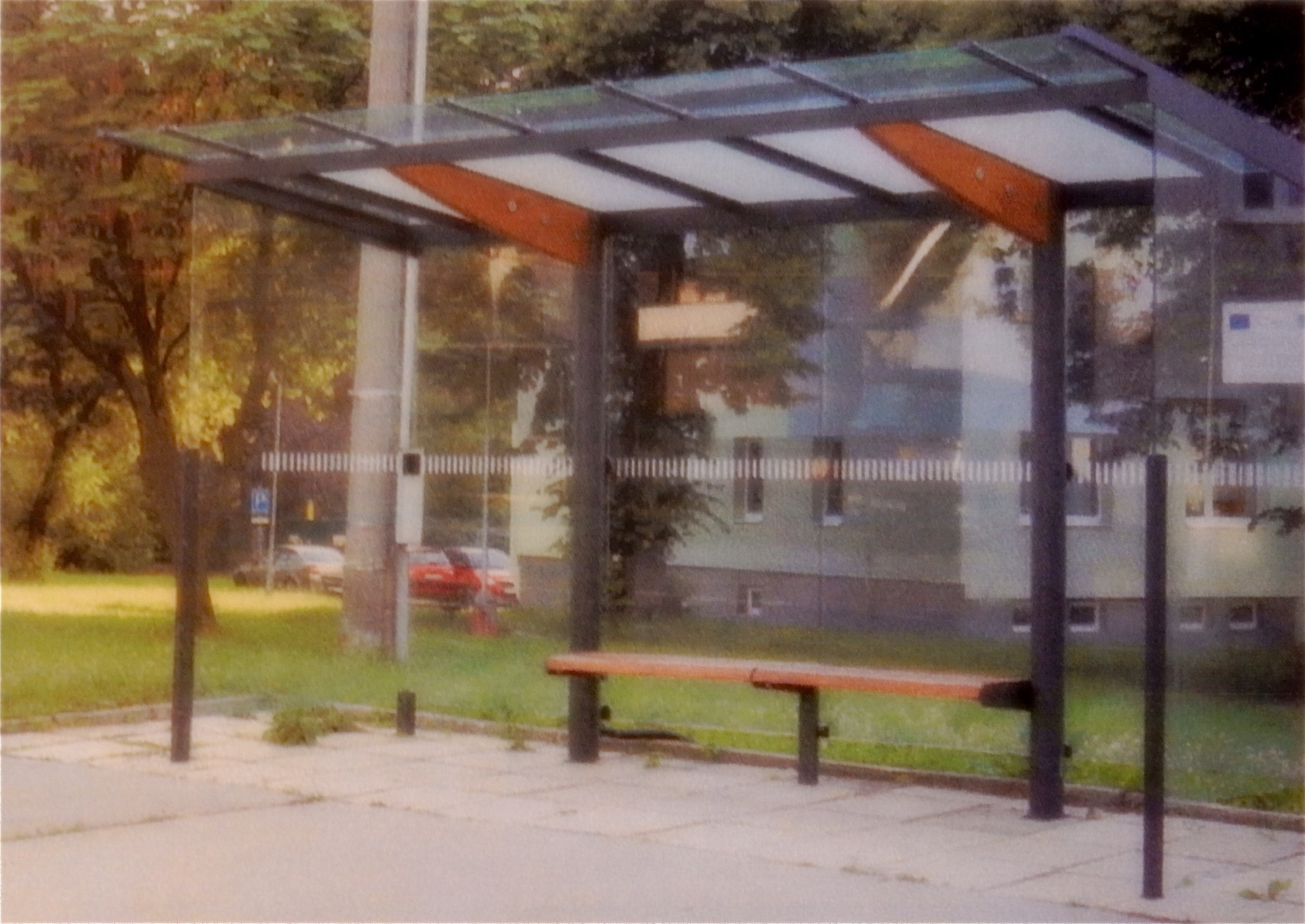
Bus waiting shelter planned for Kennedy Plaza. (RIPTA)

Bus waiting shelter planned for Kennedy Plaza. (RIPTA)

Union Studios design for Kennedy Plaza, 2013. (Union Studios)

Union Studios design for Kennedy Plaza, 2013. (Union Studios)

Standing on the steps in front of City Hall, several people waited for a tour of Kennedy Plaza to begin, followed by a public discussion of its future. We wondered why the front doors of so many important Providence public buildings are closed to the public. One of these is City Hall itself. You may climb the steps but the ornamental gateway is closed, blocking the main portal through which one used to enter to visit the mayor’s office. Closed also, at least to the public, is the original Washington Street entrance to the Providence Public Library. The public enters through what appears to be the basement on Empire Street.

More to the point, the front doors of the bus depot at Kennedy Plaza have been closed since 2002, when the building, originally a comfort station erected in 1914, was expanded and transformed into a depot for the Rhode Island Public Transit Authority. Behind these closed doors, a substation of the Providence Police Department exists to monitor activities around Rhode Island’s main transit hub.

Mary Shepard, an urbanist who advocates reform of public spaces, says the front doors of the bus depot should be reopened. She is correct. All should be opened. Until they are, these closed entrance portals serve as metaphors for the topsy-turvy civic and political leadership of Providence.

This may be most evident in the Kennedy Plaza renovation project. In July, with minimal public input, evidently in haste and with no clear plan for its future, the city demolished the eastern half of Kennedy Plaza. After the tour, last night’s public discussion at the Aurora Club, sponsored by the New England chapter of the Congress for the New Urbanism, did little to allay the impression, four months later, that any coherent plan exists to turn the plaza into a civic square shared by bus riders and the broader public.

My own impression, gathered over 30 years of experience with Kennedy Plaza and as a twice weekly bus rider for the past five years, is that the bus hub operates with relatively little stress. A time-lapse video taken from City Hall in November 2012 shows how smoothly things go. I have never felt threatened waiting for a bus or walking through the plaza. Its subculture of hangabouts and alleged drug dealers makes some people nervous, and so, along with sophisticated new bus schedule information, more surveillance cameras are to be installed as part of the current upgrade. Fine. But more visible patrols by police officers would enhance safety much more effectively.

As for the need for bus riders to give way in some degree to other user groups of a Kennedy Plaza transformed into a civic square, Burnside Park and the skating rink next door serve the functions of such a square today. Children’s events, concerts, food trucks and other programming managed by the Downtown Providence Parks Conservancy have worked well to animate the park.

There is always room for improvement, but in an era of tight budgets it seems unwise to spend money you don’t have to renovate a facility that works (Kennedy Plaza) in order to replicate the activities of another facility right next door that also works (Burnside Park). Even granting the desirability of the plaza’s renovation, isn’t that putting the cart before the horse?

Why, for that matter, didn’t the city wait for citizens to vote next month on state bond referendum No. 6 for money to help build a new transit hub at Providence Station? Its passage would certainly influence what is needed at the plaza. And yet last night’s fervent pleas from the dais to approve No. 6 suggest that advocates of the Kennedy Plaza plan believe that extra money sloshing around in the state transit trough might somehow spill over to help relieve their project’s money woes.

This kind of planning does not inspire confidence.

Instead of a new bus hub at the train station, a shuttle bus between Amtrak and Kennedy Plaza would serve the purpose of intermodal linkage at a very tiny fraction of the cost. The money saved might help to revive the attractive plan for the plaza by Union Studio Architects, announced in 2013. Cliff Wood, director of the parks conservancy, which has built up its constituency for changing the plaza on the basis of the allure of this plan, assured the audience last night that it had not been “frog-marched out of the picture.” Good! But he also said the plan might be too ambitious to bring to fruition.

Huh?

Does that mean we will be stuck for years with the “blank slate” now under construction, with its utilitarian bus shelters and wind-swept empty spaces? That is unlikely to foster Kennedy Plaza’s broader use as a civic square. A costly, unnecessary 180-degree shift in the design of the plaza seems an unlikely way to promote the phased implementation of a project amid an environment of public skepticism. But that is the tactic that has been adopted. Good work, guys!


Posted in Architecture, Development, Providence, Urbanism and planning | Tagged , , , , , | 5 Comments