Appetite for Andreozzi

Andreozzi Fertig Pano 1If you have an appetite for lovely houses in grand style, visit on Thursday evening a show of work by Barrington architect David Andreozzi. Not only is Dave a fellow board member of the New England chapter of the Institute of Classical Architecture & Art, he is a big wheel in the American Institute of Architects’ Custom Residential Architects Network (CRAN). The free event unfolds at AIAri’s headquarters downtown at 158 Washington Street from 5 to 9 as part of Gallery Night Providence. The AIAri announcement has some photos, but above and below are more. Dave’s firm’s website is here. Not quite canonical, eh wot! Feast your eyes!

B0155P 0186B0097P 0333Untitled-7


Posted in Architects, Architecture, Providence, Rhode Island, Uncategorized | Tagged , | Leave a comment

Kennedy Plaza reminder

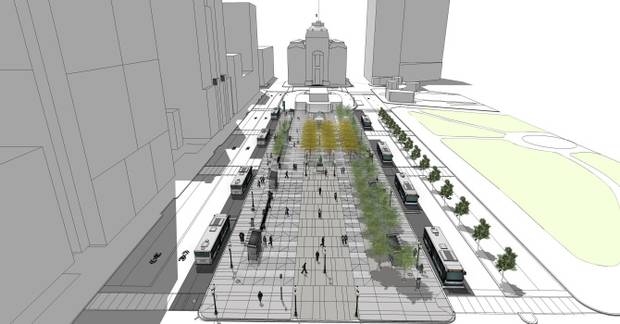
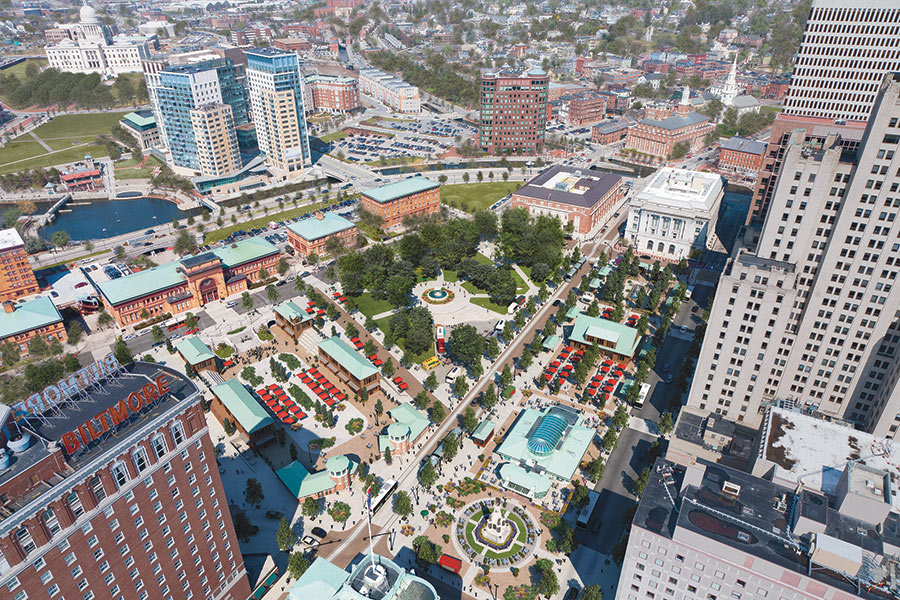
Kennedy Plaza renovation as pictured in a rendering provided by the Department of Planning & Development.

Kennedy Plaza renovation rendering provided by the Department of Planning & Development.

Wednesday’s tour of Kennedy Plaza and panel discussion of its future, sponsored by the New England chapter of the Congress for the New Urbanism, is described below:

Vision for Greater Kennedy Plaza: Walkabout and Panel
Providence, Rhode Island
Wednesday, October 15, 2014

Please join CNU New England for a walkabout in Providence’s Kennedy Plaza and panel discussion at Aurora to review the progress, programming, and next steps for the Vision for Greater Kennedy Plaza. Through a public-private partnership between the Downtown Providence Parks Conservancy and the City of Providence, this project seeks to create a pedestrian-friendly environment, encourage transit ridership, bolster economic well-being, promote arts and culture, and encourage tourism. The first steps toward implementation of the long-term vision are under construction, so please come join us to discuss what’s next. “Ideas for admission” are encouraged at the door – provide your walkabout observations and thoughts regarding next steps toward implementation of the vision.

5:30pm Walkabout – Providence City Hall, 25 Dorrance Street
6:00pm Panel Discussion – Aurora, 276 Westminster Street

Featured panelists include Cliff Wood (Providence Downtown Parks Conservancy), Ray Studley (Rhode Island Public Transit Authority), Chris Ise (City of Providence), Buff Chace (Cornish Associates)

This event is free and open to all. Suggested $5 donation helps CNU New England to sustain this regularly occurring event series at Aurora throughout the year. Please RSVP here.

Posted in Architecture, Development, Providence, Urbanism and planning | Tagged , , | Leave a comment

A Gehryesque critique

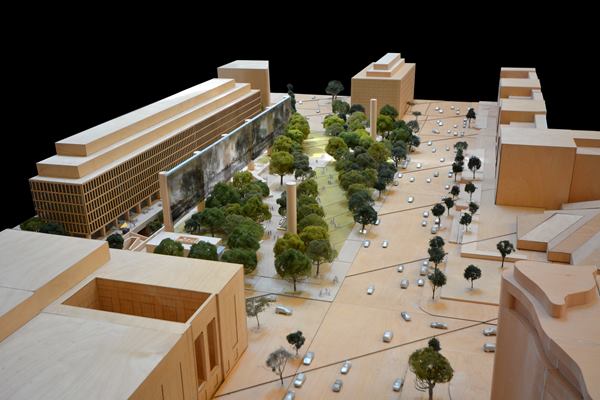
Latest rendition of Frank Gehry design for Eisenhower memorial, minus two small

Latest rendition of Frank Gehry design for Eisenhower memorial, minus two minor “tapestries.” (Eisenhower Memorial Commission)

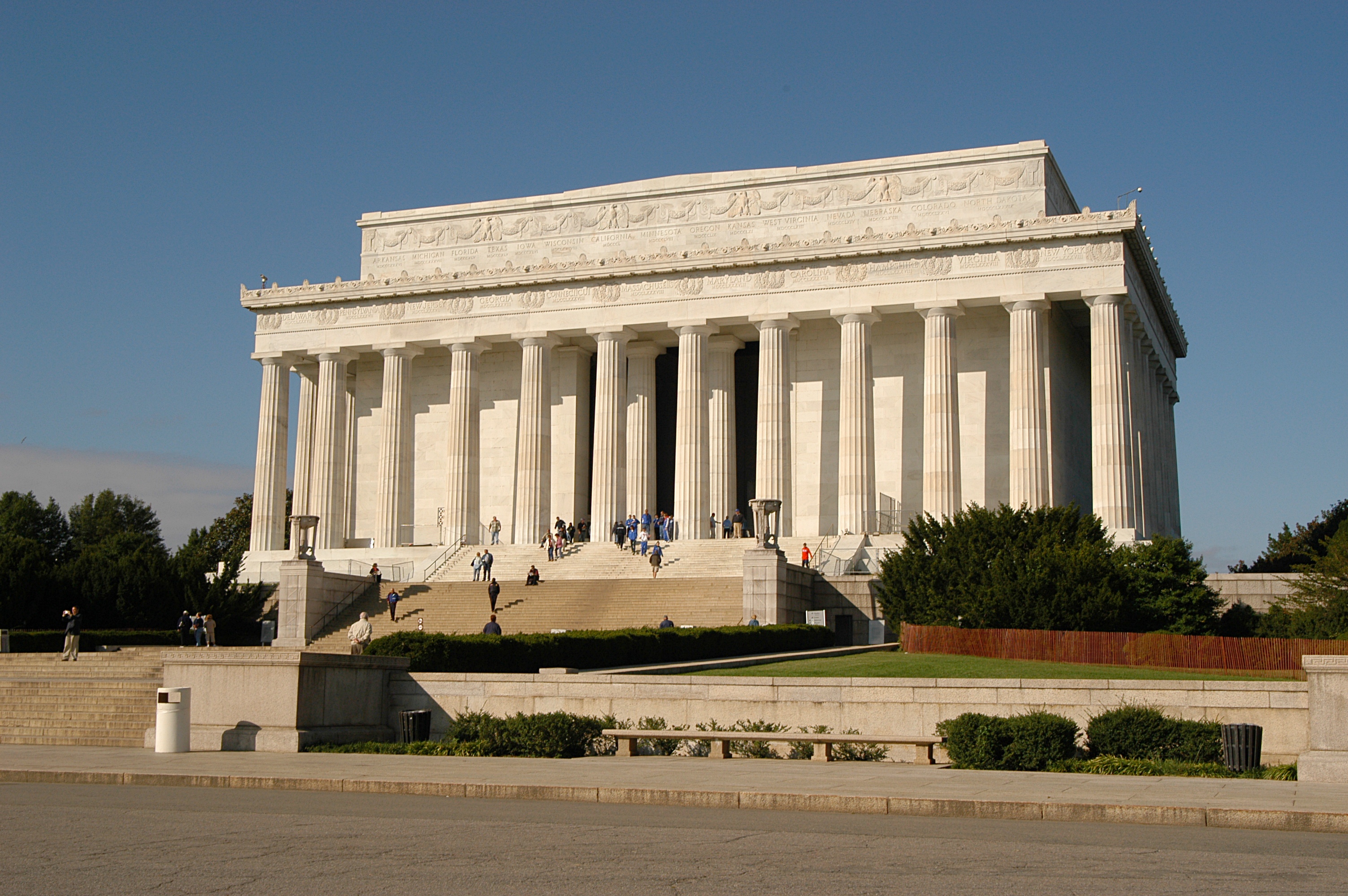
Lincoln Memorial. (ca.wikipedia.org)

Lincoln Memorial. (ca.wikipedia.org)

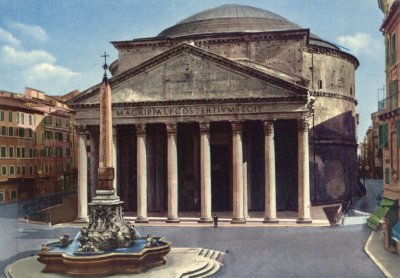
The Pantheon in Rome. :(globeriders.wordpress.com)

The Pantheon in Rome. (globeriders.wordpress.com)

This critique of the critique of the Gehry design for a memorial to Dwight Eisenhower, “An Eisenhower Impasse,” by Ned Cramer in Architect, the journal of the American Institute of Architects, is so twisted that it merits the sobriquet Gehryesque.

Gehry’s “giant rectangle of  columns and tapestries is a lineal descendant of the agoras and forums of western antiquity,” writes Cramer, “just as John Russell Pope’s Jefferson Memorial recalls the Pantheon in Rome.” But assertion is not proof. The two lineages are not the least bit comparable.

Cramer correctly notes that next to Gehry’s typically twisted designs, his memorial for Ike is sober, but he is wrong to trace it to the classical tradition. That is absurd. Just because it is rectangular and has posts (they don’t qualify as columns) does not mean it is classical, or bears any meaningful relation to the classical tradition.

Modernist critics say this all the time, and some modern architects are familiar with the classical tradition, but modernism is a reaction against tradition and a denial of the classical as valid for our time.

Gehry once wondered what Lincoln has to do with a Greek temple, and said, “Life is chaotic, dangerous and surprising. Buildings should reflect that.” His Ike memorial purposely rejects the tradition of classical memorials in Washington that his advocates (though not he himself) claim prefigures his design. They can say what they want, but they can’t have it both ways.

Gehry’s advocates have also tried to root opposition to Gehry’s memorial in politics, as if a disinclination to pay millions of tax dollars for a memorial that slaps the public (not to mention Ike) upside the head is liberal or conservative. A hint that the dislike is bipartisan (or rather nonpartisan) is that more funds have been spent by a PR firm to raise money to build it than the amount of money raised itself. That amount is negligible, half a million, unlike the large swig of taxpayer money appropriated by Congress so far for a project estimated to cost as much as $144 million.

A key line in Cramer’s essay is this: “Critically approved progressive artists don’t do straight portraiture, any more than their architect counterparts do straight classicism. Those who do, do so at their peril.” I’m not sure how to react to that. It is merely a statement of fact. No, Gehry was not knuckling under to the design apparatchiks of the AIA, but younger architects might understandably read it as a threat to anyone who contemplates wandering off the modernist reservation.

“Apotheosis isn’t part of the creative vocabulary anymore, at least not without a big dose of irony.” The culture that Gehry represents doesn’t understand that irony is not an appropriate tool for memorializing an American hero.

“In this tale of two cultures colliding,” writes Cramer of the debate over Gehry’s design, “the architect’s viewpoint deserves as much respect as the Eisenhower family’s.” Really? Well, what is the architect’s viewpoint? And why does the Eisenhower family oppose his design? Perhaps it is because the family believes that the memorial should be about Ike, not Gehry.

This piece demonstrates that like the classical architects of long ago, modern architects today have held power in their field for so long that they’ve lost the capacity to argue the case for modern architecture. Faced with a classical revival that could well knock Gehry out of the National Mall, their most trusted spear-carriers can chuck only nonsense.

Posted in Architects, Architecture, Architecture History | Tagged , , , , | 4 Comments

A liturgy of beauty

Detail of the Trevi Fountain, in Rome. (

Detail of the Trevi Fountain (1762), designed by Nicola Salvi, in Rome. (gnixus.wordpress.com)

Ah, the sun is edging its way through the clouds here in Providence. Patches of blue can be seen from the window beside the desk of your occasionally dire correspondent. So on to a passage sure to soothe the savage breast. It is from page 115 of Henry Hope Reed’s The Golden City, published in 1959. Reed has just noted how blessed we are that in recovering classical beauty we moderns need not search through the ruins of the ancients. Talk about heavy lifting! “[W]e can go about the land and find buildings entire.” He adds, “For all the debris that has risen about them, they still command. Let us restore them.” He goes on to describe scale, proportion, movement, balance, axis, and unity.

Then there are the classical elements. We have touched on the first of these, the Five Orders both in column and pilaster. Moldings, in all their variety, are essential. The pedestal, consisting of base, dado, and surbase, is a third. A fourth is the entabulature with its architrave, frieze, and cornice. The pediment, both round and triangular, is a fifth. The dome, the arch, the cornice, the keystone, the baluster [my favorite], the attic, the quoin and rustication are some of the others. They are complemented by the different kinds of ornament: the rosette, the godroom, the volute, the acanthus, the rinceau, the griffon, ad infinitum. Classical America offers examples of them on every side.

The massing of classical vocabulary is a beauty in and of itself. A string of ornamental terminology is itself as ornamental as a piling on of the real things. Someday I will open my dictionary of architecture and attempt a string of the terms of embellishment that will shake the world. Or maybe it will just fill the heart. Anyhow, a blog for another day.

(William Hazlitt, in his essay “On Great and Little Things,” had just poured his heart out over an affair with a “lodging-house decoy” that exploded in his face the year before. He directed readers by asterisk to the following disclaimer: “I beg the reader to consider this passage as merely a specimen of the mock-heroic style, and as having nothing to do with any real facts or feelings.”)

[The sun never really did make it through, alas.]

Posted in Architecture, Art and design, Uncategorized | Tagged , , , , | Leave a comment

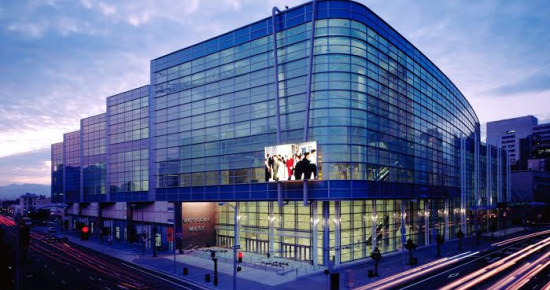
S.F.’s Moscone Centergate

The rectangle just off center is "Facsimile," by SD+R. (Architect's Newspaper)

The rectangle just off center is “Facsimile,” by DS+R. (Architect’s Newspaper)

It’s been a while since I had a good excuse to take my nickname for Diller Scofidio + Renfro out for a walk. Dildo Scrofulous + Rent Free.

And I did bring my pooper scooper!

We last heard from the architects of Brown University’s ridiculous Granoff Center for the Creative Arts (an accordian damaged in an earthquake) when they donned their Darth Vader mask to design a replacement for New York’s “beloved” American Folk Art Museum, recently demolished by its evil landlord, the Death Star (the Museum of Modern Art). The firm has gone starchitectural since its project for Brown. Thus it well fits the role of villain.

But today I concede that DS+R is the victim. An art installation called “Facsimile” by the firm at the city’s Moscone Center installed in 2003, before Rent Free joined Dildo and Scorpion (as I once put it, but that was too tame), has been voted off the island by the San Francisco Arts Commission. It was a moving screen that depicted people who stopped to mug before cameras placed within the facility. Actually, it might have been more nuanced than that. It moved on a rail from one end of the building to another. (This reminds me of “Cavorting Inanity,” a neon installation that decorates the garage of the Rhode Island Convention Center.)

The point here is not to praise or condemn the art, the artists or the folks who have decided that it has overstayed its welcome. Rather, the critic who condemned the action in the Architect’s Newspaper failed to mention that the screen had been on the fritz since its installation, and that this is why the 9-1 vote of the commission to remove it was taken. This was “glossed over” (in the apparently accurate words of commenter Mattia) in an article by Edward Dimendberg in the paper’s blog, A/N.

In short, what did he know and when did he know it?

Posted in Architects, Architecture, Art and design | Tagged , , | 1 Comment

A kinder, gentler Zaha

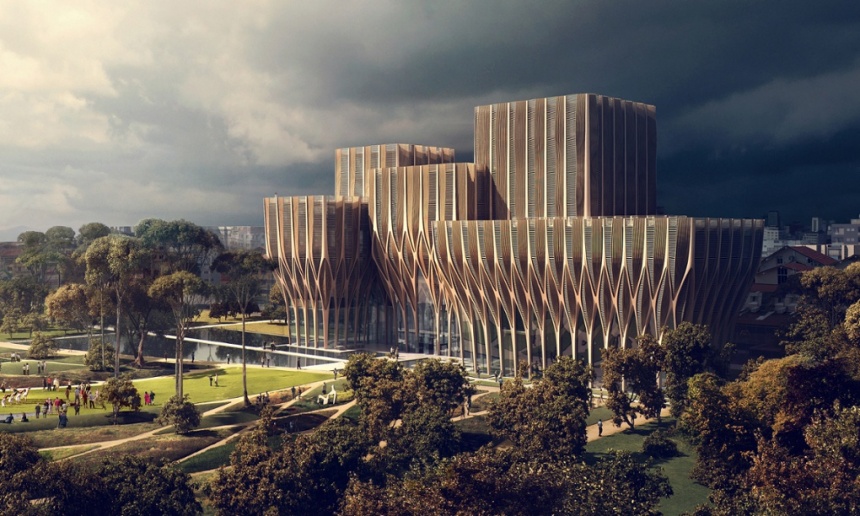
Proposed genocide museum in Cambodia by Zaha Hadid. (The Guardian)

Proposed genocide museum in Cambodia by Zaha Hadid. (The Guardian)

Ankor Wat. (ngm.nationalgeographic.com)

Ankor Wat. (ngm.nationalgeographic.com)

World Trade Center, circa 1997. (mlive.com)

World Trade Center, circa 1997. (mlive.com)

Lightening up on her typical aesthetic slash-and-turn violence, Zaha Hadid has designed a genocide museum and institute south of downtown Phnom Penh to honor the dead of Pol Pot’s savage regime. The commemoration has inspired Guardian architecture critic Oliver Wainwright to pen another item, “Zaha Hadid’s soft hymn to Cambodia’s fallen,” for my collection of pieces that unwittingly brag on the ghoulishness of modern architecture.

“Zaha Hadid has brought her trademark language of sinuous lines,” he writes, “but she has consciously eschewed some of her more violent geometries, making a building that promises to be unusually attuned to its context” For most people, this would be damnation by faint praise of an architect’s body of work. It suggests that her style is normally violent and alien to its context. And indeed, perhaps Hadid’s usual violent zigzags would have been more appropriate for this job.

Wainwright perceives Ankor Wat in the five buildings of Hadid’s design. I do not see it. But I do see a nearly perfect recapitulation of the almost Gothic ground-level sinuosities of the World Trade Center. What Osama bin Laden did to a pair of buildings in New York City, Pol Pot did to a swath of his nation’s entire population. What Daniel Libeskind did (or sought to do) to commemorate the more recent atrocity, Zaha Hadid does to commemorate the earlier one: Both designs did not so much commemorate as recommit genocide, albeit not of population but of culture.

Modern architecture has no problem with cultural genocide. That is what modernism is all about, whether in its Jacques Derrida deconstructionism, targeting the structures of human institutions, or in modern architecture’s attack on the evolutionary structures of the built human environment.

The blame in this case belongs less to Zaha, however, who’s just trying to make a buck, than to the brainwashed human-rights activist Youk Chhang, who, for all his brave archival work, is so focused on making a big splash with his institute that he overlooks the impact of its design on his nation’s already beyond sufficiently throttled culture. “Many of these memorial museums are depressing, and you leave with a sense of anger, not forgiveness,” he told Wainwright. “They are usually designed by men, so I thought maybe a woman could do it better.” There you have it.

Wainwright doesn’t mention let alone applaud cultural genocide. Most modernist architecture critics do not even begin to imagine that the starchitects they revere are committing it. (I’ll say that for them!) But this piece still deserves a place in my collection of architectural criticism that unwittingly damns modernism.

Posted in Architecture, Development, Other countries | Tagged , , , , | 1 Comment

Trad clearinghouse?

DSCN0134_2How about a clearinghouse for traditional projects? Prompted by a conversation this morning with the Washington, D.C., architect and planner Nir Buras, I am thinking of starting a new blog, associated with this ol’ Architecture Here and There blog, where architects, developers, planners and others could post (or allow me to post) their work, proposed, in progress or recently completed. The focus, as I imagine it at the outset, would be on projects larger than single-family houses, since that is where the classical revival needs most help, though they needn’t be classical and though even groupings of single-family houses in a project might very well be pertinent.

If anyone has any thoughts on the need for this, the desire for this, or how it might best be arranged, feel free to let fly.

Posted in Architects, Architecture, Development, Urbanism and planning | Tagged , , , , , | 4 Comments

Parcel 12 revisited

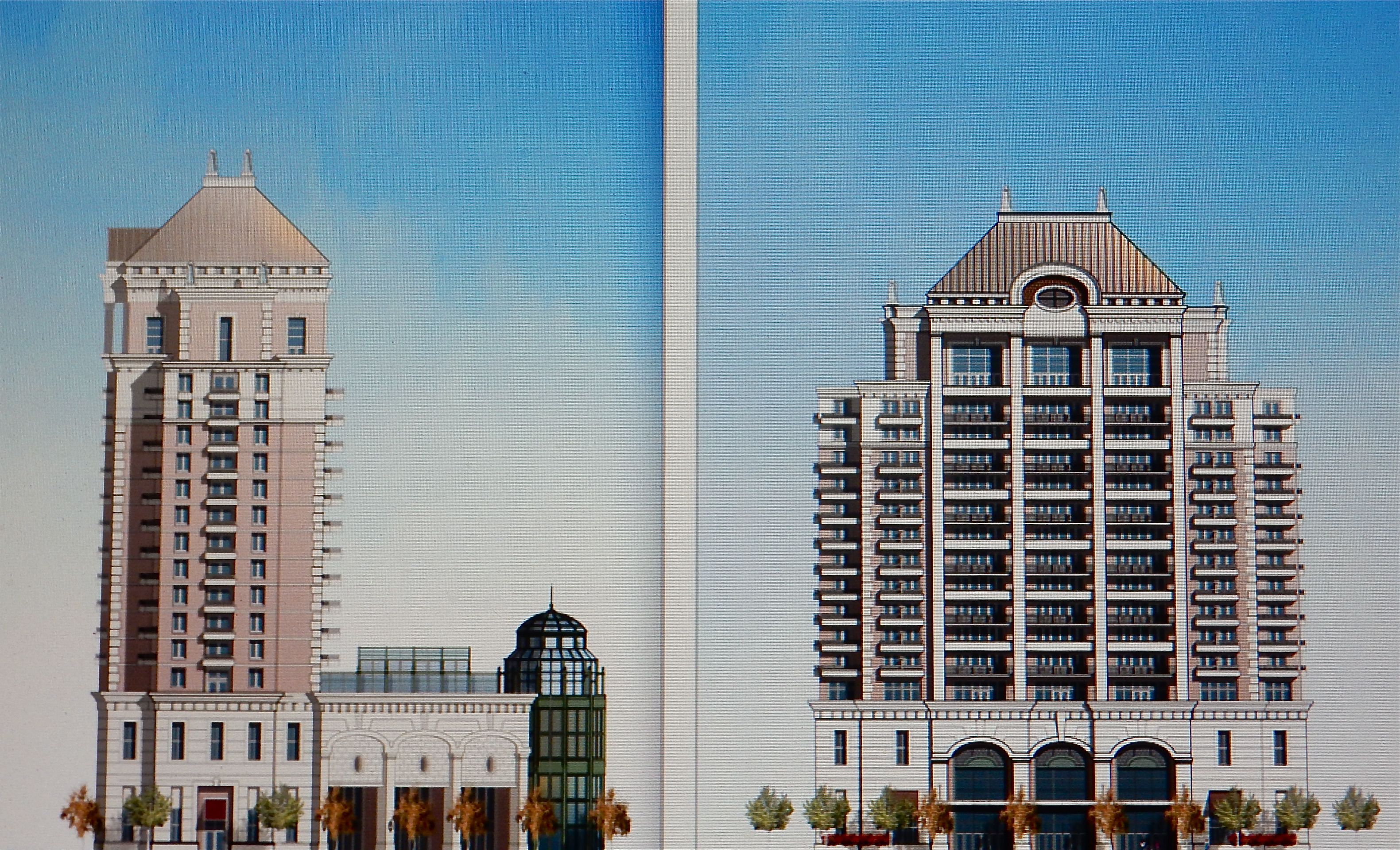
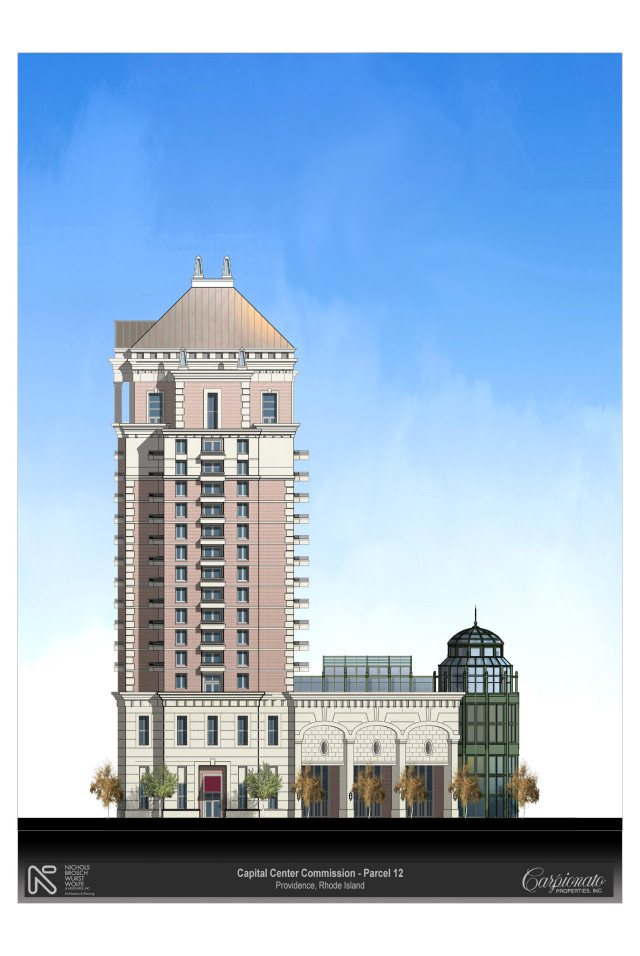
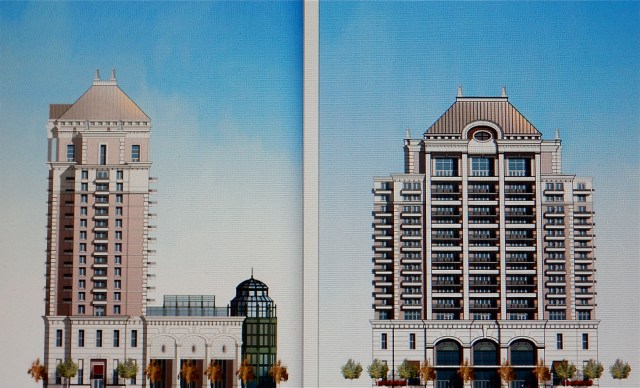
The north and east facades of the proposed Carpionato hotel design of 2006, for Parcel 12, Capital Center district, in Providence. (Courtesy of The Carpionato Group)
The north and east facades of the proposed Carpionato hotel design of 2006, for Parcel 12, Capital Center district, in Providence. (Courtesy of The Carpionato Group)

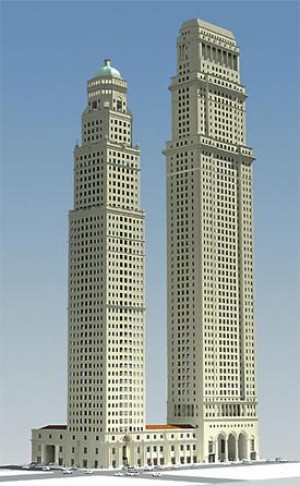
City House and the Olympic, towers designed in 2006 for Los Angeles. (ladowntownnews.com)

The Olympic and City House towers, designed in 2006 by Rick Robertson for Los Angeles. (ladowntownnews.com)

The Carpionato Group has sent me two images of its 2006 design for a proposed hotel at the northeast corner of Kennedy Plaza that fell through. It is of interest because a new hotel proposal, by First Bristol Corp. of Fall River, has just been made. I commented on the Carpionato design, by Nichols Brosch Wurst Wolfe & Assoc., in a column back then on two proposed classical skyscrapers for Los Angeles.

My friends on TradArch would have liked the towers, I think. They were designed by Rick Robertson. But some will take strong exception to the Carpionato proposal, a kinda-sorta French Second Empire design. I would concede that it is a bit of a mish-mash, even a “pastiche” (a word modernist critics like deploy against even high-caliber classical design).

I always judge new architecture against a “what it might have been” yardstick, especially in Providence, since in recent decades (except for the 1990s) new buildings were more likely to be modernist. Not holding all classical or traditional design proposals to the tippy-toppy standard will rub some TradArch’ers the wrong way, of course, especially those who think bad trad is more hurtful to the classical revival than modernism, be it bad or good – an entirely dubious proposition!

I think the Nichols partnership was the designer for the first Westin (now Omni) hotel that was completed in 1993, and its “addition,” actually an entirely new building but connected elegantly to the original by a domed interloper. A diminished version of that addition, redesigned by Jung/Brannen Assocs. in the mid-2000s, was completed in 2007.

Anyhow, here is my column from long ago, in which I tried to gird the loins of the architect of the Carpionato design of 2006 as he faced the dragons of design review. This is toward the end of the column.

Angeleno inspiration for Providence
May 18, 2006

TWO proposed skyscrapers designed by celebrity architect Frank “O!” Gehry for downtown Los Angeles were announced the same day [last week] as two other proposed downtown-L.A. skyscrapers. Gehry’s towers, of 47 and 25 stories, got the lion’s share of media coverage, of course, but the two designed by architect Richardson Robertson III for developer Rodmark would be even taller. City House and the Olympic would soar 60 and 49 stories, respectively, into the sky above the City of Angels.

But although the taller of the two would be the tallest residential tower in America, height isn’t their most interesting feature. Rather, it is that they would both be unapologetically classical in style. If built, City House and the Olympic would have no peers.

Perhaps the closest to classical among the tallest buildings erected over the past half-century is the late Philip Johnson’s AT&T Building (1980), in New York. Modernists claim they hate its boffo Chippendale roof, which is postmodern, but even more they hate the sleek, rhythmic, yet unadorned pilasters and slender mullions of its more arguably classical façades, which beat modernism at its own game.

In 2002, a dozen towers of a more overtly classical style, ranging up to 50 stories, were proposed for the World Trade Center site, in Lower Manhattan, by Franck Lohsen McCrery Architects. Unveiled in the Fall 2001 City Journal, the proposal was blocked by the criteria adopted for the WTC design competition, which was rigged to admit only modernist designs to the final round. The firm also entered an inspired classical plan in another competition, to rebuild a 60-block site on New York’s West Side.

Robert A.M. Stern has designed a mid-size classical tower on Berkeley Street, in Boston. I’m especially fond of his Brooklyn Law School tower. And his condo tower in Manhattan, the 31-story Chatham, may come closest to being a classical skyscraper. [His 35- and 19-story towers at 15 Central Park West were completed in 2008.] It has several taller rivals in New York, but they, along with a few candidates in other cities, hover even closer to postmodernism than the AT&T, with the massing of classic skyscraper form but not the detailing.

So the history of the postwar classical skyscraper is meager indeed. Rick Robertson’s two L.A. towers, if built, would almost be Chapter One.

To gaze upon the computer renderings of the Robertson proposal for Los Angeles is to conceive a civic America far lovelier, far more urbane, far more humane and even far more practical than what passes for architecture today. Let readers substitute, in their minds, buildings of this enchanting sort for the ugly (and increasingly loopy) skyscrapers that mar their skylines today. They will see, in their imagination, an American civitas not only different from but perhaps even better than the European cities to which we all travel to find the beauty so lacking here.

Despite the stirring example of its prewar classical skyscrapers, Providence has now decided to step away from the easy, logical path that could have led to its being unarguably the most beautiful city in America. In Capital Center, sanity ruled for a decade: With the Westin Hotel (1994), Providence Place (1999) and the Marriott Courtyard Hotel (2000), the city looked forward with hope to beauty; but in 2004, the Capital Center Commission snatched defeat from the jaws of victory.

The latest proposals before the commission – the Westin addition now in construction and the Carpionato Properties hotel proposal recently unveiled before the commission’s design panel — are classically inspired, but are under attack.

During the process leading to the approval of the Westin addition’s design, the panel accepted the removal of a rooftop cupola and a shift in the massing of the addition’s major and minor wings. The panel is likely to accept more recently proposed reductions in the quality of the addition’s design, including the removal of half of the upper and all of the lower gabled roofs, by which the addition maintains its identification with the original hotel tower, and a squaring off of the addition’s elegantly curved condo balconies.

Thankfully, Carpionato Properties has not yet gotten with the new program at Capital Center. It refuses to be ugly. It has proposed an imperfect and yet largely attractive hotel for Parcel 12 — the triangular Bad Sculpture Park, at the northeastern corner of Kennedy Plaza. Members of the design panel attacked its French Renaissance design as insufficiently coherent — a judgment with which, having now seen detailed drawings up close, I would disagree. Architect James Wurst should stand fast. Let him get in the panel’s face by increasing the level of detail that informs his classical design. The panel may grumble but it is unlikely to block a proposal on those grounds.

Things may look bleak in Providence, but architects here at least now have another source of inspiration. To be sure, it’s way on the other side of the country, but even as a mere proposal it towers over the landscape, easily visible from Providence.

David Brussat is a member of The Journal’s editorial board. His e- mail is: dbrussat@projo.com.

Posted in Architecture, Blast from past, Development, Providence, Urbanism and planning | Tagged , , , , | 2 Comments

Bad Scupture Park Hotel?

Here’s an updated version of the original blog from yesterday with the Carpionato design from 2006 added. I will soon post again with two images of this design, accompanied by my original column about it.

David Brussat's avatarArchitecture Here and There

Proposed design for Parcel 12 hotel, from 2006, by the Carpionato Group. Proposed design for Parcel 12 hotel, from 2006, by the Carpionato Group.

A new proposal has arisen for Parcel 12, the triangular Capital Center District land at the northeast corner of Kennedy Plaza that I’ve long called Bad Sculpture Park, in honor of its cast of uninspiring works of art. The Journal’s story today notes that hotels on that land (separated by Memorial Boulevard and the Woonasquatucket River from Capital Center itself) have been proposed before.

The Journal story, “Developer envisions hotel on triangular lot,” by Paul Grimaldi, notes two earlier proposals, by Joseph Paolino and then by Carpionato Properties, adding that “[t]he site’s limitations were the main reason neither of those proposals got built.” He was referring to its shape and the fact that it’s filled land with a high water table.

Perhaps that’s true, but it should not be forgotten that the second proposal’s traditional architecture – a…

View original post 294 more words

Posted in Uncategorized | Leave a comment

KP discombobulation

Kennady Plaza's proposed 2013 redesign by Union Studio Architects.

Kennady Plaza’s proposed 2013 redesign by Union Studio Architects.

Here is a piece about Kennedy Plaza by Brandon Klayko for archpaper.com. Donald Powers, founder of Union Studio Architects and designer of the very nice master plan, above, for Kennedy Plaza proposed in 2013, was clearly the author’s primary source for the piece. Powers demonstrated his credentials as an urbanist in his master plan but earns his credentials as a diplomatist with his remarks in Klayco’s article:

“He hopes the city can continue with the larger plan,” writes Klayko, “without losing its ambitious goals. ‘What has frustrated some is the new design seems to have been done independently of what else has been going on,’ said Powers.”

What Powers refers to is that half of Kennedy Plaza has been demolished but the “new design” now under construction is modernist, in contrast with both the terminal building that remains, which is traditional, and his own firm’s traditional master plan – which I’ve referred to as having been “frog-marched” out of the picture.

This is a delicate project that must move forward in phases, and in an environment of considerable public skepticism. But it’s hard to imagine that happening if its proponents, who score poorly as diplomats, cannot agree on something as important as the general direction its architecture will take.

I hope Powers’s master plan is still part of Kennedy Plaza’s official future. Maybe the sterile modernist bus waiting shelters being built can be easily ripped out once city officials, state transit officials and the Downtown Providence Parks Conservancy have identified funding needed to push the project farther along than the ominous-looking “blank canvas” that is being built now.

We may be able to find out more by attending a charrette on KP next Wednesday evening sponsored by the regional chapter of the Congress for the New Urbanism. There will be a tour at 5:30 starting from the front steps of City Hall. Then, at 6, a panel discussion will be held a couple blocks away at Aurora, 276 Westminster St. – the Wit Building, which was the Providence Black Rep until a few years ago and had been Roots Café until Buff Chace, local developer extraordinaire, bought it a year or so ago.

More information on the charrette is here.

Posted in Architecture, Development, Providence, Urbanism and planning | Tagged , , , | Leave a comment