Nod of the Royal Oak

10As a board member of the New England Chapter of the Institute of Classical Architecture & Art, I am greatly pleased to learn that the ICAA has received the 2014 Heritage Award of the Royal Oak Foundation. The Foundation is an American organization that supports the work of Britain’s top preservation organization, the National Trust of England, Wales and Northern Ireland. The Foundation promotes the values of classical architecture and its allied arts in America and in Britain.

The award is given “in recognition of institutions or individuals in Britain or the United States that have substantially advanced the understanding and appreciation of our shared cultural heritage.” This recognition was accepted by the Institute’s board chairman, Mark Ferguson, in a ceremony at the Foundation’s headquarters on West 35th St., in New York City. Here are the illustrated remarks of Chairman Ferguson, as recorded in the Institute’s Classicist Blog, on this happy occasion.

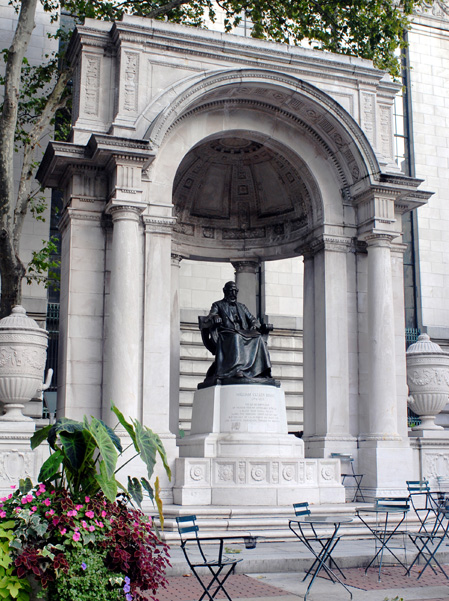
The inspiring photograph above is from the chairman’s presentation but is not identified. I have petitioned Steven Semes, chairman of the historic preservation department at Notre Dame, author of the pathbreaking book The Future of the Past and editor of the Institute’s Classicist Blog, to let me know what building has the grace to display this fine array of architraves and cornices. I will convey the information to readers as soon as I can.

… Around six this evening, Joshua Shearin sent a comment to this post identifying the photo as the Bryant Park Monument behind the New York Public Library. He added the photo below, and his identification looks sound. I give thanks for his information.

Bryant Park, Statues


Posted in Architecture, Architecture Education, Architecture History | Tagged , , , , | 2 Comments

Mansion envy, circa 1912

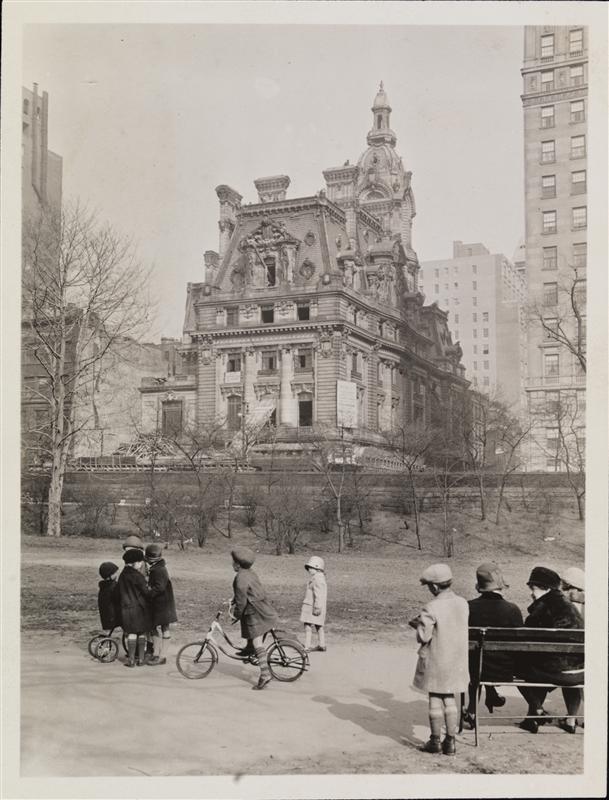
Mansion on Park Avenue built for copper magnate of the Gilded Age. (beyondthegildedage.com)

Mansion on Park Avenue built for copper magnate of the Gilded Age. (beyondthegildedage.com)

Sen. Huguette Clark and two daughters.

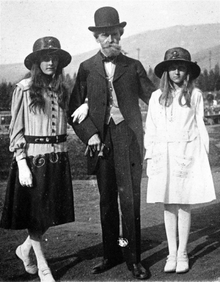
Sen. William Clark and two daughters, including Huguette, on the right.

Frankly, I don’t see anything wrong with the house pictured above (check out the urchins of wealth in Central Park). The mansion at 960 Fifth Ave. and East 77th, in Manhattan, was built in 1910 by Sen. William Clark (D-Mont.), a copper magnate, and commemorated in a poem by Wallace Irwin in 1912. The mansion no longer exists. It was demolished in 1927 and replaced by an apartment building perfectly respectable and difficult to badmouth, certainly not to the extent of its predecessor, which has been described as the most ridiculed building in New York history. I just read for the second time a wonderful novel of fantasy written in 1970 by Jack Finney, Time and Again, about a guy who travels through time back to the New York of 1882. Part of the charm of this book is Finney’s passages of description comparing the Fifth Avenue of about 40 years ago with the avenue before the demolition of so much of its fine old oligarchical architecture. I don’t see anything wrong with 960 Fifth Ave. If you’ve got it, flaunt it. Poet Irwin was clearly not of that opinion. So I’m not too keen on the attitude embodied by this piece of extended doggerel, but it sure is a lot of fun! Here it is:

Senator Copper of Tonapah Ditch
Made a clean billion in minin’ and sich
Hiked for Noo York, where his money he blew
Buildin’ a palace of Fift’ Avenoo.

“How” sez the Senator, “can I look proudest?
Build me a house that’ll holler the loudest.”
None of your slab-sided, plain mossyleums!
Gimme the treasures of art ‘an museums!

Build it new-fangled,
Scalloped and angled,
Fine, like a weddin’ cake garnished with pills:
Gents, do your dooty,
Trot out your beauty.
Gimme my money’s worth. I’ll pay the bills.”

Forty-eight architects came to consult,
Drawin’ up plans for a splendid result;
If the old Senator wanted to pay,
They’d give ‘im Art with a capital A.
Every style from the Greeks to the Hindoos,
Dago front porches and Siamese windows,
Japanese cupolas fightin’ with Russian,
Walls Sengambian, Turkish and Prussian;

Pillars Ionic,
Eaves Babylonic,
Doors cut in scallops resemblin’ a shell.
Roof was Egyptian,
Gables caniption.
Whole grand effect when completed was — hell.

When them there architects finished in style,
Forty-nine sculptors waltzed into the pile,
Swinging their chisels in circles and lines,
Carvin’ the stone work in fancy designs.
Some favored animals – tigers and snakes;
Some favored cookery – doughnuts and cakes –
Till the whole mansion was crusted with ornaments,
Cellar to garret with garden adornments,

Lettuce and onions,
Cupids and bunions,
Fowls o’ the air and fish o’ the deep,
Mermaids and dragons,
Horses and wagons —
Isn’t no wonder the neighbors can’t sleep.

Senator Copper, with pard’nable pride,
Showed the grand house where he planned to abide;
Full of emotion, he scarcely could speak;
“Can’t find its like in New York – it’s uneek.

See the variety, size and alignment,
Showin’ the owner has wealth and refinement,
Showin’ he’s one o’ the tonier classes —
Who can’t help seein’ my house when he passes?
Windows that stare at you,
Statoos that swear at you,
Steeples and weather vanes pointin’ aloof;
Nothin’ can beat it —
Just to complete it,
Guess I’ll stick gold leaf all over the roof!


Posted in Architecture, Humor | Tagged , , , , | 2 Comments

Quoins on the shop floor

Selection of embellishments for sale. (laurelbeminteriors.com)

Selection of embellishments for sale. (laurelbeminteriors.com)

There are many categories of architecture porn. (I hasten to say that’s a good thing.) One of my favorites is long lists in prose of ornamentation. So I was, shall we say, charmed to read architect Joel Pidel’s recent thread begun this afternoon on the TradArch list. It was soon joined by architect Michael Rouchell, and then by Andrès Duany, the guru of the New Urbanism. I will simply quote passages from this marvelous set of ruminations on how ornament could be sold. By the way, joining the TradArch list is free, and if you are into architecture, it is lovely to lurk and luxuriate in what these erudite folks spout out. But these are not just archiporn but genuinely good ideas. (And, I see, not from TradArch but from the Urbanist list, which I’d never heard of. I myself am alson on the Pro-Urb list) Long may this thread unspool! A quoin, by the way, is a segment of stone, brick or wood used in traditional design to reinforce the exterior corner of a building.

First there’s this idea from Joel:

I’ve had a couple pragmatic ideas for disseminating classical architecture and its details more broadly in the every day world, say for the mid-level and builder price market rather than the high or luxury end.  Somewhere between the home depot price point and the custom higher end.  There are pros and cons to these, but based on this discussion was thinking Tradarch might a good place to pool resources and ideas for such an undertaking, or criticism and derision.  I’m sure these are not “original” to myself but have probably occurred to others as well, and perhaps they are just not feasible and that is why they haven’t been done.

1) Classical autocad/revit/sketchup package.  This would be a resource put together by traditional and classical architects/designers that mid-level builders/contractors/designers could purchase with their computer based drafting software.  It would consist of a vast library of scalable classical and traditional elements: orders, columns, standing and running trim, balusters, construction details, etc.  If desired, it could even include standard traditional house typologies in plan/section/elevation as templates.  All of which, of course, could be modified as necessary.  This is already being done piecemeal, I know, by various offices who now have their own collection of details and such.  If we harnessed this for a more modest means market, it would have the benefit of increasing the quality of the low end of design, where architects are often not even involved, but admittedly would also turns it into a kit of parts.

2) Develop a parameter-based molding series generator and partner with a company that can mass produce these moldings for the lower end or spec market (think slightly customized Home Depot).  Insert period/style, room dimensions, limit conditions, hierarchical importance and a set of properly proportioned and scaled molding options for crowns, bases, rails, etc., are generated for selection and order.

Admittedly, these are more along the lines of Andrès’ ideas for mass production and have implications for the “local/handmade/artisan” market if the intent is to promote this more effectively, so I’m not sure to what extent it’s a Catch-22.

Then there’s this from Michael:

I think that this is a good idea.

I have always thought that window manufacturers should team up with shutter manufacturers so that they could offer complete window & shutter packages, sizes all coordinated, and perhaps easy enough to specify rather than going with the fixed “shutters.”
 
Perhaps entrance door/pilaster/entablature/pediment packages where the pilasters, doors, transoms and entablatures or pediments are all interchangeable.  There is some of this available off the shelf, but nothing that is properly detailed and proportioned.

And finally, from Andrès:

Joel, here is an analogy. Forgive the prices. They are probably 10 years out of date, which is the last time I was involved in buildings that had a choice – I have only done affordable housing since.

Sherwin-Williams has some 2,000 colors they sell for $24 a gallon. Ralph Lauren has 30 colors that sell for $45 a gallon. They’re both made of Sherwin-Williams paints and sold at Sherwin-Williams stores. Why are we paying more? Because somebody was selecting the good ones for us. So what your vast catalog (which is a necessary idea) requires is not in the enormous amount of everything, but a  judicious selection of a few good normal things at different price levels. To use [architect and historian John] Massengale’s categories, there would be good, better and best. We have at DPZ [his firm] several families of windows that make our façades look great within minutes. They really can’t miss. I would very much like to contribute to this endeavor with whatever we have. Also the manufacturers will listen to us and build only the good ones if  we approach them with great numbers.

Ahhhh!

Posted in Architecture, Art and design | Tagged , , , , , , , | Leave a comment

Providence No. 1 U.S. city

Revitalized Westminster Street in downtown Providence. (tripadvisor.com)

Revitalized Westminster Street in downtown Providence. (tripadvisor.com)

The Dorrance, now aka "once the Federal Reserve"! (T+L)

The Dorrance, now aka “once the Federal Reserve”! (T+L)

This is big, folks! Listen up! Travel + Leisure, the top magazine of its kind, has ranked Providence No. 1 in its list of best U.S. cities. “5 Reasons to Visit Providence” is here, and it is a joy to read, but even better is the summary article, “America’s Favorite Cities 2014,” in which Providence ranks first stacked up against its much larger rivals in many categories, most especially in those that place our glorious city into a high class of über-hipitude. Needless to say, the architecture of the largest city in the smallest state scored bigtime. Unaccountably, Los Angeles even scored higher, probably because of Frank Gehry’s ridiculous concert hall – which just goes to show that even great judges sometimes hock a goober.

This set of rankings will have Rhode Island’s brand marketeers doing a jig. They should read my free advice to Gov.-elect Gina Raimondo in my latest GoLocalProv.com column, published today. In it, I urge her to gently suggest to developers that they use traditional rather than modern architecture to design projects. Luckily you have to look at the Facebook version to read the snarky comments at the end, to whom I replied that they were incapable of trash-talking their way out of a paper bag!

And by the way, “5 Reasons” author Nikki Eckstein gets free admission into my Providence travel writer’s hall-of-fame museum for her reference to the Dorrance restaurant as having once been “the Federal Reserve.” No, sweetheart, that was the name of the previous restaurant in that space, which was originally the Union Trust Bank. Luv ya, Nikki! At least you didn’t say that the Arcade was America’s first indoor shopping mall. That is the top-ranked Providence travel-writing oops in the annals of recorded world history. The Arcade is the oldest. Older ones in Philadelphia and New York were razed eons ago.

Posted in Architecture, Art and design, Providence, Urbanism and planning | Tagged , , , , , | Leave a comment

Conflict at the Frick


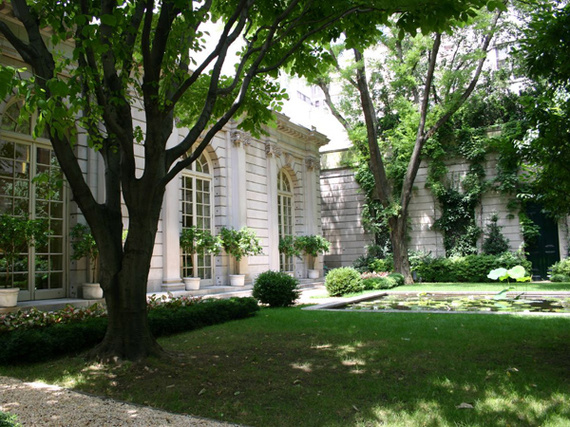
Viewing Garden and Pavilion seen from E. 70th Street. (Photo by Michael Dunn)

Viewing Garden and Pavilion seen from E. 70th Street. (Photo by Michael Dunn)

Andrew Reed, nephew of the classical revival’s late champion Henry Hope Reed, has asked me to post a petition to save the Frick Gallery from its proposed renovation. I wrote back that I was at odds with myself over the wisdom of the plan, which would add to the gracious old museum on Fifth Avenue a set of spaces designed in its original classical manner.

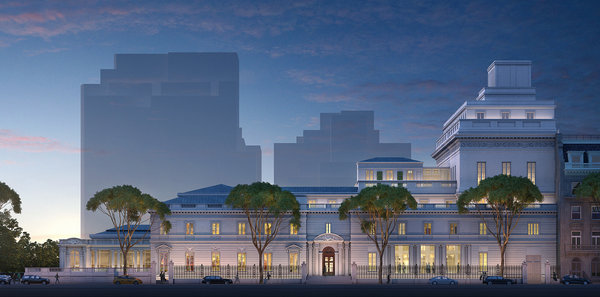
Proposed new Frick addition toward left. (NYT/Neoscape Inc.)

Proposed new Frick addition toward left. (NYT/Neoscape Inc.)

I’ve argued that this addition would play an important role in the public discourse on architecture by showing how a historic building could (and should) be expanded in its own style. Few such examples of major expansions exist. One of them, here in Providence, is the 1990 classical addition to the 1904 John Carter Brown Library.

For decades it has been considered mandatory to design additions to historic structures that contrast with the original, often in the most vulgar possible way. The idea is that an addition must be easily distinguishable from the original to preserve the latter’s authenticity. That could be done more effectively and pleasingly with a plaque. It is vital to resist this bogus “authenticity” if the world is ever to get back on the path to a beautiful future, and the Frick addition could be a rare opportunity to do so.

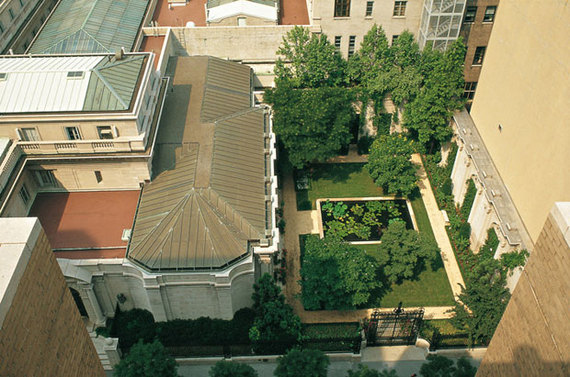
Lost, however, would be its lovely Viewing Garden, designed by the British landscape architect Russell Page. It was designed to be seen through the arched windows of the Reception Hall Pavilion (itself an addition) as if it were a work of art, which it is. The pavilion would also be demolished for the new addition. Of course it may be argued that the pavilion, designed in the 1970s by John Barrington Bayley, Harry van Dyke and G. Frederick Poehler, is itself a great example of an addition to a classical building in a classical style. And it is. But a new example more relevant to observers of the architecture scene today could be of greater exemplary utility than an addition, however fine, performed four decades ago.

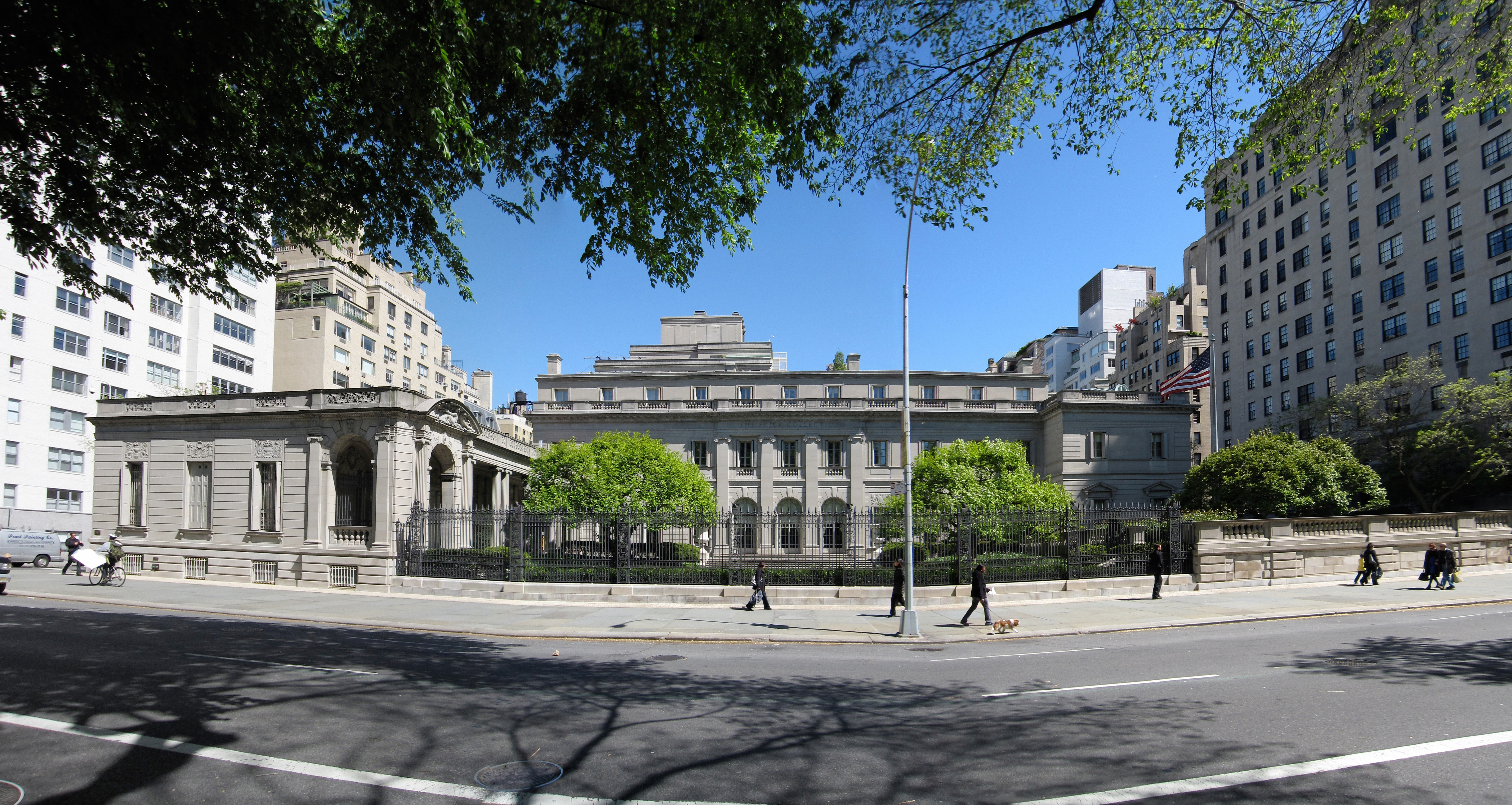
The Frick as seen across Fifth Avenue from Central Park. (en.wikipedia.org)

The Frick as seen across Fifth Avenue from Central Park. (en.wikipedia.org)

The original mansion was designed for Henry Clay Frick by Carrère & Hastings, with classical additions made in the 1930s by John Russell Pope after it was decided to turn Frick’s house into an art museum. The art is arrayed much as he placed it in his life. The new addition, stepped and classical, seemingly sensitive, would not change that, supposedly.

The Frick proposal does follow the regrettable addition to the Morgan Library by Renzo Piano and the canceled interior renovation by Norman Foster of the New York Public Library. Ridiculous though it is, the outrage against MoMA’s demolition of the Folk Art Museum (a carbuncle attached to a carbuncle) also feeds a growing and altogether necessary resistance to the corporate muscle pumping of American cultural institutions. That the new Frick addition is being designed by the modernist firm of Davis Brody Bond, which designed the 9/11 memorial museum, cannot help but promote a further raising of the public eyebrow.

Michael Kimmelman’s piece, “The Case Against a Mammoth Frick Collection Addition,” in  the New York Times is definitely worth reading.

In fact, the petition and its associated reference material is quite persuasive and, as I wrote to Andy Reed, I am not entirely convinced that the proposed new addition is the best way to go, even if it is in the proper spirit. Is it possible that an expansion that meets the Frick’s actual needs could be done without sacrificing the garden or the pavilion? The petition argues that it could be, and the more I think about it the more I am inclined to support a petition that makes the case for trying to rethink the current proposal.

Still, some sort of addition in a classical style would be appropriate, useful and valuable – but not one that sacrifices the gallery’s gentle elegance. The experience, so rare, of visiting a cultural institution masquerading as a personal home must be preserved.

The intimacy of Philadelphia’s Barnes Collection, which was founded on principles similar to those of the Frick, was destroyed when its board moved it into a new modernist building downtown. The Frick board has in mind no such dishonest subornation of a founder’s parting wishes, thankfully, but perhaps a reconsideration of its current plan is in order.

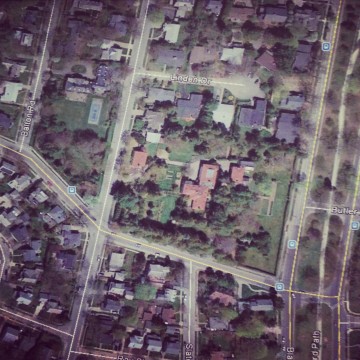
Aerial shot of Viewing Garden and pavilion. (From "Gardens of Russell Page

Aerial shot of Viewing Garden and pavilion. (From “Gardens of Russell Page”)

Posted in Architecture, Architecture History, Preservation | Tagged , , , | 1 Comment

South Street Seaputz?

South Street Seaport's festival marketplace. (Wikipedia)

South Street Seaport’s festival marketplace. (Wikipedia)

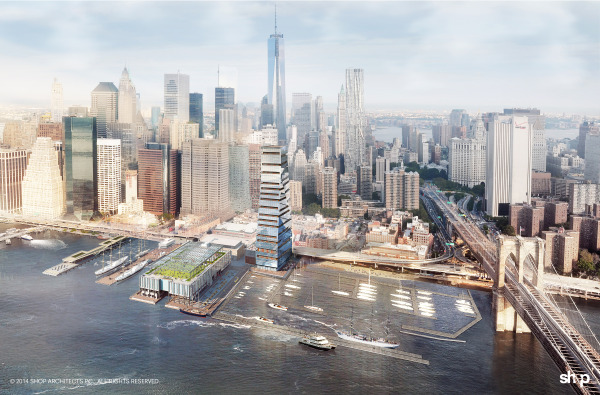
Project to replace South Street Seaport. (SHoP Architects)

Project to replace South Street Seaport. (SHoP Architects)

SEAPORT1-blog480

Schermerhorn mercantile block. (artsbeat.blogs.nytimes)

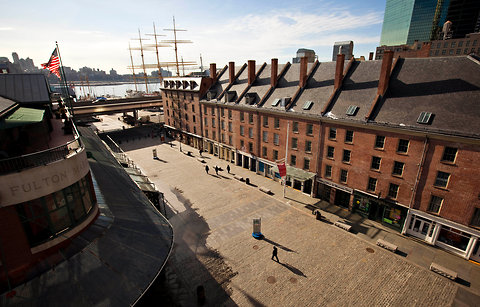
Why does no one seem upset that the venerable South Street Seaport, in New York City, is about to be zapped and tricked out as a squat Miesian glass box, courtesy of SHoP, one of the world’s worst architectural firms? And a goofy tower will be added to boot. The Seaport should be preserved as an historic early example of the festival mall concept, developed by James Rouse in 1982. The building is not stellar architecture, perhaps, but it has a traditional feel with which it girds up the staying power of New York’s bedraggled waterfront. While it does not look as if the historic Schermerhorn mercantile row is at risk, just wait. The Seaport was damaged in Hurricane Sandy, and some shops had to close, but this was hardly a reason to poke New York in the eye with yet another inexcusable eyesore. Where is the outrage!?

Posted in Architecture, Architecture History, Development, Preservation, Urbanism and planning | Tagged , , , | 6 Comments

Victory in Charleston

Design withdrawn by Clemson for Charleston. (Post & Courier)

Design withdrawn by Clemson for Charleston. (Post & Courier)

On the heels of a major setback for modernism’s assault on Paris – its city council voted narrowly against it on Monday – comes an even bigger victory against a similar assault in Charleston, S.C., where Clemson University has withdrawn its application to build a modernist school of architecture right in the middle of the city’s historic district. Bravo, and bravo squared!

Counter design by Bevan & Liberatos. (Courtesy of B & L)

Counter design by Bevan & Liberatos. (Courtesy of B & L)

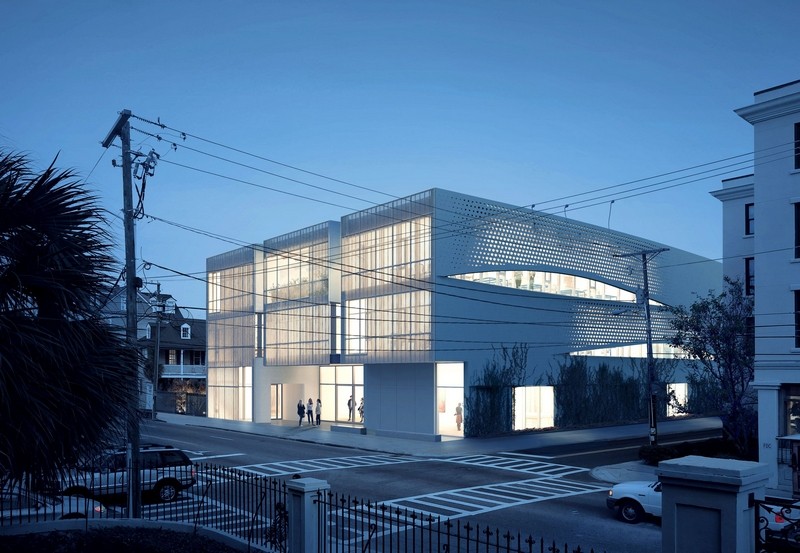
Will there now be a competition for the new building? Personally, I’d like to see them go straight to a counter-design proposed earlier this year by the Charleston firm of Bevan & Liberatos. (Imagine that, a local building designed by local architects!)

Clemson must be given credit for the grace of backing down in the face of public distress over its plan, even though they had been pushing one or another modernist design for years, and there was no reason to be sure the proposed abomination could not have been pushed through. Christopher Liberatos and Jenny Bevan, of the firm noted just above, deserve a good deal of the credit for generating opposition and giving it intelligent focus. The Post & Courier deserves credit as well for its comprehensive coverage and sensitive editorials on this issue.

Read “Clemson scraps its modern building plan” in the Post & Courier.

Posted in Architecture, Architecture Education, Development, Preservation, Urbanism and planning | Tagged , , , | 2 Comments

Character versus reputation

photo_(33)_360_360_90Last night’s City Plan Commission meeting over the fate of the Granoff estate pitted the Blackstone Neighborhood Association’s lawyer, Bill Landry, against the Granoff’s lawyer, Tom Moses, a former director of the city’s planning office. Does the law require more detail in the Granoff subdivision plan before the CPC can approve it? For now, the plan merely cuts the land into smaller parcels to be built on later. There is no developer yet, and no plan except “lines on paper,” as Landry pointed out again and again.

Without resolving the question, and after only three members of the community had been allowed to speak, the commission halted the proceedings and continued the meeting – that is, postponed it until Tuesday, Dec. 16. During the meeting, however, it emerged that the Providence Preservation Society opposes the plan, while the Rhode Island Historical Preservation & Heritage Commission has strong reservations.

Both organizations noted the property’s importance to the historical character of the East Side and of Blackstone Boulevard. Subdivision and development could degrade its character, even if it is done legally. It remains within the Granoffs’ power and its sense of stewardship to ensure that this does not happen.

The problem is that the Granoffs’ style of stewardship has often proved inhospitable to the historical character of the city. Their role in the boxy glass addition to the Rochambeau library and the addition to the RISD Art Museum on North Main Street, and in the design of Brown’s Perry and Marty Granoff Center for the Creative Arts, connects them to the corrosive impact on historic districts that afflicts modern architecture. Modernist design intentionally degrades historic districts. Its relationship to urban form is parasitical. Its contrast with historical context provides the desired edgy frisson that is absent when its neighbors are other modernist buildings.

Against this may be placed the Granoffs’ generally, if not exclusively, more positive role downtown, through their developer sons Evan and Lloyd. Refurbishing the glorious Union Trust and Turk’s Head buildings, and reviving the Providence Arcade (the nation’s oldest indoor shopping mall), display the best of the family’s stewardship. This good work downtown is contradicted, however, by their role in the demolition of the small but splendid Providence National Bank to make way for a tower that was never built – though the bank’s Weybosset Street façade, originally saved for incorporation into the proposed monstrosity, survives for now, largely through the energy of the preservation society.)

The Granoffs could give their reputation for stewardship a considerable boost by donating their Blackstone estate to the public, or to an institution that would maintain its historic character and prevent its development in a manner likely to degrade the neighborhood.

Last night’s meeting introduced to the development process legal questions that could be damaging to the Granoffs’ ability to market their property, and the continuation (that is, postponement) of last night’s meeting draws the matter out, leaving the impression that things may be spinning out of control. Time is not on the Granoffs’ side. Yesterday was Leonard Granoff’s 88th birthday. But their ace in the hole is the very character of the neighborhood whose protection is the goal of those opposed to the subdivision.

For indeed, the Granoff estate will not be the first large plot of land to be subdivided. Much of the neighborhood’s new housing in the past half century has not reflected its historic character. Lawyer Moses chilled me at last night’s meeting when he remarked that “you could see the Bodell estate as the model” for subdividing the Granoff land. The Bodell land was subdivided in the 1950s. The Linden Drive cul de sac was developed with midcentury modern homes from suburban Anywhere USA. In addition, former Brown University land, part of Aldrich Field southwest of the Granoff estate, was subdivided into lots along Ray, Gorton, Rutheven and Wriston, with several cul-de-sacs. It is even worse.

Moreover, the Blackstone neighborhood is pock-marked with modernist houses built on single lots by individuals or families who cannot have been unaware that most of their neighbors would be horrified at the erosion of their view and property values occasioned by such faddish architecture, so obviously and obnoxiously thrown in the face of historic character. These houses, sprinkled amid stretches of the fine traditional houses that account for the neighborhood’s reputation, erode the character of Blackstone no less than the subdivision of large estates. Each is a precedent for houses on the Granoff land that would degrade the neighborhood and yet cannot be accused of deviating from its historic character. That character has already been extensively eroded.

If the strategy of the Blackstone Neighborhood Organization and its lawyer is to persuade the City Plan Commission to force the Granoffs to provide more preliminary information on its subdivision plan that might box the family into a higher level of development, it is doomed to fail because its premise is faulty. Precedent for a lower level of development is to be found all over the neighborhood, cheek by jowl with the excellent architecture that first gave Blackstone its exclusive reputation. That will not change if more preliminary information is requested by the commission prior to approval.

If, on the other hand, the strategy is to buy time until the Granoffs throw in the towel, the end result still relies on the cooperation of the commission and, ultimately, the grace of the Granoffs. The neighbors cannot express minimal concern for the quality of development in their midst and then expect to be taken seriously when they finally decide to care.

Perhaps by the Dec. 16 meeting the commission, the Granoffs and the neighbors will reach some sort of agreement. Saving the stone wall and the best trees rather than increasing the minimum lot size  may be the most practical goal. Without a deal, legalisms will determine whether a zoning brawl ensues, to be won by those with the most patience, the best lawyers and the deepest pockets.

In such a fight, with much resting on how commission members, and possibly others in authority, interpret legal phrases, political connections may play a role. But improper influence often becomes evident only when a resulting decision is obviously wrong. Because the neighborhood’s character has been allowed to decline in recent decades, and because the language of municipal law protecting historic character has been so widely ignored, the task of protecting that character is more difficult. Under these circumstances it will be harder to perceive the potentially malign influence of connections. Still, it can go either way on Blackstone Boulevard.

Posted in Architecture, Development, Preservation, Providence, Urbanism and planning | Tagged , , , | 3 Comments

Wisdom of the Bulfinch

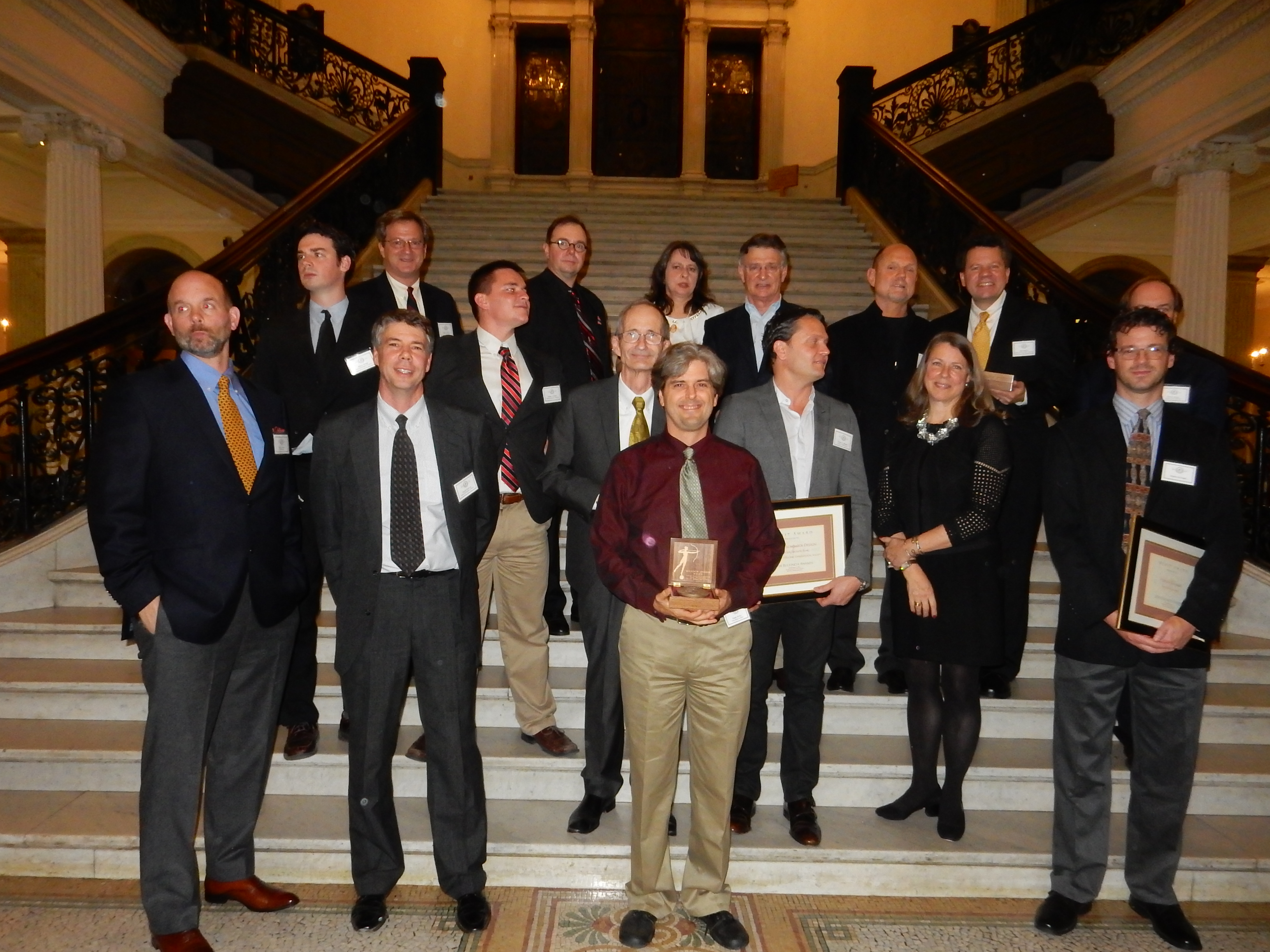
This year's Bulfinch winners standing on the Grand Staircase of the Statehouse. (Photo by David Brussat)

This year’s Bulfinch winners on the Grand Staircase of the Statehouse. (Photo by David Brussat)

Last week I attended the fifth annual ceremony at Charles Bulfinch’s Massachusetts Statehouse honoring the awards named in his honor by the New England chapter of the Institute of Classical Architecture & Art. The usual crowd of people was there along with their impeccable taste (they are classicists, after all!).

The winners gave elegant little lectures describing their victorious efforts, and the hors d’ouevres were, as usual, delicious in the extreme. The highlight of the evening (at least for those in the audience who did not step forward to receive a Bulfinch Medal) was the lecture by chapter member Aaron Helfand, of Albert Righter & Tittmann. He sought to answer the running question “… Is This Really Classical?” that probably pits classicist against classicist these days more than classicists against their modernist antagonists. In fact, I don’t think the word modernist was mentioned once by Aaron. Here are the first few passages from his talk, which may be read in its entirety here.

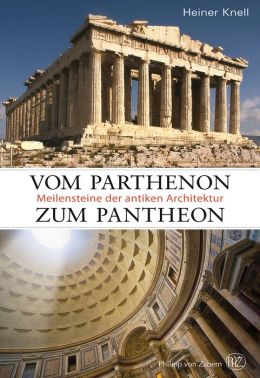
The Parthenon of Athens (top) and the Pantheon of Rome. (barnesandnoble.com)

The Parthenon of Athens (top) and the Pantheon of Rome. (barnesandnoble.com)

This year, as in past years, the awards recognize a remarkable variety of projects. The range in scale and type is to be expected; the awards invite submissions in a wide array of categories, from houses, to institutional and commercial architecture, to landscape design and craftsmanship. What may be more surprising is the stylistic range that is represented. One might well ask: Is the Institute of Classical Architecture & Art straying from its purview, perhaps, in celebrating Gothic academic buildings or Shingle-Style houses? While it is easy to point out the contrast between an understated shingle house and one featuring, say, a Roman temple-front, I would like to argue for the relevance of such buildings to our mission, the promotion of the classical tradition in New England.

 The use of the term “tradition” here is important, because it explains how an idea as disciplined as Classicism can remain flexible enough to ultimately connect projects as diverse as those we celebrate tonight. To state that classical architecture is capable of evolution is not a radical thought.

 The Parthenon and Pantheon may lay equal claim to the “classical” label, yet no one here would confuse a Greek temple with a Roman one.

 The connection between the two is not a matter of precise replication, but rather of Roman admiration for Greek architectural traditions, and their enthusiasm for engaging with and expanding those traditions in an artful and innovative way.

 As an example, the Romans did not abandon the Greek columnar orders just because their engineers were able to span greater distances using the arch. Rather, they fused the two forms together, and the resulting motif, at once traditional and novel, was so successful that it became the basis for emulation and expansion in its own right.

 That spirit of evolving tradition did not end with the fall of the Roman Empire.

Entire lecture by Aaron Helfand: 2014 Bulfinch Awards remarks – podium format

Illustrations for Helfand lecture: 141112 – Bulfinch Awards address – slides

Posted in Architecture, Art and design, Development, Uncategorized | Tagged , , , | Leave a comment

Good news from Paris!

Proposed Triangle tower in Paris by Herzog & de Meuron. (BBC)

Proposed Triangle tower in Paris by Herzog & de Meuron. (BBC)

Bravo! The city council of Paris has voted narrowly to reject the proposal for a skyscraper in the city center. Le Tour Triangle, designed by Herzog & de Meuron, lost an 83 to 78 vote. Mayor Hidalgo, a Socialist, immediately challenged its validity on grounds that some of those who voted against it revealed their vote to the public. It does not seem to me that revealing the vote one cast oneself after the tally constitutes a violation of the right to a secret ballot. But this is France, not America. The fight is surely not over – the plug uglies won’t give up easily because of a mere vote – but a victory is a victory and a good excuse to lift a glass of Champagne and smooth some of the furrows on our worried brows. Bravo!

First report from  correspondent Mary Campbell Gallagher, of SOS Paris:

THIS JUST IN FROM PARIS. George Orwell, where are you? Having lost today’s City Council vote on the Tour Triangle, 83-78, Mayor Annie Hidalgo rushed to the Tribunal Administratif, saying the court should annul the vote because skyscraper-opponents made their ballots public, and that is “undemocratic.”

Apparently the meaning of “democratic” is freely open to re-definition by the mayor’s pro-skyscraper Socialist majority. Polls have long shown that Parisians reject skyscrapers, by at least 64 per cent. But the Socialist response has been: we politicians know better. I suppose they would call that democratic.

If you have not already signed the petition, please do so now, and send it on to your friends. http://bit.ly/NoParisSkyscrapers

Posted in Architecture, Development, Other countries, Urbanism and planning | Tagged , , , , , , | 3 Comments