To be cont’d in Charleston

Proposal for Sgt. Jasper site by Bevan & Liberatos. (bevanandliberatos.com)

Proposal for Sgt. Jasper site by Bevan & Liberatos. (bevanandliberatos.com)

Beach Company, which had submitted what I thought was an elegant proposal to replace a midcentury modernist clunker of an apartment tower with three shorter but larger mostly residential buildings of seemingly high design on the edge of Charleston’s historic district, has withdrawn its application for a zoning change that would have enabled its proposal.
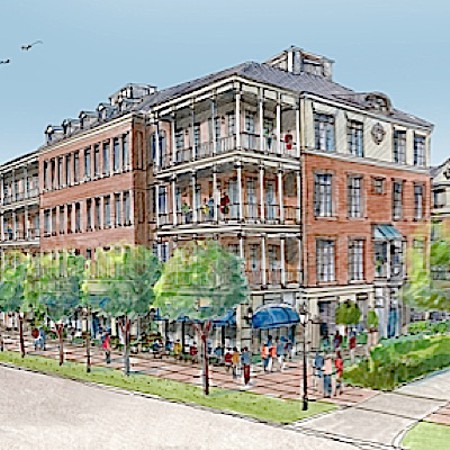
Original Beach proposal. (charlestoncitypaper.com)

Original Beach proposal. (charlestoncitypaper.com)

The preservation community in Charleston that had defeated Clemson’s proposal to plop a modernist architecture school into the historic district came out against this proposal. The rationale seemed to jibe with the desire of wealthy neighbors in single houses not to have more traffic. A deeper reason appears to have been that the developer, Beach, could not be trusted with the architecture. Beach is not going away. It owns the land and pledges to return with another proposal.

Meanwhile, Christopher Liberatos and Jenny Bevan have proposed, instead of three larger buildings, to fill most of the land with more single houses. Presumably that would have been the best idea from the beginning – basically continuing the fabric that already characterizes the neighborhood. But there may be some doubt whether there is a market for the houses – even though actual historic houses there are going for top dollar. And it may be that Beach doesn’t think it could make enough money that way. And there is, as always, the fear that it could wimp out on the architecture.

As some have pointed out, that part of Charleston needs more density and more diversity in its population. Many of the upper-crust houses are the second (or third? or fourth?) homes of out-of-towners and are unoccupied much of the year, causing a vacancy on the street. That assumes [Warning! Stereotype alert!] that such folk are normally out and about when they are in town, rather than shuttling among each other’s houses for high tea and fine dining. (Sorry!)

Let us hope that Beach’s next proposal will be some sort of finer-grained compromise between its original proposal and the high-minded B&L proposal, which I have reprinted above. It has been suggested, for example, that two families can live in a walk-up that looks like a single house for a single family. If some of the houses were of that sort, the density and variety of people would be increased. The proposed grocery store might also be retained in the next proposal, though perhaps of a lesser size and without its round-the-clockness, which I like but might cause some others to tremble.

What should not be lost is Beach’s original desire to design a place that at least arguably looks like Charleston. I would warn Charlestonians, however, that a developer who feels offended by overzealous opposition can try to take revenge by proposing an ugly project that meets code. That happened in Providence when preservationists and local monied folk joined forces to oppose a building that would have blocked views of a historical stretch as seen from the upper floors of various corporate headquarters across the Providence River in downtown. The developer, Old Stone Bank, was deeply offended. The result, known as Old Stone Square, by Edward Larrabee Barnes, seriously degrades what must be one of the nation’s great cityscapes. It is not the kind of “compromise” any lover of historical architecture could have wished for.

The photo below shows the building, and the stretch of South Main Street, to the right of the historic Old Stone Bank building (dome, extended wings, 1898), that an earlier version would have blocked. The earlier version was to have been a sort of postmodern take on Georgian Revival, fitting in with the courthouse at left, but it was sacrificed to keep the view open from towers such as the one at the far right – at a very high cost indeed. (The photo was taken in early 1990s as the Providence River was daylighted and turned into a beautiful traditional system of parks and river walks.)

Perhaps we will know more by April 12, when TradArch list members meet in Charleston to confabulate on the future of the classical revival.

Old Stone Square at upper right center. (flickr.com)

Old Stone Square at upper right center. (flickr.com)

Posted in Architecture, Architecture History, Art and design, Development, Providence, Urbanism and planning | Tagged , , , , | Leave a comment

An attitude, not a material

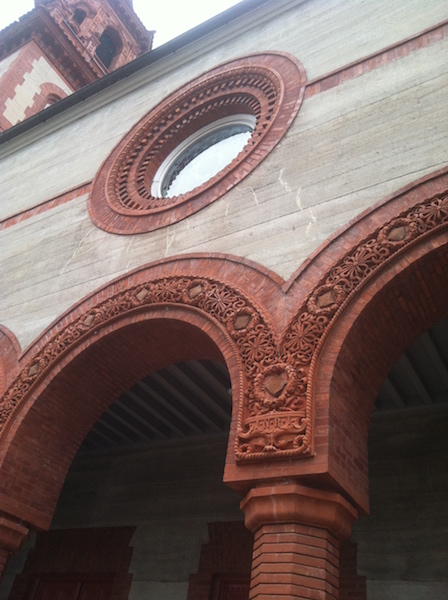
Concrete building in Saint Augustine, Fla.

Concrete building, the Hotel Acazar, in Saint Augustine, Fla. (Top two photos by Patrick Webb.)

Patrick Webb, of the American College of the Building Arts, in Charleston, delighted the TradArch list today with examples from Saint Augustine, Fla., of concrete used without brutality. They are the Hotel Acazar, above, and Grace Metodist Church, below to the left. Financed by Henry Flagler, the railroad magnate, both were designed by Carrere and Hastings and completed circa 1887, using Perth Amboy terra cotta.

Grace Methodist Church in Saint Augustine.

Grace Methodist Church in Saint Augustine.

You see, it is a matter of choice, not just cost, to bring beauty to building. I’d wager that any building of concrete in the Beton-brute style better known as Brutalism could have been made more attractive for equal cost. It’s less a matter of material than of design philosophy. The bar is ridiculously low.

Those who are drooling over Paul Rudolph’s Brutalist Orange County Government Center probably realize that, but would never admit it. They take pride in the decision back in the late 1960s when the building was first proposed, to plop it amid a traditional streetscape in Goshen, N.Y. The decision to use concrete was secondary: They were not inflicting concrete on Goshen but Brutalism. Indeed, primarily they were not inflicting Brutalism on Goshen but modernism. Joy in poking average people in the eye is a part of modern architecture’s founding conceit – that people who like this stuff are more intelligent, or have a more refined, less Philistine sense of aesthetics, than those who do not.

False! Those who do not like it are actually more nuanced, in fact, than those who like it. If it is true that the mind is like an iceberg, most of which is under water, it is fair to say that those who dislike Brutalism are using more than the percentage of their consciousness  that’s above the water. Those who like Brutalism have thoughts that are more reliant on the crutch of orthdoxy, which enables them articulate complex (and generally foolish) ideas without having to think. Their brains never reach beneath the surface.

If Orange County had built a government center more like the building above in Saint Augustine, or the equally nice one at the upper left, the embarrassing intellectual pretzeling we’ve seen in Goshen this past week would not have been necessary. For that matter, that elegant bridge in Saint Augustine, pictured below, is probably also made from concrete. Do you suppose any of the Orange County Government Center acolytes would rather have a typical modernist concrete bridge in its place? Neither do I. Would they admit it? … Just askin’.

Bridge in Saint Augustine.

Bridge in Saint Augustine. (Landmark Realty)

Posted in Architecture, Architecture Education, Art and design | Tagged , , , , , , | 2 Comments

New Urbanism’s easy choice

Kentlands, Md. (emrisse.com)

Kentlands, Md. (emrisse.com)

It is often said that New Urbanism is “agnostic” as to style. Even the charter of the Congress for the New Urbanism says so. Rob Steuteville, who edits the urbanist journal Better Cities & Towns, has written an essay, The Four Stages of New Urbanism, that deftly maps its growth since the late 1980s. It notes that New Urbanist architecture has grown “more varied and robust” since the early years, when the NU brand of traditional streets emblazoned itself in the public mind, creating considerable financial success and great hope for new beauty in America’s cities, towns and suburbs.

I would debate half of Rob’s characterization, but would rather merely ask which street most people would want to live on. One is affordable housing in Philadelphia and the other is a new suburban town in the Maryland suburbs of Washington. It is hard to afford, but that is true, in part at least, because traditional, pre-war streetscapes are still illegal in many places. Let more of it bloom and its price will decline. But as a purely aesthetic matter, it cannot be supposed that people seeing these two places will be “agnostic” as to where they’d rather live. Agree? Disagree?

Rob Steuteville’s article is on the PDF below.

four-stages

Paseo Verde, in Philadelphia. (phila.gov)

Paseo Verde, in Philadelphia. (phila.gov)

Posted in Architecture, Development, Urbanism and planning | Tagged , , , , , , | 10 Comments

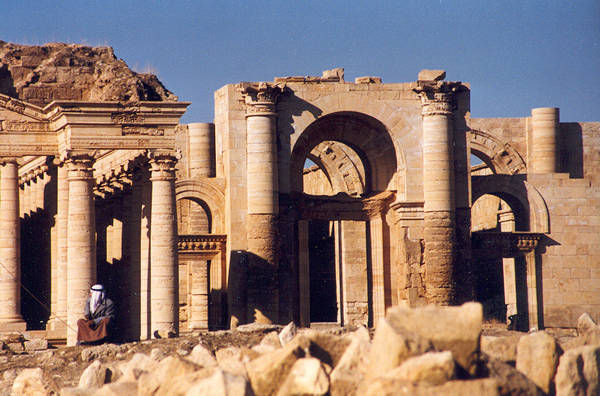
Ancient Hatra, Iraq, at risk

Ancient city of Hatra, in Iraq. (This and photos below courtesy of Wikipedia.)

Ancient city of Hatra, in Iraq. (This and photos below courtesy of Wikipedia.)

Iraqi FreedomIt is hardly to be believed that the ancient Parthian city of Hatra, more than 2,000 years old, in Iraq, is being demolished by ISIS. Nimrud, older still, was just bulldozed. Recently I wrote of the curious forces destroying ancient holy sites, and all else that is beautiful, in Mecca – destruction caused not by the invasion of Araby by the neo-imperialist troops of Western architecture (though they may be found committing cultural genocide all over the place), but by the ruling families of Saudi Arabia, who apparently hate history and consider modernism an attack on idolatry, or something like that. It is hard for a sane mind to figure out. Whatever the explanation, it does not excuse this travesty.

Read this BBC story, “Islamic State ‘demolish’ ancient Hatra site in Iraq,” and weep.

Posted in Architecture, Architecture History, Books and Culture, Preservation | Tagged , , , , , , | 3 Comments

The architecture of dessert

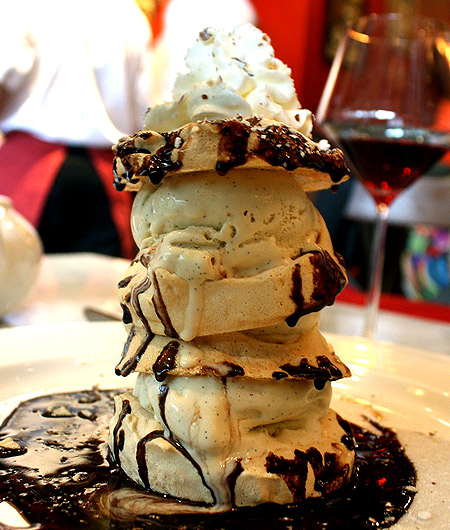
Dessert a la Gehry. (3ders.org)

Dessert a la Gehry. (3ders.org)

The resurgence of interest in Nathaniel Robert Walker’s essay on food and architecture, called “Architecture and food,” which ran here on Jan. 8, and the host of comments and, it seems, new followers of my blog it has inspired, has inspired me to contemplate another angle on food and architecture.

dessert

Dessert a la Libeskind. (spanishhipster.com)

Skyscraper a la mode. (spot.ph)

Skyscraper a la mode. (spot.ph)

Traditional architectural dessert. (azuremagazine.com)

Traditional architectural dessert. (azuremagazine.com)

Jello a la past. (thatsnerdalicious.com)

Jello a la past. (thatsnerdalicious.com)

I and those who think like me often pause to wonder how lovely life and the world would be if modern architects had taken up another line of work. For example, would that more of them had gone beyond merely dipping their toes in furniture design, for which dabble of interest they owe the gratitude of chiropractors worldwide. Zaha Hadid recently dipped her toes in shoe design, and one wishes she had slid her entire foot in and kept it there. Why have no modern architects tried to make a bigger splash in haute couture, or at least fancy eyeglassware? Architects are known for their spooky threads and kooky spectacles. Designing clothes and designing modern architecture are really two peas in a pod, except that designing clothes is so much less expensive an endeavor – easier to break in and easier to break out. They could have their egos stroked by the fawning media they are used to, even as they lay down fashion benchmarks for an entire industry that provides for the sartorial splendor of the fabulously wealthy. They would still be drooled over by those alongside whom they stroll as they laugh all the way to the bank. Too few modern architects have tried to conquer the runway! None has that I know of. Make my day by sending news that they have. I won’t be holding my breath.

But the the real place for the modern architect is in the kitchen, in particular the dessert kitchen. Here their lust for novelty could thrill a hungry audience without threatening the well-being of the entire world. I went online to find examples of architectural desserts and what I found was wanting. I could barely find a dessert that qualified for skyscraperhood, though I’m sure they are out there; they are not online. There were very few desserts worthy of Frank Gehry. To be sure, there are plenty of desserts that most modernists would spurn, such as the gew-gaw cottages of traditional bakeries or the molded replicas of the work of their betters – confections that bring to mind the term “copying the past.”

But if you Google “architecture of dessert” or “dessert architecture” there are few really great photographs of architectural desserts. Maybe that’s because they were eaten. I offer up this prospect of a new and tasty career for modern architects free of charge. Go for it!

Posted in Architects, Architecture, Art and design, Humor | Tagged , , , , , , , , , | 1 Comment

Amazing: N.Y. in 1896-1905

New York City, circa 1900. (shorpy.com)

New York City, circa 1900. (shorpy.com)

I didn’t even know they had movies that far back, but here are film clips of New York City in the decade that straddles the turn of the 19th Century. Said to be the oldest surviving film of the Big Apple. Simply amazing footage, including a fistfight among kids, a lady whose dress is swept upward by a gust from a subway grate, a copper twirling his baton, Buffalo Bill doffing his hat on parade. Lots of swells strolling on Fifth Avenue. Shots of the Flatiron Building, time-lapse demo of Star Theater on Broadway, the docks from a boat, bridges and more bridges, carriages and trolleys. Olden autos driving by old Madison Square Garden. Deep snow in 1899. Most of it is a lot clearer than you’d expect. This 8½-minute video is distributed by Yestervid.com.

Tip of the tip of the hat to John Hooker for sending me this treasure trove.

Posted in Architecture, Architecture History, Blast from past, Photography, Urbanism and planning | Tagged , , , , | 4 Comments

“Clock ticking” for brutality?

The county dithered last night but did not bar the proposed partial demo. Unfortunately, full demo seems off the table. I am crying in my beer. Photography should be the last refuge of scoundrelly architecture. Here is DC Cubed’s reaction to the decision to kick an already battered can farther down the road:
http://curbed.com/archives/2015/03/06/paul-rudolph-orange-county-government-center-demolition.php

David Brussat's avatarArchitecture Here and There

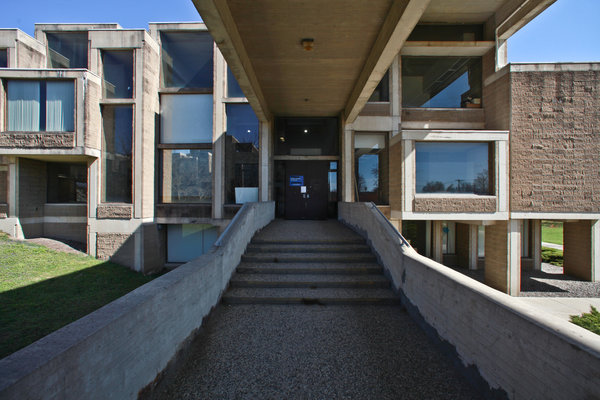
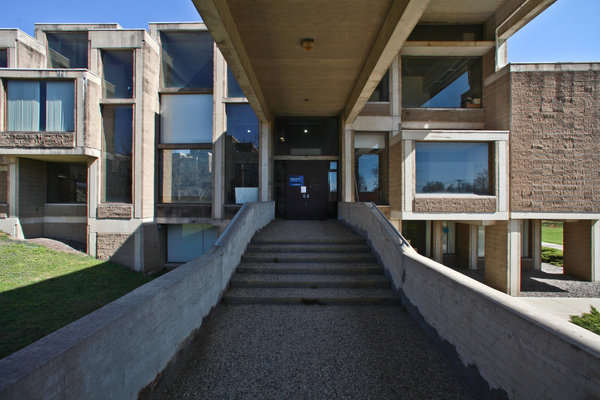
Ramp leading into Orange County (N.Y.) Government Center, by Paul Rudolph. (NTY) Passage leading into Orange County (N.Y.) Government Center, by Paul Rudolph. (NTY)

So says the New York Times’s Michael Kimmelman in “Clock Ticks for Rudolph’s Orange County Government Center.” By the time you read this, the bye-bye birdie may well have chirped its demise. I had not realized that demolition was still an option, so color me pleased. Now let’s hope county officials will do their citizens’ bidding.

Kimmelman paints a different picture, suggesting that the locals want to save a building that only public officials want to raze. Actually, the building, completed in 1963, would be gone by now but for a few fans of midcentury modernism who have raised a ruckus for Brutalism. This example of that forlorn style is by Paul Rudolph, who designed the Yale Art & Architecture Building (now renovated and rebranded as Rudolph Hall), where many architects and hip old things sucked…

View original post 289 more words

Posted in Uncategorized | Leave a comment

Cret’s wandering WWI shaft

WWI Monument in Memorial Square, Providence. (Photo by Warren Lutzel)

Paul Cret’s WWI memorial, by Stacy Tolman, 1860-1935. Click to enlarge. (Photo by Warren Lutzel)

Warren Lutzel has kindly sent me a portrait of architect Paul Philippe Cret’s monument originally erected in 1929 at Providence’s Memorial Square to commemorate World War I. The square looks almost bucolic in the painting above but in time grew congested and came to be known as “Suicide Circle,” with traffic from seven streets feeding into the orbit of Cret’s local icon, barring pedestrians from enjoying his sculptural artistry up close.

The Cret memorial in its current setting. (Photo by David Brussat)

The Cret memorial in its current setting. (Photo by David Brussat)

Drawing of memorial at Philadelphia Athenaeum. (philadelphiabuildings.org)

Drawing of memorial at Philadelphia Athenaeum. (philadelphiabuildings.org)

Detail of memorial. (proteusbrown.edu)

Detail of memorial. (proteusbrown.edu)

When the Providence River’s channel was moved in the early 1990s from under the nearby Post Office (completed in 1940 after the demise of the towered fire station just left of the monument in the painting), Memorial Square itself was demolished and became the new confluence of the daylighted Moshassuck and Woonasquatucket rivers at the head of the daylighted Providence River. (These had once been the fabled Crawford Street Bridge, at 1,147 feet the widest in the world according to Guinness.) The monument was taken down piece by piece, placed in storage on land belonging, I believe, to the Port of Providence, and in 1996 was rebuilt at the new Memorial Park. There it stands today opposite the Providence County Superior Courthouse, built in 1926-30.

I followed in my column for years the debate over where the monument should be rebuilt. Some thought it should arise near its original location, at the rivers’ confluence where One Citizens Plaza – the Darth Vader Building – was eventually built, blocking views of the State House from downriver. Others thought it should go up at the base of State House Lawn, but that would have placed it far closer to Providence Place than to the State House, across Francis Street from what should have been the northern entrance to the mall – arguably a location of insufficient dignity. When the location at what was to be Memorial Park was finally selected, a brouhaha arose over its displacement of a small memorial of stacked tablets dedicated to Italian explorer Giovanni da Verrazzano, who discovered Narragansett Bay in 1524.

The old location at Memorial Square had its charms, especially as part of the view from in front of Union Station to the east up College Hill. Cret’s monument added to the panoply of steeples and cupolas visible from there. It was a glorious collection of architectural phalluses, now slightly reduced but still glorious. I argued in my column that, with its height and grandeur, the monument in its new location would fully engage the urban room around it – the courthouse’s colonnade facing the crescendo of downtown’s towers and the south façade of the RISD Auditorium facing the façade of Edward Larrabee Barnes’s Old Stone Square (1985), which for all its flaws does undeniably form a wall. Time has proved Memorial Park to be the proper location for the monument.

The perspective in the painting leaves something to be desired. At first I thought the man reading the newspaper was a statue. I like the lady with the umbrella strolling heedlessly through what she had no reason to suspect would be called Suicide Circle. I think the object most lovingly rendered by the artist (whose name I don’t know at this writing) is the green convertible. On second thought, could the woman with the brelly actually be a traffic cop on his pedestal? Can’t really tell. Let me pause to click and enlarge.

[Pause … ] Actually it is a traffic cop in a kiosk with an umbrella. Indeed, if it were a woman her hoop skirt would have been more than slightly out of fashion, even back then.

What a delightful mixture of memory and contemplation has been aroused by Warren’s photo of that painting!

Posted in Architecture, Architecture History, Art and design, Landscape Architecture, Providence, Urbanism and planning | Tagged , , , | 2 Comments

“Clock ticking” for brutality?

Ramp leading into Orange County (N.Y.) Government Center, by Paul Rudolph. (NTY)

Passage leading into Orange County (N.Y.) Government Center, by Paul Rudolph. (NTY)

So says the New York Times’s Michael Kimmelman in “Clock Ticks for Rudolph’s Orange County Government Center.” By the time you read this, the bye-bye birdie may well have chirped its demise. I had not realized that demolition was still an option, so color me pleased. Now let’s hope county officials will do their citizens’ bidding.

Kimmelman paints a different picture, suggesting that the locals want to save a building that only public officials want to raze. Actually, the building, completed in 1963, would be gone by now but for a few fans of midcentury modernism who have raised a ruckus for Brutalism. This example of that forlorn style is by Paul Rudolph, who designed the Yale Art & Architecture Building (now renovated and rebranded as Rudolph Hall), where many architects and hip old things sucked at the fond teat of modernism. (It is easy to forget that students literally tried to burn it down in 1969.)

Kimmelman, showing a flash of humor, tries to turn public officials’ longstanding dismay at the building’s functional difficulties – such as their meetings being disturbed by the hubbub of citizens downstairs registering their automobiles – into sly strategies by Rudolph to use the building to enhance democracy. He cites former Goshen legislator Rich Baum:

The building’s atrium, he told me, was where “people interacted with county government, including the Department of Motor Vehicles, the records office and the passport office; a balcony above the main floor led to the legislature, the county executive and the primary county government decision-makers,” he said. “What this meant was that, as the leaders of county government went about their business, there was always the din of people coming in and out and doing their business. Critics said this was impractical. I think it was a purposeful and an inspired idea by Rudolph.”

Maybe. Or maybe not. Kimmelman’s effort to pretzel a noisy building into a reminder to public servants to serve the public seems like a stretch to me. Maybe contemporary notes by Rudolph prove this, but Kimmelman cites only his ability to imagine that Rudolph might have so conspired. Readers have a right to wonder. Sounds dubious to me.

Still, Kimmelman doesn’t try very hard to suggest that the building is attractive, only that the popularity of its style has had a revival. And so it has for some. But most of them do not vote in Orange County. True democracy would encourage county officials to do what citizens want, not what the acolytes of Brutalism desire. We shall see tonight.

Posted in Architects, Architecture, Architecture Education, Architecture History | Tagged , , , , , | 1 Comment

More modernist parents stuff

Image from "Have a Seat (or Don't), by Sarah Catherine Firth.

Image from “Have a Seat (or Don’t),” by Sarah Catherine Firth.

Prof. Jan Michl, of Oslo, saw my post “My Modernist Parents,” with its trailers of a short Norwegian animated film Me and My Moulton, which was up for an Oscar this year for portraying the trials and tribulations of being raised in a modernist household. Sort of a “Growing Up Absurd” kind of a thing, Jan sent “Have a Seat (or Don’t): Growing Up in a Designer Chair Museum,” by Sarah Catherine Firth.

Professor Michl, who teaches design theory and history at Gjøvik University College and the Oslo School of Architecture and Design (emeritus), sent me a fat juicy book a while back. True, it is in Czech, but the volume includes hundreds of beautiful photographs whose captions are translated by Jan into English, and at the end of which all the chapters are summarized in English translation by Jan. I offer readers his website, which contains a list of papers, in English, whose titles are themselves worth a visit. I’ll just name a couple: Form follows WHAT? The modernist notion of function as a carte blanche [1995] and The metaphor of nudity in modern design thinking [2005].

Anyway, the cartoons by Firth are sure to send you into fits of hilarity.

Posted in Architects, Architecture, Art and design, Humor | Tagged , , , , , , | Leave a comment