Rome’s exaltation explained

travelobservers.com.jpg

Rome (travelobservers.com)

I’ve always been intrigued by Rome – which I visited in 1990 – not just by its extraordinarily beauty and its ruins, but by the story of how its ancient leaders conceived the city as a crescendo of classicism in which each new road and building was intended to help the observer visualize the nobility and glory of the Roman state. It was so built. Time and history dragged it down after the empire’s fall, yet it came back during the Renaissance and the Baroque, and is now referred to as the Eternal City.

Rome remains beautiful. Its civic leaders’ continuing refusal to allow the latter-day Vandals of modern architecture in to rape it is, I am sure, a reflection of the strong DNA of beauty residing in the aesthetically charged culture of lo Stivale – the boot.

Now I see that I can learn more. Hats off to Joel Pidel for his email to TradArch about an online course, “The Meaning of Rome,” available free from Notre Dame’s School of Architecture and taught by David Mayernik and Jay Hobbs. It begins on March 15 and runs for six weeks, involving four to six hours of attention each week. Click on the video introduction to the course in the upper left corner of the link above. Be sure to click the “Read more” button below “About this course.” Sounds good.

In this architecture course you will learn how to “read” Rome, an ancient city, reborn in the fifteenth century and reshaped substantially in the following three centuries. You will discover how Renaissance and Baroque Rome’s urban form, art, and architecture projected the city’s image of itself to its citizens (urbi) and the world (orbi).

Popes, architects, scholars and sculptors invested in Rome a variety of narratives that strove to explain the city’s history, convince its citizens and visitors of its harmony, and exhort society at large to share in and shape its destiny.

You will come away from this course not only better informed about the cities of the past, but also better equipped to think about the cities of the present and the future.

Posted in Architecture, Architecture Education, Architecture History, Art and design, Books and Culture, Preservation, Urbanism and planning | Tagged , , , , , , , , , , , | 1 Comment

Garage design in Providence

Screen Shot 2016-01-05 at 3.31.50 PM.png

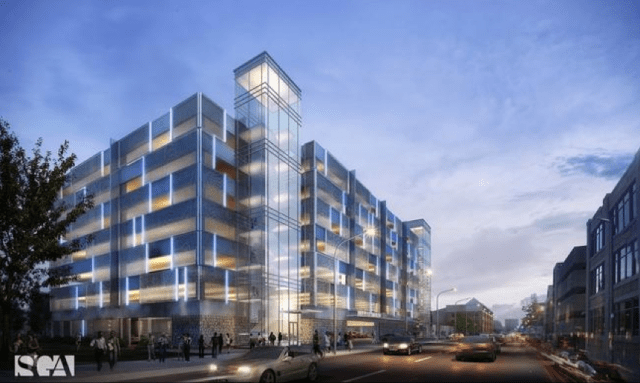
Proposed garage for South Street Landing. (SGA)

So the most shovel-ready modernist abomination in Providence is apparently about to begin construction. Maybe it’s not too late to redesign the garage so that it fits into its setting. It is right next to a neoclassical power plant being rehabbed as a nursing school in the Jewelry District. This garage typifies the reigning attitude in Providence and Rhode Island development circles that prefers designs that undermine both the Ocean State brand and one of its very few competitive advantages – beauty.

Here is the Providence Journal’s story, “Consruction of downtown Providence parking garage to begin this week,” by Kate Bramson. (The Journal’s farming out of copyediting  to Austin, Texas, may be to blame for the assertion that the garage is downtown.) Two proposed dormitories for this South Street Landing project – Brown administration offices plus a state nursing school – are equally stupid and depressing in their design, which seems intent upon blocking views of the beautiful 1912 plant. The firm SGA includes, I believe, the architect who gave us the GTECH building.

This is the sort of thing I raspberried in my post last night. But it is not too late for intelligent design to prevail, and to change the exterior of the garage (and the dorms) so that they will strengthen both the beauty and the brand of Rhode Island and its capital city. Johnson & Wales last year completed a garage just off Webyosset Street (actually in downtown) that does this – or at least gave it a good old college try. If strengthening beauty and brand is not a useful economic development policy, I’ll eat my hat.

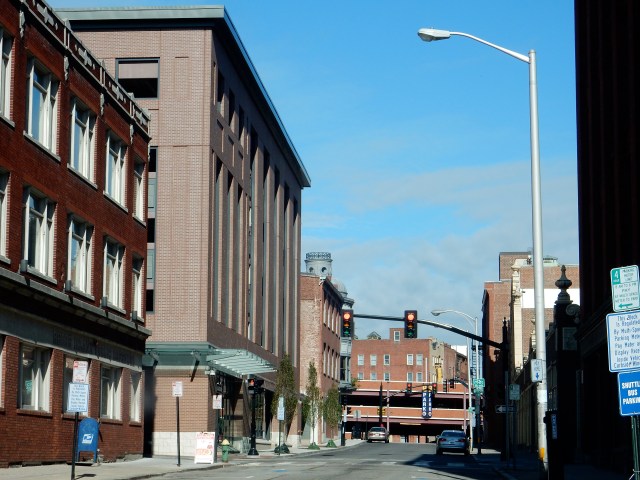
Below is a photograph of the Johnson & Wales garage, which probably should have received a rose. I will look into that.

I wrote a column toward the end of my stint at the Journal about how garages can be made elegant and unobtrusive in their settings. Richmond, Va., does this very well. I will grab it and post it as soon as I can.

DSCN3612.JPG

Johnson & Wales garage, left of center not at end of street, shot in September of 20145 so out of the running for a rose. (Photo by David Brussat)

Posted in Architecture, Architecture History, Art and design, Blast from past, Development, Providence, Rhode Island, Urbanism and planning | Tagged , , , , , , , | 6 Comments

Another classical courthouse

Screen Shot 2016-01-05 at 10.23.14 AM.png

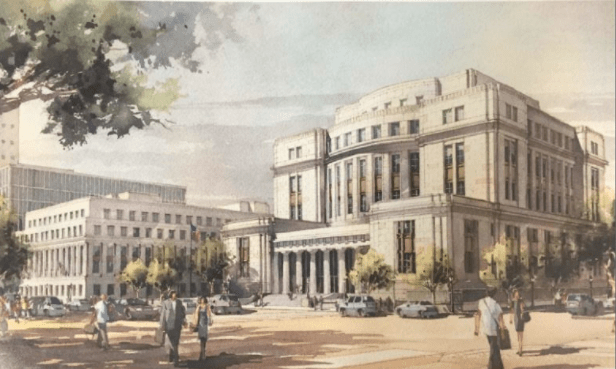
Proposed federal courthouse in Mobile, Ala. (al.com)

Tuscaloosa recently saw the completion of a beautiful classical courthouse, federal, that might have stepped directly off the Acropolis in Athens. Now Mobile, seems about to begin building a beautiful classical courthouse, also federal, designed by the Washington, D.C., firm of Hartman-Cox. It is lovely, and although I’m sure a megafirm such as H-C has committed its share of atrocities, it is also responsible for the 1990 addition to the John Carter Brown Library, on the Brown University campus here in Providence.

Is this perhaps the result of Thomas Gordon Smith getting a consolation prize of a salaried architectural fellowship when the General Services Administration knuckled under to modernists to block his rumored appointment as the agency’s chief architect in 2006? Just wonderin’

Here is a local article from Mobile (hard to say what media platform is it, AL.com?) with more illustrations of the proposal – which apparently beat our or even replaced an earlier modernist design by Safdie Architects.

And below is the John Carter Brown Library and addition.

imgp6668.jpg

John Carter Brown Library and (right) 1990 addition. (Photo by David Brussat)

Posted in Architects, Architecture, Architecture Education, Architecture History, Art and design, Development, Preservation, Providence | Tagged , , , , , , | Leave a comment

Roses and raspberries, 2015

rose-e1389270413148.jpg

If the objective were to build beauty, the past year has served Providence poorly. Since the fault is mainly in the office of the new governor, Gina Raimondo, Providence’s mayor, Jorge Elorza, can be absolved of some of the blame, though what remains speaks poorly of his leadership. I tried to push things along myself, and my belly flop must garner me a raspberry, which I will share with the appropriate parties.

[I have illustrated this post by linking to previous posts featuring images of the subjects of these roses and raspberries.]

  • So, a raspberry to Governor Raimondo for her failure – or that of her office – to grasp that while proposing a $60 million investment chest to promote development along the I-195 corridor in Providence is all well and good, such subsidies might at best match what other states already do. Left undone was an easy way to do what most other states do not do well, or at all. Raimondo failed to embrace a proposal made by your intrepid correspondent for her to phone developers to urge them to design proposed development projects traditionally to strengthen one of our state’s few competitive advantages (our beauty) instead of modernist designs that fly in the face of Rhode Island’s brand. The proposal, which relied on the idea that support from government is more important to developers than architectural styles, required no new state spending to generate public support for projects, which today is largely nonexistent.
  • No, make that a dozen raspberries for the governor (or her office).
  • But, as noted above, I deserve a raspberry for failing to marshal the local backing that might have persuaded the governor (or her office) to take my proposal seriously. Even a good idea – perhaps especially a good idea – must be accompanied by a bodyguard of back-slappers and hail-fellow-well-mets if entrée into a governor’s office is to be seriously attempted.
  • Will there be any roses this year? Yes, I bestow roses on two members of TradArch, Michael Rouchell and Dan Morales, for sending traditional design alternatives to help the governor visualize better designs for I-195 projects. And another rose to Andrés Duany, who volunteered to sit in on any meeting with the governor to further explain my proposal.
  • A raspberry to the new I-195 Redevelopment District Commission for continuing to encourage the worst sort of development designs for the corridor, apparently bringing absolutely zero new thinking to the process after Raimondo replaced almost the entire board.
  • A raspberry to the late Jim Skeffington for making such a totally unrealistic and even insulting proposal for a new PawSox stadium in Providence. Thus a potentially valid proposal (and good-looking, too) never got off the ground. The opposition’s extraordinarily weak case against the stadium seemed to snuff the idea without breaking a sweat. That the team’s owners – worth upward of $5 billion – proposed to pay for the stadium then demand even more money back was an insult to Rhode Islanders. That is what killed the stadium.
  • A rose to the state Department of Transportation for completing the George Redman Linear Park across the George Washington Bridge. It replaces the bike and pedestrian “lane” across the bridge to the East Bay Bike Path with a mighty pleasing classical design on the preserved south face of the old bridge. An old friend, Richard Ventrone, was project architect. Beauty often takes time but it is time well spent.
  • A raspberry for Providence Place. This goes out on general principles after reading that Joe’s American Grill – which graced the sidewalk of Francis Street at the mall since it opened in 1999 – will be closing on Jan. 16. I eat there a lot with my good friend Bill Patenaude – and the food is always great. But the mall has made many mistakes in recent years. In the mid ‘aughts it was making over $400/square foot, or among the top earners of U.S. malls. I doubt it’s doing that today. It refuses to fix its lighting system – especially on the Macy’s façade – and so it grows shabbier and shabbier. When Border’s Books went out of business (the chain, not just the mall location), the mall management apparently failed even to try to get a Barnes & Noble to replace it. Instead we got the umpteenth shoe store. In a few years, the entire mall will be stuffed with shoe stores, and nobody will want to go there, if it still exists.
  • A pair of roses to, believe it or not, the Procaccianti Group and First Bristol Corp. for, in the first case, recasting its proposed Fountain Street extended-stay hotel from mod to trad, and in the second case for recasting an initial bad-trad design on Parcel 12 into one that, while still far from perfect, made great strides (under architect Eric Zuena) to something much more pleasant. (Please redo that cornice, Eric!)
  • A rose to the Blackstone Boulevard community for shouting down a proposed extended series of speed bumps for the main thoroughfare from Pawtucket to College Hill. Another rose to the same community for blocking an ominous subdivision of the Granoff estate.
  • A raspberry for the owner of the Industrial Trust (“Superman”) Bank Building. Its exterior lighting remains shut off, crying “Dying City!” to anyone driving through on Route 95.
  • A raspberry to Mayor Elorza for lacking the intestinal fortitude to tell the owner of the Superman building to turn it back on.
  • A mushroom cloud of raspberries to all those – primarily the mayor and RIPTA (will the public ever learn why dynamic former RIPTA director Charles Odimgbe was ousted in early 2013? “Cold case,” anyone? Now there’s a scandal waiting to be uncovered by our watchdogs of the press!) – who brought us the new, ugly Kennedy Plaza and its cheesy plastic shelters. It opened on Jan. 20, 2015.
  • A rose of two directions for DOT’s latest round of street reform, in which a slew of one-way streets have been turned into two-way streets, making it much easier to get around downtown. Good work! Can’t those brain cells be transferred over to the heads of those in charge of wrecking Kennedy Plaza and RIPTA? Increasing fares and decreasing service is no way to dig out of RIPTA’s hole. And for that matter, why millions for a new bus hub at Providence Station when a single trolley loop (wheel not rail) could do the job for a sliver of a fraction of the cost?

Well, one can go on and on online. I seem to have forgotten to do roses and raspberries for 2014 – or did I? Oh yes, I did it last year during my six-month gig at GoLocalProv.com. Anyhow, anyone who thinks I’ve left something out for 2015, please let me know and I will consider adding to this long post of praise and (alas, mostly) perfidy.

The widely beloved illustration atop this post harks back to the era of “Dr. Downtown.” Remember him? The doctor is still trying to figure out whether there is still a demand for his smart-alecky take on local affairs. The doctor, if he were behind this column, would apologize for the lack of illustrations for each rose & raspberry. Maybe they will be added, but the evening is growing long and, well, so is this post. [I just added links to posts with illustrations of the recipients of roses and raspberries.]

Posted in Architects, Architecture, Architecture Education, Architecture History, Art and design, Blast from past, Development, Preservation, Providence, Providence Journal, Rhode Island, Urbanism and planning | Tagged , , , , , , , , , , , , , , | 4 Comments

Love at Providence Place

waterplacerb copy.jpg

Waterplace and Providence Place in 2000. (photo by Richard Benjamin)

The evening of New Year’s Day, after seeing The Force Awakens at Providence Place with Victoria, Billy and friend Maria, all the shops were closed as we descended the escalator to the third level and strolled down the concourse, at the end of which is Nordstrom. The passage raised the vague memory of a column I’d written for The Providence Journal a decade and a half before, a few months after the mall and after seeing a movie at the Hoyt’s cineplex and walking through the mall after closing time. I told Maria as we strolled along that I had written about seeing a pretty girl off in the distance at Nordstrom, and …

Well, here is that long-forgotten column, courtesy of the Journal.

***

The year of living gloriously
April 27, 2000

SUNDAY, in the evening, after a delicious Easter dinner in Cranston with the family of a dear friend, I treated myself to a movie at Providence Place. High Fidelity was a fine film for the mood I was in. Exactly a year had passed since my move downtown. And the Hoyts Cinema is a brand new downtown delight. So is the eerie experience of leaving the mall after a late movie.

Indeed, leaving the mall after hours may be an experience worth more than the movie itself. An escalator takes you down from the fourth-floor entertainment complex to the mall’s third-floor concourse, with its arched cathedral ceilings. Subdued lighting and classical music feed the ecclesiastical ambiance. Each shopfront along the concourse is a shrine to commerce. As you pass one and then another, you cannot help but judge its offering to the Goddess of Shopping, just as you might judge the congregation of a church by the height of its steeple or the ornateness of its vestibule. In the distance, at the north end of the concourse, is a beautiful woman in a sexy pose. She is seated on a bench inside the Nordstrom window, watching you approach.

It turns out that she is just a large photographic cutout; nevertheless, her presence adds to the divinity of the moment. You turn down the escalator, from which the spare, geometric elegance of the mall architecture is only the more apparent. You exit onto Francis Street and see the city at night, in all its glory, on the far horizon.

This put me in a mood for the more tried and true downtown delights, for wandering the streets of the city. A few days before, in a similar mood but at a considerably later hour, I had strolled up and down the embankments of the rivers. The tide was high and the night was silent, and I walked, brooding, all the way from Waterplace to the Crawford Street Bridge and back without seeing another soul.

At any hour, with or without the multitude, with or without WaterFire, the rivers are a constant blessing for those who live downtown. They are right next door, always beckoning, always beautiful, always a source of spiritual nourishment. Sometimes, the mellow notes of a saxophone drift from the passage beneath the Exchange Street Bridge. Sometimes, the swans are out in state, swimming up and down the Woonasquatucket, as they have done for years. Someday, when these banks are lined with balconied apartment buildings and outdoor cafés instead of empty dirt lots, our rivers of delight will be even more blissful.

But this past Sunday night, following my stroll through the vast serenity of the mall, I was drawn after a stop at home to wander up and down the streets of my neighborhood, a hop, skip and (soon) a skybridge from the mall. Downtown at 10ish on Easter Sunday was even more dark and deserted than usual. Its energetic population of clubbers was absent at home, no doubt, chilling out after their own fat repasts, or maybe it was still far too early for them to stumble out of their clubs.

In the evening, the architecture of downtown has a particular allure. It does not boast of its beauty as it does under a brilliant sun, but it speaks softly, its ornate edges glinting off the light from the historical lamps lining Westminster Street. This melancholy elegance will become more joyful if – oops! not if but when – the street is also lined with shops and cafés. There may not be enough room for lots of outdoor seating (except at Grace Square), but inside/outside seating such as that at Mediterraneo or Olives would turn Westminster into a rival of Newbury Street in Boston.

Round the corner onto Empire Street and a sort of bustle returns. A group of artists hangs outside AS220. When the door opens, the sound of the Neo-Nineties or some such high-wattage band busts out onto the street, setting off a car alarm. Around another corner, Weybosset Street’s denizenry acts out its usual plots and subplots on the sidewalk near Dunkin’ Donuts.

Of course, this may not be for everyone. Some prefer the changeless quiet of suburbia or even an in-town leafy neighborhood. But for me, give me the choice of a dozen or so restaurants a stone’s throw from where I live; give me the clang of the trolley and the clippety-clop of the mounted police; give me the hustle and bustle of the city, day and night, where insomnia at least has a raison d’etre; give me the abundance of shops of old, far beyond in number what you probably think exists; give me the gentle, quiet watchmaker on the second floor of Paolino World Headquarters, watching out the window for what I like to imagine is his lady love walking by daily for 30 years on the sidewalk of Dorrance Street below, unbeknownst; give me the friends, neighbors and acquaintances who seem to pop up around every corner. And please, give me more of all of the above by building even more apartments downtown.

They are coming, but oh so slowly! True, downtown can only get better. Yet it already offers delights aplenty for the pioneer boulevardiers and boulevardettes of downtown Providence. Let us multiply.

Copyright © 2000. LMG Rhode Island Holdings, Inc. All Rights Reserved.

***

Westminster still has a ways to go before it rivals Newbury!

When I wrote this column I used the term Downcity for the old commercial district of downtown. Within a few years the term had become regularly misused by many, including Mayor Cianci, as a synonym for downtown and I lost my taste for it, since it was no longer clear what it meant in the public mind. It was supposed to be the name of a district within the downtown neighborhood. Now, who knows? So in this version I have replaced its two occurrences with “downtown.”

The wonderful photo of Waterplace by the excellent Richard Benjamin was taken right around the time I wrote this column, pre-GTECH, pre-HUD warehouse condo towers, pre-Blue Cross/Blue Shield headquarters. Ah! Those were the days!

Posted in Architecture, Architecture History, Art and design, Development, Photography, Preservation, Providence, Providence Journal, Rhode Island, Urbanism and planning | Tagged , , , , , , , | 1 Comment

Still, his buildings were fine

Palace_of_Mechanic_Arts,_1893_World_Columbian_Exposition.jpg

World’s Columbian Exposition, 1893 (commons.wikimedia.org)

Reaching the end of Louis Sullivan’s Autobiography of an Idea, I could only wish that his place in architectural history was judged more by his buildings and less by what he wrote about architecture. Most of the book consists of long-winded passages of rodomontade explicating a far broader philosophy into which “form follows function” was set – a philosophy that exalted the “IDEA” of Man and his Powers. Very vague, to say the least: banal, perhaps – or perhaps incomprehensibly profound. It is above my pay grade to judge.

LSTransportation2

Transportation Building (wikipedia)

There is no denunciation of ornament per se, and the phrase “form ever follows function” appears nowhere. No “ever” is ever placed among the three words in Sullivan’s book. Good! Because the modifier ever would unduly fortify the principle – lifting a relatively unobjectionable idea to the level of practical impossibility. The history of architecture shows no example of function being ignored in the quest for form (except perhaps in the case of some modernist buildings). To assert that form always follows function is to display an unlikely ignorance of how those two major aspects of design always intermingle, with both sharing a simultaneous importance, or with the lead of one traded back and forth between the two in the mind of the architect: form never entirely follows function.

At the end, Sullivan denounced the American Renaissance, in which society embraced neoclassicism in the City Beautiful Movement for about half a century, and specifically the 1893 World’s Columbian Exposition (whose massive Transportation Building he was allowed to design in the only major nonclassical style), as a “poison” in American architecture:

There came a violent outbreak of the Classic and the Renaissance in the East, which slowly spread westward, contaminating all that it touched. … The damage wrought by the World’s Fair will last for half a century from its date, if not longer. …  Meanwhile, … we have now the abounding freedom of Eclecticism, the winning smile of taste, but no architecture. For Architecture, be it known, is dead.

It is never quite explained why he hated the classical. But he sees the antidote in his “IDEA” of Man and his Powers. “It requires courage,” he opines, “to remain steadfast in faith in the presence of such pollution. Yet it is precisely such courage that marks man in his power as free spirit. … The Great Modern Inversion … is now under way in its world-wide awakening.”

Of course, Sullivan had it totally wrong. He predicts that “out of the very richness and multiplicity of the architectural phenomenon called ‘styles’ there may arise within the architectural mind a perception growing slowly, perhaps suddenly, into clearness, that architecture in its material nature and in its animating essence is a plastic art” (an illimitable variety of valid forms).

Though his timing was impeccable, what we got was not what he describes as the best of architecture but the worst: modern architecture. It represents the antithesis of everything he called for in his book. What we got instead was modernism’s formulaic abhorrence of nature and the natural. What we lost was its spirit of creativity and architecture’s reliance on the power of man at work as opposed to the vapidity of theory. What was ejected by modernism was exactly those very traits – the classical and traditional architecture that had not relied upon formula but had evolved for centuries on the basis of trial and error, with the best practices for merging utility and form handed down from generation to generation. Sullivan had failed to understand that the classical orders, in practice, are not formula but creative inspiration.

Was this sudden purge of classicism the “Great Modern Inversion”? That is, can we assume that ridding architecture of tradition is what he meant by that phrase? It is hard to be sure of anything in The Autobiography of an Idea, but if so, the result was an architecture that embraces the reverse of the spirit of building that Sullivan spent his book and his life seeking.

There can be no doubt that Louis Sullivan is spinning angrily in his grave.

Posted in Architects, Architecture, Architecture Education, Architecture History, Art and design, Books and Culture, Urbanism and planning | Tagged , , , , , , , , | Leave a comment

More on form and function

louis-sullivan-jackal-01.jpg

Detail of the Wainwright Building, St. Louis, Adler & Sullivan. (beltstl.com)

Here is the first lengthy passage in which Louis Sullivan, writing in his Autobiography of an Idea, unpacks “form follows function,” which has become a mantra of the modernist movement. It had to be misinterpreted for that to occur. So far there is no banishment of ornament, only a ban on “senseless conventional rigidity.” So far as I know, even the most rigid interpretation of the classical canon does not include regimentation of the ornament of column capitals and other decorative elements of the orders. Indeed, a certain creativity of embellishment has (it seems to me) always been required because decoration itself has never been dictated.

I am sure Sullivan must have more to say on this, as I have not yet come across the formulation “form ever follows function” that is ever quoted by the cognoscenti. It must be there somewhere!

So here are the words out of the mouth of the “precursor to modernism”:

image-1440879731c8l4p-700x500

Now Louis [he is writing in the third person] felt he had arrived at a point [his new partnership with Dankmar Adler] where he had a foothold, where he could make a beginning in the open world. Having come into its responsibilities, he would face it boldly. He could now, undisturbed, start on the course of practical experimentation he had long had in mind, which was to make an architecture that fitted its functions – a realistic architecture based on well defined utilitarian needs – that all practical demands of utility should be paramount as basis of planning and design; that no architectural dictum, or tradition, or superstition, or habit, should stand in the way. He would brush them all aside, regardless of commentators. For his view, his conviction was this: That the architectural art to be of contemporary immediate value must be plastic; all senseless conventional rigidity must be taken out of it; it must intelligently serve – it must not suppress. In this wise the forms under his hand would grow naturally out of the needs and express them frankly, and freshly. This meant in his courageous mind that he would put to the test a formula he had evolved, through long contemplation of living things, namely that form follows function, which would mean, in practice, that architecture might again become a living art, if this formula were but adhered to.

Soon after, he describes his “grammar” for getting more light into buildings by using slender piers permitting larger windows, and stressing the need to emphasize the verticality of tall buildings. He then adds:

This method upset all precedent, and led Louis’s contemporaries to regard him as an iconoclast, a revolutionary, which was true enough – yet into the work was slowly infiltrated a corresponding system of artistic expression, which appeared in these structures as novel and to some repellent, in its total disregard of accepted notions.

Here is what the modernists choose to omit, that ornament was part and parcel of Sullivan’s system. He may indeed have come up with a finely alliterative “formula” – form follows function – but he himself seems to exaggerate the extent to which this was a departure from past architecture – whose diversity of form he had specifically noted while studying at the École des Beaux-Arts, in Paris. There has never been any feeling in the history of architecture prior to Sullivan that architecture lacked utility because of its decoration. Modernists have interpolated their assessment that avoiding “senseless conventional rigidity” meant stripping architecture of ornament. But so far, Sullivan does not seem to be saying that at all, or implying it, and it can only be read very obliquely into his words by ignoring his actual work. Directly after the last quoted passage he continues:

But to all objections Louis turned a deaf ear. If a thousand proclaimed him wrong, the thousand could not change his course. As buildings varying in character came under his hand, he extended to them his system of form and function, and as he did so his conviction increased that architectural manipulation, as a homely art or a fine art must be rendered completely plastic to the mind and the hand of the designer; that materials and forms must yield to the mastery of his imagination and his will; through this alone could modern conditions be met and faithfully expressed. This meant the casting aside of all pedantry, of all the artificial teachings of the schools, of the thoughtless acceptance of inane traditions, of puerile habits of uninquiring minds; that all this mess, devoid of a center of gravity of thought, and vacant of sympathy and understanding, must be superseded by a sane philosophy of a living architecture, good for all time, founded on the only possible foundation – Man and his powers.

So he takes yet another whack at elucidating the need to “cast out all pedantry,” etc., yet he still makes no mention of the supposed incapatability of ornament with function. That is the invention, or so it seems, of purposeful modernist misinterpretation, the rickety structure of their kidnapping his reputation and transmorgrifying it into a “precursor of modernism.” Later passages may prove me wrong about this, and I will report them if they show up as I complete the last quarter of Sullivan’s autobiography.

Posted in Architects, Architecture, Architecture Education, Architecture History, Art and design, Urbanism and planning | Tagged , , , , , , , | 1 Comment

Brutalism’s heroic ugliness

lead_large.jpg

Orange County Government Service Center. (Park Pasnik/The Monacelli Press)

Hats off to Jo-Anne Peck for sending to TradArch this amazing article, “In Memoriam: Important Buildings We Lost in 2015,” by Kriston Capps, a staff writer for CityLab. Quoth Peck: “I don’t see any I would miss.”

Right on, Jo-Anne! I won’t miss any of them either, but neither will I miss this opportunity to guffaw at Capps’s slobbering attitudes toward Brutalism, the focus of this article and the branch of modern architecture in the ’60s and ’70s that exalted rough concrete (“béton brut” in French). The Penguin Dictionary of Architecture describes it as “handled with an overemphasis on big chunky members which collide ruthlessly.” Exactement!

Unloved Landmark

Orange County Government Service Center. (Mike Groll/AP)

But first, a news flash: The Orange County Government Service Center, the Brutalist building designed by Paul Rudolph in Goshen, N.Y., has been demolished. That’s what Capps says, and it’s (good) news to me. I suppose that what will be left of Rudolph after a planned “renovation” of the icon is so minimal that the heartthrobs of midcentury modern are downcast. My own heart does not go pitter-pat on their behalf.

Capps writes: “Even critics who reject Brutalism for more-or-less ideological reasons – namely the anti-intellectual charge that Heroic Concrete is ‘ugly’ – ought to see that Orange County bungled this one.”

6311bd972

New county building in Goshen. (CityLab)

Well, that’s me, and I cannot see it. Sure, Orange County has bungled this one – not by demolishing the Brutish building but by planning to replace it with something that’s even worse – worse not least because Goshenites can no longer blame their ridiculous forefathers but only themselves.

In the passage quoted above Capps uses the phrase “Heroic Concrete,” alluding (and linking) to a new book out that tries to claim that Brutalism is heroic, not ugly. Not ugly!? Only a degree in architecture can explain (if not justify) a denial that Brutalism is ugly. Of course it is ugly. Modernism wallows in the idea of ugliness just as it revels in its denial of the idea of beauty.

Capps links to “The Case for Calling Brutalism ‘Heroic’ Instead.” In this article, also for CityLab, Mark Byrnes interviews the authors of Heroic: Concrete Architecture and the New Boston, by Mark Byrnes. Leaving aside the basic asininity of his thesis, Byrnes proves with his photo selection that by choosing your shot and your angle carefully you can find beauty in almost anything. He does so (once) with a staircases at the Rudolph building in Goshen. But even if a modernist accidentally commits an act of beauty it does not mean that Brutalism is beautiful, let alone heroic. To ram down the municipal throat a building the public in Goshen hated even before it was built is not heroic. It is … brutal. QED.

There is a lot of inanity in that piece, but genuine inanity masquerading as deep think is fun, so go read it. Capps’s article lists several other brutes razed this year, none that anyone is likely to honestly miss. By the way, I have used with this post the two most alluring photos from Capps’s piece. Compared to most Brutalism, they are the Mona Lisa.

22bdbaffc.jpg

Staircase in Orange County building. (Mark Pasnik/Monacelli Press)

Posted in Architects, Architecture, Architecture Education, Architecture History, Art and design, Preservation, Urbanism and planning | Tagged , , , , , | Leave a comment

Sullivan on the classical

DSCN7306.JPG

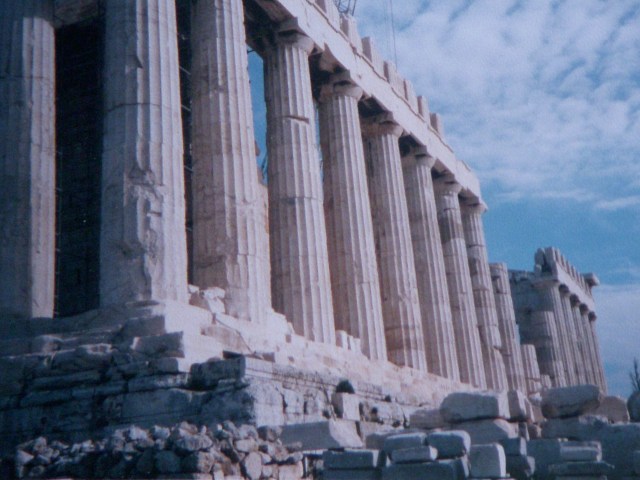
The Parthenon, circa 1998. (Photo by David Brussat)

About halfway through his Autobiography of an Idea, Louis Sullivan begins to discuss architecture. He is at MIT, circa 1872. He writes in the third person. Here he receives the received wisdom on classicism:

Louis had gone at his studies faithfully enough. He learned not only to draw but to draw very well. He traced the “Five Orders of Architecture” in a manner quite resembling copper plate, and he learned about diameters, modules, minutes, entablatures, columns, pediments and so forth and so forth, with the associated minute measurements and copious vocabulary, all of which items he supposed at the time were intended to be received in unquestioning faith, as eternal verities. And he was told that these “Orders” were “Classic,” which implied an arrival at the goal of the Platonic perfection of idea.

But Louis was not given to that kind of faith. His faith every lay in the oft-seen creative power and glory of man. His faith lay indeed in freedom. The song of Spring was the song in his heart. These rigid “Orders” seemed to say, “The book is closed; Art shall die.” Then it occurred to him, why five orders? Why not one? Each of the five plainly tells a different story. Which of them shall be sacrosanct? And if one be sacrosanct the remaining four become invalid. Now it would appear by the testimony of the world of scholarship and learning that the Greek is sacrosanct; and of all the Greek the Parthenon is super-sacrosanct. Therefore there was and has been in all time but the unique Parthenon; all else is invalid. Art is dead. …

This line of reasoning amused Louis quaintly. It seemed to him romantic; much like a fairy tale. And this is all that he gathered from the “Orders” – that they really were fairy tales of the long ago, now by the learned made rigid, mechanical and inane in the books he was pursuing, wherein they were stultified, for lack of common sense and human feeling. Hence he spent much time in the library, looking at pictures of buildings of the past that did not have pediments and columns. He found quite a few and became acquainted with “styles” and learned that styles were not considered sacrosanct, but merely human. That there was a difference in the intellectual and therefore the social scale, between a style and an order.

Granted, this is a student’s reflections on the teachings of his professors, or perhaps the disappointed older man reflecting on the long-ago teachings of his professors. I do not quarrel but merely note that the teachings of architecture professors and the response of student architects has not changed so very much over the years. Teachers exaggerate what is sacrosanct and students rebel against it. What could be more natural? And yet only in the past half a century has this natural evolution of what is taught as it travels down from professor to student to practice been interrupted. The new teaching of modernist principles makes the old teaching of classical principles seem downright libertine.

For, as Sullivan himself discovered in his research into non-canonical buildings, much diversion from the canon was permitted and accomplished for centuries in the real world of building. Today, and for more than half a century, divergence from modernist “canon” or rather “dogma” has been fought by the architectural establishment with a much more rigorous defensive apparatus. The schools teach nothing but modernism, the journals publish nothing but modernism, the firms design nothing but modernism, the professional organizations promote nothing but modernism. Deviation is possible but much more difficult than of old, where, say, the longstanding battle between neo-Gothic and neo-Classical demonstrated only that the broad liberality of a profession in which you could largely design what you wanted has grown much more conservative.

That the public remains largely disappointed with the result, yet the profession still does not brook challenge, is a sad commentary indeed on a cultish, even a totalitarian mindset in the today’s establishment. Today, a Louis Sullivan emerging from school into practice would be considered not a “precursor of modernism” let alone an adherent of it but a revolutionary force against it.

Posted in Architects, Architecture, Architecture Education, Architecture History, Art and design, Books and Culture | Tagged , , , , , | Leave a comment

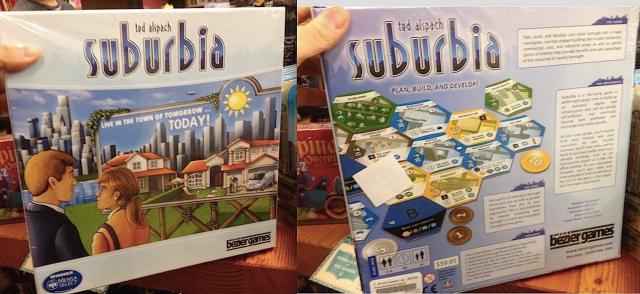
“Suburbia!” – the game!

Suburbia - the game.jpg

Front and back of the board game Suburbia. (Michael Mehaffy)

I added both exclamation points, with full ironic intent. The game Suburbia? How about let’s play another game, Traffic Jam! (exclamation added). There are city-building games already, so why in heaven’s name a suburbia-building game? Maybe it’s a sort of “city building for dummies” – people (are there any?) yet unaware that sprawl has put cities, their inhabitants and everyone else at risk.

I couldn’t remember the name of the city-building game that started it all, so I googled “city-building games” and found Sim City immediately, but also this: “Top 10 Best City Building Games.” It has a couple of Sim City versions but topped out with “Cities Skyline,” which was modernist in the video but gives you the option of building your skyline in different styles. My fave was No. 10, listed first though last ranked. It seemed very City Beautiful at first glance. You build a city then an empire. The whole video is eight minutes.

Michael Mehaffy sent to Pro-Urb some wry comments about Suburbia. He heads Sustasis, in Portland, Ore., which seeks to prolong some of the more intelligent thinking that emerged from rebuilding New Orleans and its vicinity after Katrina. Here are his astute comments on Suburbia:

I saw this in the book store today, displaying not a whiff of irony. Live in the community of tomorrow, today!  Big McMansions! Office Towers in the Park! Play the game, build more stuff, and make more profit!

They do have one thing right. It’s a massive game, with rules and incentives and all the rest of the complex influences on the still-predictable outcome.  Call it the “operating system for growth.” If you want to see a different outcome, change the rules…

And also, change the mindset. Which clearly, New Urbanism has not done for this game designer, or his fans. (Based in San Jose, by the way.)

“As your town grows, you’ll modify both your income and your reputation.  As your income grows, you’ll have more cash on hand to purchase better and more valuable buildings, such as an international airport or a high-rise office building. As your reputation increases, you’ll gain more and more population (and the winner at the end is the player with the most population).”

It’s worth remembering, once in a while, that a whole lot of people still don’t have a clue what we’re talking about. We’d better be very clear ourselves, as a first order of business.

***

Mehaffy’s Sustasis is republishing Christopher Alexander’s pathbreaking paper “A City Is Not a Tree” (the paper, before it became a book) on its 50th anniversary (with commentary) and is seeking donations to pay for the work involved. A kickstarter campaign failed to achieve its goal in the allotted time. Still, there is an interesting video link, and I’m sure Sustasis will continue in other ways to get this exciting project done. Click the link to learn more about Sustasis, its goals, and the Not a Tree project.

Posted in Architecture, Architecture Education, Architecture History, Art and design, Books and Culture, Development, Landscape Architecture, Preservation, Urbanism and planning, Video | Tagged , , , , , | 5 Comments