Fix in on worse Ike Gehry

Screen Shot 2017-05-31 at 8.49.33 PM.png

General Eisenhower speaks with men of the 101st Airborne on June 5, 1944. (National Archives)

Catesby Leigh, writing in City Journal, reports the terrible news about the Frank Gehry designed proposal for an Eisenhower memorial. The formerly skeptical Eisenhower family now backs it. President Trump now backs it. In his proposed 2018 budget, Trump throws $45 million at a project (stiffed for years by Congress) that in every facet epitomizes the swamp Trump promised to drain. Leigh itemizes the counts in that indictment in his essay, entitled “Monumental Folly: The proposed memorial to President Eisenhower becomes even less appealing.”

The subtitle refers to the recent rejection by the U.S. Commission of Fine Arts of proposed alterations. One switches out the Kansas landscape in the design’s colossal “tapestry” for a landscape of today’s beach at Normandy. Another relocates the statue of the young Ike so as to kill off the memorial’s only (if not saving) grace note – the statue of the boy looking in awe at statuary representing his accomplishments as a man.

Leigh brilliantly explains the difference between Gehry’s fatuous exercise in self-indulgence and a real work of memorialization. “The Lincoln Memorial, for example, does not tell us the story of Abraham Lincoln. It enshrines his memory in a majestic temple while the statue within evokes the essence of the martyred president—his thoughtfulness and determination.”

Still, Leigh’s article is the most depressing thing I’ve read in a long time. The prospect of blocking the abhorrent Gehry design, which so recently seemed so close, was the biggest story in architecture, at least in bringing media attention to the important battle between traditional and modernist architecture. “The memorial’s recently anticipated completion date of June 6, 2019 – D-Day’s 75th anniversary – is probably out of reach,” writes Leigh. “But it’s going to get built.” At his essay’s conclusion, with a punchy permit joke, Leigh tries to lift the spirits of those who consider Gehry’s design a paean to himself and an insult to Ike. But he doffs his cap to sad reality:

In a less imperfect world, President Trump’s secretary of the Interior, Ryan Zinke, would refuse to dignify Gehry’s scheme with a building permit. … But that’s a happier ending than the Washington swamp will likely accommodate.

Catesby Leigh believes that the cause has indeed been lost – or so it seems. (Well, I do live in a state whose motto is Hope.)

Posted in Architecture | Tagged , , , , , | 1 Comment

Steve Mouzon’s new book

Screen Shot 2017-05-30 at 11.28.11 AM.png

Cover illustration of another book about Bahamian architecture. (amazon.com)

Steve Mouzon’s excellent book The Original Green reflects thoughts I described in a review of that book and in my 2015 post “Love, beauty, architecture.” One of architecture’s most ambitious and creative thinkers, Mouzon is bringing out a second edition of his 2007 book, A Living Tradition: Architecture of the Bahamas, whose publication he hopes to attain through a Kickstarter funding effort. Everyone who contributes will get a free copy of his and his wife Wanda’s next book, Outdoor Room Design.- assuming, of course, that the Kickstarter goal of $18,000 is reached by 5 p.m. EDT this Friday ($15,565 has already been donated). What follows is the description of the book and the funding effort, including a link to his Kickstarter campaign, all of which is worthy of everyone’s attention:

***

The Kickstarter to publish the second edition of A Living Tradition [Architecture of the Bahamas] has only three days to go and we’re getting close to the $18,000 Stretch Goal. If we reach it, everyone who has pledged any amount gets a copy of Outdoor Room Design, which is an e-book (iBooks or Kindle) Wanda and I are now finishing. So if you’ve pledged support, please spread the word so you get the book, and if you haven’t pledged yet, please consider doing it now.

Outdoor Room Design steps through the process of designing a tapestry of outdoor rooms meant to be inhabited, not just viewed from indoors. It’s a little-known fact that one of the best sustainability moves we can make is to entice people outdoors so they get conditioned to the local environment. When they return indoors, they just might be able to turn the A/C off and throw the windows open… and there’s no equipment so efficient as that which is off.

The book starts with general principles like south-facing outdoors, positive outdoor space, and the really important “hints from houses.” It then lays out a number of room types you might want to consider, such as the hearth garden, dinner garden, breakfast terrace, kitchen garden, couple’s garden, frontage garden, meditation garden, coffee cove, children’s maze, orchard run, motor court/sport court, and even the secret garden. Once the rooms have been laid into the landscape, the next step is to set the borders, then lay out any garden structures. Next comes the water, with a focus on useful water elements that are not solely ornamental. The passages between the rooms are next, then the finishes, fixtures, furnishings, and finally the plant material.

Here’s a typical page screen shot. Again, anyone who pledges any level of support to the Kickstarter gets this book as a reward if we reach the $18,000 Stretch Goal. So thanks in advance for spreading the word… much appreciated! Here’s the Kickstarter link.

Steve Mouzon

Copyright © 2017 Mouzon Design, All rights reserved.
Hi, you’re receiving this email because you subscribed to Mouzon Design updates. Our site is mouzon.com.Our mailing address is:

Mouzon Design

PO Box 191217

Miami Beach, FL 33119

Add us to your address book

Posted in Architecture | Tagged , , , , | 2 Comments

Saving the history underfoot

Screen Shot 2017-05-30 at 10.36.44 AM.png

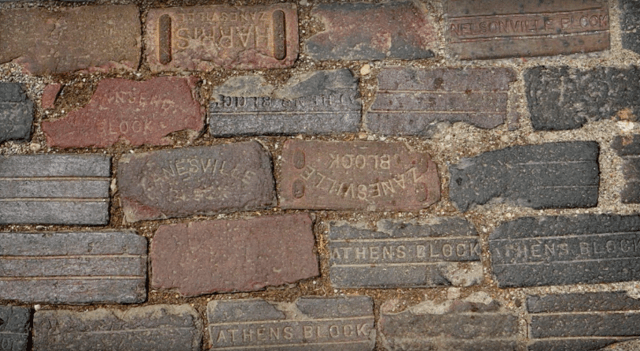
Pavement at Westminster and Eddy streets, in downtown Providence. (Pinterest)

Robin Williams, an architectural historian at the Savannah College of Art & Design, delivered a TED talk to explain “How Historic Street Pavement Modernized the City.” Williams has a pleasant manner that conveys his conviction that historic pavement is a neglected treasure that often is hiding in plain view right beneath our feet. In honor of the operation by the city of Providence to restore its own downtown’s historic pavement (it harks all the way back to the mid-1980s) – but seriously, it is very beautiful, and it is being restored right now – I am posting this video of Williams’s talk in Savannah to explain the vitality and importance of that work, and his own to preserve historic pavement. Here are some choice passages from his peroration:

Pavement is our most democratic form of built heritage. It’s accessible to everyone, and it bridges areas rich and poor. Indeed, there are enough historic pavement areas existing around the country to provide a bridge to the past, helping us to understand the struggle to make our cities livable.  Try to imagine a time before street pavement when all of our streets were dirt. No water mains, no sewers, no pavement. Just dirt. Well, the problem of getting stuck in a muddy street was common enough that it could be satirized, as in this view from San Francisco [see below]. But seriously, dirt streets pose a very important threat to the health and safety of the citizens of any given American city.

[Cities] had to decide what was most important for that street. Was it durability, smoothness, being quiet or being affordable? Because no pavement could be all of those things. Cities experimented with a bewildering variety of pavements. … Wood blocks seemed a promising option. They were smooth, cheap and quiet, like magic, but in wet weather they were slippery, and in southern cities termites and humidity eroded them quickly. In the South, readily available oyster shells were also cheap and provided a smooth ride, but turned to clouds of annoying dust. A more durable option was rectangular Belgian blocks, which were strong enough to take the heavy cart loads of waterfront and warehouse districts in cities like New York and Baltimore and other port cities. But Belgian blocks were bumpy and, worst of all, they were incredibly noisy under the metal hooves of horses. After 1880, vitrified bricks became the most popular and widely used pavement in America. … The development of modern asphalt in the 1920s was a game-changer. [It] was spread over older pavements but with a loss of local identity.

Williams goes on to describe how in many cities neighbors have fought back against asphalt, even confronting contractors with rakes and hoes (and let’s not forget pitchforks) to scrape away the affronting goo as it was being laid.

These two examples from Columbus and Philadelphia illustrate the power of pavement to activate civic pride and to define local identity. … Pavement can even be good for your health, as some researchers in Oregon discovered. … So if you really want to appreciate the distinctiveness of where you live, just look down!

Screen Shot 2017-05-30 at 9.50.50 AM.png

Cartoon mocks muddy streets of San Francisco, circa 1849. (TED talk, YouTube)

Screen Shot 2017-05-30 at 10.06.34 AM.png

Pavement in Ohio from image in Robin Williams’s TED talk. (Screenshot of YouTube)

Posted in Architecture, Landscape Architecture, Preservation, Video | Tagged , , , , , | Leave a comment

More on Penn Sta. rebuild

Screen Shot 2017-05-27 at 1.48.14 PM.png

The Gothamist yesterday ran a long article by Jake Offenhartz, “A Dramatic Plan to Rebuild Penn Station & Restore its Lost Grandeur,” that explains the several initiatives involved in the proposal to rebuild Penn Station in its original Beaux Arts style.

The first would be to bring the idea to the attention of the political, bureaucratic, design and corporate elites who control the station’s future (if anyone does). The second would be to incorporate rebuilding the McKim, Mead & White masterpiece (opened in 1910 and demolished in 1963) into evolving plans to upgrade Penn’s transportation system, which is literally falling apart. A vital and creative proposal to solve cascading problems with the rails and platforms would involve turning Penn from the terminus of the Long Island Railroad and New Jersey commuter rail into a through station. A third would be to flesh out the MM&W design, preserved in a set of all 353 blueprints at the New York Historical Society. It must be meshed with new materials and technologies, with modern needs, and commercial facilities that would revitalize the area around the station, said to be undervalued by 30 percent compared to the area around Grand Central Terminal.

Architect Richard Cameron of Atelier & Co. proposed this plan a couple of years ago after having thought it through for more than a decade. He has been joined by the National Civic Art Society, led by Justin Shubow, which, one hopes, might be able to put a bug in the ear of President Trump as part of his infrastructure program. Newly enlisted behind the Rebuild Penn plan is an urban policy center, RethinkStudio, whose director, Jim Venturi, was first to reimagine Penn as a through station.

So far, New York Gov. Andrew Cuomo has not acknowledged the Rebuild Penn plan. His proposal for a lame renovation that would address none of the station’s or the system’s main problems has been opposed editorially by the New York Times, but the newspaper has come out strongly in favor of a proposal to move the Garden to the Farley Post Office next door and replace its circular structure with a glass drum. Better than the current situation but … yawn! Moving the Garden is a necessary step in any useful plan for Penn; the Farley is now envisioned, however, as an extension of Penn for Amtrak, an elegant step that still would not solve the system’s mounting crises.

The general awfulness of Penn Station today is made all the more painful by the grandeur of the first version. Inspired by the Roman Baths of Caracalla, the original McKim, Mead and White masterpiece featured 150 foot glass ceilings, pink granite walls, and 84 Doric columns.The general waiting room, large enough to fit the entirety of Grand Central Station, possessed nine acres of travertine and granite. Summarizing the difference between that station and the one that came after it, architecture critic Vincent Scully famously said: “One entered the city like a god; one scuttles in now like a rat.”

I had been unaware the Grand Central Terminal could be fit entirely into the waiting room of the original Pennsylvania Station. It seems evident that rebuilding Penn Station in its old style within a broader revitalization of the area for commerce would transform the neighborhood, raising revenue in such a way as to minimize the cost to taxpayers of the entire project. More important, it would retrieve part of the city’s lost soul. It would, one might dare to say, make New York City great again. If only someone could be got to listen and hear the argument for Rebuild Penn.

The drawing above and those below are by Jeff Stikeman for Rebuild Penn.

Screen Shot 2017-05-27 at 1.39.37 PM.png

Screen Shot 2017-05-27 at 3.17.46 PM.png

Posted in Architecture, Development | Tagged , , , , , , , | 5 Comments

Own a free villa in Italy

Screen Shot 2017-05-26 at 7.44.54 PM.png

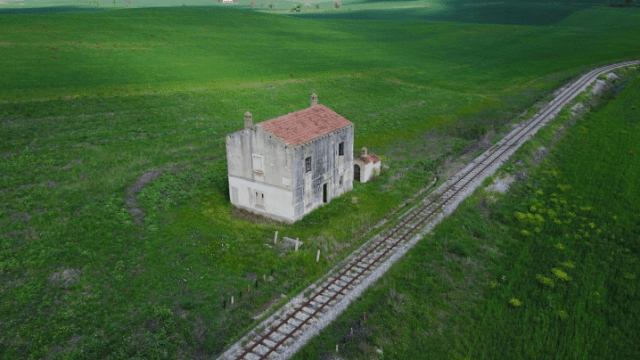
Torre Angellara in Salemo (all photos courtesy Agenzia Del Demanio)

Truly! Since not everyone is logged in to the roster of programmes gushing from Italy’s bureaucracy, such as it may be, check out this from the website Hyperallergic. Yes, Italy is giving away free castles, villas and other unused historic state-owned properties. The one catch, if you can call it that, is that you have to restore the property and turn it into a hotel, restaurant or other attractive spot for walking and biking enthusiasts.

Italy Is Giving Away 103 Historic Buildings,” by Claire Voon, displays 10 of the 103 properties (there will be future rounds of give-aways) and describes the program:

The Cammini e Percosi (Paths and Tracks) program, launched by the State Property Agency and Ministry of Cultural Heritage, arises as a unique way to promote the country’s treasures that lie off the beaten path. It’s also intended as a solution to the overcrowding of popular urban destinations, from Rome to Venice, and one that theoretically guarantees the longterm oversight of neglected sites.

“The project will promote and support the development of the slow tourism sector,” Roberto Reggi, a spokesperson for the State Property Agency, told The Local. “The goal is for private and public buildings which are no longer used to be transformed into facilities for pilgrims, hikers, tourists, and cyclists.”

So, no, you won’t be able to snag a slice of Rome on the cheap, but wherever you snag your villa or castle, it can’t be very far away from the Eternal City. And you may even learn to enjoy being out of the hubbub, making eternal friendships with the relaxed folk who have been sucked into the meandering maw of the slow tourism movement.

Hey! All you conquistador wannabes! Just do it! Veni, vidi, vici and all that!

Screen Shot 2017-05-26 at 8.04.22 PM.png

House in Irsina.

Posted in Architecture, Development, Preservation | Tagged , , , , , , , | Leave a comment

Unwelcome Arnold House?

Screen Shot 2017-05-25 at 1.52.19 PM.png

Welcome Arnold House at 21 Planet St., Providence (Catherine Zipf)

Is the Welcome Arnold House (circa 1785), on Planet Street in Fox Point, doomed to demolition by neglect? That’s the question posed by Catherine Zipf’s architecture column in today’s Providence Journal. She wonders whether its owner, Walter Bronhard, intends to let it deteriorate until it can barely stand. He has already applied to tear it down.

In “Will historic house face demolition?,” Zipf describes the history of the house and its current predicament, and explains how saving colonials in Providence has become old hat, almost a done deal as soon the plight of an old colonial house becomes known. “No one argues over saving 18th century buildings,” she writes. “We just do it.”

Good! But what about the Welcome Arnold House? Bronhard, who has not owned the house for as long as it has been deteriorating, “seeks permission from the Historic District Commission to demolish the building and recon- struct a copy,” she writes, adding: “Great idea, right? Won’t a replacement make everyone happy? Unfortunately, no.”

She correctly suggests that a replacement, even if well done, does not preserve the qualities we value in a genuine historical building. A replace- ment, or restoration, would be acceptable under the circumstances, indeed admirable, if it had burned down, or if it were in fact so deteriorated that it had to be demolished for reasons of safety. But if it gets that way through malign neglect, then it is not acceptable – though what can be done about it is hard to know. Until it actually falls down it can in theory be fixed, however expensive that may prove. The city can continue to deny a demo permit until Bronhard throws up his hands and decides either to fix the building or sell it to someone who will.

That’s my hunch, at least. I don’t know exactly what Bronhard’s rights are as a house owner – or his duties under the law. Bronhard also owns the nearby Gen. Ambrose E. Burnside House (1866) and is apparently on a house-buying spree on the East Side of Providence, so preservationists should be pressing the city to clarify these legal issues.

In reading Zipf’s thoughts about the Welcome Arnold House, I was with her (I am not always so agreeable!) until she wrote: “We don’t build buildings as we did in the Colonial period.” Obviously we cannot do so in precisely the same way, using the same tools and techniques. But we can do so to a degree that produces a contemporary house that satisfies the widespread yearning for new buildings designed in the manner of old buildings. We can and we should. We must not accept the false idea that we cannot do so. Modernists commonly assert that we cannot – but the fact is that we can, and they simply will not do so. It is a matter of choice, not fate.

And then, confusingly, she adds: “Current zoning codes will force the building’s form into a modern shape.” Well, certainly some building and safety codes mandate, say, wider steps and halls than might have been used in a historic house. But that need not prevent its design from taking a his- toric form. And, to be sure, any house built in modern times must perforce assume a “modern” shape. Any thing built today is modern in that broad sense of the word and cannot be otherwise. If that is all she means, her assertion is just a bland statement of the obvious.

But if she used the word “modern” to avoid the word “modernist,” with all its baggage, then she is not only mistaken – zoning codes force no such thing – but culpable of using rhetorical sleight of hand to mislead her readers. Per- haps she is trying to hint that we might as well accept modernist buildings because that’s all we are going to get.

For a writer, that is just as wrong as it is for the owner of a historic building to seek its demolition through a stratagem of neglect. So I will assume that Zipf was just stating the obvious – certainly no crime in that! – and that I am being hypersensitive. Get the man an Occam’s razor!

(Occam’s razor is shorthand for the theory that the simplest explanation for a phenomenon is more likely to be true than a more complex explanation. Conspiracy theorists are among those who often fail to use Occam’s razor.)

Posted in Architecture, Preservation, Providence | Tagged , , , , , , , | 4 Comments

Sad travel to Manchester

Screen Shot 2017-05-24 at 2.53.50 PM.png

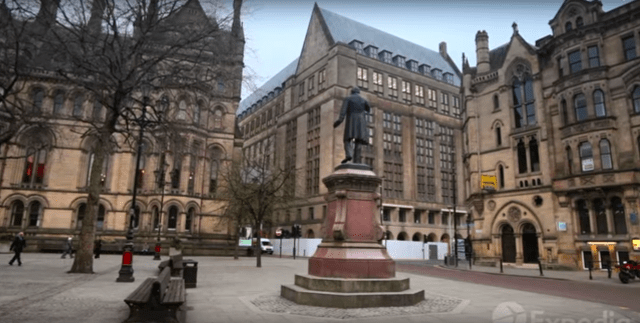
A civic square in downtown Manchester. (expedia)

Manchester has suffered a deadly blast delivered by Islamic extremists. Twenty-two have died and many others are injured. A five-minute video revealing the city’s many lovely classical buildings, set alas amid our era’s aggressive modernism, will not quell its horror and sadness. I had struggled with whether to post Manchester’s architecture, as I have come to do in the aftermath of these terrible events increasingly eviscerating cities around the globe. I would not want the reader to feel that I am equating the murder of innocents with ugly buildings. And yet it is a relationship explored by the evil Mohammad Atta. Terrorists resent the oppression represented by the global assault of the glass skyscraper, and all it represents, on indigenous cultures around the world. A perception of the need to address the relationship is far from an acceptance of the terrorists’ means of addressing it.

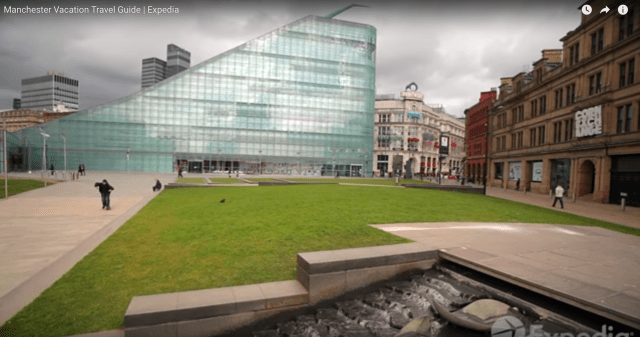
Be that as it may, I found a relatively gentle video tour of about seven minutes from Expedia, with a soft narration taking a pleasantly bland line on what has become of Manchester’s built manifestation of historical character. Those readers who watch “Manchester’s Vacation Travel Guide” join me in my condolences for the city’s citizens.

Screen Shot 2017-05-24 at 2.59.10 PM.png

National Football Museum, in Manchester. (expedia)

Posted in Architecture | Tagged , , , , | Leave a comment

TB on Fogarty’s demise

Screen Shot 2017-05-23 at 6.56.45 PM.png

The remains of the Fogarty Building. (See time-lapse video in Providence Journal, link below.)

Here is my Traditional Building blog post from a couple months ago, around the time some ardent local preservationists held a funeral for the John C. Fo- garty Memorial Building, soon after its demolition began. Soon after that its demolition was delayed, but now it is on again and the building, qua build- ing, is gone. All that’s left is the rubble, and that should be gone soon, too. The heart-warming photo above is from a video taken by the Providence Journal and linked to in a story below.

Readers with very long memories will see that this post resurrects a column I wrote for the Providence Journal back in 2007, with all discussion of the proposed demolition of the Police & Fire Headquarters removed. That demo took place soon after. The Fogarty survived another decade. The TB version is called “The Fogarty’s Demise: Not So Hard to Say Yes to Beauty.” Enjoy.

Enjoy? What about this! The Journal story that follows has a time-lapse video of the Fogarty being nibbled to death by ducks – the two machines that chewed away at it for weeks. The fall of the last wall is not shown, but interspiced are shots from many angles, and shots of the operators of the demo machines that suggest how much fun they are having and, perhaps, how much joy they are giving. The Journal story is called “Last wall of Fogarty Building falls in Providence.” It’s about three minutes of the most intimate pleasure that can be had by someone who truly loves architecture: A Brutalist building literally getting its comeuppance – getting what it deserves. … Ahhhh!

Posted in Architecture, Providence, Video | Tagged , , , , , | 1 Comment

Bench press in Providence

Screen Shot 2017-05-23 at 12.00.28 PM.png

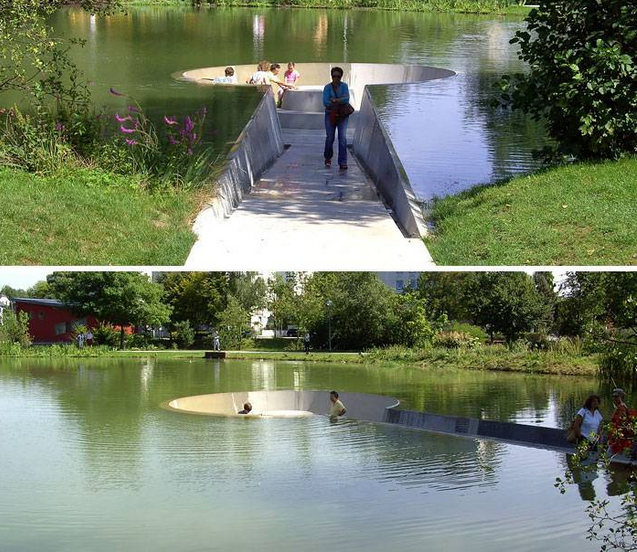
Top park bench, in Vocklabruck, Austria, on viral list. (Postize.com)

The above photo is the first on a list of benches from “14 Most Creatively Perfect Benches and Seats from All Around the World,” on the website Postize. The list of benches has gone viral, if not postal.

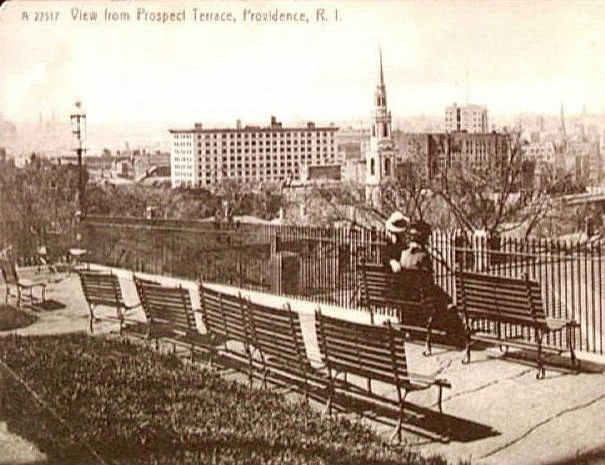
Since I cringed my way through these fascinating benches a while ago, they have boomeranged back at me through email from local citizens interested in new park benches here in Providence. I am concerned about pressure to go wacko in the redesign of one of the city’s sweetest little parks, Prospect Terrace, on Congdon Street. Replacing its old benches is high on the agenda, and they should be replaced – with new versions of the classic bench style.

Screen Shot 2017-05-23 at 11.58.25 AM.png

Old bench at Prospect Terrace. (ryan.norbaugher.com)

All of the benches that have gone viral are creative, some of them combine creativity and usefulness. Some of them combine one or both of those qualities with beauty. But most of them combine either or both of those qualities with a sort of sculptural dissonance with their surroundings that would under- mine the beauty of Prospect Terrace. The best of them are way too expensive and most of them look like maintenance nightmares, and some have safety issues. Some of them look comfortable and some others quite the opposite. But I am not sure that comfort, or at least too much of it, is high on the list of objectives for city benches in Providence!

The old-style benches reliably combine utility, efficiency and beauty – and, yes, creativity. These days, with difference for the sake of difference as the conventional wisdom, a certain dare I say boldness characterizes the strategy of going with the benches we all know and love.

I am sure most of the dozens of people who recently received the viral benches list probably think so, too, especially if they live on Congdon Street. Or if the bench were to be installed in front of their own house. Of course, most of them will insist otherwise because of the overwhelming ambient pressure in our culture to be “cool.”

Sorry. Most of these benches are fun to look at and maybe fun to sit on but for how long? Go with the tried and true. That is often the best strategy.

Screen Shot 2017-05-23 at 11.56.38 AM.png

Benches at Prospect Terrace, circa 1900, before Roger Williams monument. (PPL)

Posted in Architecture, Art and design | Tagged , , , , , | 6 Comments

Trip to Old City, Jerusalem

Screen Shot 2017-05-22 at 7.44.12 PM.png

Old City Wall, Jerusalem. (land-of-the-bible.com)

Here, from GlobeTrotter Alpha, is a 15-minute video of the Old City, Jerusalem, capital of Israel, with its Jewish, Muslim, Armenian and other sections, including the Western Wall and the Church of the Holy Sepulchre. Big events there today. Most of the shots, however, linger pleasantly and take us along the many passageways perhaps not frequented by tourists. No voice-over – this is Jerusalem as seen and heard by its residents.

Posted in Architecture, Video | Tagged , , , , , , , , | 3 Comments