Drabble does ornament

Screen Shot 2017-05-15 at 1.09.32 PM.png

Screen at Winchester Cathedral. (Alamy)

I’m close to the end of Margaret Drabble’s The Ice Age. I posted a short while ago some passages on the attitudes of developers in postwar Britain (“Inside Drabble’s developer“). Now the father of her developer protagonist has died and he visits the cathedral where he grew up the son of its schoolmaster. He is walking down an aisle, contemplating the churchly ornamentation:

Anthony, pacing, reached the aisle which was lit from within, by a small light, to show the depth and richness of the carving. Roses and tendrils of stone curled, intricate, involuted, around a central boss. The underlying rose. Craftsmanship, genius. He paused, walked on, watching the changing patterns in the wall. Diamonds, trefoils, toothing, a display of invention, fantasy, fancy – dedicated to what end? Of what had these men thought, as they nagged and whittled and chiseled at the solid blocks? Of the glory of God? It seemed somehow unlikely. … He paused again, by a strange little row of knobs of stone. They reminded him of something, some familiar pattern. He stared at them, intently, wondering, his mind empty, except for the fear of thinking about his father. There stood the row of little round knobs, each round but four-sided, each tapering into a funny little peak, as though the stone were not stone but some more liquid substance. What did they remind him of? Nipples? No, something softer, more clay-like. He touched one, felt its soft point. And suddenly it came to him: of course. They were like little icing decorations, little peaks, squeezed through a forcing bag and a rosette, onto a cake, a birthday cake, and with the realization, a whole scene, long forgotten, came back whole into his memory. …

He is a boy again. No need to go on. I did remove a short passage within the paragraph that has Anthony wondering about the craftsmen’s wages and security. I wanted to maintain the flow of the description of ornament. As to what the craftsmen were thinking as they carved, might they not have been thinking about carving?

Posted in Architecture | Tagged , , , , , , , | 5 Comments

My auction bid for Hazlitt

Screen Shot 2017-05-14 at 8.53.10 PM.png

Here’s the column I described in my post earlier today, “Surrounded by beauty,” about attending the Bruneau & Co. auction showroom, in Cranston.

***

January 26, 1989
Supply versus demand at its worst: Two book lovers chasing one book

All hail the hurly-burly of the marketplace, but for me a small, safe desk in the far corner of the office will do fine. For all the thousands of words I’ve written hawking the wonders of capitalism and urging other people to go out there and compete, I rather shrink from it myself. I suppose I have the soul of a bureaucrat.

I hasten to add that I’m proud to have the soul of a bureaucrat, as I’m the son of one, a bureaucrats’ bureaucrat in fact, who worked at that temple of bureaucracy, the Office of Management and Budget. Dad was on “the management side,” so he devoted many years to improving the management of the bureaucracy.

Among his non-bureaucratic aspirations was to run an establishment where one could both buy a book and booze it up – not the book but oneself. He envisioned his customers reaching that modestly inebriated state of mind which H.L. Mencken described as “sweetly stewed,” while either reading quietly or talking of books with other patrons.

Perhaps because my father gauged the peril such an establishment would face in competition with stores catering exclusively to readers or drinkers, this goal eluded him.
Nevertheless, he got a lot of reading done at home. I imagine he’d smile at the extent to which he passed his bookishness on to his three sons, and I suppose he would nod at my reluctance to charge into the competitive fray. I felt this disinclination anew last week at an auction of books.

I attended the auction and bid on a book, neither of which I had ever done before. The experience embodied, for me, the principle of supply and demand at its most confrontational: too many buyers chasing too few goods; in this case, two chasing one. The auction itself was fascinating, but bidding against one other person for what we both badly desired was singularly unpleasant.

My quarry was listed in the auction catalogue as Lot 124: “The Plain Speaker, L(ondon), 1826, 2 vol set. Paper on boards, Gd (25-75).” The name of the author was not disclosed in the catalogue, probably because, as was often the case in those days, it was not disclosed in the book. However, I knew that it was by my favorite author, William Hazlitt, who had had a collection of essays published that year under the same title. In short, it was a first edition, but that was not mentioned in the catalogue either. It was expected to fetch somewhere between $25 and $75. Was I the only one at the auction who knew its true value?

Hazlitt is best known for his Shakespearean criticism, but I prefer his personal essays, and his best are in The Plain Speaker. In 1978, I left a beautiful edition of it (though not a first) behind in a Washington bar after celebrating the publication of my first letter to the editor, and I had not replaced it since then with any edition of comparable value.

As I arrived at Knights of Columbus Hall in Middletown last Thursday afternoon, I suspected I might now be able to do so, and on the cheap to boot.

Some 30 people, mostly men, all but three of whom wore spectacles, were in attendance as the bidding began. Bookish as I am, I felt out of place – not for lack of glasses but for lack of a sweater and a plaid shirt. Having left the office early to attend, I was the only bidder in suit and tie. Thankfully the auctioneer, Jim Weyant of The Scribe’s Perch in Newport, wore a top hat, which balanced things out a bit.

It took an hour and a half to auction off the first 123 lots. When the Hazlitt finally reached the block, I was ready. There were no absentee bids, so the bidding started at $5. I raised my hand, and waited in the silence that followed for Jim to conclude that nobody else was interested in a somewhat tattered set of old books with no apparent author.

But instead of letting his hammer fall to announce my sly victory, his eyes darted to the back of the hall, his hand pointed, and to my distress he said, “Ten dollars . . . Do we have $15?” I raised my hand again, fearing to glance back to discover my adversary, who bid $20, whereupon I bid $25, he bid $30, I $35, and on and on until the bidding reached $110, well beyond what I imagined myself paying. I stopped raising my hand at that point, but he didn’t. The hammer fell at $120, and I lost the Hazlitt to this villain, who seemed to have bottomless pockets.

During the bidding, a sort of vertigo overtook me as I wondered how high it would go, how much I really was willing to pay for the book, the mortification I might feel if I were to drop out of this wallet-to-wallet combat first. The fear of bankruptcy triumphed over the fear of humiliation in the end, though when it was over even this failed to occur beyond a vague but bearable embarrassment at losing.

Afterward, I mustered the gumption to introduce myself to my antagonist, who, it turned out, is a used-book dealer, Michael Chandley of Cellar Stories in downtown Providence. He said he was bankrolled by somebody behind the scenes who recognized that Lot 124 was a first-edition Hazlitt: a professor at Brown University whose name he wouldn’t reveal. Whomever he or she may be, I suspect (because he avoided the auction and because he is a professor) that the actual practice of free-market principles attracts him no more than it does me.

Does my squeamishness render me an unworthy proponent of capitalism? I should hope not! Fortunately, capitalism in recent years has argued its case well enough on its own – so well, in fact, that the Marxists of Moscow and Beijing are trying it out. To say the least, the bureaucrat in me is glad to have so much help.

David Brussat is a Journal-Bulletin editorial writer.
Copyright © 1989. LMG Rhode Island Holdings, Inc. All Rights Reserved.
Record Number: MERLIN_1590416

Posted in Books and Culture | Tagged , , , , , , , , | 2 Comments

Surrounded by beauty

DSCN0725.JPG

Tableaux of antiques at Bruneau & Co. auction showroom, in Cranston.

Spent Friday morning surrounded by beauty at the auctioneer’s showroom of Kevin Bruneau out Elmwood way, just over the line in Cranston. The exterior of the low, tan cinder-block building belies its contents. A visitor, having mastered the desire to flee, enters a steel door, only to confront a large, equally dismaying blank hall of clutter.

But to approach the clutter and immerse yourself in it, as I did before my presence was noticed, brings enchantment after enchantment. A couple of rococo tables of (I imagine) oriental origin, upon the nearest of which sat an ornate sculpture of a mythical creature upholding various carved bowls rising up and up and bedecked with groups of other strange animals – my descrip- tive faculties fail me, and that’s only one of the pieces in this set.

As I learn under the guidance of Bruneau and his associates, the studio boasts a variety of antiques, difficult to fathom, from entwined embracing winged figures in marble to a steamer in a case whose paddle wheel operates to a ketch sculpted from ivory to a wretched hand “after” Rodin ($1,000 in value, or $30,000 had it been an actual Rodin) to a stuffed puma, a clay fish standing on its tail, a zinc terrier on alert, a hippopotamus in evening garb. Nudes, such as that held by Kevin below, do not go unrepresented in the showroom stock. There are paintings galore from every period. Now and then you might stumble upon a piece of architectural ornament. The most valuable item on the premises is a Patek Philippe watch valued at $150,000. Must be old, eh? No, it was manufactured in Geneva, circa 1990.

A rococo clock designed after a love story popular in the Napoleonic era, depicting its sad end in a shipwreck, is described by Bruneau’s associate and fellow auctioneer Travis Landry in “The French Revolution and its Influence on the Arts,” an article written last year for the Bruneau & Co. blog:

Bruneau & Co. Auctioneers is proud to offer this rare and important French early nineteenth century Charles X Romantic ormolu and silvered bronze clock. The bright ormolu clock topper of the shipwreck sits in beautiful contrast of the silvered bronze ocean wave base. The rim of the clock body is decorated with a repeating Rococo stylized shell pattern in high relief. The corners of the body are decorated with stylized open work cornucopia patterns with gilt highlighting. The base is decorated with swirling floral patterns with a central crest depicting a dragon and phoenix. The clock is supported by curled feet adorned with Rococo shells. The dial is silvered with black Roman numerals. The movement has an impressed maker’s mark “P.C”.

Eventually these items will disappear under the auctioneer’s hammer, to be replaced by more lovely stuff brought in by Bruneau and his network of col- lectors to fill the chamber and then vanish in their turn, bought by collectors who love them or speculators who love what they will bring in five years. I did not ask him how much this hurts. He could not think of the item in the shop he’d miss most, or even the top three. He asked his staff. They had no idea either. He took me out to his house in Scituate woods, however, where he has built a museum, clearly stocked with some of the things he loves the most, with a collection of architectural ornament clustered here and there in front of the house.

Perhaps I have missed my calling – to surround oneself with things that bring a thrill with each encounter. I was in Bruneau’s shop for just an hour but he is in his shop every day, when he’s not he’s out searching for beautiful things. In his life a marvel might be waiting to greet him around every corner. Ahh!

He did not detail the irksome aspects of being surrounded by beauty all the time. Or so I assure myself. It is a business, after all. He does not come in to work and enter full swoon for eight hours and then leave. (Does he?) I once participated in an auction. I described it in a 1989 column for the Providence Journal called “Supply versus demand at its worst: Two book lovers chasing one book,” one of my last before embracing architecture as my usual topic. The edition of Hazlitt’s 1826 essay collection The Plain Speaker was taken, after “wallet-to-wallet combat,” by Michael Chandley, of Cellar Stories on Mathewson Street. He was bidding on behalf of a Brown professor, whose name I learned years later but have since forgotten. The rascal.

[The column about my bidding at auction will be my next blog post.]

Coming up at Bruneau & Co., at 63 Fourth Ave., in Cranston are auctions on Monday, May 22, at 6 p.m. and on Saturday, June 3, at 10:30 and noon.

A tip of the chapeau to Nancy Thomas, of Tapestry Communications, who helps Kevin spread the word about his auctions and who put me in touch with the auctioneer and arranged my tour on Friday. She showed up, too. Who could stay away?

DSCN0708.jpg

Screen Shot 2017-05-14 at 4.53.02 PM.png

DSCN0740.jpg

DSCN0726.jpg

DSCN0730.JPG

DSCN0727 - Version 3.jpg

DSCN0729.JPG

DSCN0711.JPG

DSCN0728.jpg

DSCN0748.jpg

DSCN0735.jpg

DSCN0718.JPG

DSCN0712.jpg

DSCN0713.jpg

DSCN0714.jpg

DSCN0717.JPG

DSCN0738.JPG

DSCN0747.JPG

DSCN0750.JPG

DSCN0760.JPG

DSCN0768.JPG

DSCN0766.JPG

DSCN0773.jpg

DSCN0764.jpg

DSCN0763.JPG

DSCN0776.JPG

Posted in Art and design, Photography | Tagged , , , , , , , | 3 Comments

A Rogue Island Museum?

Screen Shot 2017-05-12 at 7.57.50 PM.png

Coin-O-Matic shop, in Providence, was headquarters of New England mob. (Providence Journal)

I just listened to the first episode of Crimetown, the podcast about the criminal history of Rhode Island’s capital, Providence. The podcast has zoomed to the top of the charts not just in Rhode Island and the U.S. but around the world. I found the voices of participants, journalists and other sources compelling. Still, it was troubled by the same lame gimmicks that trouble the modern TV documentary. Documentaries nowadays are clogged with fake “scenes” and bad music and tedious pregnant pauses to heighten the drama. Try that without pictures and you have a documentary podcast.

The Crimetown podcast of 18 weekly episodes on Providence was produced by Gimlet Media, Marc Smerling and Zac Stuart-Pontier.

There’s no denying the popularity of the podcast. Maybe a rebranding of the Ocean State as “Rogue Island” is in order. Anything would be preferable to the cockamamie rebranding that crash-burned last year. “Rogue Island” is one of the brickbats hurled at the colony founded by Roger Williams after he was thrown out of Massachusetts in 1636. But they were not kidding.

I myself proposed a Rogue Island Museum many years ago, and mentioned it often in my Journal column. But perhaps wary of my editor’s frequent editor- ials chiding Rhode Islanders for giving a wink and a nod to corruption, I al- ways had my tongue half in cheek and I never made a crusade of it.

In the wake of Crimetown, maybe the time is now.

The RIHMFC (rim-fack) scandal broke here right after I arrived in Rhode Island in 1984. Then came the RISDIC (riz-dick) scandal. In 1998 Gov. Ed DiPrete was jailed. Then Mayor Cianci was sent to prison. Then it was the 38 Studios scandal, starring former Red Sox ace pitcher Curt Schilling, who got the General Assembly to give him $75 million to design video games. Then the state threw its House speaker into the slammer, then the chairman of its Senate finance committee. As of now, two Providence city councilors are under indictment. These represent only the highlights of a sleazy three decades here. This state is journalist heaven – so of course my old employer, the Providence Journal, is laying off reporters by the bucketful.

Still, a Rogue Island Museum would have to reach farther back in time to reach the real mother lode of wrongdoing in this state. On top of his cardinal sin of advocating religious freedom (“soul liberty”), Roger Williams was later sacked from his state job as toll-taker on the bridge over the Providence River just four years after he was hired by the General Assembly. History has not revealed the reason to us. Maybe he harangued bridge users too mercilously, driving them to complain to their assemblymen. Or maybe he was the Rhode Island state government’s first no-show employee.

Rhode Island’s role in the slave trade was morally despicable until selling slaves was banned here; then it became legally despicable as well. For a few weeks during the Dorr Rebellion of 1842, the state had two duly elected governors. Rhode Island’s influential U.S. senator Nelson Aldrich was known during the Gilded Age as “general manager of the United States” (and not in a good way). Then, in 1924, Democratic efforts to fillibuster GOP legislation were stymied by a stink bomb set off by a hired Boston thug in the capitol de- signed by Charles Follen McKim, who is said to have won the commission because he had so many clients among the nabobs of Newport.

But there’s no taped record of these high crimes and misdemeanors, so don’t expect any podcasts of Crimestate. Nevertheless, there are lithographs, daguerreotypes, photographs and film. And there are the kinds of artifacts that are the heart and soul of a museum – the tree that consumed Roger Williams’s skeleton, the ink blotter from the desk of Senator Aldrich, a stone from the mythical slave tunnel leading to the Providence waterfront from the John Brown House, the cigarette butt that Buddy Cianci used to assault his ex-wife’s alleged lover, that sort of thing – always popular, but unsuitable for podcasts.

Yes, of course, there’s Mayor Vincent A. “Dr. Jekyll/Mr. Hyde” Cianci Jr., convicted of assault in 1984 and of corruption in 2002, who led Providence for 21 years. There are storerooms full of Buddy artifacts, many of which were on display at the Mile and a Quarter House restaurant here just last week. Pairing his history with that of New England mob boss Raymond L.S. Patriarca – whom Cianci prosecuted for murder before he ran for mayor – forms the structure of the Crimetown podcast series. Cianci’s exploits need no publicity from this corner.

My favorite has always been mob lawyer Joseph Bevilacqua as speaker of the R.I. House of Representatives and then chief justice of the state Supreme Court. Come again? The mob’s legal counsel was chief justice? Is that a joke? No. Official eyebrows were not raised until after the state police caught him on camera emerging from a motel room pulling up his zipper after a date with a hooker. Yes, he was forced to resign for having maintained contacts he had promised to break off with his old “family” friends. But the mortal sin was not that he kept up his mob ties but that the Rogue Island political class gave him that job the first place. There’s no law to wipe that slate clean.

So where should the museum be erected? The Coin-O-Matic, on Atwells Avenue, cries out for the job. I wish I’d been sufficiently on my toes to urge the Rhode Island Historical Society to buy Ray Patriarca’s headquarters of the New England La Cosa Nostra. (Yes, in a Coin-O-Matic!) There’s a famous photo of him with a cigarette hanging from his lips. The cheesy building survived as the Coin-o-Matic until just a few years ago. Now it is, I think, last time I looked, a tattoo parlor. Or something like that.

The state should buy it and turn it into the Rogue Island Museum. It’s already surrounded by fancy restaurants. What a shot in the arm for tourism in this state, and the restaurant tax! Imagine the possibilities for rebranding!

Screen Shot 2017-05-13 at 12.29.23 AM.png

Raymond L.S. Patriarca outside Providence County Superior Court. (Providence Journal)

Posted in Providence | Tagged , , , , , , , , , | 4 Comments

Remember to save Alamo

Screen Shot 2017-05-11 at 3.25.17 PM.png

The Alamo, from which modern San Antonio seems to recede. (history.com)

The Houston Chronicle’s article “The Alamo is forgettable. A controversial new plan could change that,” by Texas Architect’s Alyssa Morris, describes a proposal to “remember” the Alamo by tinkering with its site in San Antonio. But her description of the plan contains four words – “at least in gesture” – that should alarm any friend of the historic site. She writes:

A new master plan aims to restore, at least in gesture, conditions of the mission before it was destroyed, highlighting it as a place where indigenous families lived, worked and worshiped for centuries, as well as the site of the 13-day siege.

“At least in gesture” refers to a glass wall that would “suggest” the wall that had surrounded the site before it was attacked, in 1836, by Mexican General (and 11-time Mexican president) Antonio Lopez de Santa Anna. Santa Anna sacked the mission, executed the Texan survivors and ordered the mission demolished, which in part it was. But there was no glass wall at the Alamo. To put one there, as proposed by the Alamo master plan, would be to attack its memory and undermine what remains of its “authenticity.”

Morris observes, rightly or wrongly, that today’s Alamo is under siege by the surrounding urban environment. She writes:

The site retains few of the original features that would have made up the 18th-century Spanish mission, except, of course, the iconic chapel and the long barracks. But these buildings seem curiously out of place and ignored by the high-rises and parking lots of the modern metropolis that grew up around them.

Screen Shot 2017-05-11 at 2.59.32 PM.png

Ben Franklin’s ghost. (Wikipedia)

To then erect a glass wall would be to commit a further assault on history, reminiscent of the “ghost reconstruction” of Benjamin Franklin’s house and shop in Philadelphia by Venturi & Rauch. Their abstract frame desecrated that site just as a glass wall would desecrate the Alamo site.

I assume that other parts of the Alamo master plan, by Preservation Design Partnership, of Philadelphia, suggest a more sensible improvement of the site. Today the plan goes before the San Antonio City Council for concep- tual approval. Let’s hope the council will encourage the architect to “tear down that wall” so that the Alamo will not be falsely construed.

Museums of this sort have plenty of techniques to inform the public of what was there. They can erect educational boards that show what historians and archaeologists’ think the original wall looked like. They can actually rebuild the original wall according to such findings. The last thing they should do is to add yet another thing that was not there and should not be there.

Screen Shot 2017-05-11 at 3.06.17 PM.png

Rendering of Alamo historical site with glass wall and surrounding city. (PDP)

Posted in Architecture, Preservation | Tagged , , , , , , , | 7 Comments

D.C. classical tours return

Screen Shot 2017-05-10 at 5.22.26 PM.png

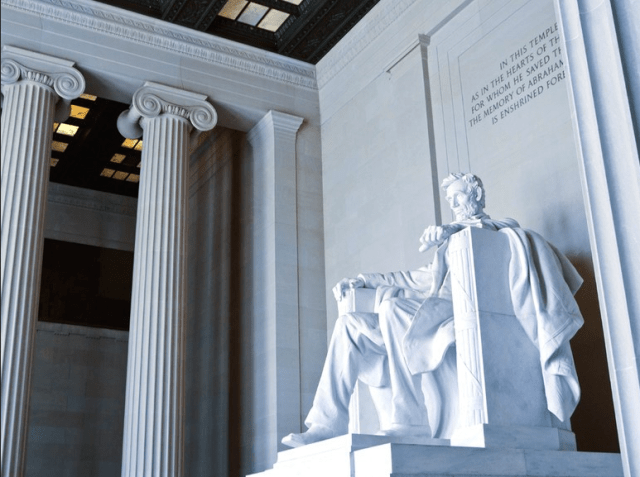
The Lincoln Memorial, by Henry Bacon. Statue by Daniel Chester French. (Conde Nast)

Washington, D.C., is among the nation’s if not the world’s most walkable big cities, and this year the town’s leading advocate for beauty, the National Civic Art Society, returns with a new slate of its walking tours. Moreover, because the District of Columbia is the capital of the free world, its architecture and accompanying sculpture must be comprehensible to citizens. In those many cases where its language is classical, its understanding is intuitive.

This is from the NCAS’s introduction to the “Our Classical Heritage” tours:

These tours are fashioned for those who wish a greater under- standing of why and how the District of Columbia came to be a classically designed city. You will learn of the ancient antecedents of our political philosophies, of the stylistic precedents of our architectural forms, and of the Founders’ classical vision.

But there are, I’m afraid, other languages (if we can so call them), and for the first time one of the tours is devoted to architecture in one of those so-called languages. So it is advantageous that this year’s tour guide, the sculptor Mi- chael Curtis, will lead all five tours. His experience in the direct translation of material to feeling will help him assess the several modernist buildings on Tour IV – “Brutal Mistakes” – on June 24.

The roster of those mistakes and the schedule for the entire series of NCAS’s “Our Classical Heritage” tours can be viewed at Eventbrite, where reserva- tions can be made at the $10 a tour, reduced from last year’s price. All of the tours are on Saturdays. The tours are individually titled as follows:

  1. June 3 – Washington, the Classical City
  2. June 10 – National, Political, and Personal Liberty
  3. June 17 – Freedom and Sacrifice
  4. June 24 – Brutal Mistakes
  5. July 8 – British America

At $10 a pop, this is the classical definition of a bargain. So I said in “Tour the national classical” a year ago, when the levy was fifty percent larger, and so it remains a year later. Although he was not among America’s founding fathers, Winston Churchill had this to say: “We shape our buildings; thereafter, they shape us.” That’s pretty much what Washington and Jefferson were thinking when they chose classical architecture to be the design template of the new United States of America. The value of understanding what our buildings say about our society has only grown since the last edition of NCAS D.C. tours.

O! To be in Washington!

Posted in Architecture | Tagged , , , , , , | 4 Comments

A “McMansion Hell” blog

Screen Shot 2017-05-09 at 11.55.32 AM.png

Kate Wagner, who writes a blog called McMansion Hell, hates McMansions, and so do I. But I revere Kate Wagner’s ability to tell the difference between a McMansion and a mansion. They are different. I sometimes wonder whether the word McMansion was invented to cast aspersions on mansions, not for being big houses built for people who can afford them, but as new houses built in old styles for people who like them – verboten to the modernist mindset.

The blog Hyperallergic has an article, “The Worst McMansion Sins, From Useless Pilasters to Hellish Transom Windows” by Sarah Archer, that understands Kate Wagner to perfection. Archer hits the jackpot when she describes McMansions as “architectural Mad Libs” and as the houses of rich people as imagined by poor people. (She was actually referring to Trump – “a poor person’s idea of a rich person.”) She writes:

Though a quick read can give the impression that the blog is about taste in a general sense, Wagner is at heart an architectural grammar scold: She hates ugly chandeliers, but what really fuels the ire of McMansion Hell is the misuse and decontextualization of elements that are supposed to carry architectural meaning. It’s the flagrant disregard for these visual and structural relationships — like, say, the cavalier application of scotch tape to the back of an overly-long necktie — that drives Wagner to share her personal hell with the internet.

She is equally devastating in her analysis of McMansion interiors. Perhaps the most amazing thing about Wagner’s site is its McMansion Scale, which analyzes current residential architecture from “New Traditional” to “McMansion Hell.” Her chart moves from “zone of forgivable errors” and “very trendy but well executed nonetheless” to “cascading gables” and “two-story entry, PoMo arch.” The chart displays a comprehensive and erudite understanding of contemporary home design, and is rib-splitting funny to boot.

A tip of the hat to Clay Fulkerson, who sent me the article from the blog Hyperallergic, an amazing compendium of quirky stuff, such as “The Octopus: A Motif of Evil in Historical Propaganda Maps,” which I’m going to next.


Posted in Architecture, Humor | Tagged , , , , | 4 Comments

The apotheosis of Ong-ard

Screen Shot 2017-05-07 at 8.14.00 PM.png

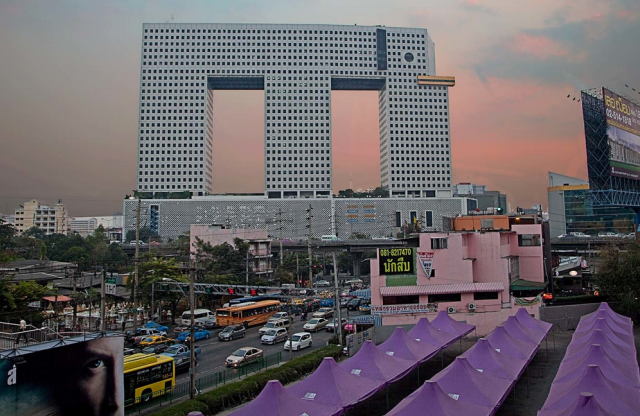
On Friday the top of my post “AD’s 24 ugliest skyscrapers” featured the Elephant Building, in Bangkok. Shortly after, Leon Krier left a comment informing me that the building’s architect, Ong-ard Satabrandhu, had had a Road to Damascus experience after designing it, and turned away from his modernist work, toward design that delves deeply and delightfully into Thai architectural tradition.

In an email Krier included a link to some illustrations, one of which is atop this post. No modern architect would ever assemble anything so enchanting. It would be beyond his power. That Ong-ard’s website is hard to get around indicates that he has not altogether chucked his modernist tendencies (mod- ernists also dislike putting the front door where it can be seen). Still, a search for descriptive material about his work (in English) rewards the effort. I en- joyed finally arriving at its “Profile” section, with its photo of the architect next to a table full of models of his work (see below). Then I found this:

Incidentally, Colin Rowe — Ong-ard’s esteemed professor at Cornell — wrote the well-known treatise “The Mathematics of the Ideal Villa” (1947), a text that discusses architectural and organizational similarities in the works of Palladio and Le Corbusier.

Well, we won’t hold that against Ong-ard. There is no similarity worth noting between La Rotonda (by Palladio) and the Villa Savoye (by Le Corbusier). Perhaps Rowe concludes that there are no such similarities – ha! – except that maybe they both preferred to use pencils. Who knows. Maybe the au- thor of this profile of Ong-ard inserted the paean to Rowe without permis- sion, and Ong-ard hadn’t the heart to chastise the perp. Or perhaps his Rowe fixation latched onto him during his Elephant Building period and he has had too much work to find time to give it the boot. Many fine architects have a hard time letting go of their teachers’ fondest theories, however misguided.

But soon I came across the following, and my thoughts about this architect, so new to me, floated back up into the clouds:

What Ong-ard discovered through his research — using drawing and photography, techniques that are almost entirely visual and not just historical or especially academic—is that certain attributes of clarity, modesty, proportion, scale, and repeated building elements are shared by most of his sources of inspiration. In other words what this quiet, talented architect found in these examples and seeks in his own work are attributes that seem to render the ego of the architect almost invisible or anonymous as if the works emerged almost without effort, from their place and situation. Such effortlessness was known in Italy, in the day of Palladio, as Sprezzatura, making the difficult seem easy.

It is very rare to find an architect who has come to his senses during his career. Ong-ard has published a book of his work, A Tradition of Serenity. Here is its forward by Leon Krier, who emphasizes the difficulty of escaping the modernist establishment even in the world’s most distant outposts. I will post some evidence of this below. Enjoy.

Screen Shot 2017-05-07 at 8.28.36 PM.png

Screen Shot 2017-05-07 at 8.46.27 PM.png

Screen Shot 2017-05-07 at 8.47.09 PM.png

Screen Shot 2017-05-07 at 8.47.23 PM.png

Screen Shot 2017-05-07 at 8.59.24 PM.png

Screen Shot 2017-05-07 at 8.59.39 PM.png

Screen Shot 2017-05-07 at 8.59.57 PM.png


Posted in Architecture | Tagged , , , , , | 4 Comments

AD’s 24 ugliest skyscrapers

Screen Shot 2017-05-04 at 8.25.46 PM.png

In Bangkok, the top building on AD’s list of 24 ugliest skyscrapers worldwide. (AD)

Architectural Digest has posted a list of the 24 ugliest skyscrapers in the world. Bully for AD. The building on top is in Bangkok. Is it the ugliest or the 24th ugliest? The editors do not say. I suspect that the list is in reverse order, not just because the protocol for lists nowadays is that the first shall be last, but because the last, in this case, is the Trump Tower in Las Vegas. Yuuugly!

It is a very ugly building but not the worst on this list. These are all ugly buildings not because they fail deeply on just about every aesthetic level – even though they do – but because they are all modernist buildings. I ap- plaud AD for posting this list, but couldn’t they find one ugly traditional skyscraper just for the sake of verismilitude? If it were a list of the most beautiful modernist skyscrapers, I dare say the best would be worse than the worst on any list of the 24 ugliest traditional skyscrapers. Or of all traditional skyscrapers of all time. Put that in your pipe and smoke it, AD!

No, of course there are probably some accidentally attractive modernist buildings that are better than the worst traditional buildings. Maybe five?

By the way, the skyscraper in Bangkok is called the Elephant Building. Did you guess that before you read it here?

Posted in Architecture, Humor | Tagged , , , , , , , , | 10 Comments

Inside Drabble’s developer

Screen Shot 2017-05-03 at 6.23.02 PM.png

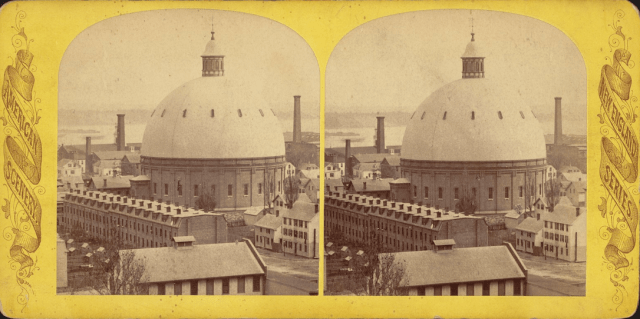
Gasometer with largest dome in the world. (digitalcommonwealth.org)

Margaret Drabble’s 1977 novel The Ice Age is supposedly about Britain and its existential angst during the ’60s and ’70s, but I just started reading it. For a few pages near the outset, at least, it concerns the career of her protagonist, Anthony Keating, son of an Anglican churchman. Keating starts out as a commentator on the BBC and becomes a property developer in London. In his first project he and his partners buy and raze an ancient tottering candy factory, the Imperial Delight Company, after which they name their new firm. She writes:

Anthony found the site inexpressibly romantic and exhilarating. … There was a large, open, cobbled space in the center of the site, which had a strange look of the countryside about it. Weeds grew up between the stones. There were horseshoes, nailed on the warehouse wall. Once there must have been a stable; no doubt the sweetmaker’s had distributed its sweets a hundred years ago by horse-drawn van. There was even a small tree: an elderberry had managed to root itself between the cobbles. It would be a pity, in a way, to remove this space, though nobody had seen it for decades, except for the handful of people who worked there, but it too would have to go. Anthony was quite relieved when Rory suggested that the local council might find their redevelopment plans more acceptable if they incorporated in them an open area for public use. “We could point out,” said Rory, who knew many developers’ architects and their ways with zoning boards, “that this present area hasn’t been seen or used for years, and we’re going to return to the community a nice patch of open space. With trees.”

That project was successful, and Anthony grew to enjoy driving around the city, looking for more property to redevelop.

London became a changed place to Anthony. Before he had seen it as a system of roads linking the houses of friends and the places of his employment, with a few restaurants and shops included in his personal map. Whole areas, hitherto ne- glected, acquired signifi- cance. At first Anthony went around dazed by achievements that he had once taken for granted: what genius had assembled the land for the Bowater House, for Eastbourne Terrace in Padding- ton, for soaring Millbank Tower and elegant Castrol House? And who could regret the forgotten buildings these giants had replaced? Even the much-maligned Centre Point of Harry Hyams revealed itself to him in a new light: indeed, he began to remark casually to friends, he had always thought it a rather fine building. …

Next, to assemble the site for another project, they bought a huge gasometer.

[H]e would drive down to look at [it], for the pleasure of looking at it. It was painted a steely gray-blue, and it rose up against the sky like a part of the sky itself; iron air, a cloud, a mirage, a paradox, defining a space in sky, changing subtly in color as the color of the sky changed. It stood dark and cold, it would catch the pink wash of sunset, it would turn white like a seagull, it would take upon itself the delicate palest blue against a slate-dark background. It was a work of art. It would have to come down, of course, for who wants an obsolete gasometer? But while it stood, while the I.D. Property Company negotiated for the other parts of the jigsaw, Anthony would gaze upon it with more pride and more wonder than he had ever, in childhood, regarded the cathedral outside his bedroom window, though that cathedral was thought by some to be the finest building in Britain. It thrilled him more to own it than it would have thrilled him to have a Velázquez, a Titian on his wall. A derelict gasometer, radiant with significance. One could see it from miles away, right across the Thames, from some directions. It lifted the heart. Up soared the heart like a bird in the chest, up through the light and airy metal shell, to the changing, so much before unnoticed sky.

Hmm. What came to mind immediately here was the image of the alien bursting from Sigourney Weaver’s colleague’s chest in Alien.

Drabble describes Anthony’s admiration for Len Wincobank, the young developer who had introduced him to the business.

… [H]e loved what he was doing, loved his buildings, believed in them, thought them beautiful, thought people ought to like them, was outraged when they didn’t (and, of course, they didn’t, as most people dislike anything new), and was determined, with a kind of blinkered faithful zeal, to make people like them. He was an enthusiast. Anthony liked Len’s girl, Maureen, too. Occasionally he had misgivings about the appearance of some of the actual developments: the center in Northam looked to him, from outside, sinister and blank, but when Len explained to him that this was the new kind of architecture, that there was no need to have any windows at all in that kind of building, that most new buildings were going to be windowless, and what about the height, the fine expanse, and of course perhaps architects hadn’t yet quite got the hang of building without windows, but they would, they would – well, Anthony began to see even the Northam center with new eyes.

Knowing little of Margaret Drabble or her work, I picked up The Ice Age on a whim at my library’s annual book sale the other day. I had no idea such a trove of developer mindset lore lurked within. I will print more excerpts if other such gems show up.

(The gasometer pictured above, in Providence, supposedly featured the world’s largest dome. It may have been built in 1850 and demolished in 1920. Or built in 1872 and demolished in 1938. Sources conflict. I was searching on Google for a gasometer with a dome to illustrate this post and found that be- fore I realized its location. I had figured it was in London or, when I started reading the text, Boston.}

Posted in Architecture, Development | Tagged , , , , , , , , | 1 Comment