Shaping a Canal St. ethos

Screen Shot 2018-01-29 at 5.15.08 PM.png

Proposed 131 Canal St. viewed from east on Thomas Street. (DBVW)

Even as a new apartment tower arises on Canal Street, another of similar size and design, just south of it along the eastern edge of the Providence River, faces a harder slog through the city’s development process. It may be too late to avoid further degrading the historical character of the old neighborhood known, in the 18th century, as Cheapside – the city’s first commercial district. But there remains an option, other than outright denial of permission to proceed, that could mitigate the damage.

Last Monday the Downtown Design Review Committee viewed early renderings of the proposed new 15-story, 227-unit building. An article in the Providence Business News, “DDRC” reviews initial renderings for proposed College Hill apartments,” by Mary MacDonald, describes the project:

According to the design documents, the portion of the new building facing North Main Street would be only three stories, designed to complement adjacent buildings. The main section, between the Congdon & Carpenter building and the Edge College Hill building now under construction, would be 7 stories and 15 stories. The larger height is proposed using the development rights from the historical building.

MacDonald’s diplomatic description does not hide the fact that this new building is trying to eat the more venerable structure, part of which dates back to 1790. The design of the main tower fits into the context only of its adjacent brother and predecessor, called Edge College Hill and now under construction. Each building has a slightly different version of the cheesy junkyard cacophony of fenestration common to recent cheap-o development. Their colors are dreadfully off-key for their neighborhood. North Main is the city’s oldest street and must not be purposely insulted.

Yet, it may be argued that when complete, the two new 15-story towers will not be so bad. They both fill asphalt parking lots. They may not totally sully the character of the neighborhood, or block cherished views any more than the 1990-vintage One Citizens Plaza tower’s 13 scary stories already do. The Citizens tower is known as the Darth Vader Building because it blocks the view, once open, to the State House from downriver. That’s all we need. More Darth Vader Buildings!

Taking a more forgiving tone, perhaps the developer of both new buildings, Vision Properties, of Conshohocken, Pa., should be applauded for letting the architect, DBVW, refrain from entirely stomping upon the history next door. The Congdon & Carpenter Building, owned by Capital Properties (which mismanaged the development of its own land in the nearby Capital Center district), is the city’s oldest industrial building and site of the 3 Steeple St. restaurant of yore, and, to this day, New Rivers restaurant.

Screen Shot 2018-01-29 at 6.57.39 PM.png

Massing of proposed 131 Canal St. (DBVW)

The design documents for the proposed new tower show 15 stories overshadowing the Congdon & Carpenter from behind, but stepping down from there to seven stories and then to only three stories facing North Main and Steeple, where it juts out to only partly block the lovely gabled east-facing façade of the C&C (where the appalling Andre the Giant/Buddy Cianci billboard used to be). The architecture of these lower reaches of the new building seems to suggest an effort to sympathize with the traditional style of the historic buildings in its vicinity. (See larger image below.)

Good!

But not good enough. The taller portions of the building add to the negative impact of the worst elements of the area’s development in recent decades, and the architects’ effort to fit into what remains of its historical setting might not be performed very well. It should look like a very high quality façadectomy – the word for putting a new building behind the façade of an old building. And, to top it off, it looks as if the view of the State House dome from the corner of Benefit and Angell streets might be entirely blocked.

Fortunately, it seems that the height and bulk of the building both depend upon a certain lawyerly s-t-r-e-t-c-h of air rights transferred from the C&C’s owner to the new tower’s developer. If suspicions raised by the Providence Preservation Society are correct, the developer hopes that city officials will “wink-wink” their attempt to flip the small floorplate of the old building into a right to build much larger floorplates stacked atop the larger building.

(Greater City Providence has a more detailed explanation of what the developer is up to in its story “15-story ‘Edge College Hill Two’ on Canal Street site,” by Jef Nickerson.)

If the city can stiffen its civic cojones, it should substitute its “wink-wink” with a stern tsk-tsk, directing the developer to return to the committee with a design that drastically diminishes the height of the tower and drastically sharpens the design of its three-story effort to fit in along North Main and Steeple. Part of that should be to step its building even farther back from Steeple to expose more of the east façade of the C&C.

Vision Properties has withdrawn its proposal. Let us hope that if it returns to start over with a re-do, it will respect not reject its historical context.

City officials have done a deplorable job protecting Providence’s primary competitive advantage over other cities, its historical character. Even they must recognize that this must end, and be turned around, or else Providence will be no more attractive than, say, Houston or Charlotte – except without the business friendliness of those two cities.

If we keep on keepin’ on, our beauty will disappear both slowly and suddenly – slowly enough that few will be alarmed, but suddenly enough that there will be no turning back once calamity reveals itself. How the city oversees this development on Canal Street will indicate whether it has the vision to save Providence from mediocrity.

Screen Shot 2018-01-29 at 5.16.32 PM.png

Proposed 131 Canal St. viewed from the southwest on Memorial Boulevard. (DBVW)

Screen Shot 2018-01-29 at 6.57.39 PM.png

Larger image of massing diagram for 131 Canal St. (DBVW)

Posted in Architecture, Development, Preservation | Tagged , , , , , , , , , | 3 Comments

Modern architecture is crazy

Screen Shot 2018-01-28 at 9.11.23 PM.png

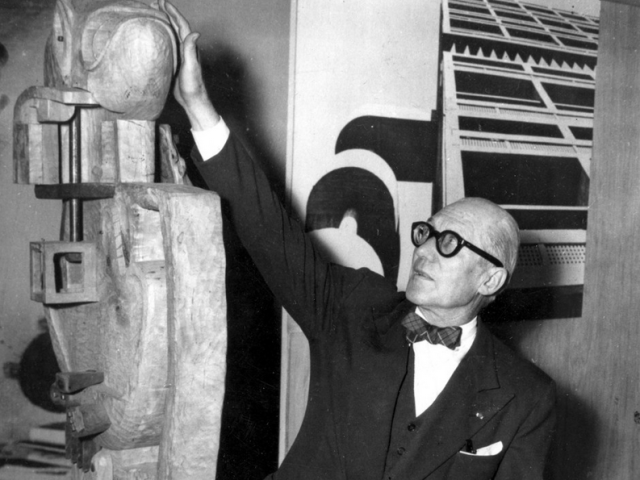
Le Corbusier, born Charles-Édouard Jeanneret, was a pioneer of modern architecture. (AP)

Among the most recent revelations of science in the service of architecture is that three of the most eminent founders of modern architecture suffered from mental illness. Le Corbusier was on the autism spectrum while Walter Gropius and Ludwig Mies van der Rohe had post-traumatic stress disorder.

Architect/researcher Ann Sussman, who has done much of the heavy lifting in this narrow field, argues that illness made them, as she says, “literally unable to process visual stimuli normally.” This affected their architecture, and, to the extent that their architecture led architecture’s departure from tradition, it helped shape the nature of that departure – which came to dominate the field in the 1950s and still does today, despite widespread skepticism among the public toward the result.

Sussman’s theory has not shattered the world of modern architecture, any more than has Malcolm Millais’s latest book, Le Corbusier, the Dishonest Architect. Revelations of this magnitude about a field’s fundamental narrative would have triggered a big rethink in any normal industry. But unlike every other field of human endeavor, architecture has developed a filter, cult-like in its rigor, to shield practitioners from alternative thinking.

So the architectural establishment has merely ignored and most architects have not even heard the bad news about their field’s most revered founders.

The first major response that I’m aware of to Sussman’s revelations comes from the website CityLab, associated with Atlantic magazine. “The Perils of Diagnosing Modernism,” by Darran Anderson, the author of Imaginary Cities, attempts to rebut “The Mental Disorders that Gave Us Modern Architecture,” an article on the Common\Edge website by Sussman and co-author Katie Chen. “Their questions and tools are useful,” writes Anderson, “but there’s danger in mistaking one piece of a puzzle for its entirety.”

This is a powerful rebuttal of Sussman’s headline but a weak rebuttal of her theory, which does concede that mental illness is just one factor in the development of modern architecture. In the first paragraph, she states:

History holds that modernism was the idealistic impulse that emerged out of the physical, moral and spiritual wreckage of the First World War. While there were other factors at work as well, this explanation, though undoubtedly true, tells an incomplete picture.

I believe that Sussman gives the factors of idealism and war’s wreckage too much credit for the rise of modern architecture, but she certainly has not tried to replace those factors with that of mental illness. After conceding the plausibility of Sussman’s theory, Anderson proceeds to argue that even if they do exist, the manifestations of mental illness she identifies are countered by other aspects of the founders’ work and writings. He goes on to argue that modern architecture predated Le Corbusier. He concludes with a ringing defense of the ideals of modern architecture.

The following examples focus on Corbusier rather than Gropius (Anderson does not mention Mies). “Le Corbusier,” he admits, “was emotionally remote and aesthetically austere.”

Yet this distance was always balanced with a desire to connect, having once said, “I felt [on a visit to Italy] an authentic human aspiration was gratified here; silence, solitude, but also daily contact with mortals.” Most comfortable being guarded, he nevertheless repeatedly placed the utmost importance on “enjoying the life-giving force of love and friendship.”

Not exactly a party-hearty kinda guy, to be sure, and yet a reading of Millais’s book on Corbusier would raise doubts about the balance Anderson claims to see. Millais writes that Corbusier’s record as a husband and friend was one of disloyalty, and his attitude toward intellectual and professional partners and his treatment of clients was one of betrayal and dishonesty. Deeds are usually stronger evidence than words.

Anderson then continues his defense of Corbusier’s architecture against the charges of austerity and remoteness, two major autistic indicators.

He lived an ascetic life and admired the lifestyle of the monks of Mount Athos—there is certainly something of the monastic cell to some of Le Corbusier’s designs. Yet these weren’t stark prisons so much as attempts to create sanctuaries amidst the clamor and chaos of modern life. “Where order reigns,” Le Corbusier wrote in Towards a New Architecture (1923), “well-being follows.”

It is fair to suggest that those used to traditional houses and apartments might consider Corbusier’s versions to indeed be akin to monastic cells and even prison cells. Certainly a reconceptualization of traditional habitations was not required to give people the ability to avoid the “clamor and chaos of modern life.” Next, Anderson chides Corbusier’s critics for taking his austere “machine for living” quote out of context.

When it is [read in context], it reveals a more humanistic side, “A house is a machine for living in. Baths, sun, hot-water, cold-water, warmth at will, conservation of food, hygiene, beauty in the sense of good proportion. An armchair is a machine for sitting in and so on.”

C’mon now! As if contemporaneous traditional houses did not feature such qualities. Leaping from a line in Corbu’s writing to the idea that his dwellings are humanistic, or at least more so than typical houses, is an exercise in self- deception. Actually, the “machine for living” quote out of context reflects the truth of Corbu’s sensibility better than the quote in context, which amounts to a lie. Another Corbusier quote from Anderson’s piece states that

“To be able to think, or meditate, after the day’s work is essential. But in order to become a center of creative thought, the home must take on an absolutely new character.”

Why does creative thought require a house of “an absolutely new character”? The fact is that it does not. Corbusier merely asserts with consummate dash and absurdity that it does, and that’s enough for Anderson (and countless other acolytes) to swill the Kool-Aid without an ounce of critical analysis.

Anderson’s defense is peppered with such assertions, which will sway most architects, readers of CityLab and others familiar with the Corbusier myth. The many thousands of books and articles about Corbusier ignore or slide by his flaws. But most historians and scholars of the modernist movement are aware of the blemishes of his record and character; however, it is professional suicide to refer to them publicly. A few books have been published in recent years about Le Corbusier’s Nazi sympathies. They are ignored by the popular and architectural press. Corbusier remains spotless to most architects and the reading public, and continues as architecture’s most treasured icon.

Likewise, consider Anderson’s assertion that modern architecture was being developed before Corbusier and Gropius arrived on the scene.

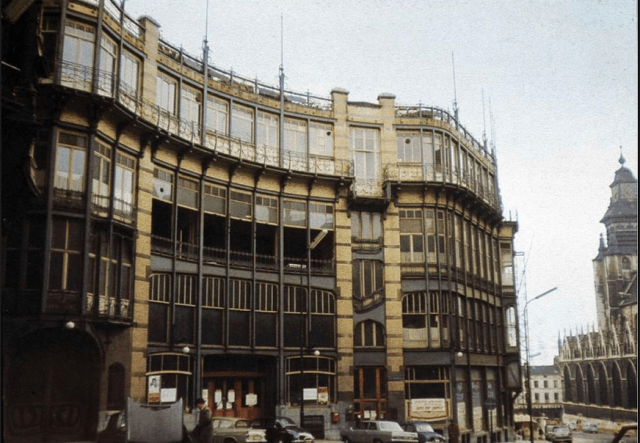
In Europe, the transition towards minimal architecture had been going on for so long there had already been generational schisms, backlashes, and synthesises. There were already architectural masterpieces in this spirit including Victor Horta’s Maison du Peuple (1896-99), Josef Hoffmann’s Sanatorium Purkersdorf (1904-5) and Stoclet Palace (begun in 1905), and Adolf Loos’s Steiner House (1910).
Screen Shot 2018-01-28 at 4.23.22 PM.png

But his examples can be used to make the opposite case. For example, the Maison du Peuple (1899) by Victor Horta, is not minimalist or orderly. It has large windows. Indeed, it could be used to argue that modern architecture takes liberties with history by arguing that it was first to make use of large windows. The Maison du Peuple is a good example of a common practice among modernist historians. Take a traditional building with a feature that eventually figured in modern architecture and claim it as a precursor of modernism when in fact it is merely a traditional building that has evolved to include large windows. Part of this process is to ignore great swaths of traditional architecture that does not fit into the modernist narrative. The modernists like to pretend not to notice historical evidence that traditional architecture has always evolved with advancements in technology.

Other examples adduced by Anderson of pre-Corbu modernism can arouse the same sort of skepticism. So no, modern architecture did not spring fully formed from the heads of Corbusier or the other founders. But Corbusier, Gropius and Mies did pull together into a movement the largely inchoate set of trends toward greater simplicity, more glass and less ornament. Gropius and Mies led the Bauhaus school (Mies even tried to get Hitler to embrace modernism as the design template for the Third Reich). And whatever may be said of his architecture, Corbusier’s flair for self-promotion surely helped to sell the movement for over four decades. And all of what they did was influenced by the psychology of their minds, including the extent to which they were mentally ill.

Adolf Loos certainly preceded Corbu et al. Anderson did not fail to yoke him into his rebuttal of Sussman and of traditional architecture.

In Ornament and Crime (1910), [Loos] announced, “Soon the streets of the town will glisten like white walls. Like Zion, the holy city, the metropolis of heaven. Then we shall have fulfillment.” There was a logic to his messianic proclamations; he recognized that times were changing fast and architecture needed to adapt. It made little sense to spend time and effort carving details into stone on buildings whose function would soon change.

Arguably the function of buildings would change, but that does not mean they needed to change. To argue from result to cause is poor logic and, in this case, the most circular of reasoning. And it is debatable that the function of buildings actually changed. Architecture’s role as protective enclosure for human activity remains essentially the same. Yes, late in the history of architecture, the need for train stations, airports and some other types of building arose, but as early versions of the former demonstrate, they did not need to be designed in a modernist style. Think Penn Station!

(Has there ever been a traditional or even a classical airport?)

And yet even in this piece by Anderson the perfervid attack on decoration – one might say on beauty itself – plows on and on.

World War I had a colossal impact on architecture, as it did every aspect of Western life. We may now view the prewar imperial societies with a nostalgic, pastel Wes Anderson filter, but there was little enthusiasm or money to begin building palaces or carving heraldic symbols for regimes that had sent millions of young men to be mutilated in the trenches.

Again, architecture if not necessarily its function did change – not after World War I so much as after World War II. Modern architecture was a novelty throughout the 1920s. Traditional architecture continued to flourish. Architects embraced embellishment for decades after Western societies had (rightly) decided to blame themselves and their political systems, and not their architecture, for the mass slaughter of the conflict. Most people and most societies were happy to stick to the traditional reverence for beauty.

Anderson may not be aware that even broader scientific research, led by mathematician and theorist Nikos Salingaros at the University of Texas in San Antonio, has found a neurobiological explanation for the public’s preference for traditionally styled buildings. The pleasure we get from ornamental detail is hardwired into our brain by evolutionary changes that stretch back to early man’s need for detailed environmental cognition to stay alive. Modernism’s ban on decoration flies directly in the face of our intuitive requirement for more, not less, information.

As late as 1931, in the The American Mercury, H.L. Mencken wrote,

The New Architecture seems to be making little progress in the United States. … A new suburb built according to the plans of, say, Le Corbusier, would provoke a great deal more mirth than admiration.

Alas! How sadly wrong was the Sage of Baltimore!

Again, architecture did change, but there’s no evidence that it had to change. What happened was that bad architecture, founded on shaky principles, pushed its way into an established industry because niche elements of society in several Western countries embraced the fallacy that change – a rejection of hundreds of years of successful practice – was necessary in architecture. There is no evidence for this, let alone proof.

Were Corbu, Grope and Mies mentally ill? It would be difficult to prove. Given the very dubious quality of modern architecture’s founding ideas, it would be equally difficult to disprove. Sussman’s theory does not necessarily prove that the leading men of modern architecture were mentally ill, but she did not need to prove that modern architecture is crazy.

Just look around you.

For all its erudition, Darran Anderson’s critique of Ann Sussman’s theory fails to pass a smell test that everyone can see.

Posted in Architecture | Tagged , , , , , , , , , , | 8 Comments

Two attacks on the East Side

Screen Shot 2018-01-27 at 4.48.43 PM.png

New SquashBusters facility at the Moses Brown School, on Hope Street, in Providence.

These two really ugly new buildings on Providence’s storied East Side reveal a thoughtlessness and lack of consideration on the part of two highly respected private schools. People walking or driving by Moses Brown or the Lincoln School must wonder how such eyesores could possibly have been foisted upon their lovely streets – Hope Street and Blackstone Boulevard, top and bottom, respectively, both at very prominent locations. Did either of these schools ask, or even care, what their neighbors might think?

The two carbuncles are, top, a set of squash courts and, bottom, a STEM (or STEAM) facility. Neither use requires a design that punches either historic neighborhood in the face. The architects are not to blame, ugly as their work looks. They just follow orders. The boards of the two schools, both Quaker, are to blame. Maybe they are not criminals, though they ignore local zoning ordinances protecting historical character. It may be more accurate to call them sinners. They have sinned against beauty, and betrayed their city, their neighborhoods, and their own institutions, which boast campuses that are otherwise lovely. Shame!

Screen Shot 2018-01-27 at 4.49.08 PM.png

New STEAM facility at the Lincoln School on Blackstone Boulevard/Butler Avenue.

Posted in Architecture | Tagged , , , , , , , , , | 10 Comments

Don’t maul the Mall, cont.

Master plan for southern end of Mall and Smithsonian. (BIG/Smithsonian)

Master plan for southern end of Mall and Smithsonian. (BIG/Smithsonian)

The good news out of Washington is that the Fine Arts Commission has expressed reservations about the latest iteration of the Bjarke Ingels Group plan to renovate the Mall near the Smithsonian’s crenelated, betowered headquarters. Good, but not good enough.

The Washington Post’s Jan. 18 article, by Peggy McGlone, is “‘It’s not good design’: Fine Arts Commission critical of Smithsonian’s plan.”

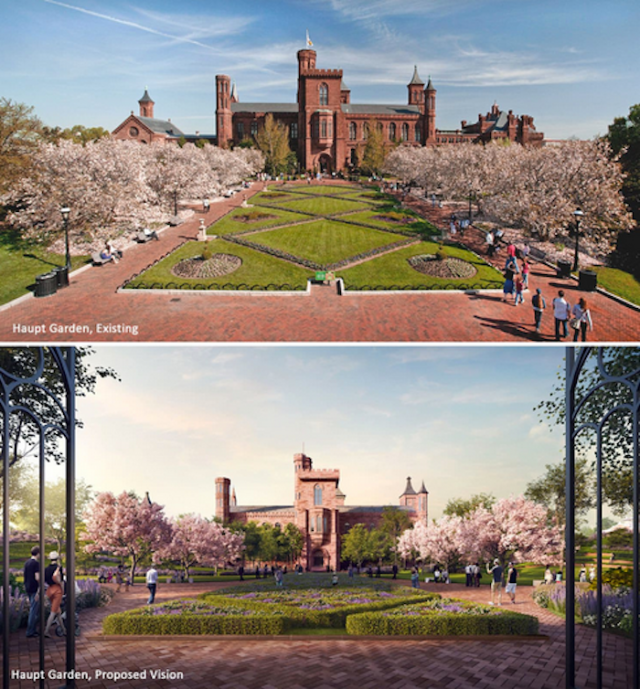
The concerns expressed this past week do not, apparently, include the silly curling corners of the Enid A. Haupt Garden, or other unsympathetic modernist touches from the BIG grab-bag. Nor does it imagine shifting the proposed visitors center from under the Haupt Garden into its most obvious setting directly to its east, the largely unused Arts and Industries Building. An image of the existing garden and of the garden as now proposed (with its curling corners outside the frame of the second image) are below.

Below this is my original, exasperated post about the BIG plan, from 2014.

Screen Shot 2018-01-25 at 8.45.57 PM.png

***

The National Mall in Washington has been undergoing renovation of its famous grass and the soil underneath. Decades of marches, concerts and festivals, not to mention the constant tramp, tramp, tramp of millions of tourists yearly on this hallowed ground of the nation, still largely based on the great classical McMillan Plan of 1901, have hardened and compressed the land. But with a sort of fluffing up of the large part of the Mall that lies under the grass, this is being fixed.

Southern portion of the National Mall. (brightspotstrategy.com)

Southern portion of the National Mall. (brightspotstrategy.com)

Fixed, it seems, to prepare the ground for an invasion by alien forms, invited not by some malign foreign power or interplanetary congress of villains but by the Smithsonian Institution itself. The Smithsonian’s museums, galleries and quaint headquarters building line either side of the Mall from the Washington Monument to the U.S. Capitol. A Danish firm based in New York, Bjarke Ingels Group, has been hired to produce a master plan for its older, southern portion over the next 20 years. At the top of this post is a disarmingly charming nighttime illustration of the plan.

Aaron Betsky praises the BIG plan for Architect, the journal of the American Institute of Architects, in “The Underground Museum Movement.” An early line well describes the work of BIG’s Bjarke Ingels, who has “married OMA’s [Rem Koolhaas’s] unabashed modernism with sculptural daring-do and a cartoon sensibility.”

Modernism popping up in BIG plan. (BIG/Smithsonian)

Modernism popping up in BIG plan. (BIG/Smithsonian)

The Mall and its interlace of spaces linking the country’s greatest national museums will indeed become a cartoon – a Jetsons cartoon – if this plan is carried out. The grand allée of America is our greatest public space. It has hosted many of U.S. history’s finest moments, such as Martin Luther King Jr.’s “I Have a Dream” speech. On a day-to-day basis it offers Washington’s visitors, workers and residents alike a pedestrian paradise where flâneurs can sit or stroll as they observe the country’s character and characters tromp by in all their diversity.

Under the BIG plan, the Mall’s grandeur will be lampooned and its essential purpose as a promenade of democracy on which to meet and greet under the blue sky will be trampled. Much of the plan imagines new spaces and connections between museums underground, itself undermining the Mall’s essence. The recent new visitors center, largely underground, for the Capitol offers plenty of reason to avoid digging down to solve an entirely imaginary need for more space for people on the mall. The Mall may need an upgrade; it does not need a reconceptualization, a repurposing, a re-anything.

Smithsonian's administrative headquarters. (news.yahoo.com)

Smithsonian’s administrative headquarters. (news.yahoo.com)

You’d think that going below grade would help avoid one of the predictable hazards of remaining above grade. But no. BIG sees a lot of modern architecture raising its ugly head above ground, up from below. From illustrations provided by BIG and the Smithsonian, most of it is predictable sterile modernist extrusions from another galaxy. The main piece, and potentially least objectionable, is a lawn with cutely raised corners between the Smithsonian administration’s towered, crenellated castle and the round Hirshorn Art Museum.

Had the structures gently lifting the corners of the lawn featured traditional architecture rising from below, teasing visitors with elements of the Mall’s greatest classical buildings, this centerpiece might have mixed beauty and frisson with admirable panache, acceptable to all. But BIG could see no farther than to gild the turd, and so even this mini-mall will cringe along with the rest of the plan’s benighted architecture.

Bad modern architecture has been creeping up and down the Mall for decades. It has been chosen to house the latest national museums. The beauty that once reigned supreme as the nation filled out the McMillan Plan in the first half of the 20th century will suffer further erosion. The conversation among the most civilized structures will be further confused. While the Mall is unlikely to lose its status as the nation’s gathering spot, its sense of place and hence its ability to wreathe the civic life of the capital city in an uplifting grandeur and importance will continue to be diminished.

Corner of lawn viewed between Smithsonian HQ and Hall of Arts & Industries. (Smithsonian)

Corner of lawn viewed between Smithsonian HQ and Hall of Arts and Industries. (Smithsonian)

This plan is not BIG but small, very small, very orthodox, very ugly. Fortunately, in a nation of stretched budgets the plan will depend on big donations from the private sector, and we may hope that these do not materialize. Maybe the Smithsonian will be thrown back on its existing resources. Chief among these is the newly renovated Hall of Arts and Industries, which now stands empty, a waste waiting to embrace a new mission. It is well placed to lead the repulse of this ridiculous alien invasion proposed for America’s most sacred space.

But a building cannot lead a fight, and the Smithsonian cannot be expected to fight against itself. So this looks like a job for Justin Shubow and the National Civic Art Society.

Posted in Architecture, Landscape Architecture | Tagged , , , , , | 3 Comments

Architecture’s deadly lingo

Screen Shot 2018-01-24 at 1.58.59 PM.png

Mack Scogin Merrill Elam Architects, Wolfsburg Science Center, 1999. (Harvard GSD)

The model above illustrates an invitation to a lecture at Harvard’s Graduate School of Design called “Architecture Before Speech: A Conversation.” I thought it must be a discussion of how humans built early habitation prior to the development of spoken language.  Interesting! But the image above created instant skepticism, and then I read the theme of the event. Here are its first two sentences:

If recent theory has highlighted architecture’s turn to evident resemblance and signification, we argue this tendency has also produced its other: The landscape of contemporary practice is filled with work whose motivating interests are anterior to meaning and averse to thematization; they are, in a way, pre-speech.

At least it must be admitted that the theme and the architecture are of a piece. In writing the headline to this post, I first used the word goofy, then changed it to deadly, thus giving my post a positive spin. If this is truly how the nation’s top architects and theorists are talking to each other, the death of modern architecture cannot be far off.

Read the rest of the introduction, which only gets worse, and the list of practices participating in the exhibition. The latter is priceless, and suggests the lengths to which architects today go to produce a spurious differentiation not just in their work but in the names of their practices. It’s a gas, the whole thing.

But how did the following line get into this invitation?

A reception for the exhibition will take place in the Druker Design Gallery immediately following the lecture.

Some things are too important for advanced communication!

Posted in Architecture | Tagged , , , , , | 11 Comments

At last, the old state arsenal

Screen Shot 2018-01-23 at 4.41.34 PM.png

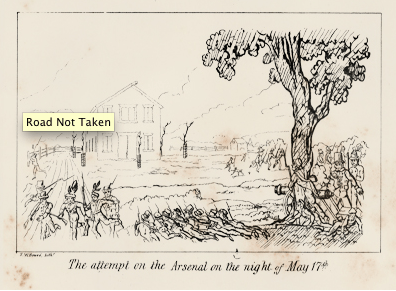
Christopher Martin, who edits the indispensable blog Quahog.org (a quahog is a clam), notes that on my Lost Providence book page I bemoaned my inability to locate a more substantial image of the arsenal attacked by Thomas Wilson Dorr at the outset of the Dorr Rebellion of 1841-42. Not that a drawing of the “battle” itself is anything to sniff at.

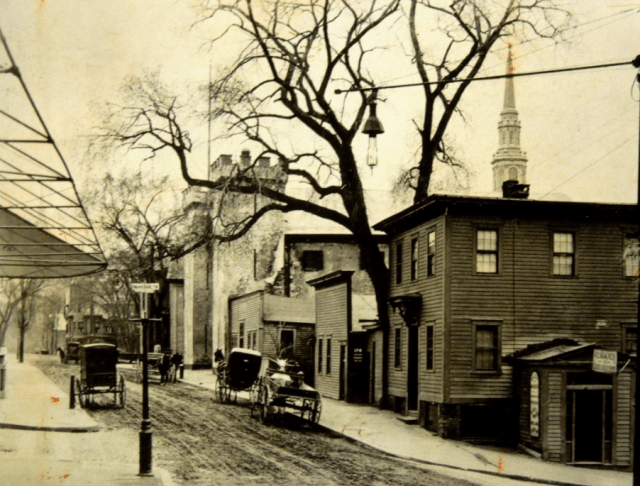
The caption on the rear of the postcard reads:

The Old White Mill was originally a state arsenal; garrisoned in May 1842; unsuccessfully attacked by Thos. W. Dorr and his forces; used in turn as a grist-mill; woolen mill and cotton mill; and purchased by the State of Rhode Island, Dec. 1895. The site is now occupied by the new State Armory, south of Dexter Training Ground, Providence, R.I.

Screen Shot 2018-01-23 at 4.51.56 PM.png

The drawing shows a building, left, considerably smaller than the Old White Mill in the postcard sent by Christopher. I do not know whether the old arsenal in the drawing is the central structure of the postcard, as expanded, or the smaller structure to its left. Evidently, sometime after the Dorr Rebellion the arsenal was sold by the state to a mill owner who, it seems, expanded the arsenal into a factory. Decades later, it was sold, perhaps by a later owner, back to the state. The mill was pulled down to make way for the Cranston Street Armory, completed in 1907, which remains at the south end of the Dexter Training Ground, site of the original arsenal.

From today’s perspective the Dorrites’ attack on the arsenal seems a comical affair. Dorr had been elected governor of Rhode Island in April 1842 under a new constitution designed to expand the sufferage. But the existing governor, elected under the royal charter of 1663 that still ruled Rhode Island long after the Revolution, did not step down.

For six weeks two parallel governors and legislatures co-existed uneasily. Attempting to end the stand-off, Dorr and his “troops” stole two Revolutionary-era cannon from the United Train of Artillery, in the old town meeting house, now the Providence County Superior Court. (Dorr grew up at 109 Benefit St., several blocks to the north.) He marched the night of May 18, 1842, on the other arsenal, in the West End, which was defended by supporters of the charter governor, Samuel Ward King of the Law and Order Party. The defenders included several members of Dorr’s family, who were upset at his shenanigans. The Dorrites tried unsuccessfully to fire one of the ancient cannon, then fled.

This may indeed seem comical, and the Dorr Rebellion fizzled out ignominiously. Dorr returned to the state in 1843 to be tried for treason and was sentenced to prison in 1844. He was released in ill health in 1845 and died in 1854. (The Providence Journal owns a silver tea service given to the paper for supporting the charter government.) Eventually, partly as a result of pressure generated by the rebellion, Rhode Island’s constitution was changed to expand voting rights to native-born citizens, lifting the requisite $134 worth of property to cast a ballot. It was lifted for foreign-born naturalized citizens in 1888.

By the way, Christopher is the co-author, with David Norton Stone, of the fascinating Rhode Island Clam Shacks, published last year by History Press, the same house that published my own book, Lost Providence, a few months after Christopher’s.

[Many thanks to Russell DeSimone for correcting several errors in the initial version of this post.]

Screen Shot 2018-01-23 at 5.44.26 PM.png

Benefit Street Arsenal, center left, which survives. Baptist Church steeple at right. Farther up Benefit Street was the United Train of Artillery, located in what was first the Congregational Church, then the town house, and eventually the site of two county courthouses at the corner of Benefit and College.

Screen Shot 2018-01-23 at 5.35.32 PM.png

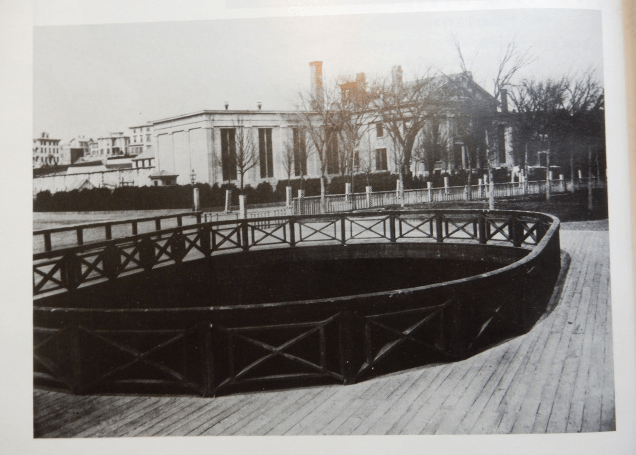
State Prison (1838-78), next to the Cove Basin, where Thomas Dorr was imprisoned for a year. Archaeologists uncovered remains of the prison before excavating the site for the Providence Place mall before its construction in 1996-99. (Providence Public Library)

Posted in Architecture | Tagged , , , , , , , , , | 2 Comments

Each state’s “ne plus ugly”

Screen Shot 2018-01-22 at 1.34.01 PM.png

The Apex Building, in Pawtucket, R.I. (YouTube)

Architecture is a form of art. When a city constructs a new building, it should add beauty to its streetscape.

The above quote, unattributed, introduces an article in MSN.com’s Business Insider entitled “The Ugliest Building in Every US State, According to Those Who Live There,” by Leanna Garfield. She asked readers to “name the one architectural eyesore they loathe within their state.”

As is typical in such surveys, and more typical the more scientific they are, all but a handful of readers turned thumbs down on modern architecture. If this were a scientific survey, taking the most disliked buildings from a significant sample of each state’s population, all of the most loathed buildings would be modernist. That was not the case here, where merely 48, arguably 49, of the 52 were modernist. (D.C. was included, and New York was given two ogres, both in New York City.)

The photo atop the online article pegging each state’s ne plus ugly shows the Apex Building, in Pawtucket, R.I. It has not been an Apex cut-rate retailer for at least a couple of decades – for a while it was a state DMV – and is expected to be torn down to make way for a minor-league baseball stadium, though taxpayers are resisting.

Who knows which way that will go. The 52 images offer some predictable eyesores, such as Boston City Hall, with its Brutalist design, and a couple of buildings by Frank Gehry. Michael Graves’s most famous building, in Portland, Ore., was caught in Oregonians’ gimlet eye. Readers were bold enough to acknowledge that even a building by Frank Lloyd Wright (in suburban Louisville, Ky.) can be worthy of brickbats. Nor were they automatically enchanted by round buildings, not even a round state house, arguably traditional, in Santa Fe. But curiously three inarguably trad buildings catch hell – two of the three seem dilapidated; the other is a perfectly lovely water tower that, one might guess, is locally disdained (as a similar structure in Chicago is globally revered) because it is infrastructure, which, as modernism has taught us, doesn’t have to be attractive – as if the modernists believe anything should be attractive.

Well, let that small masochist mini-me in your inner self out of his or her cage for a bit of fresh air, so you can enjoy this exercise in self-flagellation.

Screen Shot 2018-01-22 at 7.59.41 PM.png

Screen Shot 2018-01-22 at 7.58.39 PM.png

Screen Shot 2018-01-22 at 7.57.47 PM.png

Screen Shot 2018-01-22 at 7.54.21 PM.png

Screen Shot 2018-01-22 at 7.56.48 PM.png

Screen Shot 2018-01-22 at 8.19.01 PM.png

Posted in Architecture | Tagged , , , , , , | 9 Comments

Reed award honors Dresden

Screen Shot 2018-01-20 at 2.13.58 PM.png

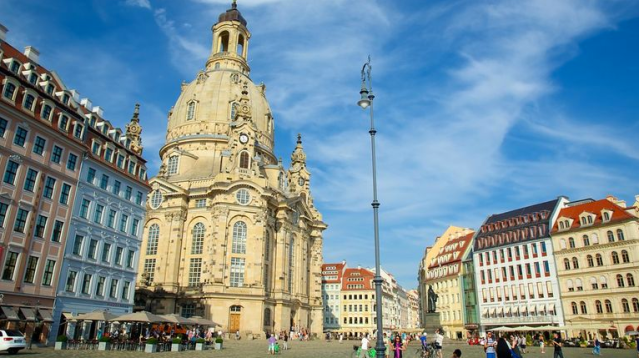
Dresden’s Neumarkt, reconstructed, with rebuilt Frauenkirche at left. (trvl-media.com)

Henry Hope Reed, one of my heroes, the original classical revivalist, lives on in the Henry Hope Reed Award handed out in association with the Richard H. Driehaus Prize. The Driehaus, rewarding achievement over a lifetime by classical architects, comes with an honorarium of $200,000. The Henry Hope Reed Award, which honors work promoting the classical revival aside from design of classical work itself, hauls in $50,000.

This year’s Reed goes to Torsten Kulke, who has led the reconstruction of Dresden’s Neumarkt, destroyed by Allied bombers in World War II and left vacant by the East Germans for half a century. Like the Breitmans – the 2018 Driehaus winners, who rebuilt a town outside of Paris (see yesterday’s post) – Kulke heads a project years in the making. His work in Dresden since 1999 has shepherded the revival of an area that surrounds one of history’s most remarkable civic reconstructions, the Frauenkirche – a separate, earlier Dresden project begun shortly after German reunification in 1989.

Here is a passage from the jury’s citation for the Henry Hope Reed award:

The reconstruction of the Historical Neumarkt at Dresden over the past two decades is an extraordinary achievement that has been met with astonishment and delight around the world. It is unique in Germany and indeed in the world in its ambition to resuscitate the lost historic heart of a city destroyed decades ago by war.

Richard Driehaus, commenting on Kulke, stated:

Torsten Kulke had the vision to see that Dresden could become a vibrant city once again, respectful of its own rich history, and he overcame significant political opposition to his plan.

Like the effort to reconstruct the church to its original design, rebuilding the church’s historic setting involved grappling with the German architectural establishment, which is as devoutly modernist as it is throughout Europe and America. The modernists claimed that rebuilding the Neumarkt would be inauthentic: only modern architecture can be appropriate in modern times. It is hogwash, of course, that any third grader can see through, yet it is powerful because modern architecture today is a global cult.

It is the work of people like Kulke in Dresden who, helming the Society for the Rebuilding of the Historical New Market Dresden for almost two decades, places before the public the idea that the loss of great and beautiful architecture need not be accepted as the final word. Nothing better makes the case for treating architecture as a phenomenon of place rather than time than the reconstruction of old places anew, and their subsequent integration as workable, lovable places into a broader community. The classical revival is based on the idea that a building’s essence is more in where it is than when it was built. The modernists want the public to believe, on the contrary, that beauty is a part of the past and should not be expected to be found in the present, let alone the future. This is wrong. It condemns millions to a lesser environment. I won’t say it is evil, but it certainly inhabits the dubious space between the immoral and the amoral.

To rebuild a lost and beloved building or place is, on the other hand, a commendable and entirely feasible effort to recoup the losses of our past. Likewise, to build anew in a style that reflects the traditions that arise out of our past to guide us into the future is a perfect example of the ways that citizens and entire industries can learn from history. Is this so difficult for our architecture establishment to understand? Of course not, which is why understanding is not the question. The answer is for Reed laureates to investigate.

In his remarks, Richard Driehaus added a key point:

Through private investment and careful project management, Torsten accomplished an extraordinary feat, and Dresden has become a model of redevelopment for cities and towns around the world.

Not the least such development is the possibility that the original Pennsylvania Station might be rebuilt, more than half a century after its demolition in 1963, to reflect the 1910 design by Charles Follen McKim of McKim Mead & White. If the Germans can do it in Dresden, Americans can do it in New York City. Learn more at Rebuild Penn Station.

Screen Shot 2018-01-20 at 2.17.09 PM.png

Frauenkirche, completed earlier as a separate project in 2005. (trvl-media.com)

Posted in Architecture | Tagged , , , , , , , , | 6 Comments

Driehaus for the Breitmans

Screen Shot 2018-01-19 at 1.47.57 PM.png

Le Plessis-Robinson, six miles southwest of Paris. (Daniel Barreau/Wikipedia)

The annual Driehaus Prize, named for Chicago philanthropist Richard H. Driehaus and administered by the School of Architecture at the University of Notre Dame, recognizes the career of work in the classical style by living architects. It has been handed out since 2003, and the sum of buildings by its laureates, if collected and arranged neatly in a valley or on a hill, perhaps near a body of water, might be the most beautiful settlement in the history of mankind. The very idea is a valuable, indeed a dangerous tool in the hands of the classical revival.

This year’s Driehaus Prize goes to a pair of architects who are well known in the classical community, but strangers to the general public, as are most architects, especially in the United States. Marc Breitman and his wife, Nada Breitman-Jakov, the founders of Atelier Breitman, in Paris, are best known for the community they planned and designed outside of Paris called Le Plessis-Robinson. They took a dreary cityscape typical of modern public housing projects and, beginning in 1990, transformed it into a paradise.

Curiously, from olden times a plessis was a village surrounded by a fence made of branches. This particular village, reaching back before 839, took its surname from various of its rulers or leading citizens – Raoul, Piquet and (after the 1789 revolution) Liberté. In 1909 it was merged with a neighboring village, Robinson, named for a cabaret whose theme was a fictional treehouse in the manner of that built by the shipwrecked family in The Swiss Family Robinson (which itself harked to Defoe’s Robinson Crusoe). After WWII, the former village/commune, by then a barracks town for Parisian gendarmes, was gobbled up by public housing. It had grown deplorable by 1990, probably well before 1990, when the Breitmans stepped in.

A passage from the Driehaus jury’s citation reads:

The radical redevelopment of Plessis-Robinson (1990–2017), a notorious working-class suburb, was realized under extremely difficult political conditions. With the Breitmans as principle architects, a neglected neighborhood of large scale housing blocks with few civic and commercial spaces was transformed into a thriving and proud city of the Ile-de-France and Région Parisienne. Splendid new avenues, squares, boulevards and parks are lined by beautiful street façades and with a focus on elegant public buildings.

It is easy to imagine the “extremely difficult political conditions” involved. Without being privy to the details, I would imagine that the politics at least partly revolved around an awareness that the impact of a beautiful place replacing an ugly place could be positively revolutionary. The feeling of “Danger, Will Robinson!”  probably erupts in the minds of those associated with the established political/development/architecture complex every time public mention is made of Le Plessis-Robinson. “Don’t let the public know about that place,” the modernists no doubt say to themselves (at least), “or our goose is cooked!”

I am sure that over the years the project has been written about derisively, as if a beautiful place were inappropriate in modern times. Similarly conceived places in America, such as Seaside and Celebration to name just two, or Poundbury, in Britain, are regularly condemned in the architectural press, which with few exceptions operates as a tool to censor news of beautiful new architecture. Could Le Plessis-Robinson have avoided similar treatment in the French architectural press? Unlikely!

I attended the 2013 Driehaus awards ceremony in Chicago and got to see a painting commissioned for the 10th anniversary of the awards program. The capriccio by Carl Laubin actually does assemble works by the first ten Driehaus laureates and lays them out in an evocative panorama (see below). Predictably, the result is an enchanting, paradisical townscape. In fact, while the buildings are more diverse, they bring to mind the view of Le Plessis-Robinson atop this post. The painting, the actual village, and others of their like suggest the aesthetic superiority of communities whose design is buttressed by a design language steeped in beauty. Steeped in beauty is important caveat because a village constituting the works of, say, Le Corbusier might have a commonality of form as the basis of its design (hardly anything comparable to an actual architectural language), but it would be ugly – or let’s say boring, to avoid the taste bugaboo – something like the public housing that the Breitmans replaced in Le Plessis-Robinson.

The Breitmans also have projects – mostly single buildings – in Belgium, Holland and elsewhere, including other places in France, such as in Paris. They are worthy recipients of the 2018 Driehaus.

(I wrote about Le Plessis-Robinson in a 2012 post published in the first four years of my blog, which were purged by the Providence Journal in 2013. Part of my research for that post came from a piece by architecture writer Charles Siegel, “Le Plessis-Robinson: A Model for Smart Growth,” in Planetizen back in 2012. Below, after the Laubin painting, are some of Siegel’s photographs of Le Plessis-Robinson.)

Screen Shot 2018-01-19 at 1.54.12 PM.png

Centennial capriccio of Driehaus laureates’ work, by Carl Laubin. (Notre Dame)

Here are some shots of Le Plessis-Robinson from Charles Siegel’s article:

Screen Shot 2018-01-19 at 4.57.21 PM.png

Screen Shot 2018-01-19 at 4.56.09 PM.png

Screen Shot 2018-01-19 at 4.55.43 PM.png

Screen Shot 2018-01-19 at 4.55.21 PM.png

Screen Shot 2018-01-19 at 4.54.58 PM.png

Screen Shot 2018-01-19 at 4.52.41 PM.png

Screen Shot 2018-01-19 at 5.04.26 PM.png

Screen Shot 2018-01-19 at 4.57.42 PM.png

Screen Shot 2018-01-19 at 4.56.59 PM.png

Posted in Architecture | Tagged , , , , , , , , , , | 7 Comments

Q. of Scots takes Edinburgh

Screen Shot 2018-01-17 at 6.39.56 PM.png

Edinburgh (oilpaintingfactory.com)

Here is Margaret, Queen of Scots, entering Edinburgh in 1503, riding with new husband James of Scotland, as seen through the lens of historical novelist Philippa Gregory in her Three Sisters, Three Queens (2016):

The day of our entry into Edinburgh is my last day as a Tudor princess before I am crowned in my new kingdom, and the king takes me up behind him on his horse, as if I were a simple lady and he my master of horse, or as if he had captured me and was bringing me home. We enter Edinburgh with me seated behind him, pressed against his back, my arms wrapped around his waist, like a peasant girl coming home from a fair. It pleases everyone. They like the romance of the picture that we make, like a woodcut of a knight and a rescued lady; they like an English princess being brought into their capital city like a trophy. They are an informal, affectionate people, these Scots. I can’t understand a word that anyone says, but the beaming faces and the kissed waving hands and the cheers show their delight at the sight of the handsome wild-looking king with his long red hair and beard, and the golden princess seated behind him on his horse.

Screen Shot 2018-01-17 at 6.42.51 PM.png

(English Monarches)

The city is walled with fine gates, and behind them the houses are a mixture of shanties and hovels, some good-sized ones with plastered walls under thick, thatched roofs, and a few newly built of stone. There is a castle perched on the very top of an incredibly steep hill at one end of the city, sheer cliffs all around it and only a narrow road to the summit; but there is a new-built palace in the valley at the other end, and outside the tight fortified walls of the town are high hills and forests. Running steeply downhill from castle to palace is a broad cobbled road, a mile long, and the best houses of the tradesmen and guildsmen front this street and their upper stories jut over it. Behind them are pretty courtyards and the dark wynds that lead to inner hidden houses and big gardens, orchards, enclosures and more houses behind them with secret alleyways that run down the hill.

At every street corner there is a tableau or a masque, with angels, goddesses and saints praying for love and fertility for me. It is a pretty little city, built as high as it is broad, the castle standing like a mountain above it, the turrets scraping the sky, the flags fluttering among the clouds. It is a jumble of a city, being rebuilt from hovels to houses, from wood to stone, gray slate roof replacing thatch. But every window, whether open to the cold air, shuttered, or glazed, shows a standard, or colors, and between the overhanging balconies they have strung scarves and chains of flowers. Every poky little doorway is crammed with the family clustered together to wave at me, and where the stone houses have an oriel window, or an upper story and a balcony, children are leaning out to cheer. The noise of all the people crammed into the little streets and the shouting as the guard push their way through is overwhelming. Ahead and behind us there must be at least a thousand horses with Scots and English lords intermingled to show the new unity that I have brought to Scotland, and we all wind our way through the narrow cobbled streets and down the hill to the palace of Holyroodhouse.

Ah, such a charming scene! But you get a hint of how petty and egotistical Gregory paints Queen Margaret. As a bonus, read the next passage, plucked actually from just before the entrance to Edinburgh, in which Margaret complains of being ignored by the king.

In the next four days before the wedding my new husband comes to visit every day, but mostly he talks to Thomas Howard [an English general who leads the guard of the large traveling party, or progress, from England] rather than to me. The old man has fought the Scots up and down the borders, but instead of being enemies for life, as anyone would expect, they are inseparable, sharing stories of campaigns and battles. My betrothed, who should be courting me, reruns old wars with my escort, and Thomas Howard, who should be attending to my comfort, forgets I am there and tells the king of his long years of campaigning. They are never happier than when they are drawing up a map of ground where they have fought, or when James the king is describing the weaponry he is designing and having built for his castles. Both of them behave, as soldiers together always do, as if women are completely irrelevant to the work of the world, as if the only interesting work is invading someone else’s lands and killing him. Even when I am seated with my ladies and the king comes in with Thomas, he wastes only a few moments being charming to me, and then asks Thomas if he has seen the new guns, the Dardanelles gun, the new light cannon, if he knows of the famous Scottish cannon Mons, the largest in Europe – which was given to James’s grandfather by the Duke of Burgundy. It is most irritating. I am sure Katherine [of Aragon, betrothed to Margaret’s brother Harry (Henry VIII)] would not stand for it.

I realize it is bad form of me to chuckle at that sort of thing in this day and age, but sorry, I can’t help it. It is fun, and whether it truly reflects the thinking of Margaret I will leave to historians. So far, in my reading of several reviews, there has been no complaint that Margaret is drawn by Gregory as a ninnyhammer.

Still, I’m sorry, I can’t resist going back a few paragraphs further to quote more in this vein, in regard to James’s big red beard. After describing his handsome face, she adds:

Except for the beard, of course. There is no getting away from the beard. I doubt there is any way to get past the beard. At least he is combed and washed and scented; it is not a beard that might have a mouse nesting in it. But I would have preferred him clean-shaven, and I cannot help but wonder if I can mention this. Surely it is bad enough for me to have to marry a man who is old enough to be my father [she is 13 and he 30] and with a smaller kingdom than my home, without him bringing a fox’s brush to bed with him?

As the owner of a beard myself, never shaved off since 1976, this passage is somewhat dismaying. Oh well.

I have finally sent away for the Library of America’s Henry James: Collected Travel Writings. When I get it I will no longer have to invent thrilling snippets of discourse about the battle between classical and modern architecture. Only kidding. But James’s observations, even if they don’t entirely make the case for me, will offer recurrent chapters in the great style wars. I hope readers will be looking forward to them.

Posted in Architecture | Tagged , , , , , , , | 1 Comment