One of Fallows’s small cities?

Screen Shot 2018-03-29 at 12.52.03 PM.png

From pamphlet cover of Power of Place Summit, March 29, 2018. (Grow Smart Rhode Island)

James Fallows, a longtime writer for The Atlantic, gave the keynote address at today’s Power of Place Summit, held every couple of years by Grow Smart Rhode Island, which is celebrating its 20th anniversary. With wife Deborah, Fallows has written a book, Our Towns: A 100,000-Mile Journey into the Heart of America, due out May 8. The Fallowses visited 29 small cities and towns, places that generally, unless there is a newsworthy crisis (“If it bleeds, it leads”), fly under the radar of the media – to whom, by the way, Fallows applied a well-deserved spanking in his 1996 book Breaking the News: How the Media Undermine American Democracy.

The Fallowses discovered that, notwithstanding the conventional view, many places between the two coasts have seen some degree of reinvention in civic life. Although I don’t know whether he visited Providence for his book, in his talk he was kind to his hosts, pausing at every turn to say he was very sure that this or that observation applies to Providence and/or Rhode Island. And he was certainly right. He and his wife, who flew from town to town in their small plane over a period of two years, summarize their findings in a list of ten characteristics common to places that have “reinvented” their civic cultures. Below I have followed each bullet point with a hint at how Providence has done on that front.

  • Positive self-image. Providence has flipped its “been down so long it looks like up to us” attitude of reverse hangdog braggadocio.
  • Puts priority on local politics over “poisonous” national politics. Here perhaps Providence has some work to do.
  • Acknowledges local patriots. Providence has many, from developer Buff Chace to WaterFire artist Barnaby Evans to the late architect Bill Warner.
  • Supports public/private projects. Providence and Rhode Island have paired, often with the feds, on several major civic projects.
  • Not afraid of big plans. Providence history has many big projects, lately including railroad relocation, river relocation, highway relocation, etc.
  • Knows its own civic story. From cradle of religious liberty to cradle of industry to, lately, moving our rivers, we locals know our story.
  • Has reinvented its downtown. Providence’s Downcity Plan revitalized its downtown by refusing to demolish old buildings. Imagine that!
  • Has a research university. Maybe not in so many words, but it certainly has Brown, RISD, URI and other fine colleges.
  • Has unusual public schools. Fox Point Elementary School, where my boy Billy attends third grade, is a great public school, which may qualify as unusual.
  • Open to diverse subcultures. Providence has been a leader in supporting immigrant, LBGT communities, etc., not to mention artists.

One major characteristic that the Fallowses seem to have left out of their recipe for civic reinvention, or at least didn’t emphasize during today’s talk, is what seems to me the germ of the idea of the Grow Smart summit. The power of place is an allusion to the phrase “the sense of place.” The sense of place represents those qualities that are the essence of a place – its identity, its sweet spot, the part of town you are most like to show off to visitors. Providence has that in spades. Many other cities do not, and under current conditions cannot, have much in the way of sense of place, which may be why the Fallowses did not make a big thing of it today.

Governor Raimondo – who Victoria, Billy and I bumped into recently at the Home Depot off Branch Avenue (an advantage of small places) – followed James Fallows to the podium, and she spoke of how well she has done at helping to revitalize the state economy. But she has been a dud at helping to build its sense of place. I have argued again and again, including directly to her, that the city and state should encourage developers to build projects that strengthen rather than weaken our “brand” – our historical character. That would not just make the city more beautiful but more robust economically. It would make the glide path to solving other problems easier. But what has she done instead? How about our cliché of an innovation district? Yuck! She has promoted projects that most Rhode Islanders find alienating, a dash of cold water on public participation, I would think.

Perhaps I am being too harsh on the governor. Feel free to complain, Gina!

The Providence Journal’s editorial in today’s paper touted a new study that makes the same omission that the Fallowses seem to have made. It touts the economic benefits of historic preservation but, like most preservationists, gives little or no thought to preserving the settings of buildings they work so hard to preserve.

Historic Preservation: Rhode Island’s Economic Revitalization Tool boasts many useful insights – such as the value of state historic preservation credits – but the most obvious tool, new traditional architecture, is left out. Many preservationists love old buildings but not new buildings that look like what preservationists used to want to preserve, which is supposedly “inauthentic.” This is a sad and self-defeating error, driven entirely by the devotion many architects and planners have to city building principles that emerged in the 1950s and have wrecked many cities in America and elsewhere, but have retained the loyalty of many designers and planners.

Among the many problems cities face, this is an easy one to solve. Mayors, governors and other civic leaders need only hint to developers of projects needing various permits that architecture that builds on historical character rather than undermining it is the only way, once historic buildings have been preserved, to further strengthen the sense of place. Developers should want to help cities and towns with this. You’d think they’d be more eager to have government on their side than they are to push tedious architectural styles that most people don’t like.

Civic leaders should avoid pushing us toward the kind of societies feared by Orwell: authoritarian governments that treat people like cogs in a machine. You’ve heard that before. “A house is a machine for living in,” Le Corbusier said. Brrr! Churchill said, “We shape our cities; thereafter, they shape us.” He was not kidding. We are headed in that direction. Listen up, Jim! New traditional architecture is the only easy way to defend against it.

Let me conclude by reminding Jim Fallows of a piece he wrote in The Atlantic, after attending a conference like today’s. He twitted celebrity architect Frank Gehry for dismissing a questioner, Project for Public Spaces founder Fred Kent, with a wave of dismissal that struck him as what a duke might use to repudiate a pesky peon, something Fallows said was last seen in medieval times. Although Fallows did not expand on the implications of that experience, he had unwittingly tapped into the underlying attitude of modern architecture toward the public.

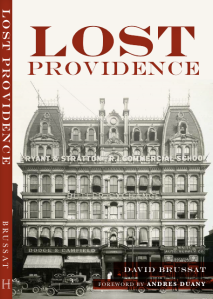
I will have to read the Fallows’s book, Our Towns, when it comes out in a month or so. As it happens, the Fallowses were given a signed copy of my book, Lost Providence, as one of three literary gifts from Grow Smart Rhode Island for appearing today. If they would like to read more about where I’m coming from in this post, that’s a good beginning.

[Tip o’ the cap to several readers who tagged me for calling PPS’s Fred Kent “Frank”! At my first newspaper, the Augusta (Ga.) Chronicle, my two editors were Frank Adams and Phil Kent. That was back in 1981-82. This may or may not explain my error; of course it does not justify my error.]
Posted in Architecture, Uncategorized | Tagged , , , , , , , | 4 Comments

James on Ruskin’s Venice

Screen Shot 2018-03-27 at 7.49.56 PM

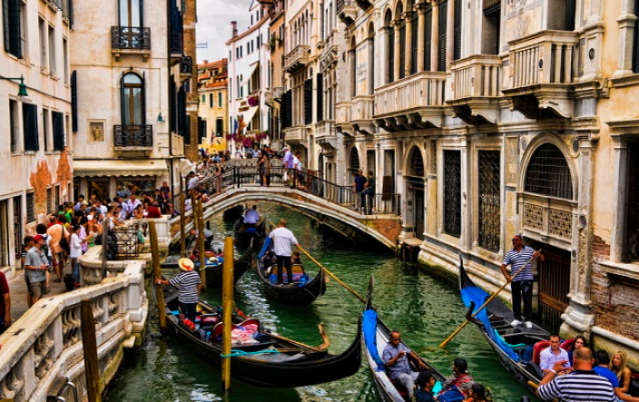
Gondolas on a canal in Venice. (thelocal.it)

In addition to narratives of place in his novels, Henry James wrote much about his personal travels, including visits to Venice, to which I’ve had the pleasure of a single blissful visit. The excerpts I’ve taken from his writing on Venice come from “Italian Hours” in the Library of America edition of his Collected Travel Writings: The Continent. (I also have his volume, in the same set, acquired separately, of writings on Britain and America.) I am indebted the Project Guttenberg, whose existence freed me from the arduous labor of transcribing so much text by hand … so I can quote at length, which is pretty much de regueur with James.

Below are snippets from a long passage on James’s reaction to John Ruskin’s thoughts in his magisterial The Stones of Venice. James, who wrote journals of his travels between 1870 and 1910, had a conflicted relationship with that book, written in 1851-53, when architects were going mano a mano over Gothic and Neoclassical styles (that is, Roman Catholic and Church of England). Whatever its faults may or may not be, Wikipedia quotes Roger Scruton that The Stones of Venice was “the greatest description in English of a place made sacred by buildings.” Well, here goes:

[Ruskin] has indeed lately produced several aids to depression in the shape of certain little humorous—ill-humorous—pamphlets (the series of St. Mark’s Rest) which embody his latest reflections on the subject of [Venice] and describe the latest atrocities perpetrated there. These latter are numerous and deeply to be deplored; but to admit that they have spoiled Venice would be to admit that Venice may be spoiled—an admission pregnant, as it seems to us, with disloyalty. Fortunately one reacts against the Ruskinian contagion, and one hour of the lagoon is worth a hundred pages of demoralised prose.

This queer late-coming prose of Mr. Ruskin … appears addressed to children of tender age. It is pitched in the nursery-key, and might be supposed to emanate from an angry governess. It is, however, all suggestive, and much of it is delightfully just. There is an inconceivable want of form in it, though the author has spent his life in laying down the principles of form and scolding people for departing from them; but it throbs and flashes with the love of his subject—a love disconcerted and abjured, but which has still much of the force of inspiration.

Among the many strange things that have befallen Venice, she has had the good fortune to become the object of a passion to a man of splendid genius, who has made her his own and in doing so has made her the world’s. There is no better reading at Venice therefore, as I say, than Ruskin, for every true Venice-lover can separate the wheat from the chaff. The narrow theological spirit, the moralism à tout propos, the queer provincialities and pruderies, are mere wild weeds in a mountain of flowers.

One may doubtless be very happy in Venice without reading at all—without criticising or analysing or thinking a strenuous thought. It is a city in which, I suspect, there is very little strenuous thinking, and yet it is a city in which there must be almost as much happiness as misery. The misery of Venice stands there for all the world to see; it is part of the spectacle—a thoroughgoing devotee of local colour might consistently say it is part of the pleasure.

The Venetian people have little to call their own—little more than the bare privilege of leading their lives in the most beautiful of towns. Their habitations are decayed; their taxes heavy; their pockets light; their opportunities few. One receives an impression, however, that life presents itself to them with attractions not accounted for in this meagre train of advantages, and that they are on better terms with it than many people who have made a better bargain. They lie in the sunshine; they dabble in the sea; they wear bright rags; they fall into attitudes and harmonies; they assist at an eternal conversazione.

I have made allowances for the patience of the modern reader by dividing James’s long paragraph (just over half of it quoted above) into five teeny weeny little paragraphs. … Okay, okay. I will run the rest of the paragraph (and maybe divide it up into three or four paragraphs. No one will accuse me of looking down Henry James’s nose at my readers!

It is not easy to say that one would have them other than they are, and it certainly would make an immense difference should they be better fed. The number of persons in Venice who evidently never have enough to eat is painfully large; but it would be more painful if we did not equally perceive that the rich Venetian temperament may bloom upon a dog’s allowance. Nature has been kind to it, and sunshine and leisure and conversation and beautiful views form the greater part of its sustenance.

It takes a great deal to make a successful American, but to make a happy Venetian takes only a handful of quick sensibility. The Italian people have at once the good and the evil fortune to be conscious of few wants; so that if the civilisation of a society is measured by the number of its needs, as seems to be the common opinion to-day, it is to be feared that the children of the lagoon would make but a poor figure in a set of comparative tables. Not their misery, doubtless, but the way they elude their misery, is what pleases the sentimental tourist, who is gratified by the sight of a beautiful race that lives by the aid of its imagination.

The way to enjoy Venice is to follow the example of these people and make the most of simple pleasures. Almost all the pleasures of the place are simple; this may be maintained even under the imputation of ingenious paradox. There is no simpler pleasure than looking at a fine Titian, unless it be looking at a fine Tintoret or strolling into St. Mark’s,—abominable the way one falls into the habit,—and resting one’s light-wearied eyes upon the windowless gloom; or than floating in a gondola or than hanging over a balcony or than taking one’s coffee at Florian’s. It is of such superficial pastimes that a Venetian day is composed, and the pleasure of the matter is in the emotions to which they minister. These are fortunately of the finest—otherwise Venice would be insufferably dull.

Reading Ruskin is good; reading the old records is perhaps better; but the best thing of all is simply staying on. The only way to care for Venice as she deserves it is to give her a chance to touch you often—to linger and remain and return.

Back in 2005, Victoria and I sat for a while in seats of lush maroon velvet at Florian’s, which still famously exists. I can’t recall what we sipped, and I had a hard time not thinking of the Austrian-born Providence architect Friedrich St. Florian. This was not long after his National World War II Memorial opened on the Mall in Washington. Ah! Beautiful! … But maybe not as beautiful as Venice.

Since not too long ago I reviewed Salvatore Settis’s If Venice Dies, which makes much of how almost nobody who lives in Venice works at anything but catering to those who visit Venice, I must add one lengthy phrase from a later paragraph:

… [T]he vexatious sense of the city of the Doges reduced to earning its living as a curiosity-shop … .

It seems that Venice has survived being a curiosity shop for centuries. Maybe only its visitors fail to understand that the Venetians might enjoy it – those who can still afford to live there!

Posted in Architecture | Tagged , , , , , , , , | 3 Comments

Mittell on Smith’s Bulfinch

Screen Shot 2018-03-26 at 12.27.26 PM.png

Norton Street Home, in Edgartown, by 2018 Bulfinch laureate Campbell Smith Architects.

My old friend and former Journal colleague David A. (“D.A.”) Mittell Jr. has written an account of the Duxbury, Massachusetts, firm of Campbell Smith Architects, which won a Bulfinch in the category of residential construction under 5,000 square feet in size. The Bulfinch Awards are sponsored by the New England chapter of the Institute of Classical Architecture & Art.

Mittell’s column (Politicus No. 1,513) primarily ruminates over the life and career of the firm’s founder, Peter Smith, his friend and neighbor growing up in Duxbury. It has little to do with the Federal-style house in Edgartown, on Martha’s Vineyard, for which the firm, founded in 1980, is honored. Smith’s partner, Pamela Campbell, founded their marriage in the same year. The firm’s project manager, Christopher DeOrsay, designed the house. Mittell writes that its “Federal style persisted in places like Martha’s Vineyard after it had gone out of fashion nearer to ever-trending cities.” And that’s about it for the house itself, which is fine because it is better seen than declaimed.

Still, many readers are sure to enjoy Mittell’s fondness for anachronisms, vocabulary and literary cadence from the antiquarian vernaculars of New England. “Webster Road went up the sand-girt hill from Cedar Street” is one such locution in this essay. Girt is the past participle of gird, as in “gird your loins.” I don’t know whether the word itself is anachronistic or antiquarian, but its use by a writer in 2018 certainly is. Anyway, you can find more such gems in Mittell’s piece, which was written for the quaintly named Duxbury Clipper, by clicking on the link below.

A Visit With Peter Smith and Campbell Smith Architects Politicus 1513

Campbell Smith Architects’ achievement will be celebrated with that of seven other Bulfinch laureates at a gala on April 28 in the Harvard Club at 374 Commonwealth Ave., Boston. Festivities begin at 6 and more detail and reservations can be found on the Bulfinch Page at the website of the New England chapter of the ICAA.

Posted in Architecture | Tagged , , , , , , | Leave a comment

The 2018 Bulfinch winners

Screen Shot 2018-03-26 at 12.20.04 PM.png

Yale’s new residential colleges, by Robert Stern Architects. (Peter Aaron/OTTO)

Winners of the eighth annual Charles Bulfinch awards include the new residential colleges at Yale designed by Robert Stern Architects. That is the most significant project of classical architecture in America in recent years, and possibly for years to come. Those of us who love to immerse ourselves in classical architecture are lucky it is in New England, or it would not have been eligible, let alone so easy to visit.

People who view the Benjamin Franklin and Pauli Murray colleges, which placed first in the “institutional” category, will better understand the allure of new classical architecture – that is, assuming visitors to the new college do not confuse them with, shall we say, “pre-existing” classical architecture. So one of the vital purposes of the Bulfinches is to let people know that certain winning structures are recently built.

“It is not good because it is old, it is old because it is good.” Someday that will be true of these two new Yale Colleges.

My apologies for lingering on just a single Bulfinch laureate. To see the rest – and they are very, very good – click on the announcement of the winners in the Boston Design Guide. Sandy Giardi’s summary comments (with pix, of course) are interesting. So you don’t have to lift your finger to click on the BDG link in order to see the winning projects, here is a list, with pix:

***

LeBlanc Jones Landscape Architects, Inc. – “John L. Gardner Estate” – Landscape Architecture

Screen Shot 2018-03-26 at 12.25.42 PM.png

***

Dell Mitchell Architects – “Brick House” – Residential Restoration, Renovation or Addition

Screen Shot 2018-03-26 at 12.26.16 PM.png

***

Carpenter & MacNeille – “Oakledge” – Residential New Construction over 5,000 square feet

Screen Shot 2018-03-26 at 12.26.45 PM.png

***

Campbell/Smith Architects – “Norton St. Home” – Residential New Construction under 5,000 square feet

Screen Shot 2018-03-26 at 12.27.26 PM.png

***

Robert A.M. Stern Architects LLP – “Benjamin Franklin College and Pauli Murray College, Yale University” – Institutional

Screen Shot 2018-03-26 at 12.58.23 PM.png

***

Carpenter & MacNeille Woodworking – “Nantucket Bunk Room” – Craftsmanship/Artisanship

Screen Shot 2018-03-26 at 12.27.53 PM.png

***

G. P. Schafer Architect – “Alterations for House by the Sea” – Interior Design

Screen Shot 2018-03-26 at 12.28.27 PM.png

***

Ronald Lee Fleming – Patron

newportri.com.png

The award for Patronage is chosen annually by the board of the ICAA New England Chapter from recommendations, also by the board, of individuals who have devoted themselves to the mission of appreciating and reviving classical architecture and its allied arts in New England. Ronald Lee Fleming, of Newport, is a noted urban planner and philanthropist whose “cottage” on Bellevue Avenue features a “backyard” filled with delightful follies – nominally useless features of mostly classical architecture, useful, however, for enlivening the spirit – among which the board and other guests have been pleased to stroll in the past.

***

This year’s jury for the other awards was composed of Marc Appleton, Thomas Pheasant and Greg Tankersley. The laureates will be celebrated on Saturday, April 28, at a gala in the Harvard Club of Boston, at 374 Commonwealth Ave., Boston. Reception begins at 6 p.m. For information on reservations for the gala and two lectures to be delivered in association with the awards program, please visit the Bulfinch Page of the chapter website.

Screen Shot 2018-03-26 at 1.21.02 PM.png

Posted in Architecture | Tagged , , , , , , , , , , , | 1 Comment

Fane tower versus beauty

Screen Shot 2018-03-25 at 3.46.19 PM.png

Providence River looking north from Point Street Bridge. (gregdubois.com)

Charles Denby is a Barrington doctor who has allied himself with the push for more art and sculpture in Providence. He doesn’t see why Providence should not have some major iconic work of art such as The Little Mermaid in Copenhagen.

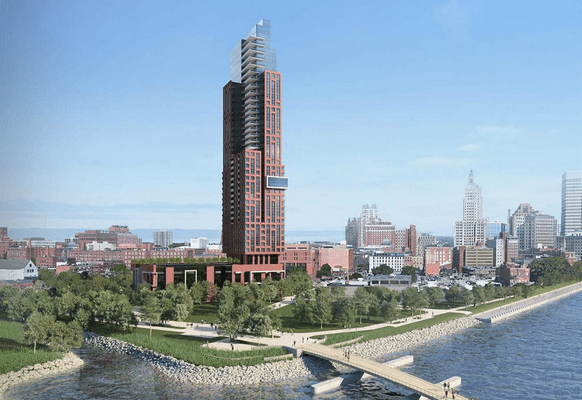
But Denby considers the skyscraper proposed by Jason Fane as more eyesore than icon. He has penned a statement against Fane’s 46-story tower from an aesthetic point of view. He does not think the City Council should let it rise three times higher than zoning allows. Here is his statement, which was published as a letter to the editor in today’s Providence Sunday Journal:

The cities of Amsterdam and Paris – to highlight only two of many examples – are admirably self-aware. They are aware that people love to stroll along the canals and  the Seine. They are careful not to disrupt the sense of openness, the lightness of being that derives from proximity to these watercourses. They abide by an aesthetic which is both implicit and established by tradition, and limit the height of buildings near these waterfronts.
.
Hence, I pose the question: Does anybody seriously believe that a 46-story tower would pass review if a developer proposed to build it along the canals or the Seine? I suggest that the authorities in Amsterdam or Paris would simply have a good laugh over that one, dismissing it as obviously absurd, as patently ruinous to the appearance and the appeal of their city.
.
And ruinous it will be if Jason Fane succeeds in erecting his out-of-scale, out-of-place, aesthetically incompatible 46-story monstrosity on the western bank of the Providence River. To boot, in Amsterdam and Paris and in the many other cities around the world more skilled in the art of crafting pleasing urban settings, they will be laughing at us.
.
Denby kindly and logically imagines that because the canals of Amsterdam and the embankments of the River Seine are beautiful today, civic leaders there can be trusted to continue to protect the beauty of their waterfronts. That may be so in Amsterdam. In Paris, whether height limits protect the Seine directly or not, Mayor Hidalgo has embarked on a program to uglify the City of Light, not just by introducing skyscrapers within the city’s boundaries but also by dumbing down the ornamental features of benches, kiosks and other street furniture that heretofore has been designed to augment the city’s beauty.
.
That’s too bad, of course, and hopefully she will be voted out before too much damage is done. Still, her desire to rape Paris does not undercut but only strengthen’s the validity of the sentiments expressed by Charles Denby about the obnoxious Fane tower proposal, which is way too tall and, regardless of its height, is architecturally incompatible with the city’s historical character.
.
Of course, the Fane Tower is just one of many affronts arising along the Providence waterfront. These include a proposed hotel on the east side of the river, and on the west side of it the Wexford complex, whose steel frame is nearing completion, as are the frames of the two Brown dormitories that will block views of the beautiful 1912 power plant at South Street Landing, as the hideous garage recently completed blocks views of it from the north.
.
Providence civic leaders are clearly uninterested in protecting the beauty of Providence, either along the river or anywhere else.
.
We have yet to see a rendering of Fane’s latest version, the “white tower with sculptured curves.” The Fane project might be blocked, however, because City Council will soon vote on whether to exempt its 470-foot height from a zoning limit of 130 feet. It has already received permission from the state to shrink the abutting park. The City Council, however, is filled with honorable men and women who may be expected to vote for the public interest, not that of a developer who has ridiculed the city for its many historic districts.
.
Well, we are allowed to hope, are we not? “Hope” is Rhode Island’s motto.
.
Screen Shot 2018-03-25 at 3.58.29 PM.png

Hope Point Tower, proposed by the Fane Organization. (Fane)

Posted in Architecture, Development | Tagged , , , , , , , , , | 7 Comments

Roman Forum, live, at night

Screen Shot 2018-03-23 at 5.53.13 PM.png

Rendering of Roman Forum at night after reconstruction someday. (Gilbert Gorski)

Above is how the Roman Forum might look at night today if it had never degenerated into ruins since the empire, or if it had been reconstructed as it was at the apogee of its ancient fame. The work, by Gilbert Gorski, was given to Léon Krier as consolation for the rejection, by Gorski’s publisher, of Krier’s introduction to The Roman Forum: A Reconstruction and Architectural Guide, by Gorski and James Packer. (Krier’s essay was posted in its entirety in “Krier: Ruins and discontents.”)

Screen Shot 2018-03-23 at 5.54.09 PM.png

The inspiration for Gorski’s rendering comes from the last line of Krier’s introduction: “To ensure maximum effect, I recommend the reader to imagine the figurants sporting contemporary clothing and steering modern vehicles.”

Clayton Fulkerson, a builder of classical models who lives in Warwick, Rhode Island, and who tends to object to the reconstruction of ruins unless they are substantially intact already, sent me the following description and photos of Cinecittá, a series of movie sets for films set in ancient Rome:

Cinecittá is a huge studio complex on the outskirts of Rome. It was conceived as part of Mussolini’s plan to revive the Italian economy. Films such as Ben Hur (the good one), Cleopatra and, more recently, Gangs of New York and the Rome series by HBO were shot there. Virtually all of Fellini’s and Zeffirelli’s films were also.
.
The tour took us to only part of the vast Rome set. HBO spared no expense and had to abort the series because of its huge cost. No stone was used in the set’s construction. It’s all a fantastic fiberglass façade mounted on steel framing. You would swear it’s all the real deal, as the Italians are devilishly good at this kind of thing. The “stones” paving the streets are cast from concrete using only five molds. The pieces are arranged in such a way that you’d never know the economies involved. When production ceases, the sets become the property of the studio, which has the right to rent them to other production companies.
.
Screen Shot 2018-03-23 at 6.01.14 PM.png
.
Screen Shot 2018-03-23 at 6.01.31 PM.png
Posted in Architecture | Tagged , , , , , , , | 3 Comments

Krier: Ruins and discontents

Screen Shot 2018-03-22 at 7.58.31 PM.png

The New Rostrum, Milliarium aureum, the Basilica Julia, the temple of Saturn, the temple of Vespasian and Titus, Via Sacra, the arch of Septimius Severus, the Mundus, the temple of Concord, the Tabularium, the temple of Jupiter.
(Giuseppe Becchetti. 1893. Gallery of Ancient Art)

Since we are still on our reconstruction roll, here is an excellent essay by Leon Krier, architectural theorist and master planner of Prince Charles’s new town of Poundbury. It was originally intended as an introduction to The Roman Forum: A Reconstruction and Architectural Guide, by Gilbert Gorski and James Packer, a massive and copiously illustrated book on the Forum. In his essay, Krier expands perceptively upon the experience of ruins causing disappointment – as noted in my recent post “Rebuild the Roman Forum.” Here is Krier’s essay in its entirety:

***

The Future of Archaeological Reconstruction

by Leon Krier

The Roman Republican Forum was one of the finest architectural and urban ensembles ever realized under the sun. Its reputation had so well survived its near total destruction that it remains to this day one of the most sought after places on earth; clearly not for what it has become, but for what it once was, not for what eyes can perceive there, but for what has disappeared from sight.

Ever since its devastation, cognoscenti and dilettanti have tried to recreate “the glory that was Rome” in measured drawings, models, paintings, all culminating in the 1930s in the creation of the Museum of Roman Civilization and Gismondi’s glorious plaster model of Imperial Rome.

Despite the formidable quantity of intelligence existing on the subject, what is missing on site is generally very unsatisfactorily evoked by guides and guidebooks, by flat words and even flatter images. The information perceived by visitors forlornly wandering amongst the ruins of the Campo Vacchino is on the whole probably even poorer than what they may remember from schoolbooks and pulp-fiction.

With the exception of having discovered once, by myself and by pure chance, a large Roman ruin in a remote pastoral landscape, I never felt established archaeological sites provoking anything but disappointed expectations. I always wondered if I, an unconditional aficionado, could get so little out of celebrated ruin-sites, what must be the state of mind of those who pay for visiting scattered remains they can’t shape back into any intelligible form. It is this feeling of frustration what, through the ages, has spurred archaeological reconstructions, i.e., retrieving in some palpable form something of great relevance not just for our forebears but for us, today.

What is it that is being so assiduously sought on archaeological sites? The question is why is that which is so keenly looked for, namely the buildings, the public spaces, the sculptures, urban furnishings and adornments, so poorly provided by archaeological sites, however well managed or manicured. Why are ruins and fragments supposed to be better vehicles for transmitting “history” than the walls and roofs themselves, the rooms, spaces, platforms and pavings, which once made the physical environment where it all happened.

Notions of conservation, reconstruction and restoration are as old as those of architecture itself. In traditional architectures there is indeed no conflict between principles of building and conservation, of maintenance and reconstruction. These conflicts only arise with the advent of “new” building materials. As a consequence, and quite unjustifiably, synthetic materials are held to be more modern than natural materials. In the ensuing ideological confusion, the technology of building with natural materials has been erroneously declared to be “historical,” dated and hence no longer of technological relevance. This historicist error is at long last being identified and corrected.

The physical and graphical reconstructions of a Valadier, Viollet-le-Duc, Evans, Thompson, Becchetti, Krischen are no longer being decried as unscientific by current archaeological science. They are being instead considered as policy models for the planning of archaeological sites. The recently completed restoration of the Maison Carrée in Nîmes and the reconstruction of the Liebfrauen Kirche in Dresden bear shining testimony to a new attitude, putting to shame the bad surgeries practiced for decades on historic buildings in the name of “modernity” and the Charter of Venice.

  • The refusal to reconstruct ruined historical buildings in their technical and material integrity
  • The sacralisation of ruins,
  • The restoration of ruins as ruins,
  • The building of costly and often purposely jarring protective devices over them,
  • The proliferation of bizarre visitors and interpretation centers,
  • The compulsive collecting, cataloguing and preserving of millions of “historical” bits and pieces, for half a century, without a policy of completing, repairing or recreating them.

All these “ideological fakes” are fast losing legitimacy. For the archaeologist, métier is undergoing a radical renewal as an artistic rather than a bureaucratic endeavor.

The formidable works of reconstruction undertaken by James E. Packer and Gilbert Gorski are the magnificent peaks of a new approach to archeology. Digital techniques are not only changing representation, achieving undreamed levels of definition in whole and detail, but are re-professionalizing archaeological investigation after decades of waste and decay. As a result, great architectural ruins need no longer just be seen as historical relics to be pampered as casualties of bygone ages, but as parts of puzzles to be recomposed in their corporal integrity, be it on paper, on screen and ultimately in situ.

It is a legitimate hope that these wonderful prospects will not merely be seen as evocations of a long gone architectural and urban past but received as inspiring visions, instrumental in leading one day soon to the actual resurrection of the Roman Forum in its former splendor. To ensure maximum effect, I recommend the reader to imagine the figurants sporting contemporary clothing and steering modern vehicles.

Posted in Architecture, Preservation | Tagged , , , , , , | 3 Comments

Zoo’s next stop: Houston

Screen Shot 2018-03-21 at 9.28.46 AM.png

Faces of the Amazon Building, under construction at Roger Williams Park Zoo. (RWP)

Next stop: the Amazon” reads the headline on today’s front-page story in the Providence Journal about the new South American Rainforest exhibit and its clichéd design, so out of step with the historical character of the zoo and its host, Roger Williams Park. “Next stop: Houston” seems more like it.

I am disappointed because every time Providence tries to move into the future, it repeats its regrettable past. That is, it replicates architecture of recent decades that rejects a gentle glide path from its past to its future. It embraces architecture that sees the future as a contrast with the past rather than a continuation of the past. It embraces buildings that most people find alien. With aggressive stupidity, the city embraces placemaking that weakens rather than strengthens its brand.

The two prime examples are most of Capital Center and most of the I-195 land. Brown and RISD are culprits, and so are the city’s medical institutions. They are all run by smart men and women who have been taken in by the folly of a cult, which is what the profession of architecture has become.

The architectural establishment suppresses design diversity, and belittles traditional architecture as illegitimate in our time. Unlike every other field of human endeavor, its operating principles reject precedent – in theory more than in practice, however, as the clichéd zoo building demonstrates. Modern architecture prefers creativity that favors freakish novelty over the subtle refinement of artistic technique. Modernist architects treat the dismay of the public with the result as a feather in their cap.

In a democracy, architecture – the most visible of the arts – should make some attempt to reflect the taste of the public rather than the taste of the editors of the leading architecture journals and members of the Pritzker prize juries. No doubt Washington, Jefferson and Roger Williams are spinning in their graves.

Providence is not alone in committing such errors. The whole world is doing the same. Providence has an opportunity to separate itself from the pack, nationally and internationally. It can do so with a credibility that most cities in America no longer enjoy. With consummate bullheadedness, Providence refuses to do so, hence spurning the economic and spiritual well-being of its citizens.

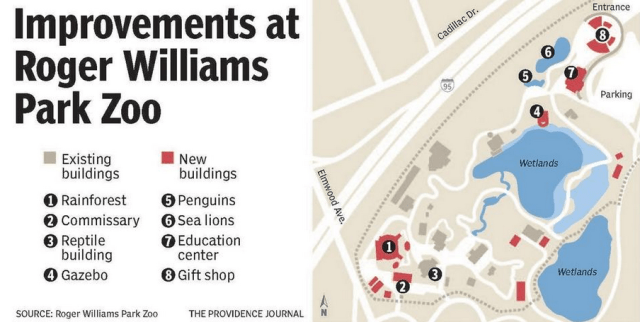
The rainforest building, whose interior seems excellent (see video), is among what from the map below seem to be upward of 13 new buildings in the zoo’s 20-year master plan. The rainforest building is especially disappointing because its architect, Yoder & Tidwell, has designed numerous facilities at the zoo in styles that mostly fit in. These include its African Pavilion, Anteater Exhibit, North American Trail and Eagle Exhibit, Children’s Zoo, Treehouse, Veterinary Hospital and others.

What happened this time? Well, it is still possible to hope that the rest of the proposed new buildings will lean toward Providence, not Houston.

Screen Shot 2018-03-21 at 11.02.08 AM.png

Posted in Architecture, Video | Tagged , , , , , , | Leave a comment

Rebuild Aristotle’s Lyceum

Screen Shot 2018-03-20 at 7.59.26 PM.png

In 1996, as construction workers cleared a site in downtown Athens for the foundations of a new Museum of Modern Art, they found traces of a large structure sitting on the bedrock. A building had occupied this same spot some two-and-a-half thousand years earlier, when it was part of a wooded sanctuary outside the origi- nal city walls, on the banks of the River Ilissos. The excavation uncovered the remains of a gymnasium, a wrestling arena, changing rooms and baths. This had been a place for athletics and exercise, where the young men of Athens had trained to become soldiers and citizens. …

An ancient gymnasium in Athens? Achh! Let ‘er rip. Cart away the sweat-stained artifacts. Build your Εθνικό Μουσείο Σύγχρονης Τέχνης, with my blessing.

But wait. Not so fast.

… [I]t was much more than just a centre for physical improve- ment. The archaeologists soon realised that they had found one of the most significant sites in all of western European intellectual culture, a site referred to continually by history’s greatest philo- sophers: the Lyceum of Aristotle. The world’s first university.

Screen Shot 2018-03-20 at 9.11.18 PM.png

Aristotle

The passages, from James Crawford’s Fallen Glories, which I mentioned in my post “Rebuild the Roman Forum,” left me filled with anxiety for the fate of the remains of the Lyceum of Aristotle. The vision of its rubble bulldozed aside to make way for a Museum of Modern Art (Εθνικό Μουσείο Σύγχρονης Τέχνης), no doubt designed to poke out the eyes of the spinning shades of the Father of Western Philosophy (a title he shares with his own tutor, Plato, whose eyes would also be at risk) and the teacher of Alexander the Great (ditto).

Thankfully, my expectation, though validated by the history of brutality as the operating system of modern architecture, was too dire. The new building was cancelled, the museum’s art stored at a temporary site nearby, and, even though not everyone agrees that the exact site of Aristotle’s Lyceum was truly identified, the excavation continued.

Alas, nothing was found of notable architectural value farther back than Roman times, and what was found was no more than the lower walls and foundations. Since Greece is no longer an empire and Athens no longer a wealthy city-state, a dig is not a done deal. The history of the site after its discovery in 1996 is described by David John in his Cheshire Cat Blog, with copious text, notes, maps and photos. Fascinating. He expresses an infinitude of frustration (or shall we say patience) at the slow pace of progress. At last, the excavation was complete. Of the results, he wrote in 2013:

[D]isappointingly, the archaeological finds at the gymnasium site proved meagre: only the foundations and lower courses of walls of the wrestling area (palaestra) and library and part of a baths from the Roman period were uncovered; there appeared to be no sign of statues, inscriptions or any significant evidence of the site as the ancient sanctuary of Apollo Lykeios, after whom the Lyceum (Λύκειον, Lykeion) was named, or as a gathering place for philosophers; and unfortunately, no treasures, revelations or “astonishing discoveries.” So far, very little has been published about the excavation finds in English, which can only be taken as a discouraging sign.

David John leaves room, however, for hope that a restoration is in the works:

Several times after this author had heard that the site would be opened he dutifully traipsed along to only to find the same fence screening a closed building site on which nothing whatsoever was happening. In September 2010 a press release by the official Athens News Agency stated that the restoration work was finally – really, really, really – about to begin. However, when I visited the site again in May 2011 there had been no discernible progress.

Restoration? Does David John mean the restoration of the ruins, if such a project makes any sense, or the rebuilding of the Lyceum? The latter, I hope. There was not enough left in the way of ruins for the average visitor, or evidently even a scholar, to feel the frisson of ancient history upon this sacred ground. (Much the same might be said of Penn Station.) Although a pleasant garden has been created next to the Lyceum site, the remains seem to be a perfect example of a ruin that could and should be rebuilt without thwarting what intellectual pleasure a ruin might have aroused. Thankfully, at any rate, the bulldozers of the modernists have been sent packing. That is a victory, in itself, of beauty and history over ugliness and nihilism.

(I am not sure how much is known through contemporary texts or drawings of how the Lyceum of Aristotle actually looked. The closest apparent attempt at a visual reconstruction that I could find is from, I think, a video game, “Call to Power 2: Aristotle’s Lyceum.” That image is on top of this post. Below is an unidentified painting from the schoolworkhelper.net website, said to show the inside of the Lyceum, though it looks bigger than the Lyceum as portrayed by the gamers. Go figure.)

[Numerous gentle readers have informed me that the painting below is Raphael’s “School of Athens,” with the structure comprising parts of St. Peter’s. Was the blogger unaware of this fact, or aware of it and, in the absence of an actual illustration of the Lyceum, making a joke?] [Update: I have fixed the caption below.]

Screen Shot 2018-03-20 at 9.07.34 PM.png

Interior of the School of Athens, by Raphael. (schoolworkhelper.net)

Posted in Architecture | Tagged , , , , , , , , | 3 Comments

Rebuild the Roman Forum

Screen Shot 2018-03-17 at 3.37.38 PM.png

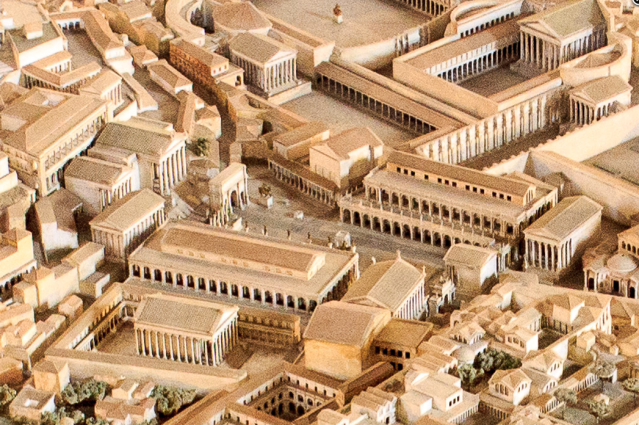
Model of the Forum as it looked at the height of the empire. (Museum of Roman Civilization)

Last October I described a master’s thesis on how to plan for a restoration of the Roman Forum – center of civic life in the capital of the Roman empire. The author, Eric Stalheim, was the first graduate of the University of Notre Dame’s School of Architecture’s preservation program, run by Steven Semes, the author of one of my architectural bibles, The Future of the Past.

So far as I know, however, nobody in Rome itself has seriously proposed rebuilding the Forum. As of now, it has been a very ruined ruin for many centuries. I would put the chance of its restoration well below that of Penn Station, the hope of all who are interested in the classical revival. On the other hand, it seems as if the Parthenon itself, in Athens, is in the process of restoration right now, though I’m not sure whether this project, which has lasted for a number of years if not decades, aims at anything like a complete restoration of the Parthenon, the Erechtheion and the rest of the Acropolis.

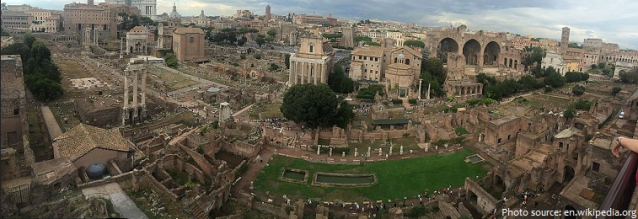
Even as a ruin the Acropolis – the main civic gathering of the Athenian city-state – is certainly more legible to the average tourist or normal citizen than the Roman Forum, which is mainly some difficult-to-distinguish ruins with a couple partially ruined colonnades standing around. A website called Jeff Bondono’s Page, from which the image above was taken, gives a good idea of what it might have looked like at the height of Imperial Rome.

This post was triggered by a chapter on the Forum in Fallen Glory: The Lives and Deaths of History’s Greatest Buildings, by James Crawford, of Scotland’s National Collection, in Edinburgh. The book takes famous buildings or sets of buildings from throughout history and discusses how they came to be and what happened to them, using a plethora of sources, contemporary, current and in between. For example, here he cites Goethe on standing amid the Forum ruins:

All history is encamped about us and all history sets forth again from us. This does not apply only to Roman history, but to the history of the whole world. From here I can accompany the conquerors to the Weser and the Euphrates, or, if I prefer to stand and gape, I can wait in the Via Sacra for their triumphant return.

Of course, not all of us have the power of Goethe’s imagination. The best case for not restoring the Forum to its ancient form (pick your era!) may be that even the most exact replica must, because we all will know it is a replica, undermine the possibility of the sort of mental time travel that Goethe could experience even amid ruins.

I would argue that rebuilding the Forum as it was in, say, A.D. 300, before it was sacked over and over again by barbarians and its own citizens, would be a valuable experience for those of us who are not Goethe. Indeed, the best of both worlds might be possible by preserving the Forum ruins as they are and rebuilding the Forum in or outside of Rome. Of course, that might tempt mod-symp ignoramuses to bloviate about the Disneyfication of history.

In the effort to reconstruct the Parthenon, it seems as if parts that cannot be restored using the original stone lying around it, of which there is quite an abundance, new marble is being cut to fit. Although experts say it will blend in after enough aging and weathering, how long will that take? I have my doubts. That’s another argument to let sleeping ruins be.

Much as I like the idea of rebuilding the Forum, I’m not sure what the best course would be. It’s a more difficult question than that of rebuilding Penn Station, whose grand hall was modeled after the Roman baths of Caracalla. Of such a restoration’s advisability, however, there is no doubt whatsoever.

Screen Shot 2018-03-17 at 3.45.28 PM.png

The Forum and its vicinity as it lies in Rome today. (Wikipedia)

Posted in Architecture, Preservation, Uncategorized | Tagged , , , , , , , , , | 15 Comments