Review: ‘Making Dystopia’

Screen Shot 2018-07-31 at 5.19.29 PM.png

[Review by David Brussat of Making Dystopia, by James Stevens Curl. Oxford University Press. 592 pages. U.S. publication date Oct. 23, 2018.]

***

Modern architecture has hoaxed the world for well over half a century. Charlatans bred the founding modernist frauds in Europe and exported the virus to America by framing a false narrative of flight from the Nazis. High society here swallowed the story hook, line and sinker, and handed to the “refugees” top academic posts at Harvard, etc., where, with the connivance of industrialists, they applied their propaganda, learned from the left and the right in prewar Europe, to effect an entirely unnecessary and unwarranted capture of American architecture and city planning. They used monopoly power to squelch dissent and to inflict a catastrophic urbanism on helpless populations, first in the West and then around the globe.

Screen Shot 2018-11-02 at 6.19.46 PM.png

In Making Dystopia: The Strange Rise and Survival of Architectural Barbarism, architectural historian James Stevens Curl exposes this tragedy and the immoral theories and practices of its proponents. He reveals damning facts about the founding modernists and their proclivities. He drags the truth from hidey-holes maintained by generations of design clerisy quite aware of how bad it would look if their secrets ever saw the light of day.

Dystopia is their worst nightmare. Stevens Curl’s book lets a thousand cats out of a thousand bags.

Published by the Oxford University Press, this volume should inspire a major rethink, a revaluation of values, a revival of old home truths whose outcome, if successful, will rank right up with the transformation of defeated Axis powers into peaceful democracies after World War II, the return to normalcy of post-communist societies in Eastern Europe and (far from complete) Russia, and the awakening of populations around the world to the fragility of the natural environment.

Screen Shot 2018-11-02 at 7.16.28 PM.png

James Stevens Curl

The fragility of the built environment is only just dawning on human societies. Centuries of architectural evolution addressed the shifting needs of cities with the latest practices and technologies that never required shoving beauty aside. Then, after World War I, it was determined by a surprisingly small coterie of disgruntled architects that comprehensive change in how to build cities was necessary. In the years after World War II, the agents of change captured architecture’s establishment. But modern architecture failed to perform as its founders predicted. In democracies, at least, the public’s deep dislike from the beginning for modernist design should have served as a natural restraint on societies’ embrace of what Stevens Curl properly calls “totalitarian dystopia.”

Yet what does it matter, it might be asked, when enormous numbers of people seem oblivious to their surroundings? They simply do not notice, and anyway are too absorbed with their mobile phones to bother with urban scenery. Their reality exists somewhere else. I think it does matter: ugliness, incessant noise, inhumane surroundings cut off from contact with Nature, a disagreeable and dangerous habitat, and a throwaway society based on advertising and spectacle are inimical to the human spirit, devaluing life and blunting sensibilities.

Unlike many critics of modern architecture, Stevens Curl attempts to recall what has been lost in the headlong rush into a nihilistic recalibration of human habitation. Don’t think merely of the fabric demolished by modern architecture’s rude interruption of the profession’s progress. Think, too, of how practice, benefiting from generations of energy and creativity wasted by modernism, could have achieved higher and higher levels of virtuosity in the arts and techniques of city building. The only losers would have been the tourism councils of cities like Paris that have spent decades feeding off the world’s shrinking supply of beauty. Though no longer monopolies of beauty, they would have grown more lovely alongside every other city and town. Assuming that beauty has net positive rather than negative influences on life and the spirit of place, citizens the world over might have experienced a more healthy culture, one in which peace, comity, and the quest to solve societies’ longstanding problems might very well have been more readily achieved. Instead of fostering an instinctive defense mechanism to tune out our built environment, humane placemaking could have brought more happiness to all citizens.

This is a plausible summary of the magnitude of the opportunity cost of the history that has in fact beset the world, as described by Stevens Curl’s book, and of the importance of trying to recapture what has been lost.

***

Screen Shot 2018-11-02 at 6.25.12 PM.png

Walter Gropius

The author begins with a concise and yet comprehensive critique of the soundness of the ideas at the foundation of modern architecture. Among its many other flaws, he exposes the fundamental contradiction between Bauhaus director Walter Gropius’s commandment that modernism “start from zero” and architectural historian Nikolaus Pevsner’s discovery of “pioneers” or “precursors” to modernist design among the great architects of the 19th century. Either it’s a break with the past or it’s not.

Stevens Curl shows how the influential Pevsner purposely misinterpreted the Arts and Crafts Movement and Art Nouveau, labeling as pioneers architects such as C.F.A. Voysey who disputed the historian’s analyses of their buildings; tracing modernism back to details of work by Charles Rennie Mackintosh and others he appears to have imagined outright; and ousting from the historical record the work of well-known architects that did not fit in his narrative. Stevens Curl quotes Pevsner’s passage applauding the “world of science and technique, of speed and danger, of hard struggle and no personal security, that is glorified in Gropius’s architecture.” Stevens Curl adds that “Pevsner seems to have been mesmerized by Gropius’s personality and physical presence.” Tom Wolfe’s moniker for Gropius, in From Bauhaus to Our House, was “The Silver Fox.”

Stevens Curl cites Pevsner as having “had the grace to admit in print that Voysey was ‘cross’ with him for ‘having discussed his work as pioneer work of the twentieth century style’ which he ‘disliked.’ ” The author takes Pevsner apart quote by damning quote, yet without seeming altogether angry at him. Indeed, later on, Stevens Curl seems to treat such movement icons as Erich Mendelsohn and Philip Johnson with kid gloves because both were apostates. The lines of Mendelsohn buildings were too curvy for modernist hard-liners. Johnson seemed, later in his career, to make a sport of rejecting successive modernist fashions. But they were modernists after all. Mendelsohn was also treated poorly by some modernists for being Jewish. Johnson, to whom Stevens Curl attributes the leading role in pushing modern architecture in the United States, was close to the Nazis in Germany and fascist groups in America during the late ’30s. He accompanied Hitler’s troops into Poland, seeming, according to correspondent William L. Shirer, more a minder than a reporter. Stevens Curl darkly notes Johnson’s “National Socialist sympathies” and “anti-Semitic tendencies.” Johnson was “titillated by the aesthetics and sexuality” of the Nazis, an obituary quoted by Stevens Curl points out. On the other hand, the relationships of Ludwig Mies van der Rohe and Le Corbusier with the Nazis and Vichy collaborators get the full brunt of Stevens Curl’s disdain, as does the hand-in-glove relationship of the Bauhaus school and early modernism with Marxist-Leninism.

Screen Shot 2018-11-02 at 6.29.45 PM.png

Le Corbusier

Among the great contributions of Dystopia is its exposure of modern architecture’s relationship with the Nazis. This has been purposely hidden from the public and scholars. Lately, however, the stonewall has sprung leaks. Stevens Curl makes good use of the pathbreaking Le Corbusier: The Dishonest Architect (2017), by Malcolm Millais, a pair of 2015 exposés, in French, of Corbusier, and Elaine Hochman’s brilliant exposure, two decades earlier, of Mies’s relationship with the Hitler regime in Architects of Fortune (1990). Mies’s attempt to persuade Hitler, through Goebbels, to accept modernism as the stylistic template of the Third Reich says a whole lot more about modernism than does its predictable rejection by Hitler. Anyhow, Stevens Curl makes much of the extensive use by the Nazis of modernist design for utilitarian buildings, a fact implicitly denied by generations of apologists for modern architecture.

To this day, the public remains cowed by convenient and longstanding myths about the founders’ relationships with the Nazis, such as the closing of the Bauhaus, or the supposedly exculpatory need of architects living in the Third Reich to seek employment from whatever clients were available. Stevens Curl sums up part of his indictment:

The National-Socialist Government did not close down the Bauhaus (in fact, it was prepared to let it continue provided certain conditions were met): the decision was that of Mies and his colleagues.

Nor did Mies either encourage emigration or himself leave Germany: on the contrary, he and many other Bauhausler sought accommodation with National Socialism. Modernists like Mies hoped their “progressive” ideas would be eagerly accepted by the revolutionary New Order … .

Screen Shot 2018-11-02 at 7.19.16 PM.png

Ludwig Mies van der Rohe

Although some traditional architects cringe when the Nazi subject is raised, it is vital to slay the Big Lie enabled by these myths, and in particular the notion that Hitler’s embrace of classical architecture means that all who hate Hitler must hate classical architecture and oppose its design and construction in today’s world. That idea, simple but wrong, has colored the thinking of many architects. This particular attitude exemplifies the deconstructivist ideas that have infected modernism, planting doubts that delegitimize the language and institutions of Western culture and society. Most modernists are unfamiliar with these ideas, but merely by erecting a modernist building they have unwittingly helped to undermine Western culture and alienate populations from their cities and nations.

***

As Stevens Curl points out, tradition continued to dominate architecture in every nation through the 1920s and ’30s. H.L. Mencken wrote in 1931 that “the new architecture seems to be making little progress in the United States. … A new suburb built according to the plans of, say, Le Corbusier, would provoke a great deal more mirth than admiration.” Even Hitler did not really face a “choice” between classicism and modernism; the latter was a newly birthed, experimental niche style, whereas classicism had been the default style for all major civic design in European nations for centuries. Modern architecture was not even officially introduced in America until the Museum of Modern Art held an exhibit on the International Style. The exhibit was put on in 1932 by the aforementioned Johnson, then curator of architecture at MoMA, joined by its first director, Alfred Barr, and architectural historian Henry-Russell Hitchcock.

Screen Shot 2018-11-02 at 6.34.39 PM.png

Philip Johnson

The natural and appropriate attitudes of Allied governments and publics toward the defeated Nazis were manipulated in a highly successful Cold War effort by the U.S. government of the late ’40s and ’50s to use architecture as a foil against the Soviets. A most riveting chapter in Making Dystopia treats the convolutions of this manipulation. The association of modernism with communism and the left was flipped, using the Big Lie that demonized traditional architecture as fascistic. The goal, in Stevens Curl’s meticulous telling, was to use modernism to illustrate the superior liberalism of American capitalism. In the process, the reputation of traditional architecture attained a bad odor among the American elite. Johnson, MoMA and the CIA were involved in this switcheroo, which sought to paint America as more progressive and creative than the Soviet Union in the fight for the hearts and minds of Europe during the Cold War.

Thomas W. Braden had been MoMA’s executive secretary (1948-49) before joining the CIA in 1950 to supervise its cultural activities, and was a key figure in the important role played by MoMA in the Cold War. Modernism was promoted as the “perfect contrast” to the “regimented, traditional and narrow” nature of Socialist Realism, and when cultural propaganda played its part during the Cold War, the functions of both the CIA’s “cultural apparatus” and MoMA’s international programs were “similar, and, in fact, mutually supportive.”

As for MoMA’s Barr, he is described as “the éminence gris behind Johnson the impresario, the publicist, the advocate, the showman” of modernism:

Barr denounced the art and architecture of National-Socialist Germany and of the Soviet Union, arguing that totalitarianism and realism were bedfellows, but that abstract art was feared and prohibited by such regimes, ergo the Modern Movement was on the side of democracy. This curiously warped notion proved very useful in the promotion of Modernism and its advocates. Intelligent Cold Warriors such as Braden realized that “dissenting intellectuals” who believed themselves to be acting freely could become useful stooges in the international propaganda war.

As this propaganda war was being waged on the international scene, its major tenets, including modernism, machine worship and technocracy were being pushed on the U.S. domestic scene. “Without the massive clout of commerce,” Stevens Curl says, “it is doubtful if Modernism would have been so universally acceptable in the West … By the late 1920s huge American industrial concerns, such as General Motors, had grasped that planned obsolescence would be necessary to sustain mass-production.”

Cheap to build, swift to deteriorate – modern architecture clearly fits the bill. In the ’40s and ’50s General Motors built traveling exhibits to convince Americans that a better and more exciting future, with cars speeding down roads lined with buildings rebuilt with glass, steel and concrete, could replace the humdrum present. The author continues:

[I]ndustrial-strength propaganda was brought into play to represent housing, clothing, food and cars (the “fourth American necessity”) as essentials, and, as the director of research for General Motors, C.F. Kettering, observed, to make people dissatisfied with what they had. Architectural historians have tended to over-emphasize the roles of architectural theorists and historians, architects, critics, and government planners in making Modernism the orthodoxy in architecture and planning: tradition was purged from the practice of design, town planning and architectural/planning education; and artists and craftsmen were put out of business.

***

A review cannot but scratch the surface of the excellence of a great book. Its publication by the Oxford University Press imparts a credibility that cannot be gainsaid. Given its exhaustive scholarship in support of its thesis, it was originally expected by the author that reaction to the book from the usual establishment critics would be silence. And in a sense he was correct: no reviewer has addressed that thesis except by harrumphing or by resort to belittling the author’s prose. One critic found it “windy, overwritten, under-edited, repetitive and full of clichés.” Absurd. (I have decades of experience proofreading and I found zero typos in its 592 pages.) In fact, there are passages with too many lists of architects – often necessary in scholarly writing. Still, Stevens Curl’s occasionally complex sentence structure is well calculated to ease the difficulty of unraveling the convolutions of modernist thinking and the devious maneuvers to put modern architecture across in spite of what he proves are its manifest shortcomings. These maneuvers and their perpetrators, cloaked in dissimulation to mask their character, have been uncovered and effectively explained by Stevens Curl.

The modernist fraud failed with the public but succeeded with the elites. The public did not need to debunk the ridiculous case for modern architecture; it just used its eyes and saw it was ugly. To paraphrase many writers, it takes an expert to believe something as stupid as modern architecture. Well, they did, and the result is a global catastrophe.

So the other big objection of the critical establishment’s herd of independent minds is the author’s undisguised anger at this turn of events. Stevens Curl wields a “trembling arquebus,” writes one critic (admittedly, a great image). The author of Dystopia may be angry but he is not a machine. To show no emotional response to the global cataclysm of modern architecture would be to reveal a lack of judicial temperament. If anything, he is not angry enough. Given his subject, his tirades are almost in the vein of diplomacy. They are entertaining, and glow with the vitality of truth.

Screen Shot 2018-11-02 at 7.41.28 PM.png

Drawing reflects author’s “death” of psychic wounds sustained in fight against modernism. (By James Stevens Curl, with apologies to Alfred Rethel)

He has reason to be angered by what has happened but perhaps he is too skeptical of the possibilities for a revival of classicism amid a resumption, in a wider social context, of common sense. In fact, at the end of his book he offers a set of extraordinarily sensible reforms directed at architectural education, which is a mess. To propose such reforms is to express at least some degree of optimism. In this reviewer’s opinion, however, schools of architecture will not change until they are forced to change, and only renewed public interest in the local development process, and pressure applied to local developers and politicians – who have good reason to listen to the public – seems the least bit likely to rebalance the tilted playing field for major design commissions, and end classicism’s overreliance on the pocketbooks of rich people. What might bring that about is another matter entirely.

Stevens Curl’s book may be said to unpack some of these issues, but at a much higher level. Against his own pessimism he suggests that “a reaction may come sooner than some predict, and it may not be containable.” Making Dystopia mentions in passing the good work of a growing coterie of classical and traditional architects, including Robert A.M. Stern here and Robert Adam in Britain, and how the craft of building is being renewed by historic preservationists and craft-oriented schools. It is a beachhead, but that is vital. He ought to have written more about why the centuries-ensconced classical establishment, so innocent of modernism’s charges against it, barely lifted a finger in response to the modernist challenge that toppled its authority. To bring about a return of its influence, a broader decline in human affairs will probably need to be reversed:

What is missing from much debate about architecture today is empathy, respect for culture in the widest sense, understanding of history (including religion), recognition of the imperative of Nature as part of humankind’s habitat, and understanding the importance of expressions of gravity and stability in building design to induce calm and ease in those who have to live with the realized works of an architecture that denies gravity, that deliberately sets out to disturb, and that only respects itself.

The world cannot continue long amid a thought system that misunderstands, disregards and attacks the history of human society and culture as it has unfolded over at least two millennia. There are two kinds of architecture – that which respects nature and its regenerative principles, mimicking biological selection, bringing change that reflects best practices handed down from one generation to another, evolving by trial and error; and that which springs anew (at least in theory) from an unnatural lust for novelty that pays little heed to the knowledge gleaned from experimentation and still less to the needs of humans or humanity, a hubristic genuflection before a fake machine ethos that delivered only a bland metaphor for the efficiency it promised – a sort of GMO architecture. A once honorable profession must get back to basics, back to beauty, back to honesty so it can move forward into the future with a healthy boost from the past.

Among the choicest of many choice quotations in the book is Edmund Burke’s advice, from Reflections on the Revolution in France (1790): “To make us love our country, our country ought to be lovely.” James Stevens Curl’s Making Dystopia may be the book that finally focuses a long overdue attention upon that sage advice.

[The following week I posted “More on ‘Making Dystopia.”]

Other reviews:

https://quadrant.org.au/magazine/2018/10/expensive-institutionalised-poverty/ – Anthony Daniels

https://www.newenglishreview.org/custpage.cfm?frm=189422&sec_id=189422 – Theodore Dalrymple

http://www.archnet-ijar.net/index.php/IJAR/article/view/1828/pdf – Nikos Salingaros

http://commonedge.org/was-modernism-really-international-a-new-history-says-no/ – Mark Alan Hewitt

Screen Shot 2018-11-02 at 7.28.41 PM.png

Oxford University

Posted in Architecture, Book/Film Reviews | Tagged , , , , , , | 17 Comments

Halloween in Providence

Screen Shot 2018-11-01 at 2.14.44 PM.png

This Halloween scene, placed on Pinterest by Lenore Allen, may be from a computer game.

Last night’s Halloween trick-or-treat scene near our little house on Providence’s East Side showcased the charms of our more modest nook of the Blackstone neighborhood. On account of its evident friendliness, our district is usually mobbed by families from other neighborhoods. Victoria, Billy and I are usually Halloween grinches and either go to a movie or turn out our lights and hunker down upstairs. Last night, however, at the request of our 9-year-old Angry Bird (“Red”), we stepped out and found a much more friendly, enchanting ambiance than we had expected. (Victoria remained behind, alas, ill abed; she’s much better today, thank you!)

Except for its pumpkin patch and its lack of crowds and paved streets, the image above, from a computer game, resembles our neck of the woods and, no doubt, our sisters east of Hope. (We all “live off Hope,” except for those who live “on Hope,” which is the same.) Our six or eight blocks of bungalows, colonials, cottages, ranches, triple-deckers, Victorians and the like, single and duplex (no manor houses or modernist houses, midcentury or otherwise), are tucked in between Hope and Lorimer Avenue, beyond which lie the much more plush portions of the neighborhood leading to Blackstone Boulevard, Butler Hospital and Swan Point Cemetery. But last night I would not have traded our precinct for any of its ritzier cousins.

We emerged just after dark had fallen. The seasonal but unexpected warmth, after weeks of winter-like cold, had drawn the owners or renters of houses – the “trick-or-treated” as opposed to trick-or-treaters – onto their stoops and porches to hand out candy to all comers. Of these there were so many that lines formed from stoop to sidewalk and beyond. Despite some jostling, the mood was impeccably genial.

The porch has been described by urbanologists as the great mediator between the house and the public. Many of the porches and front yards from which moms and dads (or other couples) handed out candy were decorated to the max, and it was to these houses that families with young children or groups of teens gravitated, eventually ignoring the houses (like ours) with lights out or no one otherwise in evidence.

Billy and I ran into people we know, especially neighbors on their porches, and a family from Billy’s school bus stop, so for the hour we lasted we enjoyed plenty of conviviality. Everyone seemed happy. The streets, though crowded with invading cars, seemed happy. It was almost festive, no, it was festive. It was the classic neighborhood experience, high on sugar. I look forward to next year. Our house has no porch, alas, and our (my) vague plan to build a porch has not advanced. Good porches make good neighborhoods.

Oh well, perhaps next year we will hand out treats from our stoop, maybe even decorate it. In the meantime, to make friendliness a more year-round phenomenon, more people who do have porches should hang out on them more, and not just on Halloween.

Posted in Architecture, Uncategorized | Tagged , , , , , , , , | 2 Comments

How the Gothic got haunted

Screen Shot 2018-10-29 at 11.50.44 PM.png

29 Nielbolt St., in the movie It. (Warner Bros. Pictures)

Here’s an interesting article, perhaps a day early, on the history of Gothic architecture – you know, with the pointed arches and towers reaching for the sky. All haunted houses are Gothic, are they not? Some say haunted houses are more likely to partake of the Victorian, but those are just some cranky modernists who look down their noses at beauty. Boo!

How Gothic Architecture Lost its Lofty Image,” by Peter Lindfield for the Epoch Times, traces Gothic through periods of popularity and otherwise. It arose in the centuries prior to the Renaissance rediscovery of Greek and Roman classicism in the 1600s, and then again in the second half of the 1800s, when it came to symbolize the resurgence of Roman Catholicism. Religious subservience to Rome was de rigueur in Britain before King Henry VIII and his rupture with the Vatican over his divorce. With the rise of Protestantism, Church of England leaders turned to classicism to express disdain for Catholicism during its period of banishment.*

My knowledge of British religious history does not quite stretch to precisely how Catholics managed to creep back into the fold in England, and neither does Lindfield’s article, but Britain’s alliance with Spain, Portugal and the Holy See itself against the godless Napoleonic France led to a softening of attitudes in Britain toward Catholicism. The longstanding battle between the faiths was reflected in an architectural style war. Eventually, after a terrible fire, Parliament was rebuilt in the Gothic style. Unfortunately, both sides were ultimately defeated by the modernists, in more ways than one, and with only a minimal hope, as of today, for “regression” in the future.

Yikes! What are we getting into!? Let’s get back to haunted houses! Bram Stoker’s Dracula and all those vampires! The Gothic novel! The Castle at Otranto (1764), by Horace Walpole, the English politician, socialite and literatus, is considered the first Gothic novel featuring a haunted house. In my opinion, his estate at Strawberry Hill, built in the Gothic Revival style, has been haunted by its too-pristine 2012 restoration. (See photo below.) Was Mary Shelley’s Frankenstein a Gothic novel? Well, certainly there was a castle involved, possibly a Gothic one, and the local townfolk chased after the good Dr. F with pitchforks, stirring sentiments that settled down over the years, maybe, into “American Gothic,” the famous painting by Grant Wood.

The photo on top is the haunted house from the 2017 movie It. That’s not the movie that was previewed for next week’s feature on the regular Saturday night TV horror show “Chiller” back in the 1960s. As kids, sitting in the dark, my brother and I watched that preview. It seemed lame. We said in unison: “That’s it?” Immediately the announcer said, “This is It!” But I can find no online mention of a black-and-white ’50s movie called It. So maybe what the announcer really said was “This is it!” And the movie – it now dawns on me – was called The Thing. Still, this really happened! Really! Cue the theremin!

* My friend Will Morgan, an architectural historian and pesky mod-symp, warns me of a certain inaccuracy, not fully explained, in my description of historical relations between Catholics and Protestants in Britain, in particular the extent to which Gothic architecture grew in esteem among the Anglicans during the 19th century. (I ought to have pointed out, as well, that most if not all of the great cathedrals in Britain and Europe were Gothic.)

Screen Shot 2018-10-29 at 9.47.09 PM.png

Strawberry Hill estate (1749-76) of Horace Walpole after 2012 restoration. (Chiswick Chap)

Posted in Architecture | Tagged , , , , , , , , | Leave a comment

‘Dystopia’ on sale in U.S.

Screen Shot 2018-10-25 at 11.29.16 PM.png

“Pardon me, where is the school of architecture?” (Austin Cramer)

On Monday, Making Dystopia, by British architectural historian James Stevens Curl, officially went on sale in the United States. I am mere pages away from its completion and will review it soon. It offers a comprehensive study of a monstrous crime, summed up in the subtitle of the book: The Strange Rise and Survival of Architectural Barbarism.

Published by Oxford University Press, this hefty volume has rattled the cages of the architectural establishment in Great Britain as, no doubt, it will here. Some of those who have praised the book have enjoyed its observations on schools of architecture. For centuries an education in the design of buildings looked backward in order to teach the next generation of architects to move forward – a pattern followed by every profession, indeed every human field of endeavor throughout history until modern architecture. Stevens Curl, who was himself trained as an architect, describes how it used to be. First, students would learn how to draw exemplary buildings:

It was only by such close examination that detailed knowledge could be acquired of proportional systems, relationships of parts, axial planning, mouldings, how junctions are formed in a satisfactory manner, and, above all, how materials were used and put together in a building, especially dressings around openings such as windows or doors, where the materials often differed from those used in expanses of wall.

Such study revealed how a moulded skirting stopped at a block above which an architrave rose; how a band of mouldings joined another band at right angles to it; how the features of a room (e.g. fire-surrounds, windows, doors, and bays) related to each other by means of main and subsidiary axes; how subtle, recessed bands or planted beads could not only disguise joints, but helped objects to look pleasing by their logical positioning and the resulting subdivision of planes; how plinths, pedestals, rails, and cornices divided and finished the designs of walls; how pilasters, antae, or buttresses could break up a long wall into a series of parts and relate to the design of entablatures, ceiling-compartments, and the geometries of floor-finishes; how to treat a corner (inside and out); how the structural aspects of holes in walls such as those required for windows and doors are expressed in design, and how the treatment of a doorway might signal its significance and meaning; and a great deal more. In other words, an understanding of the ways in which a building was constructed was encouraged by such detailed hands-on study at close proximity to the fabric, reinforced by having to draw it to scale with accuracy and sensitivity.

The student would discover a rich alphabet to start with, then a vocabulary, and then a whole language capable of infinitely adaptable use, enabling him or her to look at buildings with informed eyes, and making visits to fine cities, towns, and works of architecture all the more enjoyable and instructive. Furthermore, armed with such a language, an architect did not have to stick pedantically to dull copyism. Skilled designers such as Karl Friedrich Schinkel, Leo von Klenze, Sir John Soane, or Alexander “Greek” Thomson (all of whom were thoroughly immersed in architectural languages [and fluent in their uses too]) could employ them as springboards for adaptability, invention, and creativity, all in the service of making architecture with profound resonances and meanings, which is what real architecture is about. Those languages with which they were acquainted gave them the means by which they could actually design with fecund invention and skill, drawing on true expertise and deep learning, to make buildings that were actually fresh, truly original, and which really functioned as architecture.

Such education, which had prevailed for centuries, was killed off in the 1950s and ’60s. It was replaced by an education totally different:

[S]tudents’ “projects,” produced in “studios,” were largely graded on the basis of how closely they resembled whatever “architecture” illustrated in the magazines was currently fashionable. Despite the supposed abolition of “style,” students who did not conform to stylistic dogma were cast into outer darkness. I can confirm this, for my own time in schools of architecture was a revelation: it left me wholly unprepared for the real world designing real buildings. That experience was by no means unique, for others have come to similar conclusions concerning their own inadequate “education” and the tactics used by tutors (often reinforced by their fellow-students anxious to ingratiate themselves with the tutors) to enforce conformity on pain of rejection and ultimate failure.

Stevens Curl graduated from the architecture school at Oxford in 1963. I never went to architecture school. So, unless he started out his architect coursework as a renegade, his road to wisdom in architecture required him, at some point, to rip off the blinders I was never forced to don. Yet in my years of writing about architecture, I have encountered so many students and practitioners with so much pent-up anger, who, some moved to tears, told me horror stories of the brutality they faced from faculty in architecture school if they did not conform to modernist orthodoxy. James Stevens Curl’s description of the education of architects today is of a piece, in its honesty, truthfulness and factuality, with his book’s description of the tragic history of the profession in the 20th century.

The passages above from Making Dystopia are far from its most controversial, let alone its most angry. The passages I quote in my review will rattle the modernist cage with far more violence than these.

Posted in Architecture, Architecture Education | Tagged , , , , , | 7 Comments

A little off the top for Fane

Screen Shot 2018-10-23 at 9.04.59 PM.png

View of proposed Hope Point Tower (left center) seen from northeast. (Fane Organization)

Monday night’s public hearing into the Fane tower at City Hall barely seemed to push the needle one way or the other on whether to permit its developer, Jason Fane, to ignore the 100-foot height limit on the Jewelry District land where he hopes to build the skyscraper. He has trimmed his 598-foot proposal by 68 feet down to 530 feet. Easy on top!

That won’t shave away much community opposition to the project, but that was not the purpose. Fane hopes the haircut will provide enough cover for council members to vote yes when the full body votes on whether to hike the height limit. More members have voiced skepticism than support, I believe, but nobody knows how many members are truly undecided. To shrink the building from six times to five times what zoning permits will hardly affect the case for or against the tower. Fane realizes that, but hopes his feigned willingness to negotiate will win over some Nervous Nellies.

The fact remains that if the council approves this major zoning change, it will effectively nullify all zoning regulations in the city. At stake is not a tweak to squeeze an otherwise legal building under the wire. This would not be to bend but to discard the rules. It would be a declaration by a developer that he doesn’t care about the law – and equally, by any council member who votes to approve this profanity, a declaration of the same.

Unlike the first hearing held by the council’s Ordinance Committee in July, this time the committee did not vote to reject (as it did then) or recommend the zoning change. So far as I am aware, no date for a vote by ordinance has been set, much less a vote by the full council. It’s no wonder members aren’t eager to vote on this.

On the floor to the left of the council leadership’s dais, oddly enough, was a rather large scale model of the last proposal to challenge the tower that has been the city’s tallest since it opened in 1928 – the Industrial Trust Bank (“Superman”) Building, at 428 feet. One Ten Westminster, as it was called, was proposed in 2005 and would have risen to 520 feet, but went belly-up even before the Great Recession.

Screen Shot 2018-10-23 at 10.43.40 PM.png

Model of One Ten Westminster.

As you can see from the picture I took from the second-floor gallery last night, it was a nice model, showing the building (not so nice) in a parking lot girdled by historic fabric, including the Weybosset Street façade of the Providence National Bank (built in 1950). Some, including this reporter, have proposed putting the Fane tower at that spot. A commenter (see below) says the model was brought in by Sharon Steele, a leading opponent, to illustrate the idea of putting the Fane tower downtown.

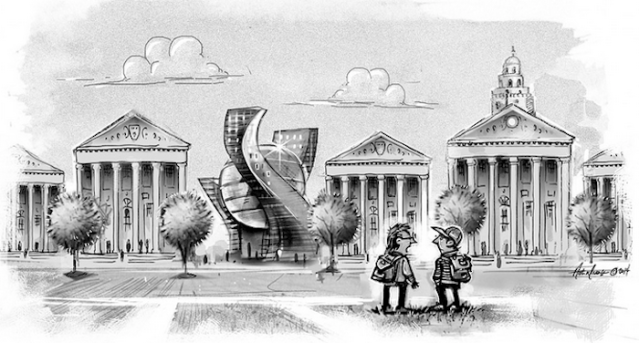
The illustrations above and below seem intended to suggest that Hope Point Tower, as the building would be called, is just another piece of the downtown skyline, and not so terribly huge. Don’t be fooled. It is out of character and out of scale. If it were built on the same spot as the proposed One Ten Westminster, many opponents of the Fane tower would no longer have any really serious objection. It would be surrounded by several tall towers and instead of sticking out like a sore thumb in the Jewelry District it would serve as an exclamation point to the crescendo of the city’s skyline. Fane has resisted advice to relocate his project to a more reasonable site. He seems to want it to stand alone as a monument to his own iconic ego.

I don’t like its design, but I would find it difficult to oppose the Fane tower if it were moved to the center of downtown. Others are irked by its lack of affordable units, or its potentially negative impact on the housing market. The former will be a problem unless affordable units are added in further negotiations with the city. If the tower were built at the One Ten site, it would generate market activity rather than stifling it. It would bring vitality to the central business district – the real downtown, not the fake downtown that city planners are trying to make of the Jewelry District.

Fane’s proposed location would split this vitality between a pair of competing activity centers, one amid an urban treasure and another poking up amid an ill-conceived innovation district already under assault by the ugliness of what has been built thus far and what is proposed. The architecture of the I-195 corridor, including the Fane tower, is a set of clichés of machine-age, high-tech design that will be as inhumane, on a smaller scale, as Boston’s sterile and steroidal innovation district. What Providence needs is development that reflects and respects our historical character, that strengthens rather than undermines the city’s brand.

Whether at 598 or 530 feet in height, the Fane tower doesn’t cut the mustard.

Screen Shot 2018-10-23 at 9.14.30 PM.png

View of proposed Fane tower (left center) from southeast of downtown. (Fane Organization)

Posted in Architecture, Development | Tagged , , , , , , , , | 18 Comments

Buildings that go extinct

Screen Shot 2018-10-22 at 10.06.30 PM.png

Image from atop McMansion Hell’s defense of modern architecture. (mcmansionhell.com)

Here is an interesting article in The Baffler, “The Archivists of Extinction,” by McMansion Hell blogger Kate Wagner. She focuses her microscope on folks who collect and post photos of old Kmarts, Toys ‘R’ Us’s, and the like, which are not just being put out to pasture now that they are going out of business, they are being demolished.

Screen Shot 2018-10-22 at 10.55.04 PM.png

Kmart Kboom? (twice.com)

Good riddance, you might say. Perhaps. My own motto, in fact, is if you want to preserve a modernist building with a demo permit taped to its front door, buy a camera. Still, thousands of people are finding a harmless way to grieve soon-to-be-lost architecture that played an emotional role in their lives, and their archival instincts are worthy of considerable respect. But let’s not get carried away.

There’s much to disagree with in Wagner’s long essay – hint, hint: she likes modern architecture – but all of it is interesting, and even provocative. She begins by pointing out how short the lifespan has become of houses and buildings in our era.

It might shock you to learn that a 2001 U.S. Census report found that the average age of a residential building was a mere thirty-two years. In neighboring Canada, the average age of all non-residential buildings falls just short of eighteen years. Nor is this perpetual youth – a symptom in part of wear and tear, constant development, and demolition – restricted to everyday buildings; it’s true of capital-A architecture as well. Many Modernist buildings, even those designed by important architects, are considered obsolete after only two or three decades.

Wagner’s point is somewhat diffuse. She explores why some buildings are lost and others saved, and she points her finger at capitalism as the chief villain. Again, perhaps. But if you read her piece analytically, it seems to me that, with or without market forces, lovely old classical buildings are safer than modernist, mid-century modern and postmodern buildings. Buildings of the pre-modern age tend to last far more than just a generation or two.

I like the motto at the bottom of the emails sent to a classicists’ discussion board, the TradArch list. It says “Things are not good because they are old but are old because they are good.” Kate Wagner should think about that.

Perhaps the principle of Occam’s Razor – that the simplest explanation is the most likely explanation – applies here. Buildings that are beautiful are more likely to be loved and thus more likely to last. Their owners and users are more likely to pay for their repair and maintenance. Buildings that are ugly are more likely to be neglected, reach a state of decrepidity beyond repair, and bite the dust sooner. Most of the buildings whose demise is rued by Wagner are modernist. She notes that even a Frank Lloyd Wright building just received its comeuppance in Montana.

All of this should be kept in mind by those in Providence who attended Monday night’s public hearing on the proposed Fane Tower. I did, briefly, before being driven out by an inability to hear from the only seat I could find – in the balcony of the acoustically challenged Council Chambers. It is highly unlikely that the Fane tower, if built, will pour revenue into the city’s coffers beyond four decades. Very highly unlikely.

Posted in Architecture, Preservation | Tagged , , , , , , , , | 2 Comments

Is architecture charming?

Screen Shot 2018-10-20 at 9.34.29 PM.png

Rhode Island State House (1901), by McKim Mead & White. (Rhode Island Public Radio)

Although it says nothing of architecture, an essay by Joseph Epstein on charm causes me to wonder whether architecture can be charming. His essay, “Life’s Little Luxury,” in The Weekly Standard, is discursive, that is, it rambles round, making its point, or its several points, with a just-in-passing manner. Partly he tries to pin down charm by identifying what it is not. When he tries to define what it is, he waltzes gracefully around the difficulty of reaching conclusions about charm. As is his way – I have read his stuff since he wrote under the pen name Aristides, editing The American Scholar from 1974 to 1998 – Epstein finds exemplars from the past or passages from writers of yore, and then toys with them.

In this he is very like my favorite writer, William Hazlitt (1778-1830), whose essays wander around without reaching much by way of conclusion, and yet by the end of it you are filled with what might be called the sensibility of his topic. Although Hazlitt engaged in the vicious literary politics of his age, and would have been hooked by the #MeToo movement today (Epstein himself asked me more than 40 years ago for an essay about Hazlitt’s illicit romantic exploits), his writing was itself gentle, its punches muffled, most of the time, within the mittens of civility. It was charming.

Here is Epstein circling around his quarry:

If one cannot define charm with real precision, how, then, does one recognize it? One recognizes it, as one does its compatriots in inexact definability, pretty much case by case, instance by instance. One recognizes charm when one feels it, sees it. Charming is the song we don’t want to stop playing, the painting that won’t leave our minds, the piece of writing we don’t want to end, the man or woman we wish never to leave the room. Charm, when present, enlivens and lights up a room, makes the world seem a more enticing place. Not quite true that charm, like beauty, is in the eye of the beholder, for there are levels of sophistication in the realm of charm. Some charm is subtler than others; some more obvious. Not everyone is likely to be charmed by Noël Coward; most people are likely to be charmed by the Marx Brothers.

At a London party in the early 1950s, Noël Coward flirted with my father, which failed to charm my mother, whom, she said, the playwright ignored. I trust Epstein would not disagree that there is always a certain amount of flirtation in charm. It need not be the least bit sexual (indeed today it had better not be!). A charming individual generates an intimacy with his or her audience. In the same way, a charming piece of architecture enchants an observer, deploying the artifice of ornamental detail to beguile the eye.

Epstein snubs architecture, and no wonder. It is no longer charming. New architecture is too eager to argue. It is not relaxed, and it is not ingratiating. In fact, most architecture today is a rejection of what architecture used to be, which was, often, charming. Modern architecture has thrown out the tools tradition used for centuries to produce charm.

I have seen no example of modern architecture that tries to do anything along that line. Modernists prefer to trick the eye with bold masses poised to challenge the laws of nature. A deeply overhanging ledge, seemingly without support, appears to desire that its observers feel a peril, a reluctance to step under the precipice for fear it might collapse. Of course that trick has been tried so many times that people are used to it, and so one of the few aspects of modern architecture that is not simply boring has lost its punch.

Screen Shot 2018-10-20 at 9.30.50 PM.png

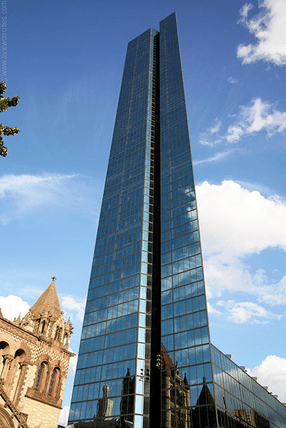
John Hancock Tower. (aviewoncities.com)

I can think of no modernist building in Providence that manages to trick a passerby, let alone flirt with him. In Boston, the John Hancock Tower has a nifty trick of turning into a vertical razor blade standing on end from a certain angle of view, at which angle it appears to entirely shed its three-dimensionality. But much classical architecture in Providence, Boston and other places evinces charm, such as balusters that could be a chorus line of breasts (or of noses, if you insist) – the Providence Public Library* – or a politician protected by a squadron of press agents, as might be seen around the dome of the Rhode Island State House surrounded by its four tourelles.

Epstein might protest that I am confusing charm with grace or even grandeur, to which I can only plead guilty. However you slice it, old buildings have more charm in their door knobs than modern architecture has in its whole beastly oeuvre. As Epstein says above, “Charm enlivens and lights up a room, makes the world seem a more enticing place.” That’s what traditional buildings once did almost by rote. It is a quality that was officially stripped from architecture in the first fifty years of the last century, much faster than it was lost by human beings in the second half. Too bad.

* See the illustration that sits atop this blog every day.

Posted in Architecture | Tagged , , , , , , , , | 1 Comment

Stop Fane tower on Monday

Screen Shot 2018-10-18 at 9.14.45 PM.png

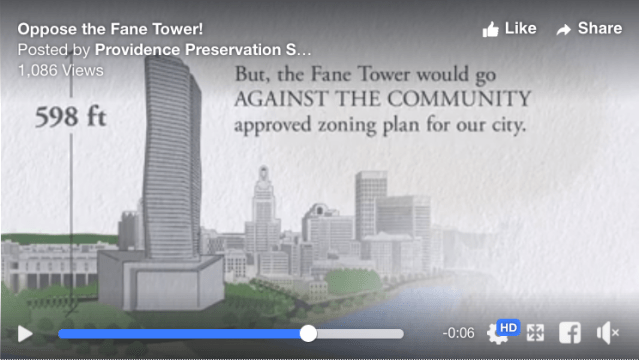
Short anti-Fane video by Providence Preservation Society. (GoLocalProv.com)

The good guys will have another opportunity to denounce the bad guys on Monday at a 5:30 p.m. public hearing of the ordinance committee of the Providence City Council.

I refer, naturally, to the proposed 600-foot Hope Point Tower by The Fane Organization. Its height would approach six times that allowed by zoning regulations, so obviously it is out of scale, and that’s without considering its style, which departs bigly from the city’s historic character. This may not be a problem for some people, only for those who understand what is good for Providence and what is bad for Providence.

After a public hearing, the Ordinance Committee recommended in July against lifting the current height limit on what is built on Parcel 42. On Sept. 6, the council, which was expected to vote on the ceiling one way or the other, instead sent the proposal back to the same committee for another hearing because – it was explained – Jason Fane was not able to testify on behalf of his own project. Yeah, right. And could not afford to send one of his employees, or hire a consultant to make the presentation? Give us a break!

Well, what has happened has happened. Why it happened may help predict what will happen in the future. If the council voted to send the proposal back to ordinance so its members would not have to vote on it one way or the other a week before September’s primary election, the fix is probably in and whatever is said at Monday’s hearing won’t matter. But we don’t know that to be the case. It may genuinely be up in the air.

So, going into the hearing, most people opposed to the proposed design and its height should feel confident that a recommendation against lifting the height limit is in the best interests of the city. Those who are squeamish about being seen as “opposing development” should rest easy, as should those worried that others might think they are “against” creating jobs and raising tax revenue for the city. How silly.

Squeamishness might have been reasonable two years ago, when there were no cranes on the Providence skyline. But now there are plenty. If the Fane tower is blocked, other developers will still want to build in Providence. And if they have better designs, more jobs and more tax revenue can be expected, because a lovelier Providence will generate more of both than an uglier Providence. A building that strengthen’s the city’s brand is better than one that contradicts the city’s brand. Anyhow, if the Fane tower is built, it might dry up the market for upscale tenants, and might also make the Route 195 corridor less attractive to developers whose buildings and tenants would be blocked by the Fane tower.

So feel easy speaking out against Fane on Monday. And lawmakers should feel easy urging the council to vote against raising the height limit – which would undermine the very idea of zoning. When even a major change in what the voters decided on a few years ago can be easily rammed through by a developer, zoning as a functional tool of urban planning ceases to exist.

The hearing at City Hall is expected to begin at 5:30. Providence is not against development, it is for better development.

Posted in Architecture, Development | Tagged , , , , , , | 3 Comments

North vs. South on Benefit

Screen Shot 2018-10-16 at 9.36.01 PM.png

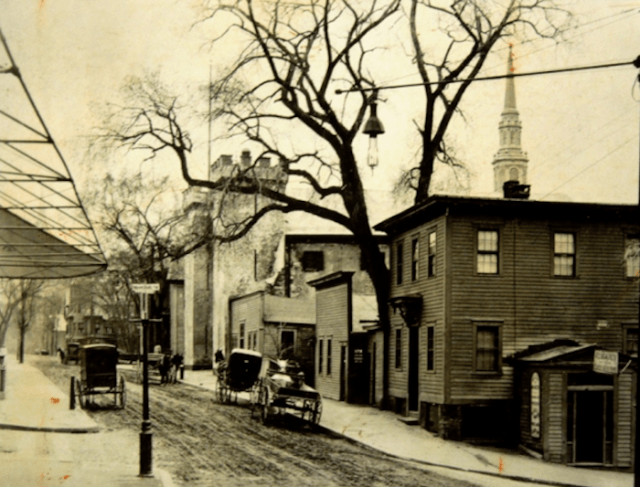
Benefit Street, Providence, circa 1900 (?); arsenal is at center-left. (source unknown … anyone?)

After a couple of centuries dodging various bullets, including the College Hill Study of 1959, Benefit Street has come under the wing of a new organization called the Mile of History Association. It held its first annual meeting Sunday in the Benefit Street Arsenal, designed by James Bucklin (of Arcade fame) and erected in 1839-40. In 1906, the arsenal was moved one lot northward to make way for the East Side railroad tunnel. Whether the photo above (whose source I wish someone could reveal to me) was taken before or after the arsenal’s relocation I cannot tell. (What good am I?)

Vincent Buonanno, formerly chairman of Brown’s facilities and design committee, opened the meeting with a question. How many in attendance were already members of MoHA? Almost every hand rose, but I could not recall whether I had joined or not. Maybe my invitation to the meeting meant I was a member. That’s my working theory for now.

The meeting proceeded as such affairs often do, with an invited speaker, Col. Michael Borg of the city’s department of public works, discussing matters of interest to members. He addressed snow removal, graffiti, streetlight repair, parking difficulties, utility repaving and potholes (often one and the same), trash recycling and trash removal. Between 1984 and 1999, I lived in three addresses on Benefit, all toward its southern end. I walked to work but had a car, so my concern was the ongoing rash of auto B&E’s. The car was a used Honda Accord hatchback from 1983, before Honda’s rise in the world. I left it unlocked so thieves wouldn’t need to break a window to enter. Occasionally I would discover the glove open and my classical tapes flung angrily into the back seat. Once a thief tried to pull my radio/tape player out but succeeded only in ripping the plastic front off. I left it hanging. My poor car was never “broken” into, let alone stolen. Colonel Borg was not asked by any MoHA members in attendance to address auto break-ins.

As I say, I lived in three apartments south of the “civic” middle blocks of Benefit, at (in order of occupancy) 283, 395 and 372. The square footage of all three did not add up to 1,000, but they were great addresses nevertheless. Just living on historic Benefit was a bit of a feather in my cap. Still, I have long wished that I had had a chance to live somewhere on the northern half of Benefit. That half has more of the feel of history. Most of the houses are smaller; most of them are indeed older (in spite of the fact that the street was built from south to north starting in 1756), and there are no grand mansions like the John Brown and Col. Joseph Nightingale houses to the south. (Not that there’s anything wrong with that.)

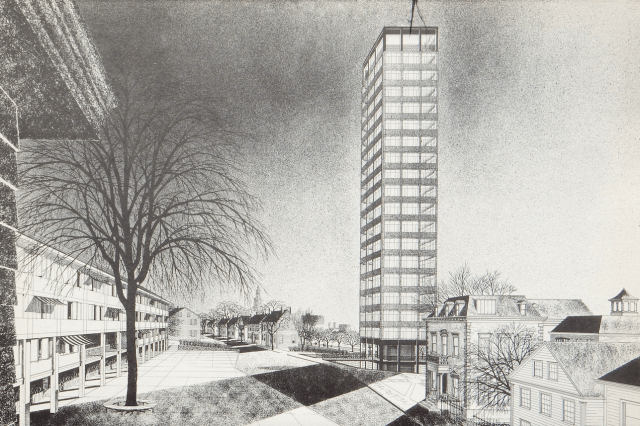
Most of the buildings on Benefit, including most of its residential properties, have been fixed up since the street was something of a slum through most of the first half of the 20th century. In 1959, the above-mentioned College Hill Survey was undertaken, with recommendations of demolition and urban renewal. Buildings on and near Benefit were assessed by “experts,” given scores, with many declared substandard and consigned to bulldozers to make way for modernist townhouses and a pair of glass residential towers of 19 and 23 stories, one at each end of Benefit. Fortunately, College Hill, including some of the city’s first families, experienced a slow burn at what the city had in mind. Several society matrons took the lead in buying some of the most decrepit houses, fixing up their exteriors and selling them to families willing to undertake interior renovations on their own. Eventually, property values skyrocketed, putting the lie to the experts’ assumption that demolition was the inevitable fate of old houses whose only need was love and attention.

Most of the earliest preservation activity took place toward the northern end of the street. The pavements were replaced by brick and beautiful faux gas-lamps were installed. Famous architecture critic Ada Louise Huxtable came to Providence to denounce these features as inauthentic. Huxtable would no doubt have preferred modernist cobra-head highway lighting and cheesy Cianci-grade el-cheapo hand-in-pocket brushed-concrete sidewalks. But the public loved the bricks and the gas lamps, and time has healed their alleged inauthenticity. Today, their upkeep is a major goal of the Mile of History Association, and rightly so. Good on them! Sign me up! (If need be.)

Nevertheless, even broken brick sidewalks and period lampposts sporting graffiti and busted glass are more beautiful and appealing, by far, than the sort of modernist crapola that would have fluttered the heart of the late Ms. Huxtable. MoHA must make sure that Benefit Street and Providence as a whole are protected from the current spate of bad architecture sprouting like pustules of acne on the face of the city. This vital advocacy should be its top priority, for Benefit Street will surely die if the city around it dies.

Screen Shot 2018-10-16 at 9.12.10 PM.png

Benefit Street with proposed tower recommended as part of 1959 College Hill Study. (author archives)

Posted in Architecture, Preservation | Tagged , , , , , , , | 2 Comments

Learn from Lombard Pozzi

Screen Shot 2018-10-12 at 8.37.14 PM.png

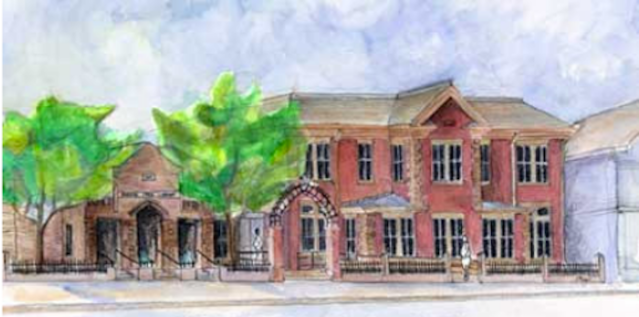
Renovated old Rogers Free Library at left, and much larger 2008 addition. (Town of Bristol)

Thursday evening I attended a lecture on the late Bristol architect Lombard Pozzi, who died in 2013. Lombard Pozzi – what a great name! More than anyone else, Pozzi is responsible for Bristol’s having managed to remain true to its charming self. Pozzi was among that rare breed, an architect trained also in preservation. He was born in Bristol and lived in one house on Hope Street since 1949. His legacy may be viewed up and down Hope, from the Peaberry Block, completed in 1988 (I dined at Le Central Bistro before the lecture) to his sensitive – yet much larger – 2008 addition to the Rogers Free Library, where his longtime friend and colleague Kevin Jordan spoke, leading his audience by way of slides he had lately taken of Pozzi’s projects.

Screen Shot 2018-10-12 at 11.05.25 PM.png

Lombard Pozzi (patch.com)

Pozzi was unlike many professional admirers of historical architecture, who think a beautiful building a century or two old is a fine thing, so long as its features do not serve as inspiration for any building constructed today. His new buildings were designed to fit gently amid the townscape. News articles previewing last night’s lecture stressed (to quote one on eastbayri.com) that Pozzi “both loved new buildings and had a healthy respect for those we inherited.” I suspect the new buildings he loved were primarily those that respected the old buildings he loved. Jordan opined that Pozzi thought little of modernist buildings “designed not to be liked.” Are they thought provoking? More likely they are headache provoking.

I’m sure that I’ll hear from those, if any, who think I have misrepresented Pozzi’s attitude toward modern architecture, or the remarks made by the good professor (retired from Roger Williams University). No doubt he must have liked some of it. After all, even I like some modernist buildings.

None of us is perfect!

Jordan told some wonderful stories of Pozzi, including their dumpster-diving in Bristol and in locations as far off as London. Pozzi was well-known for rescuing and reusing abandoned architectural features such as window shutters, window frames, balustrades, columns, doors, slate shingles, bricks, stone slabs, old electrical boxes, modern light fixtures, tin ceilings and clocks. He rescued and restored over 200 time-pieces. He saved old architectural drawings. The Providence Journal architecture columnist Catherine Zipf wrote a piece last February on a cache of 300 moldy construction drawings of Newport’s Ochre Court by Richard Morris Hunt’s firm (“Hidden treasure in Lombard’s garage“). Of how they came into Pozzi’s possession, she wrote:

We think the drawings were left in Ochre Court until 1947 and rediscovered when it was converted into Salve Regina College. But no one cared to put them in an archive. Instead, we think that someone involved with the project took them home. Pozzi (who knew everyone) collected the drawings from that person some time later. To Pozzi, their value was obvious. He cared.

Delightful!

Bonnie Warren, who worked with Pozzi on and off throughout his career, rose to remind the audience (composed mostly, it seemed, of friends and clients) of the architect’s sense of humor and compelling prose style. The evening left me thankful that someone so full of love for old buildings and their details, and the intricacy of their construction and preservation, existed in Rhode Island.

I also feel no small twinge of regret at not having learned of Pozzi sooner. Certain Rhode Island architectural eminentoes as Norman Isham, Irving Haynes and others, I’m sure, have not received their due in my almost thirty years of columniating. I once noted the sad fact and pledged to rectify it, but so far have not. I hope this post on Lombard Pozzi will bring me to that duty.

Posted in Architecture, Preservation | Tagged , , , , , | 5 Comments