Block Fane tower Monday

Screen Shot 2019-04-07 at 1.45.53 PM.png

Proposed Hope Point Tower, left. (turnto10.com)

Hope Point Tower should be called Hope Punt Tower. When it comes to hope for the livability of Providence, it punts.

The tower’s design goes for its second session before the Downtown Design Review Committee on Monday at 4:45 p.m., this time with a public hearing. Developer Jason Fane is expected to seek four waivers from the DDRC, most importantly exempting the project from zoning mandates that “building height and massing shall relate to adjacent structures.” The committee should deny that and the other three waivers.

Ted Sanderson, for 33 years the director of the Rhode Island Historical Preservation & Heritage Commission, has written a letter to DDRC members opposing the Fane proposal. He begins:

Downtown Design Review should ensure that the proposed Hope Point Tower is compatible with the existing historic building fabric and the historic character of downtown (Zoning section 600) and that this new construction complements the historic character and architectural integrity of existing structures (660).

The tower’s rejection of zoning’s protection of Providence’s historical character is the main reason to oppose it. Sanderson goes on to explain that the purpose of relocating Route 195 in the first place was to reknit the streets between downtown and the Jewelry District that were cut by the highway in the late 1950s. “[R]eplacing the highway with intrusive and incompatible new development,” writes Sanderson, “perpetuates the original highway damage in a new form and is no improvement for our city.”

That argument should be familiar to readers of this blog.

Broadly speaking, the quality of life here in Providence is high because the city retains so much of its historical character. Most of the city was built before architectural and planning practices in the 1950s shifted aesthetic priorities away from beauty and toward utility. These goals are not mutually exclusive but are treated as if they were. Unlike most other cities, Providence did not demolish most of its historic buildings to make way for “progress,” and that’s why it has so much character and heritage to protect.

The late architect and planner Bill Warner understood this. He was the visionary who led the design teams for the River Relocation Project of the 1990s and the more recent Route 195 Relocation Project, both of which used traditional design to encourage developers to embrace project designs that would strengthen Providence’s historical character. But most developers have resisted and, with high-fives from local design fashionistas, continue to foist unpleasant buildings on Providence. The result is that the city has been sacrificing its beautiful historic character for decades.

At some point the city will reach a point of no return, and will lose its beauty – one of its rare advantages in economic competition with other mid-sized cities. Most new buildings eat away at beauty little by little. Not the Fane tower. Tweaking it won’t help. Blocking it is our last opportunity to turn the tide and save Providence’s historical character, which is useful, beautiful, and vital to our quality of life.

[DDRC meeting begins at 4:45 on Monday, April 8, at 444 Westminster Street, in downtown Providence. Get there early to sign up to speak.]

Posted in Architecture, Development | Tagged , , , , , , | 2 Comments

Barf on Arc de Triomphe

Screen Shot 2019-04-05 at 9.16.46 PM.png

L’Arc de Triomphe, in Paris. (albomeadventures.com)

Christo plans to work his tragic on Paris’s Arc de Triomphe, draping it in blue fabric, but fortunately not until 2020, well after my family and I visit the City of Light, if we decide to go. The arch has been under siege for years, most recently by the yellow-vest protesters against the French president, and for decades by the insufficiently distant architorture of La Défense, so much more offensive since I last visited in 2003. The suburban La Défense, which mars the view through the arch up the Champs Élysées from the east, also represents the vandals at the gate – the future skyscrapers of central Paris, whom the city’s insane mayor has invited in to romp and ruin.

Screen Shot 2019-04-05 at 10.22.33 PM.png

Illustration of l’Arc under attack by Christo.

There should be a class-action lawsuit against Christo by the millions whose vacations he’s wrecked over the years with his wrapping of great monuments so that visitors cannot experience their beauty. Christo should be required to inform all potential travelers by certified mail well in advance of any future project, so that civilized people may schedule their visits accordingly, if they can.

But perhaps more effective would be the general dissemination of the best skit I’ve ever seen – a sendup both witty and profound by Stephen Colbert in 2005 before he left The Daily Show. His target is actually one of Christo’s least offensive installations, the Gates, in Central Park, which “reconceptualizes” what can be done with $25 million. A hospital wing? No, the redecoration of a bike path. Actually, Colbert torches not just Christo and the Gates but the world of art that takes Christo seriously.

Watch it and die laughing.

So before you do, first send it to all your friends and have them do the same, and maybe Christo will run for the hills, his head hanging in shame. Shame? Well, maybe not. Still, worth a try. Meanwhile, Christo, keep your mitts off the Arc de Triomphe. Paris and its many lovers should be up in arms over many things, but this is not the least among them.

Screen Shot 2019-04-05 at 9.17.35 PM.png

Screen Shot 2019-04-05 at 9.22.56 PM.png

Screen Shot 2019-04-05 at 9.17.52 PM.png

Screen Shot 2019-04-05 at 10.29.49 PM.png

Posted in Architecture, Humor, Video | Tagged , , , , , , | 6 Comments

Hope for Henderson Bridge?

Screen Shot 2019-04-03 at 2.54.45 PM.png

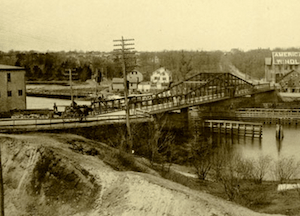
Henderson Bridge (1969) spans Seekonk River. (film.ri.gov)

Rhode Island’s Department of Transportation plans to use extra federal transportation funds to replace the stodgy old Henderson Bridge – a span that not only looks like a highway overpass but is a highway overpass. It was originally built in 1969 to carry Route 44 over the Seekonk River, but the rest of the highway was never built, at least not there.

Watch out! You can still see the dead end as you climb the final exit ramp.

Screen Shot 2019-04-03 at 1.03.53 PM.png

Henderson Bridge (Wikipedia)

The Ocean State has a tradition of building elegant bridges that are a pleasure to cross. Newport Bridge. Mount Hope Bridge. Washington Bridge.  In relinking Providence’s East Side to East Providence, the state can not only build a bridge that will make us feel proud but a new waterfront community on land freed by removing the Henderson’s network of on and off ramps.

This could be East Providence’s answer to the capital city’s innovation corridor, but instead of planting a new dead zone as the state has done in the Jewelry District, East Providence can plant a lively, lovely mixed-use district along the banks of the Seekonk.

Screen Shot 2019-04-03 at 2.51.40 PM.png

Red Bridge, built in 1895. (sos.ri.gov)

Unfortunately, RIDOT seems intent upon ramming the process through, as if the dollars from Washington will suddenly vanish if the state asks the public for input on what to do, which is not in the plan. What RIDOT appears to have in store for East Providence is the type of missed opportunity suffered by Olneyville, one of Providence’s poorest neighborhoods, when the state shoved aside an enchanting boulevard proposal for the 6/10 connector and substituted a build-in-place plan to reconstruct the bummer boulevard we already have heading in and out of downtown from the west.

The plan for the Henderson Bridge – called the Red Bridge by many, after the 1895 swing bridge that preceded it – looks to be to plop another highway overpass atop of the tall existing bridge pylons instead of straightening out its slantwise course over the Seekonk’s narrow passage to link Waterman Street in Providence with Waterman Avenue in East Providence.

What a natural!

The plan already calls for slicing off the unused highway bulk of the bridge to create a much narrower span – possibly a pair of lanes, one in either direction. Good. But even better would be to remove the existing stilts and lower the bridge deck to a more pedestrian-friendly height, with landings on the banks of the river itself. It should be similar, in urban concept, to the 1990-1996 replacement of the Crawford Street Bridge (once noted in the Guinness Book of World Records as, at 1,147 feet, the world’s widest) with the beautiful set of low, arched bridges that cross the Providence River between downtown and College Hill.

Alas, it appears that the bold and thoughtful RIDOT of 1980 to 2010, which saw not only the River Relocation Project but the I-195 Highway Relocation Project, no longer exists. RIDOT piggybacked aesthetic improvements with local tradition in mind on the back of what would otherwise have been a plain vanilla transportation infrastructure project. Life in Providence was improved for all. Then RIDOT led the way to kick Route 195 from between downtown and the Jewelry District; the fact that the state, starting in 2011, has misunderstood the point of reknitting those two historic parts of the city back together does not impugn the genius of moving the highway. (Both the river- and highway-relocation projects were conceived and led, in their design and accomplishment, by the late architect and planner Bill Warner. He must be rolling in his grave at what has been done in the I-195 corridor.)

RIDOT seems to be running a race to continue missing opportunities in Rhode Island. But the Henderson Bridge replacement process has only just begun. Here’s hoping to slow it down to a more thoughtful pace.

Screen Shot 2019-04-03 at 3.11.09 PM.png

Henderson Bridge (top), showing eastern ramp acreage; Washington Bridge below. (Google)

Posted in Development, Urbanism and planning | Tagged , , , , , | 5 Comments

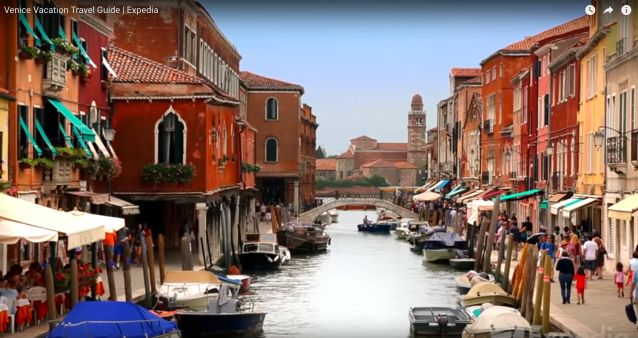
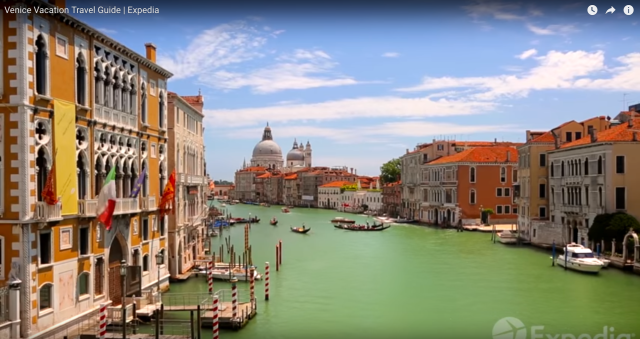
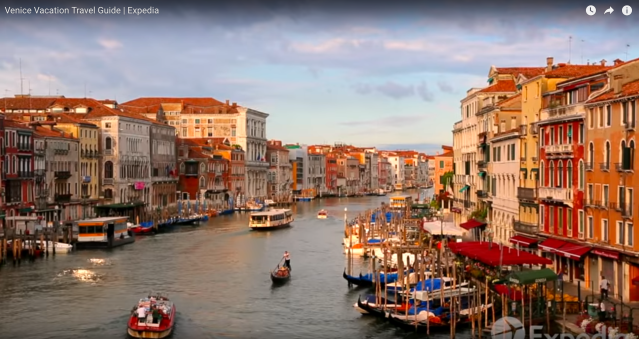
Lovely Venice in 9 minutes

Screen Shot 2019-03-31 at 10.17.25 PM.png

This beautiful travel video of Venice from Expedia lives up to the high standards of its tribe. The online travel booking service has dozens of fine videos of cities around the world that are so nice that they might make you feel that you need not go to the expense of traveling there. Only kidding. This one is merely nine minutes long. Would it were longer!

I choose Venice because I recently wrote of the Assassin’s Creed video games, the earliest of which sets its game play in La Serenissima, the Queen of the Adriatic, City of Water, City of Masks, City of Bridges, the Floating City, and City of Canals, to list only those nicknames listed in Wikipedia’s entry for the capital of the Veneto, which I visited in 2005.

Cities and towns could be as beautiful as Venice if we could turn away from modern architecture and take up the great traditions of building and urban planning. Beauty is not some thing of the past that that is lost and gone. We have every reason to make use of it today. All it requires is the will to do so – a fact that makes our ugly built environment a problem more easily soluble than almost every problem facing mankind. So much more easy to solve than such longstanding global vexations as poverty, injustice, ignorance, disease, war, etc. It is as easy as snapping our fingers – if only we could dethrone the cult of modernism that forces the world to accept its unhappy lot. If only …

But don’t get me going.

Also, I want to report that with the assistance of Kellie at WordPress support, I learned today that the difficulty of my inability to place the usual images on my last post was easily solved. All I had to do was to prune my WordPress media library, which was absolutely full. I have done so and here is the link to that post, “Vid cities in ‘Fortnite’ game,” with its intended illustration of the Happy Hamlet. And below are a couple more images of La Dominante.

Screen Shot 2019-03-31 at 10.14.54 PM.png

Screen Shot 2019-03-31 at 10.18.51 PM.png

Posted in Architecture, Video | Tagged , , , , , , , | Leave a comment

Vid cities in ‘Fortnite’ game

Screen Shot 2019-03-29 at 11.24.57 PM.png

This is Happy Hamlet, one of the towns on the island where Fortnite plays out.

I’ve written several posts on the Assassin’s Creed video games, which take place in cities like Venice, Florence and London long ago. Recently, the 13-year-old son of a member of the Pro-Urb online discussion group published on his blog a post called “What Do Cities in Fortnite Look Like?” The first series of Fortnite, “Save the World,” had over a million users in the month after its release in July 2017, but the second series, “Battle Royale,” had 125 million users in under a year. The popularity of Fortnite got it on a segment of at least one of the network evening news shows.

A lot of young people cycle through the places in video games. Reaction to the teenager’s blog post came in from Pro-Urbers. One wrote: “I often wonder if the current lack of beautiful architecture is because the more visually talented people go into computer animation, visual effects, and games.” Another wrote: “It’s not that architecture students aren’t visually talented. It’s that they’re taught to abhor the pursuit of that kind of beauty.”

The urbanism of Fortnite is not as sophisticated as that of Assassin’s Creed, but then again, the urbanism of 2019 is not as sophisticated as that of London 150 years ago, let alone Venice and Florence during the Renaissance, or, for that matter, anyplace anywhere before, say, 1950. Fortnite‘s creators are not as interested in its surroundings as in the battles that unfold within. In fact, Fortnite went viral only after it transitioned from an us-against-them (aliens) theme to an everyone-against-everyone theme. A trailer for “Battle Royale” ends with this motto: “Last One Standing Wins!”

So a comparison of Fortnite‘s settings versus those of Assassin’s Creed may be one of apples to oranges. But that does not make it uninteresting. The latest Fortnite series, called “Fortnite: Creative” encourages players to build whatever environments they desire. Let me see if there’s a YouTube video of that. … I did find “Build the Biggest House Challenge in Fortnite: Creative.” It is 19 minutes long but I could not make it past the fourth. I challenge you to try. Especially horrifying are the opening remarks by the players when they announce they are architects. Watch, if you dare!

Posted in Architecture, Art and design, Video | Tagged , , , , , | 4 Comments

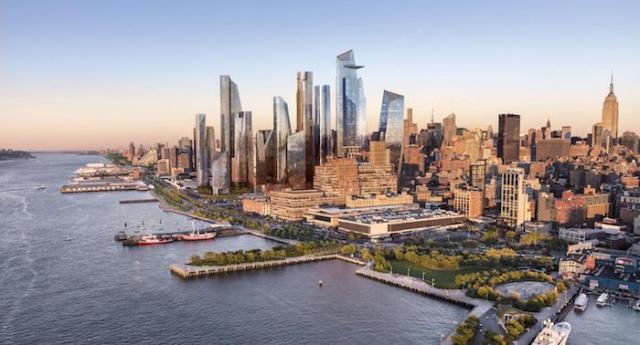
Fane tower & Hudson Yards

Hudson-Yards_Aerial.jpeg

View looking north of Hudson Yards from the Hudson River. (The Architect’s Newspaper)

A relic of dated 2000s thinking, nearly devoid of urban design, it declines to blend into the city grid.

The Fane tower, right? That building proposed for the Jewelry District near downtown Providence?

No. In fact, it’s the Hudson Yards development in Midtown Manhattan, on an old rail yard west of Penn Station. “Hudson Yards is Manhattan’s Biggest, Newest, Slickest Gated Community” is by New York Times architecture critic Michael Kimmelman. He is a much better and more comprehensive writer on architecture than his most recent predecessors, Nicolai Ouroussoff and Herbert Muschamp, who mainly saw their jobs as drooling over the latest blotches of God’s wrath on architecture committed by the world’s shiniest starchitects. Kimmelman is less colorful but more insightful.

Still, it’s almost obscene for Kimmelman to tut-tut Hudson Yards for not blending into the Manhattan grid. Although swathed in apparent care for the more nuanced aspects of the role architecture should play in cities, he still almost always gives a pass to the latest new thingamabub, or anything by architects who would shrink in horror at the idea of fitting in. Here he continues with yet more criticism of Hudson Yards that could be equally applied to almost all modern architecture, but almost never is.

And while those apartment buildings look to be less enormous than the supertalls that have gone up so far, stepping down toward the river, the whole site lacks any semblance of human scale. With its focus on the buildings’ shiny envelopes, on the monotony of reflective blue glass and the sheen of polished wood, brass, leather, marble and stone, Hudson Yards glorifies a kind of surface spectacle – as if the peak ambitions of city life were consuming luxury goods and enjoying a smooth, seductive, mindless materialism. … The triumph of this view is a consequence of government’s dwindling capacity to plan, build or repair anything significant itself. City Hall … demonstrates no grasp of urban design[.]

On a much smaller scale, Kimmelman’s words apply equally well to the Fane tower. If built it will be Providence’s tallest building, sticking out like a sore thumb and flawed in almost every other way, too. It has caused headache and heartache in this city – and that’s before its construction. Its developer, Jason Fane, has blown through every obstacle so far, though most citizens of Providence are against it, and most people assume it will be built. That is the most likely eventuality, but I think it can still be stopped.

Monday, April 8, is the next meeting of the Downtown Design Review Committee, the latest panel to clench this hot potato in its fist. The meeting will include the first public hearing to directly address the tower’s design, so please show up prepared to speak truth to power. Each person who opposes a building like this has more design smarts in his or her gut’s subconscious intuition than Kimmelman, Ourrousoff and Herbert Muschamp all rolled into one. So if you all show up, the design reviewers might just end up doing the right thing.

(By the way, Kimmelman’s article is one of those occasional pieces graced by interactive art that only the wealthiest newspapers can afford. It’s worth a look, and a read.)

Posted in Architecture, Development, Uncategorized | Tagged , , , , , , | 10 Comments

Copy, precedent, inspiration

Screen Shot 2019-03-24 at 9.34.32 PM.png

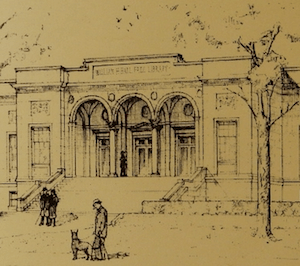
William Clements Library, Ann Arbor, Mich. (1923) and Hall Free Library (1927), Cranston, R.I.

My friend and 2019 Bulfinch Award laureate Eric Daum recently revealed in a comment to my blog post “Cranston’s Hall Free Library” that this public library, built in 1927, must have been inspired by architect Albert Kahn’s William Clements Library, at the University of Michigan, built in 1923. They are almost identical. The word inspired is perfectly suitable, whether the two buildings are the exactly the same or merely similar. A crank who knows little of architecture might say, however – and quite understandably – that one architect copied the other’s work.

Screen Shot 2019-03-24 at 9.49.51 PM.png

Drawing of Hall Free Library

“Copied the past” is a slur that modernists often use to denigrate the creativity of new traditional architecture whether it actually resembles a particular old building or not. Since the past in this case reached entirely four years back into history, the proper word is inspired. Or used as a precedent. Or maybe, instead of one seeing the other’s design in an architectural journal, such as Pencil Points, both architects might have imagined their libraries independently.

That might be the case because each building is a fundamental trope of classical design that might have inhabited the mind of each architect. Both might have been channeling the same internal meme four years apart.

Classical architects of whatever age have never been troubled, as modernist architects are, by the practice of applying previously used architectural forms in their work. But no such “copy” is ever exact, whether the inexactitude is experimentation, a reflection of utilitarian needs, or error.

Note the triple arches of each library’s entrance. The Clements library’s arches seem narrower than those of the Hall Library. The side windows are different, too, the former pedimental and the latter stripped classical – more likely in 1927 than in 1923, since the modernist challenge that gave rise to stripped classical arose, or at least grew more insistent, during the elapsed four years. The reverse might be said, however, of the roofs’ cornices – that of the Hall Library features very classical dentils (the “teeth” below the cornice) and that of the Clements Library seems more stripped, with a more subdued personality. Close examination of the entrance pavilions reveals other variations, but those are the main ones.

(William Henry Hall, founder of the Cranston library, is apparently no relation to its architect, George Frederick Hall. The Clements Library’s architect, Albert Kahn – who is not to be confused with the celebrated modernist Louis Kahn – also designed the Providence Journal building on Fountain Street, which no longer belongs to the newspaper, which now occupies rented space on the second floor.)

Both libraries are extraordinarily beautiful, possibly because both designs arise from a sort of Platonic ideal of perfect classicism. Those classicists of the past and present who insist upon following the classical orders to a tee are often looked down upon by their colleagues who consider the orders as a launching pad for innovation. The result is more likely to be a little bit off than that of their more orthodox brethren. Often but not always, of course.

Either way, both libraries are beautifully inspired. That is enough.

Posted in Architecture, Architecture History | Tagged , , , , , , | 4 Comments

Assassin’s Creed does Athens

Screen Shot 2019-03-21 at 9.24.45 PM.png

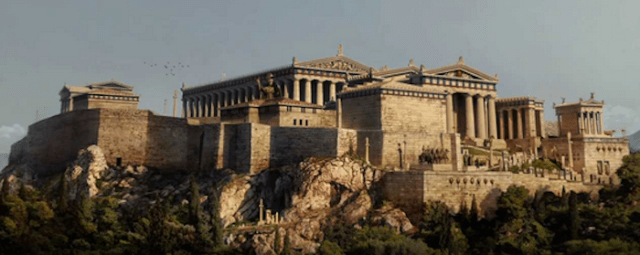
Ancient Athens, with Parthenon atop Acropolis. (reconstruction by Juan Alverez de Lara)

Here is an eight-minute video on the reconstruction of ancient Athens by game-maker Ubisoft for the latest episode (if that’s what it’s called) of Assassin’s Creed. Previous episodes have invited us into highly realistic reconstructions of Renaissance Venice and Florence and of London during the Industrial Revolution. (See my pair of October 2015 posts “Gaming the Renaissance” and “Into London’s age of grit.”) There have been eleven games in the series thus far since 2007. Such videos may perhaps be the 21st century versions of the historical novels upon which I was weaned. My takeaway on the phenomenon is from the first of my 2015 posts:

Millions of young people play these video games. The games’ allure relies at least in part on exciting scenery within which players confront enemies in situations programmed to reflect historical reality. Players see the beautiful historical architecture on display in 3D and may come, willy-nilly, to expect today’s reality to better reflect the beauty that they have “experienced,” and that classicists believe should inspire the built environment. This is popular culture, the masses putting their money where their mouth is and where their tastes are. Could it be that the beauty of architecture can also battle back into elite culture – and our cities and towns – as well?

[The image above is not from Assassin’s Creed Odyssey but a reconstruction of the Acropolis by Juan Alvarez de Lara at archaeological-reconstructions.com. Ubisoft has figured out a way to prevent the publication of screenshots from videos of their games or of videos about their games. The images I was planning to post are from the videos to which I have linked.]

Posted in Architecture, Art and design, Video | Tagged , , , , , , , | Leave a comment

Modernism vs. modernism

Screen Shot 2019-03-19 at 8.27.42 PM.png

Screen shot of opening image of Betty’s hate-modernism video. (ARTiculations.co)

Why Do People Hate Modern Architecture?” is a ten-minute video by Betty Chen, who posts from ARTiculations.com, an art supply shop in Toronto. Chen comes across as favorable to modern art and architecture. Indeed, the next video of hers on YouTube is “The Case for Brutalist Architecture.” That should be interesting. But give her some credit: she wants to explore why modern architecture is so widely disliked, and she seems to have an open mind. She has a fetching, self-deprecating style to her presentation of self on video, though in this video her voice seems somewhat less self-confident than in some of her others. I think I know why.

The defense of modern architecture often seems to involve self-criticism. I have a virtual shelf groaning under the weight of such “defenses.” Chen’s video will go on that shelf. Maybe that’s why she seems more tentative here. She may be saying things she does not really like to admit. Good for her.

She starts out asking why it is called “modern” architecture, a topic of several recent posts of my own. “Makes it kind of confusing,” she says, adding, “I didn’t come up with these terms.” Following a brief and somewhat dodgy history of modern architecture – after two world wars the need for a new architecture was “understandable”? Not so! – she brings in Robert Venturi and Denise Scott Brown to explain, via Learning from Las Vegas, the broad reaction against it and the way forward. “It’s important to recall,” says Chen, “that Scott Brown and Venturi were not calling for a revival of historic styles. Their actual position was that sometimes it’s necessary to look backward at history and tradition in order to go forward.”

But isn’t that precisely what we do when we revive historical styles? Isn’t that how architecture evolved for centuries until the rise of modernism?

Of course it is. If Scott Brown and Venturi had written a book explaining the obvious, they would be hated by the architectural establishment and their books would go unread today. No student in architecture school would ever have heard of them. But they would have been right. And maybe the design elites might have been moved an iota or two by a more sensible scholarly outlook erupting from the Brutalist battlements of Yale, and eventually, someday, won over. The world would be a much happier place, or at least much more beautiful. Oh well.

Of course, in the end, ignoring her own indictment of modern architecture, Chen comes out against any sort of classical revival, and puts her money on compromise – more flexibility, please! – which is sure to make nobody happy.

I actually prefer the clarity of Chen’s many commenters. Though her video was published on YouTube as recently as Jan. 3 of this year, there already are 2,262 comments, almost entirely critical of modernism, to judge by the first hundred or so. Here’s one I like. Morrissey Kuc writes: “Currently live in a European city and i grew up in a modern city in Australia. No contest. modern cities are uglier.” Warms my heart.

Watch the video. Read the comments. Have a blast. It’s modernism versus modernism. Pass the popcorn! A house divided against itself cannot stand, said Lincoln. Maybe not, but some things take way too long to fall.

Screen Shot 2019-03-20 at 1.27.31 AM.png

Looking askance at modern architecture is vblogger Betty Chen, whose full name was elusive.

Posted in Architecture, Video | Tagged , , , , , , | 2 Comments

A history of Thayer Street

Screen Shot 2019-03-17 at 10.02.43 PM.png

A party of Brown students on roof across Thayer Street from Andreas. Note dastardly SUV.

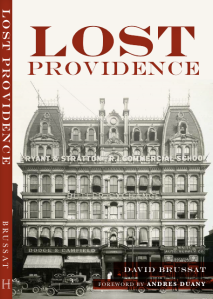
I’ve been invited to read from my book Lost Providence during an open-mic session this Friday, March 22, at the Brooklyn Coffee, Tea & Guest House, 207-209 Douglas Ave., at 6 p.m., $5, in Providence. But I think instead that I will, if my host, Lindsay Adler, will let me, read from a column I wrote about Thayer Street in 1993 for the Providence Journal (where I worked 1984-2014). It dives deep into the old shops that people love to remember. To whet your appetite, I here reprint a post from 2014 about Thayer Street:

***

Life on Thayer Street

My family dined al fresco on Thayer Street this evening. Thayer is the main street of Brown University on College Hill, in Providence. We arrived, sat down, got out our mobile media, and noticed a party under way on a roof nearby. Then we saw Billy’s grandma and grandpa across the street. Turns out they had just finished eating inside the same restaurant, Andreas, where we were eating outside. They came over.

We all enjoyed watching the roof party. At some point it seemed a “Cheese it, the landlord!” alarm went out and a very pretty girl tried to flee the roof. (She and her boyfriend had actually parked their small Volkswagen right opposite our table, bless them!) False alarm. Things calmed down, though the kid in the red sweater gave me the evil eye, I think, for shooting their shenanigans. Then we waved goodbye and they waved goodbye and we said goodbye to our folks and they left and we left, and on our way back to the car we saw a dog on a motorcycle (along with other typical Thayer personae), and went home.

I relay this homely adventure to convey the idea of a great street, which Thayer is. This is life happening in all its facets. It’s where the action is, a living adventure. Victoria took the photo that shows the Brown partiers in their urban context. At the bottom of that photo is the nemesis of great streets: the SUV. Not because it guzzles gas but because it blocks views. I love watching people stroll by on both sides of the street. Any SUV takes away part of that pleasure.

Yes, yes, we drove to Thayer in a car (it was not an SUV, I promise, not by a long shot). But that’s another complaint. Good urbanism in America – that is, towns and suburbs built before World War II and New Urbanist communities (and infill) of more recent years – is so rare that high demand has bid up the price for houses there, and so only rich people can afford to live in such neighborhoods. So we live not on College Hill but a mile or so farther north in the outer reaches of the East Side (which many people think is a synonym for College Hill). The historic districts that are so beloved and hence so expensive are no more than regular prewar neighborhoods – really nothing special about them. Build more lovely traditional neighborhoods (in many places laws must be passed making them bloody legal again) and the prices will come down. I promise.

Screen Shot 2019-03-17 at 10.02.25 PM.png

Posted in Lost Providence, Providence | Tagged , , , , , | 2 Comments