Rich building, poor building

Screen Shot 2019-02-17 at 3.13.47 PM.png

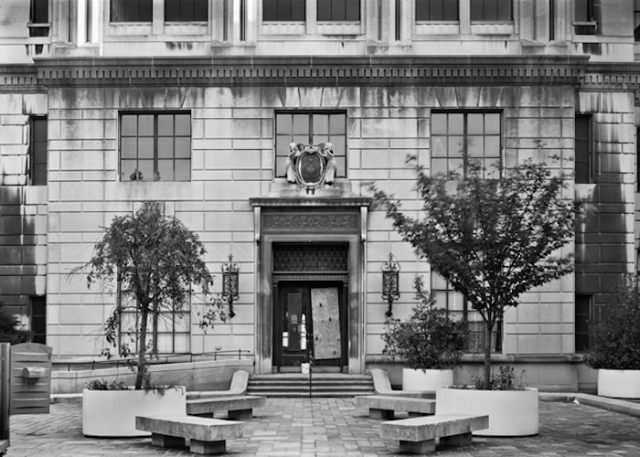
The entrance bay of the Philadelphia Board of Education Building (1932), by Irwin Catharine.

Before retiring the subject of Witold Rybczynski’s review of James Stevens Curl’s new book Making Dystopia, let me return to the critic’s remarks about the failures of modern architecture. One modest observation said so much in so few words, and it speaks to an abiding but rarely noticed truth about the difference between traditional and modern work. Here it is:

There have always been more and less expensive buildings, but in the past, less expensive meant fewer decorative elements and simpler ornamentation. The problem with minimalism is that it does not leave much to work with; a modernist building that is less beautifully detailed and finished simply looks cheap.

There’s so much less room for error in modern architecture – the error by its founders of frog-marching ornament out of building design. Traditional architects tried to respond to the attack on ornament with stripped classical, with Art Deco, and with other efforts to blend traditional complexity with modernist minimalism. The mods were having none of it. They brooked no compromise, rejected the trads’ attempt to negotiate a peace, and took over the design establishment, balling up the world with their tedium.

After the slaughter of World War I, writes Rybczynski, “it seemed to many that life simply could not go on as before.” Well, of course not. The rule of nations by royal families whose members married into royalty across Europe, and who in their consanguinity could not imagine the slide into slaughter undertaken by their governments, had to change. But did societies need to fundamentally reshape buildings and cities? This was far less evident, so far less that the very idea smacks of insanity. Oh, sure, let’s kill thousands of jobs crafting ornament and erect buildings with revolutionary and experimental new structural schemes that would require retraining millions of workers, a whole lot more money, and the abandonment of centuries of experience. The result was foreseeable and inevitable. Rybczynski writes:

The ultimate failure of modern architecture is not that it was incapable of producing beautiful works of individual art. There have been plenty of those, pace Professor Curl. The real drawback is that while the Modern Movement effectively suppressed an architectural language that had taken hundreds of years to evolve, it proved incapable of developing a successful substitute.

Modern architecture has evolved through several phases, each more idiotic than the last. The single consistency throughout the story of architecture in the last century and this one is the failure to develop a successful substitute for building techniques that were purposely abandoned for no good reason. Rybczynski is far too kind to what modernism has accomplished. It has not produced “plenty” of “beautiful works of individual art.” It has produced some, and even they tend not to fit into the fabric of the city, but to disrupt that fabric, or to achieve part of whatever success they may have by dint of their isolation, to some degree, from the city fabric, either by height or by distance. For the most part, they are sculpture, not architecture. Architecture is what was thrown out.

The strength of pre-modern architecture was that it provided a rich variety of modes of expression. It permitted complicated things to be said in complicated ways, and simpler things in simpler ways, analogous to the spoken language, which can be used to write drama and poetry or instruction booklets.

But isn’t this the summary of all that architecture should pride itself on?

Of course it is, and Rybczynski admits it in his description of the work of the architect who built the Board of Education Building in Philadelphia, which in his review he highlighted as emblematic of the relatively modest buildings in his neighborhood that he enjoyed looking at so much:

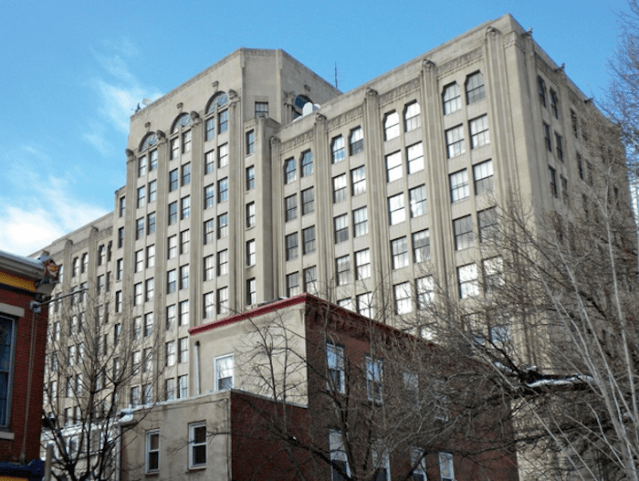
Moreover, the pre-modern architectural language could be easily learned—it didn’t require immense talent or an inordinate amount of training. Irwin T. Catharine, who designed the Board of Education Building in Logan Square, did not go to the École des Beaux-Arts like George Howe and Raymond Hood (Catharine attended a night school), or win the AIA Gold Medal like Bertram Goodhue. He spent his entire career at the Board of Education, where he started as a draftsman and rose to be chief architect. On his watch—1918–37—Philadelphia built more than a hundred new public schools; Catharine designed them all. He worked in a variety of accepted styles—simplified Collegiate Gothic, Stripped Classical, Moderne—using traditional materials, brick, and limestone, and traditional details. There was usually some ornament, not a lot but enough to please the eye. Nothing earth-shaking, yet almost all of these modest buildings have found their way onto the National Register of Historic Places. This is not so much a mark of architectural prowess as a recognition that such buildings represent something precious that has been lost.

***

[Note: Between Jan. 31 and Feb. 17, the survey results from the poll on classical versus modernist architecture have swung from No (the modernists) leading 92-8 percent to Yes (the classicists) leading 64-36 percent. Please vote. The deadline Feb. 26.]
Screen Shot 2019-02-17 at 5.38.31 PM.png

The Philadelphia Board of Education Building. (Architect Magazine)

Posted in Architecture | Tagged , , , , | 2 Comments

Rybczynski reviews Dystopia

Screen Shot 2019-02-14 at 11.36.15 PM.png

Philadelphia’s Board of Education Building in Witold Rybczynski’s neighborhood. (Architect)

“Witold Rybczynski on architectural PTSD and what James Stevens Curl gets wrong (and right) in his controversial new book” is the sub-headline of Rybczynski’s review of Making Dystopia, the magisterial history of modern architecture by Britain’s most accomplished architectural historian.

The opinion of this book by America’s most celebrated architecture critic in Architect, its most notorious architecture journal, is decidedly surprising. Though Rybczynski’s editors (I suppose) have used the subhead to give the critic a little bit of cover, his review is mostly, and most importantly, about what Making Dystopa gets right. He starts out by describing the beautiful old buildings he walks past in Philadelphia, where he lives, and how dreadful most buildings became after 1932. “What happened?” he asks. “According to Curl, what happened was ‘architectural barbarism.'” The author “does not mince words,” the critic states, and then he goes on to quote the book’s thesis, starting with how modern architecture emerged in the 1920s:

It became apparent that something very strange had occurred: an aberration, something alien to the history of humanity, something destructive aesthetically and spiritually, something ugly and unpleasant, something that was inhumane and abnormal, yet something that was almost universally accepted in architectural circles, like some fundamentalist quasi-religious cult that demanded total allegiance, obedience, and subservience.

“Curl’s language may be immoderate,” Rybczynski responds, “but he is not wrong.” (Actually, to anyone who understands what modern architecture has done to the world, the language of Dystopia, published by Oxford University Press, seems diplomatic, albeit often engagingly witty.) He continues:

In its banning of ornament, which had characterized every epoch since the Egyptian pharaohs, the International Style was an aberration. Without ornament to provide meaning, buildings did appear inhumane. The result of enthusiastically embracing industrialization and mass production, and especially using exposed concrete, was often ugly and unpleasant. (The ancient Romans built in concrete, but they clad it in marble.) And there was something fundamentalist about the Modern Movement’s intolerance, its rejection of the past, and its narrow-minded—not to say puritanical—insistence on adherence to a narrow set of aesthetic norms.

But Rybczynski, despite his natural reactions to the buildings he walks by in his Logan Square neighborhood, normally tries to toe the company line when it comes to modernism. So he cannot be expected to write a review that applauds Dystopia without reservation.

He says the book is too long, that it is “gossipy,” that it has two personalities (David McCollough and Hunter S. Thompson), and fails to mention some eminent non-Bauhaus modernists, supposedly including Frank Lloyd Wright, who is “inexplicably ignored,” although he is cited in the index six times. (He does not criticize the book’s extensive notes, index and bibliography, as some critics have done.) He notices Stevens Curl’s supposed “soft spot” for Ludwig Mies van der Rohe, who led the Bauhaus school in the 1930s; my candidate for Stevens Curl’s soft spot would be architect and modernist impresario Philip Johnson, but the author disclaims any such feeling. After curating the famous 1932 MoMA exhibit on International Style, Johnson spent almost a decade as a Nazi in Germany and the U.S. The book goes deeply into the collaboration of the founding modernists with totalitarian governments in Europe, including Le Corbusier, founding Bauhausler Walter Gropius and Mies, but none of this is mentioned in Rybczynski’s review.

Here is his major objection to Stevens Curl’s explanation for the “strange rise” of modern architecture (from the book’s subtitle “The Strange Rise and Survival of Architectural Barbarism”):

[World War I] opened the door to radical change—whether it was political (Nazism), economic (the New Deal), or architectural (Modernism). This, rather than Curl’s theory of a quasi-religious cult, is a more convincing explanation for the “strange rise” of modern architecture. As the title of his book suggests, the author assumes malevolence on the part of Gropius, Le Corbusier, et al., but what if the International Style was instead the result of a sort of postwar architectural PTSD?

It’s a sly move to attribute the sickness of modern architecture to PTSD, as if it has a sort of call on our sympathy. But “architectural PTSD” is not just a good joke. It has academic credentials. Ann Sussman was the first to draw attention to Mies’s and Gropius’s post-traumatic stress disorder from WWI, and Corbusier’s place on the autistic spectrum, and the rejection in their work of ornament and their preference for blank space. Sussman, architect, researcher and co-author of Cognitive Architecture (2014), has documented her neurobiological insights through eye-tracking and other technologies, publishing and presenting it widely to academic and other audiences in recent years. It is not just as a symbol of the machine age that modern architecture is so sterile, but a psychological response in the minds of young, fanciful, cranky architects to mental illness.

Of course, Stevens Curl does not attribute modernism’s strange rise or survival to its status as a “quasi-religious cult” and then leave it at that. He spends chapters building a convincing, scholarly, factual narrative of how the early modernists, influenced by the communists and the Nazis, constructed the cult. When Hitler refused to embrace the new experimental style as the design template of the Third Reich, the modernists decamped for America and, inserting themselves into top academic posts via Harvard, MoMA, and Philip Johnson, worked with General Motors, the CIA and the U.S. industrial elite to delink modernism from socialism and refashion it as the boy-toy of capitalist democracy. The propaganda expertise of the modernist founders was applied to American media, entertainment, academic and corporate levers of social power. And it worked.

So it was not really quite as Rybczynski puts it. He is not “setting the historical record straight” but overlooking it. He writes:

The truth, which Curl never quite acknowledges, is that in the immediate postwar era the public was attracted to anything modern—modern transportation, modern media, modern consumerism, and modern buildings. Unadorned buildings with flat roofs and large expanses of glass were as much a part of the brave new postwar world as television, fast food, tail fins, and capri pants.

No, although the CIA and other powerful institutions were involved, Curl is not engaging in conspiracy theory. Yes, television, fast food, tail fins and capri pants followed World War II, but modern architecture was more than just capri pants and tail fins. The public’s supposed acceptance of overhauling the built environment in a style most people disliked even then did not arise without a major assist from those institutions. To omit the influence of the Nazis, the communists and the propaganda tools the modernists deployed on this side of the Atlantic – through the CIA, for Christ’s sake! – is to leave out most of the story. Acolytes of modern architecture have striven for decades to hide that part of the story, but Stevens Curl lays it out for all to see.

It may be understandable, given the intense pressure on critics, to parrot the conventional wisdom about modern architecture. Maybe that explains why Rybczynski’s rebuttal to Dystopia‘s powerful but rarely heard explanation for the rise of modern architecture is so lame. But he makes up for it, big-time, by returning, in the last segment of his review, to the most vital truth: that traditional architecture’s replacement by modern architecture was very bad for the world. That took courage. Read the review.

***

A page linking to other reviews of Making Dystopia is also on my AHAT blog.

***

[Note: Between Jan. 31 and Feb. 15, the survey results from the poll on classical versus modernist architecture have swung from No (the modernists) leading 92-8 percent to Yes (the classicists) leading 64-36 percent. Please vote. The deadline Feb. 26.]

Posted in Architecture, Book/Film Reviews | Tagged , , , , , , , , | 8 Comments

Carl Laubin wins Reed award

Screen Shot 2019-02-12 at 10.25.05 PM.png

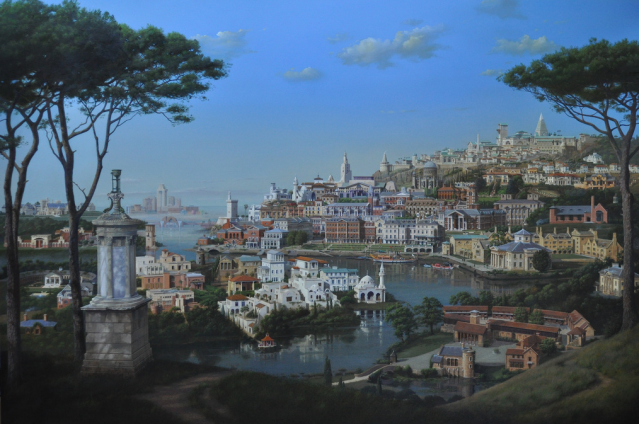
“A Classical Perspective” (2012), by Carl Laubin. (carllaubin.com)

The British-American painter Carl Laubin specializes in classical buildings assembled en masse on canvas. I first came face to face with one of his works at the celebration, in 2013, of the Richard H. Driehaus Prize for architect Thomas Beeby and the Henry Hope Reed Award for historian David Watkin, in Chicago. How pleased I was to learn that this year’s Reed laureate was Laubin himself. The good news called to mind his masterpiece, “A Classical Perspective” (2012), with which I had flirted, nay, romanced six years ago.

It was commissioned by Driehaus to honor his prize’s first ten recipients. It is a large painting of buildings designed by each laureate and nestled on hills surrounding a river that flows through an indescribably pacific imaginary scene. I was transfixed, and over two days happily followed the capriccio – as such a painting (capricci in the plural) is known – to several venues as it wandered around Chicago, serving as centerpiece for each event associated with the festivities, hosted by Driehaus, the Chicago philanthropist, and the University of Notre Dame, which sponsors the awards each year.

Screen Shot 2019-02-12 at 11.08.30 PM.png

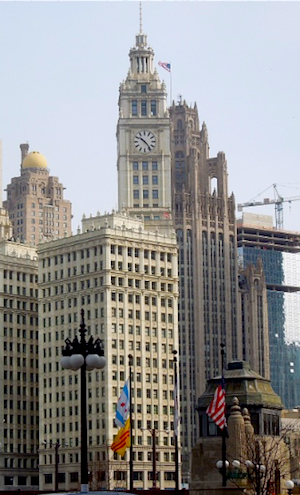
Wrigley Building (left), Tribune Tower.

Chicago, where I was born, is not considered a mecca of architecture for no reason. Even its modernist buildings, mostly skyscrapers, look good there because they are chiefly seen in the elegant jumble of their collectivity – winding along Lake Michigan and the Chicago River – rather than in the pitiless glare of their mostly sterile individuality. By far the city’s most impressive if not applauded buildings, however, are its classical buildings, especially its  most celebrated skyscrapers, the Tribune Tower (1925) and the Wrigley Building (1920) as seen together from across the river on the second city’s Magnificent Mile (Michigan Avenue). It may be the ensemble that in true spirit most resembles the grandeur of classical Rome. In fact, although vertical rather than horizontal, it looks like a Laubin come to life.

Ten Years of the Driehaus Prize,” a page on Laubin’s website, describes the creation, in the course of a year, of “A Classical Perspective,” using prose and images of the painting at various stages. Concluding with the image at the top of this post, Laubin has put together different versions in color of the full painting, finely wrought sketches of the picture as it evolved, line-drawings of close-up details of the finished work, and colored segments set into line drawings, interjecting between them explanations of the progression in his mind of how the work moved inexorably toward, I’d say, perfection.

I quote several excerpts, but strongly urge readers to click to the link and read the entire essay. Of the general idea of the landscape, Laubin writes:

The composition is loosely based on the formula for a classical landscape painting as described to me by John Outram in 1987 when I was doing a painting for him, “Imago Terrarum.” Basically, in his formula, one enters the picture from the countryside, across a bridge, over a stream which winds its way into the painting. One passes through the agrarian countryside to the town with its harbour and upwards through different levels of civilization before arriving at the Acropolis where the ideas reside.

He describes his progress through the stages of painting:

The composition continued to develop and change on canvas over the next seven months; buildings coming and going and shifting minute distances. I also found the landscape changing in the painting as the seasons progressed in reality, reflecting what I would see on my walks in the countryside. I became determined to finish the painting before autumn which would require a major shift in the tonality of the work.

Here is how he stitched together diverse work by the ten laureates:

In the completed work, I think the diverse approaches to classical or traditional architecture do combine to create a harmonious composition through their shared principles with surprising resonances occurring in unexpected juxtapositions. I thought this was true of the Atlantis/Pitiousa/street of Robert Stern Villas sequence mentioned earlier. I found the middle ground peninsula with a slightly Mediterranean flavour is another. Tropical residential buildings by Duany Plater-Zyberk and Jaquelin Robertson establish a Mediterranean influence that is continued in buildings by Léon Krier, Abdel-Wahed El-Wakil, Michael Graves and Robert Stern. Here buildings from Florida, Jeddah, Egypt, Greece, the Dominican Republic and New Jersey sit comfortably side by side. I can also see ripples of influence that run through the centre of the main town. The Moorish influence that can be found in many of Manzano Martos’ restoration projects find sympathetic neighbors in El-Wakil’s Jeddah Lighthouse and mosques, and Duany Plater-Zyberk’s Alys Beach House at one end of Manzano Martos’ Calle San Fernando and Allan Greenberg’s Rice University Humanities building at the other end. Even Porphyrios’ Duncan Galleries in Nebraska does not seem out of place next to El-Wakil’s Corniche Mosque both constructed of lively, highly articulated forms that catch the light dramatically.

Screen Shot 2019-02-12 at 11.13.46 PM.png

Leon Krier and his work. (Pinterest)

Laubin’s works mainly depict the most notable architecture of a single bygone master, or, as here, a collection of buildings by various notable architects. As Laubin notes above, “[c]lassical or traditional architecture … combine to create a harmonious composition through their shared principles with surprising resonances occurring in unexpected juxtapositions.” Laubin’s genius is not to create that harmony by himself alone but to assemble the buildings to reflect that harmony as time and nature would do themselves, applying patience and the guidance, so to speak, of architects down through the ages. In “A Classical Perspective,” Laubin conveys his most important message, which is that there is no reason the same beauty cannot be achieved by architects today.

As so many indeed have done, which the Driehaus Prize proves, and which the winners of the Henry Hope Reed Award, dedicated to the late New Yorker who founded the classical revival, demonstrate with inimitable scholarship, year after year.

***

[Note: Between Jan. 31 and Feb. 13, the survey results from the poll on classical versus modernist architecture have swung from No (the modernists) leading 92-8 percent to Yes (the classicists) leading 64-36 percent. Please vote. The deadline Feb. 26.]

Screen Shot 2019-02-12 at 10.23.50 PM.png

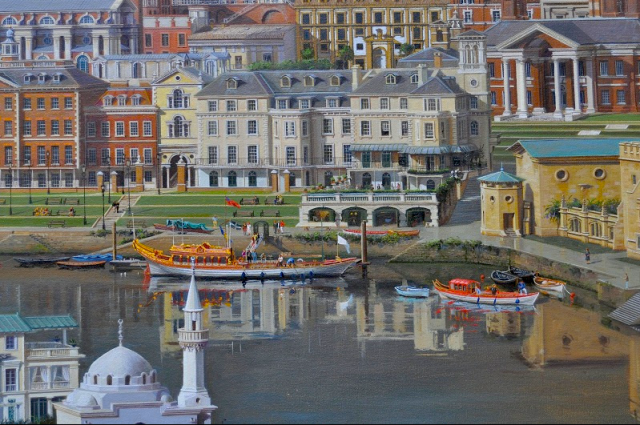
Detail of “A Classical Perspective” showing Quinlan Terry’s Richmond Riverside (1989)

Posted in Architecture | Tagged , , , , , , , , | 6 Comments

“Modern” or “modernist”?

Screen Shot 2019-02-10 at 10.42.02 PM.png

How modernist architects like to think of themselves. Meet George Jetson! (Hollywood Reporter)

Occasionally I am urged to stop using “modern architecture” and use “modernist architecture” instead. The complaint, which issues from some of architecture’s top thinkers and makes considerable sense, is that the word modern normally means “of today” or “up to date,” and that “modernist” serves to identify it as a tainted “ism” – an ideological term not to be confused with the plain everyday meaning of the word.

Calder Loth, a former preservationist for the Commonwealth of Virginia, points out that “Modern is no longer modern. It should not be called modern because it isn’t anymore. It’s been around for 100 years.”

Léon Krier, a leading theorist on architecture and urbanism, told an interviewer: “[T]he now commonly used expression Modern Movement needs to be corrected to Modernist Movement. I keep repeating this because modernist propaganda dominates via the fraudulent appropriation of the term ‘modern,’ claiming that theirs is the only legitimate form of modernity in art and architecture.”

Screen Shot 2019-02-10 at 10.58.42 PM.png

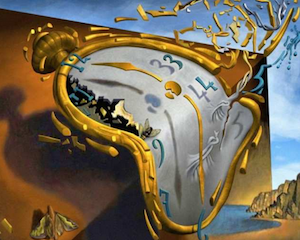
“Melting Watch” (1954), by Salvador Dali. (dalipaintings.com)

I get the point. But for all practical purposes it seems six of one and half a dozen of the other. Adding “ist” isn’t going to change how readers interpret either phrase. The goal is not so much accuracy as rhetorical effectiveness. With or without “ist,” the root word modern remains, doing the propaganda job assigned to it by the founders of the Modern Movement. Too bad, but mission accomplished.

(By the way, if I may be permitted a point in my own defense, I always use the word modernist unless it is directly in front of the word architecture.)

More interesting might be to try to find another word to substitute for either modern and modernist. Recently, in a discussion among trads, several words were suggested as options, some of them, I assume, jokingly. They included “Modernesque,” which has the same problem as modernist. From another source came several problematic stumpers: “Styless” (accurate, possibly misspelled, and unintentionally in sync with the declaration that modern architecture is not a style); “Nonpulcher” (derived from the Latin words for not and beautiful and, while accurate, too abstruse); “Vapidus” (meaning flat or insipid, also too abstruse); and “Solumutilis” (in Latin solum means soil, so, perhaps, rich soil for buildings? That can’t be it. Its common usage is preceded by a negative, so “Nonsolumutilis” makes more sense. Help!).

The founder of the classical revival, the late Henry Hope Reed, preferred “Anorexic” as a more descriptive term for modern architecture. Quite right. Still, that may also be a bit on the abstruse side, and modernists might object to being equated with an adolescent eating disorder. Maybe “Abstract” would be preferable, if it matters what modernists feel. Call it abstract architecture. This might stroke the modernist amour-propre. Modernists might find that acceptable, just as they seem so shockingly unperturbed by our use of the words traditional and classical architecture.

***

[Note: Between Jan. 31 and Feb. 11, the survey results from the poll on classical versus modernist architecture have swung from No (the modernists) leading 92-8 percent to Yes (the classicists) leading 64-36 percent. Please vote. The deadline Feb. 26.]

Posted in Architecture | Tagged , , , , , , , | 7 Comments

Uses of classical architecture

Screen Shot 2019-02-07 at 9.25.32 PM.png

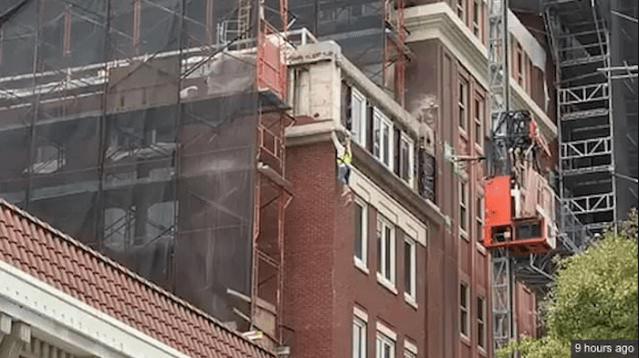
Construction worker hangs from corner after scaffolding collapse at Fort Worth apartment building.

Construction workers were renovating the brickwork of the Sundance West apartments in downtown Fort Worth, Texas, when scaffolding collapsed, leaving one worker hanging five floors up on the six-story building.

Screen Shot 2019-02-07 at 10.44.35 PM.png

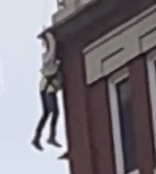
“… That safety harness keep[s] the worker from falling to the ground below” is how one local TV reporter described the event. Wrong! The building’s cornice kept the worker from falling. Video shows him holding on to the cornice for at least 33 seconds, kicking his legs a bit and then, showing strength and poise, shifting his grip hand to hand, bit by bit, around the corner and along the cornice over to safety, pulling himself onto the scaffolding that remained intact on that side of the building.

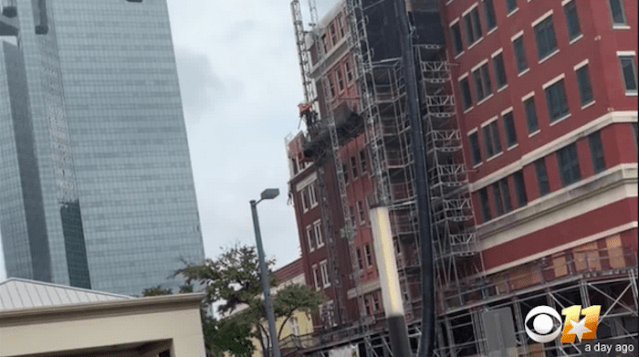
Good thing he was not on the building across the street (below, left) when the Grim Reaper came to call. Score one for classical architecture.

***

[Note: Between Jan. 31 and Feb. 8, the survey results have swung from No leading 92-8 percent to Yes leading 63-37 percent. Voting deadline Feb. 26.]

Screen Shot 2019-02-07 at 9.26.08 PM.png

Glass and steel building near work site has no hand-holds for falling workers. (CBS Channel 11)

Posted in Architecture | Tagged , , , , , | 7 Comments

Save the Chartres Cathedral

Screen Shot 2019-02-05 at 7.26.44 PM.png

Cathedral of Our Lady of Chartres, 60 miles from Paris. (lifeofanarchitect.com)

In my 2014 blog post “Change at Chartres” I discussed New York Review of Books critic Martin Filler’s “Scandalous Makeover at Chartres,” a critique of the interior restoration work at the famous cathedral about 60 miles to the southwest of Paris. Most notable, even endearing, are its two curiously asymmetrical spires. Filler’s criticism often leaves me cold, but here his fulminations were right down my alley. I wrote:

Modern architecture has been the brand of this ethos [change for the sake of change] for years. If you can’t put an ugly, arrogant addition on Chartres, then at least you can reinterpret, reconceptualize and discombobulate the experience of millions who visit, whether as tourists or congregants. Modernism has severed the connection between beauty and time. What results is propaganda and publicity.

Screen Shot 2019-02-05 at 7.16.06 PM.png

Addition proposed for Chartres. (andrewcusack.com)

Now the city of Chartres plans to put an ugly, arrogant addition onto the building, right out front, like a clown nose on the face of a beloved friend. To be placed upon the parvis (forecourt) in front of the west façade is a so-called interpretation center, a sadly conventional excuse to let modern architecture cavort inanely around a dignified building. Its purpose is to desacralize a world-famous religious icon. The sins of faux interior restoration criticized by Filler seem trivial next to this proposed atrocity, which I discovered on the website of Andrew Cusack, sent to me by Richmond, Va., architect Erik Bootsma. Cusack, who places much of the blame for this proposal on the mayor of Chartres, writes:

Having walked from Paris to Chartres myself I can imagine how much this proposal will injure the experience for pilgrims. After three days on the road, to arrive at Chartres, stand in the parvis, and gaze up at this work of beauty, devotion, and love for the Blessed Virgin is a profound experience. If constructed, this plan would deprive at least a generation or two from having this experience. (But only a generation or two, for it is simply unimaginable to think this building will not be demolished in the fullness of time.)

A generation or two only? Keep dreaming, Andrew! The world is filled with monstrosities that have cheated longer stretches of time. Culture will have coarsened further in the meantime, and the public will be forced to get used to it, though Catholic pilgrims probably will not – if such persons are still permitted to exist by then. So let us hope it will not be built at all.

The other day, the prestigious Driehaus Prize went to Belgium’s Maurice Culot (see my post “Driehaus Prize goes to Culot“), a leading educator and activist in the effort to revive traditional architecture in Europe. If that role means anything, it places him squarely in opposition to modern architecture. The Driehaus, which celebrates the life work of living classicists, comes with $200,000, and I hope this year’s Driehaus laureate will devote part of this sum, along with his consummate energy, to saving Chartres. The University of Notre Dame, whose architecture school sponsors the prize, will bestow it at a celebration on Saturday, March 23, in Chicago.

And Chartres may not be the worst new atrocity in Europe. Arguably the most beautiful street in Paris, the rue de Rivoli, site of the Louvre, has been defaced by an unnecessary façade of undulating glass on the venerable 1869 Art Nouveau-style department store Samaritaine. The thuggish renovation is an intentional insult to the City of Light. Maurice Culot should speak out in Chicago, before it is too late for Chartres Cathedral.

[Note: Between Jan. 31 and Feb. 8, the survey results have swung from No leading 92-8 percent to Yes leading 63-37 percent. Voting deadline is Feb. 26.]

Screen Shot 2019-02-10 at 4.20.39 PM.png

Samaritaine just before and after, just prior to and just after renovation. (Michael Diamant)

Posted in Architecture | Tagged , , , , , , , , , | 2 Comments

Vote for the trads or mods

Screen Shot 2019-02-03 at 4.58.15 PM.png

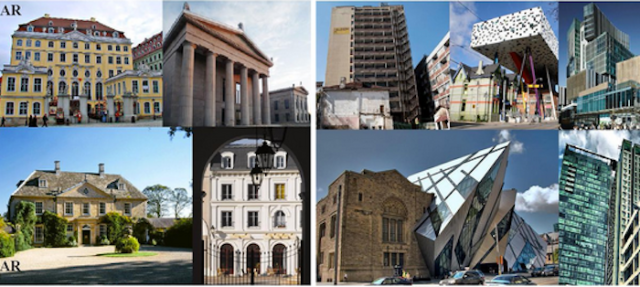
Classical architecture, left, or modern architecture, right? (Architectural Revival)

After the emergence of Making Dystopia, the history of modern architecture by James Stevens Curl published by Oxford University Press last autumn, the journal Prospect, in the U.K., held an online debate about architecture. The debate question was “Has Modern Architecture Ruined Britain?” Click the link to read the three rounds between Professor Stevens Curl’s “yes” and the “no” propounded by Senior Lecturer Barnabas Calder, author of Raw Concrete: The Beauty of Brutalism. Readers can then vote for either position. A yes is for traditional architecture and a no is for modern architecture.

Voting over the first few days since the debate was published had the modernists in a huge lead but the classicists are chipping away. As usual these days with polling, the result will not accurately reflect opinion but will serve for bragging rights. It seems that Hugh Pearman, the Brit architecture critic associated with RIBA, the Royal Institute for British Architects, is trying to round up votes for the mods. So I am doing the same for the trads.

[Update: Between Jan. 31 and Feb. 7, the results have swung from No leading 92-8 percent to Yes leading 62-38 percent. The deadline for voting is Feb. 26.]

Posted in Architecture | Tagged , , , , , , | 4 Comments

The mods’ survival explained

Screen Shot 2019-01-29 at 10.56.51 PM.png

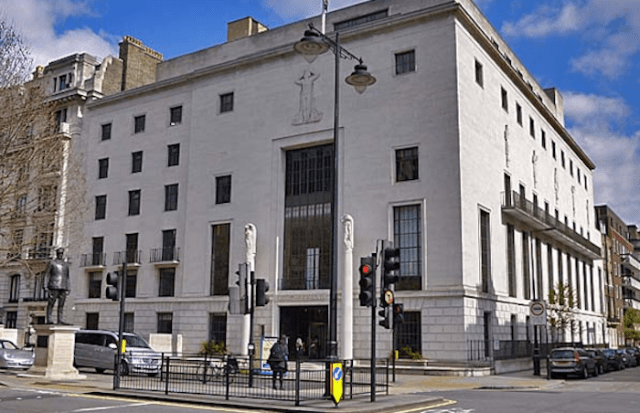
Headquarters of the Royal Institute of British Architects, London. (ManchesterHistory.net)

They cut the feedback loop.

Nobody has done a better job of explaining the persistence of modern architecture than does Roger Scruton in his review of James Stevens Curl’s new book, Making Dystopia. In his review, Scruton sums up with precision what Stevens Curl describes at length and in stunning detail in his book, subtitled “The Strange Rise and Survival of Architectural Barbarism.”

Here is Sir Roger’s explanation:

When people make mistakes and are distressed at the result, they will as a rule retrace their steps, discover where they went wrong, and try to correct the matter. That is what it means to be rational, and rationality is an evolutionary advantage, enabling our hypotheses to die in our stead, as Karl Popper famously put it. However, when decisions are made for others, by people who do not pay the cost when things go wrong, error has a tendency to become programmed into the system, since nobody has the incentive to rectify it. This is what happened with the rise of totalitarian government in the 20th century. And as James Stevens Curl shows, in this powerfully argued polemic, it is what happened when a handful of egotistical charlatans imposed modernist architecture on the rest of us, accompanying their cold-hearted and alienating forms on the people, whom they despised, with loud fanfares of self-applause.

Although modernist architecture has been hated by the mass of mankind from its first inception in the brains of Le Corbusier, Gropius, Mies van der Rohe and the rest of the gang, nobody has been able to put a stop to it, or to act on the obvious conclusion that we had better retrace our steps. A critical orthodoxy has arisen, animated by the very people who most need to be criticized, according to which the modern movement in architecture was historically necessary, uniquely functional, uniquely honest, and in any case morally correct. With a zealotry equal to that of the 17th century Puritans, the modernists took over the schools of architecture, the architectural press and the channels of critical communications, shouting their messages to the heavens, and condemning as ignorant and reactionary all those who showed the slightest hesitation in accepting it.

Scruton goes on to describe how the founding modernists were in bed with the communists and the Nazis:

What is interesting, and what comes out very clearly from this thoroughly researched account of the history and ideology of the modernist movement, is that the modernist pioneers were involved to a man (there were no women) in the communist and fascist ideologies of the day.

The modernists have tried to keep their totalitarian connection hidden. But it has come out, slowly but surely. Making Dystopia not only does a totally thorough job describing the phenomenon and its history, but has no qualms about calling modern architecture evil. Its founders learned propaganda from the master propagandists of the 20th century. The Bauhaus school was unabashedly communist under its founder, Walter Gropius. Goebbels helped Mies try to get Hitler to accept modernism as the style template for the Third Reich. During WWII, Le Corbusier was a planner for the Nazi collaborators in Vichy France. In its young adulthood, modern architecture’s guru was American architect Philip Johnson, who went to Germany in the 1930s as an acolyte of Hitler. And when he came back he supported Huey Long and Father Coughlin, the main U.S. proponents of authoritarianism. This all occurred after he curated the International Style exhibition at MoMA. The Nazi regime was more a cult than a government: modern architecture is more a cult than a profession. So the resemblance between fascist and modernist propaganda has been relentlessly pooh-poohed by modernism’s acolytes. Move along, please! There’s nothing to see here!

Screen Shot 2019-01-29 at 10.50.46 PM.png

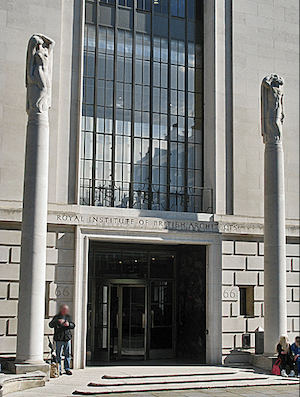
Entrance to RIBA at 66 Portland Place

The book’s treatment in Britain is a good example of the intentionally broken feedback loop described in Scruton’s review. The architectural establishment attempted to ignore Making Dystopia at first, but the instant credibility provided by its publisher, Oxford University Press, has made that difficult, so reviewers for the major British newspapers, journals and architectural media have deployed falsehood and fake outrage as their chief critical tools. Anything to avoid addressing the book’s indictment forthrightly.

Stevens Curl has been a member of the Royal Institute of British Architects for six decades, but that has not prevented its leadership circles from trying to erase the author from RIBA’s version of the Kremlin balcony, including an über-petty review in the RIBA Journal. They crib from the text of Nikolaus Pevsner, fabricator of modernism’s false narrative: down the memory hole with any 19th century architect whose work casts doubt on modernism’s fictitious “evolution”! As for any 21st century skeptic, censorship’s the ticket. Whether through evasion or deceit, modern architecture’s leadership has ensured that, as Sir Roger puts it, “error has been programmed into the system.”

That’s why something so widely disliked since its inception a century ago has managed not just to maintain its grip on societies worldwide but to leap from summit to summit in its attempt to degrade life on Earth by killing the idea of beauty in architecture, the queen of arts. Which is why the subhead of James Stevens Curl’s riveting book, “The Strange Rise and Survival of Architectural Barbarism,” may truly be described as hyper-accurate.

Posted in Architecture, Books and Culture | Tagged , , , , , , , , , , , | 8 Comments

Driehaus Prize goes to Culot

Screen Shot 2019-01-27 at 8.12.07 PM.png

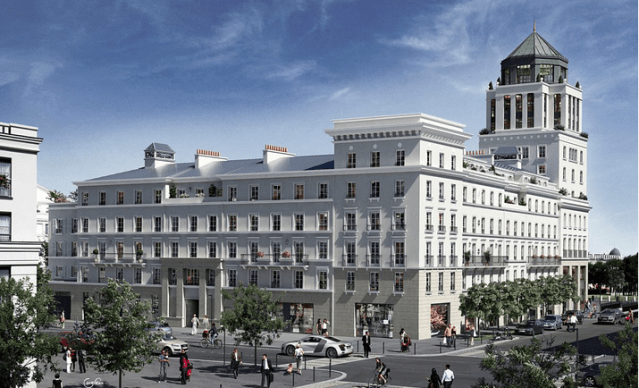
Val d’Europe, a suburban Paris village planned by Maurice Culot and founded in 1987. (ARCAS)

Maurice Culot, the Belgian architect and urban theorist who has won this year’s Richard H. Driehaus Prize, is described in an announcement by the University of Notre Dame as being “at the forefront of the creation of the modern traditional movement.” This phraseology seems to be an attempt, highly laudable, to recapture the meaning of the word “modern,” which was stolen a century ago by modern architecture.

Screen Shot 2019-01-27 at 8.24.32 PM.png

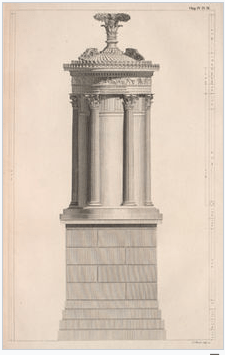
Choragic Monument, Athens

Modern architecture is a misnomer. It should have been called “bad architecture,” or, to be more charitable, “dull architecture” or “utilitarian architecture.” It’s a good thing that so few fields of human endeavor have chosen to christen their accomplishments with a word so blatantly kidnapped from its original meaning – “modern engineering,” “modern football,” “modern agriculture,” “modern fashion,” “modern automobile” and the like – or the history of everything would be much more confusing. But then modern architecture is about the only field of human endeavor that prides itself on its rejection of precedent as key to progress. (Even fashion is no exception, though haute couture is.)

I’m sure such reflections are old hat to Maurice Culot, who has founded many organizations, written piles of books and articles, and given countless lectures devoted to “the retrieval and dissemination of knowledge about what makes a city vibrant and livable,” according to Michael Lykoudis, the dean of Notre Dame’s architecture school. The Driehaus jury put it this way:

Culot made it possible to recover the knowledge of the elements and principles that have defined the best urban environments across time and place that was nearly lost, providing a brighter future for cities, towns and villages around the globe.

It may be said that the creation and propagation of cities, towns, villages and buildings is one of the human endeavors that did its job with success around the world and for many centuries. Art, agriculture, transportation, chemistry and many other fields can say the same. Some of these fields have seen their usefulness to the human project diminish over the last half century or so, but none so much and with such evil purpose as architecture.

(I would recommend the newly published Making Dystopia: The Strange Rise and Survival of Architectural Barbarism, Oxford University Press, by James Stevens Curl, to better understand the history of modern architecture and, hence, the validity of the word evil, though looking outside is sufficient, depending on where you are.)

Congratulations to Maurice Culot, who will receive, in addition to $200,000 (twice the amount to laureates of the more heavily publicized, modernist Pritzker Prize), a bronze miniature of the Choragic Monument of Lysikrates in Athens, the first known use of classicism’s Corinthian order on the exterior of a building. His recognition by the Driehaus Awards and Notre Dame follows last year’s award to Paris-based architects Marc Breitman and Nada Breitman-Jakov, with whom Culot has worked in the past.

This tribute to Culot is really a lesson in how to admit you know very little about your subject. I am much more familiar with the work of this year’s Henry Hope Reed Award, always bestowed (with $50,000) at the same time as the Driehaus to someone who is not an architect but has nevertheless contributed to the classical revival. This year’s Reed laureate is Carl Laubin, whose paintings have, according to Richard Driehaus, “brought another dimension to the work of architects both past and present, allowing a glimpse into a beautiful world, sometimes real and sometimes imagined.”

Over the years I have generally and inexcusably neglected the Reed awards, named for Henry Hope Reed, the leading pioneer of the revolt against “the Modern,” as he liked to call modern architecture, but I will devote a post to this year’s splendid Reed laureate soon.

Posted in Architecture | Tagged , , , , , , , , , | 4 Comments

In Waterbury, a sip of Conn.

Screen Shot 2019-01-24 at 2.52.14 PM.png

Statehouse of Connecticut in Hartford. (Connecticut Architecture)

Next Wednesday I’ll be visiting Waterbury, Conn., for the first time in a great many years, and even then I did not visit but passed through. For a New Englander (by choice, not by birth) I have relatively little experience of the Nutmeg State, most of it whizzing by along the coast from the windows of Amtrak. Its countryside has always charmed this urbanist more than its big cities. Its smaller cities, Waterbury, Danbury, Bristol, New Britain, and towns such as Putnam, Pomfret and others along Route 44 and roads beyond I am more familiar with from trips long ago to see relatives in Springfield, Mass. My editor at the Providence Journal, Bob Whitcomb, once dragged me to Stonington, across the Pawcatuck from Westerly. He figured he’d surprise me with its beauty – and he did. It was lovely. I was unfamiliar with that corner of Connecticut, too.

I am just as unfamiliar with a book whose author, Christopher Wigren, will lecture on his state’s trove of architecture at a lecture in Waterbury City Hall. The book, Connecticut Architecture: Stories of 100 Places, newly published by Wesleyan University Press, was a project of his employer, the Connecticut Trust for Historic Preservation, where he is deputy director. His free talk, at 6 p.m. next Wednesday, Jan. 30, is sponsored by the New England chapter of the Institute of Classical Architecture & Art as a project of its membership committee; our Michael Tyrrell made the event happen.

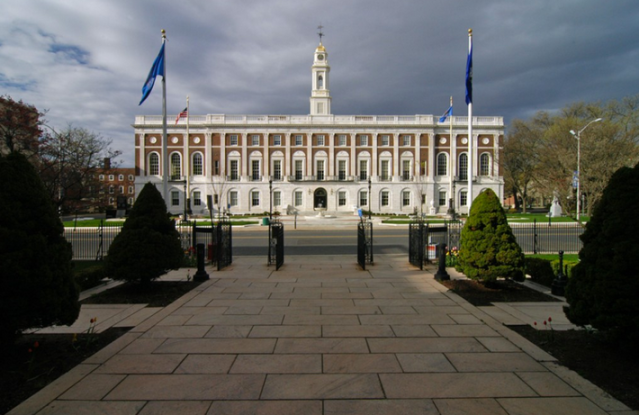
The book and its author form a good reason to attend, but the location in City Hall is of no small curiosity as well. The firm of DeCarol & Doll, of Meriden, Conn., won a Bulfinch award for its restoration of Waterbury City Hall in 2011, the second year of the annual awards program sponsored by the ICAA’s New England chapter. The HQ of the Brass City was designed by the celebrated architect Cass Gilbert and completed in 1915. Check it out!

Place Yourself,” a review of the book by Kathy Leonard Czepiel for The Daily Nutmeg, in New Haven, gives an excellent account of the book, which, with 210 photos, widely sourced, 173 of them in color, is not just a picture book for a coffee table but an erudite history of the architectural progress of the state. Czepiel thinks highly of Wigren’s treatment of it, writing:

This history is liberally accompanied by photographs and well worth a read on its own, but the book’s greatest appeal is the 12 sections that follow, highlighting different facets of Connecticut architecture: landscapes, “materials and technologies,” homes, farms, factories, towns and cities, transportation, public buildings and so on. As Wigren emphasizes in his preface, Connecticut Architecture doesn’t offer a list of greatest hits. Rather, it uses some of our most interesting, iconic or illustrative places to tell the tale of a state rich in architectural variety and stories.

A very small number of the 100 places Wigren describes in text and photos are modernist, and, to judge by Czepiel’s review, he is straightforward about it. Exemplifying what Wigren calls urban renewal’s “difficult legacy,” Czepiel describes a modernist church imposed upon one of New Haven’s targeted neighborhoods:

What remains intact of the renewal plan for Dixwell is the Dixwell Avenue Congregational United Church of Christ, designed in 1968 by New Canaan architect John M. Johansen, “who at the time was experimenting with dramatic, irregular forms in place of the simplicity of earlier Modernist designs.” The congregation itself, we’re told in the book’s introduction, had “been considering a Colonial Revival edifice before the Redevelopment Agency assigned the Modernist architect” to it.

Typical. Without knocking the splendid architecture featured in the book, it may be fair to say that Connecticut’s cities demonstrate how lucky it is that the state’s redevelopment bureaucracy did not try to impose urban renewal on the countryside. In my admittedly limited experience, rural Connecticut has been treated better than urban Connecticut. That is easy to see, and the reason for the disparity no doubt has to do with the relative power in state government of people who live in cities versus people who live in bucolic environments – a topic miles above my pay grade and perhaps Wigren’s as well. As for the suburbs betwixt town and country, I’m sure those of the Nutmeg State, as in most places, run the gamut. I look forward to learning how Chris Wigren explains all this in his book – and/or in his lecture.

Screen Shot 2019-01-24 at 10.23.30 PM.png

Waterbury City Hall (1915), designed by Cass Gilbert. (Cass Gilbert Society)

Posted in Architecture History, Preservation | Tagged , , , , , , , , , , , , | 1 Comment