Sir Roger Scruton, RIP

PeteHelme.png

Sir Roger Vernon Scruton, FBA FRSL (photo by Pete Helme)

Death took Roger Scruton today. He was the world’s deepest thinker on architecture and aesthetics, which were embedded in the conservatism of his broader philosophy. Scruton embraced tradition, holding that “the tried and true” are a stronger foundation than novelty and experiment for the good life, for public policy, for cities and towns, and for the creation of beauty in art and in architecture. The author of more than 50 books, a prose stylist of gentle precision, and a brave crusader for intellectual freedom in Soviet-ruled Eastern Europe, Scruton was knighted by Queen Elizabeth in 2016.

I feel a particular sadness at Sir Roger’s passing, from cancer, at 75. I first entered the orbit of his ideas through his 1995 book The Classical Vernacular, which became my bible. In 1999, on a visit to London, I called him up out of the blue and he invited me to his small, book-lined pied-à-terre behind the Burlington Arcade. We went out to hear a lecture by the noted architectural historian David Watkin. In 2011, I spotted him at a symposium in New York but, going up to greet him, it turned out I’d mistaken him for Robert Adam, the celebrated British classicist.

When I started reading Scruton and finally met the philosopher, I was unaware that his conservatism stretched way beyond aesthetics, architecture and classicism. Yet it was a perfectly natural fit. Ideas that spring from, say, Edmund Burke reach out not just to the right but the left. A building that arises from practices hundreds of years in the making, the accumulated wisdom of trial and error by generation after generation of builders, is more likely to reflect the natural preferences of mankind than a building whose design is new, novel, just off the blackboard, untried and, most likely, untrue. The same goes for an idea or a form of government. A respect for tradition would serve all of us with equal capability in the realms of politics and policy, whether we agree with this or not.

“The classical idiom,” writes Scruton in The Classical Vernacular, “does not so much impose unity as make diversity agreeable.” I’m sure he would urge that a politics that embraces this liberality is far more likely to be a conservative politics – in short, one that liberals should find agreeable, too. In another of my favorite passages, he makes a similar point in discussing the social impact of a street lined with classical buildings:

The classical wall, which is humanly proportioned, safe, gregar- ious, and quietly vigilant, constantly reminds the pedestrian that he is not alone, that he is in a world of human encounter, and that he must match the good manners of the wall which guides him.

Sir Roger will be missed by classicists and conservatives, but also by people who disagree with him, or have never heard of him. His ideas will improve and beautify the world for everyone, whether they like it or not, and will do so, I am sure, long after his life and work bear the fruits of tomorrow’s happier society. Roger Vernon Scruton, RIP.

Posted in Architecture, Books and Culture | Tagged , , , , , , | 4 Comments

Architecture reform school

Screen Shot 2020-01-10 at 10.02.51 PM.png

(Oops, I think I meant “Reform architecture school.”)

ArchNewsNow, compiled by the inimitable Kristen Richards, is a thrice-weekly compendium of news and opinion on architecture from around the world. Each collection of articles includes one or more features generated specifically for ANN. In recent weeks and months, ANN has hosted a series of these features on architectural education, curated by Prof. Nikos Salingaros, a globetrotting mathematician and architecture theorist at the University of Texas in San Antonio. He and Richards asked me to contribute an essay to the series, each article of which addresses a petition submitted last year by British students seeking to reform architecture schools. My contribution to the series, the 600th feature published by ANN, is reprinted in its entirety below:

***

Lesson Plan #8:

Petition of the British Architecture School Inmates

Students are taught how to tinker with computers and how to plug into a corporate design culture that aids and abets precisely what drives the petitioners to seek reform.

By David Brussat
January 9, 2020

Editor’s Note: This is the eighth in a series on the future of architectural education created and curated by Nikos A. Salingaros, Ph.D., Professor of Mathematics, winner of the 2019 Stockholm Culture Award for Architecture, and co-winner of the 2018 Clem Labine Traditional Building Award. See Lesson Plans #1 through #7 at the end of this feature.

Curator’s Note: When architects refuse to criticize their fellows, and delicately avoid disturbing an entrenched system in which they are comfortably embedded, where do we turn for sage advice on how to improve the world? To architecture critics and journalists, of course. They are commonly supposed to be impartial outsiders: fierce watchdogs working in the public’s (that’s our) interest. But, unfortunately, not many of them are truly objective. Having an informed and intelligent critic like David Brussat who courageously speaks his mind is a boon for the entire world. — N.A.S.

***

What are the priorities for reform?

Recently, a petition was assembled by students from several architecture schools in Britain asking their schools and other pertinent institutions of the design world to do more to address climate change. I read it, and looked around to see if I was being watched. I thought Allen Funt might pop out and cry, “Smile! You’re on Candid Camera!”

“We are concerned,” write the petitioners, “that at present our education does not give sufficient weight to the inherently ecological and political basis of architecture.”

In Britain, as well as in America, climate change is the central and almost exclusive focus of every architecture school and every architecture firm. Second billing goes to whether there are enough women and people of color. These are justified concerns, but not critical to architecture at a time when its product fails to satisfy a huge segment, possibly a very sizable majority, of the market for buildings. Time spent trying to turn the big business of architecture into a think tank for climate change is time spent dodging the existential issues facing the industry. This sort of misdirection can come off as intentional, perhaps even conspiratorial, in a profession that doesn’t like to hear itself criticized.

An alternative to the architecture-industrial complex

Prof. Nikos Salingaros, in his own reply to the student petition at ArchNewsNow.com, applauds their desire to reform architecture education, and offers sage advice to students seeking change. “[I]s it realistic to expect architectural education to change? The current cult-based system is not set up to diagnose – let alone fix – deep internal contradictions. The best it can do is to protect its ‘business as usual’ approach to design by applying a band-aid. Hope exists only in developing an alternative education outside the mainstream” – easier said than done, Salingaros adds.

However, the professor notes that efforts to bring real reform to architecture make this a hopeful moment for students. The best comparison may be to the “slow-food” movement. It offers a more locally based alternative to the agriculture-industrial complex. Architecture could benefit from a parallel approach. Salingaros himself has led scientific research that mines neurobiology to identify how a living, healthy architecture can be nurtured by mimicking nature’s reproductive system. The “cult-based system” shields students from learning of such advances. They must seek knowledge from outside the insulated, isolated environment of architecture school.

Here are some things students should seek to learn from beyond the walls of their universities:

• The true history of how the architectural cult captured the industry’s establishment.

• How to structure architecture firms as bottom-up rather than top-down practices.

• How to locate and use the many new sources of traditional materials and techniques.

• How to work with clients to reach solutions rather than seeking to impose solutions.

• How to understand the incremental nature of genuine architectural creativity.

• How ornamental techniques open new avenues to solve architectural challenges.

What students learn today is how to navigate a top-down system based on inept revolutionary concepts developed a century ago that have not changed substantially since the Bauhaus. Design has become a succession of experimental fashions. Creativity of form, with novelty the primary goal, has led to a corporate architecture that stifles the sort of conceptual creativity that ought to drive evolution in the design process. Students are taught how to tinker with computers and how to plug into a corporate design culture that aids and abets precisely what drives the petitioners to seek reform.

This corporate mindset cannot possibly conceive any creative way for architecture to address complicated global issues such as climate change. Inevitably, the answer that arises from the architectural cult is lame – for example, LEED-influenced gizmo green, which seeks to solve problems arising from over-dependence on technology with more technology.

Learn from nature and from tradition

Neurobiology has affirmed that architecture achieves its life-enhancing powers through a process that resembles nature’s reproductivity – the opposite of what current architectural curricula teach students, and the opposite of how architecture operates today. Much like the natural selection discovered by Darwin, best practices in erecting buildings and cities have been developed by trial and error, which are then handed down by generation after generation of builders. Styles of architecture change slowly over time as new materials and technologies capture the attention of the market and gain popularity among practitioners. These best practices are inevitably replaced by new materials and technologies, with the most useful lasting the longest.

This “natural” way of architectural evolution had been happening for centuries until it was replaced in 1920-40 by today’s machine aesthetic – in which a promised efficiency was sacrificed to a bogus metaphor of “the future.” In many respects, the practices ingrained by centuries of architectural progress mimic the scientific principles behind today’s “slow-food” movement. And those principles come from nature, and are the same principles by which architecture operated for millennia. These same principles represent a much better way for architects to help address climate change.

Architecture before what architect and urbanist Steve Mouzon calls the “Thermostat Age” developed many ways to address the challenges posed to human habitation by weather, seasons, and climate. They include windows that open and close, thick walls that retain heat in winter and cool in summer, porches and deep windows that create shade, angling houses to catch the sun or invite prevailing breezes, and other methods of enabling architecture to harness nature to control comfort. These measures do not require electricity or gasoline. Some, in their purity, may be gone, but can still be adapted to our time. The corporate architecture of the so-called Machine Age, which teaches students to look down their noses at such “old-fashioned” techniques, should be shown the door. That is how architects can address climate change.

Break out of the cult!

Such possibilities will not be developed within the cult of architecture because it would upset too many of the socio-economic systems that have properly triggered the student petitioners. The students do not appear to realize that their petition calls upon architecture schools to reinforce those very systems in a misguided attempt at their reform.

To break out of the cult is, as Salingaros states, the only hope for real change. Here’s how individual students can plan their escape:

• Read beyond the texts assigned by your professors of architecture.

• Use your outside reading to ask probing questions of your professors.

• By their response, you may judge whether your current school is right for you.

• There are very few architecture schools with traditional curricula: check them out.

• Most communities have one or more traditional architectural practices: visit them.

• Visit local historic districts with an eye to the role of beauty in modeling the future.

• Keep your chin up. There is more you can do to leverage the cyclical nature of architectural history, so there is genuine hope that change will come, especially if you, yourself, push for it.

David Brussat was the architecture critic of the Providence Journal in Rhode Island for 25 years, until 2014. He still writes about architecture and design thrice weekly in Architecture Here and There, launched in 2009.

***

See also:

Lesson Plan #7: An Implicit Rather than Explicit Model for Teaching Architecture

By Dr. Theodore Dalrymple

I would institute an annual prize, with substantial cash awards, for architecture students who would be given the task of designing a building that surpasses an iconic monstrosity in ugliness. 

Lesson Plan #6: Teacher, Don’t Teach Them Nonsense: Reforming Architecture’s Broken Education

By Mathias Agbo, Jr.

A curriculum overhaul alone cannot fix the problem; rather, the practice of architecture must first reform itself for any pedagogical reforms to make sense.

Lesson Plan #5: Letter from an architect to the gurus [teachers] and chelas [disciples] of architecture

By Shirish Beri 

From India, Shirish Beri writes this special letter out of the restlessness that arises from a genuine concern for the present state of architectural education and profession, as well as that of our society.

Lesson Plan #4: Response to Open Letter for Curriculum Change: A New, Biological Approach to Architecture

By Ann Sussman, RA, and A. Vernon Woodworth, FAIA

This response, in two parts, is from two instructors at the Boston Architectural College.

Lesson Plan #3: Beauty and Sustainability in Architectural Education

By Nicholas Boys Smith and Roger Scruton

We were greatly heartened to see architecture students call for a curriculum change to address the social, political, and ecological challenges of our time, and we want to say something about how their proposals intersect with the work of the Building Better, Building Beautiful Commission. 

Lesson Plan #2: A Time of Change

By Duo Dickinson

The coming technological changes in architecture will impose a full deconstruction of the way we educate architects. 

Lesson Plan #1 “Signs versus Symptoms”: A Reply to the Open Letter from British Architecture Students Calling for Curriculum Change

By Dr. Nikos A. Salingaros

Asking for radical reforms in architectural education, this courageous appeal could help this latest effort be taken seriously, and not simply dismissed, as previous cries for reform have been.

Posted in Architecture, Architecture Education | Tagged , , , , , , | 3 Comments

Why villains love modernism

Screen Shot 2020-01-08 at 11.16.11 PM.png

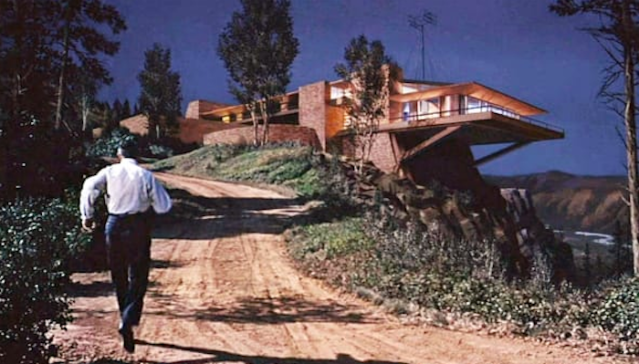
Cary Grant approaches Van Damm house in North by Northwest. (Metro-Goldwyn-Meyer)

The title of the CNN website’s feature article is actually “Why movie villains love modern architecture,” but my headline asks a more pertinent question. It’s not just movie villains but actual villains whose architectural taste flies in the face of the taste of their victims.

But the issue of movie villains and their apparent preference for modern architecture is not the least inappropriate. That is because movie directors’ ideas for cinematic villainy arise, at least partly, from their conscious or unconscious ideas of the character of actual villainy today and in history.

CNN’s article by Jacqui Palumbo is about the newly published book Lair: Radical Homes and Hideouts of Movie Villains, by Chad Oppenheim, who inhabits the architectural rather than the cinematic realm of his book’s duality. He likes the modernist Van Damm house in North by Northwest. Of the fictional villains’ lairs in Oppenheim’s book, Palumbo writes:

[T]hey are pristine, awe-inspiring, high-tech, otherworldly, often impractical, and draw heavily on the tenets of modernism. The book poses the question: Why do bad guys live in good houses?

Permitting Oppenheim’s premise to go unchallenged would be to promote the basic confusion that characterizes what I imagine (not having read it) is an otherwise fascinating book. Why do bad guys live in good houses? Well, they don’t. For most people (that is, most victims of the villainy of most villains, real or fictional) they are bad houses, not good ones.

That mistake is the book’s primary confusion, but it portends a darker thematic confusion.

Around the world and throughout history (at least since the Bauhaus), the public has been broadly skeptical of modern architecture. An instinctive wisdom inhabits this skepticism. Director George Lucas felt some of that.

The villains’ lairs and the victims’ homes in the Star Wars series suggest that Lucas channeled this dichotemy, consciously or subconsciously. So many of his cinematic settings bear out that modern architecture and traditional architecture are associated, respectively, with bad guys and good guys: the Death Star versus Theed, the capital of Naboo, designed in a sort of rotund vernacular classicism. (See my 2016 post “Lucas, return to the Light Side“)

On some level, Oppenheim seems to understand that there is a perverse relationship between modern architecture and evil. CNN’s Palumbo writes:

Lair examines how modernist, futuristic, and utopian architecture has long been associated with amorality. Over the course of the 20th and 21st centuries, sleek homes, equally minimal and extravagant, made of glass, steel, and concrete, have become the archetypal home for the idealistic recluse with dastardly ambition.

Palumbo quotes an essay selected by Oppenheim to be included in Lair:

“Modern domestic architecture has become identified almost exclusively with characters who are evil, unstable, selfish, obsessive, and driven by pleasure of the flesh,” Joseph Rosa writes in an essay in the book. “Were they still alive, this might thoroughly shock the pioneers of modernism, who envisioned their movement facilitating a healthy, honest, and moral way of life.”

Would they be shocked? To be sure, this reflects conventional wisdom about the beginnings of modern architecture in prewar Germany’s Bauhaus school, supposedly shut down by the Nazis in 1933. Still, it may be more accurate to detect more than a hint of the sinister in the vision of Bauhauslers such as Walter Gropius and Ludwig Mies van der Rohe, and the Swiss-French Le Corbusier. Corb hated streets and, like his compatriots, foresaw a very spare and regimented life for the inhabitants of the cities they planned. Socialism was their lodestar, but authoritarianism was often the mechanism. People were cogs in their visions of a machine architecture for the Machine Age. Happy faces were scrawled upon the planners’ sleek advertisements for a future much too far realized for comfort. The founding modernists’ vision comports poorly with the freedom and privacy that are lodestars of the society we exalt in the United States.

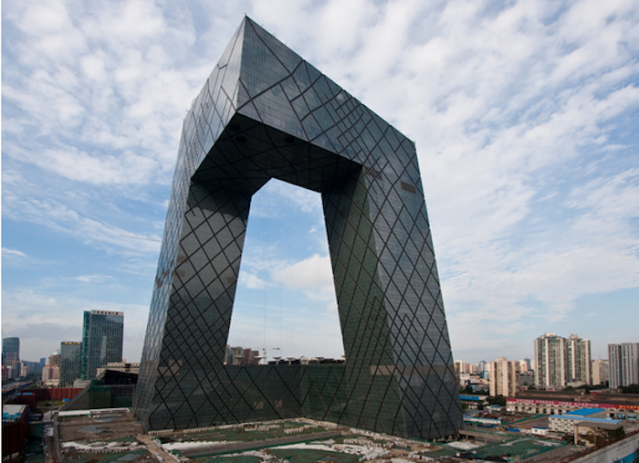
Oppenheim’s book reflects the insular attitudes of the 1 percent, in their silos, who hire amoral starchitects to build lairs for authoritarians and even totalitarians around the world. A good example is Rem Koolhaas’s CCTV headquarters in Beijing, a modernist behemoth that seems to be stomping upon the Chinese public. But it is real, so it is not in Lair. It is not likely that its readers will understand the danger posed by its supposedly lighthearted subject. Lair is a confusing book that reflects a confused mind, which itself reflects a confused culture here and around the globe.

Sorry, but bad guys live in bad houses because they are bad guys.

Screen Shot 2020-01-08 at 11.20.32 PM.png

Rem Koolhaas’s CCTV headquarters in Beijing. (skyscrapercenter.com)

Posted in Architecture | Tagged , , , , , , , , , , | 7 Comments

A threat to Europe’s beauty

Screen Shot 2020-01-04 at 7.04.14 PM.png

Dresden’s Frauenkirche: Modernists want to stop reconstructions like this. (pixels.com)

Modernists are trying to reverse trends in cultural-heritage preservation by subtle interventions in several key conservation standards of the European Union. Writing from Norway, Audun Engh of the International Network for Traditional Building, Architecture & Urbanism (INTBAU) warned me today that the modernists plan to “introduce recommendations that modernism (‘contemporary design’) should be a required style for new construction at EU-funded cultural-heritage sites.”

Mind you, that says “required,” and required in “cultural-heritage sites” – which translates into mandating ugly new buildings and additions in the most beautiful districts of Europe’s most beautiful cities. That modernists believe that this sort of change must be introduced means they recognize how preservation standards have shifted in recent decades. (Of course, they would not describe it the way I just did.)

One of the worrisome recommendations for the EU made by ICOMOS (International Council on Monuments and Sites) reads:

When new parts/elements are necessary, a project shall use contemporary design adding new value and/or use while respecting the existing ones.

This falls into the category of shocking but not surprising. Early on, modernism sought to eliminate all historical structures, which were supposedly a roadblock to the societal transformation imagined by modernism’s founders. That went by the boards soon enough. Today, modernism is best seen as parasitic – interesting only when standing next to traditional buildings. Clusters of modern architecture are boring. Still, modernists retain an atavistic desire to block beauty whenever they can.

The recommendation quoted above is among the rare instances where the phrase “contemporary design” can be found among the ICOMOS proposals for an updated EU policy on such projects. Language referring directly to “traditional” styles is almost as rare. This document and past charters that set national and global preservation policy seem designed to deflect attention from the fact that two distinct groups clearly recognized by the public are involved in preservation – traditionalists and modernists.

This obfuscation of the language of the charters makes it easier for proponents of modernism to game the rules. Clearer language would make policy more easily understood by non-professionals, that is, the public. I suspect that even within ICOMOS, there is sustained conflict between proponents of traditional and modernist design.

Modernists involved in this decades-long debate also must find it painful to note that almost all the charters (perhaps except for the Venice Charter of 1964) now call for very strong language mandating that the public be deeply involved in the planning of projects – preservation and new construction – that are still largely the domain of “experts,” who remain infatuated by modernist styles that offer free reign to experiment with urban form. The public typically prefers to avoid changes in the look of where they live and work, and would rather retain the traditional features they are used to.

But change is slow. Mandates for transparency may make modernists nervous, but the general dominance of modern architecture in building design or city and town planning has not changed, and is probably increasing in spite of positive movement in realms such as global preservation policy. After all, the mayor of arguably the most beautiful city, Paris, has opened its doors to modernist skyscrapers, and the debate continues over whether to rebuild Notre-Dame de Paris as it was or in a modernist style.

Such projects would certainly be made more difficult by another ICOMO recommendation:

Reconstructions might only be funded in exceptional circumstances, and never for tourism purposes only.

For tourism purposes only? What a crock. No famous building is ever rebuilt for tourism purposes only. At the height of the modernist movement in the 1960s, the Venice Charter prioritized modernist interventions in traditional buildings and districts. Charters and treaties since then have rolled back such prioritization to the point where famous historical buildings are being rebuilt with commendable frequency in their original style, likewise with damaged historic districts. Tourism is never the only reason. Love is always a factor.

Dresden’s massive Frauenkirche and its surrounding commercial district are just one example. The recent near completion of Berlin’s City Palace, which oddly features three sides rebuilt in the original Baroque style and one side rebuilt in a stark modernist style, is another. The score in this latest example may be rephrased as 3 Trad > 1 Mod. Great! But modernists are taking note and trying to reverse the trend.

In America, the proposal in New York City to rebuild Penn Station in its original Beaux-Arts style, if adopted, would probably be game, set, match for traditional architecture over modern architecture, at least in America – and not only in preservation policy but in how commissions for major public and private buildings are chosen. Modern architects get at least 95 percent of such commissions (this is a guess), but that could change if the public ever comes to reject the central modernist idea that beauty in civic design is no long possible or appropriate in today’s world. Not so!

The EU should reject efforts to reverse policies that favor beauty over ugliness, however slow those happy policies may be to take effect.

Posted in Architecture, Preservation | Tagged , , , , , , , , , , | 6 Comments

Best trad buildings of 2019

Screen Shot 2019-12-25 at 2.20.25 PM.png

Berlin City Palace: real or Memorex? Men in tan shirts a dead givaway. (apollo-magazine.com)

Compiling the best of the world’s traditional architecture completed in 2019 depends on what the meaning of “completed” is. I had hoped to open this annual post with Berlin’s Baroque-style Stadtschloss (City Palace), built in 1845, damaged by bombs in 1945 and demolished in 1950 by the communists. You can find online articles claiming that it was completed in 2018 and in 2019, but that its “opening” has been postponed until 2020.

Perhaps I am remiss in opening this post with a discussion of a new building (it certainly is that, even if it boasts a prior existence), and one outside of the United States to boot. It seems to have been a very desperate year for new traditional architecture. I have found two (2) new buildings that inarguably were completed in 2019. They will be celebrated below. I’m sure there must be many more unknown to me. [Update: I’ve discovered several more today, so I am not quite as glum as this paragraph suggests.]

***

Screen Shot 2019-12-31 at 1.13.12 PM.png

Crown of entrance at Riding Hall in Budapest. (Pinterest)

The indeterminate completion status of the Stadtschloss in Berlin is equivalent to that of another building I would have liked to include in this report. Online articles and recent images of the Riding Hall at the Royal Palace in Budapest were equally if not more uninformative. I had celebrated its ongoing reconstruction in “Rebuilt riding hall in Buda” on the second to the last day of 2018. The hall was obviously not complete, so I omitted it from the best trad buildings in that year’s compilation, posted on Jan. 3. (Hey, there’s an idea! Why not omit this year’s compilation and post it in a few days, next year, in the hope of rustling up news of a few more entries? … No. It would make more sense to omit this shilly-shallying over the definition of completion and, instead, title the post “Only trad buildings of 2019” – except I’m deeply sure that’s not the case.)

***

Screen Shot 2019-12-31 at 4.40.07 PM.png

Boch Chapel and Mausoleum, in Norwood, Mass., designed by Eric Daum. (Photo by Eric Daum)

A punctilious classical building I dearly want to include, and insist upon including this year, is the Boch Chapel and Mausoleum by Eric Daum. It was completed in 2018, but I did not find out about it until early this year. I am assured that the furniture was not installed until early this year. That sounds like a perfect definition of completion.

Here is a paragraph from my own description of the building, from “Daum’s lovely domed chapel“:

It may be nearly impossible for any work of classical architecture to avoid commenting on modern architecture in some way. Daum’s inability to resist using the marble columns of the Great Room to make a point is much to his credit. Most observers will not know enough to grasp the point unless they read it in Daum’s description of the building. To explain the meaning of this or that architectural feature in any building may heighten appreciation of its beauty, but such esoteric explanations are not in the least necessary for an observer to feel its beauty. The beauty of the Boch temple speaks for itself and, without necessarily aiming to do so, and whether its architect agrees or not, the temple throws a shad- ow that puts every work of modern architecture into the shade.

***

Screen Shot 2019-12-30 at 7.31.57 PM.png

Christ Chapel, Hillsdale College, in Hillsdale, Mich. (Duncan G. Stroik, Architect)

The largest classical chapel built on a college campus in 70 years is Christ Chapel, at Hillsdale College, which was dedicated on Oct. 3, 2019. Can a building be dedicated before its completion? I shall take the liberty, in this case, of assuming that dedication followed completion. The office of the esteemed architect, Duncan Stroik, celebrated for his focus on ecclesiastical architecture, has been asked to clarify this point – normally a minor one but one that has, for good or ill, taken over as the theme of this compilatory post.

Christ Chapel architect speaks on design process” ran in the student newspaper, The Collegian. The dedicatory remarks were delivered by Supreme Court Justice Clarence Thomas. Here is some more information about the chapel:

The 1,400-seat Christ Chapel at Hillsdale College boasts the first structural brick dome in North America in 50 years. In the nave, eight load-bearing 17-ton limestone columns support the balconies and the roof. A coffered barrel vault is intersected by transverse arches with the wood railings leading the eye toward the chancel.

Regardless of our assessment of the status of its completion, the chapel’s classical beauty cannot be gainsaid.

***

Screen Shot 2020-01-02 at 11.46.07 AM.png

Hotel Bennett, in Charleston, S.C., designed by Fairfax & Sammons. (Charleston Business News)

Screen Shot 2020-01-02 at 12.24.22 PM.png

Library razed for Hotel Bennett. (charlestondailyphoto.blogspot.com)

Although it was expected to open in 2017, delays in the construction of the Hotel Bennett, in Charleston, S.C., pushed its completion, or at least its opening, to January 2019, thus earning inclusion in this post. Designed by the New York firm of Fairfax & Sammons, it sits on the city’s Marion Square in the long shadow of St. Matthews Lutheran Church (see photo above) and on the original site of a wing of the Citadel military academy. Yet, how pleasing that it was a modernist building, erected in 1960, that was razed to make way for the hotel. A suit by preservationists trying, incomprehensibly, to save the library delayed construction, even though its replacement was to be a classical hotel far more suitable to its location in beautiful Charleston. That history, for those who are aware of it, only adds to the layers of charm that grace this lovely new hotel.

***

Screen Shot 2019-12-31 at 5.32.05 PM.png

The Commons, six new residential halls at Villanova University. (Villanova)

As usual, RAMSA, or Robert A.M. Stern Architects, the major designer of traditional work in the United States (and probably the world) has produced a number of traditional buildings that were completed this year. Above are the new residences, six halls called The Commons, at Villanova University, in the town of Villanova, Penn. Last year’s best trads included a delightful pedestrian bridge, also by RAMSA, on the campus. Last year’s best trads also included two buildings in Charleston, S.C., an apartment complex and a commercial office building that, I had thought, could be interpreted as having been completed in 2018. This was Courier Square’s first of three phases. (“Phases” cause headaches for definers of completion!) I am reliably informed that the completion date for both first-phase buildings was 2019.

Screen Shot 2019-12-31 at 10.19.53 PM.png

Top: 520 Park Ave., NYC. Bottom: One Bennett Park, Chicago.

My informant at RAMSA, Peter Morris Dixon, sent me a list of five buildings designed by his firm and completed this year. His list included Courier Square but not the Commons at Villanova. It also includes two residential towers, one at 520 Park Ave. (64 stories, 35 apartments) in New York City and the other, One Bennett Park (69 stories), in Chicago. Both feature attenuated versions of the classical towers of yore, with syncopated setbacks that narrow either tower as it rises upward, and modest but elegant embellishment centered around the entrance and the roof.

A very elegant golf clubhouse on Kiawah Island, by RAMSA’s Gary Brewer, who designed the splendid Nelson Fitness Center at Brown University several years back, must give way, in this compilation, to work that does not fall into the category of housing for the wealthy (at least the towers are not tucked away out of public view). Its place may be taken by RAMSA’s completion of the three phases of the Terry College of Business at the University of Georgia, in Athens. A three-phase project – begun in 2012 and, with Phase III, completed in 2019 – is rife with opportunity for those who would toy with the completion status anxiety of your correspondent. But Dixon is incapable of succumbing to the temptation to play such games. Bless his heart.

Screen Shot 2019-12-31 at 9.48.28 PM.png

Terry College of Business, Phases I-III, 2012-2019. Phase III is at lower right. (RAMSA)

***

Screen Shot 2019-12-31 at 4.18.02 PM.png

Walsh Family Hall, the new home of Notre Dame’s School of Architecture. (Notre Dame)

Screen Shot 2019-12-31 at 10.47.05 PM.png

Bond Hall, lately abandoned for Walsh Family Hall. (Wikipedia)

The British classicist John Simpson was hired by the School of Architecture at the University of Notre Dame (blessed institution!) to design its new facility, or shall I say campus, which was indubitably “occupied,” that is, completed, in January of 2019. Walsh Family Hall, as it is known, “illustrates the importance,” says Dean Michael Lykoudis, “of unifying old knowledge and new knowledge, and embracing stewardship in the present to ensure that future generations have the same opportunity to flourish.” Notre Dame has the only architecture school at a major university in the United States, and probably the world, to offer a full program in classical architecture. Some graduates of sentimental outlook may regret the school’s departure from Bond Hall (1917), but its new home is more spacious, more expressive of classicism’s principles, and is amply described in a piece in Traditional Building.

***
Screen Shot 2019-12-26 at 3.50.01 PM.png

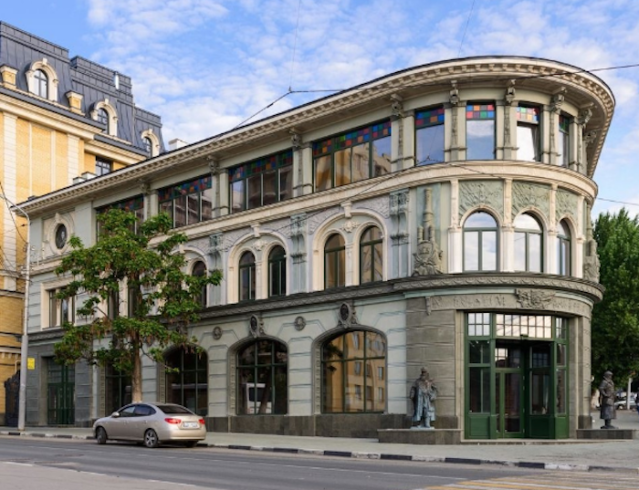
Allow me to stick my neck out and cite a lovely commercial building in Russia. Its completion in 2019, in the city of Saratov (pop. 838,321), I learned about from Michael Diamant, the founder of a marvelous blog called New Traditional Architecture. The architecture firm that did the work, Classico Art, used online voting to choose, in Diamant’s description, “the five famous Saratovians [who] were chosen to have their portraits cast in bronze as figurative detailing on the façade.”

This is the sort of modest, quasi-public building that, if they were suddenly deemed fashionable to produce in similar circumstances (nice background buildings that used to line the streets of most cities and towns worldwide), would, in not too much time, make the globe and its populations much happier and, by some scientific reckoning, much healthier than today.

***

Providence has nothing to offer for the “Best trad buildings of 2019,” but next year two buildings from the hand of Buff Chace – winner of a Bulfinch award for patronage – promise to shake our world in 2020. One of them is photographed below.

I end this post with more optimism than when I started it a few days ago. No doubt I could find new traditional buildings in China, but it’s 25 minutes to midnight, and I must join the family downstairs to watch the new year burst upon us through a miasma of glitz. Pray for us all!

Screen Shot 2019-12-31 at 11.38.21 PM.png

Building under construction on Westminster Street, in Providence.

***

I almost forgot to add that I invite anyone who knows of a new traditional building completed this year – oops, I mean last year – that I neglected to include here to send me a word about it and I will add it to this post.

Posted in Architecture | Tagged , , , , , , , , , , | 12 Comments

Notre-Dame remains dicey

Screen Shot 2019-12-26 at 11.17.59 PM.png

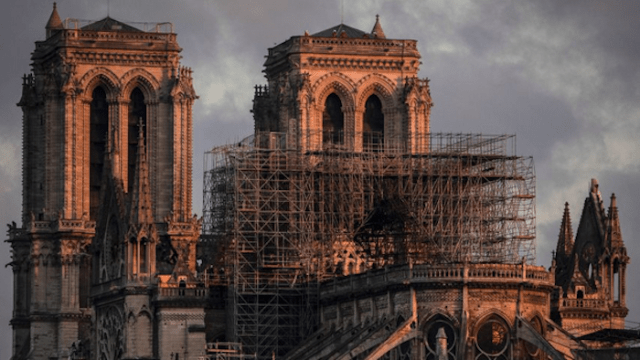
Scaffolding at Notre Dame; note triangular space where roof once stood. (Paris Muse)

It was recently reported that the annual Christmas mass at Notre-Dame de Paris will not take place for the first time since the French Revolution, and, by the way, the survival of the entire cathedral, most of which was thought to be saved, remains in doubt. The New York Times reports that:

[T]he most urgent threat to Notre-Dame is thousands of scaffolding tubes — remnants of renovation work from before the fire — that were welded together by the blaze, creating a mass of twisted metal of roughly 250 tons that is weighing down on the structure.

Workers are erecting new scaffolding so that the melted scaffolding, parts of which look like a pile of pickup sticks, can be gingerly removed. Officials do not know whether their removal will increase or decrease the stability of the stone structures that did survive the fire of last April 15.

Time magazine has a brief video tour of work to save the cathedral. There is a before-and-after video with the UK Guardian’s story on a spat over design.

That story regards continued uncertainty after months of back and forth over whether the toppled spire will be rebuilt to look as it once did (probably using advanced materials and techniques) or in a more modernist style, as many architects apparently desire. One proposal calls for a swimming pool on the roof. Months ago, the French senate passed legislation to mandate a traditional approach, but that’s clearly not the last word.

The project architect chosen by French president Emmanuel Macron insists that the new spire will be identical in appearance to the old spire. But, at a recent meeting, the general assigned to lead the project by Macron (both are open to a modernist spire) told the architect that he should “keep his mouth shut.” The general was reprimanded while the architect, Philippe Villeneuve, stood his ground, declaring: “Either I restore it identically [and] it will be me, or they make a contemporary spire and it will be someone else.”

This is an inversion of the typical form, in which politicians (and generals) support tradition, perhaps because that’s what most voters prefer, while the architects want some sort of modernist style. I suspect that the public will win this debate – but it will be moot if the scaffolding is not successfully removed. To pray for that should be part of all our new-year’s resolutions.

Posted in Architecture, Preservation | Tagged , , , , , | 7 Comments

Lost Providence still giftable

Screen Shot 2017-02-09 at 2.57.40 PM.png

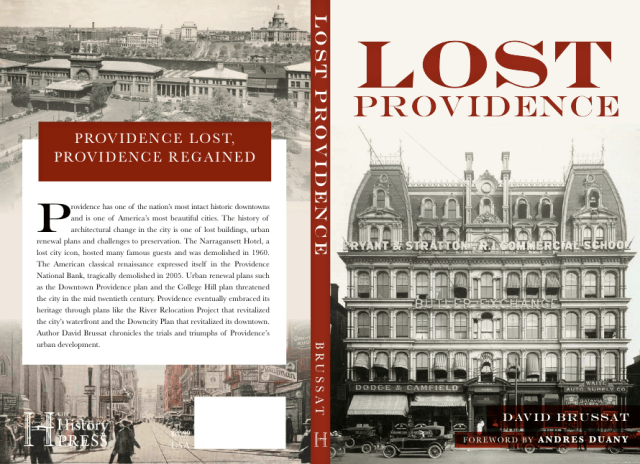
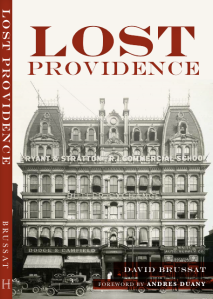
The front (right) and rear covers of Lost Providence. The front features the Butler Exchange.

Lost Providence, by yours truly, would make a great gift for anyone keen on the history of Providence, the blessing of traditional architecture, or the bane of modern architecture. Or, dear reader, get it for yourself.

Most bookstores in Providence and vicinity carry the book, I believe, and for those living outside the vicinity, it can be purchased through History Press or Amazon. Make sure you order the book, not the postcards, unless you want the postcards as well. Someone accidentally ordered the postcards through Amazon when she thought she was ordering the book (which can also be ordered as a Kindle e-book). Understandably, she was not pleased and (not understandably) gave my book just two stars. Boo-hoo!

That may have been a drag on sales and may still be, though some people who actually read the book have given it the maximum of five stars, along with reviews that actually have made me blush with pleasure. (Bless you all!). Still, if anyone wants to review it themselves, I will bless you, too. It does not need to be a lengthy or comprehensive assessment, just a positive one (only kidding!). You can do that through the Amazon link above.

Regretting any drag on sales may seem mercenary. Still, if a beautiful world may be said to be a better world, buying Lost Providence may be said to have a noble purpose. I am sure most people who used to read my weekly column at the Providence Journal for a quarter of a century and who have read this blog since its inauguration almost a decade ago feel the same sense of loss in their built environment as I do.

So if the book’s status as a rootin’ tootin’ good yarn (with a happy ending) doesn’t compel you to buy Lost Providence, then maybe this is your chance to chalk up your good deed for the day.

So, Merry Christmas and Happy Holidays to all of you.

Posted in Architecture History, Lost Providence | Tagged , , , , , , | 2 Comments

A new prize in architecture

Screen Shot 2019-12-22 at 11.23.15 PM.png

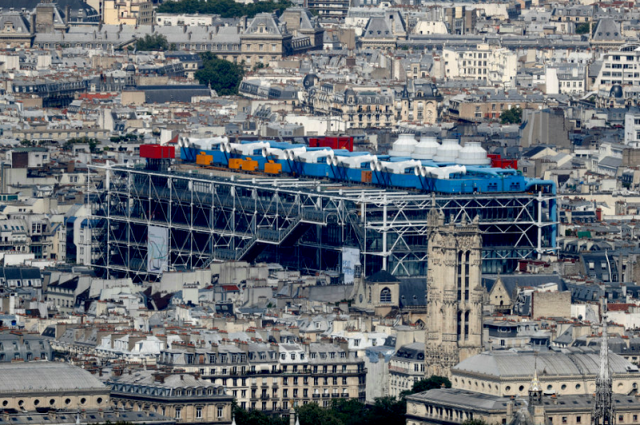
Centre Pompidou, by Renzo Piano and Richard Rogers, in Paris. (Christian Science Monitor)

ArchNewsNow.com – the indispensable source of architecture commentary from around the world – is running a series responding to a petition by British architecture students dismayed at the reluctance of architecture schools to become more involved in political issues, especially climate change. The articles suggest changes in architecture curricula, reform in architecture’s conception of itself, and just about every point between. The series is curated by Nikos Salingaros, a professor of mathematics at the University of Texas who lectures globally on such theories as how neurobiology suggests architecture’s close relationship to nature.

Perhaps the most provocative article among those run so far by ANN suggests that a new prize be instituted for students of architecture. Dr. Theodore Dalrymple, author of “An Implicit Rather than Explicit Model for Teaching Architecture,” is a retired prison doctor and psychiatrist. He opens his essay with some lines from Emily Dickinson, the final couplet of which hints at the curious nature of his proposed prize:

The Truth must dazzle gradually/ Or every man be blind.

Here is how Dalrymple describes the prize:

I would institute an annual prize, with substantial cash awards, for architecture students who would be given the task of designing a building that surpasses an iconic monstrosity in ugliness.

Huh? I did a double, no, a triple take on that. Design a building to surpass an iconic monstrosity in ugliness? I thought there must have been a mental typo in that description. Needless to say, Dalrymple’s string of trigger warnings and spoiler alerts went over my head. Yes, he does want students to be tasked with designing a new building even uglier than the one specified each year as the model, such as the Centre Pompidou in Paris.

But why? Dalrymple notes that “[j]ust as satire is dangerous these days because it is so easily transformed into policy,” the winning designs might end up actually being built. He then states his reasons why such a prize might nonetheless be useful:

[T]he student would have to think seriously about aesthetics and what makes a building graceful or hideous, what makes it adapted to its surrounding and adaptable to many purposes, what is human and inhuman, what is a proper scale, the inherent beauties or otherwise of various materials to be employed, and so forth.

All judgment is comparative, said Dr. Samuel Johnson, and the competition would force students to look about them and formulate at least rough-and-ready rules of the beautiful and its opposite. It has long been my practice to look closely at second-rate art, the better to appreciate the first-rate. And to design something worse than the Centre Pompidou – or the many other models one could name – would require real talent and imagination, not the terrible conformism of which I hear so much.

It may be objected that no student, knowing about architecture school and entering it nevertheless, could possibly be talented and imaginative enough to submit an entry. To which the natural objection is: if just a single such student exists and can be thus discovered, the prize would be worthwhile.

Dalrymple’s proposal for this prize may really be an exercise in irony. If so, it is deft beyond my ken. Leading up to his prize proposal, he proceeds through mounting levels of outrage at the asinine mentality of almost all architecture schools around the world, which, alas, generates the need for a prize of this sort. As expressed by Dalrymple, this tragedy is a comic masterpiece.

Students of architecture, take note! And notes – for your funnybone, at least, will demand that you read the whole thing.

Posted in Architecture Education | Tagged , , , , , , | 3 Comments

O starchitect house blues!

Screen Shot 2019-12-18 at 8.38.47 PM.png

Conn. house by Rafael Viñoly costing $25 million on market now at $9.75 million. (Sotheby)

A Bloomberg article, “Having a Home by a Star Architect Is Amazing – Until You Try to Sell It,” by James Tarmy, raised the hair on the back of my neck.

Among my favorite activities when I slip into one of my rare moods of masochismo is to drive around the East Side of Providence, up and down streets chock-a-block with lovely historic homes. I stop before the thankfully rare modernist houses, trying to figure out why anyone would inflict such a monstrosity on the neighborhood they have decided to move into. Sadism is the only plausible answer. Or masochism, perhaps, if they themselves are the intended victims rather than their neighbors.

Of course, if they are out in the woods like the Rafael Viñoly-designed house in Ridgefield, Conn., who cares? Except the local animal population. In fact, I love animals, but I would encourage every modernist architect to find clients who want monstrosities in the vast American outback. That will divert these architects’ energies away from cities and towns where their work does real damage to both the beauty of the civic realm and the property value of its neighborhoods. After all, if a modernist house goes up in a forest, no one sees its ugliness (except animals). The homeowners themselves, being insensate, are of little or no account in this calculation.

Speaking of calculations, the Viñoly house, pictured on top of this post, cost $25 million to design and build, but has been sitting on the market with an asking price of $9.75 million.

Given my opinion of modernist houses, let alone those built in traditional neighborhoods, it was gratifying to have my expectations confirmed.

Screen Shot 2019-12-18 at 9.30.47 PM.png

Y house by Steven Holl. (Alan Koppel)

Tarmy’s article refers to a house in the Catskills designed by Steven Holl and shaped like a Y. This reminded me of an episode of the television sitcom Wings about life at a small Nantucket airport. A famous architect who is a regular visitor to the island offers a free house design as a wedding gift to a pair of engaged airport employees. When they learn that the new house will be shaped like a 7, the two fight over who will tell the architect they don’t want it. The episode is “Frank Lloyd Wrong.” It’s fall-down funny.

Tarmy reports that the Y house, which cost $1.3 million to build back in the mid-’90s, has been placed on the market for a delusional $1.6 million, which, taking inflation into account, amounts to a markdown of about 20 percent below the original cost.

“If a local realtor [valued the Y house] by square foot, that house would be $400,000 at most, which is hilarious. It’s worth far more than that, but it has to be perceived value in the eye of the buyer.”

Kumar and the owners of the property are encountering the sobering reality of selling a “starchitect”-designed home: They might have gotten what they paid for in their house’s dramatic lines, luxurious materials, and prestigious pedigree, but when it comes time to sell, the market is often unforgiving.

I would argue that the owners got what they paid for only in theory. They misinterpreted their own desires. They thought they wanted a house they could brag on and show off. When that turned out, over time, to be weak tea, they realized what they really wanted after all was a house they could live in comfortably, and part of that meant a house that looked like a house – a house that might appreciate in value over time, and sell at a profit.

Too late.

If these agents truly believe that these modernist houses are “amazing” and should sell at a price that reflects what their owners paid to build them, they are delusional and ought to relocate to another industry. I just hope nobody leaps to the conclusion that these houses would sell better if they were nearer to civilization. I say build them all in the middle of nowhere.

Screen Shot 2019-12-18 at 10.46.09 PM.png

Scene from Episode 129, “Frank Lloyd Wrong,” in the 1990-97 sitcom Wings. (NBC)

Posted in Architecture | Tagged , , , , , , , | 6 Comments

Gone fishing, be back soon

I must announce that my operation has been postponed, possibly to January. I’m of two minds about this, but I will treat it as a boon (nobody is eager for open-heart surgery). I appreciate all the good wishes, and encourage everyone to postpone them, too – though not to postpone sending me examples of new trad buildings for my 2019 “best of” post.

David Brussat's avatarArchitecture Here and There

Screen Shot 2019-12-16 at 11.41.01 AM.png (Peanuts Worldwide)

Those who have wished me the best* have my heartfelt thanks, but please, let us not forget what I was really fishing for – examples of new traditional architecture completed during this past year of 2019. As a reminder, I link here to my “Best traditional buildings” post from last year. I hope we can improve upon that in 2019. Europeans and readers from other continents may feel free to nominate new buildings from your own special corners of the world. While all of these splendid suggestions are rolling into my in-box, I expect to put up some “favorites” from blog posts of yesteryear. Enjoy! I will be back to normal posting in a week or so, and I hope that will include a post exhibiting a robust collection of traditional buildings that opened this year.

* My heart surgery is Tuesday morning.

View original post

Posted in Uncategorized | 3 Comments