Video of pencil sculptures

Screen Shot 2016-05-16 at 8.27.02 PM.png

Pencil sculptures by Salavat Fidai. (Bright Side Video)

Screen Shot 2016-05-16 at 9.05.49 PM

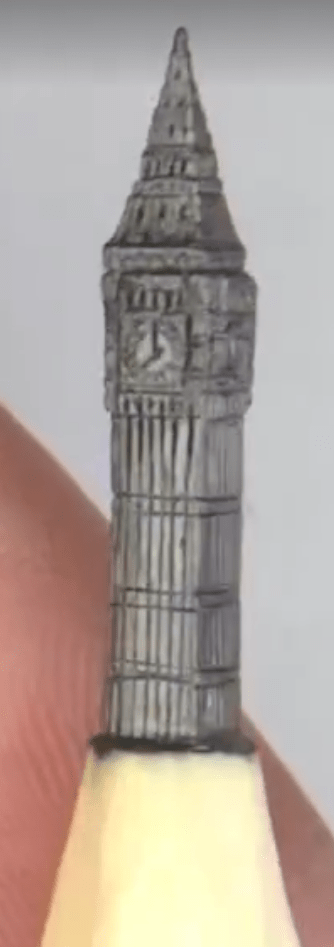
A marvelous minute of video portrays a virtuoso hand at sculpting the lead out of a pencil. Click on “Art on the tip of a pencil” to view a minute of how Salavat Fidai gets the lead out. More can be seen at his website via Facebook called Salavat Fidai Art. My wife Victoria sent me this video clip, no doubt pursuant to conversations we’ve had with our son Billy about the poor quality of the lead in pencils these days. We find, in doing homework (an astonishing amount for a kid in first grade at Vartan Gregorian Elementary, in Providence), that pencil lead snaps easily, and that sharpening a pencil is an act that calls for the patience of Job. (Not to be compared, of course, with the patience of Salavat.) That critique might actually apply to the pencil sharpener. Ours is a high-tech affair (as these things go) of plastic. It runs on batteries, and yet it routinely breaks the lead off the pencil in the process, leaving a deep empty wooden mine shaft that must be ground through before reaching a paydirt of lead to sharpen again.

As a boy we assumed such items were made in Japan. Now we assume they are made in China.

A Facebook commenter on Fidai’s video – one of almost a couple hundred thousand, according to the Facebook tally – marveled that pencil-manufacturers, who on the normal No. 2 pencil provide merely a quarter-inch of eraser at the other end must have unbounded confidence in the quality of the work being done at the business end.

No errors that we could see on Fidai’s video. He is a true virtuoso. The video is brief, almost titillating in its brevity, and if you can bear the accompanying elevator music you can see him whittle his pencil sculptures with an X-Acto knife (I think it’s called) in stop-action, whereby he completes or displays 11 sculptures in just a shaving over a minute, including wee Big Ben at left.

Stupendous!

Salavat Fidai’s sculptures are featured on Bright Side Videos.

Posted in Uncategorized | 3 Comments

Homage to Penn Station

Pennsylvania Station. (nycvintageimages.com)

Pennsylvania Station. (nycvintageimages.com)

Tonight I watched a PBS “The American Experience” presentation on the rise and fall of Pennsylvania Station, which I will preview for Thursday’s column and which will broadcast to the public next Tuesday. To gin readers up for that, enter the ol’ Wayback Machine. On March 14 of last year, my column discussed David Galbraith’s amazing video collage of clips of scenes from Hollywood films made at Penn Station before its infamous demise in 1963. The video is here. My column on it, courtesy of The Providence Journal, follows:

Video homage to Pennsylvania Station
The Providence Journal
March 14, 2013

This year marks the 50th anniversary of the demolition of New York’s Pennsylvania Station and the 100th anniversary of the opening of Grand Central Terminal. The crime of tearing down Penn Station – now widely acknowledged to be “an act of monumental vandalism,” as an editorial in The New York Times put it – may have helped preserve the life of Grand Central.

The new Penn Station, built underground and capped by the equally uninspired Madison Square Garden, should be ripped down and a new Penn Station built as a literal copy (with updated technology) of the old Penn Station by the great firm of McKim, Mead & White.

After the depressing new Pennsylvania Station opened in 1968, the architectural historian Vincent Scully wrote that “one entered the city like a god; now one scuttles in like a rat.” Unless one commutes in from the ‘burbs to Grand Central, where one still enters like a god.

So perhaps it was kismet that a few days ago, exercising my new iPod Touch, I found a video on YouTube called Penn Station, But Deliver Us From Grand Central.

The video, produced in 2008 by David Galbraith, lasts six minutes and 18 seconds, comprising 61 clips of scenes shot at Penn Station and sliced from old Hollywood movies made before its demise in 1963, then knit together with a style that evokes film noir. I found it so engaging that I posted it on my Journal blog, Architecture Here and There.

But having dispatched it to the Web masses, I could not stop looking at it myself. With each viewing its genius seemed to grow. It mesmerized me as effectively as any crowd scene.

But wait! There’s more! You also get Hollywood stars doing their thing – looking happy, puzzled, alert, pensive, worried, bored, hurried and, occasionally, mesmerized by the crowd.

On Monday, I asked my [then] colleague Froma Harrop to help me identify the movie stars. On Tuesday, before beginning to write this, I jotted a brief description of all 61 snippets, from the opening shot of the grand concourse, followed by the entry of Gregory Peck with Ingrid Bergman, who glances nervously over her shoulder in Spellbound (1945), and concluding with a shot of . . . but I will not give it away.

The film clips are spliced with such dexterity that one constantly detects a plot line emerging. Two different people in two different films run in the same direction along the identical stretch of concourse. A shot ends with a man glancing to his left, and in the next shot a woman from a different movie returns his glance. A scene of two station detectives suddenly turning around is followed by a shot of a man with that hunted look. This sort of thing continues almost to the end of the video, with no dialogue at all until . . . well, I won’t give it away.

Running like a leitmotif are clips of a man with a cigarette waiting for . . . something. He is in eight scenes in the video’s first half. Most will not recognize him. He is Jamie Smith as boxer Davey Gordon in Stanley Kubrick’s second film, Killer’s Kiss (1955).

Claudette Colbert, Judy Garland, Cary Grant and other stars show up along with Bergman and Peck. At first I thought Colbert was Lucille Ball. Froma corrected me. The man running down the stairs in a fedora, his overcoat collar turned up, looked like David McCallum from The Man from U.N.C.L.E. Probably not. We could not identify the woman with the luggage, or the sexy gal in a feathered hat ogled by a line of men as she jiggles on by. For some reason I thought she might be Ida Lupino. Nope.

Toward the end of this carnival of cameos, dialogue emerges when Bergman urges Peck to “act as if we’re taking this train.” They plot to sneak off, grab a cab to Grand Central for the train to New Rochelle. This gives Galbraith an excuse to splice in some shots near the end from Grant’s escape from New York via Grand Central in North by Northwest (1959).

The video concludes – I cannot resist telling – with four penguins discovered hiding behind a newspaper (“We’ve been ratted out, boys!”) and a zebra missing his train.

In these six blessed minutes of video the late Pennsylvania Station grants power to each scene. It is clear that one train station by which to enter Gotham like a god is not enough. Great as it is, Grand Central, which was born when Penn Station was 3, could use some brotherly assistance, yet again, to uphold the greatness of New York City. Rebuild Penn Station.

David Brussat is on The Journal’s editorial board (dbrussat@providencejournal.com). This column, with more illustrations, is also on his blog Architecture Here and There at providencejournal.com.

Posted in Uncategorized | 2 Comments

Songs of electric car silence

Screen Shot 2019-07-06 at 6.14.44 PM.png

Out to Lunch. Old Solutions to New Problems. (PL Diesslin)

One of the endearing features of electric and hybrid cars is the silence of their engines. So of course that feature is about to meet its maker. U.S. and E.U. regulators are calling for noisemaking electric engines for safety reasons. Maybe the newfangled fake engine sounds should mimic real engine sounds. That would make more sense, vrooming more softly, possibly with a melody. Actually, automakers are far ahead of government. They’ve been souping up the menacing bass growl from under the hoods of pickup trucks and muscle cars for years now. Fooled ya!

Electric automakers anticipating efforts to ruin their products’ silence are trying to beat mandates to the punch. They have gentle sonic compositions in mind, bless them, although Harley-Davidson’s electric motorcycles will supposedly emit the sound of pigs snorting. Ha-ha! Inevitably, however, the systems gurus will give drivers a menu of options that will allow automobile owners to display their own highly refined musical tastes.

Imagine each driver being able to choose the music he prefers for the car he owns. Imagine reaching the rear of a slow-moving traffic jam. Imagine the cacophony! The Beatles, the Stones, Jimi, Frank, Elvis, Barbra, Cher, Miles, the Duke, “The Marseilles” or any passage from Tchaikovsky’s 1812 Overture (a staple on the Fourth everywhere except Providence) or Beethoven’s “Ode to Joy.” All at once! (One can and probably should imagine worse.)

Screen Shot 2019-07-06 at 4.35.37 PM.png

Apocalypse Now (military.com)

I have my own favorite. For my very modest, dinged to the max 2009 Hyundai Accent, give me Wagner’s “Ride of the Valkyries” from Apocalypse Now. That’ll clear out the road ahead! Actually, for most situations, such as driving through streets near schools (now 20 m.p.h. by law), give me the Ode to Joy. Give me that and I’ll creep through Providence, schools or no schools. Or for that matter, with the news about the Providence schools, why not play Mozart on all school buses? Maybe that will improve scores in the recently damned system. And every school cafeteria should play the aria from Le Nozze di Figaro that Tim Robbins sends over the prison loudspeakers in The Shawshank Redemption creating momentary bliss for the inmates. Play it in every school cafeteria. This would pacify the student population, soothing its savage breast. Don’t just put speakers in car engines, install them on all of the lampposts that line every road and play that aria all the time, everywhere. This would create a universal road-rage-free zone, and reduce the crime rate in cities.

Conversely, I would like the meanest, muscle-bound sports car to issue forth a soft putt-putt-putt-putt-putt-putt. Watching it travel down the road and imagining the feelings of its knuckleheaded driver would generate instant Shadenfreude – satisfaction at the misery of others. Better than a psychiatrist!

Hmm. Maybe something good will come out of safety concerns. For half a century we’ve all had to put up with that bleepin’ “BEEP! BEEP! BEEP! BEEP!” whenever a truck backs up. We can blame it on Jimmy Carter, but that doesn’t help very much. Maybe now trucks will be forced to adopt sonic vehicular reform. Progress marches forward. At least we can hope.

Screen Shot 2019-07-06 at 5.45.31 PM.png

Posted in Uncategorized | 4 Comments

The real Minette de Silva

Screen Shot 2019-07-28 at 3.54.07 PM.png

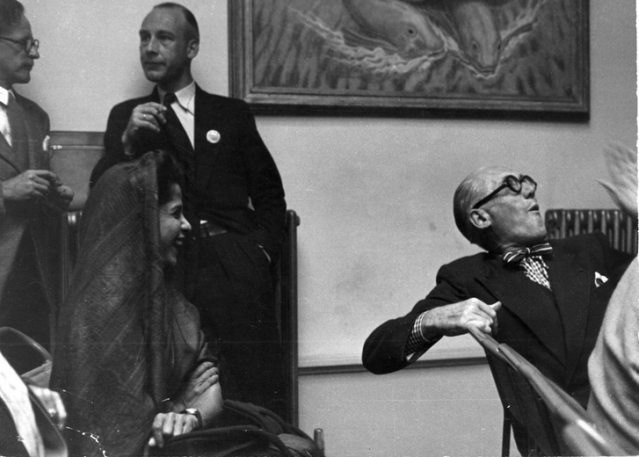
Minnette de Silva smiles at comment by Corbusier, in 1947. (Frieze)

Sometimes it seems like open season on female architects as long as they are in cahoots with the roving eye of Le Corbusier, one of the founding fathers of modern architecture. There is the recurrent hullaballoo over Eileen Gray, whose Mediterranean beach house Corbu vandalized via obscene graffiti when she was away. Then there was the stinkpot of British reporter Taya Zinken’s recollections of Corbu’s offensive behavior to her at Chandigarh.

There is much more titillation that brevity forces me to exclude.

Now there’s the new book out that transforms Sri Lankan modernist Minnette de Silva’s friendship with the Corbusier, starting in 1947, into a fictional affair. Isn’t this a little over the top? Shiromi Pinto’s Plastic Emotions is reviewed in the Guardian; Shahidha Bari offers the following description:

Screen Shot 2019-07-29 at 9.21.53 PM.png

Looking at the photograph (at left), it seems unsurprising that this real-life encounter and the exchange of letters that followed should have provided Pinto with the bones of her story. Plastic Emotions is an exercise in romantic speculation. Pinto imagines the nature of the relationship that develops between the 29-year‑old Sri Lankan and the ageing pioneer of urban modernism. She gives them trysts, meaningful exchanges, a separation and then painful longing, ending only with Le Corbusier’s death in 1965.

Actually, I wonder if the word “unsurprising” in that paragraph should have been changed by an editor to “surprising.”

I have not read the book so maybe it is unfair for me to comment, but its title does not speak well on the Great Man’s behalf. Well, did they have an affair or not? Le Corbusier was famously disloyal to his wife, mostly left behind in Paris, and it is hard to imagine him failing to fall for the lovely Sri Lankan. If they had a romantic interlude, however brief, it is hard to imagine Corbu’s legions of chroniclers not reporting it. Bari is coy on this in her article; ditto Pinto, who wrote the book. Nor, it seems, did de Silva ever retreat from her loyalty to Corbu’s architecture, so far as I can tell. She was the first Asian woman to join the Royal Institute of British Architects.

I might never have dedicated my blog to such an inconclusive topic but for the concluding lines of another article, also in the Guardian (“The brilliant female architect forgotten by history“), by Pinto herself. Describing a recent modernist project in Sri Lanka’s capital city, she quotes another architect on what de Silva might have thought of it:

“She would have hated it,” says Selva Sandrapragas, a British architect who worked with De Silva in her later years. “It displays no sensitivity to the history, culture or geography of where it is. It wraps itself around the old city, destroying the former context, suffocating it from the sea. It could literally be anywhere: Singapore, Dubai, Hong Kong.”

The question is how does that distinguish this prototypical modernist project from anything designed by Corbu?

(My hat is off to Audun Engh, of INTBAU – the International Network of Traditional Building, Architecture & Urbanism – for sending me word of the Guardian’s articles on Minnette de Silva.)

Posted in Uncategorized | 1 Comment

Bad Mad Men

Mad-Men-Season-5-Post-700x525

See them (the bad mad men) lurking in the background? Please don’t remove the foreground (the bad mad, often angry, women)! So here’s Dan Bishop, production designer for Mad Men, describing (I think in Dwell magazine, as my source seems to have implied) some of the thinking behind the show’s famously ’60s set style:

“We stayed with a fairly warm palette, because I think Matt [Weiner, show creator] kind of just appreciated that. It’s just the whole show, in a funny way, we don’t want it to be – a lot of modern architecture is pretty cold, and we’ve never been, I don’t think anybody actually, is a particular fan of that.”

I’ve never seen Mad Men but have developed a sort of a “thing” about it because of its relentless promotion of modern architecture. Many observers seem to detect a nostalgia for ’60s style in the show. But maybe the architecture and interior design is really supposed to “reflect” what its producers consider the relatively sinister aspects of the behavior of men and women in a corporate culture that eventually went from bad to worse.

Percy was not pleased with the renovation. ... Filed under Case Study 3219: Cluck Cluck Fuck (Photo: John Clark; Dwell)

Percy was not pleased with the renovation. … Filed under Case Study 3219: Cluck Cluck Fuck (Photo: John Clark; Dwell)

Perhaps Bishop felt free to open up because he’d seen the regular feature in Dwell* consisting of photographs of hip young men and women caught in the act of contemplation in their modernist houses and apartments. The author of the feature pens the hipsters thoughts, generally depressing, often taking off directly on the sterility of their home environment.

[In searching for this feature online I came across a 2010 column on Mad Men by my former colleague at the Journal, Froma Harrop, mainly on aspects of the show’s culture other than its architecture.]

* The feature is not, in fact, from Dwell but about Dwell and the culture it flacks. It is from a website called unhappyhipsters.com. This I discovered in another column by Froma, called “Hipsters Without Walls.” She describes the website as using photos from Dwell to make fun of hipsters. Here is a recent selection from unhappyhipsters.com. One of them is above.

Here’s a rueful piece by L.A. Times architecture critic Christopher Hawthorne from 2010 about the Unhappy Hipsters phenomenon (which in my opinion has not slackened even in 2013).

A shoutout to Michael Mehaffy for shooting that quote to the TradArch list!

Posted in Uncategorized | 2 Comments

Gone fishin’; back soon, II

Screen Shot 2020-01-26 at 8.28.11 PM.png

(Peanuts Worldwide)

On Tuesday I go under the knife for an aortic valve replacement, and I deeply thank all who have wished me well, both the first time (the operation was originally scheduled for Dec. 17) and this time. Nobody wants his chest jig-sawed open or folks wandering around inside his rib cage – even talented folks. And I have every high regard for my cardio surgeon, James Fingleton, along with his team, and all the fine people who operate Rhode Island Hospital at the highest standards. (Though whoever decided to demolish that nice old building a couple of years ago, well, I wish coal in his stocking next year.)

For those who consider my vacation from my blog to be their vacation from my blog, bad news! I have figured out (I think) how to post in advance so that I don’t have to write any blog posts during my hospital stay. I have lined up five posts, old favorites, scheduled for every other day between Tuesday, Jan. 28 and Wednesday, Feb. 5. The catch is that for those who get my blog by email, they will have to visit my blog to see the substitute posts. Luckily, that is very easy. Just type “Architecture Here and There” in Google and links to AHAT will automatically appear. Beijing and the Kremlin may learn of your interest in my blog, but who cares!

Anyway, thank you for your kind thoughts, and be assured that normalcy will resume in a week or so.

Posted in Uncategorized | Tagged , , , | 17 Comments

Birds versus the glass box

Screen Shot 2020-01-24 at 8.26.04 PM.png

A bird stunned by a building recuperates on Chicago’s Wacker Drive. It survived. (Chicago Tribune)

The Wexford Innovation Center, completed last year in Providence’s I-195 corridor dedicated to technology, has been killing birds. No, they are not horrified to death by its ugliness; rather, they are disoriented by its reflective plate-glass windows, which birds think they can fly through. Big mistake. Maybe they are horrified by the ugliness and then by the impact.

The Boston Globe ran a story on this, “Outside of Providence’s newest building, birds keep dying,” by Dan McGowan, one of a Globe bureau here that also includes two former Providence Journal reporters. New York, San Francisco and Toronto have ordinances to make building glass less deadly to birds. Recent efforts in Chicago are described in the Chicago Tribune, whose story on glass buildings as ornithological assassins achingly quotes Chicago Bird Collision Monitors’ director Annette Prince:

“Migration is an astounding feat of nature,” Prince said. “It’s an amazing process that these birds go through. The fact they even survive is incredible. These little birds weigh only a few ounces and travel thousands of miles on their own energy. “So, it’s unfortunate that the birds we find here in the spring have made it all the way from South America, almost to their nesting grounds in Wisconsin, and they hit a window.”

Celebrated Tribune architecture critic Blair Kamin followed up its reporters Tony Briscoe and Cindy Dampier’s lengthy news story with a column, so maybe the issue has reached critical mass – not a moment too soon.

Chicago may be the most dangerous American city for birds. A great many of the buildings downtown on its skyline, and especially those along its Lake Michigan waterfront, are sheathed in glass. Chicago’s proposed ordinance protecting birds concentrates on dimming or shutting off buildings’ interior and exterior lights after dark. A small voluntary alliance of bird protectors and building managers has been in effect since 1995 and is believed to have saved the lives of 10,000 birds a year. But crashes are estimated to kill up to a billion birds a year nationally, second only to deaths from predators such as feral cats. (Wind turbines kill approximately 328,000 birds a year.)

My naturalist friend Frederick Gorham Thurber reminds me in a comment on “O starchitect house blues!” that city buildings are not the only culprits:

The modern monstrosities in the woods are murder on endangered birds such as wood thrush and various warblers. Because of all the glass. One thing I notice is that the McMansions going up in the woods here are rarely occupied. A few weeks a year maybe. And then they bring me dead birds that hit the glass to ID.

(Thurber has recently published In the Wake of the Willows, a sequel to or fanbook of the classic Wind in the Willows.)

Buildings such as the Wexford Center in Providence, rising just seven stories, have tinted glass that makes them even more dangerous. Compared with low buildings up to three stories and high-rises above twelve, buildings between four and eleven stories kill more birds because they are by far more abundant in the nation’s cities than skyscrapers. Lights in glass buildings don’t always kill birds directly; many birds get disoriented, as do moths, by the lights, fly round and round, and die of exhaustion.

You’d think that buildings lit at night would be easier for birds to see and avoid than darkened buildings, but that’s not so. Naturally, my preference would be to ban modernist glass buildings altogether. Saving birds by reducing ugliness would, to use a possibly inapt phrase, kill two birds with one stone. But that will never happen. It makes too much sense.

Posted in Architecture | Tagged , , , , , , , , | Leave a comment

Daum: Four days in Berlin

Screen Shot 2020-01-21 at 9.56.12 PM.png

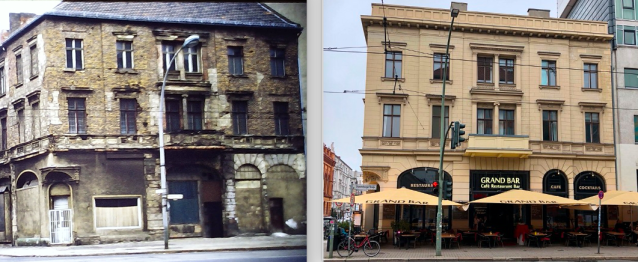
Building at the corner of Oranienbergerstrasse and Tucholskystrasse in 1986 (l.) and 2019 (r.)

This essay was written by Eric Daum, founder of the firm Eric Inman Daum, Architect, who traveled with his wife, Beth Niemi, to Berlin in November. Beth had been to East Berlin in 1986, and this essay is accompanied by pictures taken by her then and him last year. Eric, who serves with me on the board of the New England chapter of the Institute of Classical Architecture & Art, won a 2019 Bulfinch Award for his beautiful Boch Chapel and Mausoleum. An earlier essay by Eric on this blog, about Providence’s Gloria Dei church, can be read here.

***
01_1986 Beth Niemi Checkpoint Charlie.jpg

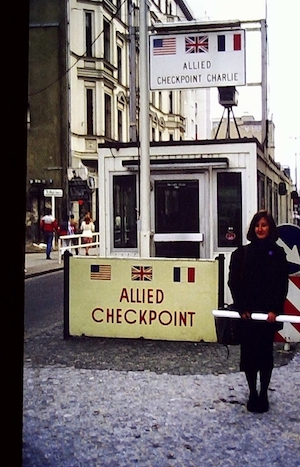
Beth Niemi at Checkpoint Charlie, 1986.

My wife and I recently returned from a trip to Berlin and Vienna. Our trip focused on the typical pursuits of traveling architects: wandering around, looking at buildings, eating good food, and drinking good German beer. It was my first visit to either city and the primary purpose, for me, was to see, at last, the work of one of my architectural heroes, the 19th century Prussian architect Karl Friedrich Schinkel. However, my wife, Beth Niemi, had visited both cities during the autumn of 1986, when we were both graduate students. During her visit to Berlin, she passed through Checkpoint Charlie and explored East Berlin, and took photographs that, when she returned, made many of our classmates, including me, jealous of the treasures of the mysterious East Berlin she had seen.

A year before, in Cambridge, we had both been enrolled in a design studio taught by visiting Italian critic Vittorio Magnago Lampugnani, whose Berlin studio was between the River Spree and the S-Bahn, an area now occupied by the new Berlin Hauptbahnhof [main rail hub] and once slated for Albert Speer’s Grosse Halle. My own projects for the studio were the most execrable of my unremarkable graduate school work, but as a group of budding designers, we fell in love with a divided city and wondered about how it might eventually be knit back together.

During the late summer of 1986, we each separately took the rite of passage of many architectural students and headed to Europe to see the buildings we knew only from lantern slides projected large in darkened classrooms. My own trip led me through Hanseatic Germany into Denmark, Sweden and Finland, terminating on my last Sunday with a stay in Brussels and a visit to the Waterloo battlefield. Beth and I met back in Boston for a drink mid-week and by Friday, she too was in Brussels as she commenced a far more comprehensive Grand Tour that included stops in Germany, Vienna, Venice and the Veneto, Florence, Sienna, Rome, the Ticino in Switzerland, Milan and finally ended her tour in Paris.

Beth’s photographs of East Berlin showed a drab gray city still displaying the damage of allied bombings, the horrific final Soviet attack on the city, and the stubborn Nazi defense, followed by 40 years of neglect under communist rule due to an absence of resources.
Screen Shot 2020-01-22 at 9.28.14 AM.png

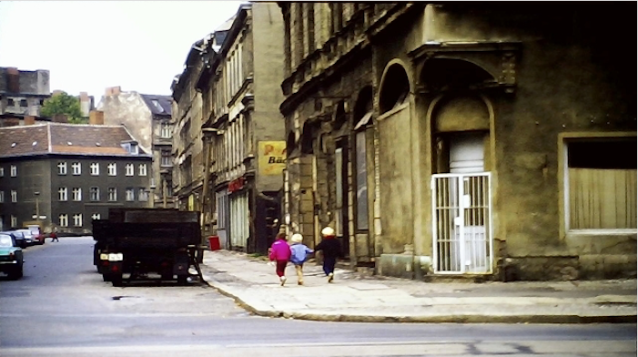
Children headed down Tucholskystrasse in 1986, next to building at top of this post.

The Saturday evening before we departed last year in early November for Berlin, we hauled out her old slides, set up her Kodak carousel projector in my office, ordered Chinese food, and spun through images of a distant Berlin and Vienna. One image struck us both. Beth said that she recalled taking it and thinking she had captured something special. In the photograph, tow-headed children in brightly colored jackets are walking away from the camera down a gray street past damaged and hastily repaired buildings. Wondering where this was, we turned to that wonderful time-wasting tool Google Earth, and quickly found the site, Tucholskystrasse, at the corner of Oranienberger Strasse. (52°31’29.67″N, 13°23’34.24″E) We were delighted to realize that this corner was just a few blocks from our hotel and planned our return to see how the spot had evolved in 33 years.

Screen Shot 2020-01-22 at 9.33.17 AM.png

That same scene today at corner of Oranienbergerstrasse and Tucholskystrasse.

There were other corners we sought out to photograph on our recent trip to compare to Beth’s images from 1986. Close by on Oranienbergerstrasse sits the Neue Synagoge, or New Synagogue, whose façade Beth had photographed in 1986. The building was largely destroyed between attacks by a Nazi gang on Kristallnacht and subsequent Allied bombings in 1944; it had been partially restored since her last visit. We walked through wide areas of Berlin, between seven and eleven miles each day during our short four days there, and regretted leaving so soon.
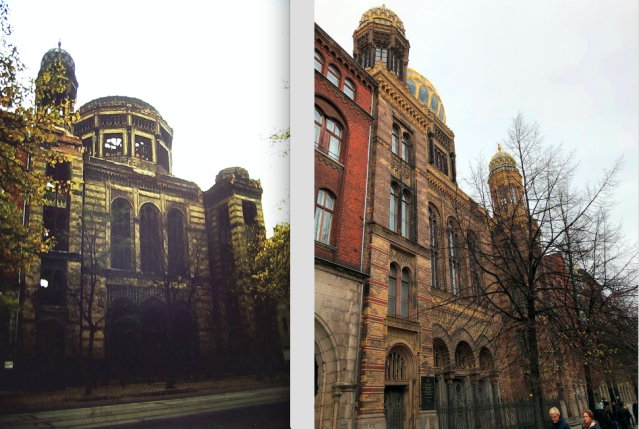
Screen Shot 2020-01-22 at 9.37.58 AM.png

Neue Synagoge in 1986 and in 2019. The front façade was restored in 1988-93.

Our trip overlapped with the 30th anniversary of the fall of the Berlin Wall. We avoided the celebration at the Brandenburg Gate as neither of us speaks German, we hate crowds, and it was raining. We did go to the Berlin Wall Memorial, also close to our hotel, the following morning, which was a solemn and emotional visit to a grim artifact of totalitarianism.

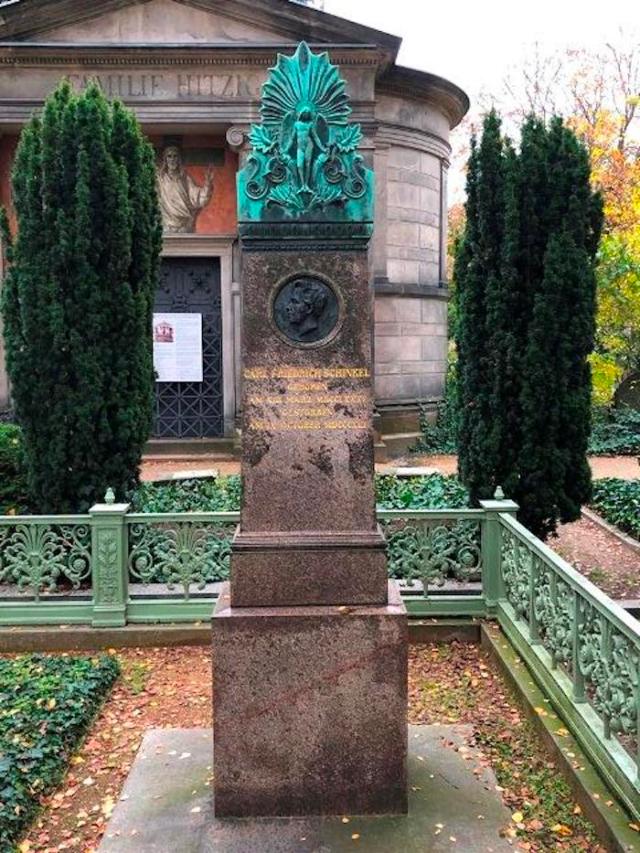
Close to our hotel, at the end of the street, sits a historic cemetery, Dorotheenstadt, whose inhabitants include, Berthold Brecht, Georg Hegel, and my beloved Karl Friedrich Schinkel. Even mausolea in this idyllic urban cemetery, which resembled a scene from a Caspar David Friedrich painting, showed damage from the furious final Soviet assault on Berlin.

Though our stay was short, we had opportunities to see much of the city and hope to return soon. I finally saw Schinkel’s works in Berlin, spent a wonderful morning in the Altes Museum, wandered the length of the Karl Marx Allee, an enormous Stalinist housing estate stretching a mile or more east of Alexanderplatz, and we ate plenty of currywurst and drank lots of beer.
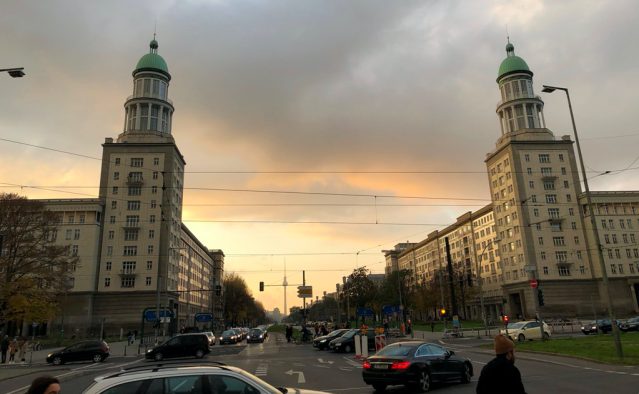
Screen Shot 2020-01-22 at 9.51.05 AM.png

Karl Marx Allee, 2019

I have one observation about the city that is based solely upon my own impressions and not supported by any deep reading of Berlin’s history. We were both fascinated by the scar left upon the cityscape by the Berlin Wall. Where Beth had passed through a military checkpoint on a restricted one-day visa, and was expected to buy GDR Marks, we freely crossed its former path daily. In places, the scar is almost invisible, in other places present and barren. New construction is ongoing in the once-cleared land as the city continues to transform into a lively, art-filled mecca. As we were staying in the former East in the Mitte neighborhood, just north of the River Spree, we were delighted by the rambling streets and the lovely restored 19th century buildings with their courtyards and little shops.

In contrast, the areas we visited in the former West Berlin had dingy modern buildings and little street life. The exception was the area around KaDeWe and on Kurfürstendamm, a garish shopping district of neon and blaring signage reminiscent of 14th Street in Manhattan. My interpretation is that in the wake of the war, as Berlin lay in ruins, the Western powers, flush with victory, poured American money under the Marshall Plan into rebuilding the French, British and American sectors as quickly as possible as a showcase of Western capitalist values. Architectural quality was, as a rule, not the goal, but rather a new gleaming display of wealth and opportunity, aesthetics be damned.
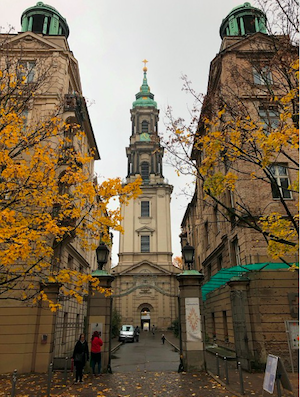
Screen Shot 2020-01-22 at 10.13.42 AM.png

Sophienkirche on Grosse Hamburger Strasse in Mitte, Berlin. Note the two flanking buildings of mirrored design, on the right, restored and on the left still bearing the scars of war and neglect, 2019

The resource-poor East made do with what was left, stabilized the ravaged buildings and muddled along. Beth’s interpretation was that “the restoration of buildings in the East was also a repudiation of the adoption of Western capitalist ideas.  It was as much about preserving German heritage and never wanting to forget what happened or what was there before.” Historical memory is potent in Berlin. As we walked through the streets of Mitte, we would come upon small brass plaques set in the sidewalk, often graced with a rose and burning candle. The plaque would name a Jewish victim of the Holocaust, the date of their abduction, and the camp of their destination. I have never before experienced a place which so widely and openly accepts its guilt for the wrongs it once committed. We were moved and stopped to read each plaque we encountered to perpetuate their memory.

After the Wall came down, formerly neglected neighborhoods were rebuilt and war-ravaged buildings restored. These have become among the most desirable neighborhoods in which to live as Berlin experiences a massive influx of youthful immigrants from throughout Germany and from around the world. Berlin is still considered an inexpensive place to live, though rents continue to rise. I think that the lesson is that benign (or malevolent) neglect can delay the demolition of a historic building until its preservation and restoration becomes viable and desirable. The resurrection of parts of Mitte and the adjacent Prenzlauer-Berg neighborhoods stand as testament to the appeal of traditional architecture and the scale of traditional streets.
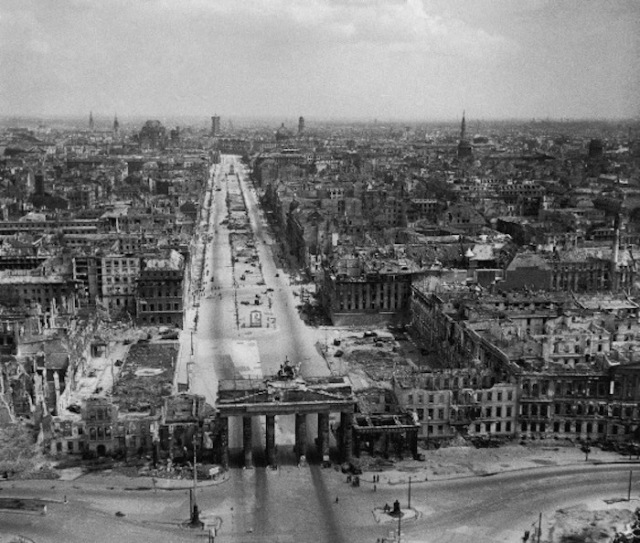
18 Berlin in 1945.jpg

Berlin looking East from the Brandenburg Gate along Unter Den Linden, 1945.
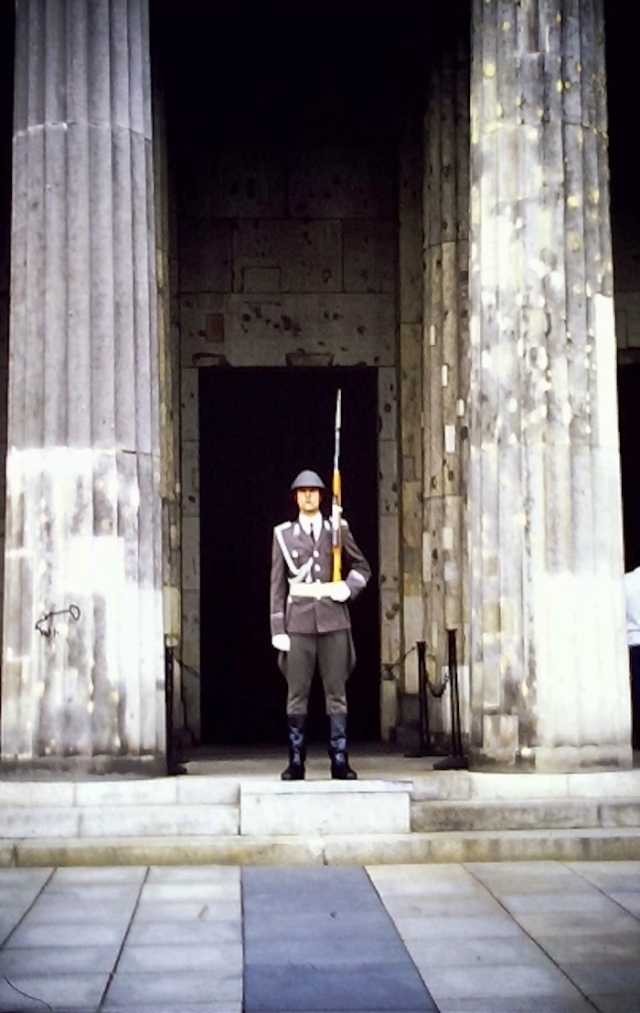
14 1986 Neue Wache.jpg

Schinkel’s Neue Wache with East German guard, then the Memorial to the Victims of Fascism and Militarism 1986.
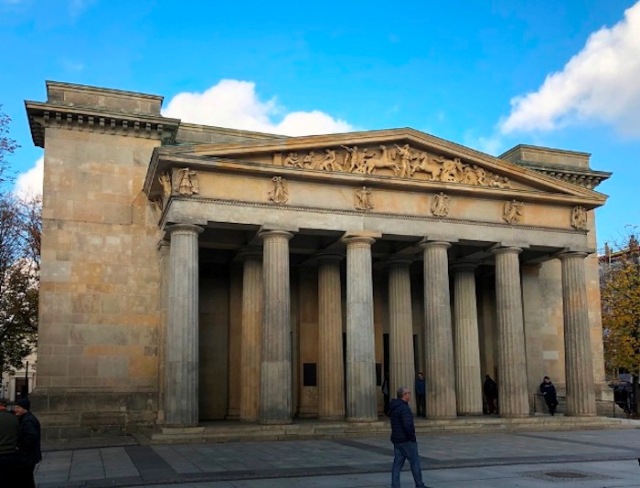
15 2019 Neue Wache.JPG

Schinkel’s Neue Wache, now a Memorial to the Victims of War and Dictatorship, 2019.
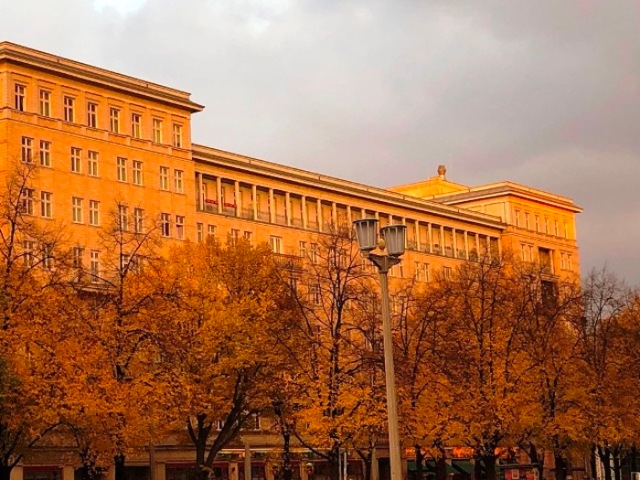
17 2019 Karl Marx allee Building.JPG

Apartment Block on Karl Marx Allee, 2019.

13 2019 altes museum.JPG

Schinkel’s Altes Museum, 2019.

11 2019 Schinkel Grave.JPG

Grave of Karl Friedrich Schinkel, in Dorotheenstadt Cemetery, 2019, Note the spelling of his first name which differs from every other source I have seen.
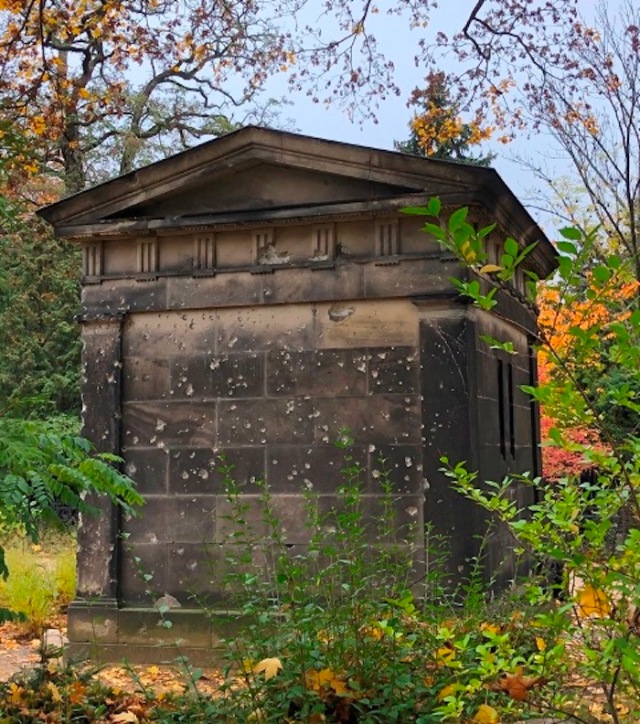
12 Dorotheenstadt Mausoleum.JPG

Mausoleum in Dorotheenstadt Cemetery displaying scars from WWII, 2019

Posted in Architecture, Preservation | Tagged , , , , , , , , , | 9 Comments

Driehaus for Thai architect

Screen Shot 2020-01-18 at 5.56.12 PM.png

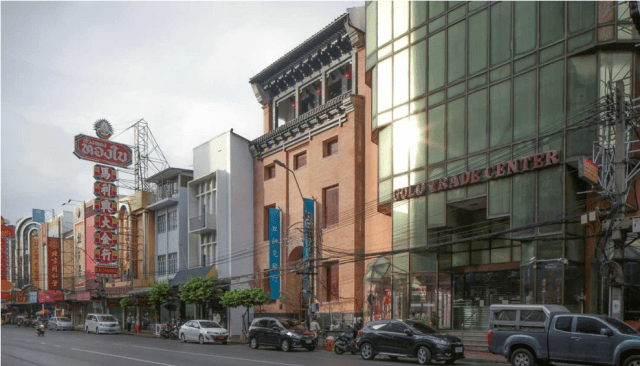
Bank building in Bangkok by Driehaus winner Ong-ard Satrabhandhu. (Ong-ard Architects)

The 2020 Driehaus Prize for Thai architect Ong-ard Satrabhandhu recalls my dinner today. I have just returned from a restaurant called Sawadee, where I continued my quest for an acceptable pad Thai after the closure, last month, of my favorite restaurant, Pakarang, where I’d been wolfing down perfect pad Thai for three decades. Then, poof! Gone.

Not quite “poof-gone” is the idea of Thailand in the Bangkok street above. Guess which building is the bank designed by the latest Driehaus laureate?

Screen Shot 2020-01-18 at 8.17.00 PM.png

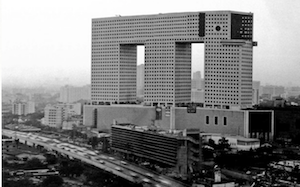
Bangkok’s “Elephant Building,” by Ong-ard Satrabhandhu. (atlasobscura.com)

That’s a trick question. I presume it to be impossible to not to guess the one in the middle. The glassy building to its right in the shot could be a skyscraper. If you go to “downtown Bangkok” on Google, you can scroll down to the bottom and see no more than one or two images of Bangkok that might not be anywhere in the world. There may be more Thai restaurants in Providence than traditional Thai buildings in Bangkok per square mile. I’m sure that cannot be so, but that’s what it looks like.

The Driehaus Prize press release describes the architecture of Ong-ard Satrabhandhu as follows:

“The work of Ong-ard Satrabhandhu demonstrates innovation within tradition,” said Michael Lykoudis, Driehaus Prize jury chair and the Francis and Kathleen Rooney Dean of Notre Dame’s School of Architecture. “His projects have a unique beauty that results from incorporating lessons gleaned from years of study across diverse cultures. The resulting buildings seamlessly blend with the vernacular traditions of Thailand.”

Obviously, the bank building in the image on top does not seamlessly blend with the vernacular traditions of Thailand. On the pictured block of that street, at least, no such tradition remains. Neither does Satrabhandhu’s work sit cheek-by-jowl with the sort of modernist buildings he learned to design in the architecture departments of Cornell and Yale during the 1960s, such as his silly Elephant Building in Bangkok. Even the sponsor of the Richard H. Driehaus Prize, the architecture school at Notre Dame, was modernist in those days. The school’s graduation – or shall we say, metamorphosis – from modernist to classical was revolutionary. Beauty dethroned ugliness in the concentration of the school’s curricula. Satrabhandhu’s early work, in the words of the prize jury’s citation,

clearly reflected his modernist education at American schools of architecture — designs of large-scale commercial buildings in Bangkok. His search for meaning in architectural form led him to explore historical sources that conveyed a sense of place with tranquility, and an environmentally responsible culture of building. This search eventually led him to classicism in its truest sense — the immutable tradition of a given culture and the universal components found across time and place.

In recent decades, Satrabhandhu has specialized in single houses and urban groupings of small buildings that blend the Thai vernacular with traditional Western, even classical, forms. That he was able to reach classicism from his modernist initiation bespeaks an independence of mind that, it might be said, distinguishes the architecture school of Notre Dame from almost every other such institution in the U.S. and around the world.

Leon Krier said of the Thai architect: “The authentic vernacular and classical creations of Ong-ard Satrabhandhu stand as vigorous, if lone, way signs to a civilized future.” I wrote a post about him, and on the difficulty of extricating oneself from the modernist trash can, in 2017, “The apotheosis of Ong-ard.”

Bravo to Ong-ard Satrabhandhu! More of his buildings and designs are featured below.

The sister award of the Driehaus Prize, the Henry Hope Reed Award, which honors its namesake’s intellectual work in the groves of classicism, was bestowed upon Clem Labine, the founder of several influential journals dedicated to traditional building. I will devote an upcoming post to the newly minted laureate.

Meanwhile, my quest for a pad Thai good enough to fill the shoes of that dish at Pakarang continues, and may never end. Bee’s is in front, but others, including Sawadee, are close behind, and still more don’t quite suit. If readers in Rhode Island have any suggestions, please let me know!

Screen Shot 2020-01-18 at 8.24.26 PM.png

Screen Shot 2020-01-18 at 8.11.49 PM.png

Screen Shot 2020-01-18 at 8.23.20 PM.png

Screen Shot 2020-01-18 at 7.48.12 PM.png

Screen Shot 2020-01-18 at 7.49.12 PM.png

Screen Shot 2020-01-18 at 7.49.55 PM.png

Screen Shot 2020-01-18 at 8.22.55 PM.png

Screen Shot 2020-01-18 at 8.13.30 PM.png

Screen Shot 2020-01-18 at 8.22.22 PM.png

Screen Shot 2020-01-18 at 8.09.52 PM.png

Screen Shot 2020-01-18 at 8.10.20 PM.png

Posted in Architecture | Tagged , , , , , , , , , | 2 Comments

The future of Providence

Screen Shot 2020-01-15 at 11.25.29 PM.png

View across Providence’s old downtown and up College Hill. (sprudge.com)

Dire. That’s a good word for the bad future of Providence if the erosion of its historic character continues at its current pace. In “Say no to ugly buildings,” an Oct. 28 oped for the Providence Journal, I listed the buildings that have opened lately in or near downtown. Here is that list:

In just the last couple of years alone, eight major new buildings have been completed in and near downtown, including the Wexford Innovation Center in the I-195 corridor, the River House apartments near the Point Street Bridge, the first of two proposed Edge College Hill residential towers on Canal Street, the low-rise Commons at Providence Station condos along the Moshassuck River in Capital Center, a Homewood Suites Hotel on Exchange Street, a Marriott Residence Inn on Fountain Street, a Woodspring Suites Hotel just outside of downtown on Corliss Street, and a large RISD dormitory near Prospect Street on College Hill.

All of these buildings reject the historical character of Providence, either purposely or with a sort of cocky ineptitude. They follow a decade in which all but one building, the lovely Nelson Fitness Center at Brown University, were designed as if to purposely trash the city’s heritage. Providence’s civic leaders are crying “Yes!” to ugly buildings, ignoring mandates in city regulations that historical character be respected.

Incomprehensibly, the same Nelson financed an “entrepreneurship center” in a piously ugly contemporary building finished last year on Thayer Street, ending a phase of new traditional buildings there. A deep foundation has been dug for Brown’s performing arts center in a starkly modernist design. Two fashionable East Side educational institutions, the Moses Brown School and the Lincoln School, have recently erected buildings that shred historical character at prominent locations on Hope Street and Blackstone Boulevard. The grounds of stately mansions on or near Blackstone are being eyed by developers for subdivision, which risks not just the estate but the entire neighborhood – eroding not just beauty but property values. Just look at what happened to the Bodell estate. The mansion of the Nicholson-Beresford estate on Blackstone was saved, but its romantic caretaker’s cottage and play house are history, and five or six houses of dubious desirability (most likely un-) are planned. The developer of the Bodell estate put a modernist house last, no doubt disturbing those who bought the first four traditional houses.

With the economy humming, what seems like a record number of teardowns on the East Side, accomplished or proposed, raises even more anxiety. The aquarium shop with the delightful mural of the deep sea on its Wickenden Street façade was demolished late last year. I hear the new owner wants to build something exciting in its place. Uh-oh. Across the street and up a block, the splendid colonial at 312 Wickenden (c. 1857), home to the dear Duck & Bunny snuggery, is said to be on the chopping block. (My sourcing on the D&B is top-notch, but only a major renovation that started last March is evident online.) Three old houses, at least one of them fine, may be sacrificed for a proposed hotel at Angell and Brook that is intended to look traditional, but so far two successive designs have been disappointing.

A host of other teardowns were cited in a November GoLocalProv piece, “East Side sees flood of teardowns as average house price tops $560,000.”

[Property broker Sally] Lapides says that Providence will benefit from the newer structures.

“What it says about the area is that it is highly desirable, there is a demand for new construction, people want to invest in Providence and there are people with money who are investing in our city. The new structures will bring in more tax revenue because the assessments will be higher on the new architecture,” says Lapides.

Of course, the area might not be highly desirable for long if Providence continues to shoot itself in the foot.

The “flood” includes a teardown near my house, off Hope; fortunately, that house is slated to be replaced by two relatively traditional duplexes. When a landowner razes an old building, the cost of demolition usually comes out of what is spent on the new one. Since the 1950s and ’60s, when old buildings have been torn down and replaced by new buildings, architectural quality has almost always suffered, whether the new buildings are modernist or traditional – the latter often by architects whose exclusively modernist education means they don’t understand traditional design techniques. In virtually the blink of an eye, it could no longer be assumed (as it had been for centuries) that a new building would be superior to what it replaced.

The anxiety stirred by this phenomenon caused historical preservation to shift from a hobby to a mass movement in less than two decades, not just in Providence but across the country and much of the globe. Preservationists saved many historic buildings, but for many years have been uninterested in protecting the settings of those old buildings by promoting new traditional architecture – which is considered déclassé by professional preservationists, whose livelihoods exist because of traditional architecture. You might think preservationists make strange bedfellows with modernists. Alas, you would be correct. If members of preservation groups knew what their boards and staffs think of their design preferences, memberships would halve overnight.

As a city like Providence expands, pressure to ignore preservationists and small property owners rises among city planning offices and developers. Meanwhile, passion naturally flags among those fighting the municipal development axis. They suspect they have no real allies. Hence the declining historical character in Rhode Island’s capital.

How long will it take for Providence’s streetscapes to be so pockmarked by modernist or bad-trad buildings that its beauty is lost? At this rate, I’d say no more than ten years.

It’s not that every modernist building is necessarily a bad one, though almost all of them are; but even a good one is sure to erode the cohesion of a block of traditional buildings – which, because they arise from gentle evolution spanning hundreds of years, fit together admirably even when they are stylistically different.

The good news is that the old commercial district of downtown Providence, known by some as Downcity (it doesn’t mean the entire downtown, please!), has almost entirely escaped the trends described up above. An unofficial moratorium on major teardowns in the commercial district started in 1979 (after the district’s Hoppin Homestead Building was razed) and ended in 2005 when the Providence National Bank was demolished in 2005. Most of the teardown sites of the past decade and a half remain vacant: that is, they remain opportunities to do the unexpected and build nice buildings instead. And only one major new building opened in the commercial district – the delightful pavilion at Grace Church, completed in 2017. Plus, two new traditional buildings of brick by Buff Chace are expected to open next year – one on the old Journal parking lot and another adding to a string of old buildings being renovated on Westminster.

The bell has already tolled for the city’s two new development districts, Capital Center (1978) and the I-195 corridor (2011). They are beyond redemption, even though four reasonably competent new traditional buildings in Capital Center – Providence Place, the Westin, its addition, and the Marriott Courtyard – showcased how major development could maintain the city’s historical character. These models were ignored, of course, there and elsewhere in the city. What else is new?

So far as I know, there are no blotches of God’s wrath on architecture on the boards for the old commercial district of downtown, whose historical fabric remains the best of any mid-sized city in the United States.

But shhh! Let’s not give anyone any ideas!

Posted in Architecture, Preservation | Tagged , , , , , , , | 1 Comment