Christo, homage to a life

Screen Shot 2020-05-31 at 11.30.58 PM

“Wrapped Reichstag” (1995), by Christo and Jeanne-Claude. (Wolfgang Volz/Christo)

The artist Christo has died. One must not, they say, speak ill of the dead. I am not speaking ill of the dead man but of his art. Those who bruise easily may stop reading here, but Christo’s death will rob me of opportunities to express my thoughts about his art, until a book is written about him or his work is honored in a museum exhibit. How they will fit it in I have no idea.

Screen Shot 2020-05-31 at 11.37.03 PM

“The Gates,” 2005. (haberarts.com)

The most iconic of those works was the 1995 draping in shiny fabric of the Reichstag, Germany’s historic parliament building in Berlin, which shortly after would suffer the indignity of a new dome by British modernist architect Norman Foster. The “installation,” as Christo’s art is denominated, was temporary, the only saving grace of his collection. This year he had planned to wrap up the Arc de Triomphe, a work still expected to reach completion by year’s end in spite of his death (if not necessarily the Covid crisis). He will no doubt go down in art history as the creator of “The Gates,” in New York’s Central Park – not because this was his best work, far from it, although it was among his least intrusive, and there is much to applaud in that. Rather, “The Gates” was the subject of a brilliant comic bit by Stephen Colbert on Jon Stewart’s Daily Show in 2005, maybe the funniest thing I’ve ever seen.

Here is a revealing quotation of Christo, taken from today’s obituary by the Associated Press:

In a 2018 interview with The Art Newspaper, Christo spoke about his signature wrapping aesthetic. In the instance of the Reichstag, he said, covering it with fabric made the Victorian sculptures, ornament and decoration disappear and, thus, highlighted, “The principal proportion of architecture.” [Perhaps the AP meant to write “the principle of proportion in architecture.]

“But, like classical sculpture, all our wrapped projects are not solid buildings; they are moving with the wind, they are breathing,” he said. “The fabric is very sensual and inviting; it’s like a skin.”

“Christo lived his life to the fullest, not only dreaming up what seemed impossible but realizing it,” said a press release announcing Christo’s death, which occurred of natural causes in New York City, where he had lived since 1964. New York’s art world rubbed off on him bigtime. His art had nothing to say except what observers thought about it, or infatuated art critics wrote about it. Christo’s career and his oeuvre was Tom Wolfe’s book The Painted Word writ large. Published in 1975, it was about how America’s art world had reached a point where art was secondary to what critics wrote of it, which was mostly ridiculous, and hence largely and accurately descriptive. That the silly career of Christo was massively successful says much more about the art world than about the art of Christo, who was born in Bulgaria. Is it Bulgaria or Romania whose capital city was said to be a stage set of grandeur masking decay? Christo’s art was exactly the reverse.

It pains me to say that while Christo was a Bulgarian, his art was American to the core. That is a criticism less of Christo than of American culture. Just about all American art and culture these days is designed to be endured in the echo chamber of the nation’s critical community, with the expectation that connoisseurs – the intelligent public having lost interest in art long ago – will be impressed not by the art itself but by the number of tweets and retweets it garners on Twitter. If you look at most modern art objectively, that makes sense. (Not the art but its dependence on the words of others.)

The most interesting thing about Christo was his wife and artistic partner, Jeanne-Claude Denat de Guillebon, who was born on the same day, June 13, in the same year, 1935, as her husband, Christo Vladimirov Javacheff. She told the London Telegraph that “[o]ur art has absolutely no purpose, except to be a work of art. We do not give messages.” She said they took separate flights so that their work would continue if one of the planes were to crash. She died of a brain aneurysm in 2009, having enjoyed 15 years of credit as co-conspirator with her husband, who took sole credit for their work between 1961 and 1994, when he was finally shamed into sharing the blame.

There is an art to the taking of credit at which Christo truly did excel. RIP.

Screen Shot 2020-06-01 at 12.29.45 AM

The Reichstag without Christo’s fabric cloak but with Norman Foster’s dome. (Wikipedia)

Posted in Architecture, Art and design, Video | Tagged , , , , , , , | 8 Comments

Trad and not so trad, cont.

Screen Shot 2020-05-29 at 5.53.01 PM

The Macedonian Museum of Archaeology, in Skopje, is an example of “bad trad.”

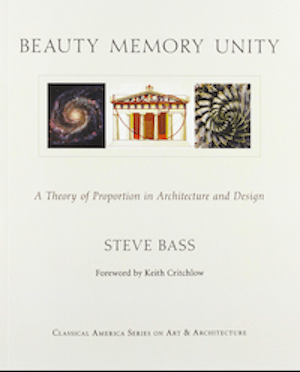
In light of my recent review of Beauty Memory Unity (2019), by Steve Bass, I offer a long post from 2017 that urges classicists to criticize bad trad more gently if they seek a classical revival. Bass describes strict methodologies for working with proportion to create beauty, but admits that great architects of the past may have used their intuitions instead. Today’s classicists who use more intuitive, less canonical methodologies should not be castigated by those who do use canonical methodologies. The same should apply to the rules of classicism generally, for the reasons described in the Dec. 17, 2017, post, “Trad and not so trad, cont.,” below.

I hasten to add that classicism that follows canonical principles, or innovates with them intelligently, is more likely to produce beauty than winging it. Still, in an era when establishment architecture seeks to crush classicism, and has no desire to create beauty, the perfect should not be the enemy of the good.

***

Classicism over thousands of years has developed an architectural language that modernism has not even sought to construct. A language would suggest a reliance on precedent. Among those who have criticized my admiration for Stan Weiss’s interior decor, Eric Daum puts it well. He writes that the decor “deletes adverbs, denies noun/verb agreement, and it doesn’t understand the rudiments of punctuation.”

Perhaps so. An antiques dealer and hotel developer, Weiss calls his ornament – yes, bought from catalogues and assembled according to his own design – a “classical fantasy,” comparable to Sarasata’s Carmen Fantasy for Violin. Maybe there is too much antique furniture in Weiss’s basic conception. Elements of his rooms strike me as Piranesian. That surely overstates the case, but the notion that it is “ugly” or “gives [one commenter] a stomach-ache” seems more like virtue signalling than genuine critical analysis.

But the objections are passionate and eloquent, and, I think, come from the heart. It is a reaction to be expected from anyone who has labored first to learn and then to apply the rules of classicism, and thus demands respect.

Screen Shot 2017-12-15 at 10.02.32 AM.png

One commenter, Nancy Thomas, a publicist who, however sensible, is not an expert in architecture, wrote:

All I know is my eyes dance at [Weiss’s embellishments], and if I could print a set of note cards with the artwork in that first image, I would do so. … What fun … how Classical!

My focus as a writer on architecture is the style wars between modern and traditional architecture. My reading in the principles and techniques of classicism is not deep, not at all. I don’t need a deep understanding to think and write about how a public square of classical design is superior to a public square squelched by modernism. I do understand the idea of classicism as a language. The importance of high standards in classical work is mother’s milk to me. However, after being assaulted on Pratt Street by the exterior of the Weiss House, I was very much taken aback by the interior. It was like stepping from an icy shower into a hot bath where nymphs bearing towels waited to dry me off in front of a fireplace. (These days I suppose they could be accused of harassing me!) At any rate, beauty is what my eyes beheld.

The honesty of my reaction is, I think, just as pure and passionate – as valid if not as well tutored – as the reaction against it.

Commenter “Anonymous” (or “Soundslike” in his original comment) writes:

The more that well-meaning traditionalists defend bad-trad architecture that treats tradition as just another shallow stylistic grab-bag, the less of a real argument we have against the cruelties and follies of Modernist architecture. … We have so much more than “style” going for us, but not if we accept anything with doodads and gewgaws applied to speak for “tradition.”

That’s all very well, entirely unobjectionable and perfectly valid so far as it goes. But the future of classical architecture does not rest entirely on the virtuosity with which classicists apply the principles. The future of classical architecture depends on whether classicists can leverage the public’s taste for traditional design into a movement away from modern architecture and back toward architecture people love.

So, what’s that famous line? “Let not the perfect be the enemy of the good.”

That is a very practical piece of advice, and it is applicable here. “Good trad” and “bad trad” are not so easily divisible. There is a scale between bad and good. At the bad end of the scale is architecture that deserves every iota of the classicists’ disdain. But as you move up the scale from the truly bad to the almost good, the advisability of castigating the almost good as if it were truly bad diminishes. Educated architects may not be emotionally capable of making this distinction, but members of the general public are, and do so instinctively, with a degree of sense born of continuous experience.

Seth Weine writes in his comment that “it is not true that bad (or even poor) classicism is better than no classicism at all.” Some classicists believe that bad trad is a greater enemy to the classical revival than modern architecture. Again, however understandable such a sentiment may be among experts, if taken seriously it virtually forecloses the possibility of a classical revival. My reply to his comment was:

Disagree strongly, Seth. Most people can tell the difference only to some degree. They may know enough to disdain the very bad, dumbed down “classicism” of a high-end CVS but far less so that of an interior like that of Weiss’s house. The latter cannot hurt the reputation of classicism anywhere near the way the former can. Therefore it serves to enhance classicism’s rep in light of most of what the public sees in its built environment. It baffles me that so many classicists cannot appreciate this. Experts might understandably see it differently, and obviously high standards are the best standards, but we design and build for clients and the public, not the experts.

The producers of places like Weiss’s interior – or, say, Providence Place mall, completed in 1999, or the neo-Georgian buildings on the edges of the Gaebe Common (except for its Triangolo Gate, which is high classicism) at Johnson & Wales University, or the Westin Hotel and its addition, or at least two of the several new hotels scheduled for construction, to take several examples from Providence – should be praised for their evident desire to produce buildings that the public will at least like.

The best examples can be praised with some brio, while lesser examples can be praised with some reserve. Even if their designers have no desire to please the public at all and have built traditional buildings for some other reason, they should be given the benefit of the doubt and praised. It may be safe to criticize the baddest of bad trad, but it should be kept in mind that what they all need most is education, not condemnation.

What an admirable goal to create friends, not enemies! It is above my pay grade to figure out how to structure a program to bring design education to the CVS design team, the facilities departments of universities, the staff of Home Depot, the architects employed by the design/build firms that build so many bland buildings today, etc. Suffice it to say, architecture schools are not required to enroll only kids, and churches are not the only institutions that could benefit by sending out missionaries.

“Anonymous” offers a useful reminder that classical education was purged from architecture schools by the modernists, leaving generations of designers without the ability to perform some of the basic tasks of architecture:

[I]f you look at buildings built before Modernism’s coup, in all of them – from the simplest 1770s house on Transit Street to the most ornate 1910s mansion on College Hill to the 1890s Fox Point workforce housing to the City Hall to the Deco storefronts downtown – you see they achieve incredible variety, but that none of them makes any of the mistakes of proportion, tectonic clarity, hierarchy, etc. that are rampant in the house you’ve extolled.

I wrote a fun post a year ago, “Skopje’s classical ambition,” on the topic of bad trad. The post chuckles at an article that quotes, with sympathy, a handful of [Skopje] modernists whose work is being shunted aside. They condemn the quality of the classicism that is replacing it. One of them even blubbered that they didn’t seek his consent to change his building. Consent!? Did he ask consent from the owners whose buildings he demolished back in the 1960s? Hardly likely! Not with Josip Braz Tito in charge!

But I digress. Here is one point from that post that applies in spades:

I lack the credentials to judge any attempt to reconnect Macedonia with its history. But Yugoslavia’s modernists benefited from modern architecture’s global effort to snuff out classical education and craftsmanship. It ill behooves them now to complain that the new classicism in Skopje is insufficiently canonical. Their hypocrisy beggars the imagination.

Classicists’ condemnation of less than canonical classicism may be unwise, but at least it’s not hypocritical!

The reputation of classicism depends only partially on how well particular buildings of classical inspiration are designed. The classical revival depends only in part on the number of classicists graduating from architecture school (few but growing). Those are both very important, and a classical revival will not happen without advances on both fronts. But if the classical revival must await a takeover of modernist education by classicist education, it will wait until doomsday. Unless the market intervenes.

For that to happen, the public must see classical and traditional architecture being built in their cities and towns. Without that, the public will continue to believe that beautiful buildings are something from the past that cannot be expected today, for various untrue reasons, such as their supposedly high expense or their supposed lack of propriety in modern times.

The public, as I suggested to Seth Weine, has no scholarly capacity to judge the canonical qualities of new classical architecture, any more than I did when I entered the Weiss House. At this point, the vast bulk of new classical architecture is likely to fall more or less beneath the level of the canonical. And a lot of it will be good enough to please the eye of most of the public. Classicism, as a profession, should take advantage of this. If it does not, if even the best of bad trad is castigated not just by the modernists but by the classicists as well, the public will continue to feel pressure to doubt its instinctive preference for traditional over modernist buildings.

A tolerance [among classicists] for some degree of bad trad is key to improving the work of its designers, and to strengthening the public’s confidence in its own instincts. Tolerance of bad trad is not incompatible with the highest standards of classical architecture. Both goods can be sought at the same time, and both can be mutually beneficial to the goal of a classical revival. No classical revival will survive if classicists cannot refrain from making enemies of their allies – those who are willing, wanting, waiting to make beautiful buildings, but who need to be taught, not disdained.

In a democracy, public taste should carry weight, but it never will until classicists find a more sophisticated way to address the making – and promotion – of classical architecture at every level. I hope my visit to Stan Weiss’s crib has helped to move that conversation forward.

Posted in Architecture | Tagged , , , , , , , | 2 Comments

Bass: ‘Beauty Memory Unity’

Screen Shot 2020-05-26 at 7.50.32 AM

Stourhead (1719), Wilshire, after Campbell; reconstruction. (Beauty Memory Unity)

New York architect Steve Bass, long associated with the Institute of Classical Architecture & Art as a teacher of classical theory, recently wrote a book, Beauty Memory Unity, on his favorite subject of architectural proportion. Proportion has long been a dodgy topic for me. I opened his book and skimmed through its pages of diagrams, equations, graphs and charts. Imagine reading passages like this one, taken at random:

[The passage below includes corrections suggested by Steve in the comments section of this post. He also corrects or clarifies some of my assertions made beyond this passage; some of those I have clarified or corrected, others not, so has to accurately reflect my thoughts, however off base they may be. So please read his entire comment.]

The elevation of the house at Stourhead, Wiltshire, 1719, [top illustration], is based on the double square. If the overall width is taken as 2 and the height 1, the basement is Ø[superscript 4], .146, the central tetrastyle is in a square of 2ز and each side wing is Ø, thus giving .618 + .764 + .618 = 2.0; a doubling of the 3-4-3 √2 cut. Notice that .764 + .618 = 1.382 and v2 =1.414; about a 2.3% difference, thus either geometrical key could be used to obtain the same pattern. The parapet is Ø[superscript 5] = .090. The midpoint of the overall height sets the spring point of the entry arch. (pp. 295-6)

Screen Shot 2020-05-25 at 10.51.34 PM

Try to imagine reading and understanding it, and you (most readers) will imagine my complete befuddlement. The idea that classical architects down through the ages used such formulae to infuse their designs with beauty seems dubious, at least to me. At moments like this I enjoy recalling the warnings of New Urbanist guru Andrés Duany that the great treatises of classical architecture invariably contradicted each other. And yet the very much simplified idea that well-proportioned things are better than ill-proportioned things seems manifestly obvious.

So, in reading Bass’s book (or shall we say treatise), I decided to skip the challenging mathematical portions and read only the textual matter. And although the latter was festooned with enough equations and terminology drawn from classical mythology to stump me entirely, the many passages without such impedimenta turn out to be quite riveting. Here is one that seemed to ratify my own doubts about proportion:

In premodern times many, though not all, aspects of proportional methodology were held in private. Traditionally, artists and architects were not intellectuals. They learned what they knew by actual experience and regular practice in studios, shops or on building sites. In many cases the proportional techniques would have been couched in mythical terms, perhaps presented to the artisan in an initiatic context.

Screen Shot 2020-05-25 at 10.55.55 PM

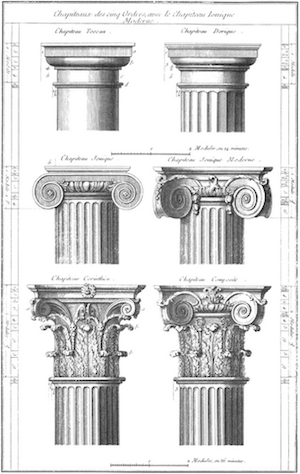
Several of the classical orders. (Wikipedia)

Does that not suggest that the use of proportions and is far from cut and dried, not really the stuff of mathematical precision? Seems so to me. Bass recognizes that he cannot really know what methods of proportion were applied by architects ages ago. And yet I am sorry: this was a poor example. The word initiatic, has, at least to some readers, an indistinct meaning. Does it mean presented to an apprentice on his first day in the studio of his master? Or does it mean presented to a novice as part of an initiation ceremony? Maybe it doesn’t matter. Maybe it does.

Still, as hazy as proportion seems from my perspective, it definitely has a role in making architecture beautiful. Just because I don’t understand it doesn’t mean that proportion’s precise application is anything other than exact and reliable in producing beauty. I can easily imagine classicists of the distant past winging it in their calculation of proportion. But that hardly means that many others – to be sure, more in the past than today – have not learned and internalized the equations set forth herein by Bass and have used them to create beautiful architecture.

Here is Bass’s introduction to his section about Michelangelo:

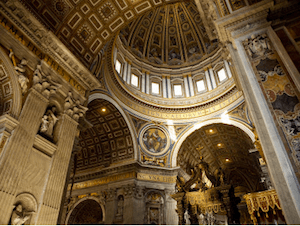
In looking at the architecture of Michelangelo, geometrical arrangements, particularly pentagonal, have been used. But these are to be considered strictly analytical. They are unlikely to have been the method actually used by Michelangelo, who drew architecture as he would the human body, finding the right place for a division as if playing a fretless musical instrument.

“Strictly analytical”? Hmm. Not sure quite what that means in terms of Michelangelo’s approach to proportion. Something in me wants to suggest that the passage paints Michelangelo as something less than a purist. Maybe the knowledge of proportions was not yet advanced enough to help the great Renaissance man. Or maybe it was.

Screen Shot 2020-05-25 at 11.21.58 PM

St. Peter’s Basilica. (michelangelo.net)

Was Michelangelo a strict constructionist, as it were, or was his way of using proportion to toy magisterially with the orders really more inspirational? Or are the fundamentals of proportion drawn, as Bass suggests, from divine forces that inspired the rules, and were therefore deployable only by such geniuses as have conscious or unconscious insight into those forces? Now there’s a question that’s above my pay grade!

There are passages in Beauty Memory Unity that, taken out of context, seem to posit any of these theories. It’s sometimes hard to tell while leaping from one equation-free passage to the next, perhaps pages away, whether Bass is expressing his theories or describing the theories of others. Picking my way through a book is surely not the best way to review it, but reading it straight through, struggling with frequent passages that fly over my head, is sure to be equally ineffective – and likely to risk a failure to complete.

All of this should be taken as the admission of a proportion skeptic that the discussion of the origin, history and practical application of proportion is not just educational but a fascinating mystery, a mystery that only heightens in its fascination as chapter follows chapter. It is a great read for the uninitiated devotee of architecture (and doubtless even more so for the initiated).

In proportion as the professional architect of today seeks to climb toward the highest rungs of creative ambition, Beauty Memory Unity will prove useful, indeed inspirational, not just as a path to beauty but as a thing of beauty in and of itself.

(For a far more coherent and constructive assessment of Steve Bass’s brilliant treatise, readers are advised to consult Patrick Webb’s review in the May issue of Traditional Building magazine.)

Posted in Architecture, Book/Film Reviews | Tagged , , , , , , , , | 7 Comments

Talk the talk on buildings

Screen Shot 2020-05-21 at 9.09.30 PM

University Campus UTEC, by Grafton Architects, 2020 Pritzker Prize winner, in Lima, Peru. (Pritzker)

Here is a post of mine from Feb. 7, 2018, “Talk the talk on buildings,” about the incoherence of architectural language. It was originally illustrated by a map of the 1901 McMillan Plan for the National Mall, a fine example of coherence. In reprinting the post, I have provided new illustrations that exemplify incoherence. They are buildings designed by this year’s Pritzker Prize winner. Here is the post:

***

An essay by Marianela D’Aprile, “What We Talk About When We Don’t Talk About Buildings,” on the website Common\Edge, gathers together some strands of discourse about architecture that I’ve posted on recently. Most particularly, I refer to a post called “Architecture’s deadly lingo,” about a lecture at Harvard’s GSD, and another, “Modern architecture is crazy,” in defense of Ann Sussman’s theories connecting the craziness of modern architecture with the suspected mental illnesses of its leading pioneers.

A fascinating panel was held [in 2018] by the National Civic Art Society, in Washington, D.C., with architects Michael Imber and Duo Dickinson discussing “Cultural Change and the Future of Architecture.” In the video of the event (an hour and 12 minutes), they danced around the problem of ugly architecture. Dickinson is the most accomplished of artful dodgers, and seemed to want to distract the audience from the myriad problems for the profession that arise from its dedication to designing buildings nobody likes. He sees the problems but doesn’t make the connection. Imber is an excellent architect and tried gamely to inject some common sense into the discussion, but was rumbled over by Dickinson’s Mack truck of bloviation. Toward the end Imber showed signs of Stockholm Syndrome. The segment where they discuss beauty had me wringing my hands in despair. The video of the event is perversely alluring.

Dickinson’s language isn’t as confusing as the random-phrase-generator prose used to introduce the lecture at the GSD, linked above, but in a way it’s more confusing because he is so good at stringing together sentences that mimic common sense but that don’t add up if you do the calculation.

In her essay, which came to me through Kristen Richards’s indispensable ArchNewsNow.com, D’Aprile writes that “[t]he desire to want to get rid of this dusty catalog of Buildings You Should Know Because Some Dead Guy Said So, is well-founded.” She wants to hear less about Paul Rudolph and more about Lina Bo Bardi. But then she goes on to complain that the profession’s discourse isn’t about architecture anymore. She cautions us about the dangers of

over-reliance on the canon to teach and practice architecture, which, as we know, can be an enterprise that redoubles many of the negative cultural symptoms of our capitalist societal structure (individualism, self-exploitation, competition; not to mention sexism, racism, ableism). But ultimately, the panelists’ intimations of how to change the state of affairs in the discipline of architec- ture aimed less at expanding or changing the canon and more at getting rid of it altogether in order to replace it with, well, some- thing else, something new, something not architectural at all.

Her thinking is strangely divided against itself. Neither she nor the GSD professors nor Dickinson nor perhaps even Imber, sensible as he may be, seem to realize that they do not discuss architecture because they cannot discuss architecture. Architecture today has no canonical design language with which to discuss architecture. Discussing architecture nowadays is like playing pickup sticks where sticks that are straight are not allowed. To compare one modernist building with another is rhetorically difficult if not impossible. To debate how buildings should help address the problems of architecture, let alone the problems of society, requires a consensus, to some degree, of what a building is and even what it should look like.

Several times in the Civic Art Society discussion, Dickinson and Imber wondered how architects can address the rapid change coming at us faster and faster. I wanted to get up and shout “Use architecture to create cities people care about!” Buildings should serve as anchors of stability people can hold on to and steady themselves in the face of onrushing evolution in our society, politics, technology, etc. Houses that look like houses, churches that look like churches, city halls that look like city halls – there’s a starting point. Why not try to recreate what humans were blessed to have for thousands of years – civic space that leveraged beauty to soothe the savage breast, in order to foster civility in the discussion of diverse viewpoints toward the goal of living together. We’ve lost that, but architects, who threw it away, will not admit it. Without admitting it, useful discussion cannot take place.

Architecture is sick. Maybe it is mentally ill – not because modern architects are mentally ill but because, wittingly or not, they work with tools and ideas that are purposely incoherent. That’s crazy, whether Corbusier was autistic or not. Architects are just part of the problem. The blindness of civic leaders, developers, planners, clients and others, including citizens who accept like sheep what those who design human habitat have dumped on us, share blame as well. But somebody must start to look reality in the eye. Might architects be the most logical candidates for the job? Let’s discuss.

Screen Shot 2020-05-21 at 9.11.22 PM

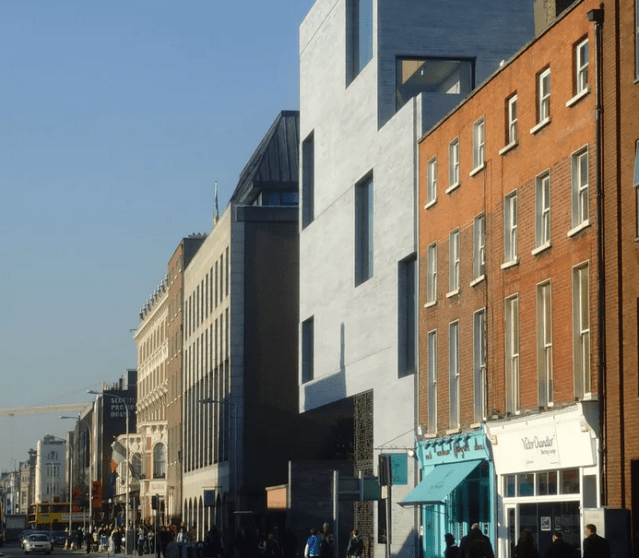
Urban Institute of Ireland, Dublin, Grafton Architects, 2020 Pritzker Prize winner. (Pritzker)

Screen Shot 2020-05-21 at 9.11.08 PM

Department of Finance, Dublin offices, Grafton Architects, 2020 Pritzker Prize winner. (Pritzker)

Posted in Architecture | Tagged , , , , , , | 4 Comments

“In the Wake of the Willows”

Screen Shot 2020-05-17 at 7.02.01 PM

Salt marshes along the Westport River, in Massachusetts. (Lauren Daley/Herald-News)

Nightly over several recent weeks – interrupted by a bout of Bell’s palsy – I read to my 11-year-old boy (and his mother) an enchanting children’s book called In the Wake of the Willows, by Frederick Gorham Thurber and lovingly illustrated by his wife, Amy. The author, a Providence native, distant relation to the comic writer James Thurber, and a naturalist living in Westport, Mass., wrote the book in homage to Kenneth Grahame’s 1908 classic, The Wind in the Willows – which he first read years ago and I read to Billy and Victoria just before In the Wake, which we finished last Friday.

Screen Shot 2020-05-17 at 8.25.45 PM

It was stated in a review of In the Wake by freelancer Lauren Daley for the Herald-News of Fall River, Mass., that its prose was “in an old-fashioned vernacular.” That brings to mind that my former editor at the Providence Journal, Philip Terzian, was often said to “affect a British accent.” Not so. Terzian spoke in full sentences of correct grammar; it only sounded like a British accent to those unused to full sentences or correct grammar. Likewise the prose of Fred Thurber: It is beautiful and energetic, like some if not all literature of the past, but that hardly makes it “old-fashioned.”

I opened the book to this passage at random as an example of Thurber’s delightful prose and narrative power:

A whip-poor-will started up in the far distance, singing its endless, monotonous song; Mr. Rat knew that this would go on all night, minute after minute, hour after hour. Why the repetition?, thought Rat. He did a quick calculation in his head, and the total was rather surprising. You would think that the lady whip-poor-wills would get the message after the first few minutes and say yea or nay; what good would it do to keep going? Maybe the whip-poor-will figured if romance did not come on the first song, maybe the ten thousandth would win her heart. …

The fact that this passage does not ring of Dickens or Thackaray does not condemn its hearty, our-side-of-the-pond modernity. It is not modernist, it is modern, with the clarity and pace of its time. Just because it is about animals does not require it to be cutesy.

My family was well-prepared to measure Thurber’s storytelling prowess against that of Kenneth Grahame, and, given Thurber’s ancestry we were not altogether astonished to find that in his prose, in his story, and in his ability to infuse animals with a human sense and sensibility, the old shoe fit very well on the modern writer. In fact, although I am not familiar with the English habitat of the original Toad, Mole, Badger, Otter and Rat (whose families seem to have emigrated to the Westport area), Thurber, who has spent decades charting Westport’s natural charms, appears to have vaulted past his literary predecessor as a naturalist of flora, fauna, landscape and waterscape. Reviewer Daley writes that Thurber told her:

Every place in the book is based on real locations in our area: The River, of course, is the Westport River. The Beach is Horseneck Beach. The Point is Westport Point. The Inn is the Paquachuck Inn. … Montaup Hill is the Native American name for Mt. Hope in Narragansett Bay. Hen & Chickens Reef is the Hen & Chickens Reef off Westport. The Island really exists, but I dare not aggravate my animal friends any more by disclosing its exact location … suffice it to say, it’s within sailing distance of Westport.

Is it really a children’s book? Probably not more so than The Wind in the Willows. As in the passage above, Thurber deftly manages to suggest in the book that the author is an observer and even a friend, if not an intimate, of the riverside community, who are real animals in a real society, as was the animal society across the pond. Thurber accomplishes the task of blending human character and characteristics into his animal characters. The beasts seem less mammalian in their behavior than, say, Winnie the Pooh. I would hesitate to insist that Thurber tackles such literary challenges with as much vivacity as Grahame. That might strike Thurber as a species of sacrilege.

So, like Wind in the Willows, In the Wake of the Willows is, it seems to me, an adult children’s book. Thurber describes its target audience as ranging from age 12 to 112. He warned me to read the afterword before reading it to Billy. I did, and had no worries. I don’t often get to brag on my child in print, but Billy was not fazed at all by the events of the afterword. I will add, too, that Billy was captivated by the “souls of the innocent” in an early (and spiritual) chapter, and kept joking about them as the story rolled on without seeming (at least in Billy’s mind) to resolve their fate. I came to enjoy his reaction to my plopping the phrase in, willy-nilly, at various points in the book.

So, yes, this is a children’s book that is fun for adults to read, especially to children. In fact, I found Fred Thurber’s prose easier to read than that of Kenneth Graham, whatever that might signify. Maybe the august British author was just pretending to write for children, or just pretending to write about animals. I think Thurber’s In the Wake is the real McCoy.

Posted in Book/Film Reviews | Tagged , , , , , , , , , | Leave a comment

Krier on living communities

DSCN3059.JPG

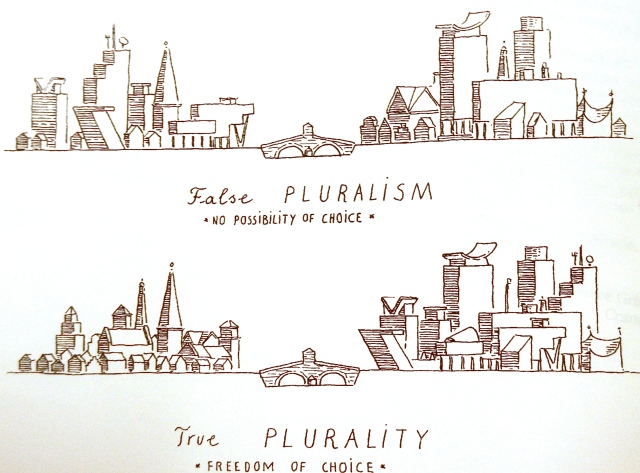
Illustration of the principle of pluralism by Leon Krier.

The other day, after I’d posted on an official Chinese edict against copycat architecture, “China bans novel archivirus,” I received an email from the great architect and theorist Leon Krier, a native of Luxembourg and master planner of Prince Charles’s town of Poundbury. Krier enclosed for my pleasure his foreword to the Beijing edition of his masterful Architecture of Community (2010). In it, he argues, among many other things, that good architecture is not good because it is traditional but because it respects the value of place (genius loci) rather than of time (Zeitgeist) in the design of livable communities. That reminded me of a motto that I occasionally see at the end of emails to the TradArch list, which goes: “It is not good because it is old, it is old because it is good.”

The Chinese should keep that in mind, or, really, bring back to mind a principle that Chinese architects once knew so well they didn’t need to remember it.

The cartoon atop this post is my favorite example of Krier’s talent for literally drawing the principles of good design, in this case the difference between real and fake pluralism. Which town would you rather live in?

(I dedicate the cartoon, or rather its use in this post, to Kristen Richards, the founder and editor of that priceless institution, ArchNewsNow, which offers a selection, thrice weekly, of news and views on architecture from around the world, for free. She is a good egg – and not just because she puts up with emails from me.)

So here is Krier’s excellent foreword:

***

Recently, a delegation of developers and planners from Shanghai and Singapore visited Poundbury, the new town I have been master-planning for HRH Prince Charles since 1988 in Dorset, England.

After my presentation, a representative from the Chinese delegation came to me, saying. “You must come to China. We want Poundbury in Shanghai.” I responded that for his country I would of course design a Chinese not an English town. “No, no,” he cut in, “we want English Poundbury. It will have much success.” When I replied that it would be as unsuitable as planting a palm tree in the Siberian tundra, the gentleman shook his head and walked away. After him the delegate of Singapore addressed me: “Mr. Krier,” he said, you must come to Singapore. We want Poundbury with skyscrapers.” When he understood that my skyscrapers would have no more than three to five floors, he too frowned in disbelief and turned on his heel.

This is to say that the present book is not about exoticism, not about the brief thrill of consuming imported alien products, not about promoting trendy European goods for globalized markets, cultures and climates.

The Architecture of Community is about something more fundamental. It is about re-establishing our own traditional forms and techniques of building and settling. The devastation of the traditional Chinese building heritage is causing headlines worldwide. Yet I am less alarmed by the loss of material than by the loss of the ideas which generated and perpetuated it for thousands of years. I am not merely talking about saving historic buildings and towns but saving the technology which created and sustained those forms, made them to be desirable and to be emulated for hundreds of generations. I am suggesting that architects and planners become primordially concerned, not with the historicity of traditional architecture and urbanism but with their technology, with the techniques of building settlements in a specific geographic location with its natural materials.

It is tragic that more and more intelligent minds should at once be spellbound by that undecipherable Spirit of the Age (Zeitgeist) and so indifferent to the Spirit of Place (Genius Loci), the conditions of nature, of local climate, topography, soil, customs, all of them phenomena objectively apprehensible in their physical and chemical qualities.

This book advocates not to respect, study and use traditional ideas because they are historical, but where and when they are relevant for us the living, essential for our well-being. They are repositories not merely of humanity, but of humaneness and ecology.

Human scale, as we now discover when too many of our built environs have lost it, is an unrenounceable attribute of civilization, not an obsolete luxury. We demonstrate here, by vision and example, how human scale can become again the yardstick of modern artifacts, adequate for our bodies and souls, for both our limited physiological capacities and our infinite desires, be they tools, buildings, cities or landscapes.

Posted in Architecture | Tagged , , , , , , | 4 Comments

Duo vs. the “style wars”

Screen Shot 2020-05-11 at 9.09.29 PM.png

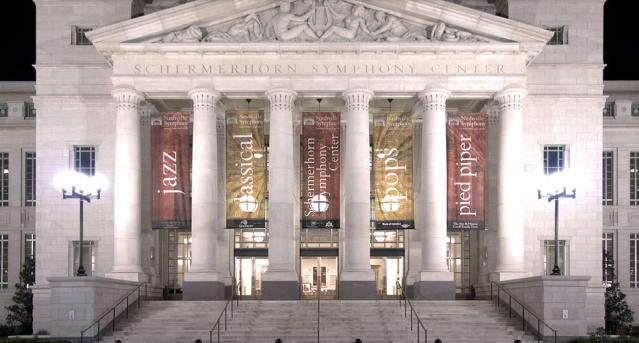
New Classicism: Schermerhorn Sympony Center, in Nashville, Tenn. (Wikipedia)

Maybe I am a rascal, or maybe I’m going batty in coronaprison, or maybe I would really just like to foster an amicable agreement, among architects, that an architecture that worked for thousands of years is preferable to – and should replace – an architecture that has not worked at all during its three-quarter century’s dominance in the industry.

So here is another post in which I take on architect Duo Dickinson (see my recent “Dickinson vs. Dickinson“). His architectural work is excellent and it is traditional, but his writing, however intelligent, is a guide to how not to think about architecture. He cannot build new traditional houses and denounce new traditional architecture without inspiring confusion. And that’s exactly what he does. So here, from July 6, 2017, is my take on his take:

***

Architect and commentator Duo Dickinson spends nine-tenths of his essay “Does the New Traditionalism Have a Point?,” on the website Common|Edge, describing new traditional architecture as if it were a recent novelty, a niche phenomenon worthy of a look but without much practical purpose. What’s the point, he asks, as if he did not already know.

After citing chapter and verse how outbreaks of new traditional architecture have been coming on strong of late, Dickinson concludes:

This revived movement may be compared to a “separate but equal” approach of creating a distinct set of rules and criteria for direction and judgment, but it’s really about architects who feel that they are the oppressed and ignored minority rising up to speak truth to power. Rejectionism of any sort is inherently reactionary and shallow. I long for a time when “Good” and “Bad” is sufficient architectural judgment—no style screed necessary.

As Dickinson admits, modern architecture has big problems. “America has felt the failures of Modernism up close and personal,” he writes. And yet “architectural culture, as defined by the vast majority of professors, journalists and ‘thought leaders,’ has a clear bias against traditional styles.”

Nevertheless, after describing valid reasons for the anger of many new traditionalists and a public (let’s not forget them, Duo) that has seen its built environment trashed by modernism for decades, Dickinson trashes those who call for an alternative.

“Irrational and defensive as it seems, the anger against Modernism is real and often absurdly extreme.” “The noise and rancor of these ‘Style Wars’ is reductionist nonsense.” It is “inherently reactionary and shallow.” It embraces a “separate but equal” approach. And anyway, new traditional buildings such as those in two almost completed Collegiate Gothic-style campuses at Yale by Robert A.M. Stern are “Hogwarts.”

And yet Dickinson is one of the few members of the establishment design culture who bother to acknowledge the existence, if not the validity, of a traditional alternative – one that is in its third millennium, has successfully resisted modernism in the private home market for half a century (as people can choose houses and don’t want modernist ones), and has become a movement not just lately but since the 1960s, when modernist-based criticism of modernism led to the postmodernist movement.

Modernism became a movement over a period of 20 years leading up to its capture of the architectural establishment in the postwar years. Preservation changed from a hobby of antiquarians into a movement just as swiftly and about 20 years later, as average people organized to oppose modernism in their cities and neighborhoods. The classical revival has taken longer to become a mass movement, 50 years and counting, because unlike historical preservation, tradition is actively opposed by the modernist establishment.

But as Dickinson seems to sense, tradition has in fact survived modernist extermination, and is rebounding – now strongly enough that critics like Dickinson cannot ignore it. He realizes that tradition is powerful, and is forced to feign confusion at such an easily understood phenomenon.

Dickinson wonders why can’t we all just get along (“I long for a time when ‘Good’ and ‘Bad’ is sufficient architectural judgment—no style screed necessary”). Just before he attests to his confusion, he quotes architectural theorist Steven Semes, a professor at Notre Dame and director of its new program in preservation, at some length, even though Semes’s words undercut the last remaining modernist excuse – that “we can’t build that way any more.” This mantra has been used time and again to shut down those who can’t see why buildings must look like machines. Why not revive the beautiful, humane places society once enjoyed? He quotes Semes:

The relation between form and technology has been completely reversed since we were in school. With digital representation, 3D printing, and virtual reality capabilities, the idea that ‘the machine’ has any bearing on the shapes and forms that architects design has gone out the window. Anything is possible, so to avoid chaos, one might look to a well-established, visually rich, and culturally resonant tradition as a framework. I see a great opportunity to explore highly innovative new classical expressions making use of all of this technology and encourage my students and colleagues to pursue this.

C’mon, Duo. Come on over to the light side. The view is much clearer over here.


9 Responses to Duo vs. the “style wars”

  1. Be looking to New York in November…

    Like

  2. Pingback: The cat and the bunny | Architecture Here and There (Edit)
  3. Steven Semes says:

    I was happy to be quoted in Duo’s essay, though I am not temperamentally an “ideologue” of any sort. I agree with Nikos about the impossibility of reconciling modernism and traditional architecture on the intellectual or artistic plane, but that doesn’t mean that people can’t recognize as a practical matter that there are multiple ways to make positive contributions to the built environment. In a world that Duo wishes existed (and I wish, too), “good” and “bad” would be judged according to how a given work contributes to the health and well-being of of inhabitants, societies and ecosystems. Then we could talk about what properties make such contributions, including the fundamental principles of mathematics and science that Nikos refers to and has done so much to reveal to all of us. Those principles do not define a style, but they do point in a certain direction. There is a spectrum of views and room for discussion and difference, though terms like “reactionary” do little to foster dialogue. If we could agree on the general principles, then we could have a great time arguing about specific works.

    Liked by 1 person

    • Well and truly stated, Steve! Nikos is correct that modernism and tradition are not reconcilable – are not intended, by the modernists at least, to be reconcilable. But we can talk to each other in a civilized way, yes? And seek to identify the fundamentals upon which architecture should be based. And if it is found that an architecture that rejects the past is fundamentally averse to the creation of beautiful species, then, if we are civilized, we can admit that, and all will be well, and we can then get down to the job of judging all architecture as good or bad (or in between) based on how well they apply those fundamentals. I certainly have no objection to that. Nor to if we decide that the fundamentals of architecture command chaos, I suppose.

      Like

  4. David,

    Duo is a fellow author over at Common\Edge, and I enjoy reading his intelligent essays. Unfortunately, we have no physical meeting space to discuss things and help each other develop our ideas. Like so many “meeting places” nowadays, it’s a strictly virtual one.

    To answer some of your questions raised by Duo’s latest essay, I need to come back to the fundamental difference between classical/traditional architecture and modernism. They cannot coexist harmoniously, since they use opposite mathematical rules of design.

    Let’s hope that an increasing number of interested players realize this soon. Otherwise we continue hoping for the unrealizable wish of getting along as “separate but equal” styles. The problem preventing this nice thought resides deeper, in mathematics and neuroscience.

    Best wishes,
    Nikos

    Liked by 1 person

    • I think the truth of your comment, Nikos, that they cannot co-exist for reasons traceable to mathematics and neuroscience, is obvious to anyone who has eyes. That is so whether or not people are aware of or give credence to scientific factors. Tradition is suppressed by modernism because modernism is fully aware that it would not long survive on a genuinely even playing field.

Posted in Architecture | Tagged , , , , , , , , | 9 Comments

China bans novel archivirus

Screen Shot 2020-05-08 at 10.02.53 PM.png

CCTV headquarters (center right), in Beijing, known as Big Pants. Or is it stomping on the people?

The People’s Republic of China, taking time off from other matters, has issued a decree banning copies of foreign design in its architecture. The decree, as described in the BBC’s “China ‘copycat’ buildings: Government clamps down on foreign imitations,” also bars “weird” design, which was already banned in 2016, and limits building heights to 500 meters (or 1,640 feet). The decree calls for “a ‘new era’ of architecture to ‘strengthen cultural confidence, show the city’s features, exhibit the contemporary spirit, and display Chinese characteristics.'” The BBC adds:

The statement, issued on 27 April but only reported this week, singles out stadiums, exhibition centres, museums and theatres as public facilities where it’s especially important to ban plagiarism.

According to the Global Times, the “fake, shoddy versions” of foreign buildings appear in “many third and fourth-tier Chinese cities.” The government did not say what will happen to existing “foreign” buildings, but does say there will be “city inspections” to check for problems.

“City constructions are the combination of a city’s external image and internal spirit, revealing a city’s culture,” the government statement says. It was unclear how rigorously the decree would be enforced. It was also unclear how architects are supposed to interpret the language of the decree.

One wonders what kind of design would exhibit the contemporary spirit while displaying Chinese characteristics. Doesn’t almost all recent Chinese architecture copy some sort of modern architecture built elsewhere in the world? How would clients and designers manage under a regime in which copying global modernism is banned? China’s architects are encouraged by the decree to “show the city’s features”; how is it even possible to design a building that does not show the city’s features? Any new building becomes a feature of the city automatically, and cannot do otherwise. At this point, does anyone still know which architectural features are characteristic of a Chinese city and which are not?

Perhaps the real intent is to put a stop to districts taken directly, often almost literally (though with little competence), from European cities such as Paris and London. No doubt their popularity embarrasses China’s architectural apparat. Perhaps the decree is intended to jumpstart a new era of copying the past of Chinese architecture – that is, to reverse decades of canceling China’s culture, such as the hutong alleyways that were demolished to make way for the Chinese Olympic Games in 2008. Maybe the cultural heritage of the Middle Kingdom can be resuscitated in time for the Chinese Olympic Games planned for 2022. Not holding my breath.

(Here is a 2013 BBC article with photos of copycat historical architecture inspired by European tourist meccas. Here’s another, by insider.com, from last year. Here is a 2006 piece from the UK Telegraph on the removal of the historic hutong alleyway neighborhoods in Beijing, including some right near the Forbidden City. But here is another piece, from a 2018 edition of the Urban Land Institute‘s newsletter, that reports on an effort to preserve one of Beijing’s few remaining hutongs.)

The photo atop this post includes the China Central Television headquarters, designed by starchitect Rem Koolhaas and popularly known as Big Pants. To me (as I’ve said at least a million times) it looks like Big Pants is stomping on the Chinese people. Supposedly it cannot be copied. But maybe I am missing the point. Perhaps the new decree seeks a sort of mau-mauing of pre-existing reality, in which the Chinese state seeks to rediscombobulate “weird” design as a feature of contemporary Chinese character.

It may be that a novel twist on Chinese cultural bat guano is about to escape from the lab. Let’s hope the Chinese do a better job of containing it this time.

Screen Shot 2020-05-08 at 11.13.09 PM.png

Thames Town, in Shanghai.

Posted in Architecture | Tagged , , , , , | 4 Comments

Plečnik capitals you can see

Screen Shot 2020-05-04 at 11.07.27 PM.pngJože Plečnik may perhaps be deemed the Antoni Gaudi of Ljubljana, the capital of Slovenia. Or vice versa. Both shifted the character of their principal cities (Barcelona in Gaudi’s case) toward a more animated, innovative and yet entirely classical character. Both architects proved that classicism can be as creative as modernism – far more so, since modernist creativity is mostly of the ridiculous “Look at me!” type. “Plecnik capitals you can see” originally ran March 25, 2015, and “Recapture Joze Plecnik!” the week before:

***

IMG_6217IMG_6220IMG_6221IMG_6213IMG_6219IMG_6208IMG_6210IMG_6218IMG_6216IMG_6215IMG_6222IMG_6214IMG_6212IMG_6211

Here is that page of column capitals by Slovenian architect Jože Plečnik, disambiguated from the shot of many capitals on two pages taken and sent to TradArch by Angelo Gueli yesterday and posted in a cropped and undisambiguated (I think that’s a word) by me. The photos were too small for readers to examine very helpfully with the naked eye. Angelo saw my post and shot each capital on those pages separately and sent them to me. Here they are.

But I cannot let the opportunity created by Angelo’s compassion pass without comment. Now that you can closely peruse each capital, you can see that all of them possess a uniquely expressive character that arises from features that would be purged by modernists, just as Harvard Graduate School of Design dean Joseph Hudnut literally threw out Harvard’s famous collection of classical plasters, causing dumbkopf architecture-school deans around the nation and the world to do likewise, as if they were an unusually idiotic species of sheep.

Let’s shove the nasty modernists aside and focus our attention on enjoying the beauty of the Plečnik capitals. I tried to figure out which of them comes closest to the canonical. It’s a tough quiz, but I suppose the closest must be the sixth, which seems to be a regular column of the Tuscan order but with a large fasces, as I think that scroll-like tubular feature is called, intervening between the Tuscan capital what would otherwise be the entablature above were it not that a coffered ceiling rests upon the fasces, an ornament that derives from the symbol for Roman authority.

Which is my favorite? That’s just as tough a nut to crack. Perhaps it is the second capital with the melancholy face between the two Ionic scrolls. Since, according to Cognitive Architecture, by Ann Sussman and Justin Hollander, our brains read faces as their number one job, maybe that explains my preference here. But I also like the capital forged from four columns arising to their own capitals at the top of a post.

It is almost impossible not to feel outrage at the meatheadedness that has robbed the world of the joy of classicism.

Here I leave readers to luxuriate alone in this heterodoxual display.

[The original post, from 2015, erroneously attributed to Bauhaus founder and GSD faculty member Walter Gropius the destruction of Harvard’s classical cast collection, rather than dean Joseph Hudnut, who actually perpetrated the atrocity. Not that Gropius hadn’t already done quite enough to eradicate beauty in the world.]IMG_6209


Posted in Architecture | Tagged , , , , , , , , , , , | 6 Comments

“Building Notre Dame”

Screen Shot 2020-05-01 at 4.45.17 PM.png

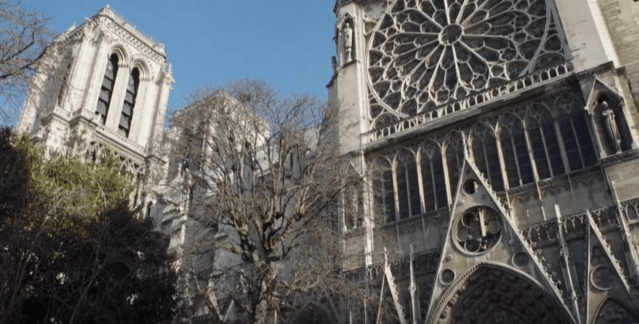
One of the identical rose transept facades at Notre-Dame. (PBS)

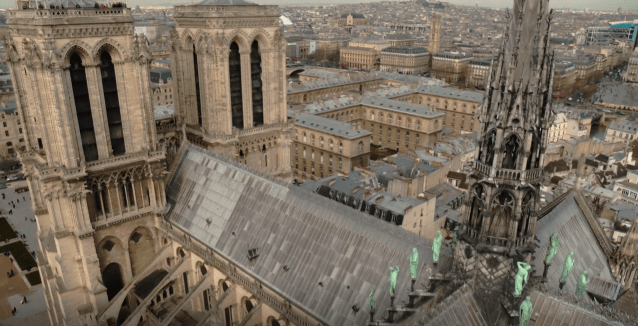
PBS has broadcast a brilliant documentary, “Building Notre-Dame,” on the construction, over some 800 years, of the cathedral in Paris. We all know that the building arose as the cutting edge of architecture in the Middle Ages, and that a year after the April fire that destroyed its roof, its spire, and weakened much of its structure, its redpair has been delayed by physical and aesthetic controversy. PBS’s film puts this work into the context of repairs and renovations to the cathedral during and since the middle ages.

Screen Shot 2020-05-01 at 5.01.26 PM.png

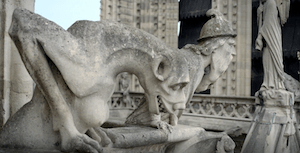
Gargoyle of Notre-Dame. (PBS)

It was discovered, after sixty years of building, at a stage of near completion, that the structure had no gutters, no drainage system. It had no way to collect and distribute rainwater – water being the most dangerous natural enemy of architecture. So they hollowed out the church’s flying buttresses so that 7,000  gallons of rainwater in an average storm would shoot out the mouths of the gargoyles, away from the church walls. Engineering the new water system enabled the walls to be raised by six feet, remounting the roof, reconfiguring the windows and their stained glass in a much larger format, larger than ever, painting the statuary and, eventually, adding architect Eugène Violette-le-duc’s famous spire.

“They kept changing their minds,” says Ken Follett, author of the novel Pillars of the Earth, first of a masterful three-volume series. “They had no sense that they were working in an old tradition. They were working at the cutting edge of technology.” He also has a nonfiction book out on Notre-Dame. Victor Hugo’s fictional The Hunchback of Notre-Dame, published in 1831, stirred up public support to save the cathedral.

It is the conceit of today’s architects that they are applying technology to architecture for the first time. What, did something click with the modern era? No. Architects started to conceive of buildings as machines, which is fine, but decided that they needed to look like machines. This was their mistake. They treated function and design as opposing dualities. Beauty was rightly offended and fled, or was ejected from, the project of architecture.

These are my words, not those of the producers of the documentary. Indeed, the documentary gives one instance of the cathedral builders’ applying the virtue of patience to correct one of their more potentially deadly errors. After the portals and two heavy bases of the towers were complete, it was discovered that they were tilting forward, under the strain of thousands of tons of stone walls and statuary. So what did they do? They waited for the ground to reach compression and the tilting to stop, which it kindly did (after how long the docu doesn’t say; nor does it say whether prayer was involved, but rather gives credit to “chance”). They built the towers straight up from there. It worked. You can still see the tilt of the base today.

The documentary opens a view to the complexity of what must be done to restore the beauty of Notre-Dame for tomorrow. I am sure that what has come before will ensure that history is respected by the principles of repair. You cannot watch this film without shuddering at the schemes afoot among modernists today, but you cannot understand this documentary without feeling confidence that the good, the true and the beautiful will prevail.

Screen Shot 2020-05-01 at 4.56.50 PM.png

View of the roof and spire, with the saved towers at left. (PBS)

Posted in Architecture, Video | Tagged , , , , , , | 3 Comments