Animal spirits of the E.O.

New federal courthouse in Mobile, Ala. (Hartman-Cox Architects)

The General Services Administration, which designs, builds and maintains all federal buildings, has issued a pair of RFQs (Request for Qualifications) for architects to design two federal courthouses, one in Ft. Lauderdale, Fla., and another in Huntsville, Ala., in a “classical style.”

Does that mean that the proposed White House executive order known as “Making Federal Buildings Beautiful Again” has been signed by President Trump and has now gone into effect? I wish, but no, alas, as of this writing that has not happened. In fact, the RFQ for the courthouse in Huntsville was issued last year. The unsigned E.O. was leaked to the press in February.

Nadine Post raised the alarm in a recent issue of Engineering News-Record (“Conflict Heightens Over GSA’s New Design Criteria”). I wish. The journal’s headline writer might have slightly overstated the case.

Nevertheless, Rep. Dina Titus (D-Nev.) has proposed legislation to block the E.O. should it ever go into effect, and has written an angry letter to GSA Administrator Emily Murphy, a Trump appointee who was unanimously approved by the Senate in December 2017. The language of Representative Titus’s questions about the RFQs was apparently lifted from the American Institute of Architects’s misleading denunciations of the E.O., phrases that enunciate a false narrative about the proposal for a new classical mandate that denies the existence of a modernist mandate in effect since 1962.

For several decades after the “guidelines” warning against an “official style” went into effect, there were no federal buildings that did not embrace AIA and GSA modernist preferences. A few classical courthouses, maybe two or three, have arisen in the past decade in Tuscaloosa, Ala. (bottom of post) and, more recent and less well known, in Mobile, Ala. (top of post). They are exceptions that prove the rule. (Is it the water in Alabama?)

So, if Trump has not signed the E.O., what is behind these recent and proposed classical courthouses?

Could it be that popular yearning for beauty is finally breaking through at the GSA? Perhaps architecture, as a field, is mimicking the “animal spirits” of the economy, which started to gallop well before Congress passed the tax and regulation cuts that Trump promised in his presidential campaign. Maybe the mere news of the impending E.O. has set off a stampede toward beauty in the design of courthouses, which has been lacking for 60 years, at least.

Critic Catesby Leigh, in a lengthy City Journal essay published in 2019 before the controversy over the E.O. emerged, describes in detail the disaster that resulted from the GSA guidelines, which were originally written by Daniel Patrick Moynihan before he became a U.S. senator from New York. By 1970, Senator Moynihan himself came to regret their dolorous impact on federal design, whose decline he said was followed by an equally regrettable – and predictable, classicists would add – decline in respect for federal authority in society as a whole. So amply illustrated of late.

Maybe it is not too late to reverse course and reject ugliness for beauty.

New federal courthouse in Tuscaloosa, Ala. (HBRA/Thomas Beeby)

Posted in Architecture | Tagged , , , , , , , , | 6 Comments

Still attacking Kennedy Plaza

Sketch of Kennedy Plaza plan proposed by Union Studio in 2013. (Union Studio)

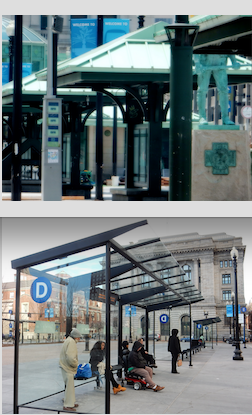
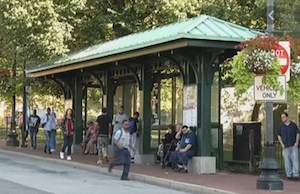
A sensible plan to renovate Kennedy Plaza attractively without evicting public transit from Providence’s central square – by far its most logical location – was submitted in 2013, designed by Union Studio. In 2015, this plan was frog-marched out of the picture by transit officials and replaced by a plan worthy of a Central European dictatorship. Sterile modernist bus kiosks were substituted for the existing Art Nouveau-style kiosks – whose number would have increased under the Union Studio plan.

Kennedy Plaza bus kiosks, old and new.

Prospects for Kennedy Plaza have only deteriorated since then. The plan now features an unnecessary, inconvenient and costly removal of buses to new bus hubs distant from Kennedy Plaza and financed by a 2014 ballot initiative widely mischaracterized by planning officials. Last week, members of the Rhode Island Transit Riders met in Kennedy Plaza to protest the plan, which would add bus hubs at Providence Station and in the Innovation District. Official descriptions of the plan are curiously difficult to locate via RIPTA and RIDOT websites, and the public no longer plays a role in the authority to proceed with the plan, which is apparently now in Governor Raimondo’s hands alone.

A story on the website EcoRINews, published in July, described concerns raised by John Flaherty of Grow Smart Rhode Island about how the plan quietly morphed in recent years from improving Kennedy Plaza to removing it from its central role in public transit. He commented:

I don’t think that many people are happy with the status quo in Kennedy Plaza, as a public space, as a place that is safe and welcoming and inviting. It’s heavily dominated by transit. I think that there are ways that this can be addressed, but I think that there’s a balance that could be achieved. They don’t seem to be interested in that. They seem very focused on reducing or eliminating any kind of transit activity in Kennedy Plaza. I think that the administration is bowing to the pressure of a few over the benefit of the many.

Flaherty expressed dismay that the city has seemed to back away from the Union Studio plan and its own 2018 proposal that would have balanced the plaza’s roles as bus hub and civic square. He told EcoRINews:

I really can’t explain it. Back in September [2019] I reached out to the city to ask, “Why aren’t you backing your proposal? We’re out here advocating for your plan. Why aren’t you?” But we didn’t really get much of a response on that.

The role of villain appears to have settled on downtown property owner Joe Paolino, who as mayor in the 1980s rescued a down-at-the-heels Westminster Street by reopening the failed 1964 “pedestrian mall” to traffic and installing elegant street lamps, brick sidewalks and street trees. Lined with shops and lofts in historic buildings redeveloped mostly by Buff Chace and Cornish Associates, it is now one of the loveliest city streets in the nation.

Fast forward two decades and Paolino seems to have developed an aversion to average people. He pushed successfully to ban smoking in the plaza. He has bought into a narrative that confuses bus riders with plaza idlers. They have been tagged, unfairly so far as I can tell, as petty criminals, drug dealers and ne’er-do-wells. Rid the plaza of their ilk and it would suddenly attract a more genteel public, including residents of a newly rehabbed Industrial Trust (“Superman”) Building, empty since 2013 but soon sure to attract public subsidies and private investment. Or so the theory goes.

Actually, combined with bus patrons and upscale idlers in the plaza after its renewal, a modest police presence would assure public safety by submerging petty crime in the general rise of the plaza’s civic and transit usage.

City and state officials should dump the new bus hubs, run a continual trolley loop between Amtrak Station and Kennedy Plaza, resuscitate the Union Studio proposal for the plaza (omitting its costly and unnecessary renovation of the skating rink), and revert to historic bus patterns here and nationwide by returning bus stops along arterial roads in and out of downtown, a transit practice foolishly discontinued in the 1970s.

The latest proposals to renovate Kennedy Plaza and whittle down its most vital role in downtown Providence reflect a drastic decline in design smarts exemplified by the River Relocation Project, led by the late Bill Warner, and the Downcity Plan, still led by Buff Chace. The design of the city’s Innovation District on land opened by moving Route 195, and the decision to replace the Route 6/10 connector with an identical concrete gash through impoverished Olneyville, rather than create a pleasing new boulevard, were breathtaking errors in city planning that will haunt Rhode Island’s capital for decades.

It’s not too late to stop Kennedy Plaza from joining those intentional blotches of God’s wrath on Providence urbanism.

Posted in Architecture, Urbanism and planning | Tagged , , , , , , , , , , , | 4 Comments

Fly train through Wuppertal

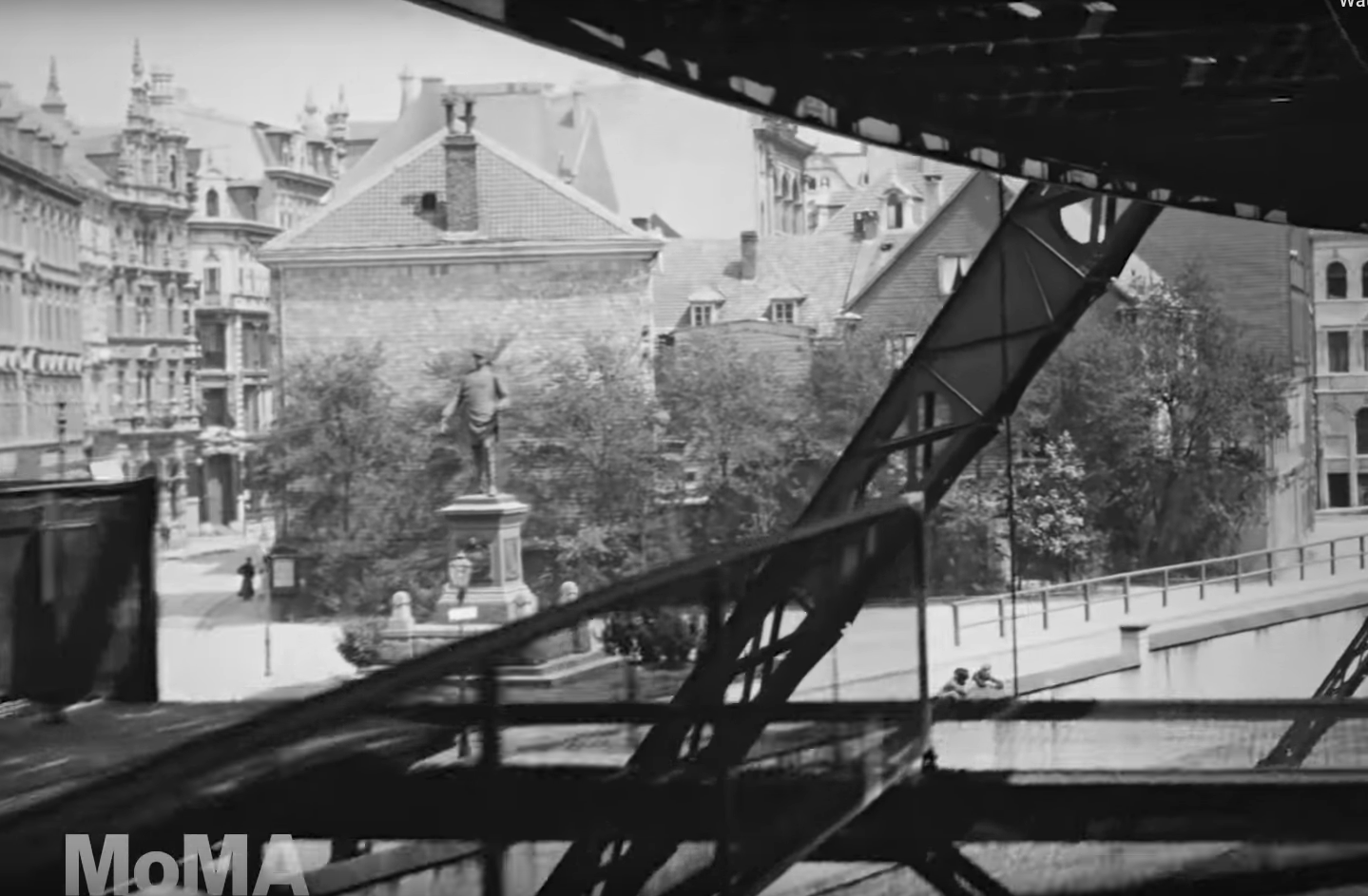
View of downtown Wuppertal from the city’s famous “flying train.” (MoMA)

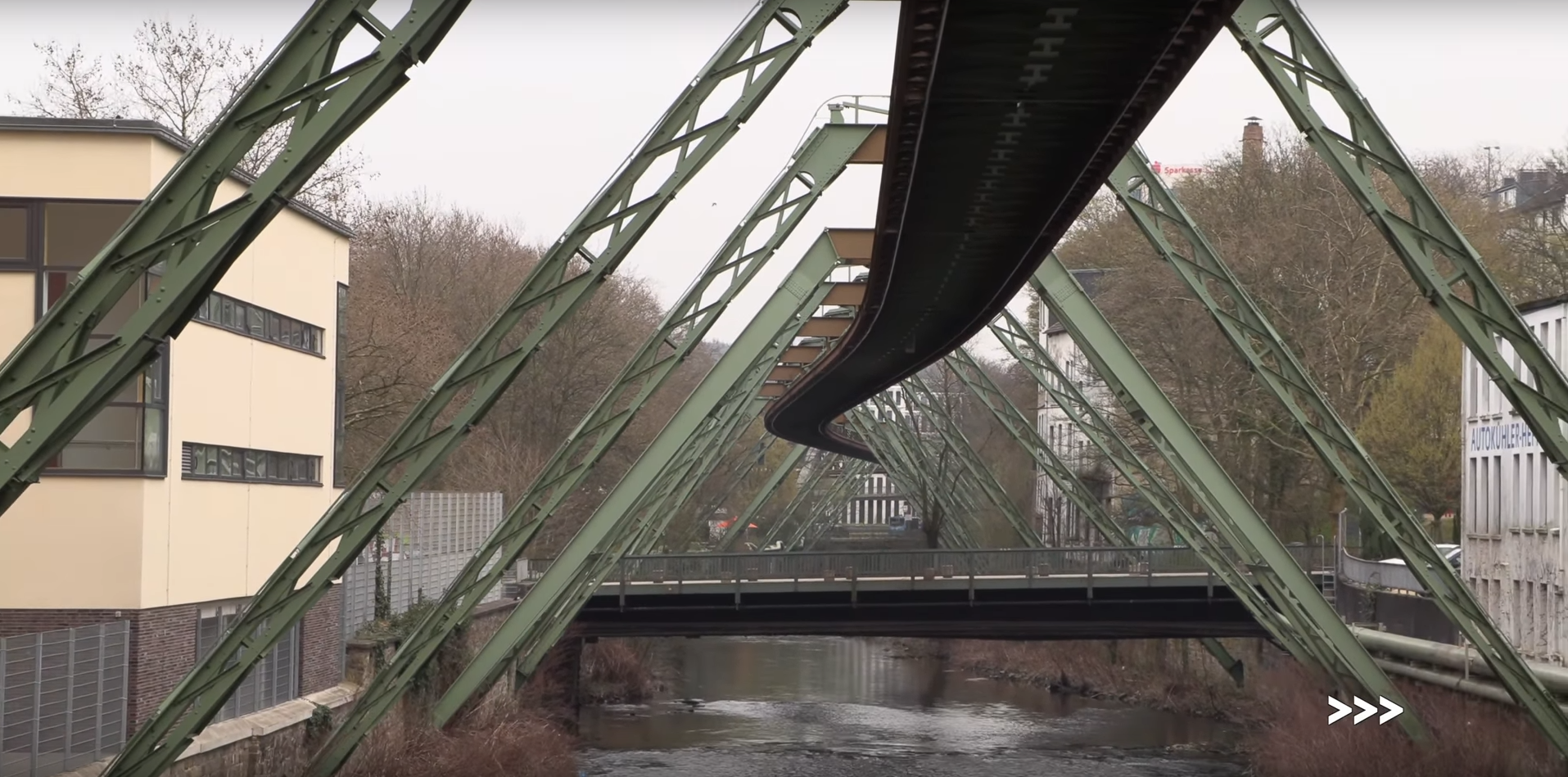
This old video, just over two minutes in length, takes viewers through the western German city of Wuppertal, population 354,382 (almost double that of Providence), on a “flying”  or “floating” train a year after its completion in 1901. The Schwebebahn is a suspension railway, a monorail hanging from tracks upheld by a system of bridge girders reminiscent of the Eiffel Tower. I almost wanted to call this post “Stairway to Heaven” because the cityscape through which the trams run is as lovely as urbanism gets. The tight-knit townhouse frontages wind with the curvature of the Wupper River, along which much of the train runs. Would that the video were longer! Would that the experience could be relived in the city today!

Alas, it cannot be. Although the Schwebebahn survives, some 40 percent of Wuppertal’s buildings were destroyed by Allied bombing in World War II, ordained perhaps by its having been the site of an early Nazi concentration camp built in 1933 to house political opponents after Hitler’s takeover of Germany. A 12-minute film of the Schwebebahn in 1995 shows what has replaced much of the war damage. Wuppertal today bears all the stigmata of a modern city. What remains of the old bears the pockmarks of the new, both in its architecture and in its urbanism.

The video of the 1902 film is made available by the Museum of Modern Art, in New York City. The film quality is superior to what is usual from that era. The photo above and three of those below are from that old film, followed by six from the more recent film, courtesy of Luke Starkenburg. It shows what seems to be the best of what remains of historic Wuppertal and, finally, some of the worst of the city’s urban character from the period since WWII.

Tip o’ the top hat to Seth Weine, architectural archivist extraordinaire, for tipping me off to the existence of the MoMa film. He also sent another video of five or so minutes from 2018, with more history of the flying train, but also more evidence of the city’s aesthetic degradation. As for the old video, he described it as “shockingly vivid” and writes:

It’s in Wuppertal, a German city toward the Western edge of the country, not far from Cologne.

Yes, I didn’t want it to end either!
 
I say “shockingly vivid,” because of the profound sharpness of the images, the joyful movement, and the strong character of all that one sees – whether it be the city’s buildings, the people walking or playing below (did you see the kid on a swing?!!), or the train that passes the one which the camera is on.
 
It’s also interesting to see that the train line’s steel supports are designed with a light touch – so they don’t seem to conflict with the traditional environment.
.

Posted in Architecture, Urbanism and planning, Video | Tagged , , , , , | 13 Comments

‘Ask Dr. Downtown’ revisited

In my last post, “Modern Diner, USModernist,” I promised USModernist talk host George Smart (aka Mr. Modernism) to send him an example of my old “Ask Dr. Downtown” columns, from when I did a column of architecture criticism every Thursday for the Providence Journal, where I served on the editorial board from 1984 to 2014. In leafing through a stack of columns, I just happened on the one from Feb. 23, 2006, that may be more along Mr. Modernism’s line than any. It is reprinted below, with its usual boilerplate montage of the mad doctor examining a city through a microscope.

***

Dear Dr. Downtown: Why are you so hard on the design reviewers of Providence [the design review panel of the Capital Center Commission]? — To Their Rescue in Touisset

The doctor thought he explained in last week’s column, “Confusion of the design reviewers.”

Dear Dr. Downtown: I didn’t think you were too hard on the design reviewers. You let ’em off easy! I’ll bet they all live in nice old houses! And then they go and saddle the rest of us with ugly modern architecture. — Redundant in Dunn’s Corners

Ugly modernism? No redundancy, please!

Dear Dr. Downtown: Redundancy? That’s not redundancy; that’s hypocrisy! — Gotcha in Gazzaville

Yes, but name-calling won’t help us understand their motives. The doctor believes they have reasons that don’t seem hypocritical to them. He described their reasons at length and with excruciating objectivity in “What can they be thinking?” (June 20, 2002) before shooting them down.

Dear Dr. Downtown: Well, they’re sure not acting shot down! — Judgmental in Jerusalem

No. They still believe, to quote the doctor himself, that “since the history of downtown Providence, like every other place, is characterized by change, they see change as essential to maintaining downtown’s historical character and preventing the city from becoming a ‘museum’ stuck in time. . . . In practice, this means holding a broad view of architectural ‘context,’ or how a new building, or an alteration or addition to an old building, fits into a historic streetscape. It doesn’t have to look like an old building; it need only respect the massing, or reflect one or two stylistic particulars by aligning the cornices, say, or arching the windows. . . . They do not intend to flout the law. As professionals, they simply cannot bring themselves to interpret the law in a way that obliges them to call a halt to change, evolution, progress, the future, as they see it.”

Dear Dr. Downtown: Well, that doesn’t make any sense at all! If “the doctor” thinks that’s reasonable, then color me confused! — Baffled in Barrington

No, no — don’t be confused! Of course it flies in the face of common sense. Of course it inhabits the realm of the obviously not true. But do they intend to flout the law? Drivers who park on the pedestrian pathway up next to the skating rink at Kennedy Plaza — they flout the law. The police officers who refuse to ticket them — they flout the law. The design reviewers are not flouting the law, at least not on purpose. They are interpreting the law.

Dear Dr. Downtown: What’s the difference? Are they protecting the historic character of Providence? No! They’re not! — Not Buffaloed in Burdickville

Well, in their defense, the doctor would argue that causing “change” is not exactly breaking–

Dear Dr. Downtown: Stop! How is it possible to put up any building and not have “change”? How is that possible? — To the Point in Ponaganset

Okay, okay. It is not possible. Even an exact copy of an old building would cause change. That’s what the doctor was about to say when you cut–

Dear Dr. Downtown: Wait! Seems to me putting up a building that the public would love — that would be change! — On Target in Tarkiln

Hey! Who’s the doctor around here, anyway?

Dear Dr. Downtown: If I were the doctor, I would ask the design reviewers why they are so afraid of Providence being a “museum stuck in time”? Aren’t all the greatest, most beloved cities, the ones we go to visit, “museums stuck in time”? Why is that a bad thing? Think Paris! Think Rome! — Florid in Florida

“Florid” is exactly right. But the doctor, putting himself briefly in the design reviewers’ shoes–

Dear Dr. Downtown: Eww! Doctor! Please don’t gross us out! — Not Quite Socratic in Sakonnet

No, that is not the doctor’s intention . . .

Dear Dr. Downtown: Then please tell us why the design reviewers’ definition of change is so one-dimensional? — Wondering Why in Wyoming

The design reviewers are trapped in the sophistry of the word modern. The critic Catesby Leigh has referred to their error as “the bogus Hegelian doctrine that modern times demand modern architecture.” In fact, any new building is modern by definition. And yet professionals in the architecture, planning and even the preservationist fields are caught in a time warp. While classical architecture is timeless, modern architecture is dated immediately. The modernists’ idea of the future is so yesterday. Their idea of progress looks like the Jetsons: a cartoon that was canceled decades ago! Modern architecture has turned the cities of America into a Disney dystopia, an endless Hanna-Barbera loop of flatness, sterility and herky-jerk, from which we cannot escape, and in which we are forever led over the cliff, again and again, like Wile E. Coyote!

That’s a cartoon worth rioting against. Don’t stone the Danes; stone the modernists!

Dear Dr. Downtown: You are on a roll! Tell us your opinion, Doc! — Fairly Affable in Fairlawn

In fact, no, don’t stone them. That would be too caveman. Make them live in modern architecture.

David Brussat is a member of The Journal’s editorial board.

Copyright © 2006. LMG Rhode Island Holdings, Inc. All Rights Reserved.
Record Number: MERLIN_336323

Posted in Architecture | Tagged , , , , , , , | 3 Comments

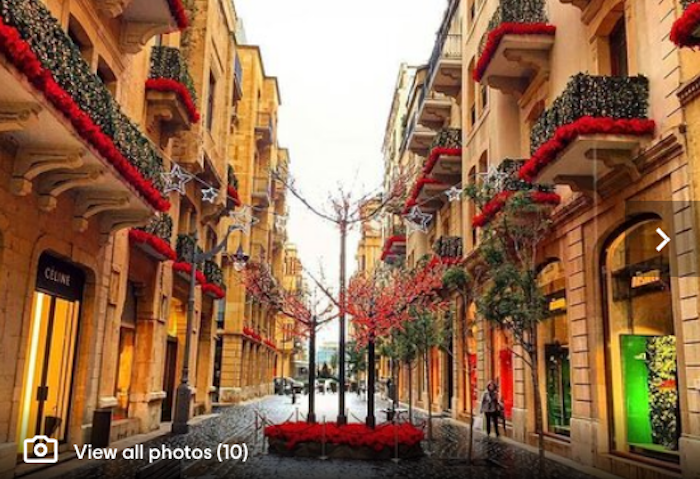
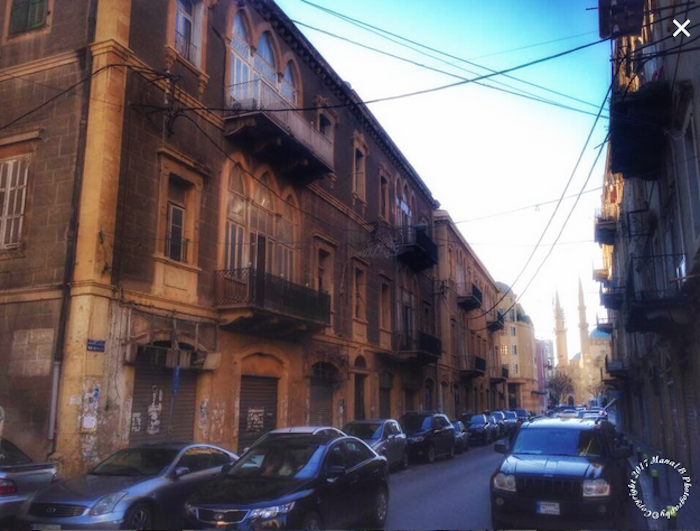
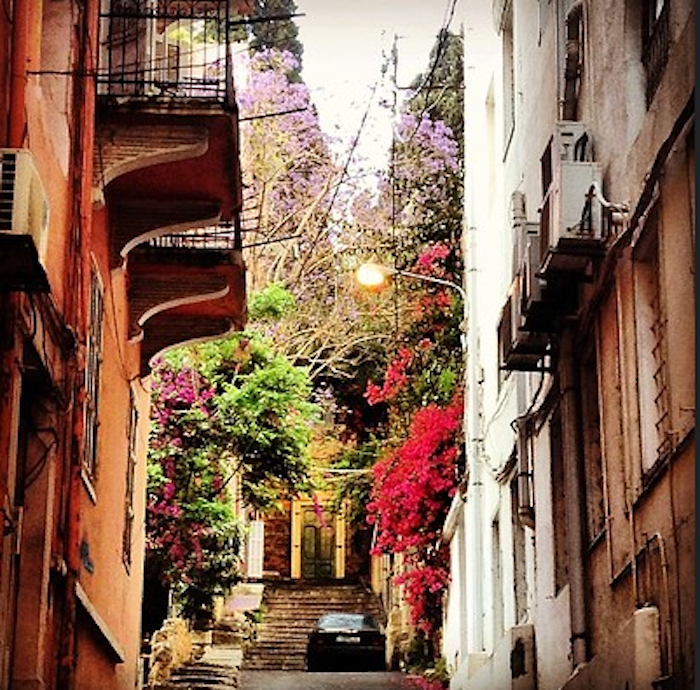
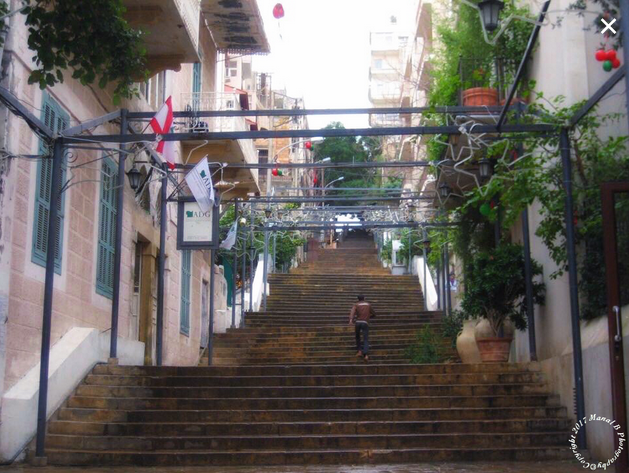
Paris of the Middle East

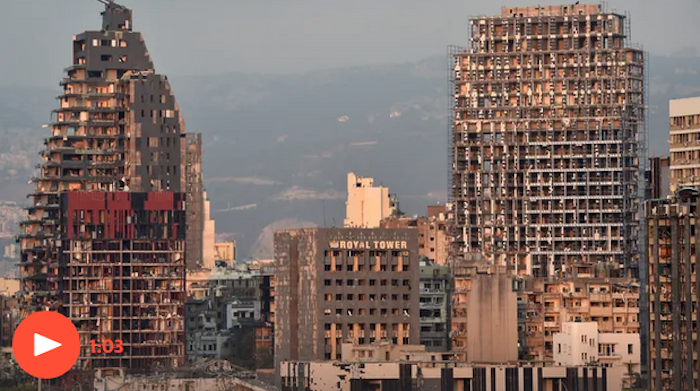
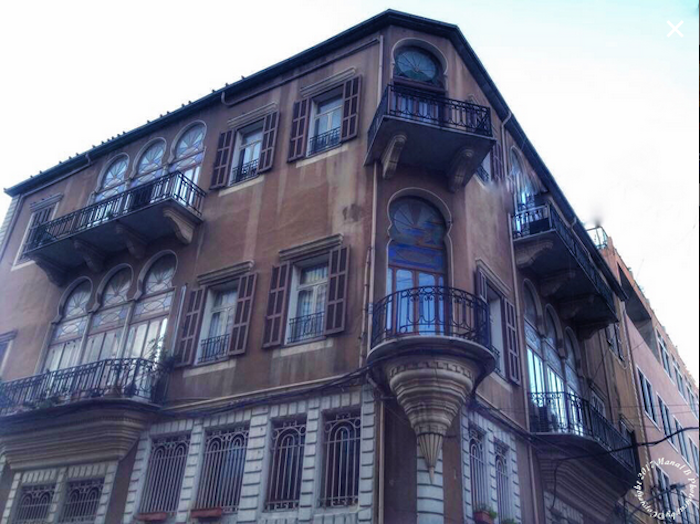
Two towers in Beirut with damage from last week’s port explosion.

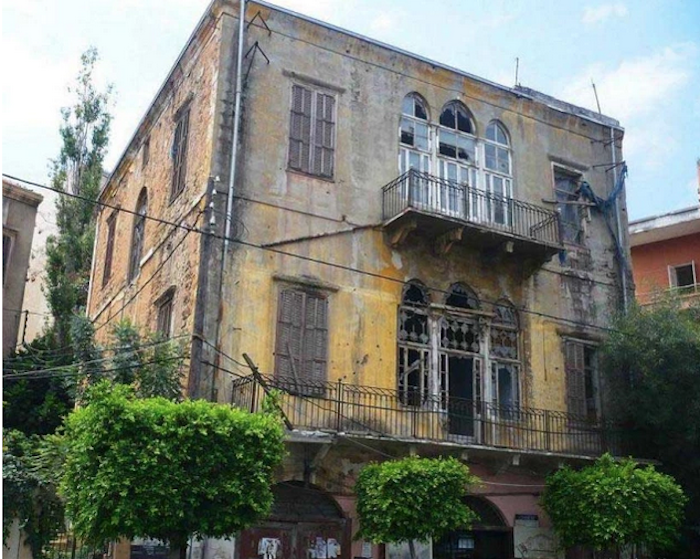
It’s been several decades since Beirut was commonly known as the Paris of the Middle East. The recent explosion, which devastated the port and wreaked serious damage on nearby central areas of the city, only adds to its problems – which seemed already to be reaching a crescendo – and sets back efforts to revive itself as a place where normal life can be led. The blame, or most of it, for both the explosion and the difficulty of Beirut’s revival may be laid at the doorstep of the terror organization Hezbollah and its puppeteers in Tehran. They stepped in to prevent peace from reigning after the end of the nation’s disastrous 1975-1989 civil war. That Lebanon’s society has not collapsed, yet, may be thanks to the resilience of the Lebanese, who have learned to weather history’s calamities. It may be that Beirut’s historical beauty contributes to their desire to live life.

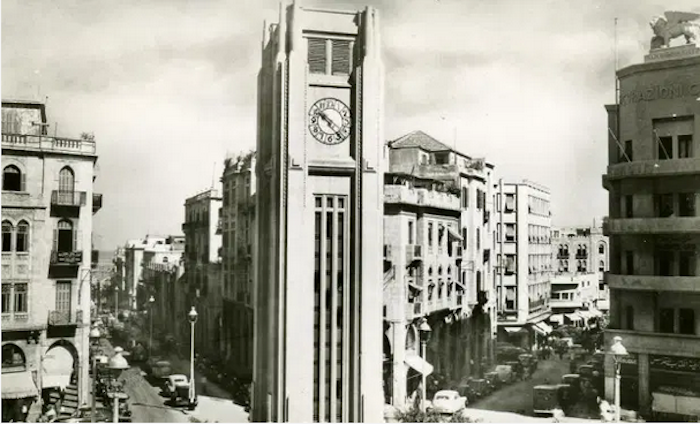
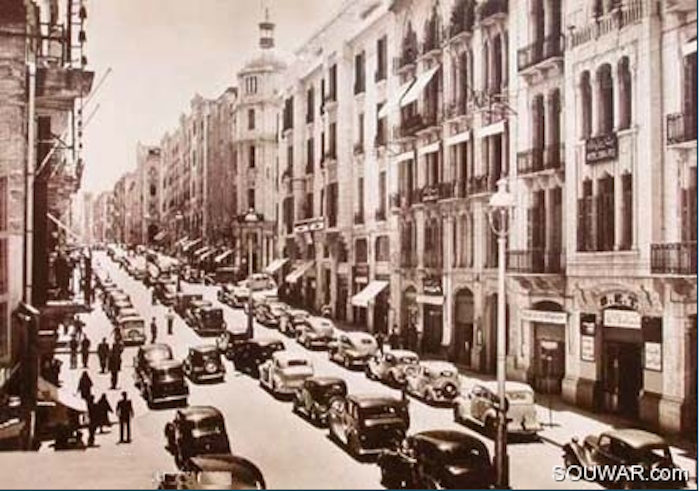
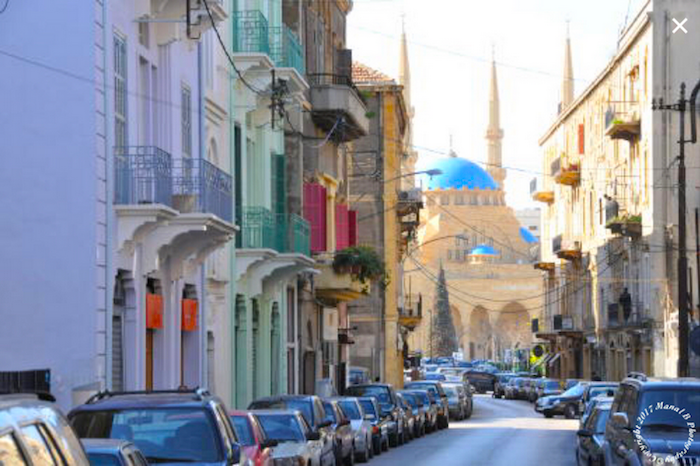
This post is dedicated to that beauty and to what hope remains that Beirut’s status as the Paris of the Middle East can, in time, be resumed. The photo that introduces this post shows damage to towers of relatively recent vintage. Below are old shots of historic Beirut, then more recent such shots, especially in the chic Gemmeyze district, some of which show damage either recent or going back to the civil war.

Posted in Architecture | Tagged , , , , , | 2 Comments

Creative capitulation in Prov

Screen Shot 2020-08-11 at 7.56.34 PM.png

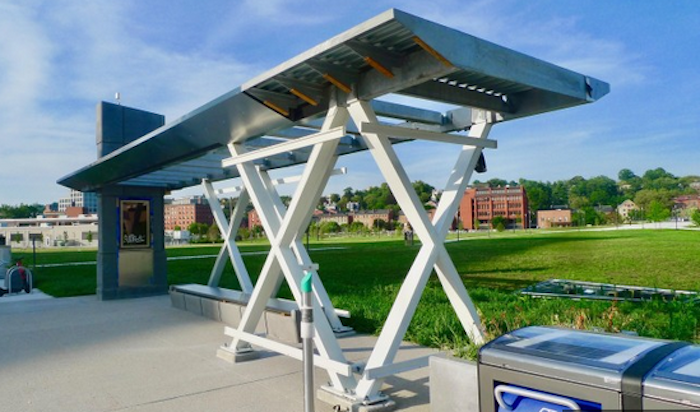
One of two bus shelters newly installed in Providence’s innovation district. (William Morgan)

In recent decades, art in Providence has served as a wrecking ball aimed not just at beauty but at the very concept of art, in a city that depends on art for its historical character, even as it brands itself the “Creative Capital.”

Screen Shot 2020-08-11 at 7.56.13 PM

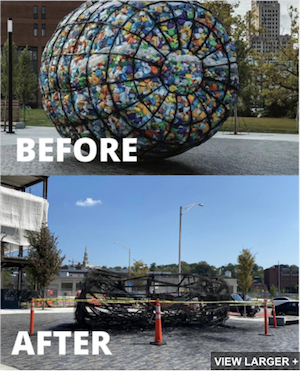
Ill-fated sculpture. (GoLocalProv.com)

Two news items: First, the R.I. Department of Transportation recently installed a pair of bus shelters in Providence’s “innovation district” that frankly look more like instruments of torture than items of street furniture. They are not really bus shelters; they are works of art. The last thing their designers want is for people to think they are a pair of measly bus shelters. The second news item is the destruction by fire, widely believed to be arson, of a large public sculpture called “Like a buoy, like a barrel” that looks like a gigantic multi-colored hand grenade. Like the bus shelters, this actual sculpture is also in the innovation district, on Dyer Street at the recently completed Wexford Innovation Center.

It pains me to reveal how very minor is my disappointment at the fate of the buoy/barrel sculpture by artist Steven Siegel for The Avenue Concept, which supports the installation of sculptures and murals in the city. I cringe at the wanton destruction of any art, even bad art. It is an assault on my freedom as much as on theirs. Artists and their corporate sponsors are free to express themselves through art, and I am just as free to dislike and disagree with their work, yet am not free to exact vigilante justice against its existence on my own. I deplore what happened to “Like a buoy, like a barrel.”

I hasten to add that nothing on the website of The Avenue Concept suggests that it or Steven Siegel are in sympathy with the recent unpleasantness involving riots and the destruction of sculptures across America. But the art supported by the agency (and just about everyone else in the art world) has a very long pedigree, one which has seen art decline over a period of a century or more from works by artists of vast talent inspired by greatness, to what we have today – works done by people with little or no artistic talent, many of which appear to have been conceived and executed by kindergarteners, requiring little more than the chutzpah to bamboozle society into thinking that their tinkering constitutes art.

Perhaps this decline reflects the inevitable trajectory of democracy, but it can and should be resisted. It is being resisted today, feebly, in that a few excellent sculptors and other artists continue to create in the old way, with the support of an ever diminishing number of patrons and institutions dedicated to their works and livelihoods. No cities seem the least bit interested in commissioning sculpture by such artists.

Screen Shot 2020-08-12 at 1.25.12 PM.png

Artist unknown to me.

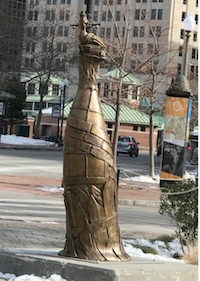
I personally have resisted for years, writing, for example, to name just two Journal columns that pop to mind, about bad art commissioned for the Rhode Island Convention Center, such as “Cavorting Inanity” (my title) on the facility’s garage, and the ugly temporary sculptures installed on downtown’s Parcel 12 before a hotel was built. Nevertheless, I praised sculptor Gillian Christy’s leaves twining up a West Side mill chimney and her pleasing “watch tower” on Kennedy Plaza, to suggest that talented sculpture emerges even amid the ilk of today’s aesthetic miasma. After a stay of a year or so, for example, the not regrettable (albeit not comprehensible) sculpture at left recently disappeared from near the Biltmore Hotel on Kennedy Plaza. Many of these new-age works seem meant for merely temporary placement – perhaps a hint of self-awareness?

Again, the decline of sculpture, not to mention statuary, may have been inevitable in a democracy. But opening the doors of art to vastly more individuals did not need to require inviting such a steep degradation of artistry to inhabit its halls. It’s hard to imagine art becoming much more debased than it is. Eventually, everyone who wants to be an artist will find no obstacle to being one. Lost in the process will be the honor and distinction society has long placed on the heads of artists. Some of this is already gone. How can the historic role of the artist in shaping our culture survive this comedown? How long can the culture survive?

Screen Shot 2020-08-12 at 6.53.44 PM.png

Bus shelter at Kennedy Plaza, removed after a 2014 “upgrade.” (WJAR)

We are starting to see some answers to these questions in the news. The work of creative artists enables the designers of bus shelters to suppose that they have a higher calling – bus shelters as art! It’s becoming more difficult to distinguish a bus shelter from a work of art. And it’s becoming more difficult to tell an artist from the computer technician who designs the bus shelter. This is not a Providence phenomenon, far from it; you can see it happening all over the world. It is difficult to tell the president of a charitable foundation from a director of a neighborhood nonviolence cooperative. It is hard to tell a protester, let alone a mostly peaceful protester, from a rioter: an impossible task, apparently, if you are journalist. Plumbers, say, have not yet been bitten by the bug, but it’s only a matter of time before plumbers start to believe that their work, properly conceived, is as creative as a work of art. Then, perhaps, we will all notice that the nation is in trouble.

Art once told the American story so that every citizen could understand it at the most basic level. Nowadays, professors of art don’t understand great art and nobody understands art as it is practiced today. As in architecture, when a building evades comprehension, the public gives it a wacky nickname, say, a common kitchen utensil, such as the Cheesegrater in London. Similarly, I would not be surprised if the torched sculpture in Providence goes down in history as the “hand grenade” or if the public starts calling the city’s new bus shelter design “The Rack.”

This all makes dialogue and understanding more difficult at all levels, and throughout society, with mayhem and chaos the intended result. Which is certainly not the vision of The Avenue Concept, at least not intentionally. But there are people out there who are watching and applauding the decline and fall of art and almost everything else. As the city with, arguably, the most artful historical character in the U.S., Providence has the most to lose if this continues. And it is speeding up, not slowing down.

Posted in Architecture, Art and design, Providence | Tagged , , , , , , , | 12 Comments

Gehry Ike in its kitschy glory

Screen Shot 2020-08-07 at 11.38.46 AM.png

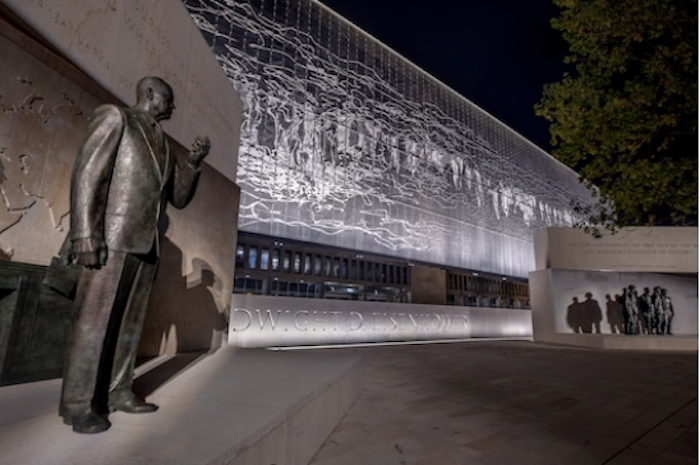
Recent view of completed National Eisenhower Memorial. (Evelyn Hockstein/Washington Post)

Frank Gehry’s monument to hims– oops, I mean to Dwight Eisenhower, does not open to the public until this Sept. 18, pushed back by the pandemic from May 8, the 75th anniversary of his victory in the European theater of World War II. Even if it does open then, it should never have opened at all. Donald Trump should have canceled it upon becoming president, before ground was broken later that year. There’s no love lost between him and Gehry, so what ever happened to the Donald’s mile-wide vindictive streak?

Not that all hope is lost. The cancel culture, in the person of our priceless iconoclasts who topple statues regardless of any link to the America they detest, is sure to come for Ike. As our 34th president, he barred gays and lesbians from the federal workforce. He cozied up to dictators and even staged a coup against one. Anyway, who cares what Ike did? He is a dead white male. Deplinth him, or leave him be, whatever. Gehry’s memorial knocks Ike down and dishonors him just by existing.

Where is Trump? Do your job!

I have probably written more columns and blog posts on this memorial than any other topic outside of Providence. I grew up in Washington, its classicism is in my blood, and although I acknowledge that today’s District of Columbia is already marred by an overabundance of modern architecture, I instantly considered Gehry’s Ike design a personal insult. His first effort to invade the nation’s capital was an addition, rejected, to the Corcoran Gallery, near the White House and where as a boy I took an art class. I admire the work of the National Civic Art Society in its steadfast opposition to the Gehry Ike, which almost succeeded. My writing on the issue is accurate but I make no claim to objectivity. Gehry is a menace and an abomination, and there is no better proof of this than his adoration by the vast majority of architecture critics, that ridiculous herd of independent minds.

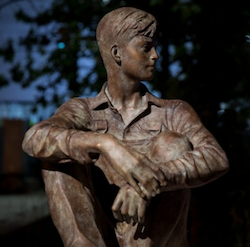
For example, Philip Kennicott’s “The new Eisenhower Memorial is stunning, especially at night,” in the Washington Post, is Gehrian in its absurdity. The piece is almost as wacky as Gehry’s design. That design features a metal scrim “tapestry” of the Normandy beaches as they look today; two larger-than-life-sized statuary groupings that depict his generalship and his presidency; and a life-sized statue of Ike himself as a boy sitting on a wall and looking forward – we are to imagine – to his accomplishments. The memorial is surrounded by the most tedious environment of bureaucratic modernism “with few lovable features,” as Kennicott puts it.

Oddly, after that admission he describes that setting as a “nice surprise”:

The architecture of the surrounding buildings, including the Air and Space Museum and the National Museum of the American Indian, has an appealing unity. The stone color is similar, and there are common elements in some of the design vocabulary. The benches and planter boxes, hard-edge and scrupulously modern, could easily wander off-site and live happily at either of the two museums that face the memorial.

A charming literary device, but it is tough to imagine the memorial’s benches and planters seeking shelter among buildings “with few lovable features.”
Screen Shot 2020-08-07 at 8.37.24 PM

Little Ike (Hockstein/WP)

The entire memorial is an exercise in modernist kitsch, especially Little Ike. The statue groupings are taken from famous old photos of Eisenhower talking to the troops before D-Day and talking with three men in the Oval Office. In a more conventional classical monument these relatively bland groupings might speak to Eisenhower’s greatness, but in the context of the huge tapestry and the cockeyed blockishness of the walls against which the statuary groupings are set, the sculptures may actually rival Little Ike in sentimentality.

Gehry had a hard time figuring out how to soak the Little Ike trope for every centimeter of its potential cringeworthiness. At first, Little Ike was supposed to be the boy looking forward at the achievements of the man. Then Little Ike was purged from the memorial. Finally he reappeared, not as the boy but as the man’s memory of the boy. Is there a plaque at the memorial where this confusion is straightened out for the understandably baffled public? I don’t think so. As they say, any joke that requires explanation falls flat.

The funniest part of Kennicott’s piece is unintentional. If it were written with a critical, mocking eye instead of with drooling admiration, it could be said to use repeatedly a form of Latin humor called litotes. Litotes is defined as an “ironic understatement in which an affirmative is expressed by the negative of its contrary – e.g., you won’t be sorry, meaning you’ll be glad.” (Sorry. I learned about litotes from a buddy in college and have waited my entire career for an excuse to use it.)

Kennicott’s description of the site’s surrounding architecture as having “few lovable features” is a great example of litotes. The tapestry, he writes, “isn’t entirely successful.” Its image of today’s Normandy beaches “isn’t easily legible.” The image’s abstract style is “a little less disappointing” in daylight. (That’s because by day you perceive it as just a fence rather than a work of art.) If you read these examples of litotes with a tone of amusement at Kennicott’s attempts to minimize the tapestry’s failures, it is not just funny but revealing. His real meanings are: “has no lovable features,” “is entirely unsuccessful,” “is impossible to understand,” and “a total disappointment.” Now you have an accurate description of the whole memorial. Of course he can’t admit that. After all, he is part of the memorial’s Praetorian guard.

Kennicott’s reverence for the Gehry style emerges in his description of how the architect articulates the Normandy beaches:

“In the end, Gehry sketched the cliffs at Pointe du Hoc freehand, in his characteristic drawing style — a herd of frenetic squiggles, like a jazzy, elongated Rorschach blot.” Of course it looks nothing like what it is intended to depict. Originally, Gehry had proposed the Kansas landscape as the subject of the tapestry. (“What Kansas landscape,” one might ask.) This didn’t exactly thrill the Eisenhower family, who wanted to highlight Ike’s accomplishments (D-Day), not his beloved wheat fields. “Changing the design … was crucial to convincing the family to support the memorial,” writes Kennicott.

The behavior of Ike’s family during the long debate over his memorial was deplorable. First they were against it, rightly so, arguing for a modest statue more fitting to his character. Then, near the end, in the face of Eisenhower’s famous dislike for modern art, they pulled a surprising switcheroo to support the design. The family’s failure of will is emblematic of the cascading failures of will in our nation’s current refusal to defend its own culture. Unwittingly (it may be hoped), Ike has been betrayed by his family.

Kennicott wisely celebrates the Gehry memorial at night. By day, its flaws are obvious. By night, they are whitewashed by the science of illumination. So why not turn off the lights? Its attack on democracy dies in darkness.

Gehry’s architecture is all about chaos. He once told a biographer: “Life is chaotic, dangerous, and surprising. Buildings should reflect that.” This total absurdity perfectly reflects the current moment of toppled statues, antifa riots and cancel culture. Eisenhower as general and president valued orderly management, not the “team of rivals” style of other leaders, such as Lincoln. So Gehry’s design for the Eisenhower memorial flouts not only his personal modesty but the character of his leadership and manhood.

Gehry’s memorial does not twist and turn as most of his buildings do, but it does intentionally reject traditional memorials. In rejecting traditional memorials he rejects tradition, and in rejecting tradition he rejects the founding fathers’ vision to pursue the nation’s ideals by acknowledging failures and seeking their correction. Instead, Gehry sows ugliness and confusion. He seeks to assist in the radical project now under way not to improve but to destroy America. He was born a Canadian and is said to be a genius, but, to be charitable, maybe he does not really understand the role he plays in architecture and the destructive role his architecture plays in the life of his adopted nation. His Eisenhower memorial is abominable because his work is abominable, and his work is abominable because, let us say, he himself is not entirely praiseworthy. (An example of litotes.) Not long ago he stated: “98 percent of what gets built today is shit.” Precisely, and he shares much of the blame. It is time for him to retire his warped T-square.

Posted in Architecture, Art and design, Preservation | Tagged , , , , , , , , | 6 Comments

Notre-Dame: Copy the past

Screen Shot 2020-08-03 at 5.00.48 PM.png

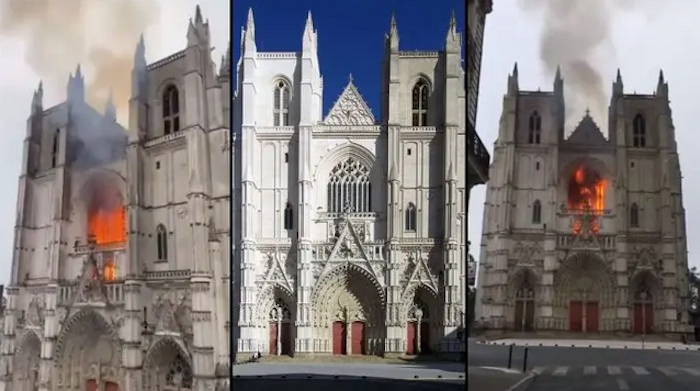
Flanking photos show fire set July 18 at Cathedral of Sts. Peter and Paul at Nantes, in France

It seems as if French President Emmanuel Macron has turned totally about on designing the restoration of the Cathedral of Notre-Dame after its fire of last year. After the conflagration he called for a modernist rebuild. About a year later, the French senate said no way, and he has recently folded his tent. Good for him. The lost spire, especially, will be rebuilt not only in its original style (during the restoration by Voillet-le-Duc in the 19th century), but, as best they can, with original materials.

This is very good news. Macron gave way probably because he foresaw that the international design competition might add years of controversy to the project, which he wants completed by 2024, in time for the Paris Olympics. In fact, if experts are correct (a very big if), the renovation may take at least a decade or two, in part because some 400 specialized masons, carpenters, etc., must be trained. But it may not be so long for the structure to be sufficiently stabilized and repaired that visitors can be allowed inside.

This is mostly great news but it arrives amid bad news, news that is possibly worse by a considerable margin. Two weeks ago fire struck the Cathedral of Saint Peter and Saint Paul at Nantes, near the Bay of Biscay, begun in 1434. The damage was less severe than at Notre-Dame, but its organ was consumed and its stained glass windows ruptured. The blaze is believed to have been arson, with fires set in three places. A Rwandan refugee volunteer at the building was picked up, released, then confessed. Worse, other French churches are being vandalized, and it appears to be anti-Catholic in motivation. (Of course, anti-Semitic crimes continue apace.)

Neither in Paris nor in Nantes has motivation for arson been established – at Notre-Dame arson itself has been denied. Some or all of this rash of violence may have roots in the same political radicalism evident in the riots that have torched parts of major American cities and toppled statues, including many with little or no connection to police brutality. Twitter comments originating in France strongly suggest a radical motive:

Another element active in Nantes, the far-left, appeared to celebrate the incident. A self-described anarchist wrote on Twitter “Je bois les larmes de cathos au réveil. 150 nouveaux abonnés en 24h. Vivement la prochaine église en feu.” (“I drink Catholic tears when I wake up. 150 new subscribers in 24 hours. Can’t wait for the next church to burn down.”) and “#Nantes La seule église qui illumine est celle qui brûle” (the familiar anarchist phrase “the only church that illuminates is one that burns.”).

Not pretty.

Speaking of such ugliness, and its antithesis, beauty, three cheers for the French authorities, who at the very least have reflected the feelings of the French people. A largely undeclared but powerful motive for repairing and rebuilding cathedrals and other memorials as they were originally designed or as glorified in the popular imagination is for the forces of tradition to push back against asinine soi-disant “philosophes” of both nationalities. As the French general at the Battle of Verdun declared, “They shall not pass!”

Posted in Architecture, Preservation | Tagged , , , , , , , | 3 Comments

History as cottage industry

Screen Shot 2020-07-29 at 2.55.25 PM.png

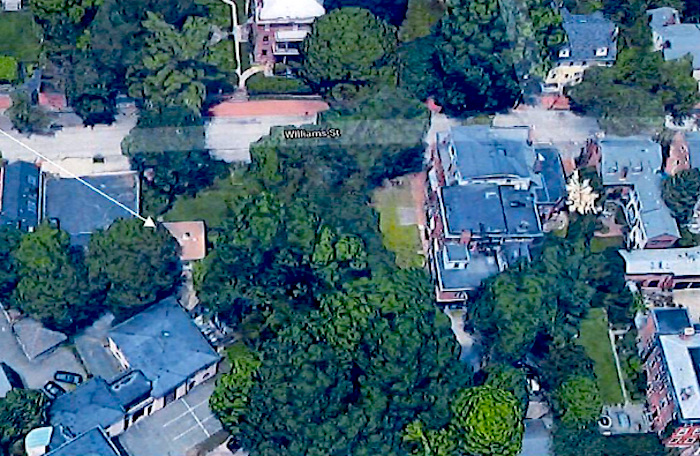
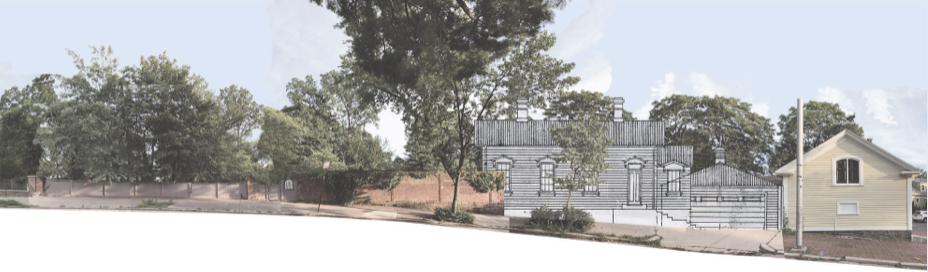
Project area between Williams and John streets, in Providence; arrow points to cottage. (PHDC)

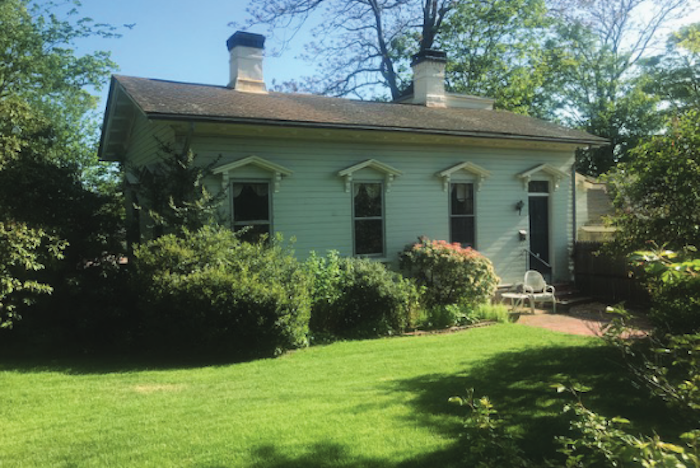
Monday’s meeting via Zoom of the Providence Historic District Commission surprised observers by delaying an expected vote to approve the relocation of a historic Italianate cottage on Williams Street, on College Hill. This was the second straight delay. That does not mean a project that neighbors oppose will be abandoned. But it does raise some questions about history.

How does this cottage fit into the grand sweep of Providence history? It depends on an infinity of historical details, not many of which are definitely known. The little cottage sits in a deeply historical neighborhood. Some opponents of the relocation do not object so much to the new siting – the cottage had been moved to its current location some 130 years ago – as to the fact that moving the cottage yet again will open the door to a vague plan for additional houses behind the cottage, spoiling the neighborhood’s historical character and sacrificing one of College Hill’s oldest and largest woods.

I sat in on parts of the PHDC meeting and heard some real nitpicking from commissioners who, I had heard, were largely unopposed to the proposal at a June 22 meeting (where the larger plan was delayed). One after another, they objected to its proximity to the street, to the profile of the roof line of the new addition, to the way the new foundation would crowd the roots of a tree, and to how the new foundation would lift the cottage too high above street level. These and other generally picayune objections – voiced more sharply than they might be if the commissioners were still on board – hinted at trouble. Shortly afterward, the PHDC did indeed vote to delay.

So what happened? Did the objections to the relocation mask new feelings about the larger development? Was the commission influenced by the large attendance at the Zoom meeting by neighbors – 25, excluding those said to have been unable to log on? Was there a battle in some commissioners’ minds over whether to heed the regulations, as required, or to hesitate on behalf of some more important issue that was unstated?

The developer will return to the commission after tinkering with the cottage. Most likely, the commission will approve the relocation and then, in time, approve new townhouses behind the cottage on proposed subdivided lots where the woods are today. This is the fate suggested by the grand sweep of Providence history, with more erosion of its historical character doomed to follow, leading, as it has in the past, to further decline in the city’s beauty, its quality of life and its long-suffering economy.

Yet, notwithstanding the minor details of a minor proposal to relocate a small but enticing cottage, perhaps a shift in the grand sweep of local history can be detected in the commission’s vote. It is all the rage now to exaggerate the influence of the coronavirus pandemic on every aspect of human life. Online collections of published articles in the field of architecture, such as ArchNewsNow.com, are almost exclusively devoted to how building and city design must change to meet the needs of Covid-19 far into the future. Many of these articles declare that all new houses must have home offices, and indeed Friedrich St. Florian, designer of the townhouses projected to go up behind the cottage on Williams Street, says they will have home offices, too, as will the cottage itself, by way of the proposed addition.

But suppose the market for home offices is offset by a market shift caused by a popular desire for less population density in cities like Providence? Maybe the existing woods seem more valuable for both the neighborhood and the city than before the pandemic. That could turn the grand sweep of history around. Maybe a conscious or unconscious recognition of that possibility can explain Monday’s PHDC vote to delay its approval of the relocation of the cottage. Or maybe not. We must wait and see.
Screen Shot 2020-07-29 at 3.01.32 PM

Small Victorian cottage whose relocation was at issue in Monday’s PHDC meeting. (PHDC)

Posted in Architecture, Development | Tagged , , , , , , , , | 5 Comments

Speak for history on Monday

Screen Shot 2020-07-26 at 7.47.21 PM.png

Set into photograph is a sketch of the proposal to relocate 59 Williams St. cottage. (PHDC)

The Providence Historic District Commission will meet tomorrow, Monday, July 27 at 4:30 p.m., via Zoom, to decide the fate of Providence.

That does not overstate the case. If the commission approves moving the historic cottage at 159 Williams Street, on College Hill, it will have opened the door to destroying not just this historic neighborhood but any of the city’s most venerable districts. The seemingly innocuous relocation of the cottage would make room for a more modern-style development. Yes, many buildings are far more historical than the cottage, but this neighborhood was built just as the nation was winning and consolidating its freedom. If it is not sacrosanct in a city so dependent on historical character, the city will already have thrown its fate to the wind. Let developers tinker elsewhere.

In what seems to be a conciliatory gesture to neighbors who feel overlooked by the PHDC process, the commission postponed voting on this at its June 22 meeting and cleared its agenda for tomorrow (Monday, July 27) of all items except that pertaining to the cottage. Commission staff prior to June 22 recommended approving the relocation as consistent with regulations, but the full commission need not obey the staff. Not too long ago, the City Plan Commission overruled its staff’s support for the Fane tower in the I-195 corridor. City commission members have a duty to take the city’s broader well-being and future into account.

The Monday meeting cannot be attended in person but may be attended via Zoom or by phone hookup. To connect with Zoom, click on https://zoom.us/j/97057854485; You may hook up by phone by dialing 1 888 475 4499 and typing in the pin number 97057854485. To speak, sign up at the Zoom site after you’ve logged in. Just as important is for people to send their opinions to the commission’s Jason Martin. His email is jmartin@providenceri.gov. To be most effective, keep it brief and to the point.

I wrote at greater length about this development on my blog July 12 in “Subdivide history? Bad idea.” Please feel free to use any part of it with or without attribution if you want to speak at the meeting or email your opinion to the commission. Information from the PHDC staff on the cottage agenda item may be seen here.

Posted in Architecture, Preservation | Tagged , , , , , , , | Leave a comment