Tradition vs. modernism

Screen Shot 2020-07-23 at 2.45.59 AM.png

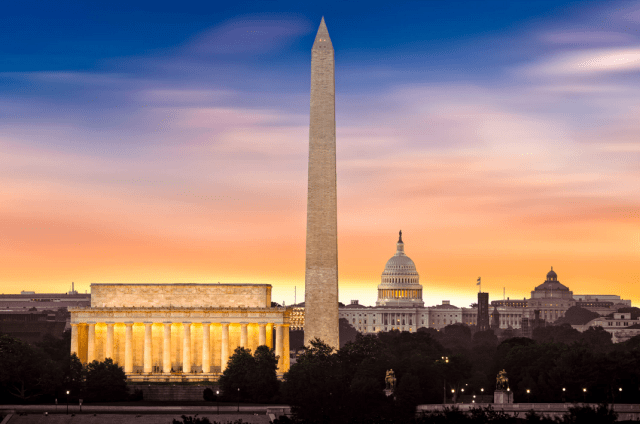
Some of the monumental classicism of the Federal City, in Washington, D.C. (Capitol Hill Hotel)

Bring it on.

Legislation has just been introduced in the U.S. House of Representatives to block a proposed executive order that would replace a mandate favoring modernist styles for federal buildings with a new and better mandate favoring traditional styles.

The bill, H.R. 7604, introduced by Rep. Dina Titus (D-Nev.), is called the “Democracy in Design Act” and would “ensure that the construction and acquisition of public buildings in the United States adheres to the Guiding Principles for Federal Architecture.” The reference is to guidelines written in 1962 by Daniel Patrick Moynihan, which state that “an official style must be avoided.” His warning has been ignored for 58 years. An official style already exists. The proposed executive order, “Making Federal Buildings Beautiful Again,” would replace it with another official style, one that is more popular and more in keeping with the principles and ideals of the nation.

The legislation has been endorsed by the American Institute of Architects, the chief organizational arm of the field of architecture. The best thing in the AIA’s endorsement is its description of the proposed executive order as “anticipated.” A brief article on the bill in the Architectural Record used the word “expected.” Let’s hope so! It has in fact not even been signed but was leaked to the press in February, sparking a brouhaha among architects. The pandemic sunk a lively debate on the issue, but the legislation proposed on July 13 sets the stage for a resumption of festivities.

Picking up on the title of the act, the AIA statement praised Congresswoman Titus for “taking the first steps toward a more democratic approach to federal architecture.” It was a devious assertion, quietly suggesting – or rather admitting – that the federal design process has been less than fair. That would be the understatement of the week. It has been estimated that since 1962 only one of every hundred federal buildings designed under the Moynihan guidelines has been traditional in style. In fact, since traditional architecture is preferred by the vast majority of the public, you might expect a truly democratic process to reflect this. On the contrary, modernism is still regarded after a century with skepticism by most people, a failed experiment in building design and city planning, not to mention beauty.

The AIA asserted that the legislation “will ensure the federal government maintains its current neutrality on architectural styles.” What a joke! Of course, there is no such neutrality. The executive order would not maintain a nonexistent neutrality but would mandate styles preferred by the public instead of by the architectural elite. In a democracy, public taste should play a role in the design process. Under the executive order, bogus neutrality would give way to a genuine diversity of style marked by true fairness.

Representative Titus seems to be in dire need of cosponsors for her bill. The AIA has sent out a mailer asking members to urge their congressmen to sign on to the bill. The brief mailing summarizes all of the disingenuous talking points in the AIA endorsement, its press release in Architectural Record, and in the congresswoman’s statement about her bill.

Washington and Jefferson chose Greco-Roman classicism to reflect the new nation’s ideals. With an astonishing variety of styles, their choice worked perfectly for more than 150 years. The pillars of tradition spoke to we the people in clear terms widely understood, and for the ages. Modernism has offered no language to appeal to patriotic sentiment. A powerful, eloquent architectural language that speaks for all is what the executive order would re-establish, and that is what the title of the “Democracy in Design Act” seems to imply. But it is a lie.

Trump has recently proposed an executive order to protect statues. Good idea! Maybe the reply from Congress will be a “Democracy in Sculpture Act” to ensure that future statues and memorials be of abstract modernism. Let us all enjoy such blessings as Frank Gehry’s ugly Eisenhower memorial, which seems meant not to honor our 34th president but the memorial’s ridiculous architect. There was a popular uprising against it, but the establishment closed ranks and rammed it through. Its May opening was delayed by the pandemic, but has been rescheduled for September. Ike has just a couple months before it is his turn to start spinning in his grave.

Even Senator Moynihan, were he still alive, might by now be having second thoughts. In 1970, eight years after his guidelines took effect, he wrote:

Twentieth-century America has seen a steady, persistent decline in the visual and emotional power of its public buildings, and this has been accompanied by a not less persistent decline in the authority of the public order.

The official design mandate that Moynihan unwittingly created in 1962 has been precisely the failure many people predicted – corrupt in its aesthetic values and responsible for corrupting American cities in uncountable and unfathomable ways, and uglifying the built environment. The American public has suffered too long. It’s way past time for change.

So it is to be classicism vs. modernism at last, and this could not be a better time to hold a national debate over architecture that reflects many of the broader issues that America faces as she heads into a presidential election.

Bring it on.

Posted in Architecture | Tagged , , , , , , , | 3 Comments

R.I.’s State House in noir

Screen Shot 2020-07-19 at 2.31.04 PM.png

Still shot from opening scene of the 1941 film High Sierra. (Warner Bros.)

Imagine my surprise at seeing, last night, the Rhode Island State House in the opening scene of High Sierra,  the 1941 film in which Humphrey Bogart is pardoned. He shortly after plans a heist in the Sierra Nevada mountains. Rhode Island’s star turn lasts but seconds, cast in noir as befits the film. The very next shot depicts some other “state capitol” entrance in high classical style, then the “Office of the Governor” and then the pardon being signed from over the governor’s shoulder. In 1938, the year the film takes place, that governor of Rhode Island would have been Robert E. Quinn, the two-term successor to Theodore Francis Green, hero of the “Bloodless Revolution” (the capture of the state by Democrats after decades of Republican rule). But in fact an actor plays the governor of Illinois, not Rhode Island. Bogart leaves “Mossmoor Prison,” in Chicago. Bogart got second billing to Ida Lupino.

I always rejoice when I happen upon a Bogart film that I’ve never seen. High Sierra opened with a cherry on top. Here is that cherry:

Posted in Architecture, Video | Tagged , , , , , , | 1 Comment

E.O. to protect the statues

Screen Shot 2020-07-16 at 11.11.37 PM.png

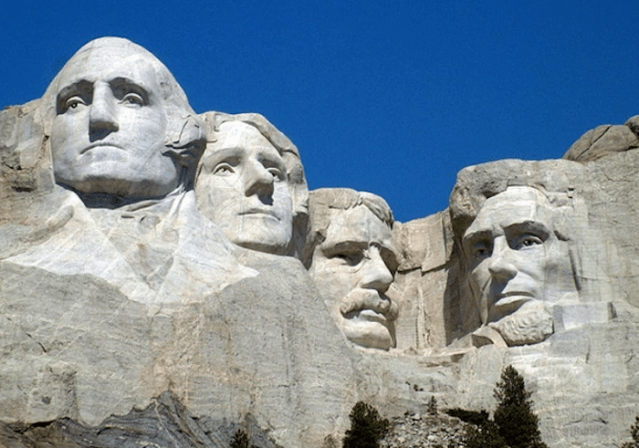
Mount Rushmore, memorializing Washington, Jefferson, T.R. and Lincoln. (Daydream Tourist)

After he spoke at Mount Rushmore to celebrate Independence Day, Donald Trump signed an executive order to protect public statuary, to reconstruct statues damaged or destroyed by vandals in the weeks leading up to the president’s oration, and to create a National Garden of American Heroes. The E.O., “Building and Rebuilding Monuments to American Heroes,” stated:

[M]onuments express our noblest ideals: respect for our ancestors, love of freedom, and striving for a more perfect union. They are works of beauty, created as enduring tributes. In preserving them, we show reverence for our past, we dignify our present, and we inspire those who are to come. To build a monument is to ratify our shared national project.

That passage, intended to describe federal statuary, could be dedicated with equal profundity to federal architecture. A great monument can be a statue or a building.

In fact, the executive order on statuary arises in the aftermath of a related and more ambitious, more controversial executive order, “Making Federal Buildings Beautiful Again,” that has not been signed as yet but which has principles in common that connect the pair of E.O.s to each other. The first order, which was leaked, causing a brouhaha among architects in February, stated that classical architecture would be preferred for federal buildings over the modernist designs that have been mandated officially over the past half century. Recognition of the importance of stylistic choice has now also been incorporated into the E.O. on statues, which states:

When a statue or work of art commissioned pursuant to this section is meant to depict a historically significant American, the statue or work of art shall be a lifelike or realistic representation of that person, not an abstract or modernist representation. … Such works of art should be designed to be appreciated by the general public and by those who use and interact with Federal buildings.

This preference for statuary and monument design that is legible to the general public is reiterated in sections of the executive order relating to new statuary commissioned for the Garden of Heroes and also in sections on the reform of statuary principles. The task force assigned to administer the E.O. would incorporate its aesthetic principles into a host of federal agencies, including the National Endowment for the Arts, the National Endowment for the Humanities, the General Services Administration (which oversees all federal architecture), and the Advisory Council on Historic Preservation.

The order suggests these aesthetic reforms at the federal level might generate pushback from the professional busybodies of the American Institute of Architecture, which was so upset by the E.O. that proposed regulatory change in the design of federal buildings. “[R]evisions made pursuant to this subsection,” said the statuary E.O., “shall be made to supersede any regulatory provisions of AIA that may conflict with or otherwise impede advancing the purposes of this subsection.”

Good.

Both of these executive orders, the first as yet unsigned and the second signed on July 3, should be seen as two sides of the same coin. Not only does federal statuary cry out for aesthetic reform but so do federal buildings. Art and architecture were once dedicated to each other, wrapped in each other’s arms. Modern architecture threw Art out of the Garden of Beauty. Perhaps on some not too distant tomorrow, they can be repatriated to each other.

Posted in Architecture, Art and design | Tagged , , , , , | 3 Comments

Subdivide history? Bad idea

IMG_1109

Small cottage slated for relocation at proposed Fox Point subdivision, Providence. (Photo by author)

The first blocks of William and John streets off Benefit Street, where College Hill meets Fox Point, are steeped not only in history but historical character. Most of the houses on these and nearby blocks were built in the late 1700s and early 1800s, just as history was giving birth to our nation. Not much has changed on these blocks in Providence except for the vehicles at the curbs. This may be the most aromatically historical residential precinct in America. Its mostly small, neat, detailed, gabled houses huddle together along its old narrow streets and lanes, almost leaning in on each other as if aware that change is breathing down their necks.

It is. Be afraid.

To learn why, I joined some 20 others, mostly neighbors, on a side lawn at Carrington House, 66 Williams St., an 1810 mansion across from the site. Architect Friedrich St. Florian described pasteboard illustrations of the site that stretches over to John Street. A small, pallid, circa 1830 classical cottage in the middle of the block is to be relocated to the site’s edge on Williams and expanded. To move it, four garages are to be demolished. A 7,600 square foot “vacant lot” of woodland extending out to John Street is to be chopped down, even though the woods, virtually a wildlife sanctuary, have survived since as far back as the Federal period of U.S. history. Historic stone walls are, of course, to be breached. Two sets of attached townhouses designed by St. Florian (see below) and, at some as yet unannounced time, up to three more residences and garages, are to be built.

Screen Shot 2020-07-12 at 5.19.41 PM

Attached townhouses in 6 John plan. (Friedrich St. Florian Architects)

Those who know the architect for his design of Providence Place and his World War II Memorial on the National Mall might be comforted by his participation. But since those heady days of his career, he has built houses wildly out of character with the East Side, and recently has backed the outrageously tall and ugly Fane tower in the Jewelry District. His expansion and the relocation of the cottage appear reasonable enough, but this plan seems to be a Trojan Horse for the townhouses, which, while posing as traditional, seem quite something else. Each has broad segments of third-story gabled roofs that appear to hover without any support but one narrow chimney each.

“Far out!” one might exclaim.

Perhaps. But not for this part of town. If these were next to the proposed Fane tower, or if they were along some street whose character had already been degraded by other inappropriately styled new buildings, I might easily sigh and shrug my shoulders. Yet amid the living history of this ancient neighborhood, they would be far beyond out of place, quite disruptive.

There may be legal issues with this subdivision development, apparently including some approvals smacking of stealth. Neighbors have been caught entirely unaware at the brink of action on a plan actually in the development process for about three years. (And the city claims to abjure secrecy and favor transparency.) Yet it also appears that the development plan is allowable “by-right,” meaning that under current law the plan does not need exemptions that might have given neighbors more of a chance to fight it.

A Ward 1 city councilman, John Goncalves, argued sensibly at last Thursday’s meeting that the law needs to be changed. That cannot happen soon enough to stop this project, alas; but in addition to the legal track there is, absent a better word, the political track. Zoning law is where the rubber of democracy at its most local hits the road. A city whose future relies upon respect for its past needs civic leaders who, while understanding the inevitability of change, try to reduce its impact on historical character. In a city so rich in examples of the economic value of historical character, Providence is strangely lacking in such leadership, or even a basic knowledge of how economic development and historical character can work hand in hand.

But civic leaders won’t care if citizens don’t give them a reason to care. The neighbors must get in politicians’ face, as they did several years ago to block a subdivision of the Granoff estate that would have eviscerated Blackstone Boulevard. The momentum from that was not maintained a couple of years later to protect the nearby Bodell estate, but at least its developer did not plan to demolish its manor house. Soon after, a developer of the Nicholson-Beresford estate did want to tear down its mansion, but at the last moment a buyer was found; still, in a tragic theft of local character, a caretaker’s cottage even more deliciously romantic than the mansion was razed, and a cheesy initial house in yet another Blackstone subdivision was built.

These are just a few of the worst of recent attacks on the historic character of Providence. The Fane tower project remains a present danger. Teardowns of charming old buildings are making way for awful buildings throughout the East Side, where, according to St. Florian, the market is “sizzling.” If this continues, the allure of Providence will soon be “fizzling.”

These latest attacks on local character extend well beyond what’s happening on the East Side, beyond the Fane tower, beyond the snaggle-tooth Route 195 corridor, beyond the split trad/mod personality of Waterplace Park, all the way back to the failed modernist College Hill survey of 1959 and the failed modernist downtown plan of 1961. Local officials learned nothing from these failures, and have encouraged, to this day, only those development plans sure to damage the city’s historic character and undermine its brand, keeping its economy in a slump that has lasted almost three quarters of a century.

The only major Providence developments in recent years that push back against this trend were the late Bill Warner’s traditional design of the new waterfront and Buff Chace’s revival of downtown living by renovating (with advice from New Urbanist Andrés Duany) underused traditional buildings.

Fortunately, Providence has an incredible bankroll of historical character that can withstand slow erosion over decades. And so it has – but that won’t last forever. And it will erode faster and faster if such an obviously valuable parcel of heritage as the area between Williams and John is thrown under the bus. Before we realize it, Providence will have passed the point of no return. The beauty of Rhode Island’s capital has continually rescued a city beset by the same problems as most other once prosperous manufacturing centers that lack our beauty. But that won’t last much longer if our current planning plunge is not reversed: Goose. Golden egg. Don’t.

The Providence Preservation Society, which hosted Thursday’s meeting along with the owner of Carrington House, shouldn’t need to think about where it stands on this project. The society should be four-square against it. Change is inevitable, as even preservationists love to say these days. So yes, let the trees between Williams and John continue to grow. That really should be change enough. There’s already too much poorly controlled change elsewhere in the city. The best course by far is to leave this salubrious neighborhood alone. Its preservation will prove of incalculable value to the city’s future.

Screen Shot 2020-07-12 at 5.18.18 PM.png

Cottage sits to right of arrow. Woods to be razed. (Providence Historic District Commission)

Screen Shot 2020-07-12 at 5.46.39 PM

Carrington House, across Williams Street from proposed subdivision. (Rhode Island Monthly)

Posted in Architecture, Development | Tagged , , , , , , , , , | 9 Comments

A short history of closets

Screen Shot 2020-07-08 at 8.46.53 PM.png

From the Regiment “K-Venience” Closet Catalogue. “Trim as a Regiment!” (See link below.)

Nir Haim Buras, author of the newly published The Art of Classic Planning, has sent some fascinating comments on closet history to the TradArch list, under the heading “Classic Closets … Not.” Imagine living without the assistance of closets. Now, thanks to Nir, closets have come out of the closet. He writes:

***

Screen Shot 2020-07-08 at 8.55.21 PM.png

In ancient times, all of an individual’s belongings could likely be bundled in a cloth cloak or blanket and hoisted on one’s back or that of an animal. People who had more things likely kept them in chests, because those people also likely moved around quite a bit, including within their homes and between homes, seasonally chasing and avoiding the sun. Chests could easily be put on wagons or draught animals as well.

But there were also closets in the form of niches in walls. These often had shelves of stone or wood, and sometimes were enclosed by wood doors in wood frames that were attached outside the niches. Such is the case with Roman libraries, as I understand things.

From the Renaissance, when chests of drawers were placed on stands, to the 18th century, armoires became increasingly “functional” and useful. They had interior shelves, drawers, and places for hanging long dresses and cloaks. They were typically made of wood and likely held frequently used clothes or clothing that had been laundered and pressed. Armoires and closets were easy – and necessary – to perfume.

Built-in closets in late 19th century and early 20th century homes were small, but walk-in closets were more generous. The walk-ins held the out-of-season set of clothes and small closets in bedrooms just held some of the clothes being used, perhaps the more outer garments.

The coat closet at the front door is a diminution of a “mud room” or “boot room” where outdoor cloaks, coats, boots, and the bonnets and hats of guests, were stored and where boots were cleaned by the staff.

Remember that horse manure was piled 60 feet high in some cities (New York); and horse shit, ladies and gentlemen, was the actual beginning of modern planning.

The first planning convention in the world was convened around the topic of the worldwide gross excess of equine manure and its corollary, ground-up khaki-colored manure dust that coated everything, including the interiors of people’s lungs.

How did we get here from closets? – I told you that classic planning was holistic!!

***

Thank you, Nir! The most intense collection of curious information about houses and aspects of living you never really thought about can be found in At Home: A Short History of Private Life, by Bill Bryson. Seth Weine, a New York City literary sleuth when not working at the headquarters of the Institute of Classical Architecture & Art, tracks down books of interest to classicists, with links. He surely must have listed Bryson’s book noted above on one or another of his lists addressed to TradArch members. He also has just sent in some good thoughts on closets, which I reprint below, along with the pertinent link. He writes:

***

What were some of the earlier – at least last century’s – approaches to closet interiors, storage, and cabinets? Here are some answers (some of which are still clever enough, or well-thought-out enough, that you might want to consider using them today).

And you will have fun with this! [The link is at the end.]

Stowed Away: A Peek Into Closets of the Past

And who could not love a selection (which is included in the article) with this title:

The Shelving With Brains

What’s great about this article (and the series of which it is part) is that you can actually enlarge each of these catalogs, and then go through them, page-by-page.

An utterly fascinating resource.

And enjoyable.

https://www.architectmagazine.com/technology/stowed-away-a-peek-into-closets-of-the-past_o?utm_source=newsletter&utm_content=Article&utm_medium=email&utm_campaign=AN_070720&

***
But wait! There’s more! Where George Carlin Puts His Stuff.

Posted in Architecture | Tagged , , , , , , | 3 Comments

Lincoln vs. Jefferson

Screen Shot 2020-07-04 at 9.06.51 PM

The Jefferson Memorial, by John Russell Pope, on the Tidal Basin. (Wikipedia)

A comparison of the Lincoln and the Jefferson memorials is almost as fascinating, in some ways even more so, than a comparison of Messrs. Lincoln and Jefferson themselves. Since I can add little to the second conversation I will confine myself, on this Independence Day, to the first.

For reasons that will become clear, I am not including Washington’s nearby commemorative obelisk in this analysis of our dear nation’s most sacred monuments. Washington is the father of our country, while Jefferson and Lincoln, both beloved, still vie for No. 2 in the ranking of presidential fame. But their rivalry is not the reason their monuments are discussed herein.

Screen Shot 2020-07-04 at 9.10.43 PM.png

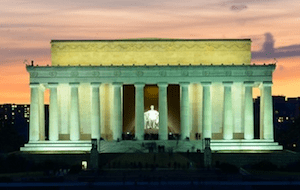
Lincoln Memorial (NBC/AP)

The Lincoln Memorial honoring our 16th president, Abraham Lincoln, heroic preserver of the Union, was completed in 1922. The Jefferson Memorial, honoring our third president after Washington and Adams, a founder of our nation and of the Democratic-Republican Party, and, of course, author of the Declaration of Independence in 1776, was completed in 1943. The design of Lincoln’s monument by the classicist Henry Bacon as a Greek temple was largely uncontroversial after the proposal for a more modest design, supposedly more in keeping with Lincoln’s character – a log cabin (much smaller, it may be presumed, and not of wood) – was rejected. Few changes to the original design were proposed. The statue of Lincoln by Daniel Chester French was doubled in size from 10 feet to 19 feet, so as to better fill the massive interior.

Screen Shot 2020-07-04 at 2.56.02 PM.png

The Lincoln Memorial arose at the west end of the National Mall, beyond a long, rectangular reflecting pool. Lincoln’s monument takes pride of place over Jefferson’s, which is sited on the far side of the Tidal Basin across the Mall from the White House. The two axes cross midway at the Washington Monument. But it is the Jefferson Memorial whose design sparked a battle royal that, so far as I am aware, no prior design of presidential memorials featured. That battle pitted heroic classicism against a then-upstart, tradition-averse modernism.

The Jefferson Memorial’s architect, John Russell Pope, made reference in its circular design to the Roman Pantheon and to Jefferson’s own design for the University of Virginia – especially the library, known as the Rotunda, that sits at the head of the “academical village” and Lawn, with its parallel formation of diverse classical pavilions. Pope in 1941 completed the National Gallery of Art in a stripped classical design – tradition’s response to the rising challenge of modern architecture – perhaps the last major federal building of classical design in the nation’s capital until the huge Ronald Reagan Building in 1998, completing the massive Federal Triangle project. The plan for a memorial to Jefferson was a late addition to the Federal Triangle plan, most of whose 10 classical buildings were complete by the mid-1930s.

Screen Shot 2020-07-04 at 2.54.41 PM.png

Pope’s classical proposal for the memorial to Jefferson raised a fury among modernists, who were just then beginning to subvert tradition as the backbone of architecture in the United States and Europe. The U.S. Commission of Fine Arts opposed the design from the start, never granting approval, which thankfully was merely advisory. Women chained themselves to cherry trees on the site. Pope listened in silence as his design was criticized as “a tired architectural lie” using “styles that are safely dead.” William Hudnut, dean of the Harvard Graduate School of Design, who had hired founding modernist Walter Gropius to teach and had destroyed the GSD’s famous collection of classical plaster casts, regretted that Pope’s design failed to provide an “abstract and universal expression in art.” He added:

In spite of Jefferson’s sympathy for the classic, shall we commemorate his simplicity and reticence by the most grandiloquent and splendiferous of monumental forms, his devotion to American culture, his democratic sympathies by an Imperial utterance?. … [It] will embody so grotesque a presentation of Jefferson’s character as to make him – if such a thing is possible – forever ridiculous.

Ridiculous. But not nearly as ridiculous as current denunciations of President Lincoln and President Jefferson.

I love the Jefferson Memorial’s graceful, calming, rondurous form. Even more I love wandering  through the Lincoln Memorial’s interior spaces, gazing up at Honest Abe and viewing the Washington Monument and the U.S. Capitol down the corridors of the colonnade that surrounds the building. As a youth I would sit by myself on its broad steps and contemplate the city planned by Pierre L’Enfant. His plan still undergirds its historic urbanity. I once sat in on a Fine Arts Commission meeting at which the design by Providence’s own Friedrich St. Florian of the National WWII Memorial was almost pecked to death by ducks. Fortunately, the ducks lost. The memorial sits discreetly today between the Lincoln Memorial and the Washington Monument, widely beloved by veterans.

Fortunately as well, the president presiding over the Jefferson Memorial design deliberations was Franklin Delano Roosevelt. He stepped into the fray and ordered by fiat that Pope’s original proposal be completed. It was built, and dedicated in 1943, the 200th anniversary of Jefferson’s birth. Poor FDR. By the time his turn came around for a memorial of his own on the Mall, the modernists were powerful enough to ensure that it was modernist. While successive modernist proposals became less obnoxious over a span of almost four decades, the completed memorial, which opened in 1997, is dismal, a relatively mild precursor to the warts-and-all philosophy currently dragging down our national spirit. As they say, no good deed goes unpunished.

Posted in Architecture | Tagged , , , , , , , , , , , | 4 Comments

L.A.’s over-the-top garage

Screen Shot 2020-07-01 at 9.32.40 PM

Garage for J.W. Robinson’s a Los Angeles department store. (Classic Planning)

This is, believe it or not, a parking garage.

I am informed by Nir Buras, author of The Art of Classic Planning, that the parking garage pictured above, built at 9th & Hill Sts. in Los Angeles in 1926, designed by Alexander Edward Curlett and Claud W. Beelman, once stored the cars of Angelenos shopping at J.W. Robinson’s, a nearby department store completed at 7th and Grand Avenue in 1915.

Screen Shot 2020-07-01 at 10.15.27 PM.png

The original Robinson’s. (USC Dornsife)

Buras, an architect, city planner and founder of the Washington, D.C. chapter of the Institute of Classical Architecture & Art, whose book was published earlier this year, called the garage “my current favorite parking structure.”

Indeed, this garage is almost too much. Should a garage, any garage, look this grand? It is classical and it is beautiful, and it looks not like a garage but like the department store it serves. Is this okay? That sounds like the old saying that a typical building designed by Ludwig Mies van der Rohe looks like the box a lovelier building came in. Yet the over-the-top quality of the Robinson’s garage violates the classical principle of hierarchy, which holds that, say, a tackle shop must not look like a state capitol.

In this case, however, I’m not sure I’d agree. Violate that principle, sez I!

Alas, that’s exactly what L.A. did. If it had followed the Law of Hierarchy, it’s most imposing buildings would not make the Robinson Garage look like the Taj Mahal. Instead, the City of Angels thumbed its nose at hierarchy, so today most of its architecture would make a tackle shop cry out for mercy.

Posted in Architecture | Tagged , , , , , | 10 Comments

Protect the statues, please!

Screen Shot 2020-06-27 at 9.42.21 AM

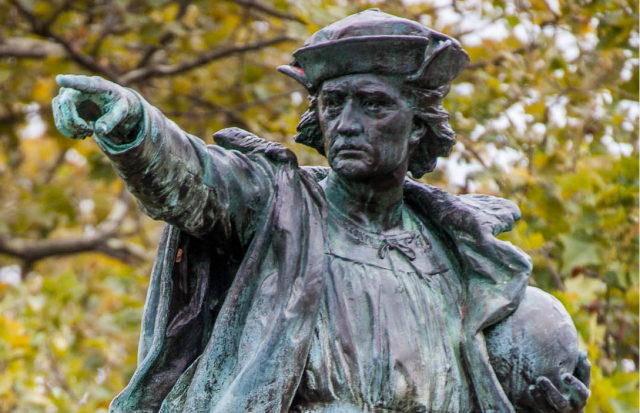
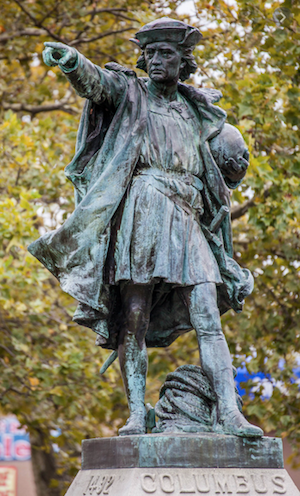
Statue of Christopher Columbus in Providence since 1893, now removed. (Wikipedia)

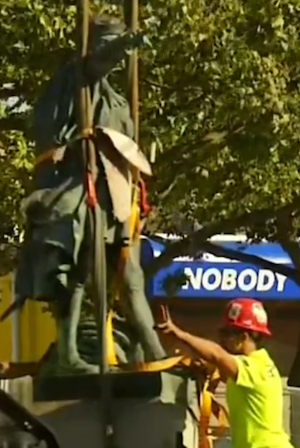
The statue of Christopher Columbus in Providence has been defaced in 2010, 2015, 2017, 2019 and 2020. Yesterday, amid American history’s most perfervid bout of iconoclasm, the statue was removed by the city for its protection. The municipal government of Providence is as feckless as they come, however, so it is far from clear whether Columbus was taken away to protect the statue or to protect the government’s derrière (CYA). Wikipedia asserts inanely that it was removed to protect the neighborhood.

Screen Shot 2020-06-27 at 5.46.56 PM

This particular statue of Columbus is a bronze copy of Frédéric Auguste Bartholdi’s statue cast in silver by the Gorham Co. for display at the 1893 World’s Columbian Exposition in Chicago. Bartholdi had previously sculpted the Statue of Liberty for New York Harbor. An article that year of 1893 in the journal Inland Printer described the art of his Columbus: “Life and vigor are implied in every line and feature, and the general effect is one of great beauty.” Its artistry is evident in the photos to the left and at the top of this post.

My dog in this current fight over statuary is largely aesthetic. I defend this Columbus because his statue is classical and beautiful. Although the statue aims to remind us of his bold voyage of discovery in 1492, when most Europeans, including many of his crew, feared that they would sail off the edge of the flat earth, my observation of this and other statuary takes the form mainly of thoughts generated by their quality as works of art.

I understand and sympathize with those who are concerned by Columbus’s sins as a colonizer. I don’t think those sins warrant defacing his statue or knocking it down. It is a reminder of an important part of our American history. This and other statues, including those of Confederate generals, are part of our history. Removing them would erase part of our history, hurtful especially to those who do not normally study that history, many of whom experience statues as an inert decoration that may grant them a passing pleasure. (Perhaps I fall into that category.) Removal would make their lives and mine shallower. They (we) are people, too.

Any statue’s removal should be undertaken only by its public – local, state or national – in a process of civilized democratic deliberation.

The reaction to statuary covers a range of feelings, from my largely aesthetic ones to understandable feelings of anger caused by the iconic reminder of, say, colonialism or slavery. But my guess is that those are rare. Feelings are pitched high these days, ginned up by events in the news, but I suspect that most people passing by a statue of Robert E. Lee in normal times would not feel anger or rage but, at worst, sadness or depression. They feel intuitively the symbolic meaning of the statue, and its implications for their lives.

In such feelings reside the importance of statuary to the individual experience of history. Nobody denies that history hurt some more than others, blacks and natives more than whites, but getting rid of the statues would rob these individuals of an important connection to their past and an incentive to desire or even, let us hope, to work for positive change. Nor would such removal do much to bring about the comity required to assist progress in resolving the ills that spring from our history.

Whatever the degree of anger over society’s continued hangover from slavery and Jim Crow, it cannot be denied that significant progress has been made toward the equality sought by our founders and emblazoned (for the first time in human history) in the documents of our foundation, and ratified by the blood of hundreds of thousands in a civil war fought to end slavery. That progress of a century and more was made in the company of more than 1,800 existing statues and memorials of Confederates or the Confederacy. Will their removal now add to the likelihood of further progress? Certainly not.

Rage has removed many statues in recent weeks. A large number of the statues under attack honored abolitonists, Union generals, President Lincoln and others dedicated to ending slavery, or who had nothing to do with slavery or, for that matter, with George Floyd. Indeed, rioting wrecked a unified belief held by all Americans that Floyd’s murder was a tragic wrong, and that justice should punish his killers. The riots destroyed that unity, that comity which might have been the result, and destroyed what progress might have arisen from peaceful marches seeking justice. The destruction of statues that have nothing to do with slavery has only made it harder to promote society’s effort to address police brutality and other injustices.

It has been noted that the incoherence apparent in the destruction of statues that have nothing to do with slavery reflects the ignorance represented, today, by the average college degree. I’d go a step further and say that the current iconoclasm is the first in history, or at least American history, where the intellectual capacity of those who attack statuary – mostly young, white and college-educated – is smaller than the intellectual capacity of those who don’t support that attack: the average American citizen.

Over the past few decades, the learning and the understanding conveyed by four years or more of higher education renders degree holders, in many fields of study, less capable of intelligent thought than those without degrees. In the field of architecture, for example, the public in its intuitive skepticism of modern architecture is more sophisticated than are the holders of almost all degrees from schools of architecture. This has been true for generations. It feels odd to say that the most educated members of society know less than the members of society generally, but that is the situation we face, with the attack on statues only the latest example of the broader decline in education and expertise. The wisdom of the masses now often bests that of the highly educated, but the masses lack power to bring fake expertise to heel.

But I don’t believe that this ignorance is the primary cause of the apparent incoherence of the attack on statues. Rather, not ignorance but calculation is behind that attack. The rioting and iconoclasm have been falsely predicated on the protests spawned by George Floyd’s murder. And the incoherence of the attacks is only apparent. The true cause is hatred for western civilization as manifested in America by its history, its institutions and its symbolic icons – including statues. The forces behind this destruction target the foundations of society itself. Statues are merely the easiest to find and attack, especially when timid police departments stand aside. Our difficulty grasping that reality is what causes this seeming incoherence. How convenient!

What better time for these forces to act than amid the re-election campaign of a president both widely hated and deeply admired, an opponent widely considered corrupt and incapacitated, global pandemic, economic meltdown, riots and the worst political scandal in American history? Current events have set up an unprecedented host of potential societal collisions. This has shaken confidence in the ability of our national institutions to guide and protect us. When we are at our weakest is when we are most likely to be attacked. Aside from the Civil War, our history has seen no period of greater vulnerability. (Let’s hope that our troubles will remain domestic.)

In spite of this, as the attack on our imperfect but striving society mounts, institutions public and private throughout the nation are surrendering their honor and dignity in mostly feigned apologies and mea-culpas. Their empty pledges are just words meant to deflect anger. Panic fanned by a complicit media fogs the sense of moderation and self-preservation that once prevailed among our most respected institutions. The reluctance to defend statues is just one instance of society’s refusal to defend its own honor.

The United States and its institutions have brought more progress to more people of all races, creeds and ethnicities – progress in health, in wealth, in safety, in freedom and political representation, just to name a few – than any previous society. Its founding documents erected high standards – equality and justice for all – and Americans have worked harder than the citizens of any other society to reach them. We’ve never claimed to be perfect, and yet hopeful immigrants continue to seek to live in our nation, warts and all.

Screen Shot 2020-06-27 at 8.42.12 PM

Columbus’s removal on June 25. (NBC-10)

The public stands foursquare against letting mobs topple statuary, and the protection of those statues can now serve as a rallying point in the defense against genuine enemies of our society, our nation, civilization itself – the good, the true and the beautiful.

Christopher Columbus should not have been removed by fiat of the city from Elmwood Avenue, but ought to have been allowed to remain so that its neighbors and the good people of Providence could have the opportunity to defend both him and the great civilization for which he stands – great for having proved its capacity, despite its flaws, to strive for the unprecedentedly just and equitable goals of our national foundation.

We in Providence still don’t know where the statue is now stored, or what fate will be administered by the committee that has apparently been formed to adjudicate its future. Its members are probably already suffering from the Stockholm syndrome. But maybe not. You never know. May history preserve Columbus from the deliberations of our self-appointed experts!

I would be even happier to see him moved from Elmwood Avenue to Federal Hill, former sanctuary for the city’s historic Italo population and today a mecca of restaurants. There I’d be able to enjoy looking at him more often. And there would be more police around to protect him, especially if he stood tall in DePasquale Square (al-fresco dining at its finest). Is Federal Hill up to the task? Heavy responsibility! It seems rattled by the uncertainties involved.

Be brave, Federal Hill! Stand strong, Providence! Viva America!

Posted in Architecture, Art and design | Tagged , , , , , , , , , , | 38 Comments

R. Crumb & Klaus’ urbanism

Screen Shot 2020-06-22 at 9.08.09 PM

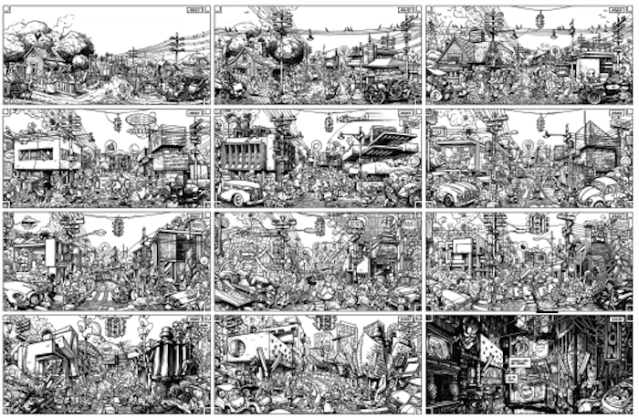
Klaus cartoon, “A Short (Architectural) History of the 20th C., after R. Crumb. (Klaustoon’s Blog)

Screen Shot 2020-06-23 at 10.06.28 PM

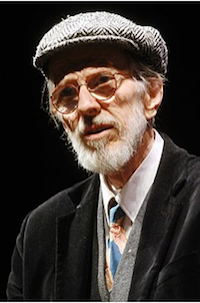
R. Crumb (Wikipedia)

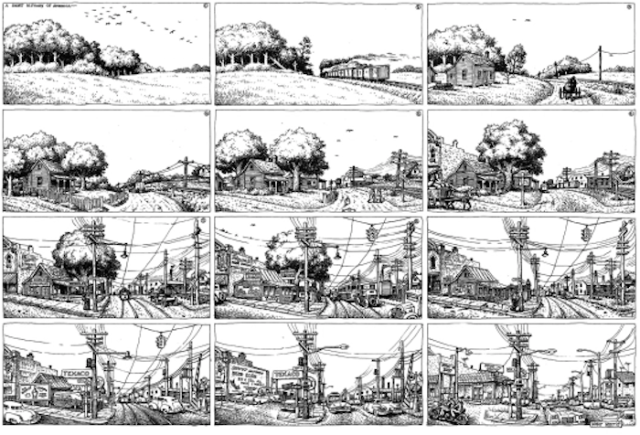
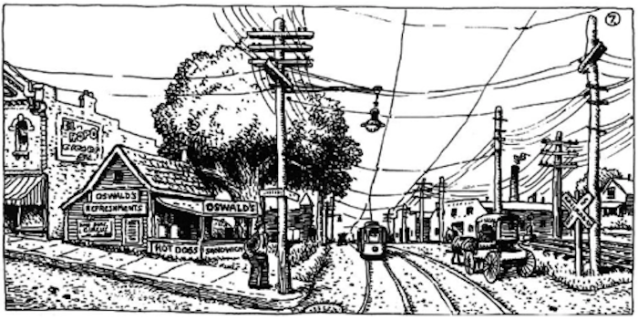
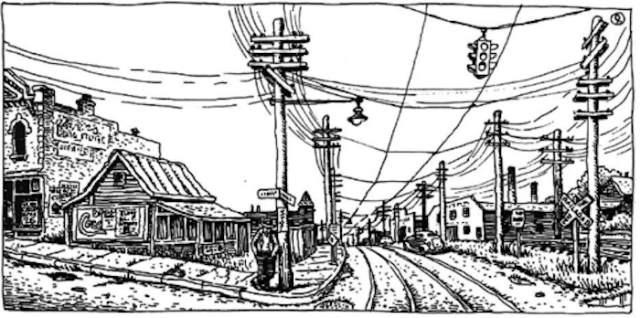
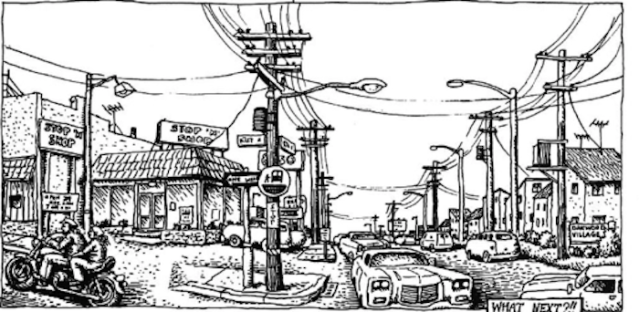
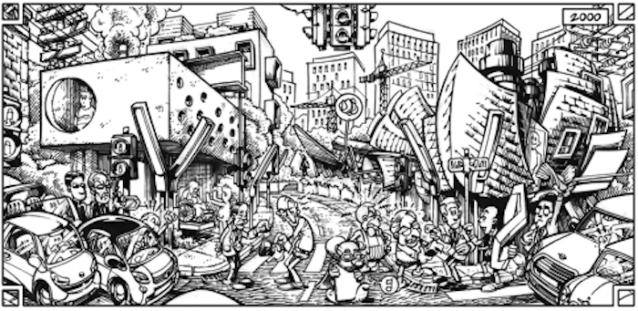
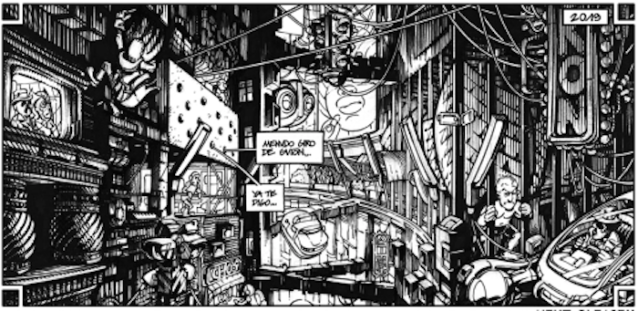
Klaustoon’s Blog has been on my blog roll for years. His intricate sketches satirize the inside baseball among the modern architects, such as one he did on the Pritzker Prize of 2015, which I discussed in “Klaustoon pricks Pritzkers.” I may be wrong, but the enduring fight between modernism and classicism does not register in his drawing. Recently, however, Klaus drew a cartoon in homage to R. (Robert) Crumb, the famous underground cartoonist (“Fritz the Cat,” “Mr. Natural,” “Keep on Truckin’ “) and his celebrated cartoon strip, “A Short History of America,” which satirizes itself. Crumb’s panels depict, over a century, the transformation of a rural landscape into a suburban intersection. Klaus’s own cartoon, “A Short (Architectural) History of the 20th Century,” in tribute to (and including a copy of) Crumb’s, and drawn in a similar mode, focuses on urban architecture, depicting the transformation of traditional urbanism into modernist buildings.

I have been unable to find out the full name of Klaus, though he has been described as “a frustrated cartoonist that lives in an old castle in Europe.” And I have little to say about either Crumb’s or Klaus’s histories, except to note that Crumb did not like modern architecture. Here is a quotation of Crumb taken from Peter Poplaski’s 2005 Crumb Handbook:

As a kid growing up in the 1950s I became acutely aware of the changes taking place in American culture and I must say I didn’t much like it. I witnessed the debasement of architecture, and I didn’t much like it.

Here, from Terry Zwigoff’s 1995 bio, is another quote that feels right:

I think Crumb is, basically he’s the Bruegel of the last half of the twentieth century. I mean, there wasn’t a Bruegel of the first half but there is one of the last half, and that is Robert Crumb.” (Robert Hughes in Crumb (Terry Zwigoff, 1995).

Pieter Bruegel the Elder (c. 1525-1569) was among the first Dutch painters to work after religion was no longer the conventional subject of art. Bruegel specialized in rural landscapes not quite as hellish as those of Hieronymus Bosch, but hardly idyllic. In their histories of America, Crumb leans more toward Bruegel while Klaus leans more toward Bosch.

Both drawn histories are rich in detail, and it is fun to examine each frame closely. If you are of a certain age, both artists evoke delightful memories of unnoticed aspects of, in the case of Crumb’s, the suburban environment and, in the case of Klaus, an urban environment, with its succession of modernist buildings, most of which are lampoons of the work of identifiable modernist architects. Both Crumb and Klaus frame their histories as decade-by-decade battles between owners of land on either side of the road.

Both are cartoons by cartoonists, but both are also inspired historians and urbanologists. Both, it seems, did meticulous on-site research. Klaus could not, of course, avoid seeing it any more than the rest of us can. Crumb, in describing his research style to a reporter from TIME magazine, observes a phenomenon I’ve often described in my blog regarding a common defense mechanism – the ability to faze out so many of the ugly aspects of our built environment. Or in Crumb’s words, what we are “trained to ignore”:

Decades later, TIME magazine revealed that, in the late 1980s, Crumb persuaded a photographer friend to drive him through commercial streets and “bleak, just-built suburbs” of California and photograph “ordinary street corners” … “methodically us[ing] the camera to capture what our increasingly inattentive eyes have been trained to ignore.” For Crumb, [this] material has not been created to be visually pleasing, and you are not able to remember exactly what it looks like. But this is the world we live in.”

Not long after I saw Klaus’s own history (all of the frames of which are pictured separately in A Short (Architectural) History of the 20th Century in a larger size) in tribute to that of Crumb, he published a post analyzing Crumb’s “A Short History of America.” Each of its 12 frames are pictured separately in a size that may be easily examined, or resized even larger for even closer inspection.

By the way, in his two posts on Crumb’s history, Klaus repeatedly denigrates his own artistic talent next to that of Crumb. Please, I would beg to disagree. Klaus merely labors under the difficulty that the scenes he draws show more modern architecture, but their ugliness should not be attributed to his pen.

Screen Shot 2020-06-22 at 9.08.26 PM

R. Crumb’s “History of America [1850-1970],” published in 1979. (Klaustoon’s Blog)

Below are three panels from Crumb’s history, followed by two from Klaus’s:

Screen Shot 2020-06-22 at 11.14.46 PM

Screen Shot 2020-06-22 at 11.15.23 PM

Screen Shot 2020-06-22 at 11.15.40 PM

Screen Shot 2020-06-22 at 11.10.39 PM

Screen Shot 2020-06-22 at 11.11.01 PM

Posted in Architecture, Urbanism and planning | Tagged , , , , , , , | 6 Comments

Aborting Menokin’s legacy

Screen Shot 2020-06-17 at 9.33.16 PM

Menokin House as it will look when rebuilt with “deconstructed” elements. (Menokin Foundation)

Menokin House, near Warsaw, Va., was built in 1769 by Francis Lightfoot Lee, who received the plantation’s land as a wedding gift. He was the brother of Gen. Lightfoot Harry Lee of Revolutionary War fame, and the uncle of Confederate Gen. Robert E. Lee. The mansion is the only remaining unpreserved home of a Virginia signatory to the Declaration of Independence.

Screen Shot 2020-06-17 at 9.32.55 PM

Menokin in 1965. (Calder Loth)

If its “restoration” goes forward as planned, it will remain the only such unpreserved homestead. Its beauty and its legacy, however, will be condemned to oblivion.

In online discussions about my last post, “A preview of the E.O. era?,” a link to a website devoted to the Menokin “restoration” was offered to exemplify changes even worse than those proposed for the Federal Reserve Building, in Washington, D.C., whose beauty is at risk from an expansion using glass curtainwall.

Just look at the image on top of this post. That is what’s in store for Menokin. Can anything worse be imagined?

I have railed for decades against a shibboleth of the historical preservation movement that changes to historic buildings should not look like the original. The idea is supposedly to preserve the original’s “integrity” by differentiating the new from the old. It is a bogus idea – a job bank for modernist architects masquerading as a preservation principle. The goal of differentiation can be achieved more effectively with signage. For example: “House built in 1810; new wing added in 1965.”

Screen Shot 2020-06-17 at 9.46.55 PM

Original design with outbuildings. (Foundation)

An article on Menokin in the online journal designboom (no initial cap) only reinforced my objection to forced differentiation. It described in laughable terms the ongoing “Glass House Project,” as it is called, an effort to “reimagine” Menokin – largely a ruin today – as a center for the study of historic construction and preservation techniques.

The intention is unobjectionable, but under the auspices of the Menokin Foundation, which owns the mansion and grounds, the project has, it seems to me, gone off the rails. Instead of restoring the house to what it looked like in, say, the time of Francis Lighthorse Lee, they are, for no apparent reason, framing much of it in glass, including the corner that collapsed in the 1960s. That is a shame and a betrayal.

The designboom article and its description of the project invite ridicule. The magazine rejects the use of initial caps in proper names and at the beginning of sentences, as if such textual decapitation atones for the magazine’s – what? – its white designer privilege? Never mind that. Just read the description of the project by author Philip Stevens (oops, philip stevens):

the glass engineering, led by eckersley o’callaghan, blends with the 18th century stone, brick, and timber. while traditional restoration methods cover evidence of the human story that historic structures present, the transparent design seeks to emphasize the deconstructed architectural elements of the building and provide a literal window into the lives of those who built, lived, and worked at menokin.

The project’s glass “blends” with the “18th century stone, brick, and timber”? No it does not. Traditional restoration methods “cover” evidence of the building’s story? No they do not. Will the “deconstructed” house tell its human story better than a reconstructed one? Not likely. Will the glass “provide a literal window” into the lives of its occupants? Hardly. The whole article by Stevens is a farrago of falsehoods and inanities. After reading it, I was all revved up to heap justifiable abuse upon the project.

And yet the fact that it has been supported by Calder Loth, the eminence gris of Virginia’s architectural historians, gave me reason to pause.

Screen Shot 2020-06-17 at 9.38.53 PM

Menokin as ruin. (Foundation)

In the mid-1980s, he received a call from a woman who then owned Menokin, seeking his help in saving the house. “What led to her call,” writes Loth in a 2006 lecture to the Virginia Historical Society, “was a letter from the National Park Service informing her that the Park Service was considering removing Menokin’s National Historic Landmark status because of loss of integrity” arising from years of abandonment and deterioration.

Now the very plan to fix it up proposes a major loss of integrity.

Loth pitched in to help. But by 2006, he states, the Menokin Foundation’s goal “was not to restore the house and develop it as a conventional house museum. Stabilization and restoration of the ruin could take place not as a goal but as a process.” Techniques used in the process would not only be applied but exhibited as educational tools. It seems to me that as of 2006, the goals of education and restoration were not necessarily incompatible. Loth stated: “Panels can be removed as various original features are put back. I think this concept has a lot of merit.” He remains an honorary trustee of the foundation and a supporter of its Menokin project.

In an email to an online classical discussion group this morning, Loth wrote that the project “will not be an aesthetically beautiful work of architecture, but a special and, we hope, an intriguing educational facility.”

Screen Shot 2020-06-18 at 12.58.27 PM

Menokin under temporary shed.

Yet Loth in his 2006 lecture describes how much of the original Menokin House and stored interior woodwork remain. The record of its original design and construction is considered the most intact and extensive of its kind. The exterior could be rebuilt to its original design (Lee’s architect is unknown), using both original materials or historical fabrications as necessary. The interior could be rebuilt as well, and while almost all of the original furnishings are lost, they too can be replaced. Nor need the project sacrifice any of its educational elements. They can inhabit the rebuilt rooms or new or existing outbuildings, which should also be restored, if necessary, or designed to fit into the setting. Such a balance should be the task of the trustees and hired professionals.

There would be no need to abandon the goal of displaying how the house was originally built, how it was rebuilt in the 21st century, and its historic occupants – Lee, his family, his slaves and the natives of the Rappahannock tribe who were the original stewards of the surrounding landscape. These goals can and should be preserved by the foundation.

Construction on the project is at an early stage such that its design, by Machado & Silvetti Associates, of Boston, could be reconceived and recommenced. The result would be a house that shelters an educational center but looks like the colonial house of the Lee family both outside and, to some extent, inside. Such a plan would accomplish all of the project’s goals and attract a wider audience without sacrificing Menokin’s authenticity, beauty and legacy to the ego of architects and, perhaps, to some but surely not all of the trustees and staff.

Surely if the Menokin Foundation’s intention is to save the house and render it useful to the broader interests of history and historical preservation, they should be eager to be rid of the plan’s artificial architectural elements and instead honor Menokin’s place in American history. Or, in these days of rage and absurdity, an argument could be made to destroy Menokin in order to atone for its place in history. Unwittingly, that is already being done.

Screen Shot 2020-06-17 at 9.40.20 PM

Menokin plantation landscape. House and outbuildings, lower left. (Menokin Foundation)

Posted in Architecture, Preservation | Tagged , , , , , , | 3 Comments