Column: Garden suburb as “Paradise Planned”

Bird's-eye view of Glendale, Ohio, founded in 1851 and considered the first garden village in America.

Bird’s-eye view of Glendale, Ohio, founded in 1851 and considered the first garden village in America.

I had planned to take the bus to work on Tuesday morning, lugging the new book “Paradise Planned: The Garden Suburb and the Modern City” in my trusty Penguin bag, hauling it in from our house in the suburbs — well, it’s still in Providence, but it feels suburban compared with my “commute” as a resident of downtown for a decade.

But “Paradise Planned” feels like a ton of bricks (12.3 pounds: Amazon), so by car we go. The prize for making fun of its size goes to Architectural Record’s reviewer Justin Davidson, whose “first instinct was to set the volume down on its own half-acre lot, give it a peaked roof, and simply move in.” Davidson says he worked out at a gym to acquire the strength to lift the book onto his “insufficient lap.”

Heavy-duty pages give the book a massiveness even beyond its 1,072 pages. More than 3,500 mostly color photos, plans, maps and diagrams, many small but printed at high resolution, testify to the luxury achieved by designer Pentagram and publisher Monacelli Press.

Truly a château among books.

Read the rest of this column at The Providence Journal.

Posted in Architecture, Book/Film Reviews, Preservation | Tagged , , , , , , , , , , , , , , , , , , , , , , , , | Leave a comment

“That was too easy” — Anonymous

I posed a challenge, more or less, in my last blog, “Zaha ‘Ha Ha’ Hadid’s thing.” I wrote, “Even I don’t have the London City Halls to photomontage the People’s Daily into Qatar’s proposed World Cup Stadium, designed by Zaha Hadid.” I wondered whether Zhou Xi’s penis could be cropped into the vulva of Zaha’s stadium to create a stir. Well, an elegant response to my challenge showed up in my e-mail inbox. Here’s the People’s Daily having intercourse with Qatar’s Stadium:

MakeLoveNotArchitecture2

Posted in Architecture, Art and design, Photography | Tagged , , , , , , , , , , | 2 Comments

How modernism got square

New town Stevenage

New town Stevenage

The title of this post harks back to one from this blog’s Providence Journal days, when I linked to a long piece in Metropolis magazine by Michael Mehaffy and Nikos Salingaros, and then did a column about it called “How modern architecture got square.” Now a piece by Robert Adam, the British classical architect, approaches the same issue from a different direction. It is called “The Institutionalization of Modernism,” in his blog at Building magazine, published in the U.K.

[Adam’s article is here, though you may have to plow through free registration.]

The piece follows Adam as he rifles through a series of official British planning documents going back years, which trace the growth of language in planning regulations there that force planning officials to favor modern rather than traditional architecture.

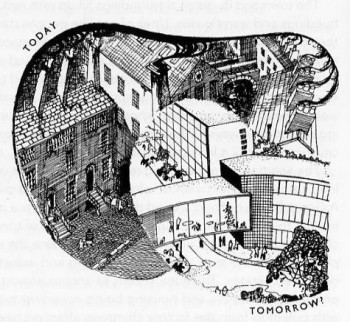
Typical U.K. modernist planning propaganda, circa 1960

Typical U.K. modernist planning propaganda, circa 1960

Planners in Britain must adhere to national planning policy summed up in official documents since passage of the Town and Country Planning Act of 1947. The latest version of the document, which he describes as “quite good,” states: “Planning policies and decisions should not attempt to impose architectural styles.” Maybe so, but a lot of official policy in prior years had similar language yet nevertheless favored or even mandated modernist styles, whether the wording of the rule stated so expressly or hinted it. (In bureaucracies, hints are often hazardous for lower-level officials to ignore.)

One example comes from planning regulations in two historic towns, Winchester and Chester. In Winchester, planners must abide by language that reads: “New development should complement but not seek to mimic existing development and should be of its time.” The first part sounds sensible to the average citizen, but the code words of “mimic” and “of its time” suggest very straightforwardly to planners that modernism is to be favored. Regulations in Chester beat even less around the bush: “The boldest and most successful designs are those which clearly express the ethos to which they relate, and do not refer to the language of earlier periods.”

In his piece, Adam describes planning language widespread in planning documents that may seem unobjectionable to many but is interpreted with great specificity as pooh-poohing new traditional designs by those charged with carrying out the law.

Adam concludes: “This is all part of the creeping institutionalisation of Modernism. For half a century it has been the style of the architectural establishment. It is now becoming the style of the bureaucrats.” That’s bad news, but Adam hopes that Britons who want to rescue their built environment from modernism will send him examples from their jurisdictions that can be used to illustrate today’s reality and thereby encourage top planning authorities to even the playing field.

“I have spoken to the government’s chief planning officer,” advises Adam in a note to readers who want to join in the fun, “and he [is willing] to receive [letters] on the subject. [They] will need to be very cool and factual.” Well, readers, I guess that means it’s up to you!

Please send any examples to Robert Adam at robertadam@adamarchitecture.com

Posted in Architecture | Tagged , , , , , , , , , , , , , | Leave a comment

Zaha “Ha Ha” Hadid’s thing

Zaha Hadid's proposed Al Wakrah Stadium, in Qatar

Zaha Hadid’s proposed Al Wakrah Stadium, in Qatar

dailypenis

London City Hall

London City Hall

Even I don’t have the London City Halls to photomontage the People’s Daily into Qatar’s proposed World Cup Stadium, designed by Zaha Hadid.

I refer, of course, firstly to Norman Foster’s London City Hall, called the “glass gonad” by London Mayor Boris Johnson, who then ordered that during the Summer Olympics it be called “London House.” His predecessor, Ken Livingston, called it the “glass testicle.”

I refer secondly to Chinese architect Zhou Qi’s People’s Daily headquarters, in Beijing, which resembles an anatomically correct penis, nothing left to the imagination, and which was recently hung from the crotch of Rem Koolhaas’s aggressive CCTV headquarters, also in Beijing, by an expert in photo montage.

I refer thirdly to the stadium by Hadid, and wonder whether Zhou’s penis hanging from Koolhaas’s crotch can be cropped into the vulva of the stadium to create a stir.

When Hadid heard that people were comparing her proposed stadium in Qatar to a vagina, she said, “It’s really embarrassing that they come up with nonsense like this,” and asked, “What are they saying? Everything with a hole in it is a vagina? That’s ridiculous,” adding that “if a guy had done this project,” no such interpretations would be made.

That’s ridiculous too. Holes have always been treated as metaphorical vaginas by some, the Lord only knows why, and, as Lizzie Crocker says in her harrumphalist Daily Beast article “Zaha Hadid’s Vagina Stadium,”  “penis-in-the-sky visuals can be traced to the phallic imagery ingrained in architectural history, from the Greeks’ colossal penis pillars and Priapic temples to the 19th-century Place Vendome Column in Paris.”

But not until Zhou’s People’s Daily did we have a building that is not merely metaphorical, allegorical, rhetorical, allusive or suggestive. Zaha’s stadium is only slightly less anatomically correct. If she was not thinking of a vagina (not necessarily her own), then what was she thinking? Did she not imagine what others might think? Impossible. Ridiculous.

Her posturing is obviously just that. She is no doubt snickering into her sleeve at her ability to pull off the sort of in-your-face stunt that is modern architecture’s chief claim to fame – and in a Muslim country to boot, where men won’t even permit women’s faces to be shown. That’s even more cheeky than Zhou’s penis in communist China. It appears that the nihilism of modernism can slap a society upside the head until it dislocates the society’s neck. When will it become acceptable to complain?

Posted in Architecture | Tagged , , , , , , , , , , , , , , , , | 6 Comments

Column: The ground game against modernism

IMG_3256

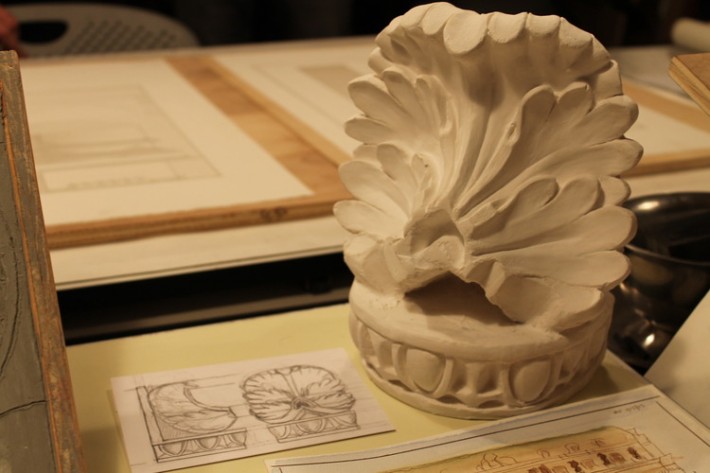
Original design by Beaux Arts Atelier student Marileny Peralta of an acanthus leaf and egg-and-dart bookend with the finished product, also by Ms. Peralta, made of hydrocal.

Little noticed amid last month’s shutdown in Washington was Congress’s shutdown of funding for the Eisenhower Memorial Commission’s proposed modernist monument for the 34th president, designed by Frank Gehry and expected to cost $142 million, mostly in federal tax dollars.

True, the commission still has $22 million in its pocket, so it will continue to swim against the tide of public taste, critical opinion and the opposition of the Eisenhower family. But eventually it will die the death of a thousand congressional cuts. One of those may come from a House investigation into alleged irregularities in the hiring of Gehry — who just happened to have worked three earlier jobs hand in glove with Rocco Siciliano, Gehry’s fellow Californian, Beverly Hills attorney, former assistant labor secretary under Eisenhower and chairman of the Ike memorial commission.

The Gehry design could in theory arise from the dead, but President Obama has appointed Bruce Cole to the commission. He is a former chairman of the National Endowment for the Humanities and also a leading critic of the design. What does that say?

Keeping Gehry out of Washington would be a signal achievement. Architecture’s chief purpose, aside from housing humans and their activities, is to create a built environment conducive to a healthy public life. Beauty was a key factor in how this goal was achieved for millennia. Would anyone say that ditching beauty in favor of novelty has created more lovable or healthier cities for the world?

Read the rest of the column in The Providence Journal

Posted in Architecture, Architecture Education | Tagged , , , , , , , , , , , , , , | 1 Comment

Column: Buildings scrape the sky’s eye

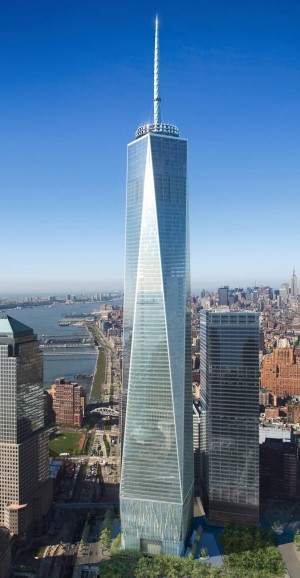
2865824-Freedom_Tower_1One World Trade Center, the 1,776-foot-tall “kick-me” sign nearing completion on New York City’s skyline, is 991 feet shy in height of the world’s tallest building, the Burj Khalifa, which rises 2,717 feet above the Dubai desert. But thanks to a decision on Tuesday by the Council on Tall Buildings and Urban Habitat, in Chicago, One WTC ranks No. 3 among the world’s tallest buildings (No. 2 is in Mecca), and is the tallest in America and the Western Hemisphere.

The council ruled yesterday that the WTC’s antenna is a spire, even though its sheath was omitted to save money. Some expected that the council would rule against it on that basis. This would have dropped it to No. 29 on a list of the world’s 100 tallest buildings (the list includes those to be finished by 2016), after the Jin Mao Tower in Shanghai, and No. 2 in America.

But the council ruled thumbs up on the antenna, enabling the WTC to eclipse Chicago’s 1,451-foot Sears Tower (now called the Willis Tower), completed in 1974, and ending its near 40-year reign as tallest building in America.

Read the rest of the column in The Providence Journal.

Posted in Architecture | Tagged , , , , | Leave a comment

Column: Small future for tall buildings in D.C.

unnamed

Like much in the District of Columbia, the Hotel Dupont Plaza has undergone change. For one thing, it is now called the Dupont Circle Hotel. But it looks much as when it was completed half a century ago. Beige brick dominates, with corner-turning strip window systems conventional in the 1950s, and only one new floor — a penthouse (styled “Level Nine”) set behind a moderately snazzy wraparound balcony of glass.

Near the northern edge of Pierre L’Enfant’s 1791 plan for the nation’s capital, Pacific Circle was renamed for Admiral Samuel Francis DuPont in 1882. Nine years later, the department-store magnate Levi P. Leiter built a mansion designed by Theophilus Chandler. It was demolished for the Dupont Plaza in 1947.

Its most recent incarnation, the Dupont Circle, where Victoria, Billy and I stayed on vacation last week, has doubled down on chic. Now part of the Doyle Collection, of Dublin, the Dupont’s swanky interiors feature an unabashedly contemporary style that belies the sober midcentury modernism of its “historic” exterior.

Read the rest of the column at The Providence Journal

Posted in Architecture, Preservation, Urbanism and planning | Tagged , , , , , , , , | Leave a comment

Column: The rise and fall of Guastavino tile

guast1

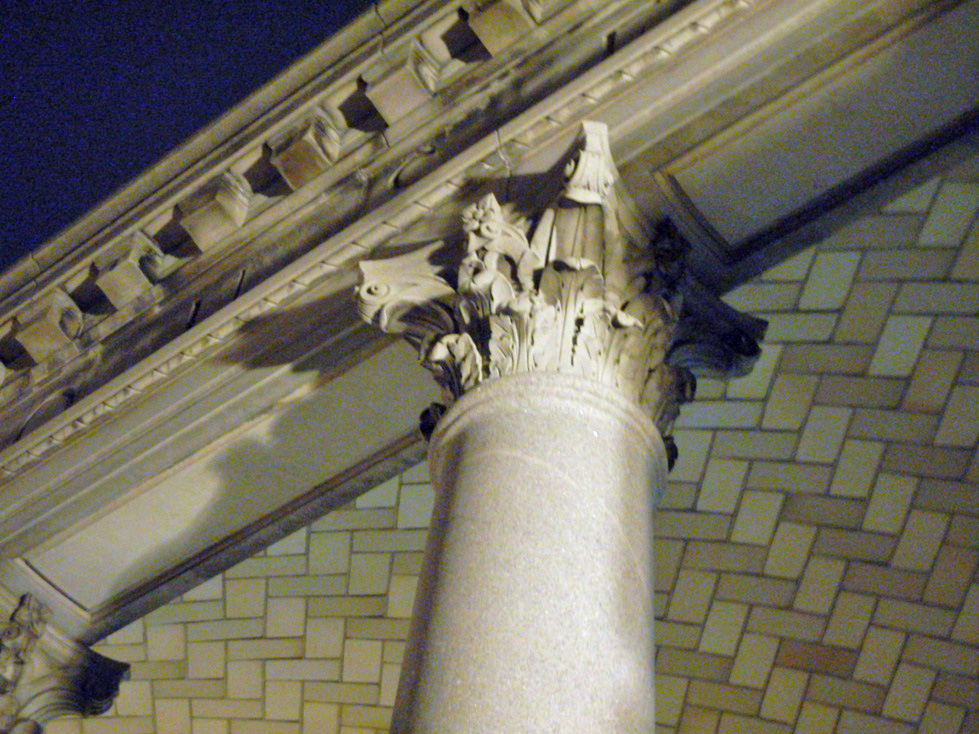
About 600 buildings in the United States, including 200 in New York, 29 in Boston, 22 in Washington and 7 in Rhode Island, feature a tile vault system perfected by a native of Valencia, Spain, brought by him to America in the 1880s, and rubbed out by modernism in the 1950s and ’60s.

Rafael Guastavino Sr. (1842-1908) rediscovered a Mediterranean tiling and vaulting technique that reaches back to ancient Rome.

His innovative tile work resolved the difficulties of large domes and vaulted structures. Once in America, where he immigrated with son Rafael Jr. in 1881, he developed the decorative possibilities of his technique. His firm dominated the field for half a century. In the end, however, Guastavino vaulting fell prey to modernism, as architects and builders spurned ornament, even utilitarian ornament.

Read the rest of this column at the Providence Journal.

Posted in Architecture, Art and design, Preservation | Tagged , , , , , , , , , , , , , , , , , , , , | Leave a comment

Architecture Here and There really begins anew

Architecture Here and There hereby, henceforth and forthwith migrates to WordPress. This is your correspondent’s first blog post. It is very preliminary, though not as preliminary as my first blog post on WordPress.org, a blog I created by accident (not by mistake; there’s a difference) instead of the WordPress.com I’d intended to create. But now things are straightening out and I’m encountering a new set of difficulties, though far less serious ones, regarding which readers are surely disinclined to know the details – suffice it to say that architecture, even when applied to the structure of a blog, does not design itself. Too bad!

Posted in Uncategorized | 1 Comment