Tall buildings all fall down

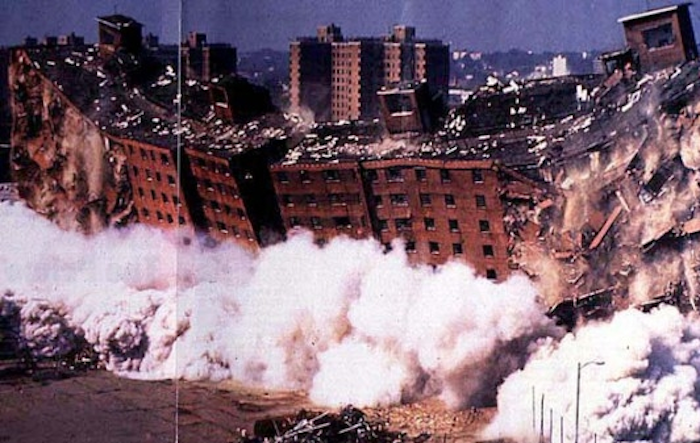
Fifteen buildings of in Yunnan, China, were imploded on Aug. 27. (Taiwan News)

Is there something off-kilter about the photo above from a video sent to me yesterday by architectural theorist Nikos Salingaros? Yes, there is.

At first I thought it was a video of Pruitt-Igoe, the St. Louis public housing project, all 33 eleven-story buildings of which were demolished in between 1972 and 1976 – an event described (falsely, alas) as “the end of modern architecture” by postmodernist architectural historian Charles Jencks. Interesting factoid: the 33 buildings were designed by Minoru Yamasaki, better known for his twin World Trade Center towers, infamously demolished on Sept. 11, 2001, by the terrorist group al-Qaeda. The demolition of Pruitt-Igoe was memorialized in about nine minutes of the 1982 film Koyaanisqatsi: Life Out of Balance.

Woolworth Building rises behind Public Advocates building. (Wikipedia)

A moment’s reflection concluded my delusion. In fact, the photograph above from early in the video at this link records the demolition of the Liyang Star City Phase II project in the Chinese city of Kunming. Note the tilt of several buildings at the start of their demolition last Friday. The dynamite expunged $154 million worth of property in 45 seconds. Some 5,300 people in 2,000 units were evacuated (before demolition, one trusts). The 15 buildings were allegedly demolished because, in the opinion of the Chinese authorities, the eight years since the beginning of construction was too long. How many buildings were occupied and why they were among those torn down was not explained. In other words, this information must be consumed with a very large pinch of salt.

Another video of the demolition gives a much clearer idea of its context as a minor dent in the skyscraperopolis that is Kunming, the capital of Yunnan province. I am not quite as confirmed an opponent of skyscrapers as my friend Nikos, who sent me the video in the hope that I might find it interesting. He was correct. And most skyscrapers are an ecological abomination, needing too much energy to build and operate without housing enough people to justify their carbon footprint. Paris with its gorgeous Haussmanesque flats of seven stories or so has an equivalent density using architecture of much greater sustainability. I suppose I’d have applauded the assassination of this group of skyscrapers in China even if they had all looked like the Woolworth Building (1913) in Manhattan. What a mockery of beauty that would have been!

The Chinese are known for the number of neighborhoods and even whole cities that have been built but are not yet occupied. No doubt the progression from legal one-child families to two- and now three-child families since 2016 plays a role. Those empty population centers have not been torn down. Could that be because some are knock-offs of European architecture and hence popular?

Chinese President Xi has banned “weird” architecture in China, and cited the CCTV tower (which looks like it is crushing the people) and the People’s Daily headquarters (which looks like a penis), both in Beijing. But the skyscrapers demolished in Yunnan are not weird or lewd but dull. On the other hand, Xi has also banned “copycat” architecture, such as, presumably, neighborhoods inspired by European architecture, which perhaps qualify as weird copycats. They are not all built with equal architectural verismilitude, to say the least. What about all those other cities filled with tedious towers, throughout Asia, Europe and the Americas? Are those not copycat buildings? Don’t hold your breath waiting for an answer. Pop go the overinflated egos! Meanwhile, Olympic construction in China has obliterated traditional hutong neighborhoods that go back many centuries, and possibly other examples of Chinese heritage whose demise remains unknown to the public. Shame!

It seems to me that the entire city of Yunnan should be demolished. But what good would that do? Chinese skyscrapers and Chinese power plants resemble each other in that so many are being built that, however many are torn down, they still swamp all efforts to put a lid on the globe’s carbon footprint. Too bad! I will continue to oppose ugly modernist towers and support the construction of beautiful new classical towers, however rare they may be. I suppose I can count them on the fingers of no more than a pair of hands. No fear of their interfering with the war on climate change. Again: Too bad.
Demolition in 1072 of Pruitt-Igoe complex, built in 1956-1958. (Finnbar5000)

Posted in Architecture, Video | Tagged , , , , , , , , | 3 Comments

Landscape urbanism revisited

***

Not long ago, in response to my post “Steuteville’s public square,” a pile of emails and comments was generated by my query as to whether something called landscape urbanism still exists. One email called for another look at its continued existence, lest the matter be lost in the flurry of comments. To which urbanist theoretician Michael Mehaffy replied:

Landscape urbanism is yet another attempt to be the anti-new urbanism. … [A]s a brand it has mostly disappeared [but] as a practice it is still pervasive because it is simply yet another reactionary form of modernism.

Mehaffy described LU as “sprawl in a pretty green dress.” He did concede LU’s “contribution of ecology to urbanism.” To which architectural theorist Nikos Salingaros added:

I see this as just a desperate grab for commissions. A bunch of faculty from the Harvard GSD [Graduate School of Design] just made up the brand name Landscape Urbanism then decided they had to displace New Urbanism in order to get those jobs. Obviously they could not compete with industrial modernist planning … [s]o they used pretty landscapes and made up a whole bunch of propaganda words about using native plant species, etc. But they then imposed the same modernist industrial buildings, since that’s all they know how to do.

In a comment, Mehaffy, agreed, adding that

[t]he trouble with Landscape Urbanism is that it is simply a scheme to “shrub up” the old modernist failures, and thereby re-supply some of their symmetry deficit. It works up to a point, but only superficially. And it is one of a number of “predatory” strategies to steal symmetries from other sources, and (temporarily) camouflage what is essentially design malpractice, from the point of view of human well-being.

I could easily construct a whole post quoting Mehaffy and Salingaros back and forth in reply to my original post. In 2018 they won Traditional Building’s Clem Labine Award – see my post “Joint prize for dynamic duo” – in which I attempt to explain their work in partnership with each other and with computer- and urban-language guru Christopher Alexander.

Together, the three of them, along with another pathfinder, architect and cognitive theorist Ann Sussman, essentially perceive that whereas traditional architecture is additive – has been building on its own progress for hundreds if not thousands of years – modern architecture is reactive. It can only conceive of progress (if you want to call it that) as a sort of aesthetic oneupmanship, always reacting to attempts at novelty by other modernist architects.

(Among other matters, Sussman’s research uses eye-tracking software to show that observers of architecture tend to avoid looking at blank spaces in buildings, and focus instead on buildings that feature traditional detailing and ornament.)

The additive character of traditional architecture resembles the reproductive character of nature, whereas the reactive character of modern architecture must address the limits of innovation. Since for modernists “copying the past” is not permitted, or at least not admitted, practitioners inevitably reach a point where the next new thing appears increasingly absurd. Its theorists consume themselves in an unending effort to differentiate the latest novelty from its predecessors. They never even reach the point of explaining how the latest novelty compares favorably with what traditionalists call the “living architecture” of their work. Modern architecture produces confusion among its adherents and anxiety or even repulsion among its victims (the public). To read a critical review of the latest work of a celebrity modernist shows that the absurdity of its design is matched only by the absurdity of the gobbledygook required to describe and defend it.

Research, polls, surveys and anecdotal evidence bear out this alienation of the public from modern architecture, whereas no science exists (that I’ve seen) that posits affection for modern architecture or its contribution to human well-being.

Traditional architecture (including its roots in Greek and Roman classicism) demonstrably contributes to positive human health outcomes. Modern architecture causes illness. It either disorients its users or bores them.

So intent are modernists to seek out the increasingly rare sources of novelty in their designs that they often forget primary tasks, such as to signal the location of a building’s front door. On the other hand, the tool of symmetry in traditional design not only places the front door in a usually central location; it also uses embellishment to boldly distinguish a front door from other doors that might be visible to an approaching observer. Salingaros refers to the modernists’ neglect of this as “symmetry deficit disorder.” To cite the title of Christopher Alexander’s most famous book, ornament is pattern language writ small. At different scales, architectural detail promotes the clarity of a design’s symbolic intent.

I see I have strayed from the question of whether landscape urbanism still exists. Of course it still exists. To quote Salingaros again:

Wikipedia is right, in that so-called Landscape Urbanism is not urbanism at all. You can see it is just industrial modernism in attractive new clothes, simply because it uses the same obscurantist modernist language to hide its lack of design substance.

It seems that symmetry – and let’s not even get into the question of beauty, which has long caused anxiety among modernists – is as verboten in the design of modernist landscapes as in the design of modernist buildings. It must be difficult for landscape urbanists to decide whether to lean toward symmetry or toward the organic patterns of nature in designing a green setting for modernist buildings and communities. Either way seems to edge too close to traditional models of landscape architecture. Split the difference, yes, but how? And how to do so without accidentally replicating the novelty of other landscape urbanists?

It’s too bad landscape urbanists have not discovered the potential usefulness of trees, shrubbery and other plantings to disguise or otherwise block modern architecture from the observation of passersby. Or maybe they have. Mehaffy recalls Frank Lloyd Wright’s cocktail party joke: “You doctors are lucky. You can bury your mistakes. We architects have to plant vines.” That might explain the continued existence of a debate over whether landscape urbanism still exists.

[Illustration of and caption for two landscape urbanism examples atop this post is from an article by D. Kelbaugh in a 2014 edition of Semantic Scholar.]

Posted in Architecture, Landscape Architecture | Tagged , , , , , , , | 1 Comment

Penn Station post Cuomo

Empire Station Complex, blue; Penn Station behind proposed new towers. (Community Board Five)

Andrew Cuomo’s resignation, effective in one week, could provide an opening to rebuild Penn Station as designed by architects McKim Mead & White in 1910. Is the next governor, Lt. Gov. Kathy Hochul, of a mind to support the plan? No one seems to know. First, she would have to stop Cuomo’s plan to expand rather than rebuild Penn Station and demolish up to 50 buildings, including the Hotel Pennsylvania, the Stewart Hotel and the Church of St. John the Baptist – all to make way for 10 towers in the so-called Empire Station Complex, a congestion magnification scheme facing broad opposition and unlikely to win city votes for whomever runs for governor next (including Hochul). She has a lot on her plate.

Also unknown is the view of Eric Adams, the city’s presumptive next mayor, whose campaign focused on NYC’s largely self-inflicted crime wave. Bringing common sense back to law enforcement in the Big Apple is certainly key to any redevelopment plan hopeful of success.

The many public advocacy groups opposed to the Empire Station Complex should join together and place the plan to rebuild Penn Station at the center of both their publicity and political strategies. Unity around a proposal of such likely popularity could have a profound force-multiplication effect.

An opposition umbrella group, the Empire Station Coalition, held a forum Aug. 13 to discuss the situation. It may be seen on YouTube. The 12 organizations include ReThinkNYC, whose plan supports the proposal to rebuild Penn using the MMW blueprints within a broader proposal to bring through service to the station and rationalize regional rail service. And it includes Human Scale NYC, which was founded by panel moderator Lynn Ellsworth, who told the audience:

[T]he real-estate industrial complex of our city has pretty much taken it over. Through campaign finance contributions to our politicians, to ownership, or the regulatory agencies getting their appointees on board, to organizing the legal or legislative systems so that the governor, mayor have all the power.

Ellsworth suggested federal intervention as a possibility, perhaps through President Biden’s transportation secretary, Pete Buttigieg, and the looming billions of a proposed federal infrastructure bill. New York state legislation to subject the Empire State Development Corporation and its Empire Station plan to the city’s authority (from which it is now exempt) is another option.

With or without the sensible Regional Unifed Network (RUN) proposal offered by ReThinkNYC, the proposal by architect Richard Cameron of Atelier & Co. to rebuild Penn Station using Charles Follen McKim’s design would sell itself easily to any New York leader truly intent upon prioritizing the public interest in beauty and economic growth. It is feasible both practically and financially. It would remove Madison Square Garden from atop Penn Station and rebuild it nearby. The plan envisions redeveloping much of the area to expand the neo-classical feel of Penn Station into a global entertainment district appealing to the traditional architectural tastes of the public. In short, it’s a plan for the people of New York rather than for the owners of Vornado Real Estate Trust, who own most of the property now targeted for redevelopment under the Cuomo plan.

You’d think that as she prepares to govern with an eye to re-election in a year or so, Kathy Hochul would want to run as fast and as far as she can from Cuomo’s priapic Empire State Complex. That means she ought to run in the direction of rebuilding Penn Station, undoing what Ada Louise Huxtable called the greatest cultural crime in American history – the 1963 demolition of the original station.

As historian Vincent Scully notably stated, “One entered the city as a god; one scuttles in now like a rat.” That’s not just a big problem for the city but for the nation and even the world. The first female governor of New York State could be the one who fixes that problem.

Rebuilt Penn Station. (by Jeff Stikeman for the National Civic Art Society)

Posted in Architecture, Development | Tagged , , , , , | 15 Comments

Entitling Historical Concepts

Eric Piasecki’s photograph on the front cover of “Visions of Home.” (Historical Concepts)

Most architectural firms have names listing one or more partners, McKim Mead & White being a chief example familiar to classicists. In recent times some firms have chosen names seemingly designed to impress you with their creativity, such as SHoP Architects, headquartered in the Woolworth Building, of all places, or S/L/A/M (now SLAM) Collaborative, headquartered in Connecticut.

And then there is Historical Concepts, an unusual name even for a traditionally oriented Atlanta-based firm that mainly designs homes for the wealthy – often the only commissions that can be had by classical and traditional architects, because modernist architects have rigged the commission system for decades.

The other day, a book arrived whose arrival was the result of a comedy of errors entangling architect David Andreozzi (of Andreozzi Architecture, naturally) in Barrington, Rhode Island. The book’s author, Andrew Cogar, had sent it by accident to me. Since the enclosed note thanked me for something I had not done that involved the Institute of Classical Architecture & Art, whose New England chapter is led by David Andreozzi, I figured the book must have been intended for that David, not this one. So I arranged to transfer it to him over pizza at his son’s new pizzeria in Providence. Apparently, David A. mentioned this to Andrew Cogar, whose graciousness resulted in the arrival of a second copy of the book, Visions of Home, at my address.

By the way, Cogar gave me a tour of Atlanta when I was there long ago as a juror for the ICAA Southeast chapter’s annual Shutze Awards, the equivalent of our chapter’s Bulfinch Awards. Maybe this ancient event triggered the delightful comedy of errors.

Since the wrapping of the first copy was too complex and ornate for me to open after I discovered the book was not meant for me, I am grateful to have received a copy of my own, which I have read with great pleasure.

I will not review the houses on display in the book, except to say they are all very lovely. Rather, I want to remark upon the title of the firm, Historical Concepts. Andrew Cogar is now head of the firm, but the book’s introduction was written by the firm’s founder, James L. Strickland, and here’s how he explained the rationale for the firm’s unusual name:

Why Historical Concepts instead of, for example, James L. Strickland Architects? Fair enough. I chose our name for two reasons. The first was that our animating idea was the creation of contemporary homes rooted in the timeless values of history, and I wanted potential clients to understand this the moment they heard our name. The second, more important reason had to do with my longstanding interest in the people with whom I work. I always believed that I was designing not just houses but a philosophy of practice … .

That says it all, because the concepts that are involved in building beauty along traditional lines require both the talent and the patience to look backward as well as forward. A firm named Historical Concepts will not be capable of functioning along those lines if its workers belong in a firm called, say, Pickup Schticks. Two years ago I wrote a post, “Romance and the style wars,” about the movie The Diary of Anne Frank, in which her romance with Peter Van Daan builds with such subtlety that it is not revealed until a gentle kiss near the film’s conclusion:

That is the traditional progression into love. It can be speeded up or even slowed down further to reflect the personalities and circumstances involved. The more or less subtle steps along the way might perhaps be compared with the succession of classical moldings that mark the transformation of a wall into a ceiling …, or, on the exterior of the house, by the diverse levels of ornament – such as (in rising order) the astragal, cymba reversa, dentils, ovolo, modillions, fascia and cyma recta – that make up the entablature of an ornate classical roof cornice.

Thus: the beauty of nature’s creativity versus the wham-bam-thank-you-ma’m of hyper-innovation that drives today’s dominant architectural concept. I am just as sure that every worker at Historical Concepts understands the difference as I am sure that it flies over that head of every egotist at Pickup Schticks.

Love and rape are not the only pair that might reflect truth: Freedom and slavery serve equally well, with Beijing’s CCTV tower, by Rem Koolhaas, leading the way, stomping on the people as cogs in a mighty machine that may be heading our way. But hey! Let’s conclude with the concept of tradition as the architecture of love and, as depicted with such beauty in Andrew Cogar’s fine book, home.

(The book was written by Andrew Cogar with Mark Krystal and Cogar’s partners at Historical Concepts. The photographs are by Eric Piasecki.)

CCTV, home of CCP propaganda in Beijing, designed by Rem Koolhaas. (NYT)

Posted in Architecture | Tagged , , , , , , , , | 10 Comments

Liverpool loses heritage status

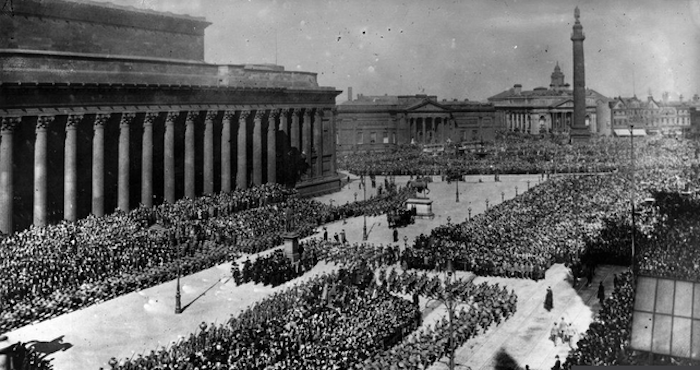
Liverpool in 1915 as troops muster before St. George’s Hall for service in World War I. (BBC)

Seventeen years after its bestowal, Liverpool has lost its status as world heritage site by an act of Unesco, the United Nations’ chief cultural agency.

Sixteen years ago, in June 2005, I attended a symposium at RISD, which had partnered with the Royal Society for the Arts to compare efforts in Providence and Liverpool to revive the two cities. At the symposium I met Arthur Mark, a mover and shaker with ties to the RSA who lives in Rhode Island. Last night I had dinner with him, not having seen him since before his 90th birthday last year. I mentioned that I’d read that Liverpool had just lost its world heritage status. I also called to Arthur’s attention my column in the Providence Journal about the symposium, “Can civic renaissance be bottled?” He reminded me that Will Alsop, the British starchitect, had criticized me, asserting that “newspaper critics” always “oppose progress.” Alsop had no idea I was in the audience, but others did, and pointed me out as evidence in favor of Alsop’s proposition and, more generally, as the skunk at their modernist garden party.

I have reprinted my column below, and remain firm in my belief that civic renaissance can be “bottled” – if civic leaders will finally understand that civic renaissance depends on preserving architectural heritage and preserving the setting of that heritage by building new buildings – of traditional styles – that people will love. Liverpool did not heed that advice, and as a result has lost its coveted global heritage status.

***

“Can civic renaissance be bottled?”
June 9, 2005
.
My father studied in Liverpool for a year after he married my mother and before they had me. Beyond recalling the tedium of postwar rationing and the joy of popping over to visit the Continent, they said little to me of their stay. Still, I was very excited to learn that the Royal Society for the Arts, based since 1754 in London, and the Rhode Island School of Design were to hold a symposium comparing the birthplace of George M. Cohan (born July 3, 1878, at 536 Wickenden St.) with that of John, Paul, George and Ringo.
.
The symposium was held Sunday through Tuesday, at the RISD Auditorium, in Providence. It drew from the design and planning elite hereabouts, but also from the ranks of RSA fellows around this country.

Much grist for comparison came in the form of ambitions dashed. By the turn of the last century, Liverpool and Providence had grown rich from commerce. By 1950, however, fortune had frowned so grimly upon the head of Narragansett Bay and the mouth of the Mersey that neither city could afford — as so many others, in both countries, did — to rip down their downtowns and build anew.

So for both, poverty seeded destiny. With the beauty of Providence, readers are familiar. Liverpool likewise has truly impressive architecture. Its Three Graces — the Royal Liver Building, the Cunard Building and the Port of Liverpool Building — were erected dockside in the robust Neo-Classical styles of the early 20th Century. Block after block of Georgian, Victorian and Edwardian buildings, such as St. George’s Hall, completed in 1854, dominate the city center. Without them, no less than in Providence, renaissance would be unimaginable.

Both revivals have their critics. As always, benefits are not equally spread. In both, the gritty residue of social and cultural inequality has itself been sold as key to the authenticity of a renaissance — a quality known on both sides of the Atlantic as edginess, or edge. “Can it be bottled?” panelists from both cities asked — rhetorically, of course, as all agreed it could not.

If not, can it at least be preserved, like the old buildings that renaissance seems to require?

At most symposia, as in life, questions outnumber answers. At this symposium, answers were officially discouraged. Some answers, however — such as “Edge cannot be bottled” — were asserted repeatedly as conclusive. So was the idea that Providence needs more modern architecture, though all seemed to agree that what it had was not very good. (I.M. Pei, Philip Johnson, Edward Larrabee Barnes and Paul Rudolf have little-noted buildings here.)

The yearning for another celebrity architect to “parachute” into town was palpable. RISD President Roger Mandle, while noting that celebrity architect Rafael Moneo is doing RISD’s museum expansion, defended the “canvas” of Providence’s historic architecture, as did Rhode Island College Prof. Mark Motte. But they seemed a tiny minority.

In fact, this reporter felt like the skunk at the garden party, and was pleased to be singled out as such after celebrity architect and panelist Will Alsop, of London, observed that newspaper critics always “oppose progress” (i.e., modern architecture). Oh? In Britain maybe they do, but not in America!

Alsop himself won the competition to design Liverpool’s Fourth Grace, to join the first three alongside the Mersey docks. Alsop’s monstrosity, if built, will elbow the heck out of the three existing Graces. Blessedly, delays assure that it won’t be up by 2008. Liverpool has been designated the European Union’s “City of Culture” for that year.

I was not surprised when a Liverpudlian panelist, Eddie Berg, pointed out that while Alsop’s design had won the official competition, it came in last in a public referendum. Of course, that was nonbinding.

The importance of a public role in directing the revival of Liverpool and Providence was another of those questions whose correct answers could be assumed. But, so far as I could tell, nobody wondered why the broad public’s clear dislike of modern architecture is always so studiously ignored.

That’s because nobody wanted to hear the answer to that question. The answer, actually, is simplicity itself: For the same reason that we preserve the old buildings that people love, new buildings should be built in styles that people will love.

Why does every renaissance city have historic architecture at its base? Because that’s what people want, and that’s where people go. Build cities as people built cities for centuries, and the questions facing most cities — of sustainability, transportation, commercialism, etc. — will not be so vexing. They were not so vexing, after all, until planning and design turned edgy after World War II.

Every city a renaissance city? Bottle that answer, you royal fellows, if you dare.

Posted in Architecture, Preservation | Tagged , , , , , | 2 Comments

Cleveland, fair and square

Public Square, with Civil War memorial and base of Terminal Tower at left. (thisiscleveland.com)

My first visit to Cleveland revealed a city rich in history and in historical architecture, far beyond what I had expected. The downtown and beyond feature many more large, old, lovely buildings than Providence. For me and perhaps for readers of this blog, the best way describe Cleveland is by comparison with Providence. Cleveland proper is more than twice the size of Rhode Island’s capital, 381,009 to 179,883; but Providence has almost twice Cleveland’s density of population, 9,773 residents per square mile to Cleveland’s 4,901.

Terminal Tower.

Cleveland, originally called Cleaveland, was founded on the southern bank of Lake Erie in 1796 by Gen. Moses Cleaveland, who led the survey team that platted the Western Reserve claimed by colonial Connecticut. He laid out the settlement in the New England style, around what he called Public Square. Soon after the founding, Cleaveland traveled back to Connecticut, never to return. The first “a” in the name was dropped in 1831 to fit onto the masthead of the Cleveland Advertiser, a spelling that soon became official. In 1836 “open warfare nearly erupted” (in the words of Wikipedia), with neighboring Ohio City, across the Cugahoga from Cleveland. It was annexed in 1854 and is now the neighborhood of Ohio City.

I’m sure my host and oldest friend, the humorist Stevenson Hugh Mields, will forgive my spare account of Cleveland’s history. He used my visit to further acquaint himself with the city, which he normally avoids, having ditched D.C.’s madding throng two years ago for Cleveland’s western exurbs, near Oberlin and its college. He now lives on a farm. His father was my father’s oldest friend, both from Milwaukee, and they both were city planners in Washington and loved cities. Steve’s oldest friend loves cities too: Steve does not. He avoids Cleveland as best he can – because it is a city. He hates not just Washington but New York, Paris, and just about any other major conurbation. In spite of himself, however, this past week he could not hide his affection for and pride in many aspects of Cleveland.

View of downtown from Progressive Field.

After my arrival we watched the Cleveland Indians trounce the St. Louis Cardinals 7 to 2, in one inning slamming three home runs in three straight at-bats while I stood in line for dogs. The stadium sits near the banks of the Cuyahoga amid downtown, offering views of the Forest City’s skyline.

Over the next few days we visited the delightful West Side Market, in the aforementioned neighborhood of Ohio City. A neoclassical-Byzantine shed of brick, it was erected in 1912 with a clock tower and Guastavino-tiled ceiling, its giant hall chock-a-block with food stalls. We explored the Cleveland Arcade, built in 1890 and inspired by Milan’s 1877 Galleria Vittorio Emanuele. This gallery, in the Art Nouveau style, sits between two buildings of nine stories spanned by a glass ceiling midway up covering four floors of shops below – now hotel rooms – with two floors of shops on the ground floor and basement levels. This is reminiscent of the Providence Arcade (1828), the nation’s oldest (but not its first, long gone in New York and Philly) indoor mall, with a ground floor of shops topped, since 2013, by two stories of mini lofts that have now gone condo.

We also explored the Euclid Arcade (1911), a neoclassical shopping gallery just down Euclid Street from its larger, older and more famous sister. Steve and I did not realize that right next door to the Euclid was a similar facility, the Colonial Arcade (1898). I sat down for a drink to await Steve’s perusal of a nearby shop, unaware that the food court where I sat was the connection to the other arcade.

Providence has no equivalent to Cleveland’s extraordinarily beautiful Terminal Tower (1927), 52 stories high. It was the tallest building outside New York City from 1927 until 1964. In the Beaux Arts style, it closely resembles New York’s Woolworth Building (1913), by Cass Gilbert, designer of four buildings on the Oberlin campus, including the splendid Allen Memorial Art Museum, which we saw the next day. Cleveland’s Union Terminal was built under Terminal Tower in 1930. The rail station closed in 1977 after Amtrak switched to a station on the banks of Lake Erie on the site of Cleveland’s original train station, Union Depot, built 1853 and rebuilt in 1865 after a fire. Union Depot had been the largest rail terminus in the U.S. until Grand Central Terminal in NYC was built in 1913. (The original Pennsylvania Station, completed in 1910 and much bigger still, was not a terminal – end of a line – but a station for through rail traffic.) The new Cleveland station sits next to a highway running along Lake Erie. Cleveland Union Terminal was renovated by 1990 into a shopping mall.

Terminal Tower, now known, officially, by some, as the Tower City Center, faces Public Square, which harks back to the city’s founding. It boasts an elegant Civil War memorial similar to Kennedy Plaza’s Civil War memorial in Providence. Cleveland’s Public Square is also bounded by buildings in a variety of styles, old and new. Not far north of Public Square is another landscaped civic plaza, the Cleveland Mall, twice the size of Public Square, and also stricken by outbreaks of the new amidst the old. The Mall is younger than Public Square but older than – and perhaps comparable to – Waterplace Park in Providence, built in the 1990s in a style far more traditional than might be expected for its era.

The Cleveland Mall was conceived in 1903, and inspired by the temporary, neoclassical White City, centerpiece of the World’s Columbian Exposition of 1893, in Chicago, which attracted 27 million visitors over six months. That was well over a third of the U.S. population, before air flight and motor cars. It was so popular that city fathers across the nation sought to copy it in their own cities. One such city was Providence, which centered its effort around Kennedy Plaza (then Exchange Place), but a more sustained example was Cleveland, which hired Daniel Burnham, famed for organizing the White City, to design its Cleveland Mall with an eye to the burgeoning City Beautiful Movement.

So Cleveland stacks up well to Providence, with the blessings (sorry, Steve) of size, in all of its dimensions, but Providence has some key advantages.

Cleveland’s downtown has more surviving beautiful historic buildings, most particularly the Terminal Tower, than has Providence, but Providence has a more historically intact downtown than Cleveland, with more blocks totally unsullied by modern architecture, street after street of historic buildings erected, mostly, between 1870 and 1930. Cleveland has many such buildings but there are fewer streets where the historical feel of their character is not interrupted, often quite dreadfully so, with modernist structures, whose ear to history is deliberately shut off. (Modern architecture is purposely anti-traditional.) And while the streets of downtown Cleveland are generously wide, downtown Providence’s streets are almost uniformly narrow, with a height-to-width ratio that urbanists calculate as being perfect for creating the outdoor-room feeling that is most comfortable for pedestrians. Destinations seem closer and distances shorter. Both Providence and Cleveland are fortunate to have had troubled economies in the heyday of modern architecture. Cleveland lacks the competitive plethora of stark modernist towers common to larger cities. Most of its downtown skyscrapers are relatively pleasing postmodern evocations of the prewar era of early towers in New York City.

The downside of living at a distance from a city is the need to spend more time in an automobile. Steve and I drove around a lot, to many charming small towns outside of Cleveland, but in particular to the small college town of Oberlin. The humorist is also a musician, and Oberlin’s music department is among the best in the world. As the school opens after the pandemic, and the calendar fills up again with free concerts by music faculty and students, the spirit of Steverino will take wing. He will rise with the joy of the blue heron named Harry who arose from the pond in front of his house almost every time we pulled into its dirt track driveway. Steve will not need to borrow the thrill of the city that enchants his old friend from Providence, at least not until I return.

I doff my hat (a new hat with a floppy brim that served me well at Progressive Field last Wednesday) to all who sent emails and comments urging me not to leave this or that classical highlight off of my Cleveland visit.

Cleveland Arcade, on Euclid Street; two nine-story buildings with shops under glass ceiling.

Euclid Arcade, also on Euclid Street, alongside Colonial Arcade.

View from Terminal Tower of southern part of Cleveland Mall. (Cleveland Memory Project)

Posted in Architecture, Urbanism and planning | Tagged , , , , , , , , , , | 12 Comments

Tomorrow: On to Cleveland

Downtown Cleveland as seen from the Cuyahoga River. (Yuanshuai Si/Getty)

I don’t think I’ve ever been to Cleveland. Pittsburgh rivals the Forest City in my memory as a stop on a bus trip home after, if I recall, dropping out of J-school at the University of Misery, in Columbia, Mo. But tomorrow all that will change. I will be visiting my oldest friend from D.C., Stevenson Hugh Mields, the great humorist, now a resident of Cleveland’s westerly exurbs, near Oberlin College.

Cleveland’s downtown is one of the several center cities in the United States most influenced by the City Beautiful movement. The erection of classical downtowns in the early 20th century arose from the popularity of the so-called “White City” built along the Chicago waterfront for the World’s Columbian Exposition of 1893. I intend to sightsee that influence in Cleveland to the hilt.

One of eight Guardians of Traffic. (Wikipedia)

Soon after I arrive we will visit Progressive Field, the second retro stadium after the Orioles’ Camden Yards, in Baltimore. We will see the Indians – ahem! I mean the Guardians, named, I guess, for one of the city’s eight “Guardians of Traffic” – play the storied St. Louis Cardinals; their name may be at risk now that ornithology has been declared racist.

Steve solicited a list of things I, as a diehard classicist, might like to see. I listed the Cleveland Art Museum, the Terminal Tower, the Old Arcade, the Wade Park District, and the Rock ‘n’ Roll Hall of Fame (kidding).

I’m sure I’ve left many notable sites off of my list, and if anyone has any recommendations, please send a blog comment or an email to dbrussat@gmail.com.

Posted in Architecture | Tagged , , , , | 10 Comments

The vapidity of the modern

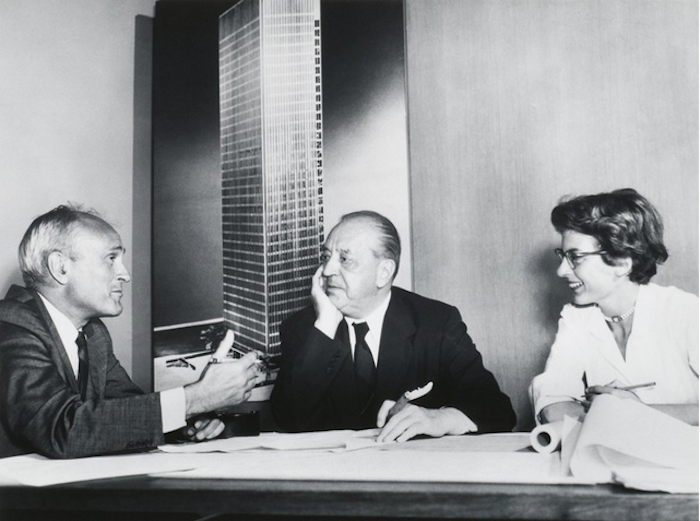
Philip Johnson, Ludwig Mies van der Rohe, and Phyllis Lambert with Seagram Building. (ArchDaily)

You know you are being targeted when your clickbait stories include video of a 2001 panel led by Charlie Rose (transcript included) discussing Ludwig Mies van der Rohe with Paul Goldberger, Phyllis Lambert (a liquor distributor’s daughter who hired Mies to design the Seagram Building in the 1950s) and Barry Bergdoll, a curator at MoMA. Yes, so even the internet is incompetent in its targeting. Here is a segment from that panel discussion that is fun because it reveals how vapid these people are. Well, no. They are intelligent people, I suppose, but they are being forced to discuss Mies, who was vapid himself, so perhaps you  can’t blame the panel for its vapidity. A better word may be incoherence. Enjoy!

15:56 Charlie Rose: Right. Right. Right.

16:00 Phyllis Lambert:  – and he said, he said, ”Yes, but it’s too mechanistic.” He said, ”We have to have our feet on the ground and our head in the clouds.”

16:04 Charlie Rose: Yeah. But can you define this philosophy – we’ve talked around it – that comes from him?

16:08 Phyllis Lambert: A philosophy?

16:10 Charlie Rose: Of – yeah. Did Mies have a philosophy? Did he have –

16:16 Phyllis Lambert: He talked freely about – I think under – it’s, it’s the internal thing. He didn’t talk about it much.

16:21 Charlie Rose: Right.

16:24 Phyllis Lambert: When he describes his buildings, it’s always fairly much a description of how they, what the pieces are. And in the office in Chicago – I mean, all of this – I was speaking to Gene Summers, who was his right-hand man for 17 years. And I said, ”Mies – did Mies ever talk about,” you know, ”his philosophical intent?” And he said no. He was interested in making things clear. He was interested in structural architecture.

16:45 Charlie Rose: Yeah. Clarity.

16:48 Phyllis Lambert: So that there was these two – yes. Absolutely. (crosstalk) There are these two levels that he was – he was on, you know, and, and—

16:56 Paul Goldberger: But they had qualities that he never talked about, but he could convey in the work, that nobody else could. And there’s a serenity to a Mies building that is not present in most sort of imitation Mies buildings, most—

17:10 Charlie Rose: But he wouldn’t talk about it.

17:13 Paul Goldberger: He wouldn’t talk about it, particularly.

17:17 Charlie Rose: He wouldn’t talk about the achievement of—

17:18 Paul Goldberger: Although, although I think when Phyllis—

17:20 Charlie Rose: —Serenity.

17:21 Paul Goldberger:  —talked about his dislike of mechanistic things, he was sort of – that was as far as he could go, to say that. It’s very interesting that the images you showed at the beginning [of the panel] all had figures in them, which is right because, in fact, people feel right inside a Miesian space. They don’t feel that it excludes them the way so many modern spaces do. There’s something about the way the human figure is in that space that feels as perfect as the presence of the human figure in any kind of architecture throughout history. It is as natural and right.

17:48 Barry Bergdoll: Well, I think there’s a connection there. I think the big – if one could say I want to put my figure on a Miesian philosophy, it is the hard one where he takes on this – there’s a kind of crisis of confidence in this issue of the technological, but it doesn’t lead to a retreat from the technological because he emphatically says this, the 20th century, is the moment of a technological transformation of society. It cannot be denied. It cannot be undone. But we need to both struggle with it, transform it and transcend it. And so there’s a kind of – there’s a realism in the sense of wanting to deal with what he will over and over again call the facts of the epic, with this desire towards spirituality, towards a restoration of something that might be either lost or endangered but without nostalgia. And I think that that is one of the reasons why he suddenly seems to be of such contemporary relevance in—

18:40 Charlie Rose: Express that again because I want to make sure I understand.

Well, that’s as good an end point as we are likely to get in this rambling conversation about Mies. But let’s be clear on the need to exclude nostalgia in referring to the restoration of something that might be either lost or endangered.

The passage just concluded was preceded by conversation equally vapid, and followed by the same. It’s hard to criticize because it’s hard to find any assertion within all the goo that one can grab onto, examine and assess. It’s the same thing that enables the Pritzker prize and its winners to float in a cloud of rhetorical gauze – how, one can only wonder, did the jury decide that this whirly-gig of a building was superior to that loopy-doopy building? If you had locked Rose, Goldberger, Lambert and Bergdoll in a room and forced them to discuss the work of McKim, Mead & White without using the word “nostalgia,” would the level of incoherence be identical? I imagine we will never know for sure.

Posted in Architecture | Tagged , , , , , | 12 Comments

Steuteville’s public square

The old New Urbanism: Kentlands, Md. (emrisse.com)

I have lost count of the number of times I’ve quoted Rob Steuteville’s writing for the Congress of the New Urbanism. The latest example is my recent post on “Guatemala’s peaceful Cayalá.” In fact, I must admit my topics on N.U. have declined in recent years as I’ve tracked what seems to be its decreasing interest in the importance of traditional architecture for new city, town and infill planning. The CNU charter’s pledge of “agnosticism” toward traditional and modernist styles got my goat a long time ago, and still has me in its grip.

At first I thought that was just what might now be called a sort of “woke equity,” given that CNU was only on the map because of its trad-styled projects, whose popularity was the envy, then, of landscape urbanists such as Harvard’s Charles Waldheim, who seem to favor a sort of natural, streetless urbanism. In a piece on a debate between Waldheim and CNU founder Andrés Duany, Steuteville cites the professor’s regret at CNU’s “hegemony” in planning circles. Waldheim then criticizes New Urbanism’s “retro design tendencies,” in response to which, according to Steuteville, Duany agreed that:

“[O]ur greatest deficiency is first-rate design.” He added that Waldheim “was astonishingly informed” about New Urbanism’s vulnerability on this front. Landscape Urbanism is self-indulgent at times, but it is “ almost universally better designed and better presented.”

In New Urbanism, there’s very little hostility to modernism except that it displeases the market and therefore modernism is generally avoided, Duany added. Devotees of classical and traditional architecture, who gravitate towards New Urbanism, may disagree with Duany on this point.

That was a long time ago, but Duany’s apparent snuggling up to Waldheim was alarming. Steuteville wrote about this debate for the New Urban Network in 2014. I certainly hope devotees of classical and traditional architecture disagree with Duany that there is “little” hostility to modernism in CNU. There should be a lot, and it ought to be more than just a matter of what displeases the market.

In recent years my former role as a devotee of new urbanism has dissipated as its annual congresses have given more and more attention and awards to the mostly rare (I still hope) examples of modernist N.U. projects. After years of turning the other cheek to modernist sniggering at N.U.’s “retro design tendencies,” CNU seemed to be crawling into bed with the devil! In 2014, after attending the latest congress, architect David Rau tweeted to traditionalist colleagues that “CNU is burning!”: “It was upsetting to discover at CNU in Buffalo that New Urbanism has been divorced from traditional architecture. Kaput, the marriage is over.”

In response to Rau’s cri de coeur, I wrote “Modernism invades the New Urbanism“: The post included this passage:

Modernists now appear to realize that their strategy of sneering at the New Urbanism has failed. They now seek to charm CNU leadership away from the traditional signifiers that the public recognizes as New Urbanism, under cover of an appeal to young Millennials starting careers in planning and architecture. Apparently, it is working.

Just a bit of history that some folks might have forgotten. Ever since, whenever I happen to read about the activities of the CNU and the new urbanists, they seem to have lapped themselves in their effort to place distance between the CNU and architecture that people love, and which made people love the new urbanism. Now it’s all about getting with the program on global warming, or developing new methodologies for implementing increasingly abstruse ideas of urbanism, gears within gears rather than old tried-and-truisms about cities, streets and beauty. Anyway, I don’t hear much about the CNU lately, let alone much criticism from the modernists. Hmm.

In 2015, Steuteville replied to my post “New Urbanism’s easy choice,” and his comment was followed up by an array of comments from traditionalists agreeing or disagreeing with my post. The two photographs juxtaposed in that post – the “old new urbanism” on top and the “new new urbanism” on the bottom – pose a stark but easy choice, it seems to me. The same two shots sit at the top and at the bottom of this post. Steuteville raises some of the complexities involved in why we supposedly cannot have the beauty we deserve, but I still think the CNU has become tangled, or lost, in many of those complexities. It was once a bright shining beacon of hope for Americans. Today, well …

Today, I would dearly love to get back on the bandwagon. I hope I am wrong about CNU having strayed from the traditional straight and narrow, and that Rob and Andrés will administer me a good spanking for my apostasy.

While I’m waiting, allow me to join the long line of comments by email praising the work of Rob Steuteville, whose writing remains enlightening even where we disagree – and, frankly, I don’t think we disagree on much. Keep up the good work, Rob! (You will receive this post by email.)

The new New Urbanism? Paseo Verde, in Philadelphia. (phila.gov)

Posted in Architecture, Development, Urbanism and planning | Tagged , , , , , , , | 18 Comments

History wins on Williams St.

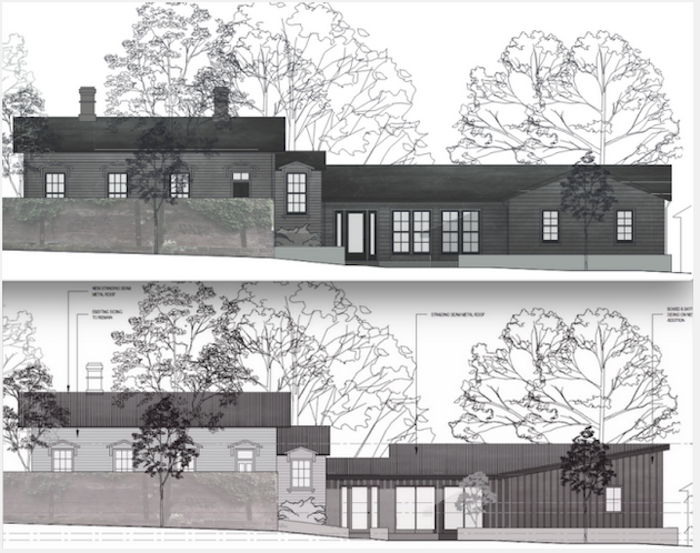
Cottage with latest proposed addition (top); cottage with modernist addition (bottom). (PHDC)

For a year or more the vultures circled over an old cottage between Williams and John streets just off of historic Benefit Street. A developer’s plan to add an ultra-modernist addition to a historic cottage at 59 Williams, and then to plop a pair of junkster modernist “town homes” behind the cottage, facing John, at the expense of a woods that had survived since the 19th century, placed the historic character of College Hill and Fox Point at dire risk. Had it proceeded, the development would have proved an irresistible precedent for even worse.

I now learn that the developer has called off his dogs. The neighborhood is safe, or as safe as any place can be in a city whose leadership prefers to eat the seed corn of its history. Two proposed modernist Brown University dorms still threaten to wreck a block on Brook Street between Power and Charlesfield streets nearby. Brown has offered to review the design of the two dorms, but it may take a sterner rattling of Brown’s cage to force the school’s leadership to see reason.

A correspondent sent me word that the plot of land with the woods on it was suddenly for sale for $1 million. Digging down further into the Zillow posting, I discovered that the Williams Street cottage had sold on June 2 for $580,000; the buyer is now seeking to flip it for $1.6 million. That suggests that the renovations recently approved by the city will go forward. But a deep source that I contacted to double-check this news told me that the developer had altogether abandoned the condo townhouse part of the project.

The cottage renovations will be historic in style, and quite easy on the eye. That is because the neighborhood maintained a constant opposition to the modernist design proposed by architect Friedrich St. Florian (with its patently clichéd awkwardly raking roof). The Providence Historic District Commission, which oversees plans for the city’s historic districts, delayed deciding on the renovations for three sessions. This probably caused the developer to ditch the modernism and go with a much more historically sensitive design, no doubt to St. Florian’s dismay. Apparently, at some point, the developer decided to ditch the whole project, including the condos, which was no doubt running far higher in costs than he expected (largely due to St. Florian’s goading the opposition’s tenacity).

There are lessons to be learned here. Members of the PHDC know what their jobs are, but are willing to stray in order to curry favor with wealthy developers and fashionable designers like St. Florian. They must be pressured to permit only those changes that will fit into a district’s historic character – using definitions of aesthetics that would feel proper in the eyes of an average resident of the district, not the kooky fake notions dreamed up by the professional designer class, who are poorly educated in all matters of design, and inflict their folly on citizens who have invested deeply in historical architecture – because citizens trust officials to do their jobs properly. The words “historic preservation” in the title of their organization must be taken more seriously.

In this process of, um, reminding officials of their duty, the neighbors almost managed to snatch defeat from the jaws of victory by bowing and scraping to a designer, St. Florian, who seems to have forgotten why he is celebrated around here. He designed one of the few traditional shopping malls in the United States, which is lovely in spite of its design flaws. And he designed a classical World War II memorial on the Mall in Washington, D.C., at a time when most designers were testing the patience of American citizens by designing goofy modernist memorials and museums in that sacred precinct.

On the same wavelength, some of the opponents did not realize how counter-productive it was to assert that they did not oppose modern architecture – except in their neighborhood. Such a hypocritical NIMBY contradiction enabled the developer (and St. Florian) to persuade themselves that the opposition was not serious and that if they could hold on long enough, they could make a lot of money by wrecking a beautiful neighborhood.

St. Florian probably did not make things any easier for his boss by using the time between commission sessions to make his designs for the cottage addition and the townhouses more, not less, ridiculous. His opponents can thank the great architect for throwing his doubt of their resolve back in their faces.

It is impossible to know what straw of opposition, or which commission delay, will break a developer’s back and force him to throw in the towel. The neighbors on Williams and John street can celebrate the fact that they did indeed manage to trip over the last straw.

It is possible that I am reading these Zillow tea leaves wrong and that the project will continue, possibly with an infusion of new cash, or with a new developer. Or that I should have done more digging to confirm my information. Neighbors must remain vigilant along Williams and John even as they gird their loins to fight Brown on Brook. However, if they are willing to learn the lessons of their victory – be even clearer that your opposition is to anti-historical design – they will show the next set of brutalizers that they are a force to be reckoned with.

Posted in Architecture, Development, Preservation | Tagged , , , , , | 2 Comments