Blast: CNU in Providence (2)

books

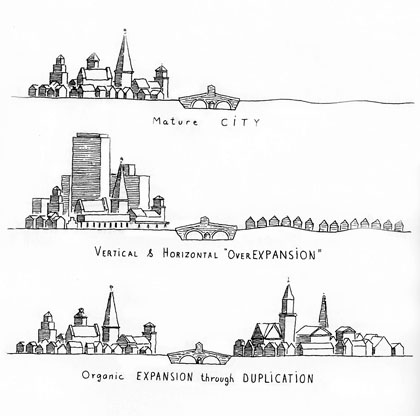
Drawing by Leon Krier above makes a point similar to that of “True and False Diversity,” which ran with the original column back in 2006.

Here is the second of those two columns:

The New Urbanists in Providence II
June 8, 2006 

THE QUESTION most asked at last week’s 14th Congress for the New Urbanism was: If style doesn’t matter, why are we always discussing it? The question answers itself.

The charter of the Congress for the New Urbanism reads, in part: “Individual architectural projects should be seamlessly linked to their surroundings. This issue transcends style.” But of course it really does not. Modernism, as conceived by modernists themselves, cannot link up seamlessly to its surroundings. Modernists are free to try, but those who succeed must abandon their modernist dogma.

The New Urbanism seeks to reconstitute the traditional patterns of living that prevailed before World War II, which have since been overturned by modern planning and design. Traditional styles are not necessarily the key to traditional neighborhood development. Walkability, proximity and intimacy of scale are more important. But the New Urbanism’s popularity, and hence its power to confront modernism, does hinge on its traditional style.

After all, the public might not necessarily recognize a traditionally patterned neighborhood without a hint from traditional styles. Slide after slide in the seminar “Can New Urbanism Capture the Market for Modernism?” showed modernist attempts at New Urbanist streetscapes. They were uniformly forgettable. Only one slide, of a block of townhouses in Aqua, part of Miami Beach, was attractive. Whether Aqua itself lives up to that slide, I cannot say. Moderne rather than modern, the block’s disciplined hubbub reminded me of the old town in the cartoon above, by Léon Krier. Aqua rejects the “Wow!” modernism that has spent decades trying, with increasing success, to live up to Krier’s wacky stereotypes.

In accepting CNU’s Athena medal honoring the seminal influence of his thinking on the New Urbanism, Krier displayed his unabashed classicism. As a boy, he watched his native Luxembourg being rebuilt in its historic patterns and styles after it was heavily damaged in the Battle of the Bulge — and its later brutalization by modernism. Krier’s influence arises in part from his erudite architectural cartoons of the modernists’ idiotic attempts at urbanism. My favorite, above, from his book Architecture: Choice or Fate (1998), shows a true and a false diversity: a traditional town on one side of a bridge and a modernist town on the other side; or a hodgepodge on both sides. The latter offers no choice.

Even as it handed him the Athena, the CNU appeared to be forgetting why it honors Krier.

In all their innocence, the New Urbanists throw open their movement to the modernists, heedless that highmindedness in modernist circles evaporated half a century ago — to be replaced by the most uncivilized behavior. The viciousness of their attack on New Urbanism following its post-Katrina success shows that they have not changed.

In a masterful challenge to “classical jihadists” (as the CNU catalogue called people like me), the CNU board’s house modernist, Daniel Solomon, focused at first on the modernists’ transformation of architectural education. He tracked the influence of Harvard’s design school under founding modernist Walter Gropius, who fostered “a widespread cult of unlearning.” Professors purged not just the practice of classical architecture but its history from courses. Texts taught budding modernists that, in Solomon’s paraphrase, “if people don’t like the mechanization and abstraction of our brand of architecture, don’t worry; it’s their fault. As a modern architect and an initiate into the true workings of historical process, you have an obligation not to listen to them.” This “Gropius anschluss” transformed the schools, the firms, and eventually the landscape. Its “smugness” was, Solomon said, “bound to create a merciless backlash,” and it did — most powerfully as the New Urbanism (although the degree of the CNU’s mercilessness is, in my view, suspect).

The rest of Solomon’s lecture, however, called upon the New Urbanists to embrace not “Wow!” modernism but a more nuanced modernism, a “playful eclecticism” patterned after three exemplars of artistic creativity: Coco Chanel’s fashions, George Balanchine’s ballet and Duke Ellington’s jazz. Because they rejected modernist dogma and embraced art history, they can be models for a less staid, more “hip” New Urbanism.

The alluring imagery of Solomon’s proposal has great strength. But he underestimates the creativity of the classical. The New Urbanism is not staid. Like a classical symphonic score, the codes and pattern books of the New Urbanism offer room for delight in the hands of a genius. The mauve curvature, say, of an otherwise straight white picket fence is architecture in the clothing of jazz. But the rules of classicism put a less heroic yet still pleasing beauty in reach of most architects — whose capacity for genius, alas, Solomon overestimates. If architecture with rules is hard to do well, try architecture without rules. New Urbanism’s central insight is that the rules of the old urbanism really do work; they need only be accepted and learned anew.

Traditional architects stand proudly on the shoulders of history. Modernists reject history, and try to stand on their own shoulders. This is contortion, not genius. It cannot fit in. But true urbanism demands fitting in — with panache if possible — something that style can assist, and New Urbanism mustn’t forget.

David Brussat is a member of The Journal’s editorial board. His e-mail is: dbrussat@projo.com.

* * *

Cartoon depicting true and false diversity, by Léon Krier

Posted in Architecture, Blast from past, Development, Providence, Urbanism and planning | Tagged , , , , , | Leave a comment

Blast: CNU in Providence (1)

Illustration by Randall Imai, of DPZ, of proposed garage flanked by apartments on the Grant's Block, in downtown Providence.

Illustration by Randall Imai, of DPZ, of proposed on 2010 or so, but never built, garage (left) flanked by apartments on the Grant’s Block, in downtown Providence.

The lengthy thread called “CNU is burning” began on the TradArch listserv with architect David Rau’s ringing expression of concern that the Congress of the New Urbanism, which recently met in Buffalo, is opening its doors too widely to modern architecture. This has been a worry of mine for years, but it apparently has reached a new and terrifying peak. My Thursday column will deal with that, but I want to rerun my two columns about CNU-16, held in Providence in 2006, before the “CNU is burning” thread runs out, if it has not already. I will post them in succession, one right after the other.

So here is the first column:

The New Urbanists in Providence
June 1, 2006

STARTING TODAY, Providence hosts the annual convention of the group whose ideas best reflect those of the late Jane Jacobs. Like the great urbanologist in her own time, the Congress for the New Urbanism is being sniped at by modernist architects and planners. Providence is in their crosshairs, too, so we welcome the CNU to our foxhole.

That the CNU holds its 14th congress in a city rather than a suburb, and so shortly after the death of Jane Jacobs, holds great symbolic meaning.

One accusation hurled at New Urbanists is that many of their projects are on unbuilt suburban and exurban land. Of course, critics never mention that the New Urbanism’s short blocks, mixed uses and walkability are illegal under conventional zoning, or that its traditional designs are frowned upon by many officials who implement the zoning. Nonetheless, the CNU aims to export Jane Jacobs’s urbane sensibility to the suburbs, where most people live.

Even a city like Providence, with so much intact historical fabric, struggles against modern planning and design practices. Providence’s historic districts would be illegal to replicate under current zoning if they were destroyed by a fire, flood or hurricane.

In spite of these obstacles, developer Arnold “Buff” Chace Jr., who chairs the CNU host committee in Providence, has pursued the revitalization of Downcity (a district in, not a synonym for, downtown). In fact, the theme of this year’s congress is “Developing the New Urbanism: Implementation.”

Crucial to Chace’s effort has been an overlay code – basically a system of exemptions from the city’s zoning code – crafted by the leading New Urbanist, Miami architect Andrés Duany, his wife and partner Elizabeth Plater-Zyberk, and their firm, DPZ. Since 1992, they have led Providence through a series of planning sessions (“charrettes”). Implementing the Downcity Plan has been slow and costly, because of both the zoning and the municipal culture, as Chace knows so well. But the plan’s urbanity is bearing fruit in a livelier, more artful downtown – albeit at a price difficult for starving artists to afford.

The first major New Urbanist development was Seaside, Fla. A beachfront community designed by Duany with housing for a range of incomes, Seaside had a traditional look and feel that was so popular that house values rocketed out of reach for most. Modernists attacked its architecture as nostalgic façades covering a multitude of bourgeois sins — as if a white picket fence could transform a family of four into a collection of hypocrites. Good grief!

And yet, since Seaside, New Urbanists have built or planned another 600 such communities. They are expensive because, like historic districts in cities, they remain rare. As more new communities are patterned after traditional neighborhoods, their cost will decline. After all, as Duany points out, historic districts are merely typical neighborhoods built before modernism. Architectural and planning elites can sneer all they like, but America isn’t listening.

It seems, however, that Duany and others may be listening. At last year’s conference, in Pasadena, the host committee honored Frank Gehry – the antithesis of the New Urbanism. The cover of Duany’s latest book, The New Civic Art: Elements of Town Planning, features Gehry’s ridiculous Guggenheim Bilbao. Increasingly, modernists have been invited to participate in New Urbanist projects.

Will Buff Chace now propose a modernist project on the site of the Grant’s Block, in Downcity? Will his CNU host committee honor Capital Center’s new Glass Box in Diapers [the GTECH headquarters] – the modernists’ first big victory over Providence in 15 years?

Let’s hope not. The CNU got a huge boost from its southern Mississippi charrette after Hurricane Katrina. It has now been hired to design the rebuilding of southern Louisiana outside of New Orleans. Lake Charles unanimously approved Duany’s plan after citizens’ enthusiastic reception. Increasingly, municipalities around America are joining developers in seeking out New Urbanist alternatives. Seeing is believing. Traditional developments’ popularity with the public threatens to overturn the modernist dogma that traditional design is inappropriate for “our era.”

The modernist attack on Andrés Duany and the CNU has been led by the dean of Tulane University’s School of Architecture, Reed Kroloff, who condemns the New Urbanism as “treacly, sugar-coated, neo-precious architecture.” His ideas for a “Newer Orleans” make Frank Gehry look like Charles Bulfinch. Maybe Kroloff will be invited to design a town hall for the next New Urbanist community.

Not likely. Yes, modernists who accept New Urbanist principles are welcome. But that’s unlikely, too. So let’s hope the CNU resists modernists trying to worm their way in. They did it to the old urbanism. That’s why we need the New Urbanism.

New Urbanists visiting Providence should enjoy what they see on tour, but learn from what the tours avoid. The CNU must not let the modernists spin poor Jane Jacobs in her grave.

David Brussat is a member of The Journal’s editorial board. His e-mail is: dbrussat@projo.com.

* * *

Illustration, from early version of Downcity Plan, of the intersection of Eddy and

Westminster streets, in downtown Providence

Journal archives

Posted in Architecture, Blast from past, Development, Providence, Urbanism and planning | Tagged , , , , | 1 Comment

An ecclesiastical mood

Chartres Cathedral, in France. (contentfy.com)

Chartres Cathedral, in France. (contentfy.com)

Something of an agnostic myself (and a Jewish one, to boot), I used to take my son to various churches not to give him a taste of theology (he was only 2 then, and we lived near Grace Church in those days, to which we paid our most frequent visits) but maybe to instill in him a taste for beauty, both in the built world and in the sound of music and the human voice. Often we would repair afterward to Tazza, the now defunct restaurant near Grace Church, for breakfast. For a while you could see the world pass by outside its windows, but then they were frosted over, and now the place has been closed – though the building owner, Buff Chace, has decided to put in new windows without the stupid frosting.

Nowadays Billy worships Angry Birds and we don’t visit churches as much. (I hope Angry Birds is not the Devil’s work!)

Today is Sunday, and I am still eager to do what little I can to help Billy by trying to soften a tough world. Also, I have been reading Nikos Salingaros, the mathematician and theorist of architecture, and have reached the chapter “Anti-Architecture and Religion” in his book Anti-Architecture and Deconstruction: The Triumph of Nihilism, originally published in 2004 but reissued four times since, most recently this year, with interesting additional material.

Anyway, his thoughts influence my post today.

Church architecture has always been beautiful architecture because church architects long tried to make churches reflect the beauty of God. You do not have to believe in God to cherish the role of religion in ordering and softening the world – even admitting that all religions have committed grievous wrongs, usually in misguided attempts to get people to hew to the one true path (as this or that religion sees it). But if you put the idea that life has meaning next to the idea that life has no meaning, most people think the former view is more compelling. It may not be true but it is certainly good. Of course it is a truism that only one religion (at most) can be “true” to the extent that its view of the world reflects how the world really is – and maybe none are. But perhaps it may be said that religion embodies a higher truth, whether God exists or not.

So church architecture reflects two of the three avatars: the good and the beautiful, and maybe also the true.

It has always irked me when I see a modernist church – the Church of St. George Jetson, as I like to say. Such a church declares that its congregation, usually through a committee of its church leaders, has decided to step away from order and beauty toward nihilism – the idea that life has no meaning, which makes it more difficult to slow humanity’s decline toward a world of chaos. Modernism in architecture and in the other arts and intellectual fields beckons toward nihilism, disorder, chaos – represented by a purposeful ugliness.

Such modernism claims, as Salingaros points out, to be scientific, but its claims are bogus. True science is closer to religion than to modernism. Science and religion have, at least, a reverence for order at their base, and both reflect processes that seek truth and exalt beauty. Modernism pulls in the other direction. Even the modernists claim that architecture should reflect its era, and ours is, increasingly, one of disorder and chaos. I think architecture’s job – beyond housing humanity’s needs – is to help solve humanity’s problems, not merely to reflect them in glass and steel. That is a low, degrading purpose.

I find I am running out of things to say on this fruitful subject, so I will conclude this post with those thoughts, such as they may be. The upshot is that for a congregation to build a modernist church may seem to be an exercise in fashion but it is really much deeper than that, and ought to be avoided.

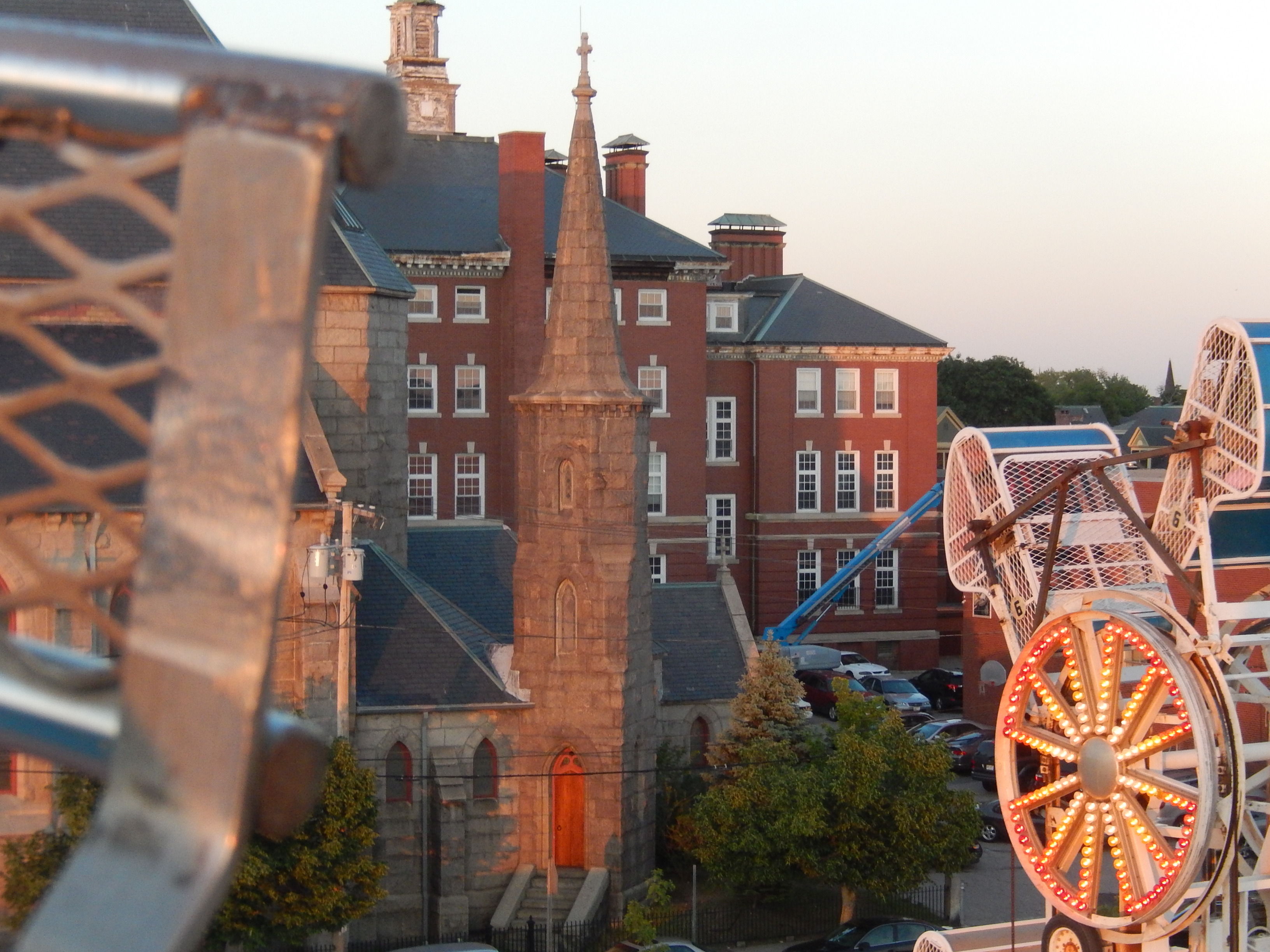
I was going to replace Chartres Cathedral with the photo below, taken last night on a ferris wheel near a local church at the end of Broadway, here in Providence, but I just couldn’t bring myself to give the heave ho to Chartres. So that photo, which seems to reflect the pressures of modernity on religion, is below rather than above, which may actually be more appropriate.

DSCN2049


Posted in Architecture, Art and design, Providence | Tagged , , , , , | 1 Comment

Palladio the Erroneous

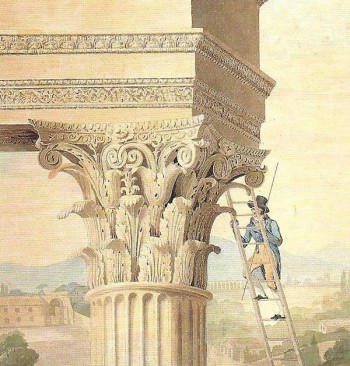
Student measuring the Temple of Castor and Pollux (detail), in Rome, by Henry Parke. (John Soane's Museum, London)

Student measuring the Temple of Castor and Pollux (detail), in Rome, by Henry Parke. (John Soane’s Museum, London)

Along with Calder Loth, in his latest essay for the Classicist Blog at the Institute of Classical Architecture & Art, I mean no disrespect to Andrea Palladio, the 16th Century architect and teacher of classicism. His influence on architecture has been enormous and enormously beautiful, in his own work, in his famous book, in the work of architects who have since drawn inspiration from both, not excluding the classicists of today who struggle to raise architecture from its doldrums.

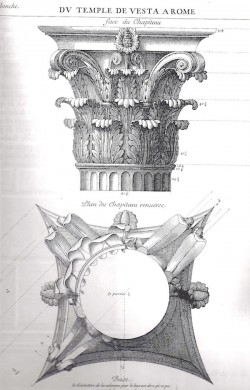
But according to Loth, drawing from the work of a later, French investigator of the Roman ruins that Palladio drew and from which he was inspired, the great man was not immune to over-hastiness (I imagine) in transcribing the details of Roman classical ornament onto paper. He used assistants to take some of the actual measurements, but the drawings were his, and their occasional inaccuracies are elegantly pinpointed by the young architect Antoine Babuty Desgodetz (1653-1728). Here is a passage describing the capitals of the Temple of Vesta, quoted by Loth:

 Palladio draws the capital quite otherwise than it is; he makes the bottom and top leaves of one height, as they usually are, and puts five olive leaves to each division; he makes the channels of the stalks twisted, ties the volutes together, and puts a small reversed leaf over them; he makes his volutes ascend into the abacus, whereas they touch only the bottom of it, he puts a flower to bear the rose in the middle of the abacus, and makes not the rose as it is [, and] he cuts off the angles of the abacus.

You don’t need to know the definitions of the words he uses to perceive that Desgodetz has an equally sensuous perception of the work both architects are drawing. (A volute is the scroll-like element of some column capitals, or tops, especially the Ionic but in this case the Composite, which mixes the Ionic with the Corinthian; the abacus is the platform upheld by the flowery ornaments of the capital.)

Corrected drawing of the Vesta capital by Desgodetz

Corrected drawing of the Vesta capital by Desgodetz

Aside from his beautiful writing, Desgodetz gilds the lily, it seems to me. He has got Palladio by the short hairs, and his illustrations are more precisely detailed, not to mention accurate, than those of Palladio. (I urge readers to click on the Classicist Blog link above to get a better idea of this.) But in the wider scheme of things, does it really matter that Palladio got some details wrong? His work and book inspire beauty to this day in spite of the fact that his drawings of Roman ruins are sometimes inaccurate.

And, indeed, it is difficult to know for sure whether Palladio’s inaccuracies are really mistakes or rather more in the line of being unable to rein in his innate creativity from improving on the Romans – even if he was there to copy them as instructive to his own work. Certainly our reverence for Palladio is not diminished by his mistakes in transcribing Roman classicism.

In fact, I thank Palladio for his mistakes, and I thank Desgodetz for going to such gorgeous lengths to point them out, because without both error and correction we would not have Calder Loth’s beautiful essay on this subject, so easily at hand by the click of a button.

Antoine Babuty Desgodetz (1653-1728
Antoine Babuty Desgodetz (1653-1728),
Posted in Architecture, Architecture History, Art and design | Tagged , , , | 3 Comments

Blast from past: Casino at Waterplace

Grand Casino of Monte Carlo, in Monaco, erected in 1858.

Grand Casino of Monte Carlo, in Monaco, erected in 1858. (stylefile.julesb.co.uk)

Back when a casino was proposed for the Rhode Island town of West Greenwich, I wrote a column that bears rereading in light of the proposal to turn the Newport Grand slots shed into a genuine casino. By the way, today Rhode Island has slots parlors up north in Lincoln and down south in Newport. The Lincoln parlor has recently been upgraded with table games and a vote on table games in Newport has been approved. Meanwhile, Massachusetts has begun to develop slots and casinos. Here is the column:

If we must have a casino . . .
July 7, 1994 

ONE WAY OR ANOTHER, casino gambling must be factored into the future of Rhode Island. If we are lucky, its impact will remain on the periphery, across state lines, siphoning the wealth of its citizens only slowly into the coffers of Connecticut, possibly Massachusetts, and ultimately into the pockets of gambling interests in Nevada.

If we must, however, Rhode Islanders will participate in the location and operation of a casino of their own – actually, of their own Indian tribe, the Narragansetts. If the time comes for Rhode Island to negotiate the details of such a casino, state officials and their Indian counterparts should seek a location that best suits the interests of Rhode Islanders.

The choice, it seems, would depend upon which of two basic strategies the state adopts. One would aim to minimize a casino’s social impact by putting it in South County. The other would aim to maximize its economic impact by putting it in Providence.

I don’t know which course would be wiser. Much would depend on calculations about the future that are difficult to make. However, supposing for the sake of discussion that a choice becomes necessary and Providence is chosen, where in the city should a casino be built? It seems to me that to maximize its utility as a tool of economic development while minimizing its potential to hurt Rhode Island’s most vulnerable citizens, there are two requirements:

* It should be designed to appeal to people who can afford to gamble, and who expect to spend a lot of money enjoying the prospect of losing more of it.

* It should be built not at the Port of Providence or at Field’s Point, as has been suggested, but downtown, in or near Capital Center.

These requirements would help our casino compete with Foxwoods. They would also minimize its allure to those of us who can least afford to gamble, and whose losses would lead to increases in state social expenditures. Such expenditures would offset, wholly or in part, whatever revenue the state hopes to gain through its participation in a casino.

We should bear in mind that Rhode Island’s participation will have been forced upon it. Its purpose should not be to fulfill its citizens’ latent desire to gamble, but to raise funds to fulfill other needs. The state isn’t obligated to offer equal-opportunity vice.

To avoid recirculating our own income, our casino should appeal primarily to gamblers from out of state. Because the allure of Foxwoods to unsophisticated gamblers has been firmly established with its banks of slots and video poker machines, our casino should appeal to sophisticated gamblers who imagine themselves matching wits with James Bond.

A stylish, exclusive casino would favor croupiers over machines, and require patrons to dress with equal panache. It should cater to those who gamble more to enjoy themselves than to enrich themselves. Come what may, it will inevitably attract gamblers who make a living on dice, chips and cards; why not seek those who will spend a lot in the process?

Our casino should be sited so as to maximize the comparison with Monte Carlo and to capitalize on Newport’s established reputation among the international jet set. Rhode Island has already invested millions in its capital city. The casino should sit on the elegant banks of the Woonasquatucket River near Waterplace in Capital Center. Throw in the option of parking at satellite lots and traveling downtown by water taxi, and our casino would offer the greatest contrast to the Foxwoods experience and the strongest allure to visitors from out of state and abroad.

A casino, say, at Field’s Point, on the other hand, would require major new infrastructure and could undermine current economic development efforts, offsetting the stimulus of the Convention Center, the Downcity Plan and Providence Place. Rather, its location should boost the city into the topmost rank of American resorts, and its architecture should revive the optimism of our own Gilded Age a century ago.

Ultimately, the best way to promote prosperity in the Ocean State is to avoid a casino. If we must have one, I suppose I’d prefer that it be in South County, and so rinky-dink that nobody would go. But try getting the Narragansetts to go along with that!

If, indeed, our limited ventures into vice have already closed our options legally, and if we conclude that the best place to build a casino is in Providence, we can at least minimize its risk by upping our stake in downtown. Let us not shrink from thinking big. At best, we might turn an unsought set of cards into a winning hand in the game of economic development.

* * *

David Brussat is a Journal-Bulletin editorial writer and columnist.

Posted in Architecture, Blast from past, Development, Providence, Rhode Island | Tagged , , , | Leave a comment

Column: Newport Grand: Guffaw or grandeur?


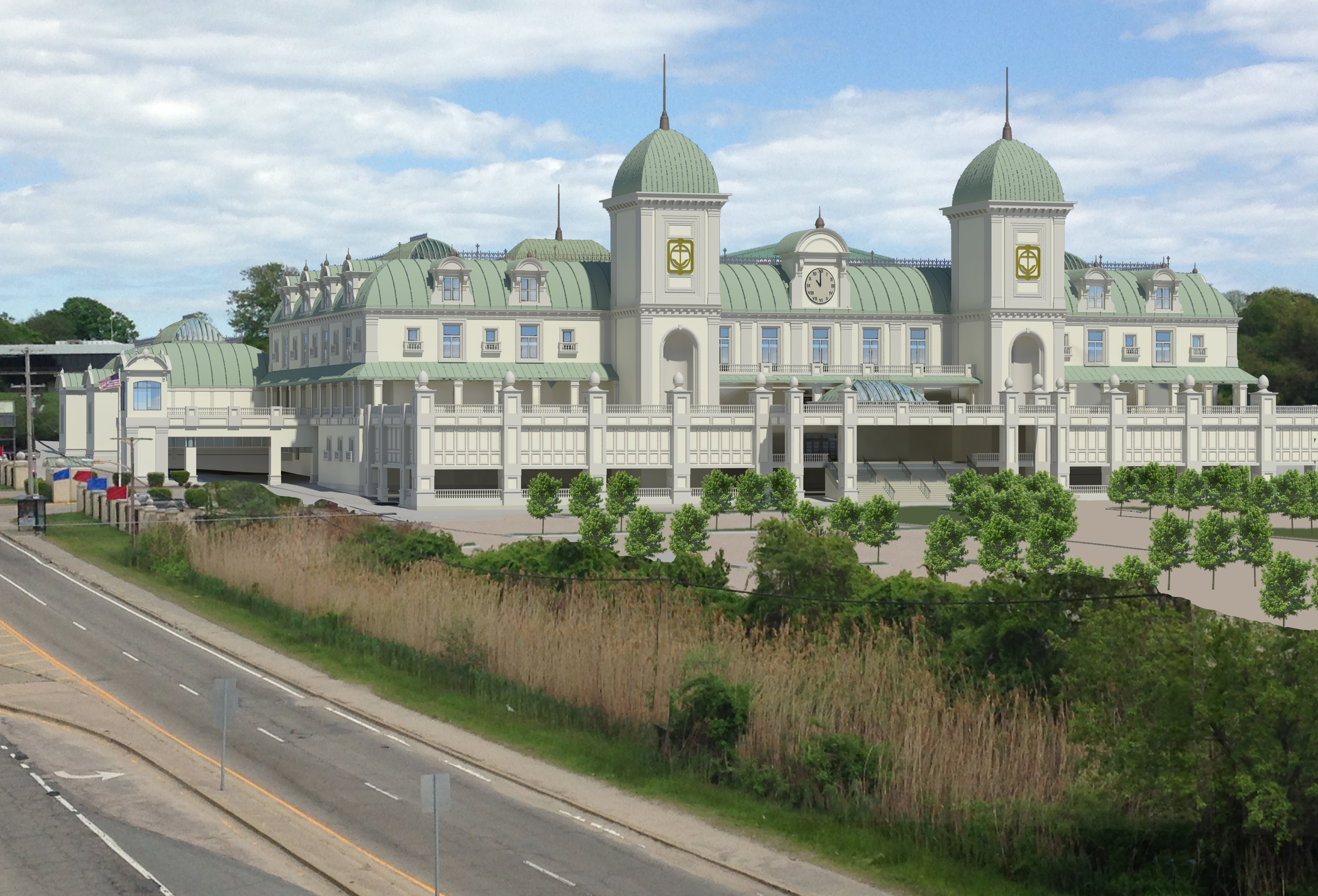
Proposed Beaux Arts casino retrofit for Newport Grand. (Northeast Collaborative Architects)

Proposed Beaux Arts casino retrofit for Newport Grand. (Northeast Collaborative Architects)

The appliqué of classical elements to the shed that once housed Newport’s jai alai fronton may take the cake in the sweepstakes for the world’s most ridiculous architectural renovation.

Newport Grand, with its big red “S-L-O-T-S” sign emblazoned on its faux façade, circa 1997, has stumbled along ever since. Its appearance brings a chuckle from drivers on the Newport Bridge as they approach the City by the Sea.

But I kid myself. It is in all probability not a chuckle but a guffaw. It is hard for a proud city to reckon with a guffaw.

The May 6 news story “Paolino’s Newport Grand bid bets on table games” featured a black-and-white sketch of the shed dressed up nicely as a Monte Carlo casino. But a color version of the sketch on the Northeast Collaborative Architects website had a roofline colored so bright a green that it looked like shrubbery, as if the proposed casino had escaped from the popular topiary gardens in Portsmouth, at the other end of Aquidneck Island.

To read the rest of this column, please visit The Providence Journal.

Posted in Architecture, Development, Rhode Island | Tagged , , , , | Leave a comment

Union Studio enchantment

thayerbrook

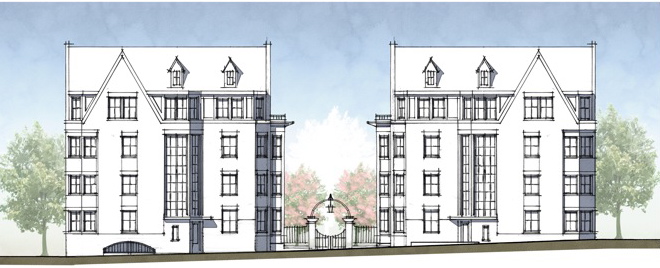
The sketch above really threw me for a loop a while back, during the evolution of the 257 Thayer St. project, when Gilbane Properties (or Development) gave the flawed original design to Union Studio Architects in downtown Providence. I visited the office, which is in the Peerless Building right across the alley from the Smith Building where I lived in 1999-2010. Don Powers, the firm’s founder and principal, and Bob Gilbane, who was also there, showed me, among other illustrations, a sketch of the Brook Street facade of the proposed building, which featured the entry to a courtyard between the Meeting Street and Euclid Avenue wings of the somewhat U-shaped building. This wow’d me even more than the building’s frontage on Thayer Street. Can you see what I mean?

I don’t know whether it’s the spare but elegant detailing of the two end pieces of the structure, or the porportions by which the two end pieces and the fenestration on each side relate to each other, or just that really great gateway, but … well, you can just feel its gentle but firm relationship not just to the street but to the city and its people.

Tomorrow readers of my column can view another sketch from the same set of the corner of the building at Thayer and Euclid. (Or they can click to my last post, “Gilbane politely objects.”) But right now you can go to the website of the 257 Thayer St. project and see a video that takes you around the building in its latest and, I assume, final incarnation. In my opinion it is less compelling than the initial Union Studio renderings, including especially the one above. But you be the judge.

Posted in Architecture, Development, Providence | Tagged , , , | 1 Comment

Gilbane politely objects

Early rendering of upgraded 257 Thayer St. design by Union Studio Architects.

Early rendering of upgraded 257 Thayer St. design by Union Studio Architects.

Robert V. Gilbane of Gilbane Properties is developer of residential apartments at 257 Thayer St., a new building that replaces nine old houses, which are gone. Construction has begun on the building. Bob objected to my portrayal, in last week’s column “Don’t just shrug off horrid hotel plan” of the project’s sequencing, which he thought implied a bait-and-switch – which it did. (I wasn’t certain enough to assert it directly.) He has written a congenial letter correcting what he believes to be my false imputations.. I’m not sure I’m entirely guilty as charged, but readers deserve to hear Bob’s side of the story.

First, my offending paragraph:

But watch out: Gilbane Properties proposed to raze nine old houses and build an apartment complex on Thayer Street, on College Hill near Brown. After loud objections from the community, the design was significantly upgraded by Union Studio Architects, in downtown Providence. Then, after getting its permits from the city, Gilbane gave the design to a third firm for, as I heard, final touches. The result leans back toward the first design, if a billboard at the site is reliable. And yet the nine houses are history and the building is under construction.

Now here is Bob’s email:

David

In your article you mentioned our 257 Thayer Street project and implied that after upgrading the design with local architects, Union Studio, and getting permits from the City, Gilbane “gave the design to a third firm for … final touches” with the result that the building ended up  looking much like the original (prior Union Studio) design. Your lead sentence implied the specter that this was perhaps a  “bait and switch.”  Nothing could be further from the truth.

Union Studio was hired by Gilbane Development Company as design architect to help shape the entire exterior of 257 Thayer in regards to building materials, exterior elevations, building footprint,  and roof line composition. Union Studios successfully did this, received accolades from many in the community, and the project received Final Approval from the Providence Planning Board in March 2013. Union Studio’s agreement with Gilbane was that they were engaged to serve in a design capacity producing the design documents but not  produce the final construction and engineering  documents. For the production of the construction documents in March, 2013 Gilbane hired Cube3, an architectural firm with a proven track record of producing outstanding construction documents for multi-family construction. During the production of these documents Union Studio continued to play a very key role in reviewing, commenting on and adding their design input to ensure that the final set of construction documents reflected the spirit and essence that was shown in their approved design.

Once the Planning Board gives Final Approval a developer cannot simply change the design or materials and start construction on a project that is materially different from what was approved. He has to submit the final construction documents (plans, specifications, materials, elevations) to the Planning Department for their detailed review and approval. Only then is a building permit issued. After conducting such review the City issued the building permit for 257 Thayer on December 4, 2013. The final design for 257 Thayer can be seen at www.257thayer.com

Bob Gilbane

Chairman & CEO

Gilbane Development Company

7 Jackson Walkway

Providence, RI 02903

Of course I must take Bob at his word, and I do. My column relayed my impression that the second design improved on the first, but that the third design did not improve on the second. This impression was (I must admit) uncomplicated, first, by the various stages of the permitting process, and second, by my being unaware that Cube3 was hired only to do the construction blueprints. I am assuming that aside from minor changes required by the permitting process and undertaken by Cubed3, but approved and overseen by Union Studio Architects (a great firm, by the way), the third design by Cube3 is essentially the same as the Union Studio’s rendering. Still, I thought the Cube3 rendering of that design stepped back toward the original, highly flawed, design rather than reflecting the great improvement I thought characterized the second design.

(Why can’t there be a Door No. 4!)

The drawing by Union Studio at the top of this post is one of the preliminary drawings shown to me not long after Gilbane hired the firm to tweak its original design. It certainly influenced me, and perhaps caused me to give too much credit to Union Studio’s final computer rendering. (All four of the renderings may be viewed when my column, which briefly addresses all this, runs on Thursday. The three I mentioned in last week’s column and in this post may be seen toward the bottom of last week’s column here.)

Posted in Architecture, Development, Providence | Tagged , , , | 1 Comment

Henry Hope Reed live!

Henry Hope Reed, who passed away last year, spoke to an audience a decade ago about the architecture of the U.S. Capitol at the National Building Museum in 2004, just before the publication of his excellent book on that building. He is here introduced by Nir Buras, a Washington architect and planner who was then the director of the Washington chapter of the Institute of Classical Architecture – now the Institute of Classical Architecture & Art since its merger in 2002 with Classical America, which Henry founded in 1968.

Anyway, the late Henry Hope Reed is my greatest hero in the realm of architecture, and finding this video of classicism’s knight in shining armor (and modernism’s most vociferous detractor), after a pleasant conversation I had with Nir this evening, was a thrill. Despite his 89 years at the time, Henry as lecturer – courtesy of C-SPAN, the National Building Museum and the ICAA – comes across as a vivacious advocate of classicism. Of course classicism embodies the good, the true and the beautiful in the design of our built environment. So please enjoy this visitation from this great and fondly remembered man.

Posted in Architecture, Architecture Education, Architecture History | Tagged , , , | Leave a comment

Koolhaas’s biennale

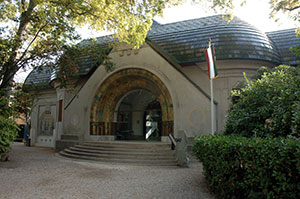
The Hungarian pavilion at an old world's fair. (Financial Times)

The Hungarian pavilion at an old world’s fair. (Financial Times)

Rem Koolhaas is director of the latest Venice Biennale of Architecture, the big cheese of international architectural exhibitions, which begins on Saturday, June 7. Predictably differentiating himself from his ridiculous predecessors by using the biennale to do something intelligent, he has made it a forum for discourse on nationality in architecture – or, as he himself admits, how nationality (and not a few other even more beloved things) have utterly disappeared from today’s design world.

Koolhaas sees the trees (the flaws of modernism) but not the forest (the fatality of those flaws, and the obvious solution of a return to traditional practices that worked for thousands of years). He is seconded in a good piece by Edwin Heathcote, architecture critic of the Financial Times. Heathcote seems to see the trees instead of the forest, too, although he articulates the trees so well that they sound like the forest. But does he take the obvious next step? Of course not. Here are a couple of passages from his piece. After describing several old pavilions from exhibitions (not the Biennale) of the past, Heathcote writes:

Each pavilion tells us about the desire to express something of the national character – and the prevailing political aesthetic. And it is this idea – and what happened to it – that is at the heart of the theme set by this year’s curator, Rem Koolhaas. The question is posed through the juxtaposition of cities a century ago – with their distinctive, bustling streetscapes, busy with architectural detail – with shots of contemporary central business districts, the anonymous cityscapes of glass towers and urban freeways that could be Houston or Dubai, La Défense or Doha. The question Koolhaas poses is: How did this happen? How did these diverse cities absorb this idea of modernity in such a homogenous way, how did one type of architecture attain such hegemony?

It is, in its way, an obvious question. And superficially at least, it addresses a taboo subject in architectural discourse – style. That’s because modernism, which started as a radical, often political idea about remaking cities for a technocratic, classless age of automobiles and sun terraces, was almost immediately co-opted as a style, a way of expressing taste, fashion and a perceived modernity. The most enduring monuments of modernism are, you could argue, not communal housing blocks or private villas but the elegant mid-century commercial office slabs that inspired the “blandscapes” of the contemporary city.

The entire article is very intelligent and worth reading, but sad in that the obvious stares both Koolhaas and Heathcote in the face every day, and they either cannot see it (nah) or ignore it.

Posted in Architecture, Architecture History | Tagged , , , , | 1 Comment