Column: Bill Warner, due diligence and history

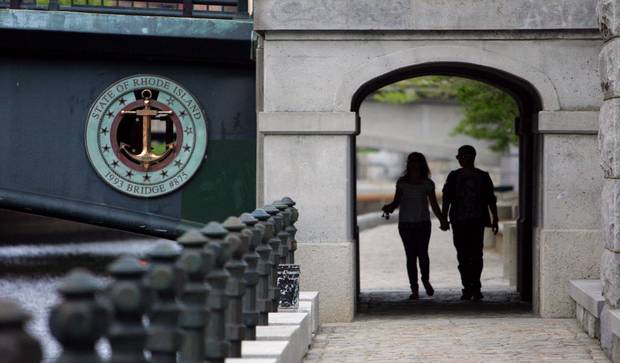
Waterplace pedestrian bridge along the river walks in Providence.

Waterplace pedestrian bridge along the river walks in Providence.

The Rhode Island Senate has passed legislation, Senate Bill No. 2255, to rename State Bridge No. 1181 — known as the Providence River Bridge — as the William D. Warner Memorial Bridge.

Perhaps, in the waning days of this session of the General Assembly, the House will pass its own version of the bill. Legislators often talk about “due diligence” required for major legislation. Naming the Providence River Bridge for the late Bill Warner, who died in August 2012, is the due diligence required by history.

Who was Bill Warner? He designed Waterplace Park and the river walks from Waterplace to Confluence Park, where the Woonasquatucket River joins the Moshassuck River to form the Providence River, and beyond to Memorial Park. He designed the dozen arched vehicular and pedestrian bridges along the way, and the parks and the river walks that extend the waterfront toward Narragansett Bay.

And Bill Warner designed the Route 195 Providence River Bridge itself. That does not entitle him to have it named for him. Most bridges are not named for their designer.

[To read the rest of this column, please visit The Providence Journal.]

Posted in Architecture, Architecture History, Providence, Rhode Island, Urbanism and planning | Tagged , , , , , | Leave a comment

What young people want

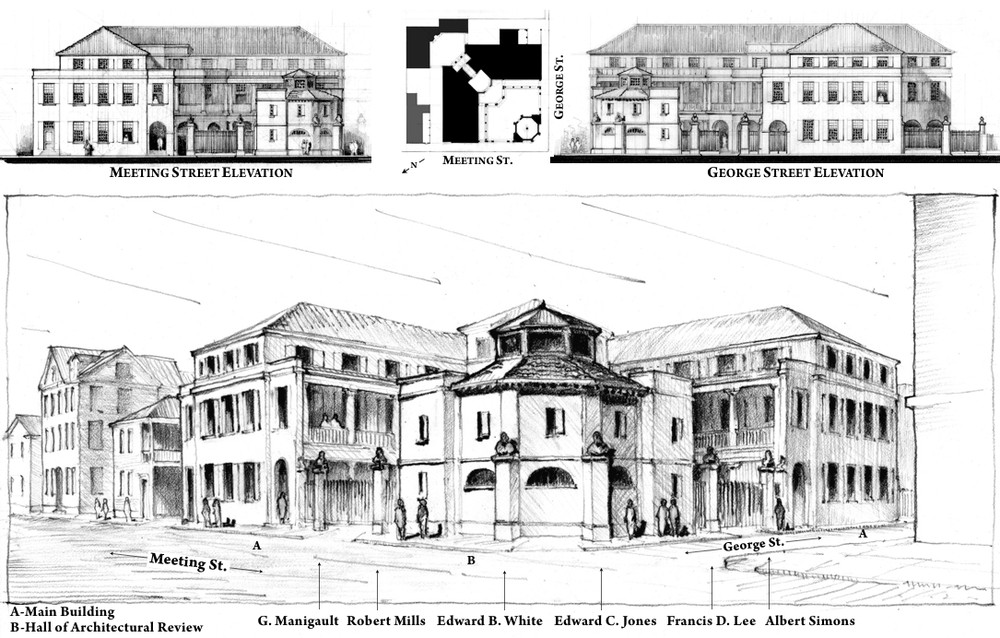
The first of two schemes presented by Bevan & Liberatos as counter proposals to the proposed Clemson building in Charleston.

The first of two schemes presented by Bevan & Liberatos as counter proposals to the proposed Clemson building in Charleston.

Jenny Bevan, of the Charleston, S.C., architecture firm Bevan & Liberatos, has written a brilliant critique of the proposed new building for the Clemson University school of architecture in the historic section of Charleston. Bevan is a graduate of both modernist and classical architecture school programs. Here is her essay in the Charleston City Paper, and the following is what I consider an especially astute passage:

When the Lee Brothers adapt an old recipe for a new cookbook, when Shepard Fairey imitates old graphics to make new images, when Quentin Baxter improvises within a standard, when Jill Hooper works with fresh paints made from centuries-old recipes, they are exemplifying our generation’s return to an open-mindedness about tradition. And their achievements are lauded. Just as Charleston has a rich and enviable traditional cuisine, so too does it have a rich and enviable traditional architecture. Yet, in architecture and preservation communities, designing new architecture with a mind open to the whole tradition of our building culture is scorned as nostalgic rather than, as in the other arts, celebrated as the creative progression within a living tradition.


Posted in Architecture, Architecture Education, Urbanism and planning | Tagged , , , , | 2 Comments

Cayalá coming along

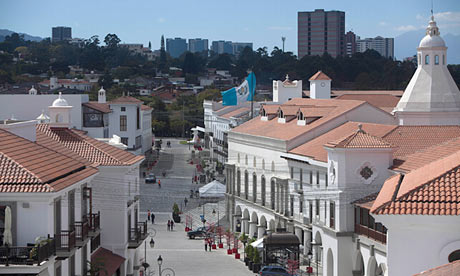
Cayala's main street, with Guatemala City, the capital, in the background. (theguardian.com)

Cayala’s main street, with Guatemala City, the capital, in the background. (theguardian.com)

Here’s a detailed report from INTBAU, the International Network for Traditional Building, Architecture & Urbanism, on Cayalá, the new traditional town in Guatemala. Its master plan was the work of Lèon Krier and the major civic building, its Athenaeum, was designed by Richard Economakis, of Notre Dame’s School of Architecture. Two ND grads heavily involved in the planning process are Pedro Godoy and Maria Sánchez. I gave Cayalá a rose in last year’s global roses and raspberries, handed out by “Dr. Downtown,” this reporter’s occasional alter ego, and later that year devoted a column to it. Here is INTBAU’s Cayalá update.

Here is a passage from the report, which was sent to the TradArch listserv by Audun Engh, a member of INTBAU’s board of directors, a role he also serves for the Council for Europen Urbanism.

Other nods to local traditions include ‘figural’ windows (octagonal or rosette), stepped tiled cornices, corner bollards, ball finials, consoles, and occasional “mudéjar” (Moorish) details like wall fountains, wooden window lattices, and chamfers.  These motifs are adapted and used to punctuate elevations, establish formal rhythms and alternation along streets, and create textures that enrich the streetscape and enhance the human scale.  Classical detailing in the more important buildings is derived from Renaissance and Baroque sources of Guatemalan civic architecture. Though treated individually, buildings are designed to work together like good ‘urban neighbors’, the overriding effect being one of variety within unity.  At Cayalá streets are made of elevations which, to use one of Lèon Krier’s analogies, “are aligned so that they make sense, like the words that form a coherent sentence.”

Posted in Architecture, Development, Other countries, Urbanism and planning | Tagged , , , | 4 Comments

Renzo Piano, constrained

New work by Renzo Piano in Paris. (Foundation Jerome Seydoux/Pathe)

New work by Renzo Piano in Paris. (Foundation Jerome Seydoux/Pathe)

A friend sent me from HuffPost this image of a new “building” in Paris by starchitect Renzo Piano (what a name!), sure that it would raise my dander sky high. But while the structure certainly confirms the stupidity of modern architecture, as if any such confirmation were needed by now, it has gracefully penned itself in the center of the block, and cannot be seen much by passersby. It does not disrupt the street, and yet through the front portico you can get a hint of its monstrosity yearning to escape – maybe generating a sigh of relief or two, perhaps even some pity. I’d say that if all modernism were equally constrained, or equally modest in its aspiration to destroy beautiful city settings, then modernism would not have raised the worldwide uproar it has. (Huh? … Only kidding.)

Posted in Architecture, Urbanism and planning | Tagged , , , | 6 Comments

Human scale in Providence

Waterplace at dusk on a WaterFire night, in the year 2000. (Photo by Richard Benjamin, RichardBenjamin.com)

Waterplace at dusk on a WaterFire night, in the year 2000. (Photo by Richard Benjamin)

Tonight I saw the documentary The Human Scale, about the work of Jan Gehl, a Dane who has sought, as I put it in last night’s post, to undo some of the damage done by modernism to the space between buildings in cities. It was an extraordinarily depressing film, in part because it seemed to wallow in the overwhelming scale of the lack of human scale inflicted upon the world, especially Asia, by modernism. It would be hard to make anything human of the space between the buildings with which modernism has carpet-bombed China and Japan.

The film opened with shots of what looked like really depressed people occupying tedious offices in those bleak buildings. They turned out to be the film’s own talking heads, including Jan Gehl, all of whom generally had good suggestions for how to cure the ills between these buildings. Eventually they got around to good things being done between buildings in Copenhagen, New York City and elsewhere. But they never got around to the question of whether the lack of human scale that is intrinsic to modern architecture had anything to do with the anomie between the buildings. Are ugliness and sterility making it more difficult to encourage people to use the space between buildings?

I wanted to ask about that after the panel also mostly declined to address the question, but feared that a question about architectural style might cast me as the skunk at the garden party, sponsored by CNU-New England and AIAri. (Normally I’d revel in such a role but I wimped out for some reason.)

The panel had redirected the documentary’s concerns to Providence, and to the question of how to animate Kennedy Plaza. Most of the buildings that create the walls of the “outdoor room” of KP and Burnside Park are delightful, but don’t have much street-level retail. So instead of asking why Jan Gehl didn’t seem to care about the lack of human scale in the buildings between which his chief interests lie, I asked whether the panel was interested in an idea I heard two decades ago from Morris Nathanson, of Pawtucket, for animating Waterplace Park, which was new then. That idea is described briefly near the end of a column I wrote, which I reprint, courtesy of the Providence Journal:

What to do at Waterplace
April 27, 1995 

ON TUESDAY, I nuked leftovers and carried them to Waterplace for lunch. There were no empty benches, so I sat down on a granite block at the base of the amphitheater, leaning against a granite bollard, from which perch I could watch both the city skyline beyond the park and the people inside it. These were a couple score at 1:30, including a half-dozen young office workers sunbathing on the grand staircase and lawn.

The Boston Globe’s architecture critic, Robert Campbell, recently characterized Waterplace Park as a setting worthy of Verdi’s opera Aida, written to commemorate the opening of the Suez Canal. He may not have realized that next year an opera company actually hopes to put on Gilbert and Sullivan’s Gondoliers at Waterplace. Until then, Shakespeare will have to do. URI’s theater department will put on free performances of Romeo and Juliet May 27 and 28.

Campbell correctly stated in his article of April 14 that plays, concerts and other occasional events are not enough to animate a new urban park such as Waterplace. Commerce, such as restaurants and shopping, is mandatory. But while we wait for land on the river to be developed, the city Parks Department plans bread and circuses for spring and summer: The department’s belated celebration of Earth Day, with an expo, kayak tours, etc., is this Sunday; the Rhode Island Songwriters Festival, June 3 and 4; bungee jumping at ESPN’s Extreme Games, June 28, 29, 30 and July 1; the Clock Tower Concerts at lunch on June 20, 22, 27, 29; and Concerts on the Half Shell on July 12, 19, 26, Aug. 2, 9, 16, 23.

These activities, also free, are set. For more information, call Bob Rizzo, of Parks, at (401) 785-9450. Other possible events include: part of the Providence Waterfront Festival; the Boat Basin Blues Festival, Aug. 12; a Harvest Festival with barge hay rides, pumpkin contests and “other foolishness”; a river walkers’ club; and a Small Ships Festival in July.

The last brings to mind a wonderful New Yorker cartoon by Charles Addams, in which little boys launch toy sailboats while a little boy on the other side of the lake launches a toy submarine. (Was this the same little boy who would one day launch a French restaurant in our town?) [Inside joke reference to Bob Burke, the owner of Pot au Feu who had recently said he wished that Memorial Boulevard should have been built at the same level as the Woonsquatucket River so that people in cars would be more able to detect its presence – never mind that the height difference insulates the river walks from car noise.]

The restaurant the city had hoped to launch at Waterplace in July will not open, so the city will not be able to use its rent to fund events, as it had planned. Therefore, sponsors are being sought for some of the above events. Meanwhile, the city has put out a new request for proposals to operate a permanent restaurant (five bids are in so far).

Patrons of even the most fascinating events grow hungry, of course. After I read three weeks ago that the city “plans to have food vending carts in Waterplace,” I phoned Pawtucket’s own Morris Nathanson, the famous designer of restaurants, to see what he thought. We met for drinks at a restaurant (whose interior he had designed) near Waterplace. He was not keen on the idea of vending carts.

Problem was, he didn’t think most cart owners would expect that they could make enough money at Waterplace. Not enough people. The city, he predicted, would find few bidders. Nor does this idea sound especially elegant, although such carts do have their proper place on the urban scene.

Nathanson suggested instead what he called the taverna system, widely used in Greece, under which an established restaurant or hotel sponsors an underused space a block or a mile away, and finds, say, a young fellow who will sell its food and drink to as many passersby as he can attract to tables, often under umbrellas, provided by the establishment. The fellow profits if he can, the establishment gets free advertising, and the city gets additional street vitality, cost-free. And visitors are charmed by the sight of waiters porting meals along the streets. [This is the idea that could help connect Kennedy Plaza to nearby restaurants.]

In fact, the Westin Hotel has proposed what amounts to a temporary taverna on all three terraces of Waterplace Pavilion, and awaits the city’s response. The Westin’s manager, Tim Kirwan, seems to have a lot of interesting ideas for Waterplace, not the least titillating of which are boat rentals and a custom ice cream program.

Thankfully, the city’s bid request for temporary food service does not seem to envision Waterplace as a free-for-all among competing food carts. It seems to foresee one “vendor” with a food and beverage license leasing space to other vendors, presumably with tables and chairs, on the terraces of the pavilion and along the banks of the river.

Much better. In any event, it looks as if there will be more to do at Waterplace this summer than watch beauty (architectural and otherwise) while munching leftovers – which is fine, thank you, for now.

* * *

David Brussat is a Journal-Bulletin editorial writer and columnist. His address on the Internet is: davidbrussat@projo.com.

Posted in Architecture, Blast from past, Providence, Urbanism and planning | Tagged , , , , , | 1 Comment

The Providence conference

388589940_bb3ba7ca51_8961

Here is an e-mail I posted just now to the TradArch and Pro-Urb listservs, discussion groups that have for three or four days now been chewing on my last column, “Modernism invades New Urbanism,” along with architect David Rau’s cri de coeur from the Congress for the New Urbanism recently concluded in Buffalo about how traditional architecture has been less and less central to the New Urbanism. Andres Duany, whom I criticized in the column, has urged me to hold a conference on classicism (pitting classicists against classicists) in Providence. I told him I like the idea but am a writer, not a planner. Well, the two lists have taken up the topic with brio. Other places for such a conference have been suggested, along with a range of alternative themes. (The conference was actually held in Charleston in April.] I have followed the conversation closely and have a new idea to throw into the pot. It is as follows:

 I’ve been reading this set of threads with mounting fascination at the prospect of a classicist conference. I find the case for places other than Providence perfectly compelling, but of course I must press for my city, and I imagine it might be a good place to hold such a conference because so many attendees are already familiar with Richmond, Denver, Charleston, etc., whereas Providence might be more fresh – though, granted, CNU was there in 2006. As for members of the ICAA, the National Civic Art Society, the National Trust for Historic Preservation, Traditional Building and other interested organizations, Providence might be a new experience for many.

Although I think this conference is destined to include elements of both trad vs. trad and trad vs. mod, and should, I agree with those who doubt the wisdom of trying to convert the mods. Not gonna happen. On the other hand, I also doubt that other strategies – while undeniably very, very important – are going to move the dime as much as they might if the playing field were anywhere near level. Frankly, I think it will be politics that moves the dime, because politics is how a democratic society changes its mind on major issues.*

The ability of trads to use newsworthy mod missteps to transform the built environment into a political issue is key. The trads failed to make hay out of the World Trade Center rebuild debacle. The British did better with Prince Charles’s intervention in Chelsea Barracks, with so many media polls pitting Quinlan Terry vs. Richard Rogers to such good effect. We are doing much better with the Eisenhower memorial flap. There are certain to be other useful brouhahas on the national and international level.

We can all practice at the local level for the next architectural imbroglio. We probably have the backing of most voters – though many don’t realize it. We need to raise consciousness on the tragedy of the built environment. We need to leverage the range of distress over the built environment to get politicians to lean on developers (often their paymasters, especially at the local level) to hire architects sensitive to popular and public taste. That’s how change will occur.

I believe we are wise to avoid making design a partisan political issue, but I still feel that the first political party to make an issue of the built environment will steal a march on its opponents. The issue should certainly be spun as bipartisan – and let’s see who picks up on it. The idea of “slow” architecture – and its reverse, the association of modernism with big money and big corporatism – is an essential part of this approach. Other ideas and trends mentioned in these four fascinating days of urbanistic and architectural back and forth could feed into the political approach.*

I’m just stirring this into the pot. I think it is an approach that, in addition, could also serve us well with young people. It does not exclude other approaches, but it is a way to “capture territory” that, so far as I know, hasn’t been widely discussed on this list.

* I could not resist a couple of additions to my original e-mail.

Posted in Architecture, Providence, Urbanism and planning | Tagged , , , , , | 2 Comments

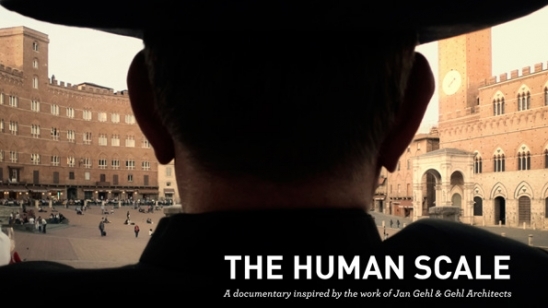
See ‘The Human Scale’

human_scale_graphic.1aecae6

That is a documentary film about the work of Jan Gehl, a Danish architect whose idea of “Life Between Buildings” encapsulates his desire, apparently, to undo some of the harm that modern planning and design have done to cities over the years. At least that’s what I take to be the matter at the heart of the film The Human Scale.

In the wake of my column about the meeting in Buffalo of the Congress for the New Urbanism, several people have expressed interest in my coming to see the film on Monday at 5:30. It will be shown by CNU New England – along with AIAri, APA of Rhode Island, and the Providence Foundation – at Aurora, in the Wit Building, which a while back was the stage for the Providence Black Repertory Comany, now alas defunct. Buff Chace recently bought the building and opened Aurora. The address is 276 Westminster Street. (I hope Don Powers, who will be there, has a copy of his firm’s design for the Wit Building in his back pocket.)

The screening will be followed by a panel discussion. I was warned that the evening was not about the buildings but the spaces between them. I appreciate the warning but I think those spaces are important, too. I plan to attend and hope for a lively discussion. With Steve Durkee, Don Powers and others on the panel, it should be lively. Steve considers himself a modernist, at least he used to, and Don specializes in buildings and places of traditional design. (Let’s you and him fight! Only kidding. Sorta.)

I think almost everyone agrees that something must be done about the spaces between the buildings in our modern (and mostly modernist) cities. Not everyone agrees that this must include more, and eventually much more, traditional design in the street walls that form the spaces between the buildings. I wonder which way, if any, this event, to the extent that it is being held with a purpose in mind, will want to take us.

A description of the film and the names of all of the panelists follows.

* * *

Special Screening of The Human Scale in Providence, Rhode Island
Monday, June 16th @ Aurora, 276 Westminster Street, Downtown Providence

Doors open at 5:30pm

CNU New England, in partnership with AIA Rhode Island, is pleased to announce a screening of The Human Scale and panel discussion in Providence, RI. Join us for a viewing of this important documentary film about the work of Danish architect Jan Gehl.

The viewing will be followed by an in-depth discussion about what Gehl’s human-centered message means for Providence. A panel featuring local planning and design experts will include:

– Russell Preston (Founder and Design Director, Principle Group) moderator
– Donald Powers (Founding Principal and President, Union Studio Architecture and Community Design)
– Steve Durkee (Senior Associate, Cornish Associates)
– William Dennis (Principal, B. Dennis Town & Building Design)
– Christine Malecki West (Principal, Kite Architects)

When: June 16, 2014: 5:30 – 8:30PM
Where: Aurora, 276 Westminster St, Providence, RI  02903
How Much: CNU and AIA Members $10, Non-Members $15, Students $5

1.5 AIA CEUs available
2.5 AICP CMs pending approval

Space is limited; sign up now!

 About the film

The Human Scale questions our assumptions about modern cities, exploring what happens when we use a people-centered approach as the focus of city design. For 40 years, Danish architect Jan Gehl has systematically studied human behavior in cities. His starting point was an interest in people, more than buildings – in what he called “Life Between Buildings.” What made it exist? Why was it destroyed? How could it be brought back? This led to studies of how people use streets, how we walk, see, rest, meet, interact etc. Jan Gehl also uses statistics, but based on different questions: How many people pass this street in a 24 hour period? How many are pedestrians, how many are driving cars or bikes? How much street space is each allowed to use? Are our streets performing well for all users?

Gehl’s early research in Italy helped to transform the planning of Denmark’s capital, Copenhagen, for the past 40 years. His ideas inspired the creation of highly walkable streets, the expansion and improvement of cycling infrastructure, and the reorganization of parks, squares and other public spaces throughout Copenhagen and across the Nordic region. Today, cities like Melbourne, New York, Christchurch and Somerville are all taking notice of Gehl’s work that helped make Copenhagen the world’s happiest city.


Posted in Architecture Education, Development, Providence, Urbanism and planning | Tagged , , , | 1 Comment

Column: Modernism invades New Urbanism

Winner of the 2014 CNU Charter Awards grand prize. (Congress for the New Urbanism)

Winner of the 2014 CNU Charter Awards grand prize. (Congress for the New Urbanism)

The New Urbanism is really the old urbanism guided by principles of human scale, residential density, proximity and walkability. Before World War II, cities, towns and villages got built and grew over time with few rules. Builders used forms and practices that had worked well throughout the history of human habitat.

That has changed, of course. Civic evolution was interrupted after the war by an ideological revolution. Tradition was dethroned by modern planning and design, based upon the dubious machine-age idea that honest design looks utilitarian and that beauty is expendable. …

[At this year’s annual meeting of the Congress for the New Urbanism,] panel discussions seemed to make a fetish of being open to modernism – so much so that CNU member David Rau issued a dire warning from the conference: “It was upsetting to discover at CNU in Buffalo that New Urbanism has been divorced from Traditional Architecture. Kaput, the marriage is over.”

[To read the rest of this column, please visit The Providence Journal.]

Posted in Uncategorized | 3 Comments

The Frick’s future

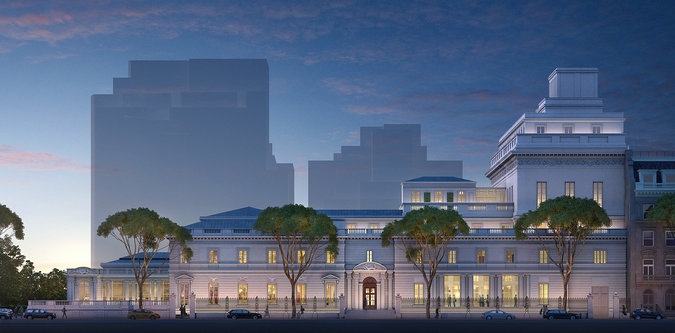
Proposed addition to Frick rises gently from center right of image. (NYT)

Proposed addition to Frick rises gently from center right of image. (NYT)

Plans emerged yesterday for an expansion of the Frick Collection. an addition reverent, it seems, in its devotion to the sensibility of the mansion built in 1913-14 for Henry Clay Frick by Carrere & Hastings, expanded by John Russell Pope in the 1930s, expanded again by John Barrington Bayley, and finally yet again by the firm doing the proposed six-story addition, Davis Brody Bond – the firm responsible for the new 9/11 museum.

Although it saddens me that the Bayley addition would be sacrificed – he was the great good friend of the late Henry Hope Reed, leader of today’s classical revival – this newly proposed addition seems to be about the best one could hope for. So far, though the devil is in the details, it seems downright lovely. It adds to the sense one gets – and I went for the first time last month – as one walks around its perimeter of a village of smaller buildings that have grown organically from the original.

One would surely like to see the existing delicate accretion of additions preserved, but an institution often needs to expand. I’ll leave to others whether that is so here, but the case made in Robin Pogrebin’s New York Times article seems powerful.

Already the usual suspects are pooh-poohing the proposal’s extraordinary sympathy – see “Beaux Arts Botox,” by Culturegrrl – so at odds with much recent practice. The modernist addition to the Morgan Library several years ago is an abomination, but the old library survives it better than, say, the Brooklyn Museum, the addition to which, as Steven Semes points out, looks as if an alien space ship had landed on its beautiful face – a bigger-than-life carbuncle that nowadays is the norm.

So if the addition here proposed emerges from the fusillade unscathed and is not watered down to suck up to the powers that be, or to save money, then it should provide a stellar example of what genuine architecture means by the word “addition.” Addition – to add on, to make better, quoth the dictionary. Sounds like a good idea.

Posted in Architecture, Art and design | Tagged , , , , | 2 Comments

Blast: Memories of Seaside

Seaside, Fla. (celsias.com)

Seaside, Fla. (celsias.com)

Here is a column I did after visiting Seaside, Fla., the first showcase project of the Congress for the New Urbanism:

If only we could clone Seaside
December 13, 2001

SEASIDE, Fla.

JAMES KUNSTLER writes of approaching Seaside, on Florida’s Gulf Coast, in his Geography of Nowhere (1993): “You drive an hour west from Panama City on Route 30-A along the ‘Redneck Riviera.’ … All of a sudden, there comes a strange break in the awful cavalcade of cheap motels, grog shops, souvenir sheds, and tombstone condo towers, and you find yourself in what appears to be a drowsing southern small town circa 1918.”

Seaside is a new community, controversial in architectural circles because it was designed to look, feel and behave like an old one. On my recent Southern swing, I approached it with Kunstler’s words in mind. Where, I wondered, was the “awful cavalcade”? Mostly, 30-A was a string of charming beach villages. Is this one Seaside? No. Is that one Seaside? No. I was afraid I’d drive right through it.

I needn’t have worried. When I got there, I knew I was in Seaside. I’m not sure I would describe it as quite the “drowsing southern small town” Kunstler did. Entering, you drive up a street of wooden mega-bungalows. Very pretty houses, possibly circa 1918, especially if you look down the side streets. But the town center has too many parking lots. Its “square,” a roundish greensward, is not adorned with the ornamental flair associated, in the nostalgic mind’s eye, with a sleepy town square. It is surrounded by tiny classical pavilions and several larger buildings. A couple of the latter seem a bit plain. The side of one seems literally sliced off to make room for a parking lot. Altogether, though, the look of “downtown” Seaside seems pleasant enough, if not quite that of a small town circa 1918.

It might have seemed that way to Kunstler, after what he had to drive through to get there 10 years ago. Much of the area has changed. The success of Seaside has bred Seaside wannabes up and down the panhandle, rendering Seaside itself somewhat less than shockingly unique.

Upon arrival, I parked next to a fishing shop and visited the Seaside Institute for some literature on New Urbanism Seaside is a model for that movement. I returned to find my keys on the seat of my locked car. The fishing shop lent me a rod to fish them out, and I set off to explore Seaside on foot.

Its evidently incomplete “downtown” notwithstanding, Seaside is pretty close to what paradise must be like, if paradise is not an orgy on a cloud but a community of families in a friendly grouping of houses. White picket fences, porch railings, balconies, carved fretwork, grids of lattice, rooftop terraces, all of this froufrou on one house after another creates a magical cascade of delicate carpentry. Footpaths lined with more picket fences wander through each block to reveal backyards secluded by greenery yet inviting to neighborly congeniality, as are the front porches and the narrow streets, as is the whole lush, breezy, pastel environment.

The houses, writes Kunstler, “are made of wood with peaked tin roofs and deep porches. No two are alike, but all share a congruity of design that is soothing to eyeballs scalded by the chaotic squalor of the strip.” (Kunstler is a latter-day Mencken, a scourge of the subooboisie, and hard not to quote.)

“At first” – Kunstler again – “one catches a fugitive whiff of theme-park cutesiness on the balmy salt breeze. This must be a common mental reflex among people, like myself, accustomed to a constant ambient dissonance in their surroundings.”

He’s not the only one. “Nostalgic,” “inauthentic,” even “authoritarian” is how most architecture critics have reacted to Seaside. As the set for the Orwellian film The Truman Show (1998), its beauty was meant to be vaguely ominous. Developed in 1982 by Robert Davis and planned by Andres Duany and Elizabeth Plater-Zyberk, Seaside is hated and feared by the modernists who dominate the firms, journals and schools of architecture.

This reaction recalls a remark by Duany at October’s big preservation meeting in Providence. He said most “historic districts” were merely typical pre-World War II places that had avoided ravishment by postwar modern architects and planners.

 Seaside looks like such a place. So do Water Color, Fla., next door to Seaside, CityPlace, in West Palm Beach, and Celebration, Fla., developed by Disney. So do Kentlands, Md., and Wickford Point, in North Kingstown. It is said that only the rich can afford to live in such communities: As usual, they bid up the price of the most pleasant places. Critics complain also that New Urbanism is really New Suburbanism. Hey, New Urbanism is illegal under zoning almost everywhere, so it is a bit much to criticize it for not having transformed our cities yet. Give it time. The more Seaside wannabes there are, the less unique they will be, and the more the market will make them available to the rest of us. This will make urbia and suburbia more civilized.

Yes, Andres Duany and the New Urbanists have the right idea. It is much easier to reconstitute traditional communities with architecture than to reconstitute a traditional society with social policy. Do the former and maybe the latter will follow. If not, well, at worst we’ll be stuck with more beauty.

David Brussat is a member of The Journal’s editorial board. His e-mail is: dbrussat@projo.com.

Posted in Architecture, Blast from past, Development, Urbanism and planning | Tagged , , , , | Leave a comment