The sad primacy of Unite

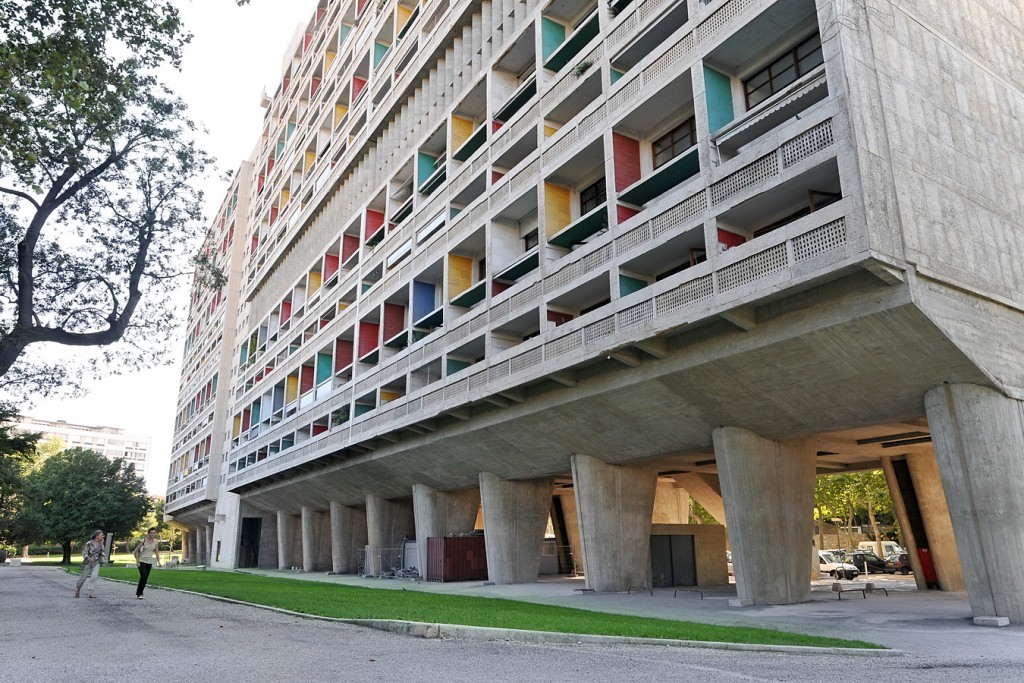
Habitation Unite, by Le Corbusier, in Marseille. (mimoa.eu)

Habitation Unite, by Le Corbusier, in Marseille. (mimoa.eu)

Regarding the minimal-security affordable housing project in Harlem by David Adjaye, this morning I have received a trenchant email from Malcolm Millais, author of Exploding the Myths of Modern Architecture:

How strange, by coincidence I saw this Horror in Harlem yesterday and was wondering how on earth something so crass could get through all the hoops, when you blog [Marc Szarkowski’s comment to TradArch on] it. I was interested that Make it Right was lumped in, I don’t have much info about this but always thought, wrongly probably, that it was somehow linked in some way to Sam Mockabee’s Rural Studio.

Though again, I’ve never really been able to label the Rural Studio stuff “good” or “bad.” I can’t say I care that much for how Rural Studio stuff looks, but if it really works for the poor people, then who am I to judge – but does it?

What we always need to remember is that the most important building, for a variety of reasons, of the 20th century was the Unité at Marseilles, finished in 1952. A prototype for mass social housing on a global scale. Still revered in the idiotic architectural ghetto, it was five times over budget, didn’t comply with building regulations, offered no opportunity for mass production and was sold off as a private condo before it was finished. And copied mercilessly and disastrously throughout the world.

It is difficult to enumerate the crimes of Le Corbusier.

Posted in Architecture, Architecture History, Urbanism and planning | Tagged , , , | 2 Comments

Against Adjaye’s agitprop

Sugar Hill housing project by David Adjaye. (Architectural Record)

Sugar Hill housing project by David Adjaye. (Architectural Record)

Adding to the widespread perception that British architect David Adjaye’s affordable-housing project in Harlem looks like a prison, architect Marc Szarkowski offers, on TradArch, this pertinent riposte to the recent mass exercise in droolery from the commentariat:

Let’s see, from James Russell’s article in Architectural Record:

– project has 124 apartments (really, that’s it for such a gargantuan slab?!)
– project cost “only” $59 million for construction ($89 million total)

So this works out to be $475,000 to $720,000 per apartment!!! (Even with a classroom and museum onsite – which aren’t exactly difficult, expensive programming – this is absurd.) What in blazes is going on here?!

The silver lining is that, contrary to the article’s assertion, there can be no “renaissance” with these projects because they’re simply not scalable for mass production and operation. It’s funny how all the architects blathering about “social housing” have, after all these years, still not found a way to offer mass housing at low cost,* deferring instead to manufactured housing and mobile-home companies, which scaled to meet the need for affordable housing.

*And no, the original existenzminimum [subsistence dwelling] housing projects in Weimar Germany were not a model for this. They may have been built on shoestring budgets (and they incorporated community centers and schools too, so what else is new!), but they fell apart precisely because there was no financially feasible way to operate and maintain them at mass scale.

So all architects can do is offer a handful of boutique, overpriced showpieces – Taino Towers, Via Verde, Make It Right and all the other low-income/high-art boutique box proposals in the arch mags/blogs – for a select handful of winners?! How’s that for favorable treatment for a 1%! That really is the silver lining behind these ugly-ass boondoggles – we don’t have to worry about their proliferation because they will never scale up for proliferation. They’re essentially just unicorn starchitecture for stigmatizing poor people.

Actually, I would only add that to say Sugar Hill looks like a prison is unfair to prisons.

Posted in Architecture, Development, Urbanism and planning | Tagged , , , , , | Leave a comment

Bad Scupture Park Hotel?

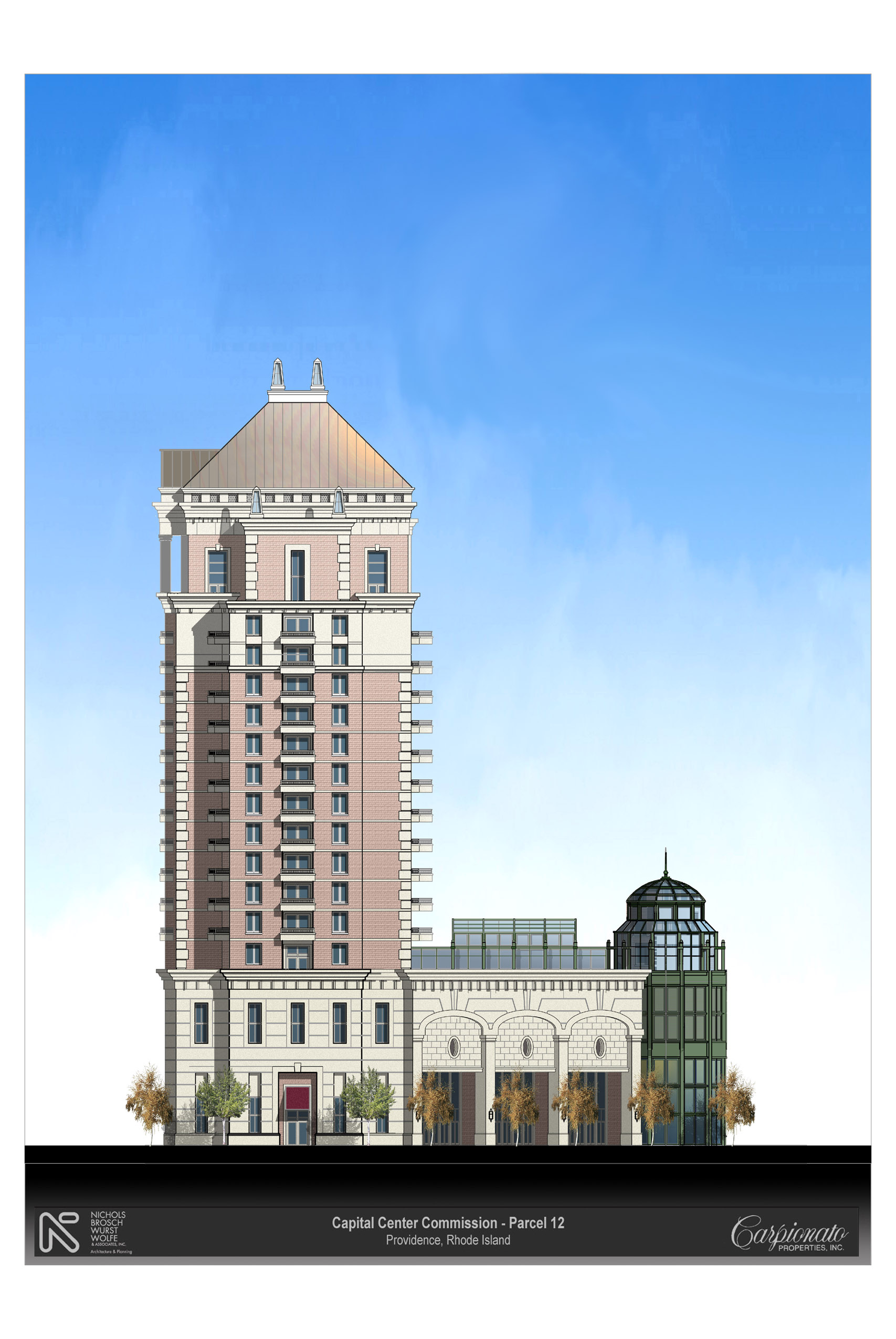
Proposed design for Parcel 12 hotel, from 2006, by the Carpionato Group.

Proposed design for Parcel 12 hotel, from 2006, by the Carpionato Group.

A new proposal has arisen for Parcel 12, the triangular Capital Center District land at the northeast corner of Kennedy Plaza that I’ve long called Bad Sculpture Park, in honor of its cast of uninspiring works of art. The Journal’s story today notes that hotels on that land (separated by Memorial Boulevard and the Woonasquatucket River from Capital Center itself) have been proposed before.

The Journal story, “Developer envisions hotel on triangular lot,” by Paul Grimaldi, notes two earlier proposals, by Joseph Paolino and then by Carpionato Properties, adding that “[t]he site’s limitations were the main reason neither of those proposals got built.” He was referring to its shape and the fact that it’s filled land with a high water table.

Perhaps that’s true, but it should not be forgotten that the second proposal’s traditional architecture – a French Second Empire-ish design I’ll grant was less than perfect – was greeted with unnecessary derision by the Capital Center’s design review panel. Their hooting was not because the design was flawed but because it was traditional. If it had been a better traditional design, criticism from the panel’s almost exclusively pro-modernist members would probably have been even more scathing. I suspect the developer decided he’d had enough.

Design review in Providence is much like I suspect that design review is in most places. It is performed by reviewers who are sympathetic to modern architecture but who realize that the public does not like it very much, and because they are political appointees they do not relish snubbing the public’s taste out loud. So the panelists’ comments are almost always difficult for developers and architects to interpret, and they leave such meetings rolling their eyes and pulling at their hair, and rightly so.

The Journal article said that this hotel is being proposed by First Bristol Corp., whose head, James Karam, was responsible for the nice traditional design he pushed through successfully for the Hampton Inn on Weybosset Street. Karam told me by phone this morning that a design for his latest proposal on Parcel 12 does not yet exist. I hope it will be traditional, but if it must go through both the Capital Center and the Downcity design review, then I wish him luck.

I will be following this project closely. For example, I am trying to get my hands on the Carpionato proposal from 2006, since I no longer have access to the Journal archives. Maybe the Carpionatos themselves – who have a delightful project on the boards for the Route 195 district – can send me an old, tattered mimeograph.

Posted in Architecture, Development, Providence | Tagged , , , , | 1 Comment

Attack on Kennedy Plaza

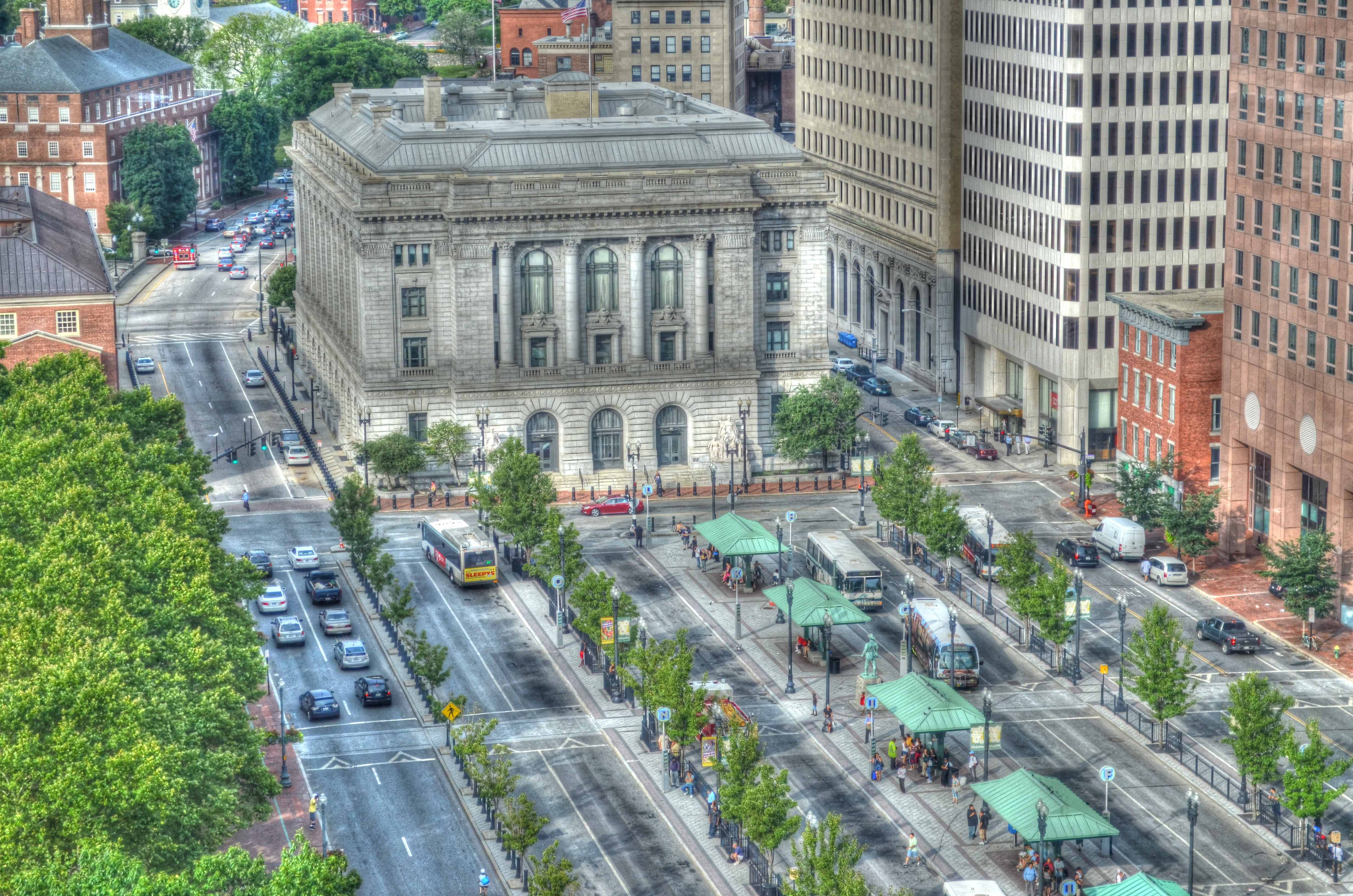
This half of Kennedy Plaza was demolished over the summer. (brendaleetroiaphotography.com)

This half of Kennedy Plaza was demolished over the summer. (brendaleetroiaphotography.com)

My last post may have unintentionally dissed Burnside Park and Kennedy Plaza, leaving readers with the impression that they were failures, and that Providence civic leaders and city officials, along with the state transit authority, were valiantly riding to the rescue of the latter. No. Both KP and Burnside Park would qualify as reasonably close to successful under Jane Jacobs’s arithematic. Kennedy Plaza was a successful bus hub until it was emptied out in July to make way for a rushed and poorly conceived attempt at redesign. A time-lapse video made from City Hall shows it operating at peak efficiency.

I also did not leave a clear enough impression that both the park and the plaza are (or in the latter case was) very attractive, the plaza spectacularly so in comparison to most such modern-day transit hubs. But the plaza’s lovely bus waiting kiosks have been ripped out and even the park, which features a beautiful Beaux Arts fountain and an equestrian statue of Gen. Ambrose Burnside, is slated to receive a clunky “arch.”

The park is and the plaza was occupied, in part, by people whom many might call riffraff, at least some of them. I have used KP and the park  frequently during my 30 years in Providence, 11 of which were spent (until five years ago) living downtown right behind the Plunder Dome (City Hall). I walked through the park and the plaza many time and was never accosted by anyone more threatening than a panhandler. The denizens of these public spaces had been sequestered mainly in the plaza and, to a lesser extent, in the park. With the temporary closure of the plaza many of them have been, to use Jacobs’s word, dispersed. Now, to the extent that they inspire anxiety, that anxiety has also been more widely dispersed downtown.

In the spring of 2013, at the ballroom on the top floor of the Biltmore Hotel, 400 people attended a formal announcement of the reformulation of Kennedy Plaza as more of a civic square than a bus depot. The redesign, by Union Studio Architects, was splendid. It picked up on the traditional features of the plaza. It appears, however, to have been frog-marched out of the picture. The windswept plaza that remains, with sterile modernist bus kiosks from Job Lot (only kidding) waiting to be installed, looks foreboding in the extreme.

Here are new renderings of the section of Kennedy Plaza being rebuilt. The illustrations seem to be stretched at least 150 percent beyond their proper verticality.

The curious thing about last year’s Biltmore announcement party is that the plan to redevelop the Industrial Trust Building next door to the plaza went unmentioned by all of the speakers. Might this reticence have arisen from embarrassment at the goal of the plan – to turn public space for people of lower income into public space for people of higher income?

In any event, a plan that requires a delicate phasing in of its segments, and the forbearance of a public rendered skeptical by other fiascos in recent memory, is likely to be even more difficult to achieve when civic beauty comes under attack from the plan itself – in this case involving a 180-degree shift from classical beauty to modernist sterility.

The plan ranks as one of the nation’s most poorly conceived efforts of city planning, in both its conception and its execution, during the last half century. The redesign of Kennedy Plaza and the dispersion of its bus users nevertheless seems, so far, to reside under the radar of the current mayoral campaign in Providence. What’s up with that?

Posted in Architecture, Development, Providence, Urbanism and planning | Tagged , , | Leave a comment

Jane Jacobs and KP

kenn1

Jane Jacobs had some interesting things to say in The Death and Life of Great American Cities (1961) about parks, and while Kennedy Plaza is not a park (though it has Burnside Park right next to it), some of it may well apply to the changes under way there. Although she exempted places like Boston Common and other major, well-used city parks, she was dubious about smaller parks without more natural animation, and which often tended to require programming, which often failed. She has this to say about one of William Penn’s parks in Philadelphia. Only Rittenhouse Square has been an unmitigated success, largely because of the vibrant commerce that surrounds it. Here she comments on Washington Square, including some remarks that bring Kennedy Plaza to mind:

The third is Washington Square, the center of an area that was at one time the heart of downtown, but is now specialized as a massive office center – insurance companies, publishing, advertising. [We wish!] Several decades ago Washington Square became Philadelphia’s pervert park, to the point where it was shunned by office lunchers and was an unmanageable vice and crime problem to park workers and police. In the mid-1950s it was torn up, closed for more than a year and redesigned. In the process its users were dispersed, which was the intent. Today it gets brief and desultory use, lying mostly empty except at lunchtime on fine days. Washington Square’s district, like Franklin Square’s, has failed at spontaneously maintaining its values, let alone raising them. Beyond the rim of offices, it is today designated for large-scale urban renewal.

So what phase of the above description would apply to Kennedy Plaza? All of them?

Posted in Architecture, Development, Providence, Urbanism and planning | Tagged , | 2 Comments

Tra La Corboobier

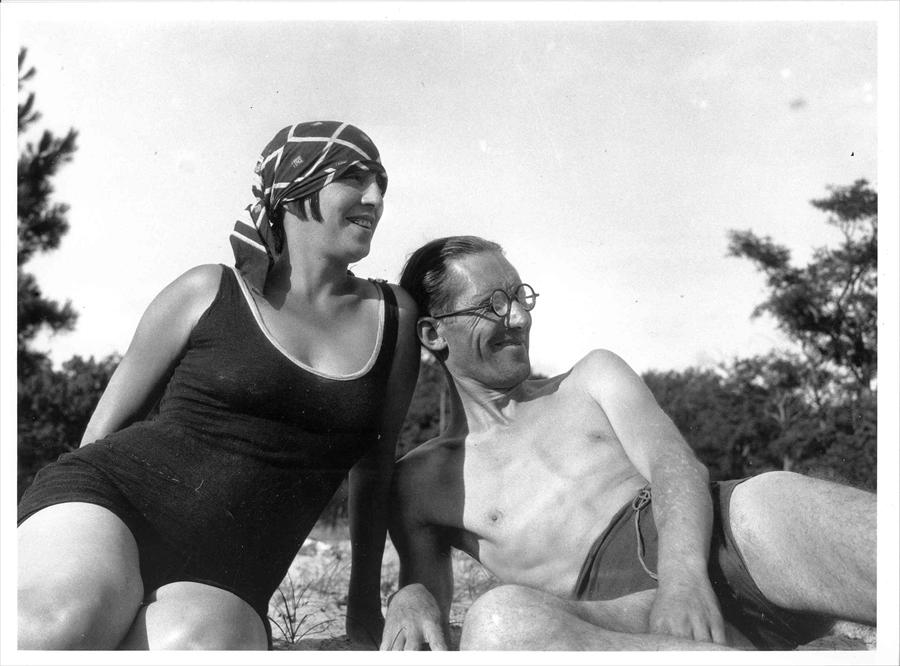
Le Corbusier with another woman, his wife Yvonne Gallis, at Le Piquey in 1930. (nicholasfoxweber.com)

Le Corbusier with another woman, his wife Yvonne Gallis, at Le Piquey in 1930. (nicholasfoxweber.com)

I take your pants away!

Seriously, this recollection in The Guardian of a British journalist, Taya Zinkin, seeking to interview Le Corbusier in India in 1965, including a long, obnoxious quotation, is totally unbelievable – in short, totally believable.

Posted in Architects, Architecture | Tagged , , | Leave a comment

Radiant Garden City Beautiful

World's Columbian Exposition of 1893, in Chicago. (newsburglar.com)

World’s Columbian Exposition of 1893, in Chicago. (newsburglar.com)

If wizards like Henry Hope Reed can be wrong on occasion, so can Jane Jacobs, who in our era is even more famous for her own pathbreaking book, The Death and Life of Great American Cities. Its chief claim to fame is to have thrown the fact of the active life of the best city streets into the face of the city-deadly megaprojects of Robert Moses, king of development in New York for almost half a century.

Jacobs spends some time toward the beginning of her book describing the horror brought to cities by the ideas of Le Corbusier and his book, The Radiant City. (We do not marvel at the mistakes of Corbu – he got everything wrong.) This was the idea that city streets were bad and should be replaced by towers in a park. In 1925 he proposed razing central Paris to carry out his totalitarian idea. She then describes the Garden City movement, originating in Britain, which was basically the idea that cities were bad and should be replaced by, in essence, suburbs. She combines these concepts into what she calls the Radiant Garden City, a catchall for bad ideas. How convenient.

But then she ropes in another concept, one that was basically flawless, of which Henry Reed was a strong proponent – the City Beautiful movement. Jacobs exaggerates and misconstrues it, referring to the World’s Columbian Exposition of 1893 as “a sort of squat, decorated forecast of Le Corbusier’s later repetitive ranks of towers in a park.” She notes that it fizzled but that its core concept of the “Monumental Center” remained, leading to America’s great civic plazas, which Jacobs did not really appreciate because she saw them as countervailing her preferred animated small streets of many shops and eyes looking out from windows. This is indeed a powerful concept – one that Moses sought to eradicate and replace with the Radiant City model – but Jacobs was mistaken, I think, in believing that a great city could not have both her animated street life and a monumental city plaza or two with a sort of Benjamin Franklin Parkway-like monumental boulevard linking them.

Anyway, I wonder whether Jacobs was compelled to rope the City Beautiful into her catalogue of woes by the elegance and charm and wit of the phrase she invented to combine them into a single monolithic pox of modern planning on all houses. Here is that passage:

The architecture of the City Beautiful centers went out of style. But the idea behind the centers was not questioned, and it has never had more force than it does today [1961]. The idea of sorting out certain cultural or public functions and decontaminating their relationship with the workaday city dovetailed nicely with the Garden City teachings. The conceptions have harmoniously merged, much as the Garden City and the Radiant City merged, into a sort of Radiant Garden City Beautiful[.]”

I suspect that as a lively writer Jacobs was so captivated by the phrase Radiant Garden City Beautiful that she twisted the last part into something more awful than she knew to be the case. Or maybe not. Still, the excitement of words can sometimes get in the way of the excitement of ideas. Maybe this is one example of that.

By the way, the World’s Columbian Exposition had over 27 million visitors over a period of six months, which was almost half the 63 million population of the United States at the time, and they could not get to Chicago anywhere near as easily as they can today. On one day over 700,000 visitors attended. In terms of “animated streets,” it would be hard for Jane Jacobs to argue with those numbers.

Posted in Architecture, Architecture History, Urbanism and planning | Tagged , , , , | 4 Comments

Photographs in action

Till Bronneer, photographer, from the Leica company blog.

Till Bronner, photographer, from the Leica company blog.

This ad for Leica, obtained from the website Sploid, commemorates the pathbreaking German camera firm’s 100th anniversary by splicing together a series of famous photos that have gone live through some sort of animation technology. Very interesting. There is some very good architecture in, I think, most of the images. About two minutes. Enjoy.

Posted in Architecture, Photography | Tagged , | 3 Comments

Henry and ‘the Heterodox’

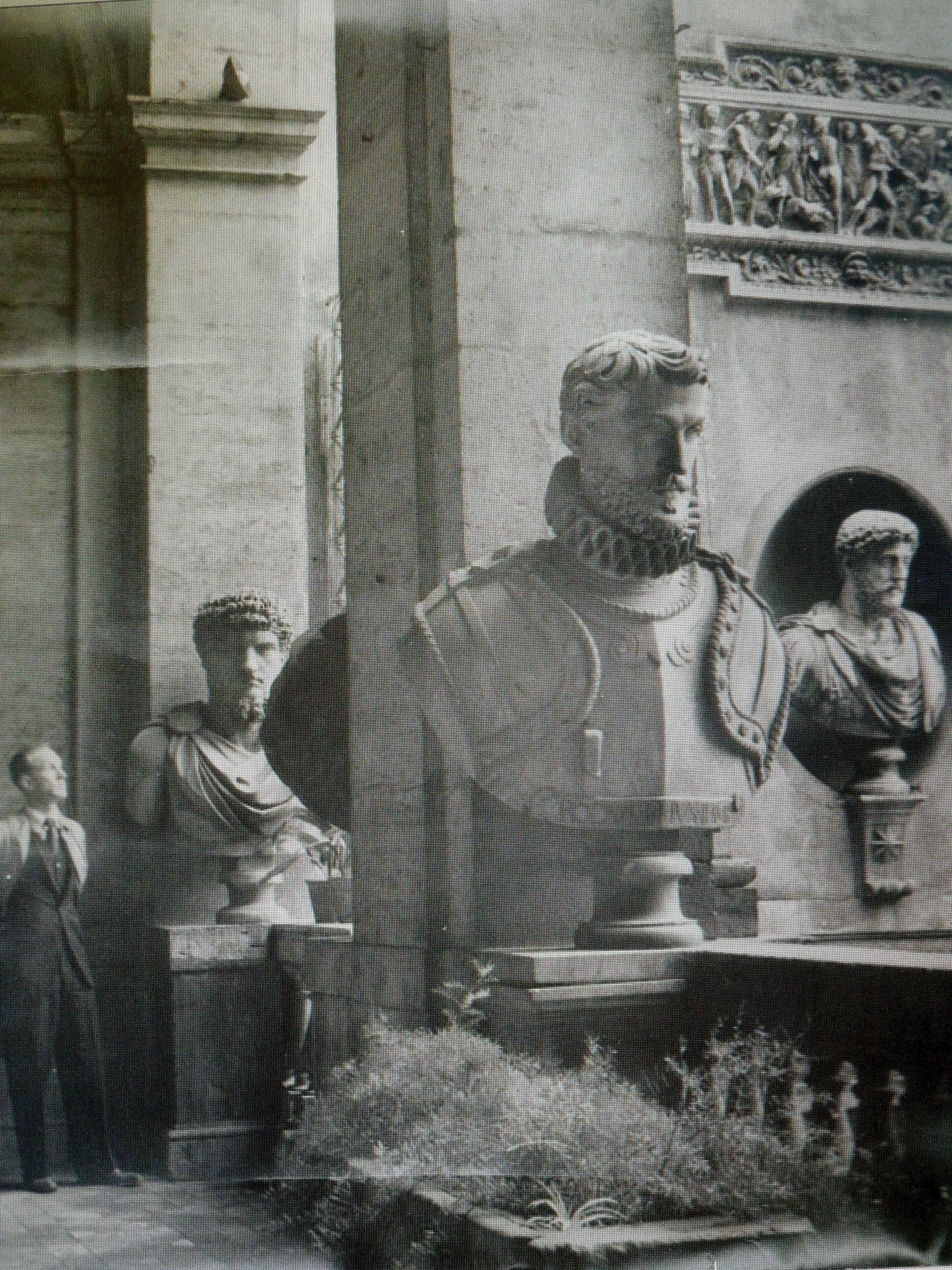
Henry Hope Reed as a young man examining classical sculpture. (Courtesy of Andrew Reed)

Henry Hope Reed as a young man examining classical sculpture. (Courtesy of Andrew Reed)

Henry Hope Reed was such a perfectionist that his detractors, and perhaps even some of his friends, called him Henry Hopeless Reed. What he sought was too perfect, too unlikely ever to be built. Hopeless.

Since classical architecture is the most practical of arts, this contradiction gave rise to debate at last Saturday’s symposium on the legacy of the late Henry Reed, who died in 2013. Reed, among so many other accomplishments, founded Classical America, which has morphed into the Institute of Classical Architecture & Art, whose Philadelphia chapter sponsored the symposium.

Reed and the ICAA, along with the nation’s (and indeed the world’s) only major classicist architecture school at the University of Notre Dame, are often lumped together as Palladiophiles by those who believe classicism is too stodgy in its reverence for the classical orders rediscovered in ancient Greece and Rome during the Italian Renaissance.

Well, call me a Palladiophile any time you want. I think the critics, and in particular Andres Duany, Driehaus Prize-winning leader of the New Urbanist movement, are way out of line. Not even Palladio was a Palladiophile if the term is taken to mean strict adherence to classical canon. He may indeed have commanded others to obey but he deviated when he liked, and so does every classicist, even today. The orders themselves encourage play both within and without their strictures. The important consideration is whether deviation is experimental based on knowledge of the orders or erroneous based on lack of same.

Duany is writing a treatise of virtually Vitruvian ambition, to be called Heterodoxia Architectonica, that “recalls to order” the disparate strands that have branched out from the Renaissance classicism for which Palladio is well known. Duany wants to “recapture” Louis Sullivan, Karl Friedrich Schinkel, Jose Plecnik and other classicists of yore whose experimental tendencies laid them open to “capture” by modernist architectural historians, who contended that those architects’ deviation from the canon pointed the way toward modernism.

Let’s take them back! So says Andres, and he is right. But he may go too far if he also tries to “take territory” from the modernists by relabeling as classicist some architects who should remain in the modernist camp. If he tries to do so, his recall to order will be hopelessly confused.

Henry Reed was confused, if not quite hopelessly so, in his perfectionist’s exclusion of Gothic, Romanesque and other styles from the classical camp. Such traditional styles bear much more in common than the differences important to architectural historians. Historians of all kinds are more interested in change than in what continues without change in the human condition, which is its vast bulk. Yet in his otherwise excellent The Golden City (1959), Reed condemned architects who “set about joining different kinds of ornament or devising new kinds. … Oddest of all was the fortress-like work of Henry Hobson Richardson, whose buildings were said to be defensible only in the military sense.” It was sad to see Reed crack a rare joke at the expense of someone he ought to have considered an ally. He even descried a deficit of ornamentation in the canonical Pennsylvania Station itself!

Speakers at the symposium, including yours truly, defended their hero against criticism from proponents of a wider definition for the classical, often invoking the perfectionist label. But to an uncomfortable degree, Reed is guilty as charged. And yet Henry mellowed over time, and even in The Golden City there is evidence that he foresaw that a broader view was required if the classical revival whose founding he led were ever to dethrone his bete noire, the Picturesque Secession, “the Modern,” whose power remains well nigh incontestable in the architectural establishment of today.

“The acanthus that never dies,” Reed says in his hopeful conclusion, “is forever putting forth new leaves.” If I read my acanthus leaves correctly, maybe even Andres Duany can afford to consider Henry Hope Reed as territory that doesn’t need to be recaptured.

The symposium considered the prospect for a more extensive conference commemorating the centennial of Henry Hope Reed’s birth in 1915. By then, one hopes, the Duanian treatise will be a matter of public record, and Henry’s place in the Fifth Recall can be examined, with all due veneration, for its role in the future of the Golden City.

Posted in Architecture, Architecture History, Urbanism and planning | Tagged , , , | Leave a comment

Pedestrian pedestrian bridge

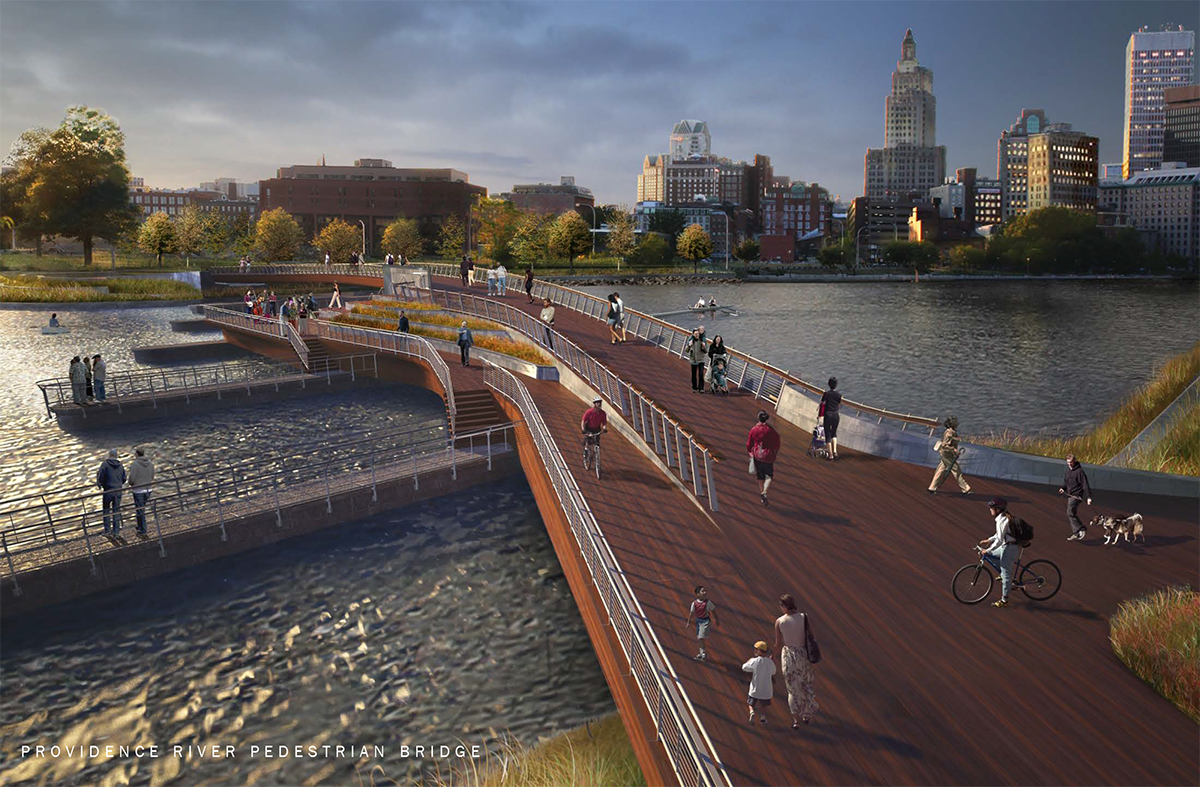
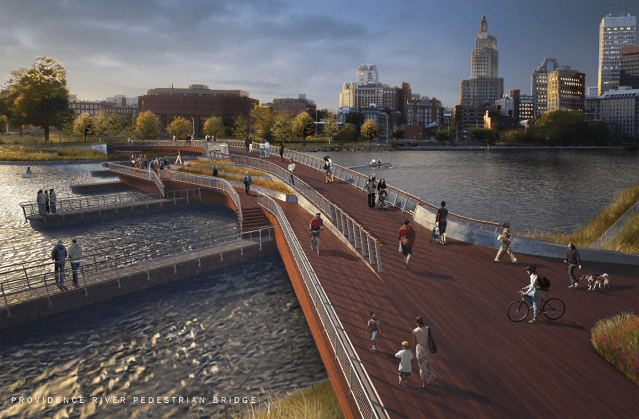
Proposed pedestrian bridge over the Providence River. (providenceri.com)

Proposed pedestrian bridge over the Providence River. (gcpvd.org)
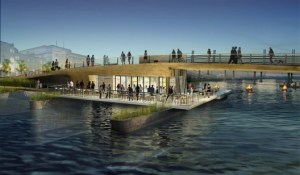
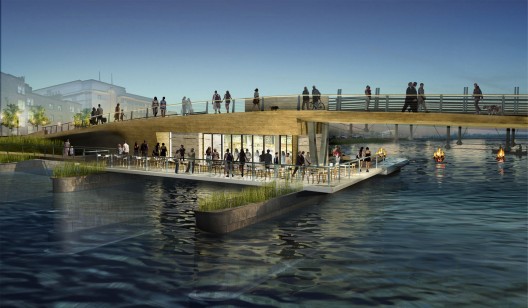
Original design of pedestrian bridge competition. (archdaily.com)
Original design of pedestrian bridge competition. (archdaily.com)

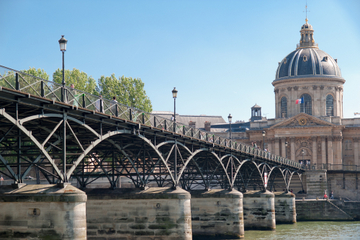
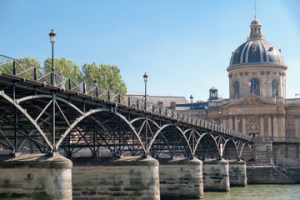
Pont des Arts pedestrian bridge in Paris. (viator.com)

Pont des Arts pedestrian bridge in Paris. (viator.com)

A bridge project I’d hoped and prayed was dead has risen to become, for lack of more ambitious possibilities as yet, the likely first part of the Route 195 development project to move forward in Providence. The streets and utilities have been laid, the hook has been baited for development, and more proposals have materialized than I would have bet on a year ago. I expected little or nothing to emerge, and indeed the “shadow parking” that has recently stumped the authorities reflects what I had thought might be, under the worst scenario, the best that could be hoped for (or feared).

But since things are moving slowly, the pedestrian bridge proposal that won the design competition that was the last developmental gasp of the ghastly mayoral administration of (now U.S. Rep.) David Cicilline has reared its ugly head. In 2010, an elegantly traditional bridge plan inspired by the Pont des Arts, in Paris, and designed by the late Bill Warner was defenestrated, an unnecessary design competition was held, and only modernist proposals were, it seems, permitted into the competition. The result was this bridge, a typically non-bridge bridge cliché of the sort that modern architecture specializes in.

As “value engineered” since its victory, the bridge’s covered restaurant and gathering place that had been part of the proposal’s allure have been dropped. What remains is actually less unattractive than is conventional in modernist design. The surface of the bridge will be an attractive type of wood (not sure it’s real, but it has the personality of wood), but there will be enough metallic sterility in the benches, railings, low lighting and other features (in the style of the bus-stop kiosks appearing around the city) to establish its credentials as a modernist bridge. In short, it will do its part to short-circuit any possibility that the city and state could use the 195 development to boost its economic future.

Providence has long bragged on its low rents compared with Boston, hoping that this would encourage developers to build here and draw businesses, workers and residents from the Hub. But what the developers discover is that Providence also has building costs about as high as those of Boston. This means that any development is unlikely to make enough of a profit with its low rents to pay back its investors for the cost of the project.

Rhode Island has sought over the years to level that tilted economic playing field with tax subsidies to reduce development costs. It has not worked very well, yet this is the strategy adopted by the Route 195 Redevelopment District Commission.

An editorial I wrote in 2011 when I was on the editorial board of the Providence Journal, about tax subsidies in the legislation that created the Route 195 district, kept disappearing from the computer system and never ran. I don’t know why this was so, but the subsidies are still there in the law, Sec. 42-64 (2011), largely unnoticed by the local media.

Here are the incentive programs as summed up in the law:

(1) Benefits from the life sciences jobs incentive program established by this section;
(2) Innovation investment tax credit established pursuant to chapter 44-63, with this section satisfying the eligibility determination in section 3 of chapter 44-63;
(3) Research and development expense credit established pursuant to chapter 44-32;
(4) Research and development property credit established pursuant to chapter 44-32; and
(5) Elective deduction for research and development facilities established pursuant to chapter 44-32;

I think there is a superior alternative. Readers have read about it in this space many times before. It is for the commission to encourage developers to propose traditional styles of building on the Route 195 land. That would be more popular. Popularity would make the development process flow more smoothly, with less expense wasted on lawyers and other tools for overcoming delay in the process. So it would be easier, and it would increase the likely success of the project. It would be more sustainable because traditional architecture – born in the lengthy pre-thermostat era – is designed to use architectural features rather than petroleum-based technology to help heat and cool buildings. Most of all, it would strengthen an already existing brand of traditional design that remains Rhode Island’s chief development asset in competition with other states, and will remain so until the state gets its economic house in order.

The design template to build on the Route 195 land has, alas, already been set at “mishmash” by the Developer’s Tool Kit published online by the the commission. The proposed pedestrian bridge buys into that mishmash. If Bill Warner’s “Pont des Arts” concept had been accepted – he was the design consultant for the Iway and designed the 195 bridge that ought to be named for him – the pedestrian bridge would probably have been built by now, and its elegance would be a very legible signal to developers of what they are expected to propose on the development land. It need not be a matter of law or of zoning but a matter of expectations, which developers prefer when they are clear.

Instead, we’ll have the pedestrian bridge that – apparently – is about to be built, slated for completion in 2016. It will signal developers to propose the ultimate in cheapo cheesy, a clear but unwanted signal that Providence is seeking the same tedious stuff that is going up, mostly, in all the other cities and states.

Way to build up the brand, guys!

Posted in Architecture, Development, Providence | Tagged , , , , | 1 Comment