Shubow on AIA’s promo

Rendering of proposed renovation of AIA headquarters, in Washington, D.C. (studio.com)

Rendering of proposed renovation of AIA headquarters, in Washington (studio.com)

Justin Shubow’s latest piece at Forbes.com, “The American Institute of Architects’ Outreach Campaign Is Doomed to Failure,” alerts readers to the multiple levels of hypocrisy that drive the self-promotion of the architects lobby. Like his study of Frank Gehry’s proposal for a memorial to Dwight Eisenhower, undertaken in his role as head of the National Civic Art Society, Shubow marshals an impressive array of links to support the facts that nail his complaints to the door of the high church of modern architecture.

Shubow is architecture’s Martin Luther. Not a happy but a necessary role, necessary to the restoration of architecture to its right and proper place.

I’m sure you will enjoy Shubow’s meticulous thrashing of AIA’s “I Look Up” ad now running on TV. Before I realized what it was, I was waiting for the logo of a personal financial adviser to snake across the bottom of the screen. Will the “I Look Up” campaign “change public perception of architects and architecture,” as intended, according to the AIA website? As Shubow writes, “Architects are always in a precarious position. Unlike doctors and lawyers, their services are never required.” He adds:

In the past, architects overcame this challenge by demonstrating the superiority of their skills and knowledge. Their buildings were simply better.  Now, however, few people believe that. The reputation of architects is at its lowest point ever. They are perceived as being problem-causers, not problem-solvers. They are purveyors of the ugly and dysfunctional, of the emotionally detached and culturally disconnected.

As long as modern architects keep bricking up the wall between architecture and the public, the profession is more and more likely to meet the fate of Fortunato, trapped in the cell of his own self-infatuation in Poe’s story “The Cask of Amontillado.” The AIA’s self-infatuated ad campaign will not avert its eventual asphyxiation.

Shubow reports that the AIA has removed from its website the result of a previous failed effort to stroke itself. I refer to its own survey of Americans’ 150 favorite buildings, done in 2007 to honor the organization’s 150th anniversary. It showed that Americans don’t like modern architecture. It’s no wonder that the survey still makes the AIA uncomfortable today. I wrote a column about it back then, and as a service to readers I reprint it here.

Not long ago, in my pursuit of a job after my layoff from the Providence Journal, I sent newly installed AIA President Elizabeth Chu Richter an excruciatingly polite note. In light of its recent program of repositioning, I offered my services to help the AIA try to fathom the role and aspirations of tradition in architecture. As I clicked the send button, I felt my spine twist slightly. But I had to find a job. Of course, I got no reply at all.

Shubow understands why. The AIA is not trying to understand or even to change the public’s perception of architecture and architects. It is a cult that relies on obedience from its members, and as an organization it will show the back of its hand to anyone who has not drunk the Kool-Aid. But individual architects need, as we all do (or most of us), to feel good about their role in the world. The “I Look Up” ad tries to convince architects that they can look up to themselves. Don’t break your necks, please!

Posted in Architects, Architecture, Architecture Education, Architecture History | Tagged , , , , , , | 3 Comments

Dump on Seagram Building

Seagram Building, by Mies van der Rohe. (www.eca.ed.ac.uk)

Seagram Building, by Mies van der Rohe. (www.eca.ed.ac.uk)

Martin Pedersen, the critic and former Metropolis editor who co-wrote a blistering attack on modernism in the New York Times last December, has loosed an excellent fusillade against the Seagram Building, completed in 1958. Writing in the Fast Company blog, Pederson’s “Hate Your Soulless Office Tower? Blame the Seagram Building” lets the icon designed by Mies van der Rohe have it with both barrels.

… A fuller appreciation of the Seagram Building has become a kind of intellectual exercise, requiring architectural tour guides. Its subtle beauties, I would argue, aren’t readily apparent to the man or woman on the street. The building is beautiful-upon-closer examination (a distinction, for me, that is somewhat similar to Sex and Talking About Sex). Unless you’re an architect, you don’t pull up to 375 Park Avenue, open the cab door, and cry: Look at that magnificent curtain wall! Those perfectly detailed mullions! That austere-yet-classical symmetry! You don’t think—as people often do, gazing up at the Empire State Building, staring slack-jawed in front of a Gothic cathedral, or even pondering the sheer lunacy of a half-mile high tower in Dubai—how could human beings have possibly built this? Instead you’re likely to glance to Mies’s crowning achievement, standing pristine and perfect, amid a forest of vastly larger and inferior knock-offs, and think: nice office building.

Perfecto! I once visited Park Avenue expressly to view the Seagram Building. I could not tell which one it was. When I finally identified it, I stepped close, looked up and tried to determine what it was about it that sets modernist hearts aflutter. I could not figure it out. I probably need to give my brain a set of modernist-appreciation exercises.

Since honesty is one of the most preenworthy things about modern architecture, I would need some sort of depretzeling exercise to come to grips with the dishonesty at the heart of the “beauty” of the Seagram. Its structural steel beams had to be coated with fire-resistant concrete, and so, to articulate the “structure” that is supposed to be evident in modernist design, Mies had non-structural I-beams copper in color attached to the concrete. I have no problem with that kind of “dishonesty” in architecture, but modernists do. Or at least they say they do. But they overlook it in the case of the Seagram Building. It goes unmentioned by Pedersen.

He does regret all the Mieslings who designed buildings up and down Park Avenue and its neighbors, whose main effect was to … – I was about to say steal Seagram’s thunder, but that would be to grant it thunder. I do not. Pedersen does. Well, I’ll let him say it:

All of these buildings loosely employ the same vocabulary as Seagram (with none of the refinement and charm), but all of them were executed for maximum profit. What this has done — besides create a somewhat dreary and overscaled pedestrian streetscape — is rob the Seagram Building of its visceral punch.

So, yeah, okay, steal its thunder. Pedersen is too kind to the Seagram. He says that the knockoffs had “none of the refinement and charm.” What refinement? What charm? It’s a glass slab. They are glass slabs. I fail to see the difference. “God is in the details” is what Mies said about his brand of architecture, meaning that a beam had to be really pure in its straightness or curvature in order to protect structure from weather. Traditional detail, such as pilasters and stringcoarses, protect joints from water; modernism relies on its component parts being so meticulously machined that they fit too closely together for rain to get in. Usually they are not. Hence, cheap knockoffs. So even if the work is truly meticulous, it’s hard to perceive so fine a result.

And of course “all of these buildings loosely employ the same vocabulary.” Modernism threw all but the bluntest vocabulary out the window, so is it any surprise that it all looks the same – in spite of its official mantra against copying the past?

I suppose I am traveling beyond Petersen’s point. Even as his sharp critique of the Seagram gives it too much credit, it remains a breath of fresh air.

Posted in Architects, Architecture, Art and design, Development | Tagged , , | 2 Comments

Mark Anthony Signorelli: The poetry of architecture

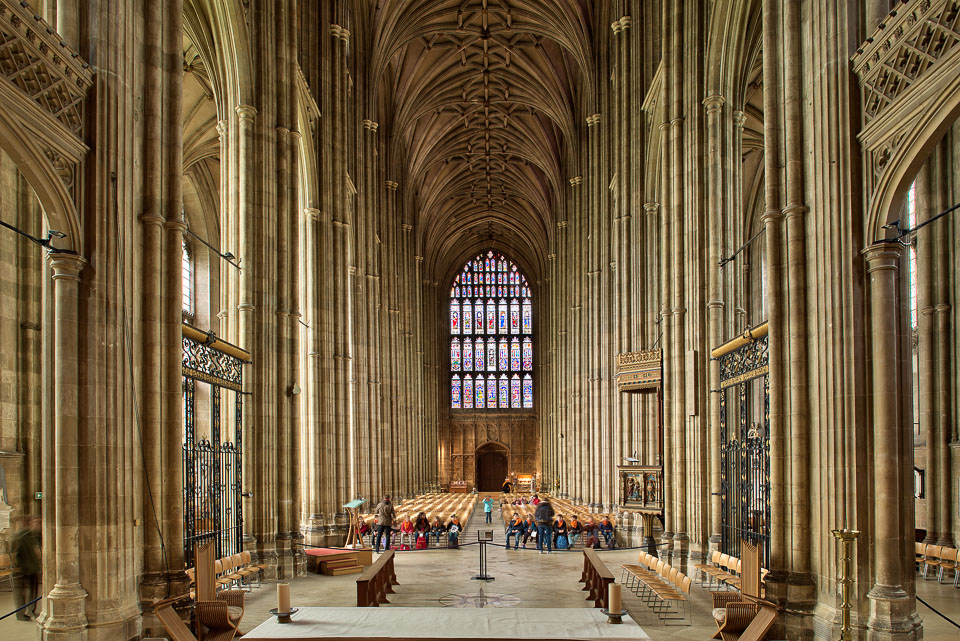
The nave of Canterbury Cathedral. (tonesshots.com)

The nave of Canterbury Cathedral. (tonesshots.com)

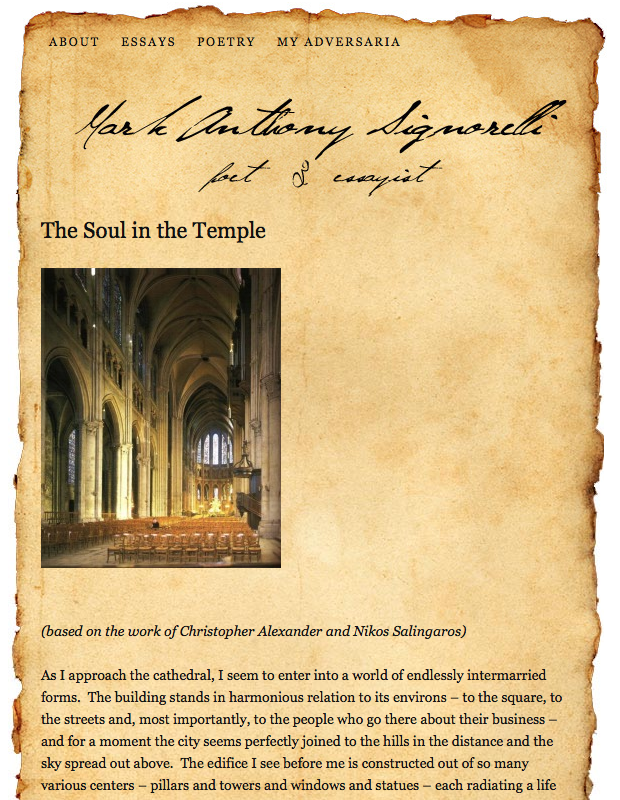
Nikos Salingaros, the theorist of architecture’s debt to biology, has sent me an essay by his sometime collaborator Mark Anthony Signorelli. Nikos describes “The Soul in the Temple” as “very insightful and very poetic (well, Mark is a poet!).” I would second that emotion while ramping it up more than a few notches. A year or so ago, Mark and Nikos wrote a call to arms for artists (and architects), “The Tyranny of Artistic Modernism,” an essay that still sends shivers of joy up my timbers. This latest essay is more an attempt to suggest the connectedness between architecture and nature – it picks up on the thinking of Nikos and fellow theorist Christopher Alexander – as it might be described not in the terms of science but of poetry. Here is an example, tracing his reflections after he has entered a ancient cathedral and reacted to its vaulting beauty:

Screen shot of website of Mark Signorelli.

Screen shot of website of Mark Anthony Signorelli.

The men who invented this structure did not war with nature; they did not seek its conquest or abolition.  They simply adhered to the basic patterns by which space and matter assume form in the natural world.  Consider the archivolt above the cathedral doors, with its multiple bands of bas-reliefs surrounding the portal.  Each band is a center in and of itself, comprised of figures and compositions which are centers themselves.  The whole serves as a boundary between the doors and the façade, defining the forms of each; at once separating the door from the facade, while connecting both and making each of them a whole.  This phenomenon of a boundary permeates the structures of the natural world.  We discover its presence where different forms interact with one another, delineating and melding the two simultaneously. 

While I’ve trolled the Web to illustrate this essay, the cathedral Signorelli describes is no particular cathedral but the cathedral of the mind of the author, so to speak, who is a poet and essayist. If you find Mark’s thoughts and language as subtle and enchanting as I do, there is more to be read at his website.


Posted in Architecture, Art and design, Books and Culture, Uncategorized | Tagged , , , , , | 1 Comment

What monuments tell us

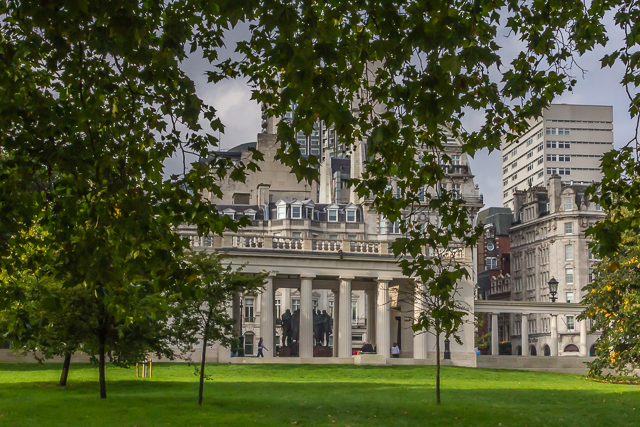
Bomber Command Memorial, in London. (crowcanyonjournal.wordpress.com)

Bomber Command Memorial, in London. (crowcanyonjournal.wordpress.com)

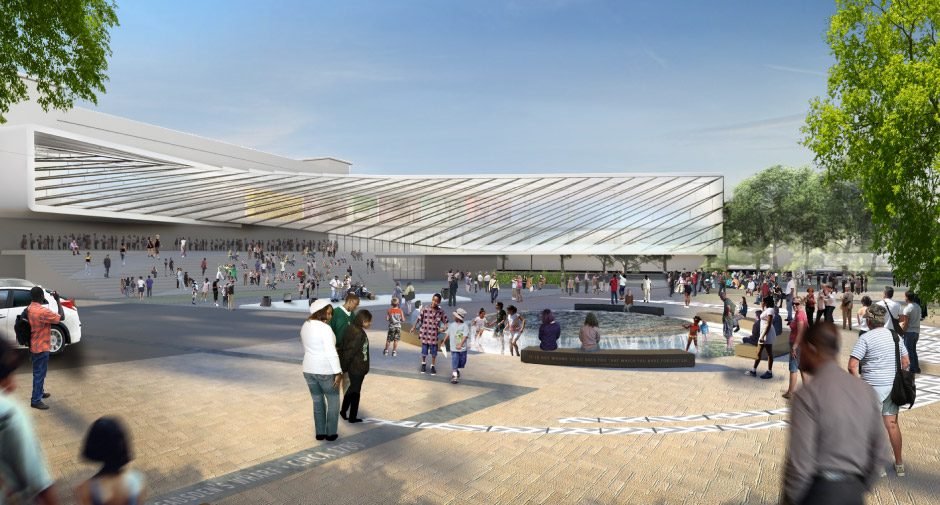
Recently, as museums to remember the stain of slavery in America are under construction in Washington and planned in Charleston, there has arisen the vital question of whether memorials should speak in a traditional language everyone can understand or a modernist language whose only clear meaning denies the past. The designs in Washington and Charleston both regrettably embrace the latter language, on the logic that any architecture before the Civil Rights Movement lacks legitimacy to reflect on slavery. Of course, nobody would propose designs in the shape of a plantation house, but modernism itself predates the Civil Rights Movement. Ultimately, the past cannot and should not be denied. It must be addressed and understood, the better to reconcile history with a future built upon truth. Traditional architecture has language for that. Modern architecture does not.

My 2012 column honoring the memorial in London to Britain’s Bomber Command addressed the language of monuments. Here it is:

Bomber Command Memorial on target

July 5, 2012

Last Thursday in London’s Green Park the dwindling number of Royal Air Force bomber crews from World War II gathered to dedicate a memorial to Britain’s wartime Bomber Command. Queen Elizabeth II and Prince Charles attended. A vintage Lancaster dropped red poppies.

The memorial honors the bomber service’s bravery, and deaths of 55,573 men of Britain and the Commonwealth who helped bring Nazi Germany to its knees.

The monument came 67 years after the end of the war. That’s because Britain is abashed at the carpet bombing of German cities in retaliation for Hitler’s carpet bombing of British cities. Britain debated the propriety of building a memorial that, while intended to remember the fallen air crews, might also be seen as a memorial to dropping bombs on cities.

The morality of that strategy was debatable, has been debated for 67 years, was indeed debated by Churchill who ordered it and the generals who sent the fliers on their grim mission. Almost 50 percent of the men in those planes died in combat, a higher rate than in any other branch of service but submarines.

The memorial honors their courage with a thoughtful classicism that needs no interpretation to be understood. Architect Liam O’Connor showed how classicism’s simple language articulates a noble endeavor. Metaphorical restraint gives powerful lift to the design. Colonnades flanking the pavilion may be seen as the long wings of a bomber. The roof uses aluminum from the wreckage of a Canadian Halifax bomber downed over Belgium.

In the pavilion a sculptural group in bronze by Philip Jackson portrays an air crew of seven exhausted men just back from a mission, some looking at the ground, others scanning the sky for homecoming comrades. Their faces reflect the range of feelings you would expect.

But there is no range of reflection in the criticism that the memorial has generated.

“This monument is a nasty piece of artistic jingoism,” writes Jonathan Jones of The UK Guardian. “Amnesiac classical,” writes Rowan Moore of the Observer. “If it had to be built, you might hope for some nuance.”

The bomber crews loved it anyway.

Many old soldiers visited the World War II Memorial on the Mall in Washington on Independence Day [by Rhode Island architect Friedrich St. Florian]. It is beloved by vets but hated by most critics for its classicism. No one dares to criticize that classical obelisk, the Washington Monument, for its lack of nuance. Frank Gehry has wondered why Lincoln got a Greek temple. No critic dares to remind him that ancient Greece gave birth to democracy.

The Greek democracy was not perfect. The democracy created by Washington, Jefferson and the other Founders was not perfect. Even four score and nine years later it was still imperfect. Lincoln’s priorities in the Civil War are debated to this day. Did he wage war more to preserve the union or to free the slaves?

Nuance is what historians are for. Monuments articulate the abiding truths of history. When architects use architecture to articulate nuance, they end up articulating nothing. In short, they end up with Frank Gehry’s proposed memorial to Dwight Eisenhower.

Gehry’s supporters say his design’s complexity of expression encourages visitors to think their own thoughts about Eisenhower. What they mean is that Gehry’s memorial has no meaning. This is so because modernism has no coherent language to convey meaning.

Of course, the architectural commentariat does not dare to point that out.

There is a code of silence about modern architecture that achieves its summit in commentary about the design of monuments and memorials. Gehry’s Eisenhower design looks like the underside of a highway access ramp, so its incoherence elicits no complaint. Liam O’Connor designed a classical Bomber Command Memorial; if it were a modernist heap instead, looking vaguely like a downed bomber or a bombed city, the critics would not now be complaining that it lacks nuance. The code of silence protects this vapidity, but most people can see through the mumbo jumbo.

And so the democracy we celebrated yesterday is chipping away at the code of silence. In June, for example, Congress defunded Gehry’s Eisenhower memorial design; and the Bomber Command Memorial opened in London to the public’s admiration, even 67 years late.

Democracy takes time to act, but history has time in abundance. The apparent demise last month [alas not yet consummated even in 2015] of a flawed memorial in Washington and the dedication last week of a great one in an even older democracy are lessons taught by citizens that architects ought to heed.

Below are renderings of the National Museum of African American History and Culture in construction on the National Mall and the International African American Museum still being designed in Charleston.

Rendering of National Museum of African American History and Culture, in Washington. (npr.org)

Rendering of National Museum of African American History and Culture, in Washington. (npr.org)

Rendering of proposed International African American Museum, in Charleston. (iaam.org)

Rendering of proposed International African American Museum, in Charleston. (iaam.org)


Posted in Architecture, Architecture History, Art and design, Blast from past, Development | Tagged , , , , , , , , , , | 3 Comments

Fashion and coquetry, 1807

By Jean Ignace Isidore Gérard (1803-47), known as Grandville. (paumsarin.wordpress.com)

By Jean Ignace Isidore Gérard (1803-47), known as Grandville. (paumsarin.wordpress.com)

My last passage quoted several posts ago from William Hazlitt was followed merely a page later by this passage, which rivals if it does not quite repeat the endlessness of its predecessor. Whereas the prior passage limns the hopelessless (at least in the opinion of sociologists) of the status of the romance-reading coquette, Hazlitt’s voluptuous language here diagrams the architecture of the female sartorial armamentarium. Here the architecture of words and of form meet in the language of perfection, or at least a perfection of language.

The young ladies we at present see with the thin muslin vest drawn tight round the slender waist, and following with nice exactness the undulations of the shape downwards, disclosing each full swell, each coy recess, obtruding on the eye each opening charm, the play of the muscles, the working of the thighs, and by the help of a walk, of which every step seems a gird, and which keeps the limbs strained to the utmost pain, displaying all those graceful involutions of person, and all those powers of fascinating motion, of which the female form is susceptible – these moving pictures of lust and nakedness, against which the greasy imaginations of grooms and porters may rub themselves, running the gauntlet of the saucy looks and indecent sarcasms of the boys in the street, starting at every ugly fellow, leering at every handsome man, and throwing out a lure for every fool (true Spartan girls, who if they were metamorphosed into any thing in the manner of Ovid, it would certainly be into valerian!) are the very same, whose mothers or grand-mothers buried themselves under a pile of clothes, whose timid steps hardly touched the ground, whose eyes were constantly averted from the rude gaze of the men, and who almost blushed at their own shadows.

Well, maybe this has indeed surpassed in length the sentence of the other day. It is from the next page of the same book criticizing the population theories of Malthus – no doubt the sort of sentence that was calculated to foster the brisk sale of volumes. So feel free to hit on this blog post.

Posted in Architecture, Art and design, Books and Culture | Tagged , , , , , | Leave a comment

Embarrassing screen shot

Screen Shot 2015-03-12 at 11.54.18 PMAbove is a screen shot part way down into the online print version of an NPR interview with Renzo Piano, “The Future of Europe’s Cities Is In Their Suburbs.” In it, the interviewer says that “Piano believes it’s the architect’s civic duty to seize even the tiniest fragment of beauty and nourish it.” Then, over to the right, is Piano’s Centre Pompidou, designed along with Richard Rogers. They took punkster Le Corbusier’s advice and tore down a big hunk of a beautiful neighborhood in Paris to erect something hideously ugly and stupid. Civic duty to nourish even the tiniest fragment of beauty, eh? So the question must be: was the photo placement accidental or did NPR set out to sandbag Piano with the truth? I’m afraid the question answers itself.

Posted in Architects, Architecture, Architecture History, Urbanism and planning | Tagged , , , , , , | 1 Comment

Frei Otto’s Pritzker: Shhh!

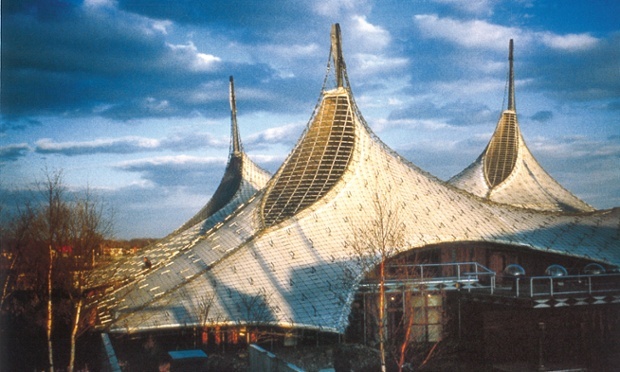
German pavilion at Expo 67 in Montreal. (Atelier Frei Otto Warmbronn)

German pavilion at Expo 67 in Montreal. (Atelier Frei Otto Warmbronn)

Frei Otto’s Pritzker exposes the jury to the charge of not having done its homework. True, his work is as ridiculous as anyone looking at it would have to conclude just by looking at it. As such, it lives up to the standard set by previous Pritzker winners. But if you read all of Oliver Wainwright’s story in the Guardian, “Frei Otto: The titan of tent architecture,” you find that the late architect, who died shortly before his Pritzker’s announcement, doubts the value of his own legacy. He is disappointed by the “buildings” he has erected and their failure to achieve the “purpose” he set for them. Otto criticizes architecture – not modern architecture per se – for what most people would see as obvious flaws. Why did the Pritzker jury decide to give Otto such a visible podium? Oops! Must have been an accident.

If you are waiting for the architectural press to quote the passages near the end of Wainwright’s piece, or Otto’s own criticism of modern architecture, don’t hold your breath. I will do it for you. (And what the heck’s gotten into Wainwright, by the way? He himself quoted these passages. Hmm.) Here are his story’s last three paragraphs:

But Otto himself was always frustrated that his ideas didn’t go elsewhere. Indeed his dream of developing a new language for a democratic world remained confined to the domain of aviaries and mega-events, co-opted for temporary thrills. In the 1970s he envisioned a fantastical speculative proposal for an Arctic City, to house 40,000 people under a 2 kilometer wide inflatable dome. But it was a naïve utopia, like Buckminster Fuller’s dome over Manhattan, that he became highly critical of later in life.

“Why should we build very large spaces when they are not necessary?” he told Icon. “We can build houses that are two or three kilometres high and we can design halls spanning several kilometres and covering a whole city but we have to ask what does it really make? What does society really need?” As Dubai proposes to build the world’s first indoor city as a hermetically sealed retail environment, and Google plans its own greenhouse tech-utopia, a plug-in city garnished with shrubbery, it’s not hard to see why Otto had mixed feelings about his own legacy.

“My generation had a big task after the war and of course we thought we could do it better,” he said. “Today 60 years later, we can’t be proud of what we have done. But we tried; we tried to go a new way.”

When you blame the problems of history on a style of architecture, as Otto’s generation of architects did, and as the founders of modernism did, then your response is probably going to take you in the wrong direction. Like (I think) most modern architects, Frei Otto understood that. Unlike most, he had the courage to admit it. May he rest in peace.

Posted in Architects, Architecture, Architecture History | Tagged , , , | Leave a comment

Hazlitt’s literary skyscraper

"The Lending Library," by Isaac Cruikshank, 1756–1810. (kittycalash.com)

“The Lending Library,” by Isaac Cruikshank, 1756–1810. (kittycalash.com)

William Hazlitt, 1778-1830. (wikiquote.org)

William Hazlitt, 1778-1830. (wikiquote.org)

William Hazlitt, whom I’ve quoted here before on the art of painting, is a writer whose sentences evoke the architecture of English. The one below certainly suggests a skyscraper. He liked to say that he wrote in a “familiar style” – which to him was to write as an educated person would speak but without affectation. He “utterly rejects not only all unmeaning pomp, but all low, cant phrases, and loose, unconnected slipshod allusions.” Hazlitt’s essays are fun to read out loud, just as Mencken’s are. The following may be one of his longest sentences. It is from his “A Reply to Malthus’s Essay on Population,” written at age 29 in 1807, when he was still hoping to make his living as a painter. He eventually became a journalist, at first reporting speeches in Parliament, then adding theater criticism, which attracted notice and brought him into literary criticism and essays on general subjects.

Is it to be wondered at that a young raw ignorant girl, who is sent up from the country as a milliner’s or mantua-maker’s apprentice, and stowed into a room with eight or ten others, who snatch every moment they can spare from caps and bonnets, and sit up half the night to read all the novels they can get, and as soon as they have finished one, send for another, whose heart, in the course of half a year, has been pierced through with twenty beaux on paper, who has been courted, seduced, ran away with, married and put to bed under all the fine names that the imagination can invent to as many fine gentlemen, who has signed and wept with so many heroes and heroines that her tears and sighs have at least caused in her a defluction of the brain, and a palpitation of the heart at the sight of every man, whose fancy is love-sick, and her head quite turned, should be unable to resist the first coxcomb of real flesh and blood, who in shining boots and a velvet collar accosts her in the shape of a lover, but who has no thoughts of marrying her, because if he were to take this imprudent step, he must give up his shining boots and velvet collar, and the respect they procure him in the world?

That’s quite a question. These days, we would reduce the number of commas and hike the flow of words toward easier comprehension. I’m not sure I’m on solid ground in dedicating the above sentence of Hazlitt’s to all of the new followers of this blog, but I’m sure I must be on target with many, and so I thought I would offer them a token of my esteem – this delightful, perhaps even romantic, passage from my favorite.

Posted in Architecture, Art and design, Books and Culture | Tagged , , , , , , | 5 Comments

New apartments downtown!

Tiny Merchants Bank Building next to Textron Building, seen from across Providence River. (ricurrency.com)

Tiny Merchants Bank Building next to Textron Building, seen from across Providence River. (ricurrency.com)

Our mini-Flatiron Building. (photosynth.net)

Our mini-Flatiron Building. (photosynth.net)

I have received an anonymous tip that the Mercants Bank Building, our mini-Flatiron brownstone “tower” opposite the Turk’s Head Building across the intersection of Westminster and Weybosset, is being renovated for apartments or condos. Excellent! Considering the units in rehabbed buildings (and possible new ones) being developed by Buff Chace, maybe this city is indeed headed for a re-renaissance!

David Brussat's avatarArchitecture Here and There

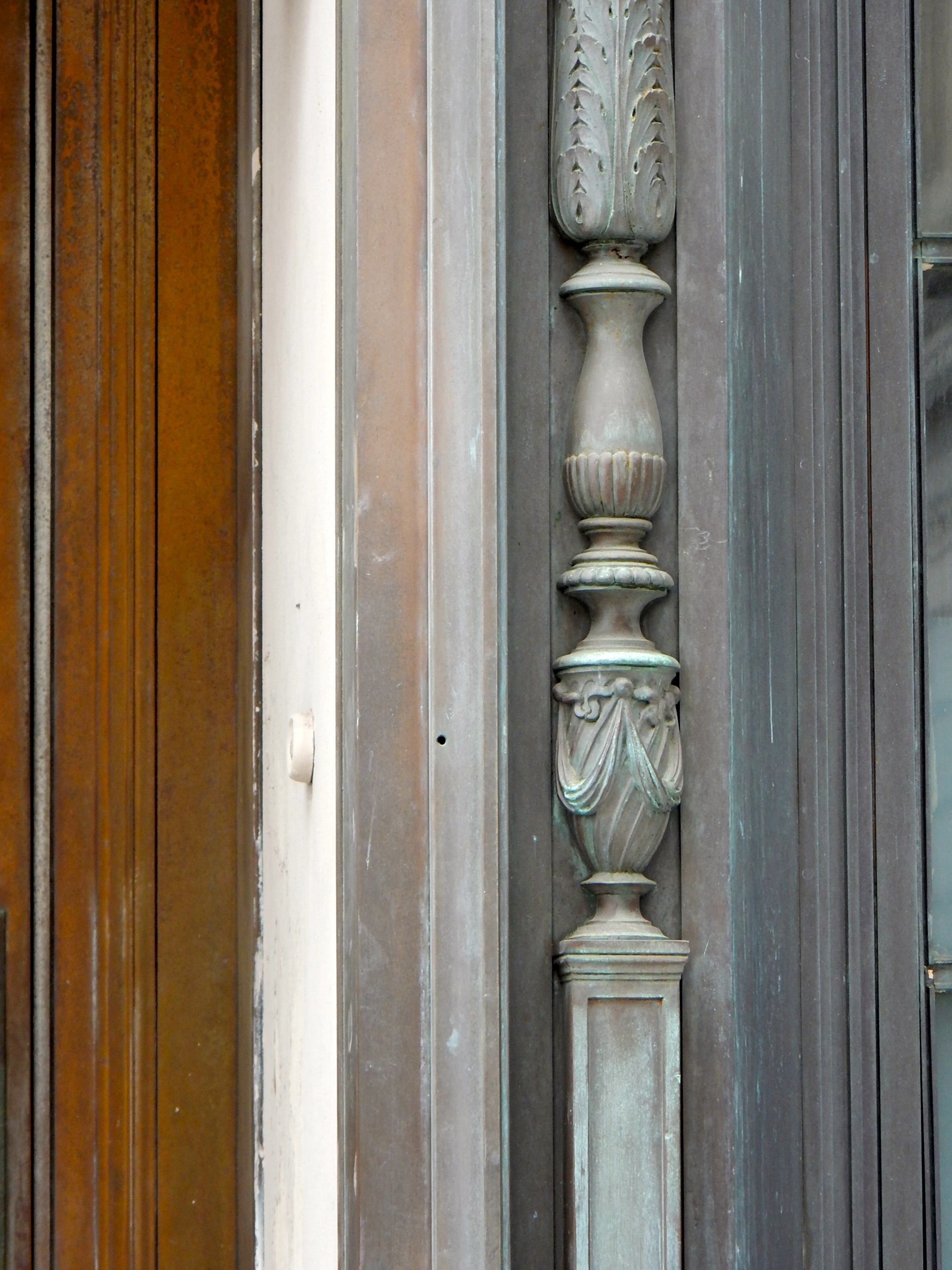
Upper portion of door surround at 32 Custom House St. Upper portion of door surround at 32 Custom House St.

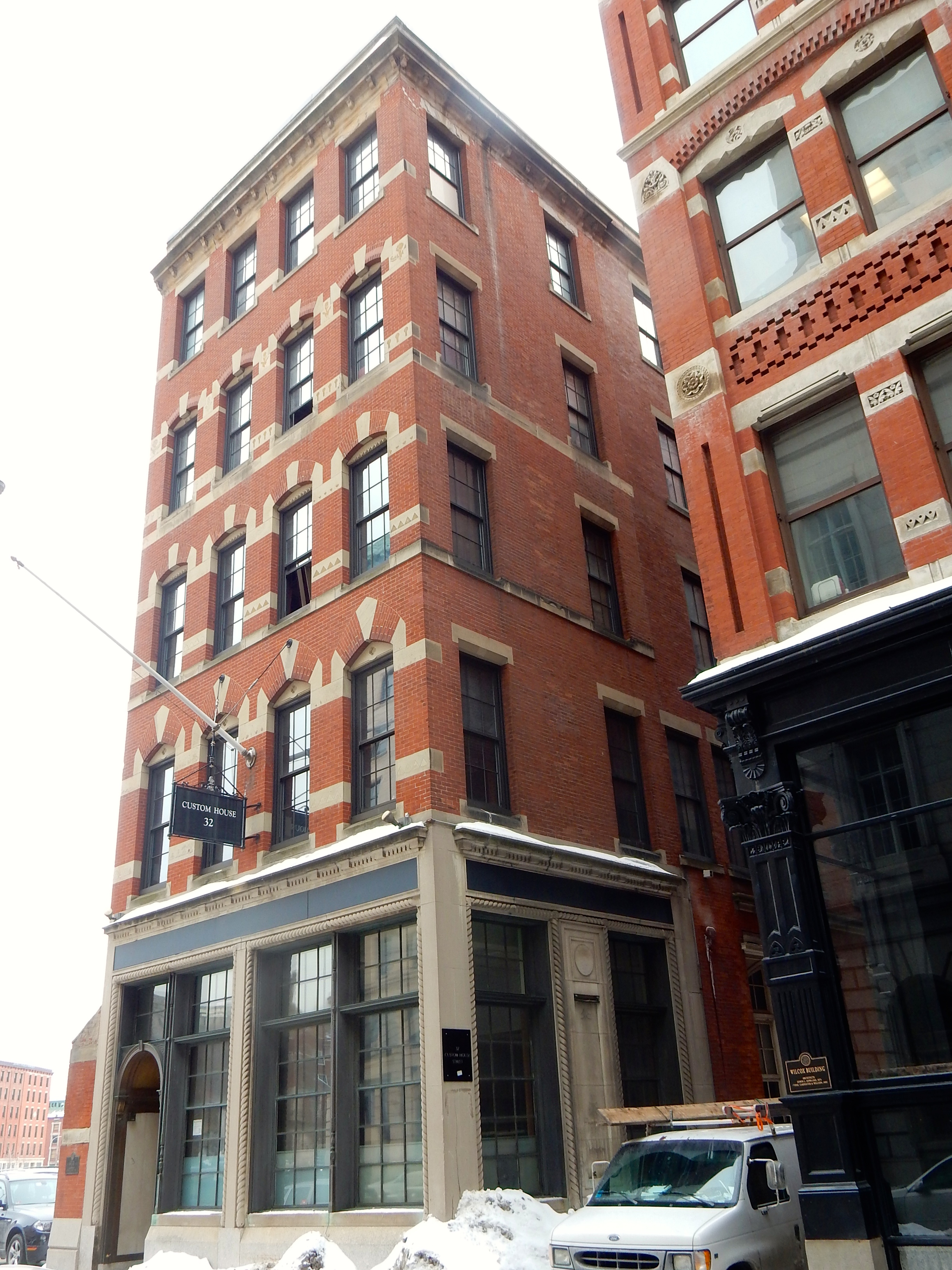
Monday evening’s meeting of the Downtown Design Review Committee relieved concerns that one must feel upon news that a graceful old building is being renovated. Who knows what evil could be afoot. But the applicant, HM Ventures 7, of Brooklyn, seems to have only good things in mind, more restoration than renovation outside. The building at 32 Custom House St., built in 1875 and known as the Real Estate Title Insurance Building, will host 10 apartments and a ground floor shop or restaurant. Bravo!

Below this post are a few photos I took of the building last week.

Proposed garage in middle between proposed student dorm and existing South Street Station. (gcpvd.org) Proposed garage in middle between proposed student dorm and existing South Street Station. (gcpvd.org)

That’s the good news from that meeting. Before I spring the bad news on readers, note that it is now the Downtown Design Review Committee, not the Downcity…

View original post 430 more words

Posted in Uncategorized | Leave a comment

New apartments downtown!

Upper portion of door surround at 32 Custom House St.

Upper portion of door surround at 32 Custom House St.

Monday evening’s meeting of the Downtown Design Review Committee relieved concerns that one must feel upon news that a graceful old building is being renovated. Who knows what evil could be afoot. But the applicant, HM Ventures 7, of Brooklyn, seems to have only good things in mind, more restoration than renovation outside. The building at 32 Custom House St., built in 1875 and known as the Real Estate Title Insurance Building, will host 10 apartments and a ground floor shop or restaurant. Bravo!

Below this post are a few photos I took of the building last week.

Proposed garage in middle between proposed student dorm and existing South Street Station. (gcpvd.org)

Proposed garage in middle between proposed student dorm and existing South Street Station. (gcpvd.org)

That’s the good news from that meeting. Before I spring the bad news on readers, note that it is now the Downtown Design Review Committee, not the Downcity Design Review Committee. I for a long time liked the term Downcity when it meant the old commercial section of downtown west of Dorrance Street and no more. Eventually, Buddy Cianci started treating the term as a synonym for downtown, and “creative” types, obeying some innate truckling-under to fashion, started upper-casing the C – as in DownCity. The term quickly degenerated into a reliable cringe-making system in my mind, and I started using it as rarely as I could.

The term supposedly got its start in the 1990s when Antoinette Downing suggested to Andres Duany, who was working to revitalize downtown, that Downcity would make a good name for the newly spiffed-up neighborhood. After it made its “debut,” its historical derivation, “Let’s go downcity” – a phrase signifying not so much a place as an activity – started rubbing some upper-crusty folks as being too working class to be sufficiently cool.

Don’t ask me to plumb those dynamics, please! Just let me congratulate the city’s planning people for bailing on that term and going back to downtown for the name of the committee. I would only add that the city should avoid adding new sections to downtown. One of the blessings of downtown is its walkability, and if too many of its neighboring districts insist on being referred to as part of downtown, then people visiting downtown will start to consider Providence’s supposed walkability as a PR fabrication – a lie.

The bad news gleaned from Monday’s meeting is all too predictable, as you might surmise from the rendering above and to the left. Right next to the glorious Neo-Colonial South Street Station being transformed into a nursing school, they are planning to put up a garage. It seems they didn’t want it to look like a garage (so far, so good) so they have decided to make it look like a suburban office pod, downright Miesian except for its synopated glass fenestration. Good grief! The proposed student dorms seek to meld a brick building with, also, a Miesian glass box. Got lemonade? Let’s make a lemon!

But put that out of your mind for now and glory in the images of 32 Custom House St. (left) and its vicinity in the Financial District of Providence. The Florentine palazzo across the street from the Title Insurance building is the Custom House (1857) itself, designed by Ammi B. Young, and the cubic thing at the east end of Custom House Street and across the river is the Old Stone Square I mentioned one post ago.

DSCN5000DSCN5011DSCN4998DSCN5016DSCN5004DSCN5009DSCN5006DSCN5005Ah! Downcity! Oops, I mean downtown!!!

Posted in Architecture, Architecture History, Development, Photography, Preservation, Providence, Urbanism and planning | Tagged , , , , , | 7 Comments