TAG 4.2 versus TAG 4.2?

Backdrop for session breaks shows relationship between classicism and nature. (CPI)

TAG 4.2 means traditional architecture gathering, this year held via Zoom from the offices, in Washington, D.C., of the Classical Planning Institute founded by Nir Buras, an Israeli American architect, author of The Art of Classic Planning, and impresario of the classical revival. The idea, quite obviously, is to gather like-minded proponents of traditional and classical architecture to discuss advances in their practice and the eventual displacement of modern architecture from its decades’ long dominance of the profession.

Or at least that’s what I thought was the idea. After Friday’s second session of the four-day event, I am not so sure. But I’ll get around to that soon. This post will only discuss the first two days.

The first day centered upon the ideas of Leon Krier, a native of Luxembourg who, as a young man, watched as its capital was transformed from historical beauty into a civic monstrosity by the modernists. Krier left Luxembourg and became a leading theorist of the resistance to modernism and godfather of the classical revival (though Henry Hope Reed’s ghost might argue the point). Krier masterplanned Poundbury, in Britain, for Prince Charles, and the beautiful new town of Cayala, in Guatemala, among many other projects, and his pictograms of architectural theory are the delight of all who happen upon them.

He has been working on a new plan for the federal quarter of Washington, D.C., that would fill in its empty spaces with classical apartment houses, and turn the Mall itself into a waterway. It makes great aesthetic sense, and doubles down on the city’s founding designer, Pierre L’Enfant. Alas, it may be a pipe dream. I grew up in D.C. and hope Krier’s plan is carried out. How TAG’s masterplanner, Nir Buras, managed to withhold mentioning his equally lovely plan for the Anacostia River embankments south of the U.S. Capitol, I don’t know.

The format of these TAG sessions invites discussion of the speaker from panelists and feedback from attendees. At session one on Thursday. hundreds of viewers on Zoom left the impression that the classical revival forges ahead, with talented practitioners building new traditional architecture and patient educators adding new facilities to teach, again, how architects built for centuries, even millennia.

Friday’s session started with a lecture by University of Texas mathematician and architectural theorist Nikos Salingaros. He described recent research in the field of neurobiology that explains why most people prefer traditional to modern architecture. His talk was reinforced by the astonishing eye-tracking evidence of architect/researcher Ann Sussman, who was on the panel.

To be succinct, Salingaros showed that traditional architecture reflects the vital need of early humans on the African savannah for visual information to protect against predators and to locate food. The human brain in its oldest recesses still craves such detail, but over the centuries the motive of survival was replaced by the desire for beauty, using artfully arrayed detail and decoration not just for pleasure but for easy identification of purpose and hierarchy in buildings and wayfinding in cities.

Neuroscience shows that the logic and aesthetics of traditional architecture satisfy human needs for emotional balance and stress reduction raised by the anxieties of everyday life. Traditional architecture reflects the natural patterns of human reproduction and organic growth. It is thus healthier and speeds healing. Modern architecture emphasizes the abstract and the experimental, thus tending to challenge the mind rather than relaxing or comforting it. This seems obvious to the average person, and cerainly to advocates of a classical revival. Hospital designers are beginning to recognize the truth, but the establishment in architecture continues to resist.

That resistance showed up in the discussion of Salingaros’s work at Friday’s TAG session, even though almost all of the attendees were surely in sync with what he was saying. There is an understandable desire among even the most vociferous proponents of an idea to soften their interactions with those who disagree with that idea. Since the appearance of and the theories behind modern architecture are the best arguments against it, no discussion of design would be complete without pushback from the modernist that inhabits the dark recesses of the soul of every traditionalist.

After all, leaving aside the desire for comity, almost every architect was taught to think and build in a modernist manner before discovering that there was a better, more logical, more beautiful way of building. Almost all traditionalists had to reject their education before embracing tradition.

So, I was not the least bit surprised when an attendee objected from the floor to the session’s “heated” criticisms of modern architecture. Nor was I surprised by the reaction of panel moderator Melissa DelVecchio, who was the chief architect of the two new classical colleges erected by her firm, RAMSA, at Yale. She declared that “we don’t help classicism by bashing modern architecture.”

Salingaros swiftly replied that “I don’t think it’s heated enough!”

Precisely. Traditional and modern architecture are opposites. One is good and the other is bad. One typology is beautiful; the other rejects beauty. Traditional architecture conduces to human health; modern architecture produces stress and disorientation. Promoting a traditional architecture of joy and healing requires at least the implicit criticism of its opposite. They are two sides of the same coin. Compromise, or the search for a “new way,” is surrender. You cannot hope to advance the classical revival without challenging today’s modernist establishment, which has sought to crush tradition for decades.

Still, in one’s own contribution to the architectural discourse, individuals are free to emphasize support for tradition over criticism of the status quo – which, increasingly so in today’s America, still requires courage. Both are vital.

Thanks to Nir Buras and his organization’s TAG sessions, there will always be people around to push the style wars toward a more intelligent correlation of forces.

Leon Krier’s plan to update Pierre L’Enfant’s federal core, in Washington, D.C. (Leon Krier)

Posted in Uncategorized | 13 Comments

Fictional Oxford pool room

Fifth-floor Smith Building loft, in downtown Providence, decked out for holiday tour in 2008.

I once lived for 11 years, 1999-2010, in a downtown Providence billiard room. It was a loft on the fifth floor of the Smith Building (built in 1912) on Eddy Street, renovated in 1999 with views looking to the south and east, down Fulton Street between City Hall and the old Providence Journal building (1906). I say it was a billiard room because when I moved in I did not have enough possessions to fill a loft of 1,100 square feet, so I bought a pool table of regulation size, high-quality slate, and sexy legs around which I arrayed my living, eating and sleeping space.

Now, since 2010, Victoria, Billy and I live in a house with more than twice as much square footage, but the pool table is in the basement. I miss the loft and its intimate view of profuse detailing at that level of both City Hall, in the Second Empire style, and the Journal, in a Beaux Arts style. No, there was nothing like playing in that eyrie space. Now our basement is almost entirely unfinished, filled with junk, but with enough room to fit a pool table, which needs enough room around it so that long, slender cues can be used to play the game. Before buying, we saw countless larger houses that would not have had enough room to fit a pool table in the basement (and which were mostly too expensive anyway).

I dream of adding an extension to our modest house that would fill in the grossly large asphalt space between the house and the garage. The pool table would be on the upper floor and many windows would look out upon the relatively pleasant neighborhood backyards. It would not rival our loft downtown, of course, but in the meantime I fortify my illusions of billiardly grandeur with the following passage from W.G. Sebald’s Austerlitz.

The protagonist, Jacques Austerlitz, is describing an upstairs billiard room that has been secretly sequestered from the rest of a 1780 house in Oxford, owned by a James Mallord Ashman, after his house was requisitioned in 1941 for official use as a wartime convalescent home.

[Ashman’s] ancestor used to play frame after frame of billiards against himself in this retreat, which he had equipped specially for the purpose, often until the dawn of day. Since his death on New Year’s Eve, 1813, no one had ever picked up a cue in the games room, said Ashman, not his grandfather or his father or himself, Ashman, let alone one of the women, of course. And indeed, said Austerlitz [in describing Ashman’s billiard room] everything was exactly as it must have been a hundred and fifty years before. The mighty mahogany table, weighted down by the slate slabs embedded in it, stood in its place unmoved; the scoring apparatus, the gold-framed looking glass on the wall, the stands for the cues and their extension shafts, the cabinet full of drawers containing the ivory balls, the chalks, brushes, polishing cloths, and everything else the billiard player requires, had never been touched again or changed in any way. Over the mantelpiece hung an engraving after Turner’s View from Greenwich Park, and the records book in which the selenographer, under the rubrick Ashman vs. Ashman, had entered all games won or lost against himself in his fine curving hand still lay open on a tall desk. The inside shutters had always been kept closed, and the light of day never entered the room.

My own billiard room had no means of blocking the view, thank goodness, and Ashman’s billiard room, between 1780 and 1813, appears to have always been used only overnight. Its view would have been of a wooded park near Oxford University, whereas my view was of downtown Providence extending through Kennedy Plaza, past Fulton Street’s row of skyscrapers, the federal courthouse built in 1908, and up College Hill – a superior view in my book. Even our wall without windows was hung with my collection of large, framed plat maps of downtown, College Hill and other precincts of the city. I doubt I’ll ever enjoy its like again. But one may always dream.

View east from loft beyond City Hall to Kennedy Plaza, downtown skyscrapers and College Hill.

Posted in Architecture, Books and Culture | Tagged , , , , , , , | 2 Comments

Andres Duany on Fox News

Clip from the beginning of Friday’s “Tucker Carlson Today,” with Andres Duany. (Fox News)

Yesterday, Fox News posted a brief segment featuring Andrés Duany on Tucker Carlson Tonight. In addition, Carlson speaks with Duany for an hour on Tucker Carlson Today. Duany was on fire in his comments about cities and towns in America today and in the past. Carlson had little to say but to nod and express agreement throughout – including the few times Duany criticized modern architecture directly, as he did indirectly throughout most of the hour.

Commenters on the Pro-Urb listserv have gone nutso at the idea that Duany would go on a show hosted by a racist, fascist, etc., etc. Carlson is none of those things, of course. A few understandably exasperated urbanists recognized that demonizing Carlson (or Duany for appearing with him) would add nothing to the discourse on architecture and urbanism. They tried to get a word in edgewise, but even “Snow White,” an academic who oversees the list, seemed to have been bullied into sanctioning an extremely long thread almost entirely of bullying against Carlson and Duany.

The extremist tendency to knowingly and purposely confuse conservatism with racism, fascism, etc., etc., is part of a longstanding effort to delegitimize and cancel Carlson and his show. And it is easy to see why. Carlson is the most talented exponent on television, by far, of a political philosophy embraced by upwards of half American voters, possibly more. A recent study found that more than a third of Tucker Carlson’s audience is composed of Democrats.

Many on Pro-Urb have asked to see the entire show, and here it is. I cannot be certain that people will be able to play it. It may be behind a paywall. If so, I am trying to get a transcript and will print it in its entirety if I do.

It is a great watch: Duany, who now sports a beard, is on fire.

Posted in Architecture | Tagged , , , , , | 10 Comments

Antwerp’s Centraal Station

Antwerp’s Centraal Railway Station, completed in 1905. (Culture Trip)

A friend sent an email literally begging me to read the novel Austerlitz, by W.G. Sebald, of whom I’d never heard, and it came in the mail just in the nick of time, preventing me from writing about the Super Bowl’s half-time show, which I am now already a day late in describing (the stage featured five white “rooms”), and of which I will say only that it must have been paid for by the GOP.

Austerlitz was published in 2001 and is said to have been written in one long paragraph of many complex sentences. But hey, I love Henry James. It seems that there is much about architecture in the novel, at least in the early going, especially Antwerp’s Centraal Station, part of whose description I quote below.

One of the projects thus initiated by the highest authority in the land [King Leopold] was the central station of the Flemish metropolis, where we [the narrator and his friend], said Austerlitz; designed by Louis Delacenserie, it was inaugurated in the summer of 1905, after ten years of planning and building, in the presence of the King himself. The model Leopold had recommended to his architects was the new railway station of Lucerne, where he had been particularly struck by the concept of the dome, so dramatically exceeding the usual modest height of railway buildings, a concept realized by Delacenserie in his own design, which was inspired by the Parthenon in Rome, in such stupendous fashion that even today [1967], said Austerlitz, exactly as the architect intended, when we step into the entrance hall we are seized by a sense of being beyond the profane, in a cathedral consecrated to international traffic and trade. Delacenserie borrowed the main elements of his monumental structure from the palaces of the Italian Renaissance, but he also struck Byzantine and Moorish notes, and perhaps when I arrived, said Austerlitz, I myself had noticed the round gray and white granite turrets, the sole purpose of which was to arouse medieval associations in the minds of railway passengers. However laughable in itself, Delacenserie’s eclecticism, united past and future in the Centraal Station with its marble stairway in the foyer and the steel and glass roof spanning the platforms, was in fact a logical stylistic approach to the new epoch, said Austerlitz, and it was also appropriate, he continued, that in Antwerp Station the elevated level from which the gods looked down on visitors to the Roman Pantheon should display, in hierarchical order, the deities of the nineteenth century – mining, industry, transport, trade, and capital. For halfway up the walls of the entrance hall, as I must have noticed, there were stone escutcheons bearing symbolic sheaves of corn, crossed hammers, winged wheels, and so on, with the heraldic motif of the beehive standing not, as one might at first think, for nature made serviceable to mankind, or even industrious labor as a social good, but symbolizing the principle of capital accumulation.

This passage is embedded in a paragraph that opens the book and does not end until its 31st page. So, yes, Austerlitz has more than one paragraph, but not all that many more. Yet even with its long sentences it is quite easy to read.

Who knows what Austerlitz (or Sebald) meant by “the new epoch”? The new century, perhaps, or the new goofball quality in the arts and, just being noticed by the public, in architecture. But that came a decade or so later. Eclecticism was still in vogue for years beyond 1905, a pastiche of old styles, and one wishes that it had remained in vogue. Uniting the past and the future is fine, if the future is not considered a rejection of the past – as in modern architecture it has been, purposely, throughout its brief history.

It would be impossible to write anything about modern architecture that a reader might find both lengthy and readable. Most writing about modern architecture is as nauseating to read – twisting language into pretzels to avoid description – as it is to experience. Modernist writing is language designed to disguise thought. An interest in modern architecture would never sustain a book like Austerlitz.

Posted in Architecture, Books and Culture | Tagged , , , , , , | 6 Comments

More dishing on Brad Pitt

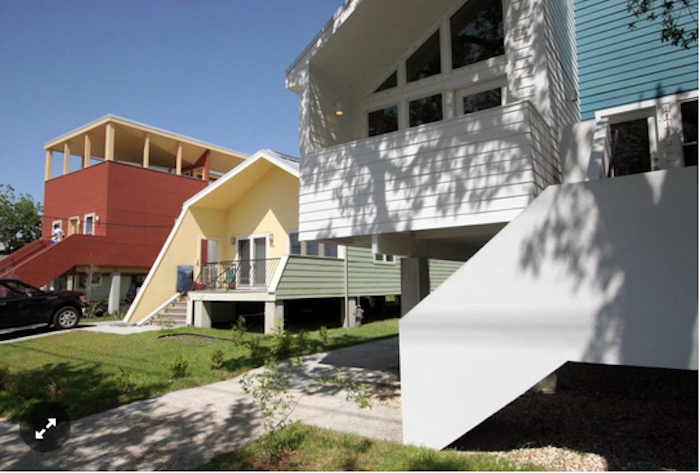
Experimental houses built by Brad Pitt’s Make It Right foundation. (Flicker/Commons)

Apparently, some media outlets have discovered the joy of dishing on celebrities who think they know best. Isn’t that all of them? At any rate, the Daily Kos and the (U.K.) Guardian both have new hit pieces out on Hollywood film crush Brad Pitt, who in the wake of Hurricane Katrina rushed to New Orleans to build new modernist houses for victims in the city’s hard-hit Lower Ninth Ward.

Anyone could have predicted that the houses would suck. The Guardian’s writer, Wilfred Chan, says they suffer from “water intrusion, black mold, porches rotted through, stair rails collapsing, fires caused by electrical problems, plumbing problems and poor ventilation.” Rebekah Sager, writing for The Daily Kos, accuses Pitt of “breaking a promise” to the ward’s mostly black community.

But he did not break a promise. Pitt formed a foundation called Make It Right to build 150 affordable, ecologically sustainable houses. Bill Clinton, Snoop Dogg and others held fundraisers. Pitt and his wife at the time, Angelina Jolie, raised millions, and donated $5 million of their own money; 109 houses were built and sold to star-struck residents for $150,000.

In 2010, Pitt declared, “We’re cracking the code on affordable green homes.” By 2014 it became evident that the houses were falling apart from the inside, but in 2016 Pitt divorced Jolie, they sold their mansion in New Orleans and the Make It Right website vanished. Two years later, a study showed that only six houses of the Make It Right neighborhood remained in “reasonably good shape.” Several have already been demolished.

Class-action suits started appearing in 2018. As described in the Guardian:

Some houses had flat roofs and lacked basic features like rain gutters, overhangs, covered beams, or waterproof paint to weather New Orleans’ torrential downpours. Within weeks, houses began to develop mold, leaks and rot. Pitt’s non-profit initially made some minor repairs, but then began pushing residents to sign non-disclosure agreements before it would tell them what was wrong with their homes. “That’s when a lot of residents started to notice that things were very fishy.”

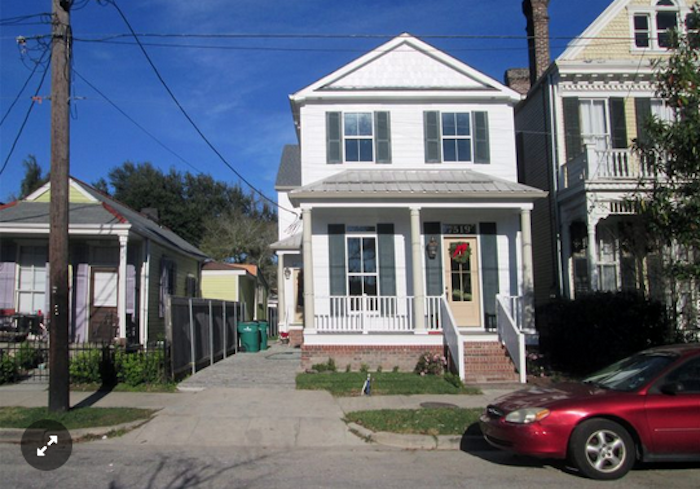
Both writers, and many others over the years, point to black mold and the other oopses, but no one seems interested in why these houses – designed by A-list architects such as Frank Gehry, David Adjaye, and Shigeru Ban – developed such a long list of problems. They did not need to look hard to discover how Brad Pitt’s houses differed from pre-Katrina houses in the ward, for example the famous shotgun houses, which had lasted decades and even centuries.

How did they differ? They were modernist. Make It Right was dedicated to Making It Wrong.

The desire to experiment with form required cutting costs on materials. The foundation could not create groovy new houses with shape-bending features and then sell them for a mere $150,000. This price tag was already below cost, but how much below cost? It was never going to work.

Brad Pitt wasn’t the only one building new houses in New Orleans after Katrina.  Of these, it seems only Pitt wanted to break the traditional rules of architecture. A study by Tulane identified 333 houses built between late 2005 and 2012, according to building permits, found that by a hefty 14 to 1 margin, residents wanted houses of traditional rather than modernist styles. As of 2012, Brad Pitt’s houses were only 1 percent of new houses built post-Katrina.

What may be more surprising than the failure of Make It Right is the behavior of its founder, Brad Pitt, certifiably a good guy, you’d think. When the writing on the wall resolved into Thou shalt not experiment on the poor, Pitt headed for the hills. The Hollywood hills, of course. Maybe that should not be so surprising. White privilege, anyone? It’s only when a blue-chip celebrity breaks the laws of architecture does the public notice, not to mention the authorities. Traditional architecture is not only more beautiful but more utilitarian and more sustainable than modern architecture. They used to build it right; now, they hardly ever do. Let’s hope Make It Right turns out to be an effective teaching moment.

[Rob Steuteville’s excellent column on this topic in his CNU Public Space also makes the points most writers fail to make. Nikos Salingaros links to Rob’s column in his comment, also excellent, below.]

Traditional houses in New Orleans. The one in the middle is new. (Infrogmation)

Posted in Architecture, Development | Tagged , , , , , | 5 Comments

Backsliding on 67 Williams

Inset at left describes changes from earlier plan for 67 Williams St. Click to enlarge. (HDC)

The proposal for a new house on Williams Street where no house has ever been built has, in my mind, slid in status from buildable perhaps to buildable not. I refer to my own minimal support for the design as okay if built with acceptably historical materials, such as wood rather than PVC for details, and assuming that the details meet the high standards of the historic neighborhood, which sits less than half a block off of Benefit Street, Providence’s famous “Mile of History.”

The latest meeting of the Providence Historic District Commission on the 67 Williams St. proposal took place on Monday. The commission decided to “continue” the process – that is, it refused to grant “conceptual approval” for now and the urged the proponents to return to the next meeting with an improved proposal. If they want to.

The HDC heard developer Jeff Hirsch, his lawyer and three architects for two hours, and concluded by rejecting conceptual approval. That is the first phase of approval, and deals with such matters as the height of the building, the distance between its front and the sidewalk of Williams Street, the number of balconies, or decks, on the house, but not whether, for example, the detailing of the roof cornices is appropriate, or whether they are made of historically appropriate construction materials.

Synthetic rather than natural materials are not only insufficient, but are usually a sign that effort will not be made to incorporate an appropriate amount or quality of detail for a historic district. And yet, according to a source, the cornices, frieze, trim and rail in the proposed house are to be made of PVC – a form of plastic. The roof is asphalt shingle. The clapboard is not of wood but of cement siding.

All this raises questions about whether the developer even intends that the house should fit into a historic district, and causes me to feel greater skepticism about the project as a whole. Commissioner Tina Regan said that with all the porches and railings and doo-dads, “it looks like a lady with too much jewelry.” I am inclined, at last, to agree with her.

The proponent’s architects apparently did not even know how tall the house was supposed to be – three stories on a street that features mostly one- and two-story houses, but how many feet tall? It’s an odd thing not to know. Since its closest neighboring houses are three-story houses, I did not agree with most opponents that its height or its massing were too large, and I still do not.

Yet the proponents now seem to have lost at least some enthusiasm for their project. For example, at Monday’s HDC meeting they were whining, according to my source, that their budget is not big enough to make some of the changes that opponents and the commission seem to want. Hirsch, the developer, even went so far as to say, on more than one occasion, that he was “trying to get to a yes here.” Does he mean he’ll say anything to get conceptual approval from the commission? Not a good look. Is it a sign of flagging enthusiasm, a throwing up of hands as the commissioners appear more skeptical of Hirsch’s proposal? Or is it a sign of even more enthusiasm than might be proper. It is hard to say.

There may be more to this than meets the eye. It did not come up at the meeting, and it may be gossip signifying nothing, but a couple of weeks ago I heard that proponent Hirsch was connected with one of the three firms proposing to build a large apartment complex blocking river views from College Hill on Parcel 2 of the waterfront east of the Providence River, near where the pedestrian bridge lands on the East Embankment. To my knowledge, he has not mentioned this connection before the commission. I looked at the documents and it was true. Cynics like me immediately and naturally wondered whether Hirsch wanted to build a house for himself on nearby Williams Street because he knew the fix was in for his firm to build the apartment complex. Well, that was clearly not the case, since that plan was rejected by the I-195 Redevelopment District Commission two days after the HDC meeting. If he knew about this in advance, it might cause a deflation in his desire to have a house of his own nearby.

Just thinkin’ outta the box!

I understand that there has been considerable confusion whether opponents of the proposed house on Williams Street have been accommodated by the HDC in their desire (and their right) to speak at Monday’s meeting. Those who wrote to the commission were, for the first time, it seems, not allowed to speak out at the meeting itself. Before the commissioners rule on the Williams Street proposal, they should figure out what the law says about who may speak at meetings, and stick by what they decide – at the next meeting and on into the future.

There is no excuse for confusion on this matter. It is a free-speech issue, which should be a top priority for a local development agency, whose deliberations are where the rubber meets the road of democracy.

Posted in Architecture, Development | Tagged , , , , | 4 Comments

Traditional design is healthier

Six examples of traditional architectural design from around the world that incorporate an intuitive understanding of multiple fractals. (Classical Planning Institute)

Without thinking much about it, most people prefer traditional architecture. Now it seems as if more detailed and ornamental styles of design for buildings and cities are not only more popular but more natural and more healthy. A new study of studies in the Urban Science Journal concludes that:

[W]e perceive urban space the same way as our ancestors perceived the landscape of our emergence, the African savannah. With significant implications for the design of cities based on our perception of streetscapes, the authors conclude that, in order to promote wellbeing, we should design streetscapes to “please” our brain.

The authors of the article in Urban Science Journal – neurobiologist Aenne Brielmann, architect/planner Nir Buras, mathematician Nikos Salingaros and physicist Richard Taylor – focus on the role of “multiple fractals”: patterns that self-repeat at different scales both in nature and in the built environment. This phenomenon of nature, when it is absent from architecture, starves the brain as it perceives streetscapes.

“What happens in your brain as you walk down the street?” ask the authors, who point to multiple studies to explain the answer. The Classic Planning Institute’s press release about the study explains it more concisely, and offers a link to the study of studies itself.

The insights that arise from the four authors’ summary are not quite new, but their role in contradicting what most architects and city planners have believed for a century could, if embraced, enable urbanists to design streets and buildings that “foster well-being, with such striking benefits as high as a 60% reduction in observers’ stress and mental fatigue.”

Fractals are the key to understanding why human beings are drawn to buildings and cities of ordered complexity arising from traditional architecture and urban patterns. For many centuries, all architecture featured detail of greater or lesser complexity. Architecture advanced by trial and error through generations of builders and designers. A century ago, tradition was increasingly challenged by new styles, dubbed “modern,” that downplayed detail and ornament in favor of a supposed utility expressed by the metaphor of machinery, with novelty more often trumping utility in prioritizing architectural development.

The public has resisted modern architecture for reasons that the eye suggests are obvious. The embellishment of traditional architecture creates beauty, and that is enough for most people. If you remove ornament from traditional architecture, you would have modern architecture. Ever since the advent of modernism, most people have found its vacant slabs boring. A multitude of surveys and anecdotal evidence has demonstrated the public’s skepticism for decades.

Indeed, popular resistance to styles based on the machine metaphor tends to undermine its utility. If people do not love a building, if they do not love where they live and work in a city, they will not provide for its repair and upkeep.

Recent research in neurobiology, tracing how the brain processes visual data back to the early development of human perception millennia ago, has advanced the knowledge of fractals and deepened our understanding of their role in how we feel about what our eyes tell us of our manmade surroundings.

Based on the makeup of the human brain, the authors sequence and characterize the earliest stages of visual processing. Laying this perceptual foundation validates the common urban experience we all share – places most people recognize as beautiful – or ugly. The perception of multiple fractals – a fundamental human characteristic – is among the first things to be processed, within 50 milliseconds.

Intuitive understanding of cities and buildings, and of how tradition regenerates patterns of design conducive to human nature, has long proved stronger than the pseudoscientific explanations modernists give for why modern architecture is the correct approach for modern times. But in modern times ancient wisdom often requires scientific backing. Without it, the quality of our built environment and the pursuit of a more humane existence will continue to be a matter of power rather than of truth. This is why the article by Brielmann, Buras, Salingaros, and Taylor is such a vital contribution to architectural discourse.

Posted in Architecture | Tagged , , , , , , , | Leave a comment

Ellsworth testifies for NYC

View of Penn Station from New Yorker Hotel. Statement by Jane Jacobs. (ReThinkNYC)

Lynn Ellsworth testified at last Thursday’s public hearing of the Empire State Development [ESD] Corporation. Ellsworth coordinates a group of organizations that opposes former Governor Cuomo’s (and now Governor Hochul’s) illegal plan to demolish the area of historic buildings around Penn Station and then erect a forest of towers that would damage New York City in a manner similar to the demolition in the 1960s of the original McKim Mead & White Pennsylvania Station, whose reconstruction is part of a comprehensive alternative proposal supported by the coalition. I have republished her brief testimony below as a guest post.

***

I’m Lynn Ellsworth, a coordinator of the Empire Station Coalition. I’m an economist and I specialize in economic development. I believe that the project concept and the choice of project site violate the UDC [Urban Development Corporation] Act [of 1968].

Section 2 of the enabling legislation for the ESD tells the agency to find urban areas that are economically suffering, that lack public transportation, are isolated and abandoned, where there is widespread poverty and “substantial unemployment,” where the buildings are “obsolete, abandoned, inefficient, dilapidated and without adequate mass transportation facilities.” The ESD is told to “to develop rental housing that is affordable to persons of low income” and to seek out urban places where there is an “unavailability of private capital.” But none of that describes the Penn neighborhood which is awash in private capital and sits on top of a massive transit network in the middle of the densest county in the entire country. The CEO of Vornado crowed about this in his annual shareholder letter and I quote:

“Day and night, the Penn District is teeming with activity. Our assets sit literally on top of Penn Station, the region’s major transportation hub, adjacent to Macy’s and Madison Square Garden” (Vornado’s Letter to Shareholders 2020)

Vornado Real Estate Trust chairman Steven] Roth repeats that the area is “teeming with traffic and our retail does really well there” and tells us that it has “the highest growth opportunity in our portfolio” He explains that the Hotel Pennsylvania was highly profitable before Vornado warehoused it.

It is circular reasoning to claim that if an area does not show constant demolition and rebuilding with Class A office space, that it is therefore “stagnant” (in the words of the Neighborhood Conditions Study). Since when is a Class A office monoculture the apex outcome for cities? As urbanists have long explained, successful cities require great diversity of office space, kinds buildings, industries, residents and incomes (Jane Jacobs 1992; Sorkin 1994; Sassen 2001). Urban success is destroyed when monocultures of any kind become dominant. Yet the ESD’s logic is that if market forces have not already demolished a neighborhood and replaced it with taller Class A buildings, then the ESD should use state power to force that result “river to river” in the words of an EDC spokesperson. By what legitimate theory of economic growth is that the case? If we apply that reasoning to the rest of the city, all of Manhattan would be demolished and rebuilt every ten years.

ESD also rhetorically equates the “age of buildings” with the words “obsolete” or “outmoded”. This is utter nonsense. The White House is over 200 years old. Should it be demolished?

The ESD bases this project in a discredited hyper-gentrification strategy, that of the “luxury city” model. It fails to provide a credible economic development strategy for working-class people, entrepreneurs, start-ups, or small businesses – all of whom currently thrive in the area. Instead, the ESD seeks to kick them out. Since when is the ESD directed by law to serve large corporations and the high-wage gentry class instead of everyone else?

— Lynn Ellsworth

Posted in Architecture, Development | Tagged , , , , , | 3 Comments

Really saving New York City

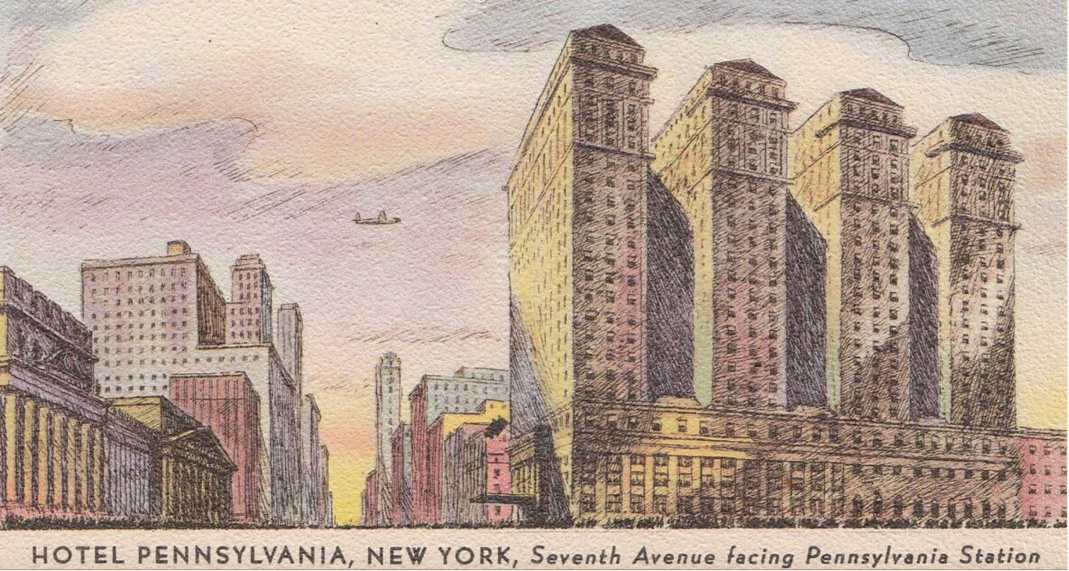
Hotel Pennsylvania (1919) is slated for demolition. (boweryboyshistory.com)

Authorities in the Big Apple, including, it now seems, the state’s new governor, Kathy Hochul, have bought into a vision of Manhattan’s future that privileges the greedy moguls of high finance and their camp followers in high office. So what else is new? You’d think that as a woman the new governor would want to flee her predecessor’s priapic project as fast as her legs can carry her. But no.

What is new is that instead of ruining the city building by building, as has been the way for decades, the entire area around Pennsylvania Station, nine square blocks, is to be torn down and rebuilt with skyscrapers from horizon to horizon. The old district – 13 landmark and landmark-eligible buildings, and at least 50 in all – will be replaced by glitzy towers and transformed into a sterile wasteland of wind corridors and dark shadows alternating with the sun’s glare reflected in hundreds of acres of glass. Meanwhile, workers, residents and visitors will enjoy endless construction sites, street closures, detours, and traffic snarls around the busiest transportation depot in the western hemisphere.

In a letter to Association for a Better New York chairman Steven Rubenstein urging him to hear an alternative plan by ReThinkNYC, its chairman Samuel Turvey wrote:

The Governor’s plan does not differ markedly from her predecessor’s. Much of the neighborhood would still be needlessly demolished, “supertall” buildings loathed by everyone except, it seems, governors of New York, will still add unsustainable density to the vicinity, blot out the sun and obscure the skyline, and, when the dust settles, Penn Station will still be trapped in the basement of a hockey rink.

This is more than a matter of whether to rebuild Penn Station to the original 1910 design of McKim Mead & White. Hochul’s plan for the neighborhood would blot out that opportunity altogether, substituting a half-assed remodel amid its plan to redevelop the area. High on the list of legacy architecture set for demolition would be the venerable Hotel Pennsylvania, also designed by McKim Mead & White and right across Seventh Avenue from Penn Station. The plan, formerly the Empire Station Complex and now called the Pennsylvania Station Civic and Land Use Improvement Project, was recently opposed by the National Trust for Historic Preservation, which described it as “hauntingly reminiscent of the failed ‘urban renewal’ strategies of the 1960s.”

Penn Station today is not on anyone’s list of landmarked buildings, nor should it be, but press accounts have suggested that unidentified preservationists want to landmark both Madison Square Garden, which squats atop Penn Station, and Two Penn Plaza, the 29-story tower also built on top of the station. That is a ridiculous idea. Landmarking those two structures would spell doomsday for rebuilding Penn Station. Turvey stresses that ReThinkNYC and the Empire State Coalition, the alliance of which it is a part, oppose any such steps. He adds:

We are not sure who is behind using preservation laws to protect Madison Square Garden and 2 Penn Plaza but it may well be a very cynical ploy by someone to detract from the fact that the State of New York, [real-estate mogul] Vornado and the Dolans [owners of the arena] would like to see the Penn neighborhood obliterated to make way for a Maginot Line of supertalls, an underground Penn Station and a dated track plan. That becomes a reality only after destroying numerous historic sites, displacing residents and hundreds of small businesses.

Cynical ploys may be the mother’s milk of New York politics. It’s surely not for nothing that historian Vincent Scully wrote after Penn Station’s demise: “One entered the city like a god; one scuttles in now like a rat.” Do we want to set the current Penn Station in cement? Do we want urban renewal in NYC? I don’t think so. Sam Turvey well encapsulates the situation:

To paraphrase Jane Jacobs, we could not save the original Penn Station but we can save New York. We can dothis, in part, by having the courage to rebuild an architectural masterpiece that should never have been destroyed andby letting logic, need and geography rather than political infighting and man-made jurisdictional limits define ourfuture transit operations. If we get this right, we will not only save New York but will unlock the region’s true potentialin ways that will burnish the legacies of all who fought to make this happen for generations to come.

***

A continuation of the public hearing held by the New York State Development Corporation in December on much of the above, which has been described as 90 percent in opposition to the Empire Station Complex, begins at 5 p.m. today at the link below:

https://us02web.zoom.us/w/81376225529?tk=QM-hbBP0oqmERx2cR1U1A3XPG7fnQwjBsbfUhieqx6g.DQMAAAAS8mao-RZGSGxyZkozaFRkZUlsdTJjNW1OZVlnAAAAAAAAAAAAAAAAAAAAAAAAAAAAAA

Posted in Architecture, Preservation | Tagged , , , , , , , , , , , | 20 Comments

Save a Providence water view

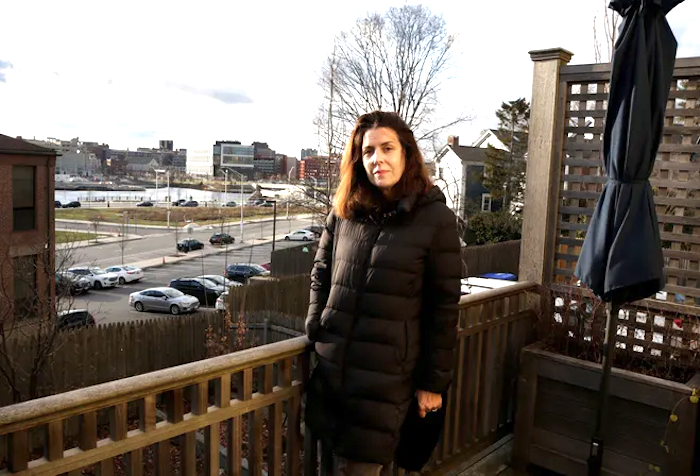
Tayo Heuser and the deck in back of her Benefit Street “home.” (Kris Craig/Providence Journal)

It may be too late to do anything for poor Tayo Heuser and Jeff Shore, according to Amy Russo’s story in the Providence Journal, “Neighbors scramble to soften impact of waterfront apartments.” They bought a “home” on Benefit Street seven years ago, and built a deck from which to enjoy their “picture-perfect view of the Providence River.” In a “twist of fate,” they they will probably soon be looking out, instead, at the rear end of a building filled with apartments.

One of three proposals for that building will be chosen on Wednesday. The Parent and Diamond proposal sears the eye considerably less than the other two along its river frontage, but all three are arguably just as godawful from the rear, which would face the Heuser’s and Shore’s deck.

I suppose they’ll have to learn to take more satisfaction from the “fossils, artifacts and paintings” that fill their home, as Russo describes it. Or maybe they will have to better appreciate the rear of the Laborers’ International Union headquarters that already blocks the southerly portion of their view. It encroaches from the left in the photo above by the Journal’s Kris Craig. To see the river, Heuser and Shore must angle their gaze to the northwest from their deck.

What dominates the view is the laborers’ parking lot on South Main Street. Yes, you can see the river, but you are also forced to see the buildings across the river for which the I-195 Redevelopment District Commission is responsible.

The predicament faced by Heuser and Shore brings into focus the reasons why their concerns should be front and center for the commissioners. Heuser and Shore have no right to a water view, but the commissioners have an obligation to promote good architecture, or no architecture if developers offer nothing that qualifies as good – and good means beauty that strengthens rather than weakens the city’s brand of historical character. A view of architecture good enough to at least compensate for the loss of a waterfront view is what the commission owes to Heuser and Shore. If that cannot be achieved, the land should remain vacant until it can be achieved, city taxes be damned.

So, yes, the fine grain of architectural design should be uppermost in the design judgments of the commission. God may be in the details, but details are central to the commission’s understanding of what a community needs from developers and architects – an understanding that clearly eludes this commission and the specialists who appear before it.

The view at issue is a pathetic hodge-podge of quasi-modernist structures. This did not have to be. For years, I have urged the commission to promote, for this district, buildings that would reflect Providence’s historical character – that is, buildings erected on smaller parcels that would break up the size and footprint of buildings and foster design with traditional forms and materials that might better reflect (on the west side of the river) the Jewelry District’s historic architecture and (on the east side of the river) the areas of Benefit Street, College Hill and Fox Point that Heuser and Shore must have found alluring when they were looking for someplace to live.

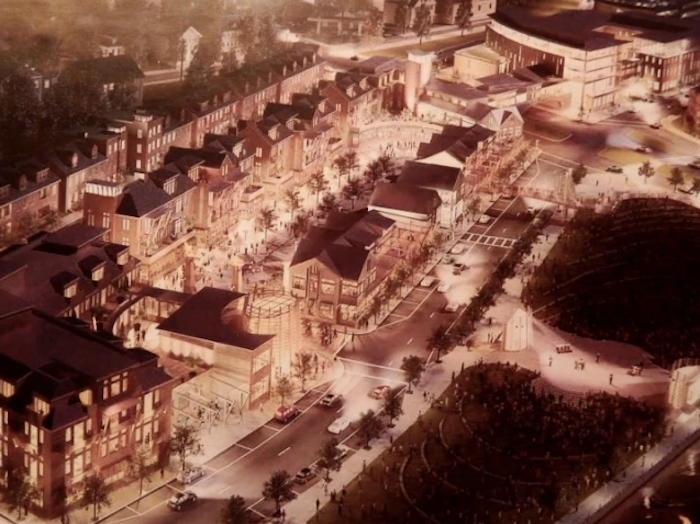
The commission has seen fit to do none of this, and as a result the banks of the Providence River between the new Crawford Street Bridge to the north and the Point Street Bridge to the south are an unholy horror. The only proposal I have seen that might have fit in the Innovation District was the Carpionato Properties development plan of 2013, Its pair of large parcels were not subdivided, but they hosted many small and elegant buildings. For some reason the proposal did not pass muster with the commission and so it disappeared into the mists of recent history. (See illustration below.)

I feel sorry for people who have recently moved into the Benefit Street neighborhood. Perhaps they thought that this city, whose past is so clearly a model upon which to build its future, might adopt development policies that would protect and extend its built heritage. Not to mention residents with even longer tenure in the neighborhood. How could they imagine, after the excellent River Relocation Project of 1990-1996 that created a new, beautiful, traditional downtown waterfront, that the city would instead imitate most American cities, knuckling under to the profane demand, among “professionals,” for architecture that rejects the past and condemns us all to a purposely ugly future.

As the only architecture critic in Providence, and one of the few (if any) around the nation, who tries to follow and review vital projects through their stages of development from a classical design viewpoint, I share blame – for not nagging and blasting the city’s various design commissions (the so-called “experts”) with sufficiently harrowing curses.

Planned development by Carpionato Properties, proposed in 2013. (Carpionato)

Posted in Architecture | Tagged , , , , , , , , | 1 Comment