Rob Krier wins his Driehaus

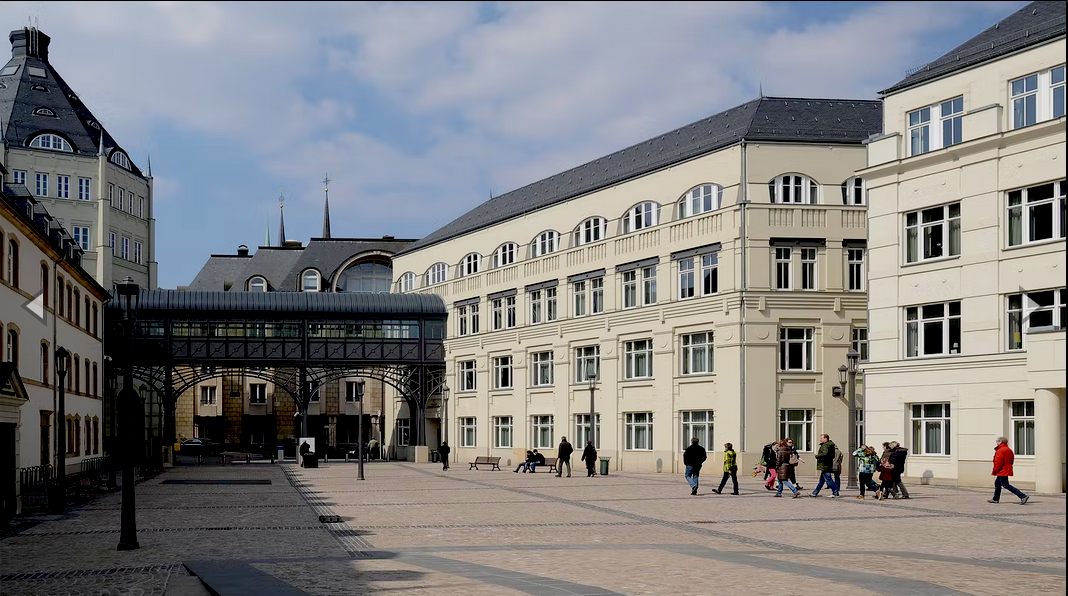
Cité Judiciaire, Luxembourg designed by Rob Krier. (Wikipedia)

The architect and urban theorist Rob Krier is this year’s Driehaus Prize laureate. The first Driehaus Prize winner, two decades ago, was his brother, architect and urban theorist Leon Krier, who was also born in Luxembourg and is about eight years younger than his sibling.
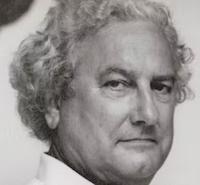
Rob Krier (Notre Dame)

Also a winner, a very big winner and for some a surprise winner, is the Driehaus Prize itself, which appears to have survived, institutionally at Notre Dame University, the sad passing just last year of namesake Richard H. Driehaus.

Along with the 2022 Driehaus, the Henry Hope Reed Award goes to Wendell Berry, the celebrated novelist, poet, essayist, environmental activist, cultural theorist and farmer who came out against war in 1973.

The Reed award was named for the arch-classicist Henry Hope Reed Jr., the first hero of the classical revival, who founded and presided for many years over the Institute of Classical Architecture & Art, and whose pathbreaking 1959 book on modern architecture taught many that classical architecture was not dead. The Reed prize brings its recipient a generous $50,000; but the Driehaus prize brings its recipient $200,000. That’s twice what goes to a Pritzker Prize winner. Every Driehaus winner brings more than twice the happiness and beauty to the world than any Pritzker winner, however you stack them up against each other, even though – as an illustration of the mysterious ways of the lord – the Pritzker is far more celebrated in our culture, a telling sign of its decline. The real difference between the two award programs is probably incalculable.

With that in mind, this year’s Driehaus honors a laureate whose work equals the sum total, at least, of the work of all past Pritzker winners, 43 laureates thus far. Architect and urban theorist Andrés Duany, who with his wife Elizabeth Plater-Zyberk won the sixth Driehaus in 2008, reports that modernist architects are learning more from traditional architects than traditional architects are learning from modernist architects. Good! So maybe the gap (if his reporting is accurate) will diminish in future decades. Or centuries.

Stefanos Polyzoides, dean of Notre Dame’s famous classicist architecture school and chairman of this year’s prize jury, had this to say:

Rob Krier’s built work demonstrates a mastery of fine art, design and construction. He was one of the first of his generation to dedicate his architecture to the end of generating a harmonious urban fabric and a well-formed public realm in tandem. He paved the way for a return to the humanist ideal of seeking a civilized life in cities.

And the jury citation itself reads:

Through his engagement with a variety of urban settings, clients and types of projects, Krier has generated a diverse oeuvre that is steeped in the particulars of specific places: always responsive to local cultures, built heritage and environmental issues.

In both cases, isn’t this what architects are supposed to do?
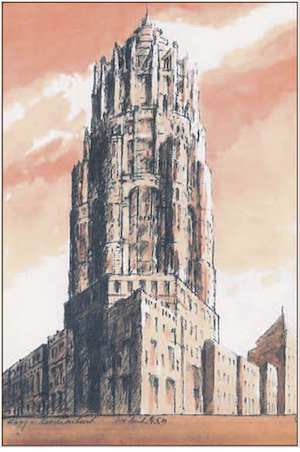
Drawing for Den Haag Rivierenbuurt tower project, 2001. (courtesy of Lucien Steil)

It is a measure of how far architecture as a discipline has fallen in the past century that Driehaus laureates tend to get awards for doing what every architect ought to do, ought to be expected to do, and ought to be taught to do. And yet Notre Dame is the only university in the world with thoroughly and unabashed curricula that teach what architecture ought to obviously be about. Its graduates are much more likely to get employment as architeccts than modernists, even in a field where traditional architects still have a hard time finding clients other than rich people who want attractive homes. (Are there rich people who want ugly houses? Apparently so!)

This is sad. But it is changing for the better. Eventually, the field will wrap its head around the fact that two-thirds to three-quarters of the general public prefers traditional to modernist architecture. Good! But this is crazy. Who are the one-quarter to one-third of the public who prefer modern to traditional architecture? Who are these people? I have written a brief essay considering this question for another publication. Even if they do accept it, I will write an expanded treatment of the matter for this blog.

For now, I congratulate the brothers Krier for bookending the Driehaus prize’s first vicennial.

Posted in Architecture | Tagged , , , , , , | 4 Comments

Bob Stern and Bill Brussat

William Zeckendorf’s circular office, visited by RAMSA. (Pinterest/from his latest book)

A book unexpected and unannounced arrived on my doorstep today: Robert A.M. Stern’s Between Memory and Invention, which I immediately mistook for an update of an earlier volume of his, Tradition and Invention in Architecture (2011). That has inhabited my bedstand for years, easily reachable for occasional forays. The new book, just out, is, however, the biography of architecture’s own Zelig – he has always been around and pops up everywhere.

I have not finished the first chapter, but it has inspired this serendipitous post. Only yesterday it occurred to me to wonder what was my father’s birthday. I thought it was in April and contemplated a post to honor him: He was born in 1922, and died in 1978. It turns out his birthday was February 26, so tomorrow will be the one-month anniversary of his one-hundredth birthday.

With that in mind, many things about Stern’s early years in Brooklyn struck a note with me – his upbringing, his religion, his family’s immigration – but none more so than the story of his invasion, at the age of 15, of the office, on New York City’s Madison Avenue, of the mega-developer William Zeckendorf.

I just walked into the building’s lobby during my summer vacation and asked the elevator operator to take me to [Zeckendorf’s firm] Webb & Knapp – totally different times [circa 1954], no security. Once I arrived, I told the secretary that I was interested in architecture and would love to see Mr. Zeckendorf’s private office if possible. I did not say I was an architecture student, which I certainly was not. I was just a kid. She was confused for sure, but ultimately called someone who could tell that I was not an axe murderer, and given that Mr. Zeckendorf was not there, I was able to visit his glass-enclosed circular office and have a good look at his rooftop garden, where a shapely Gaston Lachaise bronze stood in a reflecting pool to a backdrop of Midtown Manhattan. … This was mogul modern in ways that the executive offices in Lever House or Seagram’s could never be. As Paul Rudolph later emphasized to students: “Even the king of Seagram’s had to put up with a nine-foot ceiling.”

The office is pictured above.

The closest I can come to that story was in the late 1980s, when, on a Saturday, I and a friend from Brown asked an elevator man to take us to the top stories of the Industrial Trust Bank Building (1928) in downtown Providence, known hereabouts as the Superman Building. He let us up and we saw the executive offices and the life-sized airship gondola sitting out on a shoulder of the old building’s east façade. This was several years before every trace of the building’s connection to airships was remodeled into oblivion.

But here’s an even better story. My dad, William K. Brussat, worked as a city planner in the ’50s for Webb & Knapp and Zeckendorf as one of his so-called “fair-haired boys.” (I can’t recall who called him that.) Stern might find this story interesting, and I’ve yearned for years to commit it to print. There can be no better time to do so than what would have been Dad’s 100th year.

In 1957, our family moved to Philadelphia, where Dad oversaw the assembly of property for a Webb & Knapp project called Society Hill. He assigned an older woman he (when at home) called Princess Stephanie to attend society parties as a sort of spy to get information about land for the project. When we had her over to dinner at our townhouse near Rittenhouse Square, she used to bring me toy airplanes. Years later, Dad would describe her as a member of “the Hitler circle,” by which my brother Guy and I assumed he meant she lived in Berlin during the war. Years later still, I read a book by Ron Rosenbaum called Explaining Hitler (1998) and learned, to my horror, that “Princess Stephanie” actually was a spy in the actual Hitler social circle. You can look it up in Martha Schad’s 2002 book Hitler’s Spy Princess: The Extraordinary Life of Stephanie von Hohenlohe. She died in 1972. My father died in 1978, and I don’t recall what my mother said about this when I phoned her, but clearly she knew. She died in 2004.

I’m not sure what my father felt about architectural style. After moving back from our couple of years in Philly, we lived in a tiny boring modernist house in Wheaton, Md., a D.C. suburb, but then moved into a lovely house of traditional design near Wisconsin Avenue in D.C.’s Cleveland Park for several years – Dad was written up in a suburban paper as a planner who was reversing the prevailing trend of family flight into the suburbs. I was in elementary school then, and in 1962 we moved into a relatively plain trad semi-detached house, 3015 Rodman St., where I was primarily raised.

We furnished that house from a store called Scan, specializing in Scandinavian styles, and decorated it with decidedly modernist art and vases, etc. My mother said once to me that Dad did not like the George Washington National Masonic Memorial, in Alexandria, Va. (1933; 333 ft.), a very  traditional structure. But he was also an amateur sculptor of clay busts, mainly in figurative styles. His favorite painter (to judge by number) was Bernard Buffet, who specialized in city scenes of a scratchy quasi traditional or maybe even modernist style, such as his painting of London Bridge (below), which looks from the wall behind me as I write these posts in our guest bedroom in Providence.

So perhaps I can truly say that my father’s architectural and stylistic tastes were indeterminate, but he knew for sure that my mother, Mona, the beauty whom he married in 1950, was a woman. (Sorry, I could not resist.) I wrote about her the day after she died in this column for the Journal, “Sketching my mom of moms.”

Bob Stern’s architectural tastes might also be said to be indeterminate. To my dismay, his firm, which is widely known for its traditional houses and buildings, also erects modernist buildings, mostly office towers. I have often twitted him for this. So my favorite passage from the first chapter of his biography is as follows:

From adolescence I wanted to be an architect, to design buildings like those I saw on the Manhattan skyline – romantic expressions of modern power married to ancient form that also respected and contributed to the public realm. Beyond the novelty of New York’s first few International Style skyscrapers like the Lever House (Gordon Bunshaft and Natalie de Blois for SOM, 1951-52), which I would encounter on visits to our family dentist” – [an early warning, no doubt] – “on West 54th Street and the United Nations Secretariat (Harrison & Abramovitz, 1947-52), as new buildings popped up along the skyline beginning in the 1950s I could not understand why so many were drained of the aspirational qualities of those from the recent past. By the time I started architectural school in 1960, Manhattan had become clogged with boxlike buildings that were the same at the bottom as they were at the top, the same on one side as on the other. Their anonymous window-walls brought neither joy to the city streets nor dignity to those who worked in them, as brilliantly parodied in the opening scenes of Billy Wilder’s film The Apartment (1960). Sadly, even the swaggering corporate capitalism that created them and the astonishing hierarchies they housed had been distilled into a bland uniformity that proliferated for decades, contradicting all that had come before. As I perceived the city devolving, my dream of seeing new buildings rise in the manner of my beloved skyscrapers intensified.

You go, RAMSA! And for the most part that – his initials for Robert Arthur Morton Stern are reflected in the name of his firm – is exactly what he has done. I may be reaching here, but I’ll bet my father would look down in approval. And I look forward to reading the details in the rest of his bio, and perhaps quoting more passages in this blog.

Painting of London Bridge by Bernard Buffet. (Pinterest)

Posted in Architecture, Architecture Education | Tagged , , , , , , , , , | 1 Comment

Mittell: Strategy for Ukraine

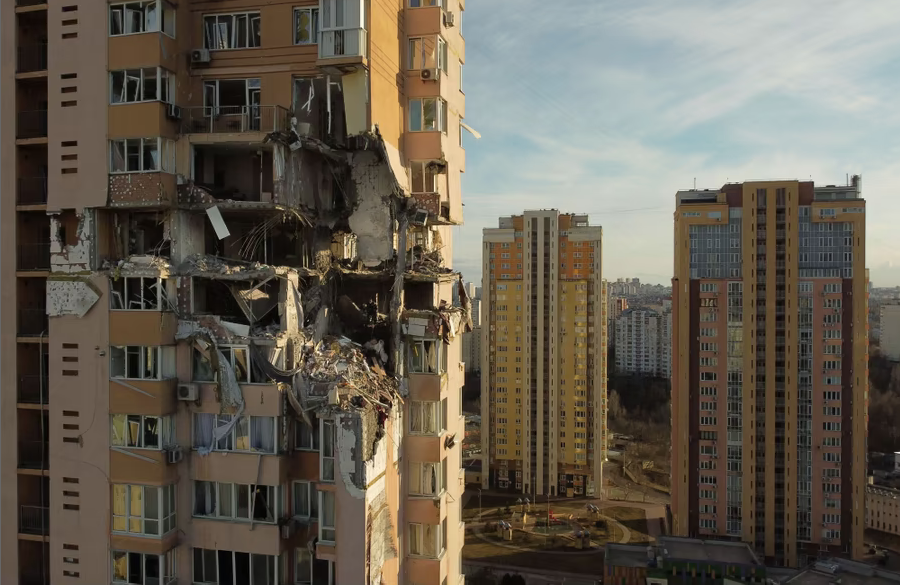
Building in Kyiv hit by Russian rocket on third day of attack. (Daniel Leal/AFP). Although it matters very little, it is my impression from TV coverage that while Russian air attacks have damaged cities extensively, little damage has been sustained so far by the more beautiful examples of Ukraine’s architecture.

This is another guest post from David Mittell, my former colleague from the Providence Journal. He has agreed with my desire to point out that his two guest posts (and maybe more) are published as a favor to a dear friend. This blog has not suddenly become the Ukraine Here and There blog.

Nor, for what it is worth, do I fully agree with the negotiating strategy David suggests. I could be wrong, but I think that if President Zelensky heeds some of the voices David mentions coming (at least) from some Americans, then perhaps it might be more likely that a cease-fire could be arranged and Russian troops withdrawn from Ukraine. To my mind, this would be a victory for Ukraine, not for Putin’s Russia.

***

Politicus No. 1454

Snatching defeat from the jaws of victory

By David A. Mittell Jr.

In America one hear’s voices saying, “Zelensky should give up on joining NATO, give up on getting Crimea back, give up on Russian-speaking Ukrainians” – and so forth.

Such thinking is understandable. But it is quite wrong. Ukrainians are winning this terrible war of one man’s misguided egomania. When the war is over Ukraine must be secure in her borders, east and west, and by no means is it reckless to hope that Georgia and Moldova – two countries currently without the protection of alliances – will have their territorial integrity restored.

These are the outcomes victory should assure. Anything less bespeaks the outcomes of defeat. In the case of America it also bespeaks weariness with watching the war on television. Shameful stuff, and inconsonant with the bravery Americans are capable of and usually demonstrate.

Posted in Architecture | Tagged , , | 4 Comments

Christopher Alexander, R.I.P.

Buildings designed and built by Christopher Alexander and associates at the campus of Eishin University, near Tokyo. (Photo by Sophie Elizabeth Alexander)

The great architectural and computer design theorist Christopher Alexander, born in Vienna and of British and American citizenship, died at his home in Binsted, Sussex, U.K. this past week after a long illness. He was 85. His more than 200 works of architecture were deeply natural, springing from the order and processes of nature that were the study of his lifetime.

Christopher Alexander

His books, primarily Notes on the Synthesis of Form (1964), A Pattern Language 1977), The Timeless Way of Building (1979), A New Theory of Urban Design (1987), and his four-volume The Nature of Order (2002-04), to name a few, show his interest in systems, natural and manmade. He felt that systems that do a better job replicating those of nature work best and could most easily be made both useful and beautiful in architecture and urbanism.

Wikipedia quotes this seminal passage from The Timeless Way of Building:

There is one timeless way of building. It is a thousand years old, and the same today as it has ever been. The great traditional buildings of the past, the villages and tents and temples in which man feels at home, have always been made by people who were very close to the center of this way. It is not possible to make great buildings, or great towns, beautiful places, places where you feel yourself, places where you feel alive, except by following this way. And, as you will see, this way will lead anyone who looks for it to buildings which are themselves as ancient in their form, as the trees and hills, and as our faces are.

He was a key figure in the New Urbanist movement – basically the old urbanism that was replaced by the sprawl criticized by Alexander in his article “A City Is Not a Tree” (1965). What many admirers don’t realize is the centrality of his ideas on order in the development of computer programming and software design. Noting Alexander’s passing, software strategist Ryan Singer wrote of his perhaps even more profound legacy (in today’s world) that “A Pattern Language inspired a generation of influential software programmers who created working methods and wrote widely-read books using Alexander’s theory of patterns.”

Alexander’s ideas in A Pattern Language led directly to the development of “wiki” design and the Wikipedia phenomenon. They may seem to be in separate and even distant fields from architecture but are in reality closely tied. Computer technology did not really take off until its systems theorists (including Alexander) discovered how software replicates nature’s generative processes. Research by the mathematician Nikos Salingaros, who has worked closely with Alexander for decades, has disclosed major similarities between neurobiological processes and the human brain’s instinctive preference for traditional building and city designs that seem to reproduce according to the same patterns as plant and animal life.

Business and data architect Richard Veryard notes that “it is possible that some software practitioners understood his work better than most architects.” That may be the understatement of the week. In fact, it is fair to say that computer theorists have been much quicker than have architects or planners to embrace the connection between the living and the manmade. It is more than fair to say that modernist architects, most of whom tend to disdain Alexander’s work, are not advocates of what he called “living architecture.”

Another colleague of Alexander’s was the urban theorist Michael Mehaffy, who today wrote:

There is a narrative within the modern architectural establishment that Alexander started out as “one of us” – a hard-nosed modern theorist – but then drifted into something gauzy and mystical. Actually this is not true at all; if you study the man’s work as I have, you will see a straight line from the very beginning to the end. It was always about mereology, about part-whole relations. It may have taken him to some surprising places, but that was only because of the evidence he found – not his own whims.

Anyone who achieves Alexandrian levels of cogitation probably tries to reach above their own pay grade, let alone that of most who are reading this obituary, including its author. Alexander’s concepts of architecture and design reflect and entwine with the concept of life itself, and beyond. Salingaros sent me a blurb from Eric Buck, in the philosophy department of the University of Kentucky, from his blurb on the jacket cover of the fourth volume of Alexander’s The Nature of Order, The Luminous Ground, which he described as “one of Christopher’s favorite quotes”:

I believe Alexander is likely to be remembered most of all, in the end, for having produced the first credible proof of the existence of God.”

God is in the details, as someone has noted. Salingaros adds: “Architecture today is situated so far away from life and metaphysics that it will not know what to make of this.” It may be hoped that Alexander knew what to make of this, and that his readers, students, architects and many others will bring that knowledge to their work long after the passage of Christopher Alexander. That will certainly make the world a more beautiful place. R.I.P.

Reprinting the rest of Mehaffy’s quotation that followed from the one above is irresistible:

In fact there’s a great story about how Alexander earned his scholarship studying math and physics at Cambridge. He was required to reproduce a famous electromagnetic experiment, and he kept getting the wrong result. All the other candidates, knowing the right answer from the textbooks, fudged their results to match – but not Alexander. It turned out that a strong electromagnet one floor below was skewing the result, and Alexander alone was observing the reality, not the preconception. On that basis, he was awarded the scholarship. From that moment on, he later said, he decided never to trust the conventional narrative, but only what he himself observed. So he did – and on the evidence, the results were incredibly useful.

[The first version of this post incorrectly attributed the Eric Buck quote to the Eric Buck who is a director at Google.]

[Urban theorist Michael Mehaffy has just published a lengthy and comprehensive obit/assessment of Christopher Alexander. Also, architect Duo Dickinson has written an obituary at Common/Edge. Finally, an excellent obituary from the New York Times.]

Posted in Architecture | Tagged , , , , , , , , , , , | 3 Comments

Mittell: Diplos, return to Kyiv

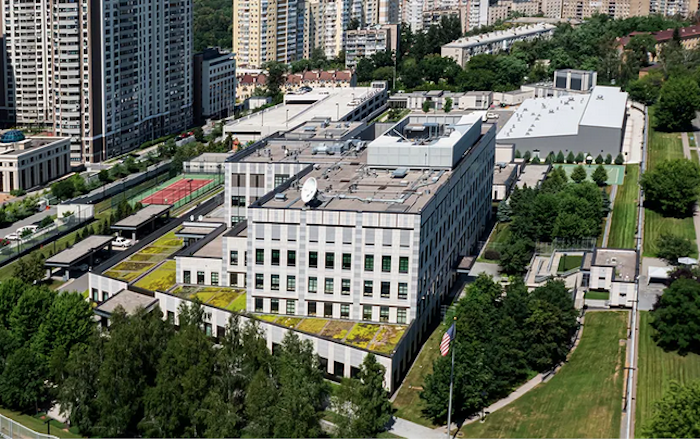
U.S. Embassy to Ukraine, completed in 2012. (Fox News)

This is a guest post by David A. Mittell Jr., a veteran of many visits to Lviv, whose beauty he described vividly in a guest post in 2016, which I recently republished. In today’s post he admonishes the U.S. ambassador and her staff to return to Kyiv from Lviv, where they have presumably been since being ordered by Washington to evacuate the U.S. embassy. (This is the 1,452nd column written by David in his illustrious journalistic career.)

***

Politicus No. 1452

Our diplomats do not belong in Lviv
.
by David A. Mittell Jr.
.
In 2016, I published a piece titled “Why I love Lviv,” which was the starting and the end point of the 27th of my 28 trips to Ukraine (the 28th included several wonderful days in Kyiv). The 2016 piece was recently republished by David Brussat, my former colleague at the Providence Journal, in his architectural blog.
.
My point is that I do love Lviv, where I have many valued friends. But although I am happy that the world is newly aware of Lviv’s multiple beauties, I do not believe that America’s diplomats belong there. In wartime, a nation’s diplomats should be in the capital near its leadership. They belong in Kyiv, or as close as possible to it.
.
Ordinarily a high diplomatic assignment entails a soft landing. But on infrequent occasions it entails real danger. Currently, the acting U.S. ambassador to Ukraine (since January 2020) is Kristina Kvien. Whatever the risk, it is her duty to be as close to Kyiv as possible – not 500 kilometers away in Lviv. She has the duty and the privilege of risking her life for two countries.
Posted in Architecture | Tagged , , , , , | 3 Comments

More shots of lovely Ukraine

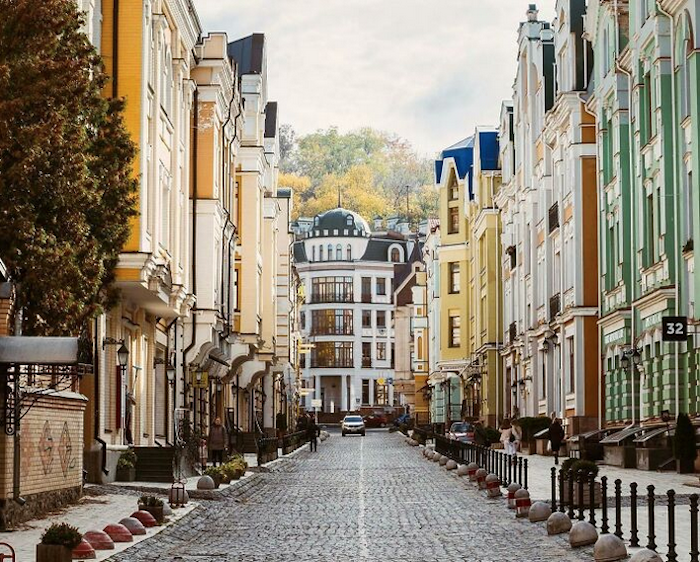
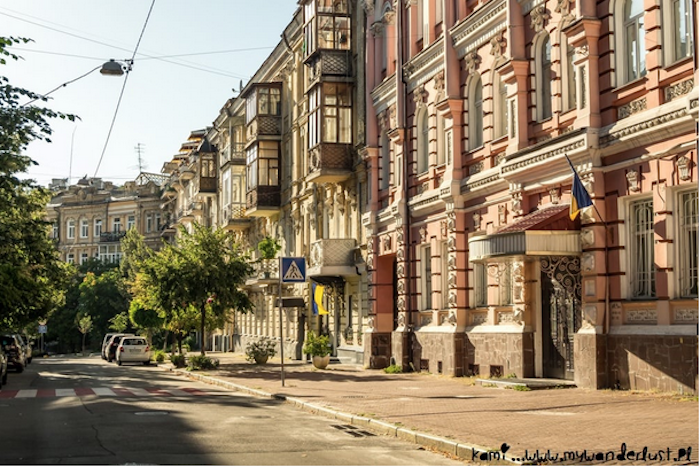
Recently built luxury apartment houses in the Vozdvyzhenka neighborhood of Kyiv. (Bored Panda)

Today I had to kill a post because because it contained a major mathematical error that could not be corrected. Fortunately – or unfortunately – I am able to substitute for it a post featuring more photographs of poor Ukraine, mostly from before the invasion, and forwarded to me by my dear mother-in-law, Agnes Somlo, who in 1956 with her husband Laszlo became a refugee of an earlier Russian invasion, that of Hungary – which is on the border of Ukraine and is receiving its refugees.

The 50 photos were collected from the internet and a text was added by Afor the website Bored Panda. It is not clear (to me at least) that they are all – or mostly – taken by Alina Kisina, a Ukrainian-born photographer who lives in the U.K. They are mostly lovely shots of buildings and urban settings in Kyiv and Lviv, although many are located in the countryside.

The photo atop this blog pictures buildings in 19th-century styles built in the 21st century in the Vozdvyzhenka neighborhood of Kyiv. The text notes that when the shots were taken “back in 2017, they were mostly still unoccupied due to the high price and low demand.” The low demand was certainly the result of the high price. Ukrainians are proud of their beautiful architecture. No doubt, were it not for the invasion, they’d be fully occupied by now. Let us hope that a negotiated settlement of the war – or a victory by the brave defenders – occurs before any (or many) of these photos are rendered valedictory.

Posted in Architecture | Tagged , , , , , , , , | Leave a comment

College Hill settings preserved

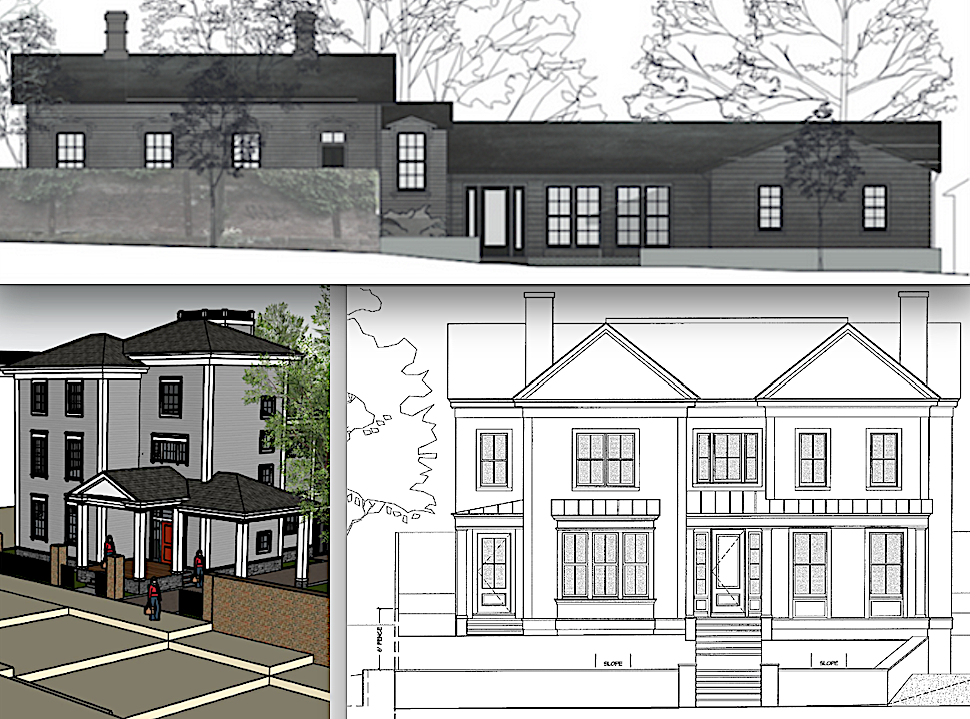
Final versions, reverse clockwise from top, of 59 Williams St., 67 Williams St. and 6 John St. (PHDC)

Three battles pitting neighbors and applicants for new construction on Williams and John streets appear, after recent meetings of the Providence Historic District Commission, to have been preservationist victories.

What? How can three new houses (one actually a new addition to an old house) be victories for preservation? Well, it is the historic character of one of the city’s oldest neighborhoods that has been preserved. All three proposals – 59 Williams, 67 Williams, and 6 John – could easily have been partly or wholly modernist, as early renderings suggested. This would have seriously diminished the historical setting in this southern section of College Hill, near Fox Point.

That did not happen.

The first battle involved adding a new addition and garage to a modest if elegant Italianate cottage, circa 1880. Swooping roof lines, vertical (board and batten) rather than horizontal (clapboard) façades, large undecorative treatments of fenestration and other non-traditional touches dominated. The designs for the addition kept getting more modernist. After months of dithering (strategic, it may be hoped) by the commission, the developer seems to have thrown up his hands and got architect Friedrich St. Florian to do a traditional design, which he did. Opponents did not all seem fully aware that what they were opposing was the very idea of modern architecture, but their persistence paid off anyway.

The second battle involved a proposed house for a family on a never-built plot of land at 67 Williams, just east of the cottage. The architects initially displayed a convoluted three-level house with no windows or doors on its drawings. This gave rise to concern that something fishy – that is, modern architecture – was afoot. Subsequent committee meetings revealed the emergence of traditional treatments for windows and doors, but no let-up in the design’s barrage of porches, terraces and widow’s walks. PVC and other composite materials only added to anxiety. The committee and the neighbors worked together to calm things down, the developer promised a more natural set of materials, and a distinctly traditional design prevailed.

The final battle involved a proposal that had reared a very ugly head as the first proposal at 59 Williams was unveiled, on the other side of this block, for a duplex at 6 John. It originated with a vaguely traditional design, also by St. Florian, but swiftly and unaccountably transitioned into an overtly modernist design clearly contrary to opposition sentiment and yet in sync with the troubled modernist 59 Williams addition. Eventually, weighed down, it seems, by the growing cost of that proposal, with multiple postponements of “conceptual” approval by the commission, both were abandoned. A new developer hired the architect J.P. Couture to design 6 John, and he pitched a traditional house that immediately satisfied both the commission and the neighbors. It looks as if it will fit right in. Given the diversity of nearby houses, Couture’s design will look as if it is part of the same historical family.

Lesson: See how easy this can be?

More can be learned. A friend has sent me pages from his upcoming book about the mid-20th century architectural illustrator, graphic artist and photographer Samuel Vance Chamberlain (1895-1975). He quotes the folklorist Henry Glassie on the sources of Chamberlain’s traditionalist sensibility:

[A]rt is a consequence of yearning. … We are born into an environment made of a near infinity of interlocking traditions, but [can] never pick them apart. … The Turks say you are born into an “air.” That air is redolent with tradition. Inevitably you breathe it in, and every breath provides influence. There is no escaping influence, so the wise artist must choose among them.

This passage reflects the instinct that gives rise to opposition among neighbors to modernist projects in their neighborhoods. They feel it intuitively, even if they cannot put their finger on its origins. They feel it strongly but often don’t quite have words to express it. They want to protect the historic character of the place where they live. Architects, members of design commissions and developers should be able to feel the same feeling, but their training has often purged its expression from their vocabulary, leading to their willingness to entertain, and often approve, proposals that obviously do not fit into their setting, and are in fact designed not to fit into their setting. They are intended as “challenges” to history and tradition, new examples of which are supposedly inappropriate in our modern era and hence to be rejected, indeed dismissed, as invalid.

Until such experts learn to see and feel again, projects will always be consumed by an unnecessary and expensive churning that nobody seems to understand. And until then, the opponents of modernist buildings, especially in historic districts, should seek to challenge those proposals every way they can. These local actors are almost always right, and their opponents are almost always wrong. Just keep on hammering as best you can until the modernists cannot take it anymore. They are temporary actors, interlopers. You are there for the long haul. Persist. That’s the ticket, and that’s the lesson that the inhabitants of Williams Street and its dear old vicinity have taught to the citizens of Providence and beyond.

Modernist version of addition (right) to cottage at 59 Williams St. (PHDC)

Posted in Architecture, Preservation | Tagged , , , , , , , | 5 Comments

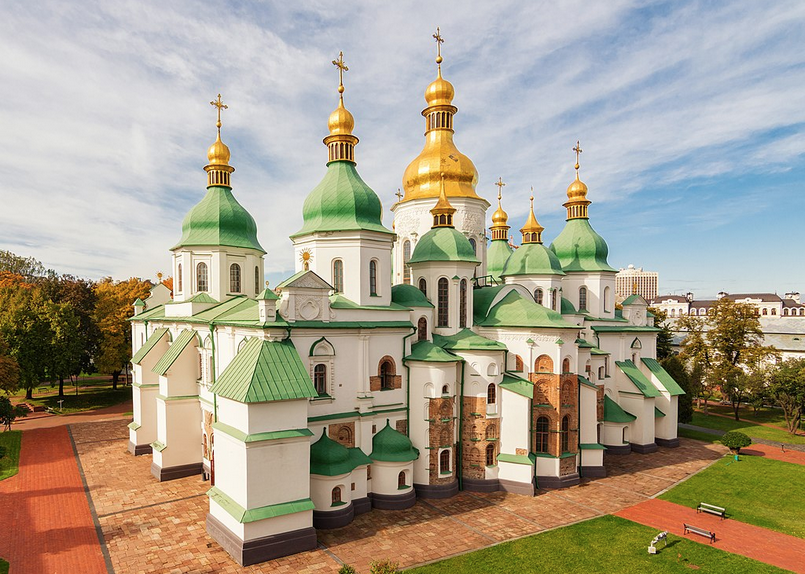
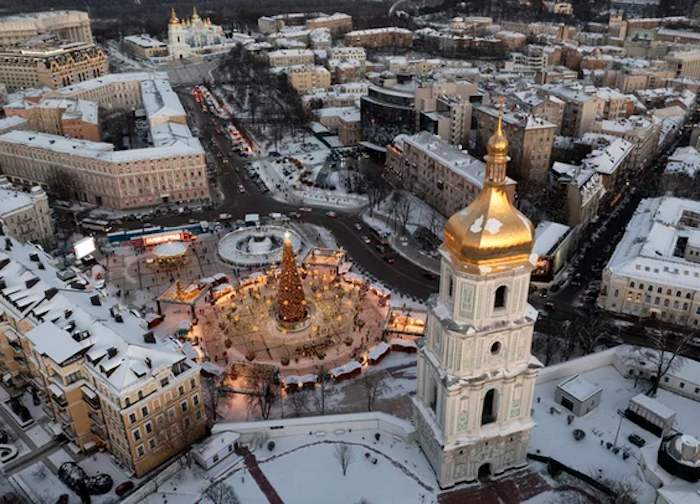
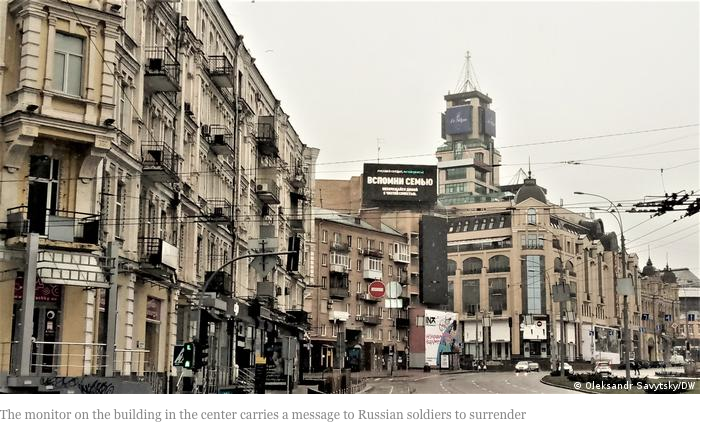
A somber look at brave Kyiv

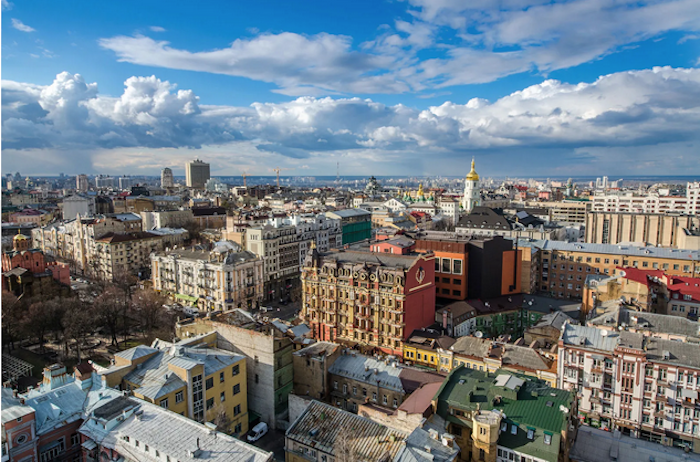
Independence Square, formerly Maidan Nezalezhnosti, in central Kyiv.

I feared last night that in posting photographs only of Lviv, and for describing Ukraine’s capital of Kyiv as a “mixture of old and new” (in my book, a quasi-dismissal), I might be properly rebuked, and so I have been. A friend writes:
.
Bombing Kyiv is comparable to bombing Venice or Paris. There has not been enough coverage of this immense loss that the Ukrainians are suffering of their centuries of heritage. I’m glad you have covered Lviv, please do more coverage.
.
Kyiv – Kiev under the late Soviet era – is now under attack by Russian forces unleashed by Vladimir Putin. The capital’s defenders have bravely slowed and even halted the attack outside of Kyiv as a lengthy convoy of military equipment tries to deploy around the embattled city. As I pointed out in “Holding our breath for Lviv” last night, “the beauty of Ukraine, and especially of its cities, girds the courage of its soldiers and citizens in the defense of their independence and sovereignty.”
.
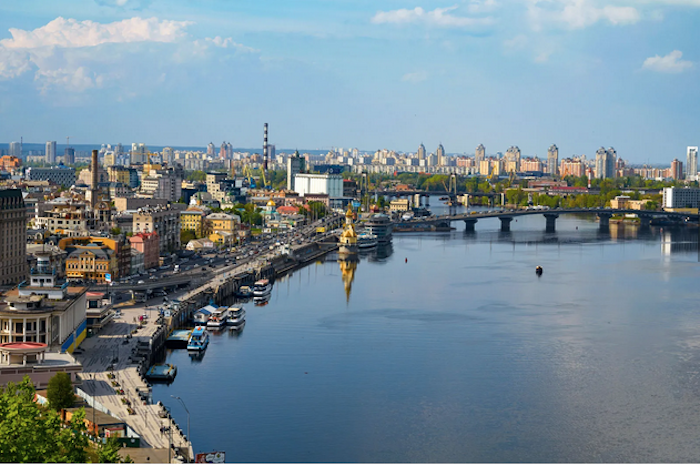
So here are some photographs of Kyiv drawn from the internet, mostly from websites devoted to touring the Ukrainian capital.
.
Posted in Architecture | Tagged , , , , | 3 Comments

Holding our breath for Lviv

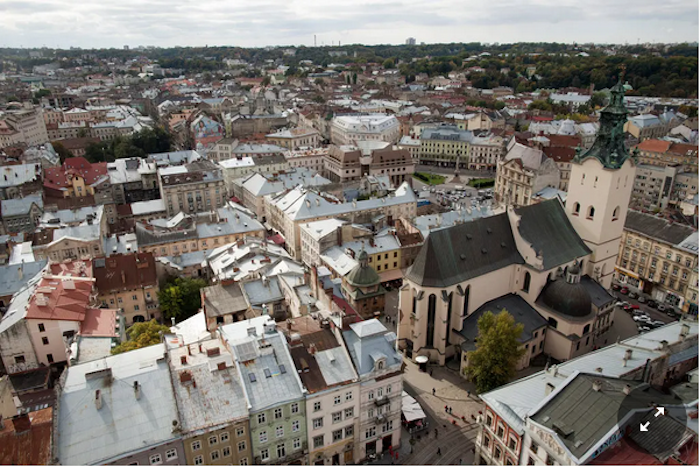
Lviv’s beautiful architecture is worth defending.

My friend and former colleague on the Providence Journal editorial board, David Mittell, once wrote me a guest post called “Why I love Lviv,” a city he has visited dozens of times and hopes to visit again, even though he is laid up in a sort of convalescent home. “Lviv in Ukraine is the least-known most beautiful city in Europe, maybe in the world.” Looking at some pictures online of Lviv – including the one above – I am sure he is correct.

For now, Russian forces invading Ukraine have not attacked Lviv as they have the capital, Kyiv, and Kharkiv, Ukraine’s second-largest city. Lviv seems to have more lovely buildings than Kyiv and Kharkiv. The capital is a mixture of the old and the new, the latter probably built mostly during the decades of Soviet occupation that ended in 1991. Kharkiv appears – again, from online images – to be predominantly in the blockish, stultifying Soviet style.

At some point and in some degree, those two cities will be rebuilt after the vile Russian attack ends, as may end up the case also with Lviv, whether Vladimir Putin manages to defeat the Ukrainians or not. News reports and commentary offer some hope that Ukraine’s brave military and civilian resistance has slowed the Russian assault and may already have degraded the likelihood of the criminal Putin’s accomplishing his war aims. We are all rooting not for Vlad the Impaler but for brave President Zelensky.

Having never been to Ukraine, or even to my knowledge spoken to a Ukrainian, I nevertheless feel that the idea of independence must be uppermost in the minds of Ukrainians’ resistance, family and friends aside. And yet I also believe that the beauty of Ukraine, and especially of its cities, girds the courage of its soldiers and citizens in the defense of their independence and sovereignty. It is surely easier to rise to the defense of a beautiful homeland. Here are some images grabbed off the internet to show some of the beauty that Ukrainians are defending.

The photos below are of Lviv, and I apologize for not recording the source information. They are mainly from tourist websites.

Posted in Architecture | Tagged , , , , , , | 2 Comments

Andres Duany at TAG 4.2

Members of the TradArch list gather in Charleston for the first TAG. (photo by author)

The architect and planner Andrés Duany, who was a founder of the Congress of the New Urbanism back in the 1990s, gave the final lecture at the fourth session of TAG 4.2, this year’s gathering via Zoom of classicists, now rebranded by the Classic Planning Institute as the Stoa – an ancient Greek word for marketplace.

Duany bombarded the attendees with his patented verve, forcing many to run for cover (figuratively). He repeatedly accused classical architecture of allowing its reverence for traditional forms to thwart the need to compete with the creativity of modern architecture, declaring that “our strength is that we build on the past but our weakness is that we don’t learn from the future.”

His audience expected none of this. Nor his declaration that the treatise he had promised to write after he and his wife, Lizz Plater-Zyberk, won the Driehaus Prize back in 2009 was on its way to completion and had not been abandoned, as almost all classicists had supposed.

In his lecture, Duany complained that this generation of classicists was the only one to have never produced a treatise explaining itself and mapping its future – because, he said, classicists had done nothing new in decades. “Whatever we build must be as correct as Palladio,” he said with regret, “even more so.”

In Duany’s book (literally, and I helped edit the first volume of the treatise, called Heterodoxia Architectonica, back in 2015, for which I was generously paid), there have been four periods during which classicists girded their aesthetic loins after periods of architectural dissipation. Duany calls these periods “recalls,” and that is a good word – a call to order in the face of disorder.

The first recall was the Renaissance, in which Italian architects, having discovered the ancient Roman treatise of Vitruvius, replaced Romanesque, Gothic and other styles of the Dark Ages. The second recall tightened up the classical canon after the exuberent rise of Baroque, Rococo and Mannerist styles in the 17th and 18th centuries. In the third recall, the École des Beaux Arts reimposed canonical discipline after its dissipation in the Eclectic period, which concluded, in the 20th, with the rise of modernism.

The current fourth recall has failed to restrain modernism, but still introduced a contemporary classical revival, including its instruction in a very few architecture schools such as Notre Dame. This movement has pushed back against modernist dominance of the profession and of almost all other academies.

Duany’s treatise aims to lead a fifth recall to gird the loins of the fourth recall, in part by redirecting it toward the young, who need a mission more ambitious than polishing the pillars of past classicism. The fifth recall intends to strengthen the canon by promoting greater innovation and the inclusion of allegedly successful modernist practices, and also by recapturing innovative classical architects who have been kidnapped by the modernists, such as José Plecnik and Louis Sullivan.

Yet even as he supports classicism and condemns modern architecture, Duany gives the trads less credit than they deserve and the mods more credit than they deserve. “It is not true that modernism is bullshit,” he argues, adding that “we’re wrong that glass walls and flat roofs don’t work.” He adds that some modernists now use brick walls and punched windows, which he says were once verboten in the modernist canon, and then he decries the “asymmetry that they learn from us but we don’t learn from them.” More curiously, he claims it is a “mistake to raise the banner of beauty.”

Huh? If not beauty, what? And what, really, can classicists learn from what modernists are designing? If some modernists are learning from classicists, then let them learn some more. Duany says that modernists lie all the time, and that a modernist design proposal often bears no resemblance to what the building will look like. Are these the techniques traditionalists should embrace?

Duany certainly overstates the case that classicists are insipid and the modernists are bold. Many modernists copy the recent past, and many classicists break with a canon that they understand quite well. But classicism, frankly, is about following traditions. With its gargantuan sterility, modernism seems to be laying a template for authoritarian rule. Classicism is the architecture of freedom and of free will. Building on the past conduces to cultural stability, empowers the meaning of tradition, fortifies respect for democratic norms, and strengthens the public’s preference for architecture that they understand and are familiar with, which enables the public to join a civilized polity to address grievances peacefully, which is what the U.S. Constitution is all about, and its equivalents in other democratic societies. Modern architecture has nothing to do with any of that.

This brief report inevitably distorts Duany’s lecture and the ideas of his treatise. His analysis contains much truth, and his expression of the current discourse of architecture is vivid and compelling. But the fact is that Duany’s own discourse, however valid, is an exercise in complexity. He abandons the chief virtue and the powerful strategic advantage classicism holds over modernism, which is that of clarity. The public knows very well the difference between classical and modern architecture, and wants no part of the latter. Duany calls, instead, on classicists to mix and match traditional and modernist concepts, and expects professional and lay people to follow a convoluted discourse. Let us all memorize the Heterodoxia Architectonica, when it comes out. It will not help. He calls on classicists to dilute classicism and embrace modernism in varying degrees. That would make more confusion than anything else, and erode progress toward a classical revival.

TAG, which is now called Stoa and was called @TradArch when first held in Charleston by a few dozen attendees (meeting in person), still boasts adherents whose views contradict those of other adherents. That was true in 2015 (see “Trading TradArch trash talk“) and is still true today. This is called discourse.

I imagine most attendees at TAG 4.2 managed to pick and choose what parts of Andrés Duany’s lecture they liked best. Here’s what I liked best:

Unlike modernists, classicists are incredibly concerned with humans and humanism. We don’t respond to the culture but try to reform the culture. The modernists don’t reform a damn thing, they only express it. The world is ready for the recovery of western culture. … The world needs a revolutionary movement: not what’s new but what’s best.

Well said.

Posted in Architecture | Tagged , , , , , , , , , | 13 Comments