Monsters at gates of Paris

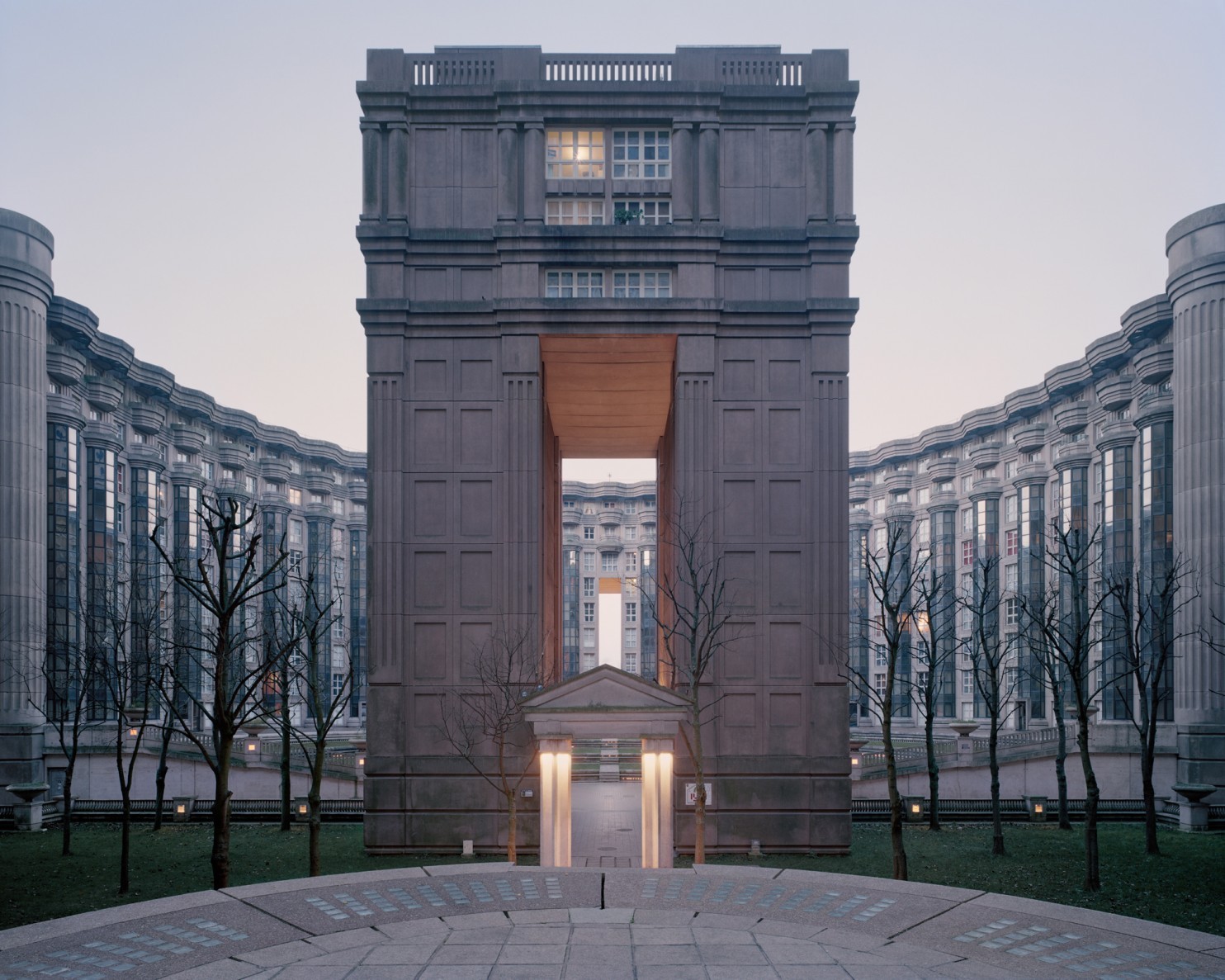
Espaces Abraxas, by Ricardo Bofill, in the Paris suburb of Noisy-le-Grand. (MessyNessyChic.com)

Espaces Abraxas, by Ricardo Bofill, in the Paris suburb of Noisy-le-Grand. (MessyNessyChic.com)

A riveting photo essay about public housing primarily for immigrants to France, based on an exhibit of the photography of Laurent Kronental, brings to mind the damage to the world done by founding modernist Le Corbusier. “A poetic vision of Paris’s crumbling suburban high-rises,” by Jordan Telcher for The Washington Post, offers a startling vision of major structures many hardly knew existed.

Another photo essay drawn from the same exhibit, on the website MessyNessyChic.com, with no author named, is called “Inside the Real-Life ‘Hunger Games’ City: A Decaying Parisian Utopia.” It makes a similar effort to find some redeeming value in what is widely considered, and admitted as such in both pieces, a massive failure of architecture.

Le Corbusier’s earlier high-rises were not for the poor but were taken up by planners in the United States and around the world as models for public housing. After their inmates displayed the often violent angst that arose with seeming inevitability in these alienating places, many have been torn down in recent decades. Corbusier proposed to tear down the heart of Paris. The photos in these two collections show buildings that, even at their worst, are much more elegant than what Corbu had in mind for the Marais district.

Tee shirt from demo of Hartford Park tower, in Providence. (Brussat archives)

Tee shirt from demo of Hartford Park tower, in Providence. (Brussat archives)

I was invited by Stephen O’Rourke, director of the Providence Housing Authority, in 1989, to witness in person the demolition of one descendant of Corbu’s hatred for mankind. Like most of “the projects,” this high-rise was modernist in design, almost a knockoff of Corbu. I will give it credit for its strength: dynamite was unable to topple the forbidding monolith: a boom, a puff of smoke, the building tilted by maybe some 20 degrees, and the party was over. All I got was a tee-shirt that said, “The Leaning Tower of Providence.” The building was eventually taken down piece by piece. (In the early period of his quarter of a century at the helm of the PHA, my friend Steve led an almost miraculous reform of the agency from one of the worst public housing authorities in the U.S. to one of the best.)

The Parisian projects from the postwar years gave rise to online comment about Ricardo Bofill, who designed some of the more well known and is widely acclaimed for his postmodern work. I am uncomfortable with the photos that display a sort of quasi-classicism in some of the buildings. Of course, the Nazis used stripped classicism on a bloated scale to exhibit what Hitler certainly and Speer probably considered the civilized brutality – we’ll grant one of those two! – that infused the Third Reich.

The photo essays got me to thinking about the “good” and the “evil” of architecture.

It is interesting to see that the typical modernist scheme to crush humanity, masquerading as design genius, can be accomplished in a quasi-classical modality as well. It is also interesting that Bofill’s Noisy-le-Grand project, Espaces Abraxas, will be a movie set for the finale of the Hunger Games cinematic trilogy. If you look at futuristic movies, you very often find that the bad guys have modernist headquarters whereas the good guys (or, more often, the victims of the bad guys) have vernacular settings.

Inside the Death Star. (blog.al.com)
Inside the Death Star. (blog.al.com)

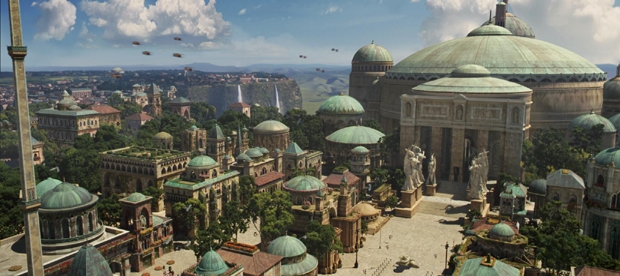
Naboo, from “Star Wars.” (lucasfilm.wikia.com)

This tendency is very strong in the Star Wars movies, directed by George Lucas. It is very revealing, and I would guess the he was channeling his subconscious intuition rather than trying to make a “statement” about good and evil architecture. But who knows. Maybe he was. Stranger things happen in Hollywood. If Lucas were dead, the plans for his museum in Chicago would have him spinning in his grave.

(Tips of the hat to Brett Van Akkeren for sending the WP photo essay to the Pro-Urb listserv, which discusses urbanism and the New Urbanist movement, and to Gary Brewer for sending the MessyNessy piece to the TradArch list.)

Posted in Architects, Architecture, Architecture Education, Architecture History, Art and design, Other countries, Providence, Urbanism and planning | Tagged , , , , , , , , , | 1 Comment

More on WWI competition

Finalist in WWI memorial competition by Devin Kimmel. (Kimmel Studios LLC)

Finalist in WWI memorial competition by Devin Kimmel. (Kimmel Studios LLC)

Aram Bakshian Jr., a White House speechwriter for Richard Nixon and brother of my old friend Doug – a globetrotting freelance journalist – has written on the World War I memorial design competition. His piece, “A War Memorial Design Competition for Monumental Egos,” in the Wall Street Journal, bears the curious subtitle: “The finalists for a national World War I memorial are disappointing. ‘Attack of the Mole People,’ anyone?”

Bakshian criticizes four of the five finalists as modernist, a description that pegs them as lacking any degree of seriousness, and he is correct in that analysis. He makes light of the modernist entries but also criticizes the one classical entry, by Devin Kimmel of Annapolis. Kimmel’s proposal features a modest tower in a park that speaks of society’s descent into war, without the mawkish sentimentality or holier-than-thou cant that characterizes many modernist war-memorial proposals – when their symbolic voice is capable of interpretation, which it frequently is not.

All seem to have some subterranean aspect to their design – one was composed largely of tiny family museums burrowed into the ground. Assuming thought was given at all, these declivitous aspects may have referred to the infamous WWI trenches. Hence “Attack of the Mole People.” Kimmel’s has an eternal flame sitting inside a “grotto.”

Bakshian calls the one classical finalist “the best of the worst,” which is literally accurate but hardly fair. Kimmel’s classical entry is so far superior to the other four that such a glib formulation mischaracterizes its quality. (My judgment here is so plainly obvious that I hesitate to give the usual “conflict of interest” trigger, that I have been paid to write press releases for Kimmel after he became a finalist.) Here is what Bakshian writes:

Only one of the proposals for the World War I monument, the best of the worst, is recognizable as a memorial to fallen heroes. It’s an attempt at heroic neoclassicism and, in the words of architectural critic Catesby Leigh, “features a large mass that resembles a hybrid of monumental arch and super-sized tombstone.” But it is busy, overloaded with verbiage, partially obscured by trees and incorporates the now-hackneyed device of yet another “eternal flame.”

This critique, despite my objection to “the best of the worst,” is generally fair. I hope that it will be improved in the time remaining before the jury reaches its verdict. Frankly, I think that Kimmel would have to impose many major new flaws upon his design to give any of the other entries a chance. I did not realize that Kimmel’s design had an eternal flame. He should get rid of it. It would only add to maintenance costs. In a post soon after the jury selected its five finalists, I urged Kimmel to make the transition to the base of the tower more explicit in the types of masonry he uses to denote degeneration.

Bakshian has been criticized for his tart dismissal of Maya Lin’s Vietnam War memorial as “the world’s largest obituary page.” That is a fair description. Even if it fails to gainsay its popularity among Vietnam vets, it is still fair. Noting Frank Gehry’s self-infatuated design for a memorial to Ike, Bakshian traces memorial architects’ refusal to subordinate their egos to their subject back to Lin’s black gash near the Mall. I suspect it may be traced back further. What is unfair is Bakshian’s description of the national World War II memorial, also on the Mall, by Rhode Island architect Friedrich St. Florian. He writes:

The enormous World War II Memorial by Friedrich St. Florian completed in 2004, with its neoclassic pillars and triumphal arches surrounding a large pool symbolic of nothing in particular, could easily be mistaken for a piece of 1930s Italian or German fascist triumphalism.

That hackneyed criticism of St. Florian’s monument as “fascist” is so ubiquitous that one almost forgives Bakshian for accidentally slipping into a modernist time warp. It qualifies for inclusion in a latter-day version of Flaubert’s “Dictionary of Received Ideas” published at the end of the Penguin edition of Bouvard and Pécuchet, in which he instructs readers how to discuss difficult topics (alphabetized) in polite society.

Bakshian does not have quite as much fun with the modernist entries as Catesby Leigh did in his critique for National Review. It is not possible to take any of them seriously, but the depth of deserved ridicule is difficult to achieve. Readers may link to Leigh’s essay from my post “Catesby Leigh’s WWI faves.” My entry in that competition, “Finalists for WWI memorial,” actually gave the modernist entries credit for not being as silly as were almost all of the non-traditional among the 350 entries. How big of me!

Posted in Architects, Architecture, Architecture Education, Architecture History, Art and design | Tagged , , , , , , , | 4 Comments

Goldberger on Newport

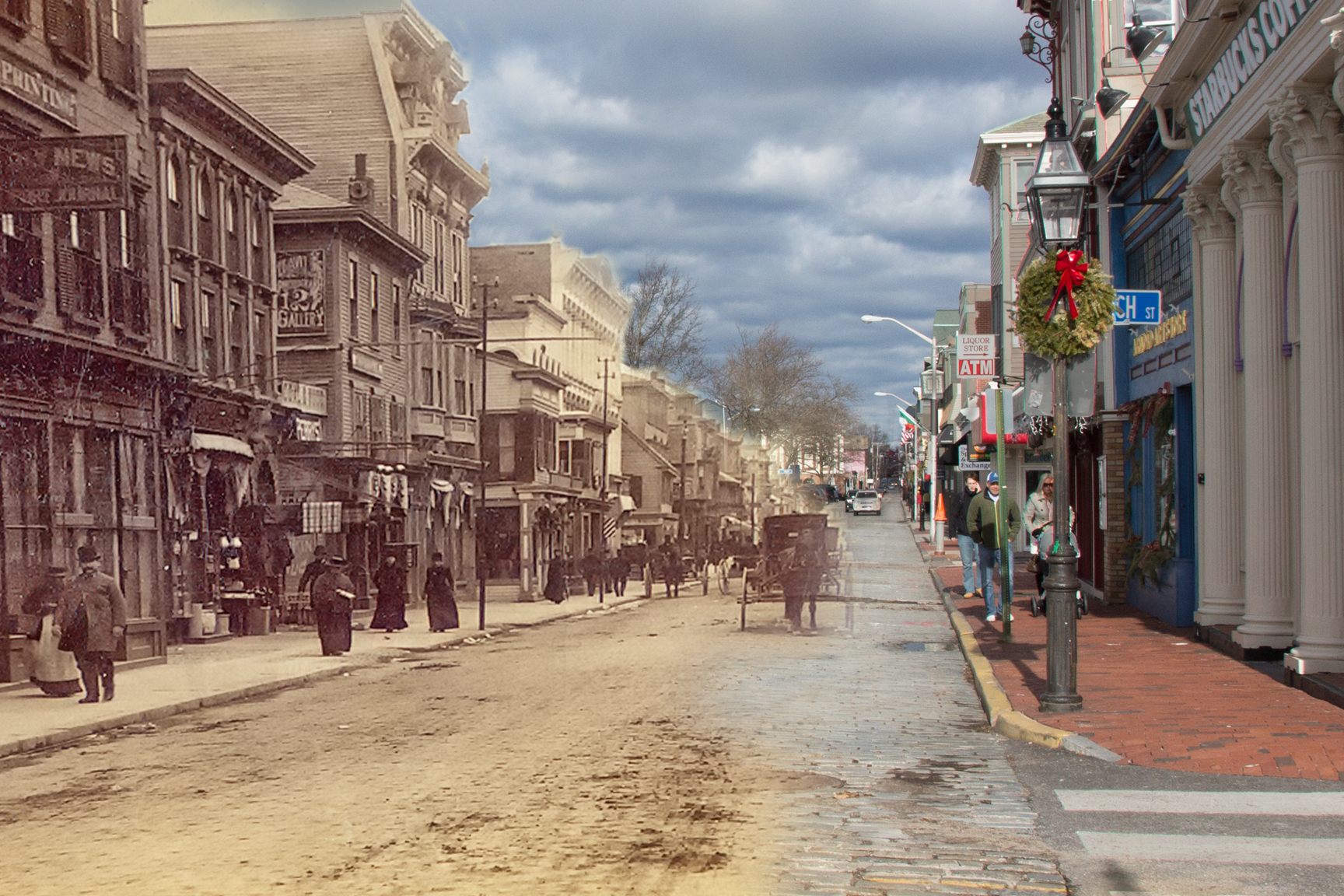
Two sides of Thames Street in two different eras. {From a February exhibit at NHS)

Two sides of Thames Street in two different eras. {From a recent exhibit at NHS)

Here is the column from 1997 about Paul Goldberger’s lecture in Newport that I refer to in my blog “Botching history in Newport.” The illustration above, which went viral online, is from an recent exhibit at the Newport Historical Society. I tried but was unable to find the illustration of the Great Friends Meeting House that Goldberger praised in his remarks quoted below. Maybe a reader has it and can send a copy to me.

Preserving Newport’s authenticity

July 3, 1997

THE NEWPORT HISTORICAL SOCIETY is planning to build a new headquarters on the grounds of the Great Friends Meeting House, built in 1699. By the end of May, the society had narrowed the field to four architects, including two famous postmodernists, Robert Venturi and Robert A.M. Stern. Then it invited New York Times architecture critic Paul Goldberger to give a speech on contemporary architecture and historic preservation.

On my way to hear the speech, to be delivered at the meeting house, the conspiracy theorist within me imagined that a “signature” building was what the Newport Historical Society secretly had in mind, and that the great critic was being brought in to help its board of directors feel more comfortable with the idea of a modern rather than a traditional building.

Well, I listened to the speech, took notes, and waited for Goldberger to say something I could blast in this space. I expected him to say that if the design makes certain stylistic bows in deference to the old meeting house, the respect due to history will have been paid; the new building could then be designed to make a bold statement rather than merely fitting into the (yawn!) traditional fabric of its historic context.

But Goldberger said nothing of the sort. Instead, he offered an elegant analysis of the quandary facing the City by the Sea. With its economy increasingly dependent on tourism, how can it change, as living cities must, without sacrificing its history? “Newport’s danger is not destruction,” he said, “but caricature. The economy will not destroy this city by tearing it down. The real risk is that it will destroy this city by forcing it to become a caricature of itself.”

He warned that Santa Fe “mandated the so-called ‘Santa Fe Style’ ” by law, and has become “an adobe theme park.” He noted the “risk of a city thinking itself so special that it tries to bottle itself.” “How does Newport protect itself from this? It is not easy, especially when your very selling point . . . is that you are thought . . . to resemble a theme park already.”

For Goldberger, the answer is “authenticity.” To illustrate, he returned to “America’s first trophy city,” to the building in which we sat. “I was struck by the wonderful invitation to tonight’s event, the lovely and gentle cartoon illustration of the Great Friends Meeting House, drawn in such a way as to deftly show us . . . the way in which this building had changed over time, the way in which the citizens of Newport had not believed it to be frozen in time but to be something that evolved and changed to reflect the evolution and change of a living city.”

He noted, however, that “far too much preservation goes on not because we value what is being preserved but because we fear what will replace it.” He called this “the dark underside of preservation,” and urged us to “remember, again, that the remakers of the Great Friends Meeting House had no such fears in 1729 and 1807. And if we are ever going to produce a valid and authentic architecture in our own time, we have to overcome that fear ourselves.”

We have nothing to fear, I would say, but modern architecture itself. If Newport seems “cute,” it is because modernism has made a freak of beauty. Modern architecture is precisely what is inauthentic.

I doubt Goldberger would say that. But in urging Newport to avoid a “superficial re-use of historical form,” he said: “I am not arguing the old modernist argument about the spirit of the age, and saying that any architecture that resembles anything traditional, anything old, is automatically invalid, and that everything has to be modern to be real. Not at all. That was something of a fallacy, . . . and not only because people love what has come before, cherish it, and seek it in what they build now. . . . But the spirit-of-the-age argument is untrue also because it is not the way architecture has ever worked. Everything has always built on what has come before, taken from it and reinterpreted it, revised it, built upon it.”

Always – until modern architecture. Instead of building upon the past, modernism rejects as “invalid” what came before. Modernists sneer at the public for loving “what has come before.” The public hates modernism for sneering at what the public loves.

Yet, modernism is again in vogue among young architects because, according to Goldberger, the revival of traditional architecture has become “glib and simple and facile.” Maybe, but if so, how much of it is the result of faint-heartedness among traditional architects caused by the continued sneering of so many critics, professors and design review panelists?

The quest for authenticity is, in fact, a quest for the courage to confront the sneer, to embrace architecture unsullied by the doubts of our own dubious century [the one we are out of now, but no doubt this one, too]. To find authenticity, architecture must seek its roots. I hope Paul Goldberger agrees. But I pray the Newport Historical Society agrees, and that Venturi, Stern et al. will bravely confront the sneer!

* * *

CAPTION: Great Friends Meeting House (1699). Inset: Sketch, on Newport Historical Society invitation, of 1729 and 1807 additions (NHS).
Copyright © 1997. LMG Rhode Island Holdings, Inc. All Rights Reserved.
Record Number: MERLIN_589503

Posted in Architects, Architecture, Architecture Education, Architecture History, Art and design, Blast from past, Development, Rhode Island, Urbanism and planning | Tagged , , , , , , , | 1 Comment

Botching history in Newport

Addition to headquarters of Newport Historical Society at right. (Photo by Cliff Vanover)

Addition to headquarters of Newport Historical Society at right. (Photos by Cliff Vanover)

In 1997, the Newport Historical Society hired Paul Goldberger, architecture critic for the New York Times at the time and then the author of The New Yorker’s storied “The Sky Line” column (and today the critic at Vanity Fair), to speak about a new headquarters building being contemplated by the society. Robert Venturi and Robert A.M. Stern were on the short list to design it. I attended the lecture and found his remarks impressive:

Newport’s danger is not destruction but caricature. The economy will not destroy this city by tearing it down. The real risk is that it will destroy this city by forcing it to become a caricature of itself.

Warnings to cities that they might become caricatures of themselves, or might turn into “museums,” are common tropes by modernists who want to give cities a license to trash their historical appearance, as if a city cannot evolve into the future without taking out a contract on its own beauty. But Goldberger’s words did not seem to partake of this.

I wrote about Goldberger’s lecture (see “Preserving Newport’s authenticity“), praising his gracious refusal to sneak in a subtle argument for building a piece of modernist egotecture. Still, I felt it necessary to warn Newporters and Rhode Islanders of the peril, even though Goldberger had poured it on in praise of Newport’s accomplishments in historic preservation.

He noted, however, that “far too much preservation goes on not because we value what is being preserved but because we fear what will replace it.” He called this “the dark underside of preservation,” and urged us to “remember, again, that the remakers of the Great Friends Meeting House had no such fears in 1729 and 1807. And if we are ever going to produce a valid and authentic architecture in our own time, we have to overcome that fear ourselves.”

We have nothing to fear, I would say, but modern architecture itself. If Newport seems “cute,” it is because modernism has made a freak of beauty. Modern architecture is precisely what is inauthentic.

Nearly two decades have passed since Goldberger visited Newport, and the society has not built itself a new headquarters. It is only now undertaking a building-wide renovation of its old headquarters on Touro Avenue, right next to the Touro Synagogue. Part of that renovation features a new entrance on the side of the original. My friend Cliff Vanover sent me pictures of that. It is nearly finished, and not entirely regrettable in its design.

Detail of addition.

Detail of addition.

In a manner that perhaps Goldberger would admire, the new entrance tower of three stories features a curious yet traditional set of roofs. A shallow pyramidal roof tops off the tower, reaching a few feet above the main headquarters building’s cornice. At the base of the tower a raised interior space extends forward with a standing- seam roof that slants gently downward, concluding with a soft swoop. From here emerges a set of stairs starting under a semi-circular roof, also with standing seams, and like the other roofs gray in color. This roofscape picks up on the gabled roof of the old entrance portico in front, whose sets of Ionic columns support a stone architrave. But the metallic “clapboard” sheathing of the tower, and its glassy ground-floor space and entrance, with their steel “ship” railings that mimic a stylistic tick of the modernist founder Le Corbusier, are not entirely mollified (to say the least) by the more traditional elements of the roofscape. In appearance, the entrance addition is at war with the original brick building. Its has elements that doff their hats to the society’s traditional headquarters, but its pastiche of styles and the jut of its massing are awkward, and are placed awkwardly against the existing assemblage of buildings.

The overall effect of the new ensemble is, alas, carbuncular.

Why didn’t the architect – Mohamad Farzan of NewPort Architecture – just add a new space and a new entrance in brick, picking up on the style of the existing headquarters? That would have respected both the history of the evolution of the society’s building and the historic character it brings to a famous street in a famous city.

The architect appears not to have wanted to imitate the flavor of the original set of buildings too closely, yet wanted to avoid the sort of egotecture that Goldberger seemed to be urging Newport to find a way to avoid in 1997. To seek the goal through “authenticity” has been the mantra for many years, with the word authenticity dubiously defined – as if using a motif that fits into a cherished setting is inauthentic while a motif that furiously elbows the setting is somehow more authentic.

The word authentic has been so misused that it is almost useless today.

The board of the Newport Historical Society should feel a degree of chagrin for its failure to embrace the obvious design solution staring it in the face from almost every direction in a place like Newport.

Touro Synagogue at left; Newport Historical Society at right.

Touro Synagogue at left; Newport Historical Society at right.

Posted in Architects, Architecture, Architecture History, Art and design, Preservation, Rhode Island, Urbanism and planning | Tagged , , , , , , | 3 Comments

Critic Moore on Zaha Hadid

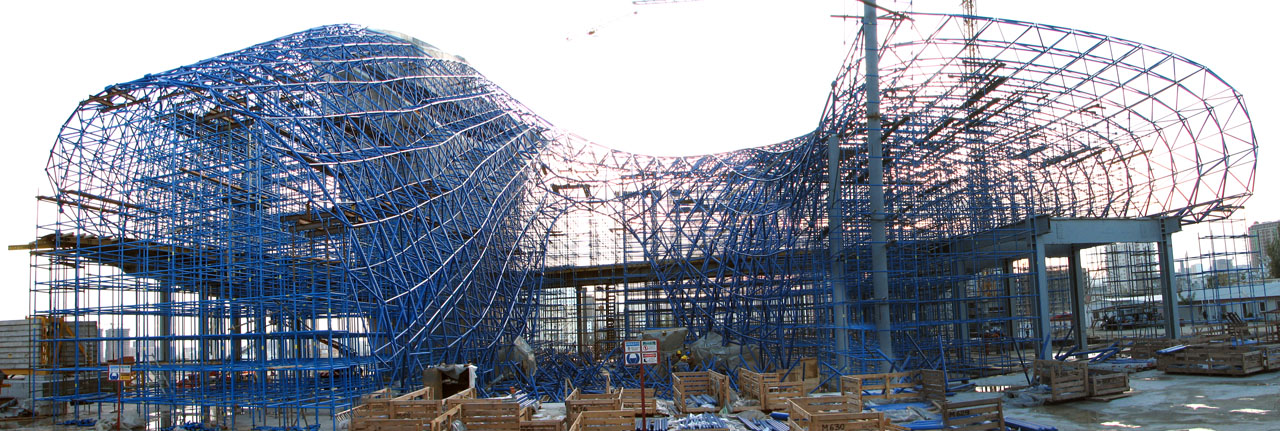
Zaha Hadid's Heydar Aliyev Cultural Centre. (buildipedia.com)

Zaha Hadid’s Heydar Aliyev Cultural Centre. (buildipedia.com)

Rowan Moore, the powerful British architecture critic of the powerful Guardian newspaper in Britain, has done a profile of Zaha Hadid and her life’s work thus far. Moore is not impressed, and his profile is a catalogue of the many difficulties clients must embrace and building users will experience if they are to build or use a place designed by Hadid.

The title of Moore’s article, “Zaha Hadid: A visionary whose ideas don’t always make sense,” qualifies as the most extravagant of understatements. And yet, while Moore does not offer much to differentiate Zaha Hadid’s architecture from the generality of its type, he does not seem to understand that his critique of Hadid is a critique of modern architecture itself.

Moore, after describing the numberless flaws typical of buildings designed by Hadid and her organization, tells the Zaha story of years in the wilderness drawing extraordinarily shaped buildings but getting few jobs, because she is a woman, because she is an Iraqi, because of her personality, because of the outlandishness of her designs. Whatever. But now she has hit pay dirt and her opportunities cannot be enumerated. Moore writes:

At some point in the last decade Hadid and her office could have used their new-found fame and status in one of two ways. They could have addressed their weak spot, which is the high degree of difficulty that it requires to realise their works, in such ways that they really might transform the everyday experiences of living in cities. Or they could have set about creating ever more elaborate and disconnected icons. Which, unfortunately, is what they chose to do.

Does this not describe the challenge facing any major modern architect and architectural firm whose lead designer has cashed in on our age’s addiction to novelty? Alas, the question answers itself.

In searching Google for an image to illustrate this post I typed “Zaha Hadid architecture” and found only drawings of Hadid’s swoopy, jaggedy designs. So I tried “Zaha Hadid buildings” and found the same thing. Then I tried “Zaha Hadid built structures” and found the above image of a building by Hadid under construction. Perhaps I have not tried hard enough, but I still can’t find any Google search configuration that offers photos of structures by Hadid that are built and in use. Must I suppose that even Google is in on the conspiracy to protect the only female global starchitect from criticism?

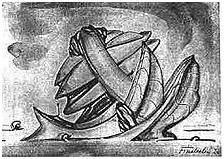
By Hermann Finsterlin (1924)

By Hermann Finsterlin (1924)

(Top o’ the morning to Malcolm Millais, in Portugal, for sending me this article from the Guardian. In sending me this Rowan Moore article, he writes, “This is yet another example of cognitive dissonance, as Moore rubbishes [Hadid] without  rubbishing modern architecture. Anyway, Hadid is old hat; look at this from Hermann Finsterlin in 1924.” He adds: “I coined the term ‘avant garbage.'” Malcolm wrote Exploding the Myths of Modern Architecture in 2009.)

Posted in Architects, Architecture, Architecture Education, Architecture History, Art and design, Development, Urbanism and planning | Tagged , , | Leave a comment

Bizarre algorithmic design

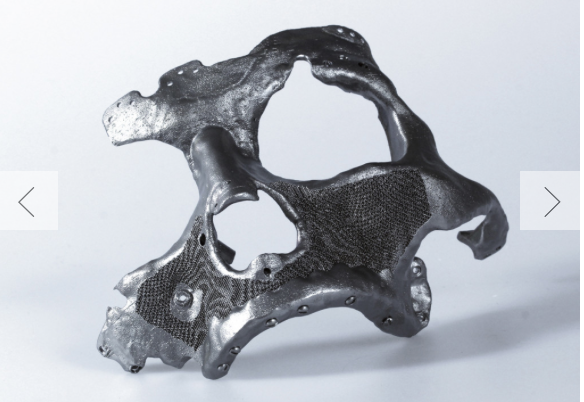
“This titanium facial implant, for reconstructive surgeries, was essentially crafted by algorithms, and optimized to accelerate regrowth.” (Screenshot/Autodesk)

Writing in Wired, Margaret Rhodes opines in “The Bizarre, Bony-Looking Future of Algorithmic Design” that not only titanium face implants (above) and swingarms for motorcycles but buildings will be grist for the algorithmic mill. This is called “generative design,” as opposed to the “explicit design” that we’ve used to make buildings and most other things for centuries. Hey, mankind! Get with the program!

But wait. Here’s how a techie design-firm worker delineates the difference:

Jordan Brandt, Autodesk’s resident futurist, makes a clear distinction between explicit design and generative design. Explicit design is when “you have an idea in your head and you draw it,” he says. “Generative design is when you state the goals of your problem and have the computer create design iterations for you.”

With generative design, a designer begins with an objective or set of objectives — the desired energy consumption for a building, for example, or the amount of sunlight a room should receive — and then lets algorithms take the reins on drafting solutions.

While there’s no denying the potential for speed in algorithmic generative design, Brandt paints a one-dimensional idea of so-called explicit design. A creator does not just think up the image of a design and set it down on a blueprint. When “you have an idea in your head and you draw it,” that idea did not just spring like Adam’s rib from your brain. Nor is that idea merely the product of the maker’s brain recalling (or having researched) precedents for what he wants to make.

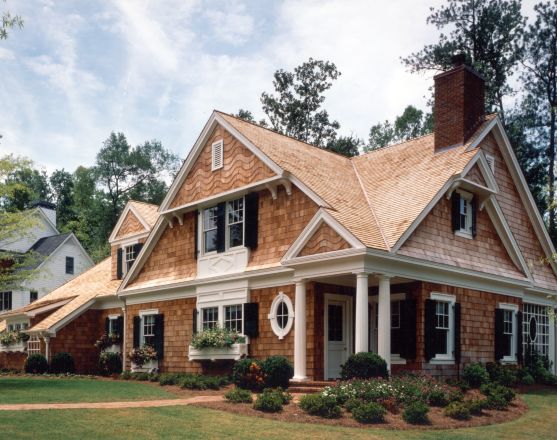
Life magazine Dream House, designed by Gary Brewer, partner of Robert A.M. Stern Architects, in 1994. (RAMSA)

Life magazine Dream House, designed by Gary Brewer, partner of Robert A.M. Stern Architects, in 1994. (RAMSA)

Long before that – perhaps centuries – others, perhaps thousands of others, gave thought to such a product, wondered how best to make it under the constraints of  the requirements, then actually made that product – say, a house.

Maybe it took more than a split second to conjure, but the result of bending the human mind toward getting the right amount of sunshine into a room might not be something to sniff at. Hundreds or thousands of craftsmen and professionals have been thinking it through using the best practices of their predecessors over long periods of time, each adding their own little bit to how to do it better and passing it on.

Given the subtlety of the human mind, perhaps this is the real generative design process. As for feeding a set of objectives into a computer so that algorithms can reach solutions, Jordan Brandt might want to consider the GIGO factor – garbage in, garbage out. How do his architechnicians know they are feeding in the right parameters? And how do they know the algorithms have been correctly set up to achieve a reliable solution?

What does asking for “the desired energy consumption for a building” entail? Has the fancy computer program’s set of algorithms ever heard of a roof overhang, adding perhaps to the shade of a porch? Does it factor in the angle of the sun? Or the option of closing the shutters, or of having a ceiling height that can handle a particular climate’s temperature range? Or may the set of algorithms is expected mainly to rely on an analyst plugging in all the available LEED-certified gizmo-green responses to nature’s vicissitudes?

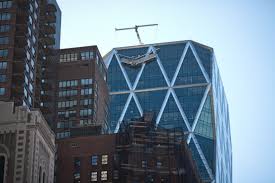
Window washing peril at Hearst Tower last year. (blogs.wsj.com)

Window washing peril at Hearst Tower last year. (blogs.wsj.com)

Just wonderin’.

Architects tinkered for centuries, trial and error, accident or design, with how to leverage climate to render a building capable of satisfying light, heating, cooling and other climate requirements spelled out in different places all over the world. Architecture today has thrown all of that wisdom out on its ear – and behold the result!

Buildings are stressing out our environment to the max with ever-higher costs. Maintenance calls for high-tech “solutions” that are pushing the edge of the inefficiency envelope toward unaffordability and collapse.

Millions to engineer, for example, a platform from which window washers could clean the kooky accordionic fenestration of “Sir” Norman Foster’s Hearst Tower in New York. And what does it do? It broke 50 stories in the air. Luckily, none of the workers fell to his death.

Would algorithmic design have called for a building with straight sides? Don’t bet on it!

University of Texas mathematician Nikos Salingaros and fellow architectural theorist Christopher Alexander thought all this through years ago. The most recent essays by Salingaros on architecture that reflects natural generative processes may be read in the journal Metropolis (linked from my post “Salingaros does Metropolis“).

And a doff  o’ the ol’ cap to Kristen Richards for popping this Wired.com essay into her miraculous ArchNewsNow.com. (Free good stuff!)

Posted in Architecture, Architecture Education, Architecture History, Art and design | Tagged , , , , , , , | Leave a comment

Rachleff programming notes

Veterans Memorial Auditorium, home of R.I. Philharmonic, in Providence. (rirocks.net)

Veterans Memorial Auditorium, home of R.I. Philharmonic, in Providence. (rirocks.net)

Victoria and I attended last night’s Rhode Island Philharmonic Orchestra performance at Veterans Memorial Auditorium. It was a wonderful concert even though – perhaps because – we left during intermission. Not that we wanted to miss Stravinsky’s “Rite of Spring,” but it is not among my favorites, and its placement at the conclusion of the program gave us our “out” to exit early, which would have been inconceivable had Tchaikovsky’s Piano Concerto No. 1 been the last piece of the evening.

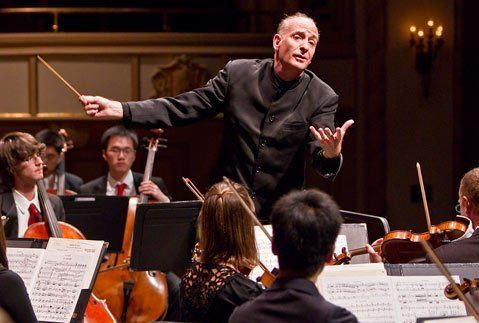
Larry Rachleff, music director at the Phil. (conductingmasterclass.wordpress.com)

Larry Rachleff, music director at the Phil. (conductingmasterclass.wordpress.com)

Igor Stravinsky, drawn by Picasso. (Wikipedia)

Igor Stravinsky, drawn by Picasso. (Wikipedia)

Inarguably, however, “Rite” is the more famous and influential piece. But last night’s solo in the concerto by guest pianist Lilya Zilberstein outshined all the notes of the “Rite” combined, unless the audience gave two standing ovations that evening. It’s a good thing the concerto had spots where Zilberstein could give her extraordinary fingers a rest!

It is common knowledge that music directors place modernist works early or in the middle of the program, saving the best for last so that people will not leave at intermission. This practice has been maintained for two decades by Larry Rachleff, whom I worship. I would worship him even more if he excluded all atonal works from the classical series every year, and I have little doubt that subscriptions would skyrocket.

Stravinsky is not exclusively atonal but his work, toward the beginning of the 20th century, pushed the modernist tendency to “challenge” audiences famous for (and both now and then often denounced for) preferring to spend an evening with beautiful music in whose pleasure they could steep themselves.

The program notes by Michael Fink are illuminating. He describes the 1913 premiere of the “Rite” as decidedly uncomfortable. “The intellectual and artistic world of Paris may have been ready for such a shocking theme [sacrifice of a young girl to the god of spring]. … The wealthy patrons, however, and more traditional-minded ballet goers definitely were not. They apparently took the work as a personal insult.”  Stravinsky himself wrote in his autobiography:

As for the actual performance, I am not in a position to judge as I left the auditorium at the first bars of the prelude, which had at once evoked derisive laughter. I was disgusted. These demonstrations, at first isolated, soon became general, provoking counter-demonstrations and very quickly developing into a terrific uproar. … I had to hold [the choreographer] Nijinsky by his clothes, for he was furious and ready to dash on to the stage at any moment and create a scandal. Diaghilev [impresario of the Ballets Russes] kept ordering the electricians to turn the lights on and off, hoping in that way to put a stop to the noise.

One can’t imagine such audience behavior these days, not necessarily because classical concert audiences have less musical judgment or lower standards today. They have more manners, but perhaps also less confidence in their convictions regarding music. At most, some in the Vets audience last night were probably rolling their eyes and having little dialogues in their heads about what music should be. But maybe audiences really do not lack that confidence – maybe it is expressed not in shouting down the music they dislike from the pits but in lower rates of subscription to the classical series.

Victoria and I listened to the Stravinsky on YouTube in bed later and agreed that, although certainly the orchestra would have performed it exceedingly well, having “The Rite of Spring” at the end certainly made it easier for us to leave in the middle.

Rachleff is a genius who has in 20 years raised the quality of Rhode Island’s philharmonic to the highest level. Victoria and I are not happy that he will be leaving soon.

But the board of the Phil should consider replacing him with a music director who will have the courage of the audience’s convictions, expressed by inflicting fewer modernist “masterpieces” on concertgoers. Such a director would have to fend off accusations of pandering to the public, but a truly courageous director would do just that, and rather than being defensive about it, defend it with brio.

Atonal is to classical music what modernism is to architecture – a bummer masquerading as a stroke of genius. Young composers coming up are realizing this, and many are putting atonal music behind them. Eventually, the trend will trickle up to the board membership and artistic directorships of orchestras. Meanwhile, however, the Philharmonic’s next music director’s most important job will be to ensure that the orchestra’s excellence is maintained, whatever the music the musicians play.

Posted in Architecture, Art and design, Books and Culture, Development, Providence, Rhode Island | Tagged , , , , , , , , | 3 Comments

Canoe canoe, Canada?

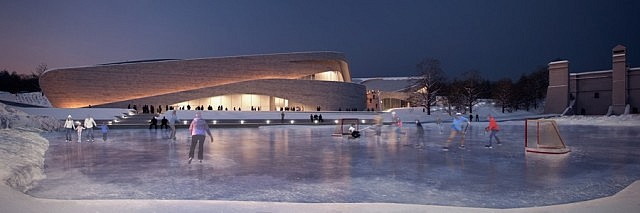
Bing Thom/Lett entry in competition for a new Canadian Canoe Museum. (CCM)

Bing Thom/Lett entry in competition for a new Canadian Canoe Museum. (CCM)

Canoe Canoe? (Can you canoe?)

Canoe Canoe? (Can you canoe?)

Canoe Canoe?” Remember that jingle from the ad for cologne back in, what, the 1970s or ’80s? Get it? Can you canoe! It rushed to mind with news that the design competition for a relocated Canadian Canoe Museum, in Peterborough, Ont., has been narrowed down to five entries.

All but one are predictable, and the one that isn’t is the most predictable of all, but in a puckish way that endears one to its ridiculosity.

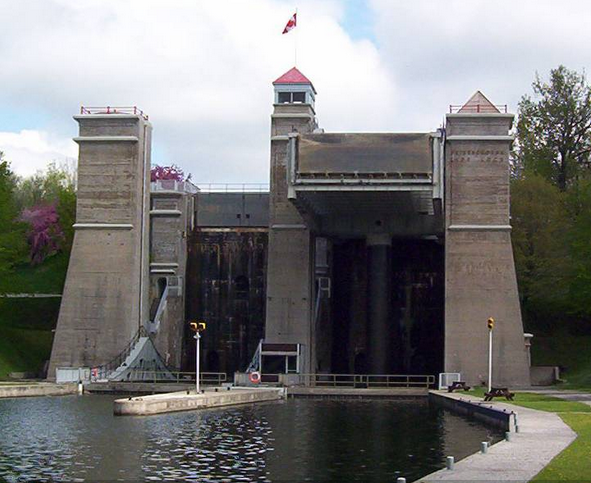
I refer to the entry by Bing Thom Architects and Lett Architects. Drawings of all five proposals have been published at KawarthaNOW.com. The four predictably predictable entries all feature modern architecture that seems, typically, to have little to do either with the elegant Peterborough Lift Lock – designed by Richard Birdsall Rogers, completed in 1904 – on the Otonabee River, which is near Lake Ontario and the new location for the museum, or any other part of the city of some 79,000.

Peterborough Lift Lock. (Wikipedia)

Peterborough Lift Lock. (Wikipedia)

But the Bing Thom/Lett proposal daringly features a pair of crossed canoes. You can see the lift lock toward the right of the illustration above. A pair of crossed canoes is no sillier than the more orthodox modernist entries, but much more refreshing. One thinks of the array of ice-hockey sticks in the tanked entry by Thom Mayne for the Alaska state capitol – though Mayne claims the hockey sticks are actually glaciers. If the Thom/Lett entry wins the museum design competition and gets built, nobody will be in any doubt that the structure is supposed to be a pair of canoes. They are not abstract in the least but fully rendered long hull canoes, very prettily arrayed as the roof of the museum.

Do Canadians really want a Canoe Museum that brings to mind Venturi’s decorated sheds from Learning from Las Vegas? Or would this roof of crossed canoes be more duck than decorated shed? Either way, a little dated, eh?

The museum should cancel and reissue the competition challenge and make noises about how nice it would be to see an entry that picks up on the Peterborough Lift Lock. I’m sure most Ontarians would like that, and it would probably attract more visits from Americans.

Posted in Architects, Architecture, Architecture History, Art and design, Development, Urbanism and planning, Video | Tagged , , , , , , , , , , , | 4 Comments

Zaha bolts BBC interview

Zaha Hadid on BBC Radio 4 “Today” show. (Guardian)

And who can blame her? Zaha Hadid was asked to explain the deaths of construction workers at the site of her vagina-like stadium in Qatar for the 2022 World Soccer Cup. At the time the charge of hundreds of deaths was lodged by human-rights groups, Hadid’s project was not yet in construction.

Proposed stadium in Qatar.

Proposed stadium in Qatar.

Critic Martin Filler last year repeated in the New York Review of Books the claim that workers had died building her stadium. She sued and won, and he apologized. I had repeated the claim, too, but I was below her radar so she didn’t sue me. I apologized anyway. Yet I do not retract my claim that as a celebrity architect she is part of a group of individuals who have done massive harm to the world, harm worthy of their being brought, collectively, before an international tribunal at The Hague.

Hadid protested the BBC “presenter” Sarah Montague’s claim that workers had died on her stadium construction site. I can’t believe that Montague was unaware of its falsity. Qatar says there still have been no deaths at that site, but does not deny that workers have died in other construction related to soccer and development projects spun off from the upcoming event.

But Hadid walked out of the interview, understandably, when the interviewer moved on to the issue of Japan dropping her Olympic stadium project earlier this year because of massive cost overruns. The interviewer asked her to explain and then told her to hurry up because time was running out. I can’t blame Hadid for cutting short the interview.

The Guardian story by Jessica Elgot, “Zaha Hadid cuts short BBC Today programme interview,” links to the radio interview by BBC’s Montague and accurately describes why Hadid walked off the set. Elgot says many are defending Hadid, as they did, and rightly so, after the claim of deaths on her Qatar stadium site had been refuted. But the interview shows how Hadid tries to weasel out of answering embarrassing questions. Still, the interviewer can be criticized for allowing her own incompetence to let Hadid off the hook. At least Montague did not try to trip Zaha as she fled the set!

Hadid is a jackass but the interviewer was rude and incompetent. I don’t blame Zaha for cutting the interview short. I blame her for her architecture.

By the way, Hadid today was awarded a gold medal by the Royal Institute of British Architects, which says a lot more about RIBA – although it is entirely predictable – than it does about her. Dame Zaha indeed!

Here is my post “In defense of Zaha?” in which I apologize to her. And I leave you with a quote from my earliest post on her insensitive reaction to news of construction worker deaths, which I do not apologize for:

I think almost any modern architect would have responded the same way as Hadid, and that the willingness to inflict such ugliness and sterility on a hapless world suggests an essential deficit in the makeup of the character of the profession as it is constituted today, at least at the level of the celebrity architect.

Posted in Architects, Architecture, Art and design, Development, Other countries, Video | Tagged , , , , , , , , | Leave a comment

Architecture and friendliness

A popular photo of Boston's Beacon Hill. (Travel & Leisure)

A popular photo of Boston’s Beacon Hill. How unfriendly! (Travel & Leisure)

My friend Cliff Vanover just sent me a link to Travel & Leisure’s new survey on the 266 places that made it onto its list of World’s Unfriendliest Cities. The unfriendliest was Moscow. A hint of political bias, perhaps? How could they tell? Could it be because Russia invaded Ukraine last year? That may say a lot more about Russia’s friendliness as a nation than its capital’s friendliness as a city. Baltimore scored high, and can you guess why? Of course, recent rioting over police brutality. But does that truly measure the extent to which people in Baltimore are friendly or not to tourists? Hardly likely!

Boston was ranked the 15th unfriendliest city. Providence was 16th. Newport was 29th. Why? Because Newport is crowded and has so many mansions for the wealthy, natch!

I think trying to measure a city’s unfriendliness is just as silly as trying to measure its happiness. I will add what I wrote in my reply to Cliff:

How can the unfriendliness of cities be measured except through inherently unreliable personal anecdotes (not that the anecdotes are false but generalizing from them is hazardous). Every city has friendly and unfriendly people. But I would add (predictably) that beautiful cities are probably friendlier cities because the people there are probably, all other things being equal, happier. Whereas a city of sterile glass-box towers is probably reflecting something, though it may not be easy to identify it precisely.

What I forgot to mention to Cliff is that going through the 266 unfriendly cities you see that each one is represented by a single photograph, and in the vast preponderance of cases the editors chose a photo of a city’s lovely traditional architecture and ignored the cluster of sterile glass and steel towers that most of them have. This may have reflected an unconscious bias on the part of editors in favor of beauty, intended in part, perhaps, to gently apologize to the cities it unjustly criticized (as the editors surely recognize). A city’s unfriendliness probably cannot be quantified at all, never mind listed in a way that pretends to rank their degree of unfriendliness in some sort of rational order. Shame!

Or maybe the editors simply thought that showing a city’s traditional architecture would be interesting and distinctive, whereas showing all their glass boxes would be a boring demonstration of how so many cities are now indistinguishable from each other.

Any way you slice it, the importance of beauty rises to the top, whether it is the happiness or the friendliness of cities that is at issue.

Posted in Architecture, Art and design, Books and Culture, Other countries, Photography, Providence, Rhode Island, Urbanism and planning | Tagged , , , , , , , , | 1 Comment