Postcard from Providence

In light of the new proposal for Kennedy Plaza and my response to it in a post yesterday, here is a column I wrote in 1992, looking forward to 1997. I reblogged it in 2014 after the last KP redesign proposal, and I am reblogging it again today. It has a bit on merging Burnside Park and KP.

David Brussat's avatarArchitecture Here and There

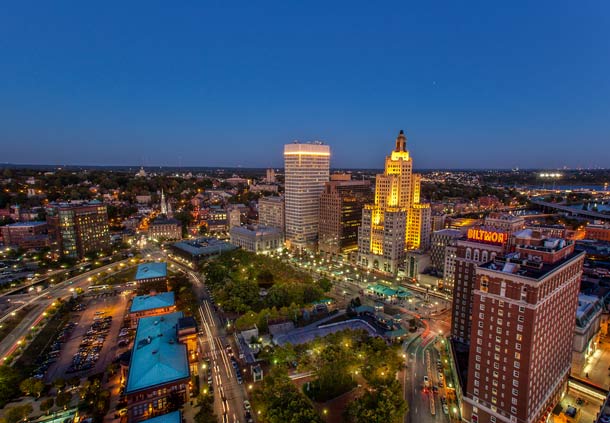
View of Kennedy Plaza from the "Narragansett Plaza." (marriott.com) View of Kennedy Plaza from the “Narragansett Plaza.” (marriott.com)

Here is the 1992 column mentioned in today’s post “Let’s ruin Kennedy Plaza” in which I suggest merging the plaza with Burnside Park to form a Central Park for Providence. I also placed the bus hub under “Kennedy Park.” On the whole this attempt to forecast the success of what was still being planned in 1992 is mawkish and unconvincing from the perspective of 2014. I cannot suppress my belief, however, that if Providence had continued to build revivalist architecture it had built in the 1990s rather than shifting to modernism as it has, the city would have done a much better job reflecting the success predicted in this postcard. And now they’re destroying Kennedy Plaza, too.

Postcard from Providence, 1997
March 4, 1992

FLEW INTO GREEN at about noon, grabbed a cab to Providence, and checked into the Biltmore (the…

View original post 1,209 more words

Posted in Uncategorized | Leave a comment

A new Kennedy Plaza plan

Screen Shot 2017-09-01 at 11.01.34 AM.png

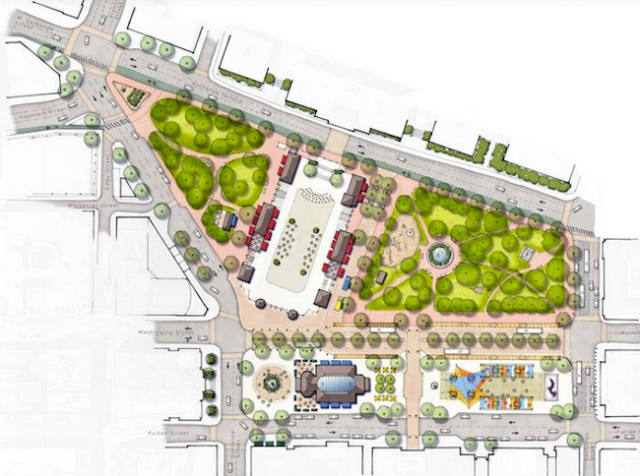
A new plan for Kennedy Plaza is described in this morning’s Providence Journal. “Kennedy Plaza plan envisions ‘true civic heart’,” by Donita Naylor and Jacqueline Tempera, describes a proposal that makes a lot of sense. It does not seem to head in the sterile, modernist direction suggested by the featureless plasticky bus kiosks installed in 2015 to replace the Art Nouveau kiosks that pleased hundreds of thousands for at least a decade. A reduced use of the plaza as a bus hub should enable the removal of the cold, barren modules that turn their backs on the city’s history.

The plan is to move most of the buses over to a new bus hub at Providence Station. East Approach, a road next to the skating rink for buses, often used by bold private drivers, is eliminated, unifying Burnside Park. Washington Street becomes two ways but is limited to buses. The now vacant portions of the plaza east of the existing intermodal terminal would be devoted to public uses such as concerts, festivals, farmers markets, and civic gatherings.

However, some substantial changes would improve this idea further.

First, eliminate the absurdist idea of a new bus hub that encroaches on the State House lawn. That is unlikely to happen, and it would only delay implementing the Kennedy Plaza plan. Instead of making Washington Street two ways and restricting it to buses, eliminate that stretch of Washington so that Burnside Park can be extended into the plaza all the way to Fulton Street. Turn the intermodal terminal into a restaurant with outdoor seating reminiscent of the Plaza Café of many years past, or of Tavern on the Green in New York’s Central Park. This would create a much more verdant and robust version of what our planners have modeled after Bryant Park.

Dorrance, Fulton, Exchange and Exchange Terrace would carry regular traffic and buses around both the plaza and the park, either with two-way traffic or one-way traffic in a counter-clockwise direction. As in the current plan, buses would stop only to pick up and let off passengers. On streets beyond the plaza would be stops every block throughout downtown. People would not have to walk to Kennedy Plaza to take the bus or from it to get to where they want to go downtown. The pattern of bus service that prevailed before Kennedy Plaza became a bus hub would return to a system similar to what most cities still have. The State House lawn and its nearby green spaces would remain sacrosanct.

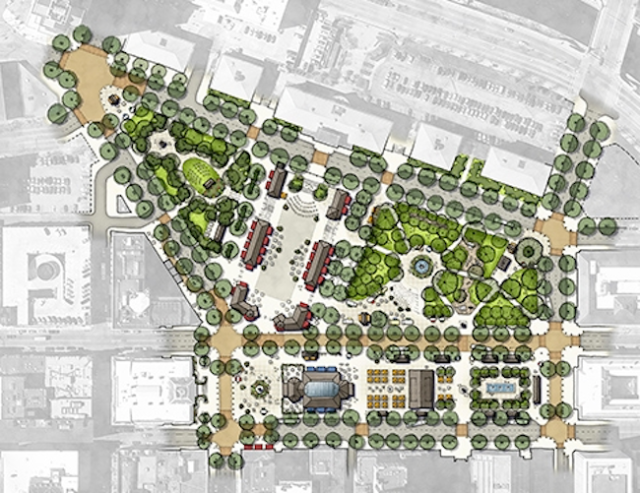
The map of the plan in the Journal was done by Union Studio, in downtown, whose plan for an earlier version of the Kennedy Plaza renovation was beautiful and excellent. That plan seemed to have been “frog-marched” out of the picture when the ugly new kiosks were installed on the plaza edges to make room for the public space envisioned east of the intermodal terminal. That space seems to have acquired a large sculpture. The way it is drawn on the map above suggests that another civic goofball is to be inflicted upon the public. It does not bode well for the broader mindset behind the plan for KP.

The original beautiful small buildings remain absent from the new plan. A set of new buildings around the skating rink in the park replaces the elegant arch of the towered pavilion designed by architect/planner Bill Warner for the rink’s entrance, which simply vanishes. That is a mistake. Any new pavilions should pick up the traditional architecture of the original Union Studio plan, and the rink area should fill the role of a new public space, which would enable the hillocks and trees of Burnside Park to expand into that space east of the intermodal terminal and up to its northern façade.

The money approved by the public in 2014 for goals that have changed radically without much public input should be refocused on a KP-centric plan far less expensive without a new bus hub at Providence Station. If allowed to do its traditional work, a modest police presence should be enough to check the problem of “bums,” which has been exaggerated, I think, to build public support for relocating the bus hub. A taverna system – suggested years ago for Waterplace Park by designer Morris Nathanson, of Pawtucket – could bring even more people into the expanded Burnside Park to eat meals brought by waiters from nearby restaurants. That would help civilize the unjustly low reputation of Kennedy Plaza’s safety and social environment.

Mayor Elorza is right that Providence’s civic center can be improved. But the latest plan still needs a lot of work.

Screen Shot 2017-09-01 at 12.42.10 PM.png

The original proposal for Kennedy Plaza renovations. (Union Studio)

Posted in Architecture, Urbanism and planning | Tagged , , , , , , , | 7 Comments

Mom rendered as a building

Screen Shot 2017-08-31 at 12.19.10 PM.png

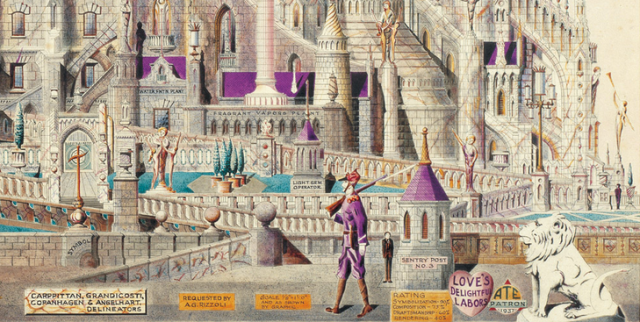
Detail from “Mother Symbolically Recaptured” (1937, by Achilles G. Rizzoli. (pomegranite.com)

I tried in my last blog, “The architecture of the wife,” earlier today, to link to a column I wrote in 2004 to honor my late mother, Mona Brussat, and downloaded from the archive of the Providence Journal. It didn’t work, but I did get the text and so here is that plus the illustrations that went with it. The column was originally entitled “Sketching the mother of all moms.”

***

THE BUILDING ABOVE, festooned with statues of mothers by the score, is the work of A.G. Rizzoli, a draftsman who worked for an architecture firm in San Francisco. His most extraordinary drawings, from the late 1930s, were done not for his boss but for his mom. This one, drawn in 1937, is called “Mother Symbolically Recaptured.”

Last week, the American Society of Architectural Illustrators held its annual meeting in Providence. I had hoped to attend. A column chronicling the convention would have offered an opportunity to discuss Rizzoli, but it just did not occur to me. Rather, I had planned to focus on the poster art for the event, featuring a sketch of the Providence County Superior Court, drawn in 1927 by Chester B. Price for the firm of Jackson, Robertson and Adams.

H.P. Lovecraft, the late Providence writer of mystery tales, praised the courthouse design in a March 20, 1929, letter to The Sunday Journal. But it included an annex (visible in the poster) across South Main Street that would have required demolishing a string of old warehouses called the Brick Row, on the Providence River. Lovecraft attacked that part of the plan. “Behind it,” he wrote, “lies the far broader clash of city-planning ideals which it typifies; the eternal warfare, based on temperament and degree of sensitiveness to deep local currents of feeling, between those who cherish a landscape truly expressive of a town’s individuality, and those who demand the uniformly modern, commercially efficient and showily sumptuous at any cost.”

(Brick Row was torn down in 1929, but the annex was not built. The site is now Memorial Park.)

The idea of writing about Lovecraft’s letter, the poster of the courthouse, and the art of drawing buildings teased me terribly the week before the meeting of illustrators. But I missed the convention because my dear sweet mother died.

Mona is with Bill now. My father died in 1978 after a career that began as a city planner in Chicago, where I was born, and continued in Philadelpha and Washington. I was in no position to memorialize him in newsprint when he died, but in 1995, after the death of his friend Hugh Mields, also a planner, I wrote about them both (“Together again,” July 20, 1995). Did their careers as planners influence my career? Not that I could tell.

My mother’s career as a teacher and actor – the former after her career as a mother of three boys, the latter after she had lost my dad — is, if anything, even more elusive in its influence on mine. We lived in a modernist house once. Later, our more traditional house in Washington was decorated in a contemporary style lifted largely from a furniture store called Scan. Full disclosure: My environment at home was comfortable, stylish and decidedly attractive. But its impact on my later architectural tastes was indeterminate at best.

IMG_0117.jpg

Photo by William K. Brussat, circa 1957.

My mother did instill in me a love for beauty. Just look at the picture of her helping me read.

Mom was a fantastic educator. Once, I was in her arms, exercising my vocabulary with a slang term for breasts. “No, David,” she said, “They are bosoms.” (This was the 1950s.) My foundation in the terminology of ornamentation was laid at an early age.

Last week, my brothers and I sat on the couch in my mother’s living room going through a batch of pictures Mom had extracted and put aside toward the beginning of her illness. They were pictures of her as a young woman. I was reminded of A.G. Rizzoli and his lovely buildings dedicated to his mom.

After a reclusive life, Rizzoli died in 1981. In 1990, hundreds of his drawings were discovered in his family’s garage. Many of the fantastical buildings were symbolic representations of people he knew — “transfigurations,” as he called them. Those published in A.G. Rizzoli: Architect of Magnificent Visions (Abrams, 1997) reveal a meticulous style that I’m pleased to see has not been totally abandoned by architectural illustrators.

On Tuesday, at the Sol Koffler Gallery, in the Rhode Island School of Design’s recently renovated building on Weybosset Street, I examined the winners of an illustration competition sponsored by the illustrators’ society. The exhibit reveals the impressive artistry gathered in Providence last week. The architectural illustrators are not to blame for the fact that so many buildings designed today are not worthy of their talent.

Rizzoli was devoted to his mother and to an idea that most architects rejected decades ago — that buildings do represent people. No, most buildings do not have bosoms, but the principles of classical architecture are rooted in the dimensions of the human body. Ornament is not merely the jewelry of architecture but its very essence, the expression of a building’s purpose, its aspirations and its place on the street but also in the heart and soul of society.

My mother, symbolically represented as a building, is a temple to love, beauty and truth.

Copyright © 2004. LMG Rhode Island Holdings, Inc. All Rights Reserved.


Posted in Architecture, Art and design, Lost Providence | Tagged , , , , , , , | 3 Comments

The architecture of the wife

092.JPG

Grace Park, in downtown Providence, with Victoria and Billy at right. (Photo from Lost Providence)

A sonnet would be more romantic, perhaps, but let me try combining, just for today, my blog, Architecture Here and There, and my dear wife, Victoria. Today marks our tenth anniversary. This evening I will be taking her out to Barrington Books, in Garden City, where I will read a chapter from my book, Lost Providence, take questions and sign books in an event at 6:30 p.m.

I hope this blog will not have its FCC license pulled if I declare that the architecture of Victoria, an undeniable sweetie, is remarkable indeed.

♥ ♥ ♥ ♥ ♥ ♥ ♥ ♥ ♥ ♥ !

In the photo atop this blog post she sits on a bench next to Billy, 8, in Grace Park outside of the Hotel Providence, downtown.

Yesterday, on GoLocalProv.com, in an interview with Kate Nagle, I was puffing my book Lost Providence and, in answer to Kate’s question about my favorite lost building, I referred to the Hoppin House as being great because it “has breasts.” Its façade has two gentle bulges, matched by yet another set in the porch balustrade, and finally graced by yet another pair in the railing in front of the house. I would not hesitate to say that the architecture of Victoria is even lovelier than the architecture of the Hoppin House.

My effort to combine work with pleasure (my blog with my wife) has an honorable precedent in the imaginary drawings of A.G. Rizzoli, a draftsman for an architectural firm in San Francisco. Nine years after his death in 1990, hundreds of his meticulous sketches of buildings were found in the family’s garage. Many were devoted to his mother, including one called “Mother Symbolically Recaptured” that I ran atop a column I wrote (“Sketching the mother of all moms“) after my mother, Mona, died in 2004.

Since I cannot draw, I dedicate this blog post to my wife of ten years. (Don’t worry, readers, I got her a couple of nice gifties, too.)

lostprov1.jpg

The Hoppin House, built in 1816 and razed in 1875. (Providence Public Library)

Screen Shot 2017-08-31 at 12.20.34 PM.png

“Mother Symbolically Recaptured,” by A.G. Rizzoli. (Pomegranite Communications)

Posted in Architecture, Books and Culture | Tagged , , , , , | 8 Comments

History survives in Houston

Screen Shot 2017-08-30 at 2.48.26 PM.png

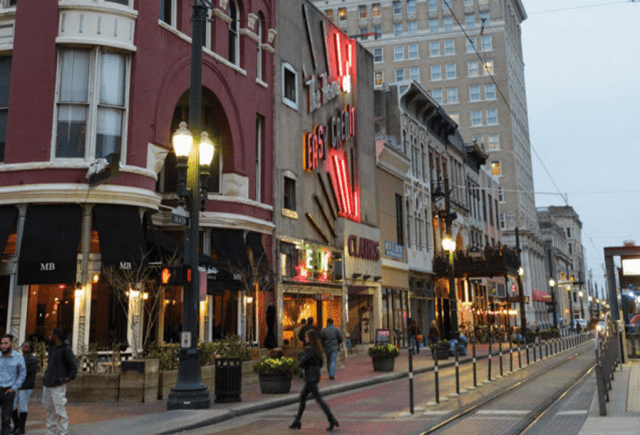
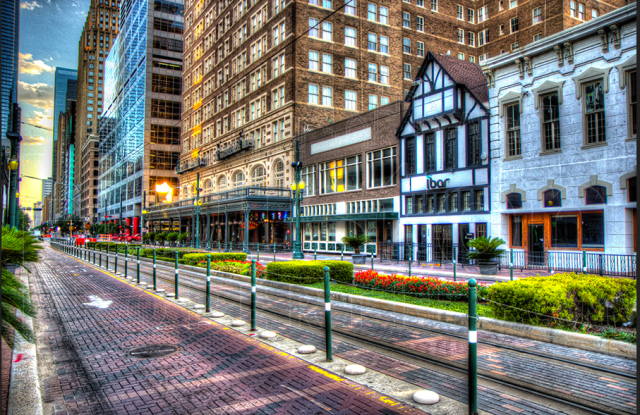
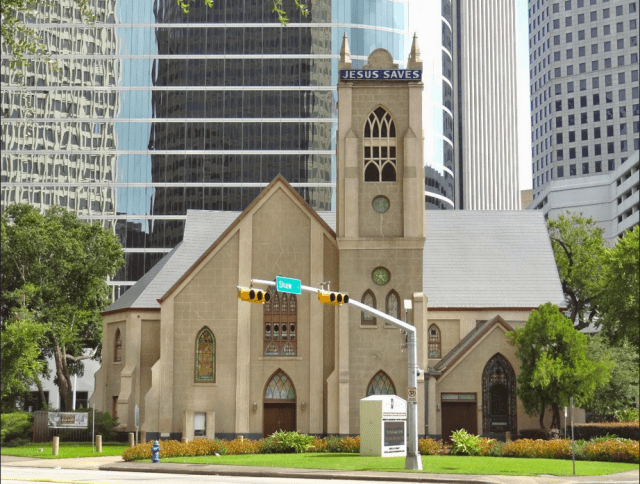
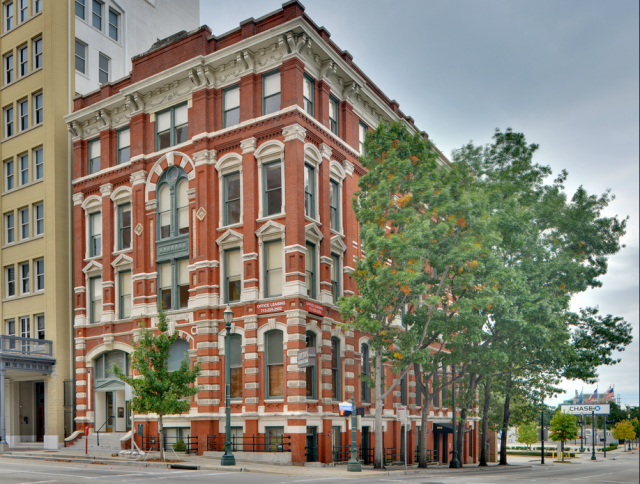
Streetscape in Houston’s Main Street Market Square Historic District. (houstontx.com)
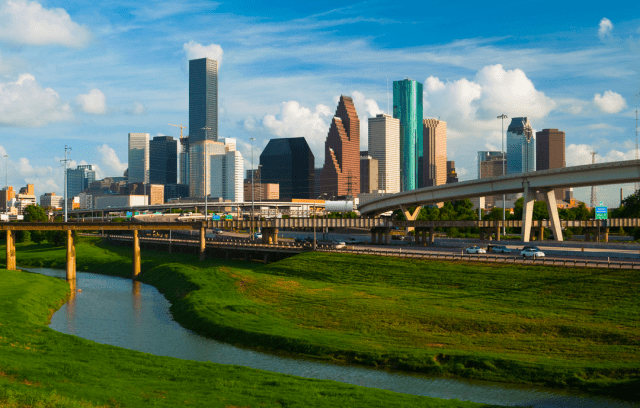
For many people, I suppose, Houston brings to mind tall glass towers sitting cheek by jowl with small gas stations and grandfathered (if not exactly grandfatherly) shops. Its historic character was submerged long before Hurricane Harvey. Zoning is a free-for-all there, with few rules, let alone protections for historic buildings. Nothing is permitted to hinder the hurly-burly of the market for development.

But Houston does have a laudable collection of historic buildings. The largest is the Main Street Market Square District north of downtown, the city’s only commercial historic district. All of its other 18 historic districts are residential – and tiny, compared with most of those in Providence. Houston’s remaining set of fine early commercial buildings was designated a historic district in 1997. About half are considered “noncontributing,” which is to say they do not really add to the feeling of history that historic districts are intended to foster. Compare that to Providence’s downtown financial and commercial districts, which I’d say they are only about 10 percent noncontributing. Thus, our downtown is only slightly eroded by modern buildings. Granted, some of the noncontributing structures here are big office towers, and, lest we forget, downtown has had some experience of historic flooding.

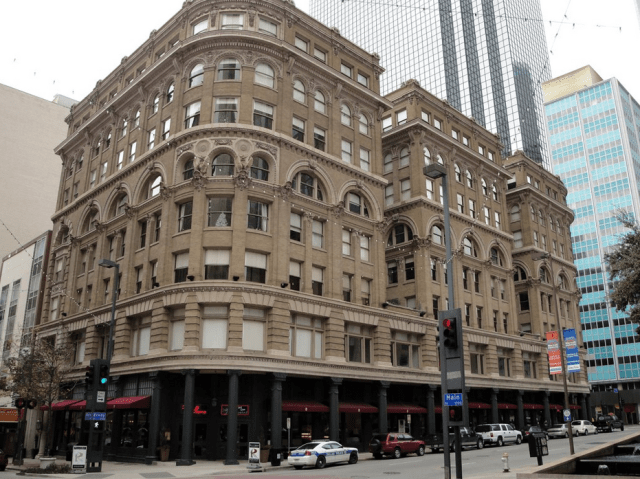
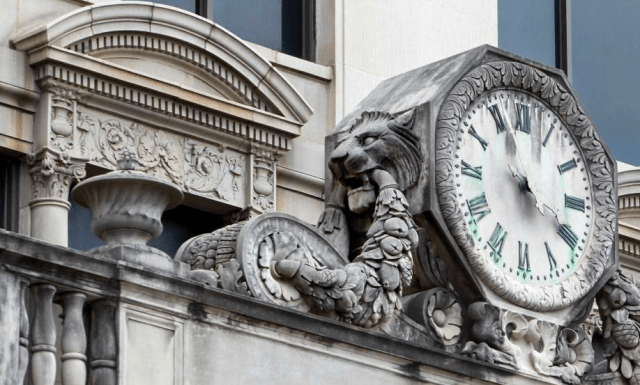
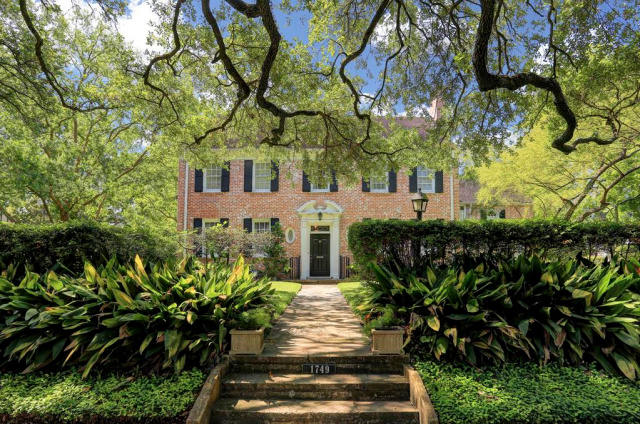
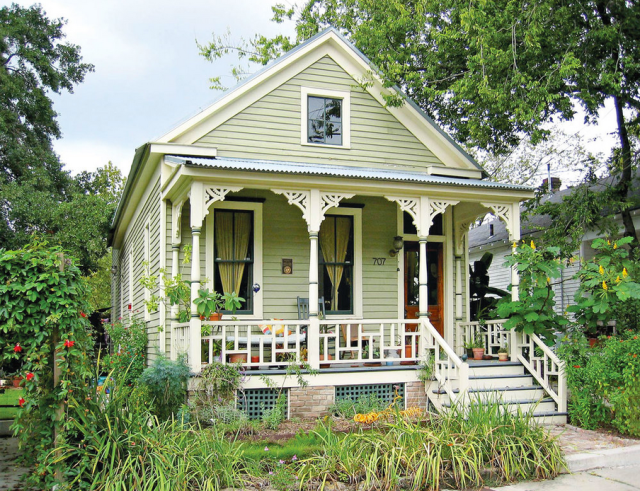
No doubt there are nice buildings scattered around Houston. Here are some, starting with Main Street Market Square. I wish I had more information about how well or poorly Houston’s historic districts have fared in the wake of Harvey. I have heard zilch. Hopefully, those which have been inundated can be saved. The city’s residents have shown a remarkable resilience, and here’s hoping the death toll remains low.

Screen Shot 2017-08-30 at 7.59.15 PM.png

Screen Shot 2017-08-30 at 8.19.17 PM.png

Screen Shot 2017-08-30 at 8.11.37 PM.png

Screen Shot 2017-08-30 at 7.57.56 PM.png

Screen Shot 2017-08-30 at 7.57.15 PM.png

Screen Shot 2017-08-30 at 7.56.31 PM.png

Screen Shot 2017-08-30 at 7.55.40 PM.png

Screen Shot 2017-08-30 at 7.54.15 PM.png

Screen Shot 2017-08-30 at 7.53.06 PM.png

Screen Shot 2017-08-30 at 8.24.21 PM.png

Screen Shot 2017-08-30 at 8.17.16 PM.png

Screen Shot 2017-08-30 at 8.16.43 PM.png

Screen Shot 2017-08-30 at 8.15.22 PM.png

Screen Shot 2017-08-30 at 8.20.11 PM.png

Screen Shot 2017-08-30 at 8.14.37 PM.png

Screen Shot 2017-08-30 at 8.12.33 PM.png

Screen Shot 2017-08-30 at 8.02.26 PM.png

Screen Shot 2017-08-30 at 8.34.44 PM.png

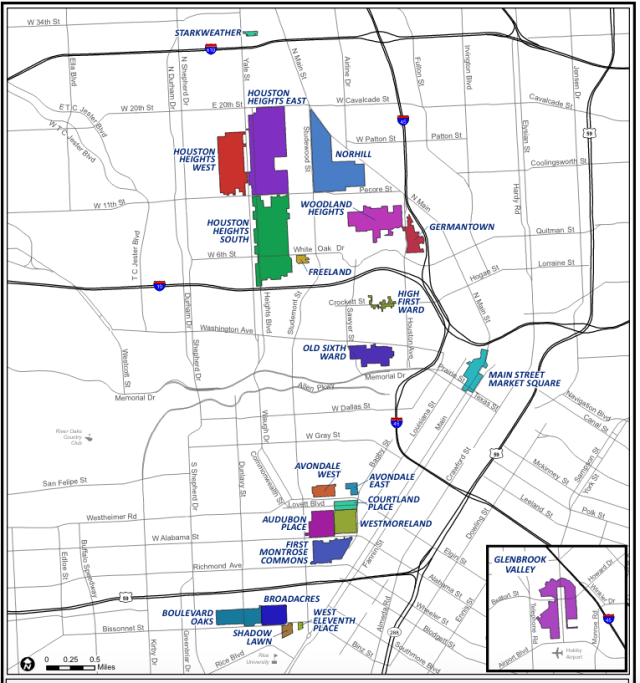
Houston’s 19 historic districts. Main Street Market Square is the most easterly, on the upper edge of downtown, which is in the lower right quadrant of the map. (houstontx.gov)

Posted in Architecture, Urbanism and planning | Tagged , , , , | 1 Comment

Salingaros’s ‘conscious cities’

Screen Shot 2017-08-29 at 6.25.07 PM.png

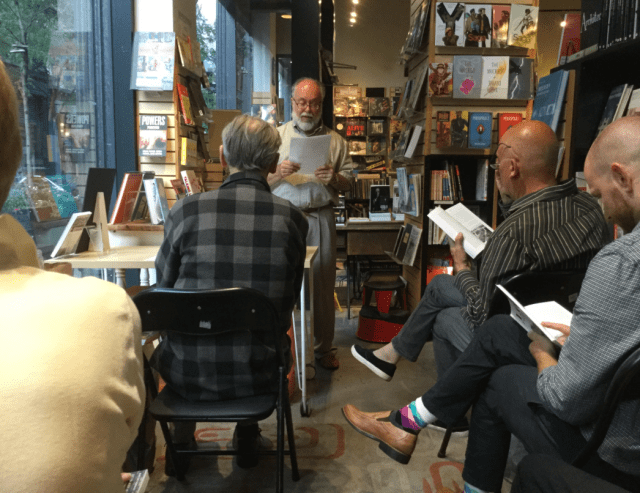
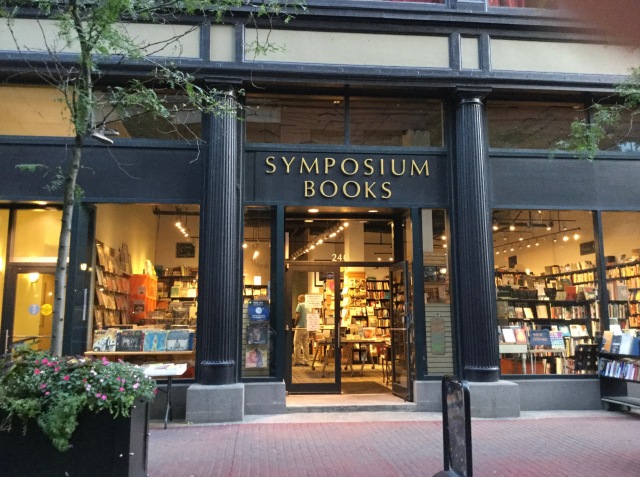
Author reads at book launch of Lost Providence at Symposium Books. (Victoria Somlo)

Last night’s Lost Providence book launch concluded with a stimulating series of exchanges regarding the nature of architecture and the allure of cities. I mentioned the work of mathematician Nikos Salingaros at the University of Texas at San Antonio. His theories, as I usually describe them, tie the high popularity of traditional architecture to primitive mankind’s survival needs, which included the capacity of the primitive mind to “read” the details of the surrounding environment. Such interpretation was needed to find dangers lurking in the savannah – such as a hidden tiger revealed by its shadow on a nearby rock. Not noticing that in time might conclude the life of the cave man. Fortunately for him (and us), his brain developed the ability to intuit the meaning of signs in the wild. Today, our intuition and our subconscious register that type of information as complexity in our built environment. Traditional architecture is a far more complex aesthetic phenomenon than the “purity of line” favored in abstract modernist architecture.

That’s an expanded version of my answer to a listener’s question. Some who attended at Symposium Books might have thought I had leapt off the deep end. But no, this is one of the most promising segments of emerging science. Salingaros, who has worked closely for decades with architectural theorist Chrisopher Alexander, recently published an essay summarizing the threads of this emerging science in Conscious Cities Journal. I’ve plucked three interesting paragraphs from “How Neuroscience Can Generate a Healthier Architecture.” Readers should read the entire essay. They might also want to click on the Wikipedia entry for conscious cities.

Healing environments are reminiscent of but don’t need to copy vernacular architecture. Design techniques that adapt to our neurophysiology necessarily bring us to appreciate design and tectonic solutions from our own past often swept away by industrial modernism. We do not advocate returning to older practices out of nostalgia, but instead urge their re-discovery in a new, ultra-modern context. The rewards of adopting healing design tools without ideological prejudice against the past are going to be profound. …

Salingaros is arguing that there are benefits to design practices that evolve over centuries of trial and error, where the latest “best practices” are handed down by successive generations of designers and builders. And there are negatives to design practices that are “experimental,” in that designers create buildings by using patterns and techniques that are not only different from historical designs but from the designs of their own rivals today. To humans, the benefits of the traditional method, briefly stated, are called “health” and the negatives of abstract creativity are “illness.”

In the next paragraph, Salingaros refers to the difference in speed with which the brain responds to traditional stimuli versus experimental “creative” stimuli. The latter, in which abstraction clashes with experience, is harder to understand, and thus the brain perceives its meaning more slowly (if at all).

This cognitive phenomenon is reminiscent of schizophrenia and results from conditioning. Abstract design exercises instill a subconscious preference for industrial forms, non-convex spaces, textures, and materials of industrial modernism that normally alarm us. Post-war architectural training superimposes a liking for negative valences, opposite to our evolution. Taking advantage of neuroplasticity, the Bauhaus teaching method engages a person emotionally and physically by using the tactile sense and exercising one’s muscles. Those kinesthetic exercises re-wire students’ brains to ignore bodily signals (our visceral response to structures), and replace them with intellectualised abstractions. Making compositions and building studio models with an empty, unnatural shape teaches students to judge according to style and ignore conflicting valences. …

Here is Salingaros’s conclusion:

Neuroscience opens a path to a new kind of adaptive architectural practice that can measurably increase human well-being. Many of the components necessary for this new design discipline are already in place, and others are being developed. We still need to solidify existing results on how the environment affects our body and health, and complete this program with research that explores new directions. Bringing together different groups of researchers who are all pursuing the same goal will strengthen the results, and help to forge a major new global discipline. The “Conscious Cities” group is making such an effort.

Good!

Posted in Architecture, Books and Culture, Lost Providence, Uncategorized | Tagged , , , , , , , | 9 Comments

“Lost Prov” blasts off today

Screen Shot 2017-08-28 at 11.12.31 AM.png

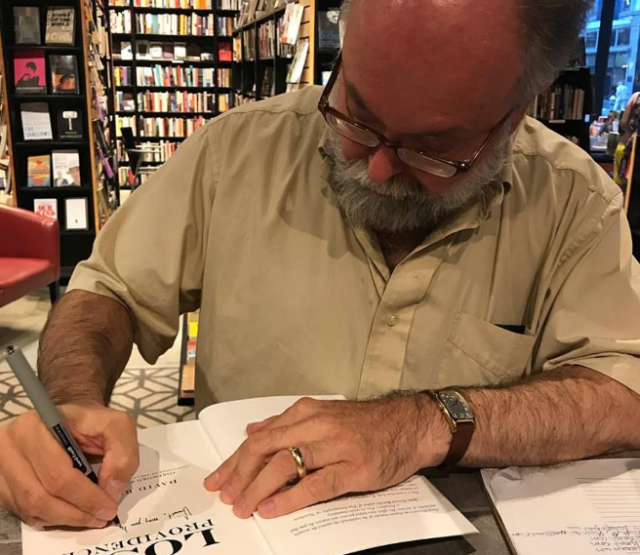
The author autographs his first copy of Lost Providence. (Anne Marie Keohane)

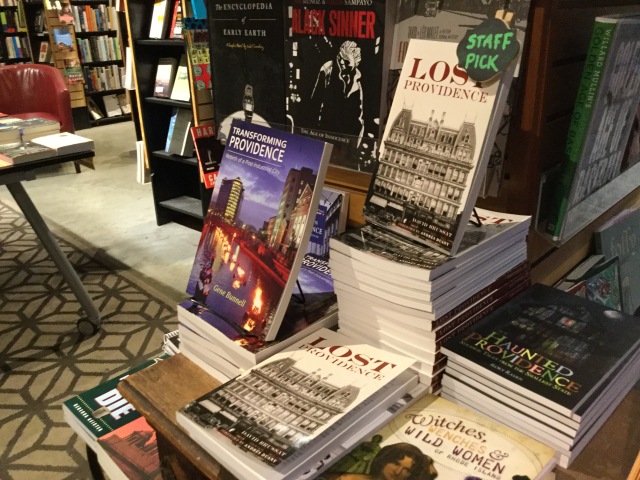
Today is the day my book Lost Providence goes on sale. At least a hundred people have already pre-ordered it from History Press/Arcadia Publishing, and that was as of two weeks ago. The official launch of the book will be this evening at Symposium Books, 240 Westminster St. in downtown Providence. I will be there at 6 p.m. to read a chapter, answer questions and sign books, but the shop has been selling the book for a couple of hours now since it opened at 10 a.m. this morning.

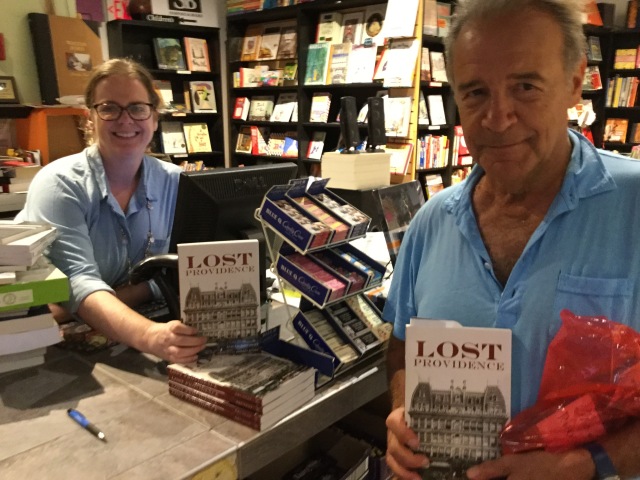
I just happened to walk in immediately after Anne Marie Keohane, who owns the shop along with Scott McCollough, had sold a copy to a gentleman named Vincent. Anne Marie alerted Vincent that the very writer of the book had just entered the shop. He asked me to autograph it, and I did so, adding an inscription, during which space of time Anne Marie took the photograph that, with some misgivings, graces the top of this post.

The book, if I may be forgiven for saying so myself, is a unique history of Providence written in terms of its physical changes. Those who know the city of today will be intrigued by the book’s descriptions of how the places they know have changed. Those who do not know Providence will want to, and will want to see a city that has done such a good job at preserving so much of its built heritage. And many readers in both categories will, I hope, embrace the author’s desire for Providence and every other city and town to design its future with an eye toward the sort of architecture people can love.

So I hope readers will drop in on Symposium this evening to become listeners. I still have not decided what chapter to read. I will probably do so at the last moment, which is my general practice in all things. So please come in, and please buy a copy of the book.

IMG_0073.jpg

IMG_0074.jpg

IMG_0075.jpg

Posted in Architecture, Architecture History, Preservation, Providence | Tagged , , , , | 30 Comments

Classicism in La-La Land

Screen Shot 2017-08-27 at 12.58.47 PM.png

New $700 million campus for USC is Collegiate Gothic in style. (L.A. Times)(

You’d think that a simpatico of sorts might naturally have developed between classical architecture and the city of Los Angeles, home of Hollywood and its beautiful stars.  Doesn’t beauty love beauty? Apparently not. I suspect many celloid beauties like to boost confidence in their appearance by surrounding themselves with ugly buildings. How else to explain … ah, well, let’s just jump to the nut graf here.

(I hasten to add that the nut graf in a piece of journalism is where the correspondent briefly explains the matter at hand. A nut graf and a nut case are two different things.)

The University of Southern California recently opened a new campus that embraces the Collegiate Gothic style. C.L. Max Nikias, the university’s president, said at a dedication ceremony last week: “And let’s always remember, the looks of the University Village give us 1,000 years of history we don’t have. Thank you, and fight on!”

Well, maybe. But the event generated a critique by L.A. Times architecture critic Christopher Hawthorne, who was bound and determined to misunderstand the new campus. Read his “Call it Collegeland: The new USC Village feels like a Disneyland-Hogwarts mashup.” And prepare to roll your eyes. Granted, the college president’s remarks opened a hole you could drive a truck through, but Hawthorne (predictably, I might add) has no intention of assessing the architecture objectively.

Indeed, it does not compare well with Yale’s new pair of Collegiate Gothic campuses in New Haven, by Robert A.M. Stern Architects. Still, the work at USC by Harley Ellis Deveroux is to be commended for its startling audacity, bringing classicism to La-La Land. Now that new classical architecture has a new major beachhead in California, maybe its influence will spread eastward in the usual manner.

Posted in Architecture | Tagged , , , , | 7 Comments

“Lost Providence” update

Screen Shot 2017-08-24 at 12.17.52 PM.png

Hamilton House, 276 Angell St., is certainly not a lost building of Providence. (Hamilton House)

Lost Providence will go on sale this Monday, August 28. Symposium Books on Westminster Street in downtown will throw the first book launch that same day, starting at 6 p.m. I will give a short introduction, read a chapter, take questions and sign books. Three days later, I will be at Barrington Books, in Garden City, at 6:30 p.m. Events will continue through September and October, including two associated with WaterFire. More events may still be added beyond the dozen now scheduled. As of now the final event will be at the Johnston Historical Society on February 28, 2018.

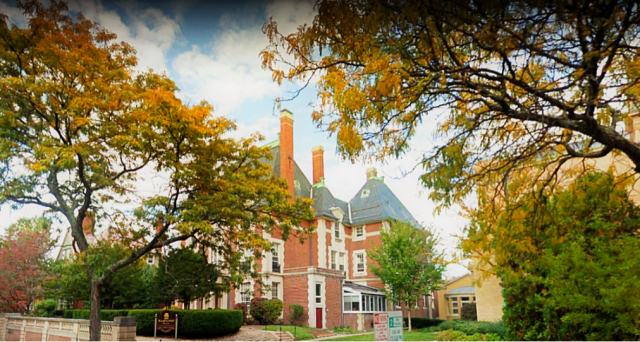
Hamilton House, the sophisticated Louis XIII-style French Renaissance mansion next to Central Congregational Church on Angell Street, in Providence, will host me to lecture, take questions and sign books on Wednesday, October 4 at 1 p.m. Hamilton House is an adult learning exchange in operation since 1972 at the elegant château completed in 1896, designed by Carrère & Hastings, the firm that designed the Central Congregational next door, the New York Public Library, and the U.S. House and Senate office buildings in Washington, D.C. The house is the only example of its kind in Providence, and was built for Francis W. Carpenter, whose Congdon & Carpenter iron and steel firm founded in 1792 was still in operation at 3-5 Steeple St., as recently as the mid-1980s. Carpenter commissioned the Congregational Church next door.

The Hamilton House event is the latest to be arranged and the only one scheduled during the afternoon, though the time is not yet set for the event at the WaterFire Arts Center with Gene Bunnell, author of Transforming Providence (2016), on Saturday, Sept. 23.

Please check out the additional photographs on the Lost Providence Page elsewhere on this blog. I am planning to put them up as soon as I post this update.

Here is the entire book event schedule:

  • Aug. 28, Symposium Books, 240 Westminster St., Providence: book launch, Monday, 6 p.m.; free
  • Aug. 31, Barrington Books at Garden City, Cranston, book reading, Q&A, and signing. Thursday at 6:30 p.m.; free
  • Sept. 7, Books on the Square, 471 Angell St., Providence, book reading, Q&A, and signing; Thursday, 7 p.m.; free
  • Sept. 20, jointly sponsored by the Providence Preservation Society and the Providence Public Library, 150 Empire St., Providence, slide lecture, Q&A, book signing, Wednesday, 6:30 p.m.; free
  • Sept. 23, WaterFire Arts Center, 475 Valley St., Providence, joint talk with Gene Bunnell, author of Transforming Providence, time TBA, free
  • Sept. 25, Rochambeau Community Library, 708 Hope St., Providence, slide lecture, Q&A, signing, Monday, 7 p.m.; free
  • Sept. 28, Preservation Society of Newport County, Rosecliff, 548 Bellevue Ave., Newport, slide lecture, Q&A, Thursday, 6 p.m.; $10 members, $15 nonmembers
  • Sept. 30, WaterFire, Q&A and book signing during the event (sponsored by the Gloria Gemma Breast Cancer Research Foundation, time TBA, free
  • Oct. 4, Hamilton House, 276 Angell St., Providence, discussion with slides and Q&A, 1 p.m., Wednesday, free
  • Oct. 5, Rhode Island Historical Society, Netop Nights at John Brown House, 52 Power St., Providence, lecture, Q&A, book signing, Thursday, 6 p.m.; free
  • Oct. 12, Preserve Rhode Island, Lippitt House Museum, 199 Hope St., Providence, reading/lecture, Q&A, book signing, Thursday, 6:30 p.m.
  • Feb. 28, Johnston Historical Society, 101 Putnam Pike, Johnston, R.I., slide lecture, Q&A, book signing, Wednesday, meeting at 7, lecture at 7:45, free
Posted in Architecture, Books and Culture, Lost Providence | Tagged , , , , , , , | 5 Comments

Old mods hard-wired to ugly

Screen Shot 2017-08-23 at 12.09.09 PM.png

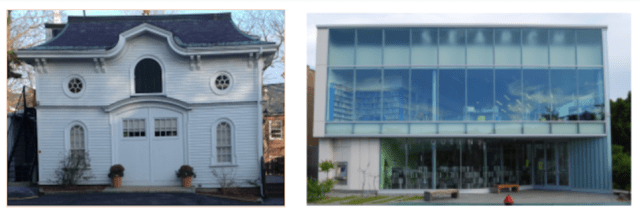
These two buildings reflect typical attributes of traditional and modern architecture. (Sussman)

The two buildings above say all that needs to be said, really, about why traditional architecture is superior to modern architecture. Still, it is crucial to understand why modern architecture emerged in the first half of the last century, and why, despite its manifest flaws, it has been so tenacious in resisting a return to a more sensible architecture.

The Mental Disorders that Gave Us Modern Architecture,” by architect and biometric researcher Ann Sussman with recent Boston College grad Katie Chen, on the website Common/Edge, offers one very compelling explanation – that the leading founders of modern architecture had damaged brains whose incapacities were reflected in their new type of building design. I commend Common/Edge for running this explosive essay.

Sussman and Chen describe extensively the effect of autism on Le Corbusier and of post-traumatic stress disorder (PTSD) on Walter Gropius and Ludwig Mies van der Rohe. Both disorders involved damaged brains’ subconscious efforts to order the disorder of their minds. Both conditions cause sufferers to avoid human contact, and eye contact in particular. All three modernist icons liked the simplest wall surfaces (undecorated) and in particular avoided aspects of architecture in which certain arrangements of windows and doors resemble the human face – which, according to eye-tracking research, lures the attention of healthy brains above every other possible stimulus.

Screen Shot 2017-08-23 at 1.31.26 PM.png

How eyes focus on building in normal brains (left) versus autistic brains. (Sussman)

A person blind in his left eye might want the travel direction on two-way roads to be reversed to driver-on-left, but he would use a broader theory to argue his case in public. Likewise, Corbu, Grope, and Mies would probably not argue for eliminating ornament on buildings because blank walls make them feel more relaxed. They might not have been conscious of that. And if they were, doing so would be totally selfish. They would instead say that European colonialism and the World War I call for a new architecture to replace the old architecture in which (as they did say) a cupola on a gabled roof represents the crown on the head of a monarch. Modernism, they argue, is the summit of architectural history. No further evolution is required.

Naturally. But that doesn’t make their argument sensible. It was never plausible to blame the tragedies of European politics and global war on the design of buildings in general, not even of buildings where terrible decisions were made. A third grader could tell you that from the get-go. He might have a harder time rebutting the argument that buildings should be utilitarian rather than decorative. But by fourth grade he could certainly do it.

It remains unclear how highly sophisticated European and American societies fell for this insanity, kicking out centuries of established tradition and embarking on the entire reconfiguration of cities and towns the length and breadth of (at first) two continents – a very expensive proposition. But it certainly fills in a lot of blanks in architectural history to know that the three founding modernists all had brain disorders whose characteristic effects had driven them toward certain architectural “solutions.”

Of course, architecture based on aesthetics that diverge from the way the brain normally processes visual stimuli must be, in some way, irksome to the vast majority of people in the world. Most people still take the traditional form of buildings for granted, and feel cheated, in some degree, by buildings that contradict their expectations. I hope that understanding the illness-centered bias against tradition will help societies redirect architecture and urbanism toward a more healthy design of the built environment.

Posted in Architecture | Tagged , , , , , , , , , | 5 Comments