More on R.I. and Amazon

Screen Shot 2017-09-17 at 3.00.49 PM.png

Sketch of part of I-195 corridor that could host new Amazon headquarters. (Greater City Providence)

In my Friday post “How R.I. can get Amazon” I pretty much asserted that beauty could tip the scales for Rhode Island and its capital Providence. That seems highly unlikely. How many corporate CEOs decide such things (or anything) on the basis of beauty?

Actually, though, if you look at Amazon’s request for proposals, it does come pretty close. It says it prefers “communities that think big and creatively when considering locations and real-estate options.” That Providence should submit a proposal based largely on its beauty demonstrates its creativity. And Providence can show that it thinks big by pointing to the city’s daylighted rivers, lined with lovely arched bridges, parks and walking paths. A state that piggybacked beautification on the back of a federal transportation project, almost entirely on the federal dime, is not a state that can be sniffed at by Amazon, a company that constantly seeks the main chance. For that matter, the primary site for Amazon to consider is on land freed up by moving an interstate highway. Although its citizens are a cynical bunch that would hardly credit the idea, thinking big is one thing Rhode Island does well.

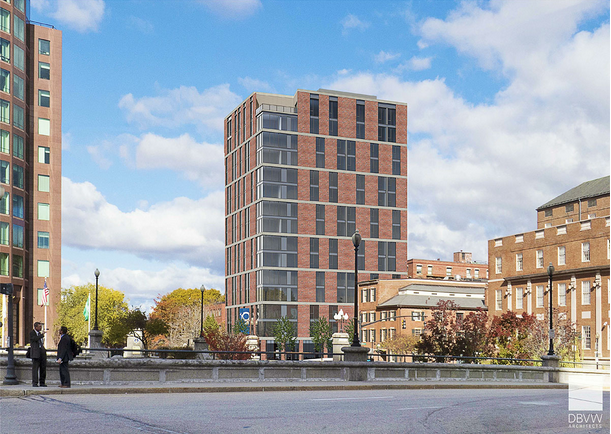
Needless to say, Amazon would shoulder the chilly Wexford proposal, above, out of the picture and plan a headquarters in keeping with its setting in the Jewelry District. Contextual design would be Providence’s one requirement for doing a deal with Amazon.

At a population of 1.056 million, the city-state of Rhode Island just qualifies under the Amazon population-size preference (that’s the word specified, not “requirement”). More dicey is our reputation for business friendliness; the state is unfriendly, the city is unfriendlier. The problem might be addressed through its generous subsidies. It is not very smart at doling out the money, which could represent an opportunity for a company that lusts after the main chance.

Well-educated and creative people form much of Providence’s population – it ranks No. 3 among cities in surveys of creatives in the population. That surely grows if the proximity of Boston is taken into account. Amazon seeks a city whose culture and quality of life live up to what Amazon denizens have become accustomed to in Seattle. Providence would surely fit that lifestyle, and more – ditto its university mix – especially, again, with Boston and (let’s now add) New York thrown in as supporting actors.

As for where in Providence, the I-195 corridor would be perfect, already prepped for development and with utilities already built in. Furthermore, the footprint would be expandable adjacent to the collective parcels of the corridor, with further expansion on infill sites very close by in downtown and Capital Center (along that daylighted set of rivers).

A reader points out that Amazon wants to avoid coastal areas that might suffer from rising ocean levels over the years. I could not find that in the RFP itself, but Providence, showing foresight and boldness, installed a hurricane barrier at its top-of-the-bay location in the 1960s.

Another reader chided me for thumbing my nose at Seattle, based on the view of that city from Amazon’s front door. My intent was not to cock a snook at Seattle but at that sort of urbanism – lots of glass boxes in a sea of pavement – wherever it may be, including the current I-195 plan. My regrets to any Seattlers who thought I was dissing their city as a whole.

I had intended to address the whys and wherefors of the beauty part of this potential Providence proposal to Amazon, but the more I looked at the Amazon RFP, the more it seemed, despite my skepticism, that Providence aligns pretty well with it, and could in fact be a player even without roping in its extraordinary beauty. So I will discuss the beauty part in another blog post very soon. Needless to say, if our city and state officials can also be made to understand the merits of beauty, then Providence could fare very well in any joust with fellow cities for the new Amazon headquarters.

Posted in Architecture, Development, Providence | Tagged , , , , , | 7 Comments

How R.I. can get Amazon

Screen Shot 2017-09-14 at 8.33.24 PM.png

View coming out of Amazon headquarters in Seattle. (Greater City Providence)

Amazon wants to build a second headquarters, presumably in some part of the country to balance its megapresence in Seattle, where it was founded. So, predictably, cities are lining up to bring Amazon home. Rhode Island will submit a bid. Commenters are saying Rhode Island is bound to fail.

But Rhode Island can win if it understands the value of its chief allure, and structures its proposal to take advantage of that allure and the difficulty other cities will certainly have in matching it.

The website Strong Towns has an essay called “What Can I Do To Make You Love Me?” by Charles Marohn, linked from Greater City Providence, and was sent me by former Rhode Islander Lee Juskalian, who has lived in California for 23 years. Marohn, taking the now conventional view that the usual subsidy sweepstakes are bad for cities, writes:

What should be astounding is how desperate our cities are. How weak and fragile they appear, yet how normal that seems to everyone. It’s hard to blame America’s cities for lining up to compete for Amazon’s love and affection; they desperately need it.

Marohn starts out by emphasizing his daughters’ intelligence as the allure they bring, as young girls, to the competition for good marriage partners. This makes sense. If he were to emphasize their beauty he would run into a buzzsaw of criticism. But Providence is not a young girl, it is an old city, and it should structure its allure with that fact very firmly in mind.

Rhode Island should focus its proposal on Providence because while the state as a whole offers much beauty, including other beautiful cities and towns in addition to its natural beauty, Providence offers a unique quality of civic beauty for a biggish city.

Look at the photograph, above, which shows the Seattle that Amazon workers see when they step out the front door of its headquarters. It reflects certain urbanistic merits but as a place it sucks. Sterile, glassy, uncongenial, uncomfortable. Not Providence. Providence and almost no other city of medium or larger size can offer a like degree of beauty. Charleston, S.C., is perhaps the only exception, and it hasn’t the same sort of major vintage downtown that Providence has. Most cities screwed themselves with urban renewal half a century ago. Not Providence. Boston comes as close as any large city  to Providence but its remaining beautiful areas are, shall we say, taken. It has botched its latest major innovation district.

But while Providence has considerable beauty it does not know how to protect it, to grow it, or to market it. It is good at preserving lovely old buildings but not at protecting and improving their settings. Its current development projects don’t strengthen but weaken its brand. The city would put itself in a far better spot for the Amazon HQ2 competition if it were to announce now a policy of designing new buildings so as to reinforce and indeed build upon its brand of historical beauty.

This is not, as some would claim, looking backward to the past. No, it is looking forward to the future. It is to use the past as a model for moving into the future, a model abandoned by almost every other city. Cities in America and around the world did this for centuries, and succeeded both aesthetically and in matters of utility. Providence should promote itself as the leader in rediscovering that same urbanistic groove.

It is not just the beauty thing to do but the smart thing to do. Sense and sensibility. A savvy proposal from Governor Raimondo’s office would be bold. Explain the unique advantage Providence has to offer. Furthermore, to show how serious it is, Raimondo should declare that Amazon would be welcome here only if it joins in strengthening the natural brand of the city and the state. She should insist that Amazon design its new headquarters in some form of new traditional architecture. If Amazon makes its decision based on the conventional criteria, toking the conventional wisdom, Providence and Rhode Island will indeed lose – and be better off for it. But if Amazon thinks out-of-the-box and groks such criteria as are explained above, the company will also prove that it truly is something different. Amazon might actually prefer a bold city to one of the desperadoes that will come a-courtin’.

Beauty and intelligence are two sides of the same coin. Together they can help the city, the state and the world’s largest internet retailer grow – both economically and in beauty. But that won’t happen unless the city and state open their own minds to new ideas.

Posted in Architecture, Development | Tagged , , , , , , | 13 Comments

Color film of Berlin in 1900

Screen Shot 2017-09-13 at 2.33.47 PM.png

Alexanderplatz, in Berlin of 1900. (Berlin Channel)

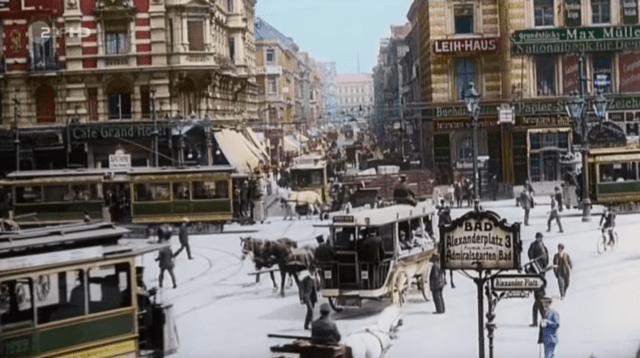
Although three decades had passed since the Franco-Prussian War and another decade and a half awaited World War I, the Berliners in this 1900 color film (with some 1914 scenes toward the end) of their city appear depressed. The elegance of their civic environment cannot have been to blame. Perhaps the militarism that seems to have infused their society was responsible. Next on tap, after this film of not quite five minutes is over, is a film, also in color, of Berlin in 1936, after Hitler’s rise, and then in 1945, after the end of World War II. Much different. And then one from 1954.

After it I watched a recent tourist film listing the top 10 attractions of Berlin. For all the great old buildings that almost unaccountably survive, Berlin in this film was very, very ugly. I was there with my brother, Tony, in 2004 or thereabouts, and as much as we tried to keep within the ambit of beautiful architecture – mostly in the former eastern sector of the once-divided city – the place seemed soulless. The non-architectural explanations for that are many, but the architectural ones should not be discounted.

[Note: Leon Krier, who knows Europe past and present far better than I do, warns me that many of the shots in the first film “are from Paris, Munich, St Petersburg. Moscow, Vienna and other European places.” And yet, the Berlin Channel labels the film as Berlin. I went through it again and could not find anything that was obviously not in Berlin, especially based on the shopfront signs, which were German so far as I could tell, but these could be in Munich or Vienna for all I know, and Leon knows so much more than I do. I would take him at his word. So let the viewer beware!]

Screen Shot 2017-09-13 at 2.37.03 PM.png

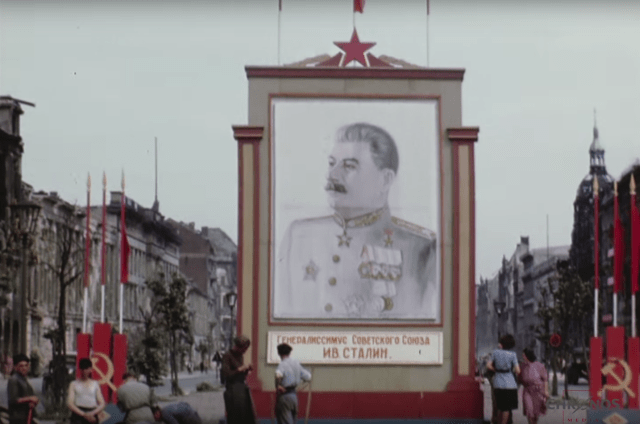
Portait of Stalin along the Unter den Linden, in Berlin of 1945. (Berlin Channel)

Posted in Architecture, Video | Tagged , , , | 1 Comment

Carbuncle Cup victor of 2017

Screen Shot 2017-09-12 at 9.14.30 PM.png

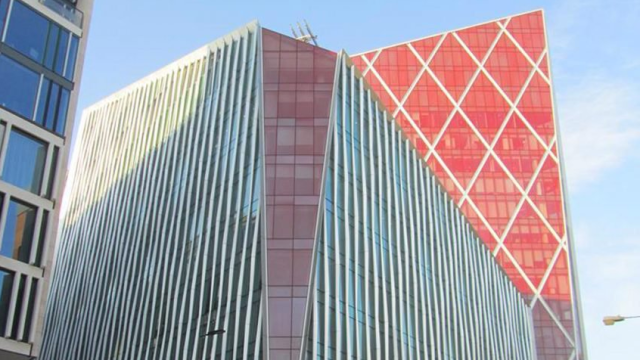
Nova Victoria, in London, this year’s winner of the Carbuncle Cub. (Dezeen)

This year’s Carbuncle Cup, awarded annually (three years now) to the worst new building in Britain, goes to a development called Nova Victoria, so called because it is what you see when you emerge from the Victoria Station tube stop. It is shown above. Dezeen describes it in “‘Crass’ London development wins 2017 Carbuncle Cup for worst UK building,” by Alice Morby.

Morby quotes urbanist David Rudlin, director of Urbed and chairman of the Academy of Urbanism, who said, “[T]he development was inefficient” – but Rudlin blamed the red spire on its south tower for its newly awarded “carbuncular status.” … “There’s no variety and you can’t read the floors. … It’s got the same proportions as Salisbury Cathedral. For me the spire gives it carbuncular status – otherwise it’s just a bad building.”

Another expert said the design, by PLP Architecture, attempted to channel Frank Gehry and Daniel Libeskind, “but had done so with little success.”

Gehry? I don’t think so. Libeskind? More likely. Until reading Morby’s story I had no idea that the red thing sticking up beyond the building at the center of the photograph was part of Nova Victoria, which it turns out is actually two buildings. Can the red thing really be described as a “spire”? Does the critic who saw Gehry and Libeskind in the design realize that she is accusing PLP Architects of copying the (recent) past?

Every time the Carbuncle Cup is awarded I ask the same thing I ask when a new Pritzker Prize winner is chosen. On the basis of what set of defined principles can a good modernist building be distinguished from a bad one? Shown a photo of this year’s Carbuncle Cup and this year’s Pritzker Prize winner, how would the average person be able to tell which is which?

I don’t know. Below is a building, the Musée Soulages in Rodez, France, by RCR Arquitectes, this year’s Pritzker winner, a firm whose three principals hail from the renegade wannabe Spanish region of Catalonia. One of my dearest wishes is to visit its capital, Barcelona, but I beg someone to tell me why the rusty building’s architect won the Pritzker and the … the … the one at the top, Nova Victoria, won the Carbuncle!

Screen Shot 2017-09-12 at 9.54.04 PM.png

Musee Soulages, in Rodez, France. (Pritzker)

Posted in Architecture | Tagged , , , , , , | 3 Comments

Brief interlude at the DNA

Screen Shot 2017-09-11 at 10.47.20 PM.png

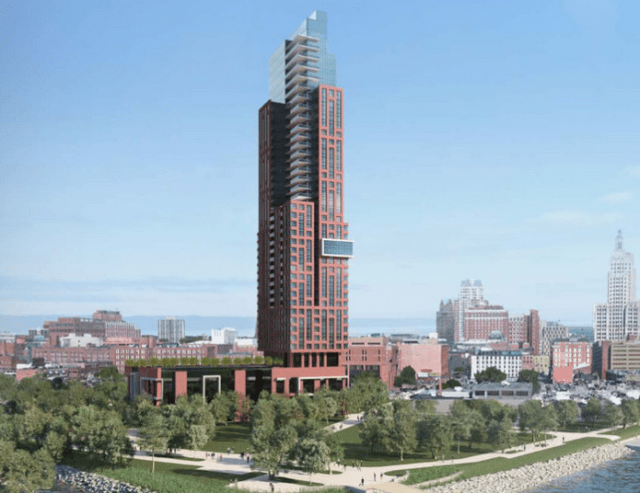
Hope Point Tower, down from three proposed slabs to one, in Providence. (Fane Organization)

When I was “Dr. Downtown” – my nom de plume at the Providence Journal – I was there at the creation of the Downtown Neighborhood Alliance, which met at the Regency under the presidency of my friend Maria Ruggieri, the famous jewelry designer. Tonight I attended a meeting of its successor, the Downtown Neighborhood Association, and made a very brief presentation about my book Lost Providence at the conclusion of the meeting. I even sold a book on the way out to a very nice couple also in attendance, Alan and Azure, who live in the Conrad Building.

The meeting focused on the Hope Point Tower proposal. Afterward I met I-195 commission director Peter McNally, who once told me that he didn’t know what traditional architecture had to do with economic development. Tonight, I described my book as an antidote to the ideas on which Jason Fane, the tower developer, bases his project, with which McNally’s I-195 commission is grappling. Well, I hope he reads the book!

But what interested me most was how the association’s president, Rich Pezzillo, grappled with the question of what is downtown Providence. He described its boundaries and how they differ from the city’s official definition of downtown. Sensibly, the DNA’s definition is not as extensive as the city’s official definition of downtown, which includes not only land on the East Side along parts of North and South Main streets but extends all the way south to include the Jewelry District, where the 195 corridor lies.

I’ve long argued that expanding the definition of downtown, as the city has, undercuts the city’s claim that Providence has a “walkable” downtown. Of course, walkability is in the feet of the beholder, but obviously the farther it is from one end of downtown to the other, the more unwalkable it is.

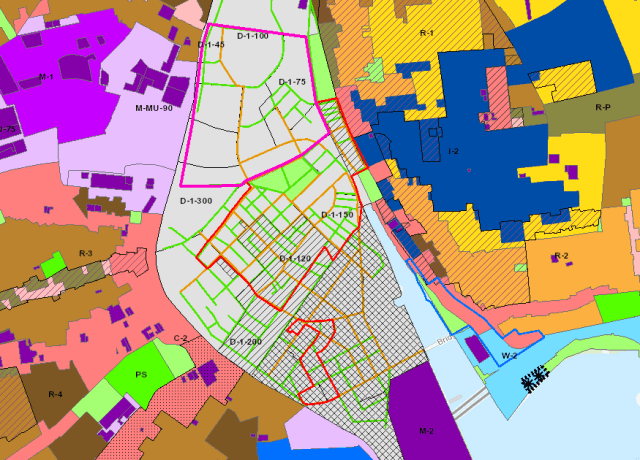
But actually, there is a greater reason that supports the loosest possible definition of downtown, and that is that downtown – the D-1 zone, to be specific – is protected under the city’s zoning code by Article 6, Section 606, whose intent is to “preserve the urban fabric of downtown Providence and ensure that new construction complements the historical character and architectural integrity of existing structures.”

Good! I think that protection should be extended to the whole city.

Thankfully, it does not need to be extended at all to put Jason Fane’s Hope Point Tower deep in legal shadows. It certainly does not complement the historical character of downtown.

Unfortunately, I forgot to ask Peter McNally about the Minion thingy going on about a third of the way up the slab of Hope Point Tower.

Screen Shot 2017-09-11 at 10.46.14 PM.png

The gray part of this Providence zoning map is the downtown (D-1) district.

Posted in Architecture, Urbanism and planning | Tagged , , , , , , , | 3 Comments

“In the Modern tradition …”

Screen Shot 2017-09-08 at 11.53.41 PM.png

Sixth Avenue. (The Real Deal)

Here is some more from High Rise, by Jerry Adler, a description of the process of erecting a skyscraper in Manhattan during the 1980s. Here Adler describes the design philosophy of Skidmore, Owings & Merrill – the modern era’s McKim, Mead & White, the architecture profession’s largest and most highly respected firm, as assertively modernist as MMW was assertively classical:

Skidmore, Owings & Merrill, founded in Chicago in 1936, is the most distinguished firm of architects in the world. It is distinguished not only for the number and significance of the buildings it has built, but also for its dedication to an idea, the idea of Modernism. So strong was SOM’s commitment to the philosophy enunciated in post-World War I Germany by Ludwig Mies van der Rohe, Walter Gropius, and others that the firm was once nicknamed the Three Blind Mies.

Ah! I like that!

The philosophy was of an architecture that expresses the highest intellectual ideals of the twentieth century, an architecture as pure as a prime number, as beautiful as an I-beam in its perfect fit of form and function. It was an architecture for an era that had looked inside the atom, in light of which it seemed absurdly petty and even dishonest for architects to be fooling around with dentillations and flutes and fillets on columns whose original function – to support the roof – could now be done so much more efficiently and forthrightly with modern materials. In their lack of superficial ornamentation and the crisp angles of their sheer glass walls, Skidmore’s buildings expressed confidence, honesty, and unity of purpose.

It is refreshing, for a classicist, to read a sincere paean to modernist principles in light of how they’ve fallen to earth over time. Nobody really believes in the principles anymore – which makes it all the more frustrating, for a classicist, that they still retain the same old magnetism of a century ago, when Adolf Loos wrote Ornament and Crime, or half a century ago, when Ludwig Mies van der Rohe – the king of “honesty” in the modernist world – used bronze I-beams to decorate (or hide) the steel piers upholding his Seagram Building.

But to continue with Adler’s paean to modernism:

In the Modern tradition, the architects of Skidmore, Owings & Merrill do not acknowledge the existence of distinctive individual styles. Modernism was not a “style” of architecture, nor did it contain “styles” within it. It was revealed truth, and therefore the end of style; its disciples were anonymous laborers among the pure planes and angles of God’s parti.

The parti is the essential idea of a building project. The parti of the high-rise of High Rise is “a building with enough glitz to stand out at Times Square but not enough to scare off potential corporate tenants.” Adler goes on to describe the mindset of Audrey Matlock, the SOM associate who, working under David Childs (the SOM bigwig), designed the building after developer Bruce Eichner switched the parti from hotel to offices and sacked Helmut Jahn, who was still its architect when I wrote my post yesterday. So here is Adler on Audrey’s mindset:

… Audrey’s architectural beliefs ran to a fairly rigorous Modernism, compared to those of most of her contemporaries at Skidmore. After fighting it for years, she had finally begun to make peace with the fact that she actually liked Sixth Avenue. Not every one of the buildings on it, maybe, but the much-maligned streetscape of mighty slabs in a row, majestic in their uncompromising conformity. You wouldn’t want the whole city to look like that, but it was astonishing and awe-inspiring to come upon half a mile of it, developed not in response to some arbitrary plan but by the convergence of the esthetic and practical ideals of a dozen different corporations.

Do I detect a slight, perhaps subconscious degree of damnation by faint praise here? Adler continues:

Anyway she’d rather have that than a city filled with the despised baubles of the last century. She loathed office buildings with colonnades, turrets and gables and finials, the whole fussy vocabulary of Postmodernism. She liked polished steel, translucent glass, and cool, textured stone in slabs.

There’s that word slabs again! How can a style of – oops, excuse me, an avatar of architecture be praised in conjunction with the word slab? Well, go figure. By the way, Adler imputes to Matlock the reigning confusion between postmodern and classical architecture. Postmodernism was cartoon classical elements plopped onto a modernist box, a phenomenon of the ’70s and ’80s that has now largely disappeared but which opened a crack in a door through which architects genuinely interested in a revival of classical forms managed to sneak back into the profession. Today they are the last best hope for beauty in the future of the built environment around the world.

Posted in Architecture, Urbanism and planning | Tagged , , , , , , | 5 Comments

“Shabby little old walkups”?

IMG_0129.jpg

Today at 7, Books on the Square, 471 Angell St. on Wayland Square, will host a book event for Lost Providence. But you already know that, so what about this:

The landscape of New York in fact is filled with monuments to the stubbornness, or greed, of property owners who insisted on planting their shabby little tenements squarely in the path of progress. In 1984, the real estate developer Seymour Durst and architect Andrew Alpern had published a book dedicated to exposing “the malevolent impact of holdouts on the face of the city” – namely, the millions of dollars in potential profits lost by developers who couldn’t build the buildings they wanted. They also deplored the esthetic effect of crummy old walkups juxtaposed with magnificent new glass office towers … .

Well, boo-hoo! If I didn’t already have a wife and kid for whom to dedicate my book, I would dedicate it to these folks with “irrational attachments” to the buildings deplored by the author of the book I’m now reading, High Rise, by Jerry Adler, published in 1993. Adler clearly sympathizes with the angst of his book’s protagonist, developer Bruce Eichner.

I imagine that the shabby little tenements and the crummy old walkups they deplore are the beautiful and forgotten buildings that make bearable a stroll among the “magnificent new glass office towers” of Manhattan. Perhaps in this case they are on the shabby side and cry out for maintenance. Still, I cry for victimized buildings like the old headquarters of Rizzoli Books, recently demolished for a new tower on 57th Street. And so I smile at the subtitle of Adler’s book: “How 1,000 Men and Women Worked Around the Clock for Five Years and Lost $200 Million Building a Skyscraper.”

Snake eyes! You lose! Ha ha!

Eichner hired Helmut Jahn, a flamboyant starchitect whose sun rose and set in the boom-boom 1980s, to design his tower at 1540 Broadway. Adler’s prose style is vivid, even though he describes a development culture that today is history. Still, I have a feeling that his book promises this reader a grand dollop of Schadenfreude.

Posted in Architecture, Development, Lost Providence, Uncategorized | Tagged , , , , , , | 2 Comments

‘Lost Prov’ reading Thursday

IMG_0128.jpg

Books on the Square will host a reading of an as yet undisclosed (and in fact unselected) chapter from Lost Providence on Thursday evening at 7 o’clock. I will also answer questions and sign copies of the book. My first two readings, at Symposium Books’ downtown launch on Aug. 28 – the date of publication – and at Barrington Books in Garden City on Aug. 31, were of Chapter 9, “Lost: The Outlet Company Store.” Thursday night I may eventually decide to read Chapter 15, “Downtown Providence 1970 Plan,” about the effort to save downtown by destroying it. That might be fun.

The book, which I wrote over a period of three months last summer and fall, is published by History Press, is based on a column I had written for the Providence Journal in 2014 called “Providence’s 10 best lost buildings.” The first ten chapters, Part I of the book, are devoted to those buildings (with side trips to existing buildings). Part II is dedicated to civic development projects between 1840 and the early years of this century. The book is a history of change in Rhode Island’s capital and an argument for respecting the state’s historic architectural heritage as the logical pathway to a more successful state.

Books on the Square is at 471 Angell St., in Wayland Square. Thursday’s event is free and open to the public.

DSCN9597.jpg

View of downtown from replacement of Union Station. (Downtown Providence 1970)

Posted in Architecture, Lost Providence | Tagged , , , , , | 1 Comment

Crane, yay! Building, boo!

Screen Shot 2017-09-05 at 4.46.17 PM.png

Rendering of 169 Canal St. (“Edge College Hill”) shows a spotty setting. (DBVW)

Providence breathes a sigh of relief at the appearance, finally, of a crane on its horizon, standing between Canal and North Main streets just north of Steeple. Enjoy the crane, folks, because you may regret the building.

Developed by Vision Properties, designed by DBVW Architects, and branded as Edge College Hill, the building leaves much to be desired. Its height grew from 10 to 15 stories during the development process. Fine. That is much taller than most of its neighbors. But its windows, set oh so slightly into its façades, register as plasticky and insubstantial. It is a box of syncopated fenestration – a modernist cliché. It copies the past – alas, the recent past, from which is purged the embellishment that creates love for buildings. Above the ground-floor retail, its 202 microlofts are aimed at students. As such, it has no provision for parking, perhaps its sole redeeming feature.

When time has decimated a neighborhood, leaving swaths of parking, it makes sense, when the moment at last arrives, to erect new buildings that match or exceed the aesthetic quality of the intact stretches of its nearby setting. Instead, we are to get 169 Canal St. – Edge College Hill.

Somebody has dropped the ball.

The Providence Preservation Society has done an excellent job protecting the beauty of this city since its creation in 1956. It has saved hundreds if not thousands of beloved houses and other buildings. However, PPS and other organizations that care about preservation fail to follow through. They fail to protect the settings of the buildings they preserve. Historic parking lots such as the one that 169 Canal will occupy play a subtle role. They preserve space for new buildings – often, as in this case, for decades – and we have every right to expect to love those new buildings. This standard was not met by Edge College Hill, and few in Providence development or preservationist circles seem to care.

A crane is not enough. It should exist to build a building worthy of the space it stands upon – even if that is just a parking lot.

Screen Shot 2017-09-05 at 4.44.03 PM.png

View of proposed 169 Canal St. from Steeple Street Bridge. (DBVW)

Posted in Architecture, Preservation | Tagged , , , , , | 3 Comments

ICAA’s Winter Intensive

Screen Shot 2017-09-03 at 11.35.28 PM.png

Nook with decorative classical items at ICAA headquarters in New York City.

The search is on, in New England and throughout the nation, for students and young professionals to participate in an intensive workshop on classical design for a week plus a day from January 6 to 13 at the Institute of Classical Architecture & Art, in its headquarters in New York City.

The New England chapter, on whose board I sit, is especially eager to find participants from its region to take advantage of the 2018 Winter Intensive, as the course is known.

A flyer describes the program as teaching “how to draw, identify, render, and compose with the classical elements to form an understanding of the basic tenets on which the classical tradition is founded. Topics include: the classical elements and composition, proportion, architectural representation through drawing and rendering, the study of precedent, and the literature of classical architecture.”

The course concludes with a panel of architects who will review a design of a small building performed by each student under the Beaux Arts system.

So this is not for the squeamish but for those who may be feeling a little, uh, squeamish about the course of study they are embarked upon, or the work they are assigned to do for the design firms where they are employed. These may be people who suspect that modern architecture – the sole curricula at almost all architecture schools, and the product of most design firms – may not be exactly what they want to design – perhaps because they have observed that most consumers of architecture – future clients – deep down don’t really like it any more than the average person does.

I am myself squeamish about proposing this course because its expense might put it out of reach for many readers. Nevertheless, not everyone who reads this blog lives in a hovel, however well designed, so here are the details:

The 2018 Winter Intensive would cost up to $2,100, exclusive of living expenses for a week in Manhattan. For some, the cost is reduced by $100 each through scholarships offered by La Polla Designs & Inspired Flooring, in Ronkonkoma, N.Y. Firms sending three or more employees would see the tuition drop by $400 each if they apply by Oct. 1. For students, the cost would be considerably less – $1,250. Membership in the ICAA further reduces the cost by another $100. Credits would accrue for an ICAA certificate in classical architecture. The deadline to apply is Friday, Oct. 27. (For more information, or to register, click the link above and scroll to the New York intensive.)

Kudos to La Polla Design for its generosity. No doubt its managers expect that a wider propagation of classicism will make it easier to find classically educated employees for their future needs. They also would expect to benefit by the nourishment of a substrata of finer taste among potential clients, which would be the ultimate result of the Winter Intensive upcoming and those going forward.

Indeed, how splendid it would be if firms of sense and sensibility around New England find these benefits worth chipping in to further reduce, by scholarship, the cost of the course for those in our region.

Screen Shot 2017-09-03 at 11.36.56 PM.png

Another nook of decorative classical items at ICAA headquarters.

Posted in Architecture, Architecture Education, Uncategorized | Tagged , , , | 1 Comment