N.D. grad’s Rome restoration

Yesterday’s post, “Preservation at Notre Dame,” introduced readers to the new Master of Science in Historic Preservation at Notre Dame’s School of Architecture. The program’s inaugural graduate, Eric Stalheim, investigated, for his master’s thesis, the restoration of the Roman Forum to public use as one among possible strategies of historic preservation.

The Forum, of course, was the center of Rome and the location of its main governmental structures. It did not originate as a single planned space but grew organically over the centuries. As with any such evolving place, a major question for preservationists who contemplate restoration must be where to “freeze” it in time. This is among the questions Stalheim encountered as he studied past restoration proposals. Another is whether restoring the Forum, either for daily use or as a museum, is feasible or even appropriate.

Today the Forum is, as program director Steven Semes describes it, a “gated tourist attraction isolated from the modern city and unusable by the city’s citizens.” It is a World Heritage Site, which limits a preservationist’s options. As a tourist attraction, it holds a venerable status as the remains of one of civilization’s great scenes of history. It is what it is – but do Rome’s citizens want to embrace the risk of transformation?

Certainly not right away, you might reasonably suppose. So Stalheim’s thesis proposes not an actual rebuilding of the Forum but an investigation of the idea of rebuilding the Forum. He writes:

This proposal simply builds upon previous exploratory inquiry by taking credible theoretical reconstructions of the past and investigating what would be required to realize such a proposal. This process requires that we understand how much we know about the monument in order to make a judgment about whether there is sufficient evidence to allow for full reconstruction.

Semes describes the structure of his investigation:

Eric first developed a master plan for the entire archaeological zone of central Rome, including the Roman Forum, the Imperial Forums, and the Palatine Hill, re-weaving the area back into the fabric of the city, re-establishing ancient and medieval routes traversing it, and uniting it to surrounding neighborhoods.

Exemplifying the sorts of balancing act preservationists must undertake was Stalheim’s hypothetical reconstruction, as described by Semes, of the Temple of the Divine Julius Caesar:

Because so little is known about the temple, Eric chose to protect the existing foundations in their current state and construct a new structure above them, occupying the same volume as the original temple and in a similar classical style, but employing modern materials like cast metal and glass. The new structure would protect the archaeological remains below while making possible a new civic use of the site, representing the previous volume of the temple and its podium without attempting to render its original material or detail. [It is the dark temple in the graphic illustration atop of this post.]

I shudder at the idea of reconstructing the temple in “modern materials like cast metal and glass.” I trust, however, that the program’s first graduate is not backsliding toward the practice, in much modernist-inspired preservation, of affirming contrast over continuity. Whether to rebuild an ancient monument using the materials and practices of the time would certainly be best, but is it feasible? Or perhaps an effort to mimic the old materials with new materials is more feasible, while accepting the inevitability of using modern methods and techniques, if it must be, in the actual work of rebuilding.

Questions like these are a large part of what preservationists must undertake to answer as they investigate specific cases, as many of them will do upon graduation. We all have reason to look forward to many more Notre Dame graduates such as Eric Stalheim, who want to protect what remains of the world we love as a model for building a future we can love even more – certainly more than what standard-issue preservation philosophies have all too often bequeathed.
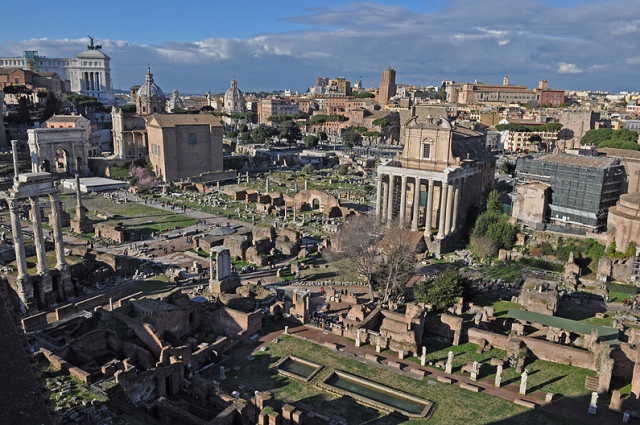
Screen Shot 2017-10-20 at 11.14.07 AM.png

The Roman Forum as it looks today. (Wikipedia)
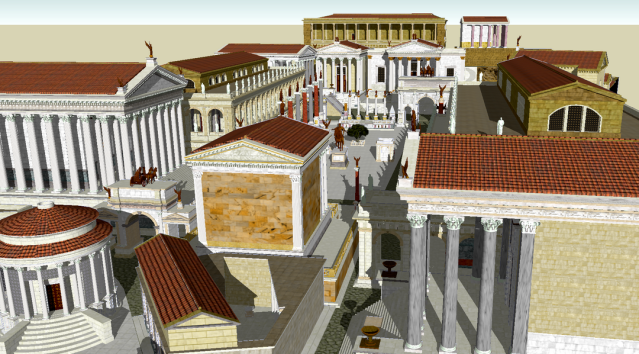
Screen Shot 2017-10-20 at 11.59.04 AM.png

Another reimagining of a rebult Forum. (From a 3D model by Lasha Tskhondia)

Posted in Architecture, Architecture Education | Tagged , , , , , , , | 21 Comments

“Best doors in the world”

Screen Shot 2017-10-18 at 7.48.35 PM.png

Carved door in Transylvania, Romania. (Chendu Stock Photos/Almy)

Screen Shot 2017-10-18 at 7.31.03 PM.png

The Art Nouveau doors to the left offer entry, according to a caption, to a building called the Maison aux Grenouilles (frogs) in Brelsko-Biala, Poland.

The doors are near the beginning of a collection of photographs labeled “Bejaroti ajtok: a village mind,” which arrived in my email inbox from my dear mother-in-law, Agnes, who received it from a friend of hers back in the old country – that is, Hungary (the friend now lives in Canada).

The doors in the topmost image are a set from Transylvania. I include them because Agnes’s friend, in her note sending the collection, had regretted that it had none of the carved wooden doors they’d seen together on a trip to Romania.

These are all marvelous doors, and I will point out, at the risk of a good tut-tutting from Agnes, that whoever assembled this collection did not feel obliged to include any “modernist” doors. Their forbearance is admirable.

The doors open a passage into the infinite creativity of sculpture in wood, stone and metal that extends back many, many centuries, to artists and craftsmen on every continent. They needed no boost from the machine aesthetic of our age. The imagery that decorate these doors is largely figurative. Like today’s mapmakers and today’s renderers of proposed buildings, along with today’s artisans in every art and craft, today’s door designers seem largely to have abandoned the effort that shines forth from the doors in this collection of photographs.

Are today’s artists less creative, less talented? I do not think so. They are in the clutches of modernist ideology, for whom creativity means designing something completely unlike anything ever designed before, rather than advancing, in ways large or small, existing methods of embellishment. That strikes me as equally if not more creative.

By the way, this collection arrived in a strange format. I cannot find it on the internet but it is (I hope) accessible by clicking on the following “Keynote” application. I hope it works also for those who do not have Apple computers.

Bejarati_ajtok_a_vilag_minden_tajarol

Posted in Architecture, Art and design | Tagged , , , , , , , | 2 Comments

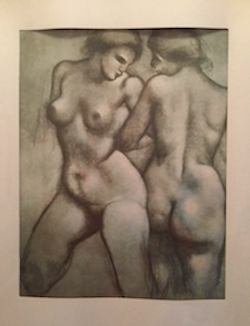
“Two Lesbians,” by Corbusier

Screen Shot 2017-10-17 at 11.30.05 AM.png

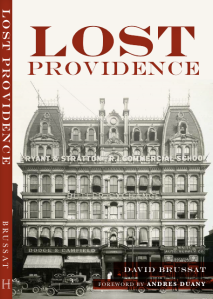
I have just started a book, newly published, that I’ve been awaiting for ages: Le Corbusier: The Dishonest Architect, by Malcolm Millais. It is a critique of Charles-Edouard Jeanneret-Gris, better known as Le Corbusier, or Corbu. One of Millais’s earlier books, Exploding the Myths of Modern Architecture (2009), was praised to the skies by Andrés Duany, the author, among many other things, of the forward to my book Lost Providence.

But enough of mutual admiration societies. What about lesbians?

Well, I was cruising again through this excellent book (I read it in manuscript form a year or two ago) and came across some material I don’t recall seeing the first time around. (By the way, this is a family blog, so those under 18 should have averted their eyes by now.) The passage, on page 26, reads:

While lurching from financial crisis to financial crisis and before becoming a Purist, Edouard had continued to paint. Voluptuous nude women had entered his pictures in 1912, “Nude with Tulip,” “Two Naked Women Lying Down,” and the openly erotic “Two Lesbians.” This all changed with Purism in 1918, and it was whilst he was doing his first Purist painting that Edouard went blind in his left eye.

Screen Shot 2017-10-17 at 1.15.18 PM.pngTwo lesbians! Whoa! I have a sketch, or maybe it is a painting, of two lesbians – or at least so they seem to be – in our smallest room on the first floor of our house, hung along with two milder sketches by one of my favorites, Heinrich Kley. You can see all three at the top of my post. I got them from my father, who had them hanging in the first-floor bathroom of the house where I grew up in Washington, D.C.
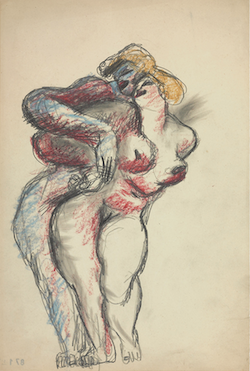
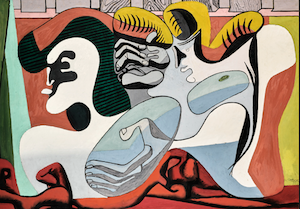
My two lesbians are not only figurative but the draftsmanship is far superior to what Corbusier was known to produce. Still, is my print the one by Corbusier? I doubt that. He is not exactly known for his representational work! But judging by the image below left, which is known to be by Corbusier, it could be. Look at the faces! But it is definitely a sketch, not a painting, so presumably it is not the one referred to above by Millais. Besides, it is dated circa 1926, well past the period that might have produced the print on my wall. Millais describes “Two Lesbians” as hailing from before Corbusier’s Purist work. Yet, you never know, do you, about those stray works of art?

Screen Shot 2017-10-17 at 1.31.02 PM.png

So if anyone can identify the picture just above to the left, I’d love to know whether I have reason to purge my WC art. Kidding. The work below, also by Corbusier, appears to be a painting from a later period that, I imagine, shows the influence of his Purism.

Screen Shot 2017-10-17 at 2.37.51 PM.png

Posted in Architecture, Art and design | Tagged , , , , , , , , , , | 10 Comments

Battle of the 195 riverfront

Screen Shot 2017-10-16 at 10.37.11 PM.png

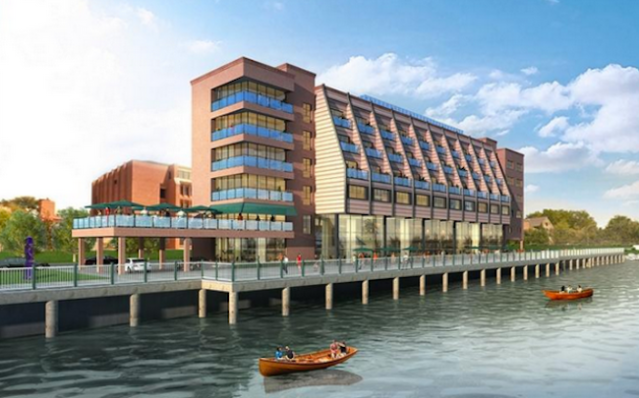
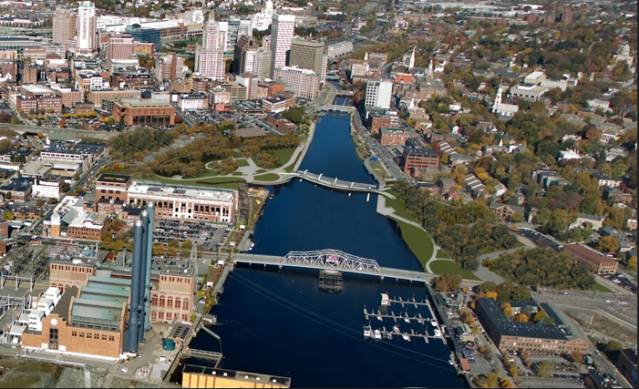
The proposed hotel would sit just north of the east end of the wavy footbridge in this illustration of what the 195 district could look like – minus its regrettable new buildings. (The River Church)

The I-195 Redevelopment District Commission gave Level 1 approval this afternoon to a hotel proposed for the water’s edge east of the Providence River, a place from which the colonists’ assault on the British revenue cutter Gaspee was launched, drawing first blood in the American revolution. The land deserves a more public-spirited purpose than a hotel.

Bob Burke, owner of Pot au Feu restaurant and an activist historian, stood up before the commission and cited other reasons this bit of waterfront is historic, and he was seconded by the state’s historian laureate, Patrick Conley. Burke still hopes the land can be used as a welcome center and museum for the city and state. One of the original 13 colonies, Rhode Island is the only state that has no such facility.

Burke would relocate to the site of a small nearby building, the Welcome Arnold House, built in 1785 and now under threat of demolition. He would use it to house a museum to explain Rhode Island’s revolutionary role and how Yankees high and low in status lived in that period. It would also serve as the headquarters for his Independence Trail, an active nonprofit that  is comparable to (and often confused by the 195 commission for) the Freedom Trail in Boston.

Importantly, Burke’s plan would take up less than 15 percent of the footprint of the hotel, which would be at least five stories tall and and plug-ugly to boot. More suitable to an airport access road, I’d say; someone liked my “1970s retread” description from Friday’s post, “Better idea for I-195 riverfront,” but that understates its carbuncularity.

Several commissioners pooh-poohed the design. When the commission’s consultant was asked for more specificity on how design changes could render the hotel more agreeable, he hemmed and hawed but said nothing to suggest that he even knew how to fudge the answer plausibly.

And yet state Commerce Secretary Stefan Pryor, in remarks just before the vote, insisted that “architectural design is extremely important,” building hope that the design might evolve in a positive direction. Still, members of the commission and its staff seem tone deaf to the beauty of Providence, let alone why it’s so beautiful, and lack any apparent willingness to protect its historical character, as city zoning requires.

Section 600 of the Providence Zoning Code reads:

The purpose of the D-1 District [downtown, now extended into the Jewelry District] is to encourage and direct development in the downtown to ensure that: new development is compatible with the existing historic building fabric and the historic character of downtown; historic structures are preserved and design alterations of existing buildings are in keeping with historic character.

But nothing the commission has approved thus far pays even lip service to this zoning language, which has the force of law. So I have little confidence that a redesign will improve the hotel significantly. It might end up featuring a faux-historical look, like a CVS in a town that has sought corporate design relaxation; it would end up pleasing nobody. Or the developer could hire an architect who knows how to do it right. Stranger things have happened.

Unfortunately, zoning here, as in most places, is designed not to frame the public’s sense of how their city should look and operate, but to help developers ignore such frivolous concerns.

As important as the hotel’s design is, its size looks largely irreducible, and thus it implicitly violates the concept of view corridors, which properly informs the I-195 development guidelines. Under those guidelines streets form the district’s view corridors, but the Providence River itself forms the city’s most natural and obvious view corridor. The hotel would break the uncommonly straight “street edge” formed by the building façades along South Water Street on the river’s east side.

The Burke plan might be feasible along a more southerly stretch of the river, perhaps on land devoted to the district’s abundant string of parks. Even so, the proposed hotel is a sucker punch to the Providence River. It should be stopped – barring the extraordinary unlikelihood of a design so good that it would moot concerns for the view corridor.


Posted in Architecture, Development | Tagged , , , , , , , , , | 13 Comments

Better idea for 195 riverfront

Screen Shot 2017-10-13 at 11.03.44 AM.png

Illustration of proposed hotel on Providence River by Gerald Fandetti. (Kendall Hotel LLC)

It appears that the I-195 Redevelopment District Commission may vote Monday to grant initial approval to a hotel proposed for a parcel along the Providence River embankment just east of the shore. Earlier reports say that the modernist design of the proposed hotel – a 1970s retread – might be redone to better reflect the historical character of the area.

I hope so, but the commission ought nevertheless to reject its so-called Level 1 approval and delay the hotel in light of a better idea that arrived at the commission’s doorstep before the hotel and deserves prior consideration.

The idea was delivered to the commission last spring by Bob Burke, owner of the Pot au Feu restaurant in the Financial District. His proposal would move the Welcome Arnold House (circa 1785), on Planet Street in Fox Point, to the site of the helicopter pad next to the river, where the hotel is to be located.

The owner of the Welcome Arnold House has withdrawn his application to demolish it and now wants to rebuild it. Since the interior is gone already, let him build an entirely new house, inspired by the original one, and let Burke move the shell of the existing exterior a few hundred feet down to the river.

Why? Because Burke, who is a historian at heart, wants to reconstruct the interior as it might have been in 1785. The house would become a nonprofit educational center – providing an experience for students and tourists of how New Englanders lived during the early days of our nation. It is difficult to believe that such a facility does not exist in this historic city.

But wait, there’s more!

Burke also hopes to reconstruct at that location a replica of the original 1636 homestead of Roger Williams, Rhode Island’s founder, on what is now North Main Street. The house was demolished as late as 1840 to make way for the James Hazard House, which still exists at 235 North Main. An exercise of historical imagination would be required, since we know no more what Roger Williams’s house looked like than what his face looked like.

Both parts of this plan are incredibly exciting, and Burke says that he is ready to move on it, if the 195 commission will let him. The two structures would take up a fraction of the footprint of the proposed hotel, and leave the water’s edge open to the public.

As Burke points out, the Rhode Island Constitution’s Article 1, Section 17 protects Rhode Islanders’ right to access the shore, and Burke argues that the hotel would limit the public’s access to a degree that could be actionable. All sorts of documents provide evidence of this: the site’s designation as historic, the Final Environmental Impact Statement for the relocation of Route 195, the Old Harbor Plan officially proposed well before Route 195’s removal was planned, and statements from the State Historic Preservation Office delineating its protected status.

Burke, while he quivers with pleasure at how his plan would serve history and the public, is somewhat miffed that the commission has not yet bothered to address his proposal, which it had before the hotel proposal. Why?

Well, perhaps because the hotel, as a business, would generate more revenue for the state through taxes. But such an expectation may be unwarranted. If you subtract the hotel project’s state subsidies and add the value of Burke’s proposal to the state’s tourism potential, the latter could add more to the state’s economy and its coffers – not to mention its delightfulness – than the hotel. Either way, that does not justify discrimination in the handling of a serious – indeed, a scintillating – public proposal that was first in line.

All of this suggests that a responsible due diligence would require that Bob Burke be heard at Monday’s commission meeting, and that his proposal’s suitability be adjudicated before the commission considders the hotel.

Screen Shot 2017-10-13 at 5.40.55 PM.png

Welcome Arnold House, 21 Planet St.

Posted in Architecture, Development, Preservation | Tagged , , , , , | 4 Comments

Goldberger & Goldhagen

Screen Shot 2017-10-12 at 12.48.49 PM.png

Goldhagen likes U.K. Pavilion, by Thomas Heatherwick, at Shanghai World Expo. (domusweb)

The Nation magazine has a review by Paul Goldberger of a book by Sarah Williams Goldhagen, also a respected architecture critic, called Welcome to Your World: How the Built Environment Shapes Our Lives. Goldberger’s review, “A Shimmery Cube,” applauds Goldhagen in ways that you might expect when a modernist critic encounters a modernist book.

Goldhagen argues in her book that architecture affects our feelings and our well-being. That’s not a novel insight. Winston Churchill stated that “we shape our buildings; thereafter, they shape us,” and that was not news either. As Goldberger reports, Goldhagen “tells us that the problem with how we understand architecture ‘is an information deficit. If people underestood just how much design matters, they’d care.'” What neither, in their modernist silo, understands is that people do care about architecture, but because modernist architecture is so alien to most people, they tune it out.

Her solution to the “problem” of modern architecture’s unpopularity with the public is the same as generations of architecture critics, theorists and practitioners. The public just doesn’t understand and requires more time in architectural re-education camps.

“Goldhagen,” writes Goldberger, “believes that she is coming to us with news of recent scientific discoveries that will change the way we think about and experience buildings.” She is wrong. Recent scientific advances are meant not to change the way we humans experience buildings but to explain the way we experience buildings. There’s a difference. We will experience buildings the same whether we have read these scientific studies or not. I imagine that Goldhagen thinks we will find it easier to like what we do not like if we can say we read a study that, in her view, justifies our evolving taste.

Goldhagen’s assertion is aspirational, but she is only interested in scientific advances that she can twist to support her own prejudices. Here is a passage from Goldberger’s review that lets the cat out of the bag:

Most claims that humans respond naturally to certain shapes have really been arguments for traditional building, many of them influenced by the writing of the architectural theorist Christopher Alexander, author of A Pattern Language and The Timeless Way of Building. Goldhagen deftly tosses the whole idea aside as “a pastiche of sociology and nostalgia”; she is not writing a screed in favor of traditional building, but rather wants to help us under- stand that comfort does not always correlate with what’s conventional.

Of course, what’s conventional these days is precisely the work of egotistical modernists among whom she parcels out praise or blame according to her discovery that scientific research states that humans prefer gentler, “lilting forms” over “sharp, irregular, angled forms.”

Well, duh!

So it’s angular Daniel Libeskind – bad! Swoopy Frank Gehry – good! But most of the public rates both as equally at odds with the traditional buildings and streetscapes they love. The public is skeptical of modern architecture, and will be skeptical no matter how “informed” they are.

Goldhagen believes that modernist architects are like traditional architects in that they seek to build structures whose forms comfort the public. Some, perhaps, but since the early days of modernism, architects – or at least the founders of modern architecture – have been more concerned with creating buildings and cities that treat humans efficiently as cogs in the machine architecture supposedly demanded by a machine age.

In another revealing passage, Goldberger’s review states:

She also believes that [people] need community, a sense of accessibility, and visual variety and stimulation, although not to the point of confusion and chaos. People respond to patterns and to a human scale; soft forms are better than hard ones, refinement better than crudity. Goldhagen dislikes buildings that might be considered arbitrary or aggressive. But none of these are hard- and-fast rules, and creativity always overrides formulas.

Well, of course. But if by her word formulas she means traditions in building, her exaltation of creativity is wrongheaded. Creativity is great, but architects who find new ways to elevate old methods of achieving beauty are just as creative, perhaps more so, than architects who develop new building forms unlike any ever before developed. In fact, the latter, experimental design often leads to more of what Goldberger lists as forms Goldhagen dislikes.

Goldberger writes of Goldhagen’s argument, “Its hard to argue with any of this.” No it’s not. He writes, “She is an articulate and consistent advocate of the kind of civilized, humane built environment that most of our best critics and historians have long favored.” Huh? What existing built environment do all of these enlightened souls have in mind?

It’s hard to imagine Goldberger arguing with Goldhagen. She is preaching to the choir, and he is the choir. To anyone not in the choir Goldberger’s review reads like a string of gag lines. I’m sure that Goldhagen’s book offers an even greater trove of delights.

Screen Shot 2017-10-12 at 12.51.52 PM.png

Goldhagen dislikes Jean Nouvel’s Serpentine Gallery pavilion, in London. (EPSE)

Posted in Architecture, Books and Culture | Tagged , , , , , , , | 17 Comments

“Lost Providence” explained

Screen Shot 2017-10-11 at 8.53.47 PM.png

Weybosset Street, in downtown Providence. (Lost Providence)

I just submitted my October post for my blog at Traditional Building, entitled “Monument vs. Fabric, or the difficulty of admitting deep error.” This means I am free to post my last month’s TB post on my Architecture Here and There blog. It was called “Lost Providence: How to interpret my new book.” Here is that interpretation as enunciated by its author.

First, a passage from the TB interpretation of the book:

Since the late 1940s and ‘50s, modern architecture has attained such a stranglehold on the field of architecture that the prospects for reform have seemed bleak. It took modernism only a couple of decades to go from niche curiosity to the conventional wisdom. Tradition has been trying to stage a comeback since the late 1950s, when Henry Hope Reed published The Golden City. What gives me hope is the speed with which historic preservation transformed itself from a hobby to a mass movement – an ongoing social revolution triggered far less by a love of history than a desire to preserve local beauty from the threat of modern architecture. Reforming the field could happen in the blink of an eye.

Stranger things have happened – such as how it took modernism only a couple of decades to go from niche curiosity (see H.L. Mencken’s dismissive editorial, “The New Architecture,” in the American Mercury of February 1931) to conventional wisdom. Should I take on that subject as the topic of a new book? Hmm.

Posted in Architecture, Lost Providence | Tagged , , , , | Leave a comment

“Lost Prov” at Lippitt House

Screen Shot 2017-10-10 at 8.07.04 PM.png

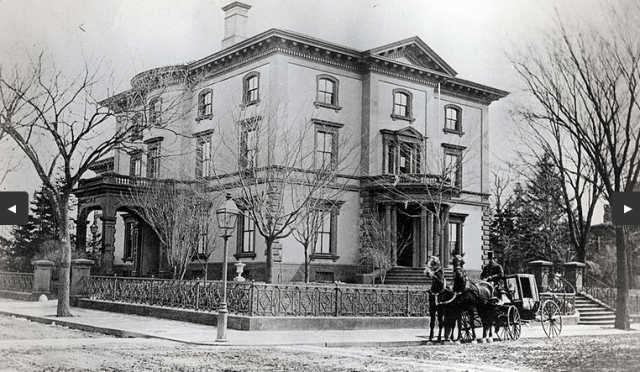
Henry Lippitt House, circa 1880. (Preserve Rhode Island)

The Lost Providence dog and pony show looks forward to luxuriating, on Thursday evening, at the Henry Lippitt House Museum, on the southeast corner of Hope & Angell streets. Hosted by Preserve Rhode Island, the event begins with a reception for the author at 6:30. His illustrated talk begins at 7. The evening is free to members of PRI and $5 for the general public.

This is simply a divine location for a lecture.

Henry Lippitt designed and oversaw the construction of the house in 1865. Beginning in 1875, the textile heir served two one-year terms as Rhode Island’s governor. He and three succeeding generations of the family lived in the mansion until 1979. After its acquisition by Preserve Rhode Island, it has served as a house museum since 1993. PRI has this to say about the physical characteristics of the house:

[T]he house is a three story, thirty room Renaissance Revival villa with Italian palazzo elements. Embellished with elaborate faux finishes, colorful stained glass windows, ornate woodwork details, and surviving original furnishings, the house is also significant for its pioneering heating and plumbing systems.

We love that!

In Part I of Lost Providence, the author uses a sort of “editorial he” language to refer to himself (as in, for example, “your distinguished correspondent”), but starting with Chapter 19 (“We Hate That”) in Part II, he begins to use the first person singular to refer to himself. An explanation why, if anyone wants to know, might be sought during the Q&A session after Thursday’s talk.

Unless a new event pops up unexpectedly, this will be the last occasion this year to sit down and drink in my curious discourse about Providence’s history of architectural change, and what the future might (and should!) bring. Not until Feb. 28, 2018, at the Johnston Historical Society, is another such opportunity scheduled to occur.

In the video below, the author’s family reacts to the discovery of a sign on the railing of the Lippitt House. The illustration on the sign is a drawing of Weybosset Street from the Downtown Providence 1970 Plan, which in 1960 announced the “Eradication of History as a Development Strategy,” as the author of Lost Providence describes it in Chapter 15. (It is easy to slip in and out of the “editorial we.”)

Posted in Architecture, Lost Providence | Tagged , , , , | Leave a comment

Henry James’s Fort Chester

Screen Shot 2017-10-09 at 8.07.48 PM.png

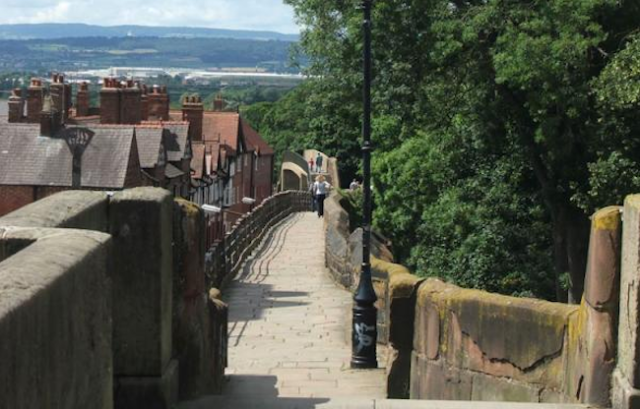
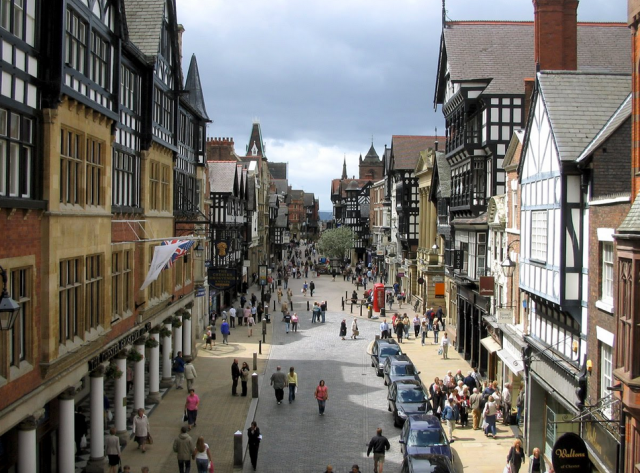
Part of the city wall at Chester, England. (treasuredays.com)

At the outset of his novel The Ambassadors, Henry James describes a couple meandering through Chester, England, once a Roman town, near today’s industrial city of Liverpool. His description evokes the subtleties of living architecture as well as I have ever seen it expressed. Not long ago I blogged passages from The Princess Casamassima. There is a book that compiles the best of James’s writing about cities – mostly from his novels, I suppose. I will not rest until I find that book, and when I find it I will be able, when the muse is on strike, to fill a quick post with a dear passage. Like this one:

The tortuous wall – girdle, long since snapped, of the little swollen city, half held in place by careful civic hands – wanders in narrow file between parapets smoothed by peaceful generations, pausing here and there for a dismantled gate or a bridged gap, with rises and drops, steps up and steps down, queer twists, queer contacts, peeps into homely streets and under the brows of gables, views of cathedral towers and waterside fields, of huddled English town and ordered English country. Too deep almost for words was the delight of these things to Strether.

In English Hours, which James wrote, according to a note at the rear of The Ambassadors, in 1905, he further adumbrates the joys of “the tortuous wall”:

The civic consciousness, sunning itself thus on the city’s rim and glancing at the little swarming towered and gabled city within, and then at the blue undulations of the near Welsh border, may easily deepen to delicious complacency.

Ahhh!

Screen Shot 2017-10-09 at 8.25.29 PM.png

Central Chester (ytimg

Posted in Architecture | Tagged , , , , | 2 Comments

Where’s the “beauty” beef?

Screen Shot 2017-10-07 at 7.36.11 PM.png

The public was asked to choose from these four actual buildings. (Beatus Est)

A couple of days ago, aware that I’ve been going around telling people that the public prefers traditional to modern architecture by huge margins, my dear mother-in-law, Agnes, asked me a good question: “Where’s the beef?”

There is a lot of evidence, and I am compiling it for her, but here’s one classicist’s reply to a modernist critic’s response to a survey that pointed out (what seems to me to be) the obvious. Commissioned in 2008 by ADAM Architects and the Traditional Architecture Group, in London, the survey showed four buildings – two traditional and two modernist – and found that of 1,042 members of the public asked which they’d rather have near their homes, three-quarters preferred the traditional buildings.

This brought on Jonathan Glancey’s critique of the survey in The Guardian and the reply to it from Erik Bootsma (whom I met on a trip to D.C. a while back) on his blog Beatus Est. His reply is entitled “When a Survey Shows Britons Prefer Classicism, Architects Attack!” (Unfortunately, neither Glancey’s piece nor the study itself are still available online.)

After describing the survey, Bootsma begins his response to Glancey :

Much to the surprise of the architectural establishment (but to neither Adam nor myself) the public preferred the traditional schemes by a three to one ratio. Predictably, though, the architectural press and heads of the prestigious architecture organizations in Great Britain used the survey as a launchpad for their invective against traditional architecture and ultimately on the public at large.

Bootsma goes on to tag Glancey’s unfair rhetorical thrusts and his clear disdain for the public. It’s a fine read. I wish I’d written it myself!

Back with more soon, Mom!

***

By the way, my next lecture – during which I will claim, yet again, that the public prefers traditional to modernist architecture by overwhelming margins – will be next Thursday, Oct. 12, at the Lippitt House, corner of Hope & Angell. Sponsored by Preserve Rhode Island, the event begins with a reception for the author at 6:30 p.m. and an illustrated lecture at 7 p.m. It is free for PRI members and $5 for the public. This will be my last scheduled public appearance until the Johnston Historical Society hosts me on Feb. 28, 2018.

Posted in Architecture | Tagged , , , , , , , , | Leave a comment