Throop Alley & other tidbits

Screen Shot 2018-02-14 at 8.42.57 PM.png

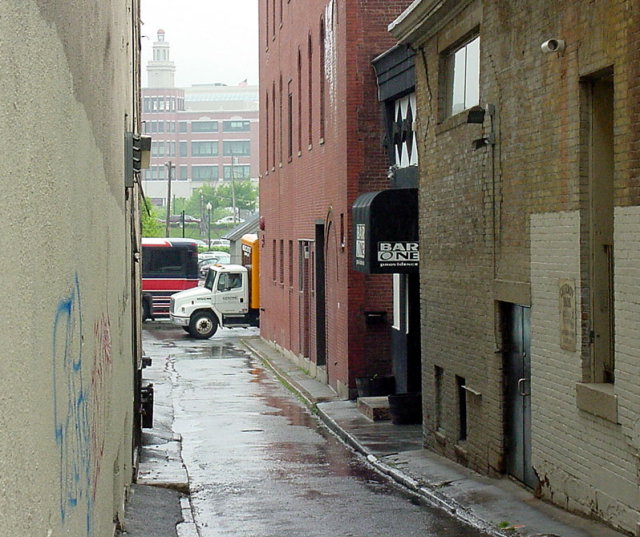
Throop Alley, to be abandoned for a building on Canal Street. (

An agenda item for an upcoming meeting brought home to me the sadness and even the anger attending some of the more pernicious projects being sold around here as “economic development.”

The agenda for the Tuesday, Feb. 20 meeting of the City Plan Commission notes that the city has been asked to abandon Throop Alley, between Canal Street and North Main Street. In recent years, the alley had been the front door to loud music blasting from local clubs. It was not my kind of place, really, but it was one of those little urban nooks that might be described as “authentic.” (Who was Throop, anyway?)

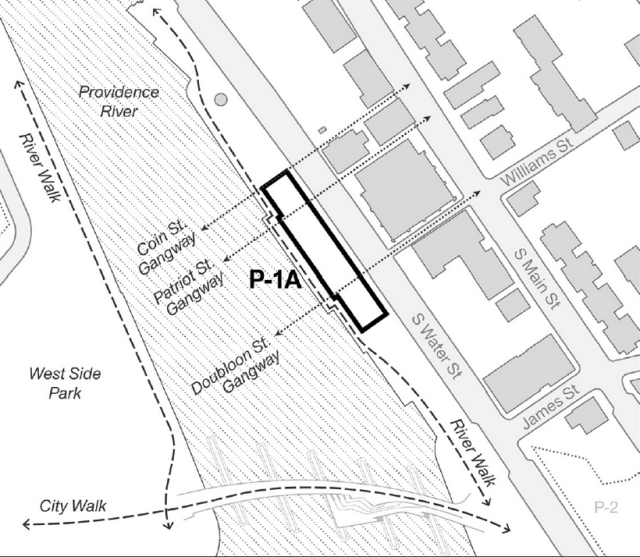
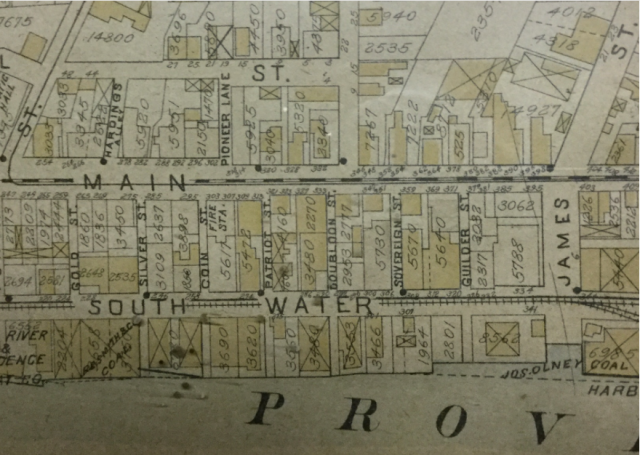
The other day I mentioned that a major proposed development on the east side of the Providence River would preserve Dollar Street. Development news now puts two other gangways at risk. Gangways are narrow old streets that once linked to wharfage along the river in many old waterfront cities. The hotel proposed for Parcel 1A of the Route 195 corridor along Water would eliminate Doubloon and Patriot streets. Regulations require that Doubloon and Patriot be preserved, but the real sticking point for the hotel developer is the land between the hotel and the water’s edge. Seems under the current hotel configuration there would not be enough of it.

A ruling of the Coastal Resources Development Council against the hotel on those grounds would probably doom it. That’s what Olin Thompson told attendees at the Jewelry District Association meeting last night. Just when that decision will be made is unclear.

Far clearer is a ruling that could doom an even more damnable project, the Fane tower, whose proposed 46 stories is about 36 stories higher than zoning allows. That is too much for an exemption from the rules: a change in the rules is required. It can be made only by the city council, which must act within 90 days of the 195 commission’s decision, on Feb. 1, to give the project a Level II approval. So the clock is ticking, Mr. Fane.

Providence now has a zoning ordinance that to some extent reflects the will of its citizens. If Jason Fane is able to convince council to change the height requirement to permit a building almost four times the currently allowable height, then for all intents and purposes no zoning ordinance exists. Anyone will be able to change any rule. All rules will beg to be ignored. That is why people must monitor the meeting schedule of the council and attend that meeting to oppose that change.

The JDA and other neighborhood groups will play a major role in marshaling a big thumbs down on this sore thumb in the Jewelry District.

Screen Shot 2018-02-14 at 8.44.24 PM.png

The footprint of the proposed hotel on 195 land east of the Providence River. (195district.com)

Screen Shot 2018-02-14 at 8.47.31 PM.png

Gangways between South Main and the river, including Doubloon and Patriot. (Brussat archives)

Posted in Architecture, Development | Tagged , , , , , , | 7 Comments

Providential hand on sea rise

Screen Shot 2018-02-13 at 10.04.50 PM.png

A ferry tilts in its slip (now Peck Street) downtown after the ’38 hurricane. (Digital Commonwealth)

The Jewelry District Association invited Barnaby Evans to speak about the future of WaterFire. That sent a shiver up my spine. Was the end nigh?

No, Evans did not say WaterFire was doomed. He did suggest that sea-level rise might inundate the world’s greatest art installation, along with the city of Providence, if we let it. To be sure, the sea isn’t rising fast enough to help us dodge the dire need to dredge our rivers. Nevertheless, he did say that compared to almost every other city on the eastern seaboard, Providence is far better able to cope with the danger of sea rise over the next few decades. If true, that is good news indeed.

It seems that history has dealt this state’s capital a lucky hand, at least compared with Boston, New York, Miami, Charleston and the other cities facing the upstart Atlantic Ocean. First, the hills dug out eons ago by a glacier act as a natural barrier to the inundation of our downtown. Second, we have the Hurricane Barrier, erected the decade following Carol. Third, we have a history of bold steps to leverage a safe future through infrastructure. That history stretches way back to include not only the Hurricane Barrier but the river relocation project of the ’90s, the highway relocation project of the ’00s, the combined sewer overflow tunnels dug beneath the city in the last decade, and many others, all the way back to the Blackstone Canal of 1828.

In spite of all this, Rhode Islanders believe we’ve been down so long it looks like up to us! But in fact, according to Evans, we are in the catbird seat.

He had a lot of maps and charts to explain how almost every other city along the Atlantic seems doomed to drown, but not us. Some of this arouses a natural skepticism. The point, however, is that if Evans is correct, Providence can not only manage sea-level rise at a far smaller cost than most other cities, but can use its inside straight to sell itself as an impregnable location. In this age of environmentia nervosa, that could be key to winning the economic sweepstakes with rival cities and states, possibly enabling authorities to jettison some of the development subsidies they now feel obliged to offer.

If only civic leaders could manage to solve the easiest of problems! How can we use civic development to strengthen rather than weaken the brand of the city and the state?

Duh.

Speaking of which, after Barnaby Evans was done, Olin Thompson of the JDA gave a rundown of where things stand with the I-195 Commission’s plan to make the Jewelry District as ugly as it can be. Major hurdles impend for two projects, the 46-story Fane tower and the clunky hotel proposed for Parcel 1A on the east bank of the Providence River. I will try to post the news on that tomorrow.

Posted in Architecture, Development | Tagged , , , , , , , , | 5 Comments

Olympic venues, 2018: wow

Screen Shot 2018-02-12 at 5.48.05 PM.png

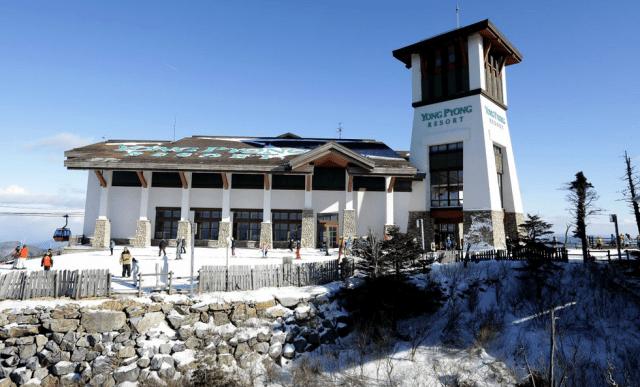
Yongpyong Alpine Center, in Pyeongchang, South Korea. (Getty Images)

To judge by my online Google search under “2018 olympic architecture,” the athletic venues and other structures built for this year’s Winter Games in Pyeongchang, South Korea, failed to capture the interest of the major architectural media.

Screen Shot 2018-02-12 at 7.39.39 PM.png

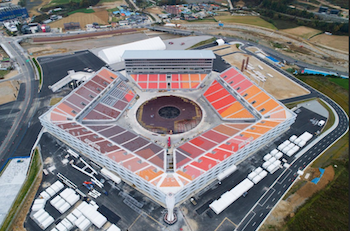
Olympic Stadium at Pyeongchang. (Kyodo News)

Maybe this professional yawn has something to do with one of the venues, the Yongpyong Alpine Center, which is traditional. (See above.) “Hey!” cried the combined editorial staff of the global architectural media, “They seem to have forgotten to get with the modernist program! That will surely impact their overall technical score in a negative manner!”

The Olympic Stadium (above left), where the lovely opening ceremonies took place last week, is a pentagon, of all things, lower-cased but no doubt still too close for comfort to the one in Alexandria, Va. Won’t that undercut the heroic Olympic diplomacy between Seoul and Pyongyang?

Where are the gravity-defying alien spaceships we’ve come to expect at the Olympiads of the past several decades?

I could find only one attempt to display a wide range of venues and none displaying every facility. The former was not in Architect, or Architectural Digest, or some other established architectural media outlet. No, it was in Business Insider: “South Korea spent over $1 billion on these mega-venues for the 2018 Winter Olympics – take a look!” by Leanna Garfield.

Scroll down and you’ll see more than your share of modernist venues, except that most of them are relatively modest affairs that look like standard-issue modernist stadia and sports facilities, eschewing the seriously over-the-top Look At Me-ism that host nations think they are expected to provide.

Screen Shot 2018-02-12 at 6.04.23 PM.png

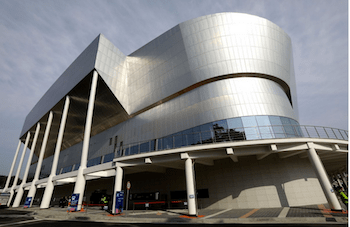
Kwandong Hockey Centre. (Getty Images)

The only entry in that category at Business Insider is the buggy, sinister Kwandong Hockey Centre, located in Gangneung. Its strutting, jut-jawed Metallica-wannabe form may seek to recapitulate the stereotypical guy athlete persona. It looks hard, if not muscular. Has it suffered a concussion? Where is its helmet!? Oh. It is a helmet!

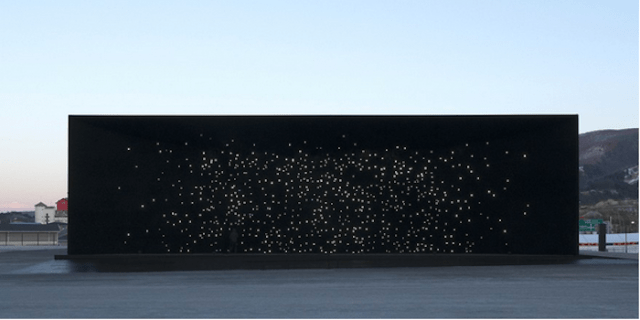
Oddly enough, the most celebrated of the modernist structures to go up among South Korea’s archipelago of sites was not included in the Business Insider report. It is the black box financed by Hyundai and covered as a solo phenomenon in several magazines. Architect maggie devoted a piece to the “Hyundai Pavilion,” designed by London architect Asif Khan. The pavilion is coated entirely in a material called Vantablack VBx2, which absorbs 99 percent of all the light that hits it, “diminishing its three dimensionality and creating,” says the architect, “the illusion of a startling black void in broad daylight.” The blackest of blacks – “superblack” – with bright stars embedded in its exterior façades.

Sounds fascinating. Looks boring. Yet it ought to have been in that roundup.

But hey, the Pentagon didn’t make it into Business Insider either.

Oh well. Maybe the next Summer Games, 2020 in Tokyo, will be ridiculous enough to spark sustained interest from the profession’s media big-feet!

Screen Shot 2018-02-12 at 6.26.11 PM.png

The Hyundai Pavilion, in Pyeongchang. (Architect)

Posted in Architecture | Tagged , , , , , , , , , | 1 Comment

Poetic justice in Portugal?

Screen Shot 2018-02-11 at 5.38.22 PM.png

Condo tower pokes at the eye of Viana do Castelo, in northern Portugal. (Turismo en Portugal)

In what may be the first major demolition based on aesthetic considerations, Viana do Castelo, a city in northern Portugal, plans to demolish a modernist residental tower that, in 1973, deflowered the character of its historic center.

Not surprisingly, the eyesore has its supporters, who oppose undoing a historic wrong that, while providing nice views for the few, degraded the quality of life for the many. In “An edifice of waste and injustice in northern Portugal,” by Monty Silley, for The Portugal Resident, the professor at a law school in Hamburg, Germany, takes a dim view of the proposed demolition of the tower and condemns its “fabricated justification.”

Unlike some of the practically abandoned and severely dilapidated neighbouring buildings (some whose roofs have actually collapsed), the Coutinho Building is solidly constructed and still in very good shape. So while other properties in the vicinity are more in need of both aesthetic as well as basic structural rehabilitation, the Coutinho Building is perfectly fine. It would be destroyed due to its height alone.

Well, not really. It’s not the height but the ugliness of the tower’s design that most people object to. In many cities, towers of lovely design that soar above a low-rise townscape generate no agita among locals or tourists. Nobody objects to the Campanile in Venice’s St. Mark’s Square, for example, and in Paris the Eiffel Tower, though initially offensive to some, is beloved compared to the Tour Montparnasse, which all Parisians hate.

If the Coutinho Building were tall but lovely, it would be fine. It’s not its height but its lack of sympathy that should seal its fate. But the narrative erected by its supporters is also topsy-turvy. The city took a public market, moved it elsewhere, and sold the land to build the tower. This was said to bring the city into the modern era. Three decades later, the city saw the light. It hoped that without the tower the historic district might qualify as a World Heritage Site. In 2003 it condemned the new market relocated to make way for the tower in 1973 and saw to the erection of a low-rise building on its site. The UNESCO designation still fell through, alas, yet the city bravely pursued its quest to rid itself of the tower. In 2005, it used the sudden absence of a public market as an excuse to condemn the tower so as to make way for a new public market on the the eventually vacant original site.

Dodgy? Perhaps. But in today’s absurdist European town planning it took a bit of municipal legerdemain to seek poetic justice. Since then, proposed demolition on behalf of beauty has survived challenge after benighted challenge in court. It now awaits a final decision. Let’s hope that the court will rule for beauty as a civic good in Viana do Castelo, and that the public’s interest in freedom from visual pollution will prevail by dint of dynamite.

Next stop, Penn Station!

[Hats off to Malcolm Millais, author of Le Corbusier, the Dishonest Architect and Exploding the Myths of Modern Architecture, for alerting me to this news.]

Screen Shot 2018-02-11 at 5.58.10 PM.png

In Paris, the Tour Montparnasse and the Tour Eiffel. (Wall Street Journal)

Posted in Architecture | Tagged , , , , , , | 6 Comments

Wild wood Scottish palace

Screen Shot 2018-02-09 at 2.48.45 PM.png

Atholl Palace Hotel (1878), near site of 3rd Earl of Atholl’s wooden palace for King James V.

Here’s a passage from Three Sisters, Three Queens, Philippa Gregory’s historical novel set in Tudor England and, mainly, Scotland that unfolds – or unravels – as Henry VIII breaks with the pope over annulling his marriage to Katherine of Aragon to make way for Anne Boleyn. Here, as the book nears its conclusion, that has just happened. The dowager Queen Margaret and her son, Scotland’s 18-year-old King James V, are traveling with their retinue in the wild north of that country, then independent, in 1530.

“I did not know, for instance,” the [papal] ambassador begins in his careful French – then he breaks off for we have come out of a forest and into a meadow beside a wide, deep river and before us is a complete palace of wood, planted in the meadow like a dream house. It is an extraordinary sight, three stories high with a great turret at each corner, flags flying at each one, and even a gatehouse and a drawbridge that is a tree trunk. ”’

“What is this?” the ambassador asks me in bewilderment.

“This, says James, grandly, hiding his own surprise, “this is a summer palace that my loyal friend John Stewart [the Earl of Atholl] has prepared for us. Please come this way.” …

Inside it is more dreamlike than ever, for the ground floors are nothing but the meadow, richly planted with flowers. Upstairs there are bedrooms in each of the four corners of the palace, and each bed is built into the wall and planted with chamomile, like a scented bower, and thrown with furs. The great hall for dining is heated in the old way with a fire in the center, and the floor is beaten mud swept to perfect cleanness and polished with the passage of many feet. The high table is on a platform, a few carved wooden steps leading up to it, and the interior glows green with the light of the best wax candles.

I look around with delight. “Come and see your room,” the countess says and guides me up the wooden stairs to the chamber that overlooks the river and the hills beyond. Every wall is hung with a tapestry of silk, and every tapestry is a woodland or meadow or riverside scene so it is as if every wall is a window to the countryside beyond. The windows themselves are wooden-framed and made of perfectly clear Venetian glass so that I can look out at the river and see my horse grazing in the water meadows, or close the shutters for warmth.

We go down to dine. The fire is lit and the smell of woodsmoke mingles with the scent of roasted meat. They are cooking every sort of bird and three kinds of venison. … “This is truly very fine,” the ambassador says to me in an undertone. “Very unexpected. What a treasure house in the middle of nowhere. This Earl of Atholl must be very, very wealthy?”

The talk is of the situation in London, and of what Margaret would say to her sister-in-law, “Katherine of Arrogant,” who has failed to provide an heir to her (Margaret’s) brother, Henry VIII, the king of England. For three days, James and the ambassador hunt, fish and swim while Margaret looks out of the window. Then they depart.

As we ride away the papal ambassador looks back and exclaims “Mother of God!”

We all turn. Where the palace had been tall and turreted there are plumes of smoke from the greenwood and the crackle of fire. Little cracks of gunpowder going off under the walls tell us that the first has been set to destroy the summer palace. …

“We should go back! We could soak it from the moat!” the papal ambassador cries. “We could save it!”

James lifts a hand. “No, it has been fired on purpose. It is the tradition,” he says grandly. “It’s a great sight.”

“A tradition?”

“When a Highland chief gives a great feast he builds the dining hall and when the feast is done he burns everything, tables, chairs, and hall. It will never be used again: it was a singular experience.”

“But the tapestries? The silverwear?”

James shrugs, a king to his fingertips. “All gone. That is the beauty of Highland hospitality: it is total. We were guests of a great lord; he gave us everything. You are in a wealthy kingdom, a kingdom like a fairy tale.”

I think James is going a bit far, but the ambassador crosses himself as if he has just seen a miracle. “That was a mighty sight,” he says.

“My son is a great king,” I remind him. “This shows you the esteem of his people.”

I don’t doubt for a moment that the countess took down the tapestries and all the valuables. They probably took the windows out before they fired the wooden walls. But it is a great sight and it has done its work. The papal ambassador will go home to Rome and tell the Pope that … Scotland is a great country, it can ally with whom it chooses.”

In certain ways these passages, which are based on fact, make us wonder, with all the progress that has led to our day, whether we have advanced or regressed, at least in our architecture, and perhaps in other ways. These are the richest, noble families, yet today, despite recent losses on Wall Street, the stock market has added some $7 trillion to our nation’s wealth, almost half of the entire U.S. GDP ($18.5 trillion) of 2016, in just a year. Our economy and the world’s probably add something like the entire value of 16th century Europe every day. (Maybe I exaggerate – or perhaps understate the case.)

In any event, in comparative terms, James was the ruler of an impoverished land. With our profound wealth today, can we moderns not take a better stab at human settlement?

(I could not find a photo, of course, or even a painting or drawing of the wooden palace, so the Atholl Palace Hotel, built in 1878 as a homeopathic institute, will have to do. The Atholl earldom’s historic seat since 1457 was at Blair Castle, built circa 1269, see below, also near the town of Pitlochry.)

(My post “Q. of Scots takes Edinburgh” took several engaging passages from near the beginning of the book.)

Screen Shot 2018-02-09 at 3.31.25 PM.png

Blair Castle, near Pitlochry, Scotland. (Pine Trees Hotel)

Posted in Architecture, Uncategorized | Tagged , , , , , , | 2 Comments

Talk the talk on buildings

Screen Shot 2018-02-07 at 4.46.22 PM.png

McMillan Plan for national mall, conceived before decline in civic arts. (Wikipedia)

An essay by Marianela D’Aprile, “What We Talk About When We Don’t Talk About Buildings,” on the website Common\Edge, gathers together some strands of discourse about architecture that I’ve posted on recently. Most particularly, I refer to a post called “Architecture’s deadly lingo,” about a lecture at Harvard’s GSD, and another, “Modern architecture is crazy,” in defense of Ann Sussman’s theories connecting the craziness of modern architecture with the suspected mental illnesses of its leading pioneers.

A fascinating panel was held recently by the National Civic Art Society, in Washington, D.C., with architects Michael Imber and Duo Dickinson discussing “Cultural Change and the Future of Architecture.” In the video of the event (an hour and 12 minutes), they danced around the problem of ugly architecture. Dickinson is the most accomplished of artful dodgers, and seemed to want to distract the audience from the myriad problems for the profession that arise from its dedication to designing buildings nobody likes. He sees the problems but doesn’t make the connection. Imber is an excellent architect and tried gamely to inject some common sense into the discussion, but was rumbled over by Dickinson’s Mack truck of bloviation. Toward the end Imber showed signs of Stockholm Syndrome. The segment where they discuss beauty had me wringing my hands in despair. The video of the event is perversely alluring.

Dickinson’s language isn’t as confusing as the random-phrase-generator prose used to introduce the lecture at the GSD, linked above, but in a way it’s more confusing because he is so good at stringing together sentences that mimic common sense but that don’t add up if you do the calculation.

In her essay, which came today through Kristen Richards’s indispensable ArchNewsNow.com, D’Aprile writes that “[t]he desire to want to get rid of this dusty catalog of Buildings You Should Know Because Some Dead Guy Said So, is well-founded.” She wants to hear less about Paul Rudolph and more about Lina Bo Bardi. But then she goes on to complain that the profession’s discourse isn’t about architecture anymore. She cautions us about the dangers of

over-reliance on the canon to teach and practice architecture, which, as we know, can be an enterprise that redoubles many of the negative cultural symptoms of our capitalist societal structure (individualism, self-exploitation, competition; not to mention sexism, racism, ableism). But ultimately, the panelists’ intimations of how to change the state of affairs in the discipline of architec- ture aimed less at expanding or changing the canon and more at getting rid of it altogether in order to replace it with, well, some- thing else, something new, something not architectural at all.

Her thinking is strangely divided against itself. Neither she nor the GSD professors nor Dickinson nor perhaps even Imber, sensible as he may be, seem to realize that they do not discuss architecture because they cannot discuss architecture. Architecture today has no canonical design language with which to discuss architecture. Discussing architecture nowadays is like playing pickup sticks where sticks that are straight are not allowed. To compare one modernist building with another is rhetorically difficult if not impossible. To debate how buildings should help address the problems of architecture, let alone the problems of society, requires a consensus, to some degree, of what a building is and even what it should look like.

Several times in the Civic Art Society discussion, Dickinson and Imber wondered how architects can address the rapid change coming at us faster and faster. I wanted to get up and shout “Use architecture to create cities people care about!” Buildings should serve as anchors of stability people can hold on to and steady themselves in the face of onrushing evolution in our society, politics, technology, etc. Houses that look like houses, churches that look like churches, city halls that look like city halls – there’s a starting point. Why not try to recreate what humans were blessed to have for thousands of years – civic space that leveraged beauty to soothe the savage breast, in order to foster civility in the discussion of diverse viewpoints toward the goal of living together. We’ve lost that, but architects, who threw it away, will not admit it. Without admitting it, useful discussion cannot take place.

Architecture is sick. Maybe it is mentally ill – not because modern architects are mentally ill but because, wittingly or not, they work with tools and ideas that are purposely incoherent. That’s crazy, whether Corbusier was autistic or not. Architects are just part of the problem. The blindness of civic leaders, developers, planners, clients and others, including citizens who accept like sheep what those who design human habitat have dumped on us, share blame as well. But somebody must start to look reality in the eye. Might architects be the most logical candidates for the job? Let’s discuss.

Posted in Architecture | Tagged , , , , , , , , , , , , | 17 Comments

Lost Prov to debut in Boston

Screen Shot 2018-02-06 at 6.44.51 PM.png

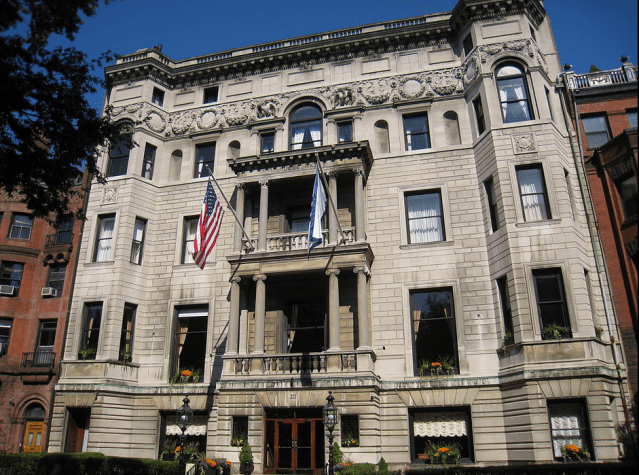
The Algonquin Club, 217 Commonwealth Ave., Boston. (Wikipedia)

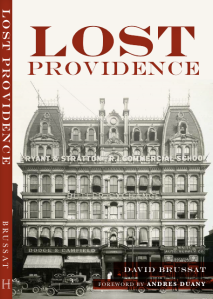
After a dozen or so events last fall to promote my book Lost Providence, I thought maybe I could relax and live, if not like a king then maybe a duke or earl, off my royalties. Ha ha! Those familiar with the good work of History Press and Arcadia Publishing will get the yoke – their imprint is for people who write for love (usually of this or that place), not money. But the love keeps on coming in. More people want to hear about the book.

The next event will be in Boston two weeks from today, on Tuesday, Feb. 20, 6:30 at the Algonquin Club (217 Commonwealth Ave.). It is sponsored by the Institute of Classical Architecture & Art’s New England chapter, on whose board I have the honor to sit. The Algonquin Club was completed in 1888 to the design of McKim Mead & White, the great Gilded Age firm of architects. Charles Follen McKim, of the firm, was a member of the Algonquin, which may or may not prove he designed it. His colleague Stanford White designed Rosecliff, the Newport “cottage” where the Preservation Society of Newport County hosted a lecture on Lost Providence in September. I look forward to addressing the guests of the ICAA at the Algonquin Club. To speak for such a group in such a building excites me beyond expression. Reservations are $25 for members of the ICAA and $35 for nonmembers.

But wait! There’s more!

On Wednesday, Feb. 28, the Johnston Historical Society, will host a Lost Providence lecture at the Museum Barn, 101 Putnam Pike, in Johnston, R.I. The lecture begins after the Society’s regular  7 o’clock meeting, at about 7:45 p.m., and is free and open to the public.

On Tuesday, March 6, the Barrington Public Library will host a Lost Providence lecture at the former Leander Peck School, designed in the Elizabethan Revival style by Providence architects Martin & Hall and completed in 1917 next door to the Barrington Town Hall, completed in 1888, same year as the Algonquin Club. The library’s address is 281 County Rd. The lecture begins at 6:30 p.m., and is free and open to the public.

Still in the works is a lecture at Fitchburg State University, in Fitchburg, Mass. It may be closed to the public, as was my Jan. 18 lecture at the Hope Club, sponsored by the Colonial Dames of Rhode Island, or open only to students at Fitchburg, or it may not happen at all. We shall see.

At any rate, if you have missed all the lectures thus far, there are others popping up on the calendar like … well, I’ll let someone else suggest an appropriate flower. At each event, the book will be on sale for $20.

Screen Shot 2018-02-06 at 7.05.11 PM.png

Barrington Public Library, next to Town Hall in Barrington, R.I. (picclick.com)

Posted in Architecture, Lost Providence | Tagged , , , , , , , , , | 3 Comments

Stern’s 250 W81st tops out

Screen Shot 2018-02-05 at 5.19.22 PM.png

From the website of 250 West 81st St. by Robert A.M. Stern Architects. (RAMSA)

Robert A. M. Stern’s latest Manhattan apartment building at 250 West 81st St., on a corner of Broadway, recently topped out. That means the top of the building’s steel structure of girders has been achieved. It is 209 feet tall, or about 18 stories by my count, based on the drawing above. I am entirely pumped about this building (“The New Classic Upper West Side Apartment House“). The renderings, by Williams New York, paint a gorgeosity of beauty, if I may be permitted to thus describe its appearance.

Cityrealty.com’s article from last June 12, “Construction begins on new Upper West Side condo,” confirms the building’s height as 18 stories, includes more details on amenities within the building, and notes that its predecessor was a three-story retail building whose demolition was completed last winter. It was a very attractive building, but the replacement of an attractive building with an arguably more attractive building, or at least a larger building of equal allure, reflects an admirable return to the status quo ante – that is, the situation before, say, 1950, after which it became conventional to worry that any building demolished would likely be replaced by something worse.

So this is progress. The big question is how long will it take before New Yorkers in the vicinity forget that the new building wasn’t erected decades ago? Will 250 West 81st become, in the public eye, just another survivor, admirable as that certainly will be? People will eventually get used to a lovelier neighborhood, just as they have been forced to accustom themselves to uglier neighborhoods, forced to turn that smile upside down.

To better encourage the construction of new traditional buildings like 250 West 81st at a higher rate requires the construction of a major building that nobody will confuse with a building that has always been there. Buildings like this are mother’s milk to a society that yearns for a revival of its civic pride. This building will help, but a bigger boost would arise from rebuilding Pennsylvania Station as it was originally designed (with updates, of course, in technology, transportation, commercial amenities, etc.) in 1910 by McKim Mead & White. You can see plans for that project at Rebuild Penn Station. After that, it’s Katy bar the door for the classical revival.

At first I thought 250 West 81st was done and these were photographs, but no, they are two renderings by Williams New York. Below that is a photo of the building torn down for the new project.

Screen Shot 2018-02-05 at 5.25.37 PM.png

Screen Shot 2018-02-05 at 5.26.30 PM.png

Screen Shot 2018-02-05 at 5.42.09 PM.png

The building demolished to make way for the much taller 250 West 81st. (CityRealty)

Posted in Architecture, Development, Uncategorized | Tagged , , , , , | 3 Comments

When is a folly not a folly?

Screen Shot 2018-02-04 at 3.58.28 PM.png

A folly on the grounds of Bellevue House, in Newport. (David Brussat photo)

What’s in a name? I’ve always loved a folly, but some follies are not as useless as their definition suggests. The London Times has an article about follies called “It’s not bonkers to be fond of a folly,” by Norman Miller. The leading exponent of follies in Rhode Island – or at least the one with the most follies on his property – is Ronald Lee Fleming, whose Bellevue House, on the avenue of the same name, is in Newport.

The follies in Miller’s article seem no more useless than the follies in Fleming’s garden. Fleming’s follies are not as useful as Fleming’s Bellevue House, but that hardly makes them useless. The definition of folly in the Oxford Dictionary of Architecture, by James Stevens Curl and Susan Wilson, is:

Eye-catching, usually a building in a contrived landscape, often otherwise useless. It might be in the form of a sham ruin, Classical temple, oriental tent, Chinoiserie pagoda or other charming fabrique set in a Picturesque garden. It might provide seats and shelter from which an agreeable view can be enjoyed, but more often simply demands attention/gives pleasure by its eccentricity. … [T]he folly is more than whimsical: it encapsulates creative longing, often in the realms of fantasy, with many allusions, far removed from the prim, joyless Modern Movement.

In short, no, they are not useless, any more than decoration itself is useless. At least a folly provides seating and shelter; beyond that it offers additional reason to love a place and to commit time, energy and resources to its perpetuation. By this standard, modern architecture is useful only in the narrowest sense of the word, and that is why so few people have any affection for it.

My post “Library of place in Newport” describes the work in progress that is Fleming’s Bellevue House and its magnificant grounds. From there you can click to an earlier post, “Flemish park on Bellevue.” Both have quite a number of photos and they give a good idea of how many and what sort of follies enliven Fleming’s estate.

Posted in Architecture, Rhode Island | Tagged , , , , , , , , , | 5 Comments

“White tower with curves”

Screen Shot 2018-02-01 at 6.34.47 PM.png

Last year’s proposal for a single tower, pared down from an original three. (Fane)

Screen Shot 2018-02-01 at 7.58.58 PM.png

Providence awaits its “white tower with sculptured curves.” That’s how developer Jason Fane, of New York City, now envisions his “iconic” building of 46 stories (no pics yet) as described to Providence Journal reporter Mark Reynolds in “Land sale gets OK for 46-story tower.”

Actually it’s a preliminary OK from the I-195 commish. But fugeddabout squeezing the word “preliminary” into a headline.

What happened to the last version of what were once three slick brown multi-slabs sporting patented Minion spectacles? But now it’s a white tower with sculptured curves. And Fane still wants a pair of these suckers. What are we to make of that?

Hope Point Towers?

Hope not.

White tower with sculptured curves? Isn’t that kinda sorta racist or sexist or both? Tough call these days. But still, sounds quite sexy to me. Sort of like the Absolute Towers, also known as the Marilyn Monroe Buildings, in a suburb of Toronto, designed by MAD Architects. (That is not a joke, at least the name is not a joke.)

Screen Shot 2018-02-01 at 6.34.17 PM.png

Site plan for the proposed Hope Point Tower on I-195 land. (Fane)

Posted in Architecture, Uncategorized | Tagged , , , , , , | 20 Comments