Singapore fling at Raffles

Screen Shot 2018-06-10 at 8.20.42 PM.png

Screenshot of the Raffles Hotel, along the waterfront in Singapore. (youtube.com)

Trump has landed in Singapore and so have we, courtesy of Expedia. I’ve noted the virtuosity of Expedia’s travel videos, which tend to focus on cities’ historic districts and ancient architecture, leaving the modernist kudzu to shock you once you have already got tickets and already arrived. Seriously, Expedia merely recognizes human nature, and caters to its desires – which yearn more to quaff a Singapore Sling at the Raffles Hotel (in a traditional building) than to bear up under the glare of modern architecture – so like a dictator’s haircut! Nah. Been there, seen that, as most people have. So beat the news cycle and enjoy Singapore before the summit begins!

Posted in Architecture, Video | Tagged , , , , , | 2 Comments

Kamin: So long, Trib Tower!

Screen Shot 2018-06-06 at 9.08.17 PM.png

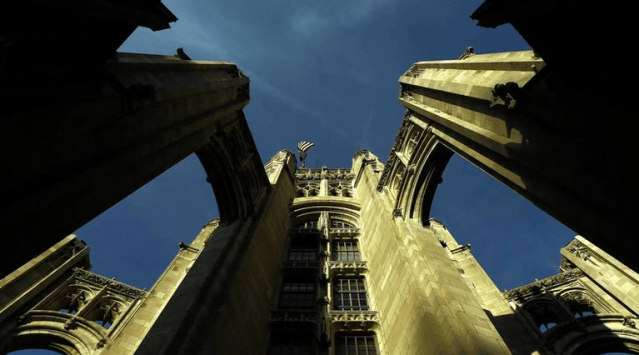
Buttresses of Tribune Tower shot from balcony on the 25th floor. (Chicago Tribune)

Blair Kamin, the architecture critic of the Chicago Tribune, longtime occupant of the Tribune Tower, used his column to lament his departure, with the rest of the newspaper, this Friday, from the Trib’s historic home in the Gothic pile since it opened in 1925.

I say “pile” with a certain reverence which I’m sure Kamin fully understands. His lament for the building designed by Raymond Hood (of Pawtucket, R.I.) and John Mead Howells strikes an elegiac tone. He writes:

I find my eyes roaming over the tower’s flamboyant neo-Gothic silhouette and its innumerable alluring details, like a sculpture of a wise old owl who clutches a camera and symbolizes the powers of careful observation. These last looks are both pleasurable and painful. I love this building, love it more deeply because we’re about to leave it.

But at least, Kamin writes, the paper isn’t moving to the burbs, just to the architectural equivalent of the burbs. He adds:

[T]here’s no glory in being a tenant in somebody else’s stolid modernist high-rise, especially when you’re leaving a building as architecturally distinguished as the tower. One Prudential Plaza could be the box Tribune Tower came in.

How I empathize with Kamin’s predicament. But I wish he would take these emotions and imagine himself not as an architecture critic who has had the pleasure of a quarter of a century arriving and departing daily at the august Tribune Tower, but as someone else. He should take the opportunity to stand in the shoes of the people who usually read his column. He can express his love for a lovable building, but it isn’t the sort of building he usually praises in his column. He should look at his departure from the Trib Tower through the eyes of a citizen of Chicago, a citizen of the world.

Kamin’s support for modern architecture is an attack on the traditional architecture for which his beloved tower stands. He may not interpret it as such, nor want to consider it as such, but so it is. He should instead consider his pen as a sword that he swings to alleviate the plight of the beleaguered citizen who must walk past ten glass-and-steel abominations for every one building that partakes of the spirit of the Tribune Tower.

Take this opportunity, Blair Kamin, to examine your real feelings about architecture. Use your ejection from the Tribune Tower and the sorrow it unleashes as a teaching moment – a learning experience – for you yourself. Then write your column from your prison cell in One Prudential Plaza as if you were Václav Havel writing from his prison cell in Prague. Those are not entirely without parallel. Think about it. Shake the world of architecture to its foundations, and help make the rest of the world a better place.

Screen Shot 2018-06-06 at 9.05.11 PM.png

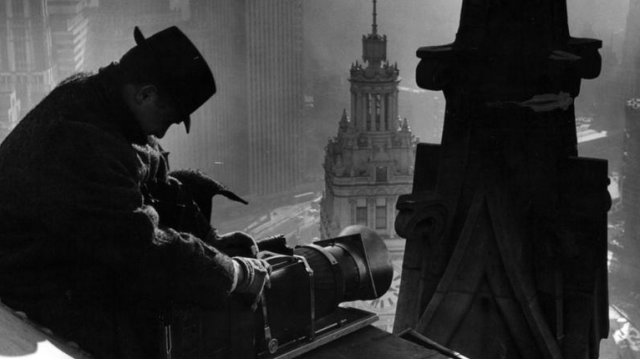
One photog shot by another atop Tribune Tower, with Wrigley Building beyond. (Chicago Tribune)

Posted in Architecture | Tagged , , , , , , | 2 Comments

Millar on Harrison in Prov

kannafoot.smugmug.com.png

First Baptist Church, in Providence – designed by Joseph Brown or Peter Harrison? (kannafoot)

John Millar has sent me some contextual thoughts about his attribution of some famous old Providence buildings to architect Peter Harrison (see my post “Harrison’s excellent career,” written after his lecture at the Boston Athenaeum last Thursday). His attribution to Harrison of a host of the city’s most celebrated buildings have raised some eyebrows here in the capital of Rhode Island. The 1986 citywide survey of historic architecture by the state preservation office attributes no buildings to Harrison, who has long been celebrated for his work in Newport.

I wanted to address briefly the Harrison designs in the Providence area. First of all, the Old Statehouse on Benefit Street: the design for it (in brick & stone quoins, and with a steeple almost the same as the one on Harrison’s Old Statehouse in Boston) was considered too expensive, so Silas Downer, a member of the General Assembly, took the plans and ruthlessly chopped them down to make the building smaller. If you want to see how it would have looked as originally designed, look at the Kent County Courthouse in East Greenwich, which however is made of wood. The Kent County building was taken directly from the original plans.

Professor Joseph Brown: one of the four Brown brothers, Joseph hung around Harrison for a while trying to learn from him, but did not put in enough time to bring it off. Because he really did design the Providence Market [House], a second-rate design that [was] enlarged and is [now] used by RISD for classroom space, writers over the years have claimed that he was a great architect, and that he designed the Baptist Church, the Joseph Brown House, the John Brown House, and others.

All of those were by Harrison. Although Joseph Brown may well have been the construction supervisor, he certainly didn’t have the knowledge to have actually designed those buildings. The amazing Joseph Brown House with its ogee pediment has a mantelpiece inside that is almost identical to one that Harrison designed decades earlier in Yorkshire, [England], and that design has never appeared in any pattern books. The John Brown House and a few of its contemporaries must have been designed before the Revolution [Harrison died in 1775; the John Brown House is conventionally said to have been built in 1786], but construction was put off until after the war was over for financial reasons.

These remarks seem plausible but plausibility is not the same as factuality. All of Harrison’s papers were burned after his death in New Haven of a heart attack as he was apparently about to be lynched for being a Tory. The loss of his papers has enabled Millar to make a case that Harrison designed some 500 more buildings around the world than the 20 or so that historians give him credit for. Perhaps this scholarship should have been undertaken long ago. Maybe Millar was the first to think of it. Or maybe Millar just went hunting for unattributed or weakly attributed buildings worldwide erected within the span of Harrison’s professional life, and if he could dig up some connection, assigned them to Harrison. Some architectural historians have apparently pushed back against Millar’s claims, but then most professionals don’t like it when their lack of diligence (if that is what it was) is exposed.

I’m looking forward to Millar’s next book on Harrison, which will help sharpen, or mute, the plausibility of his argument that Harrison’s oeuvre is some 30 times what history seems to think. Detailed research backing up Millar’s description of Harrison’s extraordinary life can strengthen the credibility of Millar’s herculean expansion of Harrison’s architectural work. Will the book contain such evidence? I don’t know. One way or another, however, the history of Peter Harrison is one for the ages.

ricurrrency.com.png

Joseph Brown House, designed by Joseph Brown or Peter Harrison? (ricurrency.com)

groupon.com.png

John Brown House, designed by Joseph Brown or Peter Harrison? (groupon.com)

Screen Shot 2018-06-04 at 8.51.43 PM.png

Market House, attributed to Joseph Brown without challenge by Peter Harrison. (wikipedia)

Screen Shot 2018-06-04 at 8.48.03 PM.png

First Rhode Island State House, unattributed but now claimed for Peter Harrison. (wikipedia)

Screen Shot 2018-06-04 at 9.02.05 PM.png

Old Statehouse, in Boston, built in 1713 yet claimed (see above) for Harrison, born in 1716.

Posted in Architecture | Tagged , , , , | 2 Comments

Quinlan Terry’s list of oopses

Screen Shot 2018-06-03 at 6.03.27 PM.png

Quinlan Terry, the British classicist who may be Prince Charles’s favorite architect, has a wonderful essay, “Seven Misunderstandings about Classical Architecture.” I want to quote two passages, one about shadows and the other about materials, one about beauty and the other about utility, though they are far from mutually exclusive. First, the passage about how the sun casting shadows on mouldings is both lovely and useful:

This leads to misunderstanding 2, which concerns functionalism. It is said that in a democratic age, the greater or lesser importance of such a simple thing as a door is no longer relevant. [Not so!] …

We therefore see just one of the functions of mouldings in stressing the relative importance of different doors. It amazes me that mouldings, which are so simple, can lead to such infinite variations. After all there is really only one curve and one straight. A cavetto is a concave curve whilst an ovolo is the opposite. A cyma recta is a cavetto followed by an ovolo, whereas a cyma reversa is the opposite. The fillets merely come between. If you stack them together, they say something – maybe an Ionic modillion cornice.

Screen Shot 2018-06-03 at 5.28.01 PM.png

If we draw the lines of perspective we can see how the profile of the mouldings are picked out by the shadows. The front of the corona and the modillions are in direct sunlight, whereas the curves of the cymas and ovolos come into and go out of shadow gently. You might think that the soffite and the coffers are lost because they are in complete shadow. But strangely enough the abacus on top of the capital acts as a reflector and sends a soft light up into the coffers by reflection. Similarly, on a Tuscan capital the square abacus casts a shadow on the circular shaft below. It also causes a flash of light on the top of the echinus and expresses the shape. A combination of soft and hard shadows is brought about by the simple geometrical solids of square abacus supported by circular echinus.

We have been thinking of the play of light, the light of the sun, on the simplest geometrical solids. It gives pleasure to the eye and makes us feel good – simple pleasures caused by natural things and in no way dependent on artificial light and the consumption of energy or the world’s resources. Classical architecture comes from a natural world which valued light and air more highly than we do today because there was then no artificial light or ventilation to help one out of difficulties.

Probably most of my readers know more of the vocabulary of classicism than I do, but even I find myself virtually aswoon at the arcana of these terms.

And now the passage about materials, and the preference for the natural over the unnatural. This passage may lack the enchanting crescendo of terminology in the passage above, but its importance to every facet of building is all the more evident, and it explains why modern buildings inevitably are exercises in planned obsolescence.

Misunderstanding 4 is about materials. I am often asked why I don’t use modern materials. To answer this, let us first make a short list of old and new building materials:

Limestone
Marble
Lime concrete
Clay bricks and tiles
Slates
Sandstone

Portland cement concrete
Steel
Reinforced concrete
Reconstructed stone
Pre-cast concrete
Sandlime bricks
Stainless steel
Aluminum
Laminated plastics

Now I am no obscurantist and I admit that I have specified at various times all the materials on the bottom list, but I have nearly always done so because they are cheaper in the short-term. There is little doubt that, quite apart from their appearance and cheapness, the materials at the bottom of the list have a shorter life than those at the top.

This means that if you use them you will have higher maintenance costs than with the traditional materials. There are the notorious examples like roofing felt which now has a shorter guarantee than most refrigerators, but leaving that aside it is worth noting that Hope Bagenal, who was for many years head of the Building Research Station, pointed out that the best building materials are practically inert, whereas the great defect of all modern materials is their high coefficient of expansion.

This means that their seasonal and diurnal expansion and contraction is such that expansion joints are essential. Even a modern brick wall has to have expansion joints every 30 feet. This in turn breaks up the monolithic nature of any structure into little isolated blocks with expansion joints. The weathering and attrition at these joints is an obvious long-term weakness, whereas a traditionally built structure has none of these problems because the matrix is lime instead of cement. Think of the Pantheon in Rome, built in brick and lime mortar. It has a diameter of 142 feet and has stood for nearly two thousand years. No reinforced concrete structure could last anything like so long because once air and moisture have penetrated to the reinforcement there is nothing which can permanently inhibit its breakdown. It does not even make a good ruin!

And since they don’t even make good ruins, let’s just take them down and cart them away. All of them. Period.

(Hats off to Seth Weine for sending Quinlan Terry’s essay to the TradArch list as part of an online conversation about the differences between “classical” and “traditional” in architecture.)

Posted in Architecture, Art and design | Tagged , , , , , | 2 Comments

Harrison’s excellent career

Screen Shot 2018-06-01 at 3.30.36 PM.png

Early photograph of Redwood Library and Athenaeum, by Peter Harrison. (Downeast Dilettante)

Had the pleasure, last night at the Boston Athenaeum, of learning more than I ever expected to know about the architect Peter Harrison. He is considered by many to be America’s first professional architect, and is known in Rhode Island for designing the Touro Synagogue, the Redwood Library, the Brick Market and a new steeple for Trinity Church in Newport. I had not realized that Peter Harrison had also designed the original Rhode Island State House (1762), the one on Benefit Street whose tower was added by Thomas Tefft in 1851-52 and whose eastern extension was added in 1867-68 by James Bucklin, both highly celebrated Rhode Island architects.

Screen Shot 2018-06-01 at 3.33.37 PM.png

Peter Harrison (Wikipedia)

All of this came flooding out at a lecture in the Boston Athenaeum sponsored jointly with the New England chapter of the Institute of Classical Architecture & Art. A profusely detailed description of Harrison’s robust career by last night’s speaker, John Fitzhugh Millar, appears on the website “Small State, Big History.”

By the time Millar, an architectural historian from Williamsburg, Va., was less than halfway through his lecture, my hand had almost cramped up from the copious notes I had taken of Harrison’s remarkable career, which seemed to have been inspired by Ferris Bueller’s Day Off, or, slightly more contemporaneously, the Renaissance sculptor Benvenuto Cellini’s Autobiography (1558-63). In Millar’s telling, the events of Harrison’s life seemed to one-up each other for nearly an hour, detail after amazing detail sparking a sustained astonishment and incredulity in his spellbound audience, and a dire wish to continue listening – which was suddenly interrupted, and, it turned out, extinguished by a fire alarm in the building next door. Our evacuation onto lovely Beacon Street was blissful as such things go, but … oh, well.

Screen Shot 2018-06-01 at 3.36.44 PM.png

John Fitzhugh Millar (SSBH)

Architectural historians have long attributed some 20 buildings to Harrison. But Millar has found in excess of 500 more buildings on every continent but Antarctica that he thinks can be plausibly attributed to Harrison. They include the Old State House (now headquarters of the Rhode Island Historical Preservation & Heritage Commission), the original of which, as listed in the preservation office’s citywide survey of 1986, is unattributed. Millar attributes to Harrison the design of Providence’s First Baptist Church (1775), which most historians attribute to Joseph Brown, brother of John and Moses Brown, for whom Brown University is named.

In 1733, Harrison, born in Yorkshire, England and aged 17, was challenged to design the largest private house in Europe, which was built and remains standing. A paucity of commissions led Harrison, along with his brother, to hire on as a commercial ship’s captain. He traveled extensively, designing whenever he laid over in a port. He often used a Palladian style. In 1738, so Millar attests, Harrison designed a palazzo in Venice, a synagogue in Suriname, a church in Guyana, a synagogue and another church in Barbados, the famous Drayton Hall in South Carolina, a plantation house in Maryland, the first Palladian cabinet (desk), the Belmont mansion in Philadelphia, and the Old North Church steeple in Boston.

That’s all in one year, 1738, when he was a ship’s captain. And it is not all he did in 1738, only what my poor hand could get down in notes. As Millar puts it, Harrison built more buildings in 1738 than most architects build in their entire careers. In 1740 he set up residence in Newport. Most of Harrison’s architectural work had not been attributed to him until recent years after Millar undertook his research. Harrison is said to have developed the first wooden rustication, or wood carved to look like stone. Millar also describes Harrison as the leading furniture designer of colonial America.

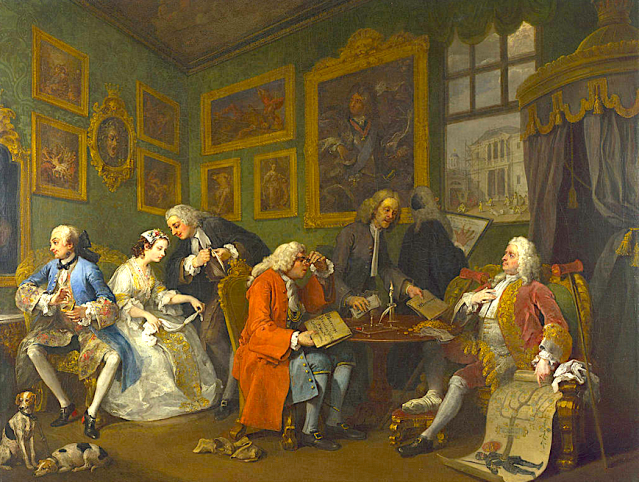
But wait, there’s more! Hogarth, the famous British artist, asked Harrison to draw a joke Palladian building that he could place in one of his drawings. Harrison did so, sketching a house whose flaw was that the window sills on the second story were too high, meaning no one could lean out the window. Quite subtle! Hogarth used it in one of his drawings, but how many Hogarth aficionados have got the yoke since 1738 is anyone’s guess. (See final image.)

More spectacularly, in 1744, Harrison was in fortified Louisbourg, Nova Scotia, then controlled by the French amid a war with Britain. After being captured at sea, he was held prisoner in Louisbourg in the house of Etienne Verrier, his friend and designer of its fort. He allowed Harrison to use his architect’s desk – inside of which the latter found plans for the fort, which he copied himself and conveyed to American colonists, who eventually took the fort. This unexpected triumph is said to have foiled France’s plan to capture Britain’s foreign colonies, then invade England. The espionage that led to the French defeat at Louisbourg gained applause for Harrison as the savior of England, and he then received even more architectural commissions from throughout Britain’s colonial empire.
Screen Shot 2018-06-01 at 4.03.59 PM.png

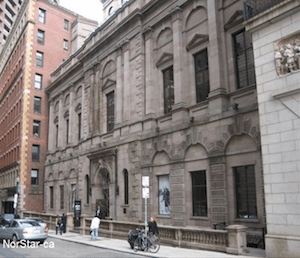
Boston Athenaeum (Waymarking)

There is much more to Harrison’s exploits than I have room to record here, including his invention of the flush toilet during his relatively relaxed captivity in Louisbourg. Harrison moved from Newport to New Haven in 1761. He was a Tory, and in 1775, a mob threatened to lynch him and then burn down his house on the New Haven Green. This caused in him a fatal heart attack. The mob did not burn down the house, which would have been a felony, but they dragged all of his furniture, library, contracts and other records onto its front lawn and burned it – a mere misdemeanor.

All of Harrison’s architectural commissions, records and plans were lost, and so Millar has used historical conjecture to attribute to Harrison so many buildings not previously known to be of his design. During the fire alarm – the one in Boston last night, not the one in New Haven in 1775 – I had the opportunity to chat with Millar, and he discussed his attribution technique, deftly and plausibly countering the idea that attribution to any particular designer might be difficult because architects and builders of that era often used pattern books and based designs more on precedent than inspiration. He brushed off with admirable panache the pushback he has gotten from fellow historians for his sparsely documented attributions.
Screen Shot 2018-06-01 at 3.40.25 PM.png

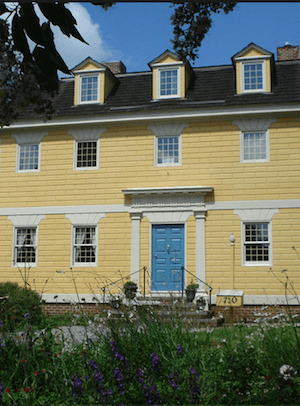
John Millar’s Newport House B&B in Williamsburg, Va. (newporthousebb.com)

I’m not sure what to think of all Millar revealed last night, but he promised to send me the text of his latest book about Peter Harrison. Meanwhile, the Athenaeum had videotaped Millar’s lecture (at least until it was interrupted). I expect to post that video, if it was actually recorded, when it finally becomes available.

Millar is not only an architectural historian but runs a bed & breakfast in Williamsburg, Va., called Newport House – a 1988 house built by Millar, inspired by Banister House, a 1756 mansion in Newport and designed by … who else but Peter Harrison! In 1956, its 200th anniversary, it was torn down. They put up a parking lot.

Millar has also built full-size working replicas of the Revolutionary War frigate of 24 guns, the Rose – it was used in the Russell Crowe film Master and Commander – inspired by the 20-volume series of historical novels by the late Patrick O’Brian – and another vessel, the 12-gun sloop Providence, the Continental Navy’s first warship, built in October 1775.

It takes maximal moxie to multiply by some 30-fold the number of buildings attributed to a single architect. John Millar makes a plausible case for Peter Harrison, and he has the panache to pull it off. In any event, he gives a damn fine lecture; even equipment oopses and the misordering of images is carried off with humor. His large Athenaeum audience left with a case of speechus interruptus. I hope he will be speaking around here again soon.

Screen Shot 2018-06-01 at 12.07.59 PM.png

Outside Boston Athenaeum, on Beacon Street, after sudden end to lecture on Peter Harrison.
Screen Shot 2018-06-03 at 11.14.04 AM.png

“The Marriage Settlement” (1743), first of six paintings in series called Marriage A-la-mode, by William Hogarth. (National Gallery, London)

Posted in Architecture | Tagged , , , , , , , , , | 5 Comments

Don’t junk up the PawSox

Screen Shot 2018-05-30 at 10.50.25 AM.png

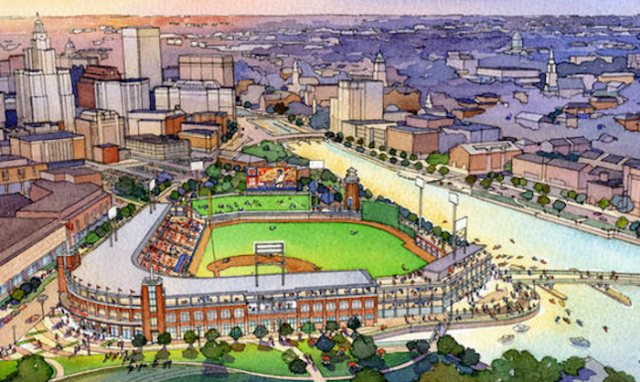
Design, proposed in 2015 by DAIQ, for a new PawSox stadium in downtown Providence. (RIPR)

The politics of the proposed new stadium for the Pawtucket Red Sox – the PawSox – are beyond me, but a new financial package just proposed by its leading opponent, Nicholas Mattiello, speaker of the Rhode Island House of Representatives, surely moves the needle forward. So let’s take a look at the look of the ballpark.

Actually, there does not seem to be much of any look in mind. The politics have crowded out the aesthetics. The PawSox conceived of the new stadium as reflecting the form of Fenway Park, including the Green Monster. The first new stadium design, the one that was to have arisen in Providence, was a classic ballpark of the old school in the Fenway tradition. Beautiful. After that tanked for silly reasons and a new location in downtown Pawtucket arose, a pair of vaguely disappointing designs showed up simultaneously, neither appearing to carry any official preference. One seemed a bit more traditional and the other more modernist. It was very hard to tell, really, but the new commercial buildings planned for nearby hinted at each design’s sensibility. Last fall, a more starkly modernist version, by college students from Yale, emerged without a Green Monster but with frontrunner status.

The latest alternative financial plan seems to place more reliance on the associated commercial development doing well enough to help pay off the stadium bonds. All of the plans rely on the hope that PawSox ticket sales will improve, and that baseball fans and other visitors to the Bucket will spur spinoff and renewal. Whatever plan is chosen, there is an  important aesthetic component upon which the plan’s success will hinge.

One of the hurdles that any plan faces is the urban renewal and modern architecture that have defaced downtown Pawtucket since the 1960s, making it hard to foster economic revival. Leveraging the city’s historical character and sense of place as a brand for its revival will be tough if the stadium and downtown don’t pull in the same direction. If that direction is traditional it will be easier; if that direction is modernist, it will be harder.

If some form of stadium legislation does come to pass, why go through these gyrations in search of a new design? Why not just build the stadium designed for Providence in Pawtucket?

Some would argue that because modern architecture is more prevalent in Pawtucket, the stadium should pick up on those cues. But why dig Pawtucket even deeper into the hole of its midcentury-modern mistake? To improve the chances for a stadium project that works, it would be wiser to cue off the historic Slater Mill that we already know attracts tourists rather than the dump of Main Street that we know does not even attract shoppers.

In fact, Pawtucket should take its inspiration from the commercial boom blooming on Providence’s Westminster Street. All smart cities try to replicate models of success. The Providence stadium design, edited for the Pawtucket location, would make it much easier for Pawtucket to smack a home run.

In any event, it is time to begin this discussion.

(The Providence-based stadium design from 2015 is atop this post and the Pawtucket-based designs are below, with the Yale proposal at the bottom.)

Screen Shot 2018-05-30 at 2.57.51 PM.png

Design, seemingly modernist, for a Pawtucket stadium at the Apex location. (WPRI.com)

Screen Shot 2018-05-30 at 3.00.44 PM.png

Design, seemingly more trad, for a Pawtucket stadium at the Apex location. (gcpvd.org)

Screen Shot 2018-05-30 at 10.37.31 AM.png

The latest design for a Pawtucket Stadium by Yale students. (PawSox)

Posted in Architecture, Development | Tagged , , , , , , , | 3 Comments

Need sigs vs. Fane today!

Screen Shot 2018-05-28 at 7.07.27 AM.png

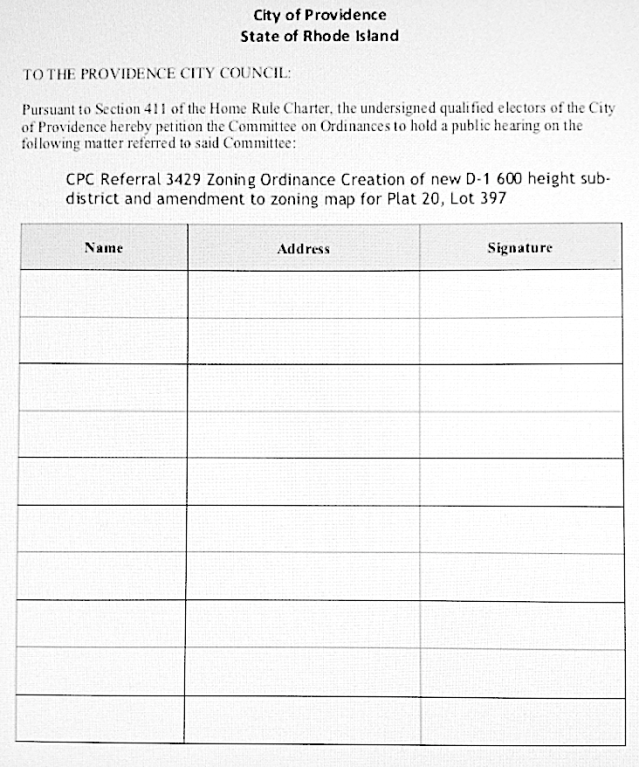
On behalf of all Providence communities, the Providence Preservation Society and Building Bridges are calling on people to get local voter signatures on the attached lists by tomorrow to force the Ordinance Committee of City Council to hold a meeting and thus to hear local testimony about changing the height zone to allow (or not allow) the Fane Organization to build its 600-foot tower.

This petition is not for or against Fane but for letting the public speak about the tower to the Ordinance Committee meeting later this spring. The signature petition must be on the Council’s desk 10 days (not 10 business days) before its next meeting Thursday June 7, so that at that meeting it can order ads notifying the public about the Ordinance meeting for the required three straight weeks before its occurrence. And only this petition will require its occurrence.

So please, please, print out several copies of this petition list, sign it yourself, and find as many friends, neighbors, acquaintances and strangers as you can, today, Monday, to sign it. Then email Sharon Steele (sharon@sharonsteele.com), who will come herself or send someone to pick them up and deliver them to the Council officer assigned to verify the names’ status as Providence voters.

If enough people sign and the petition is delivered tomorrow, the legal procedure that is being followed will force the committee to meet and to hear local testimony – which is necessary because Fane has a head start in trying to delay a City Council vote until election time distracts Council members from everything but electioneering.

This is politics at its most local, where the rubber of democracy meets the road. Please get out and find folks to sign this petition!

Screen Shot 2018-05-28 at 6.47.24 AM.png
Posted in Architecture, Development, Uncategorized | Tagged , , , , | 8 Comments

Preservationists’ progress

Screen Shot 2018-05-27 at 3.16.51 PM.png

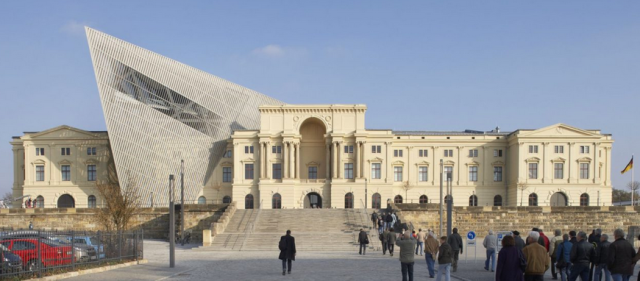
Military History Museum of Dresden, Germany, addition by Daniel Libeskind. (Common/Edge)

It is no coincidence that Hugh Cavanagh’s blog from Ireland, “Scrawling from the Wreckage,” lands on this blog just as Steven Semes, dean of historic preservation at Notre Dame’s school of architecture, has updated progress toward common sense in preservationist circles. Both writers use common sense to deconstruct the subversive but widespread alliance between modern architecture and historic preservation.

Semes has published “What Do International Standards Say About New Architecture in Historic Places?” on Common/Edge, a website whose effort to give both sides space in architecture’s style wars continues to confound my skepticism of its supposed evenhandedness.

As modernists gained control of architectural establishments around the world in the 1940s and ’50s, they instituted rule-making for architecture and preservation to overturn conventional practices. Those practices were based on centuries of experience and tradition, so their principles were handed down generation by generation, even if treatises such as that of Vitruvius went back 2,000 years. Modern architecture rejects tradition, history and experience, however, so documents like the Venice Charter of 1964 and the U.S. Interior Department’s rehabilitation standards of 1977 were needed to let people know that the practices of the past were no longer appropriate.

The results since then have fostered such architectural crimes as Daniel Libeskind’s addition to the Military History Museum in Dresden (see above), and many, many others. Readers can probably name several, at least, in their own cities and towns. Observers present locally when such assaults take place are not necessarily aware of the degree to which each has generated, over at least five decades, a growing pressure against rules that treat preservation, restoration, conservation and rehabilitation (synonyms for saving historic structures) as strategies to ruin our most beloved places.

Only such pressure can explain the slow and mostly silent shift described by Semes in how these guidelines are interpreted. Why do we want to save historic structures? Most probably think the idea is to enable people living in, working in and visiting old places to experience the artistic sensibility of the original designer. Modernists disagree. They do not want to save historic structures but to destroy them, and if they cannot be demolished outright, add carbuncles to them while framing the idea of preservation as an excuse to undermine the appeal of lovable places. The very existence of such places serves to model a better future, and to place the ugliness and stupidity of modern architecture in stark relief – so their beauty must be suppressed.

Why? No modernist architect will say so today, but they realize that modern architecture can’t really survive in competition with traditional architecture, just as socialism in one country cannot compete with free markets. Systems that disagree, that won’t toe the line, must be eliminated.

It’s really just about as simple as that. There is no place for preservation in architecture today, except to preserve midcentury modernist buildings that are reaching the end of their useful life as carbuncles. Of course most people want them to vanish, so preservation must be reconceptualized as a curator’s exercise where buildings mainly serve as examples of how each style reflects its era. That preservation might help teach us how to conserve methods of creating future places worth living in is the farthest thing from the minds of most modernists – and many preservationists.

Yet despite modernist resistance, common sense is making its way back into the rules for historic preservation and their interpretation. The guidance material for the Interior Department’s 1977 standards (administered by the U.S. Park Service) was changed in 2010 to replace illustrations of contrasting additions with illustrations of more harmonious additions. In 2011, sections of the Venice Charter that promoted contrast were amended by the Valletta Principles to deprioritize “interruptions in the continuity of the urban fabric and space.” And that’s not all. Errors in translation into English that helped sustain modernist interpretations of the rules – in the Venice Charter, for example – are being tracked down and corrected.

Semes sums it up with consummate delicacy:

[M]any in the preservation field remain stuck on the conventional misinterpretation of the earlier document. This is why we must look at the entire series of Charters and declarations where, despite some dissenting examples, we can trace an emerging consensus: Historic preservation should neither require nor prohibit any style of new construction, but should support continuities of character, scale, materials, and craft that can bring harmony to the dialogue between old and new.

The professor is much too diplomatic to say so, but it is evident that there is no role for modernist styles of architecture in preservation. Modernists could design buildings that fit the new into the old, but most have zero interest in that. Therefore, traditional styles are the only ones that can be relied upon, in practice, to protect harmony in the dialogue between old and new.

Common sense may not yet have enough momentum to get preservation – and more broadly, architecture – back to its roots, but we can hope. Semes’s book The Future of the Past, published in 2009, should be read by all who are interested in preservation. Semes’s new post as director of the preservation program at Notre Dame enables him to expand the envelope of common sense in the world of architecture. His work, and the optimism expressed in his Common/Edge essay, give every reason for hope.

Posted in Architecture, Preservation | Tagged , , , , , , , , , | 4 Comments

Scrawl from the wreckage

Screen Shot 2018-05-25 at 6.23.04 PM.png

One of the most erudite puns on record is the title, “Scrawling From the Wreckage,” of a blog from Ireland (known for its literary power) by Hugh Kavanagh, an archaeological  surveyor who specializes in built heritage. Two years ago, I posted his essay “Death by Nostalgia: How Architects Can Learn from Archaeologists.” I was bowled over by Kavanagh’s fecundity of insight. He sent me an email notifying me of another series of essays he is posting, called “Reclaiming Classicism,” of which Part I showed up Tuesday on his blog, whose subtitle is “Architecture, Design, Art and Making.”

“Reclaiming Classicism” is the top post on his blog linked above. He writes that he is embarked on a series about definitions in architecture, such as the word classical. In the popular reckoning the word classical is all over the lot. Recently, at the Bulfinch Awards gala put on by the Institute of Classical Architecture & Art (ICAA), I sat at a table where the conversation tippled upon that subject for minutes on end. Is classical the fount of tradition or merely its subset? Good question! Shouldn’t we nail down the definition? I suggested that maybe vagueness is perhaps the better part of valor when it comes to what the word means.

This was before I learned, at our meeting on Wednesday, that the ICAA, whose New England chapter allows me on its board, substituted the “classical” in its mission statement with “traditional.” It has also cut “advocacy” from its mission, and switched its elegant logo featuring the goddess Diana encircled by a wreath to a logo that drops the wreath and places a naked Diana in an awkward position vis-a-vis the acronym ICAA. The logo flouts the classical love for symmetry. At least the logo’s font has not stooped to sans serif!

I have not decided what I think about most of the above actions. I think an organization that promotes a minority position in architecture can only lose influence if it abandons advocacy. And the logo cries out for reform. And I am scared by the decision to switch from classical to traditional in the mission statement. Although the ICAA’s interest is or ought to be broader than classical as in Greco-Roman, and should embrace all traditional styles (including Gothic, Victorian, Stick, etc.), switching classical out strikes me as maybe opening doors to more dangerous forms of backsliding. So, since classical could be read as both the origin of traditional styles and as a subset of traditional styles, I think I favor letting people read what they want to into the word, especially, perhaps, when used in a mission statement.

In “Reclaiming Classicism,” Cavanagh describes several definitions of the term, all very much valid but reaching only so far. His definitions do not extend to what the word classical means today to most architects, and to some extent the public. He makes a clear distinction between what architects seem to know and what the public seems to know:

When I speak to others about classicism it’s easy to assume that my understanding is the same as everybody else’s. I’ve learned very quickly that this is rarely the case, with architects and academics showing a very shallow and biased view of classical architecture, while general members of the public often showing great insight and understanding, based on nothing but their personal experience.

Kavanagh promises to unpack this dual outlook on classicism in his next post, which may be several weeks in the future.

For now, I’m happy to have my longstanding belief in the public’s greater sophistication about architecture reiterated by Kavanagh. Most people’s knowledge of architecture is based on experience rather than study, and since architecture school aims to purge the intuitive love of beauty from the minds of architecture students, what Cavanaugh says about the narrow, shallow, biased views of specialists on the classical is not just perfectly valid but perfectly obvious.

With that remark, I will urge readers to call up Hugh Kavanagh’s blog and its wise essays. To make that easier, I have placed his blog on my “Blogs I Follow” list. Learn. Enjoy.

Posted in Architecture | Tagged , , , , , , , | 2 Comments

Krock puts his finger on it

Screen Shot 2018-05-24 at 10.40.21 PM.png

Barry Goldwater and Lyndon Johnson in the Oval Office, May 1968. (politico.com)

This blog avoids politics like the plague.

Nevertheless, today Politico ran “When the CIA Infiltrated a Political Campaign.” The look-back on the CIA’s spy in the 1964 presidential campaign of Barry Goldwater tickled my fancy in the most predictable way. Politico writer Steve Usdin describes how LBJ got the drop on AuH2O by having the CIA purloin from the GOP nominee’s headquarters the advance text of a speech in which he planned to announce a task force. Forewarned, LBJ announced his own task force first, making his rival look silly.

Having the CIA steal a speech was not LBJ’s only advantage. Usdin quotes fabled Timesman Arthur Krock – what a name for a pundit! – that Goldwater was “hopelessly outmatched” in where he delivered his televised speech:

The President of the United States [gave his] in the classic décor of his Oval Office at the White House; his helplessly scooped opponent [gave his] in the modernistic carnival setting of the Coliseum that was built for the Seattle World’s Fair.

Bingo!

… Imagine the announcement of the creation of a task force getting space on any news broadcast today!

Posted in Architecture, Humor | Tagged , , , , , , , , | Leave a comment