Joint prize for dynamic duo

Screen Shot 2018-08-29 at 7.54.31 PM.png

From the book Over Europe, Text by Jan Morris (Weldon Owen Inc., 1988)

My Traditional Building just arrived and reveals that Nikos Salingaros and Michael Mehaffy have received this year’s Clem Labine Award from the magazine. Congratulations to them both. Much of my education regarding how science affects architecture and urbanism comes from their research and writing, especially the jointly bylined pieces they’ve produced for magazines and the books they’ve edited or written.

After taking notice of the conventional wisdom that beauty is in the eye of the beholder and that science has little to do with it, TB’s lengthy online article about the award, by Nancy Ruhling, states:

[T]his year’s Clem Labine winners see a game-changing contribution to architecture from the sciences, giving us a decidedly different picture. Beauty is a largely shared experience that is rooted in the physical structure of things, they say. The sciences offer us a useful lens for understanding that structure and how we can create and improve it with more emotionally powerful and transcendent results.

Ruhling’s piece has plenty of quotes from both Mehaffy and Salingaros. She meticulously describes their work and history. The first is an urbanist who founded and runs a think tank in Portland, Ore., the Sustasis Foundation; the latter is a professor of mathematics at the University of Texas, San Antonio, who has worked for decades with the architect and computer-design theorist Christopher Alexander. Both winners seek to integrate Alexander’s “pattern language” and other “living” architectural insights into the principles and practice of the New Urbanism (basically the old urbanism revived). After introducing the pair, Ruhling quotes Salingaros:

I applied mathematical rules for the kinds of buildings that give healing feedback, and I worked with architect Christopher Alexander, the inventor of pattern language. With my formula, I can judge a building, even a door, as positive, neutral or negative.

Of course, most people do that instinctively. Nobody needs a formula to tell traditional architecture from modern architecture, or which is superior. But neither can anyone underestimate the importance of formula in codifying links between beauty and science. Our brains are hardwired by neurobiology to judge architecture and urban design. Architecture is a practical art. It is the only art people experience almost every waking moment of the day since childhood, and often even in our dreams. We all have an ability to judge buildings and streetscapes that is actually more sophisticated than that of those who have been educated in those fields. The No. 1 job of architecture schools is to purge the deep, intuitive feelings about beauty from the conscious thinking of young students.

Regarding the ability to judge the quality of place, Mehaffy states:

If you ask most people to look at traditional places, they love them. That’s where we almost all go on our holidays. Ask them to look at modern places, and the reaction is far more mixed, if not downright negative. … [Traditional architecture] has a rich and complex provenance. It represents the accumulated experience of how to live well in a beautiful, healthy environment. And it’s better adapted to the intricacies of human experiences because it evolved over a long period of time.

The two disagree somewhat on the prospects for a revival of beauty in architecture. Salingaros states that

Michael and I are fighting this giant profitable machine driven by trillions of dollars. The regime run by the top architecture schools propagates the same old ideas from the early 20th century. And the mainstream media is blindly following the architectural media, which promotes contorted buildings and glass and steel architecture. That promotion is being driven by the global building industry and its business-as-usual approach.

The more optimistic Mehaffy replies:

Nikos is focused on storming the gates of architecture, and understandably he gets frustrated because they are closed to him. I’m not as cynical as he is, maybe because I am looking at a bigger audience. I see many people in many other fields converging on the new findings from the sciences and looking at things in a very different light—especially now that people are connecting the dots to human health and sustainability. It’s just that it’s taking time for an isolated architectural establishment to awaken to the new reality. We have to keep pushing.

At the center of the pushing is, of course, Clem Labine, for whom the award is named, who founded Traditional Building and other journals that seek to spread enlightenment about architecture and urban design. He himself writes an excellent, no-holds-barred column on architecture.

Working with TB publisher Active Interest Media, Labine and his colleagues have built a network of institutions that bring architects and developers together with artisans, craftsmen and the firms through which they market their work. TB seminars across the country sponsored by AIM spread the word about traditional design and the strategies by which it makes human life more healthy and beautiful. Along with the Palladio Awards, which honor individual projects, the Clem Labine Award is a vital platform for recognizing great work by individuals to promote the classical revival.

So, yes, you two, Nikos and Michael, keep on pushing! You are bringing many others along with you, and eventually things will change and the world will realize that it, too, owes you much.
Posted in Architecture, Urbanism and planning | Tagged , , , , , , , , | 6 Comments

“Lost Providence” at age 1

Screen Shot 2018-08-28 at 11.51.20 PM.png

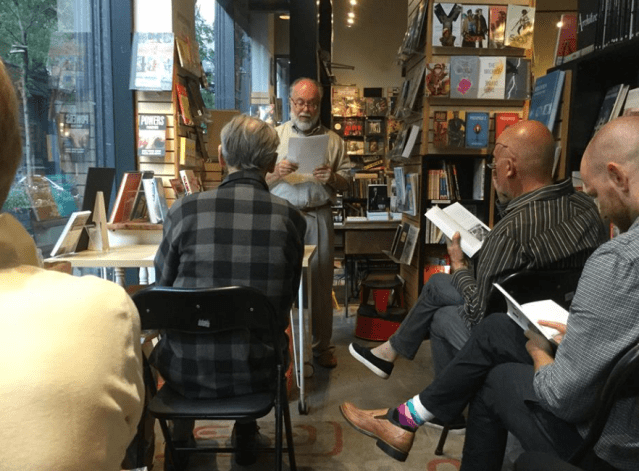
The author reads at Symposium Books one year ago today. (photo by Victoria Somlo)

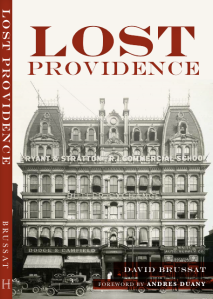
My dear wife, Victoria, just a moment ago reminded me, for some reason, that today a year has passed since the publication of my first book, Lost Providence. It had sold 548 copies as of the end of last year. My publisher, History Press/Arcadia Publishing, will send me my second royalty report at the end of next month.

On the day of publication my book was launched by Symposium Books downtown. I read a chapter then took questions. In the following months I did that or gave a lecture at a couple of dozen locations, most enchantingly at Rosecliff, speaking to the Preservation Society of Newport County. My last talk was before Ann Sussman’s class in the history of modern architecture at Fitchburg State University. Next up, a lecture at Cranston’s Hall Free Library on Saturday, Sept. 22. The date of another lecture in September, for Centerbrook Architects in Essex, Conn., has been postponed.

Well, that should do it for now. So far as I know, the book is not out of print and can still be purchased from bookstores (if it remains in stock) and from Amazon, History Press or other online booksellers.

Posted in Architecture, Lost Providence | Tagged , , , , , , | 6 Comments

Bayley on Curl’s “Dystopia”

Screen Shot 2018-08-27 at 7.52.59 PM.png

Out of Balance: From the jacket art for Making Dystopia. (Drawn by J.S. Curl after A.W.N. Pugin)

Stephen Bayley, critic for The (U.K.) Spectator, has written “Modernist architecture is not barbarous – but the blinkered rejection of it is,” the second review (that I’ve seen so far) of James Stevens Curl’s Making Dystopia: The Strange Rise and Survival of Architectural Barbarism. The first was not serious. Jonathan Glancey praised its vigor and prose style in the Telegraph (behind its paywall), but his critique was in the line of “Oh well, nothing new here, architecture has been criticized for centuries.”

Another review, Richard Morrison’s in the London Times, opens with a joke: “I wish James Stevens Curl would stop sitting on the fence.” The subhead of his article reads, “This furious blast at modern architecture comes rather too late for our skylines.” Too true! But the rest of the review was behind a paywall as well.

More serious is Bayley’s attack on the book, published by Oxford University Press. He too argues that many have criticized architecture (modernist, that is) in the past. He quotes an author from the 1930s decrying it as a “godless conspiracy of foreigners, Jews and Bolsheviks.” But in the four chapters I’ve read, Stevens Curl seems not to be outlining a conspiracy but rather a deadly virus of gargantuan stupidity. Bayley disagrees:

The “moderns” were not a coherent gang of unlettered anarchists, bent on destroying history. They did not represent a “sundering, a cultural catastrophe, based on dissolution and unreason.” They were a very broad church. And his Manichean distinctions between modernists and traditionalists were not at all clear cut.

Bayley is free to voice that opinion, but it ill suits logic to then denounce the “nearly 40 pages of preface and acknowledgments, 58 of dense endnotes and 42 of bibliography” used by Stevens Curl to substantiate his case. The author shows the modernist program was meant to split architectural history’s past from its future. Its rationale for so doing is based on unreason, and obviously so. And perhaps modern architecture was “a very broad church”: excluding nothing at all except for all architecture before modernism. The value of Making Dystopia is that Stevens Curl backs up his case with damnation by quotation of the modernists themselves. They were not a “coherent gang” but an incoherent gang, or gangs, of rival cults and compounds. Whether they were anarchists or not, they were hell-bent on destroying history. At least they had that in common. And they have come close to succeeding.

I am just on Chapter 4, “Modernism in Germany After the 1914-18 War,” but what I’ve read so far is masterful in its compilation and arrangement (maybe arraignment would be a better word) of facts and texts. Modern architecture and its advocates are toast, or ought to be. “For example,” Bayley complains, “Nikolaus Pevsner, routinely damned as the modernists’ calculating Mephis-topheles, actually established architectural history as a proper academic discipline.” Yeah? But he did so by creating a false history that omitted work by architects who didn’t fit the narrative and twisted work by others so as to fit them in where they did not fit. Many complained at being anointed as “pioneers” of a style they could not abide. Stevens Curl has Pevsner nailed, adducing truckloads of examples, including Pevsner’s own words noting the traditional roots of buildings that he elsewhere claims have no such roots – such as the Glasgow School of Art by Charles Rennie Mackintosh. What remains of the historian in Pevsner undercuts his own scholarship.

Morrison, in the Times, describes Stevens Curl’s writing as “entertainingly apoplectic,” and I agree that it “reads like an outpouring of pent-up anger, contempt, revulsion and despair accumulated over decades.” Bayley seems to think there’s something wrong with that. No. Stevens Curl has every reason to be angry at the modernists – as does everyone in the world. Bayley writes:

Aiming his trembling arquebus at some sitting targets, Curl calls contemporary architecture “psychotic” and “deranged.” I have seen Louis Kahn’s India Institute of Management in Ahmedabad, the Farnsworth House in Illinois, Tadao Ando’s Naoshima, Foster’s Hong Kong and Shanghai Bank, the Guggenheim in New York and the Neue Nationalgalerie in Berlin and do not find these psychotic or deranged at all. On the contrary, I find them fine, elegant and elevated expressions of the human spirit, at least the equal of the Parthenon or Chartres.

Huh? “At least the equal of the Parthenon or Chartres”?

And then:

[Stevens Curl] admires, quite correctly, the great achievements of Islamic, Gothic and south German rococo. These, he says, “express everything modernists hated and outlawed.” But that is nonsense.

Which is, of course, nonsense.

I’m sorry I misspoke at the beginning of this post. Bayley’s review is not serious. It is a string of inanities, non-sequiturs and, as Mencken would put it, the obviously not true. Bayley doth protest too much, and in so doing has confirmed the high qualities of James Stevens Curl’s Making Dystopia.

Posted in Architecture, Book/Film Reviews | Tagged , , , , , , , | 6 Comments

R.I. still has WaterFire

Screen Shot 2018-08-26 at 12.45.30 PM.png

WaterFire attendees watch from a pedestrian bridge at Waterplace. (Photo by author)

The PawSox may be goners, but Rhode Island remains chock full of excellent attractions. One list summarizing what to see or do in the Ocean State comes from Jim Gillis’s column in the Newport Daily News lamenting that “PawSox move is a strikeout for our state.” It reads:

Rhode Island needs to hold onto its attractions. I can’t imagine us without the jazz and folk festivals, the tennis tournament, sailing regattas, the mansions, Trinity Rep, the Providence Performing Arts Center, Roger Williams Park Zoo.

What is missing?

Well, the beaches, for one thing. And a lot more. But it startled me that WaterFire was not on Gillis’s list. Perhaps a journalist cannot be expected to mention everything.

I attended last night’s WaterFire and it was as crowded as ever, but oh so relaxing. A beautiful evening with a full moon must have drawn its usual 20,000, several times the average draw at McCoy Stadium. People walk or sit through all or part of the event, in rapture at its charms or oblivious to them, focused instead on whomever they are with. Sometimes I think WaterFire must be where the art of conversation reaches its apogee in Rhode Island. Next year WaterFire will celebrate its 25th birthday. A quarter of a century.

I wonder whether Barnaby Evans, its creator and artistic director, has some intuitive feel for whether most who attend are repeat visitors, how many visitors at each event are visiting for the first time, how many are visiting from overseas, what the breakdown of income, education, nationality, race and other attributes might be, how many enjoy the event, how many suffer through it – I cannot imagine it could be many; nobody attends in order to get their money’s worth, since unlike a ballgame a WaterFire is free for those who attend (though donations are encouraged). And you are free to leave at any time, subject of course to the constraints, if any, of family and friends.

In fact, it might be interesting to compare the experience of a WaterFire with the experience of a baseball game. Both involve spending lengths of time watching nothing happen. I am being jocular, of course. Baseball is not just watching the grass grow while waiting for a ballplayer to get a hit. And WaterFire is not just watching fires burn while waiting for the braziers to be stoked. One is a work of art, the other is a work of athletics. At both events there is music to listen to, people to talk to, other people to watch. At both there is food to eat. Baseball can be enjoyed day or night for seven months out of the year; WaterFire can only be enjoyed by night, but it does occupy a similar swath of the warmer months. You can attend 70-80 ballgames in a season (if you want) but only about a dozen WaterFires, one every two or three weeks or so, May through November. But the average ballgame only lasts two and a half hours, and then you pile out of the stadium and then out of the parking lot all at once. On the other hand, a WaterFire event can stretch on for upward of six or seven hours as the sun sets earlier and earlier as the season, and people can leave whenever they want. There is the element of suspense in baseball – who’s going to win the game! WaterFire offers little suspense. There is no winner or loser; it’s how you play the game. Maybe some attendees can bet on whether flames will bank down to a near smolder before the boats come to stoke it with logs. Or you can bet on the time that elapses between the passage of striking women, babies in strollers, dogs on leashes, or whatever turns you on  (or off). Of course, as in baseball, you don’t have to bet money; many baseball fans like to add up and figure out the game’s meaning in statistics. No doubt there are WaterFire fans with similar proclivities.

One of the biggest differences is that a baseball team might bugger out on you and move to another city. The most unpopular historical personage in Washington, D.C., is not Dick Nixon but Bob Short, who in 1972 moved the Senators, whose games I occasionally attended as a boy, to Arlington, Texas. WaterFire? Not so much!

Posted in Providence, Rhode Island | Tagged , , , , , , , | 6 Comments

Preservation in Newport

Screen Shot 2018-08-22 at 8.09.12 PM.png

Old and new that is respectful of old on Corso del Rinascimento, in Rome. (Steven Semes)

Preservationists have a vital but relatively simple job that has been made more difficult, over the years, by preservationists.

The purpose of preserving a historic building is to sustain the beauty it brings to its setting. How to do this should not be so difficult. The original architect has provided a blueprint; architects should follow that blueprint whenever repairs or additions need to be made. The same principle holds when new buildings are constructed in old settings. The new building should blend into the old setting as well as possible.

This ancient methodology was practiced by almost all architects up through the early decades of the last century. Since then, modernists have sought to disrupt the course of nature, and civilized preservationists have tried to yank preservation practice back onto its sensible historical track.

Steven Semes, a leading architectural theorist and head of the preservation program at Notre Dame’s school of architecture, shared his thoughts on the subject at the Redwood Library last week and led a discussion afterward that touched on examples from the preservation of Newport’s historic treasures.

I’m sure Professor Semes would not agree that preservation, as I describe it above, is quite that simple. But he would surely agree that preservationists themselves have, over the decades, made it more complex than it needs or ought to be. His lecture traced the historic ups and downs of preservation theory and practice as it has shuttled between the lodestars of continuity (good) and contrast (bad).

“I am speaking here,” Semes pointed out early in his talk,

about a visual and physical continuity of buildings and places, not a continuity in social structures, politics, economy, and other human arrangements. Buildings and places change more slowly than any of these, as we can see in looking at Newport, whose buildings, streets, and public spaces have changed uses but remain attractive, even if we live very differently from those who built these places.

He then refers to the “imposed gulf between old and new ways of building.” Note the word “imposed.” This “gulf” did not evolve naturally. Based on dubious historical theories (such as that World War I required a new way of building as well as new forms of rule), architects started discarding the old ways and embraced new ways in the second and third decades of the 20th century, and by 1950 had taken over as the establishment. The first attempt to codify preservation goals and practices came with the Athens Charter in 1931, which, as Semes pointed out, “emphasized the role of context.” He adds that “[i]n 1931, the Modern Movement in architecture had barely begun to be a factor … .” Indeed, H.L. Mencken that same year wrote in The American Mercury: “The New Architecture seems to be making little progress in the United States. … A new suburb built according to the plans of, say, Le Corbusier would provoke a great deal more mirth than admiration.”

The Athens Charter stressed what one Italian signatory, Gustavo Giovannoni, called ambientismo, translated as contextualism – in short, continuity. For example, he widened an old street near Rome’s Piazza Navona to divert traffic. On it he mingled old buildings with new ones of similar massing and style, and in so doing, as Semes puts it, “alter[ed] the specific form of a historical environment without radically altering its character, adapting the historic city to the needs of modern life.”

This sensibility was carried forward in America by Charleston, S.C., which created the nation’s first historic district in that same year. New Orleans, Brooklyn Heights and other cities, evidently including Newport, followed suit. John Tschirch’s masterful “Mapping the Newport Experience” suggests that the 1960 Tunnard & Harris report pushed back against urban renewal. It was commissioned by the Preservation Society of Newport County, founded in 1945 to protect the City by the Sea from the forces of contrast.

Meanwhile, however, back in Europe, founding modernist Le Corbusier had in 1925 proposed the demolition of central Paris, to be replaced by towers, parks and highways. Giovannoni’s effort to continue Italy’s ambientismo was reversed by planners employed by Benito Mussolini. Architectural historian Giulio Carlo Argan and the minister for public instruction, Guiseppe Bottai, overturned the earlier emphasis on continuity, arguing that it represented, in Argan’s words, “a double falsification with respect to both the ancient and the recent history of art.” That is, continuity required faking the past and imposing a false era on the current era. They sought a clear differentiation between what was built anew and what remained from the past.

That attitude prevailed in 1938, and in essence it was a prescription for the eventual elimination of all architecture prior to the supposed modern age. Thankfully, at least in Italy, Giovannoni’s ambientismo was reinstated after the war. All of the documents and controversies described by Semes in his lecture last week revolve around this dispute, and for decades it was the modernists who were winning, partly by purposely misinterpreting the language of earlier charters, treaties and such. Regarding such tomfoolery in the use of the Venice Charter of 1964, Semes says:

The misinterpretation of Article 9 results, in my opinion, from a deliberate misreading of the text by those, following Argan and [author Cesare] Brandi, who want to promote the opposition of historic and contemporary construction for ideological reasons.

We who attended Semes lecture saw this regrettable attitude in action during the question session when a listener challenged Semes’s suggested changes, drawn on a napkin, for a community center to be built by Trinity Church next to Queen Anne Square. In “Opinions differ when contemporary meets historic,” Newport Daily News writer Sean Flynn describes the moment:

The building was designed to look more modern from the side facing Queen Anne Square, but more like a traditional Colonial home from the side that would face Mill Street. “We did not want to build a fake historic building,” Rev. Anne Marie Richards, rector of the church, said at the time. “That would not have received approval from the Historic District Commission.”

But Semes was critical of the horizontal lines on the modern side of the proposed community center, and instead proposed a new façade with four columns, introducing vertical lines. … “We don’t think there should be thick columns on the façade of what should be a welcoming center,” Richards said. “We don’t want to put up barriers. We are a very different organization from when the founders built the church in 1726. There should be spaciousness.”

Flynn’s story has a fuller version of the discussion, but the takeaway, in my opinion, is the language used by Reverend Richards to suggest that Semes’s proposal (see images below) would have been inauthentic (“fake”), that the columns proposed by Semes would be “barriers,” and that a building must look modern in order to be useful in modern times (“We are a very different organization …”).

Surely the commission would have felt obliged to reject something called a “fake,” but maybe not something described as “inspired” by the church or something expressing continuity with the historic context of the square. Her remarks reflect the obviously false idea that a design that respects the past cannot serve the needs of the present. And Richards may be the first person in history to have asserted that a colonnade could be perceived as a barrier!

The point is that Richards was speaking not the language of design but the language of ideology. My guess is that her own modernist tendencies had already been put aside by the Trinity board, and she was worried that the design might continue to evolve toward continuity, that is, something the public might favor. So she spoke out to protect the remaining modernist portion of the design facing the square. (It seems to me that a building design that features two different and opposing styles on two different sides of the same building declares its inauthenticity from its rooftop.)

In any event, the Trinity board should make a choice, and that choice should reflect what it believes would be preferred by church members, not church officials, local elites, or the editors of architecture magazines.

Architecture is less about time than about place. If being about time means that only modernist buildings are appropriate for the cusp of the future – which will soon be an artifact of the past – then Newport and indeed the rest of the world is in trouble. So it is a very good thing that recently, as Semes so eloquently informed his audience, sense seems to be making inroads against nonsense, at least in the field of historic preservation.

(To see the design of the Trinity community center to which Steven Semes was reacting, click on the Newport Daily News website, which has the image right on top. I have not yet secured permission from Trinity or Northeast Collaborative Architects to use it.)

[Steven Semes will be speaking on the same topic in Boston on Monday, Nov. 19, at 6 p.m. in the Boston Athenaeum. The event ($25 members/$30 public) is sponsored by the New England chapter of the Institute of Classical Architecture & Art.]

Screen Shot 2018-08-22 at 2.06.45 PM.png

Community center at Trinity as proposed by Steven Semes. (Drawing by Steven Semes)

Posted in Architecture, Preservation | Tagged , , , , , , , , , , | Leave a comment

Rome: Who are those guys?

Screen Shot 2018-08-20 at 7.22.11 PM.png

Four men walking through St. Peter’s Square, Rome, in 1961. (RIBA)

Who are those guys?

Good question. But first, I must point out that indecipherable notes on a recent lecture force me to leapfrog a topic I’d intended to address today and grab a quicky topic instead. I’ve chosen to simply link to a collection of thirteen photographs of Rome selected from the RIBA Collection (Royal Institute of British Architects). “Dome sweet dome: the glory of Rome – in pictures” appeared in the Urban Eye section of The (U.K.) Guardian.

There are buildings. There are people. There is Rome. Enjoy.

But before dipping into this trove, consider the four men in the first photograph, with which I’ve illustrated this post. I expected to learn from its caption that these young sophisticates in St. Peter’s Square were modernistos – modernist architects. They have just finished thumbing their nose at the Basilica, expecting, in the manner of their ilk, that it would be demolished and no longer exist to thumb its nose at their work. But the caption was no help, except to inform me that the photo was taken in 1961 at St. Peter’s Square by Monica Pidgeon. But I am allowed, still, I think, to imagine that they are modernist architects, and to think my nasty thoughts about them.

Whoever they are, they are lucky. They are in Rome. Like Venice, like Florence, like Paris, Rome has banned modern architecture from the city, relegating it to the suburbs. Therefore, beauty accompanies the people of those cities, rich or poor, wherever they may go, every minute of the day. Look at these pictures. Most show people living their lives amid surroundings of a sort that most Americans must do without, who as a result might not be aware of what they are missing, and may have lost the ability to appreciate it – which does not require a degree in art appreciation. Does this lower their quality of life? Yes, it does. Is there someone to blame for this. You bet.

Sorry. Don’t get me going. Just look at the pictures.

(Maybe someone knows who those four guys are, and can relieve me of the burden of assuming they are modernist architects. Tip o’ the hat, by the way, to Richard Jackson, who snagged this set of photos from CityLab.)

Posted in Architecture, Photography, Uncategorized | Tagged , , , , , , , | 4 Comments

ProvSox spike smote PawSox

Screen Shot 2018-08-18 at 1.25.59 PM.png

Sketch of proposed stadium in Providence for relocated PawSox team. (Pawtucket Red Sox)

If the PawSox do decamp for Worcester in two years, as seems certain but is not, there is blame enough to go around. The team owners say Rhode Island did not really want them, and they got their first taste of scorn during the imbroglio that arose when the governor, Gina Raimondo, flip-flopped against the initial proposal to relocate to Providence.

I favored that proposal but opposed the owners’ ridiculous opening gambit, which was treated by most opponents and the media as if it were a take-it-or-leave-it deal. So when Brown University joined Raimondo in turning tail, and leading owner Jim Skeffington died, the proposal quickly evaporated, and the PawSox future parked in limbo until the Apex proposal to remain in Pawtucket eventually emerged.

Today, if the Providence proposal had been accepted in 2015, the ProvSox or the ProSox (or the PawSox if the name were kept for valid sentimental reasons) might be finishing up their first season in the new stadium.

Two frauds halted that prospect in its tracks. First was the purposeful misinterpretation by the media of the owners’ opening gambit as serious, even though it was obviously a starting point for talks. With the 38Studios scandal still fresh in the public mind, this knowing media falsehood tilted the public against the deal and paved the way for opponents to treat the issue as a private stadium vs. a public park – even though the city’s new waterfront was already festooned with parks. Raimondo’s flip and Brown’s absquatulation sealed the fate of the proposal.

I was for it primarily because I hoped that the stadium, designed as a classic ballpark of old, along the lines of beloved Fenway Park, might have led to a rethink of the modernist style in vogue for redeveloping the I-195 corridor. That is, I had hoped that the stadium would cause the 195 commission to turn thumbs down on modernist design proposals then in the pipeline, and ask their developers to redo them to fit in with the traditional stadium and the mostly traditional neighborhoods of the Jewelry District and Fox Point across the Providence River. The result would have set new development in Providence on a track to strengthen rather than weaken the brand of the city and state, which is, or at least was, based on historical beauty. That would have boosted economic growth in the city and state (including Pawtucket).

Instead, the Providence proposal and its traditional stadium fell through, the modernist 195 projects moved forward, more of the same ilk were proposed, leading to the Fane Tower proposal – which, however overwrought and uncongenial to the city’s historical fabric, is a logical progression of flawed development trends in Providence.

Some blame must accrue to those, like myself, who thought the owners of the PawSox should pay the entire bill for a new stadium, whether it was in Providence or Pawtucket. Since the team is owned by businessmen with a net worth of some $5-$6 billion, that seems reasonable. It is reasonable. But it is not the way such things are done. Thrown into the negotiations mix, first in Providence and then in Pawtucket, this attitude made a deal fair to city and state taxpayers more difficult to achieve politically.

When the venue switched from Providence back to Pawtucket, the bonanza of a team located amid a civic renaissance faded in the imagination of the owners. Even though the Apex site was more alluring than the current site, to the owners it seemed somewhat shopworn, the same-old same-old amid a potential rather than an actual urban revival. It did not glitter.

Flagging enthusiasm on the owners’ part showed in their lack of attention to the design of the stadium. This was evident in the desultory sketches of the ballpark and its surroundings at the Apex site compared with those that accompanied the proposed relocation to Providence.

Remember, Providence and Worcester vie for second place in size to Boston in New England. Compared with Pawtucket, a much larger economic and financial advantage to the state and the team arose from the Providence site at the crossing of two interstates, on the banks of a beautiful river, amid a robust downtown economy. Losing that vision sapped the owners’ interest, to the detriment of Pawtucket’s hopes, and allowed Worcester to worm its way into the owners’ minds if not their hearts. I think the owners probably feel they are stuck with Worcester after their poor treatment by Rhode Island.

But this is not over. Worcester has a signed piece of paper but it does not have a team. Not yet. Reviving the Providence proposal might tip the game back toward Rhode Island.

Screen Shot 2018-08-18 at 1.28.06 PM.png

The most widely publicized sketch of proposed PawSox stadium in Pawtucket. (Pawtucket Red Sox)

Posted in Architecture, Development | Tagged , , , , , , , , | 8 Comments

Semes in Newport Thursday

Screen Shot 2018-08-15 at 10.19.48 PM.png

Steven Semes will be speaking at 6 p.m. tomorrow, Thursday, at the Redwood Athenaeum & Library about various fascinating matters which, while international in scope, are of interest not just to preservationists but to those interested in architecture in Newport. Since this is just a reminder of that speech tomorrow, I will simply repost my announcement that ran on Saturday, Aug. 4, entitled “Stephen Semes in Newport.” Don’t ask how hard it is to choose a photograph of Newport to go with this post. That’s a lovely picture above, obviously, but equally obvious, I had to punt.

Posted in Architecture, Preservation | Tagged , , , | Leave a comment

Beyond translation indeed!

Screen Shot 2018-08-13 at 9.56.15 PM.png

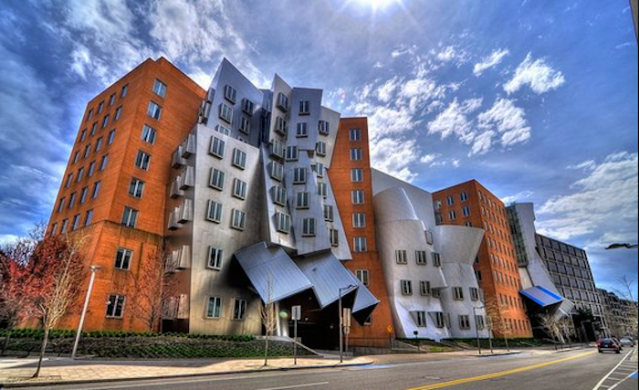
The Stata Center, by Frank Gehry, at the Massachusetts Institute of Technology. (Pinterest)

It takes an act of will to make it all the way through a passage of hilariously sublime bureaucratese – quoted from a university prospectus – sent recently by architectural historian James Stevens Curl to a group of his friends and colleagues. The passage turns the mind into glue. By the time you finally see the end of it, your brain is so sapped that you can barely manage to get from one word to the next.

One recipient, the sociologist/writer Theodore Dalrymple, sent an essay about it to a British journal, Taki’s Magazine (“Cocktails, Countesses & Mental Caviar”), published under the headline “Beyond Translation.” This inflicted it on thousands of innocent readers. (And of course yours truly has just committed the same crime.)

Except for the fact that architecture is the subject matter of the passage, which Dalrymple quotes in its entirety, he never uses the word. Here is a mere snippet:

This year we will conflate several scales and levels of work on new models for “dis-continuity and coherence,” tackling urban “meta-elements” as architectural diagrams and morphologies. Building upon our previous cities of multiplied utopias and artifacts, ruptured transfers, systems and frameworks and, ultimately, conceptual and spatial playgrounds in space-time, we will allow our pursuit of emerging urban models to inform new phases in the breakdown and re-integration of an architectural object itself.

Dalrymple never attempts to divine the meaning of the passage because, as he points out, it has no meaning. It is not supposed to be understood but to be misunderstood. The idea is that if readers cannot understand it, they will not realize how stupid it is, even if they make it all the way through. It is bowl of syllable soup. Dalrymple actually makes it sound funny:

The language is peculiar to itself and makes a speech by the late Leonid Brezhnev seem like a soliloquy by Hamlet. Full of neologisms, its words have connotations, but no definite meaning can be fixed to them. Vagueness is essential because only then can responsibility be denied when things go wrong. It is ugly and circumlocutory, but with occasional pseudo-poetic metaphors that are supposed to be inspirational but are as exciting as a cargo ship’s ballast.

It is quite a feat to describe such gobbledygook in clear language. And as Dalrymple himself admits, it is not really funny. What he attempts to describe are the thoughts of an architecture faculty member in charge of teaching young students how to create human habitation. So, yes, it would be funny if it were not so god-damned important. Of course, architecture has been filled with this sort of nincompoopery for so long that nobody realizes anymore how important the built environment is. Maybe that’s the idea.

But I might actually challenge Dalrymple in his assertion that this sort of really quite well done bureaucratese is widespread, having spread beyond government into business and (of course) academia. I know what he means – it is almost everywhere, in part because so many of the institutions of society have embraced missions that can never be accomplished, or even ought to be accomplished, and modes of thought and communication that would prevent it anyway.

Still, I would say that Dalrymple (and to begin with, Stevens Curl) chose this passage because they know very well that it could never be matched in any other industry but architecture – although certain recondite academic fields surely give architecture a run for its money.

In fact, in no other field but architecture does the language actually come closer to describing what it refers to. More so than any other industry, architecture has made a fetish of ugliness and incomprehensibility. Its buildings must be both ugly and incomprehensible in order to qualify as architecture. Shown two pictures of modernist buildings equally ugly, it would be hard to tell which had won the Pritzker Prize and which had been declared The Ugliest Building of the Year. (They have such an award in Britain, an annual prize known as the Carbuncle Cup.)

Modern architecture’s ambition is to produce buildings that reflect their (our) era. And they succeed to admir— oops, I mean they succeed, full stop. Is not our era violent, stupid, self-infatuated, delusional, scary, confusing, rude, and in the process of collapse? Well, maybe every generation brags that its era features the same qualities, but surely ours – and I refer to the past half-century – is arguably the worst in every category.

So I applaud the language of architecture, not because it has succeeded at its mission or because it mimics the product of architecture with some accuracy. No, I applaud this linguistic phenomenon because, ultimately, it must lead to the collapse of modern architecture, which cannot continue indulging its failure to communicate without eventually failing, period. Maybe even before the collapse of the societies it inflicts itself upon.

(Obviously, I leave out of this rumination the relatively small but fast growing number of professional architects who design buildings and houses that people like – that is, traditional and classical architecture informed by wisdom handed down by generations for centuries, rejected by modernist architects, just as they reject the conventions of written language.)

(By the way, James Stevens Curl is the author of the newly published Making Dystopia: The Strange Rise and Survival of Architectural Barbarism, from Oxford University Press, soon to be out in the U.S., which I am now reading.)

[I have reworked the original first paragraph of this post because, without my noticing, it seemed to suggest that the passage quoted by Stevens Curl might have been written by him. Not eager to be challenged to a duel at dawn with cavalry sabres!]

Posted in Architecture | Tagged , , , , , , , , , | 8 Comments

Lovely town main streets

Screen Shot 2018-08-12 at 5.55.57 PM.png

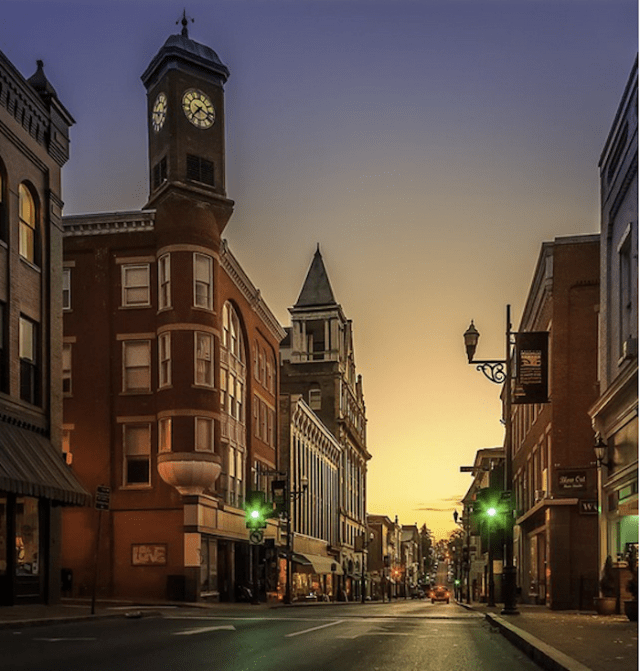
Staunton, Va., founded in 1747. (Joe Rebello/Getty Images)

Architectural Digest has posted “The 30 Most Beautiful Main Streets Across America,” and they are beautiful. I examined each photo and saw no buildings identifiable as modern architecture. For while civic beauty is primarily the presence of lovely old buildings; it is also the absence of ugly new buildings. So, it seems that all of these small-town – that’s the qualifier – main streets qualify as beautiful.

Which street is the most beautiful? Hard to say. Most looked so much alike they could have been anywhere – Anytown USA. That is not a criticism. As Tolstoy said, “All happy streets are alike; each unhappy street is unhappy in its own way.” The novelist was channeling families not streets, but the principle is the same. Just look into any textbook of urban planning.

I don’t mean to sound the same note here as the Anyplace USA formed by cookie-cutter glass-box modernism or cookie-cutter big-box stores. You could say both downtowns and the suburbs are alike in their unhappiness, too, but each in their own way. And nobody wants to go there.

The only street among the 30 that is not part of a historic district – or at least historic without any official designation – is Rosemary Beach, Fla., a New Urbanist community founded in 1995 on the Panhandle just a few miles from Seaside, the original New Urbanist community. Seaside might have made it onto the list, but its founders decided to undermine its brand, for some reason letting quasi-modernist buildings go up on the main street of that otherwise magically beautiful resort village. Not so in Rosemary Beach. It kept its chic wannabe in check.

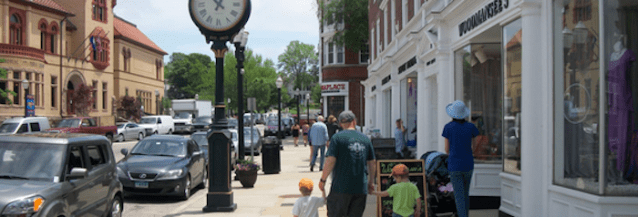
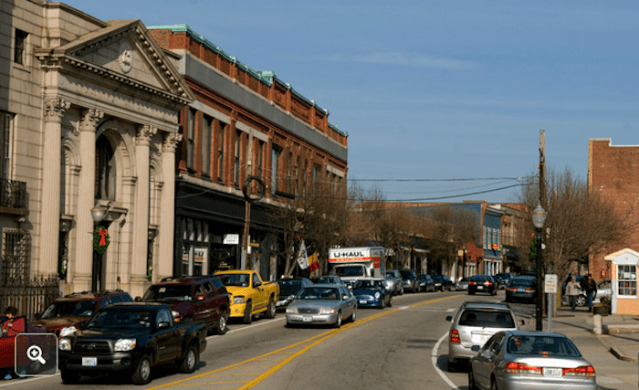
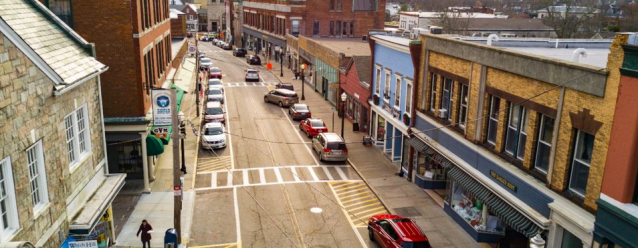
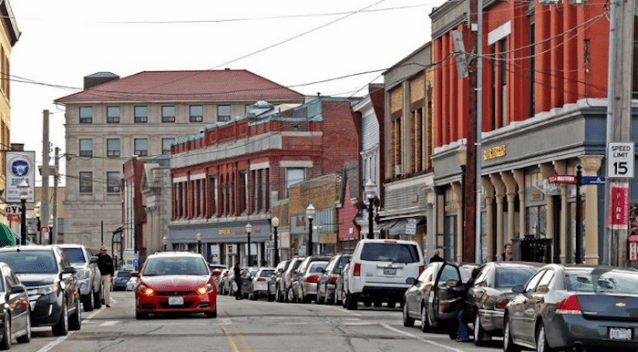
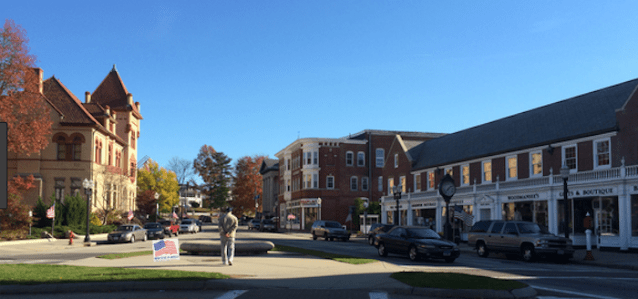
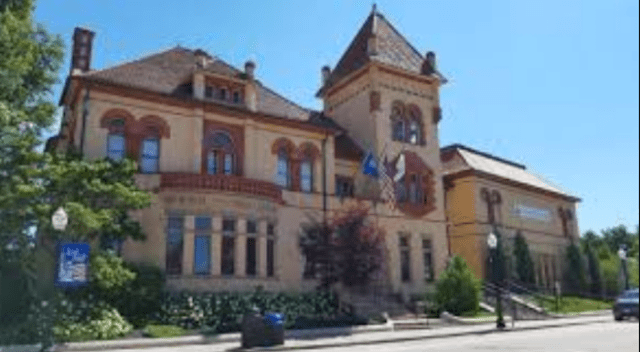
That no small-town main street was unjustly excluded from this list is unlikely. Surely Westerly, here in Rhode Island, ought to have made the cut, unless Westerly constitutes too large a metropolis – a town rather than a small town. But hold on! The population of Paducah, Ky., 25,024, is larger than Westerly’s 22,787. It made the list. So, that having been mathematically established, the top photo on this post is my favorite one from among the 30 assembled by AD. The shots below, since no small town in the Ocean State made the list, are of Westerly. I could not find Westerly’s inspired classical Post Office shot amid a grouping of buildings, but mark my words, it occupies a princely spot downtown.

I admit that I was swayed in favor of Staunton, Va., by the quality of the photograph, so evocative, so suggestive of the verticality of the best streets. But other towns showed much appeal in that their photographers captured the hard-to-define quality of a miniaturized big-city downtown. The best of this lot is difficult to identify, but you’ll know which ones I mean as you scroll down the list. Below, however, is Westerly.

Screen Shot 2018-08-12 at 8.05.25 PM.png

Screen Shot 2018-08-12 at 8.03.16 PM.png

Screen Shot 2018-08-12 at 5.37.17 PM.png

Screen Shot 2018-08-12 at 8.02.14 PM.png

Screen Shot 2018-08-12 at 5.36.05 PM.png

Screen Shot 2018-08-12 at 8.06.10 PM.png

Screen Shot 2018-08-12 at 8.07.49 PM.png

Screen Shot 2018-08-12 at 8.09.06 PM.png

Screen Shot 2018-08-12 at 5.43.17 PM.png

Posted in Architecture, Photography | Tagged , , , , , , , , , | 4 Comments