Mayor Elorza’s brave veto

Screen Shot 2018-11-30 at 10.38.58 PM.png

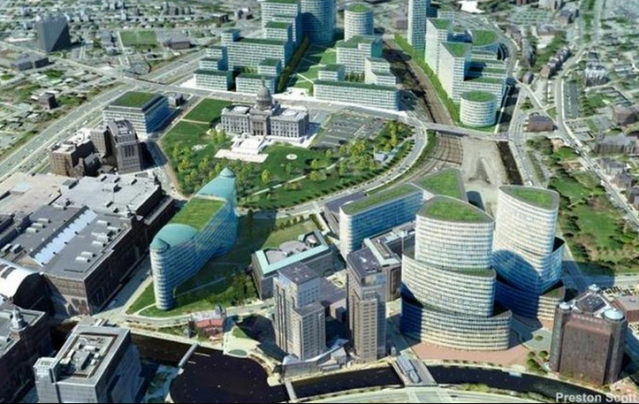
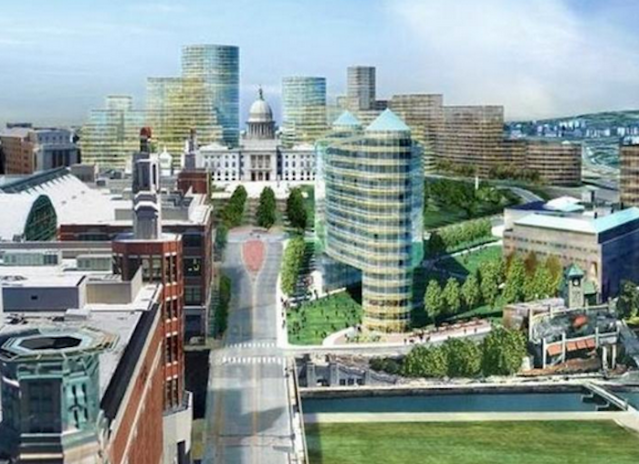
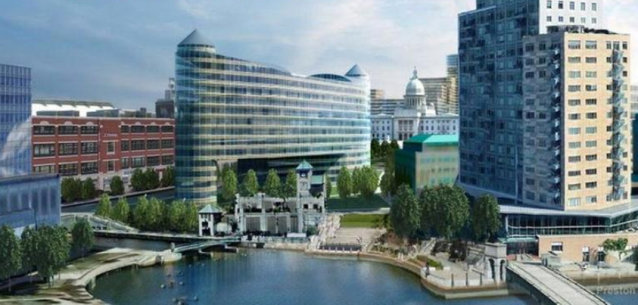
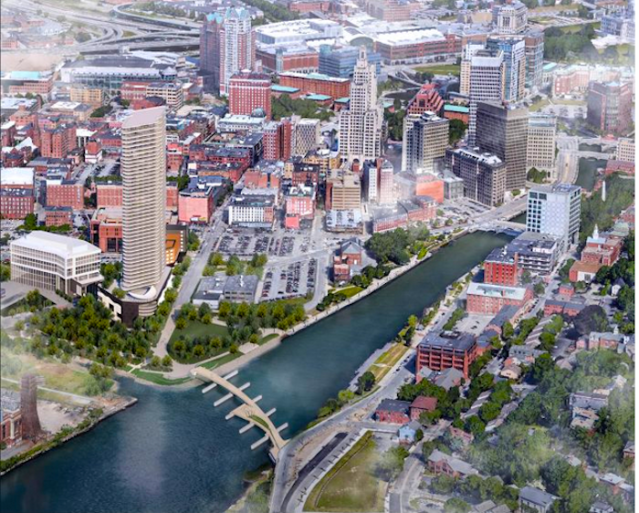
The original Fane tower (left), reduced from three; currently proposed Fane tower.

To the surprise of most observers, Mayor Elorza vetoed the Providence City Council’s approval last week of legislation to raise by a factor of six the 100-foot height limit on Parcel 42 of the Route 195 corridor. That legislation, a supposed go-ahead for the proposed Fane luxury tower, passed 9 to 5 last week, with one abstention, Council Chairman David Salvatore, who has opposed the project. Ten votes are required for the veto to be overridden, which must occur within 30 days.

So maybe Jorge Elorza’s veto will be difficult to override. I hope so. But each of the six council members capable of sustaining his veto will feel a lot of pressure to change their votes.

Even more surprising than the veto itself was the primary reason offered by the mayor for his action:

Given that this project would reshape our skyline and dramatically impact our streetscape, I made it clear both privately and publicly that the design of the building was my top priority. The developer has been unwilling to provide assurances that the city’s design recommendations would not be disregarded. As such, I have decided to veto this zoning change.

So far, so good. But what, if any, are his views on how the tower would “reshape our skyline and dramatically impact our streetscape”? Does he like the design or not? Or does the mayor merely want to make sure that his administration has a say in it? (No small concern, since at least one top state legislator wants to cut the capital city out of the design portfolio altogether.) Would he be satisfied if the Department of Planning and Development or the Downtown Design Review Commission tweaks the design just a bit this way or that way? Or does he really believe that the design of the building (as opposed to just its height) poses a major threat to the Providence skyline and streetscape? If so, then what kind of design does he have in mind? Would he be satisfied if Jason Fane switched back to his original design with its goofy Minion spectacles? Or does he think that the current design proposed by the developer (who has called our historic districts “cutesy”) actually does pose a threat to the city’s historical character because it does not fit in?

These are important questions in assessing Elorza’s veto and whether it is a political ploy or a reflection of the mayor’s deep understanding of what makes this city great. In Elorza’s letter to the City Council explaining the reasons for his veto, he wrote:

When I took office there was minimal development activity in our downtown and even less in our neighborhoods. Today, we have approximately 70 projects either completed, under construction, or in the pipeline. With more investment and development than we’ve seen in over a decade, Providence is a city on the rise.

As a growing and vibrant city, we see increasing interest from people who want to invest in our future.

Elorza makes a compelling case that Providence does not need the Fane tower either as a do-or-die project, without which our current building spree will grind to a halt, or as a symbol of the city as a great place to do business.

Maybe this current progress puts Providence in the catbird seat. No longer “beggars can’t be choosers,” maybe civic leaders can reasonably seek better projects than we’ve been getting. After all, the Fane tower is only a much taller, squigglier version of the ugly, sterile, building-as-machine metaphor that has been eroding the city’s historic character for decades. Maybe the mayor understands that for perhaps the first time in decades, Providence is in a position to demand that developers offer projects that will please the eye of the average citizen, not just its modernist-besotted design elites.

Our city has a quality of life most cities can only dream of, and much of that quality is grounded in its still-dominant fabric of traditional architecture, not yet torn down and replaced with junk as in most cities. But it is going, and it is going fast. If some mayor does not put his foot down soon, it will be gone before we realize it, and then we can kiss it good-bye.

Please, Mr. Mayor, you have been brave, but you must also be smart. Explain the importance of your veto. It is not just a ploy to retain a sliver of design authority. It is the first step in the salvation of this city’s future, a future that will not be secure if a first step is not taken soon. With its financial, fiscal and other woes, Providence needs major investment and growth if it is to sustain a competitive advantage that the Fanes of this world do not understand, and which a Fane tower will not bring. Our beauty leaves other cities in the dust and could, if embraced and put in high gear, add jet packs to our economy. If Providence will only take the easy and free step of ensuring that development projects strengthen rather than undermine our historical character – our brand – this city can write its own ticket.

Posted in Architecture, Development, Providence Journal | Tagged , , , , , , , | 10 Comments

Moore’s attack on Scruton

Screen Shot 2018-11-28 at 9.17.09 PM.png

Composite atop Rowan Moore’s article about Roger Scruton. (Lynsey Irvine/The Observer)

One of the Scepter’d Isle’s leading architecture critics, Rowan Moore of the Observer, has crafted an utterly despicable if entirely predictable attack on Sir Roger Scruton. Sir Roger is the British government’s choice to head a panel to bring beauty into U.K. housing policy. “Would you trust Roger Scruton to design your new home?” Moore asks mischievously. But the piece contains so many factual errors, half-truths, caricatures and seemingly intentional twistings of Scruton’s actual views, laid out in a fake genial, open-minded way, that most readers will have no idea of the false impression that Moore purposely conveys of Scruton.

This is not criticism but character assassination. Moore’s technique is to mischaracterize an assertion and then criticize the mischaracterizaton. Here I take on only those of Moore’s criticisms that relate to architecture. He notes up front that the current “alarm” caused by the conservative philosopher’s appointment to chair the Build Better, Build Beautiful Commission rises also from Scruton’s “record of past remarks on subjects other than architecture.” Moore refrains from addressing these, and so will I, except to suggest that if they are argued with the same rhetorical techniques as the items in Moore’s architectural indictment, they may be of equally dubious validity.

Screen Shot 2018-11-28 at 9.28.08 PM.png

Because there are so many objectionable passages in Moore’s lengthy diatribe, the way to address them is to assemble and reply to Moore’s mistakes as a kind of running dialogue. It may be read independently of Moore’s piece and of Scruton’s, to which Moore responds; however, many readers will want to read them both side by side, and read Scruton’s lecture as well. The latter, The Fabric of the City, is also linked in my post “Scruton’s first beauty volley.” (This correspondent’s Architecture Here and There blog, subtitled “Style Wars: classicism vs. modernism,” is clearly the best platform for the defense of Sir Roger!)

Scruton, says Moore at the outset, is like a monster in a monster movie whom the audience thinks has been “polished off” but who returns. Scruton, says Moore, is “a throwback to one of the most wearying and sterile phases of British architecture, the style wars that blighted the 1980s.” Moore refers to the heady time when someone, in this case Prince Charles in 1984, finally pushed back against the modern architecture that was ruining Britain (see James Stevens Curl’s excellent Making Dystopia). Scruton wrote his The Classical Vernacular in 1985 and his Aesthetics of Architecture in 1979. But modernism’s critics have not gone away. Charles has been more diplomatic but as insistent as ever against modernism; he has built Poundbury; and Scruton has widened his range of subject, pushing back against “political correctness.” His current appointment along with his knighthood in 2016 attest to his expanding influence. The challenge to modern architecture did not stop when Charles was pointed by his handlers toward other issues. The opponents of modern architecture have multiplied exponentially.

Screen Shot 2018-11-28 at 11.06.55 PM.png

Queen Mother Square, Poundbury. (Prewett Bizley)

Are the style wars “wearying and sterile”? Surely, if you like modern architecture. If it had not been for the style wars set into high gear by Charles’s “carbuncle” remark, there would probably be no Build Better, Build Beautiful Commission for Scruton to head. That would be dandy for Moore, except that there’d be fewer classicists to bash.

Moore uses the word “vernacular” from the title of Scruton’s book as if he does not know what it means. Not, as Moore says, “buildings that follow the details and compositions of past styles,” which obviously could mean to copy any old building, from the Parthenon to Parliament, or even the Brutalist-style Barbican (1982). In Scruton’s words it means architecture “by which the high rhetoric of the classical orders was brought down to earth in ordinary repeatable prose.” By definition, then, it is hierarchical, modulated, open-minded, modest, available to the wide range of classes and budgets. Moore asserts that Scruton “denigrates ‘modernism'”, by which Scruton supposedly means anything that does not “copy the past.” Yes, Scruton values buildings that are inspired by what he sees as a better time for architecture. In fact, almost all modernism except (supposedly) that begat by starchitects literally copies the past – the recent bad past rather than the more distant good past.

Screen Shot 2018-11-28 at 11.13.18 PM.png

The Barbican. (Time Out)

The point of vernacular is that it describes a wide range of buildings, often not designed by architects. “The vernacular” merely means a level of classicism whose beauty is affordable to and admirable to all. Its alternative is the junk that constitutes almost all modernism below the level of that designed by starchitects. “Bad trad,” as poorly design classical or traditional work is sometimes derisively entitled, is not to be blamed on its particular architects, mainly, but on the modernists, who have abolished virtually all tradition-themed education in design schools almost everywhere.

Scruton asserted in his lecture that “all objections to new building would slip away in the sheer relief of the public.” This aligns with my belief that the development process, in Providence and many other places, would not be so difficult if developers proposed projects whose appearance appealed to the public. As things are, the process is difficult, time-consuming and costly in part because developers and their architects must speak out of both sides of their mouths, to city and town design-committee staffers on the one hand and to the public on the other: to “experts” they mouth the usual design platitudes and to the public they try to hint that they might modify the project in a more traditional direction. This “discussion” confuses or misleads the developer, who tries, often in vain, to satisfy both sides.
Screen Shot 2018-11-28 at 11.17.15 PM.png

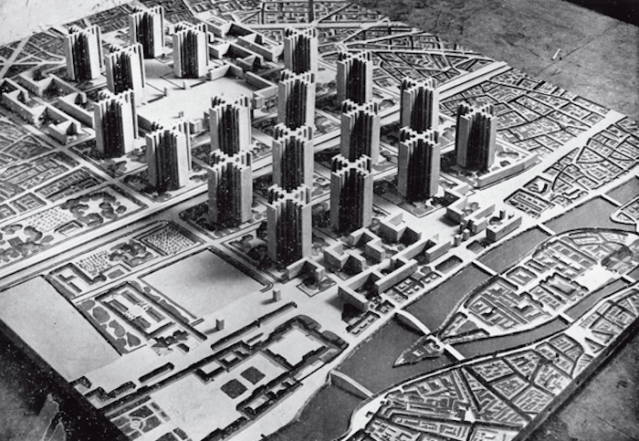
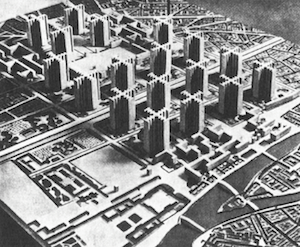
Corbusier plan for Paris. (ResearchGate)

Moore speaks to this issue by claiming that Scruton’s interest in the style wars means he is unlikely to spend enough time on the commission addressing pertinent issues such as “the interaction of the planning system and the property market,” which are supposedly more vital than aesthetics in addressing the problems that have led to the current housing situation. What Moore tries to avoid admitting is that the problems exist because the industry and the public have very different ideas of what constitutes good design (which is easy to grasp in a glance) and good planning (which is hard to grasp in a glance). This is precisely what Scruton does address, and why the style wars have never gone away. In a democracy, as Charles points out, the public taste should play some role in design.

Moore argues that after Charles’s sharp words about modern architecture, “People of talent and integrity saw their careers suffer. Mediocrities prepared to work in the approved style flourished.” The former might indeed have been talented and honest, but they favored a new model of architecture and planning that was a catastrophe. Yet it was declared by Corbu, etc., to be necessary – without any evidence – to bring buildings and cities up to a new, supposedly higher standard. One big difference between the new model and the old model it rejected was that the old model is democratic and the new model is authoritarian. So in fact, the work of Charles, Scruton and others to slow the dangerous momentum of modern architecture is precisely what was required. That so much of the new traditional architecture was mediocre is not the fault primarily of architects but of the modernist establishment for purging traditional curricula from the schools, as noted above. Bad trad is no worse than and mostly better than bad modernism, some of which, indeed, embraces traditional elements in order to be more salable.
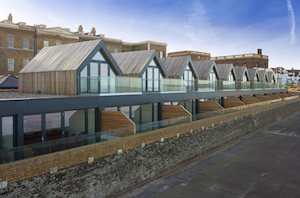
Screen Shot 2018-11-28 at 11.29.01 PM.png

Brotisch Modern, Margate Beach. (BM)

Moore notes that polls show “large majorities for the proposition that new homes should ‘fit in’ with their surroundings but small support for the idea that they should be ‘identical’ to whatever is already there.” But how does he define “fitting in,” and who’s calling for “identical” units in housing these days? Modernists certainly are not for “fitting in” but they have long favored “cookie-cutter” housing projects of a sort opposed by Scruton and his allies. So why does that sentence even exist? It exists because Moore wants readers to consider him and his modernist allies as the moderates, open to compromise, and Scruton as the radical voice of architecture. He accomplishes this by turning reality on its head – painting Scruton as stern and out of step, with Moore sweetly seeking comity in housing policy when, in fact, he’s all-in for modernism – that is, for Order over order. No, he says, it’s Scruton who wants Order.

For don’t you know? Scruton’s a nasty authoritarian! Moore tabulates the indictment in Scruton’s words: Classicism is “a law-governed order”! “Roman building types”! “The history of the implied order”! “The sanctifying of ordinary humanity”! “Principles and motifs set out by grand religious structures”! “The language of the temple”! “Good manners and fitting in”! “The suppression of ego in the interests of a wider community”! Moore quotes a Scrutonian trope: “When we lay a table for guests, dress for a party, or arrange a room … we subject the objects around us to a kind of moral discipline, … fitting the objects to an imagined community of neighbours. The same goes for planning and designing buildings. The most common form of rudeness involves standing out at all costs, drawing attention to yourself whether or not you deserve it.” You must keep your personality in check! The little fork must be outside of the big fork! Clearly, Moore suggests, Scruton is the autocrat of the dinner table – at bottom, an authoritarian.

This accusation is a kind of transference. Modernists are the ones who, for all their egotecture, require that mere humans suppress their egos and immerse themselves in the cubicles, big and small, of modern architecture. Starting in the 1950s, said Tom Wolfe in his From Our House to Bauhaus, “All at once they are willing to accept that glass of ice water in the face, that bracing slap across the mouth, that reprimand for the fat on one’s bourgeois soul, known as modern architecture.” Which architectural style has tried to snuff out its rival? If anything, modernists are totalitarian.
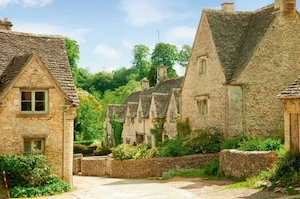
Screen Shot 2018-11-28 at 11.38.28 PM.png

Cotswolds cottages (old or new?)

All advocates for any system call for order of some sort. For classicists such as Scruton, it is the order that comes from hundreds of years, even thousands of years of passing down from generation to generation by trial and error in search of the best practices, whether for building a house or a city, for dining, raising a family, ordering a society, whatever. Even in the liberty that tradition upholds there is “implied order.” It is modernism that has sought to overturn tradition of every sort this last century; it is modern architecture that has sought to reshape society by decree of the Big Brothers, Le Corbusier, Mies and Gropius. Their diktat has survived revolts such as postmodernism by jujitsu’ing that critique with an architecture that abandons all pretense of connection with the natural order. They suppress dissent without blinking an eye, and crush any thought of a thousand flowers blooming. Their work is hated worldwide, and yet their control of the industry remains intact.

So the threat posed by Scruton is handled by Moore in the usual manner.

Screen Shot 2018-11-28 at 11.43.49 PM.png

Christ Church Spitalfields. (Museum of London)

Moore writes: “Scruton’s talks are such fusillades of inaccuracy and outdatedness, such bombardments of fake non-news, that it’s hard to know which errors to confront first.” More transference. Take the inaccurate claim of inaccuracy. For example, Scruton “falsely claims” that Hawksmoor’s Christ Church Spitalfields “was nearly demolished in the 1970s.” But Wikipedia says: “The Hawksmoor Committee staved off the threat of wholesale demolition of the empty building—proposed by the then Bishop of Stepney, Trevor Huddleston.” The web is dicey, but hardly a mention of the church on Google is without its version of how close it came to demolition. Why would Moore make such a claim? Probably because he figured it would hurt and that nobody would check his “facts.”

I lack the immediate information to check most of his claims of inaccuracy, and maybe Moore has gotten some things right. Regarding whether modernists live in Georgian houses, he notes that 18 of 18 recent Stirling Prize winners don’t live in Georgian houses. Well, that proves it! Against Scruton’s claim that modernists ignore beauty, Moore cites the word beauty on the first page of Corbusier’s book Vers une architecture. That proves it! Scruton, writes Moore, says “ordinary people all hate modern architecture.” No, Scruton did not say that. He did state that “ordinary people prefer traditional designs,” and cited a survey that found “support for traditional design is highest among the lower income groups,” who are less likely to have had their innate respect for beauty pounded out of them in architecture school. Scruton’s lecture says nothing near what Moore puts in his mouth, although the tenor of his lecture certainly suggests that he believes that most ordinary people hate modern architecture. And in his lecture he explains why at impressive length, expressed with the finest possible nuance.

To quote Moore, “One could go on.” And indeed we have. But let’s quote a paragraph from Moore’s diatribe:

Some architects continue to give fuel to Scrutonian arguments with projects that are indeed offensive expressions of personal vanity: look no further than this week’s revelation of a Norman Foster-designed “Tulip tower” proposed for the City of London. We can all agree that what happened to Detroit and Reading was in different degrees terrible. Many of us share his dislike of the crude towers now rising in London and other British cities.
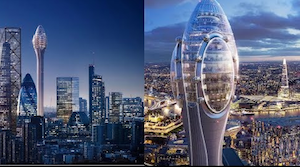
Screen Shot 2018-11-28 at 11.46.41 PM.png

Planned Tulip Tower, London. (YouTube)

I will refrain from calling that paragraph a white flag of surrender. Leaving aside that it’s not just Detroit and Reading that have been destroyed by modern architecture, what does the Tulip Tower have that other modernist towers lack? Not very much. The requisite ugliness and stupidity are there. Shouldn’t the top modernists be relied upon to refrain from “offensive expressions of personal vanity”? On the contrary. Being offensive – rejecting traditions built up over the centuries, spitting in the face of the public, is the whole idea of modern architecture.

Not even I have the patience to challenge each example of the “fusillades of inaccuracy and outdatedness” or the “half-truths and caricatures” that Moore cites in his dishonest characterization of Scruton. No doubt these are honest expressions of Moore’s disdain for Scruton, but for those who are obliged to argue the inarguable – the desirability of modern architecture – concepts like honest and dishonest become indistinguishable.

“If I had to pick a side in any style wars, I would choose that of the modernists.” To judge by Moore’s style of argument, that is understandable. Great minds think alike, they say, or something like that. So let’s be thankful that it’s Sir Roger and not Rowan Moore who has been assigned to put the beauty back into British housing policy.

Posted in Architecture | Tagged , , , , , , , | 5 Comments

Veto the tower, Mr. Mayor

Screen Shot 2018-11-26 at 11.07.43 PM.png

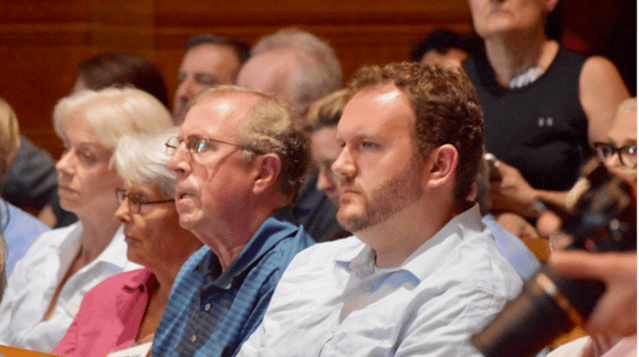
Citizens listening to testimony at City Council hearing about Fane tower. (UpriseRI)

I wrote a letter to Providence Mayor Jorge Elorza today [Monday]. I sent it by email and then hand-delivered another copy tucked inside my book Lost Providence, where I inscribed the title page in his honor. “Delivered with the sincerest hope,” I wrote, “that Providence is not lost yet!”

Since I’ve let the inscription out of the bag, I might as well go all the way and violate the privacy of our correspondence by printing the letter itself on my blog. I promise not to violate your side of the exchange, Mr. Mayor, if you reply. Here is my letter in full:

Dear Mr. Mayor:

We met during your first campaign when you dropped by a school fair at the west end of Broadway. My wife, Victoria, and our boy, Billy, were waiting with me to get on the Ferris wheel when we talked to you. I can’t recall our little chat exactly, but you expressed agreement with my belief that Providence had to protect its historical character.

You have a chance to do that by vetoing the recently passed legislation to increase the height limit for a proposed residential tower in the I-195 corridor.

Other new buildings there and elsewhere in the city, going back several decades, have undermined the historic character of downtown, but the proposed Fane tower is the biggest, and would set a precedent that threatens to speed up the erosion of our historical character.

Zoning prohibits new building that fails to protect the historical character of downtown. That is in Section 600 of the zoning code:

The purpose of the D-1 District is to encourage and direct development in the downtown to ensure that: new development is compatible with the existing historic building fabric and the historic character of downtown; historic structures are preserved and design alterations of existing buildings are in keeping with historic character.

This has been largely ignored in recent decades but it is vital to the future of Providence. Your veto could begin to reverse a trend that threatens to undermine the economy of Providence and the quality of life of those who live and work here.

Developers care a lot more about having government on their side than about architectural style. The public by a very large margin prefers traditional architecture. It is only the elites who like modern architecture, and mostly for reasons of careerism not the way it looks. Providence is a city attractive to tourists and businesses because of a beauty that no other city can compete with. Its civic leaders, led by its mayor, should try to persuade developers, including Jason Fane, to build projects that fit into the city’s historical character. That would make every project easier to get through the development process.

If developers continue to build ugly, the city will eventually lose one of its two chief competitive advantages (its beauty; the other one is its location between Boston and New York). Providence should build so as to strengthen rather than weaken its brand.

You as mayor can bring about such a change in policy. It would cost nothing, require no new laws, and make your mark on the city’s history. And a veto of the height change – which need not kill the Fane project – would be the best way to begin.

Sincerely,

David Brussat

P.S. – I will deliver to your office a copy of my book, Lost Providence, published last year, which traces the erosion of historical character in the city’s history.

Others have written letters urging the mayor to veto the bill or not to veto it. Many issues favor a veto beyond what I’ve mentioned here, such as excess height, spot zoning, the lack of affordable housing, its effect on the housing market and its possible financial weakness. The mayor has placed certain project conditions in order to ward off a veto, and he deserves credit for his toughness. The arguments for the tower are mainly jobs, taxes and to show that Providence is open for business. All of these are open to challenge but they are honestly held by many of the mayor’s constituents. He faces a tough decision. May he weigh it carefully and make the best choice he can.

Posted in Architecture, Development | Tagged , , , , , , | 2 Comments

Scruton’s first beauty volley

Screen Shot 2018-11-23 at 8.42.14 PM.png

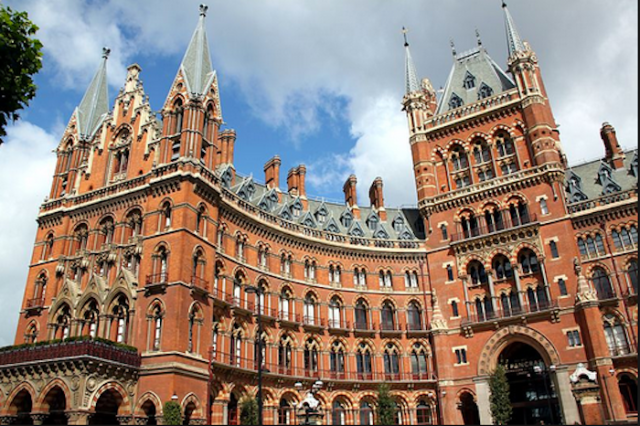
Portion of the hotel at St Pancras Station, London. (University College London)

As I mentioned in “Sir Roger’s hunt for beauty,” Roger Scruton has been appointed chairman of a commission to promote beauty in British housing policy. Naturally, all those who are opposed to beauty in architecture are on the warpath against him. I here link to what may be his first lecture since his appointment, at the Policy Exchange on Nov. 18, dedicated to the memory of Colin Amery, an ally in the fight to return beauty to the built environment. Scruton has assured the public (or, more specifically, the modernist design elites) that his role as commission chairman is not to impose classical style on British housing policy, but to invite traditionalists to join in a conversation from which they have long been excluded. Nevertheless, this lecture is sure to whip up even more hysteria among his opponents – merely because it has so much good sense. Here is a quote from “The Fabric of the City.”

As Colin constantly reminded us, the city is an evolving fabric, in which old and new come together, the old disciplining the new, and at the same time adapting to it. Something in this process of evolution must remain the same: the city itself, conceived as a settlement. Conservation should occur not in order to pickle the city in aspic, but so as to retain its identity as a living community and an object of steadfast affection. Burke argued that in politics we must reform in order to conserve; the lesson of architectural aesthetics is that we must conserve in order to reform.

This fine passage challenges one of the stalest of lies often told by modernists to sway the public against new traditional architecture. It is often said that to build new buildings inspired by old building styles will turn old cities into museums. Leave aside the injustice to museums, which constantly evolve. The idea that contemporary classicism risks turning cities into places solely for rich tourists rather than living, working populations, is a fallacy dear only to the modernist curators of architectural history.

It is those curators, led by the late Nikolaus Pevsner, who have sought to imprison styles of architecture in “periods” so as to argue that a historical style is inappropriate for today. It is the rare architectural historian who sees that architecture underwent constant flux until modernism fallaciously called a halt to that history by banning the toolbox used for centuries to produce beauty. We are left with an architectural language of, in the words of James Stevens Curl, “monosyllabic grunts.” Roger Scruton understands that, and hopes to unchain the queen of arts from its modernist cage. Let a thousand styles bloom! Perhaps that will be his motto: he knows that beauty is sure to win. This is why Sir Roger will be the perfect chairman of the new Build Better, Build Beautiful Commission.

Posted in Architecture | Tagged , , , , , , , | 7 Comments

The big boxes of the future

Screen Shot 2018-11-20 at 6.33.25 PM.png

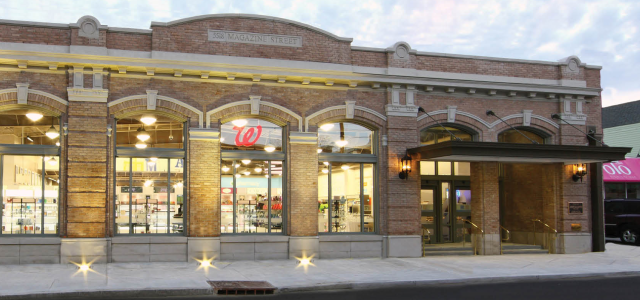
A Walgreens of classical style in 2013, after update of original building, shown below.

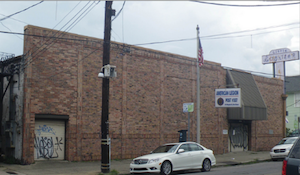
A few days ago some interesting photographs landed in my email inbox as part of an online discussion of big-box retail and its design, a subject near and dear to my heart, as I have watched the evolution of suburban retail strips on Mineral Spring Avenue (Route 15), in North Providence, R.I., and on Bald Hill Road (Route 2) in Warwick, R.I. They both have grown more traditional in appearance over time. But these photos were of commercial buildings in New Orleans (a before-and-after) and Madison, Miss.

Screen Shot 2018-11-20 at 6.34.05 PM.png

The one on top is the after, the before being the one to the left. If this were half a century ago, near the outset of suburban sprawl, before and after would be reversed, with the lovely ornate Walgreens demolished to make way for the blank-wall building. The Walgreens is much more recent, fortunately, from 2013. The enlightened property owner is Stirling Properties – ironic, since the Brits recently handed out their latest Stirling Prize, which is, I think, often mistaken over there for the Carbuncle Cup. The architect of the Walgreens renovation was Michael Rouchell, of New Orleans, a founder of the Louisiana chapter of the Institute of Classical Architecture & Art.

Beautiful as is Rouchell’s work on the drug store, an even more remarkable phenomenon is on display in the photos at the end of this post.

Screen Shot 2018-11-21 at 5.33.03 PM.png

Madison’s Mayor Butler

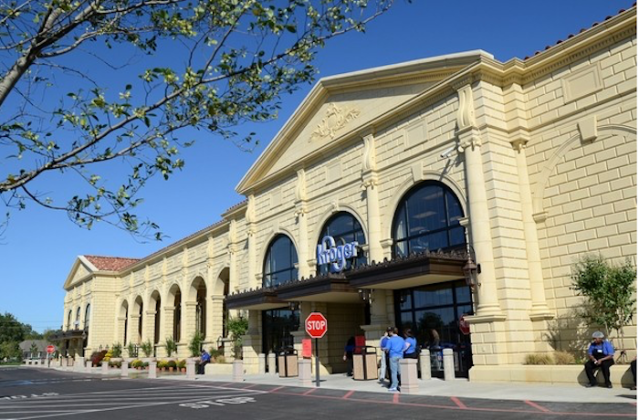
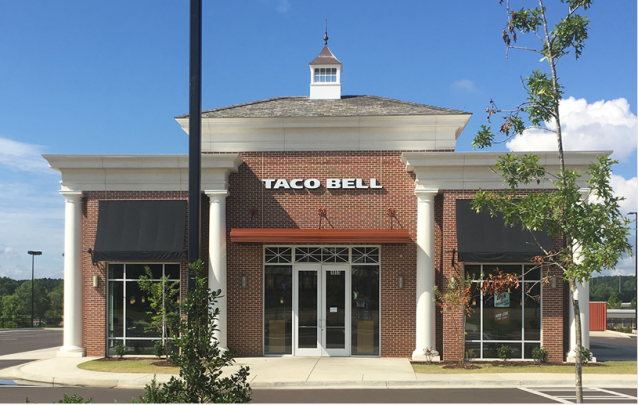
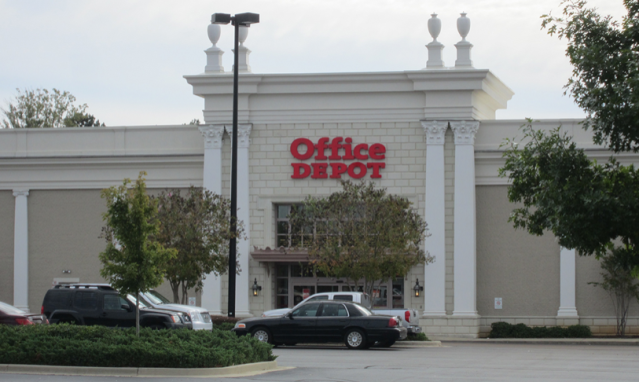
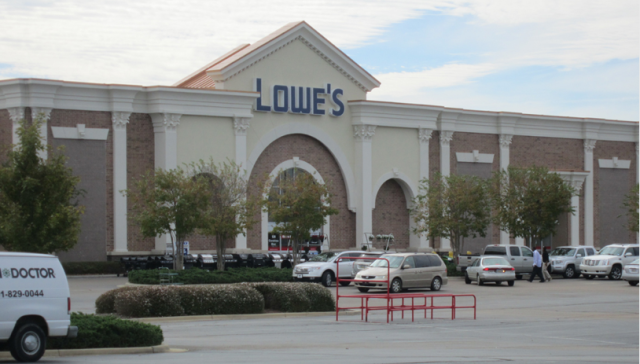
What is remarkable about these new big-box stores in Madison, Miss., is not the quality of their design but that they are, collectively, the inspiration of Madison’s mayor since 1981, Mary Hawkins Butler. I’m not at all familiar with her technique, but for years she has insisted that big-box retail hoping to move into this suburb of Jackson, the state capital, use classical styles for their design. The quality of that design may be relatively low but is still superior to what usually suffices for retail strip architecture. The five examples below are all original buildings, and I can imagine that getting the corporate design czars to budge off their barfitecture must have been akin to pulling teeth.

These stores violate many classical principles, above all that of hierarchy – meaning that a building on a commercial strip should not try to look as if it is a state capitol or a major bank headquarters (as such civic and commercial buildings were once conventionally conceived). The building atop the photos at bottom (not at left below) does the best job of violating hierarchy, and in its design far outstrips the four below it in reaching toward the upper levels of “bad trad.” (In fact, isn’t it really rather nice?) The four below it display major flaws in proportion, detailing and other aspects of classicism.

Screen Shot 2018-11-21 at 6.57.10 PM.png

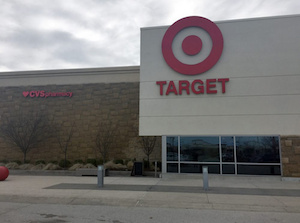
Typical big-box store design. (gmtoday.com)

And yet those who enter stores like the Kroger, Sam’s Club, Taco Bell, Office Depot and Lowe’s shown at the bottom must feel, as they enter, slightly elevated, and they probably feel the difference even if they do not necessarily notice it. And if they have just departed a store (left) that does not think it should try to look beautiful, the difference might strike them as more than slightly elevated. In the confusion of factors that cause momentary happiness in human beings, a more beautiful big-box store can only help.

The point here is that by pressuring corporate design apparatchiks to up their game before they enter the Madison retail market, Mayor Butler has improved the quality of life in her community. She has rejected today’s conventions in architecture. Good for her. Maybe she has read Making Dystopia, by James Stevens Curl, which tracks the sordid and dishonest history of modern architecture. Other mayors, governors, town, city and state officials and civic leaders should follow suit – that is, show a similarly rebellious spirit (They should read the book, too, which is here.)

Developers are more interested in having local government on their side than they are in scoring points with local design elites. Communities should take advantage of that. In some places, like Providence, conventional wisdom in architecture flies in the face of local historical character, undermining the efforts of civic leaders to effectively brand their cities and towns. That is just ridiculous, and so easy to stop.

Screen Shot 2018-11-19 at 2.08.29 PM.png

Screen Shot 2018-11-19 at 2.07.18 PM.png

Screen Shot 2018-11-19 at 2.08.14 PM.png

Screen Shot 2018-11-19 at 2.08.46 PM.png

Screen Shot 2018-11-19 at 2.07.49 PM.png

Posted in Architecture, Development | Tagged , , , , , , , , , , , | 7 Comments

Seek the bottom of beauty

Screen Shot 2018-11-16 at 7.16.27 PM.png

Weckbough Mansion, in Denver, features multiple human faces. (Denver Sun)

The headline of Joanne Ostrow’s article in the Denver Sun got my attention:

Is Denver’s contemporary architecture killing us?

Leaving aside that Denverites are not the only victims of modern architecture, the answer offered to Ostrow by the subject of her article, Denver architect Don Ruggles, founder of its Ruggles Mabe Studios, is yes. Ostrow states that “Ruggles worries that the odd angles and sharp points meant to excite are also causing neuroaesthetic problems. ‘This is a public-health issue, not a style issue.’ ”

I started reading the article and was swept up immediately. Ruggles, it seems, is among a growing number of design theorists investigating a phenomenon regarding biology and architecture that I’ve been writing about for several years now. Ruggles described to Ostrow his claim,

with support from neuroscience, that the human brain seeks certain timeless patterns without which we lack equilibrium and a sense of well-being. Freaky, fun, unusual designs may excite, but they also agitate and upset.

Prof. Nikos Salingaros, a mathematician and theorist at the University of Texas, San Antonio, has been writing about the disorienting qualities of modern architecture and its roots in neurobiology. Ann Sussman is an architect and researcher in Massachusetts who uses eye-tracking technology to follow the brain’s behavior as it reflects the approach/avoidance reaction to buildings that Ruggles reveals to Ostrow in this article, and in his book Beauty, Neuroscience and Architecture (University of Colorado Press). Both have been pathbreakers in the neuroscience of architecture.

Boy, was I glad to have stumbled across another fellow traveler!

Screen Shot 2018-11-16 at 7.17.01 PM.png

House across street from mansion above. (Denver Sun)

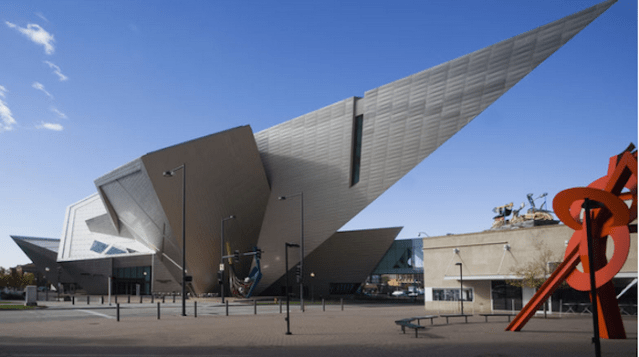
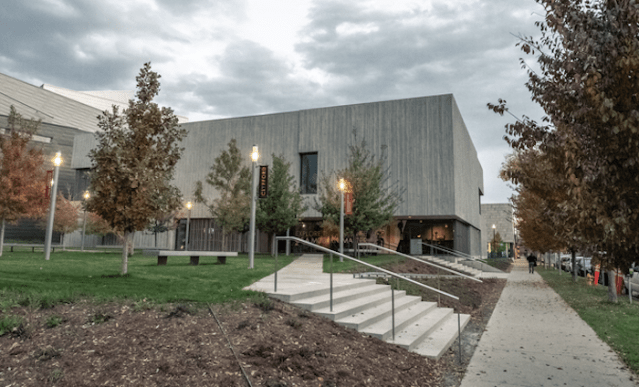
Then, however, as I reached toward the end of Ostrow’s article, Ruggles threw cold water on my happiness. He admires the house atop this post and argues next that the modernist house across the street is ugly. Fine! But then he criticizes the sinister-looking Hamilton wing of the Denver Art Museum, by Daniel Libeskind while admiring its neighbor, the Clyfford Still Museum, as “firmly rooted and calming,” though it looks like a Neo-Brutalist retread – and then says the two balance each other nicely. Huh?

In Ostrow’s article, Ruggles’s remarks are followed by quotes from a gaggle of modernists who bemoan his infatuation with the word beauty and his (initially apparent) preference for traditional architecture. Ruggles gets no credit, however, for suggesting that modernist buildings can be deemed beautiful within the ambit of his thesis, which mostly involves nine-square patterns that may be drawn upon the facades or plans of the buildings he considers beautiful. This reminds me of another book I read years ago by a writer who used slanted lines to reveal a building’s proportions, or something like that. (I must add that Ruggles’s firm’s architecture is beautiful, mostly.)

I have just dipped my toe into Don Ruggles’s thinking. His book is next to me. I will read it and try to figure out where he is coming from.

Screen Shot 2018-11-16 at 10.02.16 PM.png

Hamilton wing of the Denver Museum of Art. (wheretraveler)

Screen Shot 2018-11-16 at 9.55.43 PM.png

Clyfford Still Museum, near Hamilton wing of Denver Museum of Art. (Denver Sun)

Posted in Architecture | Tagged , , , , , , , | 1 Comment

HQ2 twofers and Providence

Screen Shot 2018-11-14 at 9.27.06 PM.png

From Rhode Island proposal for HQ2. (all images CommerceRI)

Two major eastern cities have won the HQ2 sweepstakes, and you have to wonder whether the twofers – Long Island City and Crystal City, outside Manhattan and D.C. – both realize they got half a loaf.

How soon will it take for them to recognize that getting half a loaf was to have dodged the full loaf of total victory in this Amazon sweepstakes? The cities that made it to the last round of 20 may be wiping their brows in retroactive relief. Cities like Providence, which managed to avoid Amazon’s attention altogether, may still be counting their lucky stars.

New York City and Washington, D.C., are probably large enough to embrace HQ2 and its 50,000 ÷ 2 jobs without major injury. Even longer commutes and even tighter budgets are not death warrants for such big places. Providence would have been inundated, losers both financially and in quality of life. Probably no midsized city would have been hurt as badly as Providence.

One of Providence’s two major competitive advantages – its historical character (can’t do much to stop its location between Boston and New York) – would have gone the way of the dodo. Many citizens and civic leaders are already doubtful that the city can absorb the proposed 46-story Fane tower. But there’s no question that Amazon would have clobbered the city’s beauty without blinking an eye. Still, how many Rhode Islanders were rooting against HQ2? Not many, I’d imagine.

Reader Michael Airhart commented today on one of my posts on Rhode Island’s HQ2 proposal from a year ago, “R.I’s Amazon HQ2 bid.” After describing Crystal City’s probable fate – “a cluster of a dozen cookie-cutter glass buildings crammed up against the main terminal of National Airport” (here they would have been crammed up against the Rhode Island State House) – Airhart wrote:

Did Providence ever stand a chance of attracting Amazon? No. And I think that reality only strengthens David’s contention that Providence and the state should have played to the city’s strengths — its historic architecture and culture — instead of trying to copy everyone else. Amazon would still have said no, but Providence could then have caught the attention of other companies. Pretend-ing to be like everyone else doesn’t impress the businesses that are likely to consider Providence.

So true. We dodged a bullet. A very big bullet. If we had played hard to get by demanding that Amazon build out its HQ so as to fit into Providence’s historical character, Amazon might have noticed. Probably not, but other big businesses might have, as Airhart suggests. Leave it to the “creative capital” to regurgitate the worst ideas from everywhere else!

Not everyone was against letting such a fate befall Providence, a year ago or today. Many people favor the proposed Fane tower. Many others oppose it, some because of its effect on the historical character of Providence. Yet how many of these latter oppose all of the other carbuncles planned or under construction in the I-195 corridor? Not many, I’d guess. How many opposed the GTECH building? How many opposed the Rubik’s Cube and the many other attacks on the city’s historical character that have arisen since the 1970s. Not many, I wager! And yet those buildings were no less an attack on Providence’s historical character than the Fane tower is today.

Fortunately, because the city avoided two major urban renewal plans of the 1960s that would have destroyed downtown and College Hill, Providence has so much more beauty here than most cities that developers and foolish civic leaders will need all 1,000 cuts to achieve the death of its beauty. But those slow-death-of-a-thousand-cuts are coming faster and faster.

Wake up, Providence!

Screen Shot 2018-11-14 at 9.28.52 PM.png

Screen Shot 2018-11-14 at 9.29.57 PM.png

Posted in Architecture, Development, Uncategorized | Tagged , , , , , , , , , | 9 Comments

Sir Roger’s hunt for beauty

Screen Shot 2018-11-11 at 5.39.00 PM.png

Tuscaloosa (Ala.) Federal Building and Courthouse (Architect Magazine)

Sir Roger Scruton, the British philosopher and advocate of classical beauty and architecture, has been named chairman of a commission called Building Better, Building Beautiful to advise Britain’s government on issues of beauty in housing policy. This is fabulous news. Who better? Scruton is a knight, after all, and has long donned shining armor.
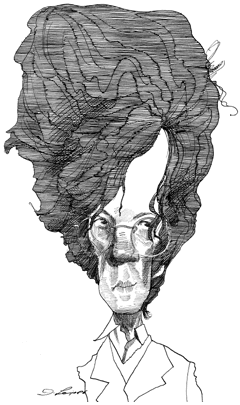
Screen Shot 2018-11-11 at 5.34.10 PM.png

By David Levine for the NYRB

Naturally, the choice has irked the forces of modern architecture arrayed on the battlements of the design establishment, whose helots have already started heaving hot pitch over the walls to block him and the forces of architectural tradition. The modernists are already in a fever over the publication of Making Dystopia, by James Stevens Curl, who just has published the most comprehensively damning history of modern architecture ever. Together, maybe he and Sir Roger can jujitsu the design establishment.

Scruton’s appointment recalls the furor over here sparked by the appointment of Thomas Gordon Smith, a classicist at Notre Dame, as chief architect of the General Services Administration, which oversees all federal building projects (no small portfolio). The mods howled and President George W. Bush buckled. British Prime Minister Theresa May appears to be made of equally stern stuff, but she may be too distracted by Brexit to succor the gnashing of teeth over Scruton.

It is also worth noting that May’s cabinet has had ministers of housing and of transport who vocally support traditional design, and perhaps other top officials of like view of whom I am unaware. And of course there is Prince Charles. The United States has never had advocates of tradition in major official or political posts or in other realms of public life, although the excellent Justin Shubow, president of the National Civic Art Society, has just been named to a seat on the U.S. Commission of Fine Arts.

Screen Shot 2018-11-11 at 5.39.52 PM.png

Commercial building in London.

May’s latest housing minister Kit Malthouse was recently castigated by modernists for tweeting that he preferred the new U.S. federal courthouse in Tuscaloosa, Ala., (top photo) with its inspiring ancient Greek temple design, over a glassy modernist commercial building in London (left). Click on the Malthouse tweet. Although Twitter replies hardly reflect any kind of deep thinking, this embarrassing tripe at least gets its viewpoint across. Commentary on architecture by professional modernists is actually far worse, filled with jargon that is incomprehensible to the layman, no doubt intentionally so.

The inability of modernist architects to defend their work recalls a similar inability or disinclination of traditional architects to defend traditional architecture in the 1920s and ’30s, when it was challenged by modernism after a reign as “the establishment” lasting not decades but centuries, if not millennia. If inarticulation precedes a fall from grace, then the pathetic reaction to Stevens Curl’s book and to Roger Scruton’s appointment bodes poorly for the modernists as they cling ludicrously to their power.

Whatever one thinks of Donald Trump, his ability to get under the skin of his opponents is a model, of sorts, for how advocates of traditional architecture should respond to what seems to be the unhinged disarray of the modernists. Keep on pointing out the flaws of modern architecture and the fatuity of their attacks on Scruton and Stevens Curl. It is not really necessary for trads to be all on the same page. There are many pages, all useful, against modern architecture. Argue for reform in architecture education. Argue for reform in local development processes. Argue for reform in how architecture addresses climate change (trad is far greener than mod glass and steel). It’s all good!

Because Sir Roger is a conservative on issues beyond aesthetics, such as fox hunting, his appointment is the subject of even more overall vituperation than Making Dystopia (which I reviewed here last week). Most advocates of traditional architecture are worried that some extremists on the far right also like traditional architecture. They have every right to do so, but advocates of modern architecture are not entitled to tar those who advocate traditional architecture with the the views of the far right. That is guilt by association. Traditionalists should not be suckered by this ploy of the modernists into playing down their architectural tastes, or their support for Scruton.

Even though tradition is naturally conservative, traditional architecture is a big tent that naturally appeals to the left as well as the right. The allied cause of historic preservation, for example, appeals as much to the left as to the right. Of course some strains of either cause appeal more to one side than to the other. Traditional architecture’s superior ecological sustainability should appeal to the left even though the modernists prefer the dubious gimmickry of LEED credentialism as a response to climate change.

Most supporters of traditional architecture hesitate to let their essentially nonpartisan aesthetic preferences get tangled up in the coils of partisan politics. That’s an understandable concern, but the quality of an idea arises from the merits of the idea itself, and not from the merits or demerits of those who support the idea.

Above all, do not denigrate what has come to be called the style wars. The public prefers traditional to modernist styles by a very wide margin, and these are firm convictions arising largely from intuition. Architecture is the only art that people engage personally every day of their lives, and so most people have solid judgment based on their innate, neurobiological reaction to their experience – it is superior to the judgment of the modernists, which is based on expertise, so-called, that arises from the purging from students in architecture schools of the conventional respect for beauty. If advocates of tradition abandon the appeal to style, however vital the various alternative appeals may be, the public will not be enlightened but turned off, confused and dismayed. Trads who buy into modernist disdain for style as a primary consideration in architecture play right into the hands of the mods.

In fact, Scruton in his 1979 book The Aesthetics of Architecture states:

A more important distinguishing feature of architecture is provided by its character as a public object. A work of architecture imposes itself come what may, and removes from every member of the public the free choice as to whether he is to observe or ignore it. Hence there is no real sense in which an architect creates his public; the case is wholly unlike those of music, literature and painting, which are, or have become, objects of free critical choice. … Clearly, the architect may change public taste, but he can do so only by addressing himself to the whole public and not merely to some educated or half-educated part of it.

Have faith in the public!

Sir Roger Scruton as the knight errant of beauty is an idea whose time has come.

Posted in Architecture | Tagged , , , , , , , , , , | 4 Comments

Committee’s Fane flip-flop

Screen Shot 2018-11-09 at 7.45.29 PM.png

Recent rendering of proposed Hope Point Tower in city context. (Fane)

Learning nothing in its latest public hearing that it did not already know, the Ordinance Committee of Providence City Council reversed itself on Thursday to recommend that the council neuter the city’s zoning laws.

It voted three to one to urge the council to raise the height limit on Parcel 42 by a factor of six – 100 feet to 600 feet – for the Hope Point Tower proposed by developer Jason Fane. In July, the same committee voted three to one to recommend against the same zoning change. The only difference was that the first vote came before and the second vote after elections for city council seats. (Bravo for Bryan Principe, the only council member to stand firm.)

That doesn’t mean the Fane tower is now a done deal. The council could still ignore the recommendations of the committee. I don’t think these men and women are corrupt, I think they are held back by old thinking about cities. This old thinking is not the future but the past. It poses in high-tech dress and fools most of the people most of the time. It is corrupt, though a better word might be corrosive – a cancer on the livability, the value, the hopes and the spirit of cities.

For almost a century, American cities have adopted growth and development practices that call for purely functional buildings on purely functional streets. With beauty thrown on the ash heap, the resulting sterility and ugliness of cities caused dismay in most people back then and most people today. The promised efficiency never materialized.

In Providence, massive urban-renewal plans for downtown and College Hill fizzled in the 1960s, leaving our city as one of the few in America with its original beauty largely intact. But Providence’s civic leaders since then have never really understood the jewel they were in charge of. They have instead tried to “catch up” with cities like Hartford and Worcester that went all-in on the idea of cities as machines and people as cogs in them.

Before the city council votes to declare that Providence’s zoning laws are just a façade for copying the respectable failures of Hartford and Worcester, our deep thinkers should rethink this more progressively. A vote for the Fane tower is a vote for the GMO architecture of GTECH, the Rubik’s Cube and the I-195 corridor as built and planned so far. A vote against the Fane tower is not a vote against development but a vote against bad development.

If the council fails to grasp the need to turn the city back toward development that strengthens rather than weakens its historic character – whose loss will kill the city’s future – then it will not matter whether Fane builds his mammoth middle finger flung at all that we love about Providence.

If one American city decided to encourage development that its citizens could love, its skyline would be filled with cranes, and its future would be the envy of every other city. Providence can be that city if it wants to.

Posted in Architecture, Development | Tagged , , , , , , , | 3 Comments

More on ‘Making Dystopia’

Screen Shot 2018-11-07 at 6.12.08 PM.png

Model of 1925 Plan Voisin by Le Corbusier to replace the Marais district of Paris. (Daily Beast)

A book whose vile subjects have grown used to shucking off well-framed attacks for decades, and yet whose stranglehold on establishment thinking has loosened in recent years, is naturally offended by what could be their coup de grâce. So it is natural that modernist architects shellacked by James Stevens Curl in his Making Dystopia (published by Oxford University Press) are fighting back, and fighting, as is their habit, dirty.

I mentioned in my review of the book last Friday that the usual suspects have pretty much ignored the book’s argument and argued instead against its prose style. Perhaps the most egregious was Stephen Bayley’s review in The (U.K.) Spectator, “Modernist architecture is not barbarous – but the blinkered rejection of it is.” Bayley writes:

It has a ‘Prolegomenon’ (yes, really), abundant Latin quotations, nearly 40 pages of preface and acknowledgments, 58 of dense endnotes and 42 of bibliography. Plus a prolix ‘Further Thoughts’ and a turgid epilogue. It is windy, overwritten, under-edited, repetitive and full of clichés. It is a book where ‘much ink has been spilled’.

How can Bayley possibly criticize the extensive documentation of extensive research? To give him credit, he is one of the few to deign to address the book’s theme. But his dismissal of the book’s prose amounts to fraud and is the reverse of what it deserves. Stevens Curl’s prose is engagingly rococo at times, well calculated to engage the reader’s mind with the convolutions of the modernist thinking he describes, the product of which he rightly (and diplomatically) calls “psychotic and “deranged.” Bayley writes:

Aiming his trembling arquebus at some sitting targets, Curl calls contemporary architecture “psychotic” and “deranged.” I have seen Louis Kahn’s India Institute of Management in Ahmedabad, the Farnsworth House in Illinois, Tadao Ando’s Naoshima, Foster’s Hong Kong and Shanghai Bank, the Guggenheim in New York and the Neue Nationalgalerie in Berlin and do not find these psychotic or deranged at all. On the contrary, I find them fine, elegant and elevated expressions of the human spirit, at least the equal of the Parthenon or Chartres.

At least the equal?! Psychotic and deranged are words that deeply understate the folly of Bayley’s article, not to mention the villainies of modern architecture.

Anthony Daniels has reviewed Dystopia, “Authoritarianism in cement and steel,” in the Australian journal Quadrant, and he takes particular aim at Bayley, who committed the debating error of conceding modernism’s appalling mistakes. Daniels quotes him, then cuts off his head:

Yes [writes Bayley], modernist principles, misunderstood by unimaginative planners, often led to atrocious results. [The founding modernist] Le Corbusier’s “vertical garden cities” became vertical slums. And there is only a sliver of difference between Walter Gropius’ Bauhaus ideals and a crap council estate.

Even overlooking the vulgarity of expression that seems now to be almost de rigueur in British journalism, this is a very curious passage, for again in essence it admits that Curl is right, although the author does not appear to realise it. Atrocious results, vertical slums, crap council estates: that is the legacy of Le Corbusier and Gropius on a huge scale.

Modern architecture is not merely unimaginative work by architects who misunderstand its principles. The work, from its best on down, is offensive to humanity, and intentionally so. To Corbusier, who is still a god to modernist practitioners, people were just ants, cogs in a machine-age future controlled by the master race – oops, the master builder. Daniels reminds readers of what the modernist clerisy has winked at for decades, that Corbusier had seriously proposed demolishing a swath of Paris, much of the Marais district, to make way for sterile concrete towers. Stevens Curl describes the Plan Voisin, which Corbusier unveiled in 1925 at the international exposition in Paris most famous for its introduction of Art Deco. Corbusier presented

a white box containing a model of the so-called Plan Voisin for Paris, an architectural and town-planning “time-bomb,” proposing the complete destruction of part of Paris east of the Louvre, and between Montmartre and the Seine, and its replacement with eighteen gigantic skyscrapers.

Daniels belabors what you might think is the obvious: “Intellectual, moral and aesthetic blindness can go no further”:

The ideals of the modernists? Totalitarianism and the view of Man as a termite or even bacterium was implicit in everything that they said and every­thing that they did: and again, I do not see how anybody could fail to see a totalitarian sensibility in their architecture. Le Corbusier detested the street because it escaped the supposedly “rational” control of the bureaucratic planner.

Modern architecture is so obviously wrong. While our elites embrace it, our popular culture often seems to reject it. Dystopian films always feature modern architecture, with the technocrat/oppressors inhabiting sterile towers and the oppressed scurrying underfoot amid the rubble of crumbling vernacular habitation. But from Orwell’s 1984 to the Star Wars series, this cinematic insight of movie directors is probably subconscious and unwitting.

Today, if any practitioner in any field, let alone an entire profession, had associated with the regimes and villains that modern architecture has, using totalitarian practices in their professional conduct, normalizing the dystopias inflicted upon society, their career would be over yesterday. Internal revolt would swiftly put a stop to the profession’s methods. Daniels concludes with a bolus of deserved contempt for the modernist absurdity and its fanboys such as Bayley:

Mr Bayley’s review ends, “At least the modernists … believed in life, in optimism, in making new.” That is the kind of thing that apologists for Bolshevism and Nazism said. But one has only to compare intramuros with extramuros Paris, the former with its multisecular glories and the latter with its Gropian, Miesian and Corbusian horrors, to grasp the scale of the modernist disaster.

It can be fun to administer justice to reprobates of this magnitude, as Stevens Curl has done, and it can be uplifting to be bastinadoed by the usual suspects for doing so. In actuality, however, Making Dystopia has been lauded by plenty of critics. One example is from Patricia Craig in the Times Literary Supplement of Oct. 12, which concludes, “This great book, in showing categorically, and cogently, what went wrong, makes an unarguable case.”

Posted in Architecture, Books and Culture | Tagged , , , , , , , , , | 3 Comments