Anacostia waterfront in D.C.

Section of proposed Anacostia river waterfront, in D.C. (Nir Buras)

I grew up in Washington, D.C., and probably gained my affection for classical architecture from its grand public spaces. I went off to college and upon my return found a striking new waterfront along the Potomac River, parallel to M Street and the C&O Canal, in Georgetown. It was exciting not because of but in spite of its architecture, which was a sort of postmodernist mash-up of various forms. But because Washington had for at least a century ignored its waterfronts, not just the Potomac but the Anacostia River, south of the U.S. Capitol and the Federal District, so just having a waterfront with popular restaurants and seating outdoors was a real pleasure for young and old in those heady disco days.

Just out is Robert Steuteville’s column on The Public Square, a blog curated by the Congress for the New Urbanism. He discusses three waterfront projects that have emerged over several decades in D.C., including the one in Georgetown, the only one I have visited. He concludes that they have “re-established Washington, D.C., as a waterfront city. The abundance, variety, easy access, and high quality of new public spaces within these developments have made the two rivers a destination and a welcomed addition to the many amenities in the nation’s capital.”

I have no dispute with that conclusion, but in terms of architecture, all three, predictably, are clunkers. Much preferable, and still possible along some lengths of the two rivers, would be a proposal by architect Nir Buras. He envisions a classically inspired waterfront along the Anacostia River, proposed in 2009, called MacMillan Two, after the MacMillan Plan that gave us D.C.’s National Mall in 1901. An in-depth look at the plan by Neil Flanagan for the website Greater Greater Washington is called “MacMillan Two envisions a classical Anacostia.”

The original plan for the Federeal City was drawn up by engineer Pierre Charles L’Enfant for George Washington in 1791. Additional inspiration for Buras’s plan comes from France. Georges-Eugène Haussmann drew up the plan of Paris we know so well for Emperor Napoleon III between 1853 and 1870. Flanagan sums up the thinking behind MacMillan Two:

[W]e know what is beautiful and what works, and we should follow that. Downplaying strident formal innovation, the relationship buildings have to precedents in a cultural tradition guides design. For McMillan Two, France provides that tradition, particularly L’Enfant’s garden models and the Beaux-arts education of Burnham, McKim, and Olmsted. …

Most buildings would stand six to eight stories tall, with the last two minimized behind a sloped roof. Large tree-lined promenades … would pass throughout the reclaimed area, with particularly verdant ones running along the upper level of the embankment. Spaces created in the embankment promenades would house boat clubs, restaurants accessible from a lower-level embankment.

This plan is plenty ambitious. Buras envisions it as unrolling over a period of a century. Perhaps, as the three waterfront developments in Steuteville’s column become tired and decrepit, and as the one pushed by Nir Buras (who was born in Israel, is author of The Art of Classic Planning, and founded the D.C. chapter of the Institute of Classical Architecture & Art) becomes more popular, it might spread north along the Potomac’s embankments, jumpstarting a revival of Western civilization. What a thought! Start now!

Far fetched, maybe, but here’s hoping for a glorious riverine future in D.C. It has waited long enough.

Posted in Architecture, Urbanism and planning | Tagged , , , , , , , | 7 Comments

100 mill for a new archives?

Archives committee met Tuesday in the library of the Rhode Island State House.

The committee seeking a new home for the Rhode Island State Archives left wiggle room on whether to erect a new building for that purpose across Smith Street from the State House. It seemed from yesterday’s discussion in the Library Room of the General Assembly that, except for the hemming and hawing, the decision to build it, rather then locating it in an existing historic building in downtown Providence, has already been made.

Rhode Island Secretary of State Gregg Amore, who chaired the meeting, and his colleagues admit that the final bill for a new archives might still rise beyond the currently estimated cost of $100 million. A few years ago, that estimate was $70 million. Even as the state still wallowed in covid money, the legislators nevertheless chose not to appropriate funds for the project.

Most of the meeting was taken up with a presentation by fundraising guru Ken Newman, who warned the committee that raising the funds for a new archives building would not be easy. Limiting the project to an archives rather than expanding it to include a museum of history would make the task much easier. That, however, would limit the public allure necessary to persuade local groups to raise the money – not to mention national sources, such as the U.S. Senate’s Appropriations Committee, on which U.S. Sen. Jack Reed sits. The decision to build a museum or an archives only is still pending.

One committee member raised memories of the 1990s fundraising fiasco of Heritage Harbor, when the prospect of a Rhode Island state history museum at the former Narragansett Electric Plant proved so attractive to donors that funds for existing historical institutions dried up almost completely for years. Though flush with money, the project nevertheless went belly up, and a state nursing school facility was installed at the site instead.

“We can’t just go to the General Assembly with a price tag,” Newman pointed out. Legislators must visit the site itself, he said, in order to generate crucial support for the project.

In fact, the archives committee recently visited the Massachusetts State Archives and the John F. Kennedy Library and Museum to see their archival and museum facilities. They found these to be very impressive, although Amore asserted that Rhode Island’s collection of historical artifacts is superior even to that of the Bay State.

It appears that while the committee is resolved to erect a new building, it remains undecided whether it will be primarily an archives or a history museum. How the committee fashions its campaign will determine how much money it can raise. For example, Newman emphasized that the project is “meant to reflect the new communities” living in Rhode Island. He added that the committee must appoint a “fiscal agent”  and that he or she must initiate a so-called “quiet phase” during which period a “matrix of donor groups” must be identified.

Hoping to win converts to the idea of a new building – needlessly, one is entitled to suspect – Amore stated congenially that no more brilliant collection of minds had ever been assembled in one room “since Thomas Jefferson dined alone at the White House.”

Whether that theory holds water depends on how the state carries out its effort. One member of the public attending the meeting had an excellent idea. Mary Shepard, a local urbanist, argued that a design competition should be held to select an architect. That would serve to publicize the idea, for better or worse, of a new building for the state archives (and museum, if that is included).

With or without such a competition, a building of traditional design would make it much easier to raise money for its construction. A herd of independent minds should not need to know that a large majority of the public (that is, voters) prefers traditional architecture to modern architecture. They need only know that historic character is built into the brand of the Ocean State. That ought to make an intelligent choice easier, especially for a building to hold its archival collections.

Posted in Architecture, Urbanism and planning | Tagged , , , , , | 9 Comments

Attack on Wickenden St.

Rendering of proposal to redevelop site of 269 Wickenden St. (CPC)

Thayer Street lost its character over the past two or three decades, as Providence and Brown shrugged their shoulders when “the Main Street of Brown University” saw its carriage trade and mom & pop shops ousted in favor of a still growing invasion of chain stores. Thayer is not without charm for those who admire the perusal of voluptuosity of either sex. But it no longer has the look or the feel of a community, or a neighborhood.

The same thing has been happening on Wickenden Street, which has for years played second fiddle to Thayer for neighborhood shopping and dining for years until Thayer opted out of the competition by putting out the welcome mat for the chains. With the development another chain apartment complex – a new building masquerading as three buildings at 269 Wickenden St. – a threshold will be breached, opening the floodgates to the destruction of the historic character and charm on Wickenden. The horizontal fenestration on the ground floor is sufficient reason to reject the proposal for aesthetic reasons – if such reasons are still considered appropriate.

The documents for the 269 Wickenden proposal.

The City Plan Commission will vote tomorrow (Tuesday, Oct. 17) on whether to approve the master plan for this gargantuan residential/retail project. Lily Bogosian, the interim director of the Fox Point Neighborhood Association, has sounded the alarm. Her letter to members of the FPNA reveals that as talks with the CPC have proceeded, the square footage of the project has grown to 75 apartment units, “more units than the entire street combined.” She adds: [Tuesday’s] meeting is likely to be FPNA’s last chance to preserve Wickenden Street’s unique and historic integrity.  Using the same development strategy, future developments that will also be unsuitable are likely to be approved.

The CPC meets at 444 Westminster, across Empire Street, beginning at 4:45 p.m. This item will be No. 6 on the agenda. It is a hybrid meeting so observers can atternd in person or on Zoom.

Here is Lily Bogosian’s letter to members of the FPNA, reprinted below in full:

On Tuesday, October 17 at 444 Westminster Street at 4:45 pm the next City Planning Commission (CPC) meeting will determine whether this controversial development that has been strongly opposed by the neighborhood and merchants is granted final Master Plan Approval.

FPNA supports responsible development throughout the city.  However, next week’s meeting is likely to be FPNA’s last chance to preserve Wickenden Street’s unique and historic integrity.  Using the same development strategy, future developments that will also be unsuitable are likely to be approved.

The new plans presented this week by the applicant have increased the building size and density to 75 apartment units, more units than the entire street combined. The 39,999 square feet of proposed residential space provides relief from a delivery drop space; a requirement at 40,0000 square feet. In other words, delivery trucks and emergency vehicles will have to double park on this already too busy two-lane street to enter the building. The height has also been increased from the upper ridge to the lowest grade on Brook and Wickenden to over 70’ tall.

This fundamental change in the heart of Wickenden Street will alter the future of our neighborhood, foretelling a street of chain stores and oversized buildings with 200-400 square foot rental units. Our neighborhood residents and local merchants’ confidence is shaken by the city’s unwillingness to incorporate very basic standards of neighborhood character as set forth  in our district’s neighborhood comprehensive plan.

To preserve all our neighborhoods’ development concerns and to guarantee adherence to the city’s comprehensive plan, FPNA needs our collective participation. The CPC must recognize that our neighborhoods are unified in support of responsible development citywide.

We hope that you will share FPNA’s immediate opposition to the 269 Wickenden development by attending the meeting on Tuesday at 4:45pm at 444 Westminster Street.  Should you prefer to attend virtually, here is the CPC’s Zoom link:

https://us02web.zoom.us/j/87233568540, or participate by telephone by dialing one of the following toll-free numbers: 833 548 0276, 833 548 0282, 877 853 5247, or 888 788 0099. The Webinar ID is 872 3356 8540.

Thank you in advance for considering your participation in FPNA’s responsible development effort.

Respectfully,

Lily Bogosian

Interim Director, FPNA

Posted in Architecture, Urbanism and planning | Tagged , , , , , | 8 Comments

Framing the classical revival

The modernist Richard Rogers plan for was outvoted in a survey by Quinlan Terry’s traditional proposal by 67 percent to 33 percent, but what was eventually build is an unsatisfactory compromise.

Here is a post written in May of 2014. Of the major efforts within the past decade to oppose modernist urban projects or to support traditional alternatives, mentioned below, most have failed. The Gehry Eisenhower memorial opened in 2020 largely as originally designed. Clemson seems to have been moved by widespread public opposition in Charleston, S.C., to a modernist architecture building at its campus there. Now it seeks to put the new building in a lovely old house blocks away from the  historic city center. After strong public opposition and the intervention of Prince (now King) Charles, the proposed modernist residential/office complex at Chelsea Barracks, in London, was blocked, but the public’s preferred design by Quinlan Terry was blocked by an unsatisfactory compromise. Construction of the planned 42-story pyramidal tower in Paris called The Triangle designed by Herzog & de Meuron began last year and is scheduled for completion in 2026. Efforts to block it in the French court system failed. Other Paris skyscrapers are pending. The proposal to rebuild Penn Station, in New York City, as originally designed by Charles Follen McKim remains one of several proposals, all of which are mired in the tangled politics of New York State transportation policy. Public participation clearly has a powerful impact on architectural development clearly, but thus far it has not shown itself to be capable of pushing aside the even more powerful forces of establishment modernism.

***

Next for the classical revival

May 24, 2015

What those who favor traditional architecture should do to promote its revival has been pretty much the subject of this blog since I started it in 2009. In fact, the strategy I favor has the advantage of being under way already. It needs merely to be shifted into a higher gear.

On Friday, I received an email that proposed using the word admirable in place of the word beauty. Then another person wrote in to defend the word beauty. Yet another person remarked that “something is emerging” in response (I think) to an email hailing a “New Classical Discourse.”

I must say I too prefer the word beauty over admirable. Admirable is too general. That may be its allure to some – it lacks the baggage that the modernist discourse has loaded upon the word beauty. Admirable is indeed an admirable word and concept, but it cannot fill in for beauty.

The whole idea of debating over new words to promote existing ideas strikes me as typical of the sort of discourse that, fascinating as it is, keeps us little by little from taking action to bring beauty back into mainstream of practice in design and building.

It seems to me that the New Classical Discourse is also a distraction from the main thing traditionalists should be doing – pushing tradition, or classicism, or beauty, or admirability – in the forums that have the power and the responsibility to shape our built environment. Those forums are city councils, design review committees, development authorities, even the newspapers, where events at the former venues are reported.

I have broached this topic a number of times on TradArch and Pro-Urb and in my blog posts without much response. I realize what I am suggesting is difficult because it goes up directly against force of influence in the real world rather than talking amongst ourselves (in the “garden party” or elsewhere) about nomenclature, framing, etc. Again, all quite vital but secondary if the goal is to bring new traditional work into the mainstream of architectural practice and the development process.

We can use existing organizational structure to promote this strategy. Indeed, it is already begun without an organizational structure. It is the work done publicly to derail the Gehry design for the Ike memorial. It is the work done in Charleston to stop Clemson’s monstrosity and to build a more reasonable political infrastructure to oversee new development there. It is the work done by the New Urbanist movement to revive principles of community that worked for hundreds of years. It is the work done in Britain to use public opinion polls to derail a Richard Rogers project in favor of a traditional project by Terry Quinlan for Chelsea Barracks. It is the work done by SOS Paris to oppose plans to build skyscrapers in the City of Light. It is the proposal in New York to rebuild Penn Station as it was originally designed by Charles Follen McKim. It is every activist descent upon  the meetings of public agencies, every letter to the editor from someone peeved by ugly new buildings and anti-urbanist projects being developed in cities and towns around the country, every effort to mobilize opposition to the further degradation of our communities.

I think the Institute of Classical Architecture & Art would be the most effective existing institution to expand this broad effort through its 15 chapters. To the extent that people have not hit the mute button on our increasingly ugly built environment, they favor traditional buildings and places by a large margin. [The ICAA stepped back from participation in this battle when it struck “advocacy” from its mission statement and barred chapter board members from using the ICAA name in its opposition to projects to which they object.]

Architects and those who support them have a responsibility to the public. The late Roger Scruton described the public as the “great disenfranchised majority of users of architecture.”

And I think that the goal should indeed be to move forward by reaching back to the already-existing answer to the problems that have beset architecture, planning, cities and the built environment. We do not need a “new discourse.”

Yes, we should reach back to the classicism and the traditions interrupted before World War II by modernism, and move forward within that tradition, adopting to changes in program and improvements in technology and materials as architecture has always done, learning from past practice, including modernism, as architecture has only lately ceased to do.

The reply will come that young people are not with us, that they consider traditional architecture to symbolize a history that they find embarrassing. I think this impression is false, generated by those who spend too much time listening to the wind blowing through the groves of academe – where generating social angst has become a cheap alternative to seeking practical answers to the real problems of the world. It’s not that such complaints entirely lack validity – it’s just that most people in the real world beyond campus walls pay them little mind, and that discourse has little to do with architecture.

In short, I think we should concentrate on an action program seeking to push forward with an already existing ideal that answers every question.

Posted in Architecture, Urbanism and planning | Tagged , , , , , , | 5 Comments

In London, a laudable ruling

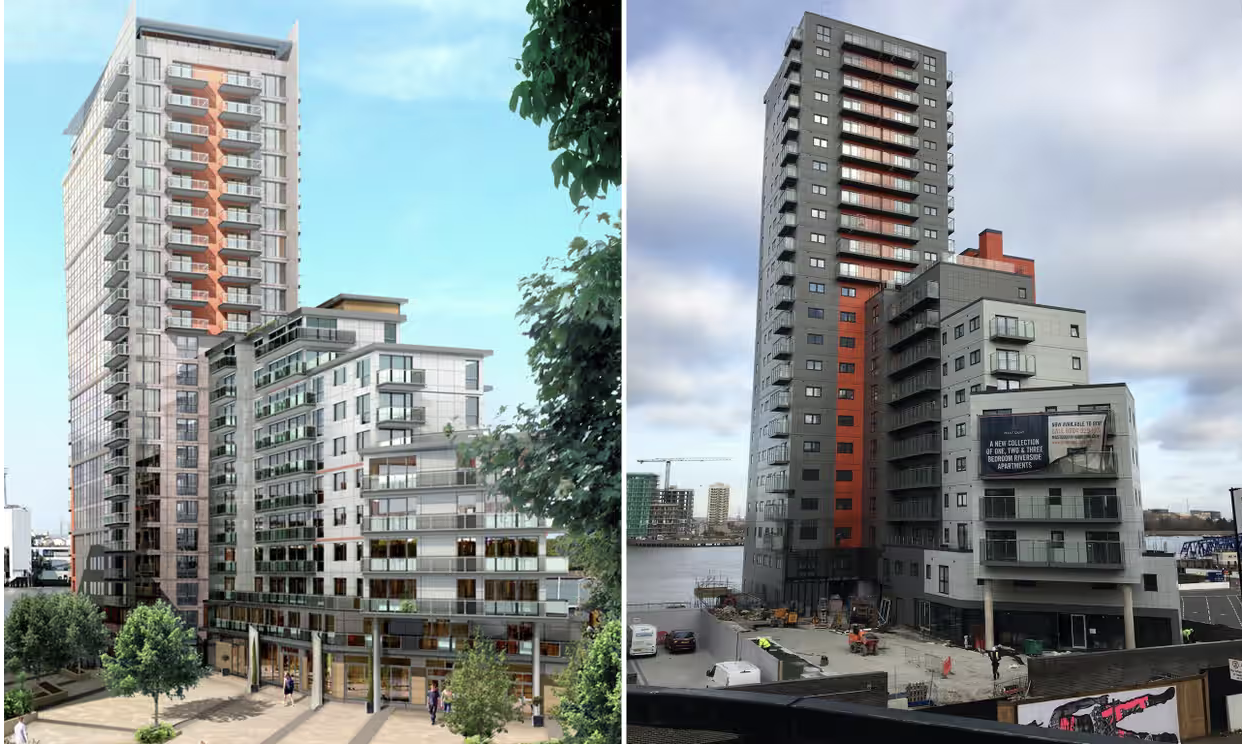
The left image shows the original design; the right image is the final product. (Guardian)

In London a developer has been ordered to tear down a completed 23-story residential building in the Royal Borough of Greenwich, in the southeast of London, because it deviates too far from the original proposal. Residents of 204 flats will have to find lodgings elsewhere. The authority that so declared states that the ruling is unprecedented, and maybe it is. If so, that’s damned pathetic. But whether it is or not, it has been decried as unfair and even brutal.

I disagree. It should be considered necessary and appropriate, even laudable. If such “brutal” rulings had been issued regularly over the years, where appropriate, this one would be unnecessary. Developers would understand by now that the rules for buildings are real, not to be ignored. The big problem is that developers do not believe planning authorities ever enforce the rules. And for years they have not done so. Here is a quote from the Guardian by the paper’s Robert Booth:

The visualisations before planning permission was granted over a decade ago showed a standard piece of contemporary residential architecture with details intended to render an otherwise blocky project easier on the eye. What was built is far more rudimentary and, in parts, resembles stacked shipping containers. There had been complaints from local people, the council said, adding that some of the buildings occupied a bigger footprint than allowed and there were missing facilities, including for disabled people.

Aidan Smith, cabinet member for regeneration, described it as a “mutant development that is a blight on the landscape.”

You can almost hear the developer saying, out of the corner of his mouth, “Oh, boo-hoo! Our footprint is too large, and the playground is not quite up to snuff. Cry me a river!” Well, don’t cry me a river, don’t tear the building down. Do throw the reprobate into the clink.

In Providence, the same situation prevails, except that it’s hard to imagine any board, panel, committee or authority having the balls to actually order that a completed building be torn down, anywhere in this city, this state or this country. For any reason. Period. Any reader who knows of such an order being enforced in the United States, please write and let me know.

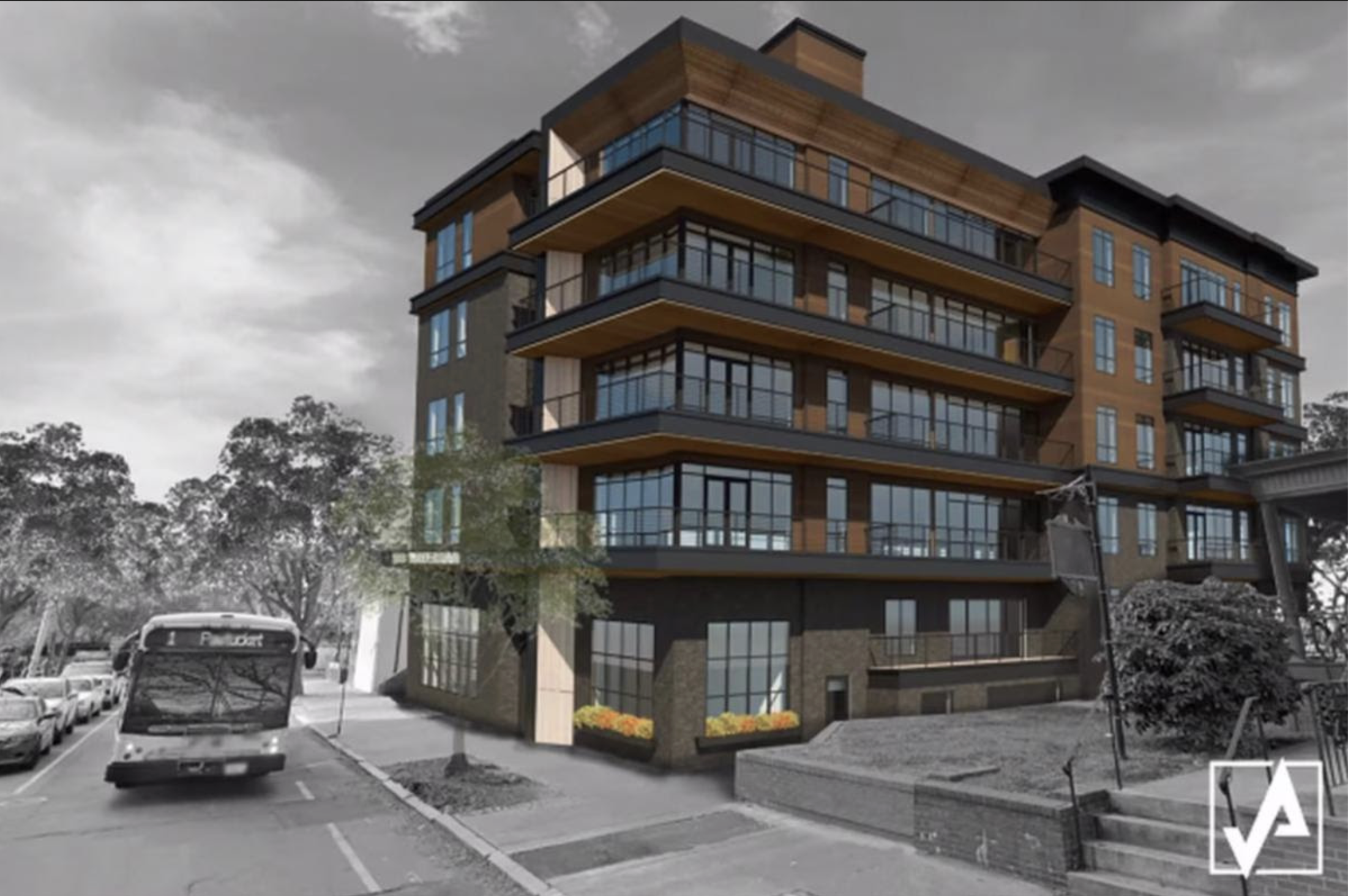
The Providence Preservation Society has voiced its regret that an old house at 108 Waterman St., near Brown University on historic College Hill, is threatened with demolition. It is a lovely Arts & Crafts sort of quasi Victorian Gothic building of some distinction. In fact, however, the Providence Historic District Commission has ruled that the building is not architecturally significant enough to lift a finger to save. Its proposed replacement is not all that bad, if you believe they will build what they have promised to build. Tsk, tsk. Shame on these “commissioners”! Where is the hangman when you need him!

Photo of 108 Providence St., on College Hill, slated for demolition, courtesy of PHDC. (Trulia)

Here is the proposed residential building proposed for 108 Waterman St. (City Plan Commission)

Posted in Architecture, Development, Preservation | Tagged , , , , , | 2 Comments

Orr’s gateway to heaven

Gate and obelisk designed by architect Robert Orr for garden of house in Essex Village, Conn. (TB)

Traditional Building, edited by Nancy Berry, may not take the longest to get through, but of the magazines I subscribe to, it is the one I long for the most whenever it comes out. I closely peruse all of the lush and colorful adverts for architectural services and crafted ornament. And the feature articles are a marvel to behold. I linger over the photographs and try to drink in all the detail conveyed by the journal’s excellent staff of writers.

A good example is the article by Nancy Ruhling about a garden gate designed by New Haven architect Robert Orr. I was stopped in my tracks while thumbing through its pages by the photo above. The wrought-iron roses twining through the curling metalwork of the gate are a masterpiece of craftsmanship. The lower part of the gate is a miniature fence to keep bunnies from feasting on the flowers of the garden behind the gate. The garden was designed by Robert’s wife, Carol Orr. The rose garden is in the rear of an 1843 Greek Revival house in Essex Village, Conn., which Orr’s firm was hired to “renovate” (meaning, I hope, to restore).

The photographs that accompany Ruhling’s essay are by Peter Aaron and the firm Garden Iron.

The gate, crafted by Chis Anderson of Garden Iron, in Westbrook, Conn., along with the obelisk behind it (designed by Orr for a limestone base, also designed by Orr and carved by the client’s sculptor in Paris) are engulfed in New Dawn roses – of the climbing persuasion – and Winchester Cathedral roses. Whatever they are, they do sound beautiful! The rest of the garden, writes Ruhling, features

forget-me-nots and bleeding hearts and peonies, … caryopteris and Little Lime hydrangeas. In between, there are bursts of poppies, foxgloves, catmint, and Montauk daisies. Eight other varieties of Austin Roses in shades of pink are planted within the border.

Invasions by young rabbits was a prime motivation for the gate:

which they consider edible delicacies. To that end, the bottom third of the gate, which is flanked by rustic granite pillars, is a series of fence-like rails that culminate in spiked arrows spaced just far enough apart to keep the rabbits at bay.

Orr adds:

If you look closely, you will see that many of the arrows are rose canes, complete with blooms, that wind themselves through to the top of the gate. … The roses were very carefully designed – they had to look like they were growing from the gate. They are integral to the design.

Ruhling adds:

They weave themselves around the main design element, an elegant quatrefoil that was inspired by that on a gate in the historic garden at Dumbarton Oaks created by Mildred Bliss, in collaboration with landscape designer Beatrix Farrand.

Unstated, and unnecessary to state, is what I naturally take away from this gate, so pleasingly described, which is that neither it nor it like are conceivable beyond the realm of the traditional architecture that is Orr’s specialty. (He and I are members of the New England chapter of the Institute of Classical Architecture & Art, headquartered in Boston.)

The gate is a masterpiece inspired in part by the gate at Dumbarton Oaks, in Washington, D.C., where I went as a third-grader (if I recall correctly) to collect fallen leaves, such as sassafras, from the trees of autumn. I know nothing at all about verdure of any sort, though I can distinguish a sassafrass leaf from the droppings of an oak tree. And I swear I can admire the shapeliness of leaves without memorizing the names of the trees they fall from. Although I admit that retaining such nomenclature would more fully clutter my memory.

The chief quality of traditional architecture (and landscape architecture, for that matter) is that you need not know much about it to enjoy its charms, which, unlike the various embellishments that modernists sometimes ‘fess up to, you don’t need an expert to explicate its meaning in order to grasp its enchantments. The gate is also inspired by the Garden of Eden, and I suppose some explication might be needed these days to understand that.

In regard to the gate’s handle, Orr offers this: “It’s like the snake is guarding the garden. You literally have to pull it to gain access.”

Okay. I suppose one must admit that the imagery is quite exciting.

The Greek Revival house in Essex whose gate and garden are by Orr Architects, in New Haven. (TB)

Posted in Architecture, Landscape Architecture | Tagged , , , , , , | 4 Comments

The soggy PVDFest mess

A happier PVDFest in downtown Providence, June 3, 2019. (Photo by author)

I’d like to put in a bid for downtown as the site for the next PVDFest. Mayor Smiley moved this year’s event out of downtown to the waterfront along the Providence River. Downtown is where festivals such as PVDFest should be held. He should put it back where it belongs.

To be sure, much has been done over the past 30 years to improve the city’s waterfront. The original work, designed by the late Bill Warner and stretching from Waterplace Park to Crawford Street Bridge, is beyond beautiful. It puts other recently developed waterfronts to shame. Thumb through two books published in 1996 and 1997 by Ann Breen and Dick Rigby, which colorfully illustrate newly developed waterfronts around the world. Put together under the aegis of the Waterfront Center, an organization in Washington, D.C., that promotes waterfront planning, the books with show how the modernist fetish for novelty, in all its grotesque splendor, has captured the design of waterfronts around the world. Almost all of the examples are appalling, featuring the typical sterility and incongruity of their modernist equivalents in the architecture of the urban streetscapes we have come to regret.

A commenter on the Nextdoor website expressed his dismay over last weekend’s PVDFest. “Remember when PVDFest was held in June,” writes Barry Dejasu, “before Smiley insisted on moving it to early September and changing the location? Yeah, great move, it went SO well this weekend.”

He has a good point – not about the weather or its date but about its relocation away from downtown proper. Most of the festival occured along the post-1996, second phase of the waterfront, southward from the Crawford Street Bridge. Because of  its aesthetic modesty, this part is not as atrocious as most recently developed waterfronts worldwide, but it does not live up to the standards set by the waterfront’s initial phase. The so-called park at the western edge of the pedestrian bridge is about as dull as a park can be – a large, plain patch of grass with no trees or shrubbery and with fat sidewalks meeting at an extraordinarily undistinguished area of concrete (I think it is) the middle, and with a semi-public café of typically uninspired design planned for sometime in the future, if it has not already been canceled.

Most of PVDFest’s Sunday schedule was canceled because of the furious storm heading for town. Saturday night’s festivities pleased a large crowd of revelers. But they would have been able to revel with greater contentment on both Saturday and Sunday if PVDFest had remained in downtown. The many shops and eateries and entertainment venues along Westminster, Weybosset, Empire and Washington streets would have offered welcome shelter from Sunday’s storm. My family annually enjoys watching the passing scene of festivities at various festivals from window seats at Blake’s Tavern at Mathewson and Washington streets. Sunday’s storm would have dampened enchantment for we three voyeurs by reducing the crowds, but heavy rain, lightning and thunder would have offered their usual aural and visual stimulation.

Above all, downtown as a festival site offers architecture beautiful way beyond that of most American cities, large and small. Most cities have replaced the bulk of their traditional architecture with bland and frequently obnoxious modernist architecture, and the pleasure of being downtown in many of those cities is much reduced. Not so in Providence, most of whose buildings still feature the robust embellishment barred from buildings erected in the decades since 1960. More of downtown Providence is listed on the National Register of Historic Places than the downtown of any other American city, and every third-grader is capable of recognizing the difference. True, many Americans have gotten used to our bland built environment, and we may no longer notice its lack of beauty, but we feel it in our bones. Urban attention deficit disorder is our shared psychic response to the brutal attack of modern architecture on our cities.

Let us hope that Mayor Smiley will return PVDFest to its rightful and historical location in downtown next year.

(View below a two-minute video taken from Blake’s Tavern in 2017.)

Posted in Architecture, Urbanism and planning, Video | Tagged , , , , , | 7 Comments

Farewell to McCoy Stadium?

Rendering of proposed twin high school on the site of McCoy Stadium. (SLAM)

We attended the farewell fireworks for McCoy Stadium last night, dubbed “The Final Inning.” Did not get there in time to secure the wrist bands that would have assured us a seat on the playing field to watch the fireworks. But we got a nice space on the lawn next to the fire house and settled into our lawn chairs to watch the explosions. Which naturally set us to thinking about what might be next for McCoy.

Apparently, the city thinks the field should be knocked down and replaced by a complex that would bring together under one roof the aging Shea High School on East Avenue, built in 1938, and Tolman High School on Exchange Street, built in 1926. And maybe the art high school across the street. In for a dime, in for a dollar, right? Why not? Pawtucket voters gave a big thumbs up to the idea, approving a bond issue of $330 million last year, and images are already available to show us what the school might look like.

The renderings are from SLAM, short for S/L/A/M Collaborative, which designed a beautiful new Center for the Humanities  at Providence College. SLAM is apparently not proud of it, to judge by its website, where that cultural facility is not pictured. The renderings for the school originally designed by SLAM to replace McCoy remind me of Tom Wolfe’s description of the typical new high school attended by students today: “a building that looks like a duplicating-machine replacement-parts wholesale distribution warehouse.”

Talk about the soft bias of low expectations! No wonder American students are doing so well!

Another architect has succeeded SLAM for the Pawtucket School District. When I find out who it is and what it has designed, I will attempt to post it, though WordPress makes that extremely difficult. I would be surprised if the new architect does not produce a building whose appearance equally merits Wolfe’s description.

(Both Shea and Tolman are beautiful buildings, however, which suggests, as one would think, that there are more factors involved in our education crisis than the disappearance of beautifully designed schools.)

A better idea would be to let billionaire Stefan Soloviev, age 48, rehab McCoy and acquire a baseball team to play there. His land development firm, called Crossroads Agriculture, based in Colorado, Kansas, and New Mexico, is worth $2.3 billion, according to Forbes magazine. He is said to be the 26th largest landowner in the United States.

Pawtucket Mayor Donald Grebian says McCoy is off the table. No it is not. But if not McCoy, let Soloviev build his own stadium where the city still envisions a soccer stadium near the Apex site, although that plan has run into financial difficulities (allegedly now resolved).

And the city should abandon the idea of putting two or three schools on one site at McCoy. To call that an awkward proposal for a city like Pawtucket would be to shame the word awkward. The $330 million proposed for that idea would serve to lovingly restore Tolman and Shea, which is admittedly in pretty bad shape. There would be enough left over to finance a major hunk of the city’s share of Soloviev’s project – if such a share were necessary.

The one question that remains is whether the Pawsox – now called the Woosox, or something like that – might be induced abandon what I hear is an uncomfortable situation in Worcester to return to Rhode Island.

Posted in Architecture, Urbanism and planning | Tagged , , , , , , , | 16 Comments

World cities shot from the sky

This is Toledo, Spain. A comment reads “Clearly not enough parking!” (Arch/Eyes)

Even before I started writing weekly about architecture in the Providence Journal (every Thursday), I had a collection of big, coffee-table books of various cities photographed from the sky. I would leaf through them by the hour. The books are long gone, some vanished over the years and others, I suppose, succumbing to a minor flood the other week which destroyed boxes of books kindly rescued from my office shelves by the Jounal after they showed me the gate in 2014. They deposited these books on the floor of my basement. Maybe half of them were inundated by the flood, which was not natural but the result of backup caused by a tree root invading a sewage pipe. But some of the boxes emerged unscathed. Maybe some of my “From Above” books are still in there.

The other day I received several emails with a link to a set of photographs of cities taken from above. I immediately decided to show them to readers  but forgot about that intention for several days. Now I cannot find any email links in my inbox that offer more than one photograph each, rather than the 20 or so that came in the original missive. Yet I found them online on a blog called ArchEyes | Timeless Architecture, and here they are (down below. Click on “continue reading,” I think):

The text seems to suggest that the photos, or at least some of them, were taken before the current era of pilotless (but not cameraless) drones. I could write a blog 20 times this long on the differences in the layout of each city, but I will spare you. But I should probably note something that most of you will note on your own, which is that some of the cities captured from above or shot from an angle are not exactly planned according to how a traditionalist would plan them. As usual, the modernists have to horn in on a good show.

(WordPress has made “improvements” recently that change how I can put links into my posts. Whether the new link format works, I have no idea. So if you don’t get the 20 cities from above, please go to the “ArchEyes” blog on the internet. I found it and so can you!)

20 Stunning Aerial Views of Cities Around the World: Captivating Urban Landscapes

Posted in Architecture | Tagged , , | 2 Comments

Put archives in Shepard Bldg.

The Shepard Building was until recently the site of URI’s downtown campus and the office of the Rhode Island Department of Education.

Almost nobody has noticed that a perfect match mates two of Rhode Island’s most critical needs. With URI moving out of the Shepard Building, why not move the state archives there instead of erecting a new and inevitably ugly building across Smith Street from the State House for that agency? Such a building was proposed several years ago, but the General Assembly refused to fund it. Thankfully.

My friend Mary Shepard (no relation to the Shepard Co. people) mentioned to me the other day that URI was no longer in the Shepard Building, which it had occupied since the state renovated it to great fanfare in 1996. Mary suggests that the state archives be moved from its current rented location at 33 Broad St. to the Shepard Building, which hosts not just the College of Continuing Education but the office of the Rhode Island Department of Education. Buff Chace, who has worked tirelessly to revitalize downtown since the early 1990s, is also involved in urging that the archives – which is part of the office of the Rhode Island Secretary of State – be moved to the Shepard Building.

A study financed by URI recently concluded that the building’s best use would be as housing. Maybe. But putting the archives there would kill two birds with one stone, avoiding a new building that could mar the view of the State House for all Rhode Islanders, and furnishing an appropriate location for the state archives, which should be located in a historic building downtown and which need not be leased space. The old Shepard’s Co. Store is just such a historic facility.

I was surprised to learn that URI had decided to abandon Shepard’s. Why? So far as I can tell, there is no reason. No doubt a fake reason can be (and probably already has been) fabricated. But the real reason is probably similar to the reason for all of this kind of bureaucratic shuffle. To spend more state money on contractors with friends in the legislature or the state bureaucracy. Architects, staff for the committee charged with deciding what to do next (and there is such an archives committee), copying services for the mounds of paperwork, restaurant tabs for the staff and professionals involved, guards to make sure that the public could not attend meeting scheduled to discuss the “problem,” etc., etc. Well, maybe not that last one, but you never know.

Before URI opened its downtown facility in the Shepard Building, the state thought it might make a nifty location for a Rhode Island history museum. The late Al Klyberg, head of the Rhode Island Historical Society, had gathered a dozen or so entities such as the R.I. Black Heritage Society, each expected to host a small museum of its own inside the facility. When URI moved to Shepard’s, Klyberg tried to set up a museum called Heritage Harbor at the Narragansett Electric plant that eventually came to house the state’s two rival nursing schools, which were never merged into one institution as they ought to have been once they decided to move into one building. It was restored in glorious fashion, but the two nursing schools remain separate organizations there.

How very Rhode Island! The Heritage Harbor idea ended up sucking all the air from local philanthropy here for years, leaving smaller heritage institutions starved for money. They have now benefited from massive covid spending, many of them using the money for dumb purposes, such as the notion of building an ugly new state archives building – a beautiful one would be beyond the pale for most of the “experts” Rhode Island hires to manage such things.

(To view an image of the abomination proposed several years ago for the archives, see my post “Nix on new archives building,” from June 28.)

Rhode Island once stored its archives at the bottom of a pond – I recall hearing of this early in my stay in the state. I think it was somewhere in South County. The British were burning everything officially colonial they could get their hands on during the revolution, and in a pinch the papers of state (a relatively small batch, by that time) were tossed under water in order to protect them from fire, which is more dangerous than water to papers, which can be dried out. Perhaps they were packaged in watertight containers. The papers apparently were retrieved. I have tried to find out more about this incident, but it is shrouded in the mists of time, and even people who might be expected to be aware of it have remained mum.

Posted in Architecture, Urbanism and planning | Tagged , , , , , , | 4 Comments