MoMA angst in the modernist world

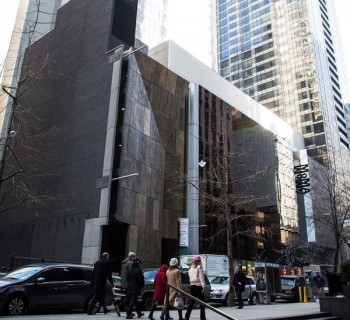
Moma's facade, with AFAM's facade at corner. (Andrew Burton/Getty Images)

MoMA’s facade, with AFAM’s facade at corner. (Andrew Burton/Getty Images)

The Jan. 9 announcement that New York’s Museum of Modern Art would indeed at last tear down the twee Folk Art Museum embedded in its (MoMA’s) glassy skin has brought to the cozy little world of modern architecture a high degree of angst that shivers my timbers.

The American Folk Art Museum is a cheesy little rectangle of rust thrust into the pastiche of the MoMA edifice on West 53rd St. The AFAM has achieved a sort of cult status now that the building, designed by Williams & Tsien only a dozen or so years ago, has become expendable. It seems, writes Martin Filler in the New York Review of Books, that its “richly textured” – ahem! – ” bronze facade clashes with MoMA’s predominantly glass street wall.” That AFAM does not fit in might strike some as an odd concern for a bunch of modernists. They never bat an eye when ramming their abominations into cohesive historical settings.

MoMA’s building combines the 1936 original by Edward Durrell Stone and Philip L. Goodwin with a 1964 addition by Philip Johnson and a late ’90s expansion by Yoshio Tanaguchi. AFAM went up toward the end of that, but in recent years the museum went bankrupt and its building was sold to MoMA, which was urged by many to incorporate it into its own museum. MoMA and its minions have only thinly disguised their reluctance to do so, let alone the slender rationale for resisting.

Anyway, the bouhaha got so hot that MoMA hired a young firm, Diller Scofidio + Renfro, to reconsider the matter. Ah, DS+R are old friends here in Providence, where they designed an art center for Brown University that melded an accordionesque facade with a facade suffering from mock earthquake damage, and awkwardly to boot! So I was glad to see they’ve run into a buzzsaw of criticism from the oh-so-culturally-sensitive architectural powers that be for doing MoMA’s bidding like a good little hired apparatchik.

Ha! Filler pulls no punches.

I was alerted to his piece, “MoMA loses face,” in the New York Review of Books by Kristen Richards’s ArchNewsNow.com website. In her intro she says “Filler fairly fumes re: DS+R’s ‘sad little sellout … they have undergone a dire transformation from vanguard mavericks to corporate apparatchiks.'”

Here is a quote:

What is perhaps most shocking about this turn of events is Diller Scofidio + Renfro’s design itself. The extraordinary capabilities of present-day computer imagery make it safe to say that any executed building is unlikely to look better than (or perhaps even as good as) its digitally enhanced renderings. If that is the case with DS+R’s MoMA illustrations, history will judge the destruction of the Folk Art building even more harshly.

This bland and banal scheme possesses all the presence and panache of a commercial parking garage entry.

We who must regularly view Dildo Scrofulous + Rent Free’s abomination on Angell Street know whereof Martin Filler speaks.

MoMA sponsored the famous 1932 exhibit that was the camel’s nose of modern architecture under the tent of tradition in America. So those of us who are unsurprised that the modernists feel angst at the brutality of their overlords can have our own little chuckle for a change.
Posted in Architecture, Art and design | Tagged , , , , , , , , , , , , , , | 2 Comments

Buda? Pest? Which is best?

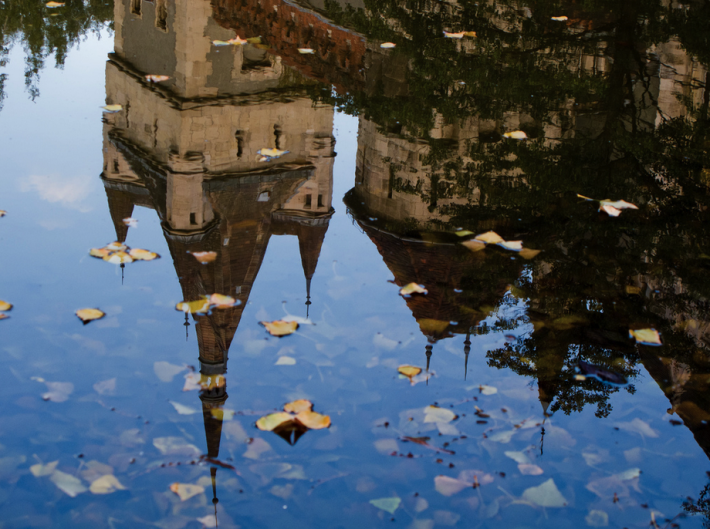
Vajdahunyad Castle, in Budapest. (vajdahunyadcastle.com)

Vajdahunyad Castle, in Budapest. (vajdahunyadcastle.com)

Commenter Seth Johnson, a Cincinnati photographer whose fine work may be seen here, wonders which side of Budapest, which spans the Danube in Hungary, is better? Buda is old and Pest is … well, not as old, more populous, more cosmopolitan, and perhaps less venerable. Perhaps one is best because from it you can see the other. I have not been to Budapest so I cannot answer Seth’s question. Somehow I get the impression that John Lukacs, author of the passage I’ve quoted in my last three posts, likes Buda best but I’m not sure. I have not asked my in-laws, who are Hungarian and escaped during the uprising in 1956, or my wife, who visited once years ago. I am a quarter Hungarian myself, but that entitles me to no special knowledge of the matter, only a special yearning to know, and to go.

So, if any reader has an opinion about whether Buda or Pest is best, or better, or worse, or maybe equal, please send it (your opinion) here. Thank you!

Posted in Architecture, Other countries | Tagged , , , , , | 3 Comments

Lukacs on winter in Budapest

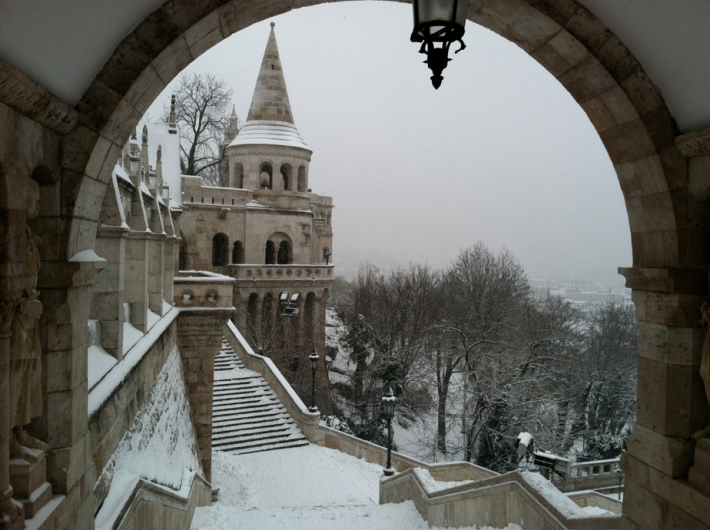
Castle Hill in ancient Buda. (trekearth.com)

Castle Hill in ancient Buda. (trekearth.com)

I skip over a paragraph laden with dark history and continue with John Lukacs’s description of winter in the Budapest of 1900:

And then, one morning – it would come as early as in the third week of November, and surely before the middle of December – one of two new things was happening. A clear day had risen over Budapest again, with the paler gold of a winter sun refracted by the crystalline cold. Or the sky was gray but rich, great flakes of snow were coming down all over Budapest: a celestial filling, like the goose down in the comforters of its bedrooms. In 1900 in Budapest winters came earlier than they come now. They were colder and snowier. There were still years (though not in the calendar year 1900) when the entire stretch of the Danube was frozen, and adventurous men could walk across the ridges of ice from Pest to Buda. There was a sense of feasting and of innocence in the air. Unlike in the snow-laden country, winter in Budapest was something else than a season of long rest and sleep; it was another season full of promise and excitement. The streets of the Inner City were filled before noon, with women and girls parading in their winter finery, and with promenading gentlemen in their fur-collared greatcoats. Girls without furs were equipped at least with a furry muff. They were stepping in and out of the confectioneries and the flower shops and the glove-makers with tiny packages wrapped in rosy, crinkly papers, hanging daintily from the tips of their little fingers. Among the horse-drawn carriages on the avenues in 1900 there still slid in and out a few sleighs – black-lacquered, drawn by black horses, and with silvered tackle, with the laps of their passengers wrapped in ancient fur-lined blankets. What the city offered was this agreeable and satisfying contrast of exterior ice and interior fire: of the diamantine, light blue, crackling cold climate of the streets only a few steps away from the inner atmosphere of the houses with the cozy woarmth of their coesseted bourgeois interiors, with deep-red carpets underfoot and perhaps with crimson tongues of fire not only in the grates of the tile stoves but in many hearts. Even in the dark, grimy streets, with their forbidding doorways and freezing entrances, the white snow thick around provided not only a contrast in color but in atmosphere: gazing inside to sense the hot interior fug, or looking outside from their cramped interiors into the snowy streets was equally good. The crunch of the snow, its odd chemical smell, the roofs and the windowsills and the shop signs and the monuments of Budapest picked out in white gave the city a compound of secure feeling. Behind those windowsills the housewives patted the long square insulating bolsters between the double windows into place; and the few walkers along the quays or up along the deserted streets and parapet walks on Castle Hill must surely have been lovers.

It was the season of long dinners, of heavily laden tables with the roasts, sausages, bacons, fowl and game sent up to the families from the country; of the smells of wet wool and leather and pastry cream and perfume in the shops of the Inner City; of the anticipations of Christmas, of dancing assemblies and balls; and for the young, the chance of meeting on the skating rink of the Budapest Skating Club on the frozen lake in City Park, under electric lights on weekday evenings. When the little blue flag of the club was up at Octagon Square it meant that the ice was sufficiently hard for the skaters – and for their flirtations, while the girls’ chaperones would gossip behind the windows of the clubhouse that was warm as an oven, aglow in the dark like the redness behind the isinglass of a stove, reeking of oiled leather, coal-smoke and the milted ice on the rough floors of that waiting room. It was a city of distinct anticipation and of distinct seasons, more distinct than now.

But I cannot let one bit from the historical paragraph between this and the last post pass:

On All Souls’ Day thousands of people streamed toward the cemeteries of Budapest, with flowers in their hands, on that holy day which is perhaps taken more seriously in Hungary than elsewhere because of the national temperament. Temetni tudunk – a terse Magyar phrase whose translation requires as many as ten English words to give its proper (and even then, not wholly exact) sense: “How to bury people – that is one thing we know.”

This mordant thought marks the end of a long passage near the beginning of the book (pages 10-14), but there is much more of eloquence, lightness, darkness and supreme interest in the rest of the book – Budapest 1900 for those who did not get in at the beginning. It can be purchased through Amazon here.

Posted in Other countries | Tagged , , , , , , , , , , , | 2 Comments

More Lukacs on Budapest

The Danube runs between Buda and Pest. (tourtellus.com)

The Danube runs between Buda and Pest. (tourtellus.com)

My heart lifts at news that four Hungarians this morning have “viewed” my post of historian John Lukacs’s description of Budapest in 1900. To reward them, here is more from that passage:

Summer was hot, hotter than in Vienna, sultry at times, broken by tremendous thunderstorms, but almost never damp. When the dark thunderheads convened high over the dry, dusty streets, they carried the promise of relief and the return of the long pleasant summer evenings, for the evenings were almost always cool. There is not much difference between a May and an August night in Budapest, except of course in the vegetation. Even on the hottest of days the trees were green, never sere. Summer was the recurrent feeling, the promise of pleasure in le bel, le frais, le vivace aujourd’hui, and a Budapest bourgeoise or a young gentry wife threw open the double-leaved windows and leaned over her geraniums with the same movement – and perhaps, too, with the same movement of the heart – as a Frenchwoman on the Cote d’Azur at summertime circa 1900, a little out of season but fraiche, belle, vivace, nonetheless. Surrounded by the yellow, powdery Hungarian countryside, Budapest then spread along the banks of the Danube like a green bower; or, perhaps (for those who prefer vegetables to flowers), rather like a super-large green cabbage whose outer leaves were edged, here and there, with the black rime of smoke from the factory chimneys. The crowded town, packed with people and rows of apartments houses, gave the impression – and the feeling – of a summer resort, perhaps even that of a spa. Few people complained of the summer in Budapest, except for those who employed it as the pretext to proclaim their departure to vacation places well-known. A profusion of fruit, greenery and fish spilled out from the markets to the sidewalks. Young people stayed up late, into the dawn. Older people, daydreaming on the hot afternoons, turned their thoughts to the winter season to come, thinking of new circumstances, new quarrels, new flirtations.

More, perhaps, to come.

Posted in Other countries | Tagged , , , , , , , , , , , , | Leave a comment

John Lukacs on Budapest

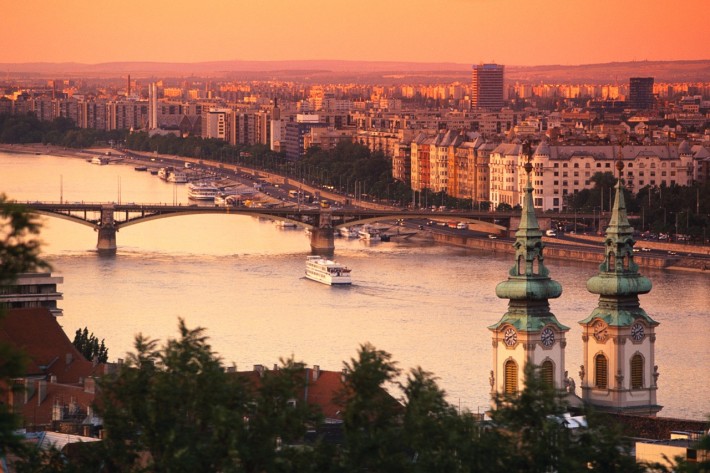
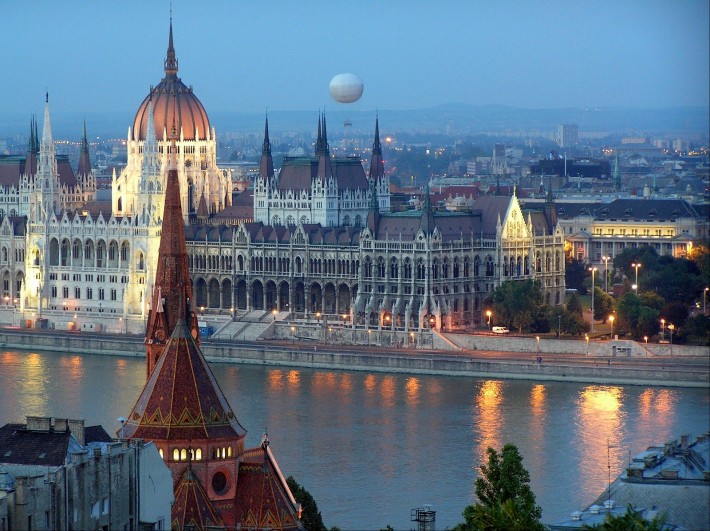
Buda as seen across the Danube from Pest (pushingtheflywheel.com)

Pest as seen across the Danube from Buda (pushingtheflywheel.com)

This post is a naked attempt to get Hungary onto the list of nations provided to WordPress bloggers to give them an idea of where their posts are being read. I am a quarter Hungarian and my wife Victoria is a full-blooded Hungarian in all four quarters. Her parents, who live a mile from us, speak Hungarian at home. I want to visit Budapest someday, but until then I want someone from Budapest to read my blog. So hear goes.

This delightful passage is from Budapest 1900, by the historian John Lukacs:

“This city,” wrote Gyula Krudy about Budapest, “smells of violets in the spring, as do mesdames along the promenade above the river on the Pest side. In the fall, it is Buda that suggests the tone: of the odd thud of chestnuts dropping on the Castle walk; fragments of the music of the military band from the kiosk on the other side wafting over in the forlorn silence. Autumn and Buda were born of the same mother.” In Budapest the contrast of the seasons, and of their colors, is sharper than in Vienna. It was surely sharper in 1900, before the age of the omnipresent automobile exhausts and diesel fumes. Violet in Budapest was, as Krudy wrote, a spring color; it was the custom to present tiny bouquets of the first violets to women as early as March. They came from the market gardens south and west of the city, sold along the Corso and in the streets by peasant women. In March, too, came the sound and the smell of the risning river. The Danube runs swifter and higher in Budapest than in Vienna. It would often flood the lower quays, and the sound and sight of that swirling mass of water would be awesome. By the end of April a pearly haze would bathe the bend of the river and the bridges and quays, rising to Castle Hill. That light would endure through the long summer mornings, lasting until the mature clarities of late September.

At night the shadows retreated, and a new, dark-green atmosphere grew over the city like a canopy of promise. This was not the acid springtime of Western Europe: May and June in Hungary, even in Budapest, have something near-Mediterranean about them. The smoke from the myriads of chimneys retreated with the shadows (except, of course, the highblown smoke of the mills and factories in the outer districts). The chairs and tables were put out before the cafes and in the open-air restaurants. It was then that the nocturnal life of Budapest blossomed, a life with singular habits and flavors that began early in the evening and lasted into the dawn, in which so many people partook. There were avenues in Budapest which were more crowded at ten at night than at ten in the morning, but not because they were concentrations of nightlife, such as in Montmartre or Piccadilly. The freshness of the dustless air, especially after the May showers, brought the presence of the Hungarian countryside into the city. Somewhat like parts of London in the eighteenth century (or Philadelphia in the nineteenth), this smokey, swollen, crowded and metropolitan Budapest was still a city with a country heart, with a sense that a provincial Arcadia was but an arm’s length away. By May the violets were gone but there was a mixture of acacias and lilacs and of the apricots, the best ones of which in Hungary were grown within the municipal confines of Budapest. There was the sense of erotic promises, earthy and tangible as well as transcendent. It penetrated the hearts of the people, and not only of the young; and it was not only a matter of espying the sinuous movements of women, movements more visible now under their light summery frocks. It was a matter of aspirations.

My fingers are tired so I will not give the rest of the passage, at least not right now. I am afraid that my wife Victoria’s sister Barbara, having visited several times, reports that all is not well in the old city. Sadly, the same might be said of many other places, where beauty, wit and charm have been replaced by glitz, stupidity and ugliness. Still, like Prague, which I’ve visited, Budapest holds out the lure of the old, even if its greatest pungency must be sought in books. Lukacs wrote Budapest 1900 in 1988, just a year before the city and the nation became free again.

Posted in Other countries | Tagged , , , , , , , , | Leave a comment

Saved: The George C. Arnold Block

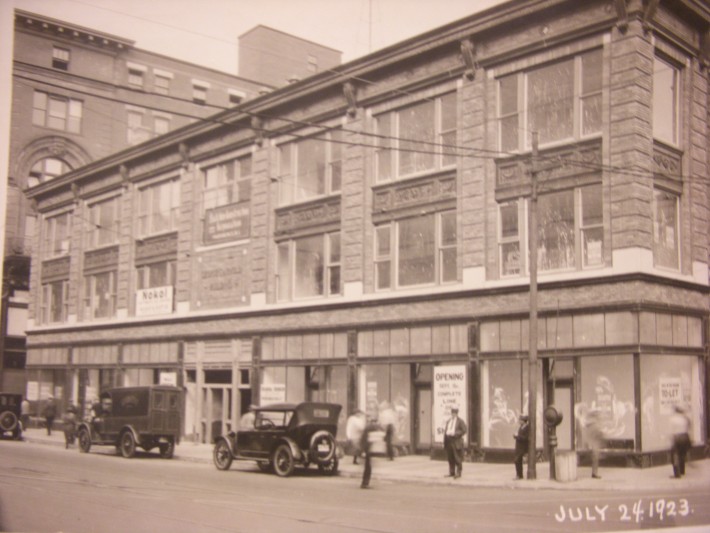
The George C. Arnold Block in 1923 is only eleven and a half feet deep (Journal archives).

The George C. Arnold Block, in 1923, is only 11-plus feet deep (Journal archives).

I am leery of the government taking buildings by eminent domain – that is, offering a take-it-or-leave it price, supposedly “fair market,” to a building owner, who, if he doesn’t take it will have the taking done for him by the state. But sometimes eminent domain is required to avert a disaster – as in the case of the George C. Arnold Block in downtown Providence – where the owner doesn’t have the resources to repair fire damage from 2009 and his only alternative seems to be to sell it to someone who will demolish it.

That, for a long time, seemed to be the likely fate of the Arnold Block. Across Washington Street is the Providence Journal’s large parking lot (where I park). Behind the Arnold Block is a parking lot owned by Paolino Properties. The former mayor, Joseph R. Paolino Jr., once tried to erect a deck over the lot that would have filled the gap around the corner from the Arnold on Mathewson, but he was blocked by the Downcity Design Review panel. It didn’t like the classical design that Paolino had proposed. The panel claimed that Paolino’s proposal violated a city ordinance mandating retail liners – a sensible law but difficult to apply in a lot of that size. It is assumed by most that Paolino, who tore down Alexander’s Restaurant to increase the lot’s size, has long had the Arnold Block in his sights.

So the poor Arnold now sits there, a block long and eleven and a half feet wide. Here is how, in a June 9, 2011, column on the nearby Mercantile Block redeveloped by the AS220 art cooperative, I described what tearing the Arnold down would do to the urban fabric of downtown Providence:

The renaissance on Washington should extend to restoring the nearby George C. Arnold Block. Damaged by fire in 2009, it serves as a flimsy but effective patch over a most obscene parking gulch ripping the street’s urban fabric. Its demolition would expose Washington’s naked asphalt desert, dimming future prospects for the street and downtown as a whole.

So I was pleased last August to learn that Pat Cortellessa, the owner of the Arnold Block (and once a forlorn candidate to oust Buddy Cianci from City Hall in, I think, 2002), had agreed to let the city take his troubled building by eminent domain. Congratulations to  him and Mayor Taveras for that. Congratulations to the young artists at AS220’s youth studio for the mural on it now. Taveras has just announced that a developer has been found to put two apartments and ground-floor retail into the Arnold. Here is part of what the mayor had to say:

The collaboration of the [Providence Redevelopment Authority], Providence Revolving Fund, Providence Historic District Commission and the owners demonstrates what we can accomplish when we work together to revitalize historic buildings and grow our economy.

The mayor’s full press release on that is here. A column I wrote about the building shortly after the fire is here. Good work all round!

Posted in Architecture, Preservation, Providence, Urbanism and planning | Tagged , , , , , , , , , , , , , , | Leave a comment

Blast from past: Review of Millais’s “Exploding …”

"Modern Movement reality" by Louis Hellman: The legacy of founding modernist Le Corbusier [From Exploding the Myths of Modern Architecture (2009, Frances Lincoln Ltd., London)]

“Modern Movement reality” by Louis Hellman: The legacy of founding modernist Le Corbusier [From Exploding the Myths of Modern Architecture (2009, Frances Lincoln Ltd., London)]

I’ve mentioned Malcolm Millais’s Exploding the Myths of Modern Architecture several times in recent posts. Malcolm, a Brit who lives in Portugal, has sent innumerable nuggets that have helped me push this blog over the edge for years. He is a specialist on modernism’s totalitarian bent. Now I have been warned that the book, published in 2009, may be about to go out of print. This would be a disappointment, and a setback to any hope for the future of mankind. Andres Duany, the New Urbanism guru who is known and respected by many who read this blog (including its author), had this to say in December 2010 about Malcolm’s book:

I came across an excellent [book criticizing modernist architecture] a couple of months ago: Exploding The Myths of Modern Architecture by Malcolm Millais. It is recent – 2009 by Frances Lincoln Limited Publishers. I think that it is the best in class. It goes into just the right depth, the criticism is on target and skillfully murderous and the tone is wry. Millais is sophisticated in perfect measure: He is both an architect and an engineer and has practiced for 40 years. He WAS there! If I could give it as a Christmas present to you all, I would.

Buy the book. Here is my review from 2009, courtesy of The Providence Journal:

Demolishing modernism’s myths

DAVID BRUSSAT

The Providence Journal
September 24, 2009

EXPOSÉS of modern architecture have been seeing through the emperor’s new clothes for half a century: Henry Hope Reed’s The Golden City (1959), Peter Blake’s Form Follows Fiasco (1977), Tom Wolfe’s From Bauhaus to Our House (1981), Roger Scruton’s The Classical Vernacular (1994), and, lately, Nathan Glazer’s From a Cause to a Style (2007), John Silber’s Architecture of the Absurd (2007) and now Malcolm Millais’s Exploding the Myths of Modern Architecture.

The last may well be the angriest, and maybe the funniest. Together they have smashed the principles of modernism into rubble, but the death-defying eyesores keep going up and up and up. Millais, an engineer and London native, attempts to explain the Teflon surfaces of an architectural style liked by almost nobody outside the design “ghetto” (as Millais puts it), whose myths have been exploded again and again but refuse to collapse.

A British friend of the author living in Bristol, R.I., e-mailed me earlier this year to suggest that I might enjoy Exploding the Myths, then newly published in Britain. We lunched downtown at Tazza and he lent me his copy. I took it to Tazza the same evening, and though it was not then due for publication in America until later this year, a woman sitting at the next table noticed it and said she had recently purchased it at Symposium Books, right next door.

I don’t normally keep an eye peeled for signs, but that was a heck of a coincidence. If destiny intends this book to finally explode modern architecture, it will not be coincidence but the book’s bloody cussedness that does the trick. Still, coincidence will not shut up. The mother of the friend of Millais who lent me his copy lives in London near Chelsea Barracks, site of a planned set of modernist towers by Richard Rogers criticized by Prince Charles. Quinlan Terry, the classicist whose neo-Georgian alternative killed the Rogers design by sparking a battle of styles that Rogers lost, drew his sketch at an opposition meeting held in the mother’s neighbor’s kitchen.

The author’s anger drips with a mordant humor driven by his inability to believe that something as ugly, stupid and unpopular as modern architecture has flourished. He writes as a practitioner in a profession that has seen its honor stripped away by modernism. Engineering used to define the limits of architectural experimentation. Now engineers gerry-rig the laws of nature to help the modernists prop up their conceits, pressing the boundaries of stability, strength, tension and gravity. Thus has modern architecture lured engineering into its bed. “Supine engineers” is how Millais sadly refers to those of his mates who’ve been seduced by the sloppy seconds of modern architects’ money and fame.

But even the most creative engineers have been unable to help the modernists design buildings that work, and Millais’s book is an encyclopedia of the technical failure of the most famous concoctions of modern architecture. From the dysfunctional chapel at Ronchamp by Le Corbusier (“As a church, Ronchamp didn’t work very well. . . . What it did do was to allow Modern Movement architects to now pursue any whimsy, without even having to pay lip service to functionality”) to the unoperatic Sydney Opera House by Danish architect Jørn Utzon, who fled Australia when the cost of its structural flaws was exposed – to the Richard Rogers/Renzo Piano inside-out Centre Pompidou in Paris, whose summer visitors broil in its outdoor escalators – to the Pruitt-Igoe public housing in St. Louis that symbolized Le Corbusier’s most savage legacy: “towers in the park” for those in society with the least choice of where to live. Etc., etc. In short, the more modernist the building, the more likely its dysfunction.

Buildings that look as if they might fall down are probably the most likely to fall down. Reading the passage on Pruitt-Igoe, the first major demolition of a modernist project, I waited for Millais to uncork the punch line – that its architect, Minoru Yamasaki, also designed that even more tragic set of demolished buildings, the Twin Towers of 9/11. . . . Millais misses few of the nuggets of irony to be mined from the dysfunctionality of architecture that prides itself on its functionality, but he did miss that one.

Still, the pages of Exploding the Myths crackle not only with the humor of its vivid (if not always classically grammatical) prose, but with hundreds of photos, sketches and cartoons, all with comical captions that lighten the book’s central tragedy.

Millais has written perhaps the fullest account of how modern architecture has survived dysfunction, dishonesty, ugliness and unpopularity. By the book’s end, however, the “why” still remains elusive. Must modern architecture literally kill people before the world will rise up against its destruction of the human habitat? After 70 years, a communism good only at killing finally got its come-uppance. It was totally unexpected. Perhaps Prince Charles will turn out to be modern architecture’s Ronald Reagan.

Again, you can buy the book through Amazon here.

Posted in Architecture, Blast from past, Book/Film Reviews | Tagged , , , , , , , , , , , , | 8 Comments

Deport the Portajohn Building

tumblr_mdc8kx0nUj1riwjz5o1_1280

Again Malcolm Millais, of Portugal, author of Exploding the Myths of Modern Architecture (2009), has sent me an uplifting essay, this time from Atlantic Cities, the urban blog, or section, of The Atlantic magazine. The essay, “Should Portland Save a Building it Really, Really Hates,” by Mark Byrnes, lives up to its snazzy headline.

Did Portland's citizens force this fine sculpture, Portlandia, on the Portland Building?

Did the citizens of Portland force this fine sculpture by Raymond Kaskey, Portlandia (1985), on the Portland Building?

What would have happened if this postmodernist building had never been built? Would another one like it have been built? Or might the postmodernist critique of modernism have forced more architects onto the road to contemporary classicism? Alas, the Portland Building (1982) was a beacon for those who disagreed with modernism and yet shuddered at the obvious idea of returning to the tried and true traditions hammered by modernism 30 or 40 years before. Yes, you can reject ugliness and stupidity without necessarily having to embrace beauty and humanity! Thank you, Portland Building. Thank you, Michael Graves. You deserve this essay.

I don’t “hate” even the most disgusting modernist buildings, but it lifts my heart to read that almost an entire city’s population can be strong where I am weak. But I do hate modern architecture in general. Now that I’ve gotten all this off my chest, read the essay itself.

Do it, Portland. Tear that building down. Leave Portlandia there to memorialize a good deed too long in coming. Modernism has tried, with considerable success, to heave classicism down the memory hole. Turnabout is fair play.

Posted in Architecture, Preservation | Tagged , , , , , , , , , , , , , , , , , , , | 1 Comment

Column: Roses and raspberries for 2013

rose

From amid the doldrums of economic lethargy, good news and potential roses for 2013 arose last year in downtown Providence, where the Arcade is being redeveloped, as are four buildings once owned by Providence Gas.

Dr. Downtown suspects that readers with good memories may recognize the above paragraph as the first sentence from last year’s dispensation of roses and raspberries. Not a lot has changed. Well, let’s go to the tape:

• A rose to Evan Granoff for reopening the Arcade just in the nick of time, since he closed it late in 2008, to avoid missing the Five-Year Rule. Like the five-second rule that lets you eat dropped food if it has been on the floor no more than five seconds, the Five-Year Rule lets the Arcade resume its landmark status as the oldest (not the first) indoor mall in America. Most of the 17 shops and eateries have opened; the Granoff rose will bloom when new downtowners fill the 48 micro lofts on the upper floors. That is expected at . . . any moment.

Please read the rest of this column at The Providence Journal.

[Editor’s note: New readers of this new blog, successor to my blog at the Journal, should be aware that “Dr. Downtown” is the alter ego of the author of this blog, filling in when matters of architecture and design call for comment backed up by special expertise. He occasionally hosts an architectural advice column. The yearly dispensation of “roses and raspberries” is his annual moment in the spotlight.]

Posted in Architecture, Providence, Urbanism and planning | Tagged , , , , , , , , , , , , , , , , , , , , , , , , , | Leave a comment

Megastegasaurus

700589

Here is Architizer’s list of 10 most controversial architectural controversies of 2013. Most will amuse readers unpredisposed to modern architecture. Many are familiar to readers of this space (or its Journal blog predecessor). The last brouhaha (whether they are in any order is anyone’s guess) is Santiago Calatrava – including his hometown Valencia’s suit challenging his own personal war against the economy of Spain. Pictured above is a rendering of Calatrava’s volcano of cost overruns, also known as the PATH rail/subway station at Ground Zero. How do you like my derisive moniker? Not derisive enough? Well, here is the Architizer controversy editor’s take on what, this year alone, is scandalous about him, called “Calatrava … Everything”:

Where to start? First, the owners of Calatrava’s Ysios Winery in Northern Spain went to the Spanish architect, demanding that he give them a better roof. Apparently, Calatrava did not take into account La Rioja’s heavy rains when designing the structure’s wavy, undulating topper. Second, his PATH station at Ground Zero in New York City has gone over budget, numerous times, with costs now estimated to reach about $3.94 billion (from its original budget of $2 billion). And just a few days ago, Calatrava’s hometown of Valencia sued the architect because his City of Arts and Sciences is falling apart, just eight years after completion. Ay Dios mio!

Posted in Architecture | Tagged , , , , , , , , , , , , , , , , | Leave a comment