Max building fail in Miami

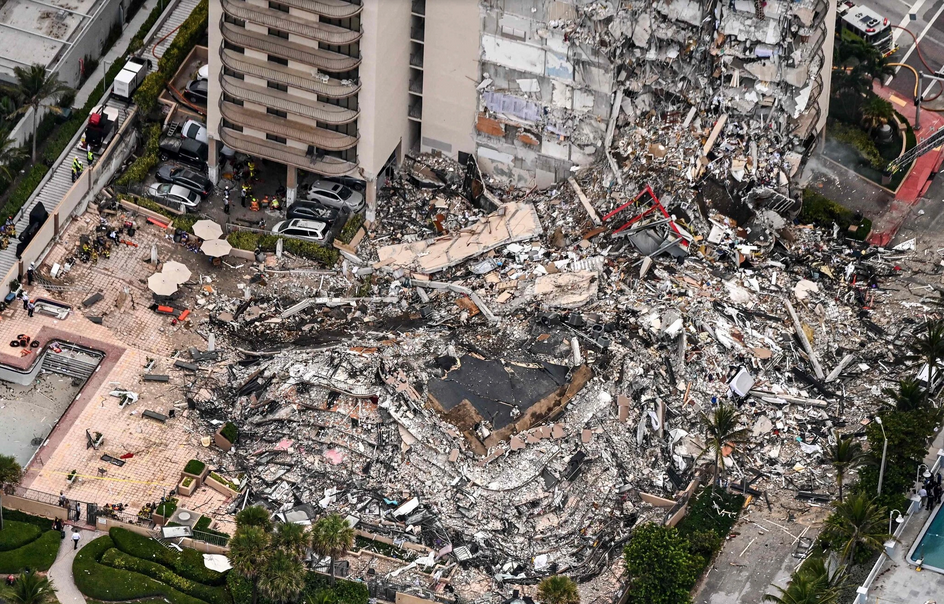
Collapsed sections of Champlain Towers in Florida. (NYT/Chandan Khanna/Agence France-Presse)

Aside from expressing sorrow and dismay, it is too early to say anything definitive about the beachfront building collapse in Surfside, Fla., north of Miami. The 12-story Champlain Towers condominiums opened in 1981 with 136 apartments. About half of the units were damaged or destroyed. Of the residents, as of Friday evening, four are confirmed dead, 37 have been rescued, 120 have been accounted for, and 159 are still missing, up from 99 yesterday. While many residents were apparently absent at 1:30 a.m. or so Thursday when it suddenly began to pancake, the death count is considered sure to rise sharply.

It is vital to learn the exact cause of this avoidable tragedy.

Most buildings that collapse in whole or in part do so during construction or during or after a hurricane or an earthquake. More than one-half of Champlain Towers collapsed early Thursday morning for no apparent reason. The building had passed inspections very recently as part of Florida’s mandated 40-year safety assessment, but rumors have emerged that 8777 Collins Ave. had been sinking at a rate of one or two millimeters per year, about the same rate as the Leaning Tower of Pisa until it was stopped in the 1990s.

The mind shrinks from contemplating what it must have been like to be inside the building as it began to topple. Most victims probably died instantly in their sleep, perhaps groggily aware for an instant or two of some noise and shaking, as if still in a dream state. Certainly few of those who did not escape survived long enough to guess what was happening. This may be of some comfort to survivors of loved ones now gone.

Several lucky survivors or witnesses have told reporters that “this does not happen in America.” Truly? The mind reels. And yet I can think of no equivalent to Thursday’s disaster. The worst collapse in Florida history, until now, was the five-story Harbour Cay, also a condominium building, which was near the end of construction when it gave way, killing 11 and injuring 23. Coincidentally, this tragedy occurred in 1981, the same year the Champlain Towers was completed.

Across the street from Champlain Towers is Eighty-Seven Park, an 18-story, 68-unit condo building designed by starchitect Renzo Piano, which opened last year. If nearby land was squishy, nearby construction might have aggravated the condition. According to an article on the collapse in The Conversation:

There was also construction work ongoing nearby, and investigators will need to consider whether this could have disturbed the foundations. This nearby construction work could have created ground movement under nearby buildings due to vibrations or deep excavations work.

Obviously no building falls down for no reason, and it’s far too early to assign blame. It is unfair to point a finger at the modernist design of the Champlain Towers, but it is entirely appropriate to wonder whether the differences between modernist and traditional architecture – or, if you prefer, differences between design and engineering practices past and present – might have played a role.

Buildings once were held up by load-bearing masonry walls. Materials were laid on thick to err on the side of caution. Then came structural steel upon which curtain wall was hung, after which the sheer solidity of construction grew more tenuous. Late in this span of time, reliance was placed on computer systems able to pinpoint the stress a structure could sustain – or so it was supposed.

Better able, to be sure, but as engineers relied more and more on computations of exactitude in the performance of materials under stress, the savings involved in attaining such precision became difficult to resist. Modernist architects ever eager to demonstrate their contempt for natural principles such as gravity put ever more pressure on engineers already weary of their usual helping of the sloppy seconds of architecture.

Architects Journal looks at potential causes of the collapse and offers a diagram (below) tracing the order in which different sections of the building collapsed.

Has modern engineering in the service of modern architecture, and in particular modernist skyscrapers, begun to cut things a little too fine? If you live in one of those supertall towers that increasingly mar the skyline in New York City and elsewhere, you might have given some thought to that possibility. This question, however it is phrased, must not be dodged or neglected as the fate of the doomed Champlain Towers is reviewed.
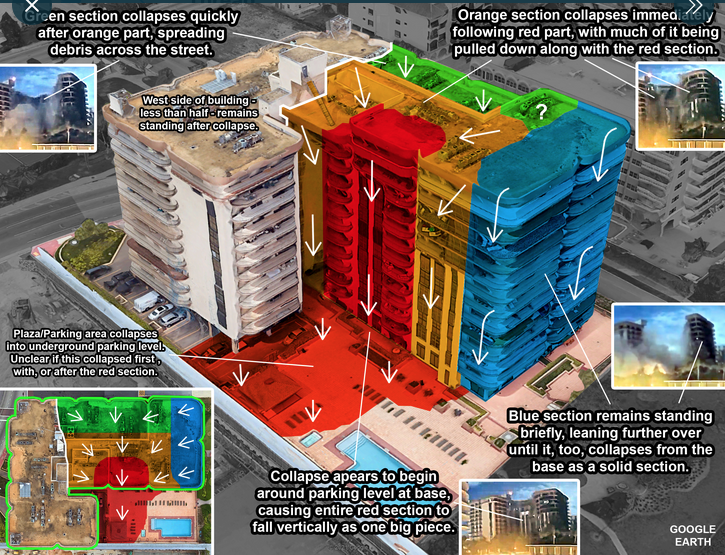
Diagram of apparent order in which building collapsed. (Architects Journal)

Posted in Architecture | Tagged , , , , , | 9 Comments

The architecture of ballet

Ballerina drags world’s problems into ballet. (H. James Hoff)

On Father’s Day we took in “Emergence,” a maskless program by Festival Ballet Providence celebrating the ongoing state of unlockingdown in which American society, at long last, finds itself. It was an excellent show. To my mind, the spare setting in the FBP parking lot beneath a beautiful azure sky did not diminish the performance of four pieces, two of modern dance and then two of traditional ballet. But the setting did recall an essay I had finished earlier in the day by Robertson Davies, the Canadian novelist and jack of all literary trades.

“How to Design a Haunted House” was actually a lecture, or speech, delivered in 1960 to the Ontario Association of Architects, whom he twits for (among other things) the decline of theater architecture. He writes:

Let us begin with the Drama. You people have just about killed it because of the revolution you have brought about in  theatre design. There was a happy day when we had wonderful playhouses, with terrible scenery: now you have given us terrible playhouses with wonderful scenery. … [Regarding the new theaters], they were not temples. … Maybe they had Stereo-Structural Sensualism; there seemed to be an awful lot of naked steel showing in some of them. I am so old-fashioned that it still makes me ashamed when I can see what holds a building up. It is honest, I know, but where is its charm? Such painfully honest architecture might perhaps be called the New Immodesty.

Back to the Festival Ballet’s “Emergence.”  Much as it would fit into my usual narrative, I cannot say that the difference between the first two dances and the last two dances was in the degree of ornament. The dancers were to a last man and woman beautiful in face and physique, and their movements were evocative of— of what? The modernist dances featured purposely stiff, often machine-like choreography, with abrupt movements suggesting displeasure via a concavity or angularity of form in the plasticity of bodily shape, often with blank looks and even frowns on the faces of the dancers. Whatever the meaning imparted by these two pieces, they seemed to repudiate the beauty of the dancers themselves.

The classical dances were, as one would expect, lovely, smooth and elegant. The choreography and the movement of the dancers’ bodies, limbs and faces seemed to exalt their physical and facial beauty. The very expressions on their faces danced just as surely as the movement of their bodies and limbs. For the first time that evening, smiles could be seen on the faces of the dancers. Their movements told a story much more legible than the stories told by the modernist dances, which challenged viewers to construct their own interpretation of the meaning of the piece. Apparently, these interpretations aimed to fill viewers’ minds with the angst of our era.

Obviously, the modernist dances were intended to make the audience think – otherwise there would be no point to them. Neither the choreography nor the dancers’ movements were beautiful, nor were the ideas they seemed to convey. The traditional dances were intended, on the other hand, to cradle the minds of the audience in feelings that had characterized ballet from time immemorial – along with music that accompanied them. The aim of the traditional dances was to give pleasure. The audience knew what to expect of the traditional pieces, especially the romantic pas de deux set to Chopin, and had little idea what to make of the modernist pieces. I am sure that to do the excruciating work of classical ballet well is a much more difficult artistic feat for the dancers.

So in the end, the performance as a whole did end up fulfilling my usual narrative. The difference between classical and modern ballet does reflect the differences between classical and modern architecture. It is easier for an architect to design a modernist building because it need not conform to practices and principles that have evolved over centuries to create beauty – a goal that most modernist architects have removed from their repertoire, so difficult is it to achieve with the tools in the modernist toolbox. Dare I suggest that modern ballet risks accomplishing the same achievement?

A university is likely to receive more donations from alumni if the beauty of the school’s campus grows in the lifelong memories of its graduates. So, likewise, a ballet company will probably win more patrons and donors if its programs favor beauty and tradition over intellect, novelty and their abstractions. In the program guide for “Emergence,” the company director, Kathleen Breen Combes, writes:

These performances represent the wide range and scale of what Festival Ballet Providence has to offer, from delightful and powerful stories, to bold, new works reflective of today’s artistic voices.

Truly. And I am glad that the company has dancers who can dance both styles of ballet. To like one style does not require audiences to dislike the other. But the Festival Ballet’s future compels its directors to approach programming decisions without indulging in fuzzy math or wishful thinking.

Posted in Art and design | Tagged , , , , , | 3 Comments

Bad language/bad buildings

“Stair Falling” (2010). Performance artist Kira O’Reilly in Ljubljana. (Nada Zgank/Kira O’Reilly)

There is a difference between language and architecture. Language, to riff off the saying attributed to Talleyrand, aims to disguise the absence of thought; whereas architecture aims to express the thoughtlessness of fatuous design.

The critic Theodore Dalrymple, a retired British prison psychiatrist, recently published an excellent essay, “The Degeneration of Public Administration,” in City Journal, about the decline of official language. He describes the clear goals set by Sir Robert Peel in 1829 for the newly established Metropolitan Police Force (in London), and their descent to the gibberish of a contempory police official’s reply to concerns over safety at a park. Dalrymple then describes the more exalted gibberish of a British museum director who empties her museum of its works to make way for an “art installation” that includes performance artist Kira O’Reilly, who throws herself nude and in slow motion down a staircase. Maria Balshaw, in 2009 the director of the Whitworth Gallery at Manchester University, records her own emotions about having curated such a feat, and her experience of having felt the physical danger to the artist – “artistic risk” being among the goals of a museum. Balshaw describes saving O’Reilly with her female gaze. Balshaw exposes her abysmal self-infatuation as a “woke” administrator. Here is how Balshaw, quoted by Dalrymple, describes O’Reilly’s work of art:

And all she did, really, was roll very, very slowly down the stairs in a series of tumbles, choreographed movements that replicated what would have happened if she’d fallen at speed to her death at the bottom of the staircase. But it unfolded over four hours, so bits of it were painfully slow to watch.

No doubt!

This did nothing to harm Balshaw’s career as an arts administrator. She is now director of the Tate Gallery in London. Throughout his essay, Dalrymple simply cannot resist zinging the ironies all of this involves.

In my first paragraph I tie it all to architecture, because that’s my job. But read the entire piece, which has nothing to do with architecture. No: on rereading I find that Dalrymple quotes Balshaw on architectural beauty. He writes:

It is also revealing that the staircase is the only context in which Balshaw mentions the quality of beauty – suggesting that, somewhere deep within her, some faint aesthetic feeling survives.

Perhaps, but she probably has the word “beauty” on her list of mental save/gets, like a star quarterback insisting his touchdown was the result of “teamwork.” Well, of course. He is on a team. (Do pro athletes take courses in how to say nothing of interest to sports reporters?) Actually, Balshaw’s reference to beauty was less likely to have been an auto-reply than an error of omission. She shouldn’t have allowed that save/get to remain on her mental keyboard. Tsk, tsk!

Dalrymple sums up:

The degeneration of the public administration puzzles me because in all walks of life, from plumbers to electricians, locksmiths, shopkeepers, taxi drivers, surgeons, cardiologists, research scientists, and so forth, I meet capable, intelligent, honest, and talented people. The explanation of this strange divergence, I suspect, is ultimately in the way that the humanities, or inhumanities, are now taught in higher education.

My wife and I recently had a delightful encounter with a young pest-control agent, who, after checking our perimeter for ants, delivered a thoughtful and seemingly learned disquisition on the comparative nuisances of ants, spiders and wasps. After he left, we went inside and wondered if he’d been to college.

Nah.

Posted in Art and design | Tagged , , , , , , , , | 4 Comments

Get rid of all speed bumps

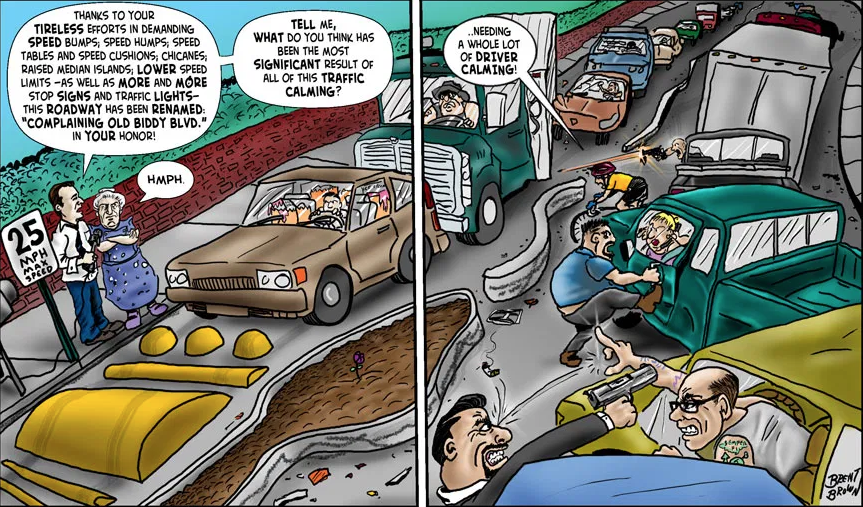
Cartoon courtesy of Brent Brown Graphix.

I doubt that social-justice warriors are on the warpath against speed bumps. Speed bumps are a prime example of punishing the innocent for the sins of the guilty. But punishing the guilty for the sins of the guilty is rational, and so these days probably verboten, so don’t expect it in Providence anytime soon.

I am on the warpath against speed bumps, however, and I admit it’s my bad that I waited until the speed bumps showed up in my neighborhood.

Shortly after they appeared on Rochambeau Avenue, which was my most frequent route from Hope Street to North Main and back, I switched over to either Doyle Avenue or Cypress Street. So I wonder how many Hope and Blackstone neighbors will adopt similar “bypass” strategies, and how many families on Doyle and Cypress will worry about their increased traffic.

Recently, mayoral candidate Brett Smiley sent out a campaign statement about the speed-bump crisis. He raised questions about the planning process for speed bumps but did not come out against speed bumps. He lost my vote.

Speaking of process, I’m glad to find that I did, in fact, write a post against speed bumps back in 2015 (see “Speed bumps on Blackstone?“) I attended a public meeting at Nathan Bishop Middle School, where 190 of 200 attendees opposed a plan to place speed bumps on Blackstone Boulevard. I wrote: “It now seems, if the city is serious about paying attention to public input,” that the speed bumps are “very likely to be abandoned.” Indeed, they never were installed. The lesson learned by the city was not to hold public forums on controversial issues.

So far as I know, and I could be wrong, there was no public input or forum to gauge community reaction to the plan to place speed bumps on Rochambeau. They have been installed, and they have also been installed on tiny 12th Street, which ends at Hope just before India restaurant. 12th Street?!

Who knows what other streets have or will soon receive a dose of such aggravation? Speed bumps are the most irksome form of traffic calming, as planners call these strategies for slowing down vehicles on streets. In some European cities, planners have found that reducing or even eliminating signs – “signage” in planner speak – reduces traffic speeds as drivers must pay more attention to how they’re getting to where they’re going.

City officials already know that speed bumps create dangers of their own. People speed up between them out of anger or to make up for (minimal) lost time. People dodging between gaps in the bumps designed to let ambulances pass through might swerve into an oncoming car or one parked to their right. People may lose control of their vehicles when they strike an unexpected speed bump. One thing’s for sure: they pay more attention to avoiding the bumps than they do to the street environment. People who live near a speed bump are irked by the scraping or crashing sound of such unexpected encounters. Is there a straw that breaks the camel’s back for such people? Do these dangers pose more risk than speeding to pedestrians? Has the city done a study? Maybe speed bumps are appropriate and effective in some places, but not on Rochambeau.

There is a class of misguided residents who apparently support speed bumps, presumably in the mistaken opinion that it will make them or their children safer. That is unlikely. What it will do is to punish the innocent for the sins of the guilty. However effective, that is wrong. The proper and more effective response to speeding is an officer of the law handing out tickets, and if that doesn’t work, hike the fine two or three hundred percent. A ticket or two that makes news will stop speeding in its tracks, or most of it – and, as a bonus, punish only the sins of the guilty, leaving the innocent alone. The best form of traffic calming is a cop.

But wait! Defund the police!

By the way, utility contractors seem unable to properly repair trenches dug to lay or fix utilities below pavements. Do our increasingly washboard streets qualify as speed bumps? Why does the city not force contractors to do their jobs?

Posted in Urbanism and planning | Tagged , , , , , , | 16 Comments

Stick by our “stuck bridge”

Bascule Bridge as seen from third floor of Wingate assisted living. (photo by author)

As usual, city authorities, including Mayor Elorza, are trying to find new ways of screwing up Providence by throwing non-existent money at it. In this case, they want to take a perfectly good old 1908 bridge, stuck engagingly in the up position for half a century, and turn it from a local icon into bad art.

The Rhode Island Department of Transportation, which owns the Crook Point Bascule rail bridge, has set aside $6 million to tear it down. But lots of people like the bridge as a landmark that seems to wander around as you drive or walk near India Point and the eastern edge of Fox Point. It is a bit of history, a relic of the era when 300 trains a year passed through the city, sending manufactured goods to market after their production here in exchange for materials to make more such high-value goods. Those were the days when Providence saw itself as sitting on top of the world. Its civic leaders enjoyed a map of the eastern seaboard with “trade arrows” pointing to markets throughout the world. They chuckled at piker cities with the gumption to pretend to be our rivals, powerhouse-wannabe cities like Boston, New York, Philadelphia and Baltimore.

The bridge might not bring all that to mind for most who see it, especially those ignorant of Providence’s past glories. But its monumental stuck-uppedness – sign of an oops that we can attribute to the past – demands attention.

According to the Providence Journal, GoLocalProv.com and other news outlets, Horsley Witten Group & Jonathan Harris, an engineering firm headquartered in Sandwich, Mass., has won a design contest held by Elorza for ideas on what to do with the bridge. As described in planning-speak (which the Journal reporter has done a fine job of emulating), the Horsley plan:

[r]epurposes the iconic landmark and its surrounding area, preserving a piece of the City’s historic infrastructure while reinvesting in an inviting new public space.

In short, destroy the village (oops, the bridge) in order to save it.

The city, says the firm, should take what makes the bridge appealing – its olden rusty form sticking notably upward – and cover it up with bad art glowing with LED lights. That way, nobody will care about it anymore, except for teenage boys (of all ages) who will enjoy throwing rocks and stones at it in order to knock out its illumination. The designers suggest future sites for affordable housing nearby, perhaps in order to provide a steady stream of unruly teenagers (just kidding!). With new art replacing the old railroad ties, suddenly the bridge will become worthy of demolition. But nobody will be eager to pay $6 million to replace a railroad monument (tarted up or left alone) with nothing.

What should be done is what sensible people would do who recognize that post-pandemic Providence has far better ways to spend its own or federal taxpayers’ money. The rust and the upward tilt of the bridge should remain. The graffiti should be zapped off. A barrier to prevent people from climbing the erect part of the bridge (occasionally to jump off) should be built. A historical plaque should be installed to explain the bridge as part of the city’s robust manufacturing and infrastructure history. When such a project is done, nobody who visits it would recognize that it has been renovated. It should look much as it looks now. Or, if this is somehow unpalatable or too costly, it should be left alone.

A pedestrian and bicycle path now leads from India Point Park (which would be plenty of park for most neighborhoods) along the edge of the Seekonk River, past Blackstone Park and onto Blackstone Boulevard. Let these users who would approach closest to the bridge enjoy it as it is.

My mother-in-law is lucky enough to have the Bascule Bridge as the centerpiece of her third-floor view from the Wingate senior assisted-living center next to the old IGA. (You’ll never guess what that stands for!) I would pen these words of warning even if her dear self did not live there, and even if I did not enjoy the prospect from that height. In fact, this is my second post on the subject. A monument that is largely free and always very interesting should be left alone to connect the city’s past to the city’s future without molestation from civic leaders who cannot think of anything better to do with our tax dollars. Enough!

Engraving from 1911 edition of Providence Magazine. (author archives)

Posted in Architecture, Preservation | Tagged , , , , , , , , | 15 Comments

A memorial to the agrafe

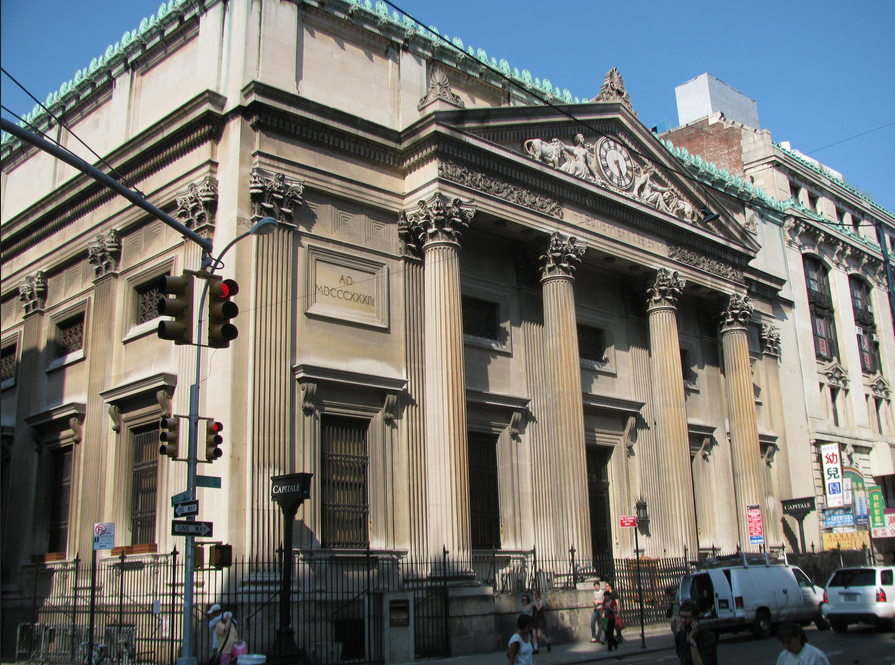
The Bowery Savings Bank, 130 Broadway. McKim, Mead & White, 1895. Each of the Corinthian columns and pilasters has an “astragal” moulding below its capital, just above the fluted portions of their shafts. As an example of “agrafe,” this astragal moulding was extended along the the faces of the adjacent walls, forming the bottom edge of a “sub frieze” at the tops of those walls; within that sub-frieze, a series of elegant geometric panels were carved. (Photo by Eden, Janine and Jim, via Wikimedia Commons)

Today is a day to remember those who have given their lives to perpetuate our American system, the first rule based on the ideal of equality under law for all citizens. Each citizen differs, and likewise, while maybe not quite so memorably, each element of the ornamental canon of classical architecture also is different, worthy and beautiful in its own way.

Seth Joseph Weine, an architect, archivist and tribune of classical architecture, long associated with the Institute of Classical Architecture & Art, headquartered in New York City, recently sent to the TradArch listserv a brief essay on a term in that canon that was new to both Seth and to me, and I hope it will be just as fascinating to readers as it is to both of us. His essay is below:

***

I was curious about what Wikipedia says are the main characteristics of Beaux-Arts architecture, so I read their article on it. I think it gets some things right – but, perhaps, doesn’t quite address the powerful soul of it.

But that’s not what I want to ask you all about. What I found mysterious was this passage in the article: “Beaux-Arts training made great use of agrafes, clasps that link one architectural detail to another.”

I think I know what they’re referring too – things like:

  • When the astragal moulding of a pilaster is extended across adjacent walls forming the bottom of the “sub-frieze,” whose space is then usually ornamented or paneled;
  • When a baseboard encounters a door architrave, and the designer makes the baseboard’s top moulding extend upward and around the architrave, to form the architrave’s taenia, a small “fillet” molding near the top of the architrave’s outermost moulding band;
  • When an arch is below a window sill, and that arch has a keystone, extending (and shaping) the keystone upward to merge with and form a (visual) support for the sill;
  • When a kitchen has a high ceiling, and the wall-cabinets are divided into sets of upper and lower doors by a taenia molding, extending that moulding horizontally to become the shape of the front edge of the kitchen’s open shelving;
  • When a building’s walls are rusticated (into bands and recesses), that same pattern is done on the columns, or conversely: the pattern on the columns is inversed – instead of recessed bands on the columns, it has bands that project;
  • Perhaps the most frequently seen example of an agrafe is when one looks at the base of a column or pilaster, and the baseboard of the adjacent or nearby wall is shaped so that the lines of the base (its “steps”) align with the major components of the base of the column or pilaster.

I love such stuff, this sort of interlocking of the design, and, in practice, I would play such delightful games as often as possible and appropriate. But I never encountered a term for such moves until I came across the word “agrafes.”

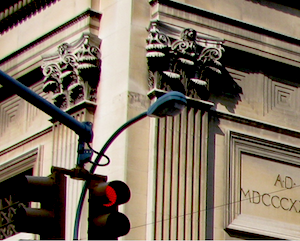
[Here Seth inserts a detail from the photograph above that gives a closer impression of the agrafe.]

I see that the word has another established use in the terminology of architectural construction: especially. it can refer to the dovetail-shaped joints we see in ancient and traditional masonry. Also, the non-architectural definition of the word means, according to Webster, “a hook-and-loop fastening,”  and they cite its etymological roots in the Latin for “to clamp on.”

Well, I’d say that sense of attachment or connectiveness resonates well with the the Beaux-Arts architectural term cited by Wikipedia.

I’ve certainly practiced agrafe-ing! But in my vasty vast experience and reading, I’d never come across the term for that kind of thing. Has anybody else ever heard of this term? Any scholarship on this? Any collection of great “agrafes”?

by Seth Joseph Weine

Posted in Architecture | Tagged , , , , , | 1 Comment

Biden’s putsch at Fine Arts

Justin Shubow examines model of Frank Gehry’s Ike memorial in 2013. (Bloomberg)

President Biden on Monday asked four of the seven members of the U.S. Commission of Fine Arts to resign or be frog-marched out of the picture if they did not do so by 6 p.m. that same day. In his response to the official letter from the White House, CFA chairman Justin Shubow stated:

I respectfully decline your request to resign. I request an explanation of the legal basis and grounds of your extraordinary request and accompanying threat of termination.

Shubow was joined in this by the three other members asked to resign. All seven of the current members were appointed by President Trump to fill normal vacancies, including Shubow in 2018 and four others appointed on Jan. 12, 2021, to replace members appointed by President Obama as he left office in 2017. Shubow was voted in as chairman on Jan. 21.

He noted that in the commission’s 110-year history, no president has ever sought a member’s resignation: “Any such removal would set a terrible precedent.”

Shubow was referring to the fact that the commission is an independent federal agency. Presidents may not remove any member without good cause, and such causes surely do not include members’ architectural tastes, which a spokeswoman cited as Biden’s rationale for the move. Nor would race qualify as an appropriate rationale, which some believe to be the real motive. All seven current members, at least as of the day before yesterday, are white males. That is awkward in this day and age but not illegal. To sack a member on grounds of his or her race, sex, religion, ethnicity or other such factor is illegal, unconstitutional or both, but no better a rationale than sacking a member for being a classicist or a modernist.

The remaining Trump appointees who were not asked to resign are its vice chairman, Rodney Mims Cook Jr., architect Duncan G. Stroik and architect James C. ­McCrery. All of them are classicists. Although Biden has selected four replacements, who in theory now hold office according to the White House letter, they may end up on the wrong side of a run-in with the law. In any event, they are all members in good standing of the modernist-industrial complex.

To remove a member of an independent federal agency without good cause will not just degrade the status of the Commission of Fine Arts but every commission that Congress has seen fit to protect from overreach by the executive branch.

No doubt Shubow and his colleagues are consulting with lawyers. It may be that refusing an illegal request to resign can moot the request. After all, none of the four members’ terms is up, and if they legally continue in their offices, there will be no vacancy for Biden to fill. (Unless he can manage to pack the commission, as if it were the Supreme Court.)

Laws that create federal agencies often are written with trapdoors or loopholes that enable politicians and bureaucrats to evade restrictions they don’t like, and perhaps this is the case with the U.S. Commission of Fine Arts. Shubow and his three colleagues – architect Steven Spandle, painter and sculptor Chas Fagan, and landscape architect Perry Guillot – might be doomed by such legislative or bureaucratic trickery, or by the recent timidity of the judicial branch.

In any event, Shubow & Co.’s lawyers should urge them to seek an injunction against the White House’s latest move in this game of architectural chess, which is likely to last a lot longer than some suspect. In the absence of a spine at the national level of the Institute of Classical Architecture & Art (which has kicked “advocacy” off its mission statement), I have asked its New England branch to urge that such an injunction be sought.

Biden’s move will counteract Trump’s effort to change the correlation of forces in U.S. architecture away from the modern architecture and toward classical and traditional architecture. These were the templates for official American design chosen by Jefferson and Washington as reflecting the ideals of democratic Greece and republican Rome that inspired the founding fathers. Biden has already cancelled an executive order signed in December by Trump that would have changed the modernist mandate for federal design that has been in force for six decades to a mandate favoring classical and traditional design.

Traditional and classical architecture are preferred by almost three-quarters of Americans, according a survey performed by the Harris Poll in October 2020. Its large majorities, extending across a wide range of demographic categories – age, race, income, education, geography, and political party – reflect a long train of earlier studies and anecdotal evidence stretching back to the early years of the 20th century. There are neither studies nor stories to be found arguing that modern architecture is preferred by majorities of anyone but its architects’ mothers. Over time, the correlation of forces between historical traditions of beauty and success, and a failed exercise in novelty a mere century old, is likely, regardless of Joe Biden, to reflect what most Americans (and probably the president himself) prefer – as would be appropriate in a democracy.

Posted in Architecture | Tagged , , , , , , | 10 Comments

Guatemala’s peaceful Cayala

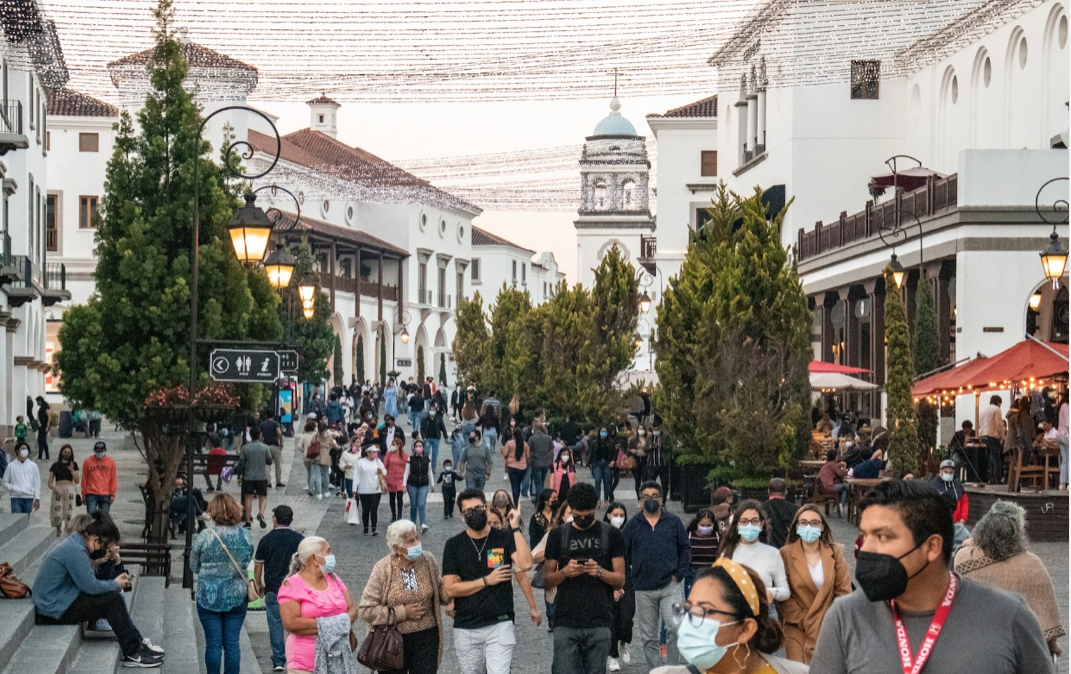
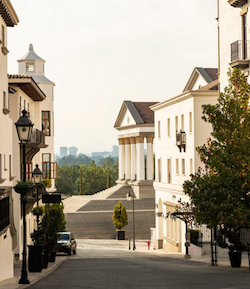
The Paseo Cayala, in Zone XVI of Guatemala City. (Estudio Urbano)

Cayalá is a new town on the edge of crime-ridden Guatemala City that has grown stronger since it was planted in 2011. I’ve written about its lovely mixture of Spanish and Mayan design influences, starting as early as 2012 in one of my weekly columns for the Providence Journal. In a 2015 post on my blog I made what is now a common error in descriptions of Ciudad Cayalá – the city of Cayalá – I called it “allegedly ‘gated’.” In a comment, architect Steve Mouzon corrected me: Cayalá is not gated, neither the town as a whole nor its central business district, known as the Paseo Cayalá. Since then, however, journalists on the left have made a cottage industry of false narratives regarding Cayalá.

Fortunately, those narratives are generally ignored by the residents of Cayalá, its many visitors and admirers from around Guatemala and the world, plus its famously droll master planner, Léon Krier, and his two  lieutenants, architects Pedro Godoy and Maria Sánchez, founders of Estudio Urbano. Still, the false narratives do sting, and do hurt Guatemala more broadly in its efforts to stabilize and improve its damaged society.

The goal of reforming architecture globally and returning beauty to its rightful centrality, in Guatemala and in the United States, requires, also, that such narratives be exposed and seen for what they are.

Before continuing on this theme, allow me to quote my own first description of Cayalá from that 2012 column, called “A new classical flower in Guatemala” and posted on my blog in 2015 following news of a visit to Guatemala by Providence Mayor Jorge Elorza:

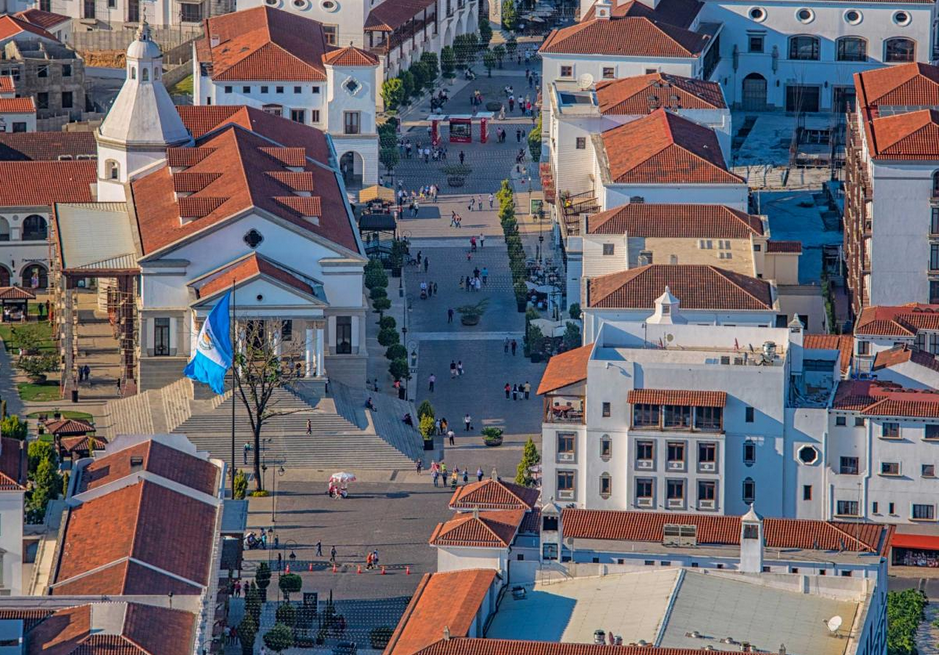
Ciudad Cayalá is a new town being built on open land beyond the city center but within the city’s broad boundary. Developed by the landowner, Grupo Cayalá, and masterplanned by Léon Krier, who spearheaded Prince Charles’s new town of Poundbury (outside Dorchester, England), Cayalá’s Phase I was finished in November. It incorporates Mayan ornamental detail amid a robust Spanish classicism. Streets and squares are lined with colonnades. A monumental set of steps ascends to the Athenaeum, designed by Notre Dame Prof. Richard Economakis, forming a pyramid of Mayan descent, topped by a Spanish temple. Photos hint at the glory of ancient Rome, whose classical buildings mounted to an urban epiphany with a seemingly natural, unplanned grandeur.

The gates theme seems to have begun with an article by Scranton University associate professor Michael E. Allison for what is now his blog called Central American Politics, focusing on the transition of (supposedly) former Central American rebel groups to political parties. In 2013, the UK Guardian posted an Associated Press story (“Guatemalan capital’s wealthy offered haven in gated city“). In 2017, Adventures Guatemala ran an article based on Allison’s reporting (“Private city built to escape crime“). Last year, in the journal Kairos, Rutgers University published “My visit to an invented city of privilege,” by a professor Madhu Murali. It is filled with one of the silliest collections of “outraged” leftist platitudes I’ve ever read. Most articles on Cayalá that are not advertisements for residential units there seem to be obsessed with its nonexistent gates, its security, and the idea that its beauty somehow makes the town inauthentic.

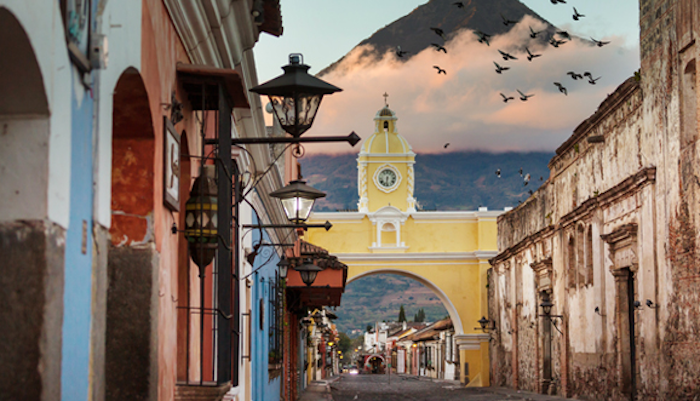
Memes that pop up in writing by Allison and picked up by other writers include not only the alleged gates but the impact of Cayalá on efforts to restore the old center of Guatemala City – the Centro Histórico, as distinguished from the far older former capital, Antigua Guatemala (now a UNESCO world heritage site), which is located some 25 miles from the capital.

Detractors [of Cayalá] say it is a blow to hopes of saving the real traditional heart of Guatemala City by drawing the wealthy from the urban center to participate in the economic and social life of a city struggling with poverty and high levels of crime and violence.

But there is another meme associated with that concern, one which has today become ubiquitous in the United States as well, with equally dire consequences for Guatemala:

One consideration why some people want to live in Cayalá boils down to the fact that many of the wealthy are simply racist. They do not like their fellow citizens. In fact, they don’t even think of them as citizens.

People who want to protect their families and themselves from crime are not racists for preferring safety to danger. To turn such an allegation into a dominant narrative, at least among the elite, risks destroying a society’s mechanisms to improve the lives of citizens. In all societies, self-preservation has been the concern  of all humans. In free societies, citizens have the right to plan for the betterment of their families, in part by selecting residences that are safe, schools that provide quality education, and jobs that offer prospects for higher income. Societies such as Guatemala, young democracies that are rising from periods of civil strife, have these same natural rights as free peoples, and it should be the purpose of government to honor and to protect those rights.

In Guatemala, it is not the alleged racism of the wealthy who move to Cayalá that poses a threat to social reconciliation or the restoration of the Centro Histórico. It is the violence itself, and the racist narrative that can promote distrust and even justify violence – Guatemala’s long civil war ended recently, in 1996. Violence is what sends those who can afford it to safer places, in or out of Guatemala, at all levels of its society (as we have seen, for example, at the U.S. border).

Arising from its history and, more recently, the Cold War, violence and injustice by Guatemalans against Guatemalans have brutalized life. Whether most of the guilt lies with the former rebels, the military, Guatemala’s elites, or U.S. support for the government, Guatemalans and their civil institutions, local and national, must work for a better future. A narrative that equates citizens’ desire for safety with racism, if it takes hold in social discourse, can only undermine the nation’s hopes for such a future.

Cayalá and the safety it offers do not work against restoring the Centro Histórico, let alone efforts to reach a modus vivendi in Guatemala; rather it is a safety valve that slows flight from the country and permits civil reconciliation to continue within its borders. It is a model for peace. When Guatemalans of all levels see an alternative to civil strife, progress will surely follow – if the people want it to, if it is allowed to happen. Cayalá thus serves a positive good in society as a lubricant for the gears of social advancement in Guatemala.

Wealthy Guatemalans who have moved from the old town to the new town are not prevented from contributing to that social advancement, whether by helping to finance the Centro Histórico’s restoration or by participating in the broader social, financial or political efforts to bring comity. Anyone at any level of income can visit Cayalá to shop, dine, visit friends or partake of its beauty. Its charms can only raise incentives to better pacify and beautify the rest of Guatemala, and serve as a model for one way of doing so. False narratives only retard prospects for a better future for all – a truth that spans not just that nation but the world.

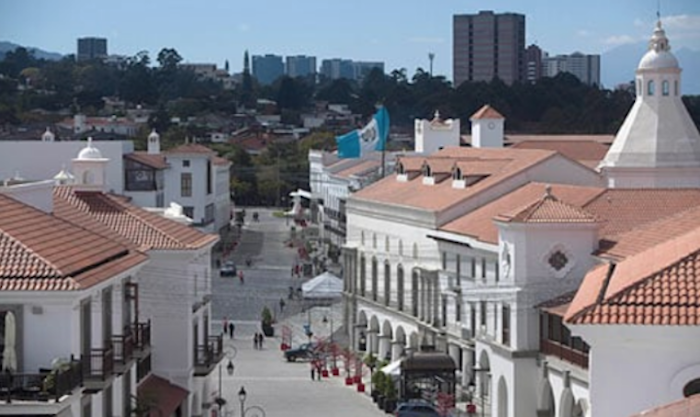
[At the end of this post are several photographs of Paseo Cayalá and Ciudad Cayalá. The first, from the UK Guardian, gives a sense of the distance from the central business district of Guatemala City. The rest, from Studio Urbano, taken from ground level and from above. Finally, there is a photo of Antigua Guatemala from the Expat Exchange.]

[Correction: The original version of this post mistook the old historical center of Guatemala City for the Antigua Guatemala, a former capital some 25 miles from today’s capital. That error was fixed by 11:54 p.m. Friday.]

***

This month, Cayalá won a Charter Award from the Congress of the New Urbanism. Celebrating the award is an article, “The Cayalá effect in Guatemala City,” from the CNU Public Square journal by its editor, Robert Steuteville. Its opening line seems to contain the “gated community” meme: “The Paseo Cayalá Neighborhood in Guatemala City is a model of open and economically resilient development in a city of gated development.” It turns out that by “city” this means Guatemala City, not Cayalá.

Posted in Architecture, Urbanism and planning | Tagged , , , , , , , , , , | 11 Comments

An architectural reawakening

Children’s library in Burundi, designed by BC Architects and Studies, in Belgium. (BCAS)

Architect David Rau gave a lecture called “Reawakening” last week, sponsored by the New Vitruvians, the youth wing of the New England chapter of the Institute of Classical Architecture & Art. He tracks four “awakenings” in the world today, involving food, happiness, genetics and our increasing knowledge of ourselves as human. Rau concludes that in the future, architecture need not be “futuristic” but can build upon the increasing awareness that architecture has been on the wrong track for a century. We must treat technology with greater skepticism and embrace local craft as the way to build if we want bring a true sustainability to design and construction, and the sort of beauty than can make us happy.

Rau describes the slow-food movement, recent studies in human happiness, the discovery by neuroscientists that our brain hasn’t evolved as much as we thought it had since prehistoric times, and the re-emergence of craft as vital to human self-worth and the survival of the planet.

It was a great lecture. Rau spoke for an hour and a half, and answered questions for another half an hour, but the ICAA has not yet posted its recording of the lecture. So I am posting the TEDx version of the lecture from six years ago, which sums up Rau’s main points in just eleven minutes.

Rau starts us out with a photograph of himself and his wife (an architectural historian) on the Grand Canal in Venice, and notes that in the print they bought of an 1742 engraving of the canal that Venice looked today as it had for almost 400 years. It was built with local materials by local artisans, highly ornamented, beautiful and beloved around the world. It was here in this ancient beloved city that Rau had his awakening, which he describes by summarizing the trends in thinking that have arisen from those who have noticed that the world is on the verge of epic fail in many realms. Many of these failures are embodied in today’s architecture, from whose errors we all can and should learn.

In the TED version, Rau seems to end with the suggestion that architecture in the future will look more like it did in the past. He said much the same to the ICAA, but hesitated to say what I think he might (and ought to) mean: that society would go back to the classical and traditional architecture that worked so well until it was interrupted by modernism in middle of the last century.

After his lecture (on Zoom), I asked him to cite a building of recent vintage that might give us some idea of what he was talking about. He named a children’s library in Africa, which seemed to me to resemble what the architectural theorist Christopher Alexander might design. Rau had mentioned Alexander and his pathbreaking book A Pattern Language in his lecture but not in his TED talk.

In spite of the fact that it is featured in Dezeen, the library is lovely, and its photo atop this post is delightful, for reasons beyond the building itself. It is highly ornamental and highly local in its materials. Still, traditional architecture features all of the avenues of reawakening that David Rau cites in his own reawakening. I will post his lecture as soon as it is available, and the reader may judge more fully whether he is calling for a new architecture or calling us back to an old one.

***

The ICAA’s New England chapter has just posted David Rau’s lecture.

Posted in Architecture | Tagged , , , , , , , | 14 Comments

OopSox chill at Polar Park

Retro stadium proposed for PawSox in Providence shortly after team was sold. (bostonglobe.com)

By the time this has posted, the WooSox, as the former PawSox Triple-A Boston Red Sox franchise is called, will have played their home opener at the new Polar Park, in Worcester, Mass. Rhode Island baseball fans are of two minds about the team’s absquatulation from Pawtucket: 1) they hate it, or 2) they really hate it. Most non-fans don’t much care. I had some pleasant outings at McCoy after I learned how to find it. Still, in this whole sad train of events, it was the lost opportunity for Providence that irks me the most.

(Absquatulation is a comical Latinate synonym for departure, with a hint of leaving with its tail between its legs.)

To recapitulate events that might have fled the memory of some readers, longtime team owner Ben Mondor died in 2010. His widow sold the team in 2015. Its new owners soon announced the team would move into a retro stadium to be built on the new Providence waterfront. Alas, the deal fell through. The new owners, disinclined to remain in Pawtucket, then played “let’s make a deal” with several Massachusetts cities. To counter this auction tactic, Pawtucket proposed, along with the state of Rhode Island, a new riverfront stadium next to its downtown. In 2017, the General Assembly approved a deal that shifted more of the financial burden from the state to the team. The team rejected that deal. At last, in 2018, Worcester pitched the best woo, with an assist from Massachusetts. Polar Park was built and the WooSox held their home opener today against the Syracuse Mets. (The WooSox won 8-5 in a game with six home runs.)

Rhode Island will survive the loss of professional baseball. Pawtucket is the big loser, but Providence could have won big-time if the stadium had been built on the vacated Route 195 land where the west end of its new pedestrian bridge terminates in one of the many public parks along the city’s new riverfront.

It seems to me that the long knives were unsheathed for this proposal from the start. The owners’ initial proposal was treated not as an opening gambit to be negotiated toward parity but as a non-negotiable deal killer by owners intending, for some obscure reason, to fail. When the proposal was twisted by the media as wealthy team owners eager to turn a public park into private profit, the city and Brown University withdrew their support, never mind that the waterfront was festooned with parks. This led to the swift demise of what could have been a bonanza for the city, the state, their citizens and, of course, the team.

My own personal stake in this deal was the hope that the classic beauty of an old-fashioned ballfield might cause the recently created innovation district to shift its architectural strategy from one of stark, raving modernism to a more people-friendly set of traditional styles – similar to the classical trend in Capital Center that was aborted by the GTECH building in the mid-1990s. That was my excuse for supporting the sin of a publicly funded sports venue. Whether it would have worked I have no idea; as things stand now, it didn’t take long for modernism to stifle all hope of a humanistic innovation district on the edge of downtown.

Polar Park, named for a soft-drink manufacturer in Worcester, is a great title for the new stadium, but not because the naming rights belong to Polar Beverages Inc. Yes, Worcester is cold in winter, but baseball is a summer game. No, Polar Park is apropos because it evokes the ballpark’s ice-cold architecture. Look at it. Warm it ain’t. A chill for WooSox fans is, however, cold comfort for baseball fans in Rhode Island, 49 miles’ drive from McCoy in the Bucket.

New Polar Park stadium for WooSox in Worcester, Mass. (William Morgan)

Brrr! … But wait! Below is an early rendering of the ballpark in Worcester back in 2019, cozy and traditional. That’s not what they built. What happened? Maybe it was the old bait-and-switch. Maybe the cozy traditional stadium proposed at first for downtown Providence would have been the same bait-and-switch. If so, this will be the last word on the subject from a rube who swallowed it hook, line and sinker.

Early rendering of proposed ballpark for Worcester Red Sox. (masslive.com)

Read William Morgan’s assessment of Worcester’s new WooSox stadium at GoLocalProv.com. It’s excellent, except for when he seems to be sorry the team did not build an even more exacrable stadium.

Posted in Architecture, Development | Tagged , , , , , , , | 6 Comments