New Engand Diary

(machinesandhumans.com)

(machinesandhumans.com)

That it is easy to park on the wrong street of the same name one town over in New England is like saying that if you don’t like the weather in New England, wait five minutes and it will change. These are not regional but universal phenomena.

Nevertheless, my experience visiting Salem on Saturday probably belongs in my former editor Robert Whitcomb’s New England Diary.

I drove from Providence to Salem for a house tour on Chestnut Street. I got off 128 North and followed signs for the nearby Peabody-Essex Museum, and finally saw Chestnut Street. I parked next to City Hall but could not find 9 Chestnut. So I was wandering around like a blind man. Lo and behold, I heard my name. Sheldon Kostelecky, president of the board of the New England chapter of the Institute of Classical Architecture & Art, picked me up and off we drove, his GPS locked on the proper stretch of Chestnut.

The tour was sponsored by the ICAA chapter. Afterward, Shel drove me back to my car. Or tried to. We couldn’t find it. We found Salem City Hall but it had changed its stripes. So off we went to the post-tour social, at fellow board member Sally Wilson’s house in Salem. Amid serious hors d’oeuvres, I recounted my tale of woe, noting that I’d thought I had parked next to Salem City Hall.

Sally’s husband John speculated that I had parked at Peabody City Hall. So after the social, having already led Shel on a wild goose chase, I rode shotgun with fellow tourists Don Ceereh and his wife Gail Fenske (of Roger Williams University). It took only moments to find Peabody City Hall, and to my considerable relief there, with a sheepish grin on its grille, was my car.

I will not tell the white-knuckle saga of my trip back to Providence in the pouring rain, which is indeed universal, but will leave the next New England Diary entry to its own diarist.

Posted in Architecture, Urbanism and planning | Tagged , , , , | 1 Comment

Salem’s Chestnut Street

DSCN3753

Yesterday I took a house tour on Chestnut Street in Salem, Mass, sponsored by the New England chapter of the Institute of Classical Architecture & Art. Founded in 1626, Salem was the home of Nathaniel Hawthorne. The tour took us inside a number of fine houses, including some where my camera was invited to remain in my pocket, and one whose owner requested that pictures could be taken for personal use only. I don’t think any of my photographs here are from that house, but I beg to be notified if I have transgressed against that desire. Indeed, to frustrate any nefarious effort to pinpoint an interior shot on the basis of its following an exterior shot, I have put all the exterior shots together, in no particular order, followed by interior shots, again in no particular order. The idea, here at least, is to enjoy the beauty inside and out without reference to much beyond the fact that most of the houses were built during the Federal period, following the Revolution, at the height of Salem’s prosperity. We saw no witches.

DSCN3683DSCN3756DSCN3664DSCN3662DSCN3666DSCN3686DSCN3734DSCN3706DSCN3797DSCN3652DSCN3713DSCN3691DSCN3713DSCN3714DSCN3719DSCN3773DSCN3633DSCN3632DSCN3725

Posted in Architecture, Architecture History, Photography, Preservation | Tagged , , , , | 2 Comments

First onto 195 land

Proposed new Johnson & Wales academic building for Route 195 land. (pbn.com)

Proposed new Johnson & Wales academic building for Route 195 land. (pbn.com)

The intersection of Pine and Chestnut context of proposed JWU building. (Photo by David Brussat)

The intersection of Pine and Chestnut context of proposed JWU building. (Photo by David Brussat)

First reported this week in the Providence Business News, Johnson & Wales University has proposed the first new building to arise on land near downtown Providence freed by the relocation of Route 195. Predictably, it will be a sort of mish-mash – or pastiche, to use a word modernists like – designed by Edward Rowse Architects, of Providence, and Architectural Resources, of Cambridge.

Worse architecture can be imagined, of course, but the proposal would step away from JWU’s effort in recent decades to extend its campus in ways that reknit the city’s fabric of historic architecture. “One hundred years ago,” said Chancellor John Bowen, “Johnson & Wales established its roots in Providence. In recent years we’ve led the way in transforming the city’s landscape.”

So why change now?

In the 1970s and ’80s the school’s program of restoring its historic buildings in downtown established the idea that downtown need not be abandoned. In the 1990s, the school built a new academic quadrangle of traditional brick architecture that fit into downtown like a friendly old glove. (Andres Duany’s firm DPZ drew up the master plan for the quad and a more general expansion.)

The new building’s proposed design represents a break away from that commendable program of preserving and reknitting the city’s historic fabric.

It is hardly surprising that the building, which will house engineering and biotech programs, embraces the reigning cliché of what buildings that house such programs should look like. Rather than committing to a design that builds on the city’s leading asset of beauty, the administration has chosen to think of its new building as an advertisement for the conventional look of what will be taught inside of it.

In short, the JWU administration has chosen the safe path rather than one that not only would strengthen the allure of the Route 195 redevelopment strip on behalf of the city and the state, but would re-establish JWU’s credentials as a bold institution.

The situation is not irreversible. The design could be easily recalibrated by its architects to reflect the traditional built environment that it will inhabit. A deft addition of columns on the first floor and cornices on the roof of the massing now proposed, plus a more elegant treatment of the fenestration with mullions instead of plate glass, would transform the design into one that would meld a modernist shape with traditional features and materials. The main aesthetic problem with the current design – its top-heaviness – could be easily resolved.

So doing, Johnson & Wales could lead the way by embracing a more natural architecture that respects its downtown context. Instead of merely being first out of the box to redevelop the Route 195 land, JWU could lead the way philosophically as well. That sounds like a good idea, but it must surmount resistance from reigning orthodoxy. Good luck!

Posted in Architects, Development, Providence, Rhode Island, Uncategorized, Urbanism and planning | Tagged , , | 1 Comment

Darrell Issa wimps out

Rep. Darrell Issa (R-Calif.). (theliberaloc.com)

Rep. Darrell Issa (R-Calif.). (theliberaloc.com)

A commenter on my recent blog updating readers on Frank Gehry’s proposal for a memorial to General Eisenhower points out that I relied on an incomplete report of what California Rep. Darrell Issa said of the proposal’s latest revisions.

Since I interpreted that report as indicating that Issa might be thinking it best to jettison the Gehry proposal, this new information is depressing to me but vital for readers’ assessment of the state of play on the memorial. The proposal by Gehry has seemed to me headed for the dumpster, and maybe it still is, but I hope I have not given readers an unjustified sense of optimism.

Here are more of Issa’s remarks conveyed by the commenter, who styles himself “lux-et-veritas”:

Your blog piece used an article on the DCist’s website by Sarah Hughes as its sole source. It’s accurate as far as it goes but leaves the reader with the impression that Representative Issa wasn’t in favor of moving ahead. I’m sure you read other news reports on the NCPC meeting which support what I heard the man say. For example, the Washington Post reported on the meeting in print, to wit:

“Issa — who said he met with Gehry in California over the Labor Day weekend — noted objections to the memorial’s design but said that the commission can’t provide” “another opportunity for it not to be perfect for someone.” And

“ ‘We can’t go back to square one,’ said Issa, who dismissed calls by detractors to scrap the Gehry design and restart the process.” And

“ ‘With the changes to the design as it is, I’m prepared to support it,’ said Rep. Darrell Issa (R-Calif.), a planning commission member who chairs the House Oversight Committee.”

I thank “lux-et-veritas” for keeping your correspondent on his toes.

Posted in Architecture, Art and design | Tagged , , , | 8 Comments

Column: Nameless building on Dorrance Street

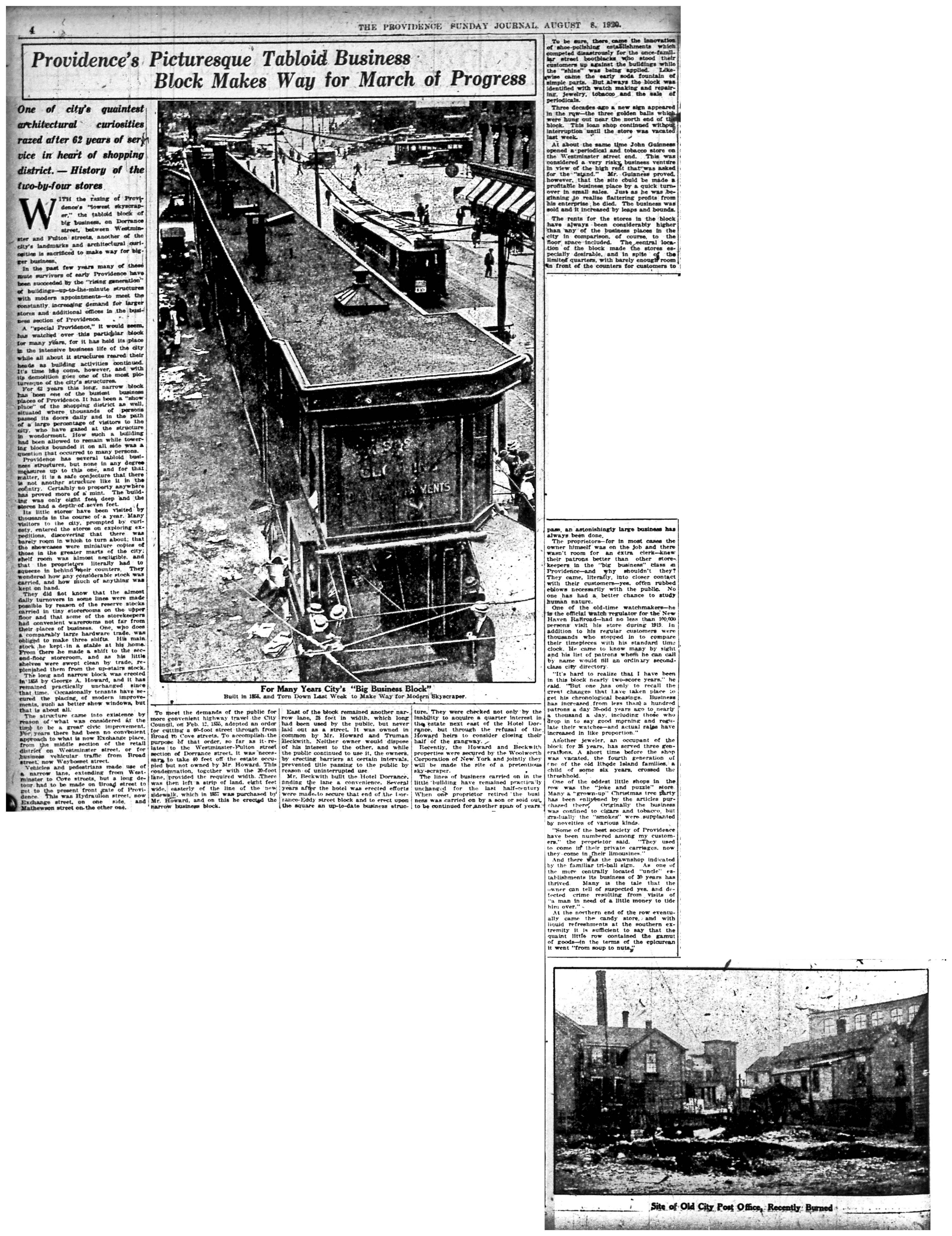
The name of the narrow building in front of the Hotel Dorrance, razed in 1920. remains a mystery. (Journal archives)
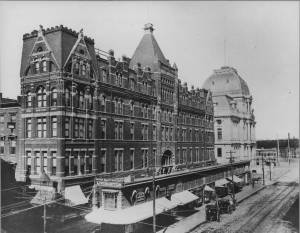
The name of the narrow building in front of the Hotel Dorrance, razed in 1920. remains a mystery. (Journal archives)

Hotel Dorrance and Dorrance Court Building. (Cliff Coutcher, John O. Pastore Collection, Providence College)

Hotel Dorrance and Dorrance Court Building. (Cliff Coutcher, John O. Pastore Collection, Providence College)

News story of buildings' demolition in 1920. (Journal archives)

News story of buildings’ demolition in 1920. (Journal archives)

Postcards of old Hotel Dorrance. (Larry DePetrillo)

Postcards of old Hotel Dorrance. (Larry DePetrillo)

Dorrance Street, looking south, circa 1920. (Journal archives)

Dorrance Street, looking south, circa 1920. (Journal archives)

Plat map, segment, downtown Providence, 1875. (Brussat archives; all maps, click to enlarge)

Plat map, segment, downtown Providence, 1875. (Brussat archives; all maps, click to enlarge)

Plat map, segment, downtown Providence, 1895. (Brussat archives)

Plat map, segment, downtown Providence, 1895. (Brussat archives)

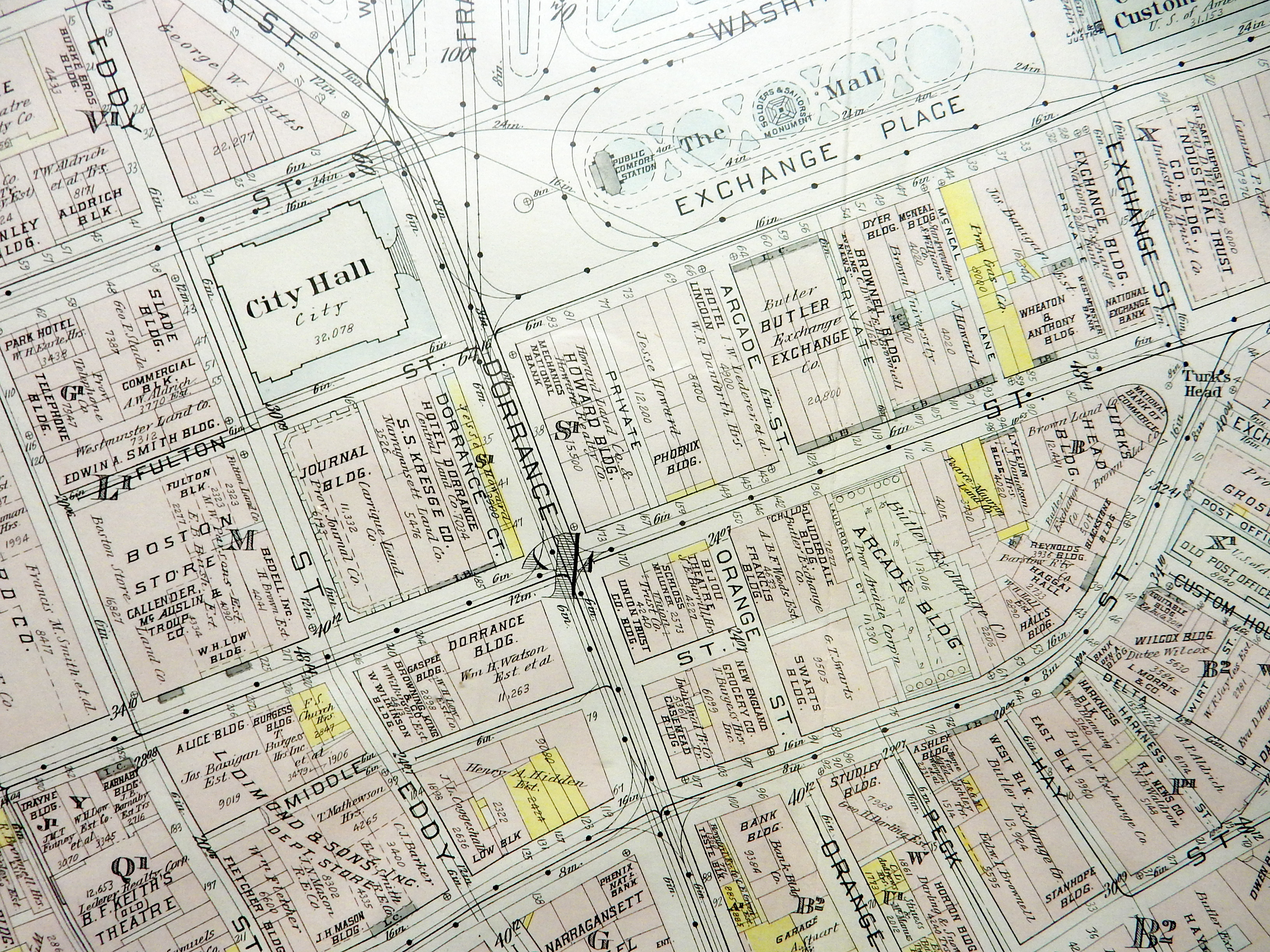
Plat map, segment, downtown Providence, 1918. (Brussat archives)

Plat map, segment, downtown Providence, 1918. (Brussat archives)

Plat map, downtown Providence, 1875. (Brussat archives)

Plat map, downtown Providence, 1875. (Brussat archives)

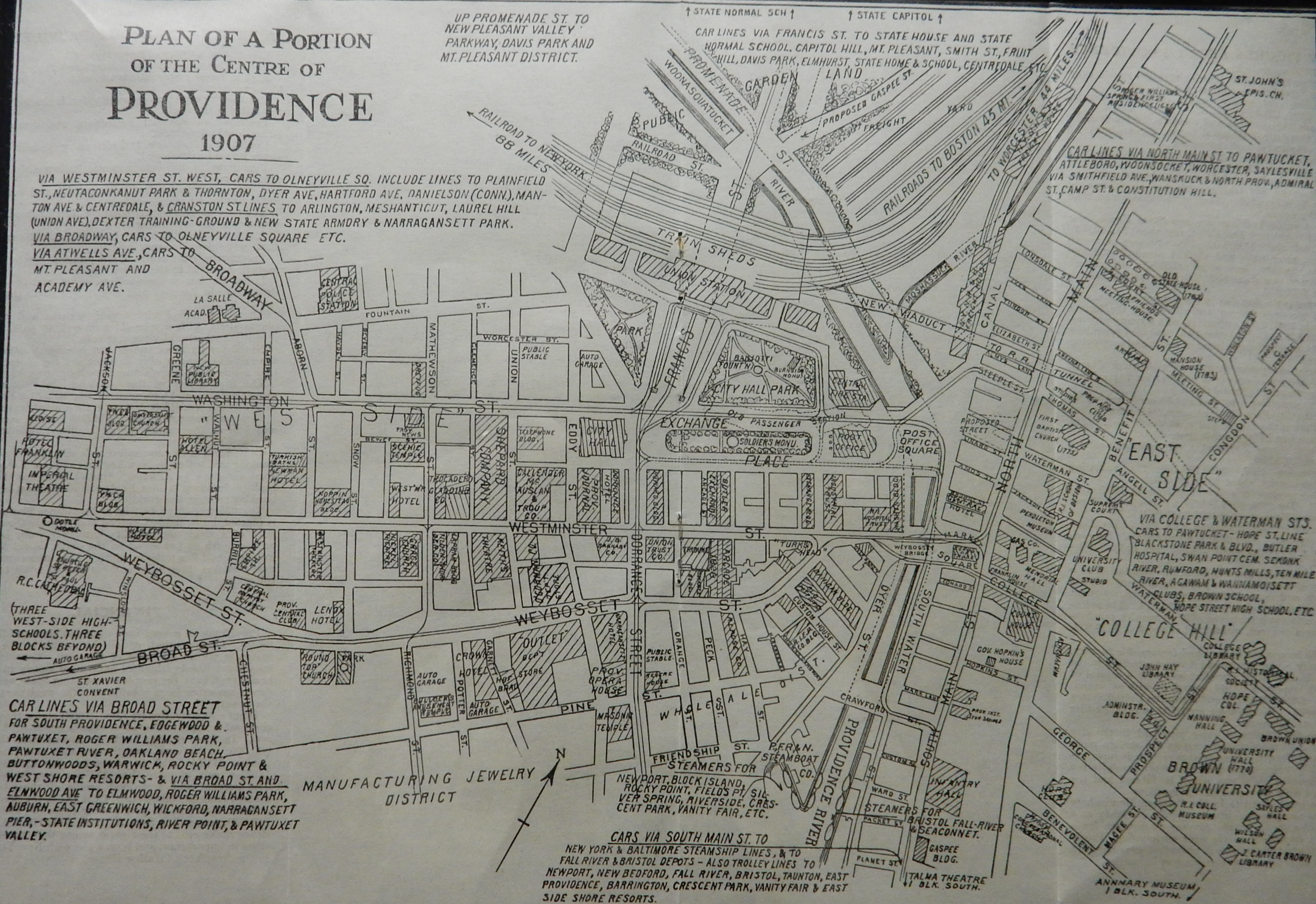
Tourist map, downtown Providence, 1907. (Brussat archives)

Tourist map, downtown Providence, 1907. (Brussat archives)

Plat map, downtown Providence, 1918. (Brussat archives)

Plat map, downtown Providence, 1918. (Brussat archives)

Last week’s column, “The mathematician vs. the modernists,” was my last hurrah as an employee of the Providence Journal. I didn’t know that as I finished writing it around 9 on Tuesday morning. Otherwise I might have written something decked out more aptly in sackcloth and ashes. At 4 in the afternoon I was handed my walking papers from HR, and my 30 years (minus two months) at the Journal were history.

So a column on a historical curiosity of downtown Providence might be a good way to ring in the continuation of the old column at my Architecture Here and There blog. Now that I no longer have the vast archival resources of the Journal at my disposal, I am glad to have Sheila Lennon’s “Time Lapse” Journal blog, which I can get without having to cross the threshold of the oldest continuously published daily newspaper in the United States.

Sheila’s “Time Lapse” blog has delighted this investigative pundit for years. Her modus operandi is to challenge readers of the newspaper to identify a scene from an old photo of a building and reveal the answer in the Sunday paper. On Aug. 2, she took a different tack. This time she told readers exactly where the scene was – but asked us to provide the name of the long, extremely narrow two-story retail building in downtown Providence, a sort of shopping mall, razed in 1920, that once stretched along Dorrance Street, parallel to the Hotel Dorrance from Westminster Street to City Hall.

“This week,” Sheila wrote, “Time Lapse is very different. We won’t be back Sunday with the answer because we don’t know the answer! We hope you do.”

Since the Brussat Archives, almost 30 years worth of books and papers from the shelves and cabinets of my Journal office, are now in 45 cardboard boxes and postal containers stacked in our basement, my only hope of finding the name of this building was to examine the collection of framed Providence plat maps that used to hang on the walls of my downtown loft and are now also stacked in our basement.

My 1875 plat map listed the owner of the building, Jesse Howard, a descendant of George A. Howard who built it, but not its name. My 1895 plat map listed the owners as “Mj. [major?] E. Harrington, E.L. Howard & Jesse Howard.” A 1907 tourist map, not an official plat, outlined the building but printed no information about it. My 1918 plat map listed its owners as “Harrington, Howard & Slade” but did name the narrow lane that ran between it and the hotel. The lane was called Dorrance Court.

I’m afraid I still do not know the name of the narrow building, which may have been erected in 1858, or in 1855, but was certainly demolished in 1920, not long after the top photo here was snapped.

A relatively large proportion of buildings downtown have their names emblazoned on their façades. The most elegantly inscribed name is the Callendar, McAuslan & Troup Store (now the Peerless Lofts) with its moniker carved in an almost unreadably ornate font onto the Westminster Street façade between the second and third stories.

But many buildings downtown don’t have names, and never did, only numerical street addresses. That may have been the fate of our commercial building, which I will take the liberty of designating the Dorrance Court Building. Today, at a mere eight feet wide, the Dorrance Court would be the narrowest building in Providence; the Teste Block at Dorrance and Weybosset (15 feet wide) and the soon to be restored George C. Arnold Block (12½ feet wide) – both on the Providence Preservation Society’s list of endangered buildings in recent years but now thankfully off of it – were built in 1860 and 1923 respectively.

The building that replaced both the Hotel Dorrance and the Dorrance Court survives to this day, the Woolworth Building, completed in 1922. Its description in the 1981 downtown architectural survey by the Rhode Island Historical Preservation & Heritage Commission says that in addition to the hotel it also replaced “a narrow, 2-story frame building (1855)[,] and the gangway between these two structures.”

No name is given. Nor does the survey describe the architectural style of the Woolworth Building beyond referring to its “Chicago-type” windows.  But if you look at the decoration, it sings of Art Deco, making it possibly the first building of that style in Providence. Next door up Westminster is the Kresge Building (1927), which is undeniably Deco, as is the Industrial Trust (“Superman”) Building (1928). As can be seen in some of Sheila’s photos, the Hotel Dorrance was originally built in a Gothic style but its gables were sliced off at some point to add a sixth story, giving the building a stumpy look around the time it was torn down.

Some of the photos in Sheila’s post suggest that the Dorrance Court originally featured stone quoining on its second-story corner piers, though the quoins may have been wood carved to look like stone – as on a number of ritzy houses on Benefit Street.

I see I have transgressed a length limit that I am no longer bound to respect. I only want to add that I was once invited to write a series of columns about great Providence buildings that had met their demise. I passed because it would just have been Sheila Lennon lite.

I will continue to write my weekly column on architecture, as I have for 24 years in the newspaper, on this blog. It will be about the style wars, of course, but also about Providence’s history and the development issues that will carry Rhode Island and its capital city into the future. If the modernists who put that future at risk year after year think that I am finally out of their hair, they will have to think again.



Posted in Architecture, Architecture History, Providence, Urbanism and planning | Tagged , , , , | 7 Comments

Under Western Eyes

westerneyesHere is a passage from Joseph Conrad’s book about revolutionaries of early 20th century Russia (though the book is mostly set in Geneva, a refuge for those feeling discomfort under the czar). Razumov, who has just met a fellow agitator who writes fiery prose for a magazine, walks away in a sour mood:

He was boiling with rage, as though he had been grossly insulted. He walked as if blind, following instinctively the shore of the diminutive harbor along the quay, through a pretty, dull garden, where dull people sat on chairs under trees, till, his fury abandoning him, he discovered himself in the middle of a long, broad bridge. He slowed down at once. To his right, beyond the toy-like jetties, he saw the green slopes framing the Petit Lac in all the marvelous banality of the picturesque made of painted cardboard, with the more distant stretch of water inanimate and shining like a piece of tin.
He turned his head away from that view for tourists, and walked on slowly, his eyes fixed on the ground.

Conrad’s insertion of such deprecatory thoughts about a place of beauty seems, to me, a reflection of the contradictions of his protagonist. Razumov, though reputedly a revolutionary and honored as such by his fellow subversives in Geneva, keeps secret that instead of having helped the terrorist Victor Haldin to blow up a police minister in St. Petersburg, he actually turned Haldin in to police. Mum’s the word! This is in the back of the reader’s mind as Razumov interacts with his fellow revolutionaries, creating quite a literary frisson. Conrad’s depiction of Razumov’s character and the personalities of his adopted revolutionary milieu is brilliant.
Whenever I see that news clip of an ISIS propaganda video featuring Brit fighters in Syria expressing joy at the fun life of a jihadi warrior, I think of this novel by Conrad. His book about terrorists in London, The Secret Agent, is even better.


Posted in Architecture, Books and Culture, Other countries | Tagged , , , , , , | Leave a comment

In defense of Zaha?

(famousarchitect.blogspot.com)

(famousarchitect.blogspot.com)

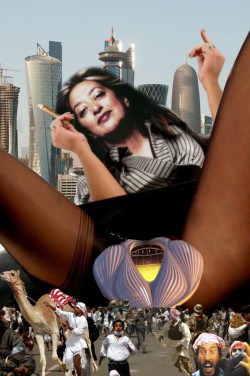
It has emerged that news stories last June out of Qatar, where Iraqi architect Zaha Hadid has a commission to build a stadium to host soccer’s World Cup in 2022, falsely asserted that hundreds of itinerant construction workers had died in the process of building her stadium. In fact, her stadium was not yet under construction. In an earlier conversation with the press she had said about poor conditions in general for workers in Qatar, death resulting, that “it is not my duty as an architect to look at it.”

Some architecture critics, such as yours truly in “500 or more workers,” relied in error on the fair assumption that the news reports accurately pegged her comment being as about deaths at her project. We picked up the story and criticized Hadid for insensitivity. Hadid chose to sue Martin Filler for this, but not me. I was not, it seems, on her radar. Obscurity has its benefits.

Nevertheless, for the record I hereby, henceforth and forthwith apologize to Zaha for any and all hurt feelings and unwarranted damage to career that may or may not have been the result of my naughty opinions therein or herein expressed.

Filler got Zaha’s goat, and she sued him, because he unpacked his negative feelings about her in a review in the New York Review of Books of a book that barely mentioned her. I have no comment here about the merits of her suit, except for a general feeling that modern architects have no moral standing to sue anyone for anything anywhere. But I do regret that the press wrongly linked her comment to her proposed stadium. Still, she did make the comment and it does reflect the inhumanity of modern architects that arises from the inhumanity of modern architecture, especially that of major commissions by starchitects. (The most direct reflection of this is Rem Koolhaas’s CCTV headquarters, in Beijing, a building that appears to be stomping on the Chinese people.)

Some critics, such as Beverly Willis in “In Defense of Zaha Hadid” on Sept. 4 in Architect, have deemed Filler’s criticism of Zaha Hadid to reflect sexism. I cannot peek inside Filler’s mind to leap to that conclusion, but in my post “Zaha ‘Ha Ha’ Hadid’s thing,” I criticized her stadium for looking like a vagina and ridiculed her absurd denial. That was not sexist because I also criticized a Chinese architect for designing a headquarters for the China People’s Daily, in Beijing, that looks like a penis (an anatomically correct penis, not just building considered vaguely phallic for being vertical rather than horizontal).

I have long criticized modern architecture for being the latest round of Western colonialism. It seems that modern architects can commit sins against a culture that would generate fierce criticism in any other field. Zaha Hadid has designed a stadium that looks like a sexual body part in a society that does not permit a woman to expose her nose in public. If modern architecture’s crimes against humanity had a literal death toll, its practitioners would be hauled before a tribunal in The Hague. Now, although it may be premature to lay any deaths at Zaha’s door in Qatar, it is very clear that people are dying in large numbers to construct modern architecture, at least in the Mideast. I doubt workers are dying at such a rate in the construction of new traditional buildings there, if any.

When a completed modernist building designed to defy gravity actually falls down on the volition of its own arrogance toward the laws of physics (as opposed to the volition of terrorism, whose anniversary will sadden us tomorrow), maybe then it will be time for the world to sue modern architecture.

I stand by the conclusion of my “Zaha’s thing” post from June:

I think almost any modern architect would have responded the same way as Hadid, and that the willingness to inflict such ugliness and sterility on a hapless world suggests an essential deficit in the makeup of the character of the profession as it is constituted today, at least at the level of the celebrity architect.

Posted in Architects, Architecture, Other countries | Tagged , , , , | 4 Comments

WTC blues

1 World Trade Center seen down Fulton Street from Financial District. (Guardian)

1 World Trade Center seen down Fulton Street from Financial District. (Photo by Vivienne Gucwa; Guardian)

The Guardian has published a lengthy article, “1 World Trade Center: How New York Tried to Rebuild its Soul,” by Jason Farago. He bemoans the lost opportunity of the World Trade Center. But he does not mention what that lost opportunity is. He swoons over the Rafael Vinoly “damned skeleton” axed by Governor Pataki in 2003 after it had been selected – to be replaced by the Daniel Libeskind foolishness rendered (in my opinion) slightly less foolish in the process that was taken over by Larry Silverstein. Despite all this, the author’s desire for a humane reknitting of Lower Manhattan hovers between every line of his piece. Yet he never mentions that such a proposal had been made, quite publicly. The Franck Lohsen McCrery WTC proposal published in November 2001’s autumn issue of City Journal, the quarterly of the Manhattan Institute, would have filled the bill admirably.

I suppose it would not do for Farago to have mentioned it. But I link readers to it because it was the best hope of reviving America in those dark days. It never went beyond the first cut in the WTC competition, presumably because it was not “of our time.” But it was!

Architecture should not simply reflect the problems of society. A hundred years ago the founding modernists believed that architecture could help solve those problems. But since then it has only made them worse by reflecting those problems in its designs – in essence, using architecture to magnify those problems. The idea of solving them was an admirable ambition (if true), but modern architecture dumped from its tool box every tool that could have helped it succeed. It is no wonder that the modernists failed to improve their world, and have only made it worse. Modern architecture continues to flounder today, successive modernisms providing even wackier “solutions,” mocking the dead concept of using architecture to uplift humans rather than mimic the worst features of their society.

The solution is right there in front of our eyes, between every line of this piece, and quite straightforwardly so. It always has been. Will it continue to be purposely ignored?

[Addendum: Rob Steuteville reminds me that the Peterson Littenberg proposal, which featured restoring the street grid according to New Urbanist principles, was the most popular of the early WTC plans. Although I prefer the Franck Lohsen McCrery proposal because its traditional urbanism also reflected traditional architecture straightforwardly, it is certainly true that accepting any NU proposal (such as the PL) would have opened the door to a more vernacular, traditional, even classical approach to the WTC rebuild.]

Posted in Architecture, Development, Uncategorized, Urbanism and planning | Tagged , , , , , | Leave a comment

Guggensinki scandal?

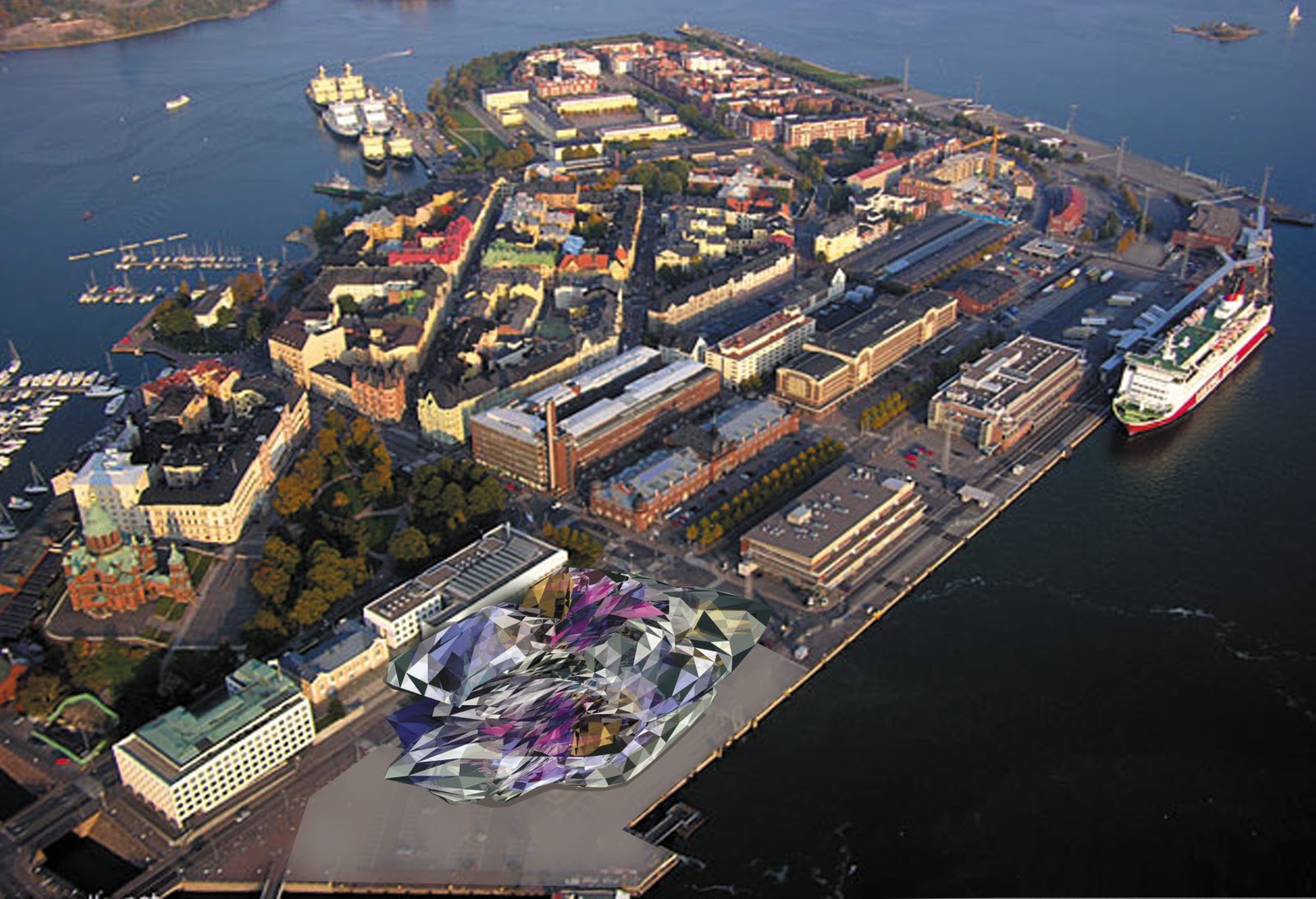
Site of proposed Guggenheim Helsinki museum. The rules do not call for the twisted turd drawn into this image. (maldinas.blogspot.com)

Site of proposed Guggenheim Helsinki museum. The rules do not call for the twisted turd drawn into this image. (maldinas.blogspot.com)

It’s far too early to say whether the design for the proposed Guggenheim museum in Helsinki will prove scandalous in its design, but entries for the Solomon R. Guggenheim Foundation’s first international museum design competition are due on Wednesday, Sept. 10. My esteemed source, the Washington classicist Nir Buras, has clued me in to what he considers scandalous about the competition.

It is that the notoriously wealthy foundation is soliciting labor and expenses worth millions of dollars from an estimated 400 entrants for its two-stage competition.

Now, most competitions involve some grumbling from folks who think their submissions should be subsidized. At least Guggenheim does not have the cheek to demand an entry fee. But the required four boards and associated labor, copying and postal costs can mount up to a stiff expense in the budgets of all but the most established architectural firms. You’d think that the foundation, which prides itself as a mentor to the arts, would establish some sort of sliding scale for entrants at all levels, not just the 55,000 euros to be awarded to the five finalists in the first stage of the competition. The eventual winner will get 100,000 euros, plus, one expects, the usual extravagant fee for design and construction oversight commanded by the victors of such competitions.

Not that anyone reading this post not already aware of the competition is likely to create an entry in time for submission by 12 noon EEST (Helsinki time). Still, we can all hope that among the typical 400 entrants are some with classical proposals, which are certainly not ruled out by the competition rules. Nir Buras has entered. Thankfully the entries are anonymous, or his disgruntlement might be an unofficial ground for dismissing his entry. I will try to post his entry to the competition as soon as he sends it to me. The number of entrants will be announced by Guggenheim consultant Malcolm Reading, of London, on Sept. 17. (By the way, it is apparently not automatic rejection for proposals that do not make the deadline.) The six finalists will be announced later this fall. The final winner will be announced in June 2015.

Helsinki is a great city, which I’ve never, alas, visited. I hope the Guggenheim Foundation will decide to do something truly novel by selecting for this prestigious commission a classical design that pays homage to the history of a great city.

Posted in Architecture, Art and design, Development | Tagged , , , | 5 Comments

Ike memorial update

ikemem

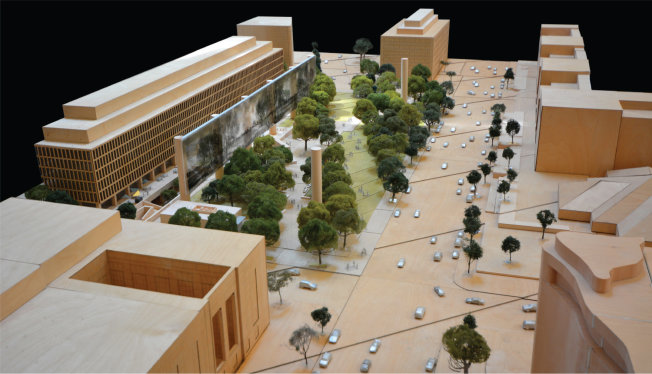
Latest Gehry design for Eisenhower memorial, with two “tapestries” cut. (usnews.com)

Frank Gehry has agreed to remove the two smaller of three giant screens, or as he calls them, tapestries from his design for a memorial on the Washington Mall to Dwight Eisenhower. It appears that the central sculptural plaza would remain the same. The National Capital Planning Commission, which rejected the Gehry design in April, had asked him to make changes, and this was the result. My source for the news is a story written by Sarah Anne Hughes at DCist.com, “Gehry’s revised Eisenhower memorial loses two controversial tapestries, but concerns remain.”

With the much larger surviving screen the design remains almost as odious as it was to start. In fact, here is what NCPC ex-officio member Rep. Darrell Issa told DCist: “[Gehry is] willing to give up the tapestries altogether and take his name off of it. I don’t believe that’s the best choice.  We lose something if we continue to say, ‘Change it, change it.’ I think the design is as close to as good as it’s going to get, unless we decide we never liked the design in the first place.”

The last words, regarding whether the design is liked, are key.

Two of four 80-foot posts that would have held up the two defenestrated tapestries would remain, which caused some back and forth on the committee. Hearing the remaining tapestry columns referred to as “vestigial” and compared to the last scene of The Planet of the Apes, Issa decorously stepped up to their defense, arguing that they resembled pylons upholding access ramps to the Interstate Highway System pushed through by Eisenhower as president. He added, to chuckles, that perhaps a plaque explaining this could be attached to the gargantuan pillars?

Funding for the Gehry proposal has essentially been zeroed out by Congress for two years running. There are many things wrong with the process that has led to this point, resulting in a sort of cottage industry of investigative committees nibbling at the Gehry proposal. The design competition was dubious and might have been rigged, the cost has skyrocketed, the expense has been borne by the public, the fundraising companies hired to raise donations for the memorial have cost the public more than the money that has been brought in, and the architect has exhibited a highly dismissive attitude toward the idea of public input into the design process.

Killing the memorial for any or all of those reasons, while a victory for the public weal, would not defeat the stated purpose of designing and building such a memorial, which is to overturn centuries of tradition in how the nation memorializes its great citizens. If Gehry decides to remove his name from the project, that would be a great signal that the public voice is reaching the ears of authority. But if the Gehry proposal is jettisoned lock, stock and barrel because of its appearance, the victory for beauty and civility in the Nation’s Capital would be undeniable.

Posted in Architecture | Tagged , , , , | 5 Comments