Your computer’s architecture

Royal Mills condo complex in West Warwick. (commons.wikimedia.org)

Royal Mills condo complex in West Warwick. (commons.wikimedia.org)

I have a difficult time finding user-friendly architecture to write about, so let me write about the user-friendliness of computer word programs. In fact, the writing has already been done, not for me but by me, back in 1988, the last time I wrote about the architecture of anything but buildings.

Prof. Elaine Chaika. (elainechaika.com)

Prof. Elaine Chaika. (elainechaika.com)

The subject rose to mind during a lecture last night entitled “Beware of Grammar Checkers,” by Dr. Elaine Ostrach Chaika, emerita professor of linguistics at Providence College, where she taught for about three decades. Her son Dan’s ladyfriend Imelda, who has been a friend of mine for years, invited me to hear Elaine speak at the Thundermist Center, across Providence Street from the Royal Mills complex in West Warwick. (The center is in a building ancillary to the mill, and hence equally beautiful.)

Professor Chaika’s eloquent diatribe against grammar-checking programs denounced a long series of incorrect suggestions from programs by Word and Grammarly that corrected her nonexistent dangling participles, sentence fragments and other faux clunkers. I harked back to the time I wrote about word programs that analyzed one’s writing style.

Here is that column from May 26, 1988:

Ahead for society: Trials and tribulations of ‘user-friendliness’

MY COMPUTER program, which enables me to write these words on my computer, is many wonderful things, but one thing it’s not is user-friendly.

(s.717.photobucket.com)

(s.717.photobucket.com)

It makes me recall many commands that are difficult to remember, whereas a user-friendly computer program would put a choice of commands before my eyes. Some user-friendly programs have “menus” that are not only helpful but cheerful, issuing kindly instructions, corrections and clarifications to the baffled or wayward user. But XyWrite has no menus. It is not helpful, let alone cheerful. In short, it is user-unfriendly.

So I have a very matter-of-fact relationship with my computer. We do business together, but we do not socialize. If only my computer were not so user-unfriendly. I can imagine sitting at my desk, flipping the “on” button and waiting as a series of blinks and beeps loads the program. I’d be greeted with a smile and a “hello, Dave.” The computer would anticipate my desires, and produce a list of column topics on the screen. I would press a button and up would come a list of ideas on my topic. And then on we’d go. . . .

But as matters stand, I still have to do all the work. I have to think of something to write about, then think of something to say about what I want to write about. Someday I will stumble on a computer program of genuine user-friendliness, and new worlds will open up to me. Until that day, my computer will remain a glorified typewriter.

That day might not be too far off, however. In the January issue of Atlantic Monthly, Barbara Wallraff describes software that can analyze a writer’s prose style. Freshmen at Colorado State University use Writer’s Workbench to hone their English Comp. skills. They put work into the computer, and out cranks a printout enumerating its flaws of grammar, style and usage.

Wallraff lists its queries: “Has the student used a lot of passive verbs? Abstractions? Very long sentences? Are the sentence patterns repetitive? What is the draft’s ‘readability grade’? . . . What is the draft’s readability grade according to four slightly different formulas?”

Another program, Critique, not only identifies flaws but corrects them. It pumps out such thoughtful suggestions as “SENTENCE TOO LONG/Consider turning the highlighted portion into an independent sentence./Omit the first highlighted word, and, if appropriate, use a conjunct (e.g., ‘however,’ ‘consequently,’) at the beginning of the second sentence.” Who’s the writer around here, anyway?

Wallraff had similar feelings about Critique: “Sometimes a user, having read certain of the messages that appear in the blue box, will experience an internal conflict. The user may, for example, suddenly feel that Critique is a self-important mechanical meddler, that his own judgment about sentence length is wholly adequate, and that if a person is unable to read with ease the sentence in question, then that person is of subnormal intelligence. . . . Then again, he may recognize that the system means no personal affront but rather was created . . . to be a tireless helper and guide.”

Well, maybe.

Until I read this article, I didn’t know such programs existed. As an admirer of the prolix and digressive English essayist William Hazlitt, I’m not sure I would want to subject my work to the ghost of Mrs. Dunn, my fourth-grade teacher, bless her soul.

Still, thinking about trying out the style analyst must be something like peering over the edge of the roof of a tall building. One finds oneself resisting the urge to throw oneself off just to satisfy one’s morbid curiosity.

Since most such programs reside at distant institutions (I don’t even want to know if Brown University has one), my morbid curiosity will have to remain unslaked. But I don’t mind. These style analysts strike me as the ultimate in user-unfriendliness, even if they are easy to use.

I have here been considering user-friendliness as a concept of interest chiefly to individuals. But Wallraff describes one style-analysis program that hinted at the vast potential benefits of user-friendliness in an educationally decimated society. The Smart Expert Editor (a.k.a. “Max”; created by John M. Smart) takes any form of literature and pares it down to an eighth-grade reading level. Max is employed at the Murray Ohio Manufacturing Company, helping technical writers produce manuals for those who buy its lawnmowers.

Horrible as that sounds, user-friendliness could solve the problem of education in this country. Even under an “Education Presidency,” the ability of schools to produce technologically literate citizens is likely to lag behind the ability of technology to multiply its own complexity. America’s competitiveness is likely to erode unless user-friendliness bridges the gap between high tech and low skill.

Some day, all instruction manuals might be fed through computers to make them user-friendly. But if the United States is to solve its education crisis and become truly competitive, our vision of user-friendliness must be broadened to encompass all aspects of knowledge, profound and mundane.

If that means computerizing more aspects of everyday life – well, isn’t that the way we’re headed anyhow? Saturated as we are in a couch-potato culture, our descendants seem doomed to evolve into disembodied heads linked telepathically to tables cluttered with remote-control units, issuing instructions to some household robot. In fact, something called Butler-in-a-Box is already on the market, for only $1,495. It can be programmed to respond to your commands in a “mock-obsequious” tone of voice.

On reflection, user-unfriendliness sounds friendlier all the time.

Actually, I do recall that after writing this piece someone asked me if I wanted to feed it into a program that would analyze it. I said yes. To this day, I simply cannot recall the result. It may have said something like I “use too many words,” which sounds to me a lot like the famous critique of Mozart – “too many notes.” But I’m sure that Professor Chaika will let me know if the architecture of my prose style is deficient.
Posted in Architecture, Books and Culture | Tagged , , , , , , , | 1 Comment

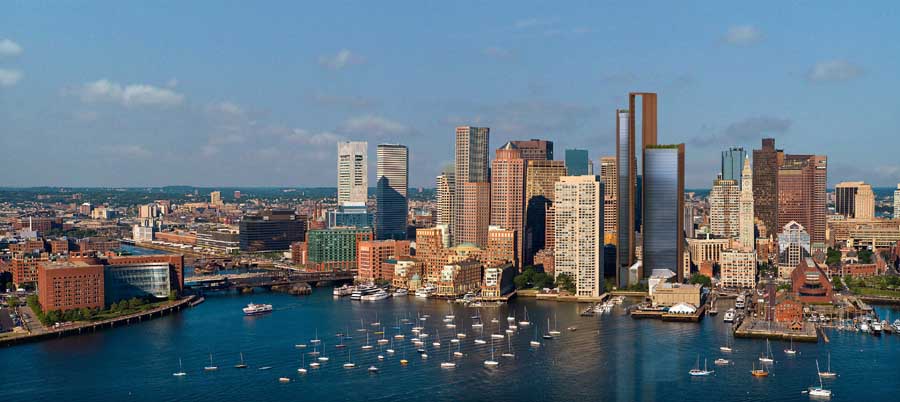
“Why is Boston so ugly?”

Boston's skyline. (ngvbridge.com)

Boston’s skyline. (ngvbridge.com)

That’s the question asked by Rachel Slade in Boston magazine. Her answer is that developers don’t hire enough Thom Maynes or Renzo Pianos. The real answer is that developers hire too many Thom Mayne and Renzo Piano wannabes, and that the wannabes produce the exact same junk as their gods. And Renzo Piano was here. But I doubt that Slade is as disappointed as I am with the results at the Isabella Stewart Gardner Museum.

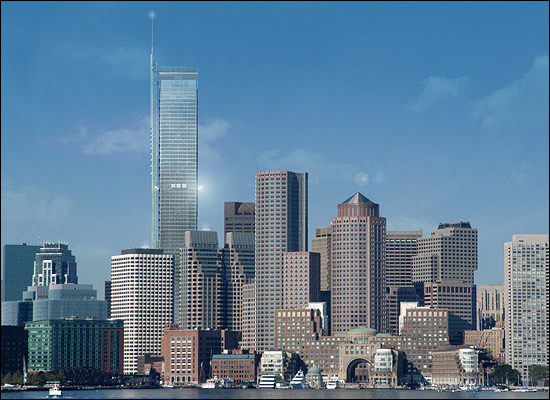
Renzo Piano's cancelled tower. (wikipedia.com)

Renzo Piano’s cancelled tower. (wikipedia.com)

Slade expresses regret that the great and elusive Piano was run out of Boston by the Federal Aviation Administration, which for safety reasons in the vicinity of Logan cut his proposed tower’s height from 1,000 to 700 feet, causing Piano to bolt in a huff. But he was invited to Boston, which deflates her theory that blame for its “ugliness” can be laid to the stultified planning culture of Boston. That culture is stultified, but not because it refuses to encourage Boston developers to hire wackier architects.

In the process of wondering why Boston planners allowed developers to clog the Seaport District’s waterfront with commercial rather than residential architecture, Slade mentions Paris. The City of Light once restricted tall buildings to La Défense, beyond the city center. “Yes, it’s miserable,” writes Slade, “but it’s not blocking anyone’s views of Notre Dame.” No it’s not. But if La Défense is miserable – and it certainly is – does Slade expect that it would look any better plopped in the middle of Boston?

So: “Why is Boston so ugly?” Well, actually it’s not. But if it were, the reason would be that it has too much modern architecture, not too little. Modern architects and their academic camp followers pride themselves on their disdain for beauty. Modern architects do not seek accolades for beauty, so they cannot be accused of worrying much about ugliness. This is perfectly evident in the city districts around the world for which they are responsible. As mainstream architecture critic Paul Goldberger (Vanity Fair, The New Yorker, New York Times) has had the honesty to admit in print on occasion, modernism has produced great buildings but never a great city. Even Rem Koolhaas has produced a poster that mocks the idea of a skyline composed of the world’s most iconic modernist towers.

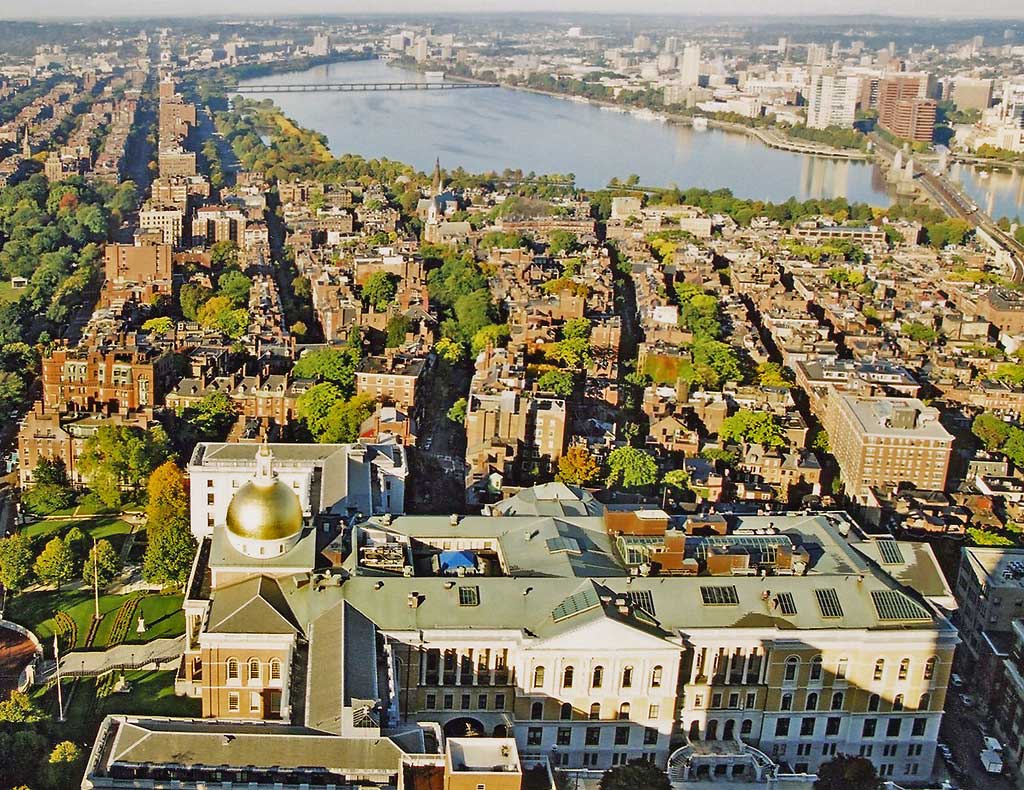
Beacon Hill and the Back Bay. (edinphoto.org.uk)

Beacon Hill and the Back Bay. (edinphoto.org.uk)

So, no, Boston is not “so ugly.” Quite the reverse. It is beautiful for an American city, and for one reason: It has less modern architecture than most American cities, many historic towers of great beauty, and, most of all, it has vast stretches of historic architecture that most American cities do not have. Boston has places such as Beacon Hill and the Back Bay, where modern architecture is almost nonexistent. These are the places where property values are the highest, and where visitors to Boston head almost to the exclusion of every other district, except maybe for the South End, the North End and Jamaica Plain, where modern architecture also very rarely raises its ugly head, or Fenway, if they are Sox fans.

At the Boston Redevelopment Authority, the Boston Civic Design Commission (with its “rock ‘n’ roll acronym”) and the Boston Society of Architects, new traditional architecture is the architecture that dare not speak its name. It has been locked in the closet since World War II. It is no surprise that Slade does not mention it. An architect and now the “articles editor” of the magazine’s Home section, she is a fountain of orthodoxy.

She betrays only one single hint that there might be an alternative to the modernism that she fails to perceive is the problem, the answer to which, especially in Boston, is as plain as the nose on her face.

The closest she comes to mentioning this alternative to modernism is a snide reference to the work of The Architectural Team, a “miserable” firm based in Cambridge and “known for the most stomach-churning kind of suburban ‘town-like’ architecture.” One may safely assume she refers to the firm’s more traditional projects rather than its modernist work. Naturally, she prefers her modernism to be performed by firms that would not deign to have any new traditional work in their portfolios.

Rachel Slade seems unaware that the ugliness she perceives is in fact what she wants to see more of in Boston. The difference between “good” modern architecture and “bad” modern architecture about which she endlessly hyperventilates simply does not exist, not even on its own terms – not to mention the difference between “beautiful” modern architecture and “ugly” modern architecture. She uses the word ugly again and again without once suggesting that its opposite should be a goal of planning and design policy in Boston.

But I think she understands the nature of her confusion, and the reality she continues to deny; she just ain’t sayin’ – it would raise too many predictable and yet, for her, entirely unanswerable questions.

(Top o’ the morning to John Massengale, who posted the article to TradArch yesterday.)

Posted in Architects, Architecture, Art and design, Development, Urbanism and planning | Tagged , , , , | Leave a comment

Naked Times Square, cont.

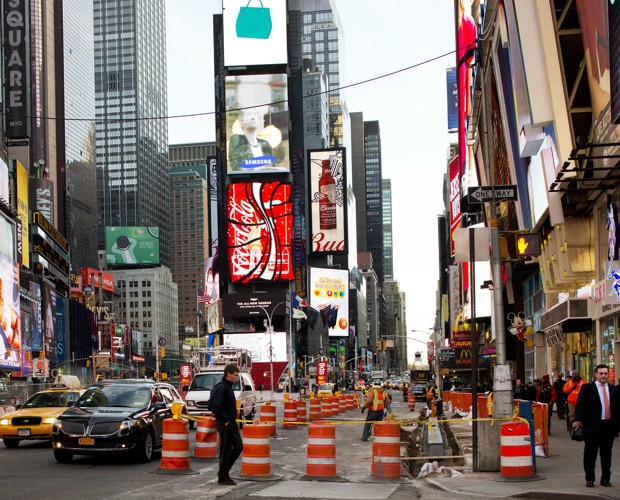
Building flaunts its nudity in Times Square. (Photo by David Brussat)

Paramount Building flaunts its nudity in Times Square. (Photo by David Brussat)

This blog, bloviating before its vacation, wondered whether anyone could tell what is underneath the electronic billboards of Times Square. Close examination suggests that few if any buildings there warrant exposure from billboard removal. The clear fact is that the billboards don’t cover them up enough. Not nearly enough. The one building in Times Square with no billboards is the beauty at the center of the photo above.

The Paramount Building, designed by Rapp & Rapp and completed in 1927, features tan masonry forming a shaft above a four-story base of lighter stone whose arched entry portal rises almost the full four stories of the base. The building steps back in deference to the 1916 law mandating setbacks to let more of the sun’s rays get to the street, and is topped by a massive clock tower surmounted by a globe.

One can only imagine if these buildings could speak what they might say to each other. The Paramount might be accused by its younger neighbors of pride – by not covering itself up with billboards. The Paramount might reply that the billboards fail to obscure the naked embarrassment of their wearers. They may treasure their commercial togs, but they are no more effective than poorly daubed makeup on a woman. Indeed, the Paramount might treasure its neighbors’ billboards even more than they do.

No, we would not have them removed, and it is unlikely that under the new federal highway law they will be removed.

Posted in Architecture, Architecture History, Art and design, Urbanism and planning | Tagged , | 2 Comments

Times Sq. billboards at risk?

Times Square (CityLab)

Times Square (The Atlantic’s CityLab)

Leave it to Kristen Richards and ArchNewsNow.com to post an article relevent to my own personal agenda – in this case, my trip down to New York City on Amtrak, starting in two hours and 26 minutes. That’s when our train leaves Amtrak’s station in Providence. We will be staying at a Hilton just feet to the left of the edge of the picture above.

Read Laura Bliss’s “No, the Feds Are Not Requiring Times Square to Remove Its Billboards” in The Atlantic’s CityLab.

The story posted on ANN describes how new federal transportation legislation puts the famous billboards of Times Square at risk. Not in time to cleanse the view from our hotel, I’m happy to say. Apparently, New York is the only state that has challenged the new law, which designates hundreds of thousands of miles of arterial road (such as Broadway as it plows through Times Square) as federal highway, subject to existing federal law on how many billboards are permitted and how proximate they can be to these highways – with punishments in the amount of 10 percent of whatever federal funds accrue to such highways.

Hey! I’m starting to sound like a federalista myself!

Anyway, it is clear that places whose billboards are a kind of cultural landmark will be able to exempt themselves from the regulations. Typical! Take all those billboards off the buildings of Times Square and what will you have? How can anyone really know? All those buildings have been covered with ads for so long that who knows what horrors (or otherwise) might be underneath.

Warning: Post no bills to this blog these next few days expected. How’s that for federalese?

Posted in Architecture, Development, Urbanism and planning | Tagged , , , , | Leave a comment

Style in words and buildings

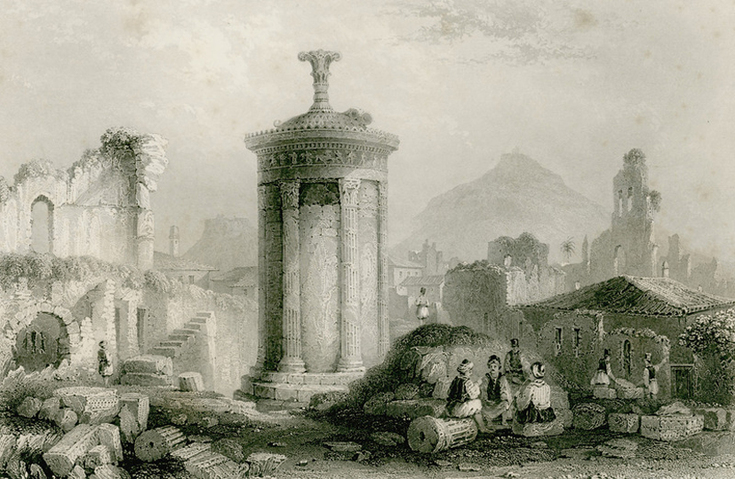
Choragic Monument of Lysicrates, in Athens. It is the symbol of the Driehaus Prize. (athenskey.com)

Choragic Monument of Lysicrates, in Athens. It is the symbol of the Driehaus Prize. (athenskey.com)

Andres Duany in his treatise Heterodoxia Architectonica engages the concept of classicism’s relation to language. Umberto Eco, in his On Literature, engages the concept of language’s relation to style. This blog is about the “style wars” of classicism versus modernism. In that regard, in terms of how the meaning of the concept of style has evolved, a quote from Eco’s essay “On Style” is quite interesting:

[S]peaking of style means discussing how the work of art is made, showing how it gradually emerged (even though sometimes this is only through the purely theoretical progression of a generative process), explaining why it offers itself to a certain type of reception, and how and why it arouses this reception. And, for those who are still interested in pronouncing judgments as to aesthetic value, it is only by identifying, tracking down, and laying bare the supreme workings of style that we are able to say why a given work is beautiful, why it has enjoyed different kinds of reception in the course of time, and why, although it follows models and sometimes even precepts that are scattered far and wide in the sea of intertextuality, it has been able to gather those legacies and make them blossom in such a way as to give life to something original. Only then will we be able to say why, although each of the different works by one artist aspires to an inimitable originality, it is possible to detect the personal style of that artist in each of those works.

What is the difference between originality and novelty? I have often criticized modern architecture for its focus on novelty at the expense of beauty. Originality is the effort to engage creatively within a set of rules, pushing against and even past them, with knowledge aforethought. Novelty is the effort to engage creatively without a set of rules.

Even the most orthodox classicist can barely avoid adopting his own personal approach to designing a building within the rules of classicism. Meanwhile, the modernist architect strives to generate a personal style that will differentiate himself from all other modernist architects. He doesn’t acknowledge the existence of any set of rules that bind him, often not even the laws of nature. In his claim to novelty he may fudge a bit, but his primary goal, unlike the classicist, is to be different rather than to create beauty. The style wars are fated to continue.

Classicism has more style than modernism. Anybody who knows anything about style can understand why. Architects whose sense of how to design includes when to obey the rules and when to disobey them will produce work that can be judged – that is what a stylist wants! The winners of the Pritzker Prize have won an award with little intrinsic value, since modern architecture has no genuine standards by which it may be judged. The winner of the Driehaus Award has demonstrated a tightrope walker’s command of architectural nuance that is worthy of celebration, admiration and emulation. The Pritzker is for celebrities. The Driehaus is for masters.

Posted in Architecture, Architecture Education, Art and design | Tagged , , , , , | Leave a comment

“The People vs. Modernism”

Screenshot of anti-modernist video by Architecture MMXII.

Screenshot of anti-modernist video by Architecture MMXII.

Malcolm Millais has sent me another video, this one entitled “The People vs. Modernism.” What a glorious compiliation! Beneath a score of ominous music selected from the depths of the minor key, its creators, who refer to themselves as ArchitectureMMXII, offer shot after shot of news and opinion clips, mostly from online, to convey the clear fact that the public does not like modern architecture. Especially notable is a thread of clips mounting up statistical evidence from polling data that confirm modernism’s astonishing dearth of popularity. For bonus points see if you can pick out an old shot of a clip from this blog, Architecture Here and There, when it was associated with my former employer, The Providence Journal.

Screenshot of Architecture Here and There blog. (Subscribe for free at right!)

Screenshot of Architecture Here and There blog. (Subscribe for free at right!)

Posted in Architecture, Architecture Education, Architecture History, Art and design, Urbanism and planning, Video | Tagged , , , , , , | Leave a comment

Preservation hits the bottom

190 Bowery St. with newly protected graffiti. (New York YIMBY)

190 Bowery St. with newly protected graffiti. (New York YIMBY)

The New York Landmarks Preservation Commission has almost hit rock bottom. It has approved a restoration project that preserves a building – and its graffiti. The website New York YIMBY reports the ruling in “Landmarks Approves Restoration and Conversion of 190 Bowery With Graffiti.” Darn low, but not rock bottom.

From the architect's plan to restore the facade.

From the architect’s plan to restore the facade. “Shh! Don’t mention the graffiti.” … Never mind.

Rock bottom would have entailed barring the restoration project unless the graffiti were also preserved. But there is a preservation architect even more idiotic than the commission itself. He is called Jørgen Cleemann, of Higgens Quasebarth & Partners, assisted by MdeAS Architects.

Excuse me. I am being daft. The real idiot here is Aby Rosen of RFR Realty. He is the client. Even if the idea of retaining the graffiti was Cleemann’s, as one must suspect, Rosen is responsible. YIMBY does not report whether tenants for the office space have been found, but apparently a first-floor tenant remains to be found. Good luck with that!

It is long past the day when adult behavior can be expected from boards and commissions charged with overseeing decisions from within the very broad realm of design. In this case, it seems that the entire commission was just bully about “saving” the graffiti.

Commissioner Frederick Bland called 190 Bowery an “extraordinary building” and applauded the “gentleness” of the proposal. He praised retention of the graffiti as an “interesting show of art.” Commissioner Diana Chapin called the proposal “very sensitive.” Commissioner Michael Goldblum said the building would be a “jewel box” and called the proposal “fantastic,” adding that it will be a “real testament to the layering that preservationists seek.”

Especially droll was Goldblum’s applause for the “layering.” He refers to the idea that, say, if the owner of a 18th century Colonial adds a Beaux Arts canopy above the entry to his house, and subsequent owner in the 21st century wants to restore it to its original 18th century appearance by removing the canopy, a “politically correct” landmarks commission might turn down the application on the grounds that “history” of the house – its layer-by-layer evolution through “periods” – must be respected.

Thus, in the case of 190 Bowery, the commission was able to approve the retention of graffiti – a literal attack of vandalism against the building – as part of its history. Reductio ad absurdum run wild!

Graffiti that tags beautiful buildings such as 190 Bowery is more than vandalism. It is censorship. In this case, authority has privileged one work of art over another, and a grafarttist over an architect at that.

Take a bow, Jørgen Cleemann!

No dissenting voices were reported by Evan Bindelglass, the who wrote the piece for New York YIMBY. It apparently stands for “Yes In My Back Yard.” Cute! Perhaps the neighbors remain advocates of NIMBYism regarding this extremely vexing proposal, but who the heck are the neighbors anyway?

What’s next? The retention of that recent pile of doggy dung? An addition every bit as significant as any other! Wouldn’t want to obliterate the historic fragrance! Don’t laugh. The commission has already passed beneath that demarcation. Idiots who own buildings must be lining up around the block.

Posted in Architecture, Architecture History, Development, Humor, Preservation | Tagged , , , , , | 9 Comments

Why is modern art so bad?

Screen shot of opening of

Screen shot of opening of “Why Is Modern Art So Bad.” Click on link, not here, to see You Tube video.

Malcolm Millais, author of Exploding the Myths of Modern Architecture and an upcoming book correcting the record on Le Corbusier, sent me a video of an artist, Robert Florczak, at Prager University, explaining the erosion of standards in the art world over the past century. Little of “Why is Modern Art So Bad?” was new to me but it was expressed with such force and clarity, and raises such obvious, if unstated, parallels with the world of architecture, that I could not resist putting it up on my blog. In the end, Florczak reveals that the white background of the sound studio he was in was not that at all, but a painting by Robert Rauschenberg. Better still was his assignment for students to analyze a Jackson Pollack painting. Priceless!

Posted in Architecture, Art and design, Humor, Video | Tagged , , , , , , , | 5 Comments

The Fountainhead of Youth

2010-02-21-the-fountainhead

[Click to enlarge]

Padriac Steinschneider, honcho of the New York chapter of the Congress of the New Urbanism, was as miffed as I was by the reflections of the Dallas Morning News architecture critic Mark Lamster on the CNU proceedings at Dallas last week. Lamster is one of those whose pretense to even-handedness on the style issues roiling CNU arises from their willingness to concede that traditional architecture is great – so long as it is 100 years old. To put all that angst in perfect context, here’s a brief quote from Paddy’s email criticizing Lamster’s calumniation:

A couple of years ago at the [CNU] congress in West Palm, [architect] Stefanos [Polyzoides] nailed the problem with the profession of architecture when he drew the parallel that an architect who makes the world a more difficult place to live in by designing buildings that demonstrate the anxiety of our times is the equivalent of a doctor who practices by spreading instead of curing disease.

And here is a lengthy quote from Paddy’s email, riffing off Ayn Rand’s The Fountainhead, published in 1943. Howard Roark was an independent-minded architect, Peter Keating was the sort of orthodox classicist that Andres Duany thinks almost all of today’s classicists are, and Ellsworth Toohey was an architecture critic in Rand’s bestselling novel.

Last week in our discussions about style and what is wrong with the profession, there were several discussions about the academies and how they teach the process of architecture. I made a statement that the first problem that seems prevalent in most schools today is that they are trying to teach to the Howard Roarks, which constitute a minute percentage of their students, instead of the Peter Keatings who fill the chairs in the studios. The reality is that the Roarks do not need the encouragement to seek excellence. By being a Roark, they will find their own way. But the Keatings, without an educational program that teaches the skills that they will be asked to use when they graduate and get hired to be part of a team in an office, end up spending a lot of money for no real gain. …

Reading Lamster’s article “Why is So Much Architecture Junk,” I suddenly became aware of who he really is in this confusion of Roarks and Keatings. Ladies and gentleman, let me introduce you to Ellsworth Toohey. Like a hamster on a squeaky wheel, Lamster’s prose creates an irritating noise, which demands a certain attention, since it is hard to ignore, but in the end just adds to the cacophony. I read the article hoping that I would come to a suggestion that could lead to a better place with the hope of less junk, but, like Toohey, who disdained the common man, while he whipped them into a frenzy, Lamster suggests that, in the end, it is the fault of the general public. Like Big Daddy, I smell the powerful odor of mendacity. And like Big Momma reminded us of what Big Daddy liked to say, I say “bullshit.”

Excellent stuff. Here’s my column from 1993, the 50th anniversary of the book, with my own take on Roark, Keating and Ellsworth about two years after I started writing about architecture. And here is my old column:

The end of modern architecture July 22, 1993   MY QUEST to discover the roots of anger in the world of modern architecture took me, recently, to The Fountainhead, the novel by Ayn Rand published 50 years ago. It is a philosophical story pitting “the man” against “the masses,” but since protagonist Howard Roark is an architect whose unconventional work alarms the traditionalists in his profession, it is also about architecture, modern architecture in particular.

The book reinforced the belief of a generation of Americans that modern architecture represented a courageous rejection of hidebound tradition. “The Fountainhead is the message that shaped the late modernism of the 20th Century,” says architecture critic and Yale Prof. Vincent Scully. “I read it as I was getting out of the service in 1946. I would read 10 pages and want to throw it against the wall.”

Maybe he destroyed his edition before reaching the passage – on page 474 in my 695-page Signet paperback – where it becomes clear that Rand was, after all, no fan of modern architecture. “Ellsworth Toohey came out in support of the cause of modern architecture,” she writes on page 474. Art critic Toohey uses his column in The New York Banner to fight individualism. For Rand, Toohey represents organized mediocrity, the enemy of excellence. His endorsement of modern architecture is properly understood as her rejection of it.

She explains: “A new school of building had been growing for a long time: it consisted of putting up four walls and a flat top over them, with a few openings. This was called new architecture. The freedom from arbitrary rules, for which Roark’s mentor Cameron had fought, the freedom that imposed a great new responsibility on the creative builder, became a mere elimination of all effort, even the effort of mastering historical styles. It became a rigid set of new rules … a new Parthenon, an easier Parthenon in the shape of a packing crate of glass and concrete.”

Roark represents neither modern nor classical architecture. How could he? He is the Individualist.

If Ayn Rand were writing her book today, however, she might make Roark an architect striving to work in the classical tradition, seeking to revive the lost art of beauty in building design. Her villains would be the hidebound modernists who purged architecture of its traditions, and ever since have duped and terrified clients into accepting buildings whose design they loathe.

This, in fact, is what has happened in American architecture since Rand published The Fountainhead in 1943.

Tom Wolfe describes it well in From Bauhaus to Our House (1981). “After 1945 our plutocrats, bureaucrats, board chairmen, CEO’s, commissioners, and college presidents undergo an inexplicable change. They become diffident and reticent. All at once they are willing to accept that glass of ice water in the face, that bracing slap across the mouth, that reprimand for the fat on one’s bourgeois soul known as modern architecture. And why? They can’t tell you. They look up at the barefaced buildings they have bought, those great hulking structures they hate so thoroughly, and they can’t figure it out themselves. It makes their heads hurt.”

Wolfe explains that, like socialists, modern architects played on guilt in the quest for power. They claimed to struggle for “the workers” against the bourgeoise, plain “worker housing” against the rich architecture of capitalism. Americans, ever awash in feelings of guilt, swallowed it in architecture as in politics.

Fortunately, the watered-down socialism of the New Deal and the Great Society, although equally bogus, was never quite as destructive as the 80-proof stuff in the Soviet Union. In The Fountainhead, the concern of the liberal elite for the masses is exposed as bogus and destructive, intentionally so.

Toohey again delivers the message. On the page before he embraces modern architecture, he engineers the success of a bad play – not just to gratify his ego but to undermine society’s ability to distinguish quality from trash. This is key to his plan to empower the masses, with himself as first of equals. But the Banner folds and he is out of a job.

For modern architecture, too, the jig is up. Postmodernism is less a reaction against modernism than a rear guard fighting to save it. But a rearguard action is nevertheless a retreat, and modern architects can read the writing on the wall. It makes their heads hurt, because they understand it all too well.

It remains only for classical architecture to stage its comeback.

[An earlier version of this post had Mark Lamster speaking at a session called “Is CNU Burning?” He actually spoke at the panel on “How to Rebuild Architecture.”]

Posted in Architects, Architecture Education, Architecture History, Books and Culture | Tagged , , , , , , | Leave a comment

My 15 minutes of fame!

Rendering of new entry to T station at Government Center, Boston. (courtesy MBTA)

Rendering of new entry to T station at Government Center, Boston. (courtesy MBTA)

James Howard Kunstler, coiner of the word “crudscape,” author of great books from The Geography of Nowhere to World Built By Hand to The Long Emergency, lecturer extraordinaire, has picked up my denunciation of the new T entry at Government Center (snuck to me by my agent in Boston’s deep infrastructure). Since I have revered Jim’s “Eyesore of the Month” for years, maybe even decades, it is a signal honor to be cited. But I owe it all to Agent 54, who dug up the information and passed it to me in the form of a dangerous tape that exploded in flames after I had finished listening to it (and without warning!). I emerged with no worse than singed eyebrows. I forgot to go see the eyesore last I was in Boston. Next time. Or maybe I’ll forget again. Who knows. The thing is eminently forgettable.

Posted in Architecture, Development, Urbanism and planning | Tagged , , , , , , , | 2 Comments