House of (52,000) Cards

Screen shot of CBS Evening News segment on Brian Berg's houses of cards.

Screen shot of CBS Evening News segment on Bryan Berg’s houses of cards.

Here’s something from CBS Evening News involving architecture – a Harvard grad named Bryan Berg who builds houses of cards. He may not have (as he admits) a full deck but he certainly uses more than one of them to create his masterpieces. He does his card tricks for casinos, Disney, anyone who will pay, around the world – and he says it adds up to more than he would make as a real architect. And, he says, if a wing of his architecture falls down he doesn’t get sued. Furthermore, knocking them down is fun and that’s what he does when he’s done putting them up. And let us add that, based on CBS’s video of what he builds in the medium of cards, his work is superior to what he was taught at Harvard’s GSD, Graduate School of Design.

Good for him. Here he is:

Posted in Architecture, Art and design, Development, Humor, Video | Tagged , , , , , , , , , | Leave a comment

Costly design in Pyongyang

Kim Jong Un at site of new Pyongyang airport terminal. (DPRK official website)

Kim Jong Un at site of new Pyongyang airport terminal. (DPRK official website)

It appears that the architect of Terminal 2 of North Korea’s international airport, Ma Won Chun, was executed because the Dear Leader failed to appreciate the design. This according to “Kim Jong Un EXECUTES airport architect because he did not like the design,” by Steve White in the Mirror.

The other day Kim and his wife toured the new facility, expected to open this week. Not many people probably noticed the absence of the architect from Kim’s entourage. Ma was executed last November as part of a larger purge for “corrupt practices and failure to follow orders.” Here is a statement that contains Kim’s indictment of the design:

“Defects were manifested in the last phase of the construction of the Terminal 2 because the designers failed to bear in mind the party’s idea of architectural beauty that is the life and soul and core in architecture to preserve the character and national identity,” Kim said, according to NKNews’ transcript of a state media report.

This is not especially chilling only because it is North Korea. Who knows why the guy really had to hang at the end of a rope (or got a bullet in the base of the neck)? It is not the way architects, not even celebrity modernists, usually die in civilized nations.

Imagine if architects here could be executed for “failing to bear in mind the party’s idea of architectural beauty.” Who would “the party” be? The AIA?

In most countries, including America, architects would be at wit’s end to figure out how to avoid execution. They would have to rely on the ability of the “jury” to look deeply into the architect’s ego and measure his zeal to reach the apogee of novelty, rather than judging him according to some culturally determined and generally explicable set of design rules. Pity his lawyer! Figuring out a useful defense strategy for a modernist would be no easier than trying to figure out a rationale for the latest Pritzker Prize selection.

So, while most Americans would probably draw their fingers across their necks to signal their assignment of fate to the architects of their built environment, let us hope it never comes to pass literally, as it seems to have done in Pyongyang.

Posted in Architects, Architecture, Architecture Education, Art and design, Development, Humor | Tagged , , , , , , , , | 6 Comments

Cellini: Pearls before duchess

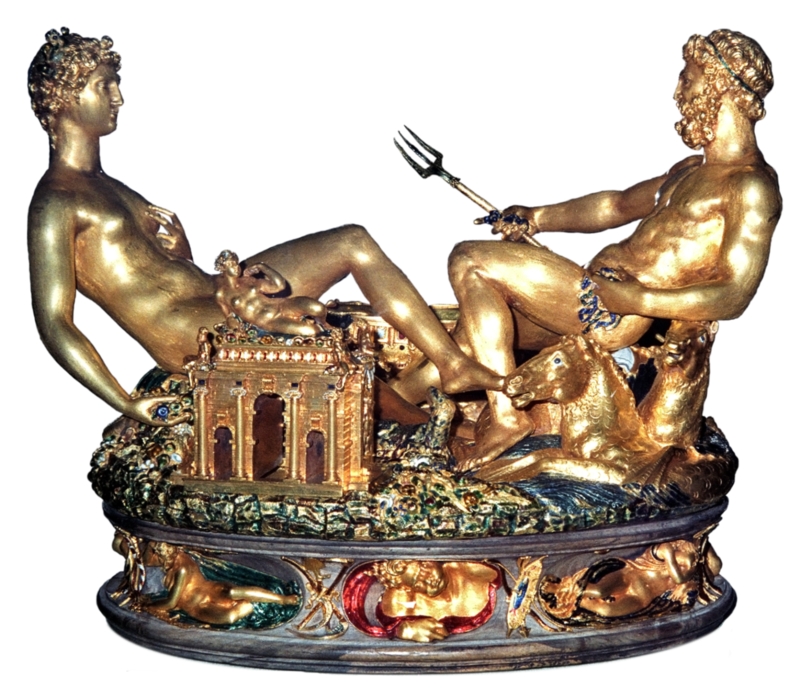
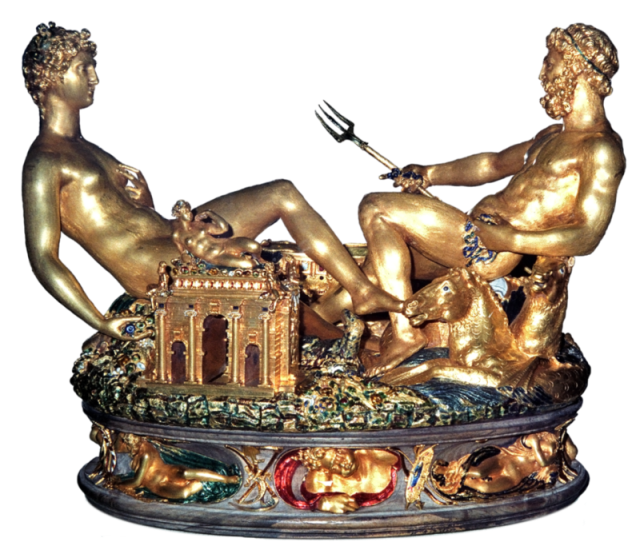
Saltcellar by Cellini done for King Francis I of France. (wikipedia.com)

Saltcellar by Cellini done for King Francis I of France. (wikipedia.com)

In the Autobiography of Benvenuto Cellini (1500-1572) he discusses fighting and money a lot. Designing the settings for jewelry – his craft as a goldsmith and sometime sculptor – is the topic to which, after fighting and money, he has the most recourse. As I read I sought passages to print for readers that best described his artistic methods, but was disappointed to find that most such passages were more in the style of (as regarding the saltceller pictured above) well, I put these four horses that look mostly like fish under the seated Neptune, across from whom is a woman whose right hand I rested upon a small temple. More what he did, which we can see, than why he did it.

There is a good stretch about casting the head of his famous Perseus (who is holding up the severed head of Medusa) but it is largely technical – I would recommend it, though, but haven’t the patience to actually transcribe it as I am about to do with Cellini’s description of lying to the Duke of Ferrara about a pearl necklace the duchess wants him to buy for her. It has some interesting description of the physicality of (flawed) pearls, but the passage is of interest more for illustrating the character of Cellini and his powerful ability to bend his words to get out of a tight spot:

[The duchess of Ferrera] watched us work for a while, and then very graciously turned to me and showed me a string of large and really very rare pearls. When she asked me for my opinion I said it was very beautiful. At this her Most Illustrious Excellency said to me: “I want the Duke to buy it for me, so my dear Benvenuto, praise it to the Duke as highly as you are capable of doing.”

When I heard what she wanted, as respectfully as I could I spoke my mind to the Duchess. “My lady,” I said, “I was under the impression that this pearl necklace belonged to your Excellency, and so it would not have been right for me to say what now, knowing that it doesn’t belong to you, I am bound to say. I must confess, your Excellency, that from my intimate knowledge of these things I can perceive very many defects in these pearls, and for that reason I would never advice your Excellency to buy them.”

At this she said: “The merchant is offering them to me for six thousand crowns, and if it weren’t for these little defects they’d be worth more than twelve thousand.”

In answer to this I said that even if the necklace were absolutely flawless I would never advise anyone to pay as much as five thousand crowns; for pearls are not jewels, they are fishes’ bones, and they suffer with time, but diamonds and rubies and emeralds do not grow old, any more than sapphires: all those are jewels, I said, and it was advisable to buy them.

The Duchess was somewhat annoyed at this, and she went on: “But I want these pearls, and so I beg you to take them to the Duke and praise them as highly as you possibly can, and although you may have to tell one or two little lies, do so for me and it will be well worth your while.”

Readers are free to imagine that the duchess is not so enamored of the pearls as she attests but is for some reason obligated to do a favor for whomever is angling to sell them to her. Anyhow, “lover of the truth and a hater of lies” though he claims to be, Cellini takes “those damned pearls” to the duke, who does not want to buy them.

“Pardon me, my lord,” I said, “these pearls are infinitely finer than any pearls ever assembled on a necklace before.” …

Then having begun to tell lies I followed them up with others, even more boldly, and made them as plausible as I could to make the Duke believe me, relying on the Duchess to come to my help when I needed her. If the bargain were concluded more than two hundred crowns would fall to me – the Duchess had said as much. …

The Duke – very graciously – began to address me again, saying: “I know that you’re expert on these matters, and so if you’re the honest man I’ve always taken you for tell me the truth now.”

So then, blushing and with my eyes rather moist from tears, I said: “My lord, if I tell your Excellency the truth the Duchess will become my deadliest enemy; and as a result I’ll be forced to move away from Florence and my enemies will at once attack me on the score of my Perseus, which I’ve promised to your Excellency’s noble school of artists: so I beg your Excellency to protect me.” …

“Everything you say will be kept under lock and key.”

At these noble words I immediately told him the truth as to my opinion concerning the pearls and I said that they were not worth much more than two thousand crowns.

[The duchess then joined them] and said: “My lord, I hope your Excellency will be kind enough to buy me that string of pearls, because I am very anxious to have them, and your Benvenuto says that he has never seen any more beautiful.”

Then the Duke said: “I don’t want to buy them.”

“But, my lord, why does your Excellency not want to please me by buying the necklace?”

“Because it does not please me to throw money away.”

The Duchess insisted: “But oh, what do you mean by ‘throw money away,’ when your Benvenuto, who so much deserves the trust you put in him, has told me it would be a good bargain even if it cost more than three thousand crowns?”

At this the Duke said: “Madam, my Benvenuto has told me that I would be throwing my money away if I bought it, since the pearls are neither round nor even, and many of them are old. And to prove it, look at this one, and that, and look here and here. No, they’re not for me.”

As he said this, the Duchess shot a malevolent look at me, and with a menacing nod of her head left us to ourselves.

In a book suffused with flying fists, daggers, swords and over-the-top braggadocio, this may be one of its most psychologically violent passages.

The excellent translation, published by Penguin, is by George Bull. Cellini’s autobiography is one of the most graphic illustrations of the life of the Renaissance, not just in its fawning supplications to one’s inferiors (who nevertheless outrank a mere master artist like Cellini), but in every other aspect of life lived without the conveniences we take for granted. But, much like James Howard Kunstler’s novel World Made by Hand, it suggests that there is much to be said for a simpler life. Not that Cellini’s life was simple – not in the least as his autobiography shows, even if it is taken with enough grains of salt to fill the vessel on the other side of Neptune’s legs, which is meant to hold salt, as the small temple is meant to hold pepper.

The saltcellar is in the Mannerist style and is the only item of his work as a goldsmith that survives. His statue of Perseus holding the head of Medusa, in Florence, is much more widely seen and celebrated.

Posted in Art and design, Books and Culture, Humor, Other countries | Tagged , , , , , , , , | 1 Comment

Helsinki Gugg goes glug glug

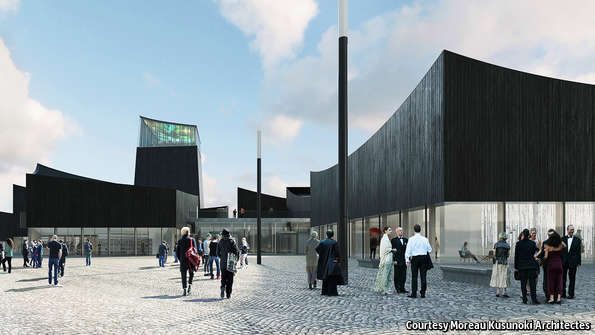
The winning entry from the Guggenheim Helsinki competition. (WSJ)

The winning entry from the Guggenheim Helsinki competition. (Moreau Kusunoki Architectes)

After all that jumping up and down, with 1,715 entries from around the world, the competition to design Guggenheim Helsinki has coughed up a winner, by Paris-based Moreau Kusunoki Architectes, of decidedly modest design, “an indistinct jumble of pavilions faced in charred wood.” Here is rest of The Economist’s assessment, called “Lacking Spark.” No writer is credited but it is James S. Russell, who inscribes criticism for its Books and Arts section. He writes:

The design, announced on June 23rd, is as quietly deferential as Frank Gehry’s Bilbao design is self-consciously flamboyant. … It is extraordinary that a design that triumphed over 1,700 competitors should turn out to be rather ordinary. It is respectful, yet teases out no identity unique to Helsinki. Moreau Kusunoki makes nothing of the waterfront site (in contrast to the much-loved Oslo Opera House, where the alluringly warped roof dips into the sea). The design considers no new way to look at art that would make it a must-visit.

Decidedly modest? Certainly. But no, it is not deferential, let alone respectful. Modern architecture does not try to be respectful and is not supposed to be respectful. Guggenheim Bilbao was not respectful. Russell says the “Guggenheim Bilbao transformed yet belongs.” It does not belong. It is there, and its success is hard to deny. Because millions of modernists – architects, artists, wannabes – have gone to pay homage, the citizens of Bilbao have decided to accept the boon of jobs and revenue to their long-depressed economy.

This boon has not proved replicable. Referring to city officials’ arguments to counter public skepticism of the Gugg’s plan for Helsinki, Russell writes:

These include the shopworn “Bilbao effect,” but efforts to replicate the Bilbao magic have foundered, from Guadalajara to Rio de Janeiro and Salzburg to Vilnius. Branches have closed in New York, Berlin and Las Vegas. Even Bilbao’s remarkable catalytic effect occurred in the context of a massive planning and infrastructure overhaul of the entire city.

Be that as it may, I wonder why any city would want to build a new civic structure composed of wood blackened by fire. Isn’t that tempting fate?

Posted in Architects, Architecture, Art and design, Development, Other countries, Urbanism and planning | Tagged , , , , | 4 Comments

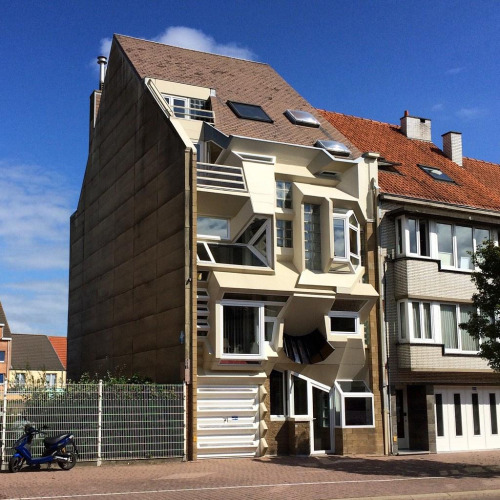
Ugly Belgian House blog!

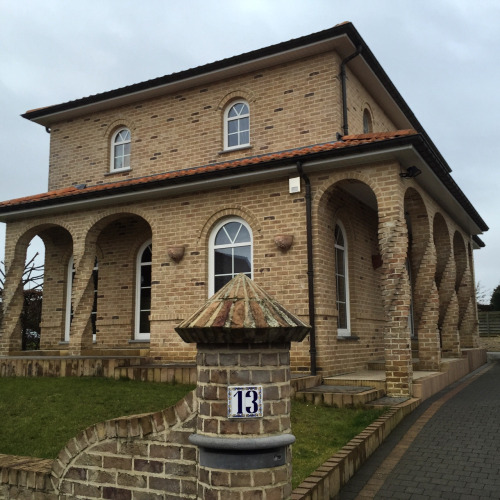
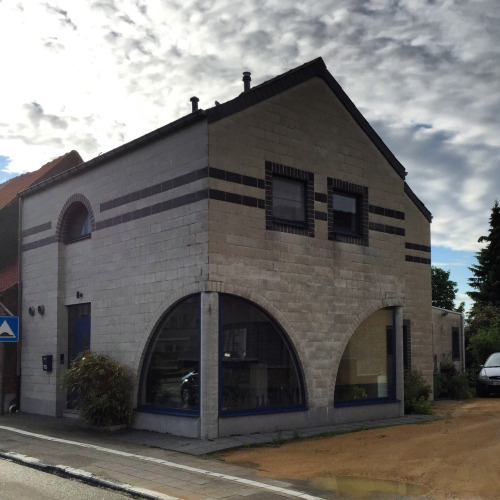
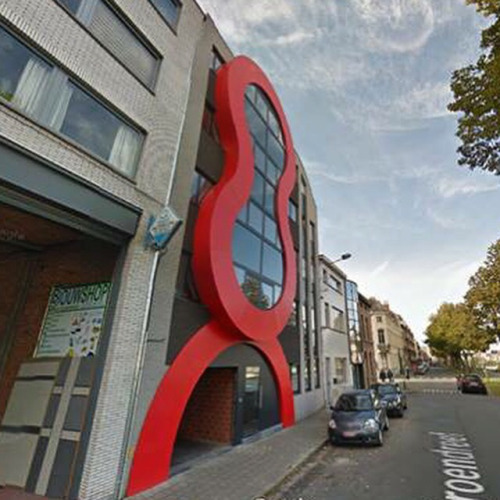
tumblr_nqgn5mYt911qm24ado1_500 tumblr_npbgj5l9SZ1qm24ado1_500tumblr_njbakzMi4P1qm24ado1_5007771176 tumblr_noyqls6XNb1qm24ado1_500 tumblr_nc6z1x3GMI1qm24ado1_500 tumblr_nqep61y8hm1qm24ado1_500 tumblr_nqba9v7rGu1qm24ado1_500 tumblr_nnfj0pSabN1qm24ado1_500I just spent some good quality time with the Ugly Belgian Houses blog. Its originator, who self-identifies only as “@hannes_BHC,” has only this to say to explain the blog: “Because most Belgian houses suck. Even mine. Seriously. My English sucks too. But i kinda like that. Fuckers.” It is all in caps, which is obscene and I refuse to post it that way. Go to his (I assume “Hannes” is a he) “About” page and here is what he says in its entirety:

Project by @hannes_bhc. If you want me to delete your house from my site, just mail me at uglybelgianhouses @gmail.com. No need for angry lawyer mails. They cost too much fucking money. If I can use your house in my book, let me know. You should also check my project #likemyride.

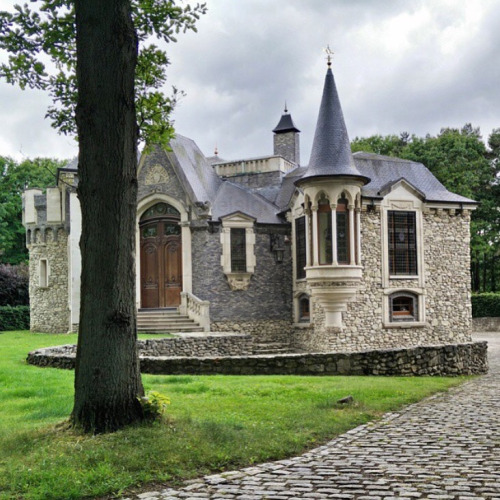
Well, his blog is a damn fine ride. The top photo at left was the latest on the site. The caption is “Batman returns. As an Ugly Belgian House.” All of them have wonderful captions. And his eye for the ugly is remarkable. Not that modern architecture has not made the “game” of finding the ugliest houses remarkably easy. Almost all modernist houses are ugly. And not that Hannes’s taste is incapable of fawlty radar.

About 95 percent of his targets are modernist but about five percent are what many very erudite classicists might call “bad trad” but which I consider experimental or, to twit my boss Andres Duany (I’m editing his treatise), “heterodox.” That is, they stray from a degree of correctness that many classicists demand in design, or even from the good manners upon which most classicism prides itself.

But I agree with someone named “awarmlight” who posted with regard to the first “bad trad” house to the left, “I would totally live there!” Hannes’s caption for that house was “Found another chateau … um, shitteau!” C’mon, Hannes! This is not an ugly house!

Trolling through the extensive archives of Ugly Belgian Houses, I’d have to admit that modern architecture offers a very large opportunity for creativity. But it is a degraded sort of creativity that does not even reach for beauty. Of course, beauty is looked down upon by modernists as some sort of bourgeois conceit that was finally jettisoned by modernism. In fact, Hannes’s captions are a very elegant example of what I have called the “derisive moniker.” I should add that his English is very capable. He selects the sort of silly simile by which most of the public targets most modern architecture, not just houses.

Hannes’s “bad trad” houses have many of the traits of good architecture: high style, proportion, symmetry (or not, if hetero), natural materials and many other aspects of good traditional houses. Those in his archive that qualify as “bad trad” are clearly head and shoulders above the “bad mod” of their archived colleagues. Am I suggesting that there are modern houses that aren’t ugly enough to make it onto this blog? I don’t say there are not. Maybe there are.

By the very nature of modern architecture, which unlike tradition requires genius, there cannot be many. Beautiful modernism is rare, very rare, precisely because modernism has abandoned almost all the tools architects used throughout most of history to achieve the qualities of firmitas, utilitas and venustas. Vitruvius’s words mean what you think they mean. Classicists look back through the history of architecture to find the best ways to achieve those goals in every building they design. Funny! They think that’s their job!

That’s why when people have a choice, as they do far more often about where they live, they generally seek to live in a traditional house, whether old or new.

By the way, I have only been through Belgium on a train, but I hope Hannes overstates the case when he says most Belgian houses are this ugly. But if they are, then the world may at least thank Hannes for sharing them with the world’s funny bone.

Posted in Architecture, Development, Humor, Other countries, Urbanism and planning | Tagged , , , , , | 4 Comments

A Pritzker for Graves?

Denver Central Library, by Michael Graves. (Michael Graves)

Denver Central Library, by Michael Graves. (Michael Graves)

A curious piece in ArchDaily.com wonders “Why Michael Graves Should Have Won the Pritzker.” After reading it I felt so whipsawed back and forth that I had to read it again to see if it really said what I thought it did. And even then I was not sure.

Roofing at Munich Olympics of 1972, by Frei Otto. (Atelier Frei Otto Warmbronn)

Roofing at Munich Olympics of 1972, by Frei Otto. (Atelier Frei Otto Warmbronn)

Portland Municipal Center, by Graves. (Flickr user camknows)

Portland Municipal Center, by Graves. (Flickr user camknows)

Dolphin Resort at Disney World, by Graves. (James Cornetet - critiquethis.us)

Dolphin Resort at Disney World, by Graves. (James Cornetet – critiquethis.us)

St. Colletta School, by Graves. (Michael Graves)

St. Colletta School, by Graves. (Michael Graves)

Noting at the outset that Michael Graves and this year’s Pritzker winner Frei Otto, of Germany, died the same week in March, Lachlan Anderson-Frank, a communications specialist at the modernist firm of MVRDV in Rotterdam, asserts that Graves deserved the Pritzker more than Otto. Anderson-Frank is surely correct that Graves’s legacy knocks that of Otto, if he may be said to have one, into a cocked hat. On this basis A-F would have given Graves a Pritzker. And I cannot say that I disagree with him.

A-F describes Graves’s work as typical of the ugliness that has come to pervade architecture. He writes:

Ugly buildings, like those of Michael Graves, are everywhere (see Hans Coudenys’ Ugly Belgian Houses blog, for example). They’re an inevitable, cultural effect of people’s desire to be different. The philosophy of self-determination embodied by “ugly architecture” only became mainstream in pop culture in the 1970s and ’80s, precisely when Graves’ work was most appreciated.

The idea that people desire to be different is ridiculous. A few people do; most people do not. And the insane persistence of ugliness in architecture should be blamed not on “people” in general but on a cultural elite that dictates an aesthetic that most people abhor. Be that as it may, A-F continues:

It’s the way in which Michael Graves’ style of ugly picked up on a wider political, philosophical and cultural trend of “being different,” in reaction to classic modernism, for which he should be commemorated, and for which he deserved the Pritzker Prize.

But instead, as a sort of cosmic joke that embodies the Pritzker, Graves’s legacy did win big-time recognition: he won the Driehaus Prize in 2012.

A-F does not mention that fact until the end of his essay, almost offhandedly, as if he learned of it after finishing it but before sending it in. The Richard Driehaus Prize is for classicists, which is why many classicists were dismayed, or at least confused, by its bestowal on Graves. He is not a classicist but a postmodernist. His buildings are, at best, cartoons of the classical. When asked, he refused to agree that he was a classicist.

Graves’s Driehaus came not long after the Institute of Classical Architecture & Art held a splashy conference on postmodernism in New York. Arguably, that conference made sense because the postmodernist moment (the 1970s and ’80s) liberated classicism. As an attack (in the end a failed, half-hearted attack) on orthodox modernism, postmodernism opened a small crack for the emergence of work by architects interested in a genuine classical revival. After criticizing their elders, the postmodernists skedaddled back into the modernist camp, having failed to back up their criticism by abandoning the aesthetic they had denounced. In actual design terms, their revolt amounted to an anemic plopping of arches and columns on the same old glass box.

The postmodernists’ pusillanimity and the subsequent resurgence of an even more perverse modernism may actually have blocked what might have been a more powerful classical revival, which today grows in strength but makes perilously little headway against the modernist behemoth.

Yet Graves did not represent a classical reaction against the modernism of Corbusier, Mies and other authoritarians who by the 1950s replaced tradition with modernism in the profession. And his work was never popular among the public, which by now rolls its eyes at the inevitability of what A-F considers ugliness in architecture.

Anyway, ugly is the wrong word for his work. A better word would be silly. Graves’s buildings could only be popular among children, or adults whose full aesthetic development was achieved prior to adolescence.

That Michael Graves did not get the prize he most deserved is a very minor tragedy. The Pritzker Prize is a joke on the world in the same way that modern architecture is an attack on the world. The former aims to supply a bogus credibility to the creaky legitimacy of the latter. Alas, after all these years, it still seems to be working.

(Tip of the hat to Gary Brewer, of RAMSA, who helped arrange the ICAA postmodernism conference and sent Lachlan Anderson-Frank’s piece to the TradArch list.)

Posted in Architects, Architecture, Art and design | Tagged , , , , , , , | 1 Comment

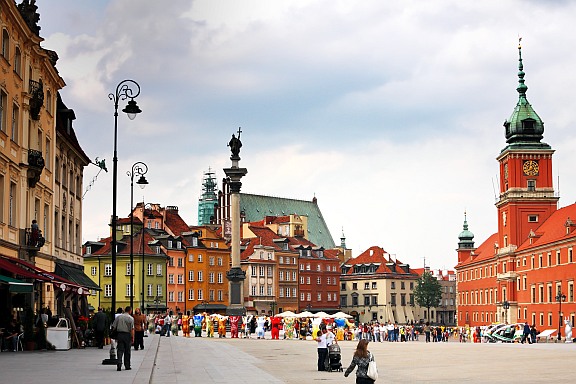
Klaustoon: Pimp my Warsaw

“Pimp My Warsaw” (cartoon by Klaus)

Old Warsaw. (europeantours.eu

Old Warsaw. (europeantours.eu

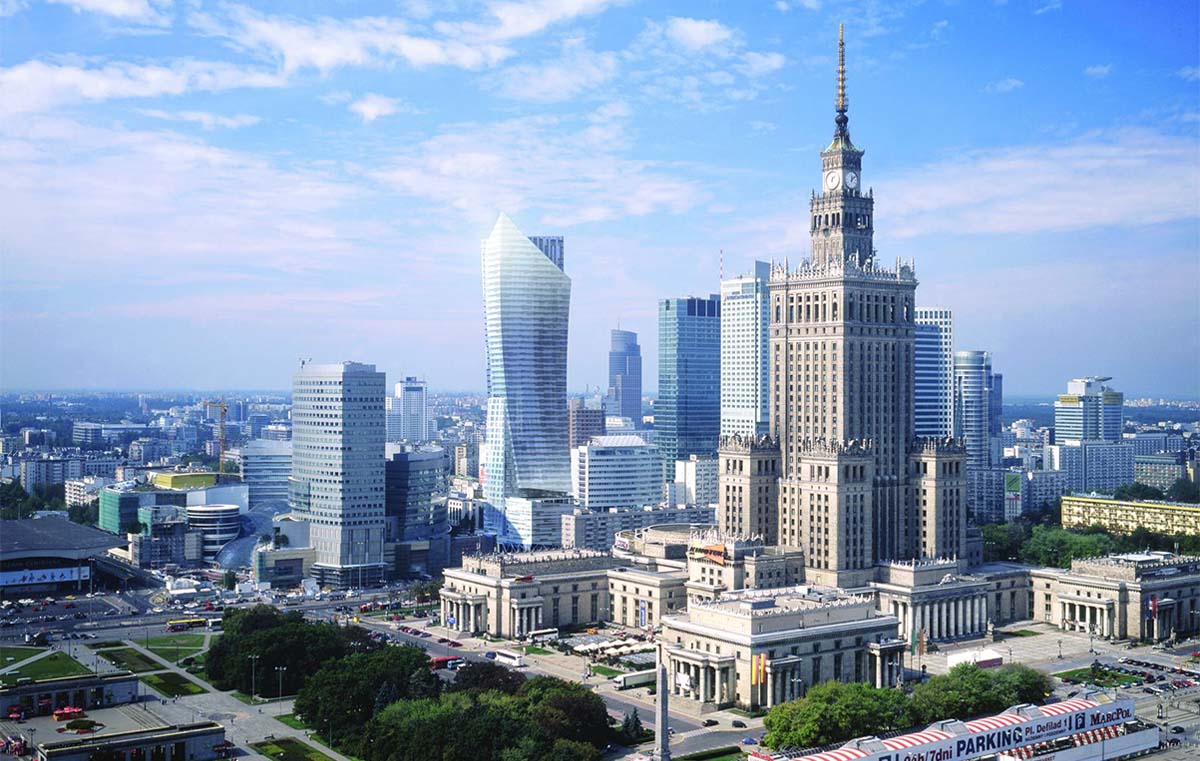
Warsaw today. (regent-holidays.co.uk)

Warsaw today. (regent-holidays.co.uk)

It looks like Warsaw, which during Poland’s communist era restored the beauty of central Warsaw after the wreckage left by the Nazis, is selling itself the rope with which to hang itself. Is this what Poland jettisoned communism for? At least Stalin gifted Warsaw the elegant tower that looks, in its massing at least, like Providence’s Industrial Trust (“Superman”) Building.

While obviously they are two different things, I am of Prince Charles’s view – expressed with regard to London – that Poland’s architects are trying to match the accomplishments of the SS and the Wehrmacht. Warsaw’s modernists and capitalists (often the same these days) are willing to destroy the city on behalf of their bottom lines. Is this the free market?

I don’t think so. It’s the free market kidnapped by pirates. Poland is now a democracy, though, so in some degree it owns the situation it has permitted.

The Klaustoon “Pimp My Warsaw” says it all. (Click to enlarge.)

Posted in Architecture, Architecture History, Development, Humor, Other countries, Urbanism and planning | Tagged , , , , , , | 7 Comments

“Now that’s resiliency!”

Michael Mehaffy's photo of the Cathedral of Christ the Savior, in Moscow.

Michael Mehaffy’s photo of the Cathedral of Christ the Savior, in Moscow.

Demolition of church in 1931. (Wikipedia)

Demolition of church in 1931. (Wikipedia)

Michael Mehaffy, an architectural theorist from Portland, Ore., who often collaborates with mathematician and fellow theorist Nikos Salingaros on treatises combining issues of design with those of science, has sent a lovely photograph he just snapped yesterday of the tallest Orthodox Christian church in the world. It was built in Moscow in 2000 after demolition of the original on the site proposed for the Palace of the Soviets, which was never built.

Of course it goes without saying that rebuilding a memorable building once sacrificed to history is a perfectly honorable project, no matter what the modernists say. Architecture does not always survive, and when its death is an injustice its resurrection is a balm to society’s ravaged soul.

Michael sent these notes, titled “Now that’s resiliency!”:

[The original church] was built from 1812 to 1861, demolished in 1931 for a gigantic and quixotic Stalinist project, never built*, and rebuilt in 2000 – with help from the somewhat mad mayor Luzhkov. [Here is the description on Wikipedia.]

Com’era, dov’era.  As it was, where it was.  My pic attached is from yesterday.

Notably, Tchaikovsky’s 1812 Overture premiered here in 1882. (Remember, the church’s construction was announced in 1812 as thanks for Russia’s victory over Napoleon.)  Yeltsin lay in state here in 2007. Pussy Riot was arrested here in 2012.

The fugue of history goes on.  The end of history, Modernism, is a charming (when not malevolent) fantasy.

* The Palace of the Soviets.  It would have been 1,600 feet tall, or about 160 stories.  Designed by Russians and Socialist Realists Boris Iofan and Vladimir Shchuko. Le Corbusier entered the competition and got his ass whipped. So did Gropius, Mendelsohn, and all the other cool kids of the day. It’s gratifying to know that bad designers lose big competitions once in a while.  And bad projects also sometimes fail to get built.

Another infamously destroyed and then reconstructed church was the Frauenkirche, in Dresden, which was demolished during the Allied firebombing of Dresden in World War II and rebuilt in the 1990s. Its speckled appearance arises from the insertion in its masonry of surviving charred blocks saved and put aside after the conflagration. I wrote about it in a blog post that has miraculously survived from my Journal column/blog days, called “A tale of two resurrections,” reprinted on the website http://deutsch-heute.blogspot.com

Posted in Architecture, Architecture History, Art and design, Other countries, Photography, Preservation | Tagged , , , , , , , | 1 Comment

Newport and its discontents

The Breakers, in Newport. (usshymandd732snipes.wordpress.com)

The Breakers, in Newport. (usshymandd732snipes.wordpress.com)

The Providence Journal has published an AP story called “Spat over Newport’s Vanderbilt family mansion, The Breakers, gets public and nasty.” The story concerns a proposed welcome center at The Breakers, but is really about how the Preservation Society of Newport County is managed, only part of which concerns the Breakers project.

Rendering of proposed welcome center. (providencejournal.com)

Rendering of proposed welcome center. (gcpvd.org)

Site plan for welcome center. (gcpvd.org)

Site plan for welcome center. (gcpvd.org)

In 2012, another Newport preservation group, the Newport Restoration Foundation, proposed inviting celebrity modernist Maya Lin to redesign Queen Anne Square in Newport. Her design – perhaps softened by the massive protests against it – turned out less hurtful than I and others had feared. But the Society’s support for it, which angered many members, donors and supporters at the time, seemed to suggest a hubris, and a truckling to money and its conceits, that ill betokens one of Newport’s greatest institutions.

Similar concerns arise in what seems to be a second round of social turmoil surrounding the Breakers welcome center. Maybe some of this is unavoidable, with the heightened tensions reflecting the heightened level of Newport society involved.

A group called Preservation Society Friends, speaking on behalf of Vanderbilt heirs and family members with long personal association with The Breakers, accuses the organization of high-handedness and abandonment of mission. The charges are made with high acerbity, and they focus their animus mainly on Trudy Coxe, director of the Society for more than a decade and a half.

The most serious accusation is that Coxe has been overly forceful in trying to turn the Society’s mission from preservation and education toward tourism and raising revenue. The society replies, with considerable plausibility, that preservation and education require more and more money as more tourists visit increasingly aged “cottages,” including The Breakers, which hosted almost half a million visitors last year.

Whether the Society has successfully balanced its responsibilities under increasing duress is a fair subject for debate. Whether the Society has, as claimed, punished disagreement on these issues by staff or reduced its organizational transparancy are also fair subjects for debate. So is the possibility that the Society’s opponents have also displayed a degree of high-handedness that has perhaps caused the Society to overreact.

Before the Friends group was created, opponents of the welcome center used some very low intellectual tactics to oppose it – as I wrote in “A fight over false ‘history’ in Newport.” But the Society itself bought into that very same low tactic.

In general, it is fair to say that major nonprofit institutions in America, with much of its culture in their trust, have begun to mimic some of the most disagreeable aspects of their corporate cousins in commerce. Perhaps some of that, too, is affecting the noble character of the preservation society.

So whether this is a story of NIMBYism run amok or of a fabled institution growing too big for its britches, I don’t know. Maybe there’s a happy middle mud pit where these issues can be addressed! Seriously, let us hope that cooler heads will prevail and that Newport’s preservationists can work out their differences amicably before the City by the Sea gets hurt.

Posted in Architecture, Architecture History, Development, Landscape Architecture, Rhode Island | Tagged , , , , , , , | Leave a comment

How to make cities better

Screen shot of video opening as ugly city slides into lovely city.

Screen shot of video opening as ugly city slides into lovely city.

I spent the early morning hours today wondering what I could do to make cities more beautiful. Then I got up, went to my computer, and found this marvelous video of 14 minutes, “How to Make an Attractive City,” made, or at least narrated, by someone with a nice British accent. The graphics are simple and enchanting, but it is the basic good common sense about cities and what makes them beautiful (or not) that took my breath away.

The video seems to be from something called The School of Life, which you can click on and subscribe to, and which claims to have 163 videos – not just about building better cities, it seems, but living better lives. And I gather the video was created by Alain de Botton, who is far from a traditionalist. His book The Architecture of Happiness had me up and down on a roller coaster. He is facile. He is a TV presenter. But here, he is right.

Some comments at the end suggest that the video is authoritarian. No, it is not. It urges people to take back their cities from the authoritarians who have imposed ugly ones on us, making it near impossible to create pretty ones that we can enjoy living in. One person complains that in the city proposed here, he will have no privacy because the living spaces are denser. Has he never heard of curtains? The city proposed here offers maximum choice, not a bland one-size-fits-all existence. It is brilliant – and obvious.

Enjoy! And hats off to Ann Daigle for sending the video to TradArch.

Posted in Architecture, Architecture History, Art and design, Development, Urbanism and planning, Video | Tagged , , , , , , | 3 Comments