

Casa en Never Never Land, Ibiza, Spain, by Office for Political Innovation. (ArchDaily)
Andrés Jaque has just been named dean of the architecture school at Columbia University. He replaces Amale Andraos, who will advise university president Lee Bollinger on his new Columbia Climate School. Jaque founded and is principal of the firm Office for Political Innovation, in New York and Madrid.
So who cares about the churn of architecture school deans? Keep reading.
Jaque’s firm, founded in 2003, “work[s] at the intersection of design, research, and critical environmental practices,” says its website. It “develops projects that transition across scales and medium [sic], intended to bring inclusivity into the built environment.” His professed aim as dean will be to help students address matters of “inclusivity, inequalities and the fundamental climate crisis.”
Indeed, the New York Times article by James S. Russell on the appointment says the firm “has developed works with an expansiveness and exuberance of form and color that address social inclusiveness and environmental responsibility.”
How does exuberance of form and color address social inclusiveness and environmental responsibility? It’s probably better not to ask. This sort of word salad is no more coherent than the buildings that architecture and architecture schools have embraced to “address” the problems it sees in the built environment.
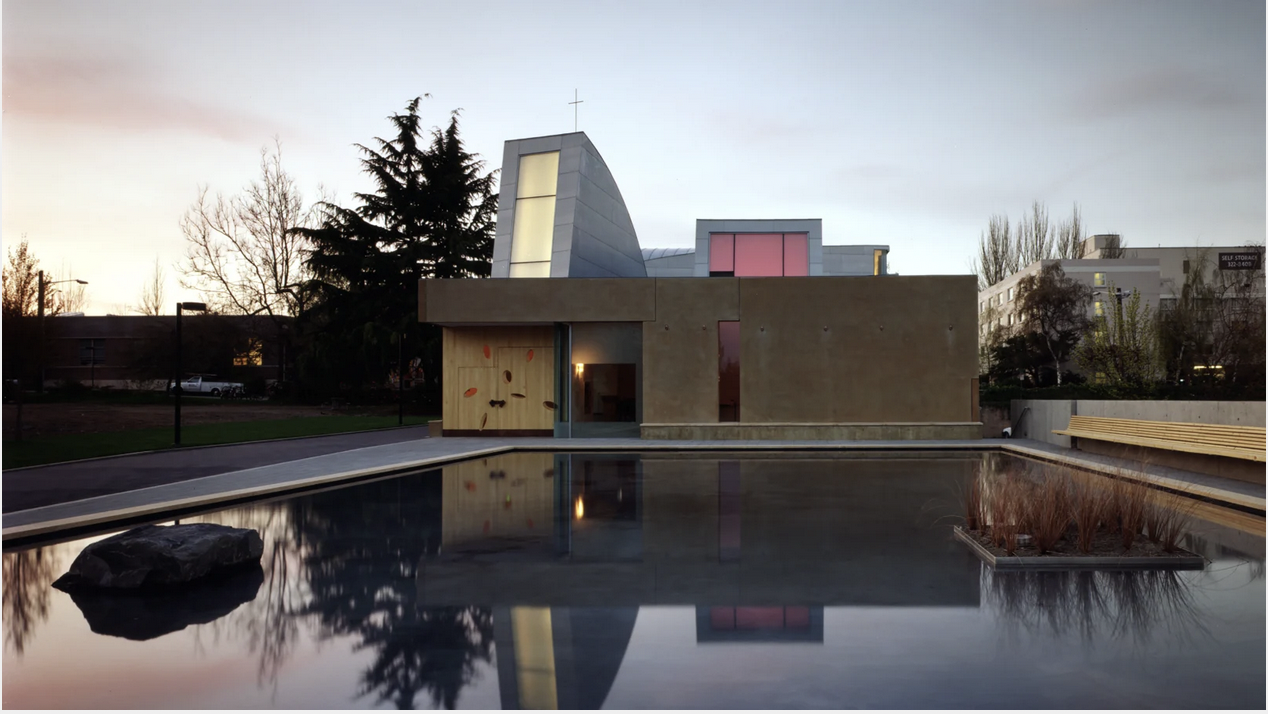
Indeed, those may be real problems, but it is not clear that solving them is the job of architecture. It is fair to doubt they can be solved via such architecture as a house in Spain by Jaque described by Russell as “choreographed pavilions on stilts of glass with chartreuse-painted trim to preserve local species of plants and pathways used by animals” (see above). Is it fair to wonder whether any plants or animals were extinguished in the process of building that house?
In a line from an interview placed by Russell directly after that description, Jaque says, “Architecture now needs to be about inclusion and messiness rather than exclusion and purity.” Try to parse that remark! You might say that architecture today is about trying to demonstrate the purity of messiness.
Padriac Steinschneider, a Columbia architecture grad of the mid-’70s, reacting to the appointment, writes that “Columbia has moved further and further away from teaching design as the creation of buildings.” Architect Daniel Morales adds, “This is true of modernism in general with its emphasis on theory over problem solving. Today modernism has become ever more grandiose in its ambition to save the world when in reality we are not politicians or social scientists.”
One of the reasons the world is so confusing today, and finds it harder and harder to address problems, is that architects and other professionals are encouraged to get out of their lanes. Andrés Jaque is just one more of the many of his ilk. The world of architecture will continue to dodge its true responsibilities.












 Architecture Here and There