
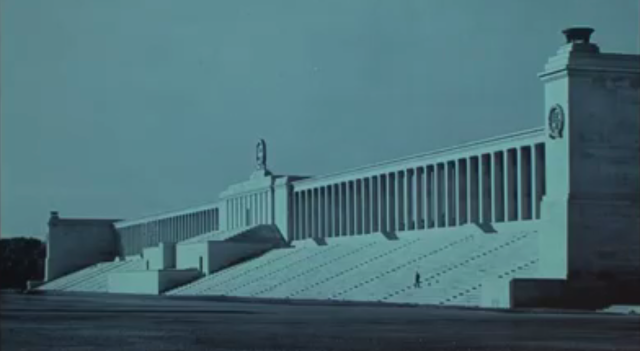
Zeppelinfeld Tribune, Nuremberg, Speer’s first work as Hitler’s architect. (screenshot)
Léon Krier does not seem to dislike modern architecture as much as I do, but he may dislike it with much more passion. The architectural theorist, master planner of Prince Charles’s new town Poundbury, and practitioner of his own edgy brand of classicism finds it easier to find a way to praise some early modernists that I find it easier to deplore, even Corbusier and Mies. His disapproval of modern architecture is much more detailed, nuanced and comprehensive than my own. My eyes are hurt by it but his soul is hurt by it. Therefore, he has the intellectual chops to level praise as he likes. This would include praising the talent of a monster like Albert Speer, Hitler’s architect.
Krier wrote a book, Albert Speer: Architecture 1932-1942, reissued in 2013, on Speer’s work, and that same year delivered this lecture on Speer at Yale. Given the spirit of the age in the groves of academe, I am surprised the lecture was allowed to proceed.
Here are several passages from Krier’s talk:
The book’s intention is not at all to applaud violence and the Nazi system, but to show how far it is a modern system. It is a modernist system and the success of it is absolutely modern. There is nothing traditional about Nazi society, just the emblems and some of the signs and the uniforms, but it is an extremely modern system, extremely modernist in fact, and the classicism was really only a very small byproduct which was reserved for special occasions. The main question the book addresses is can a war criminal be a great artist? The answer is yes. …
What I tried to prove was that he was an extraordinary talent. The question is what do we do, morally, when realizing that someone has extraordinary talent while being a war criminal. He was deeply involved in the Holocaust, the destruction of the Jews, there is no doubt and I never doubted it, and I never believed the story Speer recounted in his memoirs, and [in an interview] I told him so. I said I don’t believe your story, it was just a way to save your skin. It is impossible that you wouldn’t know what happened in the death camps. But he is a great architect. So the question is why can’t we admire a great architect who is a criminal? …
Why was classicism uniquely associated to a criminal regime, and condemned, never to be practiced anymore without bad conscience, excuses or justifications? Why just architecture? Why not the motorways? Why not the Volkswagen? Why not the industries that built the bombs, the industrial methods that set up Auschwitz and destroyed the Jews? How is it possible that we accept as innocent, as morally neutral, the modern technology which served to conquer, bomb and kill, and condemn as morally guilty the architecture, which served a symbolic purpose, is still not worked up nor integrated. We live still in that confusion.
It must be clear to anyone who has thought about this honestly that we are still in this confusion because demonizing traditional architecture by any means, fair or foul, is necessary to maintain modern architecture as the establishment of the profession. Honesty would compel fairness in the treatment of architectural style, would require, for the first time in many decades, leveling the playing field for major commissions. Given the heavy and longstanding preference of the public for tradition, fairness would doom modern architecture to a far lower status in the design and construction of our built environment.









 Architecture Here and There