Battering Battersea Station

Screen Shot 2018-03-15 at 8.54.54 PM.png

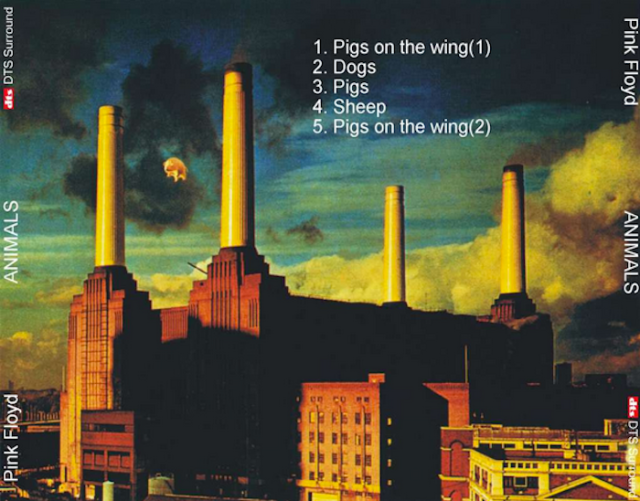
Battersea Power Station, 1929-33, on Pink Floyd album cover. (London Musical History)

Owen Hatherley has denounced a large development around the historic Battersea Power Station, in London. I cannot read his piece because it is behind the paywall of The Architects’ Journal. But I do have the next best thing – its description in the vital ArchNewsNow.com, which reads:

Hatherley minces no words re: the “genuinely dystopian” and “grim” development rising around London’s Battersea Power Station that “looks increasingly like satire – devoid of planning, intelligence or character – a tangle of superfluous skyscrapers around parodies of public spaces” (ouch!).

I would like to give Hatherley the benefit of the doubt and assume that he genuinely dislikes the sort of modern architecture he criticizes here for its overabundance and seeming mockery of generally accepted practices of civic revival, and for smothering the beloved Battersea Station amid its ugly glass-and-steel towers. But he probably likes it unless he decides, for one reason or another, as he has here, not to like it. I make that assumption only because there are so few critics on either side of the pond with the sense to dislike it. One of the few trad critics in Britain, Gavin Stamp, died last December.

Hatherley’s article caught my eye because I have a collection of articles by modernist critics who who seem to feel their credibility will be undermined if they do not criticize a modernist project once in a while. Well, wake up! You do not have any credibility except with those who’ve drunk the same Kool Aid. Almost all modernist projects can be criticized in some or all of the same terms Hatherley uses in riding to the defense of the Battersea station.

Sir Giles Gilbert Scott, who designed the once ubiquitous red Brit telephone booth – which Gavin Stamp crusaded to save – designed the Battersea’s Art Deco exterior. It was perhaps the largest brick building in the world. Scott was “consulted to appease public reaction,” according to Wikipedia – with success as it was popular from the beginning and known as the “temple to power.” It rivaled St. Paul’s in popularity, and was featured on the cover of the 1977 album “Animals” by the rock group Pink Floyd.

So naturally the modernists, who know they cannot just knock down a Grade II listed heritage structure, are building their crap around it. By hiding it they seek to avoid its unavoidable comment on the quality of their work. So sad.

***

A reader has sent me Hatherley’s article from behind the paywall. The full “This dire Battersley Power Station development is genuinely dystopian” (click on PDF below) may give rise to comments I will add below without changing anything above, unless necessary.

This dire Battersea Power Station development is genuinely dystopian _ Opinion _ Architects Journal

I would add only that the power station and the project are near the new and ridiculous U.S. embassy, which I’ll bet Hatherley has praised. Parts of the project are by Rogers Stirk Harbour. The comments below the article are interesting, including a debate over whether it is, as Hatherley says, a failed development.

Screen Shot 2018-03-15 at 7.32.34 PM.png

Battersea Power Station’s four stacks rise above recent development. (Architects’ Journal)

Posted in Architecture, Development, Uncategorized | Tagged , , , , , , | Leave a comment

Still allowed to like Meier?

Screen Shot 2018-03-14 at 6.25.44 PM.png

Dancing House, in Prague, by Frank Gehry. Flirtatious or harassment? (Naked Tour Guide)

I had absolutely no idea, two weeks ago when I wrote my post “Ha ha ha ha! Seriously?,” that its two subjects, Pritzker Prize architect Richard Meier and the late female architect Natalie de Blois, are connected. No, de Blois is not among the five women who have just accused Meier of sexual assault. But unbeknownst to me, I introduced the oppressor and the oppressed into the same post. How was I to know? You can never be too careful.

Aaron Betsky wrote in November wondering when architects would get caught up in the #MeToo movement. Now that the moment has come, his interesting column has been reposted online by Architect, for which he is a columnist. “Waiting to be Weinsteined” makes some interesting points. The article opens with this passage:

“What do you think of Louis Kahn?” one of my students asked last week. “Oh, well, I think he was God,” I answered only half-jokingly and turning away to my next task. “Oh,” she said. “Well, but he was sort of a creep, wasn’t he?” I turned around, faced her, and didn’t know what to say.

Well, Louis Kahn, now Richard Meier, who else? Oh, Lord, please: Frank O. Gehry! He is about as arrogant as they come, and also a creep. Didn’t he say that “98 percent of what gets built today is shit”? Okay, that’s a different kind of creep. I have a special animus against Gehry because he is about to uglify my hometown, Washington, D.C. Anyway, wasn’t his Dancing House, in Prague, caught in the act of dirty dancing, or maybe even frottage?

Harking back to his own 1995 book Building Sex, Betsky adds that

the values of the architecture world are thoroughly bound with notions of masculinity. The glorification of the big, the muscular, and the tall, the suppression of comfort and sensuality as important values, and the complete domination of the architecture world (still!) by men are all wrapped up together. Too many male architects see the world as a supine figure waiting for their brilliant erection to bring it to life.

Oh ho! Betsky lets the cat out of the bag. He refers to modern architecture. No other architecture calls for “the suppression of comfort and sensuality as important values.” No doubt the classical firms of a century ago and beyond were as dominated by men as are today’s. Classical architects were probably just as arrogant* as modernists are today (and with much better reason for it). The rare female architects and office staff were probably just as subject to male “interest” then as now. But back then it was probably far more subtle because it was far more forbidden than today, as of November at least.

As flirtation grows bold enough to cross the line into harassment, or worse, it becomes more desirable to chastise, sanction and prevent. But preventing dastardly behavior originating in the office must not be allowed to throttle innocent behavior. Romance often germinates in the work environment, and to block that off, or to generate a fear of indulging in it, would constitute an assault on the quality of life. In the office, gentle yearnings are among the benefits of employment. Boundaries must be clear, but innocent flirtation mustn’t be punished for the deeds of the sexually irresponsible.

Betsky cannot decide whether knowing of Kahn’s infidelities means he can no longer like Kahn’s buildings. Isn’t it just like the modernists to think that wrongdoing can be blamed on buildings? One of the founding blunders of modern architecture is that the horrors of World War I demanded not just new forms of government but new forms of architecture as well.

Betsky writes:

In an ideal world, we should be able to separate the work from the man or woman who made it, but in the real world, the cult of the “genius maker” so thoroughly defines the way in which any art is made and received that we cannot ignore questions of character when we look. Moreover, the inexcusable behavior of men has too long let them build unabashedly while inhibiting the work and the careers of women.

That’s pretty dodgy. What can Betsky mean? The “cult of the ‘genius maker” prevents us from distinguishing the artist from his (or her!) work? Sexual assault and sexual discrimination are different issues, not entirely unrelated perhaps, but still distant. Neither causes the other, and both are problems that require different programs of redress on the part of the profession.

In short, Richard Meier and Natalie de Blois may have cohabited my blog two weeks ago, but the problems each represents are worlds apart.

Betsky should feel free to erect a wall between his opinion of Kahn and of his buildings. I would not condemn him for allowing Kahn’s behavior to affect his opinion of Kahn’s work, but I would insist that they may indeed be judged independently. Some might be unable to do so, but that doesn’t mean it is impossible, or even especially difficult. To argue otherwise is to fling oneself (and one’s profession) down a dangerously slippery slope. After all, we never do have a full knowledge of anyone’s character, which is more than just what makes it into the news. So in the end we must judge an architect’s work by his buildings, or we must acknowledge that we judge it in blindness.

I may deplore Aaron Betsky’s admiration for Kahn but I will defend to the death his right to that admiration, whatever he said about bricks.

(I would have put the photo of Meier’s building on top instead of below if I could have found any Meier building guilty of the least sexual misconduct.)

(* Read the demurral in the comments below by Milton Grenfell. I would add that those who saw the sexual revolution with clear eyes, at the time or looking back, could see #MeToo’s embarrassingly conflicted discontents coming down the track.)

Screen Shot 2018-03-14 at 8.38.53 PM.png

Rickmers headquarters, in Hamburg, by Richard Meier. (richardmeier.com)

Posted in Architecture | Tagged , , , , , , , | 8 Comments

Sledding near Dutch Emb.

Screen Shot 2018-03-12 at 9.10.04 PM.png

My friend Steve Mields, age 12 perhaps, flies over bump at Cal Hill. (See video)

With snow bearing down this evening, ready to whack New England starting early tomorrow morning, thoughts naturally turn to sledding down hills while young. Or, rather, memories of same. My friends and I used to sled at Cal Hill, behind the Dutch embassy in the District of Columbia. Cal Hill, which apparently nobody knew about but us, was a very long and very steep hill with a stone building on top where, I don’t recall but am informed, hot chocolate could be had, and woods at the bottom, requiring sledders to brake hard or abandon ship.

The land was apparently owned by the Dumbarton College for Women then, whose staff never chased us away. Today it is apparently owned by the Divinity School of Howard University.

Sledding at Cal Hill was, in a word, divine. It was memorialized on 8mm film by me one late afternoon, or so it seems in my clip, which runs a bit over one minute. [Trigger warning: violent falls off sleds, stray voice in background discussing baseball, film quality execrable.] Well, some people consider grainy footage to be tantamount to historic, or at least old. However grainy, or rather perhaps blurry, this footage might be considered fun.

See Steve Mields flying down the hill and hitting our hastily built snow ramp. Will he crash? Will he abandon ship? Will he make it over? Chills and thrills aplenty in this clip. If you cannot go out and sled down a snowy hill tomorrow, this may be the best opportunity you will have to recall what it was like. Enjoy!

And by the way, in case lightning strikes and I do go out sledding tomorrow – I have a 9-year-old boy, after all – anybody know the best sledding in in Providence?

Posted in Humor, Old Video | Tagged , , , , , , | 3 Comments

Sources of modern silliness

Screen Shot 2018-03-11 at 8.51.00 PM

Even London’s Crystal Palace, an early modernist icon, had decoration. (Sources)

Nikolaus Pevsner (1902-83) wrote some of the pathbreaking works of architectural history that form the belief system of modern architecture today. The Sources of Modern Architecture and Design is one, which I am reading again for the first time in many years. Not too long ago, in “Form, function and Sullivan,” I wrote of an earlier seminal work of modernist design philosophy. Louis Sullivan’s Autobiography of an Idea, published in 1949, discussed “Form follows function,” which arose in his mind more than half a century earlier, after the invention steel framing and elevators led to the skyscraper, in which he played an important role.

Screen Shot 2018-03-11 at 9.23.39 PM

Nikolaus Pevsner

Sullivan himself attributed the concept to the Roman architect Vitruvius, who first (that we know of) enunciated the triad of firmitas, utilitas, venustas – buildings must be solid, useful, beautiful. Wikipedia says Sullivan’s maxim is “often incorrectly attributed to the sculptor Horatio Greenough (1805-52),[1] whose thinking mostly predates the later functionalist approach to architecture.” But Greenough’s linkage of form to function prior to the “later functionalists” is no more and no less what Vitruvius did. And probably lots of other architects and theorists made the obvious connection on many occasions between Vitruvius and Sullivan. It was the modernists who had the idea of using such a vapid platitude as a keystone of their architectural philosophy.

I mention that in order to suggest a parallel with the thinking of many modernist pioneers, which is glaringly evident in the very first chapter of Pevsner’s Sources. “The plea for functionalism is the first of our sources,” he writes, and then piles up quotes from Pugin, Hogarth, Voillet-le-Duc, Scott and Morris that purport to place them in a vanguard pushing for a more functional architecture.

But, though Pevsner and other modernists won’t admit it, Vitruvius stole their thunder a millennium and a half earlier. Utilitas is functionalism, and almost every architect since Vitruvius has placed function on a par with strength and beauty as required of all architecture.

What Pevsner and most other modernists truly mean by functionalism, and how it is different from architecture’s longstanding concern with function, is function without ornament. And even the quotes piled up by Pevsner in the first chapter of Sources fail to support the notion that functionalism requires that ornament be purged.

For example, Pevsner cites Pugin, writing in 1841:

There should be no features about a building which are not necessary for convenience, construction or propriety. … The smallest detail should serve a purpose, and construction itself should vary with the material employed.

Propriety? Eh? Not entirely unconnected with venustas! But even if Pugin did not use the word propriety, the passage would contain nothing that excludes ornament as a feature of a building that serves a purpose.

Indeed, Sullivan’s reputation as a “precursor of the modernist movement” may have arisen after Pevsner wrote Sources. That might explain why Sullivan makes only the slightest appearance in the book. Pevsner probably realized that Sullivan loved ornament, and he may not have had the chutzpah to label him a “pioneer” of modernism – even if he did coin the dictum “Form follows function.”

Only after modernism captured the establishment of architecture did its thinkers and leaders have the balls to treat Sullivan as a precursor to modernism. By then the field had become less a profession than a cult, and the tendency to merely suppress and ignore uncomfortable facts became part and parcel of the modernist discourse.

Anyway, modernists have a most extraordinarily narrow definition of function. If a building’s beauty makes it more likely to be maintained and repaired by the human beings who own it, use it and love it, then its beauty is functional. Put that in your pipe and smoke it, Nick Pevsner!

Posted in Architecture, Architecture History | Tagged , , , , , , | 5 Comments

Ross Award winners of 2018

Screen Shot 2018-03-09 at 4.47.36 PM

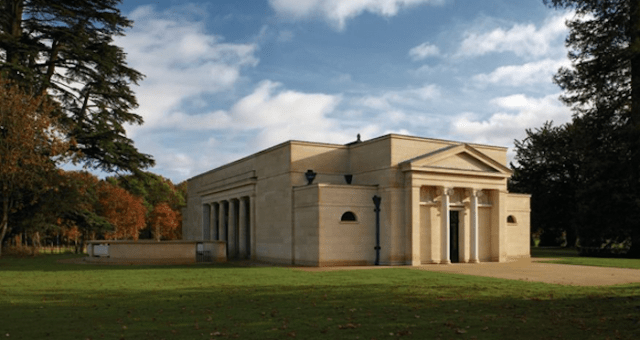
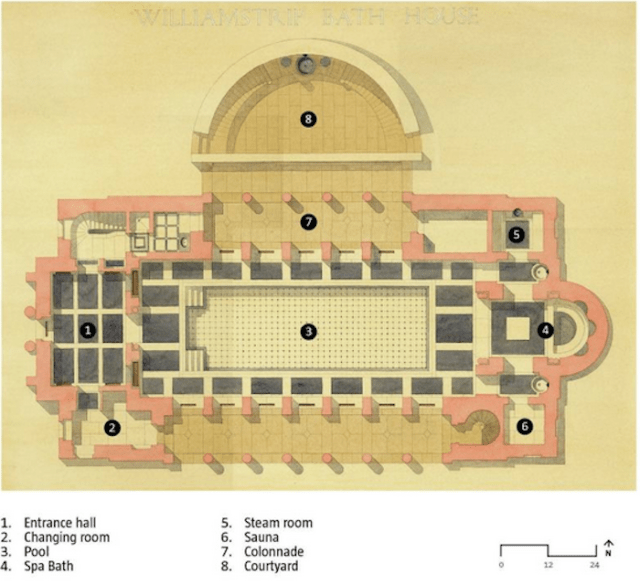
The Williamstrip Bath House, by Craig Hamilton. (Photos by Paul Highnam)

The Institute of Classical Architecture & Art has just announced this year’s Arthur Ross Award laureates. Unlike the Bulfinch Awards of the New England chapter (also just announced) and other regional ICAA awards programs, which honor specific works, the ICAA’s Ross awards honor the career “achievements and contributions of architects, painters, sculptors, artisans, interior designers, landscape designers, educators, publishers, patrons, and others dedicated to preserving and advancing the classical tradition.” This year’s honorees are excellent. Go to the announcement to see multiple examples of the life work of each laureate.

By way of introducing this year’s Ross winners, allow me to focus on one building by Craig Hamilton, this year’s choice in the category of architecture. The building is a new bath house on a wealthy estate in Gloucestershire whose manor house, restored in the 1790s by Sir John Soane, had just been renovated by Hamilton. The bath house combines a number of strains that, it seems to me, characterize much of his work since he emigrated to Britain from South Africa.

The Williamstrip Bath House combines a temple front with colonnades (one of four columns and another of six columns) that reach back on either side to a hemispherical bow at the rear of the building. Its classical styling is very restrained, except for the twin columns flanking the temple front. Their capitals are described by Katie Gerfen for Architect: “[O]n the entrance façade [Hamilton] reinterprets Ionic columns at the Temple of Apollo Epicurius in Bassae, Greece, exaggerating the volutes to the point of creating his own chambered-nautilus-like nonce order.”

The capitals surely will strike some as disproportionally rendered. Is this a sin against ye olde classical canon? Is it experimental? Is it creativity? Is it “bad trad”? Sometimes it can be hard to say, but bad trad it is not. Like the rest of the building, the temple front is certainly spare, but it would probably strike Nikolaus Pevsner, say, as criminally profuse in its embellishment.

Never mind. Advancing the classical tradition, the chief purpose of the ICAA, means preserving the canon and promoting its glory through diversification. Craig Hamilton has performed both roles, and his Ross makes perfect sense.

Screen Shot 2018-03-09 at 4.49.00 PM

Screen Shot 2018-03-09 at 8.21.35 PM

Screen Shot 2018-03-09 at 8.20.09 PM

Screen Shot 2018-03-09 at 8.20.30 PM

Screen Shot 2018-03-09 at 8.22.00 PM

Screen Shot 2018-03-09 at 8.22.25 PM

Screen Shot 2018-03-09 at 8.55.29 PM

Posted in Architecture | Tagged , , , , , , , | 4 Comments

Chinese Gordon’s Khartoum

Screen Shot 2018-03-08 at 8.46.55 PM

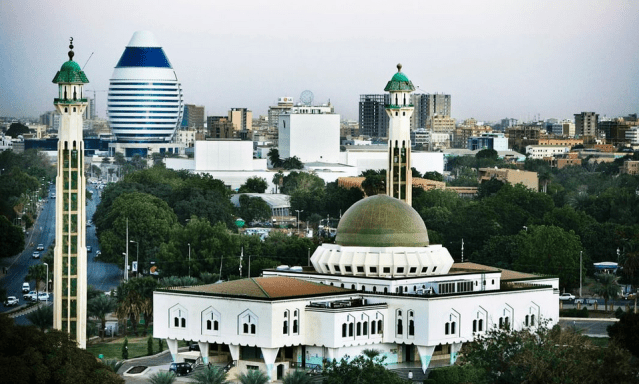
Contemporary photo of central Khartoum. (The Guardian)

I have just completed Lytton Strachey’s Eminent Victorians without finding much if anything to quote about architecture beyond what I conveyed in my post “The special beauty of decay.” Strachey contemplates four Victorians – Cardinal Manning, Florence Nightingale, Thomas Arnold (headmaster of Rugby) and Gen. Charles Gordon. He digs with an almost unseemly gleeful diligence for the hypocrisy embedded in the character of each.

Screen Shot 2018-03-08 at 10.35.14 PM

Chinese Gordon. (en.wikipedia)

The last, Charles George Gordon, was beheaded after the siege of Khartoum by the forces of the Mahdi (emissary of Mohammad). In the absence of anything especially architectural in the description of the end of Gordon’s life, I looked for an image of the palace where, at the top of its staircase, he received a spear in the chest (or was hacked to bits by scimitar, believe what you will). Not long after, his head was chopped off and stuck atop a pole. I found the palace (see below). I went to the library to find the 1966 movie Khartoum, starring Charleton Heston and Sir Laurence Olivier, but it was out. (You can see the trailer here). But I did find, online, a startling but sad and predictable shot of Khartoum.

Before considering that image, consider the following from an essay on contemporary Khartoum after the civil war that split Sudan and South Sudan into two nations. I wonder whether Nesrine Malik, the UK Guardian columnist and author of “Khartoum: the most selfish city?,” was referring to the Mahdi’s investment of Khartoum in 1885 in the opening line of this passage toward the end of her essay. She writes:

Rebel movements have twice approached and once entered Khartoum, an unthinkable prospect for its dwellers. There is a sense that the hordes are closing in, and that decades of grievances and marginalisation will finally close in and cannibalise a centre of power that has got away with divide, marginalise and rule for too long. Almost 60 years after independence, the model of the elitist city has proven to be a catastrophic failure.

Who knows? But from the photograph of contemporary central Khartoum above, it is clear that the hordes have already closed in. Look at all the bad trad poking up among the earlier modernist buildings! But must one not admit that even the bad trad, in its attempts to at least make reference to Muslim architectural traditions, has served Khartoum by defending it against being invested (that is, in Victorian terminology, conquered) by more typical sorts of modern architecture? Deny it – I dare you!

Interesting also is a story from the Middle East Eye, “New presidential palace opened on resonant date for Sudan,” about the new presidential palace built in Khartoum right next to the old one, where General Gordon died, which was not torn down. The author, who is not named in the article, discusses not only the new palace but the fact that it was financed, as is so much in Sudan these days, by the Chinese, who are heavily invested in Sudanese oil drilling operations. And he points out that the opening came on the same day, 130 years later, that Gordon lost his head.

It seems as if the author was quite unaware that Gordon’s nickname was “Chinese.” That would be worth putting in the article, ya think? Journalists tend to go weak in the knees at any hint of irony that they can pop into their stories. The anonymous author missed a biggie here.

Chinese Gordon was so named because of his prowess in military strategy and tactics and the courage he showed in China during the 1860s when, as a sort of British mercenary, he led the Chinese regulars – the so-called “Ever Victorious Army” – in defeating the Taiping Rebellion.

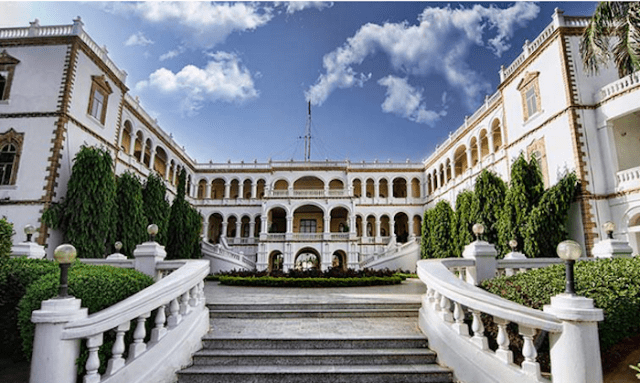
Internet images and their descriptions of the Khartoum palace in which Gordon died are so confused (or at least to me at 10:38 p.m. this evening) that I cannot tell whether the photo below is the original palace, the palace as rebuilt after the British retook Khartoum more than a decade later, a replica of the original palace apparently built by the Chinese, or the new palace recently also built by the Chinese as referred to above. If a reader knows, please tell me!

Screen Shot 2018-03-08 at 10.37.01 PM

Presidential Palace in Khartoum. (africaranking.com)

Posted in Architecture | Tagged , , , , , | Leave a comment

The sinister self-driving car

Screen Shot 2018-03-07 at 9.09.45 PM.png

Image of data-gathering by self-driving car on highway. (KitGuru)

The Atlantic has a very interesting article, “How Self-Driving Cars Will Threaten Privacy,” by Adrienne LaFrance. It actually ran a couple of years ago, and looks forward to the convenience of life with a self-driving car. The car will listen to your conversations and take your unwitting advice by, say, putting on your grocery list a type of beer you praised on the phone to a friend, or, without having to be told, adding a coffee stop on your way to work. Nice!

But there’s a darker side to all this, too. Let’s rewind and take a closer look at your commute for a minute.

There we were. The car picked us up. We wanted coffee. It suggested Peet’s. But if we’d stopped to look at the map on the screen when this happened, we might have noticed that Peet’s wasn’t actually the most efficient place to stop, nor was it on your list of preferred coffee shops, which the car’s machine-learning algorithm developed over time. Peet’s was, instead, a sponsored destination—not unlike a sponsored search result on Google. The car went ever-so-slightly out of the way to take you there.

The analysis by LaFrance goes into chilling detail about how the desire for profit might cause your car to edit your life.

Still, a lot of people will decide to put up with self-driving surveillance of this sort. We already put up with it online, allowing Google or other busybody behemoths to place ads for things they know we want in the articles we read on our laptops. And who knows what else. Better living through algorithms!

However many billions or trillions that Google, GM, and other corporations (including Uncle Sam) plow into self-driving cars, I don’t think they are in the cards. Our brains function faster and better behind the wheel using intuition developed over many thousands of years than any computer. Maybe computers can do a lot more calculations at once, and maybe they don’t drink and drive, but they can also be relied on to break down in little ways that don’t matter so much on our desktops but might matter a lot more hurtling down the highway at 65 miles per hour. The amazing thing is not how many accidents we have today but how few. Thank your brain.

So I think that after a while, after more serious testing ramps up and demonstrates the beauty of our natural onboard computers, we will shrug our shoulders and admit … no can do. Hopefully, we’ll have some useful things that are spun off by the research, like Tang was spun off by the space program.

But if it does happen – and this is one of many good reasons for it not to happen – what I worry about most is if, one day when self-driving cars are installed, I write a piece describing how we still have not been able to work out the 3D Rubik’s Cube of changes that will be required to reconcile the massive dislocations in technological, commercial, infrastructural, social, civic, economic and other systems that emerge over time because of the self-driving car. Suppose someone at Google decides to get the Ministry of Truth to issue a warrant for my arrest. All they have to do is plug a new itinerary into my car’s computer and instead of driving me to Peet’s, my car (or some corporate fleet’s car) will drive me straight to jail.

Nah. This cannot be allowed to happen.

Posted in Urbanism and planning | Tagged , , , , , , , | 4 Comments

Mighty pen on Penn Station

Screen Shot 2018-03-05 at 1.51.47 PM.png

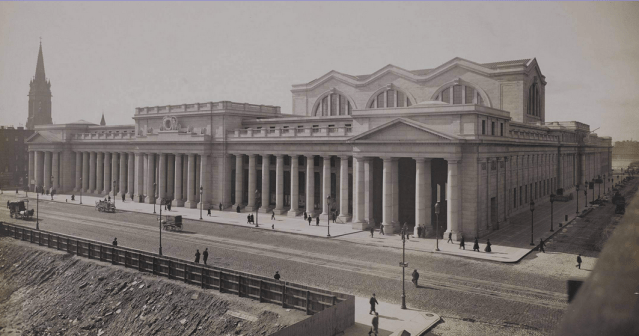
Penn Station in 1910. (Photo by L.H. Dreyer)

In “Mighty Penn,” The New Criterion has a brilliant extended reflection on the idea of rebuilding Pennsylvania Station, in New York City, as it was originally designed in 1903 by Charles Follen McKim of McKim Mead & White. Many facts of which I was unaware are unearthed by its author, Michael J. Lewis. And, in fact, I am heartened by Lewis’s support for the project. Over the years his criticism has usually left me underwhelmed. I cannot recall exactly why, but there always seemed a hesitancy on his part to support new traditional buildings, even to condemn modern architecture. No such demurral is evident in this essay. It is excellent from A to Z.

In the elegant passage below, Lewis informs readers that much of McKim’s architectural plan – spaces, walls, halls, entrances, exits, etc., drawn on paper as seen from above – survives to this day within the current Penn Station under Madison Square Garden.

And yet if the plan survives, it does so without those changes in proportion and scale, the sequence of compression and release, that gave it decorum and grace, and that treated the station’s users not as objects to be channeled efficiently through troughs, as in an abattoir, but as citizens, invested with dignity and self-respect. There can hardly be a more devastating rebuke to functionalism than the translation of McKim’s glorious sequence of spaces into a mere two-dimensional diagram of paths of movement.

Hear, hear! Below, however, is a passage that I disagree with. In outlining the largely political and psychological difficulties facing Rebuild Penn Station, led by the National Civic Art Society, Lewis writes:

Our [American] society is reluctant to acknowledge that there is any realm in which our predecessors were more capable or accomplished than we are.

Not really, I think. In the realm of architecture most people are capable of understanding that our predecessors were more capable and accomplished than we are. Most people are highly skeptical of modern architecture and have been since its beginning. It is the leading men and women of society’s political, financial and cultural institutions, mainly in the architecture and design professions, who resist acknowledging the obvious.

I’m not sure how to defeat that, but I believe it is possible, and eventually it must be done, because our current design establishment is preparing for us an environment that, aside from being plug ugly, has “Sinister” stamped on its forehead. It has been carrying us toward the sort of authoritarian societies predicted by George Orwell, Aldous Huxley and almost every other prophet of dystopia. We don’t want to go there, at least most of us don’t, whether by plane, train, ship or self-driving car.

The best quote about this whole thing is from the late Vincent Scully, who wrote after Penn Station was demolished in 1963 and rebuilt: “One entered the city like a god. Perhaps it was really too much. Now one scuttles in like a rat.” The middle sentence is usually omitted, with or without ellipses. No, it was not too much, and we deserve to enter it gloriously again.  Especially young (or old) people who never had that chance.

Screen Shot 2018-03-05 at 3.00.50 PM.png

Today’s Penn Station. (Here and Now/WBUR)

Posted in Architecture, Development, Preservation | Tagged , , , , , , , | 2 Comments

See ‘Lost Prov’ in Barrington

Screen Shot 2018-03-02 at 12.43.56 PM.png

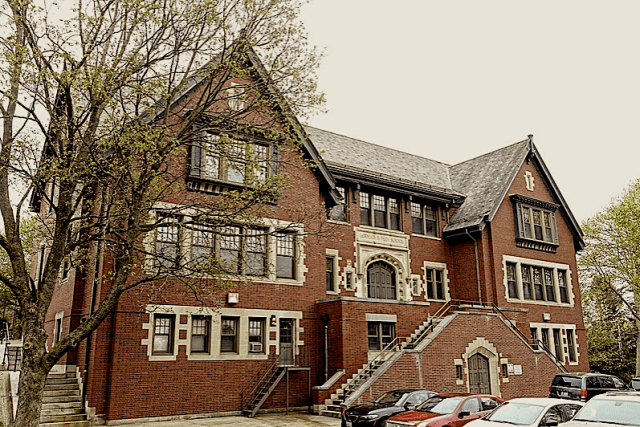
The Barrington Public Library, formerly the Leander Peck School. (Wikimedia Commons)

Next Tuesday at 6:30 p.m., the Barrington Public Library will host what may turn out to be my final public lecture about my book, Lost Providence. Only private talks have been scheduled for now from here on out, but at this open talk the public can learn things about our architectural environment that may be new to them, and for free.

That has to do with why the Barrington Public Library and its neighbor, Barrington Town Hall, and all other buildings that prize beauty not over but alongside utility, as opposed to utility alone (and often a bogus utility), are virtually banned in the field of architecture, and have been for over half a century. That means buildings such as the library are always at risk, whether local preservationists are aware of it or not.

Screen Shot 2018-03-02 at 5.40.11 PM.png

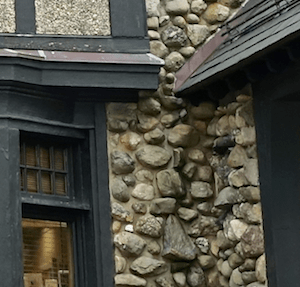
The library sits right next to Barrington Town Hall, one of Rhode Island’s most exquisite municipal buildings, finished in 1888 to the design of Stone, Carpenter & Willson. We all know what it looks like – a romantic exercise in the Tudor manor style, with gables and turrets and rustic walls of fieldstone (left) and half timber. One might swoon just driving by it, and perhaps overlook the Barrington Public Library. That would be a mistake.

The Leander Peck School was completed in 1917. The town library was moved there from the town hall sometime after 1976. Its Elizabethan Revival style, designed by the Providence firm of Martin & Hall, does not play second fiddle to town hall. Its aesthetic pedigree is as steeped in history (below left) as the town hall, even though it may be a notch below it in sheer romance.

Screen Shot 2018-03-02 at 5.45.22 PM.png

But that notch scarcely limits its allure in the least, and the people of Barrington (and whoever else might show up at the party) have a right to know why beautiful buildings are, nowadays, the rarest buildings to arise. The profession of architecture harbors a bias against tradition. It discriminates against beauty. Ugliness is considered a feather in its cap. It is not just, and it’s not fair, but it’s true today. Find out why on Tuesday.

Screen Shot 2018-03-02 at 12.49.34 PM.png

Barrington Town Hall. (Wikipedia)

Posted in Architecture, Lost Providence | Tagged , , , , , | 2 Comments

Ha ha ha ha! Seriously?

Screen Shot 2018-03-01 at 2.36.09 PM.png

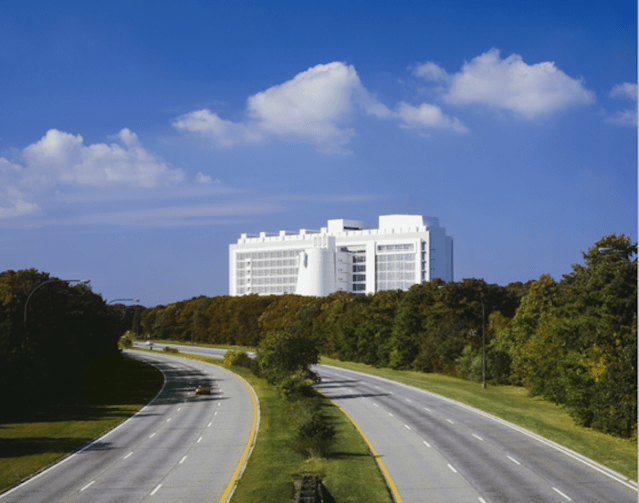
The Alphonse D’Amato Federal Courthouse on the way to the Hamptons. (American Way)

Kristen Richards’s ArchNewsNow for today has several surprises. One is in an article by Beth Dunlop for American Way magazine, “Light Fantastic,” which is about the celebrated modernist architect Richard Meier. It has a line that shivered the marrow of my funny bone.

Meier’s 2000 Alfonse M. D’Amato United States Courthouse in Central Islip, Long Island, is so beloved that even after 18 years, weekend commuters to and from the Hamptons detour past it to bask in the glow of its façade.

Really? “What the hell’s that assassinating the landscape?” is more like what I’d expect to hear. But I am sure Dunlop is correct. There are a predictable number of cranks and lunatics in any given group of 1,000 commuters to the Hamptons. On the other hand, it does remind me of when I was a kid in our Rambler station wagon zooming round the Washington Beltway waiting for the betowered Mormon Temple to rise up around a bend on the horizon and then disappear as we sped by. But that’s a good memory. The temple puts the D’Amato federal courthouse to shame.

Then there’s another article in ANN, “Save the Union Carbide building!” by Douglas Feiden, written for Our Town: The Local Paper for the Upper East Side. Designed by Natalie Griffin de Blois of Skidmore, Owings & Merrill, the UCB, completed in 1961, is a black glass box virtually indistinguishable from the Seagram Building, by Mies, which, unfortunately, is not also slated to come down. The UCB would become the tallest building ever to be razed on purpose. If it does, it would take that status away from the sainted Singer Building, the tallest tower to be demolished intentionally since 1968, when it came down at Broadway and Liberty, to be replaced by the U.S. Steel tower, another black glass box, now called One Liberty. Like all these blotches, the Union Carbide, at 270 Park Ave., is a corporate borathon. I say let ‘er rip.

And get a load of this quote:

Indeed, SOM has belatedly acknowledged that the firm’s signature works on Park Avenue could never have taken shape without de Blois.

For she not only cracked the glass ceiling, she also built it.

Bully for her! I’m not sure I’d brag so hard on that these days, especially not a man on a woman’s behalf. That line’s a great example of the advice old editors give to young writers: Kill your babies. If it sounds too cute at first blush, it deserves to be cut. Build the glass ceiling, indeed! What ever happened to crack on and keep on crackin’ that glass ceiling? That’s the spirit, not build the glass ceiling.

But put that aside. ANN has Claire Berlinski’s excellent piece on Paris from City Journal, featured on this blog as “Berlinski: Sacking of Paris.” It’s on today’s list. ANN obviates a host of sins for that.

Posted in Architecture | Tagged , , , , , , | 3 Comments